Ultralytics Explorer
ultralytics>=8.3.12 sürümü itibarıyla Ultralytics Explorer kaldırılmıştır. Explorer'ı kullanmak için pip install ultralytics==8.3.11 yükle. Benzer (ve genişletilmiş) veri kümesi keşif özellikleri Ultralytics Platform üzerinde kullanılabilir.
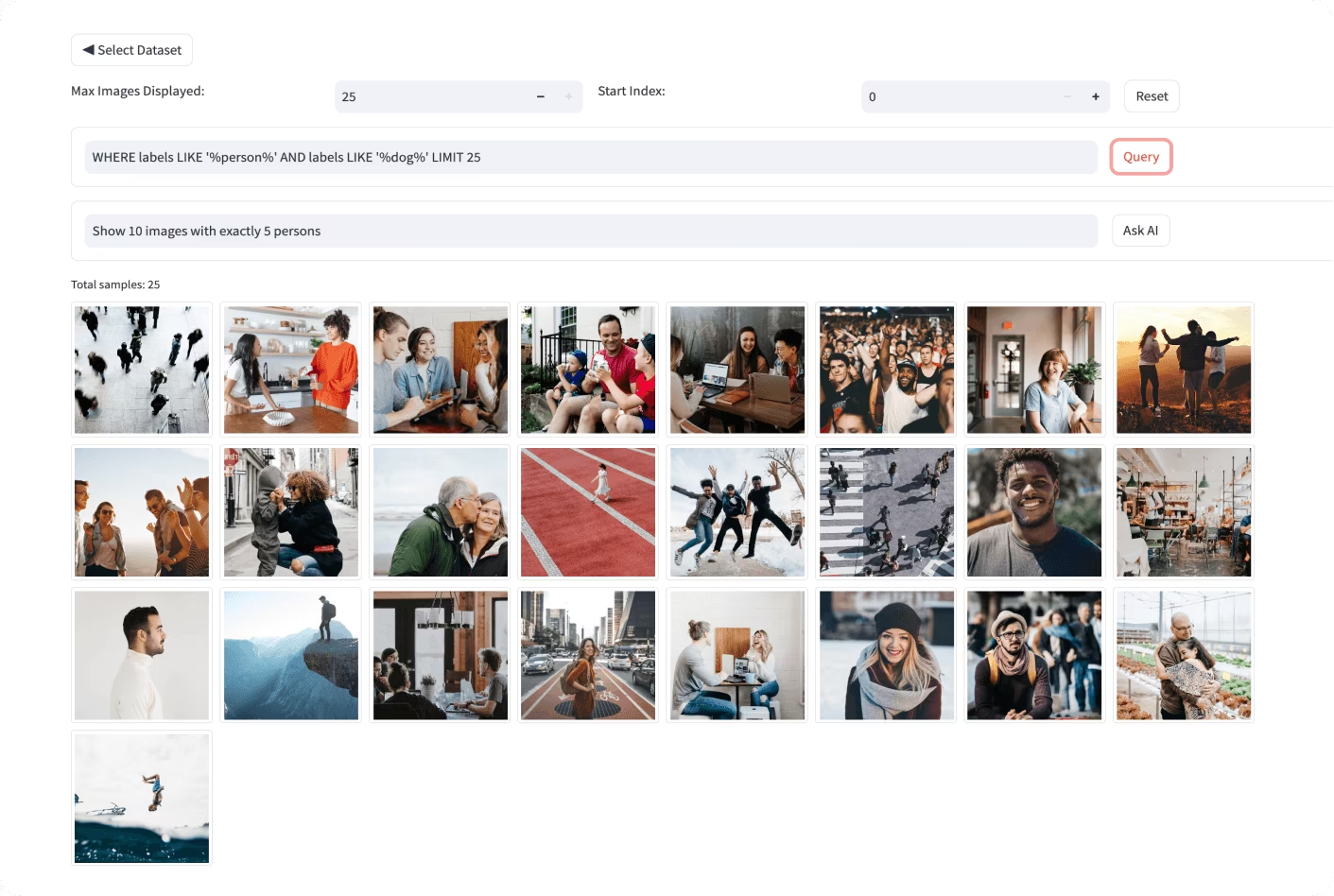
Ultralytics Explorer; CV veri kümelerini anlamsal arama, SQL sorguları, vektör benzerliği araması ve doğal dil istemleriyle keşfetmeye yönelik bir araçtır. Aynı işlevlere erişim sağlayan bir Python API'si de sunar.
İzle: Ultralytics Explorer API | Anlamsal Arama, SQL Sorguları ve Yapay Zekâya Sor Özellikleri
İsteğe Bağlı Bağımlılıkların Yüklenmesi#
Explorer, bazı işlevleri için harici kütüphanelere ihtiyaç duyar. Explorer'ı kullandığında bu kütüphaneler otomatik olarak yüklenir. Bu bağımlılıkları elle yüklemek için aşağıdaki komutu kullan:
pip install "ultralytics[explorer]==8.3.11"Explorer; gömme/anlamsal arama ve SQL sorgulama üzerine kuruludur, sunucusuz vektör veri tabanı olan LanceDB tarafından desteklenir. Geleneksel bellek içi veri tabanlarının aksine performanstan ödün vermeden diskte kalıcı olarak saklanır; böylece belleğin dolması endişesi olmadan COCO gibi büyük veri kümelerine yerel ortamında ölçeklenebilirsin.
Explorer API'si#
Bu, veri kümelerini keşfetmeye yönelik bir Python API'sidir. GUI Explorer'a da güç verir. Veri kümelerinden içgörüler elde etmek için kendi keşif amaçlı not defterlerini veya betiklerini oluştururken bu API'yi kullanabilirsin.
Tüm özellikleri ve kullanım örneklerini Explorer API belgelerinde keşfet.
GUI Explorer Kullanımı#
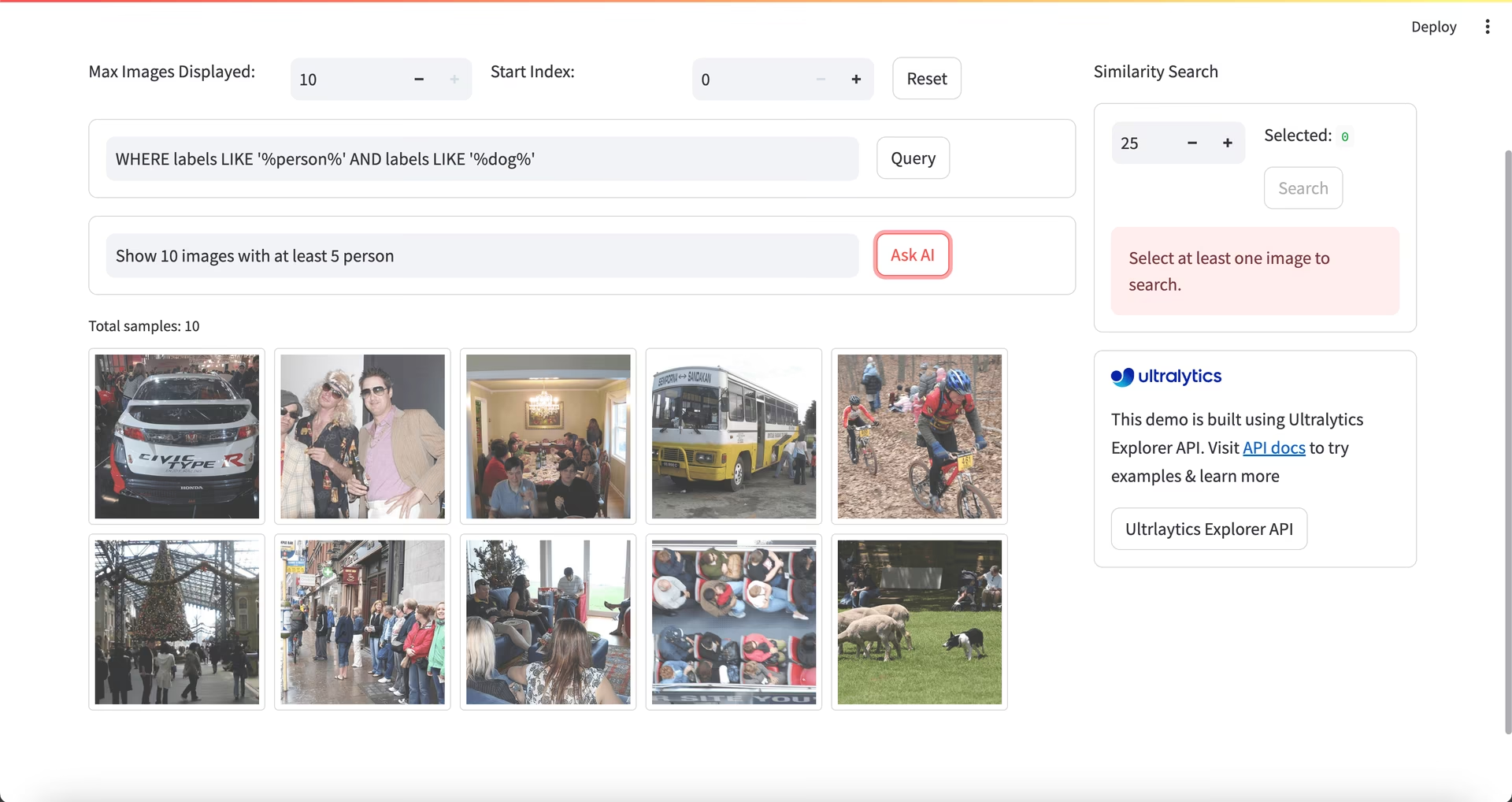
GUI demosu tarayıcında çalışır; veri kümen için gömmeler oluşturabilir, benzer görüntüleri arayabilir, SQL sorguları çalıştırabilir ve anlamsal arama yapabilirsin. Demo aşağıdaki komutla çalıştırılabilir:
yolo explorerAsk AI özelliği OpenAI'ı kullanır. Bu nedenle GUI'yi ilk çalıştırdığında OpenAI API anahtarını ayarlaman istenir. Anahtarı şöyle ayarlayabilirsin: yolo settings openai_api_key="..."
Sık Sorulan Sorular#
Ultralytics Explorer, veri kümelerini anlamsal arama, SQL sorguları, vektör benzerliği araması ve doğal dil aracılığıyla keşfetmeye yönelik bir bilgisayarlı görü (CV) aracıdır. Hem bir grafik kullanıcı arayüzü hem de bir Python API'si sunar. Gömme vektörlerini LanceDB ile diskte sakladığı için aşırı bellek kullanmadan büyük veri kümelerine ölçeklenebilir.
Explorer API hakkında daha fazla bilgi edin.
Ultralytics Explorer için gereken isteğe bağlı bağımlılıkları elle yüklemek üzere aşağıdaki
pipkomutunu kullanabilirsin:pip install "ultralytics[explorer]==8.3.11"Bu bağımlılıklar, anlamsal arama ve SQL sorgulama için gereklidir. Büyük veri kümelerinde bile veri tabanı işlemlerini verimli ve ölçeklenebilir tutan LanceDB'yi de içerir; örneğin COCO.
Ultralytics Explorer'ın GUI sürümünü kullanmak oldukça kolaydır. Gerekli bağımlılıkları yükledikten sonra GUI'yi aşağıdaki komutla başlatabilirsin:
yolo explorerGrafik kullanıcı arayüzü; veri kümesi gömmeleri oluşturmak, benzer görüntüleri aramak, SQL sorguları çalıştırmak ve anlamsal aramalar yapmak için kullanıcı dostu bir arayüz sağlar. OpenAI tarafından desteklenen Ask AI özelliği, doğal dil kullanarak veri kümelerine sorgu yöneltmene de olanak tanır.
Depolama ve ölçeklenebilirlik hakkında bilgi için yükleme talimatlarımıza göz at.
Ultralytics Explorer'daki Ask AI özelliği, kullanıcıların doğal dil sorgularıyla veri kümeleriyle etkileşim kurmasını sağlar. OpenAI tarafından desteklenen bu özellik, SQL sorguları veya benzer komutlar yazmadan veri kümen hakkında sorular sormana olanak tanır. Bu özelliği kullanmak için GUI'yi ilk çalıştırdığında OpenAI API anahtarını ayarlaman gerekir:
yolo settings openai_api_key="YOUR_API_KEY"Bu özellik ve entegrasyonu hakkında daha fazla bilgi için GUI Explorer Kullanımı bölümüne bak.
Evet. Bir Colab not defterine
pip install ultralytics==8.3.11ile sabitlenmiş sürümü yükle ve Google'ın bulut kaynaklarında gömmeler oluşturup arama çalıştırmak için VOC Keşif Örneği adımlarını izle. Daha fazla bilgi için Google Colab Kılavuzumuza göz at.


Yorumlar13
Bir soru sor, sonuçlarını paylaş veya başka birine yardım et.
pooya-github
Hi,
In colab code after running !pip install ultralytics[explorer] and running: from ultralytics import explorer i got the following error:
ImportError Traceback (most recent call last) in <cell line: 1>() ----> 1 from ultralytics import explorer
ImportError: cannot import name 'explorer' from 'ultralytics' (/usr/local/lib/python3.10/dist-packages/ultralytics/init.py)
how can i fix it?
 Glenn JocherUltralytics(düzenlendi)
@pooya-github the
Ultralytics Explorerfeature has been removed as ofultralytics>=8.3.12. To access similar or enhanced functionality, we recommend using Ultralytics Platform, our platform for dataset exploration and management. Let me know if you have further questions!-2
mkutu
how can I set this up with a custom dataset? Could you direct me to any resources. Thanks!
- Glenn JocherUltralytics(düzenlendi)
@mkutu hello!
Setting up YOLO26 with a custom dataset can be straightforward! You'd primarily need a data YAML file to describe your dataset structure and then use it in your training command. Here’s a basic guide to get you started:
-
Prepare your data: Organize your dataset into two folders (images and labels), with corresponding files named identically.
-
Create a YAML file: This file should specify the paths to your training and validation data, the number of classes, and class names. Here's an example:
# custom_data.yaml train: path/to/train/images val: path/to/val/images nc: number_of_classes names: ['class1', 'class2', 'class3'] -
Start Training: Use the following command to train your model:
yolo train data=custom_data.yaml model=yolo26n.yaml
For exploring and managing your datasets efficiently, you might consider using the Ultralytics Explorer (removed in
ultralytics>=8.3.12; useultralytics==8.3.11or Ultralytics Platform). This tool offers features like semantic search, SQL queries, and even AI-based querying to derive insights from your data.Hope this helps! If you have any more questions, feel free to ask.
-2 -
BABAFAREEDDUDEKULA
how can i run above mentioned AI using yolo v8 previously i have tried yolo v9,v8,v7,rt-detr
AloshkaD
Can you be more specific?
- Glenn JocherUltralytics(düzenlendi)
Hey there! 🌟
It sounds like you've got a pretty wide range of experience with various YOLO versions and even RT-DETR! For running AI using YOLO26 specifically, the process is smoothly integrated into the Ultralytics framework, much like the versions you've mentioned.
To get started, make sure you have Ultralytics YOLO26 installed. If not, you can do so via pip:
pip install ultralyticsAnd then, to run your AI model with YOLO26, you can simply use:
from ultralytics import YOLO

# Load the model
model = YOLO('yolo26n.pt')  # Here 'yolo26n.pt' is an example model. Replace it with your model path.

# Run inference
results = model('path_to_your_image_or_video')
Or, if you prefer using the command line:
yolo detect predict model=yolo26n.pt source=path_to_your_image_or_videoRemember to replace 'yolo26n.pt' and 'path_to_your_image_or_video' with the actual paths to your YOLO26 model and the image or video you want to run inference on. 🚀
Since you've used various versions before, the process should feel quite familiar. If there's more specific functionality from the Ultralytics Explorer that you're interested in integrating with YOLO26, such as semantic search or SQL queries, the installation command provided in the documentation will be your first step:
pip install ultralytics[explorer]After that, you can launch the Ultralytics Explorer with:
yolo explorerAnd dive into explore mode (Explorer requires
ultralytics==8.3.11, as it was removed inultralytics>=8.3.12)! For any further details or if you've got a unique use case in mind, feel free to share more specifics. Happy to help further. Happy coding! 🎉1 Thanks a lot my brother
2- Glenn JocherUltralytics(düzenlendi)
Note: Ultralytics Explorer was removed in
ultralytics>=8.3.12; to use it, installultralytics==8.3.11. Similar dataset exploration features are available in Ultralytics Platform.@BABAFAREEDDUDEKULA hey there! 😄
Thanks for reaching out. If you're interested in diving into the Ultralytics Explorer to explore CV datasets with semantic search, SQL queries, vector similarity search, and more, it sounds like you're on the right track!
To get started, ensure you've got the Explorer installed via:
pip install ultralytics[explorer]Once installed, you can jump straight into using the GUI by typing:
yolo explorerThis launches the GUI in your browser, where you can experiment with creating embeddings, conducting image searches, and even using SQL or natural language queries!
If you encounter any issues or have specific questions as you use the Ultralytics Explorer, feel free to drop them here. Happy exploring! 🌟
The yolo explorer command will open the explorer on the local machine. How would I set it up to work on AWS while I'm connected with my local machine using ssh?
 Paula DerrengerUltralytics(düzenlendi)
Note: Ultralytics Explorer was removed in
ultralytics>=8.3.12; to use it, installultralytics==8.3.11. Similar dataset exploration features are available in Ultralytics Platform.To set up the Ultralytics Explorer to work on an AWS instance while you're connected via SSH from your local machine, you can use port forwarding to access the Explorer's web interface. Here's a concise step-by-step guide:
-
SSH into AWS with Port Forwarding: Use the
-Loption to forward a local port to a port on the AWS instance. Replacelocal_portwith a port on your local machine (e.g.,8080), andaws_portwith the port the Explorer runs on (usually5000).ssh -i /path/to/your/key.pem -L local_port:localhost:aws_port user @AloshkaD -
Run Explorer on AWS: Once connected, start the Explorer on the AWS instance:
yolo explorer -
Access Explorer Locally: Open a web browser on your local machine and navigate to
localhost:local_portto access the Explorer interface.
Remember to replace
/path/to/your/key.pemwith the path to your AWS key,userwith your AWS username, andaws_instance_ipwith your AWS instance's IP address. Also, ensure that the AWS security group allows inbound traffic on theaws_port.1-
Worked with a minor tweak to reference my config file. Thank you!
- Paula DerrengerUltralytics
@AloshkaD you're welcome! I'm glad to hear that you were able to get it working with your config file. If you have any more questions or need further assistance in the future, don't hesitate to reach out. Happy exploring with Ultralytics Explorer! 🚀😊
1