Entfernungsmessung mit Ultralytics YOLO26
Was ist Entfernungsmessung?#
Bei der Entfernungsberechnung wird der Abstand zwischen zwei erkannten Objekten in einem Bild oder Videobild gemessen. Mit Ultralytics YOLO26 misst die Lösung den Abstand zwischen den Schwerpunkten zweier vom Nutzer ausgewählter Begrenzungsrahmen.
Ansehen: So schätzt du mit Ultralytics YOLO den Abstand zwischen erkannten Objekten in Pixeln 🚀
Visualisierungen#
| Entfernungsmessung mit Ultralytics YOLO26 |
|---|
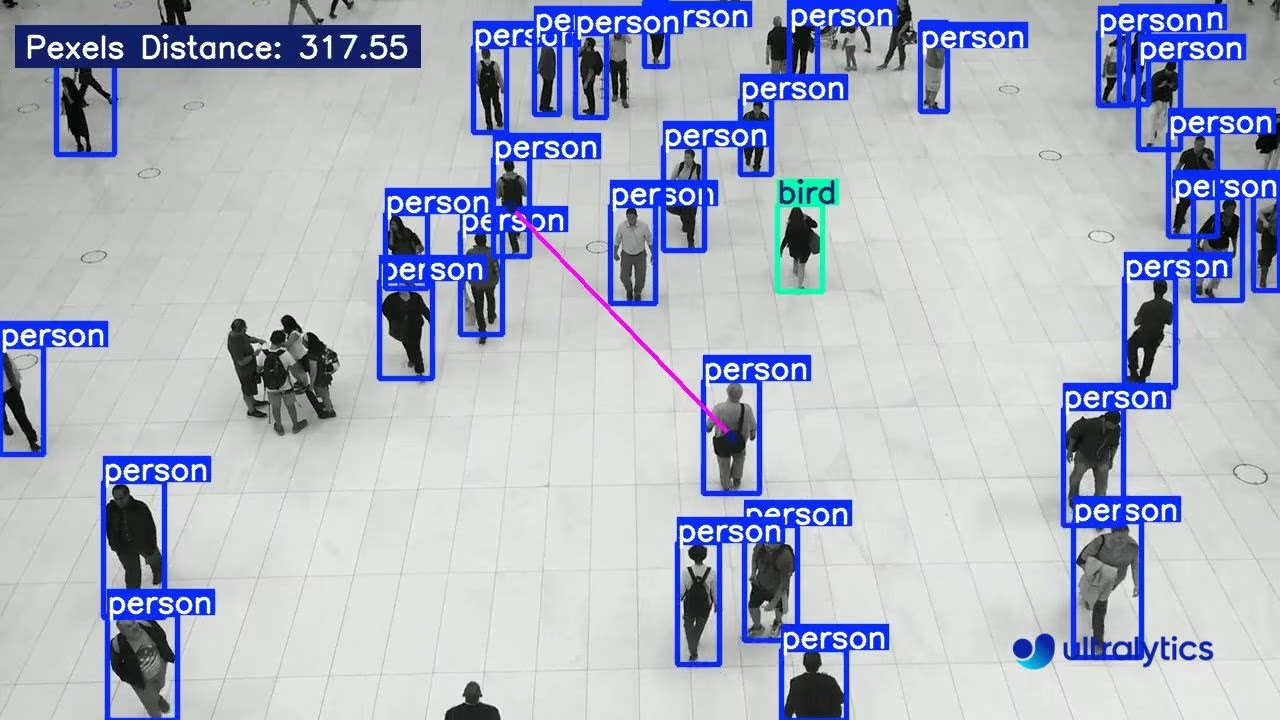 |
Vorteile der Entfernungsmessung#
- Präzise Lokalisierung: Verbessert die räumliche Positionsbestimmung bei Computer-Vision-Aufgaben.
- Größenschätzung: Ermöglicht die Schätzung der Objektgröße und sorgt so für ein besseres kontextuelles Verständnis.
- Szenenverständnis: Verbessert das Verständnis von 3D-Szenen und unterstützt so bessere Entscheidungen in Anwendungen wie autonomen Fahrzeugen und Überwachungssystemen.
- Kollisionsvermeidung: Ermöglicht Systemen, mögliche Kollisionen zu erkennen, indem sie die Abstände zwischen bewegten Objekten überwachen.
- Räumliche Analyse: Ermöglicht die Analyse von Beziehungen und Interaktionen zwischen Objekten innerhalb der überwachten Umgebung.
Entfernungsmessung
- Klicke mit der linken Maustaste auf zwei beliebige Bounding Boxes, um den Abstand zu berechnen.
- Klicke mit der rechten Maustaste, um alle eingezeichneten Punkte zu löschen.
Die Entfernung ist ein Schätzwert
Die Entfernung ist ein Schätzwert und möglicherweise nicht ganz genau, da sie anhand von 2D-Daten ohne Tiefeninformationen berechnet wird. Verwende für eine Tiefenbestimmung auf Pixelebene ein Modell zur Tiefenschätzung.
Entfernungen mit YOLO26 berechnen#
Die Lösung DistanceCalculation verfolgt Objekte über mehrere Videobilder hinweg und misst den euklidischen Abstand in Pixeln zwischen den Schwerpunkten zweier Bounding Boxes, die du mit der Maus auswählst. Führe das folgende Beispiel aus und klicke dann mit der linken Maustaste auf zwei Objekte, um die Verbindungslinie einzuzeichnen und den Abstand abzulesen. Klicke mit der rechten Maustaste, um die Auswahl aufzuheben.
import cv2

from ultralytics import solutions

cap = cv2.VideoCapture("path/to/video.mp4")
assert cap.isOpened(), "Error reading video file"

# Video-Writer
w, h, fps = (int(cap.get(x)) for x in (cv2.CAP_PROP_FRAME_WIDTH, cv2.CAP_PROP_FRAME_HEIGHT, cv2.CAP_PROP_FPS))
video_writer = cv2.VideoWriter("distance_output.avi", cv2.VideoWriter_fourcc(*"mp4v"), fps, (w, h))

# Entfernungsmessungsobjekt initialisieren
distancecalculator = solutions.DistanceCalculation(
    model="yolo26n.pt",  # Pfad zur YOLO26-Modelldatei.
    show=True,  # # Ausgabe anzeigen
)

# Video verarbeiten
while cap.isOpened():
    success, im0 = cap.read()

    if not success:
        print("Video frame is empty or processing is complete.")
        break

    results = distancecalculator(im0)

    print(results)  # auf die Ausgabe zugreifen

    video_writer.write(results.plot_im)  # das verarbeitete Bild schreiben.

cap.release()
video_writer.release()
cv2.destroyAllWindows()  # Alle geöffneten Fenster schließen
Argumente für DistanceCalculation()#
Hier ist eine Tabelle mit den Argumenten für DistanceCalculation:
| Argument | Typ | Standard | Beschreibung |
|---|---|---|---|
model | str | None | Pfad zu einer Ultralytics-YOLO-Modelldatei. |
line_width | int | 2 | Linienstärke für die Boxen, Keypoints und Zählwerte, die von der Lösung eingezeichnet werden. |
verbose | bool | True | Aktiviert das Protokoll der Lösung für jedes Bild, das Eingabeform, Klassenanzahlen und Verarbeitungsgeschwindigkeit enthält. Der Tracking-Aufruf selbst gibt grundsätzlich keine Meldungen aus. |
Du kannst in der Lösung DistanceCalculation auch die Argumente track verwenden.
| Argument | Typ | Standard | Beschreibung |
|---|---|---|---|
tracker | str | 'tracktrack.yaml' | Legt den zu verwendenden Verfolgungsalgorithmus fest. Integrierte Optionen: botsort.yaml, bytetrack.yaml, ocsort.yaml, deepocsort.yaml, fasttrack.yaml, tracktrack.yaml. |
conf | float | 0.25 | Legt den Konfidenzschwellenwert für Erkennungen fest. Niedrigere Werte ermöglichen die Verfolgung weiterer Objekte, können aber auch falsch positive Ergebnisse einschließen. |
iou | float | 0.5 | Legt den Schwellenwert für die Schnittmenge über Vereinigung (IoU) fest, um überlappende Erkennungen herauszufiltern. |
classes | list | None | Filtert die Ergebnisse nach Klassenindex. Beispielsweise verfolgt classes=[0, 2, 3] nur die angegebenen Klassen. |
device | str | None | Legt das Gerät für die Inferenz fest (z. B. cpu, cuda:0 oder 0). So kannst du für die Modellausführung zwischen CPU, einer bestimmten GPU oder anderen Rechengeräten wählen. |
imgsz | int or tuple | 640 | Zielbildgröße für die Inferenz: eine Ganzzahl für ein quadratisches Bild oder ein (height, width)-Paar. Die Formen werden an den Modellschritt angepasst. |
max_det | int | 300 | Maximale Anzahl der Erkennungen, die pro Bild vor der Verfolgung beibehalten werden. Dadurch wird die Anzahl der Objekte begrenzt, die eine Lösung in dichten Szenen verarbeitet. |
quantize | int or str | None | Inferenzpräzision: 16 (FP16) oder 32/unset (FP32) für PyTorch- und TorchScript-Modelle außerhalb der CPU; andere Formate verwenden die Präzision, die ihr Artefakt und ihre Laufzeitumgebung vorgeben. Ersetzt das veraltete Argument half. |
Außerdem stehen die folgenden Visualisierungsargumente zur Verfügung:
| Argument | Typ | Standard | Beschreibung |
|---|---|---|---|
show | bool | False | Wenn True aktiviert ist, werden die annotierten Bilder oder Videos in einem Fenster angezeigt. Nützlich für unmittelbares visuelles Feedback während der Entwicklung oder beim Testen. |
show_conf | bool | True | Zeigt neben der Bezeichnung den Konfidenzwert jeder Erkennung an. Gibt Aufschluss darüber, wie sicher sich das Modell bei der jeweiligen Erkennung ist. |
show_labels | bool | True | Zeigt für jede Erkennung eine Bezeichnung in der visuellen Ausgabe an. So lassen sich erkannte Objekte sofort erkennen. |
Implementierungsdetails#
Die Klasse DistanceCalculation verfolgt Objekte über Videobilder hinweg und berechnet den euklidischen Abstand zwischen den Schwerpunkten ausgewählter Bounding Boxes. Wenn du auf zwei Objekte klickst, führt die Lösung Folgendes aus:
- Ermittelt die Schwerpunkte (Mittelpunkte) der ausgewählten Bounding Boxes
- Berechnet den euklidischen Abstand zwischen diesen Schwerpunkten in Pixeln
- Zeigt den Abstand im Bild mit einer Verbindungslinie zwischen den Objekten an
Die Implementierung verwendet die Methode mouse_event_for_distance für Mausinteraktionen, damit Benutzer Objekte auswählen und die Auswahl bei Bedarf aufheben können. Die Methode process verarbeitet die Bilder nacheinander, verfolgt Objekte und berechnet Abstände.
Anwendungsfälle#
Die Entfernungsmessung mit YOLO26 hat zahlreiche praktische Anwendungsbereiche:
- Einzelhandelsanalysen: Misst, wie nahe Kunden an Produkten sind, und analysiert die Wirksamkeit der Ladengestaltung
- Arbeitssicherheit in der Industrie: Überwacht Sicherheitsabstände zwischen Beschäftigten und Maschinen
- Verkehrsmanagement: Analysiert Fahrzeugabstände und erkennt zu dichtes Auffahren
- Sportanalyse: Berechnet Abstände zwischen Spielern, dem Ball und wichtigen Positionen auf dem Spielfeld
- Gesundheitswesen: Stellt angemessene Abstände in Wartebereichen sicher und überwacht die Bewegung von Patienten
- Robotik: Ermöglicht Robotern, angemessene Abstände zu Hindernissen und Menschen einzuhalten
Häufig gestellte Fragen#
Um mit Ultralytics YOLO26 Abstände zwischen Objekten zu berechnen, musst du die Schwerpunkte der Bounding Boxes der erkannten Objekte ermitteln. Dazu initialisierst du die Klasse
DistanceCalculationaus dem Modulsolutionsvon Ultralytics und verwendest die Verfolgungsergebnisse des Modells, um die Abstände zu berechnen.Die Entfernungsmessung mit Ultralytics YOLO26 bietet mehrere Vorteile:
- Lokalisierungspräzision: Ermöglicht eine genaue räumliche Positionierung von Objekten.
- Größenschätzung: Hilft bei der Schätzung physischer Größen und trägt so zu einem besseren kontextuellen Verständnis bei.
- Szenenverständnis: Verbessert das Verständnis von 3D-Szenen und unterstützt bessere Entscheidungen in Anwendungen wie autonomem Fahren und Überwachung.
- Echtzeitverarbeitung: Führt Berechnungen unmittelbar aus und eignet sich dadurch für die Live-Videoanalyse.
- Integrationsmöglichkeiten: Funktioniert mit anderen YOLO26-Lösungen wie Objektverfolgung und Geschwindigkeitsschätzung.
Ja, mit Ultralytics YOLO26 kannst du in Echtzeit Video-Streams messen. Dabei werden Videobilder mit OpenCV aufgenommen, die YOLO26-Objekterkennung ausgeführt und mithilfe der Klasse
DistanceCalculationdie Abstände zwischen Objekten in aufeinanderfolgenden Bildern berechnet. Eine ausführliche Implementierung findest du im Beispiel für einen Video-Stream.Um bei der Entfernungsmessung mit Ultralytics YOLO26 eingezeichnete Punkte zu löschen, klicke mit der rechten Maustaste. Dadurch werden alle eingezeichneten Punkte gelöscht. Weitere Informationen findest du im Hinweisabschnitt des Beispiels zur Entfernungsmessung.
Zu den wichtigsten Argumenten zum Initialisieren der Klasse
DistanceCalculationin Ultralytics YOLO26 gehören:model: Pfad zur YOLO26-Modelldatei.tracker: Zu verwendender Verfolgungsalgorithmus (standardmäßig verwenden Solutionstracktrack.yaml).conf: Konfidenzschwellenwert für Erkennungen.show: Kennzeichnet, ob die Ausgabe angezeigt werden soll.
Eine vollständige Liste und die Standardwerte findest du unter Argumente von DistanceCalculation.


Kommentare195
Stell eine Frage, teile deine Ergebnisse oder hilf jemand anderem.
muhammadwildangoni
hallo, I am processing a men's 100 meter sprint video using YOLO and SpeedEstimator (Ultralytics) to detect runners, estimate their speed, and track their progress. However, the output statistics are incorrect. My code detects 16 runners, while there should only be 8 (those on the track), and the maximum speed reported is 0.00 m/s, which is clearly not correct for a sprint race. The furthest distance covered is about 96.7 meters, which seems off.
import cv2 import math import numpy as np from ultralytics import YOLO from ultralytics.solutions import speed_estimation
--- SETTINGS ---
video_path = "WHAT A RACE! _ Men s 100m Final! _ #Paris2024 highlights (online-video-cutter.com).mp4" # Change to your video path model_path = "yolo11n.pt" # Path to your YOLO model (could be yolov11n.pt if available) output_path = "output_sprint.avi" # Output video file name
meter_per_pixel = 0.05 # Calibration result for track (e.g., 0.05 for a 100m lane) center_point = (0, 720) # Track start point (adjust to your video height)
--- INITIALIZATION ---
cap = cv2.VideoCapture(video_path) assert cap.isOpened(), "Error reading video file"
w, h, fps = (int(cap.get(x)) for x in (cv2.CAP_PROP_FRAME_WIDTH, cv2.CAP_PROP_FRAME_HEIGHT, cv2.CAP_PROP_FPS)) out = cv2.VideoWriter(output_path, cv2.VideoWriter_fourcc(*"MJPG"), fps, (w, h))
model = YOLO(model_path) names = model.model.names if hasattr(model.model, "names") else ["person"]
speed_obj = speed_estimation.SpeedEstimator( names=names, reg_pts=[(0, int(h/2)), (w, int(h/2))], # Speed estimation line (across track, adjust as needed) view_img=False, meter_per_pixel=meter_per_pixel # Convert pixel to meters )
frame_count = 0 speed_over_time, distance_over_time = {}, {}
while cap.isOpened(): success, frame = cap.read() if not success: break frame_count += 1
# Detect and track runners on each frame
tracks = model.track(frame, persist=True, show=False)

# Estimate runners' speed and update visualization on frame
frame = speed_obj.estimate_speed(frame)

# Extract runner IDs, position, speed, and distance
# Make sure .boxes.id/cls property exists:
if tracks and hasattr(tracks[0], "boxes") and tracks[0].boxes.id is not None:
    boxes = tracks[0].boxes.xyxy.cpu()
    track_ids = tracks[0].boxes.id.int().cpu().tolist()
    clss = tracks[0].boxes.cls.cpu().tolist()
    for box, track_id, cls in zip(boxes, track_ids, clss):
        if cls == 0:  # 'person' class (runners)
            # Calculate runner's distance from start
            x1, y1 = int((box[0] + box[2]) // 2), int((box[1] + box[3]) // 2)
            distance = (math.sqrt((x1 - center_point[0]) ** 2 + (y1 - center_point[1]) ** 2)) * meter_per_pixel

            # Store statistics in dictionary
            if track_id not in distance_over_time:
                distance_over_time[track_id] = [0] * (frame_count - 1)
            distance_over_time[track_id].append(distance)

            speed = speed_obj.speeds.get(track_id, 0) if hasattr(speed_obj, "speeds") else 0
            if track_id not in speed_over_time:
                speed_over_time[track_id] = [0] * (frame_count - 1)
            speed_over_time[track_id].append(speed)

            # Overlay runner's speed and distance information directly on video frame
            text_speed = f"Speed: {speed:.2f} m/s"
            text_dist = f"Distance: {distance:.2f} m"
            cv2.putText(frame, f"ID:{track_id} {text_speed}, {text_dist}", (x1, y1 - 10),
                        cv2.FONT_HERSHEY_SIMPLEX, 0.8, (0,255,0), 2)

# Save frame to output video
out.write(frame)

# Display real-time video preview
cv2.imshow("Sprint Runner Detection Preview", frame)
if cv2.waitKey(1) & 0xFF == ord("q"):
    break
cap.release() out.release() cv2.destroyAllWindows()
--- Final statistics: print results to terminal ---
best_speed = max((max(speeds) for speeds in speed_over_time.values()), default=0) best_distance = max((max(distances) for distances in distance_over_time.values()), default=0) total_runners = len(distance_over_time)
print(f"Total runners detected: {total_runners}") print(f"Highest speed: {best_speed:.2f} m/s") print(f"Furthest distance covered: {best_distance:.2f} meters")
maribalke(bearbeitet)
Hi! I have tried to do a test on the distance calculation on a single image, but I keep getting the attribute error: 'DistanceCalculation' object has no attribute 'start_process'. I have basis in the YOLO11n-model, further trained on images from a different dataset.
model_path = "../runs/detect/train2/weights/best.pt" model = YOLO(model_path) dist_obj = distance_calculation.DistanceCalculation() frame = cv2.imread("../images/s73/raw_images/10.jpg") # Detect objects results = model(frame) # Run object tracking tracks = model.track(frame, persist=True, show = False) # process the image image_with_distances = dist_obj.start_process(frame, tracks) # Display the frame cv2.imshow('Distance Calculation', image_with_distances) cv2.waitKey(0) cv2.destroyAllWindows() Glenn JocherUltralytics(bearbeitet)
@maribalke thanks for reaching out!
start_process()has been removed.DistanceCalculationis now called directly on the frame and returns a results object with the annotated image inplot_im. It also runs tracking itself, so no separatemodel.track()call is needed. Here's the minimal fix for your single-image case:dist_obj = solutions.DistanceCalculation(model=model_path, show=False) results = dist_obj(frame) cv2.imshow("Distance Calculation", results.plot_im)Note that the distance is measured between two objects you select by clicking them in a display window, so a single static image only shows a distance once two boxes have been selected. For full implementation details, see our Distance Calculation Guide. Let us know if you encounter any other issues!
dgnovo
Is it possible to know the distance from an object and another object without using mouse?
- Glenn JocherUltralytics
@dgnovo yes, it's possible. You can calculate distances programmatically by using bounding box centroids from YOLO11 detections and computing the Euclidean distance between them without relying on mouse clicks. Refer to the
DistanceCalculationimplementation to customize the process for your needs: https://docs.ultralytics.com/guides/distance-calculation/.1
Muhammad-237
How can we find the distance of in the bounding box like from one point to another point in the bounding box to measure the size of object
- Glenn JocherUltralytics
@Muhammad-237 to measure the size of an object within a bounding box using Ultralytics YOLO11, you can calculate the distance between two points (e.g., edges or centroid) within that bounding box. This can be achieved using the
DistanceCalculationclass, which allows you to click on specific points to measure distances. Keep in mind, these calculations are approximations as they rely on 2D data without depth information. For more details, refer to the Distance Calculation Docs.
gg120wolf
Hi, I am using the example code of Distance Calculation using YOLO11 Example, but there is a problem of File "f:\fyp yolo\ultralytics-main\distance test1.py", line 13, in distance = solutions.DistanceCalculation() ^^^^^^^^^^^^^^^^^^^^^^^^^^^^^^^ TypeError: DistanceCalculation.init() missing 1 required positional argument: 'names' So what is this names should i set?
RizwanMunawar
@gg120wolf Hi, the correct way to use the Ultralytics distance calculation module is mentioned below.
import cv2

from ultralytics import solutions

cap = cv2.VideoCapture("Path/to/video/file.mp4")
assert cap.isOpened(), "Error reading video file"
w, h, fps = (int(cap.get(x)) for x in (cv2.CAP_PROP_FRAME_WIDTH, cv2.CAP_PROP_FRAME_HEIGHT, cv2.CAP_PROP_FPS))

# Video writer
video_writer = cv2.VideoWriter("distance_calculation.avi", cv2.VideoWriter_fourcc(*"mp4v"), fps, (w, h))

# Init distance-calculation obj
distance = solutions.DistanceCalculation(model="yolo11n.pt", show=True)

# Process video
while cap.isOpened():
    success, im0 = cap.read()
    if not success:
        print("Video frame is empty or video processing has been successfully completed.")
        break
    im0 = distance.calculate(im0)
    video_writer.write(im0)

cap.release()
video_writer.release()
cv2.destroyAllWindows()
Thanks :) The Ultralytics Team!
tylerfrisinger01
Hey there, I have a model that is trained for object detection not tracking. We are detecting two animals that are inside a cage. What we want to do is import a mp4 video then calculate the distance between the two objects while also showing the bounding boxes. However when i use the VideoStream code snippet from above, the popup window is larger then my screen. How could i adjust that code to make it a different window size so that I am able to track them in real time.
Also after this is done and the distances are calculated is there anyway to save the whole video with the bounding boxes and the distance calculations that were done in real time? Or would I have to save the video by doing the results = model.predict(save=true) and also do the VideoStream code snippet from above at the same time? and not have the distances shown in the saved video?
Get back to me as soon as possible as this is for a project for school! Thank You!!
I am also using YOLOv11, i'm not sure if that will change anything or not. And i have tried creating my own window using cv2 but that didnt work when i attempted it.
- Glenn JocherUltralytics
@tylerfrisinger01 to adjust the window size in OpenCV, you can use
cv2.namedWindow()andcv2.resizeWindow()to set a custom size. For saving the video with bounding boxes and distances, you can modify the code to include distance annotations and usecv2.VideoWriterto save the processed frames. Here's a quick example on resizing the window:cv2.namedWindow('Video', cv2.WINDOW_NORMAL) cv2.resizeWindow('Video', 800, 600) # Adjust the dimensions as neededRegarding saving the video with distances, you can overlay the distance on the frames before writing them out with
cv2.VideoWriter. If you need further assistance, feel free to ask! @glenn-jocher when I do this, it still pops open its own window that I am assuming is built into the solutions.DistanceCalculator function (since that is the name of the window) So then it does not work. Any workaround for this?
- Glenn JocherUltralytics(bearbeitet)
@tylerfrisinger01 to prevent the
DistanceCalculationfunction from opening its own window, you can set theshowparameter toFalsewhen initializing it, like so:distance = solutions.DistanceCalculation(model="yolo26n.pt", show=False). This should stop the automatic display window. For saving the video, continue usingcv2.VideoWriter. Let me know if you need further assistance!
Abtinz
Hello everyone, I want to deploy an yolov8-application on the edge device and estimate the distance through the user's camera without having to click on the detected object, how can I find the distance of the objects to the camera without need to click?
- Glenn JocherUltralytics
@Abtinz to estimate object distances without clicking, you'll need to use depth estimation techniques, as YOLOv8 primarily provides 2D bounding boxes. Consider integrating depth sensors or stereo cameras to obtain depth information. For more details, you can refer to the distance calculation guide.
gaodaren47297
Hi,Is there a method to calculate the distance between the camera and the objects?
- Glenn JocherUltralytics(bearbeitet)
@gaodaren47297 the
DistanceCalculationsolution measures the pixel distance between the centroids of two objects you select in the frame; it does not estimate the distance between the camera and an object. A 2D bounding box has no depth information, so camera-to-object distance needs extra information such as a depth sensor or stereo camera, or a calibration using an object of known size. For measuring between objects, see the distance calculation documentation on our website. If you have further questions, feel free to ask here.
Dmitrii-Smirnov
Hi Guys, Guys, I have a video with multiple objects(people) on the video. I need to calculate distance between each detected person on the each frame and to save results to csv file. Can you help me with that task? It will be really cool if you will share documentation=) As I understood relevant method for my task is DistanceCalculation(names=names[0], view_img=True).calculate_distance(obj1, obj2), am I correct?
- Glenn JocherUltralytics(bearbeitet)
@Dmitrii-Smirnov there is no
calculate_distance(obj1, obj2)method onDistanceCalculationin current versions. The solution is called on each frame (results = dist_obj(im0)), you left-click two tracked objects, and it reports the pixel distance inresults.pixels_distance. For distances between every pair of people on each frame and a CSV export, compute the centroid distances from the tracking boxes yourself. For details, see our documentation: https://docs.ultralytics.com/guides/distance-calculation/. Thank you!
- Glenn JocherUltralytics(bearbeitet)
@Dmitrii-Smirnov to calculate distances between all detected people in each frame and save the results to a CSV file, compute the centroid distances from the tracking results. The
DistanceCalculationsolution only measures between two objects you click, so for all pairs here's a basic implementation:import csv import math from itertools import combinations import cv2 from ultralytics import YOLO model = YOLO("yolo26n.pt") cap = cv2.VideoCapture("path/to/video/file.mp4") assert cap.isOpened(), "Error reading video file" with open("distances.csv", mode="w", newline="") as file: writer = csv.writer(file) writer.writerow(["Frame", "Object1", "Object2", "Distance"]) frame_count = 0 while cap.isOpened(): success, im0 = cap.read() if not success: break results = model.track(im0, persist=True, show=False, classes=[0]) # class 0 = person boxes = results[0].boxes if boxes.id is not None: centroids = dict(zip(boxes.id.int().tolist(), boxes.xywh[:, :2].tolist())) for (id1, c1), (id2, c2) in combinations(centroids.items(), 2): writer.writerow([frame_count, id1, id2, math.dist(c1, c2)]) frame_count += 1 cap.release()This script captures video frames, calculates pixel distances between detected people, and writes the results to a CSV file. For more details, refer to our documentation: https://docs.ultralytics.com/guides/distance-calculation/.
zgr1446741194
Hello author, I would like to propose a scenario similar to this: using monocular distance measurement to calculate the distance from the distant water level line (similar to the shoreline) in the video stream obtained by the camera to my camera (a kind of early warning of the water level), how can I use the solution? At present, the difficulty can be determined that we need to complete distance conversion similar to 3D to 2D, because of perspective space, instead of using fixed linear distance conversion similar to visionEye (from pixels to realistic distance). Another difficulty is that we do not know the true physical properties of the observed water line, which means that we cannot use the traditional method of monocular distance measurement to deduce the distance from the true length or height of the observed object. If you have any viable solutions, thank you very much for adding the code demo in your reply.
- Glenn JocherUltralytics
For calculating distances to a waterline using monocular vision, consider using depth estimation techniques or stereo vision for more accurate results. YOLO models can assist in object detection, but for precise distance measurement, integrating additional sensors or methods might be necessary. For more details, please refer to our distance calculation guide.