TrackZone mit Ultralytics YOLO26
Was ist TrackZone?#

TrackZone ist auf die Überwachung von Objekten in festgelegten Bereichen eines Frames statt im gesamten Frame spezialisiert. Die auf Ultralytics YOLO26 basierende Lösung integriert Objekterkennung und Tracking speziell für Zonen in Videos und Live-Kamerastreams. Da YOLO26 Erkennung auf Basis von Deep Learning und Tracking in Echtzeit ausführt, eignet sich TrackZone für Anwendungen wie die Überwachung von Menschenmengen.
Ansehen: So verfolgst du Objekte in einem Bereich mit Ultralytics YOLO26 | TrackZone 🚀
Vorteile der Objektverfolgung in Zonen (TrackZone)#
- Gezielte Analyse: Wenn du Objekte in bestimmten Zonen verfolgst, erhältst du gezieltere Erkenntnisse und kannst interessante Bereiche wie Eingänge oder Sperrzonen präzise überwachen und analysieren.
- Weniger nachgelagerter Arbeitsaufwand: Indem TrackZone Objekte außerhalb der Zone ignoriert, entfernt TrackZone irrelevante Erkennungen. Dadurch gibt es weniger Objekte, die du in der darauf aufbauenden Logik zählen, protokollieren oder für die du Warnmeldungen auslösen musst. Die Erkennung erfolgt weiterhin auf einem maskierten Frame in voller Größe und nicht auf einem eng zugeschnittenen Zonenausschnitt. Der Vorteil liegt also in einer übersichtlicheren, gezielteren Ausgabe und nicht in einer schnelleren Modellinferenz.
- Mehr Sicherheit: Die Verfolgung in Zonen verbessert die Überwachung kritischer Bereiche und hilft, ungewöhnliche Aktivitäten oder Sicherheitsverstöße frühzeitig zu erkennen.
- Skalierbare Lösungen: Dank der Möglichkeit, sich auf bestimmte Zonen zu konzentrieren, lässt sich TrackZone für verschiedene Szenarien einsetzen – von Einzelhandelsflächen bis hin zu Industrieanlagen.
Anwendungen in der Praxis#
| Landwirtschaft | Transport |
|---|---|
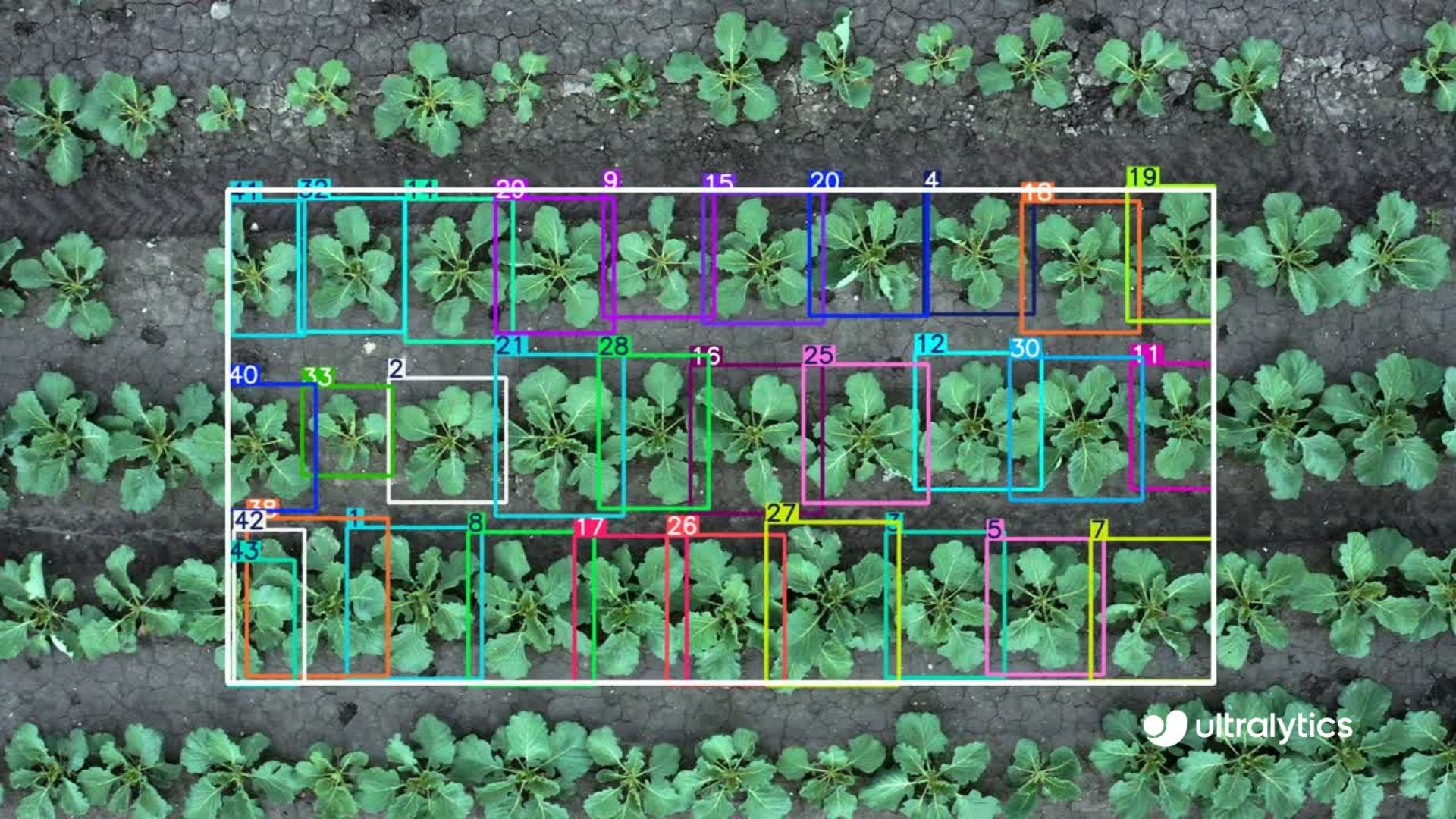 | 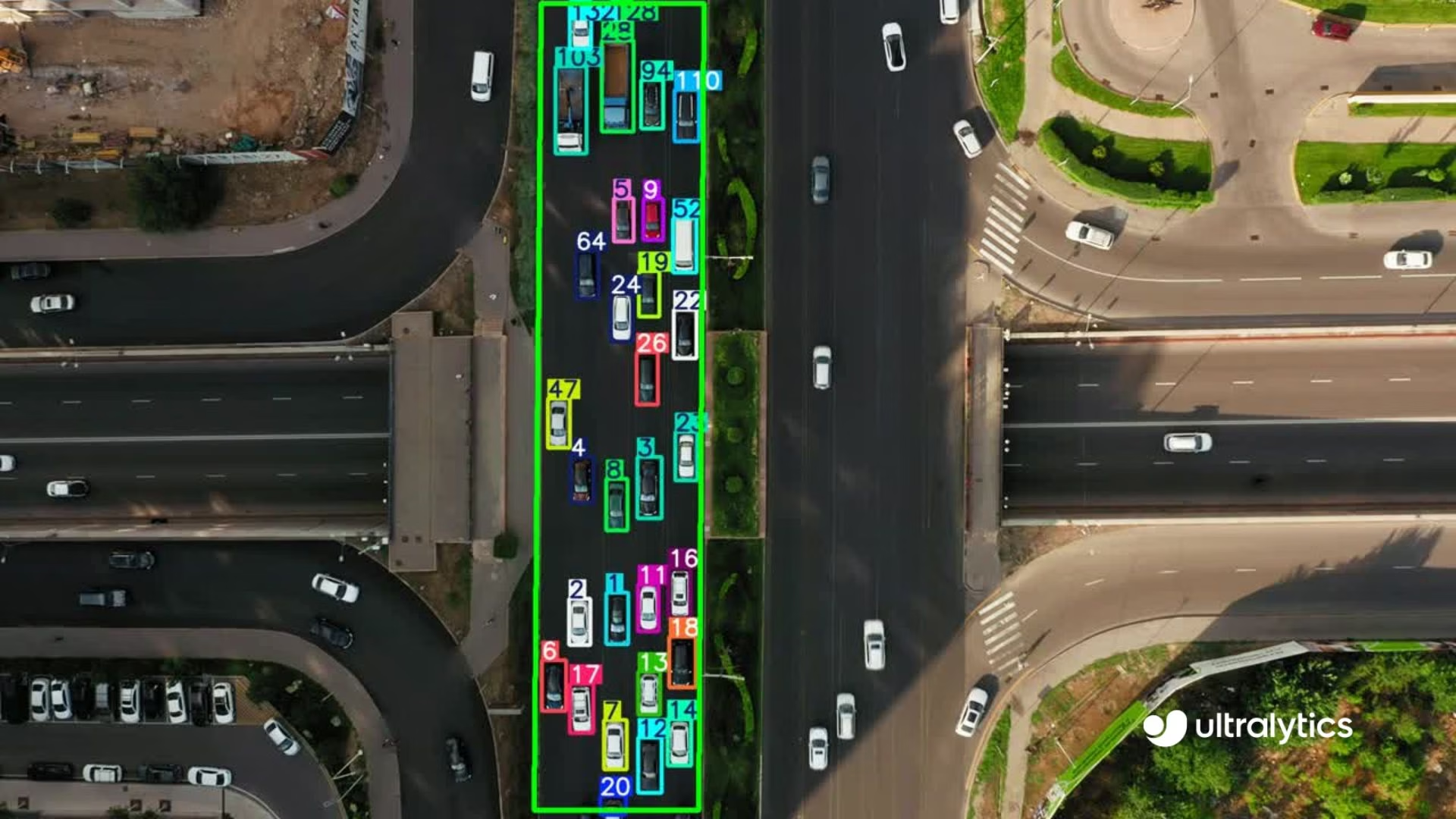 |
| Pflanzen auf einem Feld mit Ultralytics YOLO26 verfolgen | Fahrzeuge auf einer Straße mit Ultralytics YOLO26 verfolgen |
# Run a trackzone example
yolo solutions trackzone show=True

# Pass a source video
yolo solutions trackzone source="path/to/video.mp4" show=True

# Pass region coordinates
yolo solutions trackzone show=True region="[(150, 150), (1130, 150), (1130, 570), (150, 570)]"
TrackZone verwendet die Liste region, um festzustellen, welcher Teil des Frames überwacht werden soll. Definiere das Polygon passend zur physischen Zone, die dich interessiert (Türen, Tore usw.), und lasse show=True während der Konfiguration aktiviert, damit du überprüfen kannst, ob die Einblendung mit dem Videobild übereinstimmt.
- Jeder Eintrag in
regionist eine(x, y)-Pixelkoordinate im Videoframe. Liste die Punkte in der Reihenfolge auf, in der sie entlang des Umfangs des zu überwachenden Bereichs verbunden werden sollen. - Die Koordinaten sind an die Frame-Auflösung gebunden. Ein für ein 1280×720-Bild ausgelegter Bereich passt daher nicht zu einem 640×480-Bild. Lasse
show=Truewährend der Konfiguration aktiviert, damit du überprüfen kannst, ob die Einblendung zu deinem Bild passt. TrackZonereduziert die Punkte auf ihre konvexe Hülle. Eine konkave Form wird dadurch auf das kleinste konvexe Polygon vereinfacht, das alle Punkte enthält. Für nichtkonvexe Formen oder mehrere getrennte Bereiche verwendest du stattdessen die Lösung RegionCounter.- Wenn du
regionganz weglässt, wird standardmäßig eine Zone mit[(75, 75), (565, 75), (565, 285), (75, 285)]verwendet.
Argumente für TrackZone#
Hier ist eine Tabelle mit den Argumenten für TrackZone:
| Argument | Typ | Standard | Beschreibung |
|---|---|---|---|
model | str | None | Pfad zu einer Ultralytics-YOLO-Modelldatei. |
region | list oder dict | None | Punkte, die den Interessenbereich festlegen: entweder eine Liste von (x, y)-Tupeln oder ein Wörterbuch, das bei mehreren Bereichen deren Namen den jeweiligen Punktelisten zuordnet (nur RegionCounter). Bei None verwenden Lösungen, die einen Bereich benötigen, einen vordefinierten Standardbereich. |
line_width | int | 2 | Linienstärke für die Boxen, Keypoints und Zählwerte, die von der Lösung eingezeichnet werden. |
verbose | bool | True | Aktiviert das Protokoll der Lösung für jedes Bild, das Eingabeform, Klassenanzahlen und Verarbeitungsgeschwindigkeit enthält. Der Tracking-Aufruf selbst gibt grundsätzlich keine Meldungen aus. |
Die TrackZone-Lösung unterstützt die folgenden Parameter für track:
| Argument | Typ | Standard | Beschreibung |
|---|---|---|---|
tracker | str | 'tracktrack.yaml' | Legt den zu verwendenden Verfolgungsalgorithmus fest. Integrierte Optionen: botsort.yaml, bytetrack.yaml, ocsort.yaml, deepocsort.yaml, fasttrack.yaml, tracktrack.yaml. |
conf | float | 0.25 | Legt den Konfidenzschwellenwert für Erkennungen fest. Niedrigere Werte ermöglichen die Verfolgung weiterer Objekte, können aber auch falsch positive Ergebnisse einschließen. |
iou | float | 0.5 | Legt den Schwellenwert für die Schnittmenge über Vereinigung (IoU) fest, um überlappende Erkennungen herauszufiltern. |
classes | list | None | Filtert die Ergebnisse nach Klassenindex. Beispielsweise verfolgt classes=[0, 2, 3] nur die angegebenen Klassen. |
device | str | None | Legt das Gerät für die Inferenz fest (z. B. cpu, cuda:0 oder 0). So kannst du für die Modellausführung zwischen CPU, einer bestimmten GPU oder anderen Rechengeräten wählen. |
imgsz | int or tuple | 640 | Zielbildgröße für die Inferenz: eine Ganzzahl für ein quadratisches Bild oder ein (height, width)-Paar. Die Formen werden an den Modellschritt angepasst. |
max_det | int | 300 | Maximale Anzahl der Erkennungen, die pro Bild vor der Verfolgung beibehalten werden. Dadurch wird die Anzahl der Objekte begrenzt, die eine Lösung in dichten Szenen verarbeitet. |
quantize | int or str | None | Inferenzpräzision: 16 (FP16) oder 32/unset (FP32) für PyTorch- und TorchScript-Modelle außerhalb der CPU; andere Formate verwenden die Präzision, die ihr Artefakt und ihre Laufzeitumgebung vorgeben. Ersetzt das veraltete Argument half. |
Außerdem stehen die folgenden Visualisierungsoptionen zur Verfügung:
| Argument | Typ | Standard | Beschreibung |
|---|---|---|---|
show | bool | False | Wenn True aktiviert ist, werden die annotierten Bilder oder Videos in einem Fenster angezeigt. Nützlich für unmittelbares visuelles Feedback während der Entwicklung oder beim Testen. |
show_conf | bool | True | Zeigt neben der Bezeichnung den Konfidenzwert jeder Erkennung an. Gibt Aufschluss darüber, wie sicher sich das Modell bei der jeweiligen Erkennung ist. |
show_labels | bool | True | Zeigt für jede Erkennung eine Bezeichnung in der visuellen Ausgabe an. So lassen sich erkannte Objekte sofort erkennen. |
Objekte innerhalb der Zone zählen#
Jeder Aufruf des Trackers gibt ein Objekt vom Typ SolutionResults zurück. Dessen Attribut total_tracks enthält die Anzahl der Objekte, die derzeit innerhalb der Zone verfolgt werden. Lies den Wert bei jedem Frame aus, um die aktuelle Belegung zu überwachen – du kannst beispielsweise protokollieren, wie stark ein Eingang oder ein Sperrbereich frequentiert ist:
import cv2

from ultralytics import solutions

cap = cv2.VideoCapture("path/to/video.mp4")
assert cap.isOpened(), "Error reading video file"

region_points = [(150, 150), (1130, 150), (1130, 570), (150, 570)]
trackzone = solutions.TrackZone(show=False, region=region_points, model="yolo26n.pt")

while cap.isOpened():
    success, im0 = cap.read()
    if not success:
        break
    results = trackzone(im0)
    print(f"Objects currently in zone: {results.total_tracks}")  # live zone occupancy

cap.release()
Häufig gestellte Fragen#
Führe den folgenden Befehl aus, um Objekte nur innerhalb der Zone zu verfolgen, und übergib
region, um die Koordinaten der Zone festzulegen. Das eignet sich für Überwachung, die Steuerung von Menschenmengen und alle anderen Szenarien, in denen eine zonenbasierte Verfolgung erforderlich ist.yolo solutions trackzone source="path/to/video.mp4" show=TrueMit nur wenigen Codezeilen kannst du die Objektverfolgung in bestimmten Zonen einrichten und einfach in deine Projekte integrieren.
import cv2 from ultralytics import solutions cap = cv2.VideoCapture("path/to/video.mp4") assert cap.isOpened(), "Error reading video file" w, h, fps = (int(cap.get(x)) for x in (cv2.CAP_PROP_FRAME_WIDTH, cv2.CAP_PROP_FRAME_HEIGHT, cv2.CAP_PROP_FPS)) video_writer = cv2.VideoWriter("trackzone_output.avi", cv2.VideoWriter_fourcc(*"mp4v"), fps, (w, h)) trackzone = solutions.TrackZone( show=True, region=[(150, 150), (1130, 150), (1130, 570), (150, 570)], model="yolo26n.pt" ) while cap.isOpened(): success, im0 = cap.read() if not success: break results = trackzone(im0) video_writer.write(results.plot_im) cap.release() video_writer.release() cv2.destroyAllWindows()Die Zonenpunkte für die Videoverarbeitung mit Ultralytics TrackZone lassen sich einfach und flexibel konfigurieren. Du kannst die Zonen direkt in einem Python-Skript festlegen und anpassen und so genau steuern, welche Bereiche überwacht werden sollen.
from ultralytics import solutions

# Punkte des Bereichs definieren
region_points = [(150, 150), (1130, 150), (1130, 570), (150, 570)]

# TrackZone initialisieren
trackzone = solutions.TrackZone(
    show=True,  # # Ausgabe anzeigen
    region=region_points,  # # Punkte des Bereichs übergeben
)
Denke daran, dass
TrackZonedie Punkte auf ihre konvexe Hülle reduziert. Eine konkave Kontur wird dadurch auf das kleinste konvexe Polygon vereinfacht, das alle Punkte enthält.Alle drei Lösungen arbeiten mit Bereichen, beantworten aber unterschiedliche Fragen:
Lösung Verwendungszweck Typische Ausgabe TrackZone Objekte verfolgen und die aktuelle Belegung innerhalb einer einzelnen konvexen Zone überwachen Verfolgte IDs und total_tracksfür die ZoneObjectCounter Objekte zählen, die eine Linie überqueren oder einen Bereich betreten und verlassen Kumulierte Ein- und Austrittszahlen RegionCounter Objekte innerhalb eines oder mehrerer beliebiger Bereiche zählen, auch wenn diese nicht konvex sind Objektzahlen pro Bereich Wähle TrackZone, wenn du Objekte fortlaufend innerhalb eines einzelnen Bereichs verfolgen möchtest, und RegionCounter, wenn du mehrere Zonen oder eine nichtkonvexe Form benötigst.


Kommentare40
Stell eine Frage, teile deine Ergebnisse oder hilf jemand anderem.
Paul231200
Hello, great development, but I had a question about the advantages of your solution in comparison with the regions of interest that can be done in Opencv, also the question is whether it is planned to add this development to such models as yolov8?
1 Glenn JocherUltralytics(bearbeitet)
@Paul231200 thank you for your question! TrackZone offers targeted and efficient region-based tracking, reducing computational overhead compared to general frame analysis in OpenCV. As for YOLOv8, TrackZone works with any Ultralytics model you pass via
model=, including YOLOv8, though we recommend YOLO26 for new projects. For more details, you can explore TrackZone here: https://docs.ultralytics.com/guides/trackzone/.
moshiour
Hi, Its a nice feature to yolo! How do make it counting on top of it? Thank you in advance!
1- Glenn JocherUltralytics(bearbeitet)
@moshiour thank you for your kind words!
TrackZonereturns a results object withtotal_tracks, the number of objects currently tracked inside the zone:results = trackzone(im0)thenresults.total_tracks. For counting objects entering or leaving a region, see the Object Counting guide. Let us know if you have more questions!1 RizwanMunawar
@Muhammad-237 Hi, We currently don't support the counting feature with TrackZone, but It's on our TODO's list, and we will release this feature soon! Thank you! In the meantime, you can explore our documentation available at: https://docs.ultralytics.com/guides/object-counting/#__tabbed_1_1
biancalepe
Thank you for this informative resource! I have a question - am I able to obtain the unique IDs of identified objects within 20 second windows? In this case, I'd like to know how many unique cars in total were in my zone for each 20 second time period of my video.
Below is my starting code:
def count_specific_classes(video_path, output_video_path, model_path, classes_to_count, region_points):
"""Count specific classes of objects in a video.""" cap = cv2.VideoCapture(video_path) assert cap.isOpened(), "Error reading video file" # Video writer w, h, fps = (int(cap.get(x)) for x in (cv2.CAP_PROP_FRAME_WIDTH, cv2.CAP_PROP_FRAME_HEIGHT, cv2.CAP_PROP_FPS)) video_writer = cv2.VideoWriter(output_video_path, cv2.VideoWriter_fourcc(*"mp4v"), fps, (w, h)) # Initiate TrackZone (object tracking in zones, not complete frame) trackzone = solutions.TrackZone(show=True, # Display the output region=region_points, # pass the region points model=model_path, # use any model that Ultralytics supports classes=classes_to_count) # which objects to track # Process video while cap.isOpened(): success, im0 = cap.read() if not success: print("Video frame is empty or processing is complete.") break results = trackzone(im0) #print (results) # access the output video_writer.write(results.plot_im) # write the video output cap.release() video_writer.release() cv2.destroyAllWindows() # destroy all open windows- Glenn JocherUltralytics(bearbeitet)
@biancalepe you can access unique track IDs from
trackzone.track_idsand implement time-based windowing for counting. Here's how to modify your code to count unique cars in 20-second intervals:def count_unique_cars_by_time_window(video_path, output_video_path, model_path, classes_to_count, region_points, window_seconds=20): cap = cv2.VideoCapture(video_path) assert cap.isOpened(), "Error reading video file" w, h, fps = (int(cap.get(x)) for x in (cv2.CAP_PROP_FRAME_WIDTH, cv2.CAP_PROP_FRAME_HEIGHT, cv2.CAP_PROP_FPS)) video_writer = cv2.VideoWriter(output_video_path, cv2.VideoWriter_fourcc(*"mp4v"), fps, (w, h)) trackzone = solutions.TrackZone( show=True, region=region_points, model=model_path, classes=classes_to_count ) frame_count = 0 window_frame_count = window_seconds * fps # frames per 20-second window current_window = 1 unique_ids_in_window = set() window_results = [] while cap.isOpened(): success, im0 = cap.read() if not success: break results = trackzone(im0) # Track IDs of the objects currently inside the zone unique_ids_in_window.update(trackzone.track_ids) frame_count += 1 # Check if window is complete if frame_count >= window_frame_count: unique_count = len(unique_ids_in_window) window_results.append(f"Window {current_window} ({window_seconds - 20}-{window_seconds}s): {unique_count} unique cars") print(f"Window {current_window}: {unique_count} unique cars detected") # Reset for next window unique_ids_in_window.clear() current_window += 1 frame_count = 0 window_seconds += 20 video_writer.write(results.plot_im) # Handle final incomplete window if unique_ids_in_window: unique_count = len(unique_ids_in_window) print(f"Final window: {unique_count} unique cars detected") cap.release() video_writer.release() cv2.destroyAllWindows() return window_resultsThis tracks unique car IDs within each 20-second window and provides counts for analysis.
Thank you!
Running the code, I see that cars exist in the twenty second windows but the code returns back zero cars for all windows. As I was trying to parse out the code, I printed results.boxes and I get this error --> AttributeError: 'SolutionResults' object has no attribute 'boxes'. I get a similar error when I try to print out results.boxes.id. Printing results seems to get me a "total_tracks" and a "speed" option, but nothing else. Is there something I should be doing?
@biancalepe If you want to retrieve the IDs of tracked objects in a specific Zone (these will be unique), you can use the code mentioned below. Please note SolutionResults class includes the data highlighted here. Track IDs can be extracted directly by Solution Object, i.e,
trackzone.track_ids. Thanksimport cv2 from ultralytics import solutions cap = cv2.VideoCapture("path/to/video.mp4") assert cap.isOpened(), "Error reading video file" # Define region points region_points = [(150, 150), (1130, 150), (1130, 570), (150, 570)] # Video writer w, h, fps = (int(cap.get(x)) for x in (cv2.CAP_PROP_FRAME_WIDTH, cv2.CAP_PROP_FRAME_HEIGHT, cv2.CAP_PROP_FPS)) video_writer = cv2.VideoWriter("trackzone_output.avi", cv2.VideoWriter_fourcc(*"mp4v"), fps, (w, h)) # Init trackzone (object tracking in zones, not complete frame) trackzone = solutions.TrackZone( show=True, # display the output region=region_points, # pass region points model="yolo11n.pt", # use any model that Ultralytics support, i.e. YOLOv9, YOLOv10 # line_width=2, # adjust the line width for bounding boxes and text display ) # Process video while cap.isOpened(): success, im0 = cap.read() if not success: print("Video frame is empty or processing is complete.") break results = trackzone(im0) print(trackzone.track_ids) # access the track_ids video_writer.write(results.plot_im) # write the video file cap.release() video_writer.release() cv2.destroyAllWindows() # destroy all opened windowsSorry @muhammadrizwanmunawar the reason I was doing the print statements is because I was trying to figure out why the first block of code written by @glenn-jocher wasn't working. I isolated the problem to the extract IDs from results part. Using your code and glenn's I updated that section to be the code below, which seems to have fixed the problem:
Extract track IDs from results
if trackzone.track_ids is not None: track_ids = trackzone.track_ids unique_ids_in_window.update(track_ids)1- Glenn JocherUltralytics
@biancalepe excellent troubleshooting! You've correctly identified that track IDs should be accessed via
trackzone.track_idsrather than from theresultsobject. This is the proper way to extract track IDs from TrackZone for time-windowed unique counting. Great job combining the solutions!
amoore1724
Can this be used to track two separate regions in the same frame?
yes! Currently, we support the tracking objects in a single zone.
 Caio Passos
Hi! I have a question. In the docs, it says TrackZone supports classes as parameters. I tried to limit TrackZone to only detect the class 0 (person).
heres the code, almost like the example in docs:
import cv2

from ultralytics import solutions, YOLO

cap = cv2.VideoCapture(
    "/path_to_video.mp4"
)
assert cap.isOpened(), "Error reading video file"

# Define region points
region_points = [(150, 150), (1130, 150), (1130, 570), (150, 570)]

# Video writer
w, h, fps = (
    int(cap.get(x))
    for x in (cv2.CAP_PROP_FRAME_WIDTH, cv2.CAP_PROP_FRAME_HEIGHT, cv2.CAP_PROP_FPS)
)
video_writer = cv2.VideoWriter(
    "trackzone_output.avi", cv2.VideoWriter_fourcc(*"mp4v"), fps, (w, h)
)
# Init trackzone (object tracking in zones, not complete frame)
trackzone = solutions.TrackZone(
    show=True,  # display the output
    region=region_points,  # pass region points
    model="yolo11n.pt",
    names=[0],
    # use any model that Ultralytics support, i.e. YOLOv9, YOLOv10
    line_width=1,  # adjust the line width for bounding boxes and text display
)
print(f" model class names: {trackzone.model.names}")
# Process video
while cap.isOpened():
    success, im0 = cap.read()
    if not success:
        print("Video frame is empty or processing is complete.")
        break

    results = trackzone(im0)

    # print(results)  # access the output

    video_writer.write(results.plot_im)  # write the video file

cap.release()
video_writer.release()
cv2.destroyAllWindows()  # destroy all opened windows
it runs without any issue, but still detecting other classes like backpacks, for example. Can you provide some extra details on how to limit detections for person class only?
@caio-passos Hi, thanks for sharing it. The actual argument to set classes is
classes, notnames,as mentioned in the documentation here: https://docs.ultralytics.com/guides/trackzone/#trackzone-arguments. Let me know if you have any questions. Thanks- Caio Passos
Thanks!! I've changed it in the code:
trackzone = solutions.TrackZone(
    show=True,  # display the output
    region=region_points,  # pass region points
    model="yolo11n.pt",
    classes=[0],
    # use any model that Ultralytics support, i.e. YOLOv9, YOLOv10
    line_width=1,  # adjust the line width for bounding boxes and text display
)
But it led to this error, something related to the size of the mask or tensor:
Traceback (most recent call last):
  File "/home/tarzan/Documents/programing/hive/aeroporto/track.py", line 38, in <module>
    results = trackzone(im0)
              ^^^^^^^^^^^^^^
  File "/home/tarzan/Documents/programing/hive/aeroporto/.venv/lib/python3.12/site-packages/ultralytics/solutions/solutions.py", line 195, in __call__
    result = self.process(*args, **kwargs)  # Call the subclass-specific process method
             ^^^^^^^^^^^^^^^^^^^^^^^^^^^^^
  File "/home/tarzan/Documents/programing/hive/aeroporto/.venv/lib/python3.12/site-packages/ultralytics/solutions/trackzone.py", line 73, in process
    self.extract_tracks(masked_frame)
  File "/home/tarzan/Documents/programing/hive/aeroporto/.venv/lib/python3.12/site-packages/ultralytics/solutions/solutions.py", line 120, in extract_tracks
    self.tracks = self.model.track(source=im0, persist=True, classes=self.classes, **self.track_add_args)
                  ^^^^^^^^^^^^^^^^^^^^^^^^^^^^^^^^^^^^^^^^^^^^^^^^^^^^^^^^^^^^^^^^^^^^^^^^^^^^^^^^^^^^^^^
  File "/home/tarzan/Documents/programing/hive/aeroporto/.venv/lib/python3.12/site-packages/ultralytics/engine/model.py", line 593, in track
    return self.predict(source=source, stream=stream, **kwargs)
           ^^^^^^^^^^^^^^^^^^^^^^^^^^^^^^^^^^^^^^^^^^^^^^^^^^^^
  File "/home/tarzan/Documents/programing/hive/aeroporto/.venv/lib/python3.12/site-packages/ultralytics/engine/model.py", line 549, in predict
    return self.predictor.predict_cli(source=source) if is_cli else self.predictor(source=source, stream=stream)
                                                                    ^^^^^^^^^^^^^^^^^^^^^^^^^^^^^^^^^^^^^^^^^^^^
  File "/home/tarzan/Documents/programing/hive/aeroporto/.venv/lib/python3.12/site-packages/ultralytics/engine/predictor.py", line 218, in __call__
    return list(self.stream_inference(source, model, *args, **kwargs))  # merge list of Result into one
           ^^^^^^^^^^^^^^^^^^^^^^^^^^^^^^^^^^^^^^^^^^^^^^^^^^^^^^^^^^^
  File "/home/tarzan/Documents/programing/hive/aeroporto/.venv/lib/python3.12/site-packages/torch/utils/_contextlib.py", line 36, in generator_context
    response = gen.send(None)
               ^^^^^^^^^^^^^^
  File "/home/tarzan/Documents/programing/hive/aeroporto/.venv/lib/python3.12/site-packages/ultralytics/engine/predictor.py", line 336, in stream_inference
    self.results = self.postprocess(preds, im, im0s)
                   ^^^^^^^^^^^^^^^^^^^^^^^^^^^^^^^^^
  File "/home/tarzan/Documents/programing/hive/aeroporto/.venv/lib/python3.12/site-packages/ultralytics/models/yolo/detect/predict.py", line 55, in postprocess
    preds = ops.non_max_suppression(
            ^^^^^^^^^^^^^^^^^^^^^^^^
  File "/home/tarzan/Documents/programing/hive/aeroporto/.venv/lib/python3.12/site-packages/ultralytics/utils/ops.py", line 304, in non_max_suppression
    x, xk = x[filt], xk[filt]
            ~^^^^^^
IndexError: The shape of the mask [64] at index 0 does not match the shape of the indexed tensor [62, 6] at index 0
I had experienced something similar with QueueManager before, but I couldn't figure it out where or what went wrong
@caio-passos, which ultralytics version are you using?
- Caio Passos
it's ultralytics version 8.3.114
@caio-passos, please upgrade the package with
pip install -U ultralytics. This error is already fixed in the latest version.1- Caio Passos
It solved the issue, thank you!! @RizwanMunawar
1
Parthpatil0024
Is there a way to use botsort without using the track method. how to do it if i am using a ncnn model format.
skyceeee
import cv2 import gc from ultralytics import solutions
Kamerayı başlat
cap = cv2.VideoCapture(0) assert cap.isOpened(), "Kamera açılırken hata oluştu!"
Kamera çözünürlüğünü belirle
cap.set(cv2.CAP_PROP_FRAME_WIDTH, 640) cap.set(cv2.CAP_PROP_FRAME_HEIGHT, 480)
Takip bölgesini tanımla (görüntü çözünürlüğüne uygun olmalı)
region_points = [(50, 50), (590, 50), (590, 430), (50, 430)]
TrackZone nesnesini başlat
trackzone = solutions.TrackZone( show=True, region=region_points, model="C:/yazilim/staj/trackzone/yolov8n480.pt", # Daha küçük model kullanıldı imgsz=480, # Model giriş boyutu sınırlandırıldı )
Canlı görüntü işleme döngüsü
while cap.isOpened(): success, frame = cap.read() if not success: print("Kamera görüntüsü alınamadı!") break
# Görüntüyü yeniden boyutlandır
frame = cv2.resize(frame, (640, 480))

# TrackZone ile işlem yap
try:
    processed_frame = trackzone.trackzone(frame)
except Exception as e:
    print(f"Takip sırasında bir hata oluştu: {e}")
    break

# Görüntüyü göster
cv2.imshow("TrackZone Canlı Takip", processed_frame)

# Bellek temizliği yap
gc.collect()

# 'q' tuşuna basarak çıkış yapabilirsiniz
if cv2.waitKey(10) & 0xFF == ord('q'):
    break
Kamera ve pencereyi serbest bırak
cap.release() cv2.destroyAllWindows()
This is my code. I use my own trained yolov8n model. When the camera is turned on, the area I drew also appears. No problems until then. But the moment a person enters the rectangle, the kernel dies. What could be the reason for this?My model does human detection. Error: The Kernel crashed while executing code in the current cell or a previous cell. Please review the code in the cell(s) to identify a possible cause of the failure. Click here for more info. View Jupyter log for further details.
- Glenn JocherUltralytics
The kernel crash could be due to insufficient memory or a compatibility issue with your custom YOLOv8 model. Ensure your system has enough resources available, and verify that the model file is correctly configured for the
TrackZonesolution. Additionally, try reducing the input resolution further (e.g.,imgsz=320) to minimize memory usage. For further debugging, check the full error log and confirm that your model works with standardpredictfunctionality outside ofTrackZone.
nichamond143
Hi, I'm using TrackZone with a custom model, but it's not detecting the target object. However, when I crop the zone of interest from the example video and put it through the model it works fine. I also trained the model on zoomed in images of the object because the full-frame image is too noisey and the object is very small. Any advice on how to approach this?
- Glenn JocherUltralytics
@nichamond143 it sounds like the model's training on zoomed-in images may limit its ability to generalize to full-frame inputs. You could try pre-processing the video frames to crop and resize the zone of interest before passing them to the model. Alternatively, consider retraining the model with multi-scale images, including both zoomed-in and contextual full-frame examples, to improve its detection robustness.
UltralyticsAssistantUltralytics
👋 Hello, thank you for your interest in Ultralytics 🚀! It sounds like you're exploring how TrackZone uses YOLO models for object tracking and analysis – fascinating topic!
If this is a ❓ Question about custom implementations, feel free to share more details about your use case so our team or the community can better assist. If it's a 🐛 Bug Report or you need specific technical help, please provide a clear description, along with any code snippets, error messages, or logs. Including a minimum reproducible example (MRE) would greatly help us debug and offer guidance swiftly.
For general inquiries or tips on achieving optimal results, consider reviewing our resources on model training and usage. Additionally, you can join the Ultralytics community on platforms like Discord, Reddit, or Discourse for deeper interactions and advice.
Lastly, please ensure you're running the latest version of the
ultralyticspackage and all required dependencies to avoid encountering previously resolved issues. You can upgrade using thepip install -U ultralyticscommand.Thank you for being part of the Ultralytics community! 😊 An Ultralytics engineer will be here to assist you further shortly.
By converting the yolo model to tensorrt and setting coordinates in Jetson Nano, I track objects in a certain area with Jetson Nano. Can I use trackzone instead of adjusting coordinates myself? Is Jetson Nano supported?
- Glenn JocherUltralytics
@skyceeee yes, you can use TrackZone with Jetson Nano for targeted object tracking within specific areas, eliminating the need to adjust coordinates manually. TrackZone is compatible with YOLO models, including TensorRT-exported ones. Ensure you optimize your model for Jetson Nano's limited resources for best performance. More details on TrackZone can be found here.
1
Thanks so much for this feature. Is it possible to use this feature with tensorrt format in Jetson nano?
- Glenn JocherUltralytics
@skyceeee thank you for your question! Yes, you can use the TensorRT-exported YOLO models on the Jetson Nano, including for the TrackZone feature. First, export your YOLO11 model to TensorRT format using the
yolo exportcommand. Then, ensure your TensorRT runtime is properly set up on the Nano, and integrate the exported model into your tracking workflow. For more details, refer to the Export Documentation. Let us know if you encounter any issues!1