Exporter au format de modèle TF.js à partir d'un modèle YOLO26 (obsolète)
Depuis Ultralytics 8.4.83, le format d’export tfjs (TensorFlow.js) est obsolète et remplacé par le format unifié Google LiteRT. LiteRT s’exécute dans le navigateur via LiteRT.js (avec l’accélération WebGPU) — couvrant les cas d’utilisation dans le navigateur et avec Node.js, auparavant gérés par TF.js, ainsi que les déploiements mobiles, embarqués et en périphérie, à partir d’un seul modèle .tflite.
format="tfjs" fonctionne toujours, mais affiche un avertissement de dépréciation et exporte à la place un modèle LiteRT. Utilise format="litert" à l’avenir ; pour les instructions et options d’export actuelles, consulte le guide d’export LiteRT.
Le déploiement de modèles d’apprentissage automatique directement dans le navigateur ou sur Node.js peut être complexe. Tu dois veiller à ce que le format de ton modèle soit optimisé pour offrir de meilleures performances, afin qu’il puisse exécuter des applications interactives localement sur l’appareil de l’utilisateur. Le format de modèle TensorFlow.js, ou TF.js, est conçu pour consommer un minimum de ressources tout en offrant des performances rapides.
Pourquoi exporter au format TF.js ?#
L’exportation de tes modèles d’apprentissage automatique vers TensorFlow.js, développé par l’équipe TensorFlow dans le cadre de l’écosystème TensorFlow global, offre de nombreux avantages pour le déploiement d’applications d’apprentissage automatique. Elle contribue à renforcer la confidentialité et la sécurité des utilisateurs en conservant les données sensibles sur l’appareil. L’image ci-dessous présente l’architecture de TensorFlow.js et la manière dont les modèles d’apprentissage automatique sont convertis et déployés dans les navigateurs web et sur Node.js.
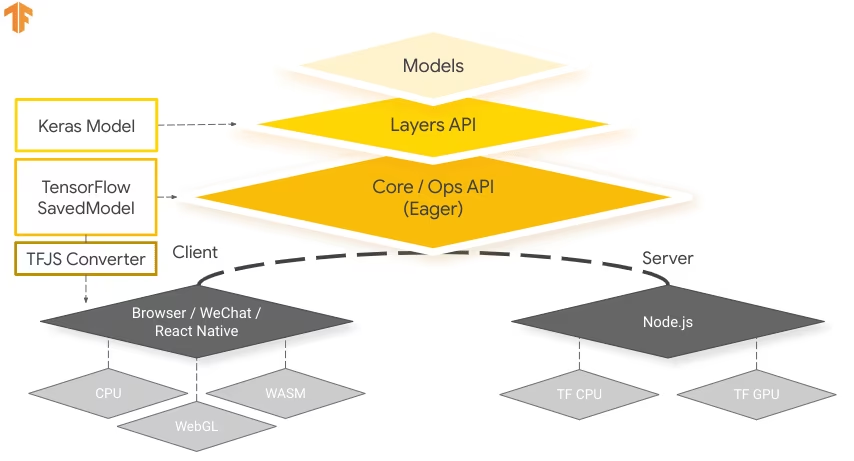
L’exécution des modèles en local réduit également la latence et offre une expérience utilisateur plus réactive. TensorFlow.js permet aussi de travailler hors ligne, ce qui permet aux utilisateurs d’utiliser ton application même sans connexion Internet. TF.js est conçu pour exécuter efficacement des modèles complexes sur des appareils aux ressources limitées et pour évoluer, avec la prise en charge de l’accélération GPU.
Principales caractéristiques de TF.js#
Voici les principales fonctionnalités qui rendent TF.js utile aux développeurs :
-
Prise en charge multiplateforme : TensorFlow.js peut être utilisé dans les navigateurs et les environnements Node.js, ce qui offre une grande flexibilité de déploiement sur différentes plateformes. Il permet aux développeurs de créer et de déployer des applications plus facilement.
-
Prise en charge de plusieurs backends : TensorFlow.js prend en charge divers backends de calcul, notamment le CPU, WebGL pour l’accélération GPU, WebAssembly (WASM) pour une vitesse d’exécution proche du natif et WebGPU pour des capacités avancées d’apprentissage automatique dans le navigateur.
-
Fonctionnalités hors ligne : avec TensorFlow.js, les modèles peuvent s’exécuter dans le navigateur sans connexion Internet, ce qui permet de développer des applications fonctionnelles hors ligne.
Options de déploiement avec TensorFlow.js#
TF.js offre plusieurs options pour déployer tes modèles d’apprentissage automatique :
-
Applications d’apprentissage automatique dans le navigateur : tu peux créer des applications web qui exécutent des modèles d’apprentissage automatique directement dans le navigateur. Cela élimine le besoin de calcul côté serveur et réduit la charge sur le serveur.
-
Applications Node.js : TensorFlow.js prend également en charge le déploiement dans les environnements Node.js, ce qui permet de développer des applications d’apprentissage automatique côté serveur. Cette solution est particulièrement utile pour les applications qui nécessitent la puissance de calcul d’un serveur ou un accès aux données côté serveur.
-
Extensions Chrome : la création d’extensions Chrome avec TensorFlow.js est un scénario de déploiement intéressant. Tu peux, par exemple, développer une extension qui permet aux utilisateurs de cliquer avec le bouton droit sur une image d’une page web pour la classifier à l’aide d’un modèle d’apprentissage automatique préentraîné. TensorFlow.js peut s’intégrer aux activités de navigation web quotidiennes pour fournir immédiatement des informations ou des améliorations fondées sur l’apprentissage automatique.
Remplacer l'export TF.js par LiteRT#
Pour les nouveaux exports, convertis ton modèle au format LiteRT.
Installation#
Pour installer le package requis, exécute :
# Install the required package for YOLO26
pip install ultralytics
Pour obtenir des instructions détaillées et connaître les bonnes pratiques liées à l’installation, consulte notre guide d’installation Ultralytics. Si tu rencontres des difficultés lors de l’installation des packages requis pour YOLO26, consulte notre guide des problèmes courants, qui propose des solutions et des conseils.
Utilisation#
Tous les modèles Ultralytics YOLO26 sont conçus pour prendre en charge l’exportation dès leur installation, ce qui facilite leur intégration à ton flux de déploiement préféré. Tu peux consulter la liste complète des formats d’exportation pris en charge et des options de configuration pour choisir la configuration la mieux adaptée à ton application.
L’argument tfjs exporte désormais un modèle .tflite LiteRT, qui prend en charge les modes Exportation, Prédiction et Validation en local et s’exécute dans le navigateur via LiteRT.js.
from ultralytics import YOLO

# Charger un modèle YOLO26
model = YOLO("yolo26n.pt")

# Exporter le modèle au format LiteRT (remplace TF.js)
model.export(format="litert", imgsz=640) # utiliser imgsz=224 pour la classificationLe modèle LiteRT exporté .tflite se charge directement avec yolo predict et yolo val, et s’exécute dans le navigateur via LiteRT.js.
Arguments d’exportation#
Consulte les arguments d’exportation LiteRT. Pour en savoir plus sur le processus d’exportation, consulte la page de la documentation Ultralytics consacrée à l’exportation.
Déploiement des modèles YOLO26 TensorFlow.js exportés#
Maintenant que tu as exporté ton modèle YOLO26, l’étape suivante consiste à le déployer. L’export produit un modèle .tflite LiteRT qui s’exécute sur l’appareil et dans le navigateur via LiteRT.js.
À titre indicatif, voici les ressources de l’ancien environnement d’exécution TensorFlow.js :
-
Extension Chrome : documentation destinée aux développeurs pour déployer tes modèles TF.js dans une extension Chrome.
-
Exécuter TensorFlow.js dans Node.js : guide TensorFlow expliquant comment exécuter directement TensorFlow.js dans Node.js.
-
Déployer TensorFlow.js - Projet Node sur une plateforme cloud : guide TensorFlow expliquant comment déployer un projet Node TensorFlow.js sur une plateforme cloud.
Résumé#
Ce guide conserve le contexte de déploiement hérité de TF.js. Utilise LiteRT pour les nouveaux exports.
Pour plus de détails sur l’utilisation, consulte la documentation officielle de TensorFlow.js.
FAQ#
Exporte plutôt au format LiteRT.
format="tfjs"fonctionne toujours, mais affiche un avertissement de dépréciation et exporte le même modèle LiteRT :Utilisationfrom ultralytics import YOLO # Charger un modèle YOLO26 model = YOLO("yolo26n.pt") # Exporter le modèle au format LiteRT (remplace TF.js) model.export(format="litert", imgsz=640) # utiliser imgsz=224 pour la classification # Le modèle '.tflite' exporté s’exécute dans le navigateur via LiteRT.js ou localement avec yolo predict/val.Pour plus de détails sur les options d’exportation prises en charge, consulte la page de la documentation Ultralytics sur les options de déploiement.
TensorFlow.js est spécialement conçu pour exécuter efficacement des modèles d’apprentissage automatique dans les navigateurs et les environnements Node.js. Voici les avantages qu’il apporte aux applications dans le navigateur :
- Réduction de la latence : exécute les modèles d’apprentissage automatique localement et fournit des résultats immédiats sans dépendre de calculs côté serveur.
- Amélioration de la confidentialité : conserve les données sensibles sur l’appareil de l’utilisateur, ce qui réduit les risques de sécurité.
- Utilisation hors ligne : les modèles peuvent fonctionner sans connexion Internet, ce qui garantit un fonctionnement continu.
- Prise en charge de plusieurs backends : offre une grande flexibilité avec des backends comme le CPU, WebGL, WebAssembly (WASM) et WebGPU pour répondre à différents besoins de calcul.
Tu souhaites en savoir plus sur TF.js ? Consulte le guide officiel de TensorFlow.js.


Commentaires45
Pose une question, partage tes résultats ou aide quelqu’un d’autre.
jupiter-mza
Hi, iam trying use yolov8n_web_model in my REACT project, all works fine, the model was loaded, predictions works, but the result, even making conversions stay wrong, its returned from my predictions: { "kept": false, "isDisposedInternal": false, "shape": [ 1, 84, 8400 ], "dtype": "float32", "size": 705600, "strides": [ 705600, 8400 ], "dataId": { "id": 1030 }, "id": 719, "rankType": "3", "scopeId": 575 } when i try to catch the results using this: const handleIdentify = async () => { if (!model) { console.warn('Modelo não carregado.'); return; } const canvas = canvasRef.current; const imageElement = canvas; const tensor = tf.browser.fromPixels(imageElement).expandDims(0).toFloat().div(tf.scalar(255)); const predictions = await model.executeAsync(tensor); // console.log("Predictions:", predictions); const result = await predictions.array(); console.log("Result:", result); // // Parâmetros da sua imagem const imgWidth = 640;
const imgHeight = 480;// Array para armazenar deteções filtradas const detections = []; for (let i = 0; i < result[0].length; i++) { const prediction = result[0][i]; // vetor de 84 elementos const x = prediction[0]; const y = prediction[1]; const w = prediction[2]; const h = prediction[3]; const objConfidence = prediction[4]; const classProbs = prediction.slice(5); // de 5 a 83 // Encontra a classe com maior probabilidade const maxClassProb = Math.max(...classProbs); const classIndex = classProbs.indexOf(maxClassProb); // Calcula a confiança do objeto const confidence = objConfidence * maxClassProb; // Define um limiar de confiança const confidenceThreshold = 0.25; if (confidence > confidenceThreshold) { // Escala as coordenadas para o tamanho da imagem const bx = x * imgWidth; const by = y * imgHeight; const bw = w * imgWidth; const bh = h * imgHeight; detections.push({ bbox: [bx - bw / 2, by - bh / 2, bw, bh], confidence: confidence, class: classIndex, }); } console.log("Detections:", detections) };} its return a resultset completely wrong like this: [ { "bbox": [ -2065.0027465820312, -2358.991241455078, 12443.428955078125, 14857.036743164062 ], "confidence": 23974.878087386023, "class": 2154 }, { "bbox": [ 2059.2428588867188, 1746.5789794921875, 2604.3841552734375, 2417.2320556640625 ], "confidence": 2756.7185883242637, "class": 6330 }, { "bbox": [ 3684.2034912109375, 1313.7918090820312, 8792.0166015625, 16787.200927734375 ], "confidence": 18003.25029833475, "class": 8224 }, { "bbox": [ 4112.9534912109375, 3463.8272094726562, 5174.500732421875, 4886.737060546875 ], "confidence": 5542.858029322, "class": 8182 } ] why ?
SarvagyaVaish
What version of ultralytics was the tfjs export tested with?
I am running this minimal example to convert a model to tfjs.
from ultralytics import YOLO

model = YOLO("yolo11l.pt")
model.export(format='tfjs')
Error i am seeing the following error:
Ultralytics 8.3.133 🚀 Python-3.11.12 torch-2.6.0+cu124 CPU (Intel Xeon 2.20GHz)
YOLO11l summary (fused): 190 layers, 25,340,992 parameters, 0 gradients, 86.9 GFLOPs

PyTorch: starting from 'yolo11l.pt' with input shape (1, 3, 640, 640) BCHW and output shape(s) (1, 84, 8400) (49.0 MB)

TensorFlow SavedModel: starting export with tensorflow 2.18.0...

ONNX: starting export with onnx 1.18.0 opset 19...
ONNX: slimming with onnxslim 0.1.52...
ONNX: export success ✅ 4.4s, saved as 'yolo11l.onnx' (97.0 MB)
TensorFlow SavedModel: starting TFLite export with onnx2tf 1.27.4...
ERROR:root:Internal Python error in the inspect module.
Below is the traceback from this internal error.

ERROR: The trace log is below.
Traceback (most recent call last):
  File "/usr/local/lib/python3.11/dist-packages/onnx2tf/utils/common_functions.py", line 313, in print_wrapper_func
    result = func(*args, **kwargs)
             ^^^^^^^^^^^^^^^^^^^^^
  File "/usr/local/lib/python3.11/dist-packages/onnx2tf/utils/common_functions.py", line 386, in inverted_operation_enable_disable_wrapper_func
    result = func(*args, **kwargs)
             ^^^^^^^^^^^^^^^^^^^^^
  File "/usr/local/lib/python3.11/dist-packages/onnx2tf/utils/common_functions.py", line 56, in get_replacement_parameter_wrapper_func
    func(*args, **kwargs)
  File "/usr/local/lib/python3.11/dist-packages/onnx2tf/ops/Conv.py", line 459, in make_node
    conv_bias(
  File "/usr/local/lib/python3.11/dist-packages/onnx2tf/ops/Conv.py", line 308, in conv_bias
    tf.nn.convolution(
  File "/usr/local/lib/python3.11/dist-packages/tensorflow/python/util/traceback_utils.py", line 153, in error_handler
    raise e.with_traceback(filtered_tb) from None
  File "/usr/local/lib/python3.11/dist-packages/tf_keras/src/layers/core/tf_op_layer.py", line 119, in handle
    return TFOpLambda(op)(*args, **kwargs)
           ^^^^^^^^^^^^^^^^^^^^^^^^^^^^^^^
  File "/usr/local/lib/python3.11/dist-packages/tf_keras/src/utils/traceback_utils.py", line 72, in error_handler
    del filtered_tb
ValueError: Exception encountered when calling layer "tf.nn.convolution_35" (type TFOpLambda).

Depth of input (384) is not a multiple of input depth of filter (256) for '{{node tf.nn.convolution_35/convolution}} = Conv2D[T=DT_FLOAT, data_format="NHWC", dilations=[1, 1, 1, 1], explicit_paddings=[], padding="SAME", strides=[1, 1, 1, 1], use_cudnn_on_gpu=true](Placeholder, tf.nn.convolution_35/convolution/filter)' with input shapes: [1,64,160,384], [1,1,256,256].

Call arguments received by layer "tf.nn.convolution_35" (type TFOpLambda):
  • input=tf.Tensor(shape=(1, 64, 160, 384), dtype=float32)
  • filters=tf.Tensor(shape=(1, 1, 256, 256), dtype=float32)
  • strides=['1', '1']
  • padding='SAME'
  • data_format=None
  • dilations=['1', '1']
  • name=None

ERROR: input_onnx_file_path: yolo11l.onnx
ERROR: onnx_op_name: wa/model.2/cv2/conv/Conv
ERROR: Read this and deal with it. https://github.com/PINTO0309/onnx2tf#parameter-replacement
ERROR: Alternatively, if the input OP has a dynamic dimension, use the -b or -ois option to rewrite it to a static shape and try again.
ERROR: If the input OP of ONNX before conversion is NHWC or an irregular channel arrangement other than NCHW, use the -kt or -kat option.
ERROR: Also, for models that include NonMaxSuppression in the post-processing, try the -onwdt option.
Traceback (most recent call last):
  File "/usr/local/lib/python3.11/dist-packages/onnx2tf/utils/common_functions.py", line 313, in print_wrapper_func
    result = func(*args, **kwargs)
             ^^^^^^^^^^^^^^^^^^^^^
  File "/usr/local/lib/python3.11/dist-packages/onnx2tf/utils/common_functions.py", line 386, in inverted_operation_enable_disable_wrapper_func
    result = func(*args, **kwargs)
             ^^^^^^^^^^^^^^^^^^^^^
  File "/usr/local/lib/python3.11/dist-packages/onnx2tf/utils/common_functions.py", line 56, in get_replacement_parameter_wrapper_func
    func(*args, **kwargs)
  File "/usr/local/lib/python3.11/dist-packages/onnx2tf/ops/Conv.py", line 459, in make_node
    conv_bias(
  File "/usr/local/lib/python3.11/dist-packages/onnx2tf/ops/Conv.py", line 308, in conv_bias
    tf.nn.convolution(
  File "/usr/local/lib/python3.11/dist-packages/tensorflow/python/util/traceback_utils.py", line 153, in error_handler
    raise e.with_traceback(filtered_tb) from None
  File "/usr/local/lib/python3.11/dist-packages/tf_keras/src/layers/core/tf_op_layer.py", line 119, in handle
    return TFOpLambda(op)(*args, **kwargs)
           ^^^^^^^^^^^^^^^^^^^^^^^^^^^^^^^
  File "/usr/local/lib/python3.11/dist-packages/tf_keras/src/utils/traceback_utils.py", line 72, in error_handler
    del filtered_tb
ValueError: Exception encountered when calling layer "tf.nn.convolution_35" (type TFOpLambda).

Depth of input (384) is not a multiple of input depth of filter (256) for '{{node tf.nn.convolution_35/convolution}} = Conv2D[T=DT_FLOAT, data_format="NHWC", dilations=[1, 1, 1, 1], explicit_paddings=[], padding="SAME", strides=[1, 1, 1, 1], use_cudnn_on_gpu=true](Placeholder, tf.nn.convolution_35/convolution/filter)' with input shapes: [1,64,160,384], [1,1,256,256].

Call arguments received by layer "tf.nn.convolution_35" (type TFOpLambda):
  • input=tf.Tensor(shape=(1, 64, 160, 384), dtype=float32)
  • filters=tf.Tensor(shape=(1, 1, 256, 256), dtype=float32)
  • strides=['1', '1']
  • padding='SAME'
  • data_format=None
  • dilations=['1', '1']
  • name=None

During handling of the above exception, another exception occurred:

Traceback (most recent call last):
  File "/usr/local/lib/python3.11/dist-packages/IPython/core/interactiveshell.py", line 3553, in run_code
    exec(code_obj, self.user_global_ns, self.user_ns)
  File "<ipython-input-2-960d66694119>", line 5, in <cell line: 0>
    model.export(format="tfjs")
  File "/usr/local/lib/python3.11/dist-packages/ultralytics/engine/model.py", line 730, in export
    return Exporter(overrides=args, _callbacks=self.callbacks)(model=self.model)
           ^^^^^^^^^^^^^^^^^^^^^^^^^^^^^^^^^^^^^^^^^^^^^^^^^^^^^^^^^^^^^^^^^^^^^
  File "/usr/local/lib/python3.11/dist-packages/ultralytics/engine/exporter.py", line 468, in __call__
    f[5], keras_model = self.export_saved_model()
                        ^^^^^^^^^^^^^^^^^^^^^^^^^
  File "/usr/local/lib/python3.11/dist-packages/ultralytics/engine/exporter.py", line 192, in outer_func
    f, model = inner_func(*args, **kwargs)
               ^^^^^^^^^^^^^^^^^^^^^^^^^^^
  File "/usr/local/lib/python3.11/dist-packages/ultralytics/engine/exporter.py", line 975, in export_saved_model
    keras_model = onnx2tf.convert(
                  ^^^^^^^^^^^^^^^^
  File "/usr/local/lib/python3.11/dist-packages/onnx2tf/onnx2tf.py", line 1149, in convert
    op.make_node(
  File "/usr/local/lib/python3.11/dist-packages/onnx2tf/utils/common_functions.py", line 379, in print_wrapper_func
    sys.exit(1)
SystemExit: 1

During handling of the above exception, another exception occurred:

Traceback (most recent call last):
  File "/usr/local/lib/python3.11/dist-packages/IPython/core/ultratb.py", line 1101, in get_records
    return _fixed_getinnerframes(etb, number_of_lines_of_context, tb_offset)
           ^^^^^^^^^^^^^^^^^^^^^^^^^^^^^^^^^^^^^^^^^^^^^^^^^^^^^^^^^^^^^^^^^
  File "/usr/local/lib/python3.11/dist-packages/IPython/core/ultratb.py", line 248, in wrapped
    return f(*args, **kwargs)
           ^^^^^^^^^^^^^^^^^^
  File "/usr/local/lib/python3.11/dist-packages/IPython/core/ultratb.py", line 281, in _fixed_getinnerframes
    records = fix_frame_records_filenames(inspect.getinnerframes(etb, context))
                                          ^^^^^^^^^^^^^^^^^^^^^^^^^^^^^^^^^^^^
  File "/usr/lib/python3.11/inspect.py", line 1739, in getinnerframes
    traceback_info = getframeinfo(tb, context)
                     ^^^^^^^^^^^^^^^^^^^^^^^^^
  File "/usr/lib/python3.11/inspect.py", line 1671, in getframeinfo
    lineno = frame.f_lineno
             ^^^^^^^^^^^^^^
AttributeError: 'tuple' object has no attribute 'f_lineno'
---------------------------------------------------------------------------
ValueError                                Traceback (most recent call last)
[/usr/local/lib/python3.11/dist-packages/onnx2tf/utils/common_functions.py](https://localhost:8080/#) in print_wrapper_func(*args, **kwargs)
    312         try:
--> 313             result = func(*args, **kwargs)
    314

21 frames
ValueError: Exception encountered when calling layer "tf.nn.convolution_35" (type TFOpLambda).

Depth of input (384) is not a multiple of input depth of filter (256) for '{{node tf.nn.convolution_35/convolution}} = Conv2D[T=DT_FLOAT, data_format="NHWC", dilations=[1, 1, 1, 1], explicit_paddings=[], padding="SAME", strides=[1, 1, 1, 1], use_cudnn_on_gpu=true](Placeholder, tf.nn.convolution_35/convolution/filter)' with input shapes: [1,64,160,384], [1,1,256,256].

Call arguments received by layer "tf.nn.convolution_35" (type TFOpLambda):
  • input=tf.Tensor(shape=(1, 64, 160, 384), dtype=float32)
  • filters=tf.Tensor(shape=(1, 1, 256, 256), dtype=float32)
  • strides=['1', '1']
  • padding='SAME'
  • data_format=None
  • dilations=['1', '1']
  • name=None

During handling of the above exception, another exception occurred:

SystemExit                                Traceback (most recent call last)
    [... skipping hidden 1 frame]

SystemExit: 1

During handling of the above exception, another exception occurred:

TypeError                                 Traceback (most recent call last)
    [... skipping hidden 1 frame]

[/usr/local/lib/python3.11/dist-packages/IPython/core/ultratb.py](https://localhost:8080/#) in find_recursion(etype, value, records)
    380     # first frame (from in to out) that looks different.
    381     if not is_recursion_error(etype, value, records):
--> 382         return len(records), 0
    383
    384     # Select filename, lineno, func_name to track frames with

TypeError: object of type 'NoneType' has no len()
WereUs666
Hello, I tried to convert the yolo pose model into tfjs format. Then I encountered an issue. I am using AWS EC2 Linux server to run the code.
python version: 3.12.0 Pytorch version: 2.6.0+cu124 tensorflow version: 2.18.0
This is the code:
from ultralytics import YOLO
model = YOLO("yolo11n-pose")
model.export(format="tfjs")
This is the error:
Traceback (most recent call last): File "/opt/conda/envs/py312/lib/python3.12/site-packages/onnx2tf/utils/common_functions.py", line 312, in print_wrapper_func result = func(*args, **kwargs) ^^^^^^^^^^^^^^^^^^^^^ File "/opt/conda/envs/py312/lib/python3.12/site-packages/onnx2tf/utils/common_functions.py", line 385, in inverted_operation_enable_disable_wrapper_func result = func(*args, **kwargs) ^^^^^^^^^^^^^^^^^^^^^ File "/opt/conda/envs/py312/lib/python3.12/site-packages/onnx2tf/utils/common_functions.py", line 55, in get_replacement_parameter_wrapper_func func(*args, **kwargs) File "/opt/conda/envs/py312/lib/python3.12/site-packages/onnx2tf/ops/Add.py", line 281, in make_node merge_two_consecutive_identical_ops_into_one( File "/opt/conda/envs/py312/lib/python3.12/site-packages/onnx2tf/utils/common_functions.py", line 5466, in merge_two_consecutive_identical_ops_into_one tf.math.add( File "/opt/conda/envs/py312/lib/python3.12/site-packages/tensorflow/python/ops/weak_tensor_ops.py", line 142, in wrapper return op(*args, **kwargs) ^^^^^^^^^^^^^^^^^^^ File "/opt/conda/envs/py312/lib/python3.12/site-packages/tensorflow/python/util/traceback_utils.py", line 153, in error_handler raise e.with_traceback(filtered_tb) from None File "/opt/conda/envs/py312/lib/python3.12/site-packages/tf_keras/src/layers/core/tf_op_layer.py", line 119, in handle return TFOpLambda(op)(*args, **kwargs) ^^^^^^^^^^^^^^^^^^^^^^^^^^^^^^^ File "/opt/conda/envs/py312/lib/python3.12/site-packages/tf_keras/src/utils/traceback_utils.py", line 72, in error_handler del filtered_tb ^^^^^^^^^^^ ValueError: Exception encountered when calling layer "tf.math.add_5" (type TFOpLambda). Dimensions must be equal, but are 32 and 16 for '{{node tf.math.add_5/Add}} = AddV2[T=DT_FLOAT](Placeholder, Placeholder_1)' with input shapes: [1,16,160,32], [1,16,160,16]. Call arguments received by layer "tf.math.add_5" (type TFOpLambda): • x=tf.Tensor(shape=(1, 16, 160, 32), dtype=float32) • y=tf.Tensor(shape=(1, 16, 160, 16), dtype=float32) • name='/model.2/m.0/Add' ERROR: input_onnx_file_path: yolo11n-pose.onnx ERROR: onnx_op_name: /model.2/m.0/Add ERROR: Read this and deal with it. https://github.com/PINTO0309/onnx2tf#parameter-replacement ERROR: Alternatively, if the input OP has a dynamic dimension, use the -b or -ois option to rewrite it to a static shape and try again. ERROR: If the input OP of ONNX before conversion is NHWC or an irregular channel arrangement other than NCHW, use the -kt or -kat option. ERROR: Also, for models that include NonMaxSuppression in the post-processing, try the -onwdt option. Glenn JocherUltralytics(modifié)
@WereUs666 thanks for sharing the details. For pose models in TF.js format, we recommend trying
model.export(format='tfjs', imgsz=(640, 640))with a fixed input size. Note thattfjsis deprecated since Ultralytics 8.4.83 and now exports a LiteRT model, so for new work useformat='litert'(see the LiteRT guide). If issues persist, please ensure you're using the latestultralyticsandonnx2tfpackages. For commercial deployment needs, visit https://ultralytics.com/license.
priyalpatel1503
I am working on an Angular project, and I have integrated the YOLOv8 model using TensorFlow.js. However, I am facing an issue where the model does not provide the predicted bounding box coordinates, but instead, I receive the following tensor output: { "kept": false, "isDisposedInternal": false, "shape": [1, 84, 8400], "dtype": "float32", "size": 705600, "strides": [705600, 8400], "dataId": {"id": 801}, "id": 492, "rankType": "3", "scopeId": 7 } This output is not giving me the expected bounding box coordinates. I am unsure how to extract the bounding boxes from this tensor output and interpret the predictions. Could you please guide me on how to retrieve the bounding box coordinates, class labels, and confidence scores from this tensor?
Here is the code I am using to load and run the model:
// Loading YOLOv8 model this.model = await tf.loadGraphModel('../../assets/yolov8n_web_model/model.json'); alert('YOLOv8 model loaded successfully');
// Preparing the image for model input const image = document.getElementById('input-image') as HTMLImageElement; const tensor = tf.browser .fromPixels(image) .resizeBilinear([640, 640]) // Resize to model input size .toFloat() .expandDims(0) .div(tf.scalar(255.0)); // Normalize
// Running the model and obtaining predictions const predictions = await this.model.execute(tensor); console.log('Predictions:', predictions); To clarify, I am working with the model directly in Angular using TensorFlow.js and do not have a Python backend. Any advice on how to proceed in this setup would be greatly appreciated.
Thank you!
- Glenn JocherUltralytics
@priyalpatel1503 the tensor output you are encountering contains raw predictions, which need decoding to extract bounding box coordinates, class labels, and confidence scores. YOLO models typically output a tensor where each grid cell holds predictions including bounding boxes, objectness scores, and class probabilities. You can apply non-maximum suppression (NMS) and appropriate post-processing on this tensor to interpret the results. Refer to the TensorFlow.js YOLO post-processing example for guidance, as it follows a similar concept.
I have tried implementing your above solution to run inference on an image, but I am encountering an issue where the predictions object is not iterable. Despite following the suggested solutions, it still doesn't work.
Here's the solution I tried: async function runInference() { // Load the model const model = await tf.loadGraphModel('/path/to/yolov8n_web_model/model.json');
// Load and preprocess the image
const img = document.getElementById('input-image');
const tensor = tf.browser.fromPixels(img).expandDims(0).toFloat().div(tf.scalar(255));

// Run inference
const predictions = await model.executeAsync(tensor);

// Process the output tensors
const [boxes, scores, classes] = predictions;
const boxesData = boxes.dataSync();
const scoresData = scores.dataSync();
const classesData = classes.dataSync();

// Filter predictions by confidence threshold
const confidenceThreshold = 0.5;
const validDetections = [];
for (let i = 0; i < scoresData.length; i++) {
    if (scoresData[i] > confidenceThreshold) {
        validDetections.push({
            box: boxesData.slice(i * 4, (i + 1) * 4),
            score: scoresData[i],
            class: classesData[i]
        });
    }
}

// Display results
validDetections.forEach(detection => {
    const [x, y, width, height] = detection.box;
    const score = detection.score;
    const className = detection.class;

    // Draw bounding box and label on the image
    // (Implement your drawing logic here)
});
}
window.onload = runInference; However, when running this code, I am getting the following error:
Error: predictions is not iterable
I have tried several approaches based on your earlier suggestions, but none of them resolved the issue. I am unsure how to correctly extract the bounding boxes, class labels, and confidence scores from the output.
Could you please provide guidance on how to properly handle the output of model.executeAsync(tensor) and how to extract the predictions (bounding boxes, class labels, and scores)?
- Glenn JocherUltralytics
The error occurs because
model.executeAsync(tensor)returns a single tensor or an array of tensors, depending on the model's output structure. In your case, ensure the model's output aligns with your extraction logic. Usepredictions.array()orpredictions.dataSync()to inspect the raw output structure and adjust your code to handle it correctly. For YOLO models, you may need to decode the tensor output into bounding boxes, classes, and scores using custom logic or post-processing functions. @glenn-jocher After calling model.executeAsync(tensor), the output I receive is a tensor object with the following shape and details: { "kept": false, "isDisposedInternal": false, "shape": [ 1, 84, 8400 ], "dtype": "float32", "size": 705600, "strides": [ 705600, 8400 ], "dataId": { "id": 864 }, "id": 555, "rankType": "3", "scopeId": 641 }
- When using predictions.array(), it returns a Promise in TensorFlow.js .The Promise resolves to a nested array structure: [ [Array(8400), Array(8400), ..., Array(8400)] ] (84 arrays, each containing 8400 values).
- When using predictions.dataSync(), I receive a Float32Array with 705600 values.
I need guidance on how to properly decode and interpret this output, especially in terms of extracting bounding box coordinates, class IDs, and class probabilities. Could you provide advice or code examples for decoding these predictions, particularly for the YOLOv8 model in TensorFlow.js? Any references, examples, or explanations will be helpful.
- Glenn JocherUltralytics(modifié)
To decode the YOLOv8 TensorFlow.js output, you need to understand that the tensor contains raw predictions. The shape
[1, 84, 8400]represents[batch_size, num_features, num_predictions_per_feature]. Here's a breakdown of processing it:- Use
predictions.array()to resolve the tensor into a nested array structure. - The 84 features are the bounding box (x, y, w, h) followed by 80 class scores. YOLOv8 has no separate objectness score:
- The first 4 values are the bounding box coordinates.
- The remaining 80 values (indices 4–83) are the per-class scores.
- For each prediction:
- Scale the bounding box coordinates to your image size if they are normalized.
- Take the highest class score as the confidence, filter by a confidence threshold, and apply Non-Maximum Suppression (NMS) to remove duplicates.
For detailed implementation, you can refer to TensorFlow.js's post-processing examples or adapt the logic to YOLOv8's output format. Let us know if you need further clarification!
- Use
lilinebo
I'm having performance issues when dealing with tensors. After the inference is completed, nms needs to be performed, and then I perform the following operation const indicesTensor = await tf.whereAsync(xcSlice); which takes about 2s, which is too long.xcSlice is [21504].In my expectation, this will only take up to 400 milliseconds
- Glenn JocherUltralytics
@mozeqiu123 the delay you're encountering with
tf.whereAsyncmay be due to the large size of your tensor. To improve performance, consider optimizing the data preparation and operations preceding this step. Also, ensure you're leveraging appropriate TensorFlow.js backends like WebGL or WASM for better execution speed. Yes, my tensor is very large. What exactly do you mean by optimizing data preparation and operations?
- Glenn JocherUltralytics
Optimizing data preparation and operations can involve ensuring the tensor is only as large as necessary by filtering or reducing dimensions early, leveraging TensorFlow.js efficient backends (e.g., WebGL for GPU acceleration), and minimizing unnecessary tensor transformations before calling costly operations. You can also experiment with batching or slicing your data into smaller chunks before processing.
Thanks for the reply. I turned on webgl at the beginning, but it was still very slow. Then I solved the problem by changing to a smaller model.
- Glenn JocherUltralytics
Thank you for sharing your update! Switching to a smaller model is a great solution for handling performance constraints. If further optimizations are needed, consider exporting your YOLO11 to TensorFlow.js or experimenting with different backends like WebGL or WASM. For more context, you can refer to the TF.js documentation.
viniciusmra
I've been trying to export some models that I trained, but I keep getting several errors when trying to run the command. Erros:
requirements: Ultralytics requirements ['sng4onnx>=1.0.1', 'onnx_graphsurgeon>=0.3.26', 'onnxslim>=0.1.31', 'tflite_support', 'onnxruntime'] not found, attempting AutoUpdate...The message says that the Ultralytics library is missing these dependencies (which is strange because I just installed Ultralytics, so it should be complete). The 'autoupdate' fails, and installing them manually also fails..
- Glenn JocherUltralytics
@viniciusmra the error indicates that some dependencies required for exporting are missing. First, try updating all packages by running
pip install ultralytics --upgradeto ensure you have the latest version. If manual dependency installation issues persist, verify your Python environment and ensure compatibility with the supported Ultralytics and dependency versions. For further guidance, refer to our Common Issues guide. Let me know if you encounter further issues.1
Hello author, I am a newbie. I trained a yolov11n OBB detection model and then converted it to tfjs format. I found that the pt model inference result is an object, so how to parse the result in tfjs?
- Glenn JocherUltralytics
@mozeqiu123 to parse the inference results in TensorFlow.js, check the format of the output from the exported YOLO model. Typically, it should provide arrays of tensor data. Map the output tensors to expected object properties like bounding box coordinates, class IDs, and confidence scores in your application logic to process and display the results. Let me know if you need more details!
1 Thank you for your reply, the specific information is here:https://github.com/ultralytics/ultralytics/issues/17768
- Glenn JocherUltralytics
Thank you for sharing the reference issue. To parse YOLO11 OBB detection results in TensorFlow.js, you will need to interpret the model's output tensors correctly based on your trained model's format. Typically, the outputs include bounding box coordinates, class predictions, confidence scores, and oriented box angles. You can check the model's documentation or inspect the export code to map these outputs properly. Let us know if further clarification is needed!
venkatshan707(modifié)
@glenn-jocher sorry for correcting. When I convert yolov8n.pt I am getting 4 bin files. when I convert yolov8m.pt and yolov8m-obb.pt I am getting 26 bin files. I could understand your point explains model complexity of yolov8m.pt and yolov8m-obb.pt are higher than yolov8n.pt. I have tried finding code snippet which can help us pruning the model and gives us small number bin files. But I have failed in that.
Would you kindly help me with code example which can fix this issue ?
#This is the code I have used to get web model from official yolov8m-obb.pt
from ultralytics import YOLO
Load the YOLO11 model
model = YOLO("yolov8m-obb.pt")
Export the model to TF.js format
model.export(format="tfjs") # creates '/yolov8m-obb.pt_web_model'
- Glenn JocherUltralytics
@venkatshan707 to reduce the number of bin files when exporting to TF.js, consider model pruning or quantization techniques. Unfortunately, we don't provide specific code examples for this, but you can explore TensorFlow.js documentation for optimization strategies. For more guidance, visit Ultralytics TF.js integration.
Fernand0GC
buenas, alguien podria ayudarme a interpretar mi output? el modelo es de deteccion de objetos y esta entrenado para reconocer 5 clases names: 0: black-shape 1: diana 2: targets-holes 3: targets-holes-2 4: targets-holes-black en la consola recibo el siguiente objeto: { "kept": false, "isDisposedInternal": false, "shape": [ 1, 9, 8400 ], "dtype": "float32", "size": 75600, "strides": [ 75600, 8400 ], "dataId": { "id": 801 }, "id": 492, "rankType": "3", "scopeId": 578 }
pude acceder al tensor mediante predictions.array() lo cual me da un output de un arreglo de 9 arreglos. este arreglo contiene valores numericos que aun no logro decifrar. 0 : (8400) [2.8815157413482666, 16.799739837646484, 35.85880661010742 ...] 1 : (8400) [4.487062931060791, 6.242208003997803, 7.13232421875 ...] 2 : (8400) [6.577016353607178, 32.058311462402344, 74.6260757446289 ...] 3 : (8400) [8.778525352478027, 12.535199165344238, 13.99738883972168 ...] 4 : (8400) [0.000003607327244026237, 0.000010992955139954574, 0.000006420665613404708 ...] 5 : (8400) [0.0000034999770832655486, 0.000010910729542956688, 0.000004991020887246123 ...] 6 : (8400) [0.000057105469750240445, 0.000025020823159138672, 0.000024430628400295973 ...] 7 : (8400) [0.000027735275580198504, 0.000019603612599894404, 0.000015360352335846983 ...] 8 : (8400) [0.00006247103010537103, 0.000020798512196051888, 0.000007502545486204326 ...]
me podrian ayudar a interpretar este output porfabor
- Glenn JocherUltralytics
@Fernand0GC hola, para interpretar tu output, los valores numéricos en los arreglos representan las predicciones del modelo. Cada arreglo de 8400 valores corresponde a diferentes aspectos de la detección, como coordenadas de cajas delimitadoras y puntuaciones de confianza para cada clase. Te recomiendo revisar cómo se estructuran las salidas de tu modelo en la documentación de TensorFlow.js para entender mejor cada componente. Si necesitas más detalles sobre el formato TF.js, puedes visitar aquí.
teengineer
@glenn-jocher thank you for your time. This example is on your web site https://docs.ultralytics.com/integrations/tfjs/#usage
- Glenn JocherUltralytics(modifié)
Update: the TF.js export is deprecated. As of Ultralytics 8.4.83,
format="tfjs"exports a LiteRT.tflitemodel instead of a*_web_model/model.json; useformat="litert"and see the LiteRT guide. The TF.js snippets below are legacy.Hello @teengineer,
Thank you for reaching out and for your interest in exporting YOLOv8 models to TensorFlow.js! The process indeed allows for efficient, high-speed, and locally-run object detection inference on various platforms, including web browsers and Node.js environments.
To get started, you can follow the example provided in our documentation to export your YOLOv8 model to the TF.js format. Here’s a concise example to guide you through the process:
Python Example
from ultralytics import YOLO

# Load the YOLOv8 model
model = YOLO("yolov8n.pt")

# Export the model to TF.js format
model.export(format="tfjs")  # creates '/yolov8n_web_model'

# Load the exported TF.js model
tfjs_model = YOLO("./yolov8n_web_model")

# Run inference
results = tfjs_model("https://ultralytics.com/images/bus.jpg")
CLI Example
# Export a YOLOv8n PyTorch model to TF.js format
yolo export model=yolov8n.pt format=tfjs  # creates '/yolov8n_web_model'

# Run inference with the exported model
yolo predict model='./yolov8n_web_model' source='https://ultralytics.com/images/bus.jpg'
For more detailed instructions, you can visit our TF.js integration guide.
If you encounter any issues, please ensure you are using the latest version of the Ultralytics package. Additionally, providing a minimum reproducible example of your issue can greatly help in diagnosing and resolving any problems. You can find more information on creating a reproducible example here.
Feel free to reach out if you have any further questions or need additional assistance. Happy coding! 😊
salim4n
Working well for me , I use in react chrome extension.
sorry double post, but in fact i can't devine whos is pred, boxing, etc : https://github.com/salim4n/pretorian-ext/blob/main/src/App.tsx
- Glenn JocherUltralytics(modifié)
Update: the TF.js export is deprecated. As of Ultralytics 8.4.83,
format="tfjs"exports a LiteRT.tflitemodel instead of a*_web_model/model.json; useformat="litert"and see the LiteRT guide. The TF.js snippets below are legacy.Hi @salim4n,
Thank you for your message! I'm glad to hear you're working on integrating YOLOv8 with a React Chrome extension. To help you better understand the predictions and bounding boxes, you might want to inspect the structure of the results returned by the model.
Here’s a quick example to guide you on how to handle the predictions in your React app:
Example Code Snippet
import React, { useEffect, useState } from 'react';
import { YOLO } from 'ultralytics';

const App = () => {
  const [results, setResults] = useState(null);

  useEffect(() => {
    const runInference = async () => {
      const model = await YOLO.load('./yolov8n_web_model');
      const results = await model.predict('https://ultralytics.com/images/bus.jpg');
      setResults(results);
    };

    runInference();
  }, []);

  return (
    <div>
      {results && results.map((result, index) => (
        <div key={index}>
          <h3>Prediction {index + 1}</h3>
          <p>Class: {result.class}</p>
          <p>Confidence: {result.confidence}</p>
          <p>Bounding Box: {result.bbox.join(', ')}</p>
        </div>
      ))}
    </div>
  );
};

export default App;
Explanation
- Loading the Model: The
YOLO.loadfunction loads the exported TF.js model. - Running Inference: The
model.predictfunction runs inference on the provided image URL. - Displaying Results: The results are stored in the state and displayed in the component.
This should help you visualize the predictions and bounding boxes in your React app. For more detailed information, you can refer to our TF.js integration guide.
If you encounter any issues, please ensure you are using the latest version of the Ultralytics package. Additionally, providing a minimum reproducible example can greatly help in diagnosing and resolving any problems. You can find more information on creating a reproducible example here.
Feel free to reach out if you have any further questions or need additional assistance. Happy coding! 😊
- Loading the Model: The
Hi @glenn-jocher , thank's for your response, but I don't find any package ultralytics on NPM, with tfjs the load-graph on custom model is very hard to use. I need to try more on a server side version, trying implementation directly on a chrome extension is not the easy way.
- Glenn JocherUltralytics(modifié)
Update: the TF.js export is deprecated. As of Ultralytics 8.4.83,
format="tfjs"exports a LiteRT.tflitemodel instead of a*_web_model/model.json; useformat="litert"and see the LiteRT guide. The TF.js snippets below are legacy.Hi @salim4n,
Thank you for your feedback and for sharing your experience. I understand that integrating TensorFlow.js (TF.js) models directly into a Chrome extension can be challenging, especially when dealing with custom models.
To address your concerns:
-
NPM Package: Currently, there is no
ultralyticspackage available on NPM. The recommended approach is to use the Python package to export your model to the TF.js format and then integrate the exported model into your JavaScript project. -
Loading Custom Models in TF.js: Loading custom models in TF.js can indeed be complex. Here’s a simplified approach to help you get started:
- Export the Model: Use the Ultralytics Python package to export your YOLOv8 model to the TF.js format.
- Integrate with TF.js: Use the exported model in your JavaScript code.
Example Code for Integration
Here’s a basic example to load and use the exported TF.js model in a Chrome extension:
Export the Model (Python)
from ultralytics import YOLO

# Load the YOLOv8 model
model = YOLO("yolov8n.pt")

# Export the model to TF.js format
model.export(format="tfjs")  # creates '/yolov8n_web_model'
Load and Use the Model (JavaScript)
import * as tf from '@tensorflow/tfjs';

async function loadModel() {
  const model = await tf.loadGraphModel('/path/to/yolov8n_web_model/model.json');
  return model;
}

async function runInference(imageElement) {
  const model = await loadModel();
  const tensor = tf.browser.fromPixels(imageElement).expandDims(0);
  const predictions = await model.executeAsync(tensor);
  console.log(predictions);
}

// Example usage
const imageElement = document.getElementById('input-image');
runInference(imageElement);
Additional Resources
For more detailed instructions on deploying TF.js models, you can refer to:
If you encounter any issues, please ensure you are using the latest version of the Ultralytics package and provide a minimum reproducible example if possible. This helps us diagnose and resolve any problems more effectively. You can find more information on creating a reproducible example here.
Feel free to reach out if you have any further questions or need additional assistance. Happy coding! 😊
-
wuhonglei
i have the same problem about how to get the
boxes,scoresandclassesfrom thepredictionsvariable, predictions is an object ,not an array, there is no property named boxes, scores and classes, does anyone know how to solve this, very appreciate 😄my html code is below:
<!DOCTYPE html>
<html>
  <head>
    <title>YOLOv8 Model Inference</title>
  </head>
  <body>
    <!-- 用于显示输入图片和绘制推理结果 -->
    <canvas id="input-image" width="640" height="640"></canvas>
    <script src="https://cdn.jsdelivr.net/npm/@tensorflow/tfjs"></script>
    <script>
      async function runModel() {
        const model = await tf.loadGraphModel("./best_web_model/model.json");

        // 1. 准备图片数据(这里使用示例图片)
        const imgElement = document.getElementById("input-image");
        const tensor = tf.browser
          .fromPixels(imgElement)
          .expandDims(0)
          .toFloat()
          .div(tf.scalar(255));

        // 2. 进行推理
        const predictions = await model.executeAsync([tensor]);
      }
    </script>
    <script>
      // 获取 canvas 元素
      const canvas = document.getElementById("input-image");
      const ctx = canvas.getContext("2d");

      // 创建新的图片对象
      const img = new Image();

      // 图片加载完成后绘制到 canvas 上
      img.onload = function () {
        ctx.drawImage(img, 0, 0, canvas.width, canvas.height);
        runModel();
      };

      // 设置图片的来源
      img.src = "./imgs/20217191442296037.jpg"; // 替换为您的图片路径
    </script>
  </body>
</html>
the output of predictions is below:
{
    "kept": false,
    "isDisposedInternal": false,
    "shape": [
        1,
        5,
        8400
    ],
    "dtype": "float32",
    "size": 42000,
    "strides": [
        42000,
        8400
    ],
    "dataId": {
        "id": 1212
    },
    "id": 701,
    "rankType": "3",
    "scopeId": 879
}
- Glenn JocherUltralytics(modifié)
Update: the TF.js export is deprecated. As of Ultralytics 8.4.83,
format="tfjs"exports a LiteRT.tflitemodel instead of a*_web_model/model.json; useformat="litert"and see the LiteRT guide. The TF.js snippets below are legacy.Hi @wuhonglei,
Thank you for your detailed question and for sharing your code! 😊
To extract the
boxes,scores, andclassesfrom thepredictionsobject in TensorFlow.js, you need to process the tensor outputs correctly. Thepredictionsobject you have is a tensor, and you can use TensorFlow.js methods to extract the necessary information.Here’s how you can modify your code to get the
boxes,scores, andclasses:Updated JavaScript Code
import * as tf from '@tensorflow/tfjs';

async function runModel() {
  const model = await tf.loadGraphModel('./best_web_model/model.json');

  // Prepare image data
  const imgElement = document.getElementById('input-image');
  const tensor = tf.browser.fromPixels(imgElement).expandDims(0).toFloat().div(tf.scalar(255));

  // Run inference
  const predictions = await model.executeAsync(tensor);

  // Extract boxes, scores, and classes
  const [boxes, scores, classes] = await Promise.all([
    predictions[0].array(),
    predictions[1].array(),
    predictions[2].array()
  ]);

  console.log('Boxes:', boxes);
  console.log('Scores:', scores);
  console.log('Classes:', classes);

  // Optionally, draw boxes on the canvas
  drawBoxes(imgElement, boxes, scores, classes);
}

function drawBoxes(imgElement, boxes, scores, classes) {
  const canvas = document.getElementById('input-image');
  const ctx = canvas.getContext('2d');
  ctx.clearRect(0, 0, canvas.width, canvas.height);
  ctx.drawImage(imgElement, 0, 0, canvas.width, canvas.height);

  boxes.forEach((box, i) => {
    const [y, x, height, width] = box;
    ctx.strokeStyle = 'red';
    ctx.lineWidth = 2;
    ctx.strokeRect(x, y, width, height);
    ctx.fillStyle = 'red';
    ctx.fillText(`Class: ${classes[i]}, Score: ${scores[i].toFixed(2)}`, x, y > 10 ? y - 5 : 10);
  });
}

// Load image and run model
const img = new Image();
img.onload = function () {
  const canvas = document.getElementById('input-image');
  const ctx = canvas.getContext('2d');
  ctx.drawImage(img, 0, 0, canvas.width, canvas.height);
  runModel();
};
img.src = './imgs/20217191442296037.jpg'; // Replace with your image path
Explanation
- Model Loading: Load the model using
tf.loadGraphModel. - Image Preparation: Convert the image to a tensor and normalize it.
- Run Inference: Execute the model and get the predictions.
- Extract Data: Use
array()to convert tensors to JavaScript arrays. - Draw Boxes: Optionally, draw the bounding boxes on the canvas.
This should help you extract and visualize the
boxes,scores, andclassesfrom your predictions. If you encounter any issues, please ensure you are using the latest version of TensorFlow.js and the Ultralytics package.For more detailed information, you can refer to our TF.js integration guide.
Feel free to reach out if you have any further questions or need additional assistance. Happy coding! 😊
- Model Loading: Load the model using
thanks very much for your detailed response, In order to better assist future developers, I will paste the code that I have successfully run in the end。 My business background: i use the yolov8 to detect the penguin in the image(object detection ). my final html code:
<!DOCTYPE html>
<html>
  <head>
    <title>YOLOv8 Object Detection with TensorFlow.js</title>
    <script src="https://cdn.jsdelivr.net/npm/@tensorflow/tfjs"></script>
  </head>
  <body>
    <input type="file" id="upload" accept="image/*" />
    <canvas id="canvas"></canvas>
    <script>
      async function loadModel() {
        // 加载模型
        const model = await tf.loadGraphModel("./best_web_model/model.json");
        return model;
      }

      async function predict(model, imageElement) {
        // 将图像转换为张量
        const tensor = tf.browser
          .fromPixels(imageElement)
          .resizeNearestNeighbor([640, 640]) // 调整大小到模型输入大小
          .toFloat()
          .expandDims(0)
          .div(tf.scalar(255.0));

        // inference
        const predictions = await model.executeAsync(tensor);

        //  predictions shape is [1, 5, 8400]
        const reshapedPredictions = predictions.reshape([5, 8400]);
        const boxesTensor = reshapedPredictions.slice([0, 0], [4, 8400]);
        const scoresTensor = reshapedPredictions
          .slice([4, 0], [1, 8400])
          .squeeze();

        // Assuming that the category label of each box is fixed (you can adjust it as needed)
        const classesTensor = tf.fill([8400], 0);

        return {
          boxes: boxesTensor,
          scores: scoresTensor,
          classes: classesTensor,
        };
      }

      function drawBoxes(imageElement, canvas, boxes, scores, classes) {
        const ctx = canvas.getContext("2d");
        canvas.width = imageElement.width;
        canvas.height = imageElement.height;
        ctx.drawImage(imageElement, 0, 0, canvas.width, canvas.height);

        const labels = ["企鹅"]; // Replace with actual label
        const validBoxes = [];

        for (let i = 0; i < scores.length; i++) {
          if (scores[i] > 0.5) {
            const x_c = boxes[0][i] / 640;
            const y_c = boxes[1][i] / 640;
            const w = boxes[2][i] / 640;
            const h = boxes[3][i] / 640;

            const x = x_c - w / 2;
            const y = y_c - h / 2;

            validBoxes.push([x, y, w, h, scores[i], classes[i]]);
          }
        }

        validBoxes.forEach((box) => {
          const [x, y, w, h, score, className] = box;
          ctx.strokeStyle = "red";
          ctx.lineWidth = 2;
          ctx.strokeRect(
            x * canvas.width,
            y * canvas.height,
            w * canvas.width,
            h * canvas.height
          );
          const text = `${className}: ${(score * 100).toFixed(2)}%`;
          ctx.fillText(text, x * canvas.width, y * canvas.height - 10);
        });
      }

      document
        .getElementById("upload")
        .addEventListener("change", async (event) => {
          const file = event.target.files[0];
          const imageElement = new Image();
          const reader = new FileReader();

          reader.onload = () => {
            imageElement.src = reader.result;
            imageElement.onload = async () => {
              const canvas = document.getElementById("canvas");
              const model = await loadModel();
              const { boxes, scores, classes } = await predict(
                model,
                imageElement
              );
              drawBoxes(
                imageElement,
                canvas,
                boxes.arraySync(),
                scores.arraySync(),
                classes.arraySync()
              );
            };
          };

          reader.readAsDataURL(file);
        });
    </script>
  </body>
</html>
the
predictionsvariable is a tensor, the format is as below:
the chrome html running result is below:

- Glenn JocherUltralytics(modifié)
Update: the TF.js export is deprecated. As of Ultralytics 8.4.83,
format="tfjs"exports a LiteRT.tflitemodel instead of a*_web_model/model.json; useformat="litert"and see the LiteRT guide. The TF.js snippets below are legacy.Hi @wuhonglei,
Thank you for sharing your detailed implementation and the final working code! It's fantastic to see how you've successfully integrated YOLOv8 with TensorFlow.js for penguin detection in your web application. 🐧
For those looking to extract
boxes,scores, andclassesfrom thepredictionstensor, your approach is spot on. Here's a concise summary and a few additional tips for clarity:Key Steps:
-
Load the Model:
const model = await tf.loadGraphModel("./best_web_model/model.json"); -
Prepare the Image:
const tensor = tf.browser.fromPixels(imageElement) .resizeNearestNeighbor([640, 640]) .toFloat() .expandDims(0) .div(tf.scalar(255.0)); -
Run Inference:
const predictions = await model.executeAsync(tensor); -
Extract Predictions:
const reshapedPredictions = predictions.reshape([5, 8400]); const boxesTensor = reshapedPredictions.slice([0, 0], [4, 8400]); const scoresTensor = reshapedPredictions.slice([4, 0], [1, 8400]).squeeze(); const classesTensor = tf.fill([8400], 0); // Adjust as needed -
Draw Boxes:
function drawBoxes(imageElement, canvas, boxes, scores, classes) {
  const ctx = canvas.getContext("2d");
  canvas.width = imageElement.width;
  canvas.height = imageElement.height;
  ctx.drawImage(imageElement, 0, 0, canvas.width, canvas.height);

  const labels = ["企鹅"]; // Replace with actual label
  const validBoxes = [];

  for (let i = 0; i < scores.length; i++) {
    if (scores[i] > 0.5) {
      const x_c = boxes[0][i] / 640;
      const y_c = boxes[1][i] / 640;
      const w = boxes[2][i] / 640;
      const h = boxes[3][i] / 640;

      const x = x_c - w / 2;
      const y = y_c - h / 2;

      validBoxes.push([x, y, w, h, scores[i], classes[i]]);
    }
  }

  validBoxes.forEach((box) => {
    const [x, y, w, h, score, className] = box;
    ctx.strokeStyle = "red";
    ctx.lineWidth = 2;
    ctx.strokeRect(
      x * canvas.width,
      y * canvas.height,
      w * canvas.width,
      h * canvas.height
    );
    const text = `${className}: ${(score * 100).toFixed(2)}%`;
    ctx.fillText(text, x * canvas.width, y * canvas.height - 10);
  });
}
Additional Tips:
- Model Optimization: Ensure your model is optimized for TF.js to improve performance.
- Threshold Adjustment: Adjust the score threshold (
0.5in this case) based on your application's requirements. - Class Labels: Replace the placeholder labels with actual class names if you have multiple classes.
For more detailed information on deploying YOLOv8 models with TensorFlow.js, you can refer to our TF.js integration guide.
If you encounter any issues or have further questions, feel free to reach out. We're here to help! 😊
3 -