Cálculo de distância usando Ultralytics YOLO26
O que é cálculo de distância?#
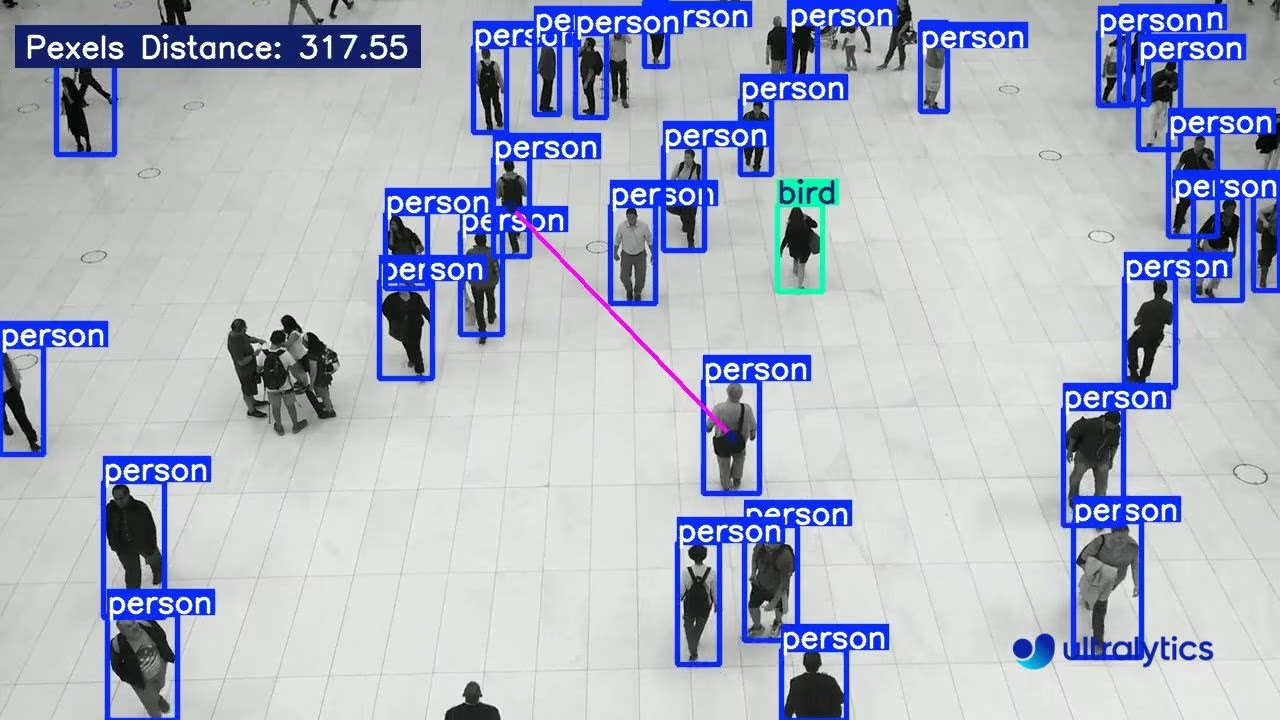
O cálculo de distância é o processo de medir o espaço entre dois objetos detectados em uma imagem ou quadro de vídeo. Com o Ultralytics YOLO26, a solução mede a distância entre os centroides de duas caixas delimitadoras selecionadas pelo usuário.
Assista: Como estimar a distância entre objetos detectados em pixels com Ultralytics YOLO 🚀
Elementos visuais#
| Cálculo de distância usando Ultralytics YOLO26 |
|---|
 |
Vantagens do cálculo de distância#
- Precisão de localização: aprimora o posicionamento espacial preciso em tarefas de visão computacional.
- Estimativa de tamanho: permite estimar o tamanho dos objetos para uma melhor compreensão contextual.
- Compreensão da cena: melhora a compreensão de cenas 3D para uma tomada de decisões mais eficaz em aplicações como veículos autônomos e sistemas de vigilância.
- Prevenção de colisões: permite que os sistemas detectem possíveis colisões monitorando as distâncias entre objetos em movimento.
- Análise espacial: facilita a análise das relações e interações entre objetos no ambiente monitorado.
Cálculo de distância
- Clique com o botão esquerdo do mouse em duas caixas delimitadoras quaisquer para calcular a distância.
- Use o botão direito do mouse para excluir todos os pontos desenhados.
A distância é uma estimativa
A distância é uma estimativa e pode não ser totalmente precisa, pois é calculada com dados 2D, que não contêm informações de profundidade. Para obter profundidade por pixel, use um modelo de estimativa de profundidade.
Calcule distâncias com YOLO26#
A solução DistanceCalculation rastreia objetos entre os quadros e mede a distância euclidiana, em pixels, entre os centroides de duas caixas delimitadoras quaisquer que você selecionar com o mouse. Execute o exemplo abaixo e, em seguida, clique com o botão esquerdo em dois objetos para desenhar a linha que os conecta e ver a distância; clique com o botão direito para limpar a seleção.
import cv2

from ultralytics import solutions

cap = cv2.VideoCapture("path/to/video.mp4")
assert cap.isOpened(), "Error reading video file"

# Gravador de vídeo
w, h, fps = (int(cap.get(x)) for x in (cv2.CAP_PROP_FRAME_WIDTH, cv2.CAP_PROP_FRAME_HEIGHT, cv2.CAP_PROP_FPS))
video_writer = cv2.VideoWriter("distance_output.avi", cv2.VideoWriter_fourcc(*"mp4v"), fps, (w, h))

# Inicializa o objeto de cálculo de distância
distancecalculator = solutions.DistanceCalculation(
    model="yolo26n.pt",  # caminho para o arquivo do modelo YOLO26.
    show=True,  # # Apresenta o resultado
)

# Processa o vídeo
while cap.isOpened():
    success, im0 = cap.read()

    if not success:
        print("Video frame is empty or processing is complete.")
        break

    results = distancecalculator(im0)

    print(results)  # acessa a saída

    video_writer.write(results.plot_im)  # escreve o quadro processado.

cap.release()
video_writer.release()
cv2.destroyAllWindows()  # fecha todas as janelas abertas
Argumentos de DistanceCalculation()#
Aqui está uma tabela com os argumentos de DistanceCalculation:
| Argumento | Tipo | Padrão | Descrição |
|---|---|---|---|
model | str | None | Caminho para um arquivo de modelo Ultralytics YOLO. |
line_width | int | 2 | Espessura das linhas das caixas, dos pontos-chave e das contagens desenhados pela solução. |
verbose | bool | True | Ativa o registro por quadro da solução, com o formato da entrada, as contagens por classe e a velocidade de processamento. A chamada de rastreamento em si é sempre silenciosa. |
Você também pode usar argumentos track na solução DistanceCalculation.
| Argumento | Tipo | Padrão | Descrição |
|---|---|---|---|
tracker | str | 'tracktrack.yaml' | Especifica o algoritmo de rastreamento a utilizar. Opções integradas: botsort.yaml, bytetrack.yaml, ocsort.yaml, deepocsort.yaml, fasttrack.yaml, tracktrack.yaml. |
conf | float | 0.25 | Define o limiar de confiança das deteções; valores mais baixos permitem rastrear mais objetos, mas podem incluir falsos positivos. |
iou | float | 0.5 | Define o limiar de interseção sobre união (IoU) para filtrar deteções sobrepostas. |
classes | list | None | Filtra os resultados pelo índice da classe. Por exemplo, classes=[0, 2, 3] rastreia apenas as classes especificadas. |
device | str | None | Especifica o dispositivo para a inferência (por exemplo, cpu, cuda:0 ou 0). Permite escolher entre CPU, uma GPU específica ou outros dispositivos de computação para executar o modelo. |
imgsz | int or tuple | 640 | Tamanho da imagem de destino para a inferência: um número inteiro para uma imagem quadrada ou um par (height, width). As dimensões são ajustadas ao stride do modelo. |
max_det | int | 300 | Número máximo de deteções mantidas por fotograma antes do rastreamento, limitando os objetos que uma solução processa em cenas densas. |
quantize | int or str | None | Precisão de inferência: 16 (FP16) ou 32/unset (FP32) para modelos PyTorch e TorchScript fora da CPU; os outros formatos usam a precisão selecionada pelo artefato e pelo ambiente de execução. Substitui o argumento obsoleto half. |
Além disso, estão disponíveis os seguintes argumentos de visualização:
| Argumento | Tipo | Padrão | Descrição |
|---|---|---|---|
show | bool | False | Se True, exibe as imagens ou os vídeos anotados em uma janela. Útil para obter feedback visual imediato durante o desenvolvimento ou os testes. |
show_conf | bool | True | Exibe a pontuação de confiança de cada detecção junto ao rótulo. Mostra o grau de certeza do modelo em cada detecção. |
show_labels | bool | True | Exibe os rótulos de cada detecção na saída visual. Permite identificar imediatamente os objetos detectados. |
Detalhes da implementação#
A classe DistanceCalculation funciona rastreando objetos entre quadros de vídeo e calculando a distância euclidiana entre os centroides das caixas delimitadoras selecionadas. Quando você clica em dois objetos, a solução:
- Extrai os centroides (pontos centrais) das caixas delimitadoras selecionadas
- Calcula a distância euclidiana entre esses centroides em pixels
- Exibe a distância no quadro com uma linha conectando os objetos
A implementação usa o método mouse_event_for_distance para lidar com as interações do mouse, permitindo que os usuários selecionem objetos e limpem as seleções conforme necessário. O método process processa cada quadro, rastreia objetos e calcula distâncias.
Aplicações#
O cálculo de distância com YOLO26 tem diversas aplicações práticas:
- Análise do varejo: mede a proximidade dos clientes aos produtos e analisa a eficácia do layout da loja
- Segurança industrial: monitora as distâncias seguras entre trabalhadores e máquinas
- Gestão do trânsito: analisa o espaçamento entre veículos e detecta quando um veículo segue outro muito de perto
- Análise esportiva: calcula as distâncias entre jogadores, a bola e posições importantes no campo
- Saúde: garante o distanciamento adequado em áreas de espera e monitora a movimentação dos pacientes
- Robótica: permite que os robôs mantenham distâncias adequadas de obstáculos e pessoas
Perguntas frequentes#
Para calcular distâncias entre objetos usando Ultralytics YOLO26, você precisa identificar os centroides das caixas delimitadoras dos objetos detectados. Esse processo envolve inicializar a classe
DistanceCalculationdo módulosolutionsda Ultralytics e usar os resultados de rastreamento do modelo para calcular as distâncias.Usar o cálculo de distância com Ultralytics YOLO26 oferece várias vantagens:
- Precisão de localização: fornece posicionamento espacial preciso para os objetos.
- Estimativa de tamanho: ajuda a estimar tamanhos físicos, contribuindo para uma melhor compreensão contextual.
- Compreensão da cena: aprimora a compreensão de cenas 3D, ajudando a tomar melhores decisões em aplicações como direção autônoma e vigilância.
- Processamento em tempo real: realiza cálculos instantaneamente, sendo adequado para análise de vídeo ao vivo.
- Capacidades de integração: funciona com outras soluções YOLO26, como rastreamento de objetos e estimativa de velocidade.
Sim, você pode calcular distâncias em transmissões de vídeo em tempo real com Ultralytics YOLO26. O processo envolve capturar quadros de vídeo usando OpenCV, executar a detecção de objetos do YOLO26 e usar a classe
DistanceCalculationpara calcular as distâncias entre objetos em quadros consecutivos. Para ver uma implementação detalhada, consulte o exemplo de transmissão de vídeo.Para excluir os pontos desenhados durante o cálculo de distância com Ultralytics YOLO26, clique com o botão direito do mouse. Essa ação limpará todos os pontos desenhados. Para mais detalhes, consulte a seção de observações do exemplo de cálculo de distância.
Os principais argumentos para inicializar a classe
DistanceCalculationno Ultralytics YOLO26 incluem:model: caminho para o arquivo do modelo YOLO26.tracker: algoritmo de rastreamento a ser usado (por padrão, as soluções usamtracktrack.yaml).conf: limite de confiança para detecções.show: sinalizador para exibir a saída.
Para ver a lista completa e os valores padrão, consulte os argumentos de DistanceCalculation.


Comentários195
Faz uma pergunta, partilha os teus resultados ou ajuda alguém.
muhammadwildangoni
hallo, I am processing a men's 100 meter sprint video using YOLO and SpeedEstimator (Ultralytics) to detect runners, estimate their speed, and track their progress. However, the output statistics are incorrect. My code detects 16 runners, while there should only be 8 (those on the track), and the maximum speed reported is 0.00 m/s, which is clearly not correct for a sprint race. The furthest distance covered is about 96.7 meters, which seems off.
import cv2 import math import numpy as np from ultralytics import YOLO from ultralytics.solutions import speed_estimation
--- SETTINGS ---
video_path = "WHAT A RACE! _ Men s 100m Final! _ #Paris2024 highlights (online-video-cutter.com).mp4" # Change to your video path model_path = "yolo11n.pt" # Path to your YOLO model (could be yolov11n.pt if available) output_path = "output_sprint.avi" # Output video file name
meter_per_pixel = 0.05 # Calibration result for track (e.g., 0.05 for a 100m lane) center_point = (0, 720) # Track start point (adjust to your video height)
--- INITIALIZATION ---
cap = cv2.VideoCapture(video_path) assert cap.isOpened(), "Error reading video file"
w, h, fps = (int(cap.get(x)) for x in (cv2.CAP_PROP_FRAME_WIDTH, cv2.CAP_PROP_FRAME_HEIGHT, cv2.CAP_PROP_FPS)) out = cv2.VideoWriter(output_path, cv2.VideoWriter_fourcc(*"MJPG"), fps, (w, h))
model = YOLO(model_path) names = model.model.names if hasattr(model.model, "names") else ["person"]
speed_obj = speed_estimation.SpeedEstimator( names=names, reg_pts=[(0, int(h/2)), (w, int(h/2))], # Speed estimation line (across track, adjust as needed) view_img=False, meter_per_pixel=meter_per_pixel # Convert pixel to meters )
frame_count = 0 speed_over_time, distance_over_time = {}, {}
while cap.isOpened(): success, frame = cap.read() if not success: break frame_count += 1
# Detect and track runners on each frame
tracks = model.track(frame, persist=True, show=False)

# Estimate runners' speed and update visualization on frame
frame = speed_obj.estimate_speed(frame)

# Extract runner IDs, position, speed, and distance
# Make sure .boxes.id/cls property exists:
if tracks and hasattr(tracks[0], "boxes") and tracks[0].boxes.id is not None:
    boxes = tracks[0].boxes.xyxy.cpu()
    track_ids = tracks[0].boxes.id.int().cpu().tolist()
    clss = tracks[0].boxes.cls.cpu().tolist()
    for box, track_id, cls in zip(boxes, track_ids, clss):
        if cls == 0:  # 'person' class (runners)
            # Calculate runner's distance from start
            x1, y1 = int((box[0] + box[2]) // 2), int((box[1] + box[3]) // 2)
            distance = (math.sqrt((x1 - center_point[0]) ** 2 + (y1 - center_point[1]) ** 2)) * meter_per_pixel

            # Store statistics in dictionary
            if track_id not in distance_over_time:
                distance_over_time[track_id] = [0] * (frame_count - 1)
            distance_over_time[track_id].append(distance)

            speed = speed_obj.speeds.get(track_id, 0) if hasattr(speed_obj, "speeds") else 0
            if track_id not in speed_over_time:
                speed_over_time[track_id] = [0] * (frame_count - 1)
            speed_over_time[track_id].append(speed)

            # Overlay runner's speed and distance information directly on video frame
            text_speed = f"Speed: {speed:.2f} m/s"
            text_dist = f"Distance: {distance:.2f} m"
            cv2.putText(frame, f"ID:{track_id} {text_speed}, {text_dist}", (x1, y1 - 10),
                        cv2.FONT_HERSHEY_SIMPLEX, 0.8, (0,255,0), 2)

# Save frame to output video
out.write(frame)

# Display real-time video preview
cv2.imshow("Sprint Runner Detection Preview", frame)
if cv2.waitKey(1) & 0xFF == ord("q"):
    break
cap.release() out.release() cv2.destroyAllWindows()
--- Final statistics: print results to terminal ---
best_speed = max((max(speeds) for speeds in speed_over_time.values()), default=0) best_distance = max((max(distances) for distances in distance_over_time.values()), default=0) total_runners = len(distance_over_time)
print(f"Total runners detected: {total_runners}") print(f"Highest speed: {best_speed:.2f} m/s") print(f"Furthest distance covered: {best_distance:.2f} meters")
maribalke(editado)
Hi! I have tried to do a test on the distance calculation on a single image, but I keep getting the attribute error: 'DistanceCalculation' object has no attribute 'start_process'. I have basis in the YOLO11n-model, further trained on images from a different dataset.
model_path = "../runs/detect/train2/weights/best.pt" model = YOLO(model_path) dist_obj = distance_calculation.DistanceCalculation() frame = cv2.imread("../images/s73/raw_images/10.jpg") # Detect objects results = model(frame) # Run object tracking tracks = model.track(frame, persist=True, show = False) # process the image image_with_distances = dist_obj.start_process(frame, tracks) # Display the frame cv2.imshow('Distance Calculation', image_with_distances) cv2.waitKey(0) cv2.destroyAllWindows() Glenn JocherUltralytics(editado)
@maribalke thanks for reaching out!
start_process()has been removed.DistanceCalculationis now called directly on the frame and returns a results object with the annotated image inplot_im. It also runs tracking itself, so no separatemodel.track()call is needed. Here's the minimal fix for your single-image case:dist_obj = solutions.DistanceCalculation(model=model_path, show=False) results = dist_obj(frame) cv2.imshow("Distance Calculation", results.plot_im)Note that the distance is measured between two objects you select by clicking them in a display window, so a single static image only shows a distance once two boxes have been selected. For full implementation details, see our Distance Calculation Guide. Let us know if you encounter any other issues!
dgnovo
Is it possible to know the distance from an object and another object without using mouse?
- Glenn JocherUltralytics
@dgnovo yes, it's possible. You can calculate distances programmatically by using bounding box centroids from YOLO11 detections and computing the Euclidean distance between them without relying on mouse clicks. Refer to the
DistanceCalculationimplementation to customize the process for your needs: https://docs.ultralytics.com/guides/distance-calculation/.1
Muhammad-237
How can we find the distance of in the bounding box like from one point to another point in the bounding box to measure the size of object
- Glenn JocherUltralytics
@Muhammad-237 to measure the size of an object within a bounding box using Ultralytics YOLO11, you can calculate the distance between two points (e.g., edges or centroid) within that bounding box. This can be achieved using the
DistanceCalculationclass, which allows you to click on specific points to measure distances. Keep in mind, these calculations are approximations as they rely on 2D data without depth information. For more details, refer to the Distance Calculation Docs.
gg120wolf
Hi, I am using the example code of Distance Calculation using YOLO11 Example, but there is a problem of File "f:\fyp yolo\ultralytics-main\distance test1.py", line 13, in distance = solutions.DistanceCalculation() ^^^^^^^^^^^^^^^^^^^^^^^^^^^^^^^ TypeError: DistanceCalculation.init() missing 1 required positional argument: 'names' So what is this names should i set?
RizwanMunawar
@gg120wolf Hi, the correct way to use the Ultralytics distance calculation module is mentioned below.
import cv2

from ultralytics import solutions

cap = cv2.VideoCapture("Path/to/video/file.mp4")
assert cap.isOpened(), "Error reading video file"
w, h, fps = (int(cap.get(x)) for x in (cv2.CAP_PROP_FRAME_WIDTH, cv2.CAP_PROP_FRAME_HEIGHT, cv2.CAP_PROP_FPS))

# Video writer
video_writer = cv2.VideoWriter("distance_calculation.avi", cv2.VideoWriter_fourcc(*"mp4v"), fps, (w, h))

# Init distance-calculation obj
distance = solutions.DistanceCalculation(model="yolo11n.pt", show=True)

# Process video
while cap.isOpened():
    success, im0 = cap.read()
    if not success:
        print("Video frame is empty or video processing has been successfully completed.")
        break
    im0 = distance.calculate(im0)
    video_writer.write(im0)

cap.release()
video_writer.release()
cv2.destroyAllWindows()
Thanks :) The Ultralytics Team!
tylerfrisinger01
Hey there, I have a model that is trained for object detection not tracking. We are detecting two animals that are inside a cage. What we want to do is import a mp4 video then calculate the distance between the two objects while also showing the bounding boxes. However when i use the VideoStream code snippet from above, the popup window is larger then my screen. How could i adjust that code to make it a different window size so that I am able to track them in real time.
Also after this is done and the distances are calculated is there anyway to save the whole video with the bounding boxes and the distance calculations that were done in real time? Or would I have to save the video by doing the results = model.predict(save=true) and also do the VideoStream code snippet from above at the same time? and not have the distances shown in the saved video?
Get back to me as soon as possible as this is for a project for school! Thank You!!
I am also using YOLOv11, i'm not sure if that will change anything or not. And i have tried creating my own window using cv2 but that didnt work when i attempted it.
- Glenn JocherUltralytics
@tylerfrisinger01 to adjust the window size in OpenCV, you can use
cv2.namedWindow()andcv2.resizeWindow()to set a custom size. For saving the video with bounding boxes and distances, you can modify the code to include distance annotations and usecv2.VideoWriterto save the processed frames. Here's a quick example on resizing the window:cv2.namedWindow('Video', cv2.WINDOW_NORMAL) cv2.resizeWindow('Video', 800, 600) # Adjust the dimensions as neededRegarding saving the video with distances, you can overlay the distance on the frames before writing them out with
cv2.VideoWriter. If you need further assistance, feel free to ask! @glenn-jocher when I do this, it still pops open its own window that I am assuming is built into the solutions.DistanceCalculator function (since that is the name of the window) So then it does not work. Any workaround for this?
- Glenn JocherUltralytics(editado)
@tylerfrisinger01 to prevent the
DistanceCalculationfunction from opening its own window, you can set theshowparameter toFalsewhen initializing it, like so:distance = solutions.DistanceCalculation(model="yolo26n.pt", show=False). This should stop the automatic display window. For saving the video, continue usingcv2.VideoWriter. Let me know if you need further assistance!
Abtinz
Hello everyone, I want to deploy an yolov8-application on the edge device and estimate the distance through the user's camera without having to click on the detected object, how can I find the distance of the objects to the camera without need to click?
- Glenn JocherUltralytics
@Abtinz to estimate object distances without clicking, you'll need to use depth estimation techniques, as YOLOv8 primarily provides 2D bounding boxes. Consider integrating depth sensors or stereo cameras to obtain depth information. For more details, you can refer to the distance calculation guide.
gaodaren47297
Hi,Is there a method to calculate the distance between the camera and the objects?
- Glenn JocherUltralytics(editado)
@gaodaren47297 the
DistanceCalculationsolution measures the pixel distance between the centroids of two objects you select in the frame; it does not estimate the distance between the camera and an object. A 2D bounding box has no depth information, so camera-to-object distance needs extra information such as a depth sensor or stereo camera, or a calibration using an object of known size. For measuring between objects, see the distance calculation documentation on our website. If you have further questions, feel free to ask here.
Dmitrii-Smirnov
Hi Guys, Guys, I have a video with multiple objects(people) on the video. I need to calculate distance between each detected person on the each frame and to save results to csv file. Can you help me with that task? It will be really cool if you will share documentation=) As I understood relevant method for my task is DistanceCalculation(names=names[0], view_img=True).calculate_distance(obj1, obj2), am I correct?
- Glenn JocherUltralytics(editado)
@Dmitrii-Smirnov there is no
calculate_distance(obj1, obj2)method onDistanceCalculationin current versions. The solution is called on each frame (results = dist_obj(im0)), you left-click two tracked objects, and it reports the pixel distance inresults.pixels_distance. For distances between every pair of people on each frame and a CSV export, compute the centroid distances from the tracking boxes yourself. For details, see our documentation: https://docs.ultralytics.com/guides/distance-calculation/. Thank you!
- Glenn JocherUltralytics(editado)
@Dmitrii-Smirnov to calculate distances between all detected people in each frame and save the results to a CSV file, compute the centroid distances from the tracking results. The
DistanceCalculationsolution only measures between two objects you click, so for all pairs here's a basic implementation:import csv import math from itertools import combinations import cv2 from ultralytics import YOLO model = YOLO("yolo26n.pt") cap = cv2.VideoCapture("path/to/video/file.mp4") assert cap.isOpened(), "Error reading video file" with open("distances.csv", mode="w", newline="") as file: writer = csv.writer(file) writer.writerow(["Frame", "Object1", "Object2", "Distance"]) frame_count = 0 while cap.isOpened(): success, im0 = cap.read() if not success: break results = model.track(im0, persist=True, show=False, classes=[0]) # class 0 = person boxes = results[0].boxes if boxes.id is not None: centroids = dict(zip(boxes.id.int().tolist(), boxes.xywh[:, :2].tolist())) for (id1, c1), (id2, c2) in combinations(centroids.items(), 2): writer.writerow([frame_count, id1, id2, math.dist(c1, c2)]) frame_count += 1 cap.release()This script captures video frames, calculates pixel distances between detected people, and writes the results to a CSV file. For more details, refer to our documentation: https://docs.ultralytics.com/guides/distance-calculation/.
zgr1446741194
Hello author, I would like to propose a scenario similar to this: using monocular distance measurement to calculate the distance from the distant water level line (similar to the shoreline) in the video stream obtained by the camera to my camera (a kind of early warning of the water level), how can I use the solution? At present, the difficulty can be determined that we need to complete distance conversion similar to 3D to 2D, because of perspective space, instead of using fixed linear distance conversion similar to visionEye (from pixels to realistic distance). Another difficulty is that we do not know the true physical properties of the observed water line, which means that we cannot use the traditional method of monocular distance measurement to deduce the distance from the true length or height of the observed object. If you have any viable solutions, thank you very much for adding the code demo in your reply.
- Glenn JocherUltralytics
For calculating distances to a waterline using monocular vision, consider using depth estimation techniques or stereo vision for more accurate results. YOLO models can assist in object detection, but for precise distance measurement, integrating additional sensors or methods might be necessary. For more details, please refer to our distance calculation guide.