Ultralytics YOLO26 ile Mesafe Hesaplama
Mesafe Hesaplama Nedir?#
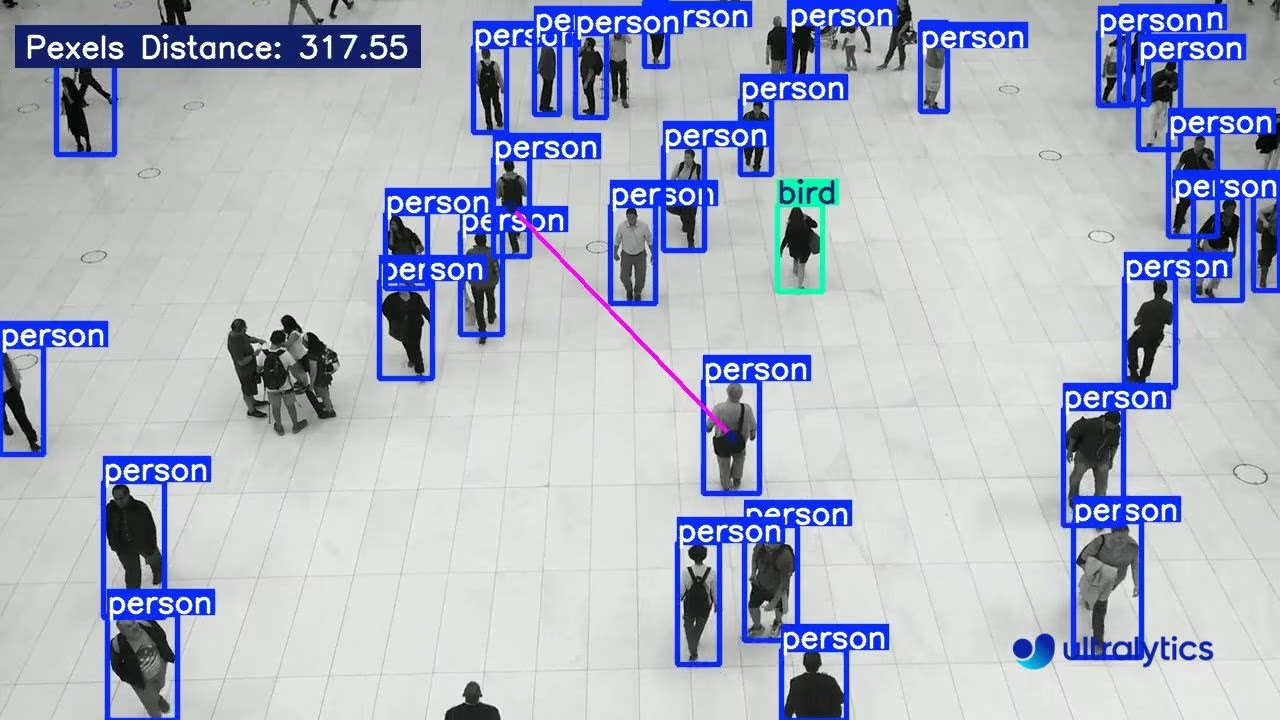
Mesafe hesaplama, bir görüntü veya video karesinde algılanan iki nesne arasındaki boşluğun ölçülmesi işlemidir. Ultralytics YOLO26 ile çözüm, kullanıcının seçtiği iki sınırlayıcı kutunun ağırlık merkezleri arasındaki mesafeyi ölçer.
İzle: Ultralytics YOLO ile Algılanan Nesneler Arasındaki Mesafe Piksel Cinsinden Nasıl Tahmin Edilir 🚀
Görseller#
| Ultralytics YOLO26 ile Mesafe Hesaplama |
|---|
 |
Mesafe Hesaplamanın Avantajları#
- Konum Belirleme Hassasiyeti: Bilgisayarlı görü görevlerinde hassas uzamsal konumlandırmayı iyileştirir.
- Boyut Tahmini: Bağlamsal kavrayışı iyileştirmek için nesne boyutunun tahmin edilmesini sağlar.
- Sahneyi Anlama: Otonom araçlar ve gözetim sistemleri gibi uygulamalarda daha iyi karar vermek için 3B sahne kavrayışını geliştirir.
- Çarpışmayı Önleme: Hareketli nesneler arasındaki mesafeleri izleyerek sistemlerin olası çarpışmaları tespit etmesini sağlar.
- Mekânsal Analiz: İzlenen ortam içindeki nesne ilişkilerinin ve etkileşimlerinin analizini kolaylaştırır.
Mesafe Hesaplama
- Mesafeyi hesaplamak için sol fare düğmesiyle herhangi iki sınırlayıcı kutuya tıkla.
- Çizilen tüm noktaları silmek için sağ fare düğmesini kullan.
Mesafe bir tahmindir
Mesafe bir tahmindir ve 2B veriler kullanılarak hesaplandığından derinlik bilgisi içermeyebilir; bu nedenle tamamen doğru olmayabilir. Piksel düzeyinde derinlik için bir derinlik tahmini modeli kullan.
YOLO26 ile Mesafeleri Hesapla#
DistanceCalculation çözümü nesneleri kareler boyunca izler ve fareyle seçtiğin herhangi iki sınırlayıcı kutunun ağırlık merkezleri arasındaki Öklid mesafesini piksel cinsinden ölçer. Aşağıdaki örneği çalıştır, ardından bağlantı çizgisini çizmek ve mesafeyi görmek için iki nesneye sol tıkl; seçimini temizlemek için sağ tıkla.
import cv2

from ultralytics import solutions

cap = cv2.VideoCapture("path/to/video.mp4")
assert cap.isOpened(), "Error reading video file"

# Video yazıcısı
w, h, fps = (int(cap.get(x)) for x in (cv2.CAP_PROP_FRAME_WIDTH, cv2.CAP_PROP_FRAME_HEIGHT, cv2.CAP_PROP_FPS))
video_writer = cv2.VideoWriter("distance_output.avi", cv2.VideoWriter_fourcc(*"mp4v"), fps, (w, h))

# Mesafe hesaplama nesnesini başlat
distancecalculator = solutions.DistanceCalculation(
    model="yolo26n.pt",  # YOLO26 model dosyasının yolu.
    show=True,  # çıktıyı görüntüle
)

# Videoyu işle
while cap.isOpened():
    success, im0 = cap.read()

    if not success:
        print("Video frame is empty or processing is complete.")
        break

    results = distancecalculator(im0)

    print(results)  # çıktıya eriş

    video_writer.write(results.plot_im)  # işlenmiş kareyi yaz.

cap.release()
video_writer.release()
cv2.destroyAllWindows()  # açık tüm pencereleri kapat
DistanceCalculation() Bağımsız Değişkenleri#
Aşağıda DistanceCalculation bağımsız değişkenlerini içeren bir tablo bulabilirsin:
| Bağımsız değişken | Tür | Varsayılan | Açıklama |
|---|---|---|---|
model | str | None | Ultralytics YOLO model dosyasının yolu. |
line_width | int | 2 | Çözümün çizdiği kutular, anahtar noktalar ve sayılar için çizgi kalınlığı. |
verbose | bool | True | Çözümün her kare için girdi şekli, sınıf sayıları ve işleme hızına ilişkin günlüğünü etkinleştirir. İzleme çağrısının kendisi her zaman sessizdir. |
DistanceCalculation çözümünde track bağımsız değişkenlerini de kullanabilirsin.
| Bağımsız değişken | Tür | Varsayılan | Açıklama |
|---|---|---|---|
tracker | str | 'tracktrack.yaml' | Kullanılacak izleme algoritmasını belirtir. Yerleşik seçenekler: botsort.yaml, bytetrack.yaml, ocsort.yaml, deepocsort.yaml, fasttrack.yaml, tracktrack.yaml. |
conf | float | 0.25 | Algılamalar için güven eşiğini belirler; düşük değerler daha fazla nesnenin izlenmesine olanak tanır ancak yanlış pozitifleri de içerebilir. |
iou | float | 0.5 | Çakışan algılamaları filtrelemek için Kesişim-Birleşim Oranı (IoU) eşiğini belirler. |
classes | list | None | Sonuçları sınıf dizinine göre filtreler. Örneğin, classes=[0, 2, 3] yalnızca belirtilen sınıfları izler. |
device | str | None | Çıkarım için kullanılacak cihazı belirtir (ör. cpu, cuda:0 veya 0). Kullanıcıların model yürütme için CPU, belirli bir GPU veya başka hesaplama cihazları arasında seçim yapmasına olanak tanır. |
imgsz | int or tuple | 640 | Hedef çıkarım görüntü boyutu: kare görüntüler için bir tam sayı veya bir (height, width) çifti. Boyutlar model adım değerine göre ayarlanır. |
max_det | int | 300 | Yoğun sahnelerde bir çözümün işleyeceği nesne sayısını sınırlamak için izleme öncesinde kare başına tutulan en yüksek algılama sayısı. |
quantize | int or str | None | Çıkarım hassasiyeti: CPU dışında PyTorch ve TorchScript modelleri için 16 (FP16) veya 32/unset (FP32); diğer biçimler, model yapıtının ve çalışma zamanının seçtiği hassasiyeti kullanır. Kullanımdan kaldırılan half argümanının yerini alır. |
Ayrıca aşağıdaki görselleştirme bağımsız değişkenleri kullanılabilir:
| Bağımsız değişken | Tür | Varsayılan | Açıklama |
|---|---|---|---|
show | bool | False | True ise açıklama eklenmiş görüntüleri veya videoları bir pencerede gösterir. Geliştirme veya test sırasında anında görsel geri bildirim almak için kullanışlıdır. |
show_conf | bool | True | Her algılamanın güven puanını etiketinin yanında gösterir. Modelin her algılamaya ne kadar güvendiğini görmeni sağlar. |
show_labels | bool | True | Görsel çıktıda her algılama için etiketleri gösterir. Algılanan nesnelerin hemen anlaşılmasını sağlar. |
Uygulama Ayrıntıları#
DistanceCalculation sınıfı, nesneleri video kareleri boyunca izleyerek ve seçilen sınırlayıcı kutuların ağırlık merkezleri arasındaki Öklid mesafesini hesaplayarak çalışır. İki nesneye tıkladığında çözüm şunları yapar:
- Seçilen sınırlayıcı kutuların ağırlık merkezlerini (merkez noktalarını) çıkarır
- Bu ağırlık merkezleri arasındaki Öklid mesafesini piksel cinsinden hesaplar
- Nesneler arasına bağlantı çizgisi çizerek mesafeyi kare üzerinde gösterir
Uygulama, fare etkileşimlerini yönetmek için mouse_event_for_distance yöntemini kullanır; böylece kullanıcılar nesneleri seçebilir ve gerektiğinde seçimleri temizleyebilir. process yöntemi ise kare kare işlemeyi, nesneleri izlemeyi ve mesafeleri hesaplamayı yönetir.
Uygulamalar#
YOLO26 ile mesafe hesaplama, çok sayıda pratik uygulama sunar:
- Perakende Analitiği: Müşterilerin ürünlere yakınlığını ölç ve mağaza yerleşiminin etkinliğini analiz et
- Endüstriyel Güvenlik: Çalışanlar ve makineler arasındaki güvenli mesafeleri izle
- Trafik Yönetimi: Araçlar arasındaki mesafeyi analiz et ve takip mesafesini korumama durumlarını tespit et
- Spor Analizi: Oyuncular, top ve sahadaki önemli konumlar arasındaki mesafeleri hesapla
- Sağlık Hizmetleri: Bekleme alanlarında uygun mesafeyi koru ve hasta hareketlerini izle
- Robotik: Robotların engellere ve insanlara uygun mesafeyi korumasını sağla
Sık Sorulan Sorular#
Ultralytics YOLO26 ile nesneler arasındaki mesafeleri hesaplamak için tespit edilen nesnelerin sınırlayıcı kutularının ağırlık merkezlerini belirlemen gerekir. Bu işlem, Ultralytics'in
solutionsmodülündekiDistanceCalculationsınıfını başlatmayı ve mesafeleri hesaplamak için modelin izleme çıktılarını kullanmayı içerir.Ultralytics YOLO26 ile mesafe hesaplama çeşitli avantajlar sunar:
- Yerelleştirme Hassasiyeti: Nesnelerin konumunu hassas biçimde belirler.
- Boyut Tahmini: Fiziksel boyutları tahmin etmeye yardımcı olarak bağlamsal kavrayışı iyileştirir.
- Sahneyi Anlama: 3B sahne kavrayışını geliştirerek otonom sürüş ve gözetim gibi uygulamalarda daha iyi kararlar alınmasına yardımcı olur.
- Gerçek Zamanlı İşleme: Hesaplamaları anında gerçekleştirir; bu da canlı video analizi için uygun olmasını sağlar.
- Entegrasyon Yetenekleri: Nesne izleme ve hız tahmini gibi diğer YOLO26 çözümleriyle birlikte çalışır.
Evet, Ultralytics YOLO26 ile gerçek zamanlı video akışlarında mesafe hesaplayabilirsin. Bu işlem, OpenCV kullanarak video karelerini yakalamayı, YOLO26 ile nesne tespiti yapmayı ve ardışık karelerdeki nesneler arasındaki mesafeleri hesaplamak için
DistanceCalculationsınıfını kullanmayı içerir. Ayrıntılı bir uygulama için video akışı örneğine bak.Ultralytics YOLO26 ile mesafe hesaplarken çizilen noktaları silmek için sağ fare düğmesiyle tıklayabilirsin. Bu işlem çizdiğin tüm noktaları temizler. Daha fazla ayrıntı için mesafe hesaplama örneğinin altındaki notlar bölümüne bak.
Ultralytics YOLO26'da
DistanceCalculationsınıfını başlatmak için kullanılan temel bağımsız değişkenler şunlardır:model: YOLO26 model dosyasının yolu.tracker: Kullanılacak izleme algoritması (Solutions varsayılan olaraktracktrack.yamlkullanır).conf: Tespitler için güven eşiği.show: Çıktıyı görüntüleme bayrağı.
Eksiksiz liste ve varsayılan değerler için DistanceCalculation bağımsız değişkenlerine bak.


Yorumlar195
Bir soru sor, sonuçlarını paylaş veya başka birine yardım et.
muhammadwildangoni
hallo, I am processing a men's 100 meter sprint video using YOLO and SpeedEstimator (Ultralytics) to detect runners, estimate their speed, and track their progress. However, the output statistics are incorrect. My code detects 16 runners, while there should only be 8 (those on the track), and the maximum speed reported is 0.00 m/s, which is clearly not correct for a sprint race. The furthest distance covered is about 96.7 meters, which seems off.
import cv2 import math import numpy as np from ultralytics import YOLO from ultralytics.solutions import speed_estimation
--- SETTINGS ---
video_path = "WHAT A RACE! _ Men s 100m Final! _ #Paris2024 highlights (online-video-cutter.com).mp4" # Change to your video path model_path = "yolo11n.pt" # Path to your YOLO model (could be yolov11n.pt if available) output_path = "output_sprint.avi" # Output video file name
meter_per_pixel = 0.05 # Calibration result for track (e.g., 0.05 for a 100m lane) center_point = (0, 720) # Track start point (adjust to your video height)
--- INITIALIZATION ---
cap = cv2.VideoCapture(video_path) assert cap.isOpened(), "Error reading video file"
w, h, fps = (int(cap.get(x)) for x in (cv2.CAP_PROP_FRAME_WIDTH, cv2.CAP_PROP_FRAME_HEIGHT, cv2.CAP_PROP_FPS)) out = cv2.VideoWriter(output_path, cv2.VideoWriter_fourcc(*"MJPG"), fps, (w, h))
model = YOLO(model_path) names = model.model.names if hasattr(model.model, "names") else ["person"]
speed_obj = speed_estimation.SpeedEstimator( names=names, reg_pts=[(0, int(h/2)), (w, int(h/2))], # Speed estimation line (across track, adjust as needed) view_img=False, meter_per_pixel=meter_per_pixel # Convert pixel to meters )
frame_count = 0 speed_over_time, distance_over_time = {}, {}
while cap.isOpened(): success, frame = cap.read() if not success: break frame_count += 1
# Detect and track runners on each frame
tracks = model.track(frame, persist=True, show=False)

# Estimate runners' speed and update visualization on frame
frame = speed_obj.estimate_speed(frame)

# Extract runner IDs, position, speed, and distance
# Make sure .boxes.id/cls property exists:
if tracks and hasattr(tracks[0], "boxes") and tracks[0].boxes.id is not None:
    boxes = tracks[0].boxes.xyxy.cpu()
    track_ids = tracks[0].boxes.id.int().cpu().tolist()
    clss = tracks[0].boxes.cls.cpu().tolist()
    for box, track_id, cls in zip(boxes, track_ids, clss):
        if cls == 0:  # 'person' class (runners)
            # Calculate runner's distance from start
            x1, y1 = int((box[0] + box[2]) // 2), int((box[1] + box[3]) // 2)
            distance = (math.sqrt((x1 - center_point[0]) ** 2 + (y1 - center_point[1]) ** 2)) * meter_per_pixel

            # Store statistics in dictionary
            if track_id not in distance_over_time:
                distance_over_time[track_id] = [0] * (frame_count - 1)
            distance_over_time[track_id].append(distance)

            speed = speed_obj.speeds.get(track_id, 0) if hasattr(speed_obj, "speeds") else 0
            if track_id not in speed_over_time:
                speed_over_time[track_id] = [0] * (frame_count - 1)
            speed_over_time[track_id].append(speed)

            # Overlay runner's speed and distance information directly on video frame
            text_speed = f"Speed: {speed:.2f} m/s"
            text_dist = f"Distance: {distance:.2f} m"
            cv2.putText(frame, f"ID:{track_id} {text_speed}, {text_dist}", (x1, y1 - 10),
                        cv2.FONT_HERSHEY_SIMPLEX, 0.8, (0,255,0), 2)

# Save frame to output video
out.write(frame)

# Display real-time video preview
cv2.imshow("Sprint Runner Detection Preview", frame)
if cv2.waitKey(1) & 0xFF == ord("q"):
    break
cap.release() out.release() cv2.destroyAllWindows()
--- Final statistics: print results to terminal ---
best_speed = max((max(speeds) for speeds in speed_over_time.values()), default=0) best_distance = max((max(distances) for distances in distance_over_time.values()), default=0) total_runners = len(distance_over_time)
print(f"Total runners detected: {total_runners}") print(f"Highest speed: {best_speed:.2f} m/s") print(f"Furthest distance covered: {best_distance:.2f} meters")
maribalke(düzenlendi)
Hi! I have tried to do a test on the distance calculation on a single image, but I keep getting the attribute error: 'DistanceCalculation' object has no attribute 'start_process'. I have basis in the YOLO11n-model, further trained on images from a different dataset.
model_path = "../runs/detect/train2/weights/best.pt" model = YOLO(model_path) dist_obj = distance_calculation.DistanceCalculation() frame = cv2.imread("../images/s73/raw_images/10.jpg") # Detect objects results = model(frame) # Run object tracking tracks = model.track(frame, persist=True, show = False) # process the image image_with_distances = dist_obj.start_process(frame, tracks) # Display the frame cv2.imshow('Distance Calculation', image_with_distances) cv2.waitKey(0) cv2.destroyAllWindows() Glenn JocherUltralytics(düzenlendi)
@maribalke thanks for reaching out!
start_process()has been removed.DistanceCalculationis now called directly on the frame and returns a results object with the annotated image inplot_im. It also runs tracking itself, so no separatemodel.track()call is needed. Here's the minimal fix for your single-image case:dist_obj = solutions.DistanceCalculation(model=model_path, show=False) results = dist_obj(frame) cv2.imshow("Distance Calculation", results.plot_im)Note that the distance is measured between two objects you select by clicking them in a display window, so a single static image only shows a distance once two boxes have been selected. For full implementation details, see our Distance Calculation Guide. Let us know if you encounter any other issues!
dgnovo
Is it possible to know the distance from an object and another object without using mouse?
- Glenn JocherUltralytics
@dgnovo yes, it's possible. You can calculate distances programmatically by using bounding box centroids from YOLO11 detections and computing the Euclidean distance between them without relying on mouse clicks. Refer to the
DistanceCalculationimplementation to customize the process for your needs: https://docs.ultralytics.com/guides/distance-calculation/.1
Muhammad-237
How can we find the distance of in the bounding box like from one point to another point in the bounding box to measure the size of object
- Glenn JocherUltralytics
@Muhammad-237 to measure the size of an object within a bounding box using Ultralytics YOLO11, you can calculate the distance between two points (e.g., edges or centroid) within that bounding box. This can be achieved using the
DistanceCalculationclass, which allows you to click on specific points to measure distances. Keep in mind, these calculations are approximations as they rely on 2D data without depth information. For more details, refer to the Distance Calculation Docs.
gg120wolf
Hi, I am using the example code of Distance Calculation using YOLO11 Example, but there is a problem of File "f:\fyp yolo\ultralytics-main\distance test1.py", line 13, in distance = solutions.DistanceCalculation() ^^^^^^^^^^^^^^^^^^^^^^^^^^^^^^^ TypeError: DistanceCalculation.init() missing 1 required positional argument: 'names' So what is this names should i set?
RizwanMunawar
@gg120wolf Hi, the correct way to use the Ultralytics distance calculation module is mentioned below.
import cv2

from ultralytics import solutions

cap = cv2.VideoCapture("Path/to/video/file.mp4")
assert cap.isOpened(), "Error reading video file"
w, h, fps = (int(cap.get(x)) for x in (cv2.CAP_PROP_FRAME_WIDTH, cv2.CAP_PROP_FRAME_HEIGHT, cv2.CAP_PROP_FPS))

# Video writer
video_writer = cv2.VideoWriter("distance_calculation.avi", cv2.VideoWriter_fourcc(*"mp4v"), fps, (w, h))

# Init distance-calculation obj
distance = solutions.DistanceCalculation(model="yolo11n.pt", show=True)

# Process video
while cap.isOpened():
    success, im0 = cap.read()
    if not success:
        print("Video frame is empty or video processing has been successfully completed.")
        break
    im0 = distance.calculate(im0)
    video_writer.write(im0)

cap.release()
video_writer.release()
cv2.destroyAllWindows()
Thanks :) The Ultralytics Team!
tylerfrisinger01
Hey there, I have a model that is trained for object detection not tracking. We are detecting two animals that are inside a cage. What we want to do is import a mp4 video then calculate the distance between the two objects while also showing the bounding boxes. However when i use the VideoStream code snippet from above, the popup window is larger then my screen. How could i adjust that code to make it a different window size so that I am able to track them in real time.
Also after this is done and the distances are calculated is there anyway to save the whole video with the bounding boxes and the distance calculations that were done in real time? Or would I have to save the video by doing the results = model.predict(save=true) and also do the VideoStream code snippet from above at the same time? and not have the distances shown in the saved video?
Get back to me as soon as possible as this is for a project for school! Thank You!!
I am also using YOLOv11, i'm not sure if that will change anything or not. And i have tried creating my own window using cv2 but that didnt work when i attempted it.
- Glenn JocherUltralytics
@tylerfrisinger01 to adjust the window size in OpenCV, you can use
cv2.namedWindow()andcv2.resizeWindow()to set a custom size. For saving the video with bounding boxes and distances, you can modify the code to include distance annotations and usecv2.VideoWriterto save the processed frames. Here's a quick example on resizing the window:cv2.namedWindow('Video', cv2.WINDOW_NORMAL) cv2.resizeWindow('Video', 800, 600) # Adjust the dimensions as neededRegarding saving the video with distances, you can overlay the distance on the frames before writing them out with
cv2.VideoWriter. If you need further assistance, feel free to ask! @glenn-jocher when I do this, it still pops open its own window that I am assuming is built into the solutions.DistanceCalculator function (since that is the name of the window) So then it does not work. Any workaround for this?
- Glenn JocherUltralytics(düzenlendi)
@tylerfrisinger01 to prevent the
DistanceCalculationfunction from opening its own window, you can set theshowparameter toFalsewhen initializing it, like so:distance = solutions.DistanceCalculation(model="yolo26n.pt", show=False). This should stop the automatic display window. For saving the video, continue usingcv2.VideoWriter. Let me know if you need further assistance!
Abtinz
Hello everyone, I want to deploy an yolov8-application on the edge device and estimate the distance through the user's camera without having to click on the detected object, how can I find the distance of the objects to the camera without need to click?
- Glenn JocherUltralytics
@Abtinz to estimate object distances without clicking, you'll need to use depth estimation techniques, as YOLOv8 primarily provides 2D bounding boxes. Consider integrating depth sensors or stereo cameras to obtain depth information. For more details, you can refer to the distance calculation guide.
gaodaren47297
Hi,Is there a method to calculate the distance between the camera and the objects?
- Glenn JocherUltralytics(düzenlendi)
@gaodaren47297 the
DistanceCalculationsolution measures the pixel distance between the centroids of two objects you select in the frame; it does not estimate the distance between the camera and an object. A 2D bounding box has no depth information, so camera-to-object distance needs extra information such as a depth sensor or stereo camera, or a calibration using an object of known size. For measuring between objects, see the distance calculation documentation on our website. If you have further questions, feel free to ask here.
Dmitrii-Smirnov
Hi Guys, Guys, I have a video with multiple objects(people) on the video. I need to calculate distance between each detected person on the each frame and to save results to csv file. Can you help me with that task? It will be really cool if you will share documentation=) As I understood relevant method for my task is DistanceCalculation(names=names[0], view_img=True).calculate_distance(obj1, obj2), am I correct?
- Glenn JocherUltralytics(düzenlendi)
@Dmitrii-Smirnov there is no
calculate_distance(obj1, obj2)method onDistanceCalculationin current versions. The solution is called on each frame (results = dist_obj(im0)), you left-click two tracked objects, and it reports the pixel distance inresults.pixels_distance. For distances between every pair of people on each frame and a CSV export, compute the centroid distances from the tracking boxes yourself. For details, see our documentation: https://docs.ultralytics.com/guides/distance-calculation/. Thank you!
- Glenn JocherUltralytics(düzenlendi)
@Dmitrii-Smirnov to calculate distances between all detected people in each frame and save the results to a CSV file, compute the centroid distances from the tracking results. The
DistanceCalculationsolution only measures between two objects you click, so for all pairs here's a basic implementation:import csv import math from itertools import combinations import cv2 from ultralytics import YOLO model = YOLO("yolo26n.pt") cap = cv2.VideoCapture("path/to/video/file.mp4") assert cap.isOpened(), "Error reading video file" with open("distances.csv", mode="w", newline="") as file: writer = csv.writer(file) writer.writerow(["Frame", "Object1", "Object2", "Distance"]) frame_count = 0 while cap.isOpened(): success, im0 = cap.read() if not success: break results = model.track(im0, persist=True, show=False, classes=[0]) # class 0 = person boxes = results[0].boxes if boxes.id is not None: centroids = dict(zip(boxes.id.int().tolist(), boxes.xywh[:, :2].tolist())) for (id1, c1), (id2, c2) in combinations(centroids.items(), 2): writer.writerow([frame_count, id1, id2, math.dist(c1, c2)]) frame_count += 1 cap.release()This script captures video frames, calculates pixel distances between detected people, and writes the results to a CSV file. For more details, refer to our documentation: https://docs.ultralytics.com/guides/distance-calculation/.
zgr1446741194
Hello author, I would like to propose a scenario similar to this: using monocular distance measurement to calculate the distance from the distant water level line (similar to the shoreline) in the video stream obtained by the camera to my camera (a kind of early warning of the water level), how can I use the solution? At present, the difficulty can be determined that we need to complete distance conversion similar to 3D to 2D, because of perspective space, instead of using fixed linear distance conversion similar to visionEye (from pixels to realistic distance). Another difficulty is that we do not know the true physical properties of the observed water line, which means that we cannot use the traditional method of monocular distance measurement to deduce the distance from the true length or height of the observed object. If you have any viable solutions, thank you very much for adding the code demo in your reply.
- Glenn JocherUltralytics
For calculating distances to a waterline using monocular vision, consider using depth estimation techniques or stereo vision for more accurate results. YOLO models can assist in object detection, but for precise distance measurement, integrating additional sensors or methods might be necessary. For more details, please refer to our distance calculation guide.