Tencent-NCNN-Export
NCNN ist ein quelloffenes Inferenz-Framework von Tencent für neuronale Netze auf Smartphones, eingebetteten Boards und Desktopcomputern. Beim Export eines Ultralytics YOLO26-Modells mit format="ncnn" wird ein Verzeichnis yolo26n_ncnn_model/ mit dem Netzwerk als Dateipaar aus .param und .bin erstellt, mit FP32- oder FP16-Gewichten.
Auf einen Blick#
| Eigenschaft | Details |
|---|---|
Argument format | ncnn |
| Ausgabe | yolo26n_ncnn_model/, ein Verzeichnis mit model.ncnn.param, model.ncnn.bin, model_ncnn.py und metadata.yaml |
| Ausführbar auf | ARM- und x86-64-CPUs sowie GPUs mit einem Vulkan-Treiber: Smartphones, Einplatinencomputer wie der Raspberry Pi und Desktopcomputer |
| Laufzeitumgebung | NCNN: das Python-Paket ncnn oder die NCNN-C++-Bibliothek in Android-, iOS- und eingebetteten Anwendungen |
| Precision | FP32- oder FP16-Gewichte; ein INT8-Export ist nicht verfügbar. YOLO26n ist mit FP32 9,8 MB groß und mit FP16-Gewichten 5,0 MB. |
| Exportrechner | Linux x86-64 oder ARM64, macOS oder Windows x64 – für diese Plattformen gibt es Builds von pnnx. Für den Export wird keine GPU benötigt. |
Die Ultralytics Platform kann ein trainiertes Modell für dich nach NCNN exportieren, sodass du keine lokale Exportumgebung benötigst.
Schnellstart#
Ultralytics-Paket installieren:
pip install ultralyticsBeim ersten Export werden die Pakete ncnn und pnnx installiert, falls sie fehlen. Bei der ersten Vorhersage mit einem exportierten Modell wird ncnn installiert, falls es fehlt. In einer neuen Umgebung sind keine weiteren Schritte nötig: Der erste Export wird im selben Durchlauf abgeschlossen, nachdem Restart runtime or rerun command for updates to take effect protokolliert wurde. Für den Export gelten folgende Versionsanforderungen:
| Paket | Erforderliche Version |
|---|---|
pnnx | Exakt 20260526. Beim Export wird diese Version installiert und jede andere Version ersetzt. |
ncnn | Beliebige Version |
torch | Version 2.0 oder neuer: Der Export überprüft die Version nicht. In den Ultralytics-Tests wird NCNN bei älteren Versionen übersprungen, da die Inferenz dort abstürzt. |
Weitere Installationsmethoden findest du in der Installationsanleitung. Exportiere anschließend dein Modell und lade das exportierte Verzeichnis, um Inferenz auszuführen oder die Genauigkeit zu überprüfen.
from ultralytics import YOLO

# Ein YOLO26-Modell laden
model = YOLO("yolo26n.pt")

# Das Modell ins NCNN-Format exportieren
model.export(format="ncnn")  # creates 'yolo26n_ncnn_model/'

# Oder exportiere stattdessen mit FP16-Gewichten, wodurch die Dateigröße halbiert wird.
model.export(format="ncnn", quantize=16)  # creates 'yolo26n_ncnn_model/'
Beide Exporte schreiben in dasselbe Verzeichnis yolo26n_ncnn_model/. Der zweite Export ersetzt daher den ersten.
from ultralytics import YOLO

# Das exportierte NCNN-Modell laden
model = YOLO("yolo26n_ncnn_model")

# Inferenz ausführen
results = model("https://ultralytics.com/images/bus.jpg")from ultralytics import YOLO
# Das exportierte NCNN-Modell laden
model = YOLO("yolo26n_ncnn_model")
# Die Genauigkeit anhand des COCO8-Datensatzes validieren
metrics = model.val(data="coco8.yaml")Unterstützte Aufgaben#
Der NCNN-Export unterstützt alle sieben Ultralytics-Aufgaben mit YOLOv8-, YOLO11- und YOLO26-Modellen: Objekterkennung, Segmentierung, semantische Segmentierung, Tiefenschätzung, Klassifizierung, Posenschätzung und OBB. Semantische Segmentierung und Tiefenschätzung sind nur mit YOLO26 verfügbar, der einzigen Modellfamilie, die diese Köpfe enthält. Auch Objekterkennungsmodelle von YOLOv5u, YOLOv9, YOLOv10 und YOLO12 lassen sich exportieren. RT-DETR-, YOLO-World- und YOLOE-Modelle mit Text-Prompt lassen sich nicht konvertieren; siehe Einschränkungen und Fehlerbehebung.
Exportargumente#
| Argument | Typ | Standard | Beschreibung |
|---|---|---|---|
format | str | 'ncnn' | Zielformat des exportierten Modells, das die Kompatibilität mit verschiedenen Bereitstellungsumgebungen festlegt. |
imgsz | int oder tuple | 640 | Bildgröße der Modelleingabe, fest im exportierten Modell hinterlegt: eine Ganzzahl für quadratische Bilder oder ein Tupel (height, width). Wird dieser Wert nicht übergeben, verwendet der Export die Größe, mit der der Checkpoint trainiert wurde. Für die offiziellen YOLO26-Checkpoints werden 640 für Detect-, Segment- und Pose-Modelle sowie für auf ADE20K vortrainierte semantische Modelle, 1024 für OBB-Modelle und auf Cityscapes vortrainierte semantische Modelle, 768 für Depth-Modelle und 224 für Classify-Modelle verwendet. |
quantize | int oder str | None | Genauigkeit der gespeicherten Gewichte: 16 (FP16) halbiert die Dateigröße; 32/nicht gesetzt entspricht FP32. 8 führt zu einem Fehler, und ein mit quantize=8 trainierter Checkpoint kann nicht nach NCNN exportiert werden; siehe Einschränkungen und Fehlerbehebung. Ersetzt das veraltete Flag half. |
nms | bool, optional | None | NCNN-Modelle geben immer Rohvorhersagen für eine externe NMS zurück. Der NMS-freie Kopf (False) und die eingebettete NMS (True) sind nicht verfügbar; siehe Einschränkungen und Fehlerbehebung. |
device | str | None | Gerät, auf dem das Modell für die Konvertierung nachgezeichnet wird: cpu (Standard, auch auf einem Rechner mit GPU), 0 für eine CUDA-GPU oder mps für Apple-Silicon. |
Von den formatspezifischen Exportargumenten akzeptiert NCNN nur diese. Informationen zu den Argumenten, die für alle Formate gelten, findest du in der Dokumentation zum Exportmodus.
Precision#
quantize legt fest, wie die Gewichte in model.ncnn.bin gespeichert werden. Die Größen beziehen sich auf ein YOLO26n-Objekterkennungsmodell, das mit imgsz=640 exportiert wurde:
quantize | Gewichte | Größe von YOLO26n |
|---|---|---|
nicht angegeben oder 32 | FP32 | 9.8 MB |
16 | FP16 | 5.0 MB |
- FP16-Gewichte:
quantize=16speichert die Gewichte in halber Genauigkeit und benötigt keine Kalibrierungsdaten. Die Eingabe und Ausgaben bleibenfloat32, sodass für das FP32-Modell geschriebener Inferenzcode unverändert funktioniert. - Genauigkeit: Auf COCO val2017 erreichten die FP32- und FP16-NCNN-Modelle von YOLO26n, das ONNX-Modell und das PyTorch-Modell (
rect=False) auf einer x86-64-Server-CPU bei derselben Eingabegröße von 640x640 alle 40.9 mAPval 50-95. - FP16-Berechnung: NCNN kann auch mit halber Genauigkeit rechnen, unabhängig von der Genauigkeit der gespeicherten Gewichte. Auf einem Apple M4 wurde dies standardmäßig für beide Exporte verwendet: Bei einem Testbild wichen die rohen Boxkoordinaten des FP32-Exports für Anker mit mehr als 0.25 Konfidenz höchstens um etwa 2.1 Pixel vom ONNX-Modell ab, und die gesamte Ausgabe stimmte mit
net.opt.use_fp16_storage = Falseim ncnn-Paket bis auf 0.01 mit dem Modell überein. Auf einer x86-64-Server-CPU wichen die Rohausgaben des FP32-Exports bei demselben Bild für Detect-, Segment-, Depth-, Classify-, Pose- und OBB-Modelle um weniger als 0.03 vom ONNX-Modell ab. Bei FP16-Gewichten wichen die Boxkoordinaten dieser Anker auf dem Server um etwa 0.3 Pixel und auf dem M4 um 1.6 Pixel von ONNX ab. Auf dem M4 veränderten diese Abweichungen die Genauigkeit um weniger als 0.1: Auf COCO128 erzielte der Ultralytics-Validator für den FP32-Export 47.7 mAP 50-95 und mit FP16-Gewichten ebenfalls 47.7, gegenüber 47.7 für das PyTorch-Modell (rect=False) bei derselben Eingabegröße von 640x640.
Ausgabeformat#
Der Export schreibt ein Verzeichnis:
| Datei | Inhalt |
|---|---|
model.ncnn.param | Der Netzwerkgraph als Textdatei |
model.ncnn.bin | Die Gewichte |
model_ncnn.py | Ein von PNNX erstelltes Python-Skript, das das Modell mit dem Paket ncnn auf einer zufälligen Eingabe ausführt |
metadata.yaml | Klassennamen, Aufgabe, Bildgröße, Batchgröße, Schrittweite und Exportargumente, die Ultralytics beim Laden des Modells ausliest |
Der Export legt außerdem ein Verzeichnis __pycache__ im Verzeichnis ab, das du löschen kannst. Das Modell erwartet eine Eingabe namens in0 mit der Form (3, height, width): ein RGB-Bild, Kanäle zuerst, float32, auf den Bereich 0–1 skaliert. Es gibt keine Batch-Dimension, und auch die Ausgaben haben keine. Die folgenden Formen beziehen sich auf die offiziellen YOLO26n-Checkpoints bei ihrer standardmäßigen Exportgröße, wobei für die semantische Segmentierung der Cityscapes-Checkpoint yolo26n-sem.pt verwendet wird:
| Aufgabe | Standardmäßiges imgsz | Ausgaben |
|---|---|---|
| Detect | 640 | out0 (84, 8400) |
| Segment | 640 | out0 (116, 8400) und out1 (32, 160, 160) |
| Semantisch | 1024 | out0 (19, 1024, 1024), ein Wert für jede Klasse und jedes Pixel |
| Tiefe | 768 | out0 (1, 768, 768), Tiefenkarte |
| Klassifizieren | 224 | out0 (1000,), Klassenwahrscheinlichkeiten |
| Pose | 640 | out0 (56, 8400) |
| OBB | 1024 | out0 (20, 21504) |
- Rohvorhersagen: Detect-, Segment-, Pose- und OBB-Modelle geben dieselben Rohvorhersagen wie ein standardmäßiger ONNX-Export zurück, jedoch ohne Batch-Dimension: für jeden Anker zunächst die Boxmitte x, Boxmitte y, Breite und Höhe in Eingabepixeln, dann die Klassenwerte und anschließend die Aufgabenwerte (32 Maskenkoeffizienten, 17 x 3 Keypoint-Werte oder der OBB-Winkel in Radiant). Wende NMS selbst an.
- Segmentierung:
out0enthält die Vorhersagen undout1die Maskenprototypen. - Semantische Segmentierung: Die Ausgabe enthält einen Wert für jede Klasse und jedes Pixel, nicht die Klassenkarte des ONNX-Exports. Berechne daher in deinem eigenen Code das Maximum entlang der Klassenachse.
- NMS: Es gibt keine NMS-freie Ausgabe und keine Ausgabe mit eingebettetem NMS; siehe Einschränkungen und Fehlerbehebung.
YOLO("yolo26n_ncnn_model") liest das Layout aus metadata.yaml, fügt die Batch-Dimension hinzu und wendet NMS an. Diese Details benötigst du daher nur, wenn du das Modell in deinem eigenen Code ausführst. Die Schlüssel von metadata.yaml umfassen names, task, imgsz, stride, batch, end2end, args und bei Pose-Modellen kpt_shape.
Ausführung mit dem ncnn-Paket#
Um das Modell außerhalb des Ultralytics-Pakets auszuführen, lade die beiden Dateien mit dem Python-Paket ncnn. Dieselben Dateien .param und .bin lassen sich in der NCNN-C++-Bibliothek unter Android, iOS und eingebettetem Linux laden.
# Zuerst exportieren: yolo export model=yolo26n.pt format=ncnn
import ncnn
import numpy as np

net = ncnn.Net()
net.opt.num_threads = 4  # Optionen festlegen, bevor das Modell geladen wird
assert net.load_param("yolo26n_ncnn_model/model.ncnn.param") == 0
assert net.load_model("yolo26n_ncnn_model/model.ncnn.bin") == 0

image = np.zeros((3, 640, 640), dtype=np.float32)  # Dein letterboxed Bild: RGB, CHW, 0-1
with net.create_extractor() as ex:
    ex.input("in0", ncnn.Mat(image).clone())
    _, out0 = ex.extract("out0")
predictions = np.array(out0)  # Form (84, 8400), Rohvorhersagen, für die NMS erforderlich ist
assert predictions.shape == (84, 8400), "export a detection model at imgsz=640"
ncnn.Mat(image) liest den Speicher des NumPy-Arrays, ohne ihn zu kopieren. Übergib daher ein C-kontiguierliches float32-Array und halte es bis zum Abschluss der Extraktion im Speicher, oder kopiere es wie oben mit .clone(). Ein mit transpose erstelltes Array ist nicht zusammenhängend, und astype oder eine anschließende Division behält dieses Layout bei. Schließe daher die Vorverarbeitung mit np.ascontiguousarray(x, dtype=np.float32) ab. In einem Test mit diesem Modell lief ein nicht zusammenhängendes Array ohne Fehler durch und lieferte falsche Vorhersagen, während ein float64-Array Python zum Absturz brachte.
Bereitstellen#
Installiere das Paket auf dem Zielgerät mit pip install ultralytics und kopiere das Verzeichnis yolo26n_ncnn_model/ dorthin. YOLO("yolo26n_ncnn_model") führt das Modell dann mit dem Python-Paket ncnn aus, das Ultralytics bei der ersten Verwendung installiert. Das Argument device bestimmt, wo NCNN ausgeführt wird:
device | Ausführungsort des Modells |
|---|---|
nicht angegeben oder cpu | NCNN auf der CPU |
vulkan:0, vulkan:1, ... | NCNN auf dem Vulkan-Gerät mit diesem Index; siehe Vulkan-GPU-Inferenz |
0 auf einem Rechner mit CUDA-GPU | NCNN auf der CPU: NCNN hat kein CUDA-Backend |
mps auf Apple Silicon | NCNN auf der CPU, während Ultralytics die Vor- und Nachverarbeitung auf der Apple-GPU ausführt. Auf einem M4 verlängerte dies die Verarbeitung des ersten Bildes um etwa 0.6 s und beschleunigte die Inferenz nicht. Lass daher device ungesetzt. |
- Feste Eingabeform: Das Modell wird immer mit seiner Export-
imgszausgeführt, die Ultralytics ausmetadata.yamlausliest. Ein anpredictodervalübergebenesimgszwird ignoriert. Exportiere erneut, um die Bildgröße zu ändern. - Batches: Das Modell verarbeitet ein Bild, und Ultralytics führt die Bilder eines Batches nacheinander aus, sodass beliebig viele Bilder funktionieren.
valsetztbatch=1unabhängig vom übergebenen Wert. - CPU-Threads: NCNN wählt die Anzahl der Threads selbst: 4 auf einem Apple M4, entsprechend der Anzahl seiner Leistungskerne. Unter Linux begrenzt Ultralytics diese Anzahl auf 8 und auf die CPUs, die der Prozess verwenden darf: seine CPU-Affinität (
taskset, Docker--cpuset-cpus) und ein CPU-Kontingent für cgroup v2 (Docker--cpus). Unter Einschränkungen und Fehlerbehebung erfährst du, wie du eine andere Anzahl festlegst.
Vulkan-GPU-Inferenz#
NCNN nutzt GPUs über Vulkan, das mit GPUs von Herstellern wie AMD, Intel, ARM, Qualcomm und Apple funktioniert, ohne CUDA zu benötigen. Übergib device="vulkan:0" für das erste Vulkan-Gerät oder vulkan:1 für das zweite:
from ultralytics import YOLO

# Das exportierte NCNN-Modell laden
model = YOLO("yolo26n_ncnn_model")

# Inferenz auf dem ersten Vulkan-Gerät ausführen
results = model("https://ultralytics.com/images/bus.jpg", device="vulkan:0")
Die GPU benötigt einen Vulkan-Treiber, der in den meisten aktuellen GPU-Treibern enthalten ist; unter Linux listet vulkaninfo die installierten Treiber auf. Der Index zählt die von NCNN erkannten Vulkan-Geräte, bei denen es sich nicht unbedingt um Hardware-GPUs handeln muss. Gib die Geräte aus, bevor du dich auf das Ergebnis verlässt:
import ncnn

for i in range(ncnn.get_gpu_count()):
    print(i, ncnn.get_gpu_info(i).device_name())
Vulkan ist nicht immer schneller als die CPU. Auf einem Apple M4 benötigte YOLO26n auf dem Vulkan-Gerät etwa 31 ms pro Bild und auf der CPU etwa 12 ms. Miss die Geschwindigkeit auf deinem Gerät.
Leitfäden zur Bereitstellung#
- Raspberry Pi: Richte Ultralytics auf Raspberry-Pi-Boards ein. Die Anleitung exportiert das Modell direkt auf dem Board nach NCNN.
- NVIDIA Jetson: NCNN auf der ARM-CPU von Jetson-Geräten, zusätzlich zu TensorRT auf deren GPU.
- NCNN-Bauanleitung: Erstelle die NCNN-C++-Bibliothek für Android, iOS, Linux, macOS, Windows und weitere Plattformen.
- NCNN auf GitHub: der Quellcode, das Python-Paket und C++-Beispiele.
- Beispiel für eine interaktive Tracking-Oberfläche: ein Ultralytics-Beispiel, das NCNN-Modelle auf Geräten ohne GPU ausführt.
- Optionen für die Modellbereitstellung: Vergleiche NCNN mit den anderen Exportformaten.
Einschränkungen und Fehlerbehebung#
- INT8:
quantize=8schlägt mitquantize=8 (INT8) is not supported; format='ncnn' supports quantize=16 (FP16), 32 or None (FP32).fehl. Verwende FP16, um die Dateigröße zu verringern, oder ein Format mit INT8-Export wie LiteRT oder MNN. - Mit
quantize=8trainierte Checkpoints: Ein mit quantisierungsbewusstem Training feinabgestimmter Checkpoint schlägt mitformat='ncnn' cannot export a QAT model: its Q/DQ ranges are only read by the 'onnx' and 'engine' backendsfehl. Exportiere stattdessen den Checkpoint, von dem aus du die Feinabstimmung begonnen hast, oder exportiere den feinabgestimmten Checkpoint nach ONNX oder TensorRT. - NMS-freier Kopf: NCNN-Modelle geben immer Rohvorhersagen zurück, für die NMS erforderlich ist. Bei
nms=Falseprotokolliert der Export eines YOLO26- oder YOLOv10-ModellsThis export format does not support end2end models, disabling the end2end branch.und verwendet den One-to-many-Kopf; bei anderen Detect-, Segment-, Pose- und OBB-Modellen, zum Beispiel YOLO11, protokolliert erThis model has no one-to-one head; using one-to-many outputs.. - Eingebettetes NMS:
nms=Trueprotokolliertformat=ncnn does not support embedded NMS; exporting native outputs for external NMS.und schreibt die Rohausgabe. - Feste Eingabeform und Batchgröße:
dynamic=Trueschlägt mitargument 'dynamic' is not supported for format='ncnn'fehl, und ein Wert fürbatchungleich 1 führt zuargument 'batch' is not supported for format='ncnn'. Exportiere erneut, um die Bildgröße zu ändern. - Nicht konvertierbare Modelle: Der Export von RT-DETR (
rtdetr-l.pt), YOLO-Worldv2 (yolov8s-worldv2.pt) und YOLOE-Modellen mit Text-Prompt (yoloe-26s-seg.pt) schlägt mitNCNN failed to load the exported model, it may contain layers NCNN does not support.fehl. Ein YOLOE-Modell mit Text-Prompt lässt sich exportieren, nachdem du seine Klassen mitset_classes()festgelegt hast; das Prompt-freie Modellyoloe-26s-seg-pf.ptlässt sich unverändert exportieren. - PNNX-Version: Für den Export ist
pnnx20260526 erforderlich; eine neuere Version wird dadurch ersetzt, da mit PNNX 20260704 konvertierte Modelle bei der Inferenz abstürzen. - Automatische Installation deaktiviert: Mit
YOLO_AUTOINSTALL=falseschlägt der Export in einer Umgebung ohne die Pakete mitNo module named 'ncnn'fehl. Installiere sie mitpip install --no-deps ncnnundpip install pnnx==20260526. - Anzahl der Threads:
predictundvalbieten kein Argument für die Anzahl der NCNN-Threads, und die VariableOMP_NUM_THREADSändert daran nichts. Unter Linux verwendet Ultralytics höchstens 8 Threads; größere Modelle können auf Maschinen mit mehr Kernen mit einer höheren Threadanzahl schneller laufen: Bei der Ausführung mit dem ncnn-Paket auf 16 Kernen eines AMD EPYC 9655 benötigte YOLO26x mit 8 Threads etwa 177 ms pro Bild und mit 16 Threads etwa 154 ms, während YOLO26n mit beiden Threadanzahlen etwa 23 ms benötigte. Um die Threadanzahl festzulegen, führe das Modell mit dem ncnn-Paket aus und setzenet.opt.num_threads, bevor das Modell geladen wird. Eine Änderung vonnum_threadsnach dem Laden des Modells verlangsamte die Inferenz. - Unvollständiges Modellverzeichnis: Wenn
model.ncnn.binfehlt oder unvollständig ist, zum Beispiel nach einer unterbrochenen Übertragung auf das Gerät, wird Python mit einem Segmentierungsfehler ohne Traceback beendet. Die letzten Ausgabezeilen nennen die Ursache:fopen yolo26n_ncnn_model/model.ncnn.bin failedoderModelBin read weight_data failed. Ein Verzeichnis ohnemodel.ncnn.paramführt zuStopIteration. Kopiere das Verzeichnis erneut. device="vulkan"ohne Index: schlägt mitIndexError: list index out of rangefehl. Gib den Index an, wie indevice="vulkan:0".- Vulkan-Gerät ist keine GPU: Auf dem für diese Seite verwendeten Linux-Server war das einzige von NCNN aufgelistete Vulkan-Gerät
llvmpipe, ein Software-Renderer, der auf der CPU läuft.device="vulkan:0"wird dann ohne Fehler und ohne GPU ausgeführt. Auch ein nicht vorhandener Index, etwavulkan:9auf einem Rechner mit einem Gerät, führt nicht zu einem Fehler. - Ausgabeverzeichnis: Jeder Export desselben Checkpoints schreibt in dasselbe Verzeichnis
yolo26n_ncnn_model/, unabhängig vonquantizeoderimgsz. Daher ersetzt der spätere Export den früheren. Benenne das Verzeichnis um, wenn du beide behalten möchtest, und behalte_ncnn_modelim Namen, zum Beispielyolo26n_fp16_ncnn_model/, da Ultralytics das Format daran erkennt. Ein Verzeichnis ohne diesen Bestandteil oder der Pfad zur Datei.paramführt zuis not a supported model format.
Weitere Fehler findest du im Leitfaden zu häufigen Problemen.
Benchmarks#
Ultralytics veröffentlicht NCNN-Benchmarks für zwei ARM-Plattformen. Die Raspberry-Pi-5-Benchmarks vergleichen NCNN für YOLO26n und YOLO26s mit sieben weiteren Formaten; die NVIDIA-Jetson-Benchmarks enthalten NCNN für alle fünf YOLO26-Objekterkennungsmodelle. Auf der YOLO26-Modellseite ist die Genauigkeit der PyTorch-Checkpoints aufgeführt.
Die Größen der exportierten YOLO26-Objekterkennungsmodelle ergeben sich aus der Summe von model.ncnn.param und model.ncnn.bin in MB (10^6 Byte) bei imgsz=640. Das Exportprotokoll gibt die Größe des gesamten Verzeichnisses in MiB aus: 9.4 MB und 4.8 MB für YOLO26n:
| Modell | PyTorch | NCNN FP32 | NCNN FP16 |
|---|---|---|---|
| YOLO26n | 5.5 | 9.8 | 5.0 |
| YOLO26s | 20.4 | 38.1 | 19.2 |
| YOLO26m | 44.3 | 81.8 | 41.0 |
| YOLO26l | 53.2 | 99.4 | 49.8 |
| YOLO26x | 118.7 | 223.0 | 111.7 |
Exportiert mit ultralytics 8.4.215, NCNN 1.0.20261020 und PNNX 20260526 am 16. November 2026.
Über NCNN#
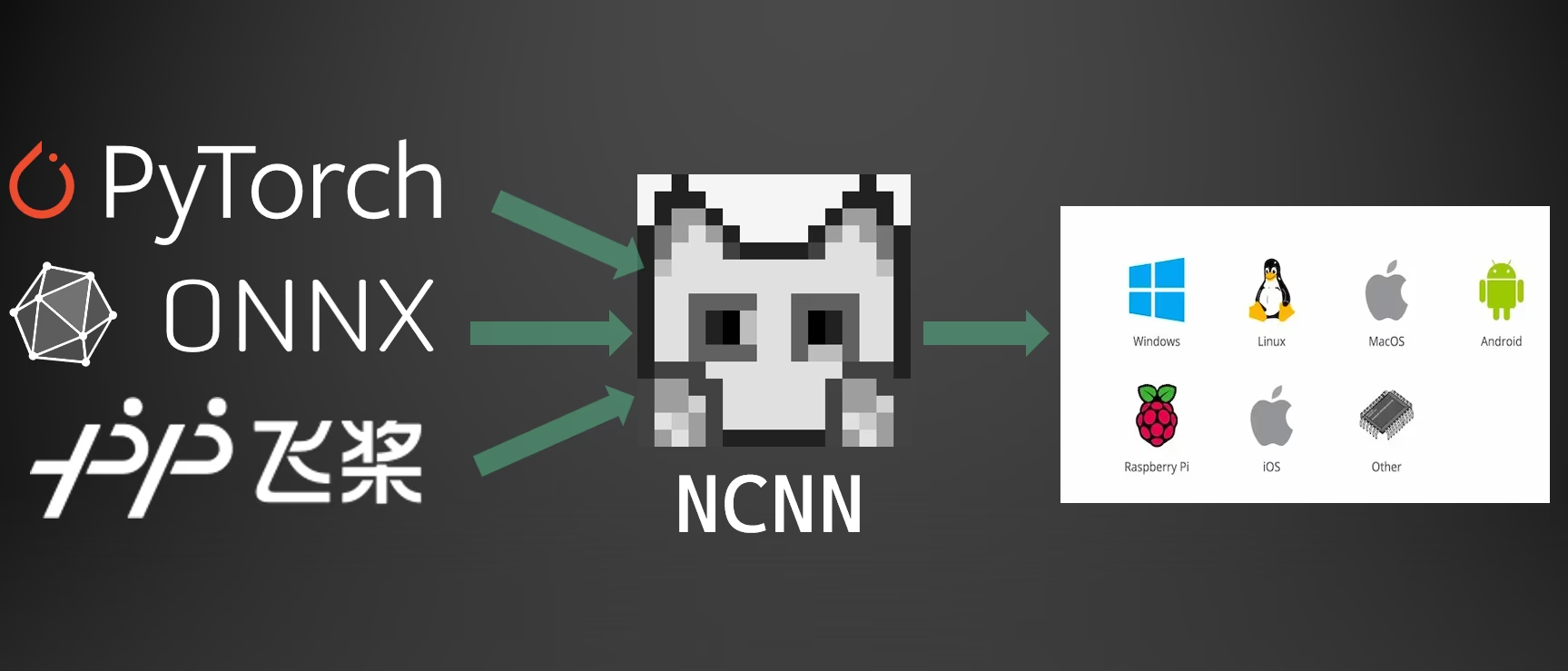
NCNN wird von Tencent entwickelt und in Tencent-Anwendungen wie QQ und WeChat verwendet. Es hat keine Laufzeitabhängigkeiten von Drittanbietern, läuft auf CPUs und über Vulkan auf GPUs und konvertiert PyTorch-Modelle mit seinem PNNX-Werkzeug, das der Ultralytics-Export verwendet. Die vollständige Referenz findest du in der NCNN-Dokumentation.
Häufig gestellte Fragen#
Verwende FP16 (
quantize=16), wenn die Modellgröße wichtig ist: YOLO26n ist mit FP16-Gewichten 5.0 MB groß, gegenüber 9.8 MB mit FP32, und benötigt keine Kalibrierungsdaten. Auf COCO val2017 erzielte YOLO26n mit FP16-Gewichten dieselben 40.9 mAPval 50-95 wie mit FP32. FP16-Gewichte verkleinern die Datei, machen das Modell aber nicht schneller: NCNN wählt die Rechengenauigkeit anhand der Hardware; siehe Genauigkeit. Validiere das exportierte Modell mit deinen eigenen Daten und auf deinem Gerät, bevor du es bereitstellst.Für die Pakete
pnnxundncnngibt es Builds für 64-Bit-ARM-Linux, und die Raspberry-Pi-Anleitung exportiert das Modell mit demselben Befehlformat="ncnn"direkt auf dem Board. Du kannst das Modell auch auf einem PC exportieren und das Verzeichnisyolo26n_ncnn_model/auf das Board kopieren. Für 32-Bit-ARM-Systeme gibt es keinen Build vonpnnx; exportiere daher auf einem anderen Rechner. Fürncnngibt es Builds, Ultralytics wurde dort jedoch nicht getestet.Erstelle die NCNN-Bibliothek für deine Plattform oder lade sie herunter, wie in der NCNN-Bauanleitung beschrieben. Füge
model.ncnn.paramundmodel.ncnn.binzur App hinzu und übergib die Eingabein0wie unter Ausgabeformat beschrieben. Dein Code muss das Bild per Letterboxing anpassen, die Rohvorhersagen decodieren und NMS anwenden. Wenn du lieber eine fertige App-Komponente verwenden möchtest, führt das Ultralytics-YOLO-Flutter-Plug-in LiteRT-Exporte unter Android und Core ML-Exporte unter iOS aus.NCNN wurde für ARM-CPUs in Smartphones und eingebetteten Platinen entwickelt. Auf einem Server mit zwei AMD EPYC 9655-Prozessoren mit jeweils 96 Kernen benötigte YOLO26n mit NCNN und 8 Threads etwa 30 ms pro Bild, während sowohl PyTorch als auch ONNX Runtime etwa 13 ms benötigten; auf einem Apple M4, auf dem NCNN 4 Threads auswählt, waren es etwa 12 ms. Für x86-64-Server sind OpenVINO und ONNX die Formate, die Ultralytics benchmarket.


Kommentare37
Stell eine Frage, teile deine Ergebnisse oder hilf jemand anderem.
gpsamt(bearbeitet)
I'm testing the use of ncnn on android. I converted a yolov11 model. I've tried every way to adjust the code, but I can't. The detections are not coming out correctly. The ncnn model on windows works as can be seen in the image. I'm sharing my native code in c++. If anyone can help me I'd really appreciate it.
Image detected with yolo predict model=C:\Users\guips\Downloads\best_ncnn_model source="C:\Users\guips\Downloads\brasil\test822.jpg" save_txt=true
#include <jni.h> #include <android/log.h> #include #include #include #include <opencv2/opencv.hpp> #include <ncnn/net.h> // #include <stb_image.h> // Uncomment if using stb_image
#define LOG_TAG "NCNN_DETECTOR" #define LOGD(...) __android_log_print(ANDROID_LOG_DEBUG, LOG_TAG, VA_ARGS) #define LOGI(...) __android_log_print(ANDROID_LOG_INFO, LOG_TAG, VA_ARGS) #define LOGE(...) __android_log_print(ANDROID_LOG_ERROR, LOG_TAG, VA_ARGS)
static ncnn::Net g_net; static std::vectorstd::string g_labels; static bool g_model_loaded = false;
struct Detection { float x, y, width, height; int label; float prob; };
static float sigmoid(float x) { return 1.0f / (1.0f + std::exp(-x)); }
static float calculate_iou(const Detection& a, const Detection& b) { float x1 = std::max(a.x, b.x); float y1 = std::max(a.y, b.y); float x2 = std::min(a.x + a.width, b.x + b.width); float y2 = std::min(a.y + a.height, b.y + b.height);
float inter_area = std::max(0.0f, x2 - x1) * std::max(0.0f, y2 - y1);
float union_area = a.width * a.height + b.width * b.height - inter_area;

return union_area > 0 ? inter_area / union_area : 0.0f;
}
extern "C" JNIEXPORT jboolean JNICALL Java_com_example_ncnnmy_1ok_MainActivity_loadModel( JNIEnv* env, jobject thiz, jstring param_path, jstring bin_path, jstring labels_path) {
const char* param_path_str = env->GetStringUTFChars(param_path, nullptr);
const char* bin_path_str = env->GetStringUTFChars(bin_path, nullptr);
const char* labels_path_str = env->GetStringUTFChars(labels_path, nullptr);

LOGI("Starting model loading...");
LOGD("Param path: %s", param_path_str);
LOGD("Bin path: %s", bin_path_str);
LOGD("Labels path: %s", labels_path_str);

g_net.clear();
g_labels.clear();
g_model_loaded = false;

g_net.opt.num_threads = 4;
g_net.opt.use_vulkan_compute = false;
g_net.opt.use_fp16_packed = false;
g_net.opt.use_fp16_storage = false;
g_net.opt.use_fp16_arithmetic = false;

int ret = g_net.load_param(param_path_str);
if (ret != 0) {
    LOGE("Failed to load .param file (%d)", ret);
    env->ReleaseStringUTFChars(param_path, param_path_str);
    env->ReleaseStringUTFChars(bin_path, bin_path_str);
    env->ReleaseStringUTFChars(labels_path, labels_path_str);
    return JNI_FALSE;
}

ret = g_net.load_model(bin_path_str);
if (ret != 0) {
    LOGE("Failed to load .bin file (%d)", ret);
    env->ReleaseStringUTFChars(param_path, param_path_str);
    env->ReleaseStringUTFChars(bin_path, bin_path_str);
    env->ReleaseStringUTFChars(labels_path, labels_path_str);
    return JNI_FALSE;
}

FILE* fp = fopen(labels_path_str, "r");
if (!fp) {
    LOGE("Failed to open labels file: %s", labels_path_str);
    env->ReleaseStringUTFChars(param_path, param_path_str);
    env->ReleaseStringUTFChars(bin_path, bin_path_str);
    env->ReleaseStringUTFChars(labels_path, labels_path_str);
    return JNI_FALSE;
}

char buffer[256];
while (fgets(buffer, sizeof(buffer), fp) != nullptr) {
    std::string label(buffer);
    label.erase(std::remove(label.begin(), label.end(), '\n'), label.end());
    label.erase(std::remove(label.begin(), label.end(), '\r'), label.end());
    if (!label.empty()) {
        g_labels.push_back(label);
    }
}
fclose(fp);

if (g_labels.empty()) {
    LOGE("No labels loaded from %s", labels_path_str);
    env->ReleaseStringUTFChars(param_path, param_path_str);
    env->ReleaseStringUTFChars(bin_path, bin_path_str);
    env->ReleaseStringUTFChars(labels_path, labels_path_str);
    return JNI_FALSE;
}

LOGI("Model loaded successfully");
LOGI("Total labels loaded: %zu", g_labels.size());
g_model_loaded = true;

env->ReleaseStringUTFChars(param_path, param_path_str);
env->ReleaseStringUTFChars(bin_path, bin_path_str);
env->ReleaseStringUTFChars(labels_path, labels_path_str);
return JNI_TRUE;
}
extern "C" JNIEXPORT jstring JNICALL Java_com_example_ncnnmy_1ok_MainActivity_detect( JNIEnv* env, jobject thiz, jstring image_path, jdouble conf_threshold, jdouble nms_threshold) {
LOGI("Running updated detect method (no debug image)");

if (!g_model_loaded) {
    LOGE("Model not loaded");
    return env->NewStringUTF("error:model_not_loaded");
}

const char* image_path_str = env->GetStringUTFChars(image_path, nullptr);
LOGI("Processing image: %s", image_path_str);

// Option 1: Use OpenCV (current)
cv::Mat image = cv::imread(image_path_str, cv::IMREAD_COLOR);
env->ReleaseStringUTFChars(image_path, image_path_str);

/*
// Option 2: Use stb_image (uncomment to test)
int width, height, channels;
unsigned char* image_data = stbi_load(image_path_str, &width, &height, &channels, 3);
env->ReleaseStringUTFChars(image_path, image_path_str);
if (!image_data) {
    LOGE("Failed to load image with stb_image");
    return env->NewStringUTF("error:image_load_failed");
}
cv::Mat image(height, width, CV_8UC3, image_data);
*/

if (image.empty()) {
    LOGE("Failed to load image");
    // stbi_image_free(image_data); // Uncomment if using stb_image
    return env->NewStringUTF("error:image_load_failed");
}

LOGD("Input image: %dx%d, channels=%d", image.cols, image.rows, image.channels());

const int target_size = 640;
int img_w = image.cols;
int img_h = image.rows;

float scale = std::min((float)target_size / img_w, (float)target_size / img_h);
int new_w = static_cast<int>(img_w * scale);
int new_h = static_cast<int>(img_h * scale);
int dx = (target_size - new_w) / 2;
int dy = (target_size - new_h) / 2;

cv::Mat resized;
cv::resize(image, resized, cv::Size(new_w, new_h));
cv::Mat input_mat(target_size, target_size, CV_8UC3, cv::Scalar(114, 114, 114));
resized.copyTo(input_mat(cv::Rect(dx, dy, new_w, new_h)));

cv::cvtColor(input_mat, input_mat, cv::COLOR_BGR2RGB);
input_mat.convertTo(input_mat, CV_32FC3, 1.0 / 255.0);

ncnn::Mat in = ncnn::Mat::from_pixels(input_mat.data, ncnn::Mat::PIXEL_RGB, target_size, target_size);

// stbi_image_free(image_data); // Uncomment if using stb_image

ncnn::Extractor ex = g_net.create_extractor();
ex.input("in0", in);
ncnn::Mat out;
ex.extract("out0", out);

if (out.empty()) {
    LOGE("Empty output from model");
    return env->NewStringUTF("error:empty_model_output");
}

LOGD("Output dimensions: w=%d, h=%d, c=%d", out.w, out.h, out.c);

int num_preds, num_classes;
bool is_decoupled = false;

if (out.c == 1) {
    LOGD("Possible decoupled heads detected, checking for additional outputs...");
    ncnn::Mat boxes, scores, classes;
    ex.extract("boxes", boxes);
    ex.extract("scores", scores);
    ex.extract("classes", classes);
    if (!boxes.empty() && !scores.empty() && !classes.empty()) {
        is_decoupled = true;
        LOGD("Decoupled heads detected: boxes=%dx%d, scores=%dx%d, classes=%dx%d",
             boxes.w, boxes.c, scores.w, scores.c, classes.w, classes.c);
        return env->NewStringUTF("error:decoupled_heads_not_implemented");
    }
}

if (!is_decoupled) {
    if (out.c >= 5) {
        num_preds = out.h * out.w;
        num_classes = out.c - 5;
        LOGD("Interpreting as [1, num_predictions, 5 + num_classes]: num_preds=%d, num_classes=%d",
             num_preds, num_classes);
    } else if (out.h >= 5) {
        num_preds = out.w;
        num_classes = out.h - 5;
        LOGD("Interpreting as [1, 5 + num_classes, num_predictions]: num_preds=%d, num_classes=%d",
             num_preds, num_classes);
    } else {
        LOGE("Invalid output dimensions: w=%d, h=%d, c=%d", out.w, out.h, out.c);
        return env->NewStringUTF("error:invalid_output_dimensions");
    }
}

if (num_classes != g_labels.size()) {
    LOGE("Mismatch between model outputs (%d) and labels (%zu)",
         num_classes, g_labels.size());
    return env->NewStringUTF("error:model_labels_mismatch");
}

std::vector<Detection> detections;
int stride = (out.c >= 5) ? out.c : out.h;
const float* data = (float*)out.data;

// Log raw outputs
if (num_preds > 0) {
    LOGD("Raw output sample: x=%.3f, y=%.3f, w=%.3f, h=%.3f, obj=%.3f",
         data[0], data[1], data[2], data[3], data[4]);
    // Log first class score
    if (num_classes > 0) {
        LOGD("Raw class score sample: class_0=%.3f", data[5]);
    }
}

for (int i = 0; i < num_preds; i++) {
    const float* pred = data + i * stride;

    float obj_score = sigmoid(pred[4]);
    if (obj_score < conf_threshold) continue;

    int class_id = 0;
    float max_score = sigmoid(pred[5]);
    for (int j = 1; j < num_classes; j++) {
        float score = sigmoid(pred[5 + j]);
        if (score > max_score) {
            max_score = score;
            class_id = j;
        }
    }

    float confidence = obj_score * max_score;
    if (confidence < conf_threshold) continue;

    // Normalize coordinates with sigmoid (assuming logits)
    float x_center = sigmoid(pred[0]) * target_size;
    float y_center = sigmoid(pred[1]) * target_size;
    float width = sigmoid(pred[2]) * target_size;
    float height = sigmoid(pred[3]) * target_size;

    // Adjust for letterbox
    float x = (x_center - width / 2 - dx) / scale;
    float y = (y_center - height / 2 - dy) / scale;
    width /= scale;
    height /= scale;

    LOGD("Prediction %d: x_center=%.2f, y_center=%.2f, width=%.2f, height=%.2f",
         i, x_center, y_center, width, height);
    LOGD("Transformed %d: x=%.2f, y=%.2f, width=%.2f, height=%.2f",
         i, x, y, width, height);

    // Validate coordinates
    if (x < 0 || y < 0 || width <= 0 || height <= 0 || x + width > img_w || y + height > img_h) {
        LOGD("Skipping invalid detection %d: x=%.2f, y=%.2f, w=%.2f, h=%.2f",
             i, x, y, width, height);
        continue;
    }

    // Minimum size filter
    if (width < 50 || height < 50) {
        LOGD("Skipping small detection %d: w=%.2f, h=%.2f", i, width, height);
        continue;
    }

    detections.push_back({x, y, width, height, class_id, confidence});
}

// NMS
std::sort(detections.begin(), detections.end(), [](const Detection& a, const Detection& b) {
    return a.prob > b.prob;
});

std::vector<bool> suppressed(detections.size(), false);
std::vector<Detection> final_detections;

for (size_t i = 0; i < detections.size(); i++) {
    if (suppressed[i]) continue;
    final_detections.push_back(detections[i]);

    for (size_t j = i + 1; j < detections.size(); j++) {
        if (suppressed[j]) continue;
        float iou = calculate_iou(detections[i], detections[j]);
        if (iou > nms_threshold) {
            suppressed[j] = true;
        }
    }
}

LOGD("Detections after NMS: %zu", final_detections.size());

// Format results
std::string result_str;
for (const auto& det : final_detections) {
    if (!result_str.empty()) result_str += ";";
    char buf[256];
    snprintf(buf, sizeof(buf), "%s:%.2f,%.0f,%.0f,%.0f,%.0f",
             g_labels[det.label].c_str(), det.prob,
             det.x, det.y, det.width, det.height);
    result_str += buf;
}

return env->NewStringUTF(result_str.empty() ? "none" : result_str.c_str());
}
Here is a log of the output of the flutter application.
[ ] D/NCNN_DETECTOR( 9180): Prediction 3730: x_center=640.00, y_center=640.00, width=640.00, height=640.00 [ ] D/NCNN_DETECTOR( 9180): Transformed 3730: x=320.00, y=240.00, width=640.00, height=640.00 [ ] D/NCNN_DETECTOR( 9180): Skipping invalid detection 3730: x=320.00, y=240.00, w=640.00, h=640.00 [ ] D/NCNN_DETECTOR( 9180): Prediction 3731: x_center=640.00, y_center=640.00, width=640.00, height=640.00 [ ] D/NCNN_DETECTOR( 9180): Transformed 3731: x=320.00, y=240.00, width=640.00, height=640.00 [ ] D/NCNN_DETECTOR( 9180): Skipping invalid detection 3731: x=320.00, y=240.00, w=640.00, h=640.00 [ ] D/NCNN_DETECTOR( 9180): Prediction 3732: x_center=640.00, y_center=640.00, width=640.00, height=640.00 [ ] D/NCNN_DETECTOR( 9180): Transformed 3732: x=320.00, y=240.00, width=640.00, height=640.00 [ ] D/NCNN_DETECTOR( 9180): Skipping invalid detection 3732: x=320.00, y=240.00, w=640.00, h=640.00 [ ] D/NCNN_DETECTOR( 9180): Detections after NMS: 0 [ ] I/flutter ( 9180): Detection result: none [ ] I/flutter ( 9180): STATUS: No objects detected [ ] E/libEGL ( 9180): called unimplemented OpenGL ES API
 Glenn JocherUltralytics(bearbeitet)
@gpsamt looking at your logs, the issue appears to be with output format parsing. YOLO11 NCNN outputs have no separate objectness score, and the class scores are already sigmoid-activated, so don't apply sigmoid again. Try parsing each prediction like this:
// Box is x_center, y_center, width, height (no sigmoid needed)
float x_center = pred[0];
float y_center = pred[1];
float width = pred[2];
float height = pred[3];
// pred[4 .. 4+nc) are the per-class scores; take the max class as the confidence

// Convert from center format to corner format
float x = (x_center - width / 2 - dx) / scale;
float y = (y_center - height / 2 - dy) / scale;
Also verify your model's actual output format by checking if coordinates are normalized (0-1) or absolute (0-640). The repeated 640.00 values suggest coordinate parsing issues. For official Android deployment examples, refer to the NCNN Android documentation.
aram199922
Hey everyone, I have trained yolo11n.pt pretrained model on my custom dataset. Run the detection on a video and got quite good results. Now trying to export ncnn with the given guide, files are being generated correctly, however the detection on the same video seems corrupted. I am trying to detect potholes on road, however ncnn model predict 300 potholes on each frame. Any suggestion?
One more note is that I have trained my model with 736p, 640p modes are converting fine. But does this mean I can't conver higher resolution trained model to ncnn?
- Glenn JocherUltralytics
@aram199922 The issue with your NCNN model detecting 300 potholes likely relates to confidence thresholds. When exporting to NCNN, default thresholds may not transfer properly. Try explicitly setting a higher confidence threshold during inference:
# Load the NCNN model
ncnn_model = YOLO("your_model_ncnn_model")

# Run inference with higher confidence threshold
results = ncnn_model("video.mp4", conf=0.5)  # Adjust this value as needed
Regarding your 736p model - yes, you can export higher resolution models to NCNN by specifying the custom size during export:
model = YOLO("your_trained_model.pt")
model.export(format="ncnn", imgsz=736)  # Use your training resolution
This ensures the exported model maintains the same input dimensions you used during training. Let me know if this helps resolve the issue!
Hello. Does anyone have any example of implementing the converted ncnn model in android?
PabloBR99
Do this work with YOLOv12?
- Glenn JocherUltralytics(bearbeitet)
@PabloBR99 YOLO12 isn't recommended for NCNN export due to training instability and performance limitations. For NCNN deployments, we strongly recommend using YOLO26 (or YOLO11), which offer optimized performance and stability across all platforms. You can find the NCNN export guide in our documentation.
I am exporting a YOLOv11s model to ncnn. My model has 4 classes, however, when I perform the export, it appears that it is identifying 3 classes: PyTorch: starting from '/content/drive/MyDrive/IAGeneration/yolo11/runs/detect/train3/weights/best.pt' with input shape (1, 3, 640, 640) BCHW and output shape(s) (1, 8, 8400) (18.3 MB). In Android Studio, this message appears:
2025-03-04 17:08:58.490 3853-3853 NcnnDetector com.example.agroinsect D Starting detection 2025-03-04 17:08:58.502 3853-3853 NcnnDetector com.example.test D Param file size: 22768 bytes 2025-03-04 17:08:58.504 3853-3853 NcnnDetector com.example.test D Load param result: 0 2025-03-04 17:08:58.504 3853-3853 NcnnDetector com.example.test D Bin file size: 10633344 bytes 2025-03-04 17:08:58.596 3853-3853 NcnnDetector com.example.test D Load model result: 10633344 2025-03-04 17:08:58.597 3853-3853 NcnnDetector com.example.test D Failed to load model file
[ +82 ms] D/CompatChangeReporter( 3853): Compat change id reported: 312399441; UID 10209; state: ENABLED [ +11 ms] D/nativeloader( 3853): Load /data/app/~~yVwXpMN1F9boaEz-oh0Bpw==/com.example.test-J2_0Fz9v3HSf0USV8uxz6Q==/lib/x86_64/libncnn_detector.so using ns clns-7 from class loader (caller=/data/app/~~yVwXpMN1F9boaEz-oh0Bpw==/com.example.test-J2_0Fz9v3HSf0USV8uxz6Q==/base.apk!classes4.dex): ok [ ] D/NcnnDetector( 3853): Library ncnn_detector loaded successfully [ ] D/NcnnDetector( 3853): Starting detection [ +10 ms] D/NcnnDetector( 3853): Param file size: 22768 bytes [ +2 ms] D/NcnnDetector( 3853): Load param result: 0 [ ] D/NcnnDetector( 3853): Bin file size: 10633344 bytes [ +97 ms] D/NcnnDetector( 3853): Load model result: 10633344 [ +1 ms] D/NcnnDetector( 3853): Failed to load model file [ ] I/flutter ( 3853): Native detect result: null [ ] I/flutter ( 3853): Detections received: [] [ ] I/flutter ( 3853): No detections found.
I have repeated the process several times, but I have not been able to resolve it. I found this answer: 'The current problem (Load model result: 37825744) suggests difficulties in exporting or compatibility.'"
- Glenn JocherUltralytics
@gpsamt thank you for reporting this issue. Let's address both aspects systematically:
-
Class Count Mismatch:
The output shape (1,8,8400) suggests your model is correctly configured for 4 classes (4 classes + 4 box coordinates = 8). This indicates the export itself is successful. The Android implementation might need adjustment to handle the 4-class output format. -
Model Loading Failure:
The "Failed to load model file" error typically indicates either:
- Missing/corrupted
.paramor.binfiles in deployment - Architecture mismatch between PyTorch and NCNN versions
- Incorrect Android NCNN implementation
We recommend:
- Verify successful local inference with your NCNN model using
yolo predict model='yolo11n_ncnn_model'before Android deployment - Ensure you're using the latest NCNN Android library from Tencent's NCNN GitHub repo
- Double-check that all NCNN model files are properly bundled in your Android assets
For specific Android implementation guidance, please consult NCNN's official Android deployment documentation.
-
I made several attempts and ended up not proceeding, however I really wanted to test my trained model running on android with ncnn. I made an export on windows of a yolo11 model trained in colab. To test the converted model yolo --> ncnn I did a test with an image with two objects. C:\Users\guips\Downloads>yolo predict model=C:\Users\guips\Downloads\best_ncnn_model source="C:\Users\guips\Downloads\brasil\test129.jpg" save_txt=true WARNING ⚠️ Unable to automatically guess model task, assuming 'task=detect'. Explicitly define task for your model, i.e. 'task=detect', 'segment', 'classify','pose' or 'obb'. Ultralytics 8.3.105 🚀 Python-3.11.9 torch-2.6.0+cpu CPU (12th Gen Intel Core(TM) i7-12700KF) Loading C:\Users\guips\Downloads\best_ncnn_model for NCNN inference...
image 1/1 C:\Users\guips\Downloads\brasil\test129.jpg: 640x640 2 Car, 103.0ms Speed: 20.4ms preprocess, 103.0ms inference, 24.2ms postprocess per image at shape (1, 3, 640, 640) Results saved to runs\detect\predict6 1 label saved to runs\detect\predict6\labels 💡 Learn more at https://docs.ultralytics.com/modes/predict
When I try to run the same image in the android application with flutter I can't. In TFLITE the output was (1,8,8400) Now it seems to be outputting (1,9,8400). I'm not able to work with the output data. I/flutter (14031): Labels loaded: 4E/libEGL (14031): called unimplemented OpenGL ES API I/flutter (14031): Storage permission denied D/InsetsController(14031): hide(ime(), fromIme=false) I/ImeTracker(14031): com.example.ncnnmy_ok:e29c5e1e: onCancelled at PHASE_CLIENT_ALREADY_HIDDEN E/libEGL (14031): called unimplemented OpenGL ES API D/InsetsController(14031): hide(ime(), fromIme=false) I/ImeTracker(14031): com.example.ncnnmy_ok:6f2d251e: onCancelled at PHASE_CLIENT_ALREADY_HIDDEN E/libEGL (14031): called unimplemented OpenGL ES API D/CompatChangeReporter(14031): Compat change id reported: 312399441; UID 10223; state: ENABLED I/flutter (14031): Image dimensions: 680.0x453.0 I/flutter (14031): Running inference on /data/user/0/com.example.ncnnmy_ok/cache/a6b569b8-5ff1-4466-ad32-49121fb24aa4/38.jpg D/MainActivity(14031): Received method call: detect I/NCNN (14031): Detecting on image: /data/user/0/com.example.ncnnmy_ok/cache/a6b569b8-5ff1-4466-ad32-49121fb24aa4/38.jpg I/NCNN (14031): Original image size: 680x453 I/NCNN (14031): Output dimensions: w=8400, h=9, c=1 I/NCNN (14031): Output saved to /data/user/0/com.example.ncnnmy_ok/cache/a6b569b8-5ff1-4466-ad32-49121fb24aa4/38.jpg_ncnn_output.txt W/NCNN (14031): Output has 4424 channels, expected 8. Using first 8 channels W/NCNN (14031): Invalid box at idx=9: w=0.000000, h=0.000000 W/NCNN (14031): Invalid box at idx=15: w=-0.010868, h=-0.063400 W/NCNN (14031): Invalid box at idx=16: w=-0.630245, h=-0.447460 W/NCNN (14031): Invalid box at idx=17: w=-0.685141, h=-0.837424 . . . W/NCNN (14031): Invalid box at idx=347: w=-0.077838, h=0.846499 F/libc (14031): Fatal signal 11 (SIGSEGV), code 2 (SEGV_ACCERR), fault addr 0x71c0c2499110 in tid 14031 (ample.ncnnmy_ok), pid 14031 (ample.ncnnmy_ok)
Build fingerprint: 'google/sdk_gphone64_x86_64/emu64xa:16/BP22.250221.010/13193326:user/release-keys' Revision: '0' ABI: 'x86_64' Timestamp: 2025-04-15 01:29:54.291432600+0000 Process uptime: 156s Cmdline: com.example.ncnnmy_ok pid: 14031, tid: 14031, name: ample.ncnnmy_ok >>> com.example.ncnnmy_ok <<< uid: 10223 signal 11 (SIGSEGV), code 2 (SEGV_ACCERR), fault addr 0x000071c0c2499110 rax 000071c0c2499100 rbx 000071c247d33be0 rcx 0000000000000004 rdx 0000000000000008 r8 00007ffc6ffc4080 r9 00007ffc6ffc40a0 r10 0000000000e8cada r11 0000000000000213 r12 00007ffc6ff903b0 r13 000071c247d33c88 r14 00007ffc6ff90718 r15 000071c247d33be0 rdi 00007ffc6ff8f840 rsi 0000000000000167 rbp 00007ffc6ff8f970 rsp 00007ffc6ff8f8b0 rip 000071c053d969ea 90 total frames backtrace: #00 pc 00000000000109ea /data/app/~~ygC8oOQ2RMgj_IeB2wDRKw==/com.example.ncnnmy_ok-1Q_3JHdbdZSe1RwVvc5qjQ==/lib/x86_64/libnative-lib.so (BuildId: 63a90d5f64ab095e3ac958c5db79324dfa15e937) #01 pc 000000000000fd3a /data/app/~~ygC8oOQ2RMgj_IeB2wDRKw==/com.example.ncnnmy_ok-1Q_3JHdbdZSe1RwVvc5qjQ==/lib/x86_64/libnative-lib.so (BuildId: 63a90d5f64ab095e3ac958c5db79324dfa15e937) #02 pc 000000000000e8aa /data/app/~~ygC8oOQ2RMgj_IeB2wDRKw==/com.example.ncnnmy_ok-1Q_3JHdbdZSe1RwVvc5qjQ==/lib/x86_64/libnative-lib.so (Java_com_example_ncnnmy_1ok_MainActivity_detect+2634) (BuildId: 63a90d5f64ab095e3ac958c5db79324dfa15e937) #03 pc 000000000022c80b /apex/com.android.art/lib64/libart.so (art_quick_generic_jni_trampoline+219) (BuildId: 53a0485d03b4e7011d7d555e293a17af) #04 pc 0000000000211dd4 /apex/com.android.art/lib64/libart.so (art_quick_invoke_stub+756) (BuildId: 53a0485d03b4e7011d7d555e293a17af) #05 pc 0000000000461715 /apex/com.android.art/lib64/libart.so (art::ArtMethod::Invoke(art::Thread*, unsigned int*, unsigned int, art::JValue*, char const*)+181) (BuildId: 53a0485d03b4e7011d7d555e293a17af) #06 pc 00000000005f74b2 /apex/com.android.art/lib64/libart.so (bool art::interpreter::DoCall(art::ArtMethod*, art::Thread*, art::ShadowFrame&, art::Instruction const*, unsigned short, bool, art::JValue*)+2402) (BuildId: 53a0485d03b4e7011d7d555e293a17af) #07 pc 0000000000233611 /apex/com.android.art/lib64/libart.so (void art::interpreter::ExecuteSwitchImplCpp(art::interpreter::SwitchImplContext*)+10625) (BuildId: 53a0485d03b4e7011d7d555e293a17af) #08 pc 000000000022eb25 /apex/com.android.art/lib64/libart.so (ExecuteSwitchImplAsm+5) (BuildId: 53a0485d03b4e7011d7d555e293a17af) #09 pc 00000000000006a4 anonymous:71c395b1d000 (com.example.ncnnmy_ok.MainActivity.configureFlutterEngine$lambda$0+0) #10 pc 00000000005ef3f2 /apex/com.android.art/lib64/libart.so (art::interpreter::Execute(art::Thread*, art::CodeItemDataAccessor const&, art::ShadowFrame&, art::JValue, bool, bool) (.__uniq.112435418011751916792819755956732575238)+466) (BuildId: 53a0485d03b4e7011d7d555e293a17af) #11 pc 00000000005f6706 /apex/com.android.art/lib64/libart.so (art::interpreter::ArtInterpreterToInterpreterBridge(art::Thread*, art::CodeItemDataAccessor const&, art::ShadowFrame*, art::JValue*)+102) (BuildId: 53a0485d03b4e7011d7d555e293a17af) #12 pc 00000000005f7498 /apex/com.android.art/lib64/libart.so (bool art::interpreter::DoCall(art::ArtMethod*, art::Thread*, art::ShadowFrame&, art::Instruction const*, unsigned short, bool, art::JValue*)+2376) (BuildId: 53a0485d03b4e7011d7d555e293a17af) #13 pc 0000000000234b05 /apex/com.android.art/lib64/libart.so (void art::interpreter::ExecuteSwitchImplCpp(art::interpreter::SwitchImplContext*)+15989) (BuildId: 53a0485d03b4e7011d7d555e293a17af) #14 pc 000000000022eb25 /apex/com.android.art/lib64/libart.so (ExecuteSwitchImplAsm+5) (BuildId: 53a0485d03b4e7011d7d555e293a17af) #15 pc 0000000000000604 anonymous:71c395b1d000 (com.example.ncnnmy_ok.MainActivity.$r8$lambda$8rE-0sywqH2S4u1lhbBM5kfBEYE+0) #16 pc 00000000005ef3f2 /apex/com.android.art/lib64/libart.so (art::interpreter::Execute(art::Thread*, art::CodeItemDataAccessor const&, art::ShadowFrame&, art::JValue, bool, bool) (.__uniq.112435418011751916792819755956732575238)+466) (BuildId: 53a0485d03b4e7011d7d555e293a17af) #17 pc 00000000005f6706 /apex/com.android.art/lib64/libart.so (art::interpreter::ArtInterpreterToInterpreterBridge(art::Thread*, art::CodeItemDataAccessor const&, art::ShadowFrame*, art::JValue*)+102) (BuildId: 53a0485d03b4e7011d7d555e293a17af) #18 pc 00000000005f7498 /apex/com.android.art/lib64/libart.so (bool art::interpreter::DoCall(art::ArtMethod*, art::Thread*, art::ShadowFrame&, art::Instruction const*, unsigned short, bool, art::JValue*)+2376) (BuildId: 53a0485d03b4e7011d7d555e293a17af) #19 pc 0000000000234b05 /apex/com.android.art/lib64/libart.so (void art::interpreter::ExecuteSwitchImplCpp(art::interpreter::SwitchImplContext*)+15989) (BuildId: 53a0485d03b4e7011d7d555e293a17af) #20 pc 000000000022eb25 /apex/com.android.art/lib64/libart.so (ExecuteSwitchImplAsm+5) (BuildId: 53a0485d03b4e7011d7d555e293a17af) #21 pc 00000000000005b8 anonymous:71c395b1d000 (com.example.ncnnmy_ok.MainActivity$$ExternalSyntheticLambda0.onMethodCall+0) #22 pc 00000000005ef3f2 /apex/com.android.art/lib64/libart.so (art::interpreter::Execute(art::Thread*, art::CodeItemDataAccessor const&, art::ShadowFrame&, art::JValue, bool, bool) (.__uniq.112435418011751916792819755956732575238)+466) (BuildId: 53a0485d03b4e7011d7d555e293a17af) #23 pc 00000000005f6706 /apex/com.android.art/lib64/libart.so (art::interpreter::ArtInterpreterToInterpreterBridge(art::Thread*, art::CodeItemDataAccessor const&, art::ShadowFrame*, art::JValue*)+102) (BuildId: 53a0485d03b4e7011d7d555e293a17af) #24 pc 00000000005f7498 /apex/com.android.art/lib64/libart.so (bool art::interpreter::DoCall(art::ArtMethod*, art::Thread*, art::ShadowFrame&, art::Instruction const*, unsigned short, bool, art::JValue*)+2376) (BuildId: 53a0485d03b4e7011d7d555e293a17af) #25 pc 00000000002346e5 /apex/com.android.art/lib64/libart.so (void art::interpreter::ExecuteSwitchImplCpp(art::interpreter::SwitchImplContext*)+14933) (BuildId: 53a0485d03b4e7011d7d555e293a17af) #26 pc 000000000022eb25 /apex/com.android.art/lib64/libart.so (ExecuteSwitchImplAsm+5) (BuildId: 53a0485d03b4e7011d7d555e293a17af) #27 pc 00000000001bfabc anonymous:71c054260000 (io.flutter.plugin.common.MethodChannel$IncomingMethodCallHandler.onMessage+0) #28 pc 00000000005ef3f2 /apex/com.android.art/lib64/libart.so (art::interpreter::Execute(art::Thread*, art::CodeItemDataAccessor const&, art::ShadowFrame&, art::JValue, bool, bool) (.__uniq.112435418011751916792819755956732575238)+466) (BuildId: 53a0485d03b4e7011d7d555e293a17af) #29 pc 00000000005f6706 /apex/com.android.art/lib64/libart.so (art::interpreter::ArtInterpreterToInterpreterBridge(art::Thread*, art::CodeItemDataAccessor const&, art::ShadowFrame*, art::JValue*)+102) (BuildId: 53a0485d03b4e7011d7d555e293a17af) #30 pc 00000000005f7498 /apex/com.android.art/lib64/libart.so (bool art::interpreter::DoCall(art::ArtMethod*, art::Thread*, art::ShadowFrame&, art::Instruction const*, unsigned short, bool, art::JValue*)+2376) (BuildId: 53a0485d03b4e7011d7d555e293a17af) #31 pc 00000000002346e5 /apex/com.android.art/lib64/libart.so (void art::interpreter::ExecuteSwitchImplCpp(art::interpreter::SwitchImplContext*)+14933) (BuildId: 53a0485d03b4e7011d7d555e293a17af) #32 pc 000000000022eb25 /apex/com.android.art/lib64/libart.so (ExecuteSwitchImplAsm+5) (BuildId: 53a0485d03b4e7011d7d555e293a17af) #33 pc 00000000001b1954 anonymous:71c054260000 (io.flutter.embedding.engine.dart.DartMessenger.invokeHandler+0) #34 pc 00000000005ef3f2 /apex/com.android.art/lib64/libart.so (art::interpreter::Execute(art::Thread*, art::CodeItemDataAccessor const&, art::ShadowFrame&, art::JValue, bool, bool) (.__uniq.112435418011751916792819755956732575238)+466) (BuildId: 53a0485d03b4e7011d7d555e293a17af) #35 pc 00000000005f6706 /apex/com.android.art/lib64/libart.so (art::interpreter::ArtInterpreterToInterpreterBridge(art::Thread*, art::CodeItemDataAccessor const&, art::ShadowFrame*, art::JValue*)+102) (BuildId: 53a0485d03b4e7011d7d555e293a17af) #36 pc 00000000005f7498 /apex/com.android.art/lib64/libart.so (bool art::interpreter::DoCall(art::ArtMethod*, art::Thread*, art::ShadowFrame&, art::Instruction const*, unsigned short, bool, art::JValue*)+2376) (BuildId: 53a0485d03b4e7011d7d555e293a17af) #37 pc 0000000000233611 /apex/com.android.art/lib64/libart.so (void art::interpreter::ExecuteSwitchImplCpp(art::interpreter::SwitchImplContext*)+10625) (BuildId: 53a0485d03b4e7011d7d555e293a17af) #38 pc 000000000022eb25 /apex/com.android.art/lib64/libart.so (ExecuteSwitchImplAsm+5) (BuildId: 53a0485d03b4e7011d7d555e293a17af) #39 pc 00000000001b19d8 anonymous:71c054260000 (io.flutter.embedding.engine.dart.DartMessenger.lambda$dispatchMessageToQueue$0$io-flutter-embedding-engine-dart-DartMessenger+0) #40 pc 00000000005ef3f2 /apex/com.android.art/lib64/libart.so (art::interpreter::Execute(art::Thread*, art::CodeItemDataAccessor const&, art::ShadowFrame&, art::JValue, bool, bool) (.__uniq.112435418011751916792819755956732575238)+466) (BuildId: 53a0485d03b4e7011d7d555e293a17af) #41 pc 00000000005f6706 /apex/com.android.art/lib64/libart.so (art::interpreter::ArtInterpreterToInterpreterBridge(art::Thread*, art::CodeItemDataAccessor const&, art::ShadowFrame*, art::JValue*)+102) (BuildId: 53a0485d03b4e7011d7d555e293a17af) #42 pc 00000000005f827f /apex/com.android.art/lib64/libart.so (bool art::interpreter::DoCall(art::ArtMethod*, art::Thread*, art::ShadowFrame&, art::Instruction const*, unsigned short, bool, art::JValue*)+2319) (BuildId: 53a0485d03b4e7011d7d555e293a17af) #43 pc 000000000023482d /apex/com.android.art/lib64/libart.so (void art::interpreter::ExecuteSwitchImplCpp(art::interpreter::SwitchImplContext*)+15261) (BuildId: 53a0485d03b4e7011d7d555e293a17af) #44 pc 000000000022eb25 /apex/com.android.art/lib64/libart.so (ExecuteSwitchImplAsm+5) (BuildId: 53a0485d03b4e7011d7d555e293a17af) #45 pc 00000000001b1168 anonymous:71c054260000 (io.flutter.embedding.engine.dart.DartMessenger$$ExternalSyntheticLambda0.run+0) #46 pc 00000000005ef3f2 /apex/com.android.art/lib64/libart.so (art::interpreter::Execute(art::Thread*, art::CodeItemDataAccessor const&, art::ShadowFrame&, art::JValue, bool, bool) (.__uniq.112435418011751916792819755956732575238)+466) (BuildId: 53a0485d03b4e7011d7d555e293a17af) #47 pc 00000000009978fb /apex/com.android.art/lib64/libart.so (artQuickToInterpreterBridge+907) (BuildId: 53a0485d03b4e7011d7d555e293a17af) #48 pc 000000000022c99c /apex/com.android.art/lib64/libart.so (art_quick_to_interpreter_bridge+140) (BuildId: 53a0485d03b4e7011d7d555e293a17af) #49 pc 0000000000160efc [anon_shmem:dalvik-jit-code-cache] (offset 0x2000000) (android.os.Handler.handleCallback+156) #50 pc 00000000000718af [anon_shmem:dalvik-jit-code-cache] (offset 0x2000000) (android.os.Handler.dispatchMessage+159) #51 pc 000000000006e9a4 [anon_shmem:dalvik-jit-code-cache] (offset 0x2000000) (android.os.Looper.loopOnce+1348) #52 pc 0000000000212136 /apex/com.android.art/lib64/libart.so (art_quick_invoke_static_stub+806) (BuildId: 53a0485d03b4e7011d7d555e293a17af) #53 pc 000000000046175c /apex/com.android.art/lib64/libart.so (art::ArtMethod::Invoke(art::Thread*, unsigned int*, unsigned int, art::JValue*, char const*)+252) (BuildId: 53a0485d03b4e7011d7d555e293a17af) #54 pc 00000000005f74b2 /apex/com.android.art/lib64/libart.so (bool art::interpreter::DoCall(art::ArtMethod*, art::Thread*, art::ShadowFrame&, art::Instruction const*, unsigned short, bool, art::JValue*)+2402) (BuildId: 53a0485d03b4e7011d7d555e293a17af) #55 pc 0000000000234b05 /apex/com.android.art/lib64/libart.so (void art::interpreter::ExecuteSwitchImplCpp(art::interpreter::SwitchImplContext*)+15989) (BuildId: 53a0485d03b4e7011d7d555e293a17af) #56 pc 000000000022eb25 /apex/com.android.art/lib64/libart.so (ExecuteSwitchImplAsm+5) (BuildId: 53a0485d03b4e7011d7d555e293a17af) #57 pc 000000000027c140 /system/framework/framework.jar (offset 0x1274000) (android.os.Looper.loop+0) #58 pc 00000000005ef3f2 /apex/com.android.art/lib64/libart.so (art::interpreter::Execute(art::Thread*, art::CodeItemDataAccessor const&, art::ShadowFrame&, art::JValue, bool, bool) (.__uniq.112435418011751916792819755956732575238)+466) (BuildId: 53a0485d03b4e7011d7d555e293a17af) #59 pc 00000000005f6706 /apex/com.android.art/lib64/libart.so (art::interpreter::ArtInterpreterToInterpreterBridge(art::Thread*, art::CodeItemDataAccessor const&, art::ShadowFrame*, art::JValue*)+102) (BuildId: 53a0485d03b4e7011d7d555e293a17af) #60 pc 00000000005f7498 /apex/com.android.art/lib64/libart.so (bool art::interpreter::DoCall(art::ArtMethod*, art::Thread*, art::ShadowFrame&, art::Instruction const*, unsigned short, bool, art::JValue*)+2376) (BuildId: 53a0485d03b4e7011d7d555e293a17af) #61 pc 0000000000234b05 /apex/com.android.art/lib64/libart.so (void art::interpreter::ExecuteSwitchImplCpp(art::interpreter::SwitchImplContext*)+15989) (BuildId: 53a0485d03b4e7011d7d555e293a17af) #62 pc 000000000022eb25 /apex/com.android.art/lib64/libart.so (ExecuteSwitchImplAsm+5) (BuildId: 53a0485d03b4e7011d7d555e293a17af) #63 pc 00000000001f1254 /system/framework/framework.jar (offset 0x7000) (android.app.ActivityThread.main+0) #64 pc 00000000005ef3f2 /apex/com.android.art/lib64/libart.so (art::interpreter::Execute(art::Thread*, art::CodeItemDataAccessor const&, art::ShadowFrame&, art::JValue, bool, bool) (.__uniq.112435418011751916792819755956732575238)+466) (BuildId: 53a0485d03b4e7011d7d555e293a17af) #65 pc 00000000009978fb /apex/com.android.art/lib64/libart.so (artQuickToInterpreterBridge+907) (BuildId: 53a0485d03b4e7011d7d555e293a17af) #66 pc 000000000022c99c /apex/com.android.art/lib64/libart.so (art_quick_to_interpreter_bridge+140) (BuildId: 53a0485d03b4e7011d7d555e293a17af) #67 pc 0000000000212136 /apex/com.android.art/lib64/libart.so (art_quick_invoke_static_stub+806) (BuildId: 53a0485d03b4e7011d7d555e293a17af) #68 pc 000000000046175c /apex/com.android.art/lib64/libart.so (art::ArtMethod::Invoke(art::Thread*, unsigned int*, unsigned int, art::JValue*, char const*)+252) (BuildId: 53a0485d03b4e7011d7d555e293a17af) #69 pc 000000000088b130 /apex/com.android.art/lib64/libart.so (_jobject* art::InvokeMethod<(art::PointerSize)8>(art::ScopedObjectAccessAlreadyRunnable const&, _jobject*, _jobject*, _jobject*, unsigned long)+2240) (BuildId: 53a0485d03b4e7011d7d555e293a17af) #70 pc 00000000007e0f1a /apex/com.android.art/lib64/libart.so (art::Method_invoke(_JNIEnv*, _jobject*, _jobject*, _jobjectArray*) (.__uniq.165753521025965369065708152063621506277)+42) (BuildId: 53a0485d03b4e7011d7d555e293a17af) #71 pc 000000000022c80b /apex/com.android.art/lib64/libart.so (art_quick_generic_jni_trampoline+219) (BuildId: 53a0485d03b4e7011d7d555e293a17af) #72 pc 0000000000211dd4 /apex/com.android.art/lib64/libart.so (art_quick_invoke_stub+756) (BuildId: 53a0485d03b4e7011d7d555e293a17af) #73 pc 0000000000461715 /apex/com.android.art/lib64/libart.so (art::ArtMethod::Invoke(art::Thread*, unsigned int*, unsigned int, art::JValue*, char const*)+181) (BuildId: 53a0485d03b4e7011d7d555e293a17af) #74 pc 00000000005f74b2 /apex/com.android.art/lib64/libart.so (bool art::interpreter::DoCall(art::ArtMethod*, art::Thread*, art::ShadowFrame&, art::Instruction const*, unsigned short, bool, art::JValue*)+2402) (BuildId: 53a0485d03b4e7011d7d555e293a17af) #75 pc 0000000000233611 /apex/com.android.art/lib64/libart.so (void art::interpreter::ExecuteSwitchImplCpp(art::interpreter::SwitchImplContext*)+10625) (BuildId: 53a0485d03b4e7011d7d555e293a17af) #76 pc 000000000022eb25 /apex/com.android.art/lib64/libart.so (ExecuteSwitchImplAsm+5) (BuildId: 53a0485d03b4e7011d7d555e293a17af) #77 pc 000000000027f6ec /system/framework/framework.jar (offset 0x2430000) (com.android.internal.os.RuntimeInit$MethodAndArgsCaller.run+0) #78 pc 00000000005ef3f2 /apex/com.android.art/lib64/libart.so (art::interpreter::Execute(art::Thread*, art::CodeItemDataAccessor const&, art::ShadowFrame&, art::JValue, bool, bool) (.__uniq.112435418011751916792819755956732575238)+466) (BuildId: 53a0485d03b4e7011d7d555e293a17af) #79 pc 00000000009978fb /apex/com.android.art/lib64/libart.so (artQuickToInterpreterBridge+907) (BuildId: 53a0485d03b4e7011d7d555e293a17af) #80 pc 000000000022c99c /apex/com.android.art/lib64/libart.so (art_quick_to_interpreter_bridge+140) (BuildId: 53a0485d03b4e7011d7d555e293a17af) #81 pc 00000000007fc865 /system/framework/x86_64/boot-framework.oat (com.android.internal.os.ZygoteInit.main+2693) (BuildId: 5539d75c58ae9a874c8bdd56a20d5ad37b7a2757) #82 pc 0000000000212136 /apex/com.android.art/lib64/libart.so (art_quick_invoke_static_stub+806) (BuildId: 53a0485d03b4e7011d7d555e293a17af) #83 pc 000000000046175c /apex/com.android.art/lib64/libart.so (art::ArtMethod::Invoke(art::Thread*, unsigned int*, unsigned int, art::JValue*, char const*)+252) (BuildId: 53a0485d03b4e7011d7d555e293a17af) #84 pc 000000000088bc46 /apex/com.android.art/lib64/libart.so (art::JValue art::InvokeWithVarArgs<_jmethodID*>(art::ScopedObjectAccessAlreadyRunnable const&, _jobject*, _jmethodID*, __va_list_tag*)+518) (BuildId: 53a0485d03b4e7011d7d555e293a17af) #85 pc 000000000072f31a /apex/com.android.art/lib64/libart.so (art::JNI::CallStaticVoidMethodV(_JNIEnv*, _jclass*, _jmethodID*, __va_list_tag*)+602) (BuildId: 53a0485d03b4e7011d7d555e293a17af) #86 pc 00000000000eefae /system/lib64/libandroid_runtime.so (_JNIEnv::CallStaticVoidMethod(_jclass*, _jmethodID*, ...)+126) (BuildId: 0e1c658a58fcbbaafa02d3d78a368ee8) #87 pc 000000000011b496 /system/lib64/libandroid_runtime.so (android::AndroidRuntime::start(char const*, android::Vectorandroid::String8 const&, bool)+966) (BuildId: 0e1c658a58fcbbaafa02d3d78a368ee8) #88 pc 0000000000004708 /system/bin/app_process64 (main+1640) (BuildId: e2134dffba60b5f40425e9c838419a02) #89 pc 0000000000054ea5 /apex/com.android.runtime/lib64/bionic/libc.so (__libc_init+117) (BuildId: 2fa253bed5a3b3aee8fce00edb55a139) Lost connection to device.
These are the first layers of the .param file and the last ones.
7767517 275 327 Input in0 0 1 in0 Convolution conv_0 1 1 in0 1 0=32 1=3 11=3 12=1 13=2 14=1 2=1 3=2 4=1 5=1 6=864 Swish silu_84 1 1 1 2 Convolution conv_1 1 1 2 3 0=64 1=3 11=3 12=1 13=2 14=1 2=1 3=2 4=1 5=1 6=18432 Swish silu_85 1 1 3 4 Convolution conv_2 1 1 4 5 0=64 1=1 11=1 12=1 13=1 14=0 2=1 3=1 4=0 5=1 6=4096
Last layer
Split splitncnn_27 1 2 313 314 315 BinaryOp add_16 2 1 310 312 316 0=0 Split splitncnn_28 1 2 316 317 318 BinaryOp add_17 2 1 314 317 319 0=0 BinaryOp div_18 1 1 319 320 0=3 1=1 2=2.000000e+00 BinaryOp sub_19 2 1 318 315 321 0=1 Concat cat_21 2 1 320 321 322 0=0 Reshape reshape_167 1 1 252 323 0=8400 1=1 BinaryOp mul_20 2 1 322 323 324 0=2 Sigmoid sigmoid_163 1 1 303 325 Concat cat_22 2 1 324 325 out0 0=0
I thank you in advance for your attention and help.
UltralyticsAssistantUltralytics
👋 Hello, thank you for your interest in Ultralytics 🚀! It's exciting to see discussions around optimizing YOLO models for mobile and embedded devices. The link you shared regarding NCNN integration is a great starting point for exploring this topic: https://docs.ultralytics.com/zh/integrations/ncnn/.
If you're encountering issues or have specific queries regarding the NCNN export or deployment, here are a few recommendations:
-
If this is a 🐛 Bug Report, please provide a minimum reproducible example so our team can better understand and debug any potential issues.
-
If this is an ❓ integration or optimization question, please provide as much context as possible, such as your model configuration, device specifications, and any logs or error messages.
For further learning and exploration, you may also find these resources helpful:
- Integration Examples: Comprehensive guides for integrating YOLO with various platforms and tools.
- NCNN Documentation: Specific details about NCNN and its benefits for resource-constrained environments.
Upgrade
Ensure you're using the latest Ultralytics package and dependencies by upgrading your environment with the following command:
pip install -U ultralyticsEnvironments
To experiment with YOLO in diverse, GPU-enabled environments, check out the following setups:
- Notebooks with free GPU:


- Cloud services like Google Cloud and AWS.
- Docker Image for efficient deployment and reproducibility
.
Status

This badge indicates the status of Ultralytics CI tests, which ensure the reliability of YOLO models across various environments. A green badge means all tests are successful ✅.
Lastly, this is an automated response to guide you as quickly as possible, but rest assured that an Ultralytics engineer will follow up soon to assist you further. Feel free to share additional information or questions in the meantime 😊.
 haitao5676
I have created a single target tracking model for deployment on Android devices. How can I export the ncnn file for deployment using my own model?
- haitao5676
I have resolved the issue of using the model trained by ncnn in Python and am now preparing to deploy Java references for Android. Excuse me!
- Glenn JocherUltralytics
@xiao5676wen thank you for your update. To deploy your YOLO11 NCNN model on Android, you'll need to build NCNN for Android using Tencent NCNN's build guide and integrate the exported model using the NCNN Android SDK. For detailed integration steps, refer to the official NCNN documentation for Android. Let me know if you encounter issues!
-
- haitao5676
How can I export ncnn using the PT file I trained myself?
- Glenn JocherUltralytics
@xiao5676wen to export your trained YOLO11
.ptmodel to NCNN format, load your model using theYOLOclass in Python and then call theexportmethod withformat="ncnn". Example:from ultralytics import YOLO model = YOLO("path_to_your_trained_model.pt") model.export(format="ncnn") # Creates the NCNN modelFor additional details, refer to the NCNN export documentation.
trungnb34
Hi everyone NCNN can be inferred from the int8 model I have a question. when converting Yolo model to int8 . Can ultralytics support it and Does the accuracy decrease much? Thanks
- Glenn JocherUltralytics(bearbeitet)
@trungnb34 Ultralytics can export YOLO models to NCNN in FP16 with
quantize=16, but INT8 quantization is not currently supported for NCNN exports (quantize=8is rejected for this format). For details, refer to the Export to NCNN guide. robert-hardman
Hello ultralytics==8.3.53 Like it doesn't support int8 yet
File "C:\Users***\AppData\Local\Programs\Python\Python312\Lib\site-packages\ultralytics\engine\exporter.py", line 253, in call validate_args(fmt, self.args, fmts_dict["Arguments"][flags.index(True) + 1]) File "C:\Users***AppData\Local\Programs\Python\Python312\Lib\site-packages\ultralytics\engine\exporter.py", line 144, in validate_args assert arg in valid_args, f"ERROR \u274c\ufe0f argument '{arg}' is not supported for format='{format}'" ^^^^^^^^^^^^^^^^^ AssertionError: ERROR \u274c\ufe0f argument 'int8' is not supported for format='ncnn'
- Glenn JocherUltralytics
@robert-hardman thank you for raising this issue. Currently, INT8 quantization is not supported for NCNN exports in Ultralytics. For updates on supported features, keep an eye on our Export documentation. Let us know if you have further questions!
1
amrboef66
Hellooo, im trying to run interference on a raspberry Pi 5, now indeed NCNN has the fastest time, but i need it to be even quicker, so i tried reducing the image format from 640 to 480, since my model does not require such a large image size, but when i do that it misidentifies and puts bounding boxes everywhere on screen. How do i reduce image size while still allowing the model to run accurately?
Also, do you have any thoughts on how i can make it quicker, perhaps a different method? I am already using Nano model and int8 quantisation.
Thank you so much!
- Glenn JocherUltralytics
@amrboef66 to improve accuracy with a smaller image size, consider fine-tuning your model on images of the desired size. Additionally, you might explore using a more efficient model architecture or further optimizing your inference pipeline.
abdullah000123
Can we directly export model in ncnn while training or we only can convert model which i obtained after training ie converting from pt to ncnn if we can convert directly while training whats is benefit in case of accuracy and also give me code if we can export directly while training model
 Paula DerrengerUltralytics
@abdullah000123 you can only export a YOLOv8 model to NCNN format after training is complete. Direct export during training is not supported. Exporting post-training ensures that the model is fully trained and optimized before conversion, which does not impact accuracy. For exporting, you can use the following command after training:
from ultralytics import YOLO
model = YOLO("yolov8n.pt")
model.export(format="ncnn")
For more details, please refer to the NCNN export guide.
woerstcase
Hey there!
I tried and on my Mac M2 Mac the inference time got from around 60ms to 30ms. And in a custom Model even faster.
But now i have the "problem" that the BBoxes are very flickering. Is there a good technique to make the bbox drawing even more smooth. I tried some approaches like drawing over 5 Frames for e.g. But if i have same classes on the image the bbox starts wandering trough the image.
best regards
- Glenn JocherUltralytics
Hey there! 👋
Great to hear about the speed improvements on your Mac M2! For smoothing out the flickering BBoxes, one approach is to apply a moving average or some form of temporal smoothing to the bounding box coordinates across frames. This helps in making the position more stable. A simple example could be:
# Assuming bbox is a list of bounding box coordinates for the current frame # prev_bboxes is a list of previous bounding boxes (could store N previous states) smoothed_bbox = current_bbox * alpha + prev_bbox * (1 - alpha)alphais a weighting factor that determines the balance between the current and previous frame's information (e.g.,alpha=0.6). This approach assumesprev_bboxis the bounding box coordinate from the previous frame. Adjustalphabased on your preference for smoothness vs. responsiveness.If you're handling multiple objects of the same class, consider incorporating an object tracker that assigns unique IDs to each object. This way, you can apply the smoothing individually to each tracked object, preventing the "wandering" effect across objects of the same class.
Hope this helps! Let us know if you have any more questions. 😊
Best regards
1 Worked for me! With my custom Model the inference time is around 15ms!
This is my smoothing function:
#Smoothing function def smooth_bbox(current_bbox, prev_bbox): if prev_bbox is None: return current_bbox smoothed_bbox = [(c * alpha + p * (1 - alpha)) for c, p in zip(current_bbox, prev_bbox)] return smoothed_bbox
....#later in the code i use it like this
    for box, confidence, cls in zip(boxes, confidences, classes):
        x1, y1, x2, y2 = map(int, box[:4])  # Extract bounding box coordinates
        class_name = names[int(cls)]

        # Generate a unique key for each bbox assuming no tracking ID available
        bbox_key = f"{x1}_{y1}_{x2}_{y2}"

        # Apply smoothing
        current_bbox = [x1, y1, x2, y2]
        if bbox_key in prev_bboxes:
            smoothed_coords = smooth_bbox(current_bbox, prev_bboxes[bbox_key])
        else:
            smoothed_coords = current_bbox

        # Update prev_bboxes
        prev_bboxes[bbox_key] = smoothed_coords

        # Calculate the center of the smoothed bbox
        center_x = int((smoothed_coords[0] + smoothed_coords[2]) / 2)
        center_y = int((smoothed_coords[1] + smoothed_coords[3]) / 2)
best regards
- Glenn JocherUltralytics
Hey there!
Great to see your impressive inference times, and thanks for sharing your smoothing function! 🚀 It looks like a solid approach. To address the flickering and "wandering" of bounding boxes for objects of the same class, you might consider integrating an object tracking algorithm like SORT or DeepSORT that assigns unique IDs to each object. This way, you can ensure that the smoothing you apply is object-specific.
Here's a small tweak to include object tracking by simply creating a unique key based on the object's class and center coordinates, assuming you'd implement tracking to assign IDs:
# Assuming bbox_key generation after object tracking assigns a unique track_id
bbox_key = f"{class_name}_{track_id}"

# Use this key for previous bbox retrieval and smoothing application
This tweak can help keep the smoothing consistent across consecutive frames for the same object, reducing "wandering."
Hope this helps make your bboxes smooth as silk! Let me know if you have other questions or if there's more we can help with.
Happy coding! 😊
Best regards