Exportación de modelos TFLite para implementación (obsoleta)
Desde Ultralytics 8.4.83, el formato de exportación independiente tflite está obsoleto y se ha sustituido por el formato unificado Google LiteRT. LiteRT (Lite Runtime) es la nueva generación y el nuevo nombre de TensorFlow Lite, y exporta el mismo modelo .tflite, que ahora permite desplegar en móviles, sistemas integrados, dispositivos edge y navegadores con un único formato.
format="tflite" sigue funcionando, pero muestra un aviso de obsolescencia y exporta un modelo LiteRT. A partir de ahora, usa format="litert"; para consultar las instrucciones y opciones de exportación actuales, consulta la guía de exportación de LiteRT.

Desplegar modelos de visión artificial en dispositivos edge o sistemas integrados requiere un formato diseñado para una inferencia eficiente en el dispositivo.
El antiguo formato de exportación TensorFlow Lite o TFLite optimizaba los modelos Ultralytics YOLO26 para tareas como la detección de objetos y la clasificación de imágenes en aplicaciones edge. Esta guía mantiene el contexto de despliegue heredado de TFLite; usa LiteRT para las nuevas exportaciones.
¿Por qué se usaba TFLite para exportar?#
Presentado por Google en mayo de 2017 como parte de su framework TensorFlow, TensorFlow Lite, o TFLite para abreviar, era un framework de aprendizaje profundo de código abierto diseñado para la inferencia en el dispositivo, también conocida como computación edge. Proporcionaba a los desarrolladores herramientas para ejecutar modelos entrenados en dispositivos móviles, sistemas integrados e IoT, así como en ordenadores tradicionales.
TensorFlow Lite era compatible con una amplia variedad de plataformas, como Linux integrado, Android, iOS y microcontroladores (MCU). Las exportaciones de TFLite permitían ejecutar modelos localmente y sin conexión.
Características principales de los modelos TFLite#
Los modelos TFLite ofrecen numerosas características clave que permiten el aprendizaje automático en el dispositivo y ayudan a los desarrolladores a ejecutar sus modelos en dispositivos móviles, sistemas integrados y edge:
-
Optimización en el dispositivo: TFLite optimiza el aprendizaje automático en el dispositivo, reduce la latencia al procesar los datos localmente, mejora la privacidad al no transmitir datos personales y minimiza el tamaño del modelo para ahorrar espacio.
-
Compatibilidad con varias plataformas: TFLite ofrece una amplia compatibilidad con plataformas, como Android, iOS, Linux integrado y microcontroladores.
-
Compatibilidad con diversos lenguajes: TFLite es compatible con varios lenguajes de programación, como Java, Swift, Objective-C, C++ y Python.
-
Alto rendimiento: utiliza aceleración por hardware y optimización de modelos para ofrecer una inferencia rápida.
Rendimiento medido (histórico)#
Estos resultados se registraron con el complemento de Flutter de Ultralytics 0.6.8 y LiteRT 2.1.5 en Android 16/API 36 en un Xiaomi 17 con 12 GB de memoria LPDDR5X. Su Snapdragon 8 Elite Gen 5 de 3 nm (SM8850) tiene una CPU Qualcomm Oryon de 8 núcleos (2 núcleos Prime de hasta 4,6 GHz y 6 núcleos Performance de hasta 3,62 GHz), una GPU Adreno y una NPU Hexagon. Estas tablas comparan los recursos TFLite INT8 heredados de onnx2tf con las exportaciones candidatas de litert-torch evaluadas durante la migración. Posteriormente, los recursos de la versión se sobrescribieron con las exportaciones estandarizadas, por lo que estas cifras no describen los bytes actuales de los recursos v0.7.0. Consulta las tablas de rendimiento de LiteRT para ver las mediciones actuales.
Ambos formatos se ejecutaron en la misma prueba consecutiva con GPU y con los tamaños de entrada indicados. Cada celda muestra el tiempo total (preprocesamiento + inferencia + posprocesamiento), con el desglose por etapa debajo; los registros nativos confirmaron que ambos formatos delegaban el grafo completo a LiteRT OpenCL (LITERT_CL) en la GPU Adreno.
| Modelo | Tarea | tamaño (píxeles) | Heredado TFLite INT8 de onnx2tf (ms) | Candidato LiteRT w8a32 (ms) |
|---|---|---|---|---|
| YOLO26n | Detección | 640 | 14.0 1.8 / 8.1 / 4.2 | 13.5 1.9 / 8.1 / 3.5 |
| YOLO26n-seg | Segmentación | 640 | 30.1 1.9 / 20.3 / 8.0 | 28.6 1.8 / 20.1 / 6.7 |
| YOLO26n-sem | Semántica | 640 | 26.4 1.9 / 16.4 / 8.1 | 32.9 1.8 / 23.0 / 8.2 |
| YOLO26n-cls | Clasificar | 224 | 3.5 0.9 / 2.2 / 0.4 | 3.2 1.0 / 2.2 / 0.1 |
| YOLO26n-pose | Pose | 640 | 17.4 2.4 / 9.9 / 5.1 | 14.0 1.9 / 9.3 / 2.8 |
| YOLO26n-obb | OBB | 640 | 13.9 3.0 / 8.3 / 2.7 | 13.0 2.9 / 7.9 / 2.3 |
La misma ejecución de migración también comparó formatos de cuantización para detección de YOLO26n. La inferencia es la métrica comparable que depende del formato:
| Formato de Android | Inferencia en GPU (ms) | Compilación en GPU |
|---|---|---|
| onnx2tf INT8 (TFLite heredado) | 8.6 | sí |
| LiteRT w8a32 (candidato) | 8.4 | sí |
LiteRT INT8 (quantize=8) | 11.0 | sí |
| LiteRT FP32 | 8.8 | sí |
LiteRT w8a16 (quantize="w8a16") | Alternativa de CPU | no |
En esta ejecución, w8a16 recurrió a la CPU y tardó unos 660 ms en total, frente a unos 17 ms con los formatos de GPU. Estos resultados motivaron la distribución de w8a32, pero la compatibilidad con delegados y el rendimiento dependen del dispositivo y de la versión del entorno de ejecución. Evalúa el dispositivo de destino y confirma la asignación del acelerador en los registros del entorno de ejecución.
Opciones de implementación en TFLite#
Antes del ejemplo de exportación de sustitución a LiteRT, veamos cómo se suelen utilizar los modelos TFLite.
TFLite ofrece varias opciones de implementación de modelos de aprendizaje automático en el dispositivo, entre ellas:
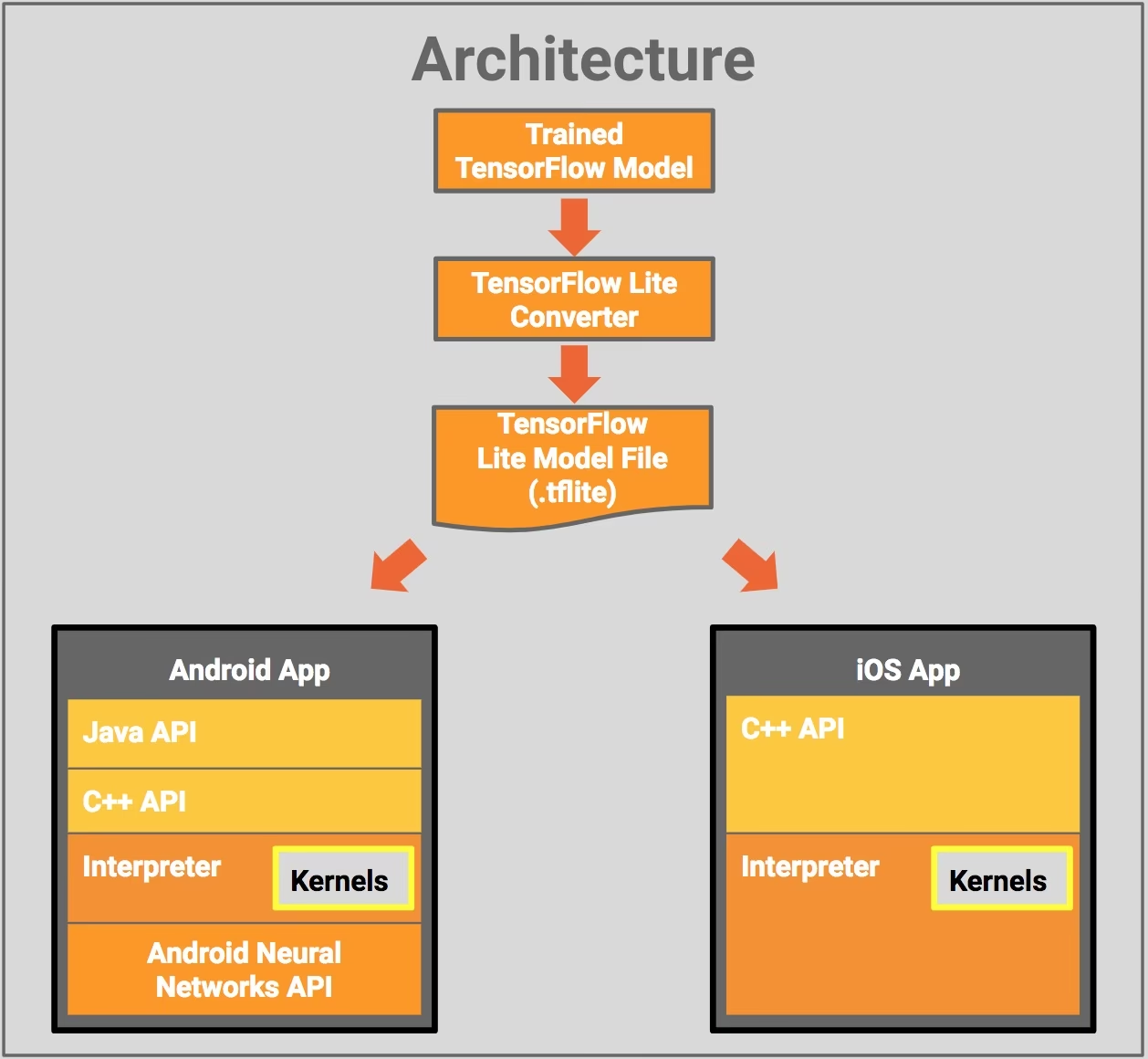
- Implementación en Android e iOS: Las aplicaciones de Android e iOS con TFLite pueden analizar las imágenes de cámaras y los datos de sensores en tiempo real para detectar e identificar objetos. TFLite también ofrece bibliotecas nativas de iOS escritas en Swift y Objective-C. El diagrama de arquitectura siguiente muestra el proceso para implementar un modelo entrenado en plataformas Android e iOS mediante TensorFlow Lite.
-
Implementación con Linux integrado: Si ejecutar la inferencia en una Raspberry Pi no alcanza la velocidad que requiere tu caso de uso, puedes usar un modelo TFLite exportado para acelerarla. Además, puedes mejorar aún más el rendimiento con un dispositivo Coral Edge TPU.
-
Implementación en microcontroladores: Los modelos TFLite también pueden implementarse en microcontroladores y otros dispositivos con solo unos pocos kilobytes de memoria. El entorno de ejecución principal cabe en tan solo 16 KB en un Arm Cortex M3 y puede ejecutar muchos modelos básicos. No requiere compatibilidad con sistemas operativos, bibliotecas estándar de C o C++ ni asignación dinámica de memoria.
Sustituir la exportación TFLite por LiteRT#
Para las nuevas exportaciones, convierte tu modelo a LiteRT. El modelo resultante conserva la extensión de archivo .tflite.
Instalación#
Para instalar los paquetes necesarios, ejecuta:
# Install the required package for YOLO26
pip install ultralytics
Para obtener instrucciones detalladas y buenas prácticas relacionadas con el proceso de instalación, consulta nuestra guía de instalación de Ultralytics. Si tienes dificultades al instalar los paquetes necesarios para YOLO26, consulta nuestra guía sobre problemas habituales, donde encontrarás soluciones y consejos.
Uso#
Todos los modelos Ultralytics YOLO26 están diseñados para admitir la exportación desde el primer momento, lo que facilita su integración en el flujo de trabajo de implementación que prefieras. Puedes consultar la lista completa de formatos de exportación y opciones de configuración compatibles para elegir la configuración más adecuada para tu aplicación.
El formato de sustitución LiteRT es compatible con los modos Exportar, Predecir y Validar. Exporta tu modelo y, después, carga el modelo .tflite exportado para ejecutar inferencias o validar su precisión.
from ultralytics import YOLO

# Carga un modelo YOLO26
model = YOLO("yolo26n.pt")

# Exporta el modelo al formato LiteRT
model.export(format="litert", imgsz=640) # usa imgsz=224 para clasificaciónfrom ultralytics import YOLO
# Carga el modelo TFLite exportado
model = YOLO("yolo26n.tflite")
# Ejecutar inferencia
results = model("https://ultralytics.com/images/bus.jpg")from ultralytics import YOLO
# Carga el modelo TFLite exportado
model = YOLO("yolo26n.tflite")
# Valida la precisión con el conjunto de datos COCO8
metrics = model.val(data="coco8.yaml")Argumentos de exportación#
Consulta los argumentos de exportación de LiteRT. Para obtener más información sobre el proceso de exportación, visita la página de la documentación de Ultralytics sobre exportación.
Implementación de modelos YOLO26 TFLite exportados#
Tras exportar tu modelo Ultralytics YOLO26 al formato LiteRT, puedes desplegar el modelo .tflite resultante. El primer paso recomendado para ejecutar un modelo TFLite es usar el método YOLO("model.tflite"), como se muestra en el fragmento de código de uso anterior. Para obtener instrucciones detalladas sobre cómo desplegar tus modelos TFLite en otros entornos, consulta estos recursos:
-
Android: guía de inicio rápido para integrar TensorFlow Lite en aplicaciones Android, con pasos sencillos para configurar y ejecutar modelos de aprendizaje automático.
-
iOS: guía para desarrolladores sobre la integración y el despliegue de modelos TensorFlow Lite en aplicaciones iOS, con instrucciones paso a paso y recursos.
-
Ejemplos de principio a fin: Esta página ofrece una descripción general de varios ejemplos de TensorFlow Lite, con aplicaciones prácticas y tutoriales para ayudar a los desarrolladores a implementar TensorFlow Lite en sus proyectos de aprendizaje automático para dispositivos móviles y edge.
Resumen#
Esta guía conserva el flujo de trabajo de implementación TFLite heredado. Para las nuevas exportaciones, usa LiteRT para crear modelos .tflite destinados a entornos de computación edge.
Para obtener más información sobre el uso, visita la documentación oficial de TFLite.
Preguntas frecuentes#
Para una nueva exportación, usa el formato LiteRT. Primero, instala el paquete necesario con:
pip install ultralyticsA continuación, usa el siguiente fragmento de código para exportar tu modelo:
from ultralytics import YOLO

# Carga un modelo YOLO26
model = YOLO("yolo26n.pt")

# Exporta el modelo al formato LiteRT
model.export(format="litert", imgsz=640)  # usa imgsz=224 para clasificación
Si utilizas la CLI, puedes hacerlo con:
yolo export model=yolo26n.pt format=litert imgsz=640 # use imgsz=224 for classificationPara obtener más información, visita la guía de exportación de Ultralytics.
TensorFlow Lite (TFLite) es un framework de aprendizaje profundo de código abierto diseñado para la inferencia en el dispositivo, por lo que es ideal para implementar modelos YOLO26 en dispositivos móviles, sistemas integrados e IoT. Entre sus principales ventajas se incluyen:
- Optimización en el dispositivo: Reduce la latencia y mejora la privacidad al procesar los datos localmente.
- Compatibilidad con plataformas: Compatible con Android, iOS, Linux integrado y MCU.
- Rendimiento: utiliza aceleración por hardware para optimizar la velocidad y la eficiencia del modelo.
Para obtener más información, consulta la guía de TFLite.
Sí, puedes ejecutar modelos YOLO26 TFLite en Raspberry Pi para mejorar la velocidad de inferencia. Primero, exporta tu modelo al formato LiteRT como se explica arriba. Después, ejecuta el modelo
.tfliteen tu Raspberry Pi conYOLO("yolo26n.tflite")o con el intérprete LiteRT.Un Coral Edge TPU puede acelerar aún más la inferencia.
TFLite permite implementar modelos en microcontroladores con recursos limitados: su entorno de ejecución principal solo necesita 16 KB de memoria en un Arm Cortex M3 y puede ejecutar muchos modelos básicos. Sin embargo, los modelos YOLO26 suelen ser demasiado grandes para la memoria habitual de los microcontroladores, así que los ordenadores de placa única, los dispositivos móviles o los aceleradores específicos son opciones más adecuadas para YOLO26.
Para empezar, visita la guía de TFLite Micro para microcontroladores.
TensorFlow Lite ofrece una amplia compatibilidad con plataformas y permite implementar modelos YOLO26 en numerosos dispositivos, entre ellos:
- Android e iOS: Compatibilidad nativa mediante las bibliotecas de TFLite para Android e iOS.
- Linux integrado: Ideal para ordenadores de placa única, como Raspberry Pi.
- Microcontroladores: Adecuado para MCU con recursos limitados.
Para obtener más información sobre las opciones de implementación, consulta nuestra guía detallada de implementación.
Si se producen errores al exportar modelos YOLO26 a LiteRT, algunas soluciones habituales son:
- Comprueba la compatibilidad de los paquetes: Asegúrate de utilizar versiones compatibles de Ultralytics,
litert-torchyai-edge-litert. Consulta nuestra guía de instalación. - Compatibilidad del modelo: Comprueba que el modelo YOLO26 específico sea compatible con la exportación a LiteRT; para ello, consulta la página de documentación de exportación de Ultralytics.
- Problemas de cuantización: Si usas la cuantización INT8, asegúrate de especificar correctamente la ruta del conjunto de datos en el parámetro
data.
Para obtener más consejos sobre la solución de problemas, visita nuestra guía de problemas habituales.
- Comprueba la compatibilidad de los paquetes: Asegúrate de utilizar versiones compatibles de Ultralytics,


Comentarios115
Haz una pregunta, comparte tus resultados o ayuda a otra persona.
saleha-fatima(editado)
hi there @glenn-jocher I am trying to convert the the yolov10 model to int8 with tflite format. but same error is occurring again and again. I've tried the solutions described in this thread but nothing seems to work. I am using this for conversion:
` from ultralytics import YOLO
model = YOLO("current_best4.pt")
model.export(format="tflite", int8=True, data='./datasets/data.yaml', imgsz=640) # creates 'yolov8n_float32.tflite'
tflite_model = YOLO("yolov8n_int8.tflite")
results = tflite_model("./frame_365.jpg")
results.show() `
and the error i am receiving is this:
ValueError: Exception encountered when calling layer "tf.math.add_5" (type TFOpLambda).
Dimensions must be equal, but are 32 and 16 for '{{node tf.math.add_5/Add}} = AddV2 [T=DT_FLOAT](Placeholder, Placeholder_1)' with input shapes: [1,80,160,32], [1,80,160,16].
Call arguments received by layer "tf.math.add_5" (type TFOpLambda): • x=tf.Tensor(shape=(1, 80, 160, 32), dtype=float32) • y=tf.Tensor(shape=(1, 80, 160, 16), dtype=float32) • name='/model.2/m.0/Add'
ERROR: input_onnx_file_path: weights/yolov10n.onnx ERROR: onnx_op_name: /model.2/m.0/Add ERROR: Read this and deal with it. https://github.com/PINTO0309/onnx2tf#parameter-replacement ERROR: Alternatively, if the input OP has a dynamic dimension, use the -b or -ois option to rewrite it to a static shape and try again. ERROR: If the input OP of ONNX before conversion is NHWC or an irregular channel arrangement other than NCHW, use the -kt or -kat option. ERROR: Also, for models that include NonMaxSuppression in the post-processing, try the -onwdt option. `
i
I have approx 5k images for calibration, so thats not the issue, all the packages are upto date as well. can you please suggest what solution should i opt for?
1 Glenn JocherUltralytics(editado)
@saleha-fatima the error appears to be related to shape mismatches during ONNX to TFLite conversion. Please ensure that your model, dataset, and TensorFlow versions are fully compatible. Refer to the onnx2tf parameter replacement guide for addressing this issue. Additionally, try exporting with
int8=Falsefirst to confirm the issue is specific to quantization. If the problem persists, please share more details about your environment or test with the latest Ultralytics version.Note: Since Ultralytics 8.4.83,
format="tflite"is deprecated and exports through LiteRT (litert-torch) instead of onnx2tf and TensorFlow. Runpip install -U ultralyticsand export withformat="litert"(see the LiteRT guide).I've tried with
int8=False, but the problem persists. this is the info related to my model, packages and dataset so i am using yolov10 model fro conversion purposes coco dataset python version=3.9.12 packages:torch==2.0.1 torchvision==0.15.2 onnx==1.17.0 onnxruntime==1.15.1 pycocotools==2.0.7 PyYAML==6.0.1 scipy==1.13.0 onnxslim==0.1.31 onnxruntime-gpu==1.18.0 gradio==4.31.5 opencv-python==4.9.0.80 psutil==5.9.8 py-cpuinfo==9.0.0 huggingface-hub==0.23.2 safetensors==0.4.3 ultralytics==8.3.69 onnx2tf==1.20.0 onnxruntime==1.15.1 tensorflow==2.18.0
I have alse tried the suggestions mentioned in error msg but nothing seems to work!
- Glenn JocherUltralytics(editado)
This was a compatibility issue between YOLOv10's architecture and the old ONNX->TFLite (onnx2tf) conversion path. Since Ultralytics 8.4.83,
format="tflite"is deprecated and exports through LiteRT (litert-torch) instead of onnx2tf and TensorFlow, so those version pins no longer apply. Runpip install -U ultralyticsand export withformat="litert"(see the LiteRT guide). nicola-321
hi there @glenn-jocher I am trying to convert the the yolov10 model to int8 with tflite format. but same error is occurring again and again. I've tried the solutions described in this thread but nothing seems to work. I am using this for conversion:
` from ultralytics import YOLO
model = YOLO("current_best4.pt")
model.export(format="tflite", int8=True, data='./datasets/data.yaml', imgsz=640) # creates 'yolov8n_float32.tflite'
tflite_model = YOLO("yolov8n_int8.tflite")
results = tflite_model("./frame_365.jpg")
results.show() `
and the error i am receiving is this:
ERROR: The trace log is below. Traceback (most recent call last): File "/mnt/drive/rev9ai/anaconda3/envs/int8_test/lib/python3.9/site-packages/onnx2tf/utils/common_functions.py", line 310, in print_wrapper_func result = func(*args, **kwargs) File "/mnt/drive/rev9ai/anaconda3/envs/int8_test/lib/python3.9/site-packages/onnx2tf/utils/common_functions.py", line 383, in inverted_operation_enable_disable_wrapper_func result = func(*args, **kwargs) File "/mnt/drive/rev9ai/anaconda3/envs/int8_test/lib/python3.9/site-packages/onnx2tf/utils/common_functions.py", line 53, in get_replacement_parameter_wrapper_func func(*args, **kwargs) File "/mnt/drive/rev9ai/anaconda3/envs/int8_test/lib/python3.9/site-packages/onnx2tf/ops/Add.py", line 248, in make_node merge_two_consecutive_identical_ops_into_one( File "/mnt/drive/rev9ai/anaconda3/envs/int8_test/lib/python3.9/site-packages/onnx2tf/utils/common_functions.py", line 5384, in merge_two_consecutive_identical_ops_into_one tf.math.add( File "/mnt/drive/rev9ai/anaconda3/envs/int8_test/lib/python3.9/site-packages/tensorflow/python/ops/weak_tensor_ops.py", line 142, in wrapper return op(*args, **kwargs) File "/mnt/drive/rev9ai/anaconda3/envs/int8_test/lib/python3.9/site-packages/tensorflow/python/util/traceback_utils.py", line 153, in error_handler raise e.with_traceback(filtered_tb) from None File "/mnt/drive/rev9ai/anaconda3/envs/int8_test/lib/python3.9/site-packages/tf_keras/src/layers/core/tf_op_layer.py", line 119, in handle return TFOpLambda(op)(*args, **kwargs) File "/mnt/drive/rev9ai/anaconda3/envs/int8_test/lib/python3.9/site-packages/tf_keras/src/utils/traceback_utils.py", line 70, in error_handler raise e.with_traceback(filtered_tb) from None ValueError: Exception encountered when calling layer "tf.math.add_5" (type TFOpLambda). Dimensions must be equal, but are 32 and 16 for '{{node tf.math.add_5/Add}} = AddV2 [T=DT_FLOAT](Placeholder, Placeholder_1)' with input shapes: [1,80,160,32], [1,80,160,16]. Call arguments received by layer "tf.math.add_5" (type TFOpLambda): • x=tf.Tensor(shape=(1, 80, 160, 32), dtype=float32) • y=tf.Tensor(shape=(1, 80, 160, 16), dtype=float32) • name='/model.2/m.0/Add' ERROR: input_onnx_file_path: weights/yolov10n.onnx ERROR: onnx_op_name: /model.2/m.0/Add ERROR: Read this and deal with it. https://github.com/PINTO0309/onnx2tf#parameter-replacement ERROR: Alternatively, if the input OP has a dynamic dimension, use the -b or -ois option to rewrite it to a static shape and try again. ERROR: If the input OP of ONNX before conversion is NHWC or an irregular channel arrangement other than NCHW, use the -kt or -kat option. ERROR: Also, for models that include NonMaxSuppression in the post-processing, try the -onwdt option.i
I have approx 5k images for calibration, so thats not the issue, all the packages are upto date as well. can you please suggest what solution should i opt for?
I've got the same error when covert yolov8 to tflite. Have you fix it?
- Glenn JocherUltralytics(editado)
For YOLOv10 TFLite conversion issues in the old onnx2tf path: Since Ultralytics 8.4.83,
format="tflite"is deprecated and exports through LiteRT (litert-torch) instead of onnx2tf and TensorFlow, so those version pins no longer apply. Runpip install -U ultralyticsand export withformat="litert"(see the LiteRT guide). If errors persist, share the full export log. Thanks for your advice. I've tried to Update dependencies and Export with dynamic axes , but unfortunately, a new issue is as below:
AssertionError: ERROR ❌️ argument 'dynamic' is not supported for format='tflite'
If I only update dependencies and delete the dynamic axes , the issue is as before:
ValueError: Exception encountered when calling layer "tf.math.add_5" (type TFOpLambda).
Dimensions must be equal, but are 32 and 16 for '{{node tf.math.add_5/Add}} = AddV2 [T=DT_FLOAT](Placeholder, Placeholder_1)' with input shapes: [1,80,160,32], [1,80,160,16].
Call arguments received by layer "tf.math.add_5" (type TFOpLambda): • x=tf.Tensor(shape=(1, 80, 160, 32), dtype=float32) • y=tf.Tensor(shape=(1, 80, 160, 16), dtype=float32) • name='/model.2/m.0/Add'
I've got the same error when covert yolov8 to tflite. Have you fix it?
hi there, yes i fixed this issue. but it then resulted into new error saying "end2end model format conversion is not supported". btw i resolved that issue by using the following versions of dependencies: torch 2.6.0 tensorflow 2.15.1 onnx2tf 1.20.0
try this but if you are looking for direct export of the model to int8 with tflite. then according to my research
exportcommand does not work. atleast it didnt work for yolov10 model. for that i converted the .pt model to IR form (onnx) then further conversion. but if your concern is just to convert model to tflite with fp16/32 quantization. i would suggest to use command line prompt for conversion. for some reasons it works!yolo export model=runs/detect/train2/weights/best.pt format=tflite half=False simplify opset=13 workspace=16- Glenn JocherUltralytics(editado)
@saleha-fatima thanks for sharing your solution! Since Ultralytics 8.4.83,
format="tflite"is deprecated and exports through LiteRT (litert-torch) instead of onnx2tf and TensorFlow. Runpip install -U ultralyticsand export withformat="litert"(see the LiteRT guide). Thedynamicargument is not supported for LiteRT export. I've got the same error when covert yolov8 to tflite. Have you fix it?
hi there, yes i fixed this issue. but it then resulted into new error saying "end2end model format conversion is not supported". btw i resolved that issue by using the following versions of dependencies: torch 2.6.0 tensorflow 2.15.1 onnx2tf 1.20.0
try this but if you are looking for direct export of the model to int8 with tflite. then according to my research
exportcommand does not work. atleast it didnt work for yolov10 model. for that i converted the .pt model to IR form (onnx) then further conversion. but if your concern is just to convert model to tflite with fp16/32 quantization. i would suggest to use command line prompt for conversion. for some reasons it works!yolo export model=runs/detect/train2/weights/best.pt format=tflite half=False simplify opset=13 workspace=16Thank you for your reply,. I've tried to update the dependencies or use the CLI but error persists. so I tried to convert the model step by step . It can be converted to onnx but when converting to tf. An new error occurs as below. It seems like the dependency conflict :
https://github.com/tensorflow/addons warnings.warn( Traceback (most recent call last): File "/workspace/user_code/model/convertModel/onnx-tensorflow/example/onnx_to_tf.py", line 3, in from onnx_tf.backend import prepare File "/workspace/user_code/model/convertModel/onnx-tensorflow/onnx_tf/init.py", line 1, in from . import backend File "/workspace/user_code/model/convertModel/onnx-tensorflow/onnx_tf/backend.py", line 28, in from onnx_tf.common.handler_helper import get_all_backend_handlers File "/workspace/user_code/model/convertModel/onnx-tensorflow/onnx_tf/common/handler_helper.py", line 3, in from onnx_tf.handlers.backend import * # noqa File "/workspace/user_code/model/convertModel/onnx-tensorflow/onnx_tf/handlers/backend/hardmax.py", line 3, in import tensorflow_addons as tfa File "/workspace/user_code/model/convertModel/myenv3.10/lib/python3.10/site-packages/tensorflow_addons/init.py", line 23, in from tensorflow_addons import activations File "/workspace/user_code/model/convertModel/myenv3.10/lib/python3.10/site-packages/tensorflow_addons/activations/init.py", line 17, in from tensorflow_addons.activations.gelu import gelu File "/workspace/user_code/model/convertModel/myenv3.10/lib/python3.10/site-packages/tensorflow_addons/activations/gelu.py", line 19, in from tensorflow_addons.utils.types import TensorLike File "/workspace/user_code/model/convertModel/myenv3.10/lib/python3.10/site-packages/tensorflow_addons/utils/types.py", line 29, in from keras.src.engine import keras_tensor ModuleNotFoundError: No module named 'keras.src.engine'
and if I use
!pip install 'keras<3.0.0' mediapipe-model-makerto fix the error from https://github.com/google-ai-edge/mediapipe/issues/5229 then it will leading to the issue as below:ImportError: This version of TensorFlow Probability requires TensorFlow version >= 2.18; Detected an installation of version 2.15.1. Please upgrade TensorFlow to proceed.
It seems like that keras<3.0.0 and TensorFlow version >= 2.18 is conflict
Hi, so i tested it on my end again and it worked. I would recommend you to create a new env and then just go for installing updated "ultralytics" package using
pip install ultralyticsnow without installing anything else just run this CLI export command:yolo export model=runs/detect/train2/weights/best.pt format=tflite half=False simplify opset=13 workspace=16It will install all the supported requirements itself. I have tested it, i am sure it will work for u as well. Do update me on this!
- Glenn JocherUltralytics(editado)
Thanks for sharing your findings. For TFLite conversion issues, create a fresh environment and let Ultralytics install what it needs when you export. Since Ultralytics 8.4.83,
format="tflite"is deprecated and exports through LiteRT (litert-torch) instead of onnx2tf and TensorFlow, so those version pins no longer apply. Runpip install -U ultralyticsand export withformat="litert"(see the LiteRT guide). If issues persist, please share your environment details fromyolo checks. Hi, so i tested it on my end again and it worked. I would recommend you to create a new env and then just go for installing updated "ultralytics" package using
pip install ultralyticsnow without installing anything else just run this CLI export command:yolo export model=runs/detect/train2/weights/best.pt format=tflite half=False simplify opset=13 workspace=16It will install all the supported requirements itself. I have tested it, i am sure it will work for u as well. Do update me on this!
Hi, thanks for your sharing!Congratulate that you fix it ! but seems that it does's work in my env. I have create a new env . only "pip install ultralytics" , loading the yolov11. and my python packages is as below: `Package Version
absl-py 2.1.0 astunparse 1.6.3 cachetools 5.5.2 certifi 2025.1.31 cffi 1.17.1 charset-normalizer 3.4.1 coloredlogs 15.0.1 contourpy 1.1.1 cycler 0.12.1 filelock 3.16.1 flatbuffers 25.2.10 fonttools 4.56.0 fsspec 2025.2.0 gast 0.4.0 google-auth 2.38.0 google-auth-oauthlib 1.0.0 google-pasta 0.2.0 grpcio 1.70.0 h5py 3.11.0 humanfriendly 10.0 idna 3.10 importlib_metadata 8.5.0 importlib_resources 6.4.5 Jinja2 3.1.5 keras 2.13.1 kiwisolver 1.4.7 libclang 18.1.1 Markdown 3.7 MarkupSafe 2.1.5 matplotlib 3.7.5 mpmath 1.3.0 networkx 3.1 numpy 1.24.3 nvidia-cublas-cu12 12.1.3.1 nvidia-cuda-cupti-cu12 12.1.105 nvidia-cuda-nvrtc-cu12 12.1.105 nvidia-cuda-runtime-cu12 12.1.105 nvidia-cudnn-cu12 9.1.0.70 nvidia-cufft-cu12 11.0.2.54 nvidia-curand-cu12 10.3.2.106 nvidia-cusolver-cu12 11.4.5.107 nvidia-cusparse-cu12 12.1.0.106 nvidia-nccl-cu12 2.20.5 nvidia-nvjitlink-cu12 12.8.61 nvidia-nvtx-cu12 12.1.105 oauthlib 3.2.2 onnx 1.17.0 onnx_graphsurgeon 0.5.5 onnx2tf 1.20.0 onnxruntime 1.16.3 onnxslim 0.1.48 opencv-python 4.11.0.86 opt_einsum 3.4.0 packaging 24.2 pandas 2.0.3 pillow 10.4.0 pip 25.0.1 protobuf 5.29.3 psutil 7.0.0 py-cpuinfo 9.0.0 pyasn1 0.6.1 pyasn1_modules 0.4.1 pybind11 2.13.6 pycparser 2.22 pyparsing 3.1.4 python-dateutil 2.9.0.post0 pytz 2025.1 PyYAML 6.0.2 requests 2.32.3 requests-oauthlib 2.0.0 rsa 4.9 scipy 1.10.1 seaborn 0.13.2 setuptools 49.2.1 six 1.17.0 sng4onnx 1.0.4 sounddevice 0.5.1 sympy 1.13.3 tensorboard 2.13.0 tensorboard-data-server 0.7.2 tensorflow-cpu 2.13.1 tensorflow-estimator 2.13.0 tensorflow-io-gcs-filesystem 0.34.0 termcolor 2.4.0 tf-keras 2.15.0 tflite-support 0.4.0 torch 2.4.1 torchvision 0.19.1 tqdm 4.67.1 triton 3.0.0 typing_extensions 4.5.0 tzdata 2025.1 ultralytics 8.3.78 ultralytics-thop 2.0.14 urllib3 2.2.3 Werkzeug 3.0.6 wheel 0.45.1 wrapt 1.17.2 zipp 3.20.2`
The problem is still `ValueError: Exception encountered when calling layer "tf.math.add_5" (type TFOpLambda).
Dimensions must be equal, but are 32 and 16 for '{{node tf.math.add_5/Add}} = AddV2 [T=DT_FLOAT](Placeholder, Placeholder_1)' with input shapes: [1,16,160,32], [1,16,160,16].
Call arguments received by layer "tf.math.add_5" (type TFOpLambda): • x=tf.Tensor(shape=(1, 16, 160, 32), dtype=float32) • y=tf.Tensor(shape=(1, 16, 160, 16), dtype=float32) • name='/model.2/m.0/Add'
ERROR: input_onnx_file_path: yolo11n.onnx ERROR: onnx_op_name: /model.2/m.0/Add ERROR: Read this and deal with it. https://github.com/PINTO0309/onnx2tf#parameter-replacement ERROR: Alternatively, if the input OP has a dynamic dimension, use the -b or -ois option to rewrite it to a static shape and try again. ERROR: If the input OP of ONNX before conversion is NHWC or an irregular channel arrangement other than NCHW, use the -kt or -kat option. ERROR: Also, for models that include NonMaxSuppression in the post-processing, try the -onwdt option.`
- Glenn JocherUltralytics(editado)
Thanks for sharing your environment details. Since Ultralytics 8.4.83,
format="tflite"is deprecated and exports through LiteRT (litert-torch) instead of onnx2tf and TensorFlow, so those version pins no longer apply. Runpip install -U ultralyticsand export withformat="litert"(see the LiteRT guide). Then export via CLI:yolo export model=yolo11n.pt format=litert imgsz=640.
Z-Mike0033
您好,我现在正在使用基于官网的yolo11m.pt预训练模型,在自己数据集上训练后的human_detector_model_float32.tflite,并在支持 TFLite GPU 代理的设备上进行推理。 1、从.pt到tflite的转换代码是官网提供的版本如下: model.export( format="tflite", imgsz=640, half=True, simplify=True ) 2、使用tflite在支持 TFLite GPU 代理的设备上进行推理,日志如下: I human_detector_mode_float32.tflite I Created GPU engine. INFO: Created TensorFlow Lite delegate for GPU. ERROR: Failed to build program executable - Build program failure error: Total size of kernel arguments exceeds limit! Total arguments size: 4120, limit: 2048 in kernel: 'main_function' error: backend compiler failed build.
error: Total size of kernel arguments exceeds limit! Total arguments size: 4120, limit: 2048 in kernel: 'main_function' error: backend compiler failed build.
ERROR: Falling back to OpenGL ERROR: TfLiteGpuDelegate Init: OpenGL-based API disabled ERROR: TfLiteGpuDelegate Prepare: delegate is not initialized ERROR: Node number 255 (TfLiteGpuDelegateV2) failed to prepare. ERROR: Restored original execution plan after delegate application failure. E tflite gpu not support!../models/extra/human_detector/human_detector_model_float32.tflite INFO: Created TensorFlow Lite XNNPACK delegate for CPU. I Load model finished I Image reader initialized. Total images: 15 I Starting image processing loop.. 3、由日志可知,模型成功加载,并创建了 GPU 代理;但在准备阶段,GPU 代理失败了,并回退到 CPU(XNNPACK)推理。主要原因是“Total size of kernel arguments exceeds limit!:**内核参数总大小超过了硬件限制。**日志显示参数大小为 4120,而限制为 2048”。 4、想问下这个是为什么?需要怎么解决这个GPU跑不了回退xnnpack的问题?
UltralyticsAssistantUltralytics
👋 Hello, thank you for your interest in Ultralytics 🚀! For users exploring model conversion and deployment, we recommend checking out the Docs where you’ll find a variety of helpful Python and CLI usage examples, as well as detailed integration guides.
If this is a 🐛 Bug Report regarding TFLite conversion, please provide a minimum reproducible example to help us investigate.
If you have a custom training ❓ Question or experience any issues during conversion, please include as much information as possible, such as code snippets, error messages, and details about your environment. Also, check our Tips for Best Training Results to ensure optimal performance.
Connect with the Ultralytics community in the way that suits you best: for real-time chat, join us on Discord 🎧, dive deeper on Discourse, or join discussions on our Subreddit.
Upgrade
Please upgrade to the latest
ultralyticspackage and all requirements in a Python>=3.8 environment with PyTorch>=1.8 to ensure your issue is not already resolved:pip install -U ultralyticsEnvironments
YOLO can be run in any of these up-to-date verified environments (with all dependencies such as CUDA/CUDNN, Python and PyTorch preinstalled):
- Notebooks with free GPU:


- Google Cloud Deep Learning VM. See GCP Quickstart Guide
- Amazon Deep Learning AMI. See AWS Quickstart Guide
- Docker Image. See Docker Quickstart Guide
Status

If this badge is green, all Ultralytics CI tests are currently passing. CI tests verify correct operation of all YOLO Modes and Tasks on macOS, Windows, and Ubuntu every 24 hours and on every commit.
🔔 This is an automated response. An Ultralytics engineer will also assist you here soon!
Alexts166
I'm working through the IDE, and I've updated the dependencies. I'm launching it from ultralytics import YOLO
Load the YOLO11 model
model = YOLO("yolo11m-obb.pt")
Export the model to TFLite format
model.export(format="tflite")
ERROR TensorFlow SavedModel: export failure 34.3s: No module named 'ai_edge_litert' Traceback (most recent call last): File "D:\nEWpapka\convert.py", line 7, in model.export(format="tflite") # creates 'yolo11n_float32.tflite' File "D:\nEWpapka.venv\lib\site-packages\ultralytics\engine\model.py", line 734, in export return Exporter(overrides=args, callbacks=self.callbacks)(model=self.model) File "D:\nEWpapka.venv\lib\site-packages\ultralytics\engine\exporter.py", line 494, in call f[5], keras_model = self.export_saved_model() File "D:\nEWpapka.venv\lib\site-packages\ultralytics\engine\exporter.py", line 198, in outer_func raise e File "D:\nEWpapka.venv\lib\site-packages\ultralytics\engine\exporter.py", line 193, in outer_func f, model = inner_func(*args, **kwargs) File "D:\nEWpapka.venv\lib\site-packages\ultralytics\engine\exporter.py", line 1003, in export_saved_model import onnx2tf # scoped for after ONNX export for reduced conflict during import File "D:\nEWpapka.venv\lib\site-packages\onnx2tf_init.py", line 1, in from onnx2tf.onnx2tf import convert, main File "D:\nEWpapka.venv\lib\site-packages\onnx2tf\onnx2tf.py", line 44, in from onnx2tf.utils.common_functions import ( File "D:\nEWpapka.venv\lib\site-packages\onnx2tf\utils\common_functions.py", line 20, in from ai_edge_litert.interpreter import Interpreter ModuleNotFoundError: No module named 'ai_edge_litert'
in bash pip install ai_edge_litert ERROR: Could not find a version that satisfies the requirement ai_edge_litert (from versions: none) ERROR: No matching distribution found for ai_edge_litert
- Glenn JocherUltralytics
You're correct that
ai_edge_literthas limited platform support and isn't available for Windows. For TFLite export on Windows, I recommend using one of these alternatives:- Google Colab (recommended): Export your model in a Colab notebook which runs on Linux
- Docker: Use the Ultralytics Docker image on Windows to export in a Linux container
- WSL2: Export using Windows Subsystem for Linux
The simplest approach is Colab - just upload your
.ptfile and run the export code there, then download the resulting.tflitefile back to your Windows machine. Thank you for your recommendations
- Notebooks with free GPU:
Hi! Please give me a hint. Exporting the model .pt in the model . tflite according to the code in the documentation. It remains to cope with the ai_edge_litert package. Do I understand correctly that there is no such package for WINDOWS? based on the information on https://pypi.org/project/ai-edge-litert/#files Or is there a way out?
longzaixiang222
您好老师,同一个模型,转换成tflite,同一张图片,每2秒识别一次,和单次识别为什么结果会不样?
每二秒识别,是通过录屏生成的图片,单次识别,是录屏后保存到本地的图片
- Glenn JocherUltralytics
@longzaixiang222 这种差异通常由以下原因造成:1) 录屏图像可能存在压缩损失或格式转换;2) 录屏帧和保存的图片可能在色彩空间、分辨率或编码上有细微差别;3) 图像预处理路径不同。建议检查两种图像的像素值、尺寸和格式是否完全一致,确保使用相同的预处理步骤。您可以尝试保存录屏帧并与本地图片进行像素级对比来定位差异源。
好的,谢谢了老师
diamondeyess
我的导出设置是:ormat = "tflite", device = "0", int8 = True, data =.....data.yaml, 为什么输出:fully_quantize: 0, inference_type: 6, input_inference_type: FLOAT32, output_inference_type: FLOAT32 ,没有完全量化吗?
- Glenn JocherUltralytics
@diamondeyess 这是正常的TFLite INT8量化行为!输入输出保持FLOAT32是为了保持精度和兼容性,而模型内部计算已经量化为INT8以提升性能和减小模型大小。这种"混合量化"可以在保持推理精度的同时获得INT8的性能优势。如需完全INT8量化(包括输入输出),需要特定的TFLite配置,但通常不推荐,因为可能影响精度。
好的,谢谢!后面输出还有一段:fully_quantize: 0, inference_type: 6, input_inference_type: INT8, output_inference_type: INT8 就是您说的完全量化吗?
- Glenn JocherUltralytics
@diamondeyess 是的,第二个输出(input_inference_type: INT8, output_inference_type: INT8)就是完全量化!这意味着模型的输入和输出也被量化为INT8。完全量化可以进一步减小模型大小和提升推理速度,但需要注意输入数据的预处理要匹配INT8格式。在使用时,您可能需要将输入数据从FLOAT32转换为INT8范围,并在推理后将输出从INT8转换回FLOAT32以便后处理。
SKUNAandGOJO
I'm trying to convert "tflite" to Google Colab, but it's showing like this
Ultralytics 8.3.133 🚀 Python-3.11.12 torch-2.6.0+cu124 CPU (Intel Xeon 2.00GHz) YOLO11n summary (fused): 100 layers, 2,584,687 parameters, 0 gradients, 6.3 GFLOPs
PyTorch: starting from 'fruit.pt' with input shape (1, 3, 640, 640) BCHW and output shape(s) (1, 17, 8400) (5.2 MB) requirements: Ultralytics requirements ['sng4onnx>=1.0.1', 'onnx_graphsurgeon>=0.3.26', 'ai-edge-litert>=1.2.0', 'onnx2tf>=1.26.3', 'protobuf>=5'] not found, attempting AutoUpdate... Looking in indexes: https://pypi.org/simple, https://pypi.ngc.nvidia.com Collecting sng4onnx>=1.0.1 Downloading sng4onnx-1.0.4-py3-none-any.whl.metadata (4.6 kB) Collecting onnx_graphsurgeon>=0.3.26 Downloading onnx_graphsurgeon-0.5.8-py2.py3-none-any.whl.metadata (8.2 kB) Collecting ai-edge-litert>=1.2.0 Downloading ai_edge_litert-1.2.0-cp311-cp311-manylinux_2_17_x86_64.whl.metadata (1.6 kB) Collecting onnx2tf>=1.26.3 Downloading onnx2tf-1.27.4-py3-none-any.whl.metadata (147 kB) ━━━━━━━━━━━━━━━━━━━━━━━━━━━━━━━━━━━━━━━ 147.7/147.7 kB 8.2 MB/s eta 0:00:00 Collecting protobuf>=5 Downloading protobuf-6.30.2-cp39-abi3-manylinux2014_x86_64.whl.metadata (593 bytes) Requirement already satisfied: numpy in /usr/local/lib/python3.11/dist-packages (from onnx_graphsurgeon>=0.3.26) (2.0.2) Requirement already satisfied: onnx>=1.14.0 in /usr/local/lib/python3.11/dist-packages (from onnx_graphsurgeon>=0.3.26) (1.17.0) Requirement already satisfied: flatbuffers in /usr/local/lib/python3.11/dist-packages (from ai-edge-litert>=1.2.0) (25.2.10) Downloading sng4onnx-1.0.4-py3-none-any.whl (5.9 kB) Downloading onnx_graphsurgeon-0.5.8-py2.py3-none-any.whl (57 kB) ━━━━━━━━━━━━━━━━━━━━━━━━━━━━━━━━━━━━━━━━ 57.9/57.9 kB 280.1 MB/s eta 0:00:00 Downloading ai_edge_litert-1.2.0-cp311-cp311-manylinux_2_17_x86_64.whl (3.5 MB) ━━━━━━━━━━━━━━━━━━━━━━━━━━━━━━━━━━━━━━━━ 3.5/3.5 MB 103.4 MB/s eta 0:00:00 Downloading onnx2tf-1.27.4-py3-none-any.whl (446 kB) ━━━━━━━━━━━━━━━━━━━━━━━━━━━━━━━━━━━━━━━ 446.1/446.1 kB 379.6 MB/s eta 0:00:00 Downloading protobuf-6.30.2-cp39-abi3-manylinux2014_x86_64.whl (316 kB) ━━━━━━━━━━━━━━━━━━━━━━━━━━━━━━━━━━━━━━━ 316.2/316.2 kB 356.0 MB/s eta 0:00:00 Installing collected packages: sng4onnx, protobuf, onnx2tf, ai-edge-litert, onnx_graphsurgeon Attempting uninstall: protobuf Found existing installation: protobuf 3.20.3 Uninstalling protobuf-3.20.3: Successfully uninstalled protobuf-3.20.3 Successfully installed ai-edge-litert-1.2.0 onnx2tf-1.27.4 onnx_graphsurgeon-0.5.8 protobuf-6.30.2 sng4onnx-1.0.4
requirements: AutoUpdate success ✅ 13.1s, installed 5 packages: ['sng4onnx>=1.0.1', 'onnx_graphsurgeon>=0.3.26', 'ai-edge-litert>=1.2.0', 'onnx2tf>=1.26.3', 'protobuf>=5'] WARNING ⚠️ requirements: Restart runtime or rerun command for updates to take effect
TensorFlow SavedModel: starting export with tensorflow 2.18.0... Downloading https://github.com/ultralytics/assets/releases/download/v8.3.0/calibration_image_sample_data_20x128x128x3_float32.npy.zip to 'calibration_image_sample_data_20x128x128x3_float32.npy.zip'... 100%|██████████| 1.11M/1.11M [00:00<00:00, 25.9MB/s] Unzipping calibration_image_sample_data_20x128x128x3_float32.npy.zip to /content/calibration_image_sample_data_20x128x128x3_float32.npy...: 100%|██████████| 1/1 [00:00<00:00, 32.58file/s] ONNX: starting export with onnx 1.18.0 opset 19...
ONNX: slimming with onnxslim 0.1.52... ONNX: export success ✅ 1.7s, saved as 'fruit.onnx' (10.2 MB) TensorFlow SavedModel: starting TFLite export with onnx2tf 1.27.4... ERROR:root:Internal Python error in the inspect module. Below is the traceback from this internal error.
ERROR: The trace log is below. Traceback (most recent call last): File "/usr/local/lib/python3.11/dist-packages/onnx2tf/utils/common_functions.py", line 313, in print_wrapper_func result = func(*args, **kwargs) ^^^^^^^^^^^^^^^^^^^^^ File "/usr/local/lib/python3.11/dist-packages/onnx2tf/utils/common_functions.py", line 386, in inverted_operation_enable_disable_wrapper_func result = func(*args, **kwargs) ^^^^^^^^^^^^^^^^^^^^^ File "/usr/local/lib/python3.11/dist-packages/onnx2tf/utils/common_functions.py", line 56, in get_replacement_parameter_wrapper_func func(*args, **kwargs) File "/usr/local/lib/python3.11/dist-packages/onnx2tf/ops/Add.py", line 281, in make_node merge_two_consecutive_identical_ops_into_one( File "/usr/local/lib/python3.11/dist-packages/onnx2tf/utils/common_functions.py", line 5475, in merge_two_consecutive_identical_ops_into_one tf.math.add( File "/usr/local/lib/python3.11/dist-packages/tensorflow/python/ops/weak_tensor_ops.py", line 142, in wrapper return op(*args, **kwargs) ^^^^^^^^^^^^^^^^^^^ File "/usr/local/lib/python3.11/dist-packages/tensorflow/python/util/traceback_utils.py", line 153, in error_handler raise e.with_traceback(filtered_tb) from None File "/usr/local/lib/python3.11/dist-packages/tf_keras/src/layers/core/tf_op_layer.py", line 119, in handle return TFOpLambda(op)(*args, **kwargs) ^^^^^^^^^^^^^^^^^^^^^^^^^^^^^^^ File "/usr/local/lib/python3.11/dist-packages/tf_keras/src/utils/traceback_utils.py", line 72, in error_handler del filtered_tb ValueError: Exception encountered when calling layer "tf.math.add_17" (type TFOpLambda).
Dimensions must be equal, but are 32 and 16 for '{{node tf.math.add_17/Add}} = AddV2 [T=DT_FLOAT](Placeholder, Placeholder_1)' with input shapes: [1,16,160,32], [1,16,160,16].
Call arguments received by layer "tf.math.add_17" (type TFOpLambda): • x=tf.Tensor(shape=(1, 16, 160, 32), dtype=float32) • y=tf.Tensor(shape=(1, 16, 160, 16), dtype=float32) • name='wa/model.2/m.0/Add'
ERROR: input_onnx_file_path: fruit.onnx ERROR: onnx_op_name: wa/model.2/m.0/Add ERROR: Read this and deal with it. https://github.com/PINTO0309/onnx2tf#parameter-replacement ERROR: Alternatively, if the input OP has a dynamic dimension, use the -b or -ois option to rewrite it to a static shape and try again. ERROR: If the input OP of ONNX before conversion is NHWC or an irregular channel arrangement other than NCHW, use the -kt or -kat option. ERROR: Also, for models that include NonMaxSuppression in the post-processing, try the -onwdt option. Traceback (most recent call last): File "/usr/local/lib/python3.11/dist-packages/onnx2tf/utils/common_functions.py", line 313, in print_wrapper_func result = func(*args, **kwargs) ^^^^^^^^^^^^^^^^^^^^^ File "/usr/local/lib/python3.11/dist-packages/onnx2tf/utils/common_functions.py", line 386, in inverted_operation_enable_disable_wrapper_func result = func(*args, **kwargs) ^^^^^^^^^^^^^^^^^^^^^ File "/usr/local/lib/python3.11/dist-packages/onnx2tf/utils/common_functions.py", line 56, in get_replacement_parameter_wrapper_func func(*args, **kwargs) File "/usr/local/lib/python3.11/dist-packages/onnx2tf/ops/Add.py", line 281, in make_node merge_two_consecutive_identical_ops_into_one( File "/usr/local/lib/python3.11/dist-packages/onnx2tf/utils/common_functions.py", line 5475, in merge_two_consecutive_identical_ops_into_one tf.math.add( File "/usr/local/lib/python3.11/dist-packages/tensorflow/python/ops/weak_tensor_ops.py", line 142, in wrapper return op(*args, **kwargs) ^^^^^^^^^^^^^^^^^^^ File "/usr/local/lib/python3.11/dist-packages/tensorflow/python/util/traceback_utils.py", line 153, in error_handler raise e.with_traceback(filtered_tb) from None File "/usr/local/lib/python3.11/dist-packages/tf_keras/src/layers/core/tf_op_layer.py", line 119, in handle return TFOpLambda(op)(*args, **kwargs) ^^^^^^^^^^^^^^^^^^^^^^^^^^^^^^^ File "/usr/local/lib/python3.11/dist-packages/tf_keras/src/utils/traceback_utils.py", line 72, in error_handler del filtered_tb ValueError: Exception encountered when calling layer "tf.math.add_17" (type TFOpLambda).
Dimensions must be equal, but are 32 and 16 for '{{node tf.math.add_17/Add}} = AddV2 [T=DT_FLOAT](Placeholder, Placeholder_1)' with input shapes: [1,16,160,32], [1,16,160,16].
Call arguments received by layer "tf.math.add_17" (type TFOpLambda): • x=tf.Tensor(shape=(1, 16, 160, 32), dtype=float32) • y=tf.Tensor(shape=(1, 16, 160, 16), dtype=float32) • name='wa/model.2/m.0/Add'
During handling of the above exception, another exception occurred:
Traceback (most recent call last): File "/usr/local/lib/python3.11/dist-packages/IPython/core/interactiveshell.py", line 3553, in run_code exec(code_obj, self.user_global_ns, self.user_ns) File "", line 7, in <cell line: 0> model.export(format="tflite") File "/usr/local/lib/python3.11/dist-packages/ultralytics/engine/model.py", line 730, in export return Exporter(overrides=args, _callbacks=self.callbacks)(model=self.model) ^^^^^^^^^^^^^^^^^^^^^^^^^^^^^^^^^^^^^^^^^^^^^^^^^^^^^^^^^^^^^^^^^^^^^ File "/usr/local/lib/python3.11/dist-packages/ultralytics/engine/exporter.py", line 468, in call f[5], keras_model = self.export_saved_model() ^^^^^^^^^^^^^^^^^^^^^^^^^ File "/usr/local/lib/python3.11/dist-packages/ultralytics/engine/exporter.py", line 192, in outer_func f, model = inner_func(*args, **kwargs) ^^^^^^^^^^^^^^^^^^^^^^^^^^^ File "/usr/local/lib/python3.11/dist-packages/ultralytics/engine/exporter.py", line 975, in export_saved_model keras_model = onnx2tf.convert( ^^^^^^^^^^^^^^^^ File "/usr/local/lib/python3.11/dist-packages/onnx2tf/onnx2tf.py", line 1149, in convert op.make_node( File "/usr/local/lib/python3.11/dist-packages/onnx2tf/utils/common_functions.py", line 379, in print_wrapper_func sys.exit(1) SystemExit: 1
During handling of the above exception, another exception occurred:
Traceback (most recent call last): File "/usr/local/lib/python3.11/dist-packages/IPython/core/ultratb.py", line 1101, in get_records return _fixed_getinnerframes(etb, number_of_lines_of_context, tb_offset) ^^^^^^^^^^^^^^^^^^^^^^^^^^^^^^^^^^^^^^^^^^^^^^^^^^^^^^^^^^^^^^^^^ File "/usr/local/lib/python3.11/dist-packages/IPython/core/ultratb.py", line 248, in wrapped return f(*args, **kwargs) ^^^^^^^^^^^^^^^^^^ File "/usr/local/lib/python3.11/dist-packages/IPython/core/ultratb.py", line 281, in _fixed_getinnerframes records = fix_frame_records_filenames(inspect.getinnerframes(etb, context)) ^^^^^^^^^^^^^^^^^^^^^^^^^^^^^^^^^^^^ File "/usr/lib/python3.11/inspect.py", line 1739, in getinnerframes traceback_info = getframeinfo(tb, context) ^^^^^^^^^^^^^^^^^^^^^^^^^ File "/usr/lib/python3.11/inspect.py", line 1671, in getframeinfo lineno = frame.f_lineno ^^^^^^^^^^^^^^ AttributeError: 'tuple' object has no attribute 'f_lineno'
ValueError Traceback (most recent call last) /usr/local/lib/python3.11/dist-packages/onnx2tf/utils/common_functions.py in print_wrapper_func(*args, **kwargs) 312 try: --> 313 result = func(*args, **kwargs) 314
22 frames ValueError: Exception encountered when calling layer "tf.math.add_17" (type TFOpLambda).
Dimensions must be equal, but are 32 and 16 for '{{node tf.math.add_17/Add}} = AddV2 [T=DT_FLOAT](Placeholder, Placeholder_1)' with input shapes: [1,16,160,32], [1,16,160,16].
Call arguments received by layer "tf.math.add_17" (type TFOpLambda): • x=tf.Tensor(shape=(1, 16, 160, 32), dtype=float32) • y=tf.Tensor(shape=(1, 16, 160, 16), dtype=float32) • name='wa/model.2/m.0/Add'
During handling of the above exception, another exception occurred:
SystemExit Traceback (most recent call last) [... skipping hidden 1 frame]
SystemExit: 1
During handling of the above exception, another exception occurred:
TypeError Traceback (most recent call last) [... skipping hidden 1 frame]
/usr/local/lib/python3.11/dist-packages/IPython/core/ultratb.py in find_recursion(etype, value, records) 380 # first frame (from in to out) that looks different. 381 if not is_recursion_error(etype, value, records): --> 382 return len(records), 0 383 384 # Select filename, lineno, func_name to track frames with
TypeError: object of type 'NoneType' has no len()
Sidyei
I directly exported my yolov8s trained model (best.pt) to tensorflow lite using this block of code:
from ultralytics import YOLO
model = YOLO("/content/runs/detect/yolov8s_sign_language/weights/best.pt") model.export( format="tflite", # Export to TFLite imgsz=[320, 320], # Match training input size dynamic=False, # Fixed batch size (required for TFLite) int8=False, # Disable quantization (preserves FP32 precision) simplify=True, # Optimize model (removes redundant ops) opset=12 # ONNX opset (if intermediate conversion is needed) )
The problem lies after conversion where there was a significant decrease of precision and it detects randomly compared to my best.pt file that performs well. Is this normal? how can I ensure that there are no lose ends during conversion?
McGillll
PyTorch: starting from 'my_model.pt' with input shape (1, 3, 640, 640) BCHW and output shape(s) (1, 6, 8400) (17.6 MB) TensorFlow SavedModel: export failure 0.0s: Unable to convert function return value to a Python type! The signature was () -> handle
TypeError Traceback (most recent call last) Cell In[11], line 2 1 model = YOLO("my_model.pt")
----> 2 model.export(format="tflite")- Glenn JocherUltralytics(editado)
Hi @McGillll,
The error you're encountering during TFLite export is happening at the TensorFlow SavedModel stage, which is a prerequisite step for TFLite conversion. This function return value conversion error typically stems from version incompatibilities between PyTorch, TensorFlow, and the conversion tools.
Since Ultralytics 8.4.83,
format="tflite"is deprecated and exports through LiteRT (litert-torch) instead of onnx2tf and TensorFlow, so those version pins no longer apply. Runpip install -U ultralyticsand export withformat="litert"(see the LiteRT guide). Then try the CLI instead of the Python API:yolo export model=my_model.pt format=litert imgsz=640Let me know if these suggestions help or if you need further assistance!
from ultralytics import YOLO model = YOLO("best5.pt") model.export(format="tflite") 模型导出后识别效果不好 使用YOLO("best5_float32.tflite") 这种加载方式,效果就很好
但我使用: interpreter = tf.lite.Interpreter(model_path="best5_float32.tflite") interpreter.allocate_tensors() input_details = interpreter.get_input_details() output_details = interpreter.get_output_details() 识别效果不佳,部分类型识别不出来,原图尺寸640*640
请问下是您们内部对图片做了什么处理吗?
- Glenn JocherUltralytics(editado)
@longzaixiang222 thank you for your question! The difference occurs because when using
YOLO("best5_float32.tflite"), we automatically handle preprocessing including image scaling, normalization (pixel values /255), and channel reordering (BGR→RGB). When using the TFLite Interpreter directly, you'll need to manually apply these preprocessing steps.For implementation details, please refer to our TFLite export documentation which explains the required input normalization and channel order. Ensure your input tensor matches the model's input shape (for current LiteRT exports (1,3,640,640) NCHW, for older onnx2tf exports (1,640,640,3) NHWC) with float32 dtype and normalized values; the
YOLOclass also letterboxes the image rather than stretching it. thanks
- Glenn JocherUltralytics(editado)
Great observation! When using the TFLite Interpreter directly, you'll need to manually replicate the preprocessing steps our
YOLOclass handles automatically. Ensure you're resizing images to the export size, normalizing pixel values to 0-1 (divide by 255), and converting BGR→RGB before inference. The input tensor should match the model's input shape (for current LiteRT exports (1,3,640,640) NCHW, for older onnx2tf exports (1,640,640,3) NHWC) with float32 dtype. Resize by letterboxing (padding to keep aspect ratio) asYOLOdoes. For implementation details, refer to our TFLite preprocessing requirements.
