YOLO-NAS
Deci, il creatore originale di YOLO-NAS, è stata acquisita da NVIDIA e Deci non mantiene più attivamente questi modelli. Ultralytics continua a supportarne l'utilizzo, ma non sono previsti ulteriori aggiornamenti da parte del team originale.
Panoramica#
Sviluppato da Deci AI, YOLO-NAS è un modello di rilevamento degli oggetti ottenuto tramite ricerca dell'architettura neurale e progettato per superare i limiti dei precedenti modelli YOLO. Migliora il supporto alla quantizzazione e il compromesso tra accuratezza e latenza.
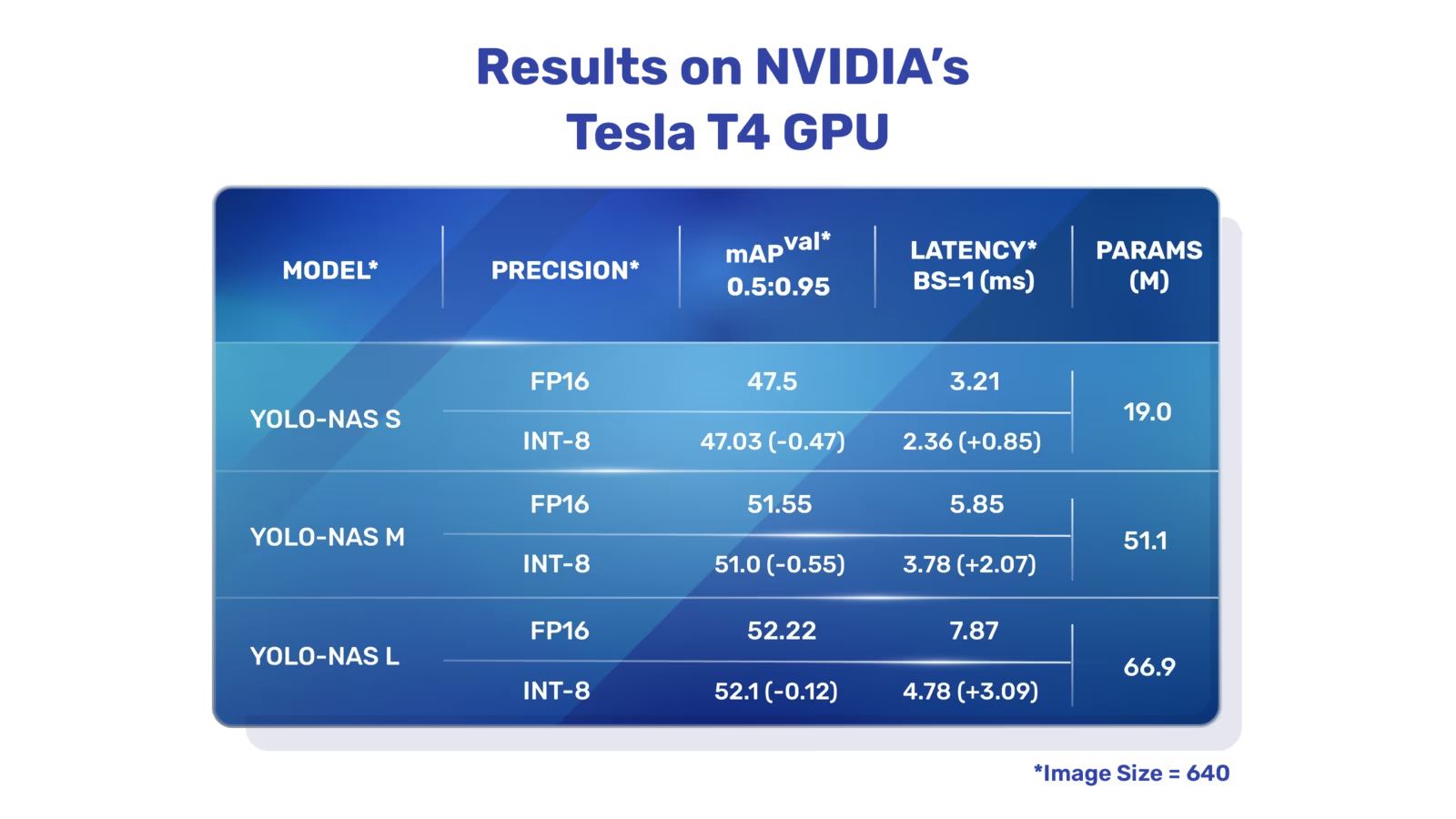 Panoramica di YOLO-NAS. YOLO-NAS usa blocchi consapevoli della quantizzazione e quantizzazione selettiva per preservare l'accuratezza dopo la quantizzazione. Quando viene convertito nella versione quantizzata INT8, il modello perde poca accuratezza, un miglioramento rispetto ai modelli YOLO precedenti.
Funzionalità principali#
- Blocco di base compatibile con la quantizzazione: YOLO-NAS introduce un nuovo blocco di base compatibile con la quantizzazione, che affronta uno dei limiti significativi dei precedenti modelli YOLO.
- Addestramento avanzato e quantizzazione: YOLO-NAS usa schemi di addestramento avanzati e la quantizzazione post-addestramento per migliorare le prestazioni.
- Ottimizzazione AutoNAC e preaddestramento: YOLO-NAS usa l'ottimizzazione AutoNAC ed è preaddestrato su dataset come COCO, Objects365 e Roboflow 100. Questo preaddestramento lo rende particolarmente adatto alle attività di rilevamento degli oggetti a valle in produzione.
Modelli preaddestrati#
Ultralytics offre modelli YOLO-NAS preaddestrati in tre dimensioni, ciascuna con un diverso equilibrio tra velocità e accuratezza:
| Modello | mAP50-95 | Latenza (ms) |
|---|---|---|
| YOLO-NAS S | 47.5 | 3.21 |
| YOLO-NAS M | 51.55 | 5.85 |
| YOLO-NAS L | 52.22 | 7.87 |
| YOLO-NAS S INT-8 | 47.03 | 2.36 |
| YOLO-NAS M INT-8 | 51.0 | 3.78 |
| YOLO-NAS L INT-8 | 52.1 | 4.78 |
Ogni variante del modello è progettata per offrire un equilibrio tra precisione media (mAP) e latenza, aiutandoti a ottimizzare le attività di rilevamento degli oggetti sia per le prestazioni sia per la velocità.
Esempi d'uso#
Il pacchetto Python ultralytics fornisce un'API Python e una CLI per eseguire i modelli YOLO-NAS.
I modelli YOLO-NAS richiedono il pacchetto super-gradients, che richiede un ambiente Python 3.10:
pip install ultralytics super-gradients "setuptools<81"Gli esempi seguenti mostrano come usare i modelli YOLO-NAS con il pacchetto ultralytics per l'inferenza e la convalida:
Esempi di inferenza e convalida#
In questo esempio, convalidiamo YOLO-NAS-s sul dataset COCO8.
Questo esempio fornisce codice semplice per l'inferenza e la validazione di YOLO-NAS. YOLO-NAS supporta anche l'esportazione, ma il pacchetto ultralytics non supporta il suo addestramento.
I file di modello *.pt preaddestrati con PyTorch possono essere passati alla classe NAS() per creare un'istanza del modello in Python:
from ultralytics import NAS

# Carica un modello YOLO-NAS-s preaddestrato su COCO
model = NAS("yolo_nas_s.pt")

# Visualizza le informazioni sul modello (facoltativo)
model.info()

# Convalida il modello sul dataset di esempio COCO8
results = model.val(data="coco8.yaml")

# Esegui l'inferenza con il modello YOLO-NAS-s sull'immagine 'bus.jpg'
results = model("path/to/bus.jpg")
Attività e modalità supportate#
YOLO-NAS è disponibile in tre varianti: Small (s), Medium (m) e Large (l). Ogni variante è progettata per rispondere a diverse esigenze di calcolo e prestazioni:
- YOLO-NAS-s: ottimizzato per gli ambienti in cui le risorse computazionali sono limitate, ma l'efficienza è fondamentale.
- YOLO-NAS-m: offre un approccio equilibrato, adatto al rilevamento degli oggetti generico con maggiore accuratezza.
- YOLO-NAS-l: pensato per gli scenari che richiedono la massima accuratezza, in cui le risorse computazionali non sono un vincolo importante.
Di seguito trovi una panoramica dettagliata di ogni modello, con i link ai relativi pesi preaddestrati, le attività supportate e la compatibilità con le diverse modalità operative.
| Tipo di modello | Pesi preaddestrati | Attività supportate | Addestramento | Validazione | Inferenza | Esporta |
|---|---|---|---|---|---|---|
| YOLO-NAS-s | yolo_nas_s.pt | Rilevamento di oggetti | ❌ | ✅ | ✅ | ✅ |
| YOLO-NAS-m | yolo_nas_m.pt | Rilevamento di oggetti | ❌ | ✅ | ✅ | ✅ |
| YOLO-NAS-l | yolo_nas_l.pt | Rilevamento di oggetti | ❌ | ✅ | ✅ | ✅ |
Citazioni e ringraziamenti#
Se usi YOLO-NAS nelle tue attività di ricerca o sviluppo, cita SuperGradients:
@misc{supergradients,
      doi = {10.5281/ZENODO.7789328},
      url = {https://zenodo.org/records/7789328},
      author = {Aharon,  Shay and {Louis-Dupont} and {Ofri Masad} and Yurkova,  Kate and {Lotem Fridman} and {Lkdci} and Khvedchenya,  Eugene and Rubin,  Ran and Bagrov,  Natan and Tymchenko,  Borys and Keren,  Tomer and Zhilko,  Alexander and {Eran-Deci}},
      title = {Super-Gradients},
      publisher = {GitHub},
      journal = {GitHub repository},
      year = {2021},
}
Ringraziamo il team SuperGradients di Deci AI per il lavoro svolto nella creazione e nella manutenzione di questa preziosa risorsa per la comunità della visione artificiale.
Domande frequenti#
YOLO-NAS, sviluppato da Deci AI, è un modello di rilevamento degli oggetti progettato con la ricerca di architetture neurali (NAS). Affronta i limiti dei precedenti modelli YOLO introducendo caratteristiche come blocchi di base compatibili con la quantizzazione e schemi di addestramento avanzati, che migliorano le prestazioni, soprattutto in ambienti con risorse computazionali limitate. YOLO-NAS supporta anche la quantizzazione e mantiene un'elevata precisione anche quando viene convertito nella versione INT8, risultando così più adatto agli ambienti di produzione.
Puoi integrare i modelli YOLO-NAS nella tua applicazione Python usando il pacchetto
ultralytics. Ecco un semplice esempio per caricare un modello YOLO-NAS preaddestrato ed eseguire l'inferenza:from ultralytics import NAS # Carica un modello YOLO-NAS-s preaddestrato su COCO model = NAS("yolo_nas_s.pt") # Convalida il modello sul dataset di esempio COCO8 results = model.val(data="coco8.yaml") # Esegui l'inferenza con il modello YOLO-NAS-s sull'immagine 'bus.jpg' results = model("path/to/bus.jpg")Per ulteriori informazioni, consulta Esempi di inferenza e convalida.
YOLO-NAS introduce diverse caratteristiche chiave che lo rendono una scelta valida per il rilevamento degli oggetti quantizzato:
- Blocco di base compatibile con la quantizzazione: architettura migliorata che preserva l'accuratezza dopo la quantizzazione.
- Addestramento avanzato e quantizzazione: utilizza schemi di addestramento avanzati e tecniche di quantizzazione post-addestramento.
- Ottimizzazione AutoNAC e preaddestramento: utilizza l'ottimizzazione AutoNAC ed è preaddestrato su dataset come COCO, Objects365 e Roboflow 100.
Queste caratteristiche contribuiscono alla sua elevata accuratezza, alle prestazioni efficienti e all'idoneità alla distribuzione negli ambienti di produzione. Scopri di più nella sezione Caratteristiche principali.
I modelli YOLO-NAS supportano il rilevamento degli oggetti nelle modalità di convalida, inferenza ed esportazione. Non supportano l'addestramento. I modelli supportati includono YOLO-NAS-s, YOLO-NAS-m e YOLO-NAS-l, ciascuno adattato a capacità computazionali e requisiti prestazionali diversi.
Sì, Ultralytics offre modelli YOLO-NAS preaddestrati a cui puoi accedere direttamente. Questi modelli sono preaddestrati su dataset come COCO. Puoi scaricarli dai link nella sezione Attività e modalità supportate. Ecco alcuni esempi:


Commenti21
Fai una domanda, condividi i tuoi risultati o aiuta qualcun altro.
riobastian09
Hi. i want to know is there any pre-configured of YOLO-NAS model? i want to use this to my experiment using the custom architecture YOLO-NAS model. Thank you!
 Glenn JocherUltralytics
@riobastian09 thank you for your question! Yes, pre-configured YOLO-NAS models, such as YOLO-NAS-s, YOLO-NAS-m, and YOLO-NAS-l, are available and optimized for inference, validation, and export. You can access these pre-trained models and easily integrate them into your experiments using the Ultralytics Python package. Unfortunately, custom architecture modifications or training directly with YOLO-NAS are not supported. For more, refer to the YOLO-NAS documentation: https://docs.ultralytics.com/models/yolo-nas/
 User
您好,我使用如下脚本将torch模型转成onnx模型时,出现如下错误: raise AttributeError(f"'{type(self).name}' object has no attribute '{name}'") AttributeError: 'YoloNAS_S' object has no attribute 'args'我该如何解决?
- User
from ultralytics import NAS model = NAS('yolo_nas_s') model.export( imgsz = [480,640], format = "onnx", simplify = True, opset = 17 )
- Glenn JocherUltralytics
@Stephen-Hao it seems like the error you're encountering is due to the 'args' attribute not being present in the 'YoloNAS_S' object. This might be related to the specific version of the model or the Ultralytics package you are using. Please ensure you have the latest version of the Ultralytics package installed. If the issue persists, consider checking the model's documentation or reaching out to the community for further assistance.
NoviceAlchemist
我训练使用的代码是:import torch import warnings from ultralytics import YOLO
忽略与“deterministic”和“non-deterministic”相关的所有警告
warnings.filterwarnings("ignore", category=UserWarning, message=".deterministic.")
if name == 'main': # 关闭PyTorch的确定性算法 torch.use_deterministic_algorithms(False)
# 初始化YOLO模型
# model_path = r'D:\ultralytics-main\ultralytics\cfg\models\v8\yolov8_attiton.yaml'
model_path = r'D:\ultralytics-main\model train\model\yolo_nas_s.pt'
model = YOLO(model_path)

# 设置正确的数据集路径
data_path = r"C:\Users\13579\Downloads\etiketlenmis_3.v6i.yolov8\data.yaml"

# 训练模型配置信息
model.train(data=data_path,
            imgsz=640,
            batch=32,
            epochs=200,
            name='NAS_S',
            )

# 设置验证集验证效果
# model.val()
但是会出现D:\Anaconda3\envs\yolov8\python.exe "D:\ultralytics-main\model train\My train\yolo nas.py" The console stream is logged into C:\Users\13579\sg_logs\console.log [2024-09-06 10:23:49] INFO - crash_tips_setup.py - Crash tips is enabled. You can set your environment variable to CRASH_HANDLER=FALSE to disable it [2024-09-06 10:23:49,572] torch.distributed.elastic.multiprocessing.redirects: [WARNING] NOTE: Redirects are currently not supported in Windows or MacOs. [WARNING]No module named 'pycocotools' [2024-09-06 10:23:51] WARNING - env_sanity_check.py - Failed to verify operating system: Deci officially supports only Linux kernels. Some features may not work as expected. WARNING ⚠️ The file 'D:\ultralytics-main\model train\model\yolo_nas_s.pt' appears to be improperly saved or formatted. For optimal results, use model.save('filename.pt') to correctly save YOLO models. Traceback (most recent call last): File "D:\ultralytics-main\model train\My train\yolo nas.py", line 15, in model = YOLO(model_path) File "D:\ultralytics-main\ultralytics\models\yolo\model.py", line 23, in init super().init(model=model, task=task, verbose=verbose) File "D:\ultralytics-main\ultralytics\engine\model.py", line 149, in init self._load(model, task=task) File "D:\ultralytics-main\ultralytics\engine\model.py", line 230, in _load self.model, self.ckpt = attempt_load_one_weight(weights) File "D:\ultralytics-main\ultralytics\nn\tasks.py", line 855, in attempt_load_one_weight ckpt, weight = torch_safe_load(weight) # load ckpt File "D:\ultralytics-main\ultralytics\nn\tasks.py", line 809, in torch_safe_load ckpt = {"model": ckpt.model} File "D:\Anaconda3\envs\yolov8\lib\site-packages\torch\nn\modules\module.py", line 1695, in getattr raise AttributeError(f"'{type(self).name}' object has no attribute '{name}'") AttributeError: 'YoloNAS_S' object has no attribute 'model'
进程已结束,退出代码为 1
这个怎么解决呀
- Glenn JocherUltralytics(modificato)
@NoviceAlchemist YOLO-NAS models in Ultralytics are pretrained and support only validation, inference and export, not training (see the Training column in the YOLO-NAS docs), so
model.train()isn't available foryolo_nas_s.pt. To train on your own dataset, use a model with training support such as YOLO26 (e.g.yolo26s.pt). If you hit model-loading errors, verify thatpycocotoolsis installed and try the latest version of the Ultralytics package.
dota2015
from ultralytics import NAS import cv2
Load a COCO-pretrained YOLO-NAS-s model
model = NAS('yolo_nas_s.pt')
Display model information (optional)
model.info() results = model.predict('000000000009.jpg')
run reslult:
C:\Users\makef.conda\envs\yolov8\python.exe -X pycache_prefix=C:\Users\makef\AppData\Local\JetBrains\PyCharm2023.3\cpython-cache "C:/Program Files/JetBrains/PyCharm 2023.3.4/plugins/python/helpers/pydev/pydevd.py" --multiprocess --qt-support=auto --client 127.0.0.1 --port 62105 --file D:\02Code\code\yolov8\v8_2\yolo_nas.py Connected to pydev debugger (build 233.15026.15) The console stream is logged into C:\Users\makef\sg_logs\console.log [2024-04-28 16:29:38] INFO - crash_tips_setup.py - Crash tips is enabled. You can set your environment variable to CRASH_HANDLER=FALSE to disable it [2024-04-28 16:29:39] WARNING - redirects.py - NOTE: Redirects are currently not supported in Windows or MacOs. [WARNING]No module named 'pycocotools' [2024-04-28 16:29:45] WARNING - env_sanity_check.py - Failed to verify operating system: Deci officially supports only Linux kernels. Some features may not work as expected. Model summary: 685 layers, 19053888 parameters, 19053888 gradients
Traceback (most recent call last): File "C:\Users\makef.conda\envs\yolov8\lib\site-packages\torch\autograd\grad_mode.py", line 43, in generator_context response = gen.send(None) File "C:\Users\makef.conda\envs\yolov8\lib\site-packages\ultralytics\engine\predictor.py", line 228, in stream_inference self.model.warmup(imgsz=(1 if self.model.pt or self.model.triton else self.dataset.bs, 3, *self.imgsz)) File "C:\Users\makef.conda\envs\yolov8\lib\site-packages\ultralytics\nn\autobackend.py", line 624, in warmup self.forward(im) # warmup File "C:\Users\makef.conda\envs\yolov8\lib\site-packages\ultralytics\nn\autobackend.py", line 450, in forward y = self.model(im, augment=augment, visualize=visualize, embed=embed) File "C:\Users\makef.conda\envs\yolov8\lib\site-packages\torch\nn\modules\module.py", line 1194, in _call_impl return forward_call(*input, **kwargs) TypeError: forward() got an unexpected keyword argument 'augment' python-BaseException
Process finished with exit code 1
 Paula DerrengerUltralytics
Hey there! 👋 It looks like you're encountering a
TypeErrorrelated to theaugmentkeyword argument when running inference with the YOLO-NAS model. The error suggests that theforward()method in the model doesn't recognize theaugmentargument. This could be due to an oversight in the code or an issue with the model's compatibility with the Ultralytics framework.Let's try running the model without any additional arguments that aren't expected. Here's how you can do it:
from ultralytics import NAS

# Load a COCO-pretrained YOLO-NAS-s model
model = NAS('yolo_nas_s.pt')

# Run inference with the YOLO-NAS-s model on the 'bus.jpg' image
results = model('path/to/bus.jpg')
This simplifies the call to the model's inference method by removing the
augmentargument, which seems to be causing the issue.If you continue to face problems or if the issue is due to something else, it might be a good idea to check the Ultralytics documentation for YOLO-NAS compatibility or raise an issue on the GitHub repository for more specific help! Hope this sorts it out for you! 😊
Hey there! So, I've decked out my project with all the latest packages, but guess what? The issue is still lurking like it's on a vacation!
Here's the riveting tale of the pip upgrade:
Downloading ultralytics-8.2.4-py3-none-any.whl (752 kB) ━━━━━━━━━━━━━━━━━━━━━━━━━━━━━━━━━━━━━━━━ 752.1/752.1 kB 28.1 kB/s eta 0:00:00 Installing collected packages: ultralytics Attempting uninstall: ultralytics Found existing installation: ultralytics 8.2.1 Uninstalling ultralytics-8.2.1: Successfully uninstalled ultralytics-8.2.1 Successfully installed ultralytics-8.2.4
Behold, the saga of the runtime logs unfolds below:
C:\Users\makef.conda\envs\yolov8\python.exe D:\02Code\code\yolov8\v8_2\yolo_nas.py The console stream is logged into C:\Users\makef\sg_logs\console.log [2024-04-29 10:42:17] INFO - crash_tips_setup.py - Crash tips is enabled. You can set your environment variable to CRASH_HANDLER=FALSE to disable it [2024-04-29 10:42:18] WARNING - redirects.py - NOTE: Redirects are currently not supported in Windows or MacOs. [WARNING]No module named 'pycocotools' [2024-04-29 10:42:21] WARNING - env_sanity_check.py - Failed to verify operating system: Deci officially supports only Linux kernels. Some features may not work as expected. Model summary: 685 layers, 19053888 parameters, 19053888 gradients
Behold, the saga of the runtime logs unfolds below: Traceback (most recent call last): File "D:\02Code\code\yolov8\v8_2\yolo_nas.py", line 10, in results = model.predict('000000000009.jpg') File "C:\Users\makef.conda\envs\yolov8\lib\site-packages\ultralytics\engine\model.py", line 452, in predict return self.predictor.predict_cli(source=source) if is_cli else self.predictor(source=source, stream=stream) File "C:\Users\makef.conda\envs\yolov8\lib\site-packages\ultralytics\engine\predictor.py", line 168, in call return list(self.stream_inference(source, model, *args, **kwargs)) # merge list of Result into one File "C:\Users\makef.conda\envs\yolov8\lib\site-packages\torch\autograd\grad_mode.py", line 43, in generator_context response = gen.send(None) File "C:\Users\makef.conda\envs\yolov8\lib\site-packages\ultralytics\engine\predictor.py", line 228, in stream_inference self.model.warmup(imgsz=(1 if self.model.pt or self.model.triton else self.dataset.bs, 3, *self.imgsz)) File "C:\Users\makef.conda\envs\yolov8\lib\site-packages\ultralytics\nn\autobackend.py", line 627, in warmup self.forward(im) # warmup File "C:\Users\makef.conda\envs\yolov8\lib\site-packages\ultralytics\nn\autobackend.py", line 453, in forward y = self.model(im, augment=augment, visualize=visualize, embed=embed) File "C:\Users\makef.conda\envs\yolov8\lib\site-packages\torch\nn\modules\module.py", line 1194, in _call_impl return forward_call(*input, **kwargs) TypeError: forward() got an unexpected keyword argument 'augment'
Process finished with exit code 1
- Paula DerrengerUltralytics(modificato)
Hey there! 😄 It looks like you're having a bit of a rough ride with the
augmentargument not being recognized during prediction. No worries, let's tidy this up!The error message you're seeing is due to the
augmentargument being passed where it was not expected. It's a simple fix; you just need to ensure you're using the prediction functionality without this argument, like so:from ultralytics import NAS # Load the COCO-pretrained YOLO-NAS-s model model = NAS('yolo_nas_s.pt') # Run inference on an image results = model('path/to/000000000009.jpg') # To visualize the results, you can do: results[0].show()This should run smoothly and get your project back on track! If issues persist or you have further questions, feel free to reach out. And remember, for the latest and greatest on usage, our docs page is always there to help you out. Happy coding! 🚀
I used your code, but the problem still persists, like a mischievous little gremlin playing hide and seek.
- Paula DerrengerUltralytics(modificato)
Hey there! 🌟 It looks like that mischievous gremlin of an issue is quite stubborn. Not to worry, let's tackle it together.
Based on your feedback and the details from the YOLO-NAS docs, it seems like you're on the right track. However, if you're still encountering issues with predictions or validation, it's possible there might be a version mismatch or a missing dependency, especially
pycocotoolswhich is crucial for dataset operations and was flagged in your logs.Firstly, please ensure you've installed
pycocotoolsby running:pip install pycocotools-windowsIf you're not on Windows, just
pycocotoolsshould work.Moreover, the error regarding the
augmentargument not being expected might suggest an incompatibility issue or an outdated piece of code. Let's try simplifying the inference code snippet to not use this argument, as shown in the Ultralytics YOLO-NAS docs:from ultralytics import NAS # Load the COCO-pretrained YOLO-NAS-s model model = NAS('yolo_nas_s.pt') # Run inference with the YOLO-NAS-s model on a local image file results = model('path/to/bus.jpg') # Visualize the results results[0].show()This code directly uses the model without additional settings that may not be supported, like
augment.If the problem continues, it could be helpful to check for updates to the Ultralytics package or consider reaching out on the GitHub issues page for more targeted support. Sometimes, issues like these have been encountered and solved by others in the community!
Don't let those gremlins get you down; you're closer to a solution than you think! 🚀
C:\Users\makef.conda\envs\yolov8\python.exe D:\02Code\code\yolov8\v8_2\yolo_nas.py The console stream is logged into C:\Users\makef\sg_logs\console.log [2024-04-28 16:27:19] INFO - crash_tips_setup.py - Crash tips is enabled. You can set your environment variable to CRASH_HANDLER=FALSE to disable it [2024-04-28 16:27:20] WARNING - redirects.py - NOTE: Redirects are currently not supported in Windows or MacOs. [WARNING]No module named 'pycocotools' [2024-04-28 16:27:23] WARNING - env_sanity_check.py - Failed to verify operating system: Deci officially supports only Linux kernels. Some features may not work as expected. Model summary: 685 layers, 19053888 parameters, 19053888 gradients Traceback (most recent call last): File "D:\02Code\code\yolov8\v8_2\yolo_nas.py", line 10, in results = model.predict('000000000009.jpg') File "C:\Users\makef.conda\envs\yolov8\lib\site-packages\ultralytics\engine\model.py", line 452, in predict return self.predictor.predict_cli(source=source) if is_cli else self.predictor(source=source, stream=stream) File "C:\Users\makef.conda\envs\yolov8\lib\site-packages\ultralytics\engine\predictor.py", line 168, in call return list(self.stream_inference(source, model, *args, **kwargs)) # merge list of Result into one File "C:\Users\makef.conda\envs\yolov8\lib\site-packages\torch\autograd\grad_mode.py", line 43, in generator_context response = gen.send(None) File "C:\Users\makef.conda\envs\yolov8\lib\site-packages\ultralytics\engine\predictor.py", line 228, in stream_inference self.model.warmup(imgsz=(1 if self.model.pt or self.model.triton else self.dataset.bs, 3, *self.imgsz)) File "C:\Users\makef.conda\envs\yolov8\lib\site-packages\ultralytics\nn\autobackend.py", line 624, in warmup self.forward(im) # warmup File "C:\Users\makef.conda\envs\yolov8\lib\site-packages\ultralytics\nn\autobackend.py", line 450, in forward y = self.model(im, augment=augment, visualize=visualize, embed=embed) File "C:\Users\makef.conda\envs\yolov8\lib\site-packages\torch\nn\modules\module.py", line 1194, in _call_impl return forward_call(*input, **kwargs) TypeError: forward() got an unexpected keyword argument 'augment'
Process finished with exit code 1
from ultralytics import NAS import cv2
Load a COCO-pretrained YOLO-NAS-s model
model = NAS('yolo_nas_s.pt')
Display model information (optional)
model.info()
results = model.predict('000000000009.jpg')
- Paula DerrengerUltralytics
Hey there! 👋 It looks like you're trying to run predictions with the YOLO-NAS model and encountered an issue regarding the
augmentargument in theforward()method. This error typically occurs if there's a version mismatch or if the model and method usage doesn't align with the expected input parameters.Based on your usage:
from ultralytics import NAS
import cv2

# Load a COCO-pretrained YOLO-NAS-s model
model = NAS('yolo_nas_s.pt')

# Display model information (optional)
model.info()

results = model.predict('000000000009.jpg')
It seems correct on the surface, suggesting it might be related to the version of Ultralytics library you're using or specific to the model's implementation.
Here are a couple of steps you might want to try:
- Ensure you have the latest version of the Ultralytics package by running:
pip install --upgrade ultralytics - Check if the YOLO-NAS model you are using is compatible with the predict function in terms of its expected arguments. You can refer to the official Ultralytics documentation for the YOLO-NAS model and verify the correct method usage.
If you're still facing issues, feel free to share more details, such as the specific error messages and your environment setup. Hopefully, this helps you move forward! 🚀
- Ensure you have the latest version of the Ultralytics package by running:
Pragyy-G
How to train out this Yolo-nas model? like fine tune it on custom dataset?
- Glenn JocherUltralytics(modificato)
@Pragyy-G hey there! 🙌 YOLO-NAS in Ultralytics is limited to pretrained weights for inference, validation and export; training and fine-tuning aren't supported (see the Training column in the YOLO-NAS docs), and there is no
Datasetclass to import.To train on a custom dataset, use a model with full training support such as YOLO26:
from ultralytics import YOLO

model = YOLO("yolo26n.pt")
model.train(data="path/to/data.yaml", epochs=100, imgsz=640)
Your dataset should follow the expected format, with a YAML file defining the train/val paths and classes.
Tottowich
@Pragyy-G Any results on this?
ashish-reddy26
Hi Glenn,
I tried training with the provided information, but I am getting the error that says 'Dataset' cannot be imported from ultralytics. Is Ultralytics not providing the resources to Dataset?
Can you clarify this and also please provide your inputs for training yolo-nas for object detection tasks (I am using yolov8 & yolov9, but I also want to try with yolo-nas as well).
Thank you, Ashish
- Glenn JocherUltralytics(modificato)
Hi Ashish,
Datasetisn't a directly importable class from theultralyticspackage. For custom training datasets, you structure your data in the expected format and use a YAML file to define paths and classes.YOLO-NAS in Ultralytics supports inference, validation and export only, not training, so to train on a custom dataset use a model like YOLO26. To validate YOLO-NAS:
from ultralytics import NAS

# Load the model
model = NAS("yolo_nas_s.pt")

# Validate the model
results = model.val(data="path/to/your/data.yaml")
Please ensure your dataset follows the structure expected by the Ultralytics framework and that the YAML file correctly points to your train and validation images and labels.