デプロイ用TFLiteモデルのエクスポート(非推奨)
Ultralytics 8.4.83以降、単独のtfliteエクスポート形式は非推奨となり、統合されたGoogle LiteRT形式に置き換えられました。LiteRT(Lite Runtime)はTensorFlow Liteの次世代版であり、新しい名称です。エクスポートされるのは同じ.tfliteモデルで、モバイル、組み込み、エッジ、ブラウザーへのデプロイを1つの形式でカバーするようになりました。
format="tflite"は引き続き動作しますが、非推奨の警告を表示し、代わりにLiteRTモデルをエクスポートします。今後はformat="litert"を使用してください。現在のエクスポート手順とオプションについては、LiteRTエクスポートガイドをご覧ください。

コンピュータービジョンモデルをエッジデバイスや組み込みデバイスにデプロイするには、デバイス上での効率的な推論向けに構築された形式が必要です。
以前のTensorFlow LiteまたはTFLiteエクスポート形式は、エッジアプリケーションでの物体検出や画像分類などのタスク向けに、Ultralytics YOLO26モデルを最適化していました。このガイドでは、従来のTFLiteデプロイ環境について説明します。新しいエクスポートにはLiteRTを使用してください。
エクスポートにTFLiteが使われていた理由#
2017年5月にGoogleがTensorFlowフレームワークの一部として発表したTensorFlow Lite、略してTFLiteは、エッジコンピューティングとも呼ばれるオンデバイス推論向けのオープンソース深層学習フレームワークでした。開発者はこのフレームワークのツールを使って、学習済みモデルをモバイル、組み込み、IoTデバイス、および従来型のコンピューターで実行できました。
TensorFlow Liteは、組み込みLinux、Android、iOS、マイクロコントローラー(MCU)など、幅広いプラットフォームに対応していました。TFLiteにエクスポートすると、アプリケーションでモデルをローカルかつオフラインで実行できました。
TFLiteモデルの主な機能#
TFLiteモデルには、開発者がモバイル、組み込み、エッジデバイスでモデルを実行できるようにし、オンデバイス機械学習を可能にするさまざまな主要機能があります。
-
デバイス上での最適化: TFLiteはデバイス上のML向けに最適化されており、データをローカルで処理してレイテンシを低減します。また、個人データを送信しないことでプライバシーを高め、モデルサイズを小さくしてストレージ容量を節約します。
-
複数プラットフォームへの対応: TFLiteは幅広いプラットフォームとの互換性を備え、Android、iOS、組み込みLinux、マイクロコントローラーをサポートしています。
-
多様な言語への対応: TFLiteは、Java、Swift、Objective-C、C++、Pythonなど、さまざまなプログラミング言語と互換性があります。
-
高いパフォーマンス: ハードウェアアクセラレーションとモデル最適化を活用し、高速な推論を実現します。
実測パフォーマンス(過去の記録)#
これらの結果は、Android 16/API 36上で、12 GB LPDDR5Xメモリを搭載したXiaomi 17を使用し、Ultralytics Flutterプラグイン0.6.8とLiteRT 2.1.5で記録されました。3 nmのSnapdragon 8 Elite Gen 5(SM8850)は、8コアのQualcomm Oryon CPU(最大4.6 GHzのPrimeコア2基と最大3.62 GHzのPerformanceコア6基)、Adreno GPU、Hexagon NPUを搭載しています。これらの表は、従来のonnx2tf INT8 TFLiteアセットと、移行中に評価した候補のlitert-torchエクスポートを比較しています。リリースアセットはその後、標準化されたエクスポートで上書きされたため、これらの数値は現在のv0.7.0アセットのバイトデータを示すものではありません。最新の測定値については、LiteRTパフォーマンステーブルをご覧ください。
両形式は、表示された入力サイズで同じ連続GPUスイープを実行しました。各セルは合計時間(前処理 + 推論 + 後処理)を示し、その下に各ステージの内訳を記載しています。ネイティブログにより、どちらの形式もAdreno GPU上でLiteRT OpenCL(LITERT_CL)にグラフ全体の処理を委譲したことが確認されました。
| モデル | タスク | サイズ (ピクセル) | 従来版 onnx2tf INT8 TFLite (ms) | 候補 w8a32 LiteRT (ms) |
|---|---|---|---|---|
| YOLO26n | Detect | 640 | 14.0 1.8 / 8.1 / 4.2 | 13.5 1.9 / 8.1 / 3.5 |
| YOLO26n-seg | Segment | 640 | 30.1 1.9 / 20.3 / 8.0 | 28.6 1.8 / 20.1 / 6.7 |
| YOLO26n-sem | セマンティック | 640 | 26.4 1.9 / 16.4 / 8.1 | 32.9 1.8 / 23.0 / 8.2 |
| YOLO26n-cls | 分類 | 224 | 3.5 0.9 / 2.2 / 0.4 | 3.2 1.0 / 2.2 / 0.1 |
| YOLO26n-pose | 姿勢推定 | 640 | 17.4 2.4 / 9.9 / 5.1 | 14.0 1.9 / 9.3 / 2.8 |
| YOLO26n-obb | OBB | 640 | 13.9 3.0 / 8.3 / 2.7 | 13.0 2.9 / 7.9 / 2.3 |
同じ移行テストでは、YOLO26n detectの量子化形式も比較しました。形式に依存する指標として比較できるのは推論時間です。
| Android形式 | GPU推論(ms) | GPUコンパイル |
|---|---|---|
| onnx2tf INT8(従来のTFLite) | 8.6 | はい |
| LiteRT w8a32(候補) | 8.4 | はい |
LiteRT INT8(quantize=8) | 11.0 | はい |
| LiteRT FP32 | 8.8 | はい |
LiteRT w8a16(quantize="w8a16") | CPUフォールバック | いいえ |
このテストでは、w8a16はCPUにフォールバックし、合計時間は約660 msでした。一方、GPU形式では約17 msでした。これらの結果を受けてw8a32の出荷が決まりましたが、デリゲートの互換性とパフォーマンスはデバイスおよびランタイムのバージョンによって異なります。対象デバイスでベンチマークを実施し、ランタイムログでアクセラレーターの配置を確認してください。
TFLiteのデプロイオプション#
LiteRTに置き換わるエクスポート例を説明する前に、TFLiteモデルの一般的な使用方法を紹介します。
TFLiteには、機械学習モデル向けのさまざまなオンデバイスデプロイオプションがあります。
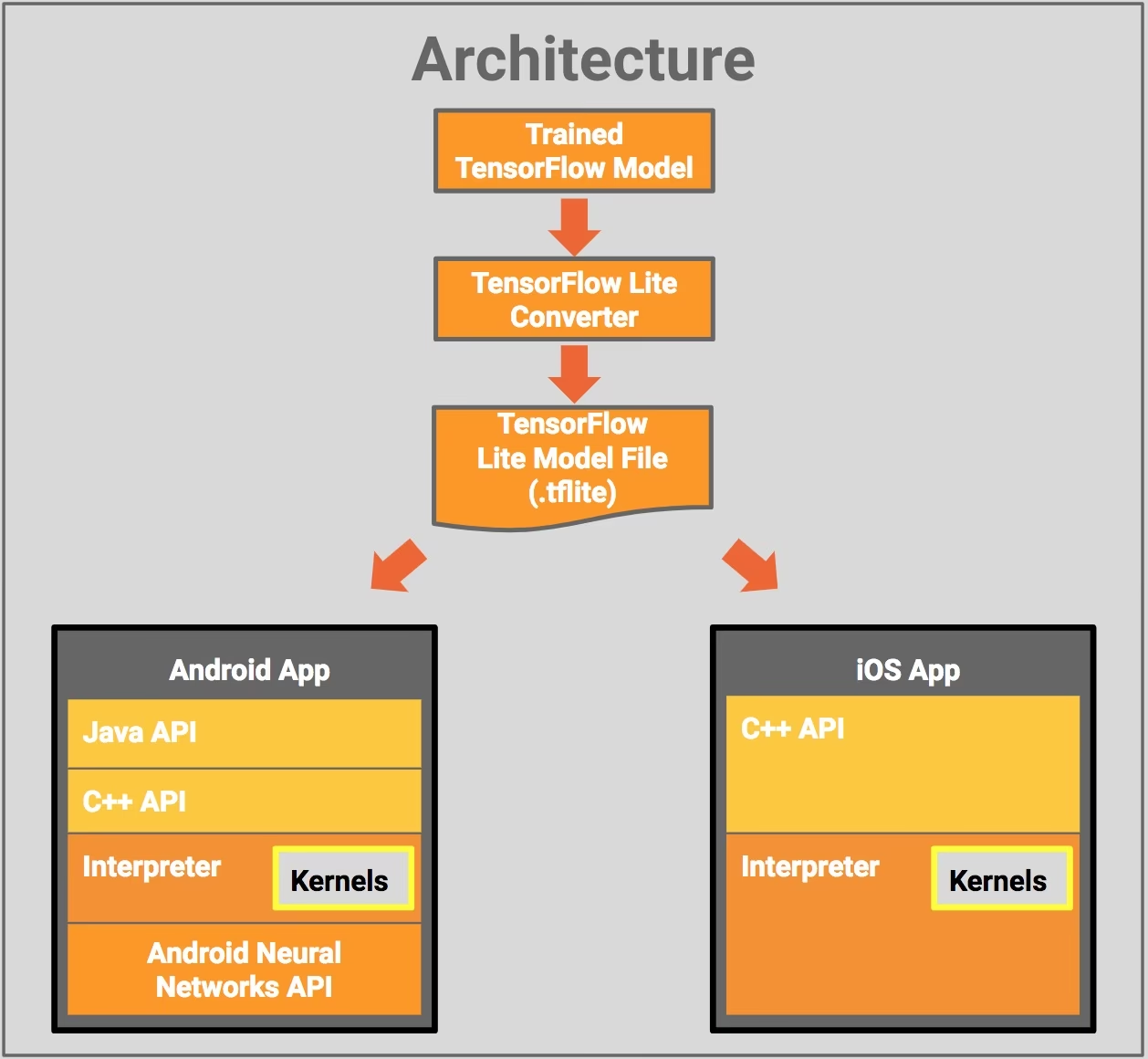
- AndroidおよびiOSへのデプロイ: TFLiteを使用するAndroidおよびiOSアプリケーションは、エッジカメラの映像やセンサーのデータを分析して、物体を検出・識別できます。TFLiteは、SwiftおよびObjective-Cで記述されたiOSネイティブライブラリも提供しています。以下のアーキテクチャ図は、TensorFlow Liteを使用して学習済みモデルをAndroidおよびiOSプラットフォームにデプロイするプロセスを示しています。
-
組み込みLinuxでの実装: Raspberry Piでの推論速度が用途の要件を満たさない場合は、エクスポートしたTFLiteモデルを使用して推論を高速化できます。さらに、Coral Edge TPUデバイスを使用してパフォーマンスを向上させることもできます。
-
マイクロコントローラーへのデプロイ: TFLiteモデルは、マイクロコントローラーや数キロバイトのメモリしか持たない他のデバイスにもデプロイできます。コアランタイムはArm Cortex M3上でわずか16 KBに収まり、多くの基本的なモデルを実行できます。オペレーティングシステムのサポート、標準CまたはC++ライブラリ、動的メモリ割り当ては必要ありません。
TFLiteエクスポートをLiteRTに置き換える#
新しいエクスポートでは、モデルをLiteRTに変換してください。生成されるモデルのファイル拡張子は.tfliteのままです。
インストール#
必要なパッケージをインストールするには、次を実行します。
# Install the required package for YOLO26
pip install ultralyticsインストール手順の詳細とベストプラクティスについては、Ultralyticsのインストールガイドをご覧ください。YOLO26に必要なパッケージのインストールで問題が発生した場合は、解決策とヒントが記載されたよくある問題のガイドをご確認ください。
使用方法#
すべてのUltralytics YOLO26モデルは、追加設定なしでエクスポートできるように設計されているため、希望するデプロイワークフローに簡単に統合できます。アプリケーションに最適な設定を選ぶには、対応するエクスポート形式と設定オプションの一覧をご覧ください。
置き換え後のLiteRT形式は、エクスポート、予測、検証の各モードをサポートしています。モデルをエクスポートし、エクスポート済みの.tfliteモデルを読み込んで、推論を実行するか精度を検証してください。
from ultralytics import YOLO

# YOLO26モデルを読み込みます
model = YOLO("yolo26n.pt")

# モデルをLiteRT形式にエクスポートします
model.export(format="litert", imgsz=640) # 分類ではimgsz=224を使用しますfrom ultralytics import YOLO
# エクスポート済みTFLiteモデルを読み込みます
model = YOLO("yolo26n.tflite")
# 推論を実行
results = model("https://ultralytics.com/images/bus.jpg")from ultralytics import YOLO
# エクスポート済みTFLiteモデルを読み込みます
model = YOLO("yolo26n.tflite")
# COCO8データセットで精度を検証します
metrics = model.val(data="coco8.yaml")エクスポート引数#
LiteRTのエクスポート引数をご覧ください。エクスポートプロセスの詳細については、エクスポートに関するUltralyticsドキュメントページをご覧ください。
エクスポート済みYOLO26 TFLiteモデルのデプロイ#
Ultralytics YOLO26モデルをLiteRT形式にエクスポートした後、生成された.tfliteモデルをデプロイできます。TFLiteモデルを実行する最初の手順として、前述の使用例コードに示すYOLO("model.tflite")メソッドを使用することを推奨します。さまざまな環境でTFLiteモデルをデプロイする詳しい手順については、以下のリソースをご覧ください。
-
Android: TensorFlow LiteをAndroidアプリケーションに統合するためのクイックスタートガイドです。設定方法と機械学習モデルの実行方法を、わかりやすい手順で説明します。
-
iOS: TensorFlow LiteモデルをiOSアプリケーションに統合してデプロイするための開発者向けガイドです。手順を追った説明とリソースを提供します。
-
エンドツーエンドの例: TensorFlow Liteのさまざまな例を概説し、開発者がモバイルやエッジデバイスでの機械学習プロジェクトにTensorFlow Liteを実装するのに役立つ実用的なアプリケーションとチュートリアルを紹介しています。
概要#
このガイドでは、従来のTFLiteデプロイワークフローについて説明します。新しいエクスポートでは、LiteRTを使用してエッジコンピューティング環境向けの.tfliteモデルを作成してください。
使い方の詳細については、TFLite公式ドキュメントをご覧ください。
よくある質問#
新しいエクスポートでは、LiteRT形式を使用してください。まず、次のコマンドで必要なパッケージをインストールします。
pip install ultralytics次に、以下のコードスニペットを使ってモデルをエクスポートします。
from ultralytics import YOLO

# YOLO26モデルを読み込みます
model = YOLO("yolo26n.pt")

# モデルをLiteRT形式にエクスポートします
model.export(format="litert", imgsz=640)  # 分類ではimgsz=224を使用します
CLIを使用する場合は、次のコマンドを実行します。
yolo export model=yolo26n.pt format=litert imgsz=640 # use imgsz=224 for classification詳細については、Ultralyticsエクスポートガイドをご覧ください。
はい、YOLO26 TFLiteモデルをRaspberry Piで実行し、推論を高速化できます。まず、上記の説明に従ってモデルをLiteRT形式にエクスポートします。次に、
YOLO("yolo26n.tflite")またはLiteRTインタープリターを使用して、Raspberry Pi上で.tfliteモデルを実行します。Coral Edge TPUを使うと、推論をさらに高速化できます。
TFLiteは、リソースが限られたマイクロコントローラーへのデプロイをサポートしています。コアランタイムに必要なメモリはArm Cortex M3上でわずか16 KBで、多くの基本的なモデルを実行できます。ただし、YOLO26モデルは一般的なマイクロコントローラーのメモリ容量を超える場合が多いため、YOLO26にはシングルボードコンピューター、モバイルデバイス、または専用アクセラレーターの使用が適しています。
使い始めるには、マイクロコントローラー向けTFLite Microガイドをご覧ください。
TensorFlow Liteは幅広いプラットフォームに対応しており、次のような多様なデバイスにYOLO26モデルをデプロイできます。
- AndroidおよびiOS: TFLiteのAndroidおよびiOSライブラリによるネイティブサポート。
- 組み込みLinux: Raspberry Piなどのシングルボードコンピューターに適しています。
- マイクロコントローラー: リソースが限られたMCUに適しています。
デプロイオプションの詳細については、詳しいデプロイガイドをご覧ください。
YOLO26モデルをLiteRTにエクスポートする際にエラーが発生した場合は、次の一般的な解決策を試してください。
- パッケージの互換性を確認する: Ultralytics、
litert-torch、ai-edge-litertの互換性のあるバージョンを使用していることを確認してください。インストールガイドをご覧ください。 - モデルのサポートを確認する: Ultralyticsのエクスポートドキュメントページを確認し、対象のYOLO26モデルがLiteRTエクスポートに対応していることを確認してください。
- 量子化の問題: INT8量子化を使用する場合は、
dataパラメーターでデータセットのパスが正しく指定されていることを確認してください。
その他のトラブルシューティングのヒントについては、一般的な問題のガイドをご覧ください。
- パッケージの互換性を確認する: Ultralytics、


コメント115
質問したり、結果を共有したり、ほかの人をサポートしたりできます。
saleha-fatima(編集済み)
hi there @glenn-jocher I am trying to convert the the yolov10 model to int8 with tflite format. but same error is occurring again and again. I've tried the solutions described in this thread but nothing seems to work. I am using this for conversion:
` from ultralytics import YOLO
model = YOLO("current_best4.pt")
model.export(format="tflite", int8=True, data='./datasets/data.yaml', imgsz=640) # creates 'yolov8n_float32.tflite'
tflite_model = YOLO("yolov8n_int8.tflite")
results = tflite_model("./frame_365.jpg")
results.show() `
and the error i am receiving is this:
ValueError: Exception encountered when calling layer "tf.math.add_5" (type TFOpLambda).
Dimensions must be equal, but are 32 and 16 for '{{node tf.math.add_5/Add}} = AddV2 [T=DT_FLOAT](Placeholder, Placeholder_1)' with input shapes: [1,80,160,32], [1,80,160,16].
Call arguments received by layer "tf.math.add_5" (type TFOpLambda): • x=tf.Tensor(shape=(1, 80, 160, 32), dtype=float32) • y=tf.Tensor(shape=(1, 80, 160, 16), dtype=float32) • name='/model.2/m.0/Add'
ERROR: input_onnx_file_path: weights/yolov10n.onnx ERROR: onnx_op_name: /model.2/m.0/Add ERROR: Read this and deal with it. https://github.com/PINTO0309/onnx2tf#parameter-replacement ERROR: Alternatively, if the input OP has a dynamic dimension, use the -b or -ois option to rewrite it to a static shape and try again. ERROR: If the input OP of ONNX before conversion is NHWC or an irregular channel arrangement other than NCHW, use the -kt or -kat option. ERROR: Also, for models that include NonMaxSuppression in the post-processing, try the -onwdt option. `
i
I have approx 5k images for calibration, so thats not the issue, all the packages are upto date as well. can you please suggest what solution should i opt for?
1 Glenn JocherUltralytics(編集済み)
@saleha-fatima the error appears to be related to shape mismatches during ONNX to TFLite conversion. Please ensure that your model, dataset, and TensorFlow versions are fully compatible. Refer to the onnx2tf parameter replacement guide for addressing this issue. Additionally, try exporting with
int8=Falsefirst to confirm the issue is specific to quantization. If the problem persists, please share more details about your environment or test with the latest Ultralytics version.Note: Since Ultralytics 8.4.83,
format="tflite"is deprecated and exports through LiteRT (litert-torch) instead of onnx2tf and TensorFlow. Runpip install -U ultralyticsand export withformat="litert"(see the LiteRT guide).I've tried with
int8=False, but the problem persists. this is the info related to my model, packages and dataset so i am using yolov10 model fro conversion purposes coco dataset python version=3.9.12 packages:torch==2.0.1 torchvision==0.15.2 onnx==1.17.0 onnxruntime==1.15.1 pycocotools==2.0.7 PyYAML==6.0.1 scipy==1.13.0 onnxslim==0.1.31 onnxruntime-gpu==1.18.0 gradio==4.31.5 opencv-python==4.9.0.80 psutil==5.9.8 py-cpuinfo==9.0.0 huggingface-hub==0.23.2 safetensors==0.4.3 ultralytics==8.3.69 onnx2tf==1.20.0 onnxruntime==1.15.1 tensorflow==2.18.0
I have alse tried the suggestions mentioned in error msg but nothing seems to work!
- Glenn JocherUltralytics(編集済み)
This was a compatibility issue between YOLOv10's architecture and the old ONNX->TFLite (onnx2tf) conversion path. Since Ultralytics 8.4.83,
format="tflite"is deprecated and exports through LiteRT (litert-torch) instead of onnx2tf and TensorFlow, so those version pins no longer apply. Runpip install -U ultralyticsand export withformat="litert"(see the LiteRT guide). nicola-321
hi there @glenn-jocher I am trying to convert the the yolov10 model to int8 with tflite format. but same error is occurring again and again. I've tried the solutions described in this thread but nothing seems to work. I am using this for conversion:
` from ultralytics import YOLO
model = YOLO("current_best4.pt")
model.export(format="tflite", int8=True, data='./datasets/data.yaml', imgsz=640) # creates 'yolov8n_float32.tflite'
tflite_model = YOLO("yolov8n_int8.tflite")
results = tflite_model("./frame_365.jpg")
results.show() `
and the error i am receiving is this:
ERROR: The trace log is below. Traceback (most recent call last): File "/mnt/drive/rev9ai/anaconda3/envs/int8_test/lib/python3.9/site-packages/onnx2tf/utils/common_functions.py", line 310, in print_wrapper_func result = func(*args, **kwargs) File "/mnt/drive/rev9ai/anaconda3/envs/int8_test/lib/python3.9/site-packages/onnx2tf/utils/common_functions.py", line 383, in inverted_operation_enable_disable_wrapper_func result = func(*args, **kwargs) File "/mnt/drive/rev9ai/anaconda3/envs/int8_test/lib/python3.9/site-packages/onnx2tf/utils/common_functions.py", line 53, in get_replacement_parameter_wrapper_func func(*args, **kwargs) File "/mnt/drive/rev9ai/anaconda3/envs/int8_test/lib/python3.9/site-packages/onnx2tf/ops/Add.py", line 248, in make_node merge_two_consecutive_identical_ops_into_one( File "/mnt/drive/rev9ai/anaconda3/envs/int8_test/lib/python3.9/site-packages/onnx2tf/utils/common_functions.py", line 5384, in merge_two_consecutive_identical_ops_into_one tf.math.add( File "/mnt/drive/rev9ai/anaconda3/envs/int8_test/lib/python3.9/site-packages/tensorflow/python/ops/weak_tensor_ops.py", line 142, in wrapper return op(*args, **kwargs) File "/mnt/drive/rev9ai/anaconda3/envs/int8_test/lib/python3.9/site-packages/tensorflow/python/util/traceback_utils.py", line 153, in error_handler raise e.with_traceback(filtered_tb) from None File "/mnt/drive/rev9ai/anaconda3/envs/int8_test/lib/python3.9/site-packages/tf_keras/src/layers/core/tf_op_layer.py", line 119, in handle return TFOpLambda(op)(*args, **kwargs) File "/mnt/drive/rev9ai/anaconda3/envs/int8_test/lib/python3.9/site-packages/tf_keras/src/utils/traceback_utils.py", line 70, in error_handler raise e.with_traceback(filtered_tb) from None ValueError: Exception encountered when calling layer "tf.math.add_5" (type TFOpLambda). Dimensions must be equal, but are 32 and 16 for '{{node tf.math.add_5/Add}} = AddV2 [T=DT_FLOAT](Placeholder, Placeholder_1)' with input shapes: [1,80,160,32], [1,80,160,16]. Call arguments received by layer "tf.math.add_5" (type TFOpLambda): • x=tf.Tensor(shape=(1, 80, 160, 32), dtype=float32) • y=tf.Tensor(shape=(1, 80, 160, 16), dtype=float32) • name='/model.2/m.0/Add' ERROR: input_onnx_file_path: weights/yolov10n.onnx ERROR: onnx_op_name: /model.2/m.0/Add ERROR: Read this and deal with it. https://github.com/PINTO0309/onnx2tf#parameter-replacement ERROR: Alternatively, if the input OP has a dynamic dimension, use the -b or -ois option to rewrite it to a static shape and try again. ERROR: If the input OP of ONNX before conversion is NHWC or an irregular channel arrangement other than NCHW, use the -kt or -kat option. ERROR: Also, for models that include NonMaxSuppression in the post-processing, try the -onwdt option.i
I have approx 5k images for calibration, so thats not the issue, all the packages are upto date as well. can you please suggest what solution should i opt for?
I've got the same error when covert yolov8 to tflite. Have you fix it?
- Glenn JocherUltralytics(編集済み)
For YOLOv10 TFLite conversion issues in the old onnx2tf path: Since Ultralytics 8.4.83,
format="tflite"is deprecated and exports through LiteRT (litert-torch) instead of onnx2tf and TensorFlow, so those version pins no longer apply. Runpip install -U ultralyticsand export withformat="litert"(see the LiteRT guide). If errors persist, share the full export log. Thanks for your advice. I've tried to Update dependencies and Export with dynamic axes , but unfortunately, a new issue is as below:
AssertionError: ERROR ❌️ argument 'dynamic' is not supported for format='tflite'
If I only update dependencies and delete the dynamic axes , the issue is as before:
ValueError: Exception encountered when calling layer "tf.math.add_5" (type TFOpLambda).
Dimensions must be equal, but are 32 and 16 for '{{node tf.math.add_5/Add}} = AddV2 [T=DT_FLOAT](Placeholder, Placeholder_1)' with input shapes: [1,80,160,32], [1,80,160,16].
Call arguments received by layer "tf.math.add_5" (type TFOpLambda): • x=tf.Tensor(shape=(1, 80, 160, 32), dtype=float32) • y=tf.Tensor(shape=(1, 80, 160, 16), dtype=float32) • name='/model.2/m.0/Add'
I've got the same error when covert yolov8 to tflite. Have you fix it?
hi there, yes i fixed this issue. but it then resulted into new error saying "end2end model format conversion is not supported". btw i resolved that issue by using the following versions of dependencies: torch 2.6.0 tensorflow 2.15.1 onnx2tf 1.20.0
try this but if you are looking for direct export of the model to int8 with tflite. then according to my research
exportcommand does not work. atleast it didnt work for yolov10 model. for that i converted the .pt model to IR form (onnx) then further conversion. but if your concern is just to convert model to tflite with fp16/32 quantization. i would suggest to use command line prompt for conversion. for some reasons it works!yolo export model=runs/detect/train2/weights/best.pt format=tflite half=False simplify opset=13 workspace=16- Glenn JocherUltralytics(編集済み)
@saleha-fatima thanks for sharing your solution! Since Ultralytics 8.4.83,
format="tflite"is deprecated and exports through LiteRT (litert-torch) instead of onnx2tf and TensorFlow. Runpip install -U ultralyticsand export withformat="litert"(see the LiteRT guide). Thedynamicargument is not supported for LiteRT export. I've got the same error when covert yolov8 to tflite. Have you fix it?
hi there, yes i fixed this issue. but it then resulted into new error saying "end2end model format conversion is not supported". btw i resolved that issue by using the following versions of dependencies: torch 2.6.0 tensorflow 2.15.1 onnx2tf 1.20.0
try this but if you are looking for direct export of the model to int8 with tflite. then according to my research
exportcommand does not work. atleast it didnt work for yolov10 model. for that i converted the .pt model to IR form (onnx) then further conversion. but if your concern is just to convert model to tflite with fp16/32 quantization. i would suggest to use command line prompt for conversion. for some reasons it works!yolo export model=runs/detect/train2/weights/best.pt format=tflite half=False simplify opset=13 workspace=16Thank you for your reply,. I've tried to update the dependencies or use the CLI but error persists. so I tried to convert the model step by step . It can be converted to onnx but when converting to tf. An new error occurs as below. It seems like the dependency conflict :
https://github.com/tensorflow/addons warnings.warn( Traceback (most recent call last): File "/workspace/user_code/model/convertModel/onnx-tensorflow/example/onnx_to_tf.py", line 3, in from onnx_tf.backend import prepare File "/workspace/user_code/model/convertModel/onnx-tensorflow/onnx_tf/init.py", line 1, in from . import backend File "/workspace/user_code/model/convertModel/onnx-tensorflow/onnx_tf/backend.py", line 28, in from onnx_tf.common.handler_helper import get_all_backend_handlers File "/workspace/user_code/model/convertModel/onnx-tensorflow/onnx_tf/common/handler_helper.py", line 3, in from onnx_tf.handlers.backend import * # noqa File "/workspace/user_code/model/convertModel/onnx-tensorflow/onnx_tf/handlers/backend/hardmax.py", line 3, in import tensorflow_addons as tfa File "/workspace/user_code/model/convertModel/myenv3.10/lib/python3.10/site-packages/tensorflow_addons/init.py", line 23, in from tensorflow_addons import activations File "/workspace/user_code/model/convertModel/myenv3.10/lib/python3.10/site-packages/tensorflow_addons/activations/init.py", line 17, in from tensorflow_addons.activations.gelu import gelu File "/workspace/user_code/model/convertModel/myenv3.10/lib/python3.10/site-packages/tensorflow_addons/activations/gelu.py", line 19, in from tensorflow_addons.utils.types import TensorLike File "/workspace/user_code/model/convertModel/myenv3.10/lib/python3.10/site-packages/tensorflow_addons/utils/types.py", line 29, in from keras.src.engine import keras_tensor ModuleNotFoundError: No module named 'keras.src.engine'
and if I use
!pip install 'keras<3.0.0' mediapipe-model-makerto fix the error from https://github.com/google-ai-edge/mediapipe/issues/5229 then it will leading to the issue as below:ImportError: This version of TensorFlow Probability requires TensorFlow version >= 2.18; Detected an installation of version 2.15.1. Please upgrade TensorFlow to proceed.
It seems like that keras<3.0.0 and TensorFlow version >= 2.18 is conflict
Hi, so i tested it on my end again and it worked. I would recommend you to create a new env and then just go for installing updated "ultralytics" package using
pip install ultralyticsnow without installing anything else just run this CLI export command:yolo export model=runs/detect/train2/weights/best.pt format=tflite half=False simplify opset=13 workspace=16It will install all the supported requirements itself. I have tested it, i am sure it will work for u as well. Do update me on this!
- Glenn JocherUltralytics(編集済み)
Thanks for sharing your findings. For TFLite conversion issues, create a fresh environment and let Ultralytics install what it needs when you export. Since Ultralytics 8.4.83,
format="tflite"is deprecated and exports through LiteRT (litert-torch) instead of onnx2tf and TensorFlow, so those version pins no longer apply. Runpip install -U ultralyticsand export withformat="litert"(see the LiteRT guide). If issues persist, please share your environment details fromyolo checks. Hi, so i tested it on my end again and it worked. I would recommend you to create a new env and then just go for installing updated "ultralytics" package using
pip install ultralyticsnow without installing anything else just run this CLI export command:yolo export model=runs/detect/train2/weights/best.pt format=tflite half=False simplify opset=13 workspace=16It will install all the supported requirements itself. I have tested it, i am sure it will work for u as well. Do update me on this!
Hi, thanks for your sharing!Congratulate that you fix it ! but seems that it does's work in my env. I have create a new env . only "pip install ultralytics" , loading the yolov11. and my python packages is as below: `Package Version
absl-py 2.1.0 astunparse 1.6.3 cachetools 5.5.2 certifi 2025.1.31 cffi 1.17.1 charset-normalizer 3.4.1 coloredlogs 15.0.1 contourpy 1.1.1 cycler 0.12.1 filelock 3.16.1 flatbuffers 25.2.10 fonttools 4.56.0 fsspec 2025.2.0 gast 0.4.0 google-auth 2.38.0 google-auth-oauthlib 1.0.0 google-pasta 0.2.0 grpcio 1.70.0 h5py 3.11.0 humanfriendly 10.0 idna 3.10 importlib_metadata 8.5.0 importlib_resources 6.4.5 Jinja2 3.1.5 keras 2.13.1 kiwisolver 1.4.7 libclang 18.1.1 Markdown 3.7 MarkupSafe 2.1.5 matplotlib 3.7.5 mpmath 1.3.0 networkx 3.1 numpy 1.24.3 nvidia-cublas-cu12 12.1.3.1 nvidia-cuda-cupti-cu12 12.1.105 nvidia-cuda-nvrtc-cu12 12.1.105 nvidia-cuda-runtime-cu12 12.1.105 nvidia-cudnn-cu12 9.1.0.70 nvidia-cufft-cu12 11.0.2.54 nvidia-curand-cu12 10.3.2.106 nvidia-cusolver-cu12 11.4.5.107 nvidia-cusparse-cu12 12.1.0.106 nvidia-nccl-cu12 2.20.5 nvidia-nvjitlink-cu12 12.8.61 nvidia-nvtx-cu12 12.1.105 oauthlib 3.2.2 onnx 1.17.0 onnx_graphsurgeon 0.5.5 onnx2tf 1.20.0 onnxruntime 1.16.3 onnxslim 0.1.48 opencv-python 4.11.0.86 opt_einsum 3.4.0 packaging 24.2 pandas 2.0.3 pillow 10.4.0 pip 25.0.1 protobuf 5.29.3 psutil 7.0.0 py-cpuinfo 9.0.0 pyasn1 0.6.1 pyasn1_modules 0.4.1 pybind11 2.13.6 pycparser 2.22 pyparsing 3.1.4 python-dateutil 2.9.0.post0 pytz 2025.1 PyYAML 6.0.2 requests 2.32.3 requests-oauthlib 2.0.0 rsa 4.9 scipy 1.10.1 seaborn 0.13.2 setuptools 49.2.1 six 1.17.0 sng4onnx 1.0.4 sounddevice 0.5.1 sympy 1.13.3 tensorboard 2.13.0 tensorboard-data-server 0.7.2 tensorflow-cpu 2.13.1 tensorflow-estimator 2.13.0 tensorflow-io-gcs-filesystem 0.34.0 termcolor 2.4.0 tf-keras 2.15.0 tflite-support 0.4.0 torch 2.4.1 torchvision 0.19.1 tqdm 4.67.1 triton 3.0.0 typing_extensions 4.5.0 tzdata 2025.1 ultralytics 8.3.78 ultralytics-thop 2.0.14 urllib3 2.2.3 Werkzeug 3.0.6 wheel 0.45.1 wrapt 1.17.2 zipp 3.20.2`
The problem is still `ValueError: Exception encountered when calling layer "tf.math.add_5" (type TFOpLambda).
Dimensions must be equal, but are 32 and 16 for '{{node tf.math.add_5/Add}} = AddV2 [T=DT_FLOAT](Placeholder, Placeholder_1)' with input shapes: [1,16,160,32], [1,16,160,16].
Call arguments received by layer "tf.math.add_5" (type TFOpLambda): • x=tf.Tensor(shape=(1, 16, 160, 32), dtype=float32) • y=tf.Tensor(shape=(1, 16, 160, 16), dtype=float32) • name='/model.2/m.0/Add'
ERROR: input_onnx_file_path: yolo11n.onnx ERROR: onnx_op_name: /model.2/m.0/Add ERROR: Read this and deal with it. https://github.com/PINTO0309/onnx2tf#parameter-replacement ERROR: Alternatively, if the input OP has a dynamic dimension, use the -b or -ois option to rewrite it to a static shape and try again. ERROR: If the input OP of ONNX before conversion is NHWC or an irregular channel arrangement other than NCHW, use the -kt or -kat option. ERROR: Also, for models that include NonMaxSuppression in the post-processing, try the -onwdt option.`
- Glenn JocherUltralytics(編集済み)
Thanks for sharing your environment details. Since Ultralytics 8.4.83,
format="tflite"is deprecated and exports through LiteRT (litert-torch) instead of onnx2tf and TensorFlow, so those version pins no longer apply. Runpip install -U ultralyticsand export withformat="litert"(see the LiteRT guide). Then export via CLI:yolo export model=yolo11n.pt format=litert imgsz=640.
Z-Mike0033
您好,我现在正在使用基于官网的yolo11m.pt预训练模型,在自己数据集上训练后的human_detector_model_float32.tflite,并在支持 TFLite GPU 代理的设备上进行推理。 1、从.pt到tflite的转换代码是官网提供的版本如下: model.export( format="tflite", imgsz=640, half=True, simplify=True ) 2、使用tflite在支持 TFLite GPU 代理的设备上进行推理,日志如下: I human_detector_mode_float32.tflite I Created GPU engine. INFO: Created TensorFlow Lite delegate for GPU. ERROR: Failed to build program executable - Build program failure error: Total size of kernel arguments exceeds limit! Total arguments size: 4120, limit: 2048 in kernel: 'main_function' error: backend compiler failed build.
error: Total size of kernel arguments exceeds limit! Total arguments size: 4120, limit: 2048 in kernel: 'main_function' error: backend compiler failed build.
ERROR: Falling back to OpenGL ERROR: TfLiteGpuDelegate Init: OpenGL-based API disabled ERROR: TfLiteGpuDelegate Prepare: delegate is not initialized ERROR: Node number 255 (TfLiteGpuDelegateV2) failed to prepare. ERROR: Restored original execution plan after delegate application failure. E tflite gpu not support!../models/extra/human_detector/human_detector_model_float32.tflite INFO: Created TensorFlow Lite XNNPACK delegate for CPU. I Load model finished I Image reader initialized. Total images: 15 I Starting image processing loop.. 3、由日志可知,模型成功加载,并创建了 GPU 代理;但在准备阶段,GPU 代理失败了,并回退到 CPU(XNNPACK)推理。主要原因是“Total size of kernel arguments exceeds limit!:**内核参数总大小超过了硬件限制。**日志显示参数大小为 4120,而限制为 2048”。 4、想问下这个是为什么?需要怎么解决这个GPU跑不了回退xnnpack的问题?
UltralyticsAssistantUltralytics
👋 Hello, thank you for your interest in Ultralytics 🚀! For users exploring model conversion and deployment, we recommend checking out the Docs where you’ll find a variety of helpful Python and CLI usage examples, as well as detailed integration guides.
If this is a 🐛 Bug Report regarding TFLite conversion, please provide a minimum reproducible example to help us investigate.
If you have a custom training ❓ Question or experience any issues during conversion, please include as much information as possible, such as code snippets, error messages, and details about your environment. Also, check our Tips for Best Training Results to ensure optimal performance.
Connect with the Ultralytics community in the way that suits you best: for real-time chat, join us on Discord 🎧, dive deeper on Discourse, or join discussions on our Subreddit.
Upgrade
Please upgrade to the latest
ultralyticspackage and all requirements in a Python>=3.8 environment with PyTorch>=1.8 to ensure your issue is not already resolved:pip install -U ultralyticsEnvironments
YOLO can be run in any of these up-to-date verified environments (with all dependencies such as CUDA/CUDNN, Python and PyTorch preinstalled):
- Notebooks with free GPU:


- Google Cloud Deep Learning VM. See GCP Quickstart Guide
- Amazon Deep Learning AMI. See AWS Quickstart Guide
- Docker Image. See Docker Quickstart Guide
Status

If this badge is green, all Ultralytics CI tests are currently passing. CI tests verify correct operation of all YOLO Modes and Tasks on macOS, Windows, and Ubuntu every 24 hours and on every commit.
🔔 This is an automated response. An Ultralytics engineer will also assist you here soon!
Alexts166
I'm working through the IDE, and I've updated the dependencies. I'm launching it from ultralytics import YOLO
Load the YOLO11 model
model = YOLO("yolo11m-obb.pt")
Export the model to TFLite format
model.export(format="tflite")
ERROR TensorFlow SavedModel: export failure 34.3s: No module named 'ai_edge_litert' Traceback (most recent call last): File "D:\nEWpapka\convert.py", line 7, in model.export(format="tflite") # creates 'yolo11n_float32.tflite' File "D:\nEWpapka.venv\lib\site-packages\ultralytics\engine\model.py", line 734, in export return Exporter(overrides=args, callbacks=self.callbacks)(model=self.model) File "D:\nEWpapka.venv\lib\site-packages\ultralytics\engine\exporter.py", line 494, in call f[5], keras_model = self.export_saved_model() File "D:\nEWpapka.venv\lib\site-packages\ultralytics\engine\exporter.py", line 198, in outer_func raise e File "D:\nEWpapka.venv\lib\site-packages\ultralytics\engine\exporter.py", line 193, in outer_func f, model = inner_func(*args, **kwargs) File "D:\nEWpapka.venv\lib\site-packages\ultralytics\engine\exporter.py", line 1003, in export_saved_model import onnx2tf # scoped for after ONNX export for reduced conflict during import File "D:\nEWpapka.venv\lib\site-packages\onnx2tf_init.py", line 1, in from onnx2tf.onnx2tf import convert, main File "D:\nEWpapka.venv\lib\site-packages\onnx2tf\onnx2tf.py", line 44, in from onnx2tf.utils.common_functions import ( File "D:\nEWpapka.venv\lib\site-packages\onnx2tf\utils\common_functions.py", line 20, in from ai_edge_litert.interpreter import Interpreter ModuleNotFoundError: No module named 'ai_edge_litert'
in bash pip install ai_edge_litert ERROR: Could not find a version that satisfies the requirement ai_edge_litert (from versions: none) ERROR: No matching distribution found for ai_edge_litert
- Glenn JocherUltralytics
You're correct that
ai_edge_literthas limited platform support and isn't available for Windows. For TFLite export on Windows, I recommend using one of these alternatives:- Google Colab (recommended): Export your model in a Colab notebook which runs on Linux
- Docker: Use the Ultralytics Docker image on Windows to export in a Linux container
- WSL2: Export using Windows Subsystem for Linux
The simplest approach is Colab - just upload your
.ptfile and run the export code there, then download the resulting.tflitefile back to your Windows machine. Thank you for your recommendations
- Notebooks with free GPU:
Hi! Please give me a hint. Exporting the model .pt in the model . tflite according to the code in the documentation. It remains to cope with the ai_edge_litert package. Do I understand correctly that there is no such package for WINDOWS? based on the information on https://pypi.org/project/ai-edge-litert/#files Or is there a way out?
longzaixiang222
您好老师,同一个模型,转换成tflite,同一张图片,每2秒识别一次,和单次识别为什么结果会不样?
每二秒识别,是通过录屏生成的图片,单次识别,是录屏后保存到本地的图片
- Glenn JocherUltralytics
@longzaixiang222 这种差异通常由以下原因造成:1) 录屏图像可能存在压缩损失或格式转换;2) 录屏帧和保存的图片可能在色彩空间、分辨率或编码上有细微差别;3) 图像预处理路径不同。建议检查两种图像的像素值、尺寸和格式是否完全一致,确保使用相同的预处理步骤。您可以尝试保存录屏帧并与本地图片进行像素级对比来定位差异源。
好的,谢谢了老师
diamondeyess
我的导出设置是:ormat = "tflite", device = "0", int8 = True, data =.....data.yaml, 为什么输出:fully_quantize: 0, inference_type: 6, input_inference_type: FLOAT32, output_inference_type: FLOAT32 ,没有完全量化吗?
- Glenn JocherUltralytics
@diamondeyess 这是正常的TFLite INT8量化行为!输入输出保持FLOAT32是为了保持精度和兼容性,而模型内部计算已经量化为INT8以提升性能和减小模型大小。这种"混合量化"可以在保持推理精度的同时获得INT8的性能优势。如需完全INT8量化(包括输入输出),需要特定的TFLite配置,但通常不推荐,因为可能影响精度。
好的,谢谢!后面输出还有一段:fully_quantize: 0, inference_type: 6, input_inference_type: INT8, output_inference_type: INT8 就是您说的完全量化吗?
- Glenn JocherUltralytics
@diamondeyess 是的,第二个输出(input_inference_type: INT8, output_inference_type: INT8)就是完全量化!这意味着模型的输入和输出也被量化为INT8。完全量化可以进一步减小模型大小和提升推理速度,但需要注意输入数据的预处理要匹配INT8格式。在使用时,您可能需要将输入数据从FLOAT32转换为INT8范围,并在推理后将输出从INT8转换回FLOAT32以便后处理。
SKUNAandGOJO
I'm trying to convert "tflite" to Google Colab, but it's showing like this
Ultralytics 8.3.133 🚀 Python-3.11.12 torch-2.6.0+cu124 CPU (Intel Xeon 2.00GHz) YOLO11n summary (fused): 100 layers, 2,584,687 parameters, 0 gradients, 6.3 GFLOPs
PyTorch: starting from 'fruit.pt' with input shape (1, 3, 640, 640) BCHW and output shape(s) (1, 17, 8400) (5.2 MB) requirements: Ultralytics requirements ['sng4onnx>=1.0.1', 'onnx_graphsurgeon>=0.3.26', 'ai-edge-litert>=1.2.0', 'onnx2tf>=1.26.3', 'protobuf>=5'] not found, attempting AutoUpdate... Looking in indexes: https://pypi.org/simple, https://pypi.ngc.nvidia.com Collecting sng4onnx>=1.0.1 Downloading sng4onnx-1.0.4-py3-none-any.whl.metadata (4.6 kB) Collecting onnx_graphsurgeon>=0.3.26 Downloading onnx_graphsurgeon-0.5.8-py2.py3-none-any.whl.metadata (8.2 kB) Collecting ai-edge-litert>=1.2.0 Downloading ai_edge_litert-1.2.0-cp311-cp311-manylinux_2_17_x86_64.whl.metadata (1.6 kB) Collecting onnx2tf>=1.26.3 Downloading onnx2tf-1.27.4-py3-none-any.whl.metadata (147 kB) ━━━━━━━━━━━━━━━━━━━━━━━━━━━━━━━━━━━━━━━ 147.7/147.7 kB 8.2 MB/s eta 0:00:00 Collecting protobuf>=5 Downloading protobuf-6.30.2-cp39-abi3-manylinux2014_x86_64.whl.metadata (593 bytes) Requirement already satisfied: numpy in /usr/local/lib/python3.11/dist-packages (from onnx_graphsurgeon>=0.3.26) (2.0.2) Requirement already satisfied: onnx>=1.14.0 in /usr/local/lib/python3.11/dist-packages (from onnx_graphsurgeon>=0.3.26) (1.17.0) Requirement already satisfied: flatbuffers in /usr/local/lib/python3.11/dist-packages (from ai-edge-litert>=1.2.0) (25.2.10) Downloading sng4onnx-1.0.4-py3-none-any.whl (5.9 kB) Downloading onnx_graphsurgeon-0.5.8-py2.py3-none-any.whl (57 kB) ━━━━━━━━━━━━━━━━━━━━━━━━━━━━━━━━━━━━━━━━ 57.9/57.9 kB 280.1 MB/s eta 0:00:00 Downloading ai_edge_litert-1.2.0-cp311-cp311-manylinux_2_17_x86_64.whl (3.5 MB) ━━━━━━━━━━━━━━━━━━━━━━━━━━━━━━━━━━━━━━━━ 3.5/3.5 MB 103.4 MB/s eta 0:00:00 Downloading onnx2tf-1.27.4-py3-none-any.whl (446 kB) ━━━━━━━━━━━━━━━━━━━━━━━━━━━━━━━━━━━━━━━ 446.1/446.1 kB 379.6 MB/s eta 0:00:00 Downloading protobuf-6.30.2-cp39-abi3-manylinux2014_x86_64.whl (316 kB) ━━━━━━━━━━━━━━━━━━━━━━━━━━━━━━━━━━━━━━━ 316.2/316.2 kB 356.0 MB/s eta 0:00:00 Installing collected packages: sng4onnx, protobuf, onnx2tf, ai-edge-litert, onnx_graphsurgeon Attempting uninstall: protobuf Found existing installation: protobuf 3.20.3 Uninstalling protobuf-3.20.3: Successfully uninstalled protobuf-3.20.3 Successfully installed ai-edge-litert-1.2.0 onnx2tf-1.27.4 onnx_graphsurgeon-0.5.8 protobuf-6.30.2 sng4onnx-1.0.4
requirements: AutoUpdate success ✅ 13.1s, installed 5 packages: ['sng4onnx>=1.0.1', 'onnx_graphsurgeon>=0.3.26', 'ai-edge-litert>=1.2.0', 'onnx2tf>=1.26.3', 'protobuf>=5'] WARNING ⚠️ requirements: Restart runtime or rerun command for updates to take effect
TensorFlow SavedModel: starting export with tensorflow 2.18.0... Downloading https://github.com/ultralytics/assets/releases/download/v8.3.0/calibration_image_sample_data_20x128x128x3_float32.npy.zip to 'calibration_image_sample_data_20x128x128x3_float32.npy.zip'... 100%|██████████| 1.11M/1.11M [00:00<00:00, 25.9MB/s] Unzipping calibration_image_sample_data_20x128x128x3_float32.npy.zip to /content/calibration_image_sample_data_20x128x128x3_float32.npy...: 100%|██████████| 1/1 [00:00<00:00, 32.58file/s] ONNX: starting export with onnx 1.18.0 opset 19...
ONNX: slimming with onnxslim 0.1.52... ONNX: export success ✅ 1.7s, saved as 'fruit.onnx' (10.2 MB) TensorFlow SavedModel: starting TFLite export with onnx2tf 1.27.4... ERROR:root:Internal Python error in the inspect module. Below is the traceback from this internal error.
ERROR: The trace log is below. Traceback (most recent call last): File "/usr/local/lib/python3.11/dist-packages/onnx2tf/utils/common_functions.py", line 313, in print_wrapper_func result = func(*args, **kwargs) ^^^^^^^^^^^^^^^^^^^^^ File "/usr/local/lib/python3.11/dist-packages/onnx2tf/utils/common_functions.py", line 386, in inverted_operation_enable_disable_wrapper_func result = func(*args, **kwargs) ^^^^^^^^^^^^^^^^^^^^^ File "/usr/local/lib/python3.11/dist-packages/onnx2tf/utils/common_functions.py", line 56, in get_replacement_parameter_wrapper_func func(*args, **kwargs) File "/usr/local/lib/python3.11/dist-packages/onnx2tf/ops/Add.py", line 281, in make_node merge_two_consecutive_identical_ops_into_one( File "/usr/local/lib/python3.11/dist-packages/onnx2tf/utils/common_functions.py", line 5475, in merge_two_consecutive_identical_ops_into_one tf.math.add( File "/usr/local/lib/python3.11/dist-packages/tensorflow/python/ops/weak_tensor_ops.py", line 142, in wrapper return op(*args, **kwargs) ^^^^^^^^^^^^^^^^^^^ File "/usr/local/lib/python3.11/dist-packages/tensorflow/python/util/traceback_utils.py", line 153, in error_handler raise e.with_traceback(filtered_tb) from None File "/usr/local/lib/python3.11/dist-packages/tf_keras/src/layers/core/tf_op_layer.py", line 119, in handle return TFOpLambda(op)(*args, **kwargs) ^^^^^^^^^^^^^^^^^^^^^^^^^^^^^^^ File "/usr/local/lib/python3.11/dist-packages/tf_keras/src/utils/traceback_utils.py", line 72, in error_handler del filtered_tb ValueError: Exception encountered when calling layer "tf.math.add_17" (type TFOpLambda).
Dimensions must be equal, but are 32 and 16 for '{{node tf.math.add_17/Add}} = AddV2 [T=DT_FLOAT](Placeholder, Placeholder_1)' with input shapes: [1,16,160,32], [1,16,160,16].
Call arguments received by layer "tf.math.add_17" (type TFOpLambda): • x=tf.Tensor(shape=(1, 16, 160, 32), dtype=float32) • y=tf.Tensor(shape=(1, 16, 160, 16), dtype=float32) • name='wa/model.2/m.0/Add'
ERROR: input_onnx_file_path: fruit.onnx ERROR: onnx_op_name: wa/model.2/m.0/Add ERROR: Read this and deal with it. https://github.com/PINTO0309/onnx2tf#parameter-replacement ERROR: Alternatively, if the input OP has a dynamic dimension, use the -b or -ois option to rewrite it to a static shape and try again. ERROR: If the input OP of ONNX before conversion is NHWC or an irregular channel arrangement other than NCHW, use the -kt or -kat option. ERROR: Also, for models that include NonMaxSuppression in the post-processing, try the -onwdt option. Traceback (most recent call last): File "/usr/local/lib/python3.11/dist-packages/onnx2tf/utils/common_functions.py", line 313, in print_wrapper_func result = func(*args, **kwargs) ^^^^^^^^^^^^^^^^^^^^^ File "/usr/local/lib/python3.11/dist-packages/onnx2tf/utils/common_functions.py", line 386, in inverted_operation_enable_disable_wrapper_func result = func(*args, **kwargs) ^^^^^^^^^^^^^^^^^^^^^ File "/usr/local/lib/python3.11/dist-packages/onnx2tf/utils/common_functions.py", line 56, in get_replacement_parameter_wrapper_func func(*args, **kwargs) File "/usr/local/lib/python3.11/dist-packages/onnx2tf/ops/Add.py", line 281, in make_node merge_two_consecutive_identical_ops_into_one( File "/usr/local/lib/python3.11/dist-packages/onnx2tf/utils/common_functions.py", line 5475, in merge_two_consecutive_identical_ops_into_one tf.math.add( File "/usr/local/lib/python3.11/dist-packages/tensorflow/python/ops/weak_tensor_ops.py", line 142, in wrapper return op(*args, **kwargs) ^^^^^^^^^^^^^^^^^^^ File "/usr/local/lib/python3.11/dist-packages/tensorflow/python/util/traceback_utils.py", line 153, in error_handler raise e.with_traceback(filtered_tb) from None File "/usr/local/lib/python3.11/dist-packages/tf_keras/src/layers/core/tf_op_layer.py", line 119, in handle return TFOpLambda(op)(*args, **kwargs) ^^^^^^^^^^^^^^^^^^^^^^^^^^^^^^^ File "/usr/local/lib/python3.11/dist-packages/tf_keras/src/utils/traceback_utils.py", line 72, in error_handler del filtered_tb ValueError: Exception encountered when calling layer "tf.math.add_17" (type TFOpLambda).
Dimensions must be equal, but are 32 and 16 for '{{node tf.math.add_17/Add}} = AddV2 [T=DT_FLOAT](Placeholder, Placeholder_1)' with input shapes: [1,16,160,32], [1,16,160,16].
Call arguments received by layer "tf.math.add_17" (type TFOpLambda): • x=tf.Tensor(shape=(1, 16, 160, 32), dtype=float32) • y=tf.Tensor(shape=(1, 16, 160, 16), dtype=float32) • name='wa/model.2/m.0/Add'
During handling of the above exception, another exception occurred:
Traceback (most recent call last): File "/usr/local/lib/python3.11/dist-packages/IPython/core/interactiveshell.py", line 3553, in run_code exec(code_obj, self.user_global_ns, self.user_ns) File "", line 7, in <cell line: 0> model.export(format="tflite") File "/usr/local/lib/python3.11/dist-packages/ultralytics/engine/model.py", line 730, in export return Exporter(overrides=args, _callbacks=self.callbacks)(model=self.model) ^^^^^^^^^^^^^^^^^^^^^^^^^^^^^^^^^^^^^^^^^^^^^^^^^^^^^^^^^^^^^^^^^^^^^ File "/usr/local/lib/python3.11/dist-packages/ultralytics/engine/exporter.py", line 468, in call f[5], keras_model = self.export_saved_model() ^^^^^^^^^^^^^^^^^^^^^^^^^ File "/usr/local/lib/python3.11/dist-packages/ultralytics/engine/exporter.py", line 192, in outer_func f, model = inner_func(*args, **kwargs) ^^^^^^^^^^^^^^^^^^^^^^^^^^^ File "/usr/local/lib/python3.11/dist-packages/ultralytics/engine/exporter.py", line 975, in export_saved_model keras_model = onnx2tf.convert( ^^^^^^^^^^^^^^^^ File "/usr/local/lib/python3.11/dist-packages/onnx2tf/onnx2tf.py", line 1149, in convert op.make_node( File "/usr/local/lib/python3.11/dist-packages/onnx2tf/utils/common_functions.py", line 379, in print_wrapper_func sys.exit(1) SystemExit: 1
During handling of the above exception, another exception occurred:
Traceback (most recent call last): File "/usr/local/lib/python3.11/dist-packages/IPython/core/ultratb.py", line 1101, in get_records return _fixed_getinnerframes(etb, number_of_lines_of_context, tb_offset) ^^^^^^^^^^^^^^^^^^^^^^^^^^^^^^^^^^^^^^^^^^^^^^^^^^^^^^^^^^^^^^^^^ File "/usr/local/lib/python3.11/dist-packages/IPython/core/ultratb.py", line 248, in wrapped return f(*args, **kwargs) ^^^^^^^^^^^^^^^^^^ File "/usr/local/lib/python3.11/dist-packages/IPython/core/ultratb.py", line 281, in _fixed_getinnerframes records = fix_frame_records_filenames(inspect.getinnerframes(etb, context)) ^^^^^^^^^^^^^^^^^^^^^^^^^^^^^^^^^^^^ File "/usr/lib/python3.11/inspect.py", line 1739, in getinnerframes traceback_info = getframeinfo(tb, context) ^^^^^^^^^^^^^^^^^^^^^^^^^ File "/usr/lib/python3.11/inspect.py", line 1671, in getframeinfo lineno = frame.f_lineno ^^^^^^^^^^^^^^ AttributeError: 'tuple' object has no attribute 'f_lineno'
ValueError Traceback (most recent call last) /usr/local/lib/python3.11/dist-packages/onnx2tf/utils/common_functions.py in print_wrapper_func(*args, **kwargs) 312 try: --> 313 result = func(*args, **kwargs) 314
22 frames ValueError: Exception encountered when calling layer "tf.math.add_17" (type TFOpLambda).
Dimensions must be equal, but are 32 and 16 for '{{node tf.math.add_17/Add}} = AddV2 [T=DT_FLOAT](Placeholder, Placeholder_1)' with input shapes: [1,16,160,32], [1,16,160,16].
Call arguments received by layer "tf.math.add_17" (type TFOpLambda): • x=tf.Tensor(shape=(1, 16, 160, 32), dtype=float32) • y=tf.Tensor(shape=(1, 16, 160, 16), dtype=float32) • name='wa/model.2/m.0/Add'
During handling of the above exception, another exception occurred:
SystemExit Traceback (most recent call last) [... skipping hidden 1 frame]
SystemExit: 1
During handling of the above exception, another exception occurred:
TypeError Traceback (most recent call last) [... skipping hidden 1 frame]
/usr/local/lib/python3.11/dist-packages/IPython/core/ultratb.py in find_recursion(etype, value, records) 380 # first frame (from in to out) that looks different. 381 if not is_recursion_error(etype, value, records): --> 382 return len(records), 0 383 384 # Select filename, lineno, func_name to track frames with
TypeError: object of type 'NoneType' has no len()
Sidyei
I directly exported my yolov8s trained model (best.pt) to tensorflow lite using this block of code:
from ultralytics import YOLO
model = YOLO("/content/runs/detect/yolov8s_sign_language/weights/best.pt") model.export( format="tflite", # Export to TFLite imgsz=[320, 320], # Match training input size dynamic=False, # Fixed batch size (required for TFLite) int8=False, # Disable quantization (preserves FP32 precision) simplify=True, # Optimize model (removes redundant ops) opset=12 # ONNX opset (if intermediate conversion is needed) )
The problem lies after conversion where there was a significant decrease of precision and it detects randomly compared to my best.pt file that performs well. Is this normal? how can I ensure that there are no lose ends during conversion?
McGillll
PyTorch: starting from 'my_model.pt' with input shape (1, 3, 640, 640) BCHW and output shape(s) (1, 6, 8400) (17.6 MB) TensorFlow SavedModel: export failure 0.0s: Unable to convert function return value to a Python type! The signature was () -> handle
TypeError Traceback (most recent call last) Cell In[11], line 2 1 model = YOLO("my_model.pt")
----> 2 model.export(format="tflite")- Glenn JocherUltralytics(編集済み)
Hi @McGillll,
The error you're encountering during TFLite export is happening at the TensorFlow SavedModel stage, which is a prerequisite step for TFLite conversion. This function return value conversion error typically stems from version incompatibilities between PyTorch, TensorFlow, and the conversion tools.
Since Ultralytics 8.4.83,
format="tflite"is deprecated and exports through LiteRT (litert-torch) instead of onnx2tf and TensorFlow, so those version pins no longer apply. Runpip install -U ultralyticsand export withformat="litert"(see the LiteRT guide). Then try the CLI instead of the Python API:yolo export model=my_model.pt format=litert imgsz=640Let me know if these suggestions help or if you need further assistance!
from ultralytics import YOLO model = YOLO("best5.pt") model.export(format="tflite") 模型导出后识别效果不好 使用YOLO("best5_float32.tflite") 这种加载方式,效果就很好
但我使用: interpreter = tf.lite.Interpreter(model_path="best5_float32.tflite") interpreter.allocate_tensors() input_details = interpreter.get_input_details() output_details = interpreter.get_output_details() 识别效果不佳,部分类型识别不出来,原图尺寸640*640
请问下是您们内部对图片做了什么处理吗?
- Glenn JocherUltralytics(編集済み)
@longzaixiang222 thank you for your question! The difference occurs because when using
YOLO("best5_float32.tflite"), we automatically handle preprocessing including image scaling, normalization (pixel values /255), and channel reordering (BGR→RGB). When using the TFLite Interpreter directly, you'll need to manually apply these preprocessing steps.For implementation details, please refer to our TFLite export documentation which explains the required input normalization and channel order. Ensure your input tensor matches the model's input shape (for current LiteRT exports (1,3,640,640) NCHW, for older onnx2tf exports (1,640,640,3) NHWC) with float32 dtype and normalized values; the
YOLOclass also letterboxes the image rather than stretching it. thanks
- Glenn JocherUltralytics(編集済み)
Great observation! When using the TFLite Interpreter directly, you'll need to manually replicate the preprocessing steps our
YOLOclass handles automatically. Ensure you're resizing images to the export size, normalizing pixel values to 0-1 (divide by 255), and converting BGR→RGB before inference. The input tensor should match the model's input shape (for current LiteRT exports (1,3,640,640) NCHW, for older onnx2tf exports (1,640,640,3) NHWC) with float32 dtype. Resize by letterboxing (padding to keep aspect ratio) asYOLOdoes. For implementation details, refer to our TFLite preprocessing requirements.
