Ultralytics YOLO26 支持的计算机视觉任务#
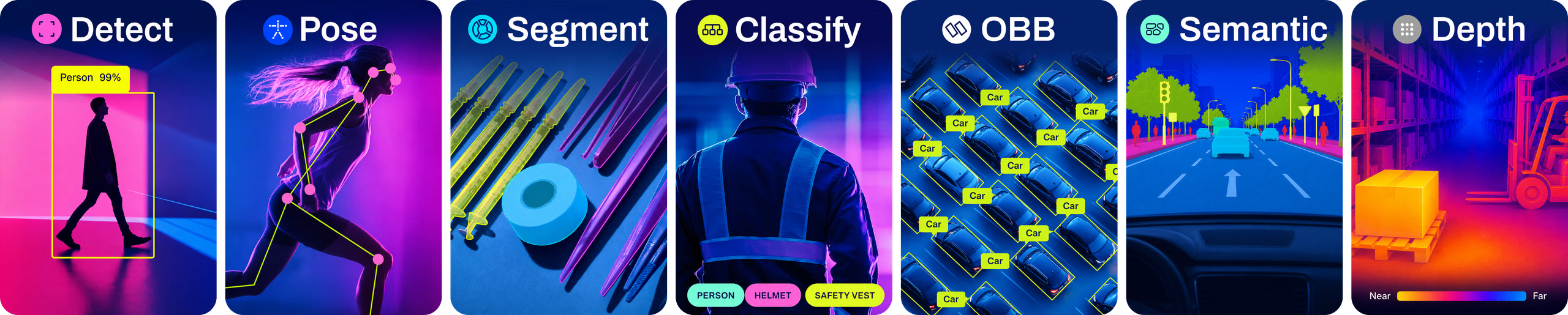
Ultralytics YOLO26 支持多种计算机视觉任务:检测、分割、语义分割、深度估计、分类、姿态估计和 OBB。每项任务都有不同的目标和应用场景,因此你可以使用单一框架解决各种计算机视觉问题。
有关计划中的 YOLO27 支持,请参阅 YOLO27 预览。YOLO27 即将推出,目前尚不可用;本指南使用的是已发布的 YOLO26 模型。
观看: 探索 Ultralytics YOLO26 任务:目标检测、实例分割、语义分割、深度估计、分类、姿态估计和 OBB。
检测#
目标检测是 YOLO26 支持的主要任务。它通过识别图像或视频帧中的对象,并在对象周围绘制边界框来实现检测。系统会根据检测对象的特征将其分类到不同类别中。YOLO26 能在单张图像或单个视频帧中快速检测多个对象,足以满足监控系统和自动驾驶汽车等实时应用的需求。
实例分割#
实例分割在目标检测的基础上进一步为每个对象生成像素级掩码。这种精度适用于医学影像、农业分析和制造业质量控制等应用。
语义分割#
语义分割会为图像中的每个像素分配类别标签,从而生成覆盖整个场景的稠密类别图。与实例分割不同,语义分割不会区分同一类别中的不同对象。因此,它非常适合自动驾驶、场景解析和土地覆盖制图等应用;在这些应用中,理解完整的空间布局比识别单个对象更重要。
深度估计#
单目深度估计根据单张 RGB 图像预测以米为单位的逐像素深度图。输出是与输入图像对齐的稠密浮点数图,适用于 3D 场景重建、机器人导航以及需要根据单个摄像头推断空间布局的 AR/VR 应用。
分类#
图像分类根据图像内容对整张图像进行分类。这项任务适用于电子商务中的商品分类、内容审核和野生动物监测等应用。
姿态估计#
姿态估计会检测图像或视频帧中的特定关键点,以跟踪动作或估计姿态。这些关键点可以表示人体关节、面部特征或其他重要关注点。YOLO26 姿态模型可实时检测关键点,因此适用于健身应用、体育分析和人机交互。
OBB#
有向边界框(OBB)检测通过增加方向角,改进传统目标检测,从而更准确地定位旋转对象。对于航空影像分析、文档处理和工业应用等对象可能以不同角度出现的场景,这项能力尤为重要。YOLO26 OBB 模型使用 DOTAv1 航空影像数据集进行预训练。
接下来做什么#
选好任务了吗?使用数据集指南按对应格式准备数据,然后使用你自己的图像进行训练。
常见问题#
使用 Ultralytics YOLO26 进行目标检测,请按以下步骤操作:
- 按合适的格式准备数据集。
- 使用检测任务训练 YOLO26 模型。
- 输入新的图像或视频帧,使用模型进行预测。
示例from ultralytics import YOLO # 加载预训练的 YOLO 模型(根据需要调整模型类型) model = YOLO("yolo26n.pt") # n、s、m、l、x 版本可用 # 对图像执行目标检测 results = model.predict(source="image.jpg") # 也可以使用视频、目录、URL 等作为输入 # 显示结果 results[0].show() # 显示第一张图像的结果如需更详细的说明,请查看我们的检测示例。
使用 YOLO26 执行分割任务有以下优势:
- 高精度:分割任务可生成精确的像素级掩码。
- 速度:YOLO26 针对实时应用进行了优化,即使处理高分辨率图像也能快速完成。
- 多种应用场景:它非常适合医学影像、自动驾驶以及其他需要精细图像分割的应用。
在图像分割部分了解更多关于 YOLO26 分割的优势和应用场景。
是。YOLO26 姿态模型可检测图像和视频帧中的关键点(例如人体关节),并将这些关键点连接成姿态。这适用于跟踪体育分析、医疗保健和人机交互应用中的动作。
如需了解更多详情和实现技巧,请访问我们的姿态估计示例。
YOLO26 有向目标检测(OBB)会为每个框预测一个额外的角度参数,因此与轴对齐框相比,旋转对象的定位更加紧密。这对需要准确定位旋转对象的应用很有帮助,例如航空影像分析和仓库自动化。
- 更紧凑的边界框:旋转框包含的背景更少,有助于区分密集排列或倾斜的对象。
- 应用广泛:适用于地理空间分析、机器人等任务。
如需了解更多详情和示例,请查看有向目标检测部分。
评论15
提出问题、分享结果,或帮助其他人。
adhinajay
I quantized a YOLOv8 model. Now I want to fine tune it, so how can I convert the ONNX file back to a .pt file?
DukeZacharia
Yes, you can utilize Explainable AI (XAI) with YOLOv9 or YOLOv11,
even though these versions are unofficial or experimental extensions beyond YOLOv8.
YOLO is fundamentally a convolutional neural network (CNN),
which means that many XAI techniques applicable to CNNs or object detection models can be adapted for use with these versions.
On Thu, 12 Jun 2025 at 17:27, Md Saimul Haque Shanto < @.***> wrote:
Can I use XAI with YOLOv11 or YOLOv9 ? If so, how can I apply it to an object detection task?
— Reply to this email directly, view it on GitHub https://github.com/orgs/ultralytics/discussions/16241#discussioncomment-13443327, or unsubscribe https://github.com/notifications/unsubscribe-auth/AGZSZVZYSGD2CDV75M5O7KD3DE2XNAVCNFSM6AAAAABOCSRMJGVHI2DSMVQWIX3LMV43URDJONRXK43TNFXW4Q3PNVWWK3TUHMYTGNBUGMZTENY . You are receiving this because you were mentioned.Message ID: @.*** com>
Saimul-Shanto
Can I use XAI with YOLOv11 or YOLOv9 ? If so, how can I apply it to an object detection task?
AashishThakur1321
how can I provide different object ids in videos to same types of objects like there are 5 persons in a video frame, then how to provide different ids to these persons such that it tracks these objects with same id throughout the videos
 Glenn JocherUltralytics(已编辑)
@AashishThakur1321 to track multiple persons with unique IDs in videos using YOLO, utilize the built-in tracking mode with
tracker=botsort.yamlortracker=bytetrack.yamlconfiguration. Example CLI command:
yolo track model=yolo26n.pt source=video.mp4
This automatically assigns unique IDs to each person and maintains them across frames. For customization, see our tracking documentation.
Good, Afternoon, does Yolo work for Human Action Detection in realtime?
- Glenn JocherUltralytics
@DukeZacharia good afternoon! YOLO can be used for real-time human action detection through pose estimation. For more details, please explore the pose estimation section in the Ultralytics documentation.
1
NasserAlqeifi
Hi there! Could anyone point me to the papers for YOLOv8 and YOLOv11 Instance Segmentation? Thank you!
- Glenn JocherUltralytics(已编辑)
@NasserAlqeifi hello! Ultralytics has not published formal research papers for YOLOv8 and YOLO11. YOLO26 does have a paper, see the YOLO26 docs. For detailed information on segmentation, please refer to the Ultralytics documentation. If you have further questions, feel free to ask!
1 Hi @glenn-jocher ,
Thank you for the information! I'm a master's student currently using the YOLOv8 Instance Segmentation model for my thesis. I've also tried using YOLOv11 and noticed that the documentation mentions it utilizes a variant of the U-Net architecture for segmentation.
I would love to know more about how segmentation and object detection work in YOLOv11, as well as the key differences between YOLOv8 and YOLOv11 in these tasks. Any additional insights would be greatly appreciated!
Thank you!
- Glenn JocherUltralytics(已编辑)
Thank you for your interest! Instance segmentation in YOLOv8 and YOLO11 is not based on U-Net. It uses the YOLO detection head with an additional prototype-mask branch that produces the masks. For more details, please refer to the segmentation docs; for new projects we recommend YOLO26.
hrbjoern
Would be nice to have examples for tracking, too ...
- Glenn JocherUltralytics
@hrbjoern thank you for your suggestion! We currently have tracking examples in our documentation. You can explore them for more insights on implementing tracking with YOLOv8.
OK, thanks. I just figured that since it's mentioned in the beginning of the page (photo), it should also be explained ...
- Glenn JocherUltralytics
Yes sorry for the confusion. We've placed the Tracking docs under Modes rather than Tasks here: https://docs.ultralytics.com/modes/track/
1