Ultralytics Explorer
Desde ultralytics>=8.3.12, Ultralytics Explorer ya no está disponible. Para usar Explorer, instala pip install ultralytics==8.3.11. En Ultralytics Platform tienes funciones similares y ampliadas para explorar conjuntos de datos.
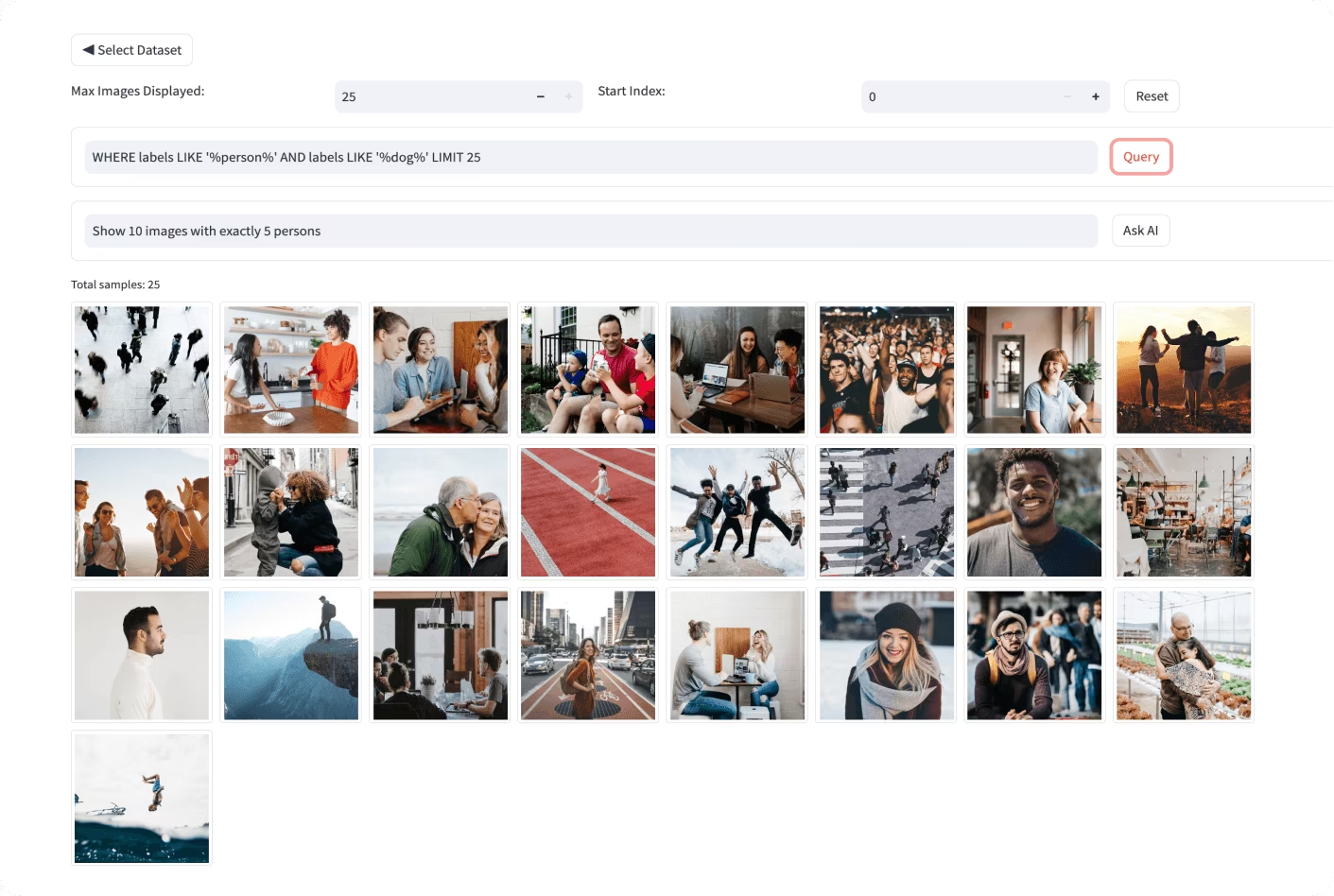
Ultralytics Explorer es una herramienta para explorar conjuntos de datos de visión artificial mediante búsqueda semántica, consultas SQL, búsqueda por similitud vectorial e instrucciones en lenguaje natural. También ofrece una API de Python para acceder a las mismas funciones.
Ver: API Explorer de Ultralytics | Búsqueda semántica, consultas SQL y funciones de Ask AI
Instalación de dependencias opcionales#
Explorer depende de bibliotecas externas para algunas de sus funciones. Se instalan automáticamente al usar Explorer. Para instalar estas dependencias manualmente, usa el siguiente comando:
pip install "ultralytics[explorer]==8.3.11"Explorer funciona con embeddings, búsqueda semántica y consultas SQL, y utiliza el servidor sin servidor de base de datos vectorial LanceDB. A diferencia de las bases de datos tradicionales en memoria, se guarda en disco sin sacrificar rendimiento, por lo que puedes escalar localmente a conjuntos de datos grandes como COCO sin quedarte sin memoria.
API de Explorer#
Esta es una API de Python para explorar tus conjuntos de datos. También es la base de la interfaz gráfica de Explorer. Puedes usarla para crear tus propios notebooks o scripts exploratorios y obtener información sobre tus conjuntos de datos.
Descubre todas las funciones y consulta ejemplos de uso en la documentación de la API de Explorer.
Uso de la interfaz gráfica de Explorer#
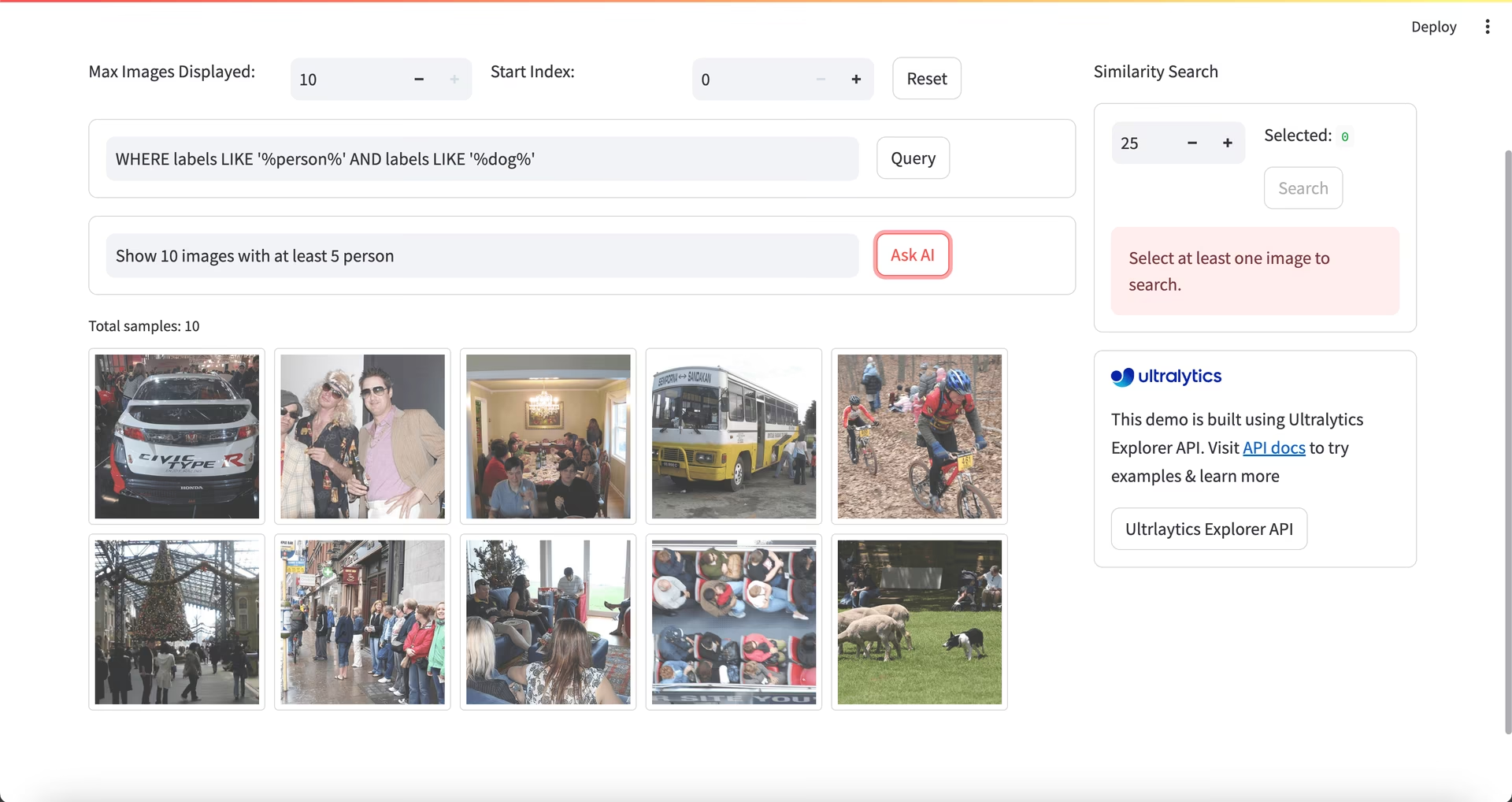
La demo de la interfaz gráfica se ejecuta en el navegador y te permite crear embeddings para tu conjunto de datos, buscar imágenes similares, ejecutar consultas SQL y realizar búsquedas semánticas. Puedes iniciarla con el siguiente comando:
yolo explorerLa función Ask AI usa OpenAI, así que la primera vez que ejecutes la interfaz gráfica se te pedirá que configures la clave de API de OpenAI. Puedes configurarla así: yolo settings openai_api_key="..."
Preguntas frecuentes#
Ultralytics Explorer es una herramienta para explorar conjuntos de datos de visión artificial (CV) mediante búsqueda semántica, consultas SQL, búsqueda por similitud vectorial y lenguaje natural. Ofrece tanto una interfaz gráfica de usuario como una API de Python. Como almacena los embeddings en disco con LanceDB, puede escalar a conjuntos de datos grandes sin consumir demasiada memoria.
Obtén más información sobre la API de Explorer.
Para instalar manualmente las dependencias opcionales que necesita Ultralytics Explorer, puedes usar el siguiente comando
pip:pip install "ultralytics[explorer]==8.3.11"Estas dependencias son necesarias para la búsqueda semántica y las consultas SQL. Entre ellas se incluye LanceDB, que mantiene las operaciones de la base de datos eficientes y escalables, incluso con conjuntos de datos grandes como COCO.
Usar la versión con interfaz gráfica de Ultralytics Explorer es sencillo. Después de instalar las dependencias necesarias, puedes iniciar la interfaz gráfica con el siguiente comando:
yolo explorerLa interfaz gráfica ofrece un entorno fácil de usar para crear embeddings de conjuntos de datos, buscar imágenes similares, ejecutar consultas SQL y realizar búsquedas semánticas. La función Ask AI, basada en OpenAI, también te permite consultar conjuntos de datos mediante lenguaje natural.
Para obtener información sobre el almacenamiento y la escalabilidad, consulta nuestras instrucciones de instalación.
La función Ask AI de Ultralytics Explorer permite interactuar con los conjuntos de datos mediante consultas en lenguaje natural. Esta función, basada en OpenAI, te permite hacer preguntas sobre tu conjunto de datos sin escribir consultas SQL ni comandos similares. Para utilizarla, tendrás que configurar tu clave de API de OpenAI la primera vez que ejecutes la interfaz gráfica:
yolo settings openai_api_key="YOUR_API_KEY"Para obtener más información sobre esta función y cómo integrarla, consulta la sección Uso de la interfaz gráfica de Explorer.
Sí. Instala la versión fijada con
pip install ultralytics==8.3.11en un notebook de Colab y sigue el ejemplo de exploración de VOC para crear embeddings y realizar búsquedas con los recursos en la nube de Google. Obtén más información en nuestra guía de Google Colab.


Comentarios13
Haz una pregunta, comparte tus resultados o ayuda a otra persona.
pooya-github
Hi,
In colab code after running !pip install ultralytics[explorer] and running: from ultralytics import explorer i got the following error:
ImportError Traceback (most recent call last) in <cell line: 1>() ----> 1 from ultralytics import explorer
ImportError: cannot import name 'explorer' from 'ultralytics' (/usr/local/lib/python3.10/dist-packages/ultralytics/init.py)
how can i fix it?
 Glenn JocherUltralytics(editado)
@pooya-github the
Ultralytics Explorerfeature has been removed as ofultralytics>=8.3.12. To access similar or enhanced functionality, we recommend using Ultralytics Platform, our platform for dataset exploration and management. Let me know if you have further questions!-2
mkutu
how can I set this up with a custom dataset? Could you direct me to any resources. Thanks!
- Glenn JocherUltralytics(editado)
@mkutu hello!
Setting up YOLO26 with a custom dataset can be straightforward! You'd primarily need a data YAML file to describe your dataset structure and then use it in your training command. Here’s a basic guide to get you started:
-
Prepare your data: Organize your dataset into two folders (images and labels), with corresponding files named identically.
-
Create a YAML file: This file should specify the paths to your training and validation data, the number of classes, and class names. Here's an example:
# custom_data.yaml train: path/to/train/images val: path/to/val/images nc: number_of_classes names: ['class1', 'class2', 'class3'] -
Start Training: Use the following command to train your model:
yolo train data=custom_data.yaml model=yolo26n.yaml
For exploring and managing your datasets efficiently, you might consider using the Ultralytics Explorer (removed in
ultralytics>=8.3.12; useultralytics==8.3.11or Ultralytics Platform). This tool offers features like semantic search, SQL queries, and even AI-based querying to derive insights from your data.Hope this helps! If you have any more questions, feel free to ask.
-2 -
BABAFAREEDDUDEKULA
how can i run above mentioned AI using yolo v8 previously i have tried yolo v9,v8,v7,rt-detr
AloshkaD
Can you be more specific?
- Glenn JocherUltralytics(editado)
Hey there! 🌟
It sounds like you've got a pretty wide range of experience with various YOLO versions and even RT-DETR! For running AI using YOLO26 specifically, the process is smoothly integrated into the Ultralytics framework, much like the versions you've mentioned.
To get started, make sure you have Ultralytics YOLO26 installed. If not, you can do so via pip:
pip install ultralyticsAnd then, to run your AI model with YOLO26, you can simply use:
from ultralytics import YOLO

# Load the model
model = YOLO('yolo26n.pt')  # Here 'yolo26n.pt' is an example model. Replace it with your model path.

# Run inference
results = model('path_to_your_image_or_video')
Or, if you prefer using the command line:
yolo detect predict model=yolo26n.pt source=path_to_your_image_or_videoRemember to replace 'yolo26n.pt' and 'path_to_your_image_or_video' with the actual paths to your YOLO26 model and the image or video you want to run inference on. 🚀
Since you've used various versions before, the process should feel quite familiar. If there's more specific functionality from the Ultralytics Explorer that you're interested in integrating with YOLO26, such as semantic search or SQL queries, the installation command provided in the documentation will be your first step:
pip install ultralytics[explorer]After that, you can launch the Ultralytics Explorer with:
yolo explorerAnd dive into explore mode (Explorer requires
ultralytics==8.3.11, as it was removed inultralytics>=8.3.12)! For any further details or if you've got a unique use case in mind, feel free to share more specifics. Happy to help further. Happy coding! 🎉1 Thanks a lot my brother
2- Glenn JocherUltralytics(editado)
Note: Ultralytics Explorer was removed in
ultralytics>=8.3.12; to use it, installultralytics==8.3.11. Similar dataset exploration features are available in Ultralytics Platform.@BABAFAREEDDUDEKULA hey there! 😄
Thanks for reaching out. If you're interested in diving into the Ultralytics Explorer to explore CV datasets with semantic search, SQL queries, vector similarity search, and more, it sounds like you're on the right track!
To get started, ensure you've got the Explorer installed via:
pip install ultralytics[explorer]Once installed, you can jump straight into using the GUI by typing:
yolo explorerThis launches the GUI in your browser, where you can experiment with creating embeddings, conducting image searches, and even using SQL or natural language queries!
If you encounter any issues or have specific questions as you use the Ultralytics Explorer, feel free to drop them here. Happy exploring! 🌟
The yolo explorer command will open the explorer on the local machine. How would I set it up to work on AWS while I'm connected with my local machine using ssh?
 Paula DerrengerUltralytics(editado)
Note: Ultralytics Explorer was removed in
ultralytics>=8.3.12; to use it, installultralytics==8.3.11. Similar dataset exploration features are available in Ultralytics Platform.To set up the Ultralytics Explorer to work on an AWS instance while you're connected via SSH from your local machine, you can use port forwarding to access the Explorer's web interface. Here's a concise step-by-step guide:
-
SSH into AWS with Port Forwarding: Use the
-Loption to forward a local port to a port on the AWS instance. Replacelocal_portwith a port on your local machine (e.g.,8080), andaws_portwith the port the Explorer runs on (usually5000).ssh -i /path/to/your/key.pem -L local_port:localhost:aws_port user @AloshkaD -
Run Explorer on AWS: Once connected, start the Explorer on the AWS instance:
yolo explorer -
Access Explorer Locally: Open a web browser on your local machine and navigate to
localhost:local_portto access the Explorer interface.
Remember to replace
/path/to/your/key.pemwith the path to your AWS key,userwith your AWS username, andaws_instance_ipwith your AWS instance's IP address. Also, ensure that the AWS security group allows inbound traffic on theaws_port.1-
Worked with a minor tweak to reference my config file. Thank you!
- Paula DerrengerUltralytics
@AloshkaD you're welcome! I'm glad to hear that you were able to get it working with your config file. If you have any more questions or need further assistance in the future, don't hesitate to reach out. Happy exploring with Ultralytics Explorer! 🚀😊
1