Ultralytics Explorer
ultralytics>=8.3.12以降、Ultralytics Explorerは削除されています。Explorerを使用するには、pip install ultralytics==8.3.11をインストールしてください。同様の(拡張された)データセット探索機能はUltralytics Platformで利用できます。
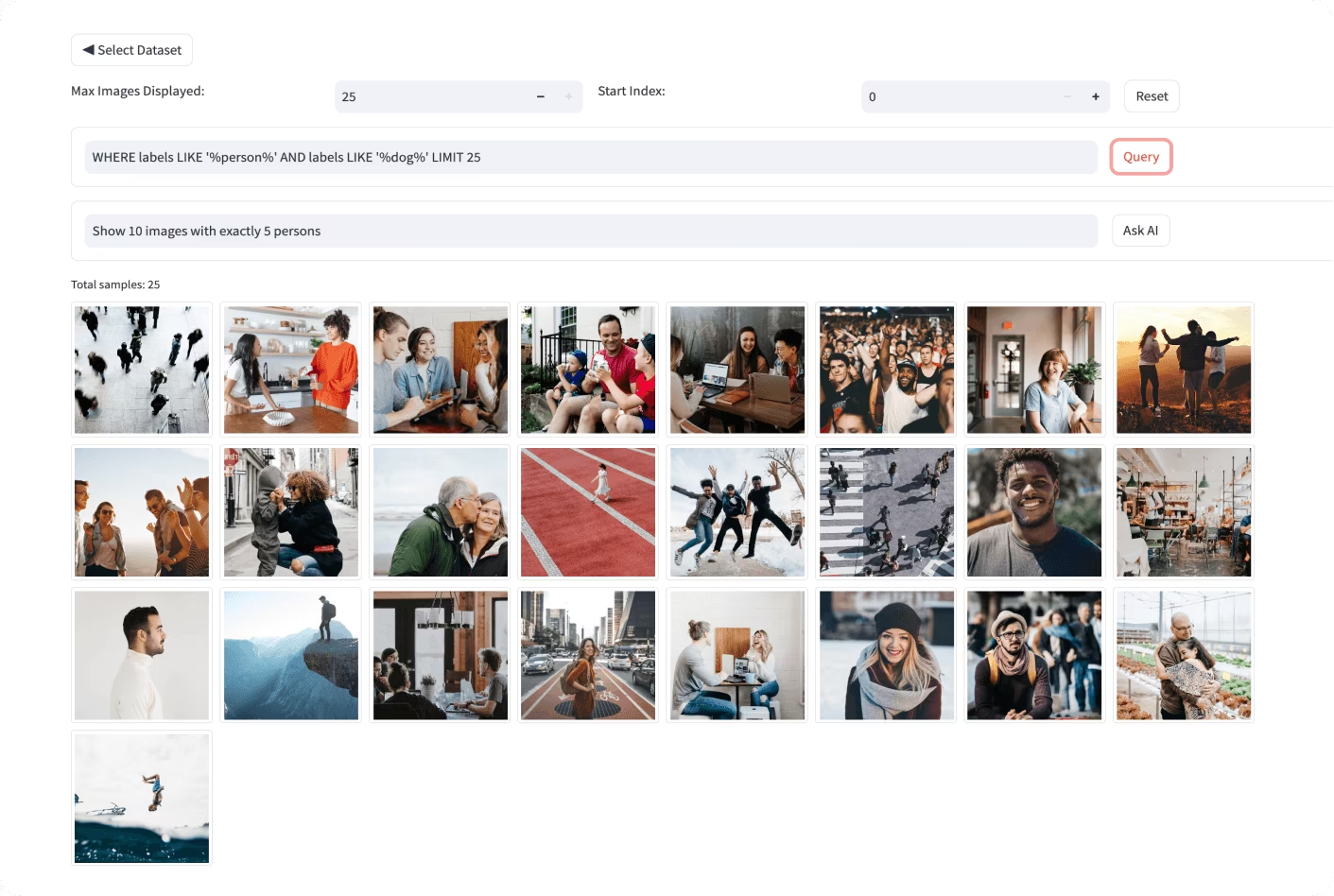
Ultralytics Explorerは、セマンティック検索、SQLクエリ、ベクトル類似度検索、自然言語プロンプトを使用してCVデータセットを探索するツールです。同じ機能にアクセスできるPython APIも提供します。
視聴: Ultralytics Explorer API | セマンティック検索、SQL クエリ、AI 質問機能
オプションの依存関係のインストール#
Explorerの一部の機能は外部ライブラリに依存しています。Explorerを使用すると、これらのライブラリは自動的にインストールされます。依存関係を手動でインストールするには、次のコマンドを使用してください。
pip install "ultralytics[explorer]==8.3.11"Explorerは埋め込み/セマンティック検索とSQLクエリに対応し、サーバーレスのベクトルデータベースであるLanceDBを基盤としています。従来のインメモリDBとは異なり、パフォーマンスを損なわずにディスク上へ永続化されるため、メモリ不足になることなく、COCOのような大規模データセットにもローカルで対応できます。
Explorer API#
これは、データセットを探索するためのPython APIです。GUI ExplorerもこのAPIを使用しています。独自の探索用ノートブックやスクリプトを作成し、データセットから知見を得るために活用できます。
Explorer APIドキュメントで、すべての機能と使用例をご確認ください。
GUI Explorerの使用方法#
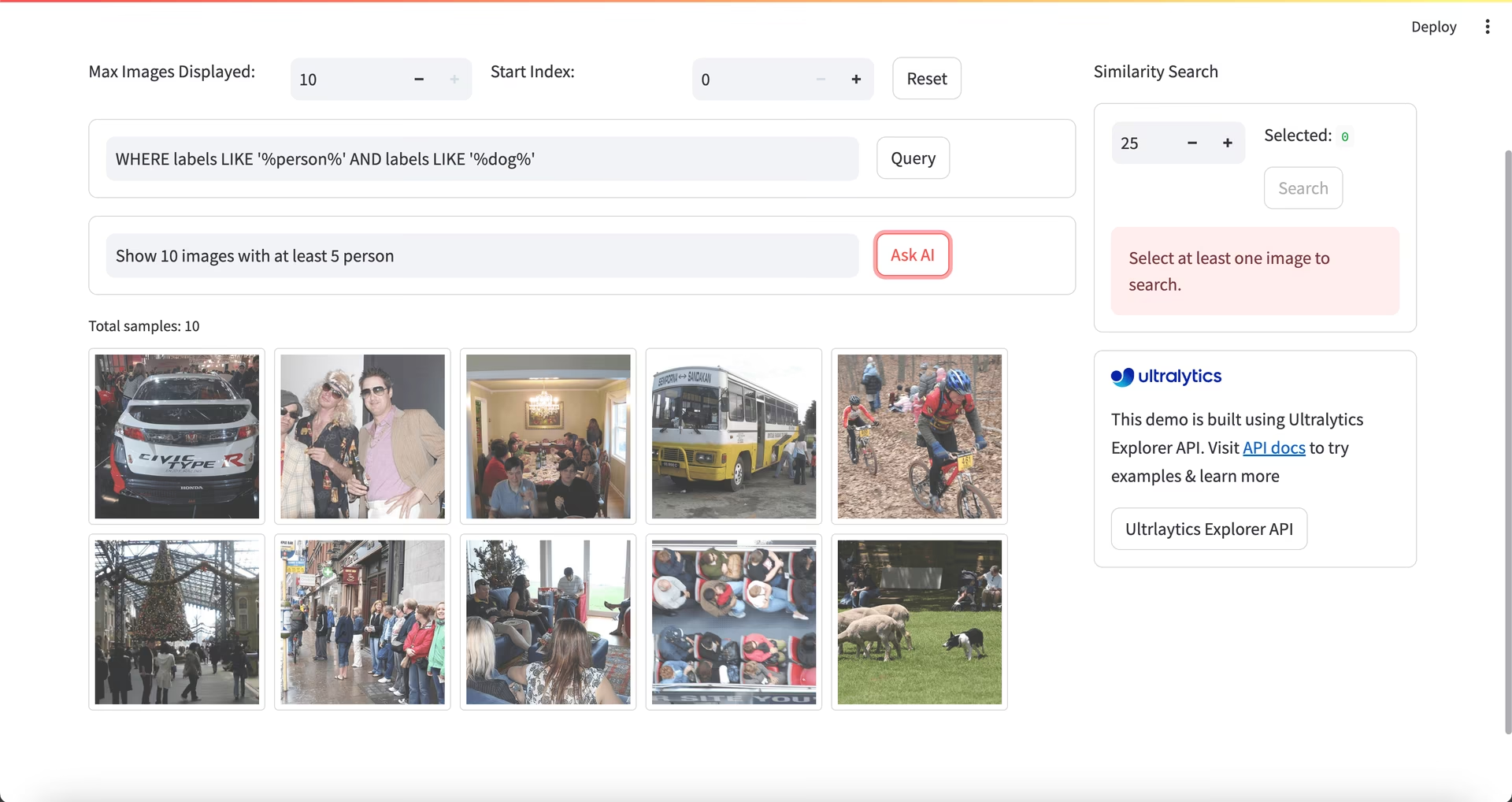
GUIデモはブラウザー上で動作し、データセットの埋め込みを作成して類似画像を検索したり、SQLクエリを実行したり、セマンティック検索を行ったりできます。次のコマンドで実行できます。
yolo explorerAsk AI機能はOpenAIを使用するため、GUIを初めて実行するときにOpenAIのAPIキーを設定するよう求められます。 次のように設定できます - yolo settings openai_api_key="..."
よくある質問#
Ultralytics Explorerは、セマンティック検索、SQLクエリ、ベクトル類似度検索、自然言語を使ってコンピュータービジョン(CV)データセットを探索するツールです。GUIとPython APIの両方を提供します。LanceDBを使用して埋め込みをディスク上に保存するため、過剰なメモリ使用を避けながら大規模データセットに対応できます。
Explorer APIの詳細をご覧ください。
Ultralytics Explorerに必要なオプションの依存関係を手動でインストールするには、次の
pipコマンドを使用できます。pip install "ultralytics[explorer]==8.3.11"これらの依存関係は、セマンティック検索とSQLクエリに必要です。LanceDBも含まれており、COCOのような大規模データセットでも、データベース操作の効率性と拡張性を維持します。
Ultralytics ExplorerのGUI版は簡単に使用できます。必要な依存関係をインストールした後、次のコマンドでGUIを起動できます。
yolo explorerGUIでは、データセットの埋め込みの作成、類似画像の検索、SQLクエリの実行、セマンティック検索を行うための使いやすいインターフェースを提供します。OpenAIを利用するAsk AI機能では、自然言語を使ってデータセットにクエリを実行することもできます。
ストレージとスケーラビリティについては、インストール手順をご覧ください。
Ultralytics ExplorerのAsk AI機能を使用すると、自然言語のクエリでデータセットを操作できます。OpenAIを利用するこの機能では、SQLクエリなどのコマンドを書かずにデータセットについて質問できます。この機能を使用するには、GUIを初めて実行するときにOpenAI APIキーを設定してください。
yolo settings openai_api_key="YOUR_API_KEY"この機能とその連携方法について詳しくは、GUI Explorerの使用方法のセクションをご覧ください。
はい。Colabノートブックで
pip install ultralytics==8.3.11を使って指定バージョンをインストールし、VOC探索の例に従って、Googleのクラウドリソース上で埋め込みを作成し、検索を実行してください。Google Colabガイドで詳細をご覧ください。


コメント13
質問したり、結果を共有したり、ほかの人をサポートしたりできます。
pooya-github
Hi,
In colab code after running !pip install ultralytics[explorer] and running: from ultralytics import explorer i got the following error:
ImportError Traceback (most recent call last) in <cell line: 1>() ----> 1 from ultralytics import explorer
ImportError: cannot import name 'explorer' from 'ultralytics' (/usr/local/lib/python3.10/dist-packages/ultralytics/init.py)
how can i fix it?
 Glenn JocherUltralytics(編集済み)
@pooya-github the
Ultralytics Explorerfeature has been removed as ofultralytics>=8.3.12. To access similar or enhanced functionality, we recommend using Ultralytics Platform, our platform for dataset exploration and management. Let me know if you have further questions!-2
mkutu
how can I set this up with a custom dataset? Could you direct me to any resources. Thanks!
- Glenn JocherUltralytics(編集済み)
@mkutu hello!
Setting up YOLO26 with a custom dataset can be straightforward! You'd primarily need a data YAML file to describe your dataset structure and then use it in your training command. Here’s a basic guide to get you started:
-
Prepare your data: Organize your dataset into two folders (images and labels), with corresponding files named identically.
-
Create a YAML file: This file should specify the paths to your training and validation data, the number of classes, and class names. Here's an example:
# custom_data.yaml train: path/to/train/images val: path/to/val/images nc: number_of_classes names: ['class1', 'class2', 'class3'] -
Start Training: Use the following command to train your model:
yolo train data=custom_data.yaml model=yolo26n.yaml
For exploring and managing your datasets efficiently, you might consider using the Ultralytics Explorer (removed in
ultralytics>=8.3.12; useultralytics==8.3.11or Ultralytics Platform). This tool offers features like semantic search, SQL queries, and even AI-based querying to derive insights from your data.Hope this helps! If you have any more questions, feel free to ask.
-2 -
BABAFAREEDDUDEKULA
how can i run above mentioned AI using yolo v8 previously i have tried yolo v9,v8,v7,rt-detr
AloshkaD
Can you be more specific?
- Glenn JocherUltralytics(編集済み)
Hey there! 🌟
It sounds like you've got a pretty wide range of experience with various YOLO versions and even RT-DETR! For running AI using YOLO26 specifically, the process is smoothly integrated into the Ultralytics framework, much like the versions you've mentioned.
To get started, make sure you have Ultralytics YOLO26 installed. If not, you can do so via pip:
pip install ultralyticsAnd then, to run your AI model with YOLO26, you can simply use:
from ultralytics import YOLO

# Load the model
model = YOLO('yolo26n.pt')  # Here 'yolo26n.pt' is an example model. Replace it with your model path.

# Run inference
results = model('path_to_your_image_or_video')
Or, if you prefer using the command line:
yolo detect predict model=yolo26n.pt source=path_to_your_image_or_videoRemember to replace 'yolo26n.pt' and 'path_to_your_image_or_video' with the actual paths to your YOLO26 model and the image or video you want to run inference on. 🚀
Since you've used various versions before, the process should feel quite familiar. If there's more specific functionality from the Ultralytics Explorer that you're interested in integrating with YOLO26, such as semantic search or SQL queries, the installation command provided in the documentation will be your first step:
pip install ultralytics[explorer]After that, you can launch the Ultralytics Explorer with:
yolo explorerAnd dive into explore mode (Explorer requires
ultralytics==8.3.11, as it was removed inultralytics>=8.3.12)! For any further details or if you've got a unique use case in mind, feel free to share more specifics. Happy to help further. Happy coding! 🎉1 Thanks a lot my brother
2- Glenn JocherUltralytics(編集済み)
Note: Ultralytics Explorer was removed in
ultralytics>=8.3.12; to use it, installultralytics==8.3.11. Similar dataset exploration features are available in Ultralytics Platform.@BABAFAREEDDUDEKULA hey there! 😄
Thanks for reaching out. If you're interested in diving into the Ultralytics Explorer to explore CV datasets with semantic search, SQL queries, vector similarity search, and more, it sounds like you're on the right track!
To get started, ensure you've got the Explorer installed via:
pip install ultralytics[explorer]Once installed, you can jump straight into using the GUI by typing:
yolo explorerThis launches the GUI in your browser, where you can experiment with creating embeddings, conducting image searches, and even using SQL or natural language queries!
If you encounter any issues or have specific questions as you use the Ultralytics Explorer, feel free to drop them here. Happy exploring! 🌟
The yolo explorer command will open the explorer on the local machine. How would I set it up to work on AWS while I'm connected with my local machine using ssh?
 Paula DerrengerUltralytics(編集済み)
Note: Ultralytics Explorer was removed in
ultralytics>=8.3.12; to use it, installultralytics==8.3.11. Similar dataset exploration features are available in Ultralytics Platform.To set up the Ultralytics Explorer to work on an AWS instance while you're connected via SSH from your local machine, you can use port forwarding to access the Explorer's web interface. Here's a concise step-by-step guide:
-
SSH into AWS with Port Forwarding: Use the
-Loption to forward a local port to a port on the AWS instance. Replacelocal_portwith a port on your local machine (e.g.,8080), andaws_portwith the port the Explorer runs on (usually5000).ssh -i /path/to/your/key.pem -L local_port:localhost:aws_port user @AloshkaD -
Run Explorer on AWS: Once connected, start the Explorer on the AWS instance:
yolo explorer -
Access Explorer Locally: Open a web browser on your local machine and navigate to
localhost:local_portto access the Explorer interface.
Remember to replace
/path/to/your/key.pemwith the path to your AWS key,userwith your AWS username, andaws_instance_ipwith your AWS instance's IP address. Also, ensure that the AWS security group allows inbound traffic on theaws_port.1-
Worked with a minor tweak to reference my config file. Thank you!
- Paula DerrengerUltralytics
@AloshkaD you're welcome! I'm glad to hear that you were able to get it working with your config file. If you have any more questions or need further assistance in the future, don't hesitate to reach out. Happy exploring with Ultralytics Explorer! 🚀😊
1