YOLO-NAS
YOLO-NASの開発元であるDeciはNVIDIAに買収され、これらのモデルはDeciによる積極的なメンテナンスが終了しました。Ultralyticsは引き続きモデルの使用をサポートしますが、開発元チームからの追加アップデートは予定されていません。
概要#
Deci AIが開発したYOLO-NASは、ニューラルアーキテクチャ探索によって生成されたオブジェクト検出モデルであり、従来のYOLOモデルの制約に対処するよう設計されています。量子化への対応と、精度とレイテンシのトレードオフを改善しています。
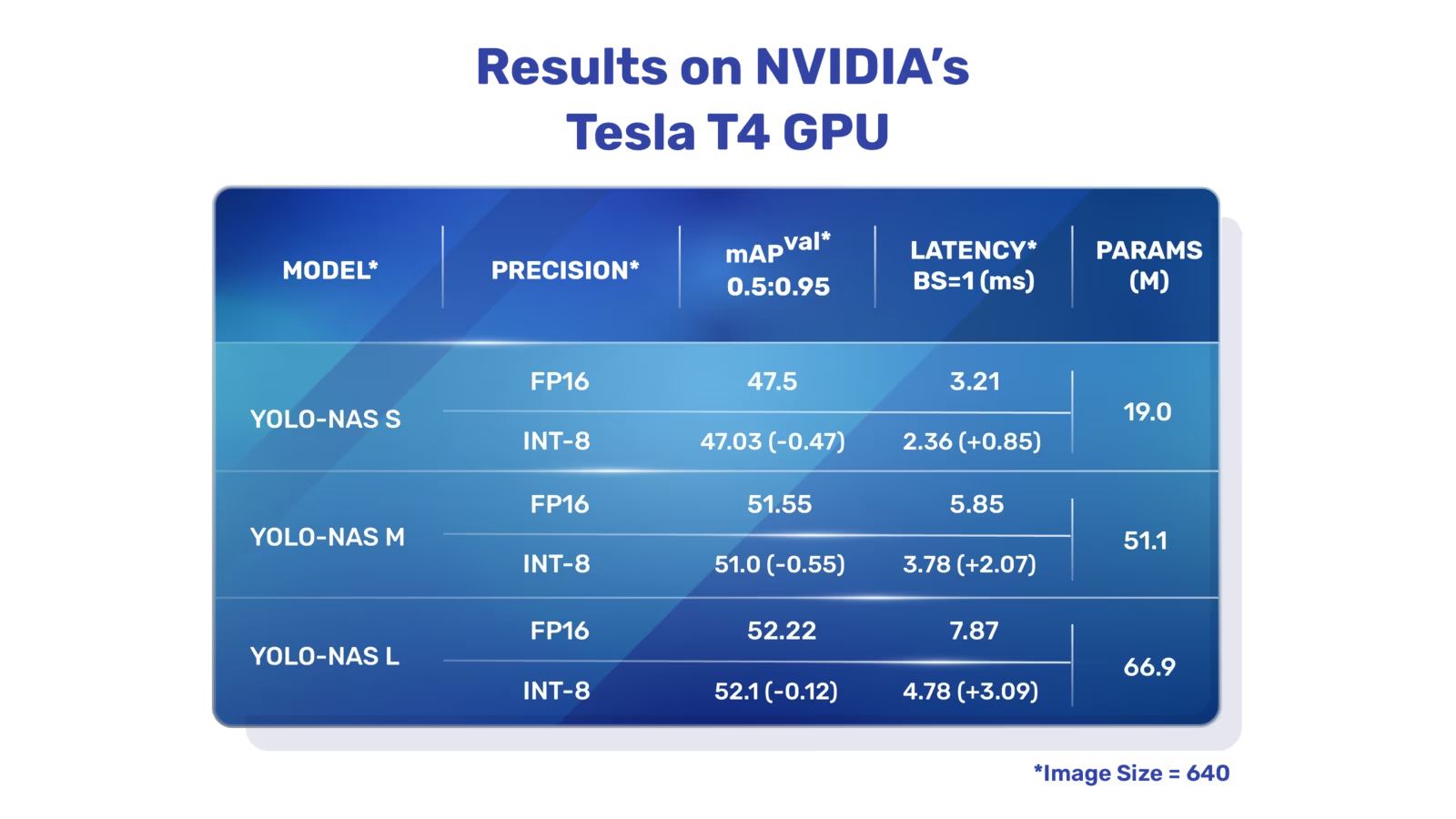 YOLO-NASの概要。 YOLO-NASは量子化を考慮したブロックと選択的量子化を使用し、量子化後も精度を維持します。INT8量子化バージョンに変換した場合の精度低下はわずかで、従来のYOLOモデルから改善されています。
主な機能#
- 量子化に適した基本ブロック: YOLO-NASは、従来のYOLOモデルの大きな制約の一つに対処するため、量子化に適した新しい基本ブロックを導入しています。
- 高度な学習と量子化: YOLO-NASは高度な学習方式と学習後量子化を使用して性能を向上させます。
- AutoNAC最適化と事前学習: YOLO-NASはAutoNAC最適化を使用し、COCO、Objects365、Roboflow 100などのデータセットで事前学習されています。この事前学習により、実運用環境における下流のオブジェクト検出タスクに適しています。
事前学習済みモデル#
Ultralyticsは、速度と精度のバランスがそれぞれ異なる3サイズの事前学習済みYOLO-NASモデルを提供しています。
| モデル | mAP50-95 | レイテンシ (ms) |
|---|---|---|
| YOLO-NAS S | 47.5 | 3.21 |
| YOLO-NAS M | 51.55 | 5.85 |
| YOLO-NAS L | 52.22 | 7.87 |
| YOLO-NAS S INT-8 | 47.03 | 2.36 |
| YOLO-NAS M INT-8 | 51.0 | 3.78 |
| YOLO-NAS L INT-8 | 52.1 | 4.78 |
各モデルのバリエーションは、平均適合率(mAP)とレイテンシのバランスを考慮して設計されており、性能と速度の両面で物体検出タスクを最適化できます。
使用例#
ultralytics Pythonパッケージは、YOLO-NASモデルを実行するためのPython APIとCLIを提供します。
YOLO-NASモデルにはsuper-gradientsパッケージが必要です。このパッケージにはPython 3.10環境が必要です。
pip install ultralytics super-gradients "setuptools<81"以下の例では、推論と検証にultralyticsパッケージを使用してYOLO-NASモデルを利用する方法を示します。
推論と検証の例#
この例では、COCO8データセットでYOLO-NAS-sを検証します。
この例では、YOLO-NASのシンプルな推論コードと検証コードを示します。YOLO-NASはエクスポートにも対応していますが、ultralyticsパッケージでは学習をサポートしていません。
PyTorchの事前学習済み*.ptモデルファイルをNAS()クラスに渡すと、Pythonでモデルインスタンスを作成できます。
from ultralytics import NAS

# COCOで事前学習したYOLO-NAS-sモデルを読み込む
model = NAS("yolo_nas_s.pt")

# モデル情報を表示(任意)
model.info()

# COCO8サンプルデータセットでモデルを検証する
results = model.val(data="coco8.yaml")

# 'bus.jpg'画像でYOLO-NAS-sモデルを使用して推論を実行する
results = model("path/to/bus.jpg")サポート対象のタスクとモード#
YOLO-NASにはSmall(s)、Medium(m)、Large(l)の3つのバリアントがあります。それぞれ異なる計算能力と性能のニーズに合わせて設計されています。
- YOLO-NAS-s:計算リソースが限られていても効率性が重要な環境向けに最適化されています。
- YOLO-NAS-m:バランスの取れた構成で、より高い精度が求められる汎用的なオブジェクト検出に適しています。
- YOLO-NAS-l:計算リソースに大きな制約がなく、最高の精度が求められるシナリオ向けに設計されています。
以下では、各モデルの詳細として、事前学習済み重みへのリンク、対応タスク、さまざまな動作モードとの互換性を紹介します。
| モデルタイプ | 事前学習済み重み | サポートされるタスク | トレーニング | 検証 | 推論 | エクスポート |
|---|---|---|---|---|---|---|
| YOLO-NAS-s | yolo_nas_s.pt | 物体検出 | ❌ | ✅ | ✅ | ✅ |
| YOLO-NAS-m | yolo_nas_m.pt | 物体検出 | ❌ | ✅ | ✅ | ✅ |
| YOLO-NAS-l | yolo_nas_l.pt | 物体検出 | ❌ | ✅ | ✅ | ✅ |
引用と謝辞#
研究または開発でYOLO-NASを使用する場合は、SuperGradientsを引用してください。
@misc{supergradients,
      doi = {10.5281/ZENODO.7789328},
      url = {https://zenodo.org/records/7789328},
      author = {Aharon,  Shay and {Louis-Dupont} and {Ofri Masad} and Yurkova,  Kate and {Lotem Fridman} and {Lkdci} and Khvedchenya,  Eugene and Rubin,  Ran and Bagrov,  Natan and Tymchenko,  Borys and Keren,  Tomer and Zhilko,  Alexander and {Eran-Deci}},
      title = {Super-Gradients},
      publisher = {GitHub},
      journal = {GitHub repository},
      year = {2021},
}コンピュータビジョンコミュニティにとって貴重なリソースの作成と維持に尽力された、Deci AIのSuperGradientsチームに感謝します。
よくある質問#
Deci AIが開発したYOLO-NASは、ニューラルアーキテクチャサーチ(NAS)を用いて設計された物体検出モデルです。量子化に適した基本ブロックや高度なトレーニング方式などの機能を導入し、従来のYOLOモデルの制約に対処します。これらの機能は、特に計算リソースが限られた環境で性能を向上させます。YOLO-NASは量子化にも対応しており、INT8版に変換しても高い精度を維持するため、本番環境での利用に適しています。
ultralyticsパッケージを使用して、YOLO-NASモデルをPythonアプリケーションに統合できます。事前学習済みYOLO-NASモデルを読み込んで推論を実行する簡単な例を以下に示します。from ultralytics import NAS # COCOで事前学習したYOLO-NAS-sモデルを読み込む model = NAS("yolo_nas_s.pt") # COCO8サンプルデータセットでモデルを検証する results = model.val(data="coco8.yaml") # 'bus.jpg'画像でYOLO-NAS-sモデルを使用して推論を実行する results = model("path/to/bus.jpg")詳細については、推論と検証の例をご覧ください。
YOLO-NASには、量子化オブジェクト検出に適したモデルとなる、次のような主要機能があります。
- 量子化に適した基本ブロック: 量子化後も精度を維持する、強化されたアーキテクチャです。
- 高度な学習と量子化: 高度な学習方式と学習後量子化技術を使用します。
- AutoNAC最適化と事前学習: AutoNAC最適化を使用し、COCO、Objects365、Roboflow 100などのデータセットで事前学習されています。
これらの機能により、高い精度、効率的な性能、実運用環境への適性が実現します。詳細については、主な機能セクションをご覧ください。
YOLO-NASモデルは、検証、推論、エクスポートの各モードで物体検出に対応しています。トレーニングには対応していません。対応モデルにはYOLO-NAS-s、YOLO-NAS-m、YOLO-NAS-lがあり、それぞれ異なる計算能力と性能要件に合わせて設計されています。
はい。Ultralyticsが提供する事前学習済みYOLO-NASモデルに直接アクセスできます。これらのモデルはCOCOなどのデータセットで事前学習されています。対応タスクとモードセクションにあるリンクからダウンロードできます。例をいくつか示します。


コメント21
質問したり、結果を共有したり、ほかの人をサポートしたりできます。
riobastian09
Hi. i want to know is there any pre-configured of YOLO-NAS model? i want to use this to my experiment using the custom architecture YOLO-NAS model. Thank you!
 Glenn JocherUltralytics
@riobastian09 thank you for your question! Yes, pre-configured YOLO-NAS models, such as YOLO-NAS-s, YOLO-NAS-m, and YOLO-NAS-l, are available and optimized for inference, validation, and export. You can access these pre-trained models and easily integrate them into your experiments using the Ultralytics Python package. Unfortunately, custom architecture modifications or training directly with YOLO-NAS are not supported. For more, refer to the YOLO-NAS documentation: https://docs.ultralytics.com/models/yolo-nas/
 User
您好,我使用如下脚本将torch模型转成onnx模型时,出现如下错误: raise AttributeError(f"'{type(self).name}' object has no attribute '{name}'") AttributeError: 'YoloNAS_S' object has no attribute 'args'我该如何解决?
- User
from ultralytics import NAS model = NAS('yolo_nas_s') model.export( imgsz = [480,640], format = "onnx", simplify = True, opset = 17 )
- Glenn JocherUltralytics
@Stephen-Hao it seems like the error you're encountering is due to the 'args' attribute not being present in the 'YoloNAS_S' object. This might be related to the specific version of the model or the Ultralytics package you are using. Please ensure you have the latest version of the Ultralytics package installed. If the issue persists, consider checking the model's documentation or reaching out to the community for further assistance.
NoviceAlchemist
我训练使用的代码是:import torch import warnings from ultralytics import YOLO
忽略与“deterministic”和“non-deterministic”相关的所有警告
warnings.filterwarnings("ignore", category=UserWarning, message=".deterministic.")
if name == 'main': # 关闭PyTorch的确定性算法 torch.use_deterministic_algorithms(False)
# 初始化YOLO模型
# model_path = r'D:\ultralytics-main\ultralytics\cfg\models\v8\yolov8_attiton.yaml'
model_path = r'D:\ultralytics-main\model train\model\yolo_nas_s.pt'
model = YOLO(model_path)

# 设置正确的数据集路径
data_path = r"C:\Users\13579\Downloads\etiketlenmis_3.v6i.yolov8\data.yaml"

# 训练模型配置信息
model.train(data=data_path,
            imgsz=640,
            batch=32,
            epochs=200,
            name='NAS_S',
            )

# 设置验证集验证效果
# model.val()
但是会出现D:\Anaconda3\envs\yolov8\python.exe "D:\ultralytics-main\model train\My train\yolo nas.py" The console stream is logged into C:\Users\13579\sg_logs\console.log [2024-09-06 10:23:49] INFO - crash_tips_setup.py - Crash tips is enabled. You can set your environment variable to CRASH_HANDLER=FALSE to disable it [2024-09-06 10:23:49,572] torch.distributed.elastic.multiprocessing.redirects: [WARNING] NOTE: Redirects are currently not supported in Windows or MacOs. [WARNING]No module named 'pycocotools' [2024-09-06 10:23:51] WARNING - env_sanity_check.py - Failed to verify operating system: Deci officially supports only Linux kernels. Some features may not work as expected. WARNING ⚠️ The file 'D:\ultralytics-main\model train\model\yolo_nas_s.pt' appears to be improperly saved or formatted. For optimal results, use model.save('filename.pt') to correctly save YOLO models. Traceback (most recent call last): File "D:\ultralytics-main\model train\My train\yolo nas.py", line 15, in model = YOLO(model_path) File "D:\ultralytics-main\ultralytics\models\yolo\model.py", line 23, in init super().init(model=model, task=task, verbose=verbose) File "D:\ultralytics-main\ultralytics\engine\model.py", line 149, in init self._load(model, task=task) File "D:\ultralytics-main\ultralytics\engine\model.py", line 230, in _load self.model, self.ckpt = attempt_load_one_weight(weights) File "D:\ultralytics-main\ultralytics\nn\tasks.py", line 855, in attempt_load_one_weight ckpt, weight = torch_safe_load(weight) # load ckpt File "D:\ultralytics-main\ultralytics\nn\tasks.py", line 809, in torch_safe_load ckpt = {"model": ckpt.model} File "D:\Anaconda3\envs\yolov8\lib\site-packages\torch\nn\modules\module.py", line 1695, in getattr raise AttributeError(f"'{type(self).name}' object has no attribute '{name}'") AttributeError: 'YoloNAS_S' object has no attribute 'model'
进程已结束,退出代码为 1
这个怎么解决呀
- Glenn JocherUltralytics(編集済み)
@NoviceAlchemist YOLO-NAS models in Ultralytics are pretrained and support only validation, inference and export, not training (see the Training column in the YOLO-NAS docs), so
model.train()isn't available foryolo_nas_s.pt. To train on your own dataset, use a model with training support such as YOLO26 (e.g.yolo26s.pt). If you hit model-loading errors, verify thatpycocotoolsis installed and try the latest version of the Ultralytics package.
dota2015
from ultralytics import NAS import cv2
Load a COCO-pretrained YOLO-NAS-s model
model = NAS('yolo_nas_s.pt')
Display model information (optional)
model.info() results = model.predict('000000000009.jpg')
run reslult:
C:\Users\makef.conda\envs\yolov8\python.exe -X pycache_prefix=C:\Users\makef\AppData\Local\JetBrains\PyCharm2023.3\cpython-cache "C:/Program Files/JetBrains/PyCharm 2023.3.4/plugins/python/helpers/pydev/pydevd.py" --multiprocess --qt-support=auto --client 127.0.0.1 --port 62105 --file D:\02Code\code\yolov8\v8_2\yolo_nas.py Connected to pydev debugger (build 233.15026.15) The console stream is logged into C:\Users\makef\sg_logs\console.log [2024-04-28 16:29:38] INFO - crash_tips_setup.py - Crash tips is enabled. You can set your environment variable to CRASH_HANDLER=FALSE to disable it [2024-04-28 16:29:39] WARNING - redirects.py - NOTE: Redirects are currently not supported in Windows or MacOs. [WARNING]No module named 'pycocotools' [2024-04-28 16:29:45] WARNING - env_sanity_check.py - Failed to verify operating system: Deci officially supports only Linux kernels. Some features may not work as expected. Model summary: 685 layers, 19053888 parameters, 19053888 gradients
Traceback (most recent call last): File "C:\Users\makef.conda\envs\yolov8\lib\site-packages\torch\autograd\grad_mode.py", line 43, in generator_context response = gen.send(None) File "C:\Users\makef.conda\envs\yolov8\lib\site-packages\ultralytics\engine\predictor.py", line 228, in stream_inference self.model.warmup(imgsz=(1 if self.model.pt or self.model.triton else self.dataset.bs, 3, *self.imgsz)) File "C:\Users\makef.conda\envs\yolov8\lib\site-packages\ultralytics\nn\autobackend.py", line 624, in warmup self.forward(im) # warmup File "C:\Users\makef.conda\envs\yolov8\lib\site-packages\ultralytics\nn\autobackend.py", line 450, in forward y = self.model(im, augment=augment, visualize=visualize, embed=embed) File "C:\Users\makef.conda\envs\yolov8\lib\site-packages\torch\nn\modules\module.py", line 1194, in _call_impl return forward_call(*input, **kwargs) TypeError: forward() got an unexpected keyword argument 'augment' python-BaseException
Process finished with exit code 1
 Paula DerrengerUltralytics
Hey there! 👋 It looks like you're encountering a
TypeErrorrelated to theaugmentkeyword argument when running inference with the YOLO-NAS model. The error suggests that theforward()method in the model doesn't recognize theaugmentargument. This could be due to an oversight in the code or an issue with the model's compatibility with the Ultralytics framework.Let's try running the model without any additional arguments that aren't expected. Here's how you can do it:
from ultralytics import NAS

# Load a COCO-pretrained YOLO-NAS-s model
model = NAS('yolo_nas_s.pt')

# Run inference with the YOLO-NAS-s model on the 'bus.jpg' image
results = model('path/to/bus.jpg')
This simplifies the call to the model's inference method by removing the
augmentargument, which seems to be causing the issue.If you continue to face problems or if the issue is due to something else, it might be a good idea to check the Ultralytics documentation for YOLO-NAS compatibility or raise an issue on the GitHub repository for more specific help! Hope this sorts it out for you! 😊
Hey there! So, I've decked out my project with all the latest packages, but guess what? The issue is still lurking like it's on a vacation!
Here's the riveting tale of the pip upgrade:
Downloading ultralytics-8.2.4-py3-none-any.whl (752 kB) ━━━━━━━━━━━━━━━━━━━━━━━━━━━━━━━━━━━━━━━━ 752.1/752.1 kB 28.1 kB/s eta 0:00:00 Installing collected packages: ultralytics Attempting uninstall: ultralytics Found existing installation: ultralytics 8.2.1 Uninstalling ultralytics-8.2.1: Successfully uninstalled ultralytics-8.2.1 Successfully installed ultralytics-8.2.4
Behold, the saga of the runtime logs unfolds below:
C:\Users\makef.conda\envs\yolov8\python.exe D:\02Code\code\yolov8\v8_2\yolo_nas.py The console stream is logged into C:\Users\makef\sg_logs\console.log [2024-04-29 10:42:17] INFO - crash_tips_setup.py - Crash tips is enabled. You can set your environment variable to CRASH_HANDLER=FALSE to disable it [2024-04-29 10:42:18] WARNING - redirects.py - NOTE: Redirects are currently not supported in Windows or MacOs. [WARNING]No module named 'pycocotools' [2024-04-29 10:42:21] WARNING - env_sanity_check.py - Failed to verify operating system: Deci officially supports only Linux kernels. Some features may not work as expected. Model summary: 685 layers, 19053888 parameters, 19053888 gradients
Behold, the saga of the runtime logs unfolds below: Traceback (most recent call last): File "D:\02Code\code\yolov8\v8_2\yolo_nas.py", line 10, in results = model.predict('000000000009.jpg') File "C:\Users\makef.conda\envs\yolov8\lib\site-packages\ultralytics\engine\model.py", line 452, in predict return self.predictor.predict_cli(source=source) if is_cli else self.predictor(source=source, stream=stream) File "C:\Users\makef.conda\envs\yolov8\lib\site-packages\ultralytics\engine\predictor.py", line 168, in call return list(self.stream_inference(source, model, *args, **kwargs)) # merge list of Result into one File "C:\Users\makef.conda\envs\yolov8\lib\site-packages\torch\autograd\grad_mode.py", line 43, in generator_context response = gen.send(None) File "C:\Users\makef.conda\envs\yolov8\lib\site-packages\ultralytics\engine\predictor.py", line 228, in stream_inference self.model.warmup(imgsz=(1 if self.model.pt or self.model.triton else self.dataset.bs, 3, *self.imgsz)) File "C:\Users\makef.conda\envs\yolov8\lib\site-packages\ultralytics\nn\autobackend.py", line 627, in warmup self.forward(im) # warmup File "C:\Users\makef.conda\envs\yolov8\lib\site-packages\ultralytics\nn\autobackend.py", line 453, in forward y = self.model(im, augment=augment, visualize=visualize, embed=embed) File "C:\Users\makef.conda\envs\yolov8\lib\site-packages\torch\nn\modules\module.py", line 1194, in _call_impl return forward_call(*input, **kwargs) TypeError: forward() got an unexpected keyword argument 'augment'
Process finished with exit code 1
- Paula DerrengerUltralytics(編集済み)
Hey there! 😄 It looks like you're having a bit of a rough ride with the
augmentargument not being recognized during prediction. No worries, let's tidy this up!The error message you're seeing is due to the
augmentargument being passed where it was not expected. It's a simple fix; you just need to ensure you're using the prediction functionality without this argument, like so:from ultralytics import NAS # Load the COCO-pretrained YOLO-NAS-s model model = NAS('yolo_nas_s.pt') # Run inference on an image results = model('path/to/000000000009.jpg') # To visualize the results, you can do: results[0].show()This should run smoothly and get your project back on track! If issues persist or you have further questions, feel free to reach out. And remember, for the latest and greatest on usage, our docs page is always there to help you out. Happy coding! 🚀
I used your code, but the problem still persists, like a mischievous little gremlin playing hide and seek.
- Paula DerrengerUltralytics(編集済み)
Hey there! 🌟 It looks like that mischievous gremlin of an issue is quite stubborn. Not to worry, let's tackle it together.
Based on your feedback and the details from the YOLO-NAS docs, it seems like you're on the right track. However, if you're still encountering issues with predictions or validation, it's possible there might be a version mismatch or a missing dependency, especially
pycocotoolswhich is crucial for dataset operations and was flagged in your logs.Firstly, please ensure you've installed
pycocotoolsby running:pip install pycocotools-windowsIf you're not on Windows, just
pycocotoolsshould work.Moreover, the error regarding the
augmentargument not being expected might suggest an incompatibility issue or an outdated piece of code. Let's try simplifying the inference code snippet to not use this argument, as shown in the Ultralytics YOLO-NAS docs:from ultralytics import NAS # Load the COCO-pretrained YOLO-NAS-s model model = NAS('yolo_nas_s.pt') # Run inference with the YOLO-NAS-s model on a local image file results = model('path/to/bus.jpg') # Visualize the results results[0].show()This code directly uses the model without additional settings that may not be supported, like
augment.If the problem continues, it could be helpful to check for updates to the Ultralytics package or consider reaching out on the GitHub issues page for more targeted support. Sometimes, issues like these have been encountered and solved by others in the community!
Don't let those gremlins get you down; you're closer to a solution than you think! 🚀
C:\Users\makef.conda\envs\yolov8\python.exe D:\02Code\code\yolov8\v8_2\yolo_nas.py The console stream is logged into C:\Users\makef\sg_logs\console.log [2024-04-28 16:27:19] INFO - crash_tips_setup.py - Crash tips is enabled. You can set your environment variable to CRASH_HANDLER=FALSE to disable it [2024-04-28 16:27:20] WARNING - redirects.py - NOTE: Redirects are currently not supported in Windows or MacOs. [WARNING]No module named 'pycocotools' [2024-04-28 16:27:23] WARNING - env_sanity_check.py - Failed to verify operating system: Deci officially supports only Linux kernels. Some features may not work as expected. Model summary: 685 layers, 19053888 parameters, 19053888 gradients Traceback (most recent call last): File "D:\02Code\code\yolov8\v8_2\yolo_nas.py", line 10, in results = model.predict('000000000009.jpg') File "C:\Users\makef.conda\envs\yolov8\lib\site-packages\ultralytics\engine\model.py", line 452, in predict return self.predictor.predict_cli(source=source) if is_cli else self.predictor(source=source, stream=stream) File "C:\Users\makef.conda\envs\yolov8\lib\site-packages\ultralytics\engine\predictor.py", line 168, in call return list(self.stream_inference(source, model, *args, **kwargs)) # merge list of Result into one File "C:\Users\makef.conda\envs\yolov8\lib\site-packages\torch\autograd\grad_mode.py", line 43, in generator_context response = gen.send(None) File "C:\Users\makef.conda\envs\yolov8\lib\site-packages\ultralytics\engine\predictor.py", line 228, in stream_inference self.model.warmup(imgsz=(1 if self.model.pt or self.model.triton else self.dataset.bs, 3, *self.imgsz)) File "C:\Users\makef.conda\envs\yolov8\lib\site-packages\ultralytics\nn\autobackend.py", line 624, in warmup self.forward(im) # warmup File "C:\Users\makef.conda\envs\yolov8\lib\site-packages\ultralytics\nn\autobackend.py", line 450, in forward y = self.model(im, augment=augment, visualize=visualize, embed=embed) File "C:\Users\makef.conda\envs\yolov8\lib\site-packages\torch\nn\modules\module.py", line 1194, in _call_impl return forward_call(*input, **kwargs) TypeError: forward() got an unexpected keyword argument 'augment'
Process finished with exit code 1
from ultralytics import NAS import cv2
Load a COCO-pretrained YOLO-NAS-s model
model = NAS('yolo_nas_s.pt')
Display model information (optional)
model.info()
results = model.predict('000000000009.jpg')
- Paula DerrengerUltralytics
Hey there! 👋 It looks like you're trying to run predictions with the YOLO-NAS model and encountered an issue regarding the
augmentargument in theforward()method. This error typically occurs if there's a version mismatch or if the model and method usage doesn't align with the expected input parameters.Based on your usage:
from ultralytics import NAS
import cv2

# Load a COCO-pretrained YOLO-NAS-s model
model = NAS('yolo_nas_s.pt')

# Display model information (optional)
model.info()

results = model.predict('000000000009.jpg')
It seems correct on the surface, suggesting it might be related to the version of Ultralytics library you're using or specific to the model's implementation.
Here are a couple of steps you might want to try:
- Ensure you have the latest version of the Ultralytics package by running:
pip install --upgrade ultralytics - Check if the YOLO-NAS model you are using is compatible with the predict function in terms of its expected arguments. You can refer to the official Ultralytics documentation for the YOLO-NAS model and verify the correct method usage.
If you're still facing issues, feel free to share more details, such as the specific error messages and your environment setup. Hopefully, this helps you move forward! 🚀
- Ensure you have the latest version of the Ultralytics package by running:
Pragyy-G
How to train out this Yolo-nas model? like fine tune it on custom dataset?
- Glenn JocherUltralytics(編集済み)
@Pragyy-G hey there! 🙌 YOLO-NAS in Ultralytics is limited to pretrained weights for inference, validation and export; training and fine-tuning aren't supported (see the Training column in the YOLO-NAS docs), and there is no
Datasetclass to import.To train on a custom dataset, use a model with full training support such as YOLO26:
from ultralytics import YOLO

model = YOLO("yolo26n.pt")
model.train(data="path/to/data.yaml", epochs=100, imgsz=640)
Your dataset should follow the expected format, with a YAML file defining the train/val paths and classes.
Tottowich
@Pragyy-G Any results on this?
ashish-reddy26
Hi Glenn,
I tried training with the provided information, but I am getting the error that says 'Dataset' cannot be imported from ultralytics. Is Ultralytics not providing the resources to Dataset?
Can you clarify this and also please provide your inputs for training yolo-nas for object detection tasks (I am using yolov8 & yolov9, but I also want to try with yolo-nas as well).
Thank you, Ashish
- Glenn JocherUltralytics(編集済み)
Hi Ashish,
Datasetisn't a directly importable class from theultralyticspackage. For custom training datasets, you structure your data in the expected format and use a YAML file to define paths and classes.YOLO-NAS in Ultralytics supports inference, validation and export only, not training, so to train on a custom dataset use a model like YOLO26. To validate YOLO-NAS:
from ultralytics import NAS

# Load the model
model = NAS("yolo_nas_s.pt")

# Validate the model
results = model.val(data="path/to/your/data.yaml")
Please ensure your dataset follows the structure expected by the Ultralytics framework and that the YAML file correctly points to your train and validation images and labels.