Ultralytics YOLO26が対応するコンピュータービジョンタスク
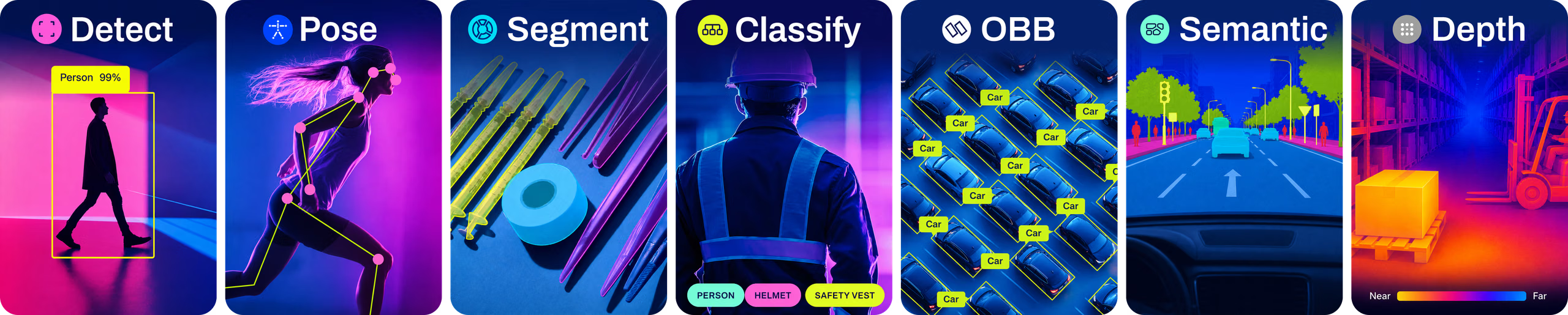
Ultralytics YOLO26は、複数のコンピュータービジョンタスクをサポートします。検出、セグメンテーション、セマンティックセグメンテーション、深度推定、分類、姿勢推定、OBBが含まれます。各タスクには異なる目的とユースケースがあるため、単一のフレームワークで幅広いコンピュータービジョンの問題に対応できます。
YOLO27の今後のサポートについては、YOLO27プレビューをご覧ください。YOLO27は近日公開予定で、現在はまだ利用できません。このガイドではリリース済みのYOLO26モデルを使用します。
視聴する: Ultralytics YOLO26のタスクを紹介します:物体検出、インスタンスセグメンテーション、セマンティックセグメンテーション、深度推定、分類、姿勢推定、OBB。
検出#
YOLO26がサポートする主要なタスクは物体検出です。画像または動画フレーム内のオブジェクトを識別し、その周囲にバウンディングボックスを描画します。検出したオブジェクトは、特徴に基づいてさまざまなカテゴリに分類されます。YOLO26は、単一の画像または動画フレーム内の複数のオブジェクトを、監視システムや自動運転車などのリアルタイムアプリケーションに十分な速度で検出します。
インスタンスセグメンテーション#
インスタンスセグメンテーションは、各オブジェクトのピクセル単位のマスクを生成することで、物体検出をさらに発展させたものです。この精度は、医療画像、農業分析、製造品質管理などのアプリケーションで役立ちます。
セマンティックセグメンテーション#
セマンティックセグメンテーションは、画像内のすべてのピクセルにクラスラベルを割り当て、シーン全体を表す高密度なクラスマップを生成します。インスタンスセグメンテーションとは異なり、同じクラスに属する個々のオブジェクトを区別しません。そのため、個々のオブジェクトの識別よりも空間全体の把握が重要な自動運転、シーン解析、土地被覆マッピングに適しています。
深度推定#
単眼深度推定では、単一のRGB画像からピクセルごとの深度マップをメートル単位で予測します。出力は入力画像に位置合わせされた高密度な浮動小数点マップであり、単一カメラから空間配置を推定する必要がある3Dシーン再構成、ロボットナビゲーション、AR/VRアプリケーションに適しています。
分類#
画像分類では、画像全体を内容に基づいてカテゴリ分けします。ECサイトの商品分類、コンテンツモデレーション、野生動物のモニタリングなどのアプリケーションで役立ちます。
姿勢推定#
姿勢推定では、画像や動画フレーム内の特定のキーポイントを検出し、動きを追跡したり姿勢を推定したりします。キーポイントは、人間の関節、顔の特徴、その他の重要な関心点を表します。YOLO26の姿勢モデルはキーポイントをリアルタイムで検出するため、フィットネスアプリケーション、スポーツ分析、ヒューマンコンピューターインタラクションに役立ちます。
OBB#
Oriented Bounding Box(OBB)検出では、従来の物体検出に向きの角度を加え、回転したオブジェクトの位置をより正確に特定します。この機能は、オブジェクトがさまざまな角度で現れる航空画像解析、文書処理、産業用途で特に役立ちます。YOLO26 OBBモデルは、DOTAv1航空画像データセットで事前学習されています。
次のステップ#
タスクを選びましたか?Datasets guideに従ってデータをフォーマットし、独自の画像でトレーニングしてください。
よくある質問#
Ultralytics YOLO26は、次のコンピュータービジョンタスクをサポートします。
- 物体検出: 画像や動画フレーム内の物体を特定し、その周囲にバウンディングボックスを描画して位置を特定します。
- インスタンスセグメンテーション: 検出した各物体に対してピクセル単位のマスクを生成します。医用画像処理などの用途に役立ちます。
- セマンティックセグメンテーション: 画像内のすべてのピクセルにクラスラベルを割り当て、シーンを高密度に理解します。
- 深度推定: 1枚のRGB画像から、ピクセルごとの深度マップをメートル単位で予測します。
- 分類: 画像の内容に基づいて、画像全体を分類します。
- 姿勢推定: 画像や動画フレーム内の特定のキーポイントを検出し、動きや姿勢を追跡します。
- 方向付き物体検出(OBB): 向きの角度を追加して回転した物体を検出し、精度を高めます。
物体検出にUltralytics YOLO26を使用するには、次の手順に従ってください。
- データセットを適切なフォーマットで準備します。
- 検出タスクを使用してYOLO26モデルをトレーニングします。
- 新しい画像や動画フレームを入力し、モデルを使って予測します。
例from ultralytics import YOLO # 事前学習済みYOLOモデルを読み込みます(必要に応じてモデルタイプを調整してください) model = YOLO("yolo26n.pt") # n、s、m、l、xの各バージョンを利用できます # 画像で物体検出を実行する results = model.predict(source="image.jpg") # 動画、ディレクトリ、URLなども使用できます # 結果を表示します results[0].show() # 最初の画像の結果を表示します詳しい手順については、検出の例をご覧ください。
セグメンテーションタスクにYOLO26を使用すると、次のようなメリットがあります。
- 高精度: セグメンテーションタスクでは、ピクセル単位の精密なマスクを生成できます。
- 速度: YOLO26はリアルタイムアプリケーション向けに最適化されており、高解像度画像でも高速に処理できます。
- 幅広い用途: 医用画像処理、自動運転、詳細な画像セグメンテーションが必要なその他の用途に最適です。
セグメンテーションにおけるYOLO26のメリットとユースケースについては、画像セグメンテーションのセクションをご覧ください。
はい。YOLO26の姿勢モデルは、画像や動画フレーム内の人間の関節などのキーポイントを検出し、それらをつないで姿勢を表します。スポーツ分析、医療、ヒューマンコンピューターインタラクションのアプリケーションで動きを追跡する際に役立ちます。
詳しい情報や実装のヒントについては、姿勢推定の例をご覧ください。
YOLO26によるOriented Object Detection(OBB)では、各ボックスに追加の角度パラメーターを予測するため、回転したオブジェクトを軸に沿ったボックスよりも正確に位置特定できます。航空画像解析や倉庫の自動化など、回転したオブジェクトを正確に位置特定する必要があるアプリケーションで有効です。
- よりタイトなボックス: 回転ボックスは背景の含まれる範囲が小さいため、密集したオブジェクトや斜めのオブジェクトを分離しやすくなります。
- 幅広い用途: 地理空間解析、ロボティクスなどのタスクに役立ちます。
詳しい情報や例については、方向付き物体検出のセクションをご覧ください。


コメント15
質問したり、結果を共有したり、ほかの人をサポートしたりできます。
adhinajay
I quantized a YOLOv8 model. Now I want to fine tune it, so how can I convert the ONNX file back to a .pt file?
DukeZacharia
Yes, you can utilize Explainable AI (XAI) with YOLOv9 or YOLOv11,
even though these versions are unofficial or experimental extensions beyond YOLOv8.
YOLO is fundamentally a convolutional neural network (CNN),
which means that many XAI techniques applicable to CNNs or object detection models can be adapted for use with these versions.
On Thu, 12 Jun 2025 at 17:27, Md Saimul Haque Shanto < @.***> wrote:
Can I use XAI with YOLOv11 or YOLOv9 ? If so, how can I apply it to an object detection task?
— Reply to this email directly, view it on GitHub https://github.com/orgs/ultralytics/discussions/16241#discussioncomment-13443327, or unsubscribe https://github.com/notifications/unsubscribe-auth/AGZSZVZYSGD2CDV75M5O7KD3DE2XNAVCNFSM6AAAAABOCSRMJGVHI2DSMVQWIX3LMV43URDJONRXK43TNFXW4Q3PNVWWK3TUHMYTGNBUGMZTENY . You are receiving this because you were mentioned.Message ID: @.*** com>
Saimul-Shanto
Can I use XAI with YOLOv11 or YOLOv9 ? If so, how can I apply it to an object detection task?
AashishThakur1321
how can I provide different object ids in videos to same types of objects like there are 5 persons in a video frame, then how to provide different ids to these persons such that it tracks these objects with same id throughout the videos
 Glenn JocherUltralytics(編集済み)
@AashishThakur1321 to track multiple persons with unique IDs in videos using YOLO, utilize the built-in tracking mode with
tracker=botsort.yamlortracker=bytetrack.yamlconfiguration. Example CLI command:
yolo track model=yolo26n.pt source=video.mp4
This automatically assigns unique IDs to each person and maintains them across frames. For customization, see our tracking documentation.
Good, Afternoon, does Yolo work for Human Action Detection in realtime?
- Glenn JocherUltralytics
@DukeZacharia good afternoon! YOLO can be used for real-time human action detection through pose estimation. For more details, please explore the pose estimation section in the Ultralytics documentation.
1
NasserAlqeifi
Hi there! Could anyone point me to the papers for YOLOv8 and YOLOv11 Instance Segmentation? Thank you!
- Glenn JocherUltralytics(編集済み)
@NasserAlqeifi hello! Ultralytics has not published formal research papers for YOLOv8 and YOLO11. YOLO26 does have a paper, see the YOLO26 docs. For detailed information on segmentation, please refer to the Ultralytics documentation. If you have further questions, feel free to ask!
1 Hi @glenn-jocher ,
Thank you for the information! I'm a master's student currently using the YOLOv8 Instance Segmentation model for my thesis. I've also tried using YOLOv11 and noticed that the documentation mentions it utilizes a variant of the U-Net architecture for segmentation.
I would love to know more about how segmentation and object detection work in YOLOv11, as well as the key differences between YOLOv8 and YOLOv11 in these tasks. Any additional insights would be greatly appreciated!
Thank you!
- Glenn JocherUltralytics(編集済み)
Thank you for your interest! Instance segmentation in YOLOv8 and YOLO11 is not based on U-Net. It uses the YOLO detection head with an additional prototype-mask branch that produces the masks. For more details, please refer to the segmentation docs; for new projects we recommend YOLO26.
hrbjoern
Would be nice to have examples for tracking, too ...
- Glenn JocherUltralytics
@hrbjoern thank you for your suggestion! We currently have tracking examples in our documentation. You can explore them for more insights on implementing tracking with YOLOv8.
OK, thanks. I just figured that since it's mentioned in the beginning of the page (photo), it should also be explained ...
- Glenn JocherUltralytics
Yes sorry for the confusion. We've placed the Tracking docs under Modes rather than Tasks here: https://docs.ultralytics.com/modes/track/
1