Расчёт расстояния с помощью Ultralytics YOLO26
Что такое расчёт расстояния?#
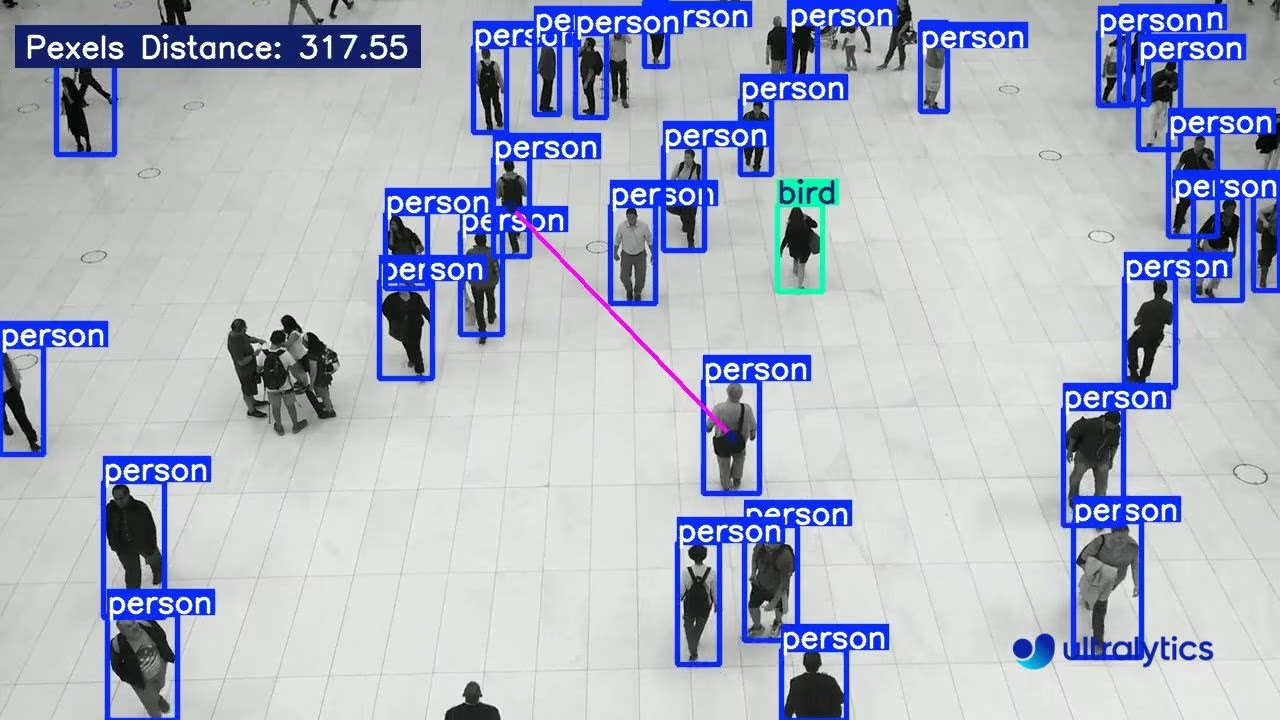
Расчёт расстояния — это процесс измерения расстояния между двумя обнаруженными объектами на изображении или в кадре видео. Решение на базе Ultralytics YOLO26 измеряет расстояние между центроидами двух ограничивающих рамок, выбранных пользователем.
Смотри: Как оценивать расстояние между обнаруженными объектами в пикселях с помощью Ultralytics YOLO 🚀
Иллюстрации#
| Расчёт расстояния с помощью Ultralytics YOLO26 |
|---|
 |
Преимущества расчёта расстояния#
- Точность локализации: повышает точность пространственного позиционирования в задачах компьютерного зрения.
- Оценка размера: позволяет оценивать размер объектов для лучшего понимания контекста.
- Понимание сцены: улучшает понимание трёхмерной сцены и помогает принимать более обоснованные решения в таких приложениях, как автономные транспортные средства и системы видеонаблюдения.
- Предотвращение столкновений: позволяет системам выявлять возможные столкновения, отслеживая расстояния между движущимися объектами.
- Пространственный анализ: помогает анализировать взаимосвязи и взаимодействия объектов в наблюдаемой среде.
Расчёт расстояния
- Щёлкни левой кнопкой мыши по любым двум ограничивающим рамкам, чтобы рассчитать расстояние.
- Щёлкни правой кнопкой мыши, чтобы удалить все нарисованные точки.
Расстояние является приблизительным
Расстояние является оценочным и может быть неточным, поскольку рассчитывается по 2D-данным, в которых отсутствует информация о глубине. Чтобы оценить глубину для каждого пикселя, используй модель оценки глубины.
Расчёт расстояний с помощью YOLO26#
Решение DistanceCalculation отслеживает объекты между кадрами и измеряет евклидово расстояние в пикселях между центрами любых двух ограничивающих рамок, выбранных тобой мышью. Запусти пример ниже, затем щёлкни левой кнопкой мыши по двум объектам, чтобы провести соединительную линию и увидеть расстояние; щёлкни правой кнопкой, чтобы сбросить выбор.
import cv2

from ultralytics import solutions

cap = cv2.VideoCapture("path/to/video.mp4")
assert cap.isOpened(), "Error reading video file"

# Запись видео
w, h, fps = (int(cap.get(x)) for x in (cv2.CAP_PROP_FRAME_WIDTH, cv2.CAP_PROP_FRAME_HEIGHT, cv2.CAP_PROP_FPS))
video_writer = cv2.VideoWriter("distance_output.avi", cv2.VideoWriter_fourcc(*"mp4v"), fps, (w, h))

# Инициализация объекта расчёта расстояния
distancecalculator = solutions.DistanceCalculation(
    model="yolo26n.pt",  # путь к файлу модели YOLO26.
    show=True,  # отобразить результат
)

# Обработка видео
while cap.isOpened():
    success, im0 = cap.read()

    if not success:
        print("Video frame is empty or processing is complete.")
        break

    results = distancecalculator(im0)

    print(results)  # доступ к результату

    video_writer.write(results.plot_im)  # запись обработанного кадра.

cap.release()
video_writer.release()
cv2.destroyAllWindows()  # закрытие всех открытых окон
Аргументы DistanceCalculation()#
Вот таблица с аргументами DistanceCalculation:
| Аргумент | Тип | По умолчанию | Описание |
|---|---|---|---|
model | str | None | Путь к файлу модели Ultralytics YOLO. |
line_width | int | 2 | Толщина линий рамок, ключевых точек и счётчиков, которые рисует решение. |
verbose | bool | True | Включает журнал решения для каждого кадра с указанием формы входных данных, количества объектов по классам и скорости обработки. Сам вызов отслеживания всегда выполняется без вывода сообщений. |
В решении DistanceCalculation также можно использовать аргументы track.
| Аргумент | Тип | По умолчанию | Описание |
|---|---|---|---|
tracker | str | 'tracktrack.yaml' | Задаёт алгоритм отслеживания. Встроенные варианты: botsort.yaml, bytetrack.yaml, ocsort.yaml, deepocsort.yaml, fasttrack.yaml, tracktrack.yaml. |
conf | float | 0.25 | Задаёт порог уверенности для обнаружений: при более низких значениях можно отслеживать больше объектов, но возрастает вероятность ложноположительных срабатываний. |
iou | float | 0.5 | Задаёт порог пересечения над объединением (IoU) для фильтрации перекрывающихся обнаружений. |
classes | list | None | Фильтрует результаты по индексу класса. Например, classes=[0, 2, 3] отслеживает только указанные классы. |
device | str | None | Задаёт устройство для инференса (например, cpu, cuda:0 или 0). Позволяет выбрать CPU, определённый GPU или другое вычислительное устройство для выполнения модели. |
imgsz | int or tuple | 640 | Целевой размер изображения для инференса: целое число для квадратного изображения или пара (height, width). Размеры корректируются с учётом шага модели. |
max_det | int | 300 | Максимальное количество обнаружений, сохраняемых в каждом кадре перед отслеживанием; ограничивает число объектов, обрабатываемых решением в насыщенных сценах. |
quantize | int or str | None | Точность инференса: 16 (FP16) или 32/unset (FP32) для моделей PyTorch и TorchScript не на CPU; для других форматов точность определяется артефактом модели и средой выполнения. Заменяет устаревший аргумент half. |
Кроме того, доступны следующие аргументы визуализации:
| Аргумент | Тип | По умолчанию | Описание |
|---|---|---|---|
show | bool | False | Если True, показывает аннотированные изображения или видео в окне. Полезно для мгновенной визуальной проверки во время разработки или тестирования. |
show_conf | bool | True | Показывает оценку уверенности каждой детекции рядом с меткой. Позволяет оценить уверенность модели в каждой детекции. |
show_labels | bool | True | Показывает метки каждой детекции на визуализации. Помогает сразу понять, какие объекты обнаружены. |
Подробности реализации#
Класс DistanceCalculation отслеживает объекты между видеокадрами и рассчитывает евклидово расстояние между центрами выбранных ограничивающих рамок. Когда ты щёлкаешь по двум объектам, решение:
- Извлекает центры выбранных ограничивающих рамок
- Рассчитывает евклидово расстояние между этими центрами в пикселях
- Отображает расстояние на кадре и соединяет объекты линией
В реализации используется метод mouse_event_for_distance для обработки действий мышью: пользователь может выбирать объекты и при необходимости сбрасывать выбор. Метод process обрабатывает кадры по очереди, отслеживает объекты и рассчитывает расстояния.
Применение#
Расчёт расстояния с помощью YOLO26 находит множество практических применений:
- Аналитика розничной торговли: измерение близости покупателей к товарам и анализ эффективности планировки магазина
- Промышленная безопасность: контроль безопасного расстояния между работниками и оборудованием
- Управление дорожным движением: анализ интервалов между транспортными средствами и выявление опасного сближения
- Спортивная аналитика: расчёт расстояния между игроками, мячом и ключевыми точками поля
- Здравоохранение: обеспечение необходимой дистанции в зонах ожидания и отслеживание перемещения пациентов
- Робототехника: помощь роботам в поддержании безопасного расстояния до препятствий и людей
Часто задаваемые вопросы#
Чтобы рассчитать расстояние между объектами с помощью Ultralytics YOLO26, нужно определить центры ограничивающих рамок обнаруженных объектов. Для этого инициализируй класс
DistanceCalculationиз модуляsolutionsUltralytics и используй результаты отслеживания модели для расчёта расстояний.Расчёт расстояния с помощью Ultralytics YOLO26 даёт несколько преимуществ:
- Точность локализации: обеспечивает точное пространственное позиционирование объектов.
- Оценка размера: помогает оценивать физические размеры объектов и лучше понимать контекст.
- Понимание сцены: улучшает понимание трёхмерной сцены и помогает принимать более обоснованные решения в таких приложениях, как автономное вождение и видеонаблюдение.
- Обработка в реальном времени: выполняет расчёты на лету и подходит для анализа видео в реальном времени.
- Возможности интеграции: работает с другими решениями YOLO26, такими как отслеживание объектов и оценка скорости.
Да, с помощью Ultralytics YOLO26 можно рассчитывать расстояние в видеопотоках в реальном времени. Для этого нужно захватывать видеокадры с помощью OpenCV, запускать обнаружение объектов с YOLO26 и использовать класс
DistanceCalculationдля расчёта расстояний между объектами в последовательных кадрах. Подробный пример реализации см. в примере обработки видеопотока.Чтобы удалить точки, нарисованные при расчёте расстояния с помощью Ultralytics YOLO26, щёлкни правой кнопкой мыши. Так ты удалишь все нарисованные точки. Подробнее см. в примечании к примеру расчёта расстояния.
К основным аргументам для инициализации класса
DistanceCalculationв Ultralytics YOLO26 относятся:model: путь к файлу модели YOLO26.tracker: алгоритм отслеживания (по умолчанию в решениях используетсяtracktrack.yaml).conf: порог уверенности для обнаружений.show: флаг отображения результата.
Полный список аргументов и их значений по умолчанию см. в описании аргументов DistanceCalculation.


Комментарии195
Задай вопрос, поделись результатами или помоги кому-нибудь.
muhammadwildangoni
hallo, I am processing a men's 100 meter sprint video using YOLO and SpeedEstimator (Ultralytics) to detect runners, estimate their speed, and track their progress. However, the output statistics are incorrect. My code detects 16 runners, while there should only be 8 (those on the track), and the maximum speed reported is 0.00 m/s, which is clearly not correct for a sprint race. The furthest distance covered is about 96.7 meters, which seems off.
import cv2 import math import numpy as np from ultralytics import YOLO from ultralytics.solutions import speed_estimation
--- SETTINGS ---
video_path = "WHAT A RACE! _ Men s 100m Final! _ #Paris2024 highlights (online-video-cutter.com).mp4" # Change to your video path model_path = "yolo11n.pt" # Path to your YOLO model (could be yolov11n.pt if available) output_path = "output_sprint.avi" # Output video file name
meter_per_pixel = 0.05 # Calibration result for track (e.g., 0.05 for a 100m lane) center_point = (0, 720) # Track start point (adjust to your video height)
--- INITIALIZATION ---
cap = cv2.VideoCapture(video_path) assert cap.isOpened(), "Error reading video file"
w, h, fps = (int(cap.get(x)) for x in (cv2.CAP_PROP_FRAME_WIDTH, cv2.CAP_PROP_FRAME_HEIGHT, cv2.CAP_PROP_FPS)) out = cv2.VideoWriter(output_path, cv2.VideoWriter_fourcc(*"MJPG"), fps, (w, h))
model = YOLO(model_path) names = model.model.names if hasattr(model.model, "names") else ["person"]
speed_obj = speed_estimation.SpeedEstimator( names=names, reg_pts=[(0, int(h/2)), (w, int(h/2))], # Speed estimation line (across track, adjust as needed) view_img=False, meter_per_pixel=meter_per_pixel # Convert pixel to meters )
frame_count = 0 speed_over_time, distance_over_time = {}, {}
while cap.isOpened(): success, frame = cap.read() if not success: break frame_count += 1
# Detect and track runners on each frame
tracks = model.track(frame, persist=True, show=False)

# Estimate runners' speed and update visualization on frame
frame = speed_obj.estimate_speed(frame)

# Extract runner IDs, position, speed, and distance
# Make sure .boxes.id/cls property exists:
if tracks and hasattr(tracks[0], "boxes") and tracks[0].boxes.id is not None:
    boxes = tracks[0].boxes.xyxy.cpu()
    track_ids = tracks[0].boxes.id.int().cpu().tolist()
    clss = tracks[0].boxes.cls.cpu().tolist()
    for box, track_id, cls in zip(boxes, track_ids, clss):
        if cls == 0:  # 'person' class (runners)
            # Calculate runner's distance from start
            x1, y1 = int((box[0] + box[2]) // 2), int((box[1] + box[3]) // 2)
            distance = (math.sqrt((x1 - center_point[0]) ** 2 + (y1 - center_point[1]) ** 2)) * meter_per_pixel

            # Store statistics in dictionary
            if track_id not in distance_over_time:
                distance_over_time[track_id] = [0] * (frame_count - 1)
            distance_over_time[track_id].append(distance)

            speed = speed_obj.speeds.get(track_id, 0) if hasattr(speed_obj, "speeds") else 0
            if track_id not in speed_over_time:
                speed_over_time[track_id] = [0] * (frame_count - 1)
            speed_over_time[track_id].append(speed)

            # Overlay runner's speed and distance information directly on video frame
            text_speed = f"Speed: {speed:.2f} m/s"
            text_dist = f"Distance: {distance:.2f} m"
            cv2.putText(frame, f"ID:{track_id} {text_speed}, {text_dist}", (x1, y1 - 10),
                        cv2.FONT_HERSHEY_SIMPLEX, 0.8, (0,255,0), 2)

# Save frame to output video
out.write(frame)

# Display real-time video preview
cv2.imshow("Sprint Runner Detection Preview", frame)
if cv2.waitKey(1) & 0xFF == ord("q"):
    break
cap.release() out.release() cv2.destroyAllWindows()
--- Final statistics: print results to terminal ---
best_speed = max((max(speeds) for speeds in speed_over_time.values()), default=0) best_distance = max((max(distances) for distances in distance_over_time.values()), default=0) total_runners = len(distance_over_time)
print(f"Total runners detected: {total_runners}") print(f"Highest speed: {best_speed:.2f} m/s") print(f"Furthest distance covered: {best_distance:.2f} meters")
maribalke(изменено)
Hi! I have tried to do a test on the distance calculation on a single image, but I keep getting the attribute error: 'DistanceCalculation' object has no attribute 'start_process'. I have basis in the YOLO11n-model, further trained on images from a different dataset.
model_path = "../runs/detect/train2/weights/best.pt" model = YOLO(model_path) dist_obj = distance_calculation.DistanceCalculation() frame = cv2.imread("../images/s73/raw_images/10.jpg") # Detect objects results = model(frame) # Run object tracking tracks = model.track(frame, persist=True, show = False) # process the image image_with_distances = dist_obj.start_process(frame, tracks) # Display the frame cv2.imshow('Distance Calculation', image_with_distances) cv2.waitKey(0) cv2.destroyAllWindows() Glenn JocherUltralytics(изменено)
@maribalke thanks for reaching out!
start_process()has been removed.DistanceCalculationis now called directly on the frame and returns a results object with the annotated image inplot_im. It also runs tracking itself, so no separatemodel.track()call is needed. Here's the minimal fix for your single-image case:dist_obj = solutions.DistanceCalculation(model=model_path, show=False) results = dist_obj(frame) cv2.imshow("Distance Calculation", results.plot_im)Note that the distance is measured between two objects you select by clicking them in a display window, so a single static image only shows a distance once two boxes have been selected. For full implementation details, see our Distance Calculation Guide. Let us know if you encounter any other issues!
dgnovo
Is it possible to know the distance from an object and another object without using mouse?
- Glenn JocherUltralytics
@dgnovo yes, it's possible. You can calculate distances programmatically by using bounding box centroids from YOLO11 detections and computing the Euclidean distance between them without relying on mouse clicks. Refer to the
DistanceCalculationimplementation to customize the process for your needs: https://docs.ultralytics.com/guides/distance-calculation/.1
Muhammad-237
How can we find the distance of in the bounding box like from one point to another point in the bounding box to measure the size of object
- Glenn JocherUltralytics
@Muhammad-237 to measure the size of an object within a bounding box using Ultralytics YOLO11, you can calculate the distance between two points (e.g., edges or centroid) within that bounding box. This can be achieved using the
DistanceCalculationclass, which allows you to click on specific points to measure distances. Keep in mind, these calculations are approximations as they rely on 2D data without depth information. For more details, refer to the Distance Calculation Docs.
gg120wolf
Hi, I am using the example code of Distance Calculation using YOLO11 Example, but there is a problem of File "f:\fyp yolo\ultralytics-main\distance test1.py", line 13, in distance = solutions.DistanceCalculation() ^^^^^^^^^^^^^^^^^^^^^^^^^^^^^^^ TypeError: DistanceCalculation.init() missing 1 required positional argument: 'names' So what is this names should i set?
RizwanMunawar
@gg120wolf Hi, the correct way to use the Ultralytics distance calculation module is mentioned below.
import cv2

from ultralytics import solutions

cap = cv2.VideoCapture("Path/to/video/file.mp4")
assert cap.isOpened(), "Error reading video file"
w, h, fps = (int(cap.get(x)) for x in (cv2.CAP_PROP_FRAME_WIDTH, cv2.CAP_PROP_FRAME_HEIGHT, cv2.CAP_PROP_FPS))

# Video writer
video_writer = cv2.VideoWriter("distance_calculation.avi", cv2.VideoWriter_fourcc(*"mp4v"), fps, (w, h))

# Init distance-calculation obj
distance = solutions.DistanceCalculation(model="yolo11n.pt", show=True)

# Process video
while cap.isOpened():
    success, im0 = cap.read()
    if not success:
        print("Video frame is empty or video processing has been successfully completed.")
        break
    im0 = distance.calculate(im0)
    video_writer.write(im0)

cap.release()
video_writer.release()
cv2.destroyAllWindows()
Thanks :) The Ultralytics Team!
tylerfrisinger01
Hey there, I have a model that is trained for object detection not tracking. We are detecting two animals that are inside a cage. What we want to do is import a mp4 video then calculate the distance between the two objects while also showing the bounding boxes. However when i use the VideoStream code snippet from above, the popup window is larger then my screen. How could i adjust that code to make it a different window size so that I am able to track them in real time.
Also after this is done and the distances are calculated is there anyway to save the whole video with the bounding boxes and the distance calculations that were done in real time? Or would I have to save the video by doing the results = model.predict(save=true) and also do the VideoStream code snippet from above at the same time? and not have the distances shown in the saved video?
Get back to me as soon as possible as this is for a project for school! Thank You!!
I am also using YOLOv11, i'm not sure if that will change anything or not. And i have tried creating my own window using cv2 but that didnt work when i attempted it.
- Glenn JocherUltralytics
@tylerfrisinger01 to adjust the window size in OpenCV, you can use
cv2.namedWindow()andcv2.resizeWindow()to set a custom size. For saving the video with bounding boxes and distances, you can modify the code to include distance annotations and usecv2.VideoWriterto save the processed frames. Here's a quick example on resizing the window:cv2.namedWindow('Video', cv2.WINDOW_NORMAL) cv2.resizeWindow('Video', 800, 600) # Adjust the dimensions as neededRegarding saving the video with distances, you can overlay the distance on the frames before writing them out with
cv2.VideoWriter. If you need further assistance, feel free to ask! @glenn-jocher when I do this, it still pops open its own window that I am assuming is built into the solutions.DistanceCalculator function (since that is the name of the window) So then it does not work. Any workaround for this?
- Glenn JocherUltralytics(изменено)
@tylerfrisinger01 to prevent the
DistanceCalculationfunction from opening its own window, you can set theshowparameter toFalsewhen initializing it, like so:distance = solutions.DistanceCalculation(model="yolo26n.pt", show=False). This should stop the automatic display window. For saving the video, continue usingcv2.VideoWriter. Let me know if you need further assistance!
Abtinz
Hello everyone, I want to deploy an yolov8-application on the edge device and estimate the distance through the user's camera without having to click on the detected object, how can I find the distance of the objects to the camera without need to click?
- Glenn JocherUltralytics
@Abtinz to estimate object distances without clicking, you'll need to use depth estimation techniques, as YOLOv8 primarily provides 2D bounding boxes. Consider integrating depth sensors or stereo cameras to obtain depth information. For more details, you can refer to the distance calculation guide.
gaodaren47297
Hi,Is there a method to calculate the distance between the camera and the objects?
- Glenn JocherUltralytics(изменено)
@gaodaren47297 the
DistanceCalculationsolution measures the pixel distance between the centroids of two objects you select in the frame; it does not estimate the distance between the camera and an object. A 2D bounding box has no depth information, so camera-to-object distance needs extra information such as a depth sensor or stereo camera, or a calibration using an object of known size. For measuring between objects, see the distance calculation documentation on our website. If you have further questions, feel free to ask here.
Dmitrii-Smirnov
Hi Guys, Guys, I have a video with multiple objects(people) on the video. I need to calculate distance between each detected person on the each frame and to save results to csv file. Can you help me with that task? It will be really cool if you will share documentation=) As I understood relevant method for my task is DistanceCalculation(names=names[0], view_img=True).calculate_distance(obj1, obj2), am I correct?
- Glenn JocherUltralytics(изменено)
@Dmitrii-Smirnov there is no
calculate_distance(obj1, obj2)method onDistanceCalculationin current versions. The solution is called on each frame (results = dist_obj(im0)), you left-click two tracked objects, and it reports the pixel distance inresults.pixels_distance. For distances between every pair of people on each frame and a CSV export, compute the centroid distances from the tracking boxes yourself. For details, see our documentation: https://docs.ultralytics.com/guides/distance-calculation/. Thank you!
- Glenn JocherUltralytics(изменено)
@Dmitrii-Smirnov to calculate distances between all detected people in each frame and save the results to a CSV file, compute the centroid distances from the tracking results. The
DistanceCalculationsolution only measures between two objects you click, so for all pairs here's a basic implementation:import csv import math from itertools import combinations import cv2 from ultralytics import YOLO model = YOLO("yolo26n.pt") cap = cv2.VideoCapture("path/to/video/file.mp4") assert cap.isOpened(), "Error reading video file" with open("distances.csv", mode="w", newline="") as file: writer = csv.writer(file) writer.writerow(["Frame", "Object1", "Object2", "Distance"]) frame_count = 0 while cap.isOpened(): success, im0 = cap.read() if not success: break results = model.track(im0, persist=True, show=False, classes=[0]) # class 0 = person boxes = results[0].boxes if boxes.id is not None: centroids = dict(zip(boxes.id.int().tolist(), boxes.xywh[:, :2].tolist())) for (id1, c1), (id2, c2) in combinations(centroids.items(), 2): writer.writerow([frame_count, id1, id2, math.dist(c1, c2)]) frame_count += 1 cap.release()This script captures video frames, calculates pixel distances between detected people, and writes the results to a CSV file. For more details, refer to our documentation: https://docs.ultralytics.com/guides/distance-calculation/.
zgr1446741194
Hello author, I would like to propose a scenario similar to this: using monocular distance measurement to calculate the distance from the distant water level line (similar to the shoreline) in the video stream obtained by the camera to my camera (a kind of early warning of the water level), how can I use the solution? At present, the difficulty can be determined that we need to complete distance conversion similar to 3D to 2D, because of perspective space, instead of using fixed linear distance conversion similar to visionEye (from pixels to realistic distance). Another difficulty is that we do not know the true physical properties of the observed water line, which means that we cannot use the traditional method of monocular distance measurement to deduce the distance from the true length or height of the observed object. If you have any viable solutions, thank you very much for adding the code demo in your reply.
- Glenn JocherUltralytics
For calculating distances to a waterline using monocular vision, consider using depth estimation techniques or stereo vision for more accurate results. YOLO models can assist in object detection, but for precise distance measurement, integrating additional sensors or methods might be necessary. For more details, please refer to our distance calculation guide.