حساب المسافة باستخدام Ultralytics YOLO26
ما حساب المسافة؟#
حساب المسافة هو عملية قياس المسافة الفاصلة بين كائنين مكتشفين داخل صورة أو إطار فيديو. ويقيس الحل باستخدام Ultralytics YOLO26 المسافة بين مركزي مربعي الإحاطة اللذين يحددهما المستخدم.
شاهد: كيفية تقدير المسافة بين الكائنات المكتشفة باستخدام Ultralytics YOLO بالبكسل 🚀
المرئيات#
| حساب المسافة باستخدام Ultralytics YOLO26 |
|---|
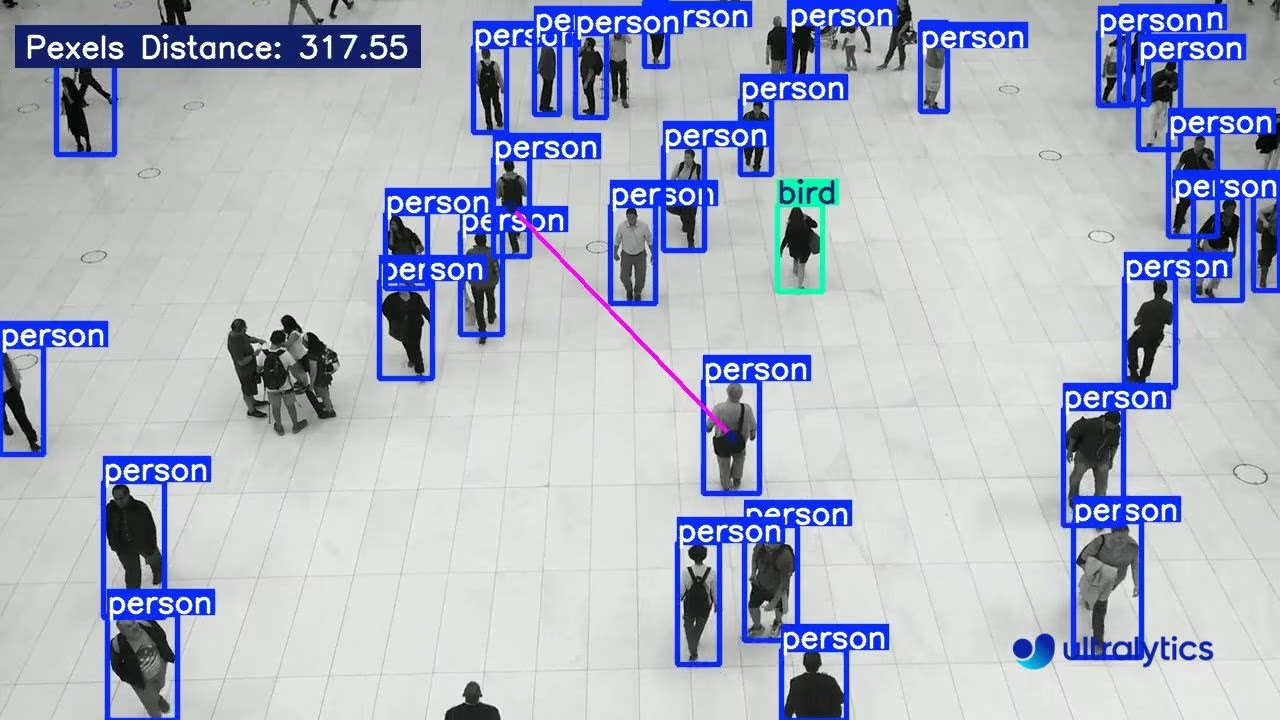 |
مزايا حساب المسافة#
- دقة تحديد الموقع: تعزز دقة تحديد المواقع المكانية في مهام الرؤية الحاسوبية.
- تقدير الحجم: يتيح تقدير حجم الكائن لفهم السياق على نحو أفضل.
- فهم المشهد: يحسّن استيعاب المشاهد ثلاثية الأبعاد لاتخاذ قرارات أفضل في تطبيقات مثل المركبات ذاتية القيادة وأنظمة المراقبة.
- تجنّب الاصطدام: يتيح للأنظمة اكتشاف احتمالات الاصطدام من خلال مراقبة المسافات بين الكائنات المتحركة.
- التحليل المكاني: يسهّل تحليل العلاقات والتفاعلات بين الكائنات داخل البيئة الخاضعة للمراقبة.
حساب المسافة
- انقر بزر الفأرة الأيسر على مربعي إحاطة لحساب المسافة.
- استخدم زر الفأرة الأيمن لحذف جميع النقاط المرسومة.
المسافة تقديرية
المسافة تقديرية وقد لا تكون دقيقة تمامًا لأنها تُحسب باستخدام بيانات ثنائية الأبعاد تفتقر إلى معلومات العمق. للحصول على العمق لكل بكسل، استخدم نموذج تقدير العمق.
حساب المسافات باستخدام YOLO26#
يتتبّع الحل DistanceCalculation الكائنات عبر الإطارات ويقيس المسافة الإقليدية، بوحدة البكسل، بين مركزي أي مربعي إحاطة تحددهما بالفأرة. شغّل المثال أدناه، ثم انقر بزر الفأرة الأيسر على كائنين لرسم الخط الواصل بينهما وقراءة المسافة؛ وانقر بزر الفأرة الأيمن لمسح التحديد.
import cv2
from ultralytics import solutions
cap = cv2.VideoCapture("path/to/video.mp4")
assert cap.isOpened(), "Error reading video file"
# كاتب الفيديو
w, h, fps = (int(cap.get(x)) for x in (cv2.CAP_PROP_FRAME_WIDTH, cv2.CAP_PROP_FRAME_HEIGHT, cv2.CAP_PROP_FPS))
video_writer = cv2.VideoWriter("distance_output.avi", cv2.VideoWriter_fourcc(*"mp4v"), fps, (w, h))
# تهيئة كائن حساب المسافة
distancecalculator = solutions.DistanceCalculation(
model="yolo26n.pt", # مسار ملف نموذج YOLO26.
show=True, # # اعرض الناتج
)
# معالجة الفيديو
while cap.isOpened():
success, im0 = cap.read()
if not success:
print("Video frame is empty or processing is complete.")
break
results = distancecalculator(im0)
print(results) # الوصول إلى المخرجات
video_writer.write(results.plot_im) # كتابة الإطار المعالَج.
cap.release()
video_writer.release()
cv2.destroyAllWindows() # إغلاق جميع النوافذ المفتوحةوسيطات DistanceCalculation()#
إليك جدولًا بمعاملات DistanceCalculation:
| المعامل | النوع | الافتراضي | الوصف |
|---|---|---|---|
model | str | None | مسار ملف نموذج Ultralytics YOLO. |
line_width | int | 2 | سماكة الخط للصناديق والنقاط المفتاحية والعدادات التي يرسمها الحل. |
verbose | bool | True | يفعّل سجل الحل لكل إطار، ويشمل شكل المدخل وعدد الفئات وسرعة المعالجة. يظل استدعاء التتبع نفسه صامتًا دائمًا. |
يمكنك أيضًا استخدام الوسائط track في الحل DistanceCalculation.
| المعامل | النوع | الافتراضي | الوصف |
|---|---|---|---|
tracker | str | 'tracktrack.yaml' | يحدد خوارزمية التتبع المطلوب استخدامها. الخيارات المضمنة: botsort.yaml، bytetrack.yaml، ocsort.yaml، deepocsort.yaml، fasttrack.yaml، tracktrack.yaml. |
conf | float | 0.25 | يضبط عتبة الثقة للكشوفات؛ إذ تسمح القيم الأقل بتتبع مزيد من الكائنات، لكنها قد تتضمن إيجابيات كاذبة. |
iou | float | 0.5 | يضبط عتبة التقاطع على الاتحاد (IoU) لتصفية الكشوفات المتداخلة. |
classes | list | None | يصفّي النتائج حسب فهرس الفئة. على سبيل المثال، لا يتتبع classes=[0, 2, 3] إلا الفئات المحددة. |
device | str | None | يحدد الجهاز المستخدم للاستدلال (مثل cpu أو cuda:0 أو 0). ويتيح للمستخدمين الاختيار بين CPU أو GPU محددة أو أجهزة حوسبة أخرى لتنفيذ النموذج. |
imgsz | int or tuple | 640 | حجم صورة الاستدلال المستهدف: عدد صحيح لصورة مربعة، أو زوج (height, width). تُعدّل الأبعاد وفقًا لخطوة النموذج. |
max_det | int | 300 | الحد الأقصى لعدد الكشوفات التي يُحتفظ بها لكل إطار قبل التتبع، ما يحد من عدد الكائنات التي يعالجها الحل في المشاهد الكثيفة. |
quantize | int or str | None | دقة الاستدلال: 16 (FP16) أو 32/unset (FP32) لنماذج PyTorch وTorchScript خارج CPU؛ أما التنسيقات الأخرى فتستخدم الدقة التي يحددها الملف الاصطناعي وبيئة التشغيل. يحل هذا الوسيط محل الوسيطة half المهملة. |
بالإضافة إلى ذلك، تتوفر معاملات التصوّر التالية:
| المعامل | النوع | الافتراضي | الوصف |
|---|---|---|---|
show | bool | False | إذا كان True، يعرض الصور أو مقاطع الفيديو المشروحة في نافذة. يفيد ذلك في الحصول على ملاحظات مرئية فورية أثناء التطوير أو الاختبار. |
show_conf | bool | True | يعرض درجة الثقة لكل اكتشاف بجوار التسمية، ما يوضح مدى يقين النموذج بشأن كل اكتشاف. |
show_labels | bool | True | يعرض تسميات كل اكتشاف في المخرجات المرئية، ما يتيح فهم الكائنات المكتشفة فورًا. |
تفاصيل التنفيذ#
تعمل الفئة DistanceCalculation من خلال تتبّع الكائنات عبر إطارات الفيديو وحساب المسافة الإقليدية بين مراكز مربعات الإحاطة المحددة. عند النقر على كائنين، يقوم الحل بما يلي:
- استخراج مراكز مربعات الإحاطة المحددة (نقاطها المركزية)
- حساب المسافة الإقليدية بين هذه المراكز بالبكسل
- عرض المسافة على الإطار مع خط يصل بين الكائنين
يستخدم التنفيذ الطريقة mouse_event_for_distance للتعامل مع تفاعلات الفأرة، ما يتيح للمستخدمين تحديد الكائنات ومسح التحديدات عند الحاجة. أما الطريقة process فتتولى معالجة الإطارات إطارًا تلو الآخر، وتتبع الكائنات، وحساب المسافات.
التطبيقات#
لحساب المسافة باستخدام YOLO26 تطبيقات عملية عديدة:
- تحليلات البيع بالتجزئة: قياس مدى قرب العملاء من المنتجات وتحليل مدى فعالية تخطيط المتجر
- السلامة الصناعية: مراقبة مسافات الأمان بين العمال والآلات
- إدارة حركة المرور: تحليل التباعد بين المركبات واكتشاف الاقتراب الشديد من المركبة الأمامية
- التحليل الرياضي: حساب المسافات بين اللاعبين والكرة ومواضع الملعب الرئيسية
- الرعاية الصحية: ضمان التباعد المناسب في مناطق الانتظار ومراقبة حركة المرضى
- الروبوتات: تمكين الروبوتات من الحفاظ على مسافات مناسبة عن العوائق والأشخاص
الأسئلة الشائعة#
لحساب المسافات بين الكائنات باستخدام Ultralytics YOLO26، عليك تحديد مراكز مربعات الإحاطة للكائنات المكتشفة. تتضمن هذه العملية تهيئة الفئة
DistanceCalculationمن الوحدةsolutionsفي Ultralytics، واستخدام مخرجات التتبّع الخاصة بالنموذج لحساب المسافات.يوفر حساب المسافة باستخدام Ultralytics YOLO26 عدة مزايا:
- دقة تحديد الموقع: يوفر تموضعًا مكانيًا دقيقًا للكائنات.
- تقدير الحجم: يساعد في تقدير الأحجام الفعلية، مما يسهم في فهم السياق على نحو أفضل.
- فهم المشهد: يعزّز استيعاب المشاهد ثلاثية الأبعاد، مما يساعد على تحسين اتخاذ القرار في تطبيقات مثل القيادة الذاتية والمراقبة.
- المعالجة في الوقت الفعلي: تُجري الحسابات فورًا، ما يجعلها مناسبة لتحليل الفيديو المباشر.
- إمكانات التكامل: تعمل مع حلول YOLO26 الأخرى مثل تتبّع الكائنات وتقدير السرعة.
نعم، يمكنك حساب المسافة في تدفقات الفيديو في الوقت الفعلي باستخدام Ultralytics YOLO26. تتضمن العملية التقاط إطارات الفيديو باستخدام OpenCV، وتشغيل اكتشاف الكائنات باستخدام YOLO26، واستخدام الفئة
DistanceCalculationلحساب المسافات بين الكائنات في الإطارات المتعاقبة. للاطلاع على تنفيذ مفصّل، راجع مثال تدفق الفيديو.لحذف النقاط المرسومة أثناء حساب المسافة باستخدام Ultralytics YOLO26، يمكنك النقر بزر الفأرة الأيمن. سيمسح هذا الإجراء جميع النقاط التي رسمتها. لمزيد من التفاصيل، راجع قسم الملاحظات ضمن مثال حساب المسافة.
تشمل المعاملات الرئيسية لتهيئة الفئة
DistanceCalculationفي Ultralytics YOLO26 ما يلي:model: مسار ملف نموذج YOLO26.tracker: خوارزمية التتبّع المراد استخدامها (تستخدم الحلول افتراضيًاtracktrack.yaml).conf: عتبة الثقة لعمليات الكشف.show: علامة لعرض المخرجات.
للاطلاع على القائمة الكاملة والقيم الافتراضية، راجع معاملات DistanceCalculation.


التعليقات195
اطرح سؤالًا، وشارك نتائجك، أو ساعد شخصًا آخر.
muhammadwildangoni
hallo, I am processing a men's 100 meter sprint video using YOLO and SpeedEstimator (Ultralytics) to detect runners, estimate their speed, and track their progress. However, the output statistics are incorrect. My code detects 16 runners, while there should only be 8 (those on the track), and the maximum speed reported is 0.00 m/s, which is clearly not correct for a sprint race. The furthest distance covered is about 96.7 meters, which seems off.
import cv2 import math import numpy as np from ultralytics import YOLO from ultralytics.solutions import speed_estimation
--- SETTINGS ---
video_path = "WHAT A RACE! _ Men s 100m Final! _ #Paris2024 highlights (online-video-cutter.com).mp4" # Change to your video path model_path = "yolo11n.pt" # Path to your YOLO model (could be yolov11n.pt if available) output_path = "output_sprint.avi" # Output video file name
meter_per_pixel = 0.05 # Calibration result for track (e.g., 0.05 for a 100m lane) center_point = (0, 720) # Track start point (adjust to your video height)
--- INITIALIZATION ---
cap = cv2.VideoCapture(video_path) assert cap.isOpened(), "Error reading video file"
w, h, fps = (int(cap.get(x)) for x in (cv2.CAP_PROP_FRAME_WIDTH, cv2.CAP_PROP_FRAME_HEIGHT, cv2.CAP_PROP_FPS)) out = cv2.VideoWriter(output_path, cv2.VideoWriter_fourcc(*"MJPG"), fps, (w, h))
model = YOLO(model_path) names = model.model.names if hasattr(model.model, "names") else ["person"]
speed_obj = speed_estimation.SpeedEstimator( names=names, reg_pts=[(0, int(h/2)), (w, int(h/2))], # Speed estimation line (across track, adjust as needed) view_img=False, meter_per_pixel=meter_per_pixel # Convert pixel to meters )
frame_count = 0 speed_over_time, distance_over_time = {}, {}
while cap.isOpened(): success, frame = cap.read() if not success: break frame_count += 1
# Detect and track runners on each frame
tracks = model.track(frame, persist=True, show=False)

# Estimate runners' speed and update visualization on frame
frame = speed_obj.estimate_speed(frame)

# Extract runner IDs, position, speed, and distance
# Make sure .boxes.id/cls property exists:
if tracks and hasattr(tracks[0], "boxes") and tracks[0].boxes.id is not None:
    boxes = tracks[0].boxes.xyxy.cpu()
    track_ids = tracks[0].boxes.id.int().cpu().tolist()
    clss = tracks[0].boxes.cls.cpu().tolist()
    for box, track_id, cls in zip(boxes, track_ids, clss):
        if cls == 0:  # 'person' class (runners)
            # Calculate runner's distance from start
            x1, y1 = int((box[0] + box[2]) // 2), int((box[1] + box[3]) // 2)
            distance = (math.sqrt((x1 - center_point[0]) ** 2 + (y1 - center_point[1]) ** 2)) * meter_per_pixel

            # Store statistics in dictionary
            if track_id not in distance_over_time:
                distance_over_time[track_id] = [0] * (frame_count - 1)
            distance_over_time[track_id].append(distance)

            speed = speed_obj.speeds.get(track_id, 0) if hasattr(speed_obj, "speeds") else 0
            if track_id not in speed_over_time:
                speed_over_time[track_id] = [0] * (frame_count - 1)
            speed_over_time[track_id].append(speed)

            # Overlay runner's speed and distance information directly on video frame
            text_speed = f"Speed: {speed:.2f} m/s"
            text_dist = f"Distance: {distance:.2f} m"
            cv2.putText(frame, f"ID:{track_id} {text_speed}, {text_dist}", (x1, y1 - 10),
                        cv2.FONT_HERSHEY_SIMPLEX, 0.8, (0,255,0), 2)

# Save frame to output video
out.write(frame)

# Display real-time video preview
cv2.imshow("Sprint Runner Detection Preview", frame)
if cv2.waitKey(1) & 0xFF == ord("q"):
    break
cap.release() out.release() cv2.destroyAllWindows()
--- Final statistics: print results to terminal ---
best_speed = max((max(speeds) for speeds in speed_over_time.values()), default=0) best_distance = max((max(distances) for distances in distance_over_time.values()), default=0) total_runners = len(distance_over_time)
print(f"Total runners detected: {total_runners}") print(f"Highest speed: {best_speed:.2f} m/s") print(f"Furthest distance covered: {best_distance:.2f} meters")
maribalke(تم التعديل)
Hi! I have tried to do a test on the distance calculation on a single image, but I keep getting the attribute error: 'DistanceCalculation' object has no attribute 'start_process'. I have basis in the YOLO11n-model, further trained on images from a different dataset.
model_path = "../runs/detect/train2/weights/best.pt" model = YOLO(model_path) dist_obj = distance_calculation.DistanceCalculation() frame = cv2.imread("../images/s73/raw_images/10.jpg") # Detect objects results = model(frame) # Run object tracking tracks = model.track(frame, persist=True, show = False) # process the image image_with_distances = dist_obj.start_process(frame, tracks) # Display the frame cv2.imshow('Distance Calculation', image_with_distances) cv2.waitKey(0) cv2.destroyAllWindows() Glenn JocherUltralytics(تم التعديل)
@maribalke thanks for reaching out!
start_process()has been removed.DistanceCalculationis now called directly on the frame and returns a results object with the annotated image inplot_im. It also runs tracking itself, so no separatemodel.track()call is needed. Here's the minimal fix for your single-image case:dist_obj = solutions.DistanceCalculation(model=model_path, show=False) results = dist_obj(frame) cv2.imshow("Distance Calculation", results.plot_im)Note that the distance is measured between two objects you select by clicking them in a display window, so a single static image only shows a distance once two boxes have been selected. For full implementation details, see our Distance Calculation Guide. Let us know if you encounter any other issues!
dgnovo
Is it possible to know the distance from an object and another object without using mouse?
- Glenn JocherUltralytics
@dgnovo yes, it's possible. You can calculate distances programmatically by using bounding box centroids from YOLO11 detections and computing the Euclidean distance between them without relying on mouse clicks. Refer to the
DistanceCalculationimplementation to customize the process for your needs: https://docs.ultralytics.com/guides/distance-calculation/.1
Muhammad-237
How can we find the distance of in the bounding box like from one point to another point in the bounding box to measure the size of object
- Glenn JocherUltralytics
@Muhammad-237 to measure the size of an object within a bounding box using Ultralytics YOLO11, you can calculate the distance between two points (e.g., edges or centroid) within that bounding box. This can be achieved using the
DistanceCalculationclass, which allows you to click on specific points to measure distances. Keep in mind, these calculations are approximations as they rely on 2D data without depth information. For more details, refer to the Distance Calculation Docs.
gg120wolf
Hi, I am using the example code of Distance Calculation using YOLO11 Example, but there is a problem of File "f:\fyp yolo\ultralytics-main\distance test1.py", line 13, in distance = solutions.DistanceCalculation() ^^^^^^^^^^^^^^^^^^^^^^^^^^^^^^^ TypeError: DistanceCalculation.init() missing 1 required positional argument: 'names' So what is this names should i set?
RizwanMunawar
@gg120wolf Hi, the correct way to use the Ultralytics distance calculation module is mentioned below.
import cv2

from ultralytics import solutions

cap = cv2.VideoCapture("Path/to/video/file.mp4")
assert cap.isOpened(), "Error reading video file"
w, h, fps = (int(cap.get(x)) for x in (cv2.CAP_PROP_FRAME_WIDTH, cv2.CAP_PROP_FRAME_HEIGHT, cv2.CAP_PROP_FPS))

# Video writer
video_writer = cv2.VideoWriter("distance_calculation.avi", cv2.VideoWriter_fourcc(*"mp4v"), fps, (w, h))

# Init distance-calculation obj
distance = solutions.DistanceCalculation(model="yolo11n.pt", show=True)

# Process video
while cap.isOpened():
    success, im0 = cap.read()
    if not success:
        print("Video frame is empty or video processing has been successfully completed.")
        break
    im0 = distance.calculate(im0)
    video_writer.write(im0)

cap.release()
video_writer.release()
cv2.destroyAllWindows()
Thanks :) The Ultralytics Team!
tylerfrisinger01
Hey there, I have a model that is trained for object detection not tracking. We are detecting two animals that are inside a cage. What we want to do is import a mp4 video then calculate the distance between the two objects while also showing the bounding boxes. However when i use the VideoStream code snippet from above, the popup window is larger then my screen. How could i adjust that code to make it a different window size so that I am able to track them in real time.
Also after this is done and the distances are calculated is there anyway to save the whole video with the bounding boxes and the distance calculations that were done in real time? Or would I have to save the video by doing the results = model.predict(save=true) and also do the VideoStream code snippet from above at the same time? and not have the distances shown in the saved video?
Get back to me as soon as possible as this is for a project for school! Thank You!!
I am also using YOLOv11, i'm not sure if that will change anything or not. And i have tried creating my own window using cv2 but that didnt work when i attempted it.
- Glenn JocherUltralytics
@tylerfrisinger01 to adjust the window size in OpenCV, you can use
cv2.namedWindow()andcv2.resizeWindow()to set a custom size. For saving the video with bounding boxes and distances, you can modify the code to include distance annotations and usecv2.VideoWriterto save the processed frames. Here's a quick example on resizing the window:cv2.namedWindow('Video', cv2.WINDOW_NORMAL) cv2.resizeWindow('Video', 800, 600) # Adjust the dimensions as neededRegarding saving the video with distances, you can overlay the distance on the frames before writing them out with
cv2.VideoWriter. If you need further assistance, feel free to ask! @glenn-jocher when I do this, it still pops open its own window that I am assuming is built into the solutions.DistanceCalculator function (since that is the name of the window) So then it does not work. Any workaround for this?
- Glenn JocherUltralytics(تم التعديل)
@tylerfrisinger01 to prevent the
DistanceCalculationfunction from opening its own window, you can set theshowparameter toFalsewhen initializing it, like so:distance = solutions.DistanceCalculation(model="yolo26n.pt", show=False). This should stop the automatic display window. For saving the video, continue usingcv2.VideoWriter. Let me know if you need further assistance!
Abtinz
Hello everyone, I want to deploy an yolov8-application on the edge device and estimate the distance through the user's camera without having to click on the detected object, how can I find the distance of the objects to the camera without need to click?
- Glenn JocherUltralytics
@Abtinz to estimate object distances without clicking, you'll need to use depth estimation techniques, as YOLOv8 primarily provides 2D bounding boxes. Consider integrating depth sensors or stereo cameras to obtain depth information. For more details, you can refer to the distance calculation guide.
gaodaren47297
Hi,Is there a method to calculate the distance between the camera and the objects?
- Glenn JocherUltralytics(تم التعديل)
@gaodaren47297 the
DistanceCalculationsolution measures the pixel distance between the centroids of two objects you select in the frame; it does not estimate the distance between the camera and an object. A 2D bounding box has no depth information, so camera-to-object distance needs extra information such as a depth sensor or stereo camera, or a calibration using an object of known size. For measuring between objects, see the distance calculation documentation on our website. If you have further questions, feel free to ask here.
Dmitrii-Smirnov
Hi Guys, Guys, I have a video with multiple objects(people) on the video. I need to calculate distance between each detected person on the each frame and to save results to csv file. Can you help me with that task? It will be really cool if you will share documentation=) As I understood relevant method for my task is DistanceCalculation(names=names[0], view_img=True).calculate_distance(obj1, obj2), am I correct?
- Glenn JocherUltralytics(تم التعديل)
@Dmitrii-Smirnov there is no
calculate_distance(obj1, obj2)method onDistanceCalculationin current versions. The solution is called on each frame (results = dist_obj(im0)), you left-click two tracked objects, and it reports the pixel distance inresults.pixels_distance. For distances between every pair of people on each frame and a CSV export, compute the centroid distances from the tracking boxes yourself. For details, see our documentation: https://docs.ultralytics.com/guides/distance-calculation/. Thank you!
- Glenn JocherUltralytics(تم التعديل)
@Dmitrii-Smirnov to calculate distances between all detected people in each frame and save the results to a CSV file, compute the centroid distances from the tracking results. The
DistanceCalculationsolution only measures between two objects you click, so for all pairs here's a basic implementation:import csv import math from itertools import combinations import cv2 from ultralytics import YOLO model = YOLO("yolo26n.pt") cap = cv2.VideoCapture("path/to/video/file.mp4") assert cap.isOpened(), "Error reading video file" with open("distances.csv", mode="w", newline="") as file: writer = csv.writer(file) writer.writerow(["Frame", "Object1", "Object2", "Distance"]) frame_count = 0 while cap.isOpened(): success, im0 = cap.read() if not success: break results = model.track(im0, persist=True, show=False, classes=[0]) # class 0 = person boxes = results[0].boxes if boxes.id is not None: centroids = dict(zip(boxes.id.int().tolist(), boxes.xywh[:, :2].tolist())) for (id1, c1), (id2, c2) in combinations(centroids.items(), 2): writer.writerow([frame_count, id1, id2, math.dist(c1, c2)]) frame_count += 1 cap.release()This script captures video frames, calculates pixel distances between detected people, and writes the results to a CSV file. For more details, refer to our documentation: https://docs.ultralytics.com/guides/distance-calculation/.
zgr1446741194
Hello author, I would like to propose a scenario similar to this: using monocular distance measurement to calculate the distance from the distant water level line (similar to the shoreline) in the video stream obtained by the camera to my camera (a kind of early warning of the water level), how can I use the solution? At present, the difficulty can be determined that we need to complete distance conversion similar to 3D to 2D, because of perspective space, instead of using fixed linear distance conversion similar to visionEye (from pixels to realistic distance). Another difficulty is that we do not know the true physical properties of the observed water line, which means that we cannot use the traditional method of monocular distance measurement to deduce the distance from the true length or height of the observed object. If you have any viable solutions, thank you very much for adding the code demo in your reply.
- Glenn JocherUltralytics
For calculating distances to a waterline using monocular vision, consider using depth estimation techniques or stereo vision for more accurate results. YOLO models can assist in object detection, but for precise distance measurement, integrating additional sensors or methods might be necessary. For more details, please refer to our distance calculation guide.