Ultralytics YOLO26
نظرة عامة#
Ultralytics YOLO26 عائلة موحّدة من نماذج الرؤية الآنية، موضحة في ورقة Ultralytics YOLO26. وتقدّم استدلالًا شاملًا أصيلًا، ورأس كشف أخف، ووصفة تدريب محدّثة، ورؤوسًا مخصصة لمهام الكشف والتقسيم والتصنيف وتقدير الوضعية والكشف الموجّه.
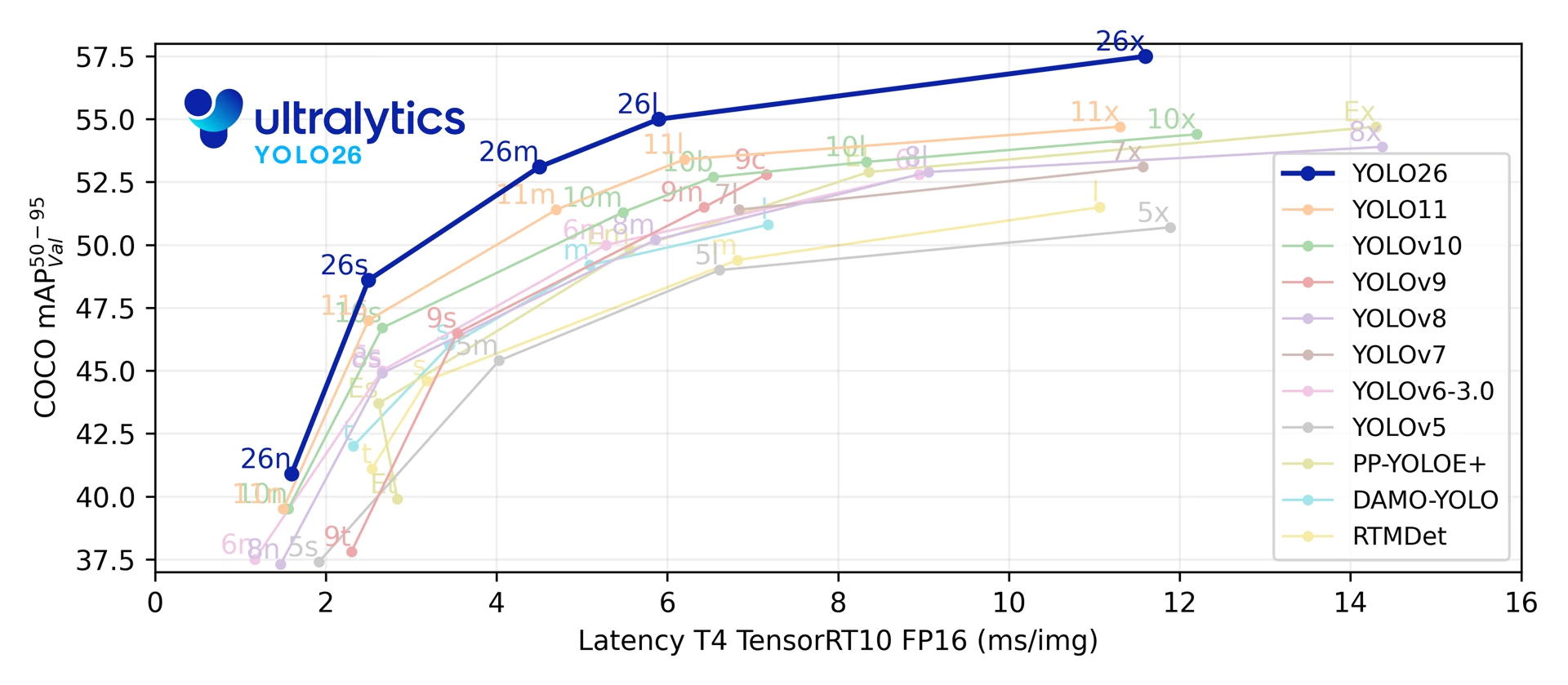
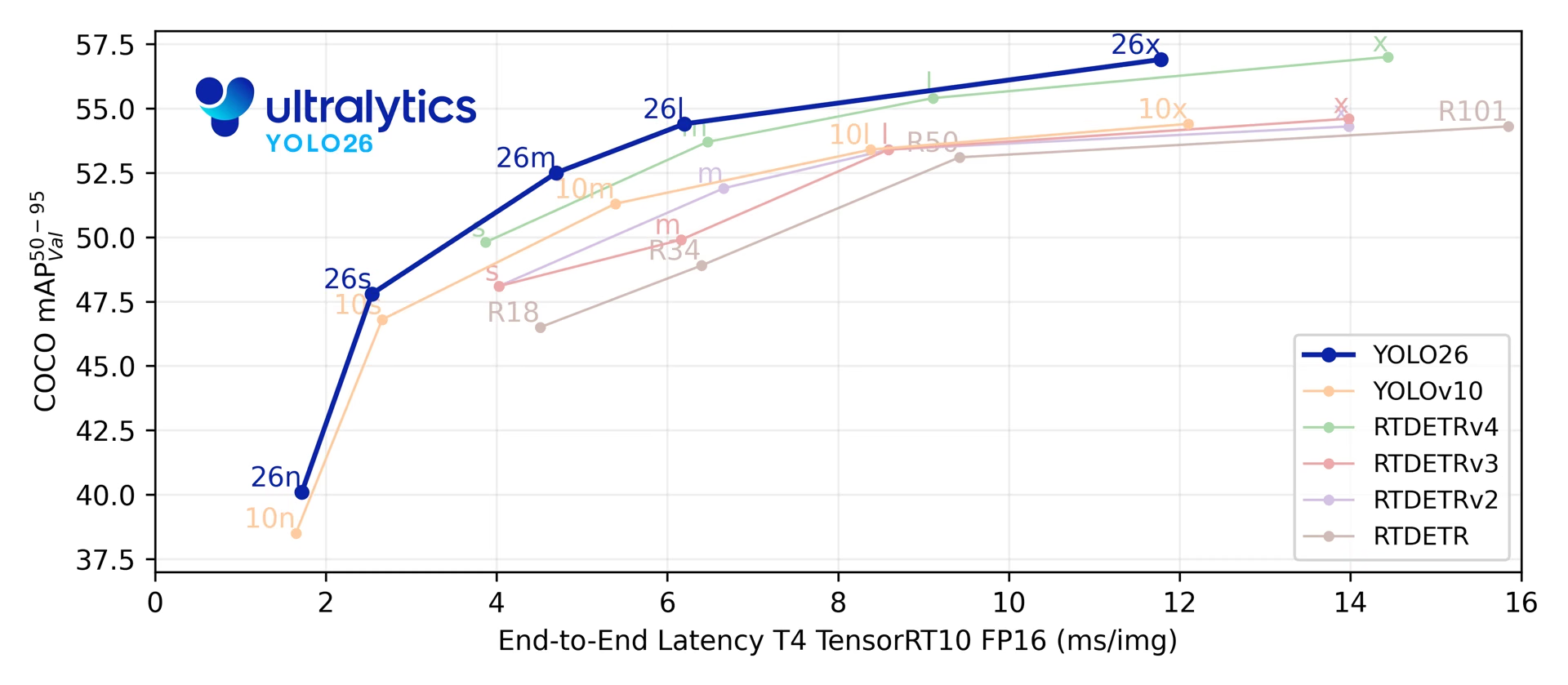
عبر مقاييس الكشف الخمسة، يحقق YOLO26 40.9-57.5 mAP على COCO بزمن استجابة 1.7-11.8 ms باستخدام T4 TensorRT. وتذكر الورقة أيضًا أن استدلال YOLO26n على CPU باستخدام ONNX أسرع بما يصل إلى 43% مقارنةً بـ YOLO11n على Intel Xeon CPU @ 2.00 GHz.
راجع معاينة YOLO27 غير الصادر للاطلاع على البنية والمهام والمعايير الأولية المخطط لها.
from ultralytics import YOLO
model = YOLO("yolo26n.pt") # تحميل نموذج YOLO26n مدرّب مسبقًا
results = model("path/to/bus.jpg") # تشغيل الاستدلالاستكشف نماذج YOLO26 وشغّلها مباشرةً على منصة Ultralytics.
تتمحور عائلة نماذج YOLO26 حول أربعة مجالات تصميم:
- الاستدلال الشامل الأصيل: ينتج رأس الكشف الاختياري أحادي المطابقة تنبؤات من دون قمع الصناديق غير القصوى (NMS)، ما يبسّط النشر ويقلل المعالجة اللاحقة.
- انحدار مربعات أخف وزنًا: يزيل YOLO26 خسارة البؤرة التوزيعية (DFL)، ما يقلّل تعقيد رأس الكشف مع الحفاظ على نطاق انحدار غير مقيّد.
- تحديثات وصفة التدريب: يجمع مسار التدريب بين MuSGD (مُحسِّن هجين يجمع Muon وSGD) وProgressive Loss وSTAL (إسناد التسميات المراعي للأجسام الصغيرة) لتحسين التحسين، وتوجيه الإشراف نحو رأس الاستدلال، والحفاظ على تغطية التسميات الإيجابية للأجسام الصغيرة. وترد المعلمات الفائقة الكاملة لنقاط التحقق المُصدَرة في دليل وصفة تدريب YOLO26.
- رؤوس وخسائر خاصة بالمهام: يضيف YOLO26 تصميمات مخصصة لتجزئة المثيلات، وأنواع التجزئة الدلالية، وتقدير الوضعية، والكشف الموجّه، مع الحفاظ على مسار نموذج واحد عبر المهام.
تحسّن هذه التحديثات مجتمعةً المفاضلة بين الدقة وزمن الاستجابة عبر مقاييس النماذج وأهداف النشر المختلفة.
الميزات الرئيسية#
-
انحدار بلا DFL يزيل YOLO26 خسارة البؤرة التوزيعية (DFL)، ما يقلّل تعقيد رأس الكشف ويسهّل التصدير.
-
استدلال من البداية إلى النهاية وخالٍ من NMS يدعم YOLO26 الاستدلال الأصلي من البداية إلى النهاية باستخدام
nms=False، وينتج التنبؤات دون خطوة NMS منفصلة. ويستخدم المسار الافتراضي من واحد إلى متعدد NMS لتحقيق الدقة. -
Progressive Loss + STAL يوجّه Progressive Loss تركيز التدريب نحو الرأس المستخدم أثناء الاستدلال، بينما يحسّن STAL التغطية الإيجابية للتسميات الخاصة بالأجسام الصغيرة.
-
مُحسِّن MuSGD مُحسِّن هجين يجمع SGD مع Muon، ويكيّف أفكار التحسين من تدريب النماذج اللغوية الكبيرة لتناسب الرؤية الحاسوبية.
-
النشر الفعّال يقلّل الرأس المبسّط والمسار الاختياري الخالي من NMS الحمل الزائد للاستدلال عبر أهداف التصدير وملفات تعريف الأجهزة، بما في ذلك تسريع CPU باستخدام ONNX الذي أبلغت عنه الورقة لـ YOLO26n مقارنةً بـ YOLO11n.
-
تحسينات تقسيم المثيلات يضيف خسارة التقسيم الدلالي لتحسين تقارب النموذج، ويرتقي بوحدة proto لتستخدم معلومات متعددة المقاييس وتحسّن جودة الأقنعة. وتُظهر الورقة مكاسب مقارنةً بـ YOLO11 تصل إلى +2.5 في box AP و+3.7 في mask AP على تقسيم مثيلات COCO.
-
تقدير دقيق للوضعية يدمج تقدير الاحتمالية اللوغاريتمية المتبقية (RLE) لتحديد مواقع نقاط الارتكاز بدقة أكبر، ويحسّن عملية فك الترميز لزيادة سرعة الاستدلال. وتذكر الورقة مكاسب تصل إلى +7.2 AP مقارنةً بـ YOLO11 في تقدير الوضعية على COCO.
-
فك ترميز OBB محسّن يضيف خسارة زاوية متخصصة لتحسين دقة الكشف عن الأجسام المربعة، ويحسّن فك ترميز OBB لمعالجة مشكلات الانقطاع عند الحدود. وتذكر الورقة مكاسب تصل إلى +3.4 mAP مقارنةً بـ YOLO11 في الكشف الموجّه على DOTA-v1.0.
المهام والأوضاع المدعومة#
يدعم YOLO26 مجموعة مهام Ultralytics القياسية عبر خمسة مقاييس للنماذج:
| النموذج | أسماء الملفات | المهمة | التدريب | التحقق | الاستدلال | التصدير |
|---|---|---|---|---|---|---|
| YOLO26 | yolo26n.pt yolo26s.pt yolo26m.pt yolo26l.pt yolo26x.pt | الكشف | ✅ | ✅ | ✅ | ✅ |
| YOLO26-seg | yolo26n-seg.pt yolo26s-seg.pt yolo26m-seg.pt yolo26l-seg.pt yolo26x-seg.pt | تجزئة الكائنات | ✅ | ✅ | ✅ | ✅ |
| YOLO26-sem | yolo26n-sem.pt yolo26s-sem.pt yolo26m-sem.pt yolo26l-sem.pt yolo26x-sem.pt | التجزئة الدلالية | ✅ | ✅ | ✅ | ✅ |
| YOLO26-depth | yolo26n-depth.pt yolo26s-depth.pt yolo26m-depth.pt yolo26l-depth.pt yolo26x-depth.pt | تقدير العمق | ✅ | ✅ | ✅ | ✅ |
| YOLO26-cls | yolo26n-cls.pt yolo26s-cls.pt yolo26m-cls.pt yolo26l-cls.pt yolo26x-cls.pt | التصنيف | ✅ | ✅ | ✅ | ✅ |
| YOLO26-pose | yolo26n-pose.pt yolo26s-pose.pt yolo26m-pose.pt yolo26l-pose.pt yolo26x-pose.pt | الوضعية/النقاط المفتاحية | ✅ | ✅ | ✅ | ✅ |
| YOLO26-obb | yolo26n-obb.pt yolo26s-obb.pt yolo26m-obb.pt yolo26l-obb.pt yolo26x-obb.pt | الكشف الموجّه | ✅ | ✅ | ✅ | ✅ |
يشمل هذا الإطار الموحد الكشف في الوقت الفعلي، وتجزئة المثيلات، والتجزئة الدلالية، وتقدير العمق أحادي العين، والتصنيف، وتقدير الوضعية، والكشف عن الأجسام الموجّهة، مع دعم التدريب والتحقق والاستدلال والتصدير.
يضيف كلٌّ من yolo26-p2.yaml وyolo26-p6.yaml رأس كشف P2 (للأجسام الصغيرة) أو P6 (للمدخلات الكبيرة)، ولا يُطرحان إلا في صورة معماريتَي YAML. ولا تُنشر أوزان خاصة بمقياس محدد لـ yolo26*-p2.pt أو yolo26*-p6.pt. أنشئ تهيئةً بمقياس محدد انطلاقًا من YAML (مثل YOLO("yolo26n-p6.yaml")) ودرّب النموذج الناتج أو أجرِ له ضبطًا دقيقًا حسب الحاجة؛ يوضّح تدريب نموذج YOLO26 P2 انطلاقًا من أوزان مدرّبة مسبقًا كيفية البدء من yolo26n.pt والتحقق من وجود مخرجات P2.
مقاييس الأداء#
راجع وثائق الكشف للاطلاع على أمثلة استخدام هذه النماذج المدرّبة على COCO، والتي تتضمن 80 فئة مدرّبة مسبقًا.
| النموذج | الحجم (بكسل) | mAPval50-95 | mAPالتحقق50-95 (e2e) | السرعة CPU ONNX (مللي ثانية) | السرعة T4 TensorRT10 (ms) | المعاملات (M) | FLOPs (B) |
|---|---|---|---|---|---|---|---|
| YOLO26n | 640 | 40.9 | 40.1 | 38.9 ± 0.7 | 1.7 ± 0.0 | 2.4 | 5.5 |
| YOLO26s | 640 | 48.6 | 47.8 | 87.2 ± 0.9 | 2.5 ± 0.0 | 9.5 | 20.9 |
| YOLO26m | 640 | 53.1 | 52.5 | 220.0 ± 1.4 | 4.7 ± 0.1 | 20.4 | 68.4 |
| YOLO26l | 640 | 55.0 | 54.4 | 286.2 ± 2.0 | 6.2 ± 0.2 | 24.8 | 86.8 |
| YOLO26x | 640 | 57.5 | 56.9 | 525.8 ± 4.0 | 11.8 ± 0.2 | 55.7 | 194.4 |
قيم Params وFLOPs تخص النموذج المدمج بعد طي Conv/BatchNorm وإزالة فرع الكشف غير المستخدم. تحدد قياسات السرعة رأسًا خاليًا من NMS باستخدام nms=False. وتحتفظ نقاط التحقق المدرّبة مسبقًا ببنية التدريب الكاملة، وقد تُظهر أعدادًا أعلى.
أمثلة الاستخدام#
يقدم هذا القسم أمثلة بسيطة على التدريب والاستدلال باستخدام YOLO26.
يدرّب المثال أدناه نموذج YOLO26 من نوع Detect لتنفيذ اكتشاف الكائنات على مجموعة البيانات المثال COCO8.
يمكن تمرير نماذج *.pt المدربة مسبقًا من PyTorch، وكذلك ملفات الإعداد *.yaml، إلى الصنف YOLO() لإنشاء مثيل نموذج في Python:
from ultralytics import YOLO
# تحميل نموذج YOLO26n مدرب مسبقًا على COCO
model = YOLO("yolo26n.pt")
# تنفيذ الاستدلال باستخدام نموذج YOLO26n على الصورة 'bus.jpg'
results = model("path/to/bus.jpg")
# تدريب النموذج على مجموعة بيانات المثال COCO8 لمدة 100 حقبة
results = model.train(data="coco8.yaml", epochs=100, imgsz=640)تستخدم نماذج الكشف YOLO26 بنية رأس مزدوج توفر مرونة لسيناريوهات النشر المختلفة:
- رأس واحد إلى متعدد (افتراضي): يولّد مخرجات YOLO التقليدية التي تتطلب معالجة لاحقة باستخدام NMS، ويُخرج
(N, nc + 4, 8400)حيث يمثّلncعدد الفئات. يحقق هذا الرأس عادةً دقة أعلى قليلًا مقابل معالجة إضافية. - رأس واحد إلى واحد (
nms=False): ينتج تنبؤات شاملة من البداية إلى النهاية دون NMS، ويُخرج(N, 300, 6)بحد أقصى يبلغ 300 كشف لكل صورة. هذا الرأس محسّن للاستدلال السريع وتبسيط النشر.
يمكنك التبديل بين الرؤوس أثناء التصدير أو التنبؤ أو التحقق:
from ultralytics import YOLO
model = YOLO("yolo26n.pt")
# استخدام رأس واحد إلى متعدد (افتراضي، يطبّق Ultralytics تقنية NMS)
results = model.predict("image.jpg") # inference
metrics = model.val(data="coco.yaml") # validation
model.export(format="onnx") # export
# اختيار رأس واحد إلى واحد الخالي من NMS
results = model.predict("image.jpg", nms=False) # inference
metrics = model.val(data="coco.yaml", nms=False) # validation
model.export(format="onnx", nms=False) # exportيستخدم التنبؤ والتحقق افتراضيًا رأس واحد إلى متعدد لتحقيق الدقة. استخدم nms=False للاستدلال الخالي من NMS، أو nms=True لتضمين NMS في تصدير مدعوم. يُدرَّب كلا الرأسين بصرف النظر عن هذا الاختيار. راجع دليل الكشف الشامل من البداية إلى النهاية للاطلاع على تنسيقات المخرجات وتوافق التصدير.
YOLOE-26: الكشف والتقسيم بمفردات مفتوحة#
يشغّل YOLO26 أيضًا YOLOE-26، وهو إصدار ذو مفردات مفتوحة يكشف فئات الأجسام ويقسّمها استنادًا إلى مطالبات نصية أو مطالبات بصرية أو وضع خالٍ من المطالبات بدلًا من قائمة فئات ثابتة يتعلمها أثناء التدريب. يحتفظ YOLOE-26 برأس YOLO26 الاختياري الشامل والخالي من NMS (e2e)، لذا يظل الاستدلال ذو المفردات المفتوحة سريعًا بما يكفي للبيئات الديناميكية التي تتغير فيها الفئات المستهدفة بمرور الوقت. يحقق YOLOE-26x 40.6 AP على مجموعة minival من LVIS باستخدام المطالبات النصية، و38.5 AP باستخدام المطالبات البصرية، و31.1 AP في الوضع الخالي من المطالبات — وهي أرقام Non-E2E الواردة في الورقة، ويتأخر عنها الرأس الشامل بمقدار 1.1 و2.3 و1.2 AP.
راجع وثائق YOLOE للاطلاع على جداول الأداء بحسب الحجم، والإصدارات التي لا تتطلب مطالبات، وأمثلة الاستخدام الكاملة.
الاستشهادات والشكر والتقدير#
للاطلاع على وصف تقني كامل لبنية YOLO26 ووصفة التدريب ورؤوس المهام وامتداد YOLOE-26 ذي المفردات المفتوحة، اقرأ Ultralytics YOLO26: نماذج رؤية موحدة وآنية وشاملة من البداية إلى النهاية. إذا استخدمت YOLO26 في بحثك، يُرجى الاستشهاد بما يلي:
@misc{jocher2026ultralyticsyolo26unifiedrealtime,
  title = {Ultralytics YOLO26: Unified Real-Time End-to-End Vision Models},
  author = {Glenn Jocher and Jing Qiu and Mengyu Liu and Shuai Lyu and Fatih Cagatay Akyon and Muhammet Esat Kalfaoglu},
  year = {2026},
  eprint = {2606.03748},
  archivePrefix = {arXiv},
  primaryClass = {cs.CV},
  doi = {10.48550/arXiv.2606.03748},
  url = {https://arxiv.org/abs/2606.03748},
}
يتوفر رمز YOLO26 ونماذجه ووثائقه في مستودع Ultralytics على GitHub ووثائق Ultralytics بموجب ترخيصي AGPL-3.0 والمؤسسات.
الأسئلة الشائعة#
- انحدار بلا DFL: يبسّط رأس الكشف ومسار التصدير
- استدلال شامل من البداية إلى النهاية وخالٍ من NMS: يدعم الاستدلال الخالي من NMS باستخدام
nms=False - الخسارة التقدمية + STAL: يحسّن التوافق أثناء التدريب وتغطية تسميات الكائنات الصغيرة
- مُحسِّن MuSGD: يجمع SGD مع التحسين المستوحى من Muon لتحقيق تدريب مستقر
- رؤوس وخسائر خاصة بالمهام: تحسّن دعم التقسيم وتقدير الوضعية والكشف الموجّه
YOLO26 هو عائلة نماذج موحدة توفر دعمًا شاملًا من البداية إلى النهاية لمهام متعددة في الرؤية الحاسوبية:
- كشف الكائنات
- تجزئة الكائنات
- التجزئة الدلالية
- تقدير العمق أحادي العين
- تصنيف الصور
- تقدير الوضعية
- كشف الكائنات الموجّهة (OBB)
يدعم كل إصدار بالحجم (n وs وm وl وx) جميع المهام، إضافةً إلى إصدارات المفردات المفتوحة عبر YOLOE-26.
يعزز YOLO26 كفاءة النشر من خلال:
- استدلال أصلي اختياري شامل من البداية إلى النهاية دون NMS (
nms=False) - انحدار بلا DFL ورأس كشف أخف
- تصدير النموذج المدمج الذي يزيل المكونات المساعدة المخصصة للتدريب فقط
- استدلال ONNX على CPU أسرع بنسبة تصل إلى 43% لـ YOLO26n مقارنةً بـ YOLO11n على Intel Xeon CPU @ 2.00 GHz
- تنسيقات تصدير مرنة تشمل TensorRT وONNX وCoreML وLiteRT وOpenVINO
- استدلال أصلي اختياري شامل من البداية إلى النهاية دون NMS (
تتوفر نماذج YOLO26 للتنزيل عبر حزمة
ultralytics. ثبّت الحزمة أو حدّثها ثم حمّل نموذجًا:from ultralytics import YOLO # تحميل نموذج YOLO26 nano مدرب مسبقًا model = YOLO("yolo26n.pt") # تشغيل الاستدلال على صورة results = model("image.jpg")راجع قسم أمثلة الاستخدام للحصول على إرشادات التدريب والتحقق والتصدير.


التعليقات117
اطرح سؤالًا، وشارك نتائجك، أو ساعد شخصًا آخر.
hongzhuoxx
除了监督模型,我还期待着ultralytics可以推出高效准确易用的非监督瑕疵检测模型!
4Syedshajib55
How do I modify the architectural components (Head and Neck) of YOLOv26?
What is the process for inserting a Dropout layer at the end of the backbone in the YOLOv26 configuration?
2 Glenn JocherUltralytics
YOLO26 (no “v”) architecture edits are done in the model YAML, so start by copying
ultralytics/cfg/models/26/yolo26.yamlinto your project, modify thebackbone:/head:layer lists (the “neck” is part ofhead:), and train from that YAML following the Model YAML Configuration Guide.# yolo26_custom.yaml backbone: # ... existing backbone layers ... - [-1, 1, nn.Dropout, [0.2]] # add dropout at end of backbone (train-time only) head: # ... existing head/neck layers ...yolo train model=yolo26_custom.yaml data=your_dataset.yaml imgsz=640If you share which task model you’re editing (
detect/seg/pose/obb) and which variant (n/s/m/l/x), we can point you to the exact YAML to start from and where to insert the change in that graph.1Hi Glenn,
Thank you for the quick response and guidance! To answer your question: I am focusing on the detect task, and I will be experimenting with both the s (small) and m (medium) variants.
For context, I am working on a paper targeting a Q1 journal. My project focuses on Emotion Detection (5 classes: Angry, Happy, Sad, Neutral, Surprised) using the RAVDESS dataset. I have extracted peak emotion frames from the videos and augmented the dataset to roughly 21k images (640x640 resolution). My core research objective is to demonstrate that a customized YOLO26 architecture can outperform the standard baseline for detecting subtle facial micro-expressions. To achieve this, I want to modify the backbone—specifically by adding Batch Normalization and Dropout layers (potentially after the C2f blocks or may be after c3k2 blocks of that yolo26 architechtural images) to improve regularization and prevent overfitting on facial features.
Could you help me with the following?
-
Could you point me to the exact base YAML files for the yolo26s and yolo26m detection models to use as my starting point?
-
From an architectural standpoint, where exactly in the backbone would you theoretically recommend inserting these Dropout/BN layers? (e.g., after which specific layer index or block) to maximize accuracy without degrading the spatial feature maps necessary for facial detection?
Any insights on how to best structure this custom YAML would be incredibly helpful. Thanks again for your time!
-
- Baseline Reference: Finally, could you share the raw YAML configuration code that details the standard YOLO26 backbone and head? I would like to include this exact baseline structure in my paper’s methodology section to clearly contrast it with my proposed modifications.
hbzylilin
延迟了10天了,还没动静
1lwplw
真不错,期待开源
1- Glenn JocherUltralytics(تم التعديل)
@etemical 感谢建议!目前未原生支持行为识别/多目标行为检测;建议先用 YOLO26 组合
detect+track多目标跟踪与可选pose关键点作为上游信号,并在 GitHub 提交详细需求(数据标注格式与评测指标)为 Feature Request 模板 便于评估;参考 Track 模式文档 与 Pose 任务文档。yolo track model=yolo26n.pt source=your_video.mp4 tracker=bytetrack.yaml show=True yolo pose predict model=yolo26n-pose.pt source=your_video.mp4 show=True@lwplw 谢谢关注!YOLO26 现已发布,可阅读我们的 YOLO26 介绍博客 了解功能。
Jiahao Chen
请问如果我想要引用本页面的YOLO26和其他模型的对比曲线图,已经在文中索引了来源。但是期刊要求需要拿到作者的授权,请问如何申请授权呢?
 Paula DerrengerUltralytics
您好,针对期刊要求的图片书面授权,建议联系 Ultralytics 法务团队,说明申请转载 YOLO26 对比曲线图,并附上页面链接、具体图片、论文题目、期刊名称、是否修改图片,以及期刊的授权模板(如有),请求确认版权归属并提供书面许可。目前未找到该图专门的公开授权流程,因此这里不能代为授予许可;请以收到的正式书面回复为准。
cyberpunk-edgerunner
maybe
CIFAR-10-LTdataset can help. you do not need background images because our initial conversation started without that, for an image, there can be one to 15 object in one image The cause of the shared-memory increase will remain unconfirmed unless you runpython train.pyin your computer with an rtx gpuOn Sat, Oct 10, 2026 at 6:15 AM Paula Derrenger @.***> wrote:
Understood—you don’t need to interrupt your work for the batch=16 comparison. Could you name a public long-tailed dataset you consider representative and share your approximate class counts, background-image proportion, and typical/maximum objects per image? That would help define a reproduction using the configuration you already shared, without requiring your company’s data or another production run. The cause of the shared-memory increase remains unconfirmed.
— Reply to this email directly, view it on GitHub https://github.com/orgs/ultralytics/discussions/26446?email_source=notifications&email_token=BSIM7DUZ6A5KFG7YKF2H6KT5TGBBRA5CNFSNUABIM5UWIORPF5TWS5BNNB2WEL2ENFZWG5LTONUW63SDN5WW2ZLOOQXTCOBYGQ2DONBZUZZGKYLTN5XKOY3PNVWWK3TUUVSXMZLOOSWGM33PORSXEX3DNRUWG2Y#discussioncomment-18844749, or unsubscribe https://github.com/notifications/unsubscribe-auth/BSIM7DTBK4XV3HXIPMFHVXT5TGBBRAVCNFSNUABIKJSXA33TNF2G64TZHM2TGNJTGYYDINBVHNCGS43DOVZXG2LPNY5TCMBZGE3TMNRUUF3AE . Triage notifications, keep track of coding agent tasks and review pull requests on the go with GitHub Mobile for iOS https://github.com/notifications/mobile/ios/BSIM7DST66YNYHAKPWPY3PT5TGBBRA5CNFSNUABIM5UWIORPF5TWS5BNNB2WEL2ENFZWG5LTONUW63SDN5WW2ZLOOQXTCOBYGQ2DONBZUZZGKYLTN5XKOY3PNVWWK3TUUVSXMZLOOSVGM33PORSXEX3JN5ZQ and Android https://github.com/notifications/mobile/android/BSIM7DRDX2BJPHP7PHHKRG35TGBBRA5CNFSNUABIM5UWIORPF5TWS5BNNB2WEL2ENFZWG5LTONUW63SDN5WW2ZLOOQXTCOBYGQ2DONBZUZZGKYLTN5XKOY3PNVWWK3TUUVSXMZLOOSXGM33PORSXEX3BNZSHE33JMQ. Download it today! You are receiving this because you commented.Message ID: @.*** com>
- Paula DerrengerUltralytics
Thanks for clarifying the 1–15 objects per image; we can keep background-only images out of the reproduction.
CIFAR-10-LTis a long-tailed classification benchmark, so it would not directly reproduce your multi-object detection setup. I can’t executepython train.pyon an RTX GPU here, and I haven’t reproduced the shared-memory increase. Could you share a public-data version of the script, including dataset preparation, so someone with suitable hardware can run the same test without your company’s data?
I cannot run the same code with batch=16, reasons:
- I work in a company and have my own KPI to meet and improve
- I have added background image data in the dataset so it is no longer same.
- I am planning to add more images in future.
I suggest you download a long tailed distributed dataset to mimic my experiment.
thank you
On Fri, Oct 9, 2026 at 5:15 AM Paula Derrenger @.***> wrote:
Thanks for clarifying that it was 15 GB of shared GPU memory and sharing the configuration; sorry for requesting the script again. To test whether batch-related memory pressure contributes, could you compare your batch=64 run with batch=16, keeping all other settings unchanged? See the batch-size guidance https://docs.ultralytics.com/guides/model-training-tips#batch-size-and-gpu-utilization. Please share epoch 2–3 text logs and dedicated/shared GPU memory readings from the comparison; this will help narrow down the cause without assuming the memory change is a bug.
— Reply to this email directly, view it on GitHub https://github.com/orgs/ultralytics/discussions/26446?email_source=notifications&email_token=BSIM7DWLJ3KRNTXM7Y6Q4O35TARKLA5CNFSNUABIM5UWIORPF5TWS5BNNB2WEL2ENFZWG5LTONUW63SDN5WW2ZLOOQXTCOBYGI2TINRTUZZGKYLTN5XKOY3PNVWWK3TUUVSXMZLOOSWGM33PORSXEX3DNRUWG2Y#discussioncomment-18825463, or unsubscribe https://github.com/notifications/unsubscribe-auth/BSIM7DQLZ4KWCGA6TEUDIS35TARKLAVCNFSNUABIKJSXA33TNF2G64TZHM2TGNJTGYYDINBVHNCGS43DOVZXG2LPNY5TCMBZGE3TMNRUUF3AE . Triage notifications, keep track of coding agent tasks and review pull requests on the go with GitHub Mobile for iOS https://github.com/notifications/mobile/ios/BSIM7DV53PCZWPENVMYYNYT5TARKLA5CNFSNUABIM5UWIORPF5TWS5BNNB2WEL2ENFZWG5LTONUW63SDN5WW2ZLOOQXTCOBYGI2TINRTUZZGKYLTN5XKOY3PNVWWK3TUUVSXMZLOOSVGM33PORSXEX3JN5ZQ and Android https://github.com/notifications/mobile/android/BSIM7DX2XUXERTKYLIDJ2C35TARKLA5CNFSNUABIM5UWIORPF5TWS5BNNB2WEL2ENFZWG5LTONUW63SDN5WW2ZLOOQXTCOBYGI2TINRTUZZGKYLTN5XKOY3PNVWWK3TUUVSXMZLOOSXGM33PORSXEX3BNZSHE33JMQ. Download it today! You are receiving this because you commented.Message ID: @.*** com>
- Paula DerrengerUltralytics
Understood—you don’t need to interrupt your work for the
batch=16comparison. Could you name a public long-tailed dataset you consider representative and share your approximate class counts, background-image proportion, and typical/maximum objects per image? That would help define a reproduction using the configuration you already shared, without requiring your company’s data or another production run. The cause of the shared-memory increase remains unconfirmed.
- I have shared you exact code in this email thread(check my second reply) and the command to run it was `python .\det_yoloM_5-10.py' .
- yes, it was 15GB of shared GPU
- sorry, I do not have
separate dedicated/shared memory readings at comparable batch positions in each epoch, but there was a steady consumption of about 15GB of shared memory throughout the training. however I can provide you argos.yaml
task: detect mode: train model: yolo26m.pt data: yoloDet_clsAgnostic_split/data.yaml epochs: 200 time: null patience: 20 batch: 64 imgsz: 640 save: true save_period: -1 cache: false device: '0' workers: 6 project: null name: train-2 exist_ok: false pretrained: true cls_remap: true optimizer: auto verbose: false seed: 0 deterministic: true single_cls: false rect: false cos_lr: false close_mosaic: 10 resume: false amp: true fraction: 1.0 profile: false freeze: null multi_scale: 0.0 compile: false channels_last: null overlap_mask: true mask_ratio: 4 dropout: 0.0 val: true split: val save_json: false conf: null iou: 0.7 max_det: 300 quantize: null dnn: false plots: true nms: null source: null vid_stride: 1 stream_buffer: false visualize: false augment: false agnostic_nms: false classes: null retina_masks: false embed: null show: false save_frames: false save_txt: false save_conf: false save_crop: false show_labels: true show_conf: true show_boxes: true line_width: null format: torchscript keras: false optimize: false dynamic: false simplify: true opset: null workspace: null lr0: 0.01 lrf: 0.01 momentum: 0.937 weight_decay: 0.0005 warmup_epochs: 3.0 warmup_momentum: 0.8 warmup_bias_lr: 0.1 distill_model: null dis: 6.0 box: 7.5 cls: 0.5 cls_pw: 0.0 dfl: 1.5 pose: 12.0 kobj: 1.0 rle: 1.0 angle: 1.0 dlog: 1.0 dgrad: 0.5 dlam: 1.0 nbs: 64 hsv_h: 0.015 hsv_s: 0.7 hsv_v: 0.4 degrees: 0.0 translate: 0.1 scale: 0.5 shear: 0.0 perspective: 0.0 flipud: 0.0 fliplr: 0.5 bgr: 0.0 mosaic: 1.0 mixup: 0.0 cutmix: 0.0 copy_paste: 0.0 copy_paste_mode: flip auto_augment: randaugment erasing: 0.4 cfg: null tracker: tracktrack.yaml save_dir: C:\Training9\runs\detect\train-2On Thu, Oct 8, 2026 at 6:07 AM Paula Derrenger @.***> wrote:
Thanks for the complete checks and text logs. Epoch 2 is faster (14:27 versus 1:02:39), despite GPU_mem dropping from 28.6G to 17.4G, so these readings alone don’t establish GPU underutilization. Could you paste your exact training command or script, including the model and training settings? Also, does “around 15 epoch” mean 15 GB of shared GPU memory in both epochs? Please provide separate dedicated/shared memory readings at comparable batch positions in each epoch so we can investigate the discrepancy.
— Reply to this email directly, view it on GitHub https://github.com/orgs/ultralytics/discussions/26446?email_source=notifications&email_token=BSIM7DQKA3GIYQSCDVEWEJ35S3OWHA5CNFSNUABIM5UWIORPF5TWS5BNNB2WEL2ENFZWG5LTONUW63SDN5WW2ZLOOQXTCOBYGAZTKNJWUZZGKYLTN5XKOY3PNVWWK3TUUVSXMZLOOSWGM33PORSXEX3DNRUWG2Y#discussioncomment-18803556, or unsubscribe https://github.com/notifications/unsubscribe-auth/BSIM7DX34MSUWFFX5WDRXW35S3OWHAVCNFSNUABIKJSXA33TNF2G64TZHM2TGNJTGYYDINBVHNCGS43DOVZXG2LPNY5TCMBZGE3TMNRUUF3AE . Triage notifications, keep track of coding agent tasks and review pull requests on the go with GitHub Mobile for iOS https://github.com/notifications/mobile/ios/BSIM7DSVPQ3LAONGDZOZWWD5S3OWHA5CNFSNUABIM5UWIORPF5TWS5BNNB2WEL2ENFZWG5LTONUW63SDN5WW2ZLOOQXTCOBYGAZTKNJWUZZGKYLTN5XKOY3PNVWWK3TUUVSXMZLOOSVGM33PORSXEX3JN5ZQ and Android https://github.com/notifications/mobile/android/BSIM7DQHEDECXNLNQEWJLC35S3OWHA5CNFSNUABIM5UWIORPF5TWS5BNNB2WEL2ENFZWG5LTONUW63SDN5WW2ZLOOQXTCOBYGAZTKNJWUZZGKYLTN5XKOY3PNVWWK3TUUVSXMZLOOSXGM33PORSXEX3BNZSHE33JMQ. Download it today! You are receiving this because you commented.Message ID: @.*** com>
- Paula DerrengerUltralytics
Thanks for clarifying that it was 15 GB of shared GPU memory and sharing the configuration; sorry for requesting the script again. To test whether batch-related memory pressure contributes, could you compare your
batch=64run withbatch=16, keeping all other settings unchanged? See the batch-size guidance. Please share epoch 2–3 text logs and dedicated/shared GPU memory readings from the comparison; this will help narrow down the cause without assuming the memory change is a bug.
here are my yolo checks yolo checks Ultralytics 8.4.155 Python-3.13.12 torch-2.12.0.dev20260408+cu128 CUDA:0 (NVIDIA GeForce RTX 5090, 32607MiB) Setup complete (24 CPUs, 63.5 GB RAM, 1738.9/1881.5 GB disk)
OS Windows-11-10.0.26200-SP0 Environment Windows Python 3.13.12 Install pip Path C:\Users\devth\miniconda3\Lib\site-packages\ultralytics RAM 63.46 GB Disk 1738.9/1881.5 GB CPU Intel Core Ultra 9 285K CPU count 24 GPU NVIDIA GeForce RTX 5090, 32607MiB GPU count 1 CUDA 12.8
cloudpickle 3.1.2>=3.1.1 filelock 3.29.0>=3.16.1 numpy 2.4.4>=1.23.0; platform_system != "Darwin" numpy 2.4.4!=2.0.,!=2.1.,!=2.2.*,!=2.3.0,!=2.3.1,!=2.3.2,!=2.3.3,!=2.3.4,>=1.23.0; platform_system == "Darwin" matplotlib 3.10.8>=3.3.0 opencv-python 4.13.0.92!=4.13.0.90,>=4.7.0 pillow 12.2.0>=7.1.2 pyyaml 6.0.3>=5.3.1 requests 2.32.5>=2.23.0 torch 2.12.0.dev20260408+cu128>=1.8.0 torch 2.12.0.dev20260408+cu128!=2.4.0,>=1.8.0; sys_platform == "win32" torchvision 0.27.0.dev20260407+cu128>=0.9.0 psutil 7.2.2>=5.8.0 polars 1.40.1>=0.20.0 nvidia-ml-py 13.610.43>=12.0.0 ultralytics-thop 2.1.6>=2.1.6 ultralytics-platform 0.1.48>=0.1.45; python_version >= "3.11"
(shared memory used in first and second epoch was around 15 epoch) these are the first two epoch details in Text
 Epoch    GPU_mem   box_loss   cls_loss    l1_loss  Instances       Size
  1/200      28.6G      1.174      1.891    0.01363         90
640: 33% ━━━╸──────── 1561/4702 1.1it/s 23:55<49:25libpng warning: iCCP: known incorrect sRGB profile 1/200 28.6G 1.15 1.582 0.01327 91 640: 56% ━━━━━━╸───── 2674/4702 1.3it/s 40:45<26:43libpng warning: iCCP: known incorrect sRGB profile 1/200 28.6G 1.144 1.475 0.01325 77 640: 72% ━━━━━━━━╸─── 3419/4702 1.3it/s 49:44<16:45libpng warning: iCCP: known incorrect sRGB profile 1/200 28.6G 1.144 1.471 0.01325 84 640: 73% ━━━━━━━━╸─── 3451/4702 1.4it/s 50:07<14:41libpng warning: iCCP: known incorrect sRGB profile 1/200 28.6G 1.146 1.395 0.01332 84 640: 92% ━━━━━━━━━━━─ 4370/4702 5.0it/s 1:01:16<1:07libpng warning: iCCP: known incorrect sRGB profile 1/200 28.6G 1.146 1.373 0.01335 74 640: 100% ━━━━━━━━━━━━ 4702/4702 1.3it/s 1:02:39 Class Images Instances Box(P R mAP50 mAP50-95): 22% ━━╸───────── 57/256 2.5it/s 26.7s<1:19libpng warning: iCCP: known incorrect sRGB profile Class Images Instances Box(P R mAP50 mAP50-95): 47% ━━━━━╸────── 122/256 2.3it/s 1:10<59.4slibpng warning: iCCP: known incorrect sRGB profile Class Images Instances Box(P R mAP50 mAP50-95): 100% ━━━━━━━━━━━━ 256/256 1.9it/s 2:17 all 32677 47931 0.863 0.726 0.818 0.584
Epoch GPU_mem box_loss cls_loss l1_loss InstancesSize 2/200 17.4G 1.183 1.123 0.01413 74 640: 29% ━━━╸──────── 1380/4702 5.1it/s 4:16<10:45libpng warning: iCCP: known incorrect sRGB profile 2/200 17.4G 1.196 1.133 0.01441 107 640: 55% ━━━━━━╸───── 2615/4702 5.8it/s 8:09<6:02libpng warning: iCCP: known incorrect sRGB profile 2/200 17.4G 1.193 1.126 0.01434 99 640: 64% ━━━━━━━╸──── 3020/4702 5.5it/s 9:20<5:06libpng warning: iCCP: known incorrect sRGB profile 2/200 17.4G 1.193 1.125 0.01435 106 640: 67% ━━━━━━━━──── 3179/4702 5.6it/s 9:50<4:33libpng warning: iCCP: known incorrect sRGB profile 2/200 17.4G 1.192 1.121 0.01434 109 640: 81% ━━━━━━━━━╸── 3847/4702 5.5it/s 11:52<2:36libpng warning: iCCP: known incorrect sRGB profile 2/200 17.4G 1.195 1.12 0.01437 86 640: 100% ━━━━━━━━━━━━ 4702/4702 5.4it/s 14:27 Class Images Instances Box(P R mAP50 mAP50-95): 22% ━━╸───────── 57/256 2.5it/s 20.6s<1:21libpng warning: iCCP: known incorrect sRGB profile Class Images Instances Box(P R mAP50 mAP50-95): 47% ━━━━━╸────── 122/256 2.1it/s 50.3s<1:04libpng warning: iCCP: known incorrect sRGB profile Class Images Instances Box(P R mAP50 mAP50-95): 100% ━━━━━━━━━━━━ 256/256 2.3it/s 1:51 all 32677 47931 0.889 0.778 0.87 0.638
On Tue, Oct 6, 2026 at 10:29 AM Paula Derrenger @.***> wrote:
No—by “yolo checks output,” I mean the terminal’s software/hardware summary, not results.csv. Please activate the same Python environment used for training, run yolo checks in PowerShell, and paste its complete text output; it reports your Ultralytics, Python, PyTorch, and GPU details (environment checks reference https://docs.ultralytics.com/reference/utils/checks#ultralytics.utils.checks.check_yolo). (docs.ultralytics.com https://docs.ultralytics.com/reference/utils/checks) Thanks for sharing the driver information. Please also provide separate dedicated/shared GPU-memory readings at matching points in epochs 1 and 2, plus your training command or configuration, so we can investigate without assuming the memory drop indicates hardware underutilization.
— Reply to this email directly, view it on GitHub https://github.com/orgs/ultralytics/discussions/26446?email_source=notifications&email_token=BSIM7DSK7MKPVE56RJJGI435SR33BA5CNFSNUABIM5UWIORPF5TWS5BNNB2WEL2ENFZWG5LTONUW63SDN5WW2ZLOOQXTCOBXG4YDKNJSUZZGKYLTN5XKOY3PNVWWK3TUUVSXMZLOOSWGM33PORSXEX3DNRUWG2Y#discussioncomment-18770552, or unsubscribe https://github.com/notifications/unsubscribe-auth/BSIM7DRBVYTDNBPWAZRUQXL5SR33BAVCNFSNUABIKJSXA33TNF2G64TZHM2TGNJTGYYDINBVHNCGS43DOVZXG2LPNY5TCMBZGE3TMNRUUF3AE . Triage notifications, keep track of coding agent tasks and review pull requests on the go with GitHub Mobile for iOS https://github.com/notifications/mobile/ios/BSIM7DXMRZI3YZR75VFDAGT5SR33BA5CNFSNUABIM5UWIORPF5TWS5BNNB2WEL2ENFZWG5LTONUW63SDN5WW2ZLOOQXTCOBXG4YDKNJSUZZGKYLTN5XKOY3PNVWWK3TUUVSXMZLOOSVGM33PORSXEX3JN5ZQ and Android https://github.com/notifications/mobile/android/BSIM7DRXQCNW5JUZNGVDHU35SR33BA5CNFSNUABIM5UWIORPF5TWS5BNNB2WEL2ENFZWG5LTONUW63SDN5WW2ZLOOQXTCOBXG4YDKNJSUZZGKYLTN5XKOY3PNVWWK3TUUVSXMZLOOSXGM33PORSXEX3BNZSHE33JMQ. Download it today! You are receiving this because you commented.Message ID: @.*** com>
- Paula DerrengerUltralytics
Thanks for the complete checks and text logs. Epoch 2 is faster (14:27 versus 1:02:39), despite
GPU_memdropping from 28.6G to 17.4G, so these readings alone don’t establish GPU underutilization. Could you paste your exact training command or script, including the model and training settings? Also, does “around 15 epoch” mean 15 GB of shared GPU memory in both epochs? Please provide separate dedicated/shared memory readings at comparable batch positions in each epoch so we can investigate the discrepancy.
pls explain what is yolo checks output? what do you mean by that ? are you referring to results.csv from runs folder??
here is my driver detail PS C:\Training9> nvidia-smi Tue Oct 6 09:22:05 2026 +-----------------------------------------------------------------------------------------+ | NVIDIA-SMI 610.60 KMD Version: 610.60 CUDA UMD Version: 13.3 | +-----------------------------------------+------------------------+----------------------+ | GPU Name Driver-Model | Bus-Id Disp.A | Volatile Uncorr. ECC | | Fan Temp Perf Pwr:Usage/Cap | Memory-Usage | GPU-Util Compute M. | | | | MIG M. | |=========================================+========================+======================| | 0 NVIDIA GeForce RTX 5090 WDDM | 00000000:01:00.0 On | N/A | | 57% 73C P1 479W / 575W | 19362MiB / 32607MiB | 80% Default | | | | N/A | +-----------------------------------------+------------------------+----------------------+
PS C:\Training9> nvcc --version nvcc: NVIDIA (R) Cuda compiler driver Copyright (c) 2005-2025 NVIDIA Corporation Built on Wed_Jan_15_19:38:46_Pacific_Standard_Time_2025 Cuda compilation tools, release 12.8, V12.8.61 Build cuda_12.8.r12.8/compiler.35404655_0
epoch 1 vram usage(in terminal) = 28.6 GB and in task manager ~29.1 GB epoch 2 to epoch 73 vram usage (in terminal) = 17.4 GB and in task manager vram usage is 18.1 GB
73rd epoch
Epoch GPU_mem box_loss cls_loss l1_loss InstancesSize 73/200 17.4G 0.9935 0.7903 0.01002 86 640: 0% ──────────── 4/4702 4.4it/s 1.0s<17:51libpng warning: iCCP: known incorrect sRGB profile 73/200 17.4G 1.023 0.7368 0.01159 84 640: 9% ━─────────── 446/4702 5.8it/s 1:17<12:17libpng warning: iCCP: known incorrect sRGB profile 73/200 17.4G 1.024 0.7397 0.01152 93 640: 63% ━━━━━━━╸──── 2990/4702 5.6it/s 8:41<5:06libpng warning: iCCP: known incorrect sRGB profile 73/200 17.4G 1.024 0.7402 0.01151 119 640: 65% ━━━━━━━╸──── 3080/4702 5.3it/s 8:57<5:06libpng warning: iCCP: known incorrect sRGB profile 73/200 17.4G 1.026 0.7422 0.01152 113 640: 76% ━━━━━━━━━─── 3586/4702 5.6it/s 10:28<3:20libpng warning: iCCP: known incorrect sRGB profile 73/200 17.4G 1.029 0.7459 0.01156 78 640: 100% ━━━━━━━━━━━━ 4702/4702 5.7it/s 13:46 Class Images Instances Box(P R mAP50 mAP50-95): 22% ━━╸───────── 57/256 2.7it/s 20.9s<1:13libpng warning: iCCP: known incorrect sRGB profile Class Images Instances Box(P R mAP50 mAP50-95): 47% ━━━━━╸────── 122/256 2.1it/s 48.9s<1:02libpng warning: iCCP: known incorrect sRGB profile Class Images Instances Box(P R mAP50 mAP50-95): 100% ━━━━━━━━━━━━ 256/256 2.4it/s 1:47 all 32677 47931 0.927 0.855 0.93 0.724
since you are trying to replicate my detection code , I must tell you in my train folder I have around 150000 images with txt files, 32000 in val and 31000 in test
while you are at it, I need a change in the ultralytics package, since it can detect and restore corrupt JPG(and many more errors), would it possible for you to make this change permanent? since it a type of fix and everyone wants that and no one wants to ultralytics package to just internally fix the images i know it won't be implemented by of security reasons by just keep in future todo list
to be honest , in my view, the ultralytics package does not fully utilise the hardware. I have run barebone code that using just the pytorch and few more basic codes and they utilise
thank you in advance
On Mon, Oct 5, 2026 at 10:42 PM Paula Derrenger @.***> wrote:
Thanks for sharing the script. A plausible explanation for the drop from 28.6G to 17.4G is cache cleanup between epochs: the training loop https://docs.ultralytics.com/reference/engine/trainer#ultralytics.engine.trainer.BaseTrainer._do_train conditionally clears reserved memory before validation and at epoch end when usage exceeds 50% of device capacity. This could explain the drop, but does not establish why Windows reports shared-memory usage. ( docs.ultralytics.com https://docs.ultralytics.com/reference/engine/trainer) Please share yolo checks output, your NVIDIA driver version, and dedicated/shared GPU-memory readings as text at matching points in both epochs so we can check your installed version and distinguish the two observations.
— Reply to this email directly, view it on GitHub https://github.com/orgs/ultralytics/discussions/26446?email_source=notifications&email_token=BSIM7DSOVWTY24AP4M6GU5D5SPI7FA5CNFSNUABIM5UWIORPF5TWS5BNNB2WEL2ENFZWG5LTONUW63SDN5WW2ZLOOQXTCOBXGYZTCOJVUZZGKYLTN5XKOY3PNVWWK3TUUVSXMZLOOSWGM33PORSXEX3DNRUWG2Y#discussioncomment-18763195, or unsubscribe https://github.com/notifications/unsubscribe-auth/BSIM7DUUEOVQC4A4Q7SCGUL5SPI7FAVCNFSNUABIKJSXA33TNF2G64TZHM2TGNJTGYYDINBVHNCGS43DOVZXG2LPNY5TCMBZGE3TMNRUUF3AE . Triage notifications, keep track of coding agent tasks and review pull requests on the go with GitHub Mobile for iOS https://github.com/notifications/mobile/ios/BSIM7DVWK73UY4PTSMIRTTL5SPI7FA5CNFSNUABIM5UWIORPF5TWS5BNNB2WEL2ENFZWG5LTONUW63SDN5WW2ZLOOQXTCOBXGYZTCOJVUZZGKYLTN5XKOY3PNVWWK3TUUVSXMZLOOSVGM33PORSXEX3JN5ZQ and Android https://github.com/notifications/mobile/android/BSIM7DW6Q4F7VJMCOTRDMPD5SPI7FA5CNFSNUABIM5UWIORPF5TWS5BNNB2WEL2ENFZWG5LTONUW63SDN5WW2ZLOOQXTCOBXGYZTCOJVUZZGKYLTN5XKOY3PNVWWK3TUUVSXMZLOOSXGM33PORSXEX3BNZSHE33JMQ. Download it today! You are receiving this because you commented.Message ID: @.*** com>
- Paula DerrengerUltralytics
No—by “
yolo checksoutput,” I mean the terminal’s software/hardware summary, notresults.csv. Please activate the same Python environment used for training, runyolo checksin PowerShell, and paste its complete text output; it reports your Ultralytics, Python, PyTorch, and GPU details (environment checks reference). (docs.ultralytics.com) Thanks for sharing the driver information. Please also provide separate dedicated/shared GPU-memory readings at matching points in epochs 1 and 2, plus your training command or configuration, so we can investigate without assuming the memory drop indicates hardware underutilization.