تصدير Tencent NCNN
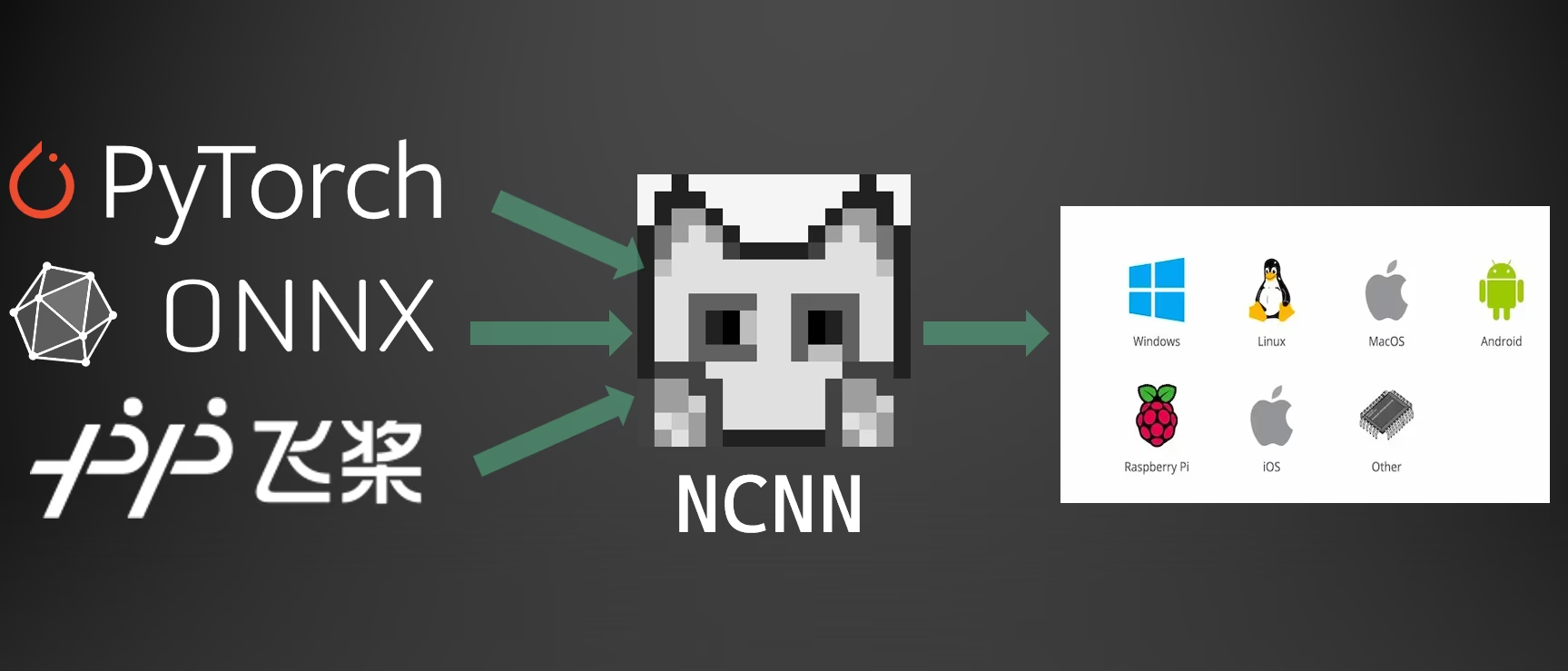
NCNN هو إطار عمل استدلال الشبكات العصبية مفتوح المصدر من Tencent، مخصص للهواتف واللوحات المضمنة وأجهزة الكمبيوتر المكتبية. يؤدي تصدير نموذج Ultralytics YOLO26 باستخدام format="ncnn" إلى إنشاء دليل yolo26n_ncnn_model/ يحتوي على الشبكة في ملفين متلازمين هما .param و.bin، بأوزان FP32 أو FP16.
لمحة سريعة#
| الخاصية | التفاصيل |
|---|---|
وسيطة format | ncnn |
| المخرجات | yolo26n_ncnn_model/، دليل يحتوي على model.ncnn.param وmodel.ncnn.bin وmodel_ncnn.py وmetadata.yaml |
| يعمل على | وحدات CPU من نوع ARM وx86-64، ووحدات GPU المزودة ببرنامج تشغيل Vulkan: الهواتف، وأجهزة الكمبيوتر أحادية اللوحة مثل Raspberry Pi، وأجهزة الكمبيوتر المكتبية |
| بيئة التشغيل | NCNN: حزمة Python المسماة ncnn، أو مكتبة NCNN بلغة C++ في تطبيقات Android وiOS والتطبيقات المضمنة |
| الدقة | أوزان FP32 أو FP16؛ لا يتوفر تصدير INT8. يبلغ حجم YOLO26n مقدار 9.8 MB بدقة FP32 و5.0 MB باستخدام أوزان FP16 |
| جهاز التصدير | Linux x86-64 أو ARM64، أو macOS، أو Windows x64؛ وهي الأنظمة الأساسية التي تتوفر لها إصدارات pnnx. لا يتطلب التصدير GPU |
يمكن أن تصدّر منصة Ultralytics نموذجًا مدرّبًا إلى NCNN نيابةً عنك، لذا لن تحتاج إلى بيئة تصدير محلية.
البدء السريع#
ثبّت حزمة Ultralytics:
pip install ultralyticsيثبّت التصدير الأول حزمتَي ncnn وpnnx إذا لم تكونا مثبتتين، ويثبّت أول تنبؤ باستخدام نموذج مُصدَّر ncnn إذا لم تكن مثبتة. لا تحتاج بيئة جديدة إلى أي شيء آخر: يكتمل التصدير في التشغيل نفسه بعد تسجيل Restart runtime or rerun command for updates to take effect. يتطلب التصدير الإصدارات التالية:
| الحزمة | الإصدار المطلوب |
|---|---|
pnnx | الإصدار 20260526 تحديدًا. يثبّت التصدير هذا الإصدار ويستبدل أي إصدار آخر |
ncnn | أي إصدار |
torch | الإصدار 2.0 أو أحدث: لا يتحقق التصدير من الإصدار، وتتجاوز اختبارات Ultralytics اختبار NCNN في الإصدارات الأقدم لأن الاستدلال كان يتعطل فيها |
للاطلاع على طرق التثبيت الأخرى، راجع دليل التثبيت. ثم صدّر نموذجك وحمّل الدليل المُصدَّر لتشغيل الاستدلال أو التحقق من دقته.
from ultralytics import YOLO
# تحميل نموذج YOLO26
model = YOLO("yolo26n.pt")
# تصدير النموذج بتنسيق NCNN
model.export(format="ncnn") # creates 'yolo26n_ncnn_model/'
# أو صدّر باستخدام أوزان FP16 بدلًا من ذلك، ما يخفض حجم الملف إلى النصف
model.export(format="ncnn", quantize=16) # creates 'yolo26n_ncnn_model/'تكتب عمليتا التصدير الدليل yolo26n_ncnn_model/ نفسه، لذا تحل الثانية محل الأولى.
from ultralytics import YOLO
# تحميل نموذج NCNN المُصدَّر
model = YOLO("yolo26n_ncnn_model")
# تنفيذ الاستدلال
results = model("https://ultralytics.com/images/bus.jpg")from ultralytics import YOLO
# تحميل نموذج NCNN المُصدَّر
model = YOLO("yolo26n_ncnn_model")
# # التحقق من الدقة على مجموعة بيانات COCO8
metrics = model.val(data="coco8.yaml")المهام المدعومة#
يدعم تصدير NCNN مهام Ultralytics السبع جميعها باستخدام نماذج YOLOv8 وYOLO11 وYOLO26: الكشف، وتقسيم الصور، والتقسيم الدلالي، وتقدير العمق، والتصنيف، وتقدير الوضعية، وOBB. لا يتوفر التقسيم الدلالي وتقدير العمق إلا مع YOLO26، وهي العائلة الوحيدة التي تتضمن هذين الرأسين. ويمكن أيضًا تصدير نماذج الكشف من YOLOv5u وYOLOv9 وYOLOv10 وYOLO12. لا يمكن تحويل نماذج RT-DETR وYOLO-World ونماذج YOLOE التي تستخدم مطالبات نصية؛ راجع القيود واستكشاف الأخطاء وإصلاحها.
وسيطات التصدير#
| المعامل | النوع | الافتراضي | الوصف |
|---|---|---|---|
format | str | 'ncnn' | التنسيق المستهدف للنموذج المُصدَّر، ويحدد مدى توافقه مع بيئات النشر المختلفة. |
imgsz | int أو tuple | 640 | حجم صورة إدخال النموذج، ويكون ثابتًا في النموذج المُصدَّر: عدد صحيح للصور المربعة أو صف (height, width). إذا لم تُمرر قيمة، يستخدم التصدير الحجم الذي دُرِّبت عليه نقطة التحقق. تستخدم نقاط التحقق الرسمية لـ YOLO26 القيمة 640 لنماذج الكشف والتقسيم والوضعية، وللنماذج الدلالية المدربة مسبقًا على ADE20K؛ والقيمة 1024 لنماذج OBB وللنماذج الدلالية المدربة مسبقًا على Cityscapes؛ والقيمة 768 للعمق؛ والقيمة 224 للتصنيف. |
quantize | int أو str | None | دقة الأوزان المخزنة: تقلل 16 (FP16) حجم الملف إلى النصف؛ أما 32 أو عدم تحديدها فيعني FP32. تؤدي 8 إلى خطأ، ولا يمكن تصدير نقطة تحقق دُرِّبت باستخدام quantize=8 إلى NCNN؛ راجع القيود واستكشاف الأخطاء وإصلاحها. تحل هذه العلامة محل العلامة المهجورة half. |
nms | bool، اختياري | None | تعيد نماذج NCNN دائمًا التنبؤات الخام لإجراء NMS خارجيًا. لا يتوفر الرأس الخالي من NMS (False) ولا NMS المضمّن (True)؛ راجع القيود واستكشاف الأخطاء وإصلاحها. |
device | str | None | الجهاز الذي يتتبع النموذج لإجراء التحويل: cpu (القيمة الافتراضية، وكذلك على جهاز مزود بوحدة GPU)، أو 0 لوحدة GPU تعمل بـ CUDA، أو mps لشرائح Apple. |
من بين وسيطات التصدير الخاصة بالتنسيق، لا يقبل NCNN سوى هذه الوسيطات. للاطلاع على الوسيطات المشتركة بين جميع التنسيقات، راجع وثائق وضع التصدير.
الدقة#
تحدد quantize طريقة تخزين الأوزان في model.ncnn.bin. الأحجام محسوبة لنموذج الكشف YOLO26n المُصدَّر باستخدام imgsz=640:
quantize | الأوزان | حجم YOLO26n |
|---|---|---|
غير محدد أو 32 | FP32 | 9.8 MB |
16 | FP16 | 5.0 MB |
- أوزان FP16: تخزن
quantize=16الأوزان باستخدام دقة نصفية، ولا تتطلب بيانات معايرة. تظل المدخلات والمخرجاتfloat32، لذا يعمل كود الاستدلال المكتوب لنموذج FP32 دون أي تعديل. - الدقة: على مجموعة COCO val2017، وعلى وحدة CPU لخادم x86-64، حققت نماذج NCNN بدقتَي FP32 وFP16 من YOLO26n، ونموذج ONNX، ونموذج PyTorch (
rect=False) جميعها 40.9 mAPval 50-95 عند استخدام الإدخال نفسه بحجم 640x640. - الحساب بدقة FP16: يمكن لـ NCNN إجراء الحسابات بدقة نصفية أيضًا، بصرف النظر عن دقة الأوزان المخزنة. وقد فعل ذلك افتراضيًا لكلا التصديرين على Apple M4: في صورة اختبار واحدة، اختلفت إحداثيات الصناديق الخام لتصدير FP32 عن نموذج ONNX بحد أقصى يقارب 2.1 بكسل للمراسي التي تتجاوز ثقتها 0.25، وتطابق الناتج بالكامل مع اختلاف لا يتجاوز 0.01 عند ضبط
net.opt.use_fp16_storage = Falseفي حزمة ncnn. وعلى وحدة CPU لخادم x86-64، اختلفت المخرجات الخام لتصدير FP32 عن نموذج ONNX بأقل من 0.03 في الصورة نفسها لنماذج الكشف والتقسيم والعمق والتصنيف والوضعية وOBB. ومع أوزان FP16، اختلفت إحداثيات صناديق تلك المراسي عن ONNX بنحو 0.3 بكسل على الخادم و1.6 بكسل على M4. وعلى M4، أدت هذه الاختلافات إلى تغيير الدقة بأقل من 0.1: على COCO128، أعطى مدقق Ultralytics نتيجة 47.7 mAP 50-95 لتصدير FP32 و47.7 مع أوزان FP16، مقابل 47.7 لنموذج PyTorch (rect=False) عند استخدام الإدخال نفسه بحجم 640x640.
تنسيق المخرجات#
تكتب عملية التصدير دليلًا واحدًا:
| الملف | المحتويات |
|---|---|
model.ncnn.param | مخطط الشبكة في ملف نصي |
model.ncnn.bin | الأوزان |
model_ncnn.py | برنامج نصي بلغة Python أنشأه PNNX لتشغيل النموذج على إدخال عشوائي باستخدام الحزمة ncnn |
metadata.yaml | أسماء الفئات والمهمة وحجم الصورة وحجم الدفعة وخطوة الشبكة ووسيطات التصدير، التي تقرؤها Ultralytics عند تحميل النموذج |
يُنشئ التصدير أيضًا مجلد __pycache__ في الدليل، ويمكنك حذفه. يستقبل النموذج إدخالًا واحدًا اسمه in0 وبالشكل (3, height, width): صورة RGB واحدة، والقنوات أولًا، وfloat32، مع تحجيم القيم إلى 0-1. لا يوجد بُعد للدفعة، ولا تحتوي المخرجات عليه أيضًا. الأشكال التالية تخص نقاط التحقق الرسمية YOLO26n بأحجام التصدير الافتراضية، مع نقطة التحقق Cityscapes yolo26n-sem.pt للتقسيم الدلالي:
| المهمة | القيمة الافتراضية imgsz | المخرجات |
|---|---|---|
| Detect | 640 | out0 (84, 8400) |
| Segment | 640 | out0 و(116, 8400) وout1 و(32, 160, 160) |
| دلالي | 1024 | out0 و(19, 1024, 1024)، درجة لكل فئة ولكل بكسل |
| العمق | 768 | out0 (1, 768, 768)، خريطة العمق |
| التصنيف | 224 | out0 و(1000,)، احتمالات الفئات |
| الوضعية | 640 | out0 (56, 8400) |
| OBB | 1024 | out0 (20, 21504) |
- التنبؤات الخام: تعيد نماذج الكشف والتقسيم والوضعية وOBB التنبؤات الخام نفسها التي يعيدها تصدير ONNX الافتراضي، من دون بُعد الدفعة: لكل مرساة، مركز الصندوق x ومركزه y وعرضه وارتفاعه بوحدات بكسل الإدخال، ثم درجات الفئات، ثم قيم المهمة (32 معاملًا للقناع، أو 17 × 3 قيمة لنقاط المفاصل، أو زاوية OBB بالراديان). طبّق NMS بنفسك.
- التقسيم: يحتوي
out0على التنبؤات، ويحتويout1على نماذج الأقنعة الأولية. - التقسيم الدلالي: يحتوي المخرج على درجة لكل فئة ولكل بكسل، وليس على خريطة الفئات الخاصة بتصدير ONNX؛ لذا احسب القيمة العظمى عبر محور الفئات في التعليمات البرمجية الخاصة بك.
- NMS: لا يتوفر مخرج خالٍ من NMS أو مضمّن فيه NMS؛ راجع القيود واستكشاف الأخطاء وإصلاحها.
تقرأ YOLO("yolo26n_ncnn_model") تخطيط البيانات من metadata.yaml، وتضيف بُعد الدفعة، وتطبّق NMS؛ لذلك لا تحتاج إلى هذه التفاصيل إلا عند تشغيل النموذج في كودك الخاص. تتضمن مفاتيح metadata.yaml القيم names وtask وimgsz وstride وbatch وend2end وargs، بالإضافة إلى kpt_shape لنماذج الوضعية.
التشغيل باستخدام حزمة ncnn#
لتشغيل النموذج خارج حزمة Ultralytics، حمّل الملفين باستخدام حزمة Python ncnn. ويمكن تحميل الملفين نفسيهما، .param و.bin، في مكتبة NCNN لـ C++ على Android وiOS وLinux المضمن.
# التصدير أولًا: yolo export model=yolo26n.pt format=ncnn
import ncnn
import numpy as np
net = ncnn.Net()
net.opt.num_threads = 4 # اضبط الخيارات قبل تحميل النموذج
assert net.load_param("yolo26n_ncnn_model/model.ncnn.param") == 0
assert net.load_model("yolo26n_ncnn_model/model.ncnn.bin") == 0
image = np.zeros((3, 640, 640), dtype=np.float32) # صورتك بعد إضافة الحواف: RGB، CHW، 0-1
with net.create_extractor() as ex:
ex.input("in0", ncnn.Mat(image).clone())
_, out0 = ex.extract("out0")
predictions = np.array(out0) # الشكل (84, 8400)، تنبؤات خام تتطلب NMS
assert predictions.shape == (84, 8400), "export a detection model at imgsz=640"تقرأ ncnn.Mat(image) ذاكرة مصفوفة NumPy دون نسخها؛ لذا مرّر مصفوفة float32 متصلة وفق C وأبقها متاحة حتى اكتمال الاستخراج، أو انسخها باستخدام .clone() كما في المثال أعلاه. المصفوفة المنشأة باستخدام transpose غير متصلة، كما أن astype أو إجراء قسمة بعدها يحافظ على هذا التخطيط؛ لذا أكمِل المعالجة المسبقة باستخدام np.ascontiguousarray(x, dtype=np.float32). في اختبار بهذا النموذج، عملت مصفوفة غير متصلة دون خطأ وأعادت تنبؤات خاطئة، بينما تسببت مصفوفة float64 في تعطل Python.
النشر#
على الجهاز المستهدف، ثبّت الحزمة باستخدام pip install ultralytics وانسخ إليه الدليل yolo26n_ncnn_model/. بعد ذلك، يشغّل YOLO("yolo26n_ncnn_model") النموذج باستخدام حزمة Python ncnn، التي تثبتها Ultralytics عند أول استخدام. تحدد الوسيطة device مكان تشغيل NCNN:
device | مكان تشغيل النموذج |
|---|---|
غير محدد أو cpu | NCNN على وحدة CPU |
vulkan:0, vulkan:1, ... | NCNN على جهاز Vulkan ذي هذا الفهرس؛ راجع الاستدلال باستخدام GPU عبر Vulkan |
0 على جهاز مزود بوحدة GPU تعمل بـ CUDA | NCNN على وحدة CPU: لا يملك NCNN واجهة خلفية لـ CUDA |
mps على أجهزة Apple silicon | NCNN على وحدة CPU، بينما تنفّذ Ultralytics المعالجة المسبقة واللاحقة على GPU من Apple. أضاف ذلك نحو 0.6 ثانية للصورة الأولى على M4، ولم يجعل الاستدلال أسرع؛ لذا اترك device دون ضبط |
- شكل إدخال ثابت: يعمل النموذج دائمًا بحجم التصدير
imgsz، الذي تقرؤه Ultralytics منmetadata.yaml. يتم تجاهلimgszإذا مُررت إلىpredictأوval. أعد التصدير لتغيير حجم الصورة. - الدفعات: يستقبل النموذج صورة واحدة، وتعالج Ultralytics صور الدفعة الواحدة تلو الأخرى، لذا يمكن استخدام أي عدد من الصور. تضبط
valقيمةbatch=1مهما كانت القيمة التي تمررها. - خيوط CPU: يختار NCNN عدد الخيوط بنفسه: 4 على Apple M4، وهو عدد أنوية الأداء فيه. في Linux، تحد Ultralytics هذا العدد بحد أقصى 8، وبعدد وحدات CPU التي يمكن للعملية استخدامها: تقارب CPU الخاص بها (
taskset، وDocker--cpuset-cpus) وحصة CPU في cgroup v2 (Docker--cpus). راجع القيود واستكشاف الأخطاء وإصلاحها لاستخدام عدد مختلف.
الاستدلال باستخدام GPU عبر Vulkan#
يعمل NCNN على وحدات GPU عبر Vulkan، المتوافق مع موردي GPU مثل AMD وIntel وARM وQualcomm وApple، من دون CUDA. مرّر device="vulkan:0" لاستخدام جهاز Vulkan الأول، أو vulkan:1 لاستخدام الجهاز الثاني:
from ultralytics import YOLO
# تحميل نموذج NCNN المُصدَّر
model = YOLO("yolo26n_ncnn_model")
# شغّل الاستدلال على جهاز Vulkan الأول
results = model("https://ultralytics.com/images/bus.jpg", device="vulkan:0")تحتاج وحدة GPU إلى برنامج تشغيل Vulkan، وهو متوفر في معظم برامج تشغيل GPU الحديثة؛ ويسرد vulkaninfo البرامج المثبتة على Linux. يشير الفهرس إلى أجهزة Vulkan التي يعثر عليها NCNN، وقد لا تكون وحدات GPU فعلية. اعرضها قبل الاعتماد على النتيجة:
import ncnn

for i in range(ncnn.get_gpu_count()):
    print(i, ncnn.get_gpu_info(i).device_name())
ليس Vulkan أسرع من CPU دائمًا. استغرق YOLO26n نحو 31 مللي ثانية لكل صورة على جهاز Vulkan ونحو 12 مللي ثانية على CPU في Apple M4. قِس الأداء على جهازك في الحالتين.
أدلة النشر#
- Raspberry Pi: أعد إعداد Ultralytics على لوحات Raspberry Pi، حيث يصدّر الدليل النموذج إلى NCNN على اللوحة نفسها.
- NVIDIA Jetson: تشغيل NCNN على وحدة ARM CPU في أجهزة Jetson، إلى جانب TensorRT على GPU فيها.
- تعليمات بناء NCNN: ابنِ مكتبة NCNN لـ C++ على Android وiOS وLinux وmacOS وWindows وغيرها من الأنظمة المستهدفة.
- NCNN على GitHub: الشيفرة المصدرية وحزمة Python وأمثلة C++.
- مثال واجهة تتبع تفاعلية: مثال من Ultralytics يشغّل نماذج NCNN على أجهزة لا تستخدم سوى CPU.
- خيارات نشر النماذج: قارن NCNN بتنسيقات التصدير الأخرى.
القيود واستكشاف الأخطاء وإصلاحها#
- INT8: يفشل
quantize=8معquantize=8 (INT8) is not supported; format='ncnn' supports quantize=16 (FP16), 32 or None (FP32).. استخدم FP16 لتقليل حجم الملف، أو استخدم تنسيقًا يدعم التصدير إلى INT8 مثل LiteRT أو MNN. - نقاط التحقق المدربة باستخدام
quantize=8: تفشل نقطة تحقق ضُبطت باستخدام التدريب الواعي بالتكميم معformat='ncnn' cannot export a QAT model: its Q/DQ ranges are only read by the 'onnx' and 'engine' backends. صدّر بدلًا من ذلك نقطة التحقق التي بدأت منها الضبط الدقيق، أو صدّر نقطة التحقق المضبوطة إلى ONNX أو TensorRT. - الرأس الخالي من NMS: تعيد نماذج NCNN دائمًا تنبؤات خام تتطلب NMS. عند استخدام
nms=False، يسجل تصدير نموذج YOLO26 أو YOLOv10This export format does not support end2end models, disabling the end2end branch.ويستخدم الرأس واحدًا إلى متعدد؛ أما نماذج الكشف والتقسيم والوضعية وOBB الأخرى، مثل YOLO11، فتسجلThis model has no one-to-one head; using one-to-many outputs. - NMS المضمّن: تسجّل
nms=Trueالرسالةformat=ncnn does not support embedded NMS; exporting native outputs for external NMS.وتكتب المخرج الخام. - شكل الإدخال الثابت وحجم الدفعة: يفشل
dynamic=Trueمعargument 'dynamic' is not supported for format='ncnn'، ويفشل أيbatchغير 1 معargument 'batch' is not supported for format='ncnn'. أعد التصدير لتغيير حجم الصورة. - النماذج التي يتعذر تحويلها: يفشل تصدير نماذج RT-DETR (
rtdetr-l.pt) وYOLO-Worldv2 (yolov8s-worldv2.pt) وYOLOE التي تستخدم مطالبات نصية (yoloe-26s-seg.pt) معNCNN failed to load the exported model, it may contain layers NCNN does not support.. يمكن تصدير نموذج YOLOE الذي يستخدم مطالبات نصية بعد تثبيت فئاته باستخدامset_classes()، كما يمكن تصدير النموذجyoloe-26s-seg-pf.ptالخالي من المطالبات كما هو. - إصدار PNNX: يتطلب التصدير الإصدار
pnnx20260526، ويستبدل إصدارًا أحدث، لأن النماذج المحوّلة باستخدام PNNX 20260704 تتعطل أثناء الاستدلال. - إيقاف التثبيت التلقائي: مع
YOLO_AUTOINSTALL=false، يفشل التصدير معNo module named 'ncnn'في بيئة تفتقر إلى الحزم. ثبّتها باستخدامpip install --no-deps ncnnوpip install pnnx==20260526. - عدد الخيوط: لا يحتوي
predictوvalعلى وسيطة لتحديد عدد خيوط NCNN، كما أن المتغيرOMP_NUM_THREADSلا يغيّره. في Linux، تستخدم Ultralytics ما يصل إلى 8 خيوط، وقد تعمل النماذج الأكبر بسرعة أكبر باستخدام عدد أكبر على الأجهزة ذات الأنوية الأكثر: عند التشغيل باستخدام حزمة ncnn على 16 نواة من AMD EPYC 9655، استغرق YOLO26x نحو 177 ms لكل صورة باستخدام 8 خيوط ونحو 154 ms باستخدام 16 خيطًا، بينما استغرق YOLO26n نحو 23 ms في الحالتين. لاختيار عدد الخيوط، شغّل النموذج باستخدام حزمة ncnn واضبطnet.opt.num_threadsقبل تحميله. أدى تغييرnum_threadsبعد تحميل النموذج إلى إبطاء الاستدلال. - دليل النموذج غير المكتمل: عندما يكون
model.ncnn.binمفقودًا أو غير مكتمل، مثلما يحدث بعد انقطاع النسخ إلى الجهاز، يتوقف Python بسبب خطأ تجزئة دون إظهار تتبع المكدس. توضح الأسطر الأخيرة من المخرجات السبب:fopen yolo26n_ncnn_model/model.ncnn.bin failedأوModelBin read weight_data failed. ويفشل الدليل الذي لا يحتوي علىmodel.ncnn.paramمعStopIteration. انسخ الدليل مرة أخرى. device="vulkan"دون فهرس: يفشل معIndexError: list index out of range. اكتب الفهرس كما فيdevice="vulkan:0".- جهاز Vulkan ليس GPU: كان جهاز Vulkan الوحيد الذي عرضه NCNN على خادم Linux المستخدم لهذه الصفحة هو
llvmpipe، وهو عارض برمجي يعمل على CPU. عندئذ يعملdevice="vulkan:0"دون خطأ ومن دون GPU. كما أن استخدام فهرس غير موجود، مثلvulkan:9على جهاز يحتوي على جهاز واحد، لا يؤدي إلى خطأ. - دليل الإخراج: يكتب كل تصدير لنقطة تحقق واحدة إلى الدليل نفسه
yolo26n_ncnn_model/، مهما كانت قيمةquantizeأوimgsz؛ لذا يستبدل التصدير اللاحق التصدير السابق. أعد تسمية الدليل للاحتفاظ بكليهما، وأبقِ_ncnn_modelفي اسمه، مثلyolo26n_fp16_ncnn_model/، لأن Ultralytics تتعرف على التنسيق من خلاله. ويفشل الدليل الذي لا يتضمنه، أو مسار الملف.param، معis not a supported model format.
للاطلاع على الأخطاء الأخرى، راجع دليل المشكلات الشائعة.
المعايير المرجعية#
تنشر Ultralytics معايير أداء NCNN لمنصتين من ARM. تقارن معايير Raspberry Pi 5 بين NCNN وسبعة تنسيقات أخرى باستخدام YOLO26n وYOLO26s، وتتضمن معايير NVIDIA Jetson نتائج NCNN لنماذج الكشف الخمسة كلها من YOLO26. وتعرض صفحة نموذج YOLO26 دقة نقاط التحقق في PyTorch.
أحجام نماذج الكشف YOLO26 المُصدَّرة، محسوبة بمجموع model.ncnn.param وmodel.ncnn.bin بالميغابايت (10^6 بايت) عند imgsz=640. يسجل سجل التصدير حجم الدليل بأكمله بوحدة MiB: 9.4 MB و4.8 MB لـ YOLO26n:
| النموذج | PyTorch | NCNN FP32 | NCNN FP16 |
|---|---|---|---|
| YOLO26n | 5.5 | 9.8 | 5.0 |
| YOLO26s | 20.4 | 38.1 | 19.2 |
| YOLO26m | 44.3 | 81.8 | 41.0 |
| YOLO26l | 53.2 | 99.4 | 49.8 |
| YOLO26x | 118.7 | 223.0 | 111.7 |
صُدّر باستخدام ultralytics 8.4.215 وNCNN 1.0.20261020 وPNNX 20260526 في 16 نوفمبر 2026.
نبذة عن NCNN#
تطوّر Tencent مكتبة NCNN، وتُستخدم في تطبيقات Tencent مثل QQ وWeChat. ولا تعتمد على أي مكونات تشغيل خارجية، وتعمل على وحدات CPU ووحدات GPU عبر Vulkan، كما تحوّل نماذج PyTorch باستخدام أداة PNNX التي يستخدمها تصدير Ultralytics. للاطلاع على المرجع الكامل، راجع وثائق NCNN.
الأسئلة الشائعة#
استخدم FP16 (
quantize=16) عندما يكون حجم النموذج مهمًا: يبلغ حجم YOLO26n 5.0 MB بأوزان FP16 مقابل 9.8 MB بدقة FP32، ولا يحتاج إلى بيانات معايرة. حقق YOLO26n على COCO val2017 نتيجة 40.9 mAPval 50-95 نفسها بأوزان FP16 وFP32. تجعل أوزان FP16 الملف أصغر، لكنها لا تجعل النموذج أسرع: يختار NCNN دقة الحساب وفقًا للأجهزة؛ راجع الدقة. تحقّق من النموذج المُصدَّر باستخدام بياناتك وجهازك قبل نشره.تتوفر إصدارات من الحزمتين
pnnxوncnnلنظام Linux ذي ARM 64 بت، ويُجري دليل Raspberry Pi التصدير على اللوحة باستخدام الأمرformat="ncnn"نفسه. ويمكنك أيضًا التصدير على حاسوب ونسخ الدليلyolo26n_ncnn_model/إلى اللوحة. لا يتوفر إصدار منpnnxلنظام ARM ذي 32 بت، لذا صدّر النموذج على جهاز آخر؛ أماncnnفتتوفر له إصدارات، لكن Ultralytics لم تختبره هناك.ابنِ مكتبة NCNN لمنصتك أو نزّلها كما هو موضح في تعليمات بناء NCNN، وأضف
model.ncnn.paramوmodel.ncnn.binإلى التطبيق، ومرّر إدخالin0كما هو موضح في تنسيق الإخراج. يجب أن يضيف كودك الحواف إلى الصورة، ويفك ترميز التنبؤات الخام، ويطبّق NMS. إذا كنت تفضل مكوّن تطبيق جاهزًا، فإن إضافة Ultralytics YOLO لـ Flutter تشغّل صادرات LiteRT على Android وصادرات Core ML على iOS.صُمم NCNN للعمل على وحدات CPU من ARM في الهواتف واللوحات المضمنة. على خادم يضم معالجي AMD EPYC 9655، لكل منهما 96 نواة، استغرق YOLO26n نحو 30 ms لكل صورة باستخدام NCNN مع 8 خيوط، مقابل نحو 13 ms باستخدام كل من PyTorch وONNX Runtime، وعلى Apple M4، حيث يختار NCNN استخدام 4 خيوط، استغرق نحو 12 ms. بالنسبة إلى خوادم x86-64، فإن OpenVINO وONNX هما التنسيقان اللذان تقيس Ultralytics أداءهما.


التعليقات37
اطرح سؤالًا، وشارك نتائجك، أو ساعد شخصًا آخر.
gpsamt(تم التعديل)
I'm testing the use of ncnn on android. I converted a yolov11 model. I've tried every way to adjust the code, but I can't. The detections are not coming out correctly. The ncnn model on windows works as can be seen in the image. I'm sharing my native code in c++. If anyone can help me I'd really appreciate it.
Image detected with yolo predict model=C:\Users\guips\Downloads\best_ncnn_model source="C:\Users\guips\Downloads\brasil\test822.jpg" save_txt=true
#include <jni.h> #include <android/log.h> #include #include #include #include <opencv2/opencv.hpp> #include <ncnn/net.h> // #include <stb_image.h> // Uncomment if using stb_image
#define LOG_TAG "NCNN_DETECTOR" #define LOGD(...) __android_log_print(ANDROID_LOG_DEBUG, LOG_TAG, VA_ARGS) #define LOGI(...) __android_log_print(ANDROID_LOG_INFO, LOG_TAG, VA_ARGS) #define LOGE(...) __android_log_print(ANDROID_LOG_ERROR, LOG_TAG, VA_ARGS)
static ncnn::Net g_net; static std::vectorstd::string g_labels; static bool g_model_loaded = false;
struct Detection { float x, y, width, height; int label; float prob; };
static float sigmoid(float x) { return 1.0f / (1.0f + std::exp(-x)); }
static float calculate_iou(const Detection& a, const Detection& b) { float x1 = std::max(a.x, b.x); float y1 = std::max(a.y, b.y); float x2 = std::min(a.x + a.width, b.x + b.width); float y2 = std::min(a.y + a.height, b.y + b.height);
float inter_area = std::max(0.0f, x2 - x1) * std::max(0.0f, y2 - y1);
float union_area = a.width * a.height + b.width * b.height - inter_area;

return union_area > 0 ? inter_area / union_area : 0.0f;
}
extern "C" JNIEXPORT jboolean JNICALL Java_com_example_ncnnmy_1ok_MainActivity_loadModel( JNIEnv* env, jobject thiz, jstring param_path, jstring bin_path, jstring labels_path) {
const char* param_path_str = env->GetStringUTFChars(param_path, nullptr);
const char* bin_path_str = env->GetStringUTFChars(bin_path, nullptr);
const char* labels_path_str = env->GetStringUTFChars(labels_path, nullptr);

LOGI("Starting model loading...");
LOGD("Param path: %s", param_path_str);
LOGD("Bin path: %s", bin_path_str);
LOGD("Labels path: %s", labels_path_str);

g_net.clear();
g_labels.clear();
g_model_loaded = false;

g_net.opt.num_threads = 4;
g_net.opt.use_vulkan_compute = false;
g_net.opt.use_fp16_packed = false;
g_net.opt.use_fp16_storage = false;
g_net.opt.use_fp16_arithmetic = false;

int ret = g_net.load_param(param_path_str);
if (ret != 0) {
    LOGE("Failed to load .param file (%d)", ret);
    env->ReleaseStringUTFChars(param_path, param_path_str);
    env->ReleaseStringUTFChars(bin_path, bin_path_str);
    env->ReleaseStringUTFChars(labels_path, labels_path_str);
    return JNI_FALSE;
}

ret = g_net.load_model(bin_path_str);
if (ret != 0) {
    LOGE("Failed to load .bin file (%d)", ret);
    env->ReleaseStringUTFChars(param_path, param_path_str);
    env->ReleaseStringUTFChars(bin_path, bin_path_str);
    env->ReleaseStringUTFChars(labels_path, labels_path_str);
    return JNI_FALSE;
}

FILE* fp = fopen(labels_path_str, "r");
if (!fp) {
    LOGE("Failed to open labels file: %s", labels_path_str);
    env->ReleaseStringUTFChars(param_path, param_path_str);
    env->ReleaseStringUTFChars(bin_path, bin_path_str);
    env->ReleaseStringUTFChars(labels_path, labels_path_str);
    return JNI_FALSE;
}

char buffer[256];
while (fgets(buffer, sizeof(buffer), fp) != nullptr) {
    std::string label(buffer);
    label.erase(std::remove(label.begin(), label.end(), '\n'), label.end());
    label.erase(std::remove(label.begin(), label.end(), '\r'), label.end());
    if (!label.empty()) {
        g_labels.push_back(label);
    }
}
fclose(fp);

if (g_labels.empty()) {
    LOGE("No labels loaded from %s", labels_path_str);
    env->ReleaseStringUTFChars(param_path, param_path_str);
    env->ReleaseStringUTFChars(bin_path, bin_path_str);
    env->ReleaseStringUTFChars(labels_path, labels_path_str);
    return JNI_FALSE;
}

LOGI("Model loaded successfully");
LOGI("Total labels loaded: %zu", g_labels.size());
g_model_loaded = true;

env->ReleaseStringUTFChars(param_path, param_path_str);
env->ReleaseStringUTFChars(bin_path, bin_path_str);
env->ReleaseStringUTFChars(labels_path, labels_path_str);
return JNI_TRUE;
}
extern "C" JNIEXPORT jstring JNICALL Java_com_example_ncnnmy_1ok_MainActivity_detect( JNIEnv* env, jobject thiz, jstring image_path, jdouble conf_threshold, jdouble nms_threshold) {
LOGI("Running updated detect method (no debug image)");

if (!g_model_loaded) {
    LOGE("Model not loaded");
    return env->NewStringUTF("error:model_not_loaded");
}

const char* image_path_str = env->GetStringUTFChars(image_path, nullptr);
LOGI("Processing image: %s", image_path_str);

// Option 1: Use OpenCV (current)
cv::Mat image = cv::imread(image_path_str, cv::IMREAD_COLOR);
env->ReleaseStringUTFChars(image_path, image_path_str);

/*
// Option 2: Use stb_image (uncomment to test)
int width, height, channels;
unsigned char* image_data = stbi_load(image_path_str, &width, &height, &channels, 3);
env->ReleaseStringUTFChars(image_path, image_path_str);
if (!image_data) {
    LOGE("Failed to load image with stb_image");
    return env->NewStringUTF("error:image_load_failed");
}
cv::Mat image(height, width, CV_8UC3, image_data);
*/

if (image.empty()) {
    LOGE("Failed to load image");
    // stbi_image_free(image_data); // Uncomment if using stb_image
    return env->NewStringUTF("error:image_load_failed");
}

LOGD("Input image: %dx%d, channels=%d", image.cols, image.rows, image.channels());

const int target_size = 640;
int img_w = image.cols;
int img_h = image.rows;

float scale = std::min((float)target_size / img_w, (float)target_size / img_h);
int new_w = static_cast<int>(img_w * scale);
int new_h = static_cast<int>(img_h * scale);
int dx = (target_size - new_w) / 2;
int dy = (target_size - new_h) / 2;

cv::Mat resized;
cv::resize(image, resized, cv::Size(new_w, new_h));
cv::Mat input_mat(target_size, target_size, CV_8UC3, cv::Scalar(114, 114, 114));
resized.copyTo(input_mat(cv::Rect(dx, dy, new_w, new_h)));

cv::cvtColor(input_mat, input_mat, cv::COLOR_BGR2RGB);
input_mat.convertTo(input_mat, CV_32FC3, 1.0 / 255.0);

ncnn::Mat in = ncnn::Mat::from_pixels(input_mat.data, ncnn::Mat::PIXEL_RGB, target_size, target_size);

// stbi_image_free(image_data); // Uncomment if using stb_image

ncnn::Extractor ex = g_net.create_extractor();
ex.input("in0", in);
ncnn::Mat out;
ex.extract("out0", out);

if (out.empty()) {
    LOGE("Empty output from model");
    return env->NewStringUTF("error:empty_model_output");
}

LOGD("Output dimensions: w=%d, h=%d, c=%d", out.w, out.h, out.c);

int num_preds, num_classes;
bool is_decoupled = false;

if (out.c == 1) {
    LOGD("Possible decoupled heads detected, checking for additional outputs...");
    ncnn::Mat boxes, scores, classes;
    ex.extract("boxes", boxes);
    ex.extract("scores", scores);
    ex.extract("classes", classes);
    if (!boxes.empty() && !scores.empty() && !classes.empty()) {
        is_decoupled = true;
        LOGD("Decoupled heads detected: boxes=%dx%d, scores=%dx%d, classes=%dx%d",
             boxes.w, boxes.c, scores.w, scores.c, classes.w, classes.c);
        return env->NewStringUTF("error:decoupled_heads_not_implemented");
    }
}

if (!is_decoupled) {
    if (out.c >= 5) {
        num_preds = out.h * out.w;
        num_classes = out.c - 5;
        LOGD("Interpreting as [1, num_predictions, 5 + num_classes]: num_preds=%d, num_classes=%d",
             num_preds, num_classes);
    } else if (out.h >= 5) {
        num_preds = out.w;
        num_classes = out.h - 5;
        LOGD("Interpreting as [1, 5 + num_classes, num_predictions]: num_preds=%d, num_classes=%d",
             num_preds, num_classes);
    } else {
        LOGE("Invalid output dimensions: w=%d, h=%d, c=%d", out.w, out.h, out.c);
        return env->NewStringUTF("error:invalid_output_dimensions");
    }
}

if (num_classes != g_labels.size()) {
    LOGE("Mismatch between model outputs (%d) and labels (%zu)",
         num_classes, g_labels.size());
    return env->NewStringUTF("error:model_labels_mismatch");
}

std::vector<Detection> detections;
int stride = (out.c >= 5) ? out.c : out.h;
const float* data = (float*)out.data;

// Log raw outputs
if (num_preds > 0) {
    LOGD("Raw output sample: x=%.3f, y=%.3f, w=%.3f, h=%.3f, obj=%.3f",
         data[0], data[1], data[2], data[3], data[4]);
    // Log first class score
    if (num_classes > 0) {
        LOGD("Raw class score sample: class_0=%.3f", data[5]);
    }
}

for (int i = 0; i < num_preds; i++) {
    const float* pred = data + i * stride;

    float obj_score = sigmoid(pred[4]);
    if (obj_score < conf_threshold) continue;

    int class_id = 0;
    float max_score = sigmoid(pred[5]);
    for (int j = 1; j < num_classes; j++) {
        float score = sigmoid(pred[5 + j]);
        if (score > max_score) {
            max_score = score;
            class_id = j;
        }
    }

    float confidence = obj_score * max_score;
    if (confidence < conf_threshold) continue;

    // Normalize coordinates with sigmoid (assuming logits)
    float x_center = sigmoid(pred[0]) * target_size;
    float y_center = sigmoid(pred[1]) * target_size;
    float width = sigmoid(pred[2]) * target_size;
    float height = sigmoid(pred[3]) * target_size;

    // Adjust for letterbox
    float x = (x_center - width / 2 - dx) / scale;
    float y = (y_center - height / 2 - dy) / scale;
    width /= scale;
    height /= scale;

    LOGD("Prediction %d: x_center=%.2f, y_center=%.2f, width=%.2f, height=%.2f",
         i, x_center, y_center, width, height);
    LOGD("Transformed %d: x=%.2f, y=%.2f, width=%.2f, height=%.2f",
         i, x, y, width, height);

    // Validate coordinates
    if (x < 0 || y < 0 || width <= 0 || height <= 0 || x + width > img_w || y + height > img_h) {
        LOGD("Skipping invalid detection %d: x=%.2f, y=%.2f, w=%.2f, h=%.2f",
             i, x, y, width, height);
        continue;
    }

    // Minimum size filter
    if (width < 50 || height < 50) {
        LOGD("Skipping small detection %d: w=%.2f, h=%.2f", i, width, height);
        continue;
    }

    detections.push_back({x, y, width, height, class_id, confidence});
}

// NMS
std::sort(detections.begin(), detections.end(), [](const Detection& a, const Detection& b) {
    return a.prob > b.prob;
});

std::vector<bool> suppressed(detections.size(), false);
std::vector<Detection> final_detections;

for (size_t i = 0; i < detections.size(); i++) {
    if (suppressed[i]) continue;
    final_detections.push_back(detections[i]);

    for (size_t j = i + 1; j < detections.size(); j++) {
        if (suppressed[j]) continue;
        float iou = calculate_iou(detections[i], detections[j]);
        if (iou > nms_threshold) {
            suppressed[j] = true;
        }
    }
}

LOGD("Detections after NMS: %zu", final_detections.size());

// Format results
std::string result_str;
for (const auto& det : final_detections) {
    if (!result_str.empty()) result_str += ";";
    char buf[256];
    snprintf(buf, sizeof(buf), "%s:%.2f,%.0f,%.0f,%.0f,%.0f",
             g_labels[det.label].c_str(), det.prob,
             det.x, det.y, det.width, det.height);
    result_str += buf;
}

return env->NewStringUTF(result_str.empty() ? "none" : result_str.c_str());
}
Here is a log of the output of the flutter application.
[ ] D/NCNN_DETECTOR( 9180): Prediction 3730: x_center=640.00, y_center=640.00, width=640.00, height=640.00 [ ] D/NCNN_DETECTOR( 9180): Transformed 3730: x=320.00, y=240.00, width=640.00, height=640.00 [ ] D/NCNN_DETECTOR( 9180): Skipping invalid detection 3730: x=320.00, y=240.00, w=640.00, h=640.00 [ ] D/NCNN_DETECTOR( 9180): Prediction 3731: x_center=640.00, y_center=640.00, width=640.00, height=640.00 [ ] D/NCNN_DETECTOR( 9180): Transformed 3731: x=320.00, y=240.00, width=640.00, height=640.00 [ ] D/NCNN_DETECTOR( 9180): Skipping invalid detection 3731: x=320.00, y=240.00, w=640.00, h=640.00 [ ] D/NCNN_DETECTOR( 9180): Prediction 3732: x_center=640.00, y_center=640.00, width=640.00, height=640.00 [ ] D/NCNN_DETECTOR( 9180): Transformed 3732: x=320.00, y=240.00, width=640.00, height=640.00 [ ] D/NCNN_DETECTOR( 9180): Skipping invalid detection 3732: x=320.00, y=240.00, w=640.00, h=640.00 [ ] D/NCNN_DETECTOR( 9180): Detections after NMS: 0 [ ] I/flutter ( 9180): Detection result: none [ ] I/flutter ( 9180): STATUS: No objects detected [ ] E/libEGL ( 9180): called unimplemented OpenGL ES API
 Glenn JocherUltralytics(تم التعديل)
@gpsamt looking at your logs, the issue appears to be with output format parsing. YOLO11 NCNN outputs have no separate objectness score, and the class scores are already sigmoid-activated, so don't apply sigmoid again. Try parsing each prediction like this:
// Box is x_center, y_center, width, height (no sigmoid needed)
float x_center = pred[0];
float y_center = pred[1];
float width = pred[2];
float height = pred[3];
// pred[4 .. 4+nc) are the per-class scores; take the max class as the confidence

// Convert from center format to corner format
float x = (x_center - width / 2 - dx) / scale;
float y = (y_center - height / 2 - dy) / scale;
Also verify your model's actual output format by checking if coordinates are normalized (0-1) or absolute (0-640). The repeated 640.00 values suggest coordinate parsing issues. For official Android deployment examples, refer to the NCNN Android documentation.
aram199922
Hey everyone, I have trained yolo11n.pt pretrained model on my custom dataset. Run the detection on a video and got quite good results. Now trying to export ncnn with the given guide, files are being generated correctly, however the detection on the same video seems corrupted. I am trying to detect potholes on road, however ncnn model predict 300 potholes on each frame. Any suggestion?
One more note is that I have trained my model with 736p, 640p modes are converting fine. But does this mean I can't conver higher resolution trained model to ncnn?
- Glenn JocherUltralytics
@aram199922 The issue with your NCNN model detecting 300 potholes likely relates to confidence thresholds. When exporting to NCNN, default thresholds may not transfer properly. Try explicitly setting a higher confidence threshold during inference:
# Load the NCNN model
ncnn_model = YOLO("your_model_ncnn_model")

# Run inference with higher confidence threshold
results = ncnn_model("video.mp4", conf=0.5)  # Adjust this value as needed
Regarding your 736p model - yes, you can export higher resolution models to NCNN by specifying the custom size during export:
model = YOLO("your_trained_model.pt")
model.export(format="ncnn", imgsz=736)  # Use your training resolution
This ensures the exported model maintains the same input dimensions you used during training. Let me know if this helps resolve the issue!
Hello. Does anyone have any example of implementing the converted ncnn model in android?
PabloBR99
Do this work with YOLOv12?
- Glenn JocherUltralytics(تم التعديل)
@PabloBR99 YOLO12 isn't recommended for NCNN export due to training instability and performance limitations. For NCNN deployments, we strongly recommend using YOLO26 (or YOLO11), which offer optimized performance and stability across all platforms. You can find the NCNN export guide in our documentation.
I am exporting a YOLOv11s model to ncnn. My model has 4 classes, however, when I perform the export, it appears that it is identifying 3 classes: PyTorch: starting from '/content/drive/MyDrive/IAGeneration/yolo11/runs/detect/train3/weights/best.pt' with input shape (1, 3, 640, 640) BCHW and output shape(s) (1, 8, 8400) (18.3 MB). In Android Studio, this message appears:
2025-03-04 17:08:58.490 3853-3853 NcnnDetector com.example.agroinsect D Starting detection 2025-03-04 17:08:58.502 3853-3853 NcnnDetector com.example.test D Param file size: 22768 bytes 2025-03-04 17:08:58.504 3853-3853 NcnnDetector com.example.test D Load param result: 0 2025-03-04 17:08:58.504 3853-3853 NcnnDetector com.example.test D Bin file size: 10633344 bytes 2025-03-04 17:08:58.596 3853-3853 NcnnDetector com.example.test D Load model result: 10633344 2025-03-04 17:08:58.597 3853-3853 NcnnDetector com.example.test D Failed to load model file
[ +82 ms] D/CompatChangeReporter( 3853): Compat change id reported: 312399441; UID 10209; state: ENABLED [ +11 ms] D/nativeloader( 3853): Load /data/app/~~yVwXpMN1F9boaEz-oh0Bpw==/com.example.test-J2_0Fz9v3HSf0USV8uxz6Q==/lib/x86_64/libncnn_detector.so using ns clns-7 from class loader (caller=/data/app/~~yVwXpMN1F9boaEz-oh0Bpw==/com.example.test-J2_0Fz9v3HSf0USV8uxz6Q==/base.apk!classes4.dex): ok [ ] D/NcnnDetector( 3853): Library ncnn_detector loaded successfully [ ] D/NcnnDetector( 3853): Starting detection [ +10 ms] D/NcnnDetector( 3853): Param file size: 22768 bytes [ +2 ms] D/NcnnDetector( 3853): Load param result: 0 [ ] D/NcnnDetector( 3853): Bin file size: 10633344 bytes [ +97 ms] D/NcnnDetector( 3853): Load model result: 10633344 [ +1 ms] D/NcnnDetector( 3853): Failed to load model file [ ] I/flutter ( 3853): Native detect result: null [ ] I/flutter ( 3853): Detections received: [] [ ] I/flutter ( 3853): No detections found.
I have repeated the process several times, but I have not been able to resolve it. I found this answer: 'The current problem (Load model result: 37825744) suggests difficulties in exporting or compatibility.'"
- Glenn JocherUltralytics
@gpsamt thank you for reporting this issue. Let's address both aspects systematically:
-
Class Count Mismatch:
The output shape (1,8,8400) suggests your model is correctly configured for 4 classes (4 classes + 4 box coordinates = 8). This indicates the export itself is successful. The Android implementation might need adjustment to handle the 4-class output format. -
Model Loading Failure:
The "Failed to load model file" error typically indicates either:
- Missing/corrupted
.paramor.binfiles in deployment - Architecture mismatch between PyTorch and NCNN versions
- Incorrect Android NCNN implementation
We recommend:
- Verify successful local inference with your NCNN model using
yolo predict model='yolo11n_ncnn_model'before Android deployment - Ensure you're using the latest NCNN Android library from Tencent's NCNN GitHub repo
- Double-check that all NCNN model files are properly bundled in your Android assets
For specific Android implementation guidance, please consult NCNN's official Android deployment documentation.
-
I made several attempts and ended up not proceeding, however I really wanted to test my trained model running on android with ncnn. I made an export on windows of a yolo11 model trained in colab. To test the converted model yolo --> ncnn I did a test with an image with two objects. C:\Users\guips\Downloads>yolo predict model=C:\Users\guips\Downloads\best_ncnn_model source="C:\Users\guips\Downloads\brasil\test129.jpg" save_txt=true WARNING ⚠️ Unable to automatically guess model task, assuming 'task=detect'. Explicitly define task for your model, i.e. 'task=detect', 'segment', 'classify','pose' or 'obb'. Ultralytics 8.3.105 🚀 Python-3.11.9 torch-2.6.0+cpu CPU (12th Gen Intel Core(TM) i7-12700KF) Loading C:\Users\guips\Downloads\best_ncnn_model for NCNN inference...
image 1/1 C:\Users\guips\Downloads\brasil\test129.jpg: 640x640 2 Car, 103.0ms Speed: 20.4ms preprocess, 103.0ms inference, 24.2ms postprocess per image at shape (1, 3, 640, 640) Results saved to runs\detect\predict6 1 label saved to runs\detect\predict6\labels 💡 Learn more at https://docs.ultralytics.com/modes/predict
When I try to run the same image in the android application with flutter I can't. In TFLITE the output was (1,8,8400) Now it seems to be outputting (1,9,8400). I'm not able to work with the output data. I/flutter (14031): Labels loaded: 4E/libEGL (14031): called unimplemented OpenGL ES API I/flutter (14031): Storage permission denied D/InsetsController(14031): hide(ime(), fromIme=false) I/ImeTracker(14031): com.example.ncnnmy_ok:e29c5e1e: onCancelled at PHASE_CLIENT_ALREADY_HIDDEN E/libEGL (14031): called unimplemented OpenGL ES API D/InsetsController(14031): hide(ime(), fromIme=false) I/ImeTracker(14031): com.example.ncnnmy_ok:6f2d251e: onCancelled at PHASE_CLIENT_ALREADY_HIDDEN E/libEGL (14031): called unimplemented OpenGL ES API D/CompatChangeReporter(14031): Compat change id reported: 312399441; UID 10223; state: ENABLED I/flutter (14031): Image dimensions: 680.0x453.0 I/flutter (14031): Running inference on /data/user/0/com.example.ncnnmy_ok/cache/a6b569b8-5ff1-4466-ad32-49121fb24aa4/38.jpg D/MainActivity(14031): Received method call: detect I/NCNN (14031): Detecting on image: /data/user/0/com.example.ncnnmy_ok/cache/a6b569b8-5ff1-4466-ad32-49121fb24aa4/38.jpg I/NCNN (14031): Original image size: 680x453 I/NCNN (14031): Output dimensions: w=8400, h=9, c=1 I/NCNN (14031): Output saved to /data/user/0/com.example.ncnnmy_ok/cache/a6b569b8-5ff1-4466-ad32-49121fb24aa4/38.jpg_ncnn_output.txt W/NCNN (14031): Output has 4424 channels, expected 8. Using first 8 channels W/NCNN (14031): Invalid box at idx=9: w=0.000000, h=0.000000 W/NCNN (14031): Invalid box at idx=15: w=-0.010868, h=-0.063400 W/NCNN (14031): Invalid box at idx=16: w=-0.630245, h=-0.447460 W/NCNN (14031): Invalid box at idx=17: w=-0.685141, h=-0.837424 . . . W/NCNN (14031): Invalid box at idx=347: w=-0.077838, h=0.846499 F/libc (14031): Fatal signal 11 (SIGSEGV), code 2 (SEGV_ACCERR), fault addr 0x71c0c2499110 in tid 14031 (ample.ncnnmy_ok), pid 14031 (ample.ncnnmy_ok)
Build fingerprint: 'google/sdk_gphone64_x86_64/emu64xa:16/BP22.250221.010/13193326:user/release-keys' Revision: '0' ABI: 'x86_64' Timestamp: 2025-04-15 01:29:54.291432600+0000 Process uptime: 156s Cmdline: com.example.ncnnmy_ok pid: 14031, tid: 14031, name: ample.ncnnmy_ok >>> com.example.ncnnmy_ok <<< uid: 10223 signal 11 (SIGSEGV), code 2 (SEGV_ACCERR), fault addr 0x000071c0c2499110 rax 000071c0c2499100 rbx 000071c247d33be0 rcx 0000000000000004 rdx 0000000000000008 r8 00007ffc6ffc4080 r9 00007ffc6ffc40a0 r10 0000000000e8cada r11 0000000000000213 r12 00007ffc6ff903b0 r13 000071c247d33c88 r14 00007ffc6ff90718 r15 000071c247d33be0 rdi 00007ffc6ff8f840 rsi 0000000000000167 rbp 00007ffc6ff8f970 rsp 00007ffc6ff8f8b0 rip 000071c053d969ea 90 total frames backtrace: #00 pc 00000000000109ea /data/app/~~ygC8oOQ2RMgj_IeB2wDRKw==/com.example.ncnnmy_ok-1Q_3JHdbdZSe1RwVvc5qjQ==/lib/x86_64/libnative-lib.so (BuildId: 63a90d5f64ab095e3ac958c5db79324dfa15e937) #01 pc 000000000000fd3a /data/app/~~ygC8oOQ2RMgj_IeB2wDRKw==/com.example.ncnnmy_ok-1Q_3JHdbdZSe1RwVvc5qjQ==/lib/x86_64/libnative-lib.so (BuildId: 63a90d5f64ab095e3ac958c5db79324dfa15e937) #02 pc 000000000000e8aa /data/app/~~ygC8oOQ2RMgj_IeB2wDRKw==/com.example.ncnnmy_ok-1Q_3JHdbdZSe1RwVvc5qjQ==/lib/x86_64/libnative-lib.so (Java_com_example_ncnnmy_1ok_MainActivity_detect+2634) (BuildId: 63a90d5f64ab095e3ac958c5db79324dfa15e937) #03 pc 000000000022c80b /apex/com.android.art/lib64/libart.so (art_quick_generic_jni_trampoline+219) (BuildId: 53a0485d03b4e7011d7d555e293a17af) #04 pc 0000000000211dd4 /apex/com.android.art/lib64/libart.so (art_quick_invoke_stub+756) (BuildId: 53a0485d03b4e7011d7d555e293a17af) #05 pc 0000000000461715 /apex/com.android.art/lib64/libart.so (art::ArtMethod::Invoke(art::Thread*, unsigned int*, unsigned int, art::JValue*, char const*)+181) (BuildId: 53a0485d03b4e7011d7d555e293a17af) #06 pc 00000000005f74b2 /apex/com.android.art/lib64/libart.so (bool art::interpreter::DoCall(art::ArtMethod*, art::Thread*, art::ShadowFrame&, art::Instruction const*, unsigned short, bool, art::JValue*)+2402) (BuildId: 53a0485d03b4e7011d7d555e293a17af) #07 pc 0000000000233611 /apex/com.android.art/lib64/libart.so (void art::interpreter::ExecuteSwitchImplCpp(art::interpreter::SwitchImplContext*)+10625) (BuildId: 53a0485d03b4e7011d7d555e293a17af) #08 pc 000000000022eb25 /apex/com.android.art/lib64/libart.so (ExecuteSwitchImplAsm+5) (BuildId: 53a0485d03b4e7011d7d555e293a17af) #09 pc 00000000000006a4 anonymous:71c395b1d000 (com.example.ncnnmy_ok.MainActivity.configureFlutterEngine$lambda$0+0) #10 pc 00000000005ef3f2 /apex/com.android.art/lib64/libart.so (art::interpreter::Execute(art::Thread*, art::CodeItemDataAccessor const&, art::ShadowFrame&, art::JValue, bool, bool) (.__uniq.112435418011751916792819755956732575238)+466) (BuildId: 53a0485d03b4e7011d7d555e293a17af) #11 pc 00000000005f6706 /apex/com.android.art/lib64/libart.so (art::interpreter::ArtInterpreterToInterpreterBridge(art::Thread*, art::CodeItemDataAccessor const&, art::ShadowFrame*, art::JValue*)+102) (BuildId: 53a0485d03b4e7011d7d555e293a17af) #12 pc 00000000005f7498 /apex/com.android.art/lib64/libart.so (bool art::interpreter::DoCall(art::ArtMethod*, art::Thread*, art::ShadowFrame&, art::Instruction const*, unsigned short, bool, art::JValue*)+2376) (BuildId: 53a0485d03b4e7011d7d555e293a17af) #13 pc 0000000000234b05 /apex/com.android.art/lib64/libart.so (void art::interpreter::ExecuteSwitchImplCpp(art::interpreter::SwitchImplContext*)+15989) (BuildId: 53a0485d03b4e7011d7d555e293a17af) #14 pc 000000000022eb25 /apex/com.android.art/lib64/libart.so (ExecuteSwitchImplAsm+5) (BuildId: 53a0485d03b4e7011d7d555e293a17af) #15 pc 0000000000000604 anonymous:71c395b1d000 (com.example.ncnnmy_ok.MainActivity.$r8$lambda$8rE-0sywqH2S4u1lhbBM5kfBEYE+0) #16 pc 00000000005ef3f2 /apex/com.android.art/lib64/libart.so (art::interpreter::Execute(art::Thread*, art::CodeItemDataAccessor const&, art::ShadowFrame&, art::JValue, bool, bool) (.__uniq.112435418011751916792819755956732575238)+466) (BuildId: 53a0485d03b4e7011d7d555e293a17af) #17 pc 00000000005f6706 /apex/com.android.art/lib64/libart.so (art::interpreter::ArtInterpreterToInterpreterBridge(art::Thread*, art::CodeItemDataAccessor const&, art::ShadowFrame*, art::JValue*)+102) (BuildId: 53a0485d03b4e7011d7d555e293a17af) #18 pc 00000000005f7498 /apex/com.android.art/lib64/libart.so (bool art::interpreter::DoCall(art::ArtMethod*, art::Thread*, art::ShadowFrame&, art::Instruction const*, unsigned short, bool, art::JValue*)+2376) (BuildId: 53a0485d03b4e7011d7d555e293a17af) #19 pc 0000000000234b05 /apex/com.android.art/lib64/libart.so (void art::interpreter::ExecuteSwitchImplCpp(art::interpreter::SwitchImplContext*)+15989) (BuildId: 53a0485d03b4e7011d7d555e293a17af) #20 pc 000000000022eb25 /apex/com.android.art/lib64/libart.so (ExecuteSwitchImplAsm+5) (BuildId: 53a0485d03b4e7011d7d555e293a17af) #21 pc 00000000000005b8 anonymous:71c395b1d000 (com.example.ncnnmy_ok.MainActivity$$ExternalSyntheticLambda0.onMethodCall+0) #22 pc 00000000005ef3f2 /apex/com.android.art/lib64/libart.so (art::interpreter::Execute(art::Thread*, art::CodeItemDataAccessor const&, art::ShadowFrame&, art::JValue, bool, bool) (.__uniq.112435418011751916792819755956732575238)+466) (BuildId: 53a0485d03b4e7011d7d555e293a17af) #23 pc 00000000005f6706 /apex/com.android.art/lib64/libart.so (art::interpreter::ArtInterpreterToInterpreterBridge(art::Thread*, art::CodeItemDataAccessor const&, art::ShadowFrame*, art::JValue*)+102) (BuildId: 53a0485d03b4e7011d7d555e293a17af) #24 pc 00000000005f7498 /apex/com.android.art/lib64/libart.so (bool art::interpreter::DoCall(art::ArtMethod*, art::Thread*, art::ShadowFrame&, art::Instruction const*, unsigned short, bool, art::JValue*)+2376) (BuildId: 53a0485d03b4e7011d7d555e293a17af) #25 pc 00000000002346e5 /apex/com.android.art/lib64/libart.so (void art::interpreter::ExecuteSwitchImplCpp(art::interpreter::SwitchImplContext*)+14933) (BuildId: 53a0485d03b4e7011d7d555e293a17af) #26 pc 000000000022eb25 /apex/com.android.art/lib64/libart.so (ExecuteSwitchImplAsm+5) (BuildId: 53a0485d03b4e7011d7d555e293a17af) #27 pc 00000000001bfabc anonymous:71c054260000 (io.flutter.plugin.common.MethodChannel$IncomingMethodCallHandler.onMessage+0) #28 pc 00000000005ef3f2 /apex/com.android.art/lib64/libart.so (art::interpreter::Execute(art::Thread*, art::CodeItemDataAccessor const&, art::ShadowFrame&, art::JValue, bool, bool) (.__uniq.112435418011751916792819755956732575238)+466) (BuildId: 53a0485d03b4e7011d7d555e293a17af) #29 pc 00000000005f6706 /apex/com.android.art/lib64/libart.so (art::interpreter::ArtInterpreterToInterpreterBridge(art::Thread*, art::CodeItemDataAccessor const&, art::ShadowFrame*, art::JValue*)+102) (BuildId: 53a0485d03b4e7011d7d555e293a17af) #30 pc 00000000005f7498 /apex/com.android.art/lib64/libart.so (bool art::interpreter::DoCall(art::ArtMethod*, art::Thread*, art::ShadowFrame&, art::Instruction const*, unsigned short, bool, art::JValue*)+2376) (BuildId: 53a0485d03b4e7011d7d555e293a17af) #31 pc 00000000002346e5 /apex/com.android.art/lib64/libart.so (void art::interpreter::ExecuteSwitchImplCpp(art::interpreter::SwitchImplContext*)+14933) (BuildId: 53a0485d03b4e7011d7d555e293a17af) #32 pc 000000000022eb25 /apex/com.android.art/lib64/libart.so (ExecuteSwitchImplAsm+5) (BuildId: 53a0485d03b4e7011d7d555e293a17af) #33 pc 00000000001b1954 anonymous:71c054260000 (io.flutter.embedding.engine.dart.DartMessenger.invokeHandler+0) #34 pc 00000000005ef3f2 /apex/com.android.art/lib64/libart.so (art::interpreter::Execute(art::Thread*, art::CodeItemDataAccessor const&, art::ShadowFrame&, art::JValue, bool, bool) (.__uniq.112435418011751916792819755956732575238)+466) (BuildId: 53a0485d03b4e7011d7d555e293a17af) #35 pc 00000000005f6706 /apex/com.android.art/lib64/libart.so (art::interpreter::ArtInterpreterToInterpreterBridge(art::Thread*, art::CodeItemDataAccessor const&, art::ShadowFrame*, art::JValue*)+102) (BuildId: 53a0485d03b4e7011d7d555e293a17af) #36 pc 00000000005f7498 /apex/com.android.art/lib64/libart.so (bool art::interpreter::DoCall(art::ArtMethod*, art::Thread*, art::ShadowFrame&, art::Instruction const*, unsigned short, bool, art::JValue*)+2376) (BuildId: 53a0485d03b4e7011d7d555e293a17af) #37 pc 0000000000233611 /apex/com.android.art/lib64/libart.so (void art::interpreter::ExecuteSwitchImplCpp(art::interpreter::SwitchImplContext*)+10625) (BuildId: 53a0485d03b4e7011d7d555e293a17af) #38 pc 000000000022eb25 /apex/com.android.art/lib64/libart.so (ExecuteSwitchImplAsm+5) (BuildId: 53a0485d03b4e7011d7d555e293a17af) #39 pc 00000000001b19d8 anonymous:71c054260000 (io.flutter.embedding.engine.dart.DartMessenger.lambda$dispatchMessageToQueue$0$io-flutter-embedding-engine-dart-DartMessenger+0) #40 pc 00000000005ef3f2 /apex/com.android.art/lib64/libart.so (art::interpreter::Execute(art::Thread*, art::CodeItemDataAccessor const&, art::ShadowFrame&, art::JValue, bool, bool) (.__uniq.112435418011751916792819755956732575238)+466) (BuildId: 53a0485d03b4e7011d7d555e293a17af) #41 pc 00000000005f6706 /apex/com.android.art/lib64/libart.so (art::interpreter::ArtInterpreterToInterpreterBridge(art::Thread*, art::CodeItemDataAccessor const&, art::ShadowFrame*, art::JValue*)+102) (BuildId: 53a0485d03b4e7011d7d555e293a17af) #42 pc 00000000005f827f /apex/com.android.art/lib64/libart.so (bool art::interpreter::DoCall(art::ArtMethod*, art::Thread*, art::ShadowFrame&, art::Instruction const*, unsigned short, bool, art::JValue*)+2319) (BuildId: 53a0485d03b4e7011d7d555e293a17af) #43 pc 000000000023482d /apex/com.android.art/lib64/libart.so (void art::interpreter::ExecuteSwitchImplCpp(art::interpreter::SwitchImplContext*)+15261) (BuildId: 53a0485d03b4e7011d7d555e293a17af) #44 pc 000000000022eb25 /apex/com.android.art/lib64/libart.so (ExecuteSwitchImplAsm+5) (BuildId: 53a0485d03b4e7011d7d555e293a17af) #45 pc 00000000001b1168 anonymous:71c054260000 (io.flutter.embedding.engine.dart.DartMessenger$$ExternalSyntheticLambda0.run+0) #46 pc 00000000005ef3f2 /apex/com.android.art/lib64/libart.so (art::interpreter::Execute(art::Thread*, art::CodeItemDataAccessor const&, art::ShadowFrame&, art::JValue, bool, bool) (.__uniq.112435418011751916792819755956732575238)+466) (BuildId: 53a0485d03b4e7011d7d555e293a17af) #47 pc 00000000009978fb /apex/com.android.art/lib64/libart.so (artQuickToInterpreterBridge+907) (BuildId: 53a0485d03b4e7011d7d555e293a17af) #48 pc 000000000022c99c /apex/com.android.art/lib64/libart.so (art_quick_to_interpreter_bridge+140) (BuildId: 53a0485d03b4e7011d7d555e293a17af) #49 pc 0000000000160efc [anon_shmem:dalvik-jit-code-cache] (offset 0x2000000) (android.os.Handler.handleCallback+156) #50 pc 00000000000718af [anon_shmem:dalvik-jit-code-cache] (offset 0x2000000) (android.os.Handler.dispatchMessage+159) #51 pc 000000000006e9a4 [anon_shmem:dalvik-jit-code-cache] (offset 0x2000000) (android.os.Looper.loopOnce+1348) #52 pc 0000000000212136 /apex/com.android.art/lib64/libart.so (art_quick_invoke_static_stub+806) (BuildId: 53a0485d03b4e7011d7d555e293a17af) #53 pc 000000000046175c /apex/com.android.art/lib64/libart.so (art::ArtMethod::Invoke(art::Thread*, unsigned int*, unsigned int, art::JValue*, char const*)+252) (BuildId: 53a0485d03b4e7011d7d555e293a17af) #54 pc 00000000005f74b2 /apex/com.android.art/lib64/libart.so (bool art::interpreter::DoCall(art::ArtMethod*, art::Thread*, art::ShadowFrame&, art::Instruction const*, unsigned short, bool, art::JValue*)+2402) (BuildId: 53a0485d03b4e7011d7d555e293a17af) #55 pc 0000000000234b05 /apex/com.android.art/lib64/libart.so (void art::interpreter::ExecuteSwitchImplCpp(art::interpreter::SwitchImplContext*)+15989) (BuildId: 53a0485d03b4e7011d7d555e293a17af) #56 pc 000000000022eb25 /apex/com.android.art/lib64/libart.so (ExecuteSwitchImplAsm+5) (BuildId: 53a0485d03b4e7011d7d555e293a17af) #57 pc 000000000027c140 /system/framework/framework.jar (offset 0x1274000) (android.os.Looper.loop+0) #58 pc 00000000005ef3f2 /apex/com.android.art/lib64/libart.so (art::interpreter::Execute(art::Thread*, art::CodeItemDataAccessor const&, art::ShadowFrame&, art::JValue, bool, bool) (.__uniq.112435418011751916792819755956732575238)+466) (BuildId: 53a0485d03b4e7011d7d555e293a17af) #59 pc 00000000005f6706 /apex/com.android.art/lib64/libart.so (art::interpreter::ArtInterpreterToInterpreterBridge(art::Thread*, art::CodeItemDataAccessor const&, art::ShadowFrame*, art::JValue*)+102) (BuildId: 53a0485d03b4e7011d7d555e293a17af) #60 pc 00000000005f7498 /apex/com.android.art/lib64/libart.so (bool art::interpreter::DoCall(art::ArtMethod*, art::Thread*, art::ShadowFrame&, art::Instruction const*, unsigned short, bool, art::JValue*)+2376) (BuildId: 53a0485d03b4e7011d7d555e293a17af) #61 pc 0000000000234b05 /apex/com.android.art/lib64/libart.so (void art::interpreter::ExecuteSwitchImplCpp(art::interpreter::SwitchImplContext*)+15989) (BuildId: 53a0485d03b4e7011d7d555e293a17af) #62 pc 000000000022eb25 /apex/com.android.art/lib64/libart.so (ExecuteSwitchImplAsm+5) (BuildId: 53a0485d03b4e7011d7d555e293a17af) #63 pc 00000000001f1254 /system/framework/framework.jar (offset 0x7000) (android.app.ActivityThread.main+0) #64 pc 00000000005ef3f2 /apex/com.android.art/lib64/libart.so (art::interpreter::Execute(art::Thread*, art::CodeItemDataAccessor const&, art::ShadowFrame&, art::JValue, bool, bool) (.__uniq.112435418011751916792819755956732575238)+466) (BuildId: 53a0485d03b4e7011d7d555e293a17af) #65 pc 00000000009978fb /apex/com.android.art/lib64/libart.so (artQuickToInterpreterBridge+907) (BuildId: 53a0485d03b4e7011d7d555e293a17af) #66 pc 000000000022c99c /apex/com.android.art/lib64/libart.so (art_quick_to_interpreter_bridge+140) (BuildId: 53a0485d03b4e7011d7d555e293a17af) #67 pc 0000000000212136 /apex/com.android.art/lib64/libart.so (art_quick_invoke_static_stub+806) (BuildId: 53a0485d03b4e7011d7d555e293a17af) #68 pc 000000000046175c /apex/com.android.art/lib64/libart.so (art::ArtMethod::Invoke(art::Thread*, unsigned int*, unsigned int, art::JValue*, char const*)+252) (BuildId: 53a0485d03b4e7011d7d555e293a17af) #69 pc 000000000088b130 /apex/com.android.art/lib64/libart.so (_jobject* art::InvokeMethod<(art::PointerSize)8>(art::ScopedObjectAccessAlreadyRunnable const&, _jobject*, _jobject*, _jobject*, unsigned long)+2240) (BuildId: 53a0485d03b4e7011d7d555e293a17af) #70 pc 00000000007e0f1a /apex/com.android.art/lib64/libart.so (art::Method_invoke(_JNIEnv*, _jobject*, _jobject*, _jobjectArray*) (.__uniq.165753521025965369065708152063621506277)+42) (BuildId: 53a0485d03b4e7011d7d555e293a17af) #71 pc 000000000022c80b /apex/com.android.art/lib64/libart.so (art_quick_generic_jni_trampoline+219) (BuildId: 53a0485d03b4e7011d7d555e293a17af) #72 pc 0000000000211dd4 /apex/com.android.art/lib64/libart.so (art_quick_invoke_stub+756) (BuildId: 53a0485d03b4e7011d7d555e293a17af) #73 pc 0000000000461715 /apex/com.android.art/lib64/libart.so (art::ArtMethod::Invoke(art::Thread*, unsigned int*, unsigned int, art::JValue*, char const*)+181) (BuildId: 53a0485d03b4e7011d7d555e293a17af) #74 pc 00000000005f74b2 /apex/com.android.art/lib64/libart.so (bool art::interpreter::DoCall(art::ArtMethod*, art::Thread*, art::ShadowFrame&, art::Instruction const*, unsigned short, bool, art::JValue*)+2402) (BuildId: 53a0485d03b4e7011d7d555e293a17af) #75 pc 0000000000233611 /apex/com.android.art/lib64/libart.so (void art::interpreter::ExecuteSwitchImplCpp(art::interpreter::SwitchImplContext*)+10625) (BuildId: 53a0485d03b4e7011d7d555e293a17af) #76 pc 000000000022eb25 /apex/com.android.art/lib64/libart.so (ExecuteSwitchImplAsm+5) (BuildId: 53a0485d03b4e7011d7d555e293a17af) #77 pc 000000000027f6ec /system/framework/framework.jar (offset 0x2430000) (com.android.internal.os.RuntimeInit$MethodAndArgsCaller.run+0) #78 pc 00000000005ef3f2 /apex/com.android.art/lib64/libart.so (art::interpreter::Execute(art::Thread*, art::CodeItemDataAccessor const&, art::ShadowFrame&, art::JValue, bool, bool) (.__uniq.112435418011751916792819755956732575238)+466) (BuildId: 53a0485d03b4e7011d7d555e293a17af) #79 pc 00000000009978fb /apex/com.android.art/lib64/libart.so (artQuickToInterpreterBridge+907) (BuildId: 53a0485d03b4e7011d7d555e293a17af) #80 pc 000000000022c99c /apex/com.android.art/lib64/libart.so (art_quick_to_interpreter_bridge+140) (BuildId: 53a0485d03b4e7011d7d555e293a17af) #81 pc 00000000007fc865 /system/framework/x86_64/boot-framework.oat (com.android.internal.os.ZygoteInit.main+2693) (BuildId: 5539d75c58ae9a874c8bdd56a20d5ad37b7a2757) #82 pc 0000000000212136 /apex/com.android.art/lib64/libart.so (art_quick_invoke_static_stub+806) (BuildId: 53a0485d03b4e7011d7d555e293a17af) #83 pc 000000000046175c /apex/com.android.art/lib64/libart.so (art::ArtMethod::Invoke(art::Thread*, unsigned int*, unsigned int, art::JValue*, char const*)+252) (BuildId: 53a0485d03b4e7011d7d555e293a17af) #84 pc 000000000088bc46 /apex/com.android.art/lib64/libart.so (art::JValue art::InvokeWithVarArgs<_jmethodID*>(art::ScopedObjectAccessAlreadyRunnable const&, _jobject*, _jmethodID*, __va_list_tag*)+518) (BuildId: 53a0485d03b4e7011d7d555e293a17af) #85 pc 000000000072f31a /apex/com.android.art/lib64/libart.so (art::JNI::CallStaticVoidMethodV(_JNIEnv*, _jclass*, _jmethodID*, __va_list_tag*)+602) (BuildId: 53a0485d03b4e7011d7d555e293a17af) #86 pc 00000000000eefae /system/lib64/libandroid_runtime.so (_JNIEnv::CallStaticVoidMethod(_jclass*, _jmethodID*, ...)+126) (BuildId: 0e1c658a58fcbbaafa02d3d78a368ee8) #87 pc 000000000011b496 /system/lib64/libandroid_runtime.so (android::AndroidRuntime::start(char const*, android::Vectorandroid::String8 const&, bool)+966) (BuildId: 0e1c658a58fcbbaafa02d3d78a368ee8) #88 pc 0000000000004708 /system/bin/app_process64 (main+1640) (BuildId: e2134dffba60b5f40425e9c838419a02) #89 pc 0000000000054ea5 /apex/com.android.runtime/lib64/bionic/libc.so (__libc_init+117) (BuildId: 2fa253bed5a3b3aee8fce00edb55a139) Lost connection to device.
These are the first layers of the .param file and the last ones.
7767517 275 327 Input in0 0 1 in0 Convolution conv_0 1 1 in0 1 0=32 1=3 11=3 12=1 13=2 14=1 2=1 3=2 4=1 5=1 6=864 Swish silu_84 1 1 1 2 Convolution conv_1 1 1 2 3 0=64 1=3 11=3 12=1 13=2 14=1 2=1 3=2 4=1 5=1 6=18432 Swish silu_85 1 1 3 4 Convolution conv_2 1 1 4 5 0=64 1=1 11=1 12=1 13=1 14=0 2=1 3=1 4=0 5=1 6=4096
Last layer
Split splitncnn_27 1 2 313 314 315 BinaryOp add_16 2 1 310 312 316 0=0 Split splitncnn_28 1 2 316 317 318 BinaryOp add_17 2 1 314 317 319 0=0 BinaryOp div_18 1 1 319 320 0=3 1=1 2=2.000000e+00 BinaryOp sub_19 2 1 318 315 321 0=1 Concat cat_21 2 1 320 321 322 0=0 Reshape reshape_167 1 1 252 323 0=8400 1=1 BinaryOp mul_20 2 1 322 323 324 0=2 Sigmoid sigmoid_163 1 1 303 325 Concat cat_22 2 1 324 325 out0 0=0
I thank you in advance for your attention and help.
UltralyticsAssistantUltralytics
👋 Hello, thank you for your interest in Ultralytics 🚀! It's exciting to see discussions around optimizing YOLO models for mobile and embedded devices. The link you shared regarding NCNN integration is a great starting point for exploring this topic: https://docs.ultralytics.com/zh/integrations/ncnn/.
If you're encountering issues or have specific queries regarding the NCNN export or deployment, here are a few recommendations:
-
If this is a 🐛 Bug Report, please provide a minimum reproducible example so our team can better understand and debug any potential issues.
-
If this is an ❓ integration or optimization question, please provide as much context as possible, such as your model configuration, device specifications, and any logs or error messages.
For further learning and exploration, you may also find these resources helpful:
- Integration Examples: Comprehensive guides for integrating YOLO with various platforms and tools.
- NCNN Documentation: Specific details about NCNN and its benefits for resource-constrained environments.
Upgrade
Ensure you're using the latest Ultralytics package and dependencies by upgrading your environment with the following command:
pip install -U ultralyticsEnvironments
To experiment with YOLO in diverse, GPU-enabled environments, check out the following setups:
- Notebooks with free GPU:


- Cloud services like Google Cloud and AWS.
- Docker Image for efficient deployment and reproducibility
.
Status

This badge indicates the status of Ultralytics CI tests, which ensure the reliability of YOLO models across various environments. A green badge means all tests are successful ✅.
Lastly, this is an automated response to guide you as quickly as possible, but rest assured that an Ultralytics engineer will follow up soon to assist you further. Feel free to share additional information or questions in the meantime 😊.
 haitao5676
I have created a single target tracking model for deployment on Android devices. How can I export the ncnn file for deployment using my own model?
- haitao5676
I have resolved the issue of using the model trained by ncnn in Python and am now preparing to deploy Java references for Android. Excuse me!
- Glenn JocherUltralytics
@xiao5676wen thank you for your update. To deploy your YOLO11 NCNN model on Android, you'll need to build NCNN for Android using Tencent NCNN's build guide and integrate the exported model using the NCNN Android SDK. For detailed integration steps, refer to the official NCNN documentation for Android. Let me know if you encounter issues!
-
- haitao5676
How can I export ncnn using the PT file I trained myself?
- Glenn JocherUltralytics
@xiao5676wen to export your trained YOLO11
.ptmodel to NCNN format, load your model using theYOLOclass in Python and then call theexportmethod withformat="ncnn". Example:from ultralytics import YOLO model = YOLO("path_to_your_trained_model.pt") model.export(format="ncnn") # Creates the NCNN modelFor additional details, refer to the NCNN export documentation.
trungnb34
Hi everyone NCNN can be inferred from the int8 model I have a question. when converting Yolo model to int8 . Can ultralytics support it and Does the accuracy decrease much? Thanks
- Glenn JocherUltralytics(تم التعديل)
@trungnb34 Ultralytics can export YOLO models to NCNN in FP16 with
quantize=16, but INT8 quantization is not currently supported for NCNN exports (quantize=8is rejected for this format). For details, refer to the Export to NCNN guide. robert-hardman
Hello ultralytics==8.3.53 Like it doesn't support int8 yet
File "C:\Users***\AppData\Local\Programs\Python\Python312\Lib\site-packages\ultralytics\engine\exporter.py", line 253, in call validate_args(fmt, self.args, fmts_dict["Arguments"][flags.index(True) + 1]) File "C:\Users***AppData\Local\Programs\Python\Python312\Lib\site-packages\ultralytics\engine\exporter.py", line 144, in validate_args assert arg in valid_args, f"ERROR \u274c\ufe0f argument '{arg}' is not supported for format='{format}'" ^^^^^^^^^^^^^^^^^ AssertionError: ERROR \u274c\ufe0f argument 'int8' is not supported for format='ncnn'
- Glenn JocherUltralytics
@robert-hardman thank you for raising this issue. Currently, INT8 quantization is not supported for NCNN exports in Ultralytics. For updates on supported features, keep an eye on our Export documentation. Let us know if you have further questions!
1
amrboef66
Hellooo, im trying to run interference on a raspberry Pi 5, now indeed NCNN has the fastest time, but i need it to be even quicker, so i tried reducing the image format from 640 to 480, since my model does not require such a large image size, but when i do that it misidentifies and puts bounding boxes everywhere on screen. How do i reduce image size while still allowing the model to run accurately?
Also, do you have any thoughts on how i can make it quicker, perhaps a different method? I am already using Nano model and int8 quantisation.
Thank you so much!
- Glenn JocherUltralytics
@amrboef66 to improve accuracy with a smaller image size, consider fine-tuning your model on images of the desired size. Additionally, you might explore using a more efficient model architecture or further optimizing your inference pipeline.
abdullah000123
Can we directly export model in ncnn while training or we only can convert model which i obtained after training ie converting from pt to ncnn if we can convert directly while training whats is benefit in case of accuracy and also give me code if we can export directly while training model
 Paula DerrengerUltralytics
@abdullah000123 you can only export a YOLOv8 model to NCNN format after training is complete. Direct export during training is not supported. Exporting post-training ensures that the model is fully trained and optimized before conversion, which does not impact accuracy. For exporting, you can use the following command after training:
from ultralytics import YOLO
model = YOLO("yolov8n.pt")
model.export(format="ncnn")
For more details, please refer to the NCNN export guide.
woerstcase
Hey there!
I tried and on my Mac M2 Mac the inference time got from around 60ms to 30ms. And in a custom Model even faster.
But now i have the "problem" that the BBoxes are very flickering. Is there a good technique to make the bbox drawing even more smooth. I tried some approaches like drawing over 5 Frames for e.g. But if i have same classes on the image the bbox starts wandering trough the image.
best regards
- Glenn JocherUltralytics
Hey there! 👋
Great to hear about the speed improvements on your Mac M2! For smoothing out the flickering BBoxes, one approach is to apply a moving average or some form of temporal smoothing to the bounding box coordinates across frames. This helps in making the position more stable. A simple example could be:
# Assuming bbox is a list of bounding box coordinates for the current frame # prev_bboxes is a list of previous bounding boxes (could store N previous states) smoothed_bbox = current_bbox * alpha + prev_bbox * (1 - alpha)alphais a weighting factor that determines the balance between the current and previous frame's information (e.g.,alpha=0.6). This approach assumesprev_bboxis the bounding box coordinate from the previous frame. Adjustalphabased on your preference for smoothness vs. responsiveness.If you're handling multiple objects of the same class, consider incorporating an object tracker that assigns unique IDs to each object. This way, you can apply the smoothing individually to each tracked object, preventing the "wandering" effect across objects of the same class.
Hope this helps! Let us know if you have any more questions. 😊
Best regards
1 Worked for me! With my custom Model the inference time is around 15ms!
This is my smoothing function:
#Smoothing function def smooth_bbox(current_bbox, prev_bbox): if prev_bbox is None: return current_bbox smoothed_bbox = [(c * alpha + p * (1 - alpha)) for c, p in zip(current_bbox, prev_bbox)] return smoothed_bbox
....#later in the code i use it like this
    for box, confidence, cls in zip(boxes, confidences, classes):
        x1, y1, x2, y2 = map(int, box[:4])  # Extract bounding box coordinates
        class_name = names[int(cls)]

        # Generate a unique key for each bbox assuming no tracking ID available
        bbox_key = f"{x1}_{y1}_{x2}_{y2}"

        # Apply smoothing
        current_bbox = [x1, y1, x2, y2]
        if bbox_key in prev_bboxes:
            smoothed_coords = smooth_bbox(current_bbox, prev_bboxes[bbox_key])
        else:
            smoothed_coords = current_bbox

        # Update prev_bboxes
        prev_bboxes[bbox_key] = smoothed_coords

        # Calculate the center of the smoothed bbox
        center_x = int((smoothed_coords[0] + smoothed_coords[2]) / 2)
        center_y = int((smoothed_coords[1] + smoothed_coords[3]) / 2)
best regards
- Glenn JocherUltralytics
Hey there!
Great to see your impressive inference times, and thanks for sharing your smoothing function! 🚀 It looks like a solid approach. To address the flickering and "wandering" of bounding boxes for objects of the same class, you might consider integrating an object tracking algorithm like SORT or DeepSORT that assigns unique IDs to each object. This way, you can ensure that the smoothing you apply is object-specific.
Here's a small tweak to include object tracking by simply creating a unique key based on the object's class and center coordinates, assuming you'd implement tracking to assign IDs:
# Assuming bbox_key generation after object tracking assigns a unique track_id
bbox_key = f"{class_name}_{track_id}"

# Use this key for previous bbox retrieval and smoothing application
This tweak can help keep the smoothing consistent across consecutive frames for the same object, reducing "wandering."
Hope this helps make your bboxes smooth as silk! Let me know if you have other questions or if there's more we can help with.
Happy coding! 😊
Best regards