نموذج YOLO-World
نموذج YOLO-World نهج آني لكشف المفردات المفتوحة، قائم على Ultralytics وYOLOv8. ويكشف الكائنات في الصورة انطلاقًا من أوصاف نصية. وبخفض متطلبات الحوسبة مع الحفاظ على دقة تنافسية، يلائم YOLO-World نطاقًا واسعًا من تطبيقات الرؤية الحاسوبية.
شاهد: سير عمل تدريب YOLO World على مجموعة بيانات مخصصة
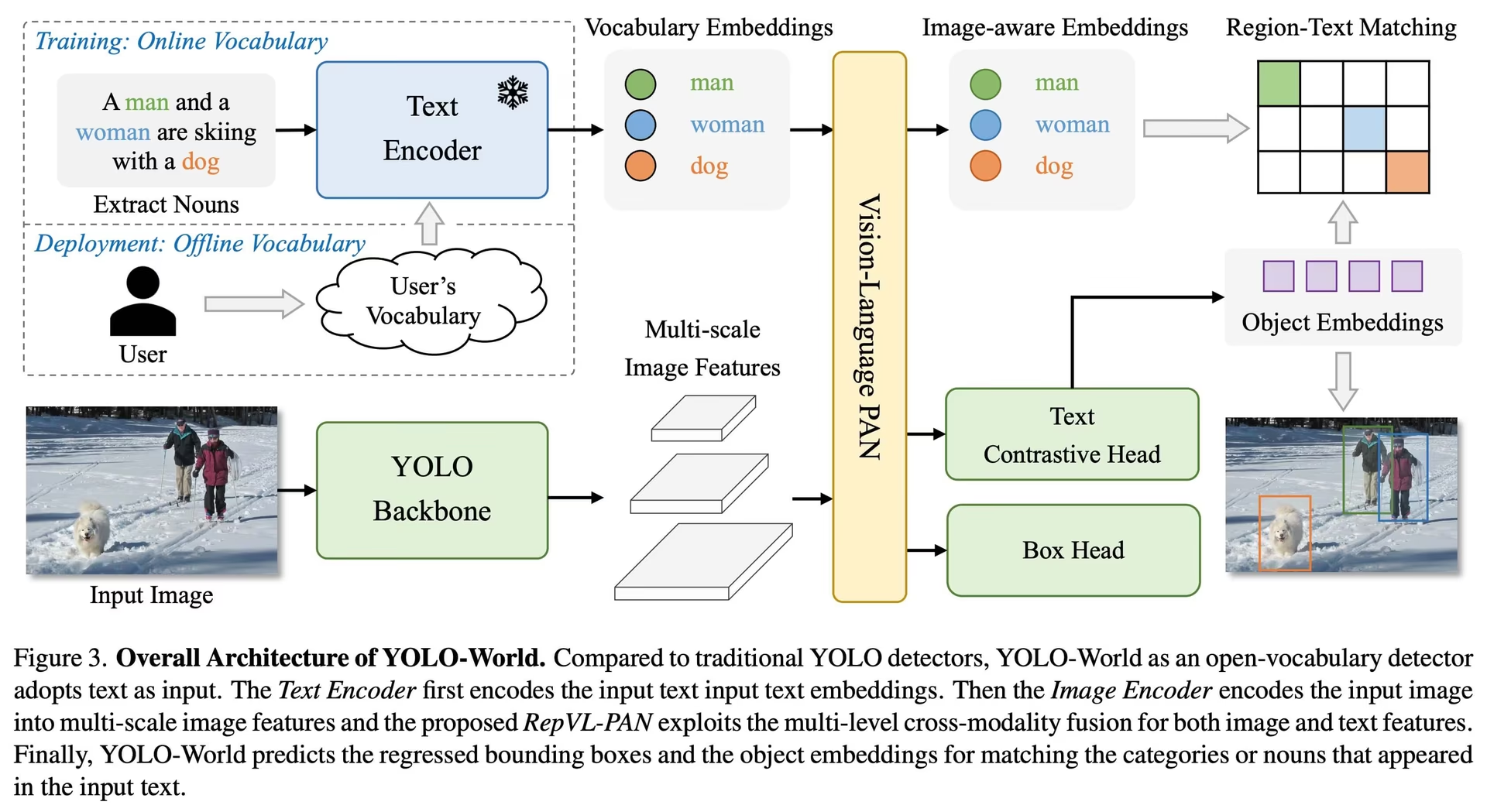
نظرة عامة#
يعالج YOLO-World تحديات نماذج الكشف التقليدية ذات المفردات المفتوحة، التي تعتمد غالبًا على نماذج Transformer ثقيلة تتطلب موارد حوسبة كبيرة. أما كواشف الفئات المغلقة، فتعتمد على فئات كائنات محددة مسبقًا، مما يحد من استخدامها في السيناريوهات الديناميكية. يوسّع YOLO-World إطار YOLOv8 ليشمل الكشف ذو المفردات المفتوحة، باستخدام نمذجة الرؤية واللغة والتدريب المسبق على مجموعات بيانات كبيرة للتعرّف بكفاءة على نطاق واسع من الكائنات في سيناريوهات التعلّم دون أمثلة.
للاستخدام بالمفردات المفتوحة عندما تحتاج أيضًا إلى أقنعة الكائنات أو المطالبات المرئية أو وضع خالٍ من المطالبات، راجع YOLOE، الذي يستخدم واجهة API نفسها set_classes().
الميزات الرئيسية#
-
حل آني: بُني YOLO-World على شبكات CNN السريعة، ويقدّم كشفًا ذا مفردات مفتوحة بسرعة تكفي للتطبيقات التي تتطلب نتائج فورية.
-
الكفاءة والأداء: يقلل YOLO-World متطلبات الحوسبة والموارد مع الحفاظ على الدقة، موفرًا بديلًا فعالًا لكواشف المفردات المفتوحة الأثقل المعتمدة على Transformer، ومتيحًا تطبيقات آنية.
-
الاستدلال باستخدام مفردات غير متصلة: يقدم YOLO-World استراتيجية «المطالبة ثم الكشف»، مستخدمًا مفردات غير متصلة لتحسين الكفاءة أكثر. يتيح هذا النهج استخدام مطالبات مخصصة تُحتسب مسبقًا، بما فيها التسميات التوضيحية أو الفئات، لترميزها وتخزينها كتضمينات للمفردات غير المتصلة، مما يبسط عملية الكشف.
-
مدعوم بـ YOLOv8: يستند YOLO-World إلى Ultralytics YOLOv8، ويكيّف بنية الكشف الآني فيه لتوفير كشف سريع ودقيق ذي مفردات مفتوحة.
-
تميز في المقاييس المرجعية: يتفوق YOLO-World على كواشف المفردات المفتوحة الحالية، بما فيها MDETR وسلسلة GLIP، من حيث السرعة والكفاءة في المقاييس المرجعية القياسية، وفقًا للقياس على وحدة GPU واحدة من NVIDIA V100.
-
تطبيقات متعددة الاستخدامات: تجعل كفاءة YOLO-World الكشف ذا المفردات المفتوحة عمليًا للعديد من مهام الرؤية، إذ يعمل بسرعة تفوق بكثير الأساليب السابقة ذات المفردات المفتوحة.
النماذج المتاحة والمهام المدعومة وأوضاع التشغيل#
يوضح هذا القسم النماذج المتاحة وأوزانها المحددة المدرّبة مسبقًا، والمهام التي تدعمها، وتوافقها مع أوضاع التشغيل المختلفة مثل التدريب والتحقق والاستدلال والتصدير، ويُشار إلى الأوضاع المدعومة بالرمز ✅ وغير المدعومة بالرمز ❌.
تُنقل جميع أوزان YOLOv8-World مباشرةً من مستودع YOLO-World الرسمي؛ ويعود الفضل فيها إلى مؤلفي المستودع.
| نوع النموذج | الأوزان المدرّبة مسبقاً | المهام المدعومة | التدريب | التحقق | الاستدلال | التصدير |
|---|---|---|---|---|---|---|
| YOLOv8s-world | yolov8s-world.pt | كشف الكائنات | ✅ | ✅ | ✅ | ❌ |
| YOLOv8s-worldv2 | yolov8s-worldv2.pt | كشف الكائنات | ✅ | ✅ | ✅ | ✅ |
| YOLOv8m-world | yolov8m-world.pt | كشف الكائنات | ✅ | ✅ | ✅ | ❌ |
| YOLOv8m-worldv2 | yolov8m-worldv2.pt | كشف الكائنات | ✅ | ✅ | ✅ | ✅ |
| YOLOv8l-world | yolov8l-world.pt | كشف الكائنات | ✅ | ✅ | ✅ | ❌ |
| YOLOv8l-worldv2 | yolov8l-worldv2.pt | كشف الكائنات | ✅ | ✅ | ✅ | ✅ |
| YOLOv8x-world | yolov8x-world.pt | كشف الكائنات | ✅ | ✅ | ✅ | ❌ |
| YOLOv8x-worldv2 | yolov8x-worldv2.pt | كشف الكائنات | ✅ | ✅ | ✅ | ✅ |
النقل دون تدريب مسبق على مجموعة بيانات COCO#
| نوع النموذج | mAP50-95 | mAP50 | mAP75 |
|---|---|---|---|
| yolov8s-world | 37.4 | 52.0 | 40.6 |
| yolov8s-worldv2 | 37.7 | 52.2 | 41.0 |
| yolov8m-world | 42.0 | 57.0 | 45.6 |
| yolov8m-worldv2 | 43.0 | 58.4 | 46.8 |
| yolov8l-world | 45.7 | 61.3 | 49.8 |
| yolov8l-worldv2 | 45.8 | 61.3 | 49.8 |
| yolov8x-world | 47.0 | 63.0 | 51.2 |
| yolov8x-worldv2 | 47.1 | 62.8 | 51.4 |
أمثلة الاستخدام#
توفر Ultralytics واجهة Python البرمجية وأوامر CLI لنماذج YOLO-World.
شاهد: أمثلة على استخدام نموذج YOLO-World مع Ultralytics | المفردات المفتوحة، بلا مطالبات، والمزيد
استخدام التدريب#
نوصي بشدة باستخدام yolov8-worldv2 للتدريب المخصص، لأنه يدعم التدريب الحتمي ويتيح التصدير بسهولة أكبر إلى تنسيقات مثل ONNX وTensorRT.
درّب نموذج كشف الكائنات YOLO-World باستخدام طريقة train، كما هو موضح أدناه على مجموعة البيانات COCO8 النموذجية:
يمكن تمرير نماذج *.pt المدربة مسبقًا من PyTorch، وكذلك ملفات الإعداد *.yaml، إلى الصنف YOLOWorld() لإنشاء مثيل نموذج في Python:
from ultralytics import YOLOWorld
# تحميل نموذج YOLOv8s-worldv2 مدرّب مسبقًا
model = YOLOWorld("yolov8s-worldv2.pt")
# تدريب النموذج على مجموعة بيانات المثال COCO8 لمدة 100 حقبة
results = model.train(data="coco8.yaml", epochs=100, imgsz=640)
# تشغيل الاستدلال باستخدام نموذج YOLO-World على الصورة 'bus.jpg'
results = model("path/to/bus.jpg")الاستخدام للتنبؤ#
نفّذ كشف الكائنات باستخدام طريقة predict، كما هو موضح أدناه:
from ultralytics import YOLOWorld
# تهيئة نموذج YOLO-World
model = YOLOWorld("yolov8s-world.pt") # أو اختر yolov8m/l-world.pt لأحجام مختلفة
# تنفيذ الاستدلال باستخدام نموذج YOLOv8s-world على الصورة المحددة
results = model.predict("path/to/image.jpg")
# عرض النتائج
results[0].show()يحمّل هذا المقتطف نموذجًا مدرّبًا مسبقًا وينفّذ التنبؤ على صورة.
الاستخدام للتحقق#
تحقّق من النموذج على مجموعة بيانات كما يلي:
from ultralytics import YOLO
# إنشاء نموذج YOLO-World
model = YOLO("yolov8s-world.pt") # أو اختر yolov8m/l-world.pt لأحجام مختلفة
# إجراء التحقق من صحة النموذج على مجموعة البيانات النموذجية COCO8
metrics = model.val(data="coco8.yaml")تتبُّع الاستخدام#
نفّذ تتبّع الكائنات باستخدام نموذج YOLO-World على مقاطع الفيديو أو الصور كما يلي:
from ultralytics import YOLO
# إنشاء نموذج YOLO-World
model = YOLO("yolov8s-world.pt") # أو اختر yolov8m/l-world.pt لأحجام مختلفة
# التتبّع باستخدام نموذج YOLO-World على فيديو
results = model.track(source="path/to/video.mp4")تأتي نماذج YOLO-World التي توفرها Ultralytics مهيّأة مسبقًا بفئات مجموعة بيانات COCO ضمن مفرداتها غير المتصلة، لذا فهي جاهزة للاستخدام فورًا. يتيح ذلك لنماذج YOLOv8-World التعرّف مباشرةً على الفئات القياسية الثمانين المحددة في مجموعة بيانات COCO والتنبؤ بها، من دون الحاجة إلى إعداد أو تخصيص إضافي.
تعيين المطالبات#
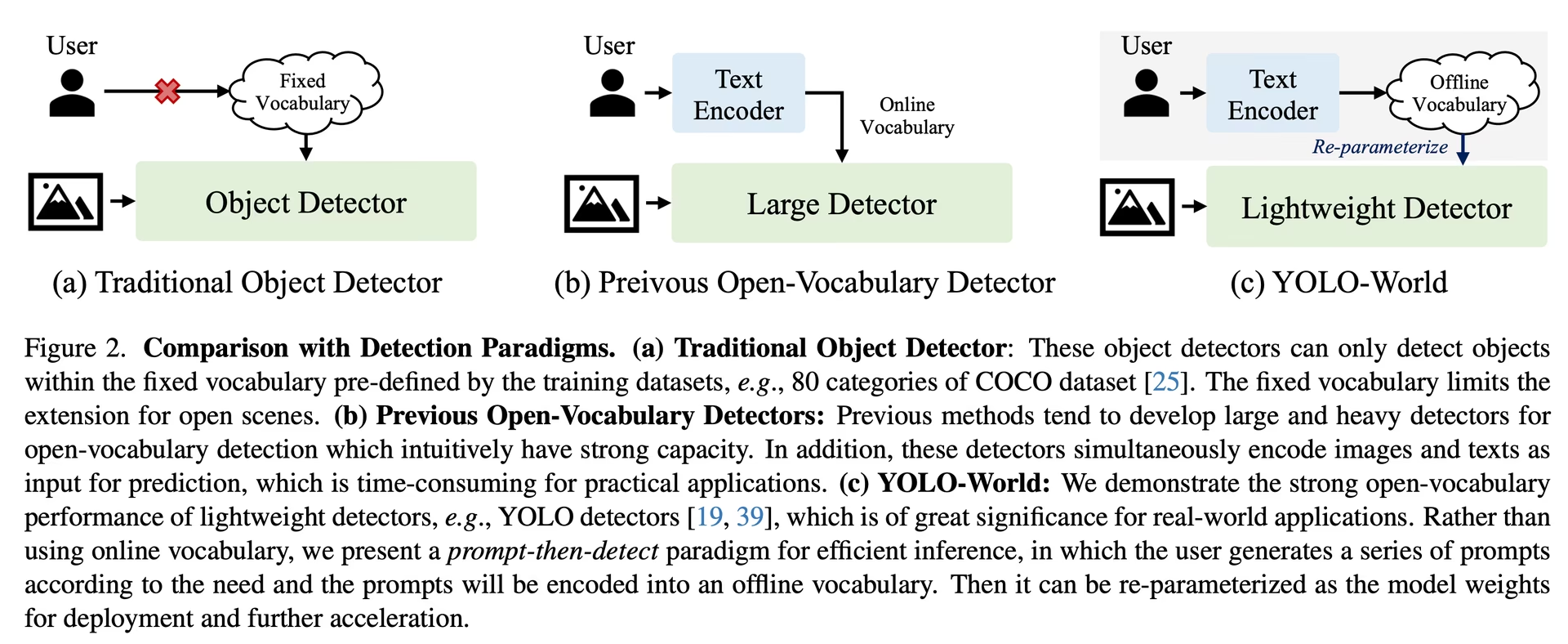
يتيح إطار YOLO-World تحديد الفئات ديناميكيًا عبر مطالبات مخصصة، مما يسمح للمستخدمين بمواءمة النموذج مع احتياجاتهم من دون إعادة التدريب. وتفيد هذه الميزة على نحو خاص في تكييف النموذج مع مجالات جديدة أو مهام محددة لم تكن ضمن بيانات التدريب الأصلية. ومن خلال تعيين مطالبات مخصصة، يوجّه المستخدمون النموذج نحو الكائنات موضع الاهتمام، مما يحسّن ملاءمة نتائج الكشف ودقتها.
على سبيل المثال، إذا كان تطبيقك يتطلب اكتشاف كائني «شخص» و«حافلة» فقط، فيمكنك تحديد هاتين الفئتين مباشرةً:
from ultralytics import YOLO
# تهيئة نموذج YOLO-World
model = YOLO("yolov8s-world.pt") # أو اختر yolov8m/l-world.pt
# تعريف فئات مخصصة
model.set_classes(["person", "bus"])
# تنفيذ التنبؤ للفئات المحددة في صورة
results = model.predict("path/to/image.jpg")
# عرض النتائج
results[0].show()وجد بعض المستخدمين أن إضافة سلسلة فارغة "" بوصفها فئة خلفية قد تحسّن أداء الكشف في بعض السيناريوهات. ويبدو أن هذا السلوك يعتمد على السيناريو، كما أن آليته الدقيقة غير مفهومة تمامًا:
model.set_classes(["person", "bus", ""])تبقى السلسلة الفارغة في model.names بوصفها فئة مستقلة، بما في ذلك أي نموذج تحفظه، ولذلك تظهر نتائج الكشف الخاصة بها بتسمية فارغة. مرّر classes=[0, 1] وقت التنبؤ للاحتفاظ بفئاتك الفعلية فقط.
يمكنك أيضًا حفظ نموذج بعد تعيين فئات مخصصة. وبذلك تنشئ إصدارًا من نموذج YOLO-World متخصصًا لحالة الاستخدام الخاصة بك. تدمج هذه العملية تعريفات الفئات المخصصة مباشرةً في ملف النموذج، ليصبح جاهزًا للاستخدام مع الفئات المحددة من دون أي تعديلات إضافية. اتبع الخطوات التالية لحفظ نموذج YOLO-World المخصص وتحميله:
حمّل أولًا نموذج YOLO-World، وعيّن له فئات مخصصة، ثم احفظه:
from ultralytics import YOLO
# تهيئة نموذج YOLO-World
model = YOLO("yolov8s-world.pt") # أو اختر yolov8m/l-world.pt
# تعريف فئات مخصصة
model.set_classes(["person", "bus"])
# حفظ النموذج مع المفردات غير المتصلة المحددة
model.save("custom_yolov8s.pt")بعد الحفظ، يعمل النموذج custom_yolov8s.pt مثل أي نموذج YOLOv8 مدرّب مسبقًا، مع اختلاف أساسي: أصبح الآن محسّنًا لاكتشاف الفئات التي عرّفتها فقط. ويمكن لهذا التخصيص تحسين أداء الكشف وكفاءته بدرجة كبيرة في سيناريوهات تطبيقك المحددة.
from ultralytics import YOLO
# تحميل نموذجك المخصص
model = YOLO("custom_yolov8s.pt")
# تشغيل الاستدلال لاكتشاف فئاتك المخصصة
results = model.predict("path/to/image.jpg")
# عرض النتائج
results[0].show()فوائد الحفظ باستخدام مفردات مخصصة#
- الكفاءة: تبسيط عملية الكشف من خلال التركيز على الكائنات ذات الصلة، وتقليل العبء الحسابي وتسريع الاستدلال.
- المرونة: تتيح تكييف النموذج بسهولة مع مهام الكشف الجديدة أو المتخصصة من دون الحاجة إلى إعادة تدريب موسعة أو جمع بيانات إضافية.
- البساطة: تبسيط النشر من خلال إلغاء الحاجة إلى تحديد الفئات المخصصة مرارًا عند التشغيل، مما يجعل النموذج قابلًا للاستخدام مباشرةً بمفرداته المضمّنة.
- الأداء: تعزيز دقة الكشف عن الفئات المحددة من خلال تركيز انتباه النموذج وموارده على التعرّف على الكائنات المعرّفة.
يتيح هذا النهج تخصيص نماذج كشف الكائنات لمهام محددة من دون إعادة التدريب، مما يجعل الكشف ذا المفردات المفتوحة عمليًا لنطاق أوسع من التطبيقات.
إعادة إنتاج النتائج الرسمية من الصفر (تجريبي)#
إعداد مجموعات البيانات#
- بيانات التدريب
| مجموعة البيانات | النوع | العينات | الصناديق | ملفات التعليقات التوضيحية |
|---|---|---|---|---|
| Objects365v1 | الكشف | 609k | 9621k | objects365_train.json |
| GQA | التأريض | 621k | 3681k | final_mixed_train_no_coco.json |
| Flickr30k | التأريض | 149k | 641k | final_flickr_separateGT_train.json |
- بيانات التحقق
| مجموعة البيانات | النوع | ملفات التعليقات التوضيحية |
|---|---|---|
| LVIS minival | الكشف | minival.txt |
بدء التدريب من الصفر#
جرى تخصيص WorldTrainerFromScratch بدرجة كبيرة للسماح بتدريب نماذج YOLO-World على مجموعات بيانات الكشف ومجموعات بيانات التأريض في الوقت نفسه.
from ultralytics import YOLOWorld
from ultralytics.models.yolo.world.train_world import WorldTrainerFromScratch
# الخيار 1: استخدام قاموس Python
data = {
"train": {
"yolo_data": ["Objects365.yaml"],
"grounding_data": [
{
"img_path": "flickr30k/images",
"json_file": "flickr30k/final_flickr_separateGT_train.json",
},
{
"img_path": "GQA/images",
"json_file": "GQA/final_mixed_train_no_coco.json",
},
],
},
"val": {"yolo_data": ["lvis.yaml"]},
}
# الخيار 2: استخدام ملف YAML (yolo_world_data.yaml)
# train:
# yolo_data:
# - Objects365.yaml
# grounding_data:
# - img_path: flickr/full_images/
# json_file: flickr/annotations/final_flickr_separateGT_train_segm.json
# - img_path: mixed_grounding/gqa/images
# json_file: mixed_grounding/annotations/final_mixed_train_no_coco_segm.json
# val:
# yolo_data:
# - lvis.yaml
model = YOLOWorld("yolov8s-worldv2.yaml")
model.train(
data=data, # أو data="yolo_world_data.yaml" عند استخدام ملف YAML
batch=128,
epochs=100,
trainer=WorldTrainerFromScratch,
)الاستشهادات والشكر والتقدير#
نتقدم بخالص الشكر إلى مركز الرؤية الحاسوبية في مختبر Tencent للذكاء الاصطناعي على عملهم الرائد في الكشف الفوري عن الكائنات بمفردات مفتوحة باستخدام YOLO-World:
@article{cheng2024yolow,
title={YOLO-World: Real-Time Open-Vocabulary Object Detection},
author={Cheng, Tianheng and Song, Lin and Ge, Yixiao and Liu, Wenyu and Wang, Xinggang and Shan, Ying},
journal={arXiv preprint arXiv:2401.17270},
year={2024}
}
لمزيد من القراءة، تتوفر ورقة YOLO-World الأصلية على arXiv. ويمكن الوصول إلى الشيفرة المصدرية للمشروع والموارد الإضافية عبر مستودع GitHub. ونقدّر التزامهم بتطوير هذا المجال ومشاركة رؤاهم القيّمة مع المجتمع.
الأسئلة الشائعة#
نموذج YOLO-World هو نهج آني لكشف الكائنات، يستند إلى إطار Ultralytics YOLOv8. وينفّذ الكشف ذا المفردات المفتوحة عبر تحديد الكائنات داخل الصورة استنادًا إلى نص وصفي. وباستخدام نمذجة الرؤية واللغة والتدريب المسبق على مجموعات بيانات كبيرة، يحقق YOLO-World كفاءة عالية مع خفض المتطلبات الحاسوبية، مما يجعله ملائمًا تمامًا للتطبيقات الآنية.
يدعم YOLO-World استراتيجية «المطالبة ثم الكشف»، التي تستخدم مفردات غير متصلة لتحسين الكفاءة. وتُرمّز المطالبات المخصصة، مثل التسميات التوضيحية أو فئات كائنات محددة، مسبقًا وتُخزّن كتضمينات للمفردات غير المتصلة. يبسط هذا النهج عملية الكشف من دون الحاجة إلى إعادة التدريب. ويمكنك تعيين هذه المطالبات ديناميكيًا داخل النموذج لمواءمته مع مهام كشف محددة، كما هو موضح أدناه:
from ultralytics import YOLOWorld # تهيئة نموذج YOLO-World model = YOLOWorld("yolov8s-world.pt") # تعريف فئات مخصصة model.set_classes(["person", "bus"]) # تنفيذ التنبؤ على صورة results = model.predict("path/to/image.jpg") # عرض النتائج results[0].show()يوفر YOLO-World عدة مزايا مقارنةً بنماذج الكشف التقليدية ذات المفردات المفتوحة:
- أداء آني: يستخدم شبكات CNN سريعة للكشف بسرعة وكفاءة.
- الكفاءة وانخفاض متطلبات الموارد: يحافظ YOLO-World على أداء مرتفع مع تقليل متطلبات الحوسبة والموارد بدرجة كبيرة.
- المطالبات القابلة للتخصيص: يدعم النموذج تعيين المطالبات ديناميكيًا، مما يتيح للمستخدمين تحديد فئات كشف مخصصة من دون إعادة تدريب.
- التميز في المعايير المرجعية: يتفوق على كواشف المفردات المفتوحة الأخرى، مثل MDETR وGLIP، من حيث السرعة والكفاءة في المعايير المرجعية القياسية.
درّب نموذج YOLO-World على مجموعة بياناتك باستخدام واجهة Python البرمجية أو CLI. إليك كيفية بدء التدريب باستخدام Python:
from ultralytics import YOLOWorld # تحميل نموذج YOLOv8s-worldv2 مدرّب مسبقًا model = YOLOWorld("yolov8s-worldv2.pt") # تدريب النموذج على مجموعة بيانات COCO8 لمدة 100 حقبة results = model.train(data="coco8.yaml", epochs=100, imgsz=640)أو باستخدام CLI:
yolo train model=yolov8s-worldv2.pt data=coco8.yaml epochs=100 imgsz=640توفّر Ultralytics عدة نماذج YOLO-World مدرّبة مسبقًا، تدعم مهامًا وأوضاع تشغيل متنوعة:
نوع النموذج الأوزان المدرّبة مسبقاً المهام المدعومة التدريب التحقق الاستدلال التصدير YOLOv8s-world yolov8s-world.pt كشف الكائنات ✅ ✅ ✅ ❌ YOLOv8s-worldv2 yolov8s-worldv2.pt كشف الكائنات ✅ ✅ ✅ ✅ YOLOv8m-world yolov8m-world.pt كشف الكائنات ✅ ✅ ✅ ❌ YOLOv8m-worldv2 yolov8m-worldv2.pt كشف الكائنات ✅ ✅ ✅ ✅ YOLOv8l-world yolov8l-world.pt كشف الكائنات ✅ ✅ ✅ ❌ YOLOv8l-worldv2 yolov8l-worldv2.pt كشف الكائنات ✅ ✅ ✅ ✅ YOLOv8x-world yolov8x-world.pt كشف الكائنات ✅ ✅ ✅ ❌ YOLOv8x-worldv2 yolov8x-worldv2.pt كشف الكائنات ✅ ✅ ✅ ✅ لإعادة إنتاج النتائج الرسمية من البداية، عليك تجهيز مجموعات البيانات وبدء التدريب باستخدام الشيفرة المقدّمة. يتضمن إجراء التدريب إنشاء قاموس بيانات وتشغيل طريقة
trainباستخدام مدرّب مخصّص:from ultralytics import YOLOWorld from ultralytics.models.yolo.world.train_world import WorldTrainerFromScratch data = { "train": { "yolo_data": ["Objects365.yaml"], "grounding_data": [ { "img_path": "flickr30k/images", "json_file": "flickr30k/final_flickr_separateGT_train.json", }, { "img_path": "GQA/images", "json_file": "GQA/final_mixed_train_no_coco.json", }, ], }, "val": {"yolo_data": ["lvis.yaml"]}, } model = YOLOWorld("yolov8s-worldv2.yaml") model.train(data=data, batch=128, epochs=100, trainer=WorldTrainerFromScratch)


التعليقات244
اطرح سؤالًا، وشارك نتائجك، أو ساعد شخصًا آخر.
IamShubhamGupto
Authors of yolo world released instructions to fine tune their models, would that be supported by ultralytics? if so id like to contribute - https://github.com/AILab-CVC/YOLO-World/blob/master/docs/finetuning.md
5 Paula DerrengerUltralytics(تم التعديل)
@IamShubhamGupto hey there! 👋
Absolutely, we're all for community contributions. Training is supported for YOLO-World models in Ultralytics (we recommend
yolov8*-worldv2.ptfor custom training), see the Train Usage section of the YOLO-World docs:from ultralytics import YOLOWorld model = YOLOWorld("yolov8s-worldv2.pt") model.train(data="coco8.yaml", epochs=100, imgsz=640)If you'd like to add parts of the authors' fine-tuning workflow that aren't covered yet, fork the repo, make your changes, and submit a pull request. Happy coding! 😊👨💻
2woerstcase
If I get you right you thinking in a use like this? https://supervision.roboflow.com/develop/notebooks/zero-shot-object-detection-with-yolo-world/#filtering-detectuions-by-area
- Paula DerrengerUltralytics(تم التعديل)
Hey there! 👋
Yes, you're on the right track! The example you've linked from Roboflow demonstrates filtering detections by area, which is indeed supported by Ultralytics YOLO models. You can achieve similar functionality by manipulating the
resultsobject after prediction to filter out detections based on their bounding box area or any other criteria you prefer.Here's a quick example of how you might do that:
from ultralytics import YOLO

# Load a pretrained YOLO26 model
model = YOLO('yolo26n.pt')

# Perform object detection on an image
results = model('path/to/image.jpg')

# Filter detections by bounding box area (e.g., area > 1000 pixels)
filtered_results = [det for det in results[0].boxes.xyxy if (det[2] - det[0]) * (det[3] - det[1]) > 1000]

# Do something with filtered_results
Hope this helps! If you have more questions or need further assistance, feel free to ask. Happy coding! 😊🚀
2 sbsbsbsbcccc
@IamShubhamGupto嗨呀!👋
当然,我们全力支持社区贡献和对 YOLO-World 等微调模型的支持。如果你有兴趣做出贡献,那就太好了!🌟
请注意,虽然我们支持各种 YOLOv8 任务和模式,但
yolov8*-world.pt目前不支持 YOLO-World 模型 ( ) 的训练模式。不过,您仍然可以使用预先训练的权重进行推理和验证。如果您有与我们现有框架兼容的特定微调流程,我们很乐意看到您的成果!请随意分叉存储库,进行更改,然后提交拉取请求。如果您需要任何帮助或在此过程中有疑问,请随时提出。
祝你编码愉快!😊👨💻
你好,大佬,我想使用mixgrouding数据集和我自己定义的封闭数据集交叉训练,你有具体的mixgrouding数据集配置教程吗data = { "train": { "yolo_data": ["Objects365.yaml"], "grounding_data": [ { "img_path": "../datasets/GQA/images", "json_file": "../datasets/GQA/final_mixed_train_no_coco.json", }, ], }, }
model = YOLOWorld("yolov8s-worldv2.yaml")这几个yaml文件哪里可以找到?
meidachen
Thanks for the great work! I'm wondering which training data has been used for yolov8x-worldv2 model? The model on the official site has "YOLO-Worldv2-X" trained on O365+GoldG+CC3M-Lite, are the training data the same as from here?
2 Glenn JocherUltralytics
@meidachen thank you for your kind words! 😊
The YOLOv8x-worldv2 model has indeed been trained on a combination of datasets, specifically Objects365, GoldG, and CC3M-Lite. This diverse training data helps the model excel in open-vocabulary detection tasks by leveraging a wide variety of object categories and contexts.
If you have any further questions or need additional details, feel free to ask. For more information on the YOLO-World model, you can also visit our YOLO-World documentation.
Happy experimenting! 🚀
Dragosjosan
The model performance of the Yolo World Hugging Face model (https://huggingface.co/spaces/stevengrove/YOLO-World) is better for my purpose than the standard inference one "YOLOv8x-worldv2" for example.
Because my lack of domain knowledge regarding this topics I can't make the HF model work on my Mac (not an M processor) so I would like to be able to use the model weights with the abstraction from the ultralytics library.
Is there any way to use the author's provided weights together with the inference library? For example: model = YOLOWorld('yolow-v8_l_clipv2_frozen_t2iv2_bn_o365_goldg_pretrain.pth')
From the author's instruction on how to run the model on an image one needs the configuration file and the weights: https://github.com/AILab-CVC/YOLO-World
The conf file I want to use and the weights are available here: https://huggingface.co/spaces/stevengrove/YOLO-World/blob/main/configs/pretrain/yolo_world_l_t2i_bn_2e-4_100e_4x8gpus_obj365v1_goldg_train_lvis_minival.py https://huggingface.co/spaces/stevengrove/YOLO-World/blob/main/yolow-v8_l_clipv2_frozen_t2iv2_bn_o365_goldg_pretrain.pth
Thank you in advance :)
1- Paula DerrengerUltralytics(تم التعديل)
Hey there! 😊 Thanks for reaching out with your query.
Loading the original authors'
.pthweights and.pyconfig file into Ultralytics isn't supported:YOLOWorld()accepts Ultralytics.ptweights or.yamlmodel files only, and the architectures and weight names differ. Use the weights provided by Ultralytics instead, for exampleyolov8x-worldv2.pt:from ultralytics import YOLOWorld model = YOLOWorld("yolov8x-worldv2.pt") results = model.predict("path/to/image.jpg")Results can differ from the Hugging Face demo because of different weights, preprocessing and settings such as
confandimgsz. If you got any more questions, feel free to ask. 🚀 Hey @pderrenger,
Thanks your for answering my request! :)
The "8.1.42" ultralytics Version doesn't have an 'config' instance attribute, so I the provided code snippet raises an error.
YOLOWorld.__init__() got an unexpected keyword argument 'config'Do you suppose I'm doing something wrong?
Thanks again 👍
- Paula DerrengerUltralytics
@Dragosjosan hey there! 😊 It looks like there was a slight misunderstanding regarding model initialization with a 'config' attribute. The
YOLOWorldclass and the way to load pre-trained models or weights with a specific configuration don't directly support an 'config' attribute as part of the initialization process in the Ultralytics YOLOv8's current implementation.For using a model with specific weights, here's the correct approach:
from ultralytics import YOLO

# Load the model using pre-trained weights
model = YOLO('path/to/your/yolov8s-worldv2.pt')  # Example model

# Now, you can use this model for inference, training, etc.
# Example for inference
results = model.predict('path/to/image.jpg')
results[0].show()
If you're trying to integrate configurations that don't directly map to the pre-trained models provided by Ultralytics, it would usually involve modifying the model's architecture or training process, which is a bit more involved and typically done within the Python scripts or notebooks rather than through the CLI.
I hope this clears things up! If you have any more questions or need further help, feel free to ask. 👍
@pderrenger thank you again for your answer.
Since we don't have the expected
model.ptexpected by the YOLO class, is there any way to convert the Hugging Facehf_model.pth?- Paula DerrengerUltralytics(تم التعديل)
Hey @Dragosjosan! 😊
Directly loading or converting external
.pthweights (such as the Hugging Face ones) into the Ultralytics framework isn't supported, since the model architectures and weight naming conventions differ. Please use the weights provided by Ultralytics, for exampleyolov8x-worldv2.pt.Hope this helps! 🚀
Hey @pderrenger,
Thank you!
- Paula DerrengerUltralytics
Hey there! 🌟
Thank you for sharing your interest and enthusiasm! 🚀 To directly address your query, here's a concise example showing how to perform inferential tasks using the pre-trained YOLO-World models with our Python API:
from ultralytics import YOLO

# Load a pre-trained YOLO-World model (e.g., yolov8s-worldv2.pt for object detection)
model = YOLO('yolov8s-worldv2.pt')

# Run inference on an image
results = model.predict('path/to/image.jpg')

# Visualize and/or process the inference results
results[0].show()  # Displays the image with detections
This snippet loads a YOLO-World model, performs object detection on a specified image, and then visualizes the results. For different tasks or models, simply change the model filename (e.g.,
yolov8m-worldv2.pt).If you're keen on training or further customizing the model, remember that the v2 models (
yolov8*-worldv2.pt) support export for deployment. Just ensure you follow the documentation closely for the best outcomes!Feel free to reach out for more help or share your progress! Happy coding! 😊
tpsvoets
Hey @Dragosjosan, did you have any success getting the .pth file to work? I am not sure why it is suggested to use a config, while that is currently not supported. And I also don't understand the latest reply by @pderrenger?
Hi @tpsvoets ,
not with the ultralytics library, no.
Some of the answers might be auto-generated I guess. Long story short: they don't support it. If you want to convert it to .pt you need to figure it out on your own with pytorch and then also adapt this .pt to the ultralytics configuration.
Are you also interested in the topic?
junnnnchi
Hey @Dragosjosan I am also interested in this topic, did you figure out how to convert .pth to .pt?
Hey @junnnnchi,
no, sorry. How do you plan on tackling this problem? Maybe we can figure it out together.
@Dragosjosan ah too bad, it's a shame we cannot get any network file to work with the code. Right now it remains unknown for me how the two demos can differ quite so much. Do we know if the architecture is the same, so if the .pth to .pt conversion works that it will result in something that actually works?
@Dragosjosan I used the roboflow's implementation for YOLO-World. This version gives better results for my project. You might consider this.
@junnnnchi for my application the model from Hugging Face works best... But good that you found something that works. May I ask what your App do? :)
mustfkeskin
Has anyone solved this problem? 🤗
How can I integrate the above mentioned files into the ultralytics library. I liked the model results better when working on Huggingface. I noticed that the model size used on Huggingface is a bit bigger size
The conf file I want to use and the weights are available here: https://huggingface.co/spaces/stevengrove/YOLO-World/blob/main/configs/pretrain/yolo_world_l_t2i_bn_2e-4_100e_4x8gpus_obj365v1_goldg_train_lvis_minival.py https://huggingface.co/spaces/stevengrove/YOLO-World/blob/main/yolow-v8_l_clipv2_frozen_t2iv2_bn_o365_goldg_pretrain.pth
- Glenn JocherUltralytics
@mustfkeskin unfortunately, integrating the specific .pth weights with the Ultralytics library isn't directly supported. You might need to convert the weights to a compatible format like .pt and adjust configurations manually. For further guidance, consider exploring PyTorch documentation or community forums.
-1
venuss920
Hi, guys, if we set and fine-tune our own dataset to fine-tune the model, then while fine-tuning the YOLO-World model, it will also learn text prompts while learning object detection as well?
- Paula DerrengerUltralytics
Fine-tuning on a standard detection dataset trains YOLO-World to associate visual features with your dataset’s class-name text embeddings; it does not learn arbitrary new prompts as separate annotations or generally train the text encoder. For richer phrase grounding, training requires paired grounding data rather than only YOLO detection labels; see the YOLO-World training reference.
feekyzz
为什么会出现单卡训练跑通train 但是多卡会出现类别和grounding之间不匹配的现象? Why does training run normally on a single GPU, but when using multiple GPUs, there is a mismatch between the nc and the grounding annotations?
- Glenn JocherUltralytics
多卡下这类
nc与 grounding 标注不匹配通常更像是 DDP 进程读到了不一致的data配置、*.cache或混合安装环境,而不是单纯类别数设置问题;请先确认你是按 YOLO-World 训练示例 使用yolov8*-worldv2和WorldTrainerFromScratch,然后把完整 traceback、你的多卡启动命令,以及ultralytics.utils.checks.collect_system_info()的输出贴在这里,如果最近改过标签或数据集结构,也请先删除labels目录下的*.cache后再试。 感谢您的答复,我按照你的建议,删除了*.cache,确认了完全按照示例使用。
这是我的train.py
from ultralytics import YOLOWorld
from ultralytics.models.yolo.world.train_world import WorldTrainerFromScratch

# Option 1: Use Python dictionary
data = dict(
    train=dict(
        yolo_data=["/home/qh1/Qwen/Yw/ultralytics-Yw/datasets/Objects365.yaml"],
        grounding_data=[
            dict(
                img_path="/home/qh1/Qwen/Yw/ultralytics-Yw/datasets/flickr30k/images",
                json_file="/home/qh1/Qwen/Yw/ultralytics-Yw/datasets/flickr30k/final_flickr_separateGT_train.json",
            ),
            dict(
                img_path="/home/qh1/Qwen/Yw/ultralytics-Yw/datasets/gqa/images",
                json_file="/home/qh1/Qwen/Yw/ultralytics-Yw/datasets/gqa/final_mixed_train_no_coco.json",
            ),
        ],
    ),
    val=dict(yolo_data=["/home/qh1/Qwen/Yw/ultralytics-Yw/datasets/lvis.yaml"]),
)
model = YOLOWorld("yolov8-worldv2.yaml")
model.train(
    data=data,
    batch=256,
    epochs=10,
    trainer=WorldTrainerFromScratch,
    workers=16,
    device=[0,2],
    name="Base-v8-worldv2",
)
这是我的训练脚本.sh
#!/bin/bash
# Stable RTDETR multi-GPU training script

# 设置使用的物理 GPU
export CUDA_VISIBLE_DEVICES=0,2

# NCCL / DDP 稳定性环境变量
export NCCL_DEBUG=INFO
export NCCL_IB_DISABLE=1
export NCCL_P2P_DISABLE=1
export TORCH_NCCL_BLOCKING_WAIT=1
export TORCH_NCCL_ASYNC_ERROR_HANDLING=1

# 设置随机 master port 避免冲突
PORT=$(shuf -i 25000-30000 -n 1)
echo "Using master port: $PORT"

# 创建日志文件
LOG_FILE="z-train2-02.log"
touch $LOG_FILE

# 后台运行训练
nohup python -u z-train2.py \
    --device 0 2 \
    --master_port $PORT \
    > $LOG_FILE 2>&1 &

echo "Training started, logging to $LOG_FILE"
echo "Use 'tail -f $LOG_FILE' to watch progress"
这是我的collect_system_info()输出
Ultralytics 8.3.229 🚀 Python-3.8.20 torch-2.1.0 CUDA:0 (NVIDIA H100 PCIe, 81089MiB)
Setup complete ✅ (128 CPUs, 503.5 GB RAM, 3277.3/24934.1 GB disk)

OS                     Linux-6.8.0-101-generic-x86_64-with-glibc2.17
Environment            Linux
Python                 3.8.20
Install                pip
Path                   /home/qh1/Qwen/Yw/ultralytics-Yw/ultralytics
RAM                    503.51 GB
Disk                   3277.3/24934.1 GB
CPU                    INTEL XEON GOLD 6530
CPU count              128
GPU                    NVIDIA H100 PCIe, 81089MiB
GPU count              8
CUDA                   12.1

numpy                  ✅ 1.24.3>=1.23.0
matplotlib             ✅ 3.7.5>=3.3.0
opencv-python          ✅ 4.13.0.92>=4.6.0
pillow                 ✅ 10.4.0>=7.1.2
pyyaml                 ✅ 6.0.2>=5.3.1
requests               ✅ 2.28.2>=2.23.0
scipy                  ✅ 1.10.1>=1.4.1
torch                  ✅ 2.1.0>=1.8.0
torch                  ✅ 2.1.0!=2.4.0,>=1.8.0; sys_platform == "win32"
torchvision            ✅ 0.16.0>=0.9.0
psutil                 ✅ 7.2.2>=5.8.0
polars                 ✅ 1.8.2>=0.20.0
ultralytics-thop       ✅ 2.0.18>=2.0.18
{'OS': 'Linux-6.8.0-101-generic-x86_64-with-glibc2.17', 'Environment': 'Linux', 'Python': '3.8.20', 'Install': 'pip', 'Path': '/home/qh1/Qwen/Yw/ultralytics-Yw/ultralytics', 'RAM': '503.51 GB', 'Disk': '3277.3/24934.1 GB', 'CPU': 'INTEL XEON GOLD 6530', 'CPU count': 128, 'GPU': 'NVIDIA H100 PCIe, 81089MiB', 'GPU count': 8, 'CUDA': '12.1', 'Package Info': {'numpy': '✅ 1.24.3>=1.23.0', 'matplotlib': '✅ 3.7.5>=3.3.0', 'opencv-python': '✅ 4.13.0.92>=4.6.0', 'pillow': '✅ 10.4.0>=7.1.2', 'pyyaml': '✅ 6.0.2>=5.3.1', 'requests': '✅ 2.28.2>=2.23.0', 'scipy': '✅ 1.10.1>=1.4.1', 'torch': '✅ 2.1.0!=2.4.0,>=1.8.0; sys_platform == "win32"', 'torchvision': '✅ 0.16.0>=0.9.0', 'psutil': '✅ 7.2.2>=5.8.0', 'polars': '✅ 1.8.2>=0.20.0', 'ultralytics-thop': '✅ 2.0.18>=2.0.18'}}
这是我的报错日志
Traceback (most recent call last): File "/home/qh1/Qwen/Yw/yw_env/lib/python3.8/site-packages/ultralytics/engine/validator.py", line 227, in __call__ self.loss += model.loss(batch, preds)[1] File "/home/qh1/Qwen/Yw/yw_env/lib/python3.8/site-packages/ultralytics/nn/tasks.py", line 977, in loss return self.criterion(preds, batch) File "/home/qh1/Qwen/Yw/yw_env/lib/python3.8/site-packages/ultralytics/utils/loss.py", line 463, in __call__ return self.loss(self.parse_output(preds), batch) File "/home/qh1/Qwen/Yw/yw_env/lib/python3.8/site-packages/ultralytics/utils/loss.py", line 468, in loss loss, loss_detach = self.get_assigned_targets_and_loss(preds, batch)[1:] File "/home/qh1/Qwen/Yw/yw_env/lib/python3.8/site-packages/ultralytics/utils/loss.py", line 414, in get_assigned_targets_and_loss _, target_bboxes, target_scores, fg_mask, target_gt_idx = self.assigner( File "/home/qh1/Qwen/Yw/yw_env/lib/python3.8/site-packages/torch/nn/modules/module.py", line 1518, in _wrapped_call_impl return self._call_impl(*args, **kwargs) File "/home/qh1/Qwen/Yw/yw_env/lib/python3.8/site-packages/torch/nn/modules/module.py", line 1527, in _call_impl return forward_call(*args, **kwargs) File "/home/qh1/Qwen/Yw/yw_env/lib/python3.8/site-packages/torch/utils/_contextlib.py", line 115, in decorate_context return func(*args, **kwargs) File "/home/qh1/Qwen/Yw/yw_env/lib/python3.8/site-packages/ultralytics/utils/tal.py", line 98, in forward return self._forward(pd_scores, pd_bboxes, anc_points, gt_labels, gt_bboxes, mask_gt) File "/home/qh1/Qwen/Yw/yw_env/lib/python3.8/site-packages/ultralytics/utils/tal.py", line 126, in _forward mask_pos, align_metric, overlaps = self.get_pos_mask( File "/home/qh1/Qwen/Yw/yw_env/lib/python3.8/site-packages/ultralytics/utils/tal.py", line 164, in get_pos_mask align_metric, overlaps = self.get_box_metrics(pd_scores, pd_bboxes, gt_labels, gt_bboxes, mask_in_gts * mask_gt) File "/home/qh1/Qwen/Yw/yw_env/lib/python3.8/site-packages/ultralytics/utils/tal.py", line 195, in get_box_metrics bbox_scores[mask_gt] = pd_scores[ind[0], :, ind[1]][mask_gt] # b, max_num_obj, h*w RuntimeError: CUDA error: device-side assert triggered CUDA kernel errors might be asynchronously reported at some other API call, so the stacktrace below might be incorrect. For debugging consider passing CUDA_LAUNCH_BLOCKING=1. Compile with `TORCH_USE_CUDA_DSA` to enable device-side assertions. During handling of the above exception, another exception occurred: Traceback (most recent call last): File "/home/qh1/.config/Ultralytics/DDP/_temp_jzzt2g3g140562231208544.py", line 13, in <module> results = trainer.train() File "/home/qh1/Qwen/Yw/ultralytics-Yw/ultralytics/engine/trainer.py", line 246, in train self._do_train() File "/home/qh1/Qwen/Yw/ultralytics-Yw/ultralytics/engine/trainer.py", line 520, in _do_train self.metrics, self.fitness = self.validate() File "/home/qh1/Qwen/Yw/ultralytics-Yw/ultralytics/engine/trainer.py", line 752, in validate metrics = self.validator(self) File "/home/qh1/Qwen/Yw/yw_env/lib/python3.8/site-packages/torch/utils/_contextlib.py", line 115, in decorate_context return func(*args, **kwargs) File "/home/qh1/Qwen/Yw/yw_env/lib/python3.8/site-packages/ultralytics/engine/validator.py", line 227, in __call__ self.loss += model.loss(batch, preds)[1] File "/home/qh1/Qwen/Yw/yw_env/lib/python3.8/site-packages/ultralytics/utils/ops.py", line 59, in __exit__ self.dt = self.time() - self.start # delta-time File "/home/qh1/Qwen/Yw/yw_env/lib/python3.8/site-packages/ultralytics/utils/ops.py", line 69, in time torch.cuda.synchronize(self.device) File "/home/qh1/Qwen/Yw/yw_env/lib/python3.8/site-packages/torch/cuda/__init__.py", line 783, in synchronize return torch._C._cuda_synchronize() RuntimeError: CUDA error: device-side assert triggered CUDA kernel errors might be asynchronously reported at some other API call, so the stacktrace below might be incorrect. For debugging consider passing CUDA_LAUNCH_BLOCKING=1. Compile with `TORCH_USE_CUDA_DSA` to enable device-side assertions. [E ProcessGroupNCCL.cpp:915] [Rank 1] NCCL watchdog thread terminated with exception: CUDA error: device-side assert triggered CUDA kernel errors might be asynchronously reported at some other API call, so the stacktrace below might be incorrect. For debugging consider passing CUDA_LAUNCH_BLOCKING=1. Compile with `TORCH_USE_CUDA_DSA` to enable device-side assertions. Exception raised from c10_cuda_check_implementation at /opt/conda/conda-bld/pytorch_1695392036766/work/c10/cuda/CUDAException.cpp:44 (most recent call first): frame #0: c10::Error::Error(c10::SourceLocation, std::string) + 0x57 (0x7a2ad6d91617 in /home/qh1/Qwen/Yw/yw_env/lib/python3.8/site-packages/torch/lib/libc10.so) frame #1: c10::detail::torchCheckFail(char const*, char const*, unsigned int, std::string const&) + 0x64 (0x7a2ad6d4c98d in /home/qh1/Qwen/Yw/yw_env/lib/python3.8/site-packages/torch/lib/libc10.so) frame #2: c10::cuda::c10_cuda_check_implementation(int, char const*, char const*, int, bool) + 0x118 (0x7a2ada9939f8 in /home/qh1/Qwen/Yw/yw_env/lib/python3.8/site-packages/torch/lib/libc10_cuda.so) frame #3: c10d::ProcessGroupNCCL::WorkNCCL::finishedGPUExecutionInternal() const + 0x80 (0x7a2a41b46790 in /home/qh1/Qwen/Yw/yw_env/lib/python3.8/site-packages/torch/lib/libtorch_cuda.so) frame #4: c10d::ProcessGroupNCCL::WorkNCCL::isCompleted() + 0x58 (0x7a2a41b4a5b8 in /home/qh1/Qwen/Yw/yw_env/lib/python3.8/site-packages/torch/lib/libtorch_cuda.so) frame #5: c10d::ProcessGroupNCCL::workCleanupLoop() + 0x24b (0x7a2a41b60dfb in /home/qh1/Qwen/Yw/yw_env/lib/python3.8/site-packages/torch/lib/libtorch_cuda.so) frame #6: c10d::ProcessGroupNCCL::ncclCommWatchdog() + 0x78 (0x7a2a41b61108 in /home/qh1/Qwen/Yw/yw_env/lib/python3.8/site-packages/torch/lib/libtorch_cuda.so) frame #7: <unknown function> + 0xdf0e6 (0x7a2ad7c0a0e6 in /home/qh1/Qwen/Yw/yw_env/bin/../lib/libstdc++.so.6) frame #8: <unknown function> + 0x94ac3 (0x7a2af4294ac3 in /lib/x86_64-linux-gnu/libc.so.6) frame #9: <unknown function> + 0x1268d0 (0x7a2af43268d0 in /lib/x86_64-linux-gnu/libc.so.6) terminate called after throwing an instance of 'std::runtime_error' what(): [Rank 1] NCCL watchdog thread terminated with exception: CUDA error: device-side assert triggered CUDA kernel errors might be asynchronously reported at some other API call, so the stacktrace below might be incorrect. For debugging consider passing CUDA_LAUNCH_BLOCKING=1. Compile with `TORCH_USE_CUDA_DSA` to enable device-side assertions. Exception raised from c10_cuda_check_implementation at /opt/conda/conda-bld/pytorch_1695392036766/work/c10/cuda/CUDAException.cpp:44 (most recent call first): frame #0: c10::Error::Error(c10::SourceLocation, std::string) + 0x57 (0x7a2ad6d91617 in /home/qh1/Qwen/Yw/yw_env/lib/python3.8/site-packages/torch/lib/libc10.so) frame #1: c10::detail::torchCheckFail(char const*, char const*, unsigned int, std::string const&) + 0x64 (0x7a2ad6d4c98d in /home/qh1/Qwen/Yw/yw_env/lib/python3.8/site-packages/torch/lib/libc10.so) frame #2: c10::cuda::c10_cuda_check_implementation(int, char const*, char const*, int, bool) + 0x118 (0x7a2ada9939f8 in /home/qh1/Qwen/Yw/yw_env/lib/python3.8/site-packages/torch/lib/libc10_cuda.so) frame #3: c10d::ProcessGroupNCCL::WorkNCCL::finishedGPUExecutionInternal() const + 0x80 (0x7a2a41b46790 in /home/qh1/Qwen/Yw/yw_env/lib/python3.8/site-packages/torch/lib/libtorch_cuda.so) frame #4: c10d::ProcessGroupNCCL::WorkNCCL::isCompleted() + 0x58 (0x7a2a41b4a5b8 in /home/qh1/Qwen/Yw/yw_env/lib/python3.8/site-packages/torch/lib/libtorch_cuda.so) frame #5: c10d::ProcessGroupNCCL::workCleanupLoop() + 0x24b (0x7a2a41b60dfb in /home/qh1/Qwen/Yw/yw_env/lib/python3.8/site-packages/torch/lib/libtorch_cuda.so) frame #6: c10d::ProcessGroupNCCL::ncclCommWatchdog() + 0x78 (0x7a2a41b61108 in /home/qh1/Qwen/Yw/yw_env/lib/python3.8/site-packages/torch/lib/libtorch_cuda.so) frame #7: <unknown function> + 0xdf0e6 (0x7a2ad7c0a0e6 in /home/qh1/Qwen/Yw/yw_env/bin/../lib/libstdc++.so.6) frame #8: <unknown function> + 0x94ac3 (0x7a2af4294ac3 in /lib/x86_64-linux-gnu/libc.so.6) frame #9: <unknown function> + 0x1268d0 (0x7a2af43268d0 in /lib/x86_64-linux-gnu/libc.so.6) WARNING ⚠️ CUDA OutOfMemoryError in TaskAlignedAssigner, using CPU [2026-04-21 22:14:56,796] torch.distributed.elastic.multiprocessing.api: [WARNING] Sending process 2677721 closing signal SIGTERM [2026-04-21 22:15:02,669] torch.distributed.elastic.multiprocessing.api: [ERROR] failed (exitcode: -6) local_rank: 1 (pid: 2677722) of binary: /home/qh1/Qwen/Yw/yw_env/bin/python Traceback (most recent call last): File "/home/qh1/Qwen/Yw/yw_env/lib/python3.8/runpy.py", line 194, in _run_module_as_main return _run_code(code, main_globals, None, File "/home/qh1/Qwen/Yw/yw_env/lib/python3.8/runpy.py", line 87, in _run_code exec(code, run_globals) File "/home/qh1/Qwen/Yw/yw_env/lib/python3.8/site-packages/torch/distributed/run.py", line 810, in <module> main() File "/home/qh1/Qwen/Yw/yw_env/lib/python3.8/site-packages/torch/distributed/elastic/multiprocessing/errors/__init__.py", line 346, in wrapper return f(*args, **kwargs) File "/home/qh1/Qwen/Yw/yw_env/lib/python3.8/site-packages/torch/distributed/run.py", line 806, in main run(args) File "/home/qh1/Qwen/Yw/yw_env/lib/python3.8/site-packages/torch/distributed/run.py", line 797, in run elastic_launch( File "/home/qh1/Qwen/Yw/yw_env/lib/python3.8/site-packages/torch/distributed/launcher/api.py", line 134, in __call__ return launch_agent(self._config, self._entrypoint, list(args)) File "/home/qh1/Qwen/Yw/yw_env/lib/python3.8/site-packages/torch/distributed/launcher/api.py", line 264, in launch_agent raise ChildFailedError( torch.distributed.elastic.multiprocessing.errors.ChildFailedError: ============================================================ /home/qh1/.config/Ultralytics/DDP/_temp_jzzt2g3g140562231208544.py FAILED ------------------------------------------------------------ Failures: <NO_OTHER_FAILURES> ------------------------------------------------------------ Root Cause (first observed failure): [0]: time : 2026-04-21_22:14:56 host : fusion-G5500-V7 rank : 1 (local_rank: 1) exitcode : -6 (pid: 2677722) error_file: <N/A> traceback : Signal 6 (SIGABRT) received by PID 2677722 ============================================================ Traceback (most recent call last): File "z-train2.py", line 24, in <module> model.train( File "/home/qh1/Qwen/Yw/ultralytics-Yw/ultralytics/engine/model.py", line 778, in train self.trainer.train() File "/home/qh1/Qwen/Yw/ultralytics-Yw/ultralytics/engine/trainer.py", line 238, in train raise e File "/home/qh1/Qwen/Yw/ultralytics-Yw/ultralytics/engine/trainer.py", line 236, in train subprocess.run(cmd, check=True) File "/home/qh1/Qwen/Yw/yw_env/lib/python3.8/subprocess.py", line 516, in run raise CalledProcessError(retcode, process.args, subprocess.CalledProcessError: Command '['/home/qh1/Qwen/Yw/yw_env/bin/python', '-m', 'torch.distributed.run', '--nproc_per_node', '2', '--master_port', '44421', '/home/qh1/.config/Ultralytics/DDP/_temp_jzzt2g3g140562231208544.py']' returned non-zero exit status 1.- Glenn JocherUltralytics
从这份 traceback 看,问题更像是 DDP 子进程混用了本地仓库和
site-packages的ultralytics(trainer.py走的是/ultralytics-Yw/,但validator.py、loss.py、tal.py来自site-packages),再叠加WorldTrainerFromScratch这类自定义组件不适合通过device=[0,2]触发自动 DDP;请按 multi-GPU custom code 说明 直接用torch.distributed.run启动训练脚本、去掉model.train()里的多卡device参数,并先统一成单一安装路径(建议只保留一个环境并用pip install -e .),另外日志里已经出现TaskAlignedAssignerOOM,先把batch=256降下来再复现,这个 OOM 也会连带触发后面的CUDA device-side assert。 感谢您的回复,我按照您的设置已经完全解决了训练的问题。 现在有一个小小的问题,batch不能设置太大,不然仍会在val的过程中触发索引不匹配,这个应该就是你说的问题吧“先把 batch=256 降下来再复现,这个 OOM 也会连带触发后面的 CUDA device-side assert”。
- Glenn JocherUltralytics
是的,这基本就是同一个问题:
val阶段的TaskAlignedAssigner对显存更敏感,大batch先触发 OOM 后,后面的“索引不匹配”或device-side assert通常只是连锁报错;建议把验证批次设得比训练更小,必要时参考 多卡自定义代码训练说明 先训练、再单独用更小batch做val。 你好,为什么在训练了30轮左右,val仍停留在0.019左右
- Glenn JocherUltralytics
如果你现在是用
WorldTrainerFromScratch从头训练,这种情况下 30 个 epoch 左右val还停在较低水平通常并不异常,尤其是用 LVISminival验证时;YOLO-World 从头训练参考 的官方配方本身就是epochs=100,而 训练常见问题 里也提到从头训练会比加载预训练权重收敛更慢。若到 100 个 epoch 后precision、recall和mAP50-95仍几乎不变,再把results.csv、训练曲线和一小份可复现数据贴出来,我们再继续看是否是数据质量或类映射问题。
wcymbnl
你好,我在训练自己的数据集的过程中,采用除了yoloworld以外的模型,精度都非常好。可是,一旦利用预训练权重是yolo-worldv2的模型后,一模一样的数据集,map一直为0。训练的代码也是你们提供的,请问如何解决。
mengdxiran
我也遇到了同样的问题,请问解决了吗?
- Glenn JocherUltralytics
@faesray Currently the YOLO-World integration only supports the built‑in CLIP text encoder (
ViT-B/32) viabuild_text_model, so swapping in a custom text encoder is not exposed as a config option—you’d need to modifyultralytics.nn.text_model.build_text_modeland retrain, which is a research-level change; for better accuracy with the existing pipeline, use the largeryolov8m/l/x-worldv2backbones rather than relying onsalone, see the model table in the YOLOWorld reference.@yizhihuo99 训练自己数据集时,普通“闭集”微调不需要在
.txt标签或yaml里写整句描述,只要在data.yaml里正确填写names,或在推理时用model.set_classes([...]),训练器会自动根据类别名生成文本特征;只有像文档示例那样用WorldTrainerFromScratch做“检测 + grounding”联合训练时,描述性语言才写在 grounding 的 JSON 里(例如 Flickr30k/GQA 的caption字段),并通过grounding_data传入,而不是放在 YOLO 的txt标签中,具体结构可以参考 WorldTrainerFromScratch 示例.@mgh-man 这里的
nc被硬编码为 80 是刻意设计,它表示“单张图像中最多使用的文本提示数”,而不是数据集的总类别数,所以即使 Objects365 有 365 类,只要一张图里实际出现的不同类别数 ≤ 80,就可以正常训练,不会因为类别 ID > 80 而“无法训练”;目前这个上限只能通过修改WorldTrainer.get_model中的nc=min(self.data["nc"], 80)以及相应模型代码来变更,暂时不支持通过yaml直接把它安全地提高到 365。@wcymbnl @mengdxiran 如果同一数据集在其它模型上 mAP 很高,而换成
yolov8*-worldv2后 mAP 始终为 0,请先确认您是用YOLOWorld类在训练,例如:from ultralytics import YOLOWorld model = YOLOWorld("yolov8s-worldv2.pt") model.train(data="your_dataset.yaml", epochs=100, imgsz=640)然后请检查
your_dataset.yaml中nc是否与names长度一致、标注类别索引是否从 0 连续编号,并在修正后删除标签目录下的*.cache文件再重新训练;如果问题仍在,烦请贴出完整的训练命令、model.train(...)调用和一次完整的日志,以及yolo checks的输出,方便我们进一步定位原因。
mgh-man
Hello, I reproduced the official results from scratch according to the example and found that objects365 has 365 categories, but I cannot set nc to 365. Model. yaml is set to nc=80 during runtime (model. yaml nc=365 with nc=80), which results in images corresponding to categories with indexes exceeding 80 being unable to be trained. I noticed the following explanation in the code:
NOTE: This
nchere is the max number of different text samples in one image, rather than the actualnc.NOTE: Following the official config, nc hard-coded to 80 for now.
So how can I customize the number of nc?
Yangyang875
参考:YOLO-World 模型 - Ultralytics YOLO 文档
Mr.Y @.***
------------------ 原始邮件 ------------------ 发件人: "ultralytics/ultralytics" @.>; 发送时间: 2025年9月6日(星期六) 晚上11:04 @.>; @.@.>; 主题: Re: [ultralytics/ultralytics] zh/models/yolo-world/ (Discussion #8458)
我想问一下,在训练自己的数据集的时候,在哪里添加具有文本描述性的语言,在txt标签文件还是训练时使用的yaml文件
— Reply to this email directly, view it on GitHub, or unsubscribe. You are receiving this because you commented.Message ID: @.***>
yizhihuo99
我想问一下,在训练自己的数据集的时候,在哪里添加具有文本描述性的语言,在txt标签文件还是训练时使用的yaml文件
BorhanPetgar
Hi, thanks for integrating YOLO-World. Is it possible to get the embedding for each bounding box?