
Mobile-Modell zur Segmentierung beliebiger Objekte (MobileSAM)
MobileSAM ist ein kompaktes, effizientes Modell für die Bildsegmentierung, das für Mobilgeräte und Edge-Geräte entwickelt wurde. Es bringt Metas Segment Anything Model (SAM) auf Geräte mit begrenzter Rechenleistung und segmentiert ein Bild auf einer GPU in etwa 12 ms. Dabei bleibt es mit der ursprünglichen SAM-Pipeline kompatibel. Seine geringe Größe eignet sich für Echtzeitanwendungen und ressourcenschonende Bereitstellungen.
Video ansehen: So führst du mit Ultralytics Inferenz mit MobileSAM aus | Schritt-für-Schritt-Anleitung
MobileSAM kommt in verschiedenen Projekten zum Einsatz, darunter Grounding-SAM, AnyLabeling und Segment Anything in 3D.
MobileSAM wurde in weniger als einem Tag auf einer einzelnen GPU mit einem Datensatz aus 100.000 Bildern (1 % der ursprünglichen SA-1B-Bilder) trainiert.
Verfügbare Modelle, unterstützte Aufgaben und Betriebsmodi#
Die folgende Tabelle zeigt das verfügbare MobileSAM-Modell, seine vortrainierten Gewichte, die unterstützten Aufgaben und die Kompatibilität mit verschiedenen Betriebsmodi wie Training, Validierung, Inferenz und Export. Unterstützte Modi sind mit ✅, nicht unterstützte Modi mit ❌ gekennzeichnet.
| Modelltyp | Vortrainierte Gewichte | Unterstützte Aufgaben | Training | Validierung | Inferenz | Exportieren |
|---|---|---|---|---|---|---|
| MobileSAM | mobile_sam.pt | Instanzsegmentierung | ❌ | ❌ | ✅ | ❌ |
Vergleich von MobileSAM und YOLO#
Der folgende Vergleich zeigt die Unterschiede zwischen Metas SAM-Varianten, MobileSAM und den Segmentierungsmodellen von Ultralytics, darunter YOLO26:
| Modell | Größe (MB) | Parameter (M) | Geschwindigkeit (CPU) (ms/Bild) |
|---|---|---|---|
| Meta SAM-b | 375 | 93.7 | 41703 |
| Meta SAM2-b | 162 | 80.8 | 28867 |
| Meta SAM2-t | 78.1 | 38.9 | 23430 |
| MobileSAM | 40.7 | 10.1 | 23802 |
| FastSAM-s mit YOLOv8-Backbone | 23.9 | 11.8 | 58.0 |
| Ultralytics YOLOv8n-seg | 7.1 (11.0-mal kleiner) | 3.4 (11.4-mal weniger) | 24.8 (945-mal schneller) |
| Ultralytics YOLO11n-seg | 6.2 (12.6-mal kleiner) | 2.9 (13.4-mal weniger) | 24.3 (964-mal schneller) |
| Ultralytics YOLO26n-seg | 6.7 (11.7-mal kleiner) | 2.7 (14.4-mal weniger) | 25.2 (930-mal schneller) |
Dieser Vergleich zeigt die erheblichen Unterschiede bei Modellgröße und Geschwindigkeit zwischen SAM-Varianten und YOLO-Segmentierungsmodellen. SAM-Modelle bieten zwar einzigartige Funktionen zur automatischen Segmentierung, doch YOLO-Modelle – insbesondere YOLOv8n-seg, YOLO11n-seg und YOLO26n-seg – sind deutlich kleiner, schneller und recheneffizienter.
Die Geschwindigkeiten von SAM wurden mit PyTorch gemessen, die von YOLO mit ONNX Runtime. Die Tests wurden auf einem Apple M4 Air von 2025 mit 16 GB RAM und torch==2.10.0, ultralytics==8.4.31 und onnxruntime==1.24.4 durchgeführt. So kannst du diese Ergebnisse reproduzieren:
from ultralytics import ASSETS, SAM, YOLO, FastSAM

# SAM2-t, SAM2-b, SAM-b, MobileSAM profilieren
for file in ["sam_b.pt", "sam2_b.pt", "sam2_t.pt", "mobile_sam.pt"]:
    model = SAM(file)
    model.info()
    model(ASSETS)

# FastSAM-s profilieren
model = FastSAM("FastSAM-s.pt")
model.info()
model(ASSETS)

# YOLO-Modelle profilieren (ONNX)
for file_name in ["yolov8n-seg.pt", "yolo11n-seg.pt", "yolo26n-seg.pt"]:
    model = YOLO(file_name)
    model.info()
    onnx_path = model.export(format="onnx", dynamic=True, nms=False)  # NMS-freier YOLO26-Head; für YOLOv8/YOLO11 ohne Funktion
    model = YOLO(onnx_path)
    model(ASSETS)
Der Wechsel von SAM zu MobileSAM#
MobileSAM behält dieselbe Pipeline wie das ursprüngliche SAM bei, einschließlich Vorverarbeitung, Nachverarbeitung und sämtlicher Schnittstellen. Daher kannst du mit minimalen Änderungen an deinem Arbeitsablauf von SAM zu MobileSAM wechseln.
Der entscheidende Unterschied ist der Bildencoder: MobileSAM ersetzt den ursprünglichen ViT-H-Encoder (637 Millionen Parameter) durch einen deutlich kleineren Tiny-ViT-Encoder (5 Millionen Parameter). Auf einer einzelnen GPU verarbeitet MobileSAM ein Bild in etwa 12 ms (8 ms für den Encoder, 4 ms für den Maskendecoder).
Vergleich der ViT-basierten Bildencoder#
| Bildencoder | Ursprüngliches SAM | MobileSAM |
|---|---|---|
| Parameter | 637M | 5M |
| Geschwindigkeit | 452ms | 8ms |
Promptgesteuerter Maskendecoder#
| Maskendecoder | Ursprüngliches SAM | MobileSAM |
|---|---|---|
| Parameter | 3.876M | 3.876M |
| Geschwindigkeit | 4ms | 4ms |
Vergleich der gesamten Pipeline#
| Gesamte Pipeline (Encoder + Decoder) | Ursprüngliches SAM | MobileSAM |
|---|---|---|
| Parameter | 641M | 9.66M |
| Geschwindigkeit | 456ms | 12ms |
Die Leistung von MobileSAM und dem ursprünglichen SAM wird unten anhand von Punkt- und Box-Vorgaben veranschaulicht.

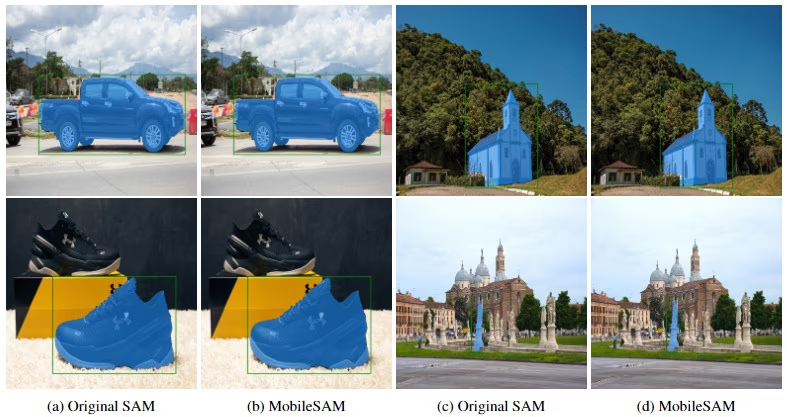
In den GPU-Benchmarks des MobileSAM-Artikels ist MobileSAM etwa siebenmal kleiner und fünfmal schneller als FastSAM.
MobileSAM mit Ultralytics testen#
Wie beim ursprünglichen SAM bietet Ultralytics eine einfache Schnittstelle, um MobileSAM mit Punkt- und Rahmen-Prompts zu testen.
Modell herunterladen#
Lade die vortrainierten MobileSAM-Gewichte von den Ultralytics-Assets herunter.
Punktvorgabe#
from ultralytics import SAM

# Das Modell laden
model = SAM("mobile_sam.pt")

# Eine Segmentierung anhand einer einzelnen Punktvorgabe vorhersagen
model.predict("ultralytics/assets/zidane.jpg", points=[900, 370], labels=[1])

# Mehrere Segmentierungen anhand mehrerer Punktvorgaben vorhersagen
model.predict("ultralytics/assets/zidane.jpg", points=[[400, 370], [900, 370]], labels=[1, 1])

# Für jedes Objekt eine Segmentierung anhand mehrerer Punktvorgaben vorhersagen
model.predict("ultralytics/assets/zidane.jpg", points=[[[400, 370], [900, 370]]], labels=[[1, 1]])

# Eine Segmentierung anhand positiver und negativer Vorgaben vorhersagen.
model.predict("ultralytics/assets/zidane.jpg", points=[[[400, 370], [900, 370]]], labels=[[1, 0]])Box-Vorgabe#
from ultralytics import SAM

# Das Modell laden
model = SAM("mobile_sam.pt")

# Eine Segmentierung anhand einer einzelnen Box-Vorgabe vorhersagen
model.predict("ultralytics/assets/zidane.jpg", bboxes=[439, 437, 524, 709])

# Mehrere Segmentierungen anhand mehrerer Box-Vorgaben vorhersagen
model.predict("ultralytics/assets/zidane.jpg", bboxes=[[439, 437, 524, 709], [114, 196, 313, 708]])
Sowohl MobileSAM als auch SAM bieten dieselbe API. Weitere Informationen zur Verwendung findest du in der SAM-Dokumentation.
Segmentierungsdatensätze mithilfe eines Erkennungsmodells automatisch erstellen#
Um deinen Datensatz mit dem Ultralytics-Framework automatisch zu annotieren, verwende die Funktion auto_annotate, die ein Erkennungsmodell wie YOLO26x mit MobileSAM kombiniert:
from ultralytics.data.annotator import auto_annotate

auto_annotate(data="path/to/images", det_model="yolo26x.pt", sam_model="mobile_sam.pt")| Argument | Typ | Standard | Beschreibung |
|---|---|---|---|
data | str | erforderlich | Pfad zum Verzeichnis mit den Zielbildern für die Annotation oder Segmentierung. |
det_model | str | 'yolo26x.pt' | Pfad zum YOLO-Erkennungsmodell für die anfängliche Objekterkennung. |
sam_model | str | 'sam_b.pt' | Pfad zum SAM-Modell für die Segmentierung (unterstützt SAM-, SAM 2-, MobileSAM- und SAM 3-Gewichte). |
device | str | '' | Rechengerät (z. B. 'cuda:0', 'cpu' oder '' zur automatischen Geräteerkennung). |
conf | float | 0.25 | Konfidenzschwelle der YOLO-Erkennung, um unsichere Erkennungen herauszufiltern. |
iou | float | 0.5 | IoU-Schwelle für Non-Maximum Suppression, um überlappende Boxen herauszufiltern. |
imgsz | int | 640 | Eingabegröße für die Größenanpassung von Bildern (bei Bedarf auf das nächste Vielfache von 32 aufgerundet). |
max_det | int | 300 | Höchstzahl der Erkennungen pro Bild zur effizienten Speichernutzung. |
classes | list[int] | None | Liste der zu erkennenden Klassenindizes (z. B. [0, 1] für Person und Fahrrad). |
output_dir | str | None | Speicherverzeichnis für Annotationen (standardmäßig ein Verzeichnis neben <data>_auto_annotate_labels). |
Zitate und Danksagungen#
Wenn MobileSAM für deine Forschung oder Entwicklung hilfreich ist, solltest du die folgende Veröffentlichung zitieren:
@article{mobile_sam,
  title={Faster Segment Anything: Towards Lightweight SAM for Mobile Applications},
  author={Zhang, Chaoning and Han, Dongshen and Qiao, Yu and Kim, Jung Uk and Bae, Sung Ho and Lee, Seungkyu and Hong, Choong Seon},
  journal={arXiv preprint arXiv:2306.14289},
  year={2023}
}
Lies die vollständige MobileSAM-Veröffentlichung auf arXiv.
Häufig gestellte Fragen#
MobileSAM ist ein leichtgewichtiges, schnelles Bildsegmentierungsmodell, das für mobile Anwendungen und den Einsatz auf Edge-Geräten optimiert ist. Es behält dieselbe Verarbeitungskette wie das ursprüngliche SAM bei, ersetzt jedoch den großen ViT-H-Encoder (637 Mio. Parameter) durch einen kompakten Tiny-ViT-Encoder (5 Mio. Parameter). Dadurch ist die gesamte MobileSAM-Verarbeitungskette etwa 66-mal kleiner als die des ursprünglichen SAM (9,66 Mio. gegenüber 641 Mio. Parametern) und etwa 38-mal schneller: Sie benötigt rund 12 ms pro Bild statt 456 ms bei SAM.
MobileSAM mit Ultralytics zu testen ist ganz einfach. Du kannst Punkt- und Box-Vorgaben verwenden, um Segmentierungen vorherzusagen. Zum Beispiel mit einer Punktvorgabe:
from ultralytics import SAM

# Das Modell laden
model = SAM("mobile_sam.pt")

# Eine Segmentierung anhand einer Punktvorgabe vorhersagen
model.predict("ultralytics/assets/zidane.jpg", points=[900, 370], labels=[1])
Weitere Informationen findest du im Abschnitt MobileSAM mit Ultralytics testen.
Dank seines leichten Designs und der schnellen Inferenz eignet sich MobileSAM ideal für mobile Geräte und Edge-Anwendungen. Im Vergleich zum ursprünglichen SAM hat MobileSAM etwa 66-mal weniger Parameter und läuft etwa 38-mal schneller. Damit eignet es sich für die Echtzeitsegmentierung auf Geräten mit begrenzten Rechenressourcen. Durch seine Effizienz können Mobilgeräte Bilder ohne nennenswerte Verzögerung in Echtzeit segmentieren. Bei Ultralytics unterstützt MobileSAM nur die Inferenz; Training, Validierung und Export sind nicht verfügbar.
MobileSAM wurde in weniger als einem Tag auf einer einzelnen GPU mit einem Datensatz aus 100.000 Bildern (1 % der ursprünglichen SA-1B-Bilder) trainiert. Dabei wurde der Bildencoder ViT-H von SAM in einen Tiny-ViT-Encoder destilliert. Vortrainierte Gewichte und Implementierungsdetails findest du im MobileSAM-Repository auf GitHub.
MobileSAM wurde für eine schnelle und effiziente Bildsegmentierung in mobilen Umgebungen und Edge-Umgebungen entwickelt. Zu den wichtigsten Anwendungsfällen gehören:
- Interaktive Segmentierung in Echtzeit für mobile Apps
- Bildverarbeitung mit geringer Latenz auf Geräten mit begrenzter Rechenleistung
- Integration in KI-gestützte mobile Anwendungen für erweiterte Realität (AR), Analysen und mehr


Kommentare27
Stell eine Frage, teile deine Ergebnisse oder hilf jemand anderem.
czbphoto
请问是否有遇到多线程情况下使用同一个sam实例推理分割时,出现显存占用持续增长,直到报错:显存无法分配问题?
 Glenn JocherUltralytics
@czbphoto 会的;请勿在多线程中共享同一个
SAM/SAMPredictor实例——为每个线程各自创建预测器或改为单线程队列;每张图像后调用predictor.reset_image()释放编码特征;若使用 SAM 2,其跨帧 memory bank 也会累积,需在批次结束后reset_image()清空,见SAM 2 内存机制说明。# 每线程各自持有预测器,避免共享 from threading import Thread import cv2 from ultralytics.models.sam import Predictor as SAMPredictor def worker(device, paths, boxes): pred = SAMPredictor(overrides=dict(model="mobile_sam.pt", device=device, imgsz=1024, task="segment", mode="predict")) for p, bb in zip(paths, boxes): im = cv2.imread(p) pred.set_image(im) _ = pred(bboxes=[bb]) # 推理 pred.reset_image() # 立即释放图像特征 # 示例:将不同样本分配到不同线程 Thread(target=worker, args=("cuda:0", ["a.jpg","b.jpg"], [[100,100,200,200]]*2)).start()若仍出现显存持续增长,请附上最小可复现脚本、完整文本日志与系统信息,便于我们复现与定位:
yolo checks非常感谢,问题已经解决
nowander(bearbeitet)
inference time cost too much here is my inference code:
from ultralytics import SAM
model = SAM("/mnt/pt/mobile_sam.pt")
model.info() source = "/home/sf/Pictures/images/"
results = model.predict(source,imgsz=640, save=True,project="mobile_sam",device="cuda",bboxes=[100, 100, 200, 200])#,points=[[600,600],[700,1000]])
------- log image 198/200 /home/sf/Pictures/images/camera_307_preposition_20240307_094542.jpg: 640x640 1 0, 1 1, 1 2, 1 3, 1 4, 1 5, 1 6, 1 7, 1 8, 1 9, 1 10, 1 11, 1 12, 1 13, 522.9ms image 199/200 /home/sf/Pictures/images/camera_307_preposition_20240307_095714.jpg: 640x640 1 0, 1 1, 1 2, 1 3, 1 4, 1 5, 1 6, 1 7, 1 8, 1 9, 1 10, 519.0ms image 200/200 /home/sf/Pictures/images/camera_307_preposition_20240307_100339.jpg: 640x640 1 0, 1 1, 1 2, 1 3, 1 4, 1 5, 1 6, 1 7, 1 8, 1 9, 1 10, 1 11, 572.9ms Speed: 0.8ms preprocess, 516.1ms inference, 0.5ms postprocess per image at shape (1, 3, 640, 640) Results saved to mobile_sam/predict3
my gpu is RTX5080.why it cost so much
RizwanMunawar(bearbeitet)
@nowander, could you please share the complete logs? In my testing, the performance is slightly slower than FastSAM, but still noticeably faster than the SAM models. What’s the size of your original image? Larger images can naturally affect speed. You might also want to try FastSAM, as it’s typically very quick in most cases. Thanks.
my code: from ultralytics import SAM model = SAM("/mnt/pt/mobile_sam.pt") model.info() results = model("/home/sf/Pictures/one_image/car.jpg", bboxes=[226, 278, 683, 499],imgsz=640)
the log : Model summary: 246 layers, 10,130,092 parameters, 10,130,092 gradients
image 1/1 /home/sf/Pictures/one_image/car.jpg: 640x640 1 0, 272.1ms Speed: 16.0ms preprocess, 272.1ms inference, 28.9ms postprocess per image at shape (1, 3, 640, 640)
i only test one image(car.jpg) this time ,the size of image is 870*573,it cost 272.1ms inference
but when i use this code(write myself):
""" yolo_sam2_annotate_with_time.py 基于 ultralytics.data.annotator.auto_annotate
- 检测 + 分割
- 掩膜着色 + 类别文字
- 实时显示耗时 """
from pathlib import Path import time import cv2 import numpy as np from ultralytics.data.annotator import auto_annotate from ultralytics import YOLO, SAM, FastSAM
"""---------------- 参数 ----------------""" IMAGE_DIR = Path("/home/sf/Pictures/one_image") # 输入图片 """ 结果保存""" DET_MODEL = "/mnt/pt/yolov5x.pt" SAM_MODEL = ("/mnt/pt/mobile_sam.pt") label_dir =Path("/home/sf/Pictures/images_auto_annotate_labels") save_di1 = DET_MODEL.split("/")[-1].split(".pt",1)[0] save_di2 = SAM_MODEL.split("/")[-1].split(".pt",1)[0] OUT_DIR = Path(f"runs/{save_di1}{save_di2}/seg_vis") # 或 sam2_t.pt / sam2_l.pt """ -------------------------------------"""
OUT_DIR.mkdir(parents=True, exist_ok=True)
"""1. 先运行 auto_annotate,让它在 images/labels 下生成 .txt""" t0 = time.perf_counter() auto_annotate( data=str(IMAGE_DIR), det_model=DET_MODEL, sam_model=SAM_MODEL, output_dir=str(label_dir) """标签输出到 images/labels/*.txt""" ) anno_time = (time.perf_counter() - t0) * 1000 """ anno_time1 = (time.time() - t0)""" print(f"auto_annotate 总耗时: {anno_time:.1f} ms") """ print(f"auto_annotate1 总耗时: {anno_time1:.1f} ms")"""
""" 2. 加载模型(用于计时)""" yolo = YOLO(DET_MODEL) if Path(SAM_MODEL).stem.startswith("Fast"): """ sam_model = FastSAM(sam_model)""" sam = FastSAM(SAM_MODEL) else: """ sam_model = SAM(sam_model)""" sam = SAM(SAM_MODEL) """ sam = SAM(SAM_MODEL)""" """sam=FastSAM(SAM_MODEL)""" sum_time=0 num = 0 """ 3. 可视化:逐张读取原图 + 标签,叠加掩膜和类别"""
label_dir =Path("/home/sf/Pictures/images")
class_names = yolo.names
for img_path in IMAGE_DIR.glob("*"): if img_path.suffix.lower() not in {".jpg", ".png", ".jpeg", ".bmp"}: continue """print("aaaaaaa")""" img = cv2.imread(str(img_path)) h, w = img.shape[:2] label_path = label_dir / f"{img_path.stem}.txt" if not label_path.exists(): # print("bbbbb") continue
""" 3-1 读取 YOLO-seg 标签"""
bboxes, masks_raw, cls_ids = [], [], []
with open(label_path, "r") as f:
    for row in f:
        parts = row.strip().split()
        cls_id = int(parts[0])
        poly = list(map(float, parts[1:]))
        """ 还原成像素坐标(x,y)"""
        polygon = [(poly[i] * w, poly[i + 1] * h)
                   for i in range(0, len(poly), 2)]
        polygon = np.array(polygon, np.int32)
        """ 简易 bbox"""
        x1, y1, x2, y2 = polygon[:, 0].min(), polygon[:, 1].min(), \
                         polygon[:, 0].max(), polygon[:, 1].max()
        bboxes.append([x1, y1, x2, y2])
        cls_ids.append(cls_id)

""" 3-2 用 SAM 生成掩膜(用于计时)"""
t0 = time.perf_counter()
""" print("img[..., ::-1]",img[..., ::-1].shape)#(573, 860, 3)"""
results = sam(img[..., ::-1], bboxes=bboxes)   # RGB
""" print("bboxes",bboxes)""" seg_time = (time.perf_counter() - t0) * 1000 sum_time += seg_time num += 1 """ print("num",num)""" masks = results[0].masks # list[np.ndarray(H,W)] colors = [np.random.randint(0, 255, 3).tolist() for _ in cls_ids]
vis = img.copy()


###################     FASTSAM   ####################
if save_di2.startswith("Fast"):

    h_orig, w_orig = img.shape[:2]

    """ 掩膜 tensor: [N, H_sam, W_sam]"""
    masks_tensor = results[0].masks.data  # torch.Tensor
    h_sam, w_sam = masks_tensor.shape[1:]

    """ 逐张处理"""
    for mask_t, cls_id, color in zip(masks_tensor, cls_ids, colors):
        """ 1) 先变成 numpy"""
        mask_np = mask_t.cpu().numpy()  # [H_sam, W_sam]  float/uint8
        """ 2) resize 回原图尺寸"""
        mask_resized = cv2.resize(mask_np, (w_orig, h_orig),
                                  interpolation=cv2.INTER_NEAREST)
        mask_bool = mask_resized.astype(bool)

        """3) 上色"""
        vis[mask_bool] = (vis[mask_bool] * 0.5 + np.array(color, dtype=np.uint8) * 0.5)

        """ 4) 画轮廓"""
        contours, _ = cv2.findContours(mask_bool.astype(np.uint8),
                                       cv2.RETR_EXTERNAL,
                                       cv2.CHAIN_APPROX_SIMPLE)
        cv2.drawContours(vis, contours, -1, color, 2)

        x, y, w, h = cv2.boundingRect(contours[0])
        cv2.putText(vis, class_names[cls_id], (x, max(y - 5, 15)),
                    cv2.FONT_HERSHEY_SIMPLEX, 0.8, color, 2)


"""           SAM2    """
else:

    for mask, cls_id, color in zip(masks, cls_ids, colors):
        """ 原来的报错两行"""
        """vis[mask] = (vis[mask] * 0.5 + np.array(color, dtype=np.uint8) * 0.5)"""
""" 假设 results = sam(img[..., ::-1], bboxes=bboxes)""" masks_tensor = results[0].masks.data # torch.Tensor [N, H, W] masks_np = masks_tensor.cpu().numpy() # ndarray [N, H, W]
        colors = [np.random.randint(0, 255, 3, dtype=np.uint8).tolist() for _ in cls_ids]

        for mask_2d, cls_id, color in zip(masks_np, cls_ids, colors):
            mask_2d = mask_2d.astype(bool)           # 转成布尔
            vis[mask_2d] = (vis[mask_2d] * 0.5 + np.array(color, dtype=np.uint8) * 0.5)

           """画轮廓"""
            contours, _ = cv2.findContours(mask_2d.astype(np.uint8),
                                           cv2.RETR_EXTERNAL,
                                           cv2.CHAIN_APPROX_SIMPLE)
            cv2.drawContours(vis, contours, -1, color, 2)

            x, y, w, h = cv2.boundingRect(contours[0])
            cv2.putText(vis, class_names[cls_id], (x, max(y - 5, 15)),
                        cv2.FONT_HERSHEY_SIMPLEX, 0.8, color, 2)
##########################################################################################
""" 3-3 在左上角叠加耗时""" cv2.putText(vis, f"Detect: {anno_time/len(list(IMAGE_DIR.glob('*'))):.1f} ms", (10, 30), cv2.FONT_HERSHEY_SIMPLEX, 0.8, (0, 255, 0), 2) cv2.putText(vis, f"Segment: {seg_time:.1f} ms", (10, 60), cv2.FONT_HERSHEY_SIMPLEX, 0.8, (0, 255, 0), 2)
""" 3-4 弹窗 + 保存"""
win_name = f"YOLO+SAM-2  {img_path.name}"
"""cv2.imshow(win_name, vis)""" save_path = OUT_DIR / f"{img_path.stem}_vis.jpg" cv2.imwrite(str(save_path), vis) """ print(f"[Done] {img_path.name} Segment={seg_time:.1f}ms")""" """cv2.waitKey(0)""" """ cv2.destroyWindow(win_name)""" """ print("nummm",num)""" print(f"avg segment inferenct time {sum_time/num:.1f} ms") """cv2.destroyAllWindows()"""
the log as follow: PRO TIP 💡 Replace 'model=/mnt/pt/yolov5x.pt' with new 'model=/mnt/pt/yolov5xu.pt'. YOLOv5 'u' models are trained with https://github.com/ultralytics/ultralytics and feature improved performance vs standard YOLOv5 models trained with https://github.com/ultralytics/yolov5.
image 1/1 /home/sf/Pictures/one_image/car.jpg: 448x640 1 car, 13.9ms Speed: 1.7ms preprocess, 13.9ms inference, 91.0ms postprocess per image at shape (1, 3, 448, 640) auto_annotate 总耗时: 1614.3 ms PRO TIP 💡 Replace 'model=/mnt/pt/yolov5x.pt' with new 'model=/mnt/pt/yolov5xu.pt'. YOLOv5 'u' models are trained with https://github.com/ultralytics/ultralytics and feature improved performance vs standard YOLOv5 models trained with https://github.com/ultralytics/yolov5.
0: 1024x1024 1 0, 15.6ms Speed: 3.0ms preprocess, 15.6ms inference, 0.3ms postprocess per image at shape (1, 3, 1024, 1024) avg segment inferenct time 28.7 ms
it only cost 15.6ms inference. looking forward for your reply and thx.
i found when i run auto_annotates function,it call sam_model(line 64 annotator.py),and it cost 117ms,when i run sam() again,it Loaded intoGPU in advance,so it only cost 15.6 ms inference.. is it true. and if that is the true,the mobile_sam will cost about 500ms with RTX5080(use demo code)
To test my conjecture, I did the following experiment:
from pathlib import Path import time import cv2 import numpy as np from ultralytics.data.annotator import auto_annotate from ultralytics import YOLO, SAM, FastSAM from ultralytics import SAM SAM_MODEL = ("/mnt/pt/mobile_sam.pt") sam = SAM(SAM_MODEL)
import time img_path = "/home/sf/Pictures/one_image/car.jpg" img = cv2.imread(str(img_path)) t0 = time.perf_counter() ”“”print("img[..., ::-1]",img[..., ::-1].shape)#(573, 860, 3)”“” bboxes = [[np.int32(226), np.int32(278), np.int32(683), np.int32(499)]] results = sam(img[..., ::-1], bboxes=bboxes) # RGB ”“”print("bboxes",bboxes)”“” seg_time = (time.perf_counter() - t0) * 1000 print("11111---ssssseg_time",seg_time) t0 = time.perf_counter() “”“ print("img[..., ::-1]",img[..., ::-1].shape)#(573, 860, 3) bboxes = [[np.int32(226), np.int32(278), np.int32(683), np.int32(499)]] results = sam(img[..., ::-1], bboxes=bboxes) # RGB ”“” print("bboxes",bboxes)”“” seg_time = (time.perf_counter() - t0) * 1000 print("22222--ssssseg_time",seg_time)
and log: Segment: 256.2 ms 0: 1024x1024 1 0, 256.3ms Speed: 26.1ms preprocess, 256.3ms inference, 27.3ms postprocess per image at shape (1, 3, 1024, 1024) 11111---ssssseg_time 544.9139869888313
Segment: 15.3 ms 0: 1024x1024 1 0, 15.4ms Speed: 5.1ms preprocess, 15.4ms inference, 0.2ms postprocess per image at shape (1, 3, 1024, 1024) 22222--ssssseg_time 21.185592049732804
- Glenn JocherUltralytics
@nowander Your analysis is right: the first SAM call includes one‑time GPU setup (CUDA context, weights transfer, cuDNN autotune), so it’s much slower; subsequent calls are the steady‑state (~15–30 ms on your RTX). Also note that when you pass a folder plus
bboxesonce, the prompt is consumed on the first image and the rest fall back to “segment everything” (hence many masks and slower runs). Use per‑image prompts orSAMPredictorand warm up before timing:from pathlib import Path import cv2, time, torch from ultralytics.models.sam import Predictor as SAMPredictor overrides = dict(model="mobile_sam.pt", device="cuda", imgsz=1024, task="segment", mode="predict", conf=0.25) pred = SAMPredictor(overrides=overrides) # warmup im = cv2.imread("path/to/one.jpg") pred.set_image(im) pred(bboxes=[100, 100, 200, 200]) pred.reset_image() # per-image prompts (avoid segment-everything) src = Path("/path/to/images") for p in src.glob("*.jpg"): im = cv2.imread(str(p)) pred.set_image(im) torch.cuda.synchronize(); t0 = time.perf_counter() r = pred(bboxes=[[x1, y1, x2, y2]]) # supply bbox for this image torch.cuda.synchronize(); print(f"{(time.perf_counter()-t0)*1000:.1f} ms") pred.reset_image()See the SAMPredictor example in the SAM docs and the
auto_annotateAPI here for reference on how prompts are used per image: auto_annotate reference. If you still see >200 ms after warmup and per‑image prompts, please shareyolo checksoutput and the full text logs so we can dig deeper:yolo checks Thank you very much for your reply, you are right, when set a folde as source r, finally call self.generate (models/sam/predict.py) on lines 202 and 203, when set source as an image, the parameter takes effect, call line 205 self.prompt_inference (models/sam/predict.py).when i use this: src = Path("/path/to/images") for p in src.glob("*.jpg"): im = cv2.imread(str(p)) pred.set_image(im) torch.cuda.synchronize(); t0 = time.perf_counter() r = pred(bboxes=[[x1, y1, x2, y2]]) # supply bbox for this image torch.cuda.synchronize(); print(f"{(time.perf_counter()-t0)*1000:.1f} ms") pred.reset_image() it only cost about 20ms in my GPU,and thx again for your reply.
- Glenn JocherUltralytics
Great to hear your timings are down to ~20 ms; for even higher throughput across multiple prompts on the same image, reuse encoder features by calling
SAMPredictor.set_image()once and issuing additional prompt calls beforereset_image()—see the SAMPredictor reference for details: ultralytics.models.sam.predict.Predictor.
 User
good
tunahsu
Hi! Is it possible to filter out low-quality masks during inference using confidence/score?
- Glenn JocherUltralytics
@tunahsu yes, you can filter out low-quality masks during inference by adjusting the confidence threshold using the
confparameter when running the model. For more details on setting this parameter, you can refer to the MobileSAM documentation. Let us know if you have further questions!
ismailwale
How can I make an inference of a video using frame by frame in loop using Mobilesam ?because I tried multiple times making inference directly with video predictor I constantly running out of memory despite setting stream =True since SAM is trying to keep the memory of 2000 frames of the video at ones . I will appreciate any ideal on how to predict and segment the video as a single frame image at every instance and put everything in a loop.
- Glenn JocherUltralytics
@ismailwale to process video frame-by-frame with MobileSAM and avoid memory overflow, load the video using OpenCV, iterate through each frame in a loop, perform inference using
MobileSAMon individual frames, and release unused memory after each iteration. Make sure not to enable streaming mode. Here is a basic example structure:import cv2 from ultralytics import SAM # Initialize the VideoCapture and load the model cap = cv2.VideoCapture("path/to/video.mp4") model = SAM("mobile_sam.pt") while cap.isOpened(): ret, frame = cap.read() if not ret: break # Perform inference on the current frame results = model.predict(frame) # Process results or save outputs # ... cap.release() # Release the videoThis approach minimizes memory usage by processing frames sequentially. Let us know if you need further clarification!
Thanks so much , your lines of code really jump-start my thinking. I sincerely appreciate. Please keep on with your good work . Be blessed
gopalkatushar
This is great. Is there a way to segment everything like we have in fastsam, without prompting?
- Glenn JocherUltralytics(bearbeitet)
@gopalkatushar yes, MobileSAM can segment everything without prompts, like FastSAM. Call it without
bboxesorpoints, e.g.SAM("mobile_sam.pt")("path/to/image.jpg"). For more details, please refer to the SAM documentation.
Kunal8020
How can I use this for multi class segmentation. I am detecting the multiple objects using YOLO-World. I want to use the bounding box results from YOLO-World as prompt to MobileSAM. How can I use to segment different objects in the same image??
 Paula DerrengerUltralytics
Hello!
To use MobileSAM for segmenting multiple objects in the same image using bounding box results from YOLO-World, you can follow these steps:
-
Run YOLO-World Detection: First, use YOLO-World to detect objects in your image. This will provide you with bounding boxes for each detected object.
-
Prepare Bounding Box Inputs: Extract the bounding box coordinates from the YOLO-World output. These coordinates will be used as prompts for MobileSAM.
-
Segment with MobileSAM: For each bounding box, use the MobileSAM model to segment the object within that box. You can do this by passing the bounding box coordinates to MobileSAM's predict function, similar to the box prompt example:
from ultralytics import SAM

# Load the model
model = SAM("mobile_sam.pt")

# Predict a segment based on a box prompt
model.predict("path/to/image.jpg", bboxes=[x1, y1, x2, y2])
Repeat this for each bounding box provided by YOLO-World.
This approach allows you to segment each detected object individually. If you need further assistance or have more specific requirements, feel free to ask!
1-
FlySka
Hi, Do you have any notebook or repository for fine-tuning mobileSAM? Could it be done in the same way as with the regular SAM?
- Paula DerrengerUltralytics
Hi there,
Yes, fine-tuning MobileSAM can generally be approached in the same manner as with the regular SAM. Since MobileSAM retains the same pipeline, including pre-processing, post-processing, and interfaces, adaptations for MobileSAM from SAM should be minimal.
Here's a quick Python snippet that illustrates how you could load and use MobileSAM for predictions, which mirrors the usage for SAM:
from ultralytics import SAM

# Load the MobileSAM model
model = SAM('mobile_sam.pt')

# Predict a segment based on a point prompt
result = model.predict('path/to/your/image.jpg', points=[x, y], labels=[label_id])
You can apply any fine-tuning procedures used for SAM in a similar fashion for MobileSAM. If you need more detailed steps or specific adjustments for fine-tuning, feel free to ask!
Best regards!
AnandSingh-0619
Hey! How can I run batch inference with multiple images and bounding boxes on the Mobile SAM model?
- Glenn JocherUltralytics
Hey there! 👋
Running batch inference with multiple images and bounding boxes on MobileSAM is quite straightforward. Here’s a quick example of how you could do that:
from ultralytics import SAM

# Load the MobileSAM model
model = SAM('mobile_sam.pt')

# List of images and their corresponding boxes
images = ['path/to/image1.jpg', 'path/to/image2.jpg']
boxes = [[439, 437, 524, 709], [500, 400, 550, 720]]  # Example boxes for each image

# Predict segments based on box prompts for each image
for image, box in zip(images, boxes):
    result = model.predict(image, bboxes=[box])
    # You can now process the result as needed
This code loads the model, iterates over your images and boxes, and then performs prediction for each image using the specified boxes. Don't forget to adjust the image paths and box coordinates according to your data. 😊
Let us know if you need more help!
I'm working with the Ultralytics Mobile SAM model and need to perform batch inference for multiple images, each with its own set of bounding boxes, without using a for loop to iterate over each image. How can I efficiently run batch inference on the Mobile SAM model with this setup?
- Glenn JocherUltralytics(bearbeitet)
Hi there!
predictdoes not take animages=tensor, so for several images with their own boxes loop over them and pass each image's boxes (XYXY):from ultralytics import SAM model = SAM("mobile_sam.pt") for image, box in zip(images, boxes): results = model.predict(image, bboxes=[box])Each call can take several boxes for the same image, e.g.
bboxes=[[x1, y1, x2, y2], [x3, y3, x4, y4]]. 😊-1