Ultralytics YOLO26 en NVIDIA Jetson con DeepStream SDK y TensorRT
Ver: Cómo usar los modelos Ultralytics YOLO26 con NVIDIA Deepstream en Jetson Orin NX 🚀
Esta guía explica cómo implementar Ultralytics YOLO26 en dispositivos NVIDIA Jetson con DeepStream SDK y TensorRT. Aquí usamos TensorRT para maximizar el rendimiento de inferencia en la plataforma Jetson.
Esta guía explica cómo configurar DeepStream para YOLO26, realizar la calibración INT8, configurar varios flujos y consultar los resultados de las pruebas de rendimiento.
Esta guía se ha probado con el NVIDIA Jetson Orin Nano Super Developer Kit, que ejecuta la versión JP6.1 de JetPack, con el Seeed Studio reComputer J4012, basado en NVIDIA Jetson Orin NX de 16 GB y con la versión JP5.1.3 de JetPack, y con el Seeed Studio reComputer J1020 v2, basado en NVIDIA Jetson Nano de 4 GB y con la versión JP4.6.4 de JetPack. Se espera que funcione en toda la gama de hardware NVIDIA Jetson, incluidos los modelos más recientes y los antiguos.
¿Qué es NVIDIA DeepStream?#
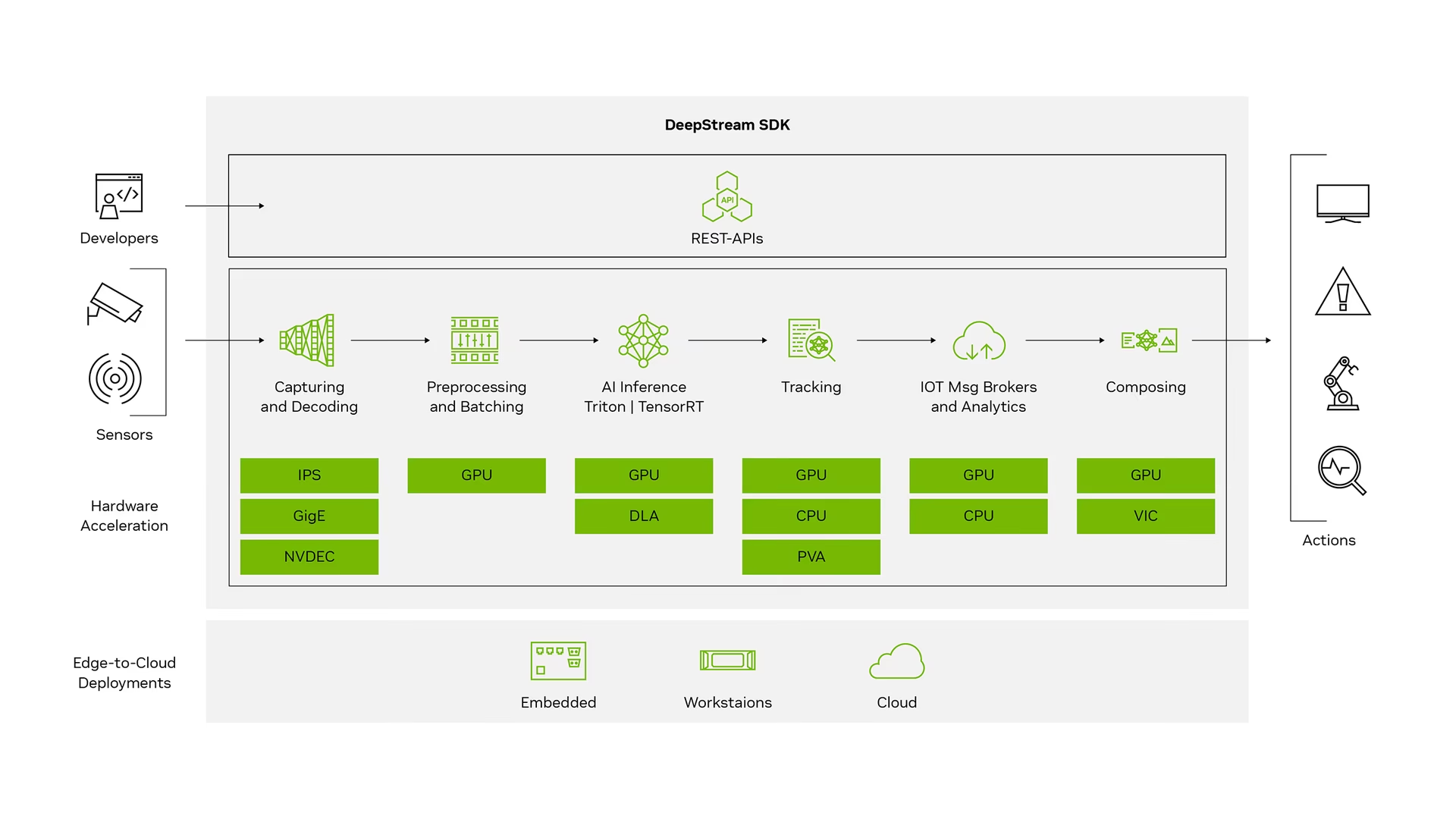
El DeepStream SDK de NVIDIA es un conjunto de herramientas completo para el análisis en streaming, basado en GStreamer y destinado al procesamiento multisensor, así como a la comprensión de vídeo, audio e imágenes mediante IA. Es ideal para desarrolladores de IA aplicada a la visión, socios de software, startups y fabricantes de equipos originales que crean aplicaciones y servicios de IVA (analítica de vídeo inteligente). Puedes crear canalizaciones de procesamiento de flujos que incorporen redes neuronales y otras tareas complejas, como el seguimiento, la codificación y decodificación de vídeo, y la renderización de vídeo. Estas canalizaciones permiten analizar en tiempo real datos de vídeo, imágenes y sensores. La compatibilidad multiplataforma de DeepStream te ofrece una forma más rápida y sencilla de desarrollar aplicaciones y servicios de IA aplicada a la visión en tus instalaciones, en el borde y en la nube.
Requisitos previos#
Antes de seguir esta guía:
- Consulta nuestra documentación, Guía de inicio rápido: NVIDIA Jetson con Ultralytics YOLO26, para configurar tu dispositivo NVIDIA Jetson con Ultralytics YOLO26
- Instala DeepStream SDK según la versión de JetPack
- Para JetPack 4.6.4, instala DeepStream 6.0.1
- Para JetPack 5.1.3, instala DeepStream 6.3
- Para JetPack 6.1, instala DeepStream 7.1
- Para JetPack 7.1, instala DeepStream 9.0
En esta guía hemos utilizado el método de paquetes Debian para instalar DeepStream SDK en el dispositivo Jetson. También puedes consultar DeepStream SDK en Jetson (archivado) para acceder a versiones antiguas de DeepStream.
Configuración de DeepStream para YOLO26#
Aquí usamos el repositorio de GitHub marcoslucianops/DeepStream-Yolo, que incluye compatibilidad con NVIDIA DeepStream SDK para modelos YOLO. Agradecemos las contribuciones de marcoslucianops.
-
Instala Ultralytics con las dependencias necesarias
pip install ultralytics onnx onnxslim -
Clona el repositorio DeepStream-Yolo
cd ~ git clone https://github.com/marcoslucianops/DeepStream-Yolo -
Descarga el modelo de detección Ultralytics YOLO26 (.pt) que prefieras desde el proyecto YOLO26. Aquí usamos yolo26s.pt.
wget https://github.com/ultralytics/assets/releases/download/v8.4.0/yolo26s.pt
También puedes usar un modelo YOLO26 entrenado a medida.
-
Convierte el modelo a ONNX y escribe el archivo
labels.txtdel que DeepStream lee los nombres de las clasesfrom ultralytics import YOLO model = YOLO("yolo26s.pt") model.export(format="onnx", nms=False, agnostic_nms=True) # crea 'yolo26s.onnx' with open("labels.txt", "w") as f: f.write("\n".join(model.names.values()))
nms=False exporta el cabezal sin NMS y agnostic_nms=True conserva una sola clase por detección para que cluster-mode=4 (sin agrupamiento) en la configuración de DeepStream no dibuje dos veces un cuadro. Añade imgsz=1280 para cambiar el tamaño de inferencia (predeterminado: 640), batch=4 para un tamaño de lote de 4 (el lote exportado es estático, por lo que debe coincidir con batch-size en la configuración de DeepStream) y opset=12 para TensorRT 8.2 o anterior (DeepStream 6.0.1 y versiones anteriores). Consulta los argumentos de exportación para ver la lista completa.
-
Copia el archivo de modelo generado
.onnxy el archivolabels.txten la carpetaDeepStream-Yolocp yolo26s.onnx labels.txt ~/DeepStream-Yolo cd ~/DeepStream-Yolo -
Establece la versión de CUDA según la versión de JetPack instalada
Para JetPack 4.6.4:
export CUDA_VER=10.2Para JetPack 5.1.3:
export CUDA_VER=11.4Para JetPack 6.1:
export CUDA_VER=12.6Para JetPack 7.1:
export CUDA_VER=13.0 -
Compila la biblioteca
make -C nvdsinfer_custom_impl_Yolo clean && make -C nvdsinfer_custom_impl_Yolo -
Edita el archivo
config_infer_primary_yolo26.txtsegún tu modelo (para YOLO26s con 80 clases)[property] ... onnx-file=yolo26s.onnx ... num-detected-classes=80 ... parse-bbox-func-name=NvDsInferParseYolo ...
YOLO26 redimensiona la entrada con relleno centrado y se ejecuta sin NMS. Para obtener la mejor precisión, añade lo siguiente a la sección [property] de config_infer_primary_yolo26.txt:
[property]
...
maintain-aspect-ratio=1
symmetric-padding=1
cluster-mode=4
...-
Edita el archivo
deepstream_app_config... [primary-gie] ... config-file=config_infer_primary_yolo26.txt -
También puedes cambiar la fuente de vídeo en el archivo
deepstream_app_config. Aquí se carga un archivo de vídeo de forma predeterminada... [source0] ... uri=file:///opt/nvidia/deepstream/deepstream/samples/streams/sample_1080p_h264.mp4
Ejecuta la inferencia#
deepstream-app -c deepstream_app_config.txtLa generación del archivo del motor TensorRT puede tardar mucho antes de que empiece la inferencia.
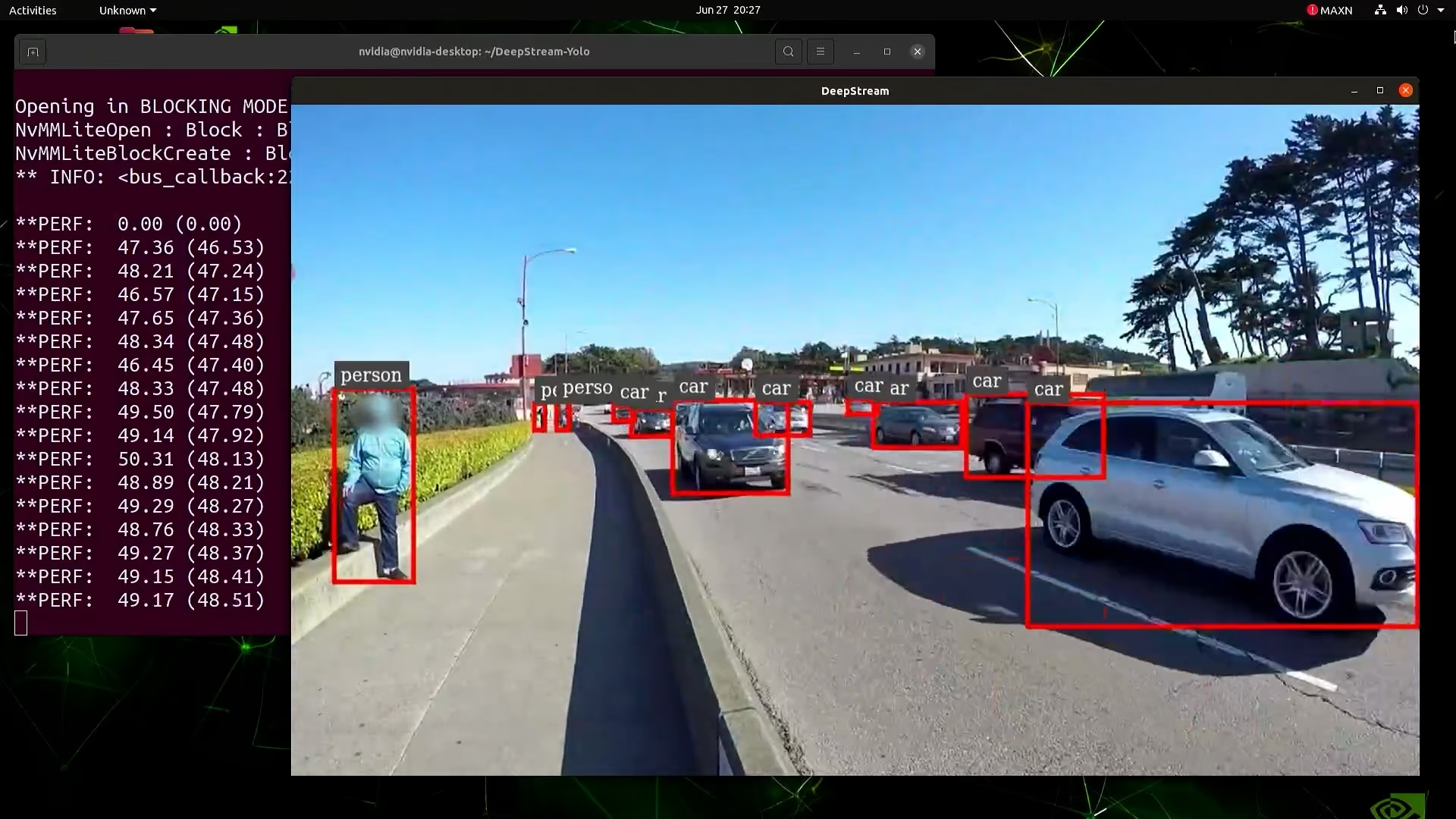
Para convertir el modelo a precisión FP16, configura model-engine-file=model_b1_gpu0_fp16.engine y network-mode=2 dentro de config_infer_primary_yolo26.txt
Calibración INT8#
Para usar precisión INT8 en la inferencia, sigue estos pasos:
Actualmente, INT8 no funciona con TensorRT 10.x. Esta sección de la guía se ha probado con TensorRT 8.x, que debería funcionar.
-
Establece la variable de entorno
OPENCVexport OPENCV=1 -
Compila la biblioteca
make -C nvdsinfer_custom_impl_Yolo clean && make -C nvdsinfer_custom_impl_Yolo -
Para el conjunto de datos COCO, descarga val2017, extráelo y muévelo a la carpeta
DeepStream-Yolo -
Crea un directorio nuevo para las imágenes de calibración
mkdir calibration -
Ejecuta lo siguiente para seleccionar 1000 imágenes aleatorias del conjunto de datos COCO y realizar la calibración
for jpg in $(ls -1 val2017/*.jpg | sort -R | head -1000); do
  cp ${jpg} calibration/
done
NVIDIA recomienda usar al menos 500 imágenes para obtener una buena precisión. En este ejemplo se eligen 1000 imágenes para mejorarla (por lo general, cuantas más imágenes uses, mayor será la precisión). Puedes configurarlo con head -1000. Por ejemplo, para usar 2000 imágenes, emplea head -2000. Este proceso puede tardar mucho.
-
Crea el archivo
calibration.txtcon todas las imágenes seleccionadasrealpath calibration/*jpg > calibration.txt -
Establece las variables de entorno
export INT8_CALIB_IMG_PATH=calibration.txt
export INT8_CALIB_BATCH_SIZE=1
Los valores más altos de INT8_CALIB_BATCH_SIZE permiten calibrar con mayor precisión y rapidez. Configúralo en función de la memoria de tu GPU.
-
Actualiza el archivo
config_infer_primary_yolo26.txtDe
...
model-engine-file=model_b1_gpu0_fp32.engine
#int8-calib-file=calib.table
...
network-mode=0
...
A
...
model-engine-file=model_b1_gpu0_int8.engine
int8-calib-file=calib.table
...
network-mode=1
...
Ejecuta la inferencia INT8#
Ejecuta el mismo comando para crear el motor INT8 e iniciar la inferencia:
deepstream-app -c deepstream_app_config.txtConfiguración de varios flujos#
Ver: Cómo ejecutar inferencias con varias secuencias usando Ultralytics YOLO26 y NVIDIA DeepStream en Jetson Orin 🚀
Para configurar varios flujos en una sola aplicación DeepStream, haz los siguientes cambios en el archivo deepstream_app_config.txt:
-
Cambia las filas y las columnas para crear una cuadrícula según el número de flujos que quieras usar. Por ejemplo, para 4 flujos, puedes añadir 2 filas y 2 columnas.
[tiled-display] rows=2 columns=2 -
Añade un grupo
[sourceN]independiente para cada flujo, cada uno con su propiouriynum-sources=1.[source0] enable=1 type=3 uri=file:///path/to/video1.mp4 num-sources=1 [source1] enable=1 type=3 uri=file:///path/to/video2.mp4 num-sources=1 [source2] enable=1 type=3 uri=file:///path/to/video3.mp4 num-sources=1 [source3] enable=1 type=3 uri=file:///path/to/video4.mp4 num-sources=1
Ejecuta la inferencia con varios flujos#
Ejecuta el mismo comando para iniciar todos los flujos en la visualización en mosaico:
deepstream-app -c deepstream_app_config.txt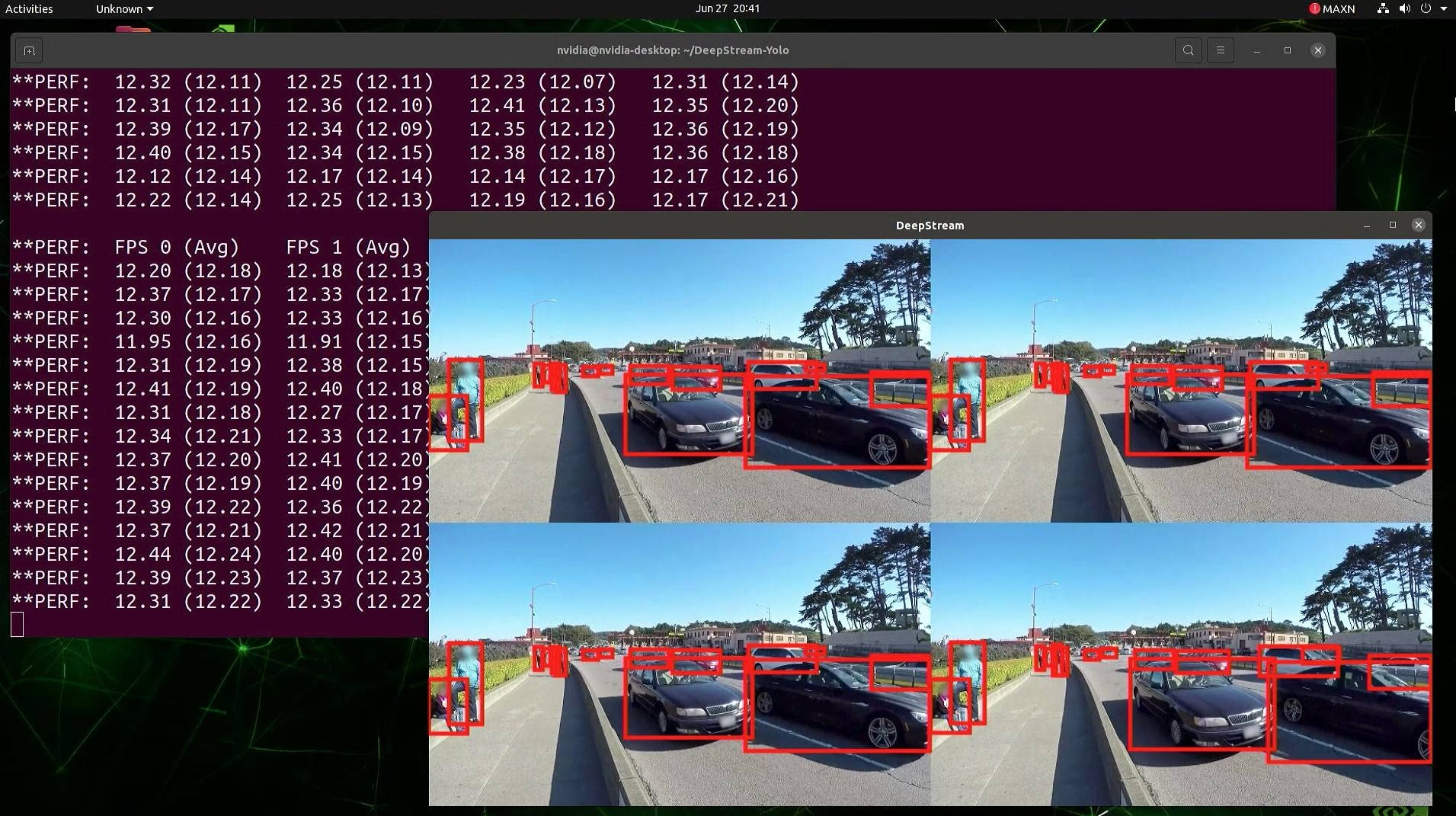
Resultados de las pruebas de rendimiento#
Las siguientes pruebas de rendimiento resumen el rendimiento de los modelos YOLO11 con distintos niveles de precisión de TensorRT y un tamaño de entrada de 640x640 en NVIDIA Jetson Orin NX de 16 GB. YOLO26 utiliza el mismo flujo de trabajo de exportación e inferencia de DeepStream descrito anteriormente.
Gráfico comparativo#
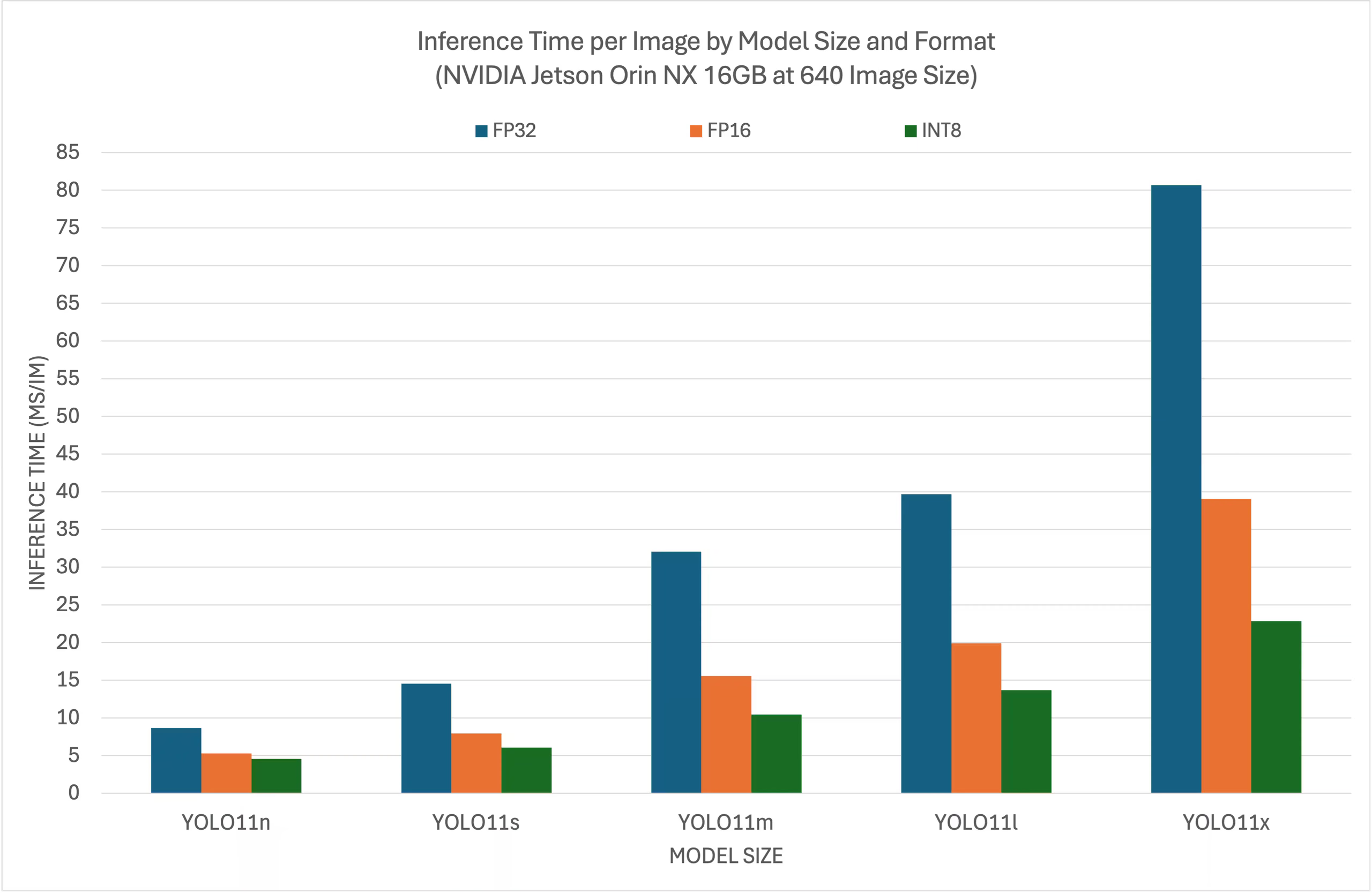
Tabla comparativa detallada#
| Formato | Estado | Tiempo de inferencia (ms/im) |
|---|---|---|
| TensorRT (FP32) | ✅ | 8.64 |
| TensorRT (FP16) | ✅ | 5.27 |
| TensorRT (INT8) | ✅ | 4.54 |
Agradecimientos#
Esta guía la crearon inicialmente nuestros amigos de Seeed Studio, Lakshantha y Elaine.
Preguntas frecuentes#
Para configurar Ultralytics YOLO26 en un dispositivo NVIDIA Jetson, primero tienes que instalar DeepStream SDK compatible con tu versión de JetPack. Sigue la guía paso a paso de nuestra Guía de inicio rápido para configurar NVIDIA Jetson para implementar YOLO26.
El uso de TensorRT con YOLO26 optimiza el modelo para la inferencia, reduce considerablemente la latencia y mejora el rendimiento en los dispositivos NVIDIA Jetson. TensorRT ofrece inferencia de aprendizaje profundo de alto rendimiento y baja latencia mediante la fusión de capas, la calibración de precisión y la optimización automática de kernels. Esto permite una ejecución más rápida y eficiente, especialmente útil en aplicaciones en tiempo real, como el análisis de vídeo y las máquinas autónomas.
Sí, la guía para implementar Ultralytics YOLO26 con DeepStream SDK y TensorRT es compatible con toda la gama NVIDIA Jetson. Esto incluye dispositivos como Jetson Orin NX de 16 GB con JetPack 5.1.3 y Jetson Nano de 4 GB con JetPack 4.6.4. Consulta la sección Configuración de DeepStream para YOLO26 para ver los pasos detallados.
Exporta el modelo con el exportador de Ultralytics y el cabezal sin NMS, y escribe el archivo
labels.txtdel que DeepStream lee los nombres de las clases:from ultralytics import YOLO model = YOLO("yolo26s.pt") model.export(format="onnx", nms=False, agnostic_nms=True) # crea 'yolo26s.onnx' with open("labels.txt", "w") as f: f.write("\n".join(model.names.values()))Añade
opset=12para TensorRT 8.2 o anterior (DeepStream 6.0.1 y versiones anteriores). Para obtener más información sobre la conversión de modelos, consulta nuestra sección sobre exportación de modelos.Para ejecutar la inferencia INT8, calibra el modelo con un conjunto representativo de imágenes y cambia la configuración de DeepStream al modo INT8. Descarga las imágenes COCO val2017, selecciona unas 1000 imágenes de calibración, establece las variables de entorno
INT8_CALIB_IMG_PATHyINT8_CALIB_BATCH_SIZEy, después, actualizaconfig_infer_primary_yolo26.txtconmodel-engine-file=model_b1_gpu0_int8.engine,int8-calib-file=calib.tableynetwork-mode=1. Consulta la sección Calibración INT8 para ver todos los pasos. Actualmente, INT8 requiere TensorRT 8.x.Para procesar varios flujos en una sola aplicación DeepStream, edita el archivo
deepstream_app_config.txtpara añadir una cuadrícula de visualización en mosaico y enumerar cada URI de origen. Establecerowsycolumnsen[tiled-display]para crear la cuadrícula, añade un grupo[sourceN]independiente por flujo con sus propiosuriynum-sources=1, y ajusta la cuadrícula al número de flujos. Consulta la sección Configuración de varios flujos para ver un ejemplo completo.El rendimiento de los modelos YOLO11 en NVIDIA Jetson Orin NX de 16 GB varía según los niveles de precisión de TensorRT. Por ejemplo, los modelos YOLO11s consiguen:
- Precisión FP32: 14.53 ms/im, 68.8 FPS
- Precisión FP16: 7.91 ms/im, 126 FPS
- Precisión INT8: 6.05 ms/im, 165 FPS
Estos resultados muestran cuánto aceleran los motores TensorRT FP16 e INT8 los modelos YOLO11 en el hardware NVIDIA Jetson.


Comentarios145
Haz una pregunta, comparte tus resultados o ayuda a otra persona.
Llinz24
hi!I encountered the following issue when using NVIDIA's official DeepStream 8.0 gc-triton-devel image to implement deepstream-yolo: I cannot compile the library, and it prompts that my Tensor version is too new. Is there any solution? Could it be that the current code hasn't fully adapted to DeepStream 8.0? ( root@LGDX:/workspace/DeepStream-Yolo# export CUDA_VER=12.8 root@LGDX:/workspace/DeepStream-Yolo# make -C nvdsinfer_custom_impl_Yolo clean && make -C nvdsinfer_custom_impl_Yolo make: Entering directory '/workspace/DeepStream-Yolo/nvdsinfer_custom_impl_Yolo' rm -rf libnvdsinfer_custom_impl_Yolo.so rm -rf nvdsinfer_yolo_engine.o nvdsparsebbox_Yolo.o utils.o yolo.o yoloPlugins.o layers/activation_layer.o layers/batchnorm_layer.o layers/channels_layer.o layers/convolutional_layer.o layers/deconvolutional_layer.o layers/implicit_layer.o layers/pooling_layer.o layers/reorg_layer.o layers/route_layer.o layers/sam_layer.o layers/shortcut_layer.o layers/slice_layer.o layers/upsample_layer.o nvdsparsebbox_Yolo_cuda.o yoloForward.o yoloForward_nc.o yoloForward_v2.o make: Leaving directory '/workspace/DeepStream-Yolo/nvdsinfer_custom_impl_Yolo' make: Entering directory '/workspace/DeepStream-Yolo/nvdsinfer_custom_impl_Yolo' g++ -c -o nvdsinfer_yolo_engine.o -Wall -std=c++11 -shared -fPIC -Wno-error=deprecated-declarations -I/opt/nvidia/deepstream/deepstream/sources/includes -I/usr/local/cuda-12.8/include nvdsinfer_yolo_engine.cpp g++ -c -o nvdsparsebbox_Yolo.o -Wall -std=c++11 -shared -fPIC -Wno-error=deprecated-declarations -I/opt/nvidia/deepstream/deepstream/sources/includes -I/usr/local/cuda-12.8/include nvdsparsebbox_Yolo.cpp In file included from nvdsparsebbox_Yolo.cpp:26: nvdsparsebbox_Yolo.cpp: In function 'void checkFunc_NvDsInferParseYolo(NvDsInferParseCustomFunc)': /opt/nvidia/deepstream/deepstream/sources/includes/nvdsinfer_custom_impl.h:221:17: warning: infinite recursion detected [-Winfinite-recursion] 221 | static void checkFunc_ ## customParseFunc (NvDsInferParseCustomFunc func = customParseFunc)
| ^~~~~~~~~~ nvdsparsebbox_Yolo.cpp:129:1: note: in expansion of macro 'CHECK_CUSTOM_PARSE_FUNC_PROTOTYPE' 129 | CHECK_CUSTOM_PARSE_FUNC_PROTOTYPE(NvDsInferParseYolo); | ^~~~~~~~~~~~~~~~~~~~~~~~~~~~~~~~~ /opt/nvidia/deepstream/deepstream/sources/includes/nvdsinfer_custom_impl.h:222:41: note: recursive call 222 | { checkFunc_ ## customParseFunc (); };
| ~~~~~~~~~~~~~~~~~~~~~~~~~~~~~~^~ nvdsparsebbox_Yolo.cpp:129:1: note: in expansion of macro 'CHECK_CUSTOM_PARSE_FUNC_PROTOTYPE' 129 | CHECK_CUSTOM_PARSE_FUNC_PROTOTYPE(NvDsInferParseYolo); | ^~~~~~~~~~~~~~~~~~~~~~~~~~~~~~~~~ g++ -c -o utils.o -Wall -std=c++11 -shared -fPIC -Wno-error=deprecated-declarations -I/opt/nvidia/deepstream/deepstream/sources/includes -I/usr/local/cuda-12.8/include utils.cpp g++ -c -o yolo.o -Wall -std=c++11 -shared -fPIC -Wno-error=deprecated-declarations -I/opt/nvidia/deepstream/deepstream/sources/includes -I/usr/local/cuda-12.8/include yolo.cpp In file included from yolo.cpp:29: yoloPlugins.h:53:59: warning: 'IPluginV2DynamicExt' is deprecated [-Wdeprecated-declarations] 53 | nvinfer1::IPluginV2DynamicExt* clone() const noexcept override; | ^~~~~~~~ In file included from /usr/include/x86_64-linux-gnu/NvInfer.h:22, from /usr/include/x86_64-linux-gnu/NvOnnxParser.h:21, from yolo.cpp:26: /usr/include/x86_64-linux-gnu/NvInferRuntime.h:406:22: note: declared here 406 | class TRT_DEPRECATED IPluginV2DynamicExt : public nvinfer1::IPluginV2Ext | ^~~~~~~~~~~~~~~~~~~ yoloPlugins.h:124:9: warning: 'IPluginV2DynamicExt' is deprecated [-Wdeprecated-declarations] 124 | override { | ^~~~~~~~ /usr/include/x86_64-linux-gnu/NvInferRuntime.h:406:22: note: declared here 406 | class TRT_DEPRECATED IPluginV2DynamicExt : public nvinfer1::IPluginV2Ext | ^~~~~~~~~~~~~~~~~~~ yoloPlugins.h:130:18: warning: 'IPluginV2DynamicExt' is deprecated [-Wdeprecated-declarations] 130 | noexcept override { | ^~~~~~~~ /usr/include/x86_64-linux-gnu/NvInferRuntime.h:406:22: note: declared here 406 | class TRT_DEPRECATED IPluginV2DynamicExt : public nvinfer1::IPluginV2Ext | ^~~~~~~~~~~~~~~~~~~ yolo.cpp: In member function 'nvinfer1::ICudaEngine* Yolo::createEngine(nvinfer1::IBuilder*, nvinfer1::IBuilderConfig*)': yolo.cpp:71:76: error: 'kEXPLICIT_BATCH' is not a member of 'nvinfer1::NetworkDefinitionCreationFlag' 71 | tic_cast<uint32_t>(nvinfer1::NetworkDefinitionCreationFlag::kEXPLICIT_BATCH); | ^~~~~~~~~~~~~~~In file included from /usr/include/c++/13/cassert:44, from layers/../utils.h:32, from layers/route_layer.h:9, from yolo.h:39, from yolo.cpp:28: yolo.cpp:155:21: error: 'class nvinfer1::IBuilder' has no member named 'platformHasFastFp16' 155 | assert(builder->platformHasFastFp16()); | ^~~~~~~~~~~~~~~~~~~ yolo.cpp:156:44: error: 'kFP16' is not a member of 'nvinfer1::BuilderFlag' 156 | config->setFlag(nvinfer1::BuilderFlag::kFP16); | ^~~~~ yolo.cpp:159:21: error: 'class nvinfer1::IBuilder' has no member named 'platformHasFastInt8' 159 | assert(builder->platformHasFastInt8()); | ^~~~~~~~~~~~~~~~~~~ yolo.cpp:160:44: error: 'kINT8' is not a member of 'nvinfer1::BuilderFlag' 160 | config->setFlag(nvinfer1::BuilderFlag::kINT8); | ^~~~~ yolo.cpp: In member function 'NvDsInferStatus Yolo::buildYoloNetwork(std::vector&, nvinfer1::INetworkDefinition&)': yolo.cpp:481:36: warning: 'IPluginV2DynamicExt' is deprecated [-Wdeprecated-declarations] 481 | nvinfer1::IPluginV2DynamicExt* yoloPlugin = new YoloLayer(m_InputW, m_InputH, m_NumClasses, m_NewCoords, | ^~~~~~~~~~ /usr/include/x86_64-linux-gnu/NvInferRuntime.h:406:22: note: declared here 406 | class TRT_DEPRECATED IPluginV2DynamicExt : public nvinfer1::IPluginV2Ext | ^~~~~~~~~~~~~~~~~~~ yolo.cpp:484:31: warning: 'IPluginV2Layer' is deprecated [-Wdeprecated-declarations] 484 | nvinfer1::IPluginV2Layer* yolo = network.addPluginV2(yoloTensorInputs, m_YoloCount, yoloPlugin); | ^~~~ /usr/include/x86_64-linux-gnu/NvInfer.h:2542:22: note: declared here 2542 | class TRT_DEPRECATED IPluginV2Layer : public ILayer | ^~~~~~~~~~~~~~ yolo.cpp:484:57: warning: 'nvinfer1::IPluginV2Layer nvinfer1::INetworkDefinition::addPluginV2(nvinfer1::ITensor* const*, int32_t, nvinfer1::IPluginV2&)' is deprecated [-Wdeprecated-declarations] 484 | nvinfer1::IPluginV2Layer* yolo = network.addPluginV2(yoloTensorInputs, m_YoloCount, yoloPlugin); | ~~~~~~~~~~~~~~~~~~~^~~~~~~~~~~~~~~~~~~~~~~~~~~~~~~~~~~~~~~~~~~~ /usr/include/x86_64-linux-gnu/NvInfer.h:8859:36: note: declared here 8859 | TRT_DEPRECATED IPluginV2Layer addPluginV2(ITensor* const* inputs, int32_t nbInputs, IPluginV2& plugin) noexcept | ^~~~~~~~~~~ make: *** [Makefile:86: yolo.o] Error 1 make: Leaving directory '/workspace/DeepStream-Yolo/nvdsinfer_custom_impl_Yolo' root@LGDX:/workspace/DeepStream-Yolo#)
 Glenn JocherUltralytics
Yes, those build errors are from a TensorRT API mismatch, not your commands: the
DeepStream-Yolopath used in this doc was tested with the DeepStream/JetPack combinations listed in the Jetson + DeepStream guide, andDeepStream 8.0 gc-triton-develis using newer TensorRT APIs where symbols likekEXPLICIT_BATCH,kFP16, andplatformHasFastFp16()are gone, so it will not compile unchanged; for now please use a supported version combo from the guide or a direct TensorRT export workflow, and if you want to stay on DS 8.0 please share the exactDeepStream-Yolocommit plus your TensorRT version here so we can point out the required upstream patch areas.root@LGDX:/workspace/DeepStream-Yolo# dpkg -l | grep tensorrt ii tensorrt-dev 11.0.0.114-1+cuda13.2 amd64 Meta package for TensorRT development libraries
If I plan to use yolo11-pose and yolo26, what kind of adjustments do I need?
- Glenn JocherUltralytics(editado)
For
YOLO11-pose, use DeepStream-Yolo-Pose withconfig_infer_primary_yolo11_pose.txt; forYOLO26detection, use the main DeepStream-Yolo repo and export through its updatedexport_yolo26.pypath or export with thenmsargument described in the End-to-End Detection guide for the classic DeepStream parser flow. The bigger blocker is your environment: DeepStream 8.0 on x86 is validated with TensorRT 10.9.0.34, while your container has TensorRT11.0.0, and TRT 11 removed the older builder-flag/calibrator APIs, so those external DeepStream custom libs need a TRT11 migration before they will compile; the quickest path is a TRT 10.9 DeepStream 8.0 stack plus the latest repo files, and the relevant Ultralytics export compatibility notes are in Export Settings.
 User
Why can't I see my class name in the block boxes with multiple RTSP video streams (like in the single-stream example)?
Is there a way to fix this?
- Glenn JocherUltralytics
Yes—if you’re using
deepstream-appin tiled multistream mode, bbox labels are often hidden unless you start it with-t, so trydeepstream-app -c deepstream_app_config.txt -t, then confirm[osd]hasdisplay-text=1and increasetext-sizeif the tiles are small; please keep Jetson/DeepStream questions here in Discussions so the team can track them, and the Jetson + DeepStream guide is the right reference alongside NVIDIA’s DeepStream reference app docs. (forums.developer.nvidia.com)
Is YOLO26-seg currently supported for direct deployment and execution in DeepStream? Are there any available tutorials or reference solutions?
- Glenn JocherUltralytics
Not in the published direct DeepStream flow yet—the current Jetson + DeepStream guide is detection-focused and uses
DeepStream-Yolo, while the available segmentation reference is DeepStream-Yolo-Seg, which currently listsYOLO11-SegandYOLOv8-Segsupport rather thanYOLO26-seg, so there isn’t an official YOLO26-seg DeepStream tutorial at the moment; feel free to keep the details here in Discussions and we can help with the closest path forward. (docs.ultralytics.com) I'm running into an issue with YOLO11-seg + DeepStream and could use some help 🙏 So I exported my YOLO11-seg model to ONNX and then to a TensorRT engine. When I run deepstream-app, it does find and load the engine just fine — but the segmentation part just doesn't work. I'm not seeing any masks or even bounding boxes on the video output. Any idea what might be going wrong here? Also, when I use the deepstream-yolo export script to get the ONNX file, the output only shows one node: 1 OUTPUT kFLOAT output 100x102406 But from what I've seen with official YOLO-seg exports (like from Ultralytics), there should usually be two outputs — one for boxes/classes and another for the masks. That mismatch feels like it might be part of the problem? Has anyone run into this before? Any tips on: How to export the ONNX correctly for YOLO-seg (maybe a flag I'm missing?) What to tweak in the DeepStream config (config_infer_primary.txt, parser settings, etc.) to make it actually show the segmentation results? Thanks in advance!
- Glenn JocherUltralytics
Yes, a single-output ONNX is very likely the blocker here: for YOLO11-seg, DeepStream needs the segmentation export with both detection and mask-proto outputs, so a detection-style ONNX/parser will often load the engine but show neither boxes nor masks; please re-export from the Ultralytics side using the workflow in the TensorRT export docs, make sure you are using the segmentation-specific DeepStream parser/config rather than the detection one, and if it still fails please paste the full
deepstream-applog plusyolo checksoutput here so we can verify the tensor names, parser, and engine match.
aneesarom
Below is the result from deepstream
**PERF: FPS 0 (Avg) **PERF: 53.80 (58.72) **PERF: 60.00 (59.38) **PERF: 60.00 (59.59) **PERF: 60.00 (59.69)
But i can get around 85 fps using ultralytics inference. why is that so. what is the need of using deepstream then. or i am doing anything wrong?
- Glenn JocherUltralytics
Those
PERFnumbers fromdeepstream-appare end-to-end pipeline FPS and are often capped by your input stream rate and/or display sync (so a steady ~60 usually means you’re running “real-time/render-limited,” not model-limited), while your Ultralytics run is likely closer to “pure inference throughput”; DeepStream’s value is when you need a full GStreamer pipeline (decode/scale/batching/multi-stream/OSD/encode/RTSP), so for a fair comparison try a headless config (disable OSD/tiler and use fakesink withsync=0) as described in the Ultralytics YOLO26 DeepStream on Jetson guide and make sure you’re matching TensorRT precision/imgszlike in the TensorRT export docs:[osd] enable=0 [tiled-display] enable=0 [sink0] type=1 sync=0If you paste your
deepstream_app_config.txt[source0]+[sink0]+[primary-gie]sections (and JetPack/DeepStream versions) here, we can point out what’s throttling it.1 @glenn-jocher Thank you so much for your reply. Now i understood and can see 120 Fps with this setting. But i have a doubt when do we need deepstream over normal ultralytics inferencing. Can you explain it
- Glenn JocherUltralytics
DeepStream is worth using when you need a production GStreamer pipeline around the model—hardware-accelerated decode/encode, zero-copy GPU memory, batching across multiple cameras/streams, RTSP ingest/egress, OSD/tiling, tracking, and easy composition with other DeepStream plugins—whereas “plain” Ultralytics inference is often the simplest/fastest path for single-stream or custom Python loops that just need model outputs; the DeepStream on Jetson guide and the TensorRT export docs are the best references, and feel free to drop your specific target pipeline (sources/sinks/stream count/latency needs) here so we can sanity-check the recommended setup.
Saarulog
Hello,
Thank you for all your help to my issues.
I have a usb camera with the below format and fails to run. How do I get deepstream to accept or convert the format below to the needed format for display.
Deepstream 7.1/Jetpack 6.2.1
deepstream app text file:
[soruce0] camera- camera-fps-n=9 camera-fps-d=1
v4l2-ctl -d /dev/video0 --list-formats-ext
ioctl: VIDIOC_ENUM_FMT Type: Video Capture
[0]: 'UYVY' (UYVY 4:2:2)
	Size: Discrete 80x60
		Interval: Discrete 0.111s (9.000 fps)
[1]: 'Y16 ' (16-bit Greyscale)
	Size: Discrete 80x60
		Interval: Discrete 0.111s (9.000 fps)
	Size: Discrete 80x63
		Interval: Discrete 0.111s (9.000 fps)
[2]: 'GREY' (8-bit Greyscale)
	Size: Discrete 80x60
		Interval: Discrete 0.111s (9.000 fps)
[3]: 'RGBP' (16-bit RGB 5-6-5)
	Size: Discrete 80x60
		Interval: Discrete 0.111s (9.000 fps)
[4]: 'BGR3' (24-bit BGR 8-8-8)
	Size: Discrete 80x60
		Interval: Discrete 0.111s (9.000 fps)
GST_DEBUG=3 deepstream-app -c deepstream_app_config_yolo26_1usbcam.txt
Setting min object dimensions as 16x16 instead of 1x1 to support VIC compute mode. WARNING: [TRT]: Using an engine plan file across different models of devices is not recommended and is likely to affect performance or even cause errors. 0:00:00.401328266 6238 0xaaaad1ab46c0 INFO nvinfer gstnvinfer.cpp:684:gst_nvinfer_logger:<primary_gie> NvDsInferContext[UID 1]: Info from NvDsInferContextImpl::deserializeEngineAndBackend() <nvdsinfer_context_impl.cpp:2092> [UID = 1]: deserialized trt engine from :/home/shamsee/DeepStream-Yolo/model_b1_gpu0_fp32.engine Implicit layer support has been deprecated INFO: [Implicit Engine Info]: layers num: 0
0:00:00.401518311 6238 0xaaaad1ab46c0 INFO nvinfer gstnvinfer.cpp:684:gst_nvinfer_logger:<primary_gie> NvDsInferContext[UID 1]: Info from NvDsInferContextImpl::generateBackendContext() <nvdsinfer_context_impl.cpp:2195> [UID = 1]: Use deserialized engine model: /home/shamsee/DeepStream-Yolo/model_b1_gpu0_fp32.engine 0:00:00.412604525 6238 0xaaaad1ab46c0 INFO nvinfer gstnvinfer_impl.cpp:343:notifyLoadModelStatus:<primary_gie> [UID 1]: Load new model:/home/shamsee/DeepStream-Yolo/config_infer_primary_yolo26_1usbcam_flir.txt sucessfully 0:00:00.414435142 6238 0xaaaad1cb8920 WARN basesrc gstbasesrc.c:3127:gst_base_src_loop:<src_elem> error: Internal data stream error. 0:00:00.414475340 6238 0xaaaad1cb8920 WARN basesrc gstbasesrc.c:3127:gst_base_src_loop:<src_elem> error: streaming stopped, reason not-negotiated (-4) 0:00:00.414521843 6238 0xaaaad1ab46c0 WARN v4l2src gstv4l2src.c:794:gst_v4l2src_query:<src_elem> Can't give latency since framerate isn't fixated ! nvstreammux: Successfully handled EOS for source_id=0
Runtime commands: h: Print this help q: Quit
p: Pause
r: Resume
NOTE: To expand a source in the 2D tiled display and view object details, left-click on the source. To go back to the tiled display, right-click anywhere on the window.
** INFO: <bus_callback:291>: Pipeline ready
ERROR from src_elem: Internal data stream error. Debug info: ../libs/gst/base/gstbasesrc.c(3127): gst_base_src_loop (): /GstPipeline:pipeline/GstBin:multi_src_bin/GstBin:src_sub_bin0/GstV4l2Src:src_elem: streaming stopped, reason not-negotiated (-4) ** INFO: <bus_callback:256>: incorrect camera parameters provided, please provide supported resolution and frame rate
** INFO: <bus_callback:277>: Pipeline running
** INFO: <bus_callback:334>: Received EOS. Exiting ...
Quitting 0:00:01.483704521 6238 0xaaaad1ab46c0 ERROR GST_BUS gstbus.c:1075:gst_bus_remove_watch: no bus watch was present App run failed
- Glenn JocherUltralytics
That
not-negotiated (-4)is coming fromv4l2srcnot being able to match the caps DeepStream requested (your snippet also has a typo: it must be[source0], and you needtype,camera-width, andcamera-heightset explicitly); please try a minimal V4L2 source config like this (and set[streammux] live-source=1for a USB cam), per the DeepStreamdeepstream-appsource-group keys in the NVIDIA reference app docs and our YOLO26 DeepStream Jetson guide:[source0] enable=1 type=1 camera-v4l2-dev-node=0 camera-width=80 camera-height=60 camera-fps-n=9 camera-fps-d=1 video-format=NV12If it still fails, first confirm GStreamer can negotiate your camera at
80x60@9inUYVY(then we can mirror that into DeepStream), and paste your full[source0]+[streammux]blocks here in this discussion along with the complete text log (not a screenshot). Thanks Glenn. Its working Sir!!!!
Hello I finally got everything else working but stuck in terms of wanting to extract deepstream metadata(inference results-frame, trackerID, detection class, bounding box and etc) and to allow my crewai agents to access for further processing/instructions. I Don't know where to start or what to create(config files or edit files), properties needed or mapping it within the deepstream_app_config.txt/config_infer_primary_yolo26 besides the custom crewai tool(python) to retrieve the needed metadata. I don't want to use cloud storage but locally to jetson orin nano. Any suggestion, direction PLEASE would be GREATLY appreciated. Thanks again for your help and time. SA
- Glenn JocherUltralytics
DeepStream already attaches detections/tracks as
NvDsBatchMeta(frame +NvDsObjectMetawithclass_id, bbox, andobject_idoncenvtrackeris enabled), butdeepstream-appisn’t really meant to be “extended” from Python—if you want to feed results into CrewAI locally on the Orin, the usual path is to build a small custom DeepStream app using the NVIDIA DeepStream Python sample apps and add a pad-probe on thenvinfer/nvtrackersrc pad to serialize metadata (e.g., JSON) and hand it directly to your agents.# inside a pad-probe callback import pyds batch_meta = pyds.gst_buffer_get_nvds_batch_meta(hash(gst_buffer)) l_frame = batch_meta.frame_meta_list while l_frame: frame_meta = pyds.NvDsFrameMeta.cast(l_frame.data) l_obj = frame_meta.obj_meta_list while l_obj: obj = pyds.NvDsObjectMeta.cast(l_obj.data) tid = int(obj.object_id) # tracker ID (requires nvtracker) cid = int(obj.class_id) # class r = obj.rect_params # bbox (left, top, width, height) conf = float(obj.confidence) # -> push to your local queue / file / socket for CrewAI l_obj = l_obj.next l_frame = l_frame.nextIf you reply with your JetPack/DeepStream versions and whether you’re currently running the stock
deepstream-appconfig or a custom GStreamer pipeline, I can point you to the closest matching sample to start from. Thanks Glen. I am using Jetpack 6.2.1 and DeepStream 7.1. Deepstream-Yolo(deepstream_app_config.txt). How would the "deepstream_app_config.txt/config_infer_primary_yolo26" be mapped or linked to the deepstream python example you provided above?
- Glenn JocherUltralytics
deepstream_app_config.txtis parsed only bydeepstream-app; the Python samples don’t “map” it automatically, so in Python you recreate the pipeline in code and simply reuse the samenvinferconfig by pointingnvinferat your existingconfig_infer_primary_yolo26.txt(which can keep all your DeepStream-Yolo settings like custom parser lib paths) as shown in the DeepStream on Jetson guide and the upstream DeepStream-Yolo project.# after you create the elements in your Python pipeline pgie = Gst.ElementFactory.make("nvinfer", "primary-gie") pgie.set_property("config-file-path", "config_infer_primary_yolo26.txt") tracker = Gst.ElementFactory.make("nvtracker", "tracker") # set tracker properties from your tracker config the same way (or load them via configparser)
AfaqKarim(editado)
Title: Guidance Needed: Where to Modify Code to Add Custom Violation Logic and Modbus Output in DeepStream-YOLO Pipeline
Hello DeepStream-YOLO Team,
First of all, thank you for the excellent DeepStream-YOLO integration repository. I was able to successfully deploy a YOLO26 model using DeepStream on a Jetson Orin Nano (JetPack 6.1), and inference is working correctly using
deepstream-appwithconfig_infer_primary_yolo26.txt.
My Use Case
I am building an industrial safety system. After YOLO detection, if there is violation i have to send 0 or 1 through modbus to the plc: .
So I need to integrate custom logic after detection results.
My Question
In this DeepStream-YOLO setup, in which file or location should I add my custom logic?
Specifically, I want to know:
-
Should I modify:
nvdsparsebbox_Yolo.cppinsidenvdsinfer_custom_impl_Yolo?- Or write a custom DeepStream app (like
deepstream-test1/deepstream-test3)? - Or add a probe function after
nvinferin the pipeline?
Because I understand that:
- Parsing
.sois only for decoding bounding boxes, - But my requirement is to process detections and send a Modbus signal continuously.
So I want guidance on the recommended DeepStream architecture for this.
My Current Setup
- Jetson Orin Nano – JetPack 6.1
- DeepStream-YOLO repo working
- YOLO26 model inference OK
- Using
deepstream-app -c deepstream_app_config.txt
Goal
After detection → evaluate violation → send Modbus 0/1 signal in real-time.
I would really appreciate guidance on:
- Best file/place to implement this logic,
- Any example for accessing detection metadata in DeepStream-YOLO.
Thank you again for your great work 🙏
- Glenn JocherUltralytics
You generally shouldn’t put violation/Modbus logic inside
nvdsparsebbox_Yolo.cpp(keep the custom parser.sofocused on decoding tensors → boxes); the recommended DeepStream architecture is to write a small custom DeepStream app (C/C++ or Python) and attach a pad-probe afternvinfer(or afternvtrackerif you want stable IDs) to readNvDsObjectMetaand then publish your Modbus 0/1 in a non-blocking way (e.g., queue + worker thread), while still following the config/export flow in our Jetson DeepStream + TensorRT guide and the marcoslucianops/DeepStream-Yolo repository.// Probe callback (attach to a pad after nvinfer/nvtracker, e.g. OSD sink pad) static GstPadProbeReturn probe_cb(GstPad* pad, GstPadProbeInfo* info, gpointer user_data) { GstBuffer* buf = (GstBuffer*)info->data; NvDsBatchMeta* batch = gst_buffer_get_nvds_batch_meta(buf); for (NvDsMetaList* lf = batch->frame_meta_list; lf; lf = lf->next) { NvDsFrameMeta* f = (NvDsFrameMeta*)lf->data; for (NvDsMetaList* lo = f->obj_meta_list; lo; lo = lo->next) { NvDsObjectMeta* o = (NvDsObjectMeta*)lo->data; // o->class_id, o->confidence, o->rect_params; compute “violation” then enqueue Modbus 0/1 } } return GST_PAD_PROBE_OK; }If you share whether you need “violation” per-frame or latched with hysteresis (and whether you’re using
nvtracker), reply here and we can suggest the cleanest probe point and metadata fields to use. Hi @glenn-jocher — thanks, that makes sense.
My requirements:
Input: RTSP (H.264) on Jetson Orin Nano (JP 6.1 / DS 7.1)
Throughput: ~25 FPS
Tracking: Not using nvtracker (I only need a global safety signal, not per-person IDs)
Decision: Per-frame violation, but I’m open to latching / hysteresis if that’s the recommended way to avoid flicker.
Output: Modbus TCP to PLC; I need to continuously send 0/1 (currently planning to write a coil bit), e.g. modbus_write_bit(coil_addr, value) at ~25Hz (or “send on change” if better).
Violation rule (current):
I define a polygon zone (danger/no-go area).
Violation = 1 if a detected person bbox is fully inside the polygon (all 4 corners inside).
Violation = 0 otherwise.
Questions to confirm best architecture:
Probe location: since I’m not using tracker, is the best place a pad-probe on nvinfer src pad (or OSD sink pad)?
Metadata fields: I’m reading from NvDsObjectMeta → class_id, confidence, rect_params (left/top/width/height). Is that the correct/standard way?
Best practice for Modbus: should I publish every frame (25Hz), or only on state change with a small debounce/hysteresis window (e.g., require N consecutive frames to assert violation)?
If you can point to the cleanest DeepStream sample to start from (e.g., deepstream-test3 or deepstream-app custom plugin approach) and the recommended probe pad in that pipeline, I’ll follow that pattern.
Thanks again 🙏
-
Hello, Deepstream Clarity question please.
I notice the Nvidia Deepstream_python_app sample application use python file and one or more configuration text files. While Ultralytics Deepstream_Yolo uses two configuration text files.
-
Could you please explain why Deepstream_Yolo is different?
-
This command for Yolo26 "python3 export_yolo26.py -w yolo26s.pt" does not seem to generate a working .onnx model file but works with previous Yolo models(Ex. Yolo11). What are my options to get this to work?
Thank you for your help and time.
- Glenn JocherUltralytics(editado)
DeepStream-Yolo isn’t fundamentally “different” from
deepstream_python_apps—it just splits configuration the waydeepstream-appexpects:deepstream_app_config.txtdescribes the full pipeline/sources/sinks, whileconfig_infer_primary_yolo26.txtis thenvinfer(GIE) config that points to the ONNX/engine and the custom YOLO parser library; the Python sample builds more of the pipeline in code so you’ll see fewer/different config files even though the same DeepStream components are in play (see the DeepStream on Jetson + Ultralytics YOLO26 guide).For the YOLO26 ONNX export, it almost always comes down to a JetPack/DeepStream compatibility mismatch with
--dynamic/--opset(DeepStream 6.0.1 and earlier needopset=12, while newer DeepStream uses the exports shown in the guide), so please paste the full terminal output from the export command (text, not a screenshot) and youryolo checksoutput so we can see your exact JetPack/DeepStream/Python/Ultralytics versions (also double-check you followed the Jetson setup in the Jetson quickstart). Hello. Thank you for the quick response. below is the terminal output.
Starting: yolo26s.pt Opening YOLO26 model YOLO26s summary (fused): 122 layers, 9,496,140 parameters, 0 gradients, 20.7 GFLOPs Creating labels.txt file Exporting the model to ONNX W0205 20:50:46.390000 684277 torch/onnx/_internal/exporter/_compat.py:125] Setting ONNX exporter to use operator set version 18 because the requested opset_version 17 is a lower version than we have implementations for. Automatic version conversion will be performed, which may not be successful at converting to the requested version. If version conversion is unsuccessful, the opset version of the exported model will be kept at 18. Please consider setting opset_version >=18 to leverage latest ONNX features W0205 20:50:48.526000 684277 torch/onnx/_internal/exporter/_schemas.py:455] Missing annotation for parameter 'input' from (input, boxes, output_size: 'Sequence[int]', spatial_scale: 'float' = 1.0, sampling_ratio: 'int' = -1, aligned: 'bool' = False). Treating as an Input. W0205 20:50:48.527000 684277 torch/onnx/_internal/exporter/_schemas.py:455] Missing annotation for parameter 'boxes' from (input, boxes, output_size: 'Sequence[int]', spatial_scale: 'float' = 1.0, sampling_ratio: 'int' = -1, aligned: 'bool' = False). Treating as an Input. W0205 20:50:48.528000 684277 torch/onnx/_internal/exporter/_schemas.py:455] Missing annotation for parameter 'input' from (input, boxes, output_size: 'Sequence[int]', spatial_scale: 'float' = 1.0). Treating as an Input. W0205 20:50:48.528000 684277 torch/onnx/_internal/exporter/_schemas.py:455] Missing annotation for parameter 'boxes' from (input, boxes, output_size: 'Sequence[int]', spatial_scale: 'float' = 1.0). Treating as an Input. The model version conversion is not supported by the onnxscript version converter and fallback is enabled. The model will be converted using the onnx C API (target version: 17). Failed to convert the model to the target version 17 using the ONNX C API. The model was not modified Traceback (most recent call last): File "/home/shamsee/Shamsee/lib/python3.10/site-packages/onnxscript/version_converter/init.py", line 127, in call converted_proto = _c_api_utils.call_onnx_api( File "/home/shamsee/Shamsee/lib/python3.10/site-packages/onnxscript/version_converter/_c_api_utils.py", line 65, in call_onnx_api result = func(proto) File "/home/shamsee/Shamsee/lib/python3.10/site-packages/onnxscript/version_converter/init.py", line 122, in _partial_convert_version return onnx.version_converter.convert_version( File "/home/shamsee/Shamsee/lib/python3.10/site-packages/onnx/version_converter.py", line 39, in convert_version converted_model_str = C.convert_version(model_str, target_version) RuntimeError: /github/workspace/onnx/version_converter/BaseConverter.h:65: adapter_lookup: Assertion
falsefailed: No Adapter To Version $17 for Resize Done: yolo26s.onnx- Glenn JocherUltralytics(editado)
That log shows PyTorch is actually exporting at opset 18 and then failing to down-convert to opset 17 (
No Adapter To Version 17 for Resize), so the fix is to export with an opset that matches what the exporter is using (>=18) instead of forcing 17:python3 export_yolo26.py -w yolo26s.pt --opset 18If you’re on an older DeepStream/TensorRT stack that truly requires lower opset (e.g. DeepStream 6.0.1), you’ll need the DeepStream 6.0.1 and earlier setting from the guide (
opset=12) and typically an older PyTorch ONNX exporter that can produce opset 12 cleanly; please paste youryolo checksoutput and the exact DeepStreamnvinferONNX parsing error so we can align this to your JetPack/DeepStream version (see the DeepStream on Jetson + Ultralytics YOLO26 guide and the Jetson quickstart). smh, User Error. :-) I forgot about the steps at https://docs.ultralytics.com/guides/nvidia-jetson/ . It works after following steps!!!
One last issue for Segmentation ONNX conversion. Hopefully this is another user error. python3 export_yolo26.py -w yolo26s-seg.pt
I got these error:
Starting: yolo26s-seg.pt Opening YOLO26 model YOLO26s-seg summary (fused): 139 layers, 10,396,300 parameters, 0 gradients, 34.2 GFLOPs Creating labels.txt file Exporting the model to ONNX Traceback (most recent call last): File "/home/shamsee/ultralytics/export_yolo26.py", line 157, in main(args) File "/home/shamsee/ultralytics/export_yolo26.py", line 116, in main torch.onnx.export( File "/home/shamsee/Sentinel_yolo26/Sentinel_proj/lib/python3.10/site-packages/torch/onnx/utils.py", line 549, in export _export( File "/home/shamsee/Sentinel_yolo26/Sentinel_proj/lib/python3.10/site-packages/torch/onnx/utils.py", line 1641, in _export graph, params_dict, torch_out = _model_to_graph( File "/home/shamsee/Sentinel_yolo26/Sentinel_proj/lib/python3.10/site-packages/torch/onnx/utils.py", line 1184, in _model_to_graph graph, params, torch_out, module = _create_jit_graph(model, args) File "/home/shamsee/Sentinel_yolo26/Sentinel_proj/lib/python3.10/site-packages/torch/onnx/utils.py", line 1060, in _create_jit_graph graph, torch_out = _trace_and_get_graph_from_model(model, args) File "/home/shamsee/Sentinel_yolo26/Sentinel_proj/lib/python3.10/site-packages/torch/onnx/utils.py", line 964, in _trace_and_get_graph_from_model trace_graph, torch_out, inputs_states = torch.jit._get_trace_graph( File "/home/shamsee/Sentinel_yolo26/Sentinel_proj/lib/python3.10/site-packages/torch/jit/_trace.py", line 1502, in _get_trace_graph outs = ONNXTracedModule( File "/home/shamsee/Sentinel_yolo26/Sentinel_proj/lib/python3.10/site-packages/torch/nn/modules/module.py", line 1714, in _wrapped_call_impl return self._call_impl(*args, **kwargs) File "/home/shamsee/Sentinel_yolo26/Sentinel_proj/lib/python3.10/site-packages/torch/nn/modules/module.py", line 1725, in _call_impl return forward_call(*args, **kwargs) File "/home/shamsee/Sentinel_yolo26/Sentinel_proj/lib/python3.10/site-packages/torch/jit/_trace.py", line 141, in forward graph, out = torch._C._create_graph_by_tracing( File "/home/shamsee/Sentinel_yolo26/Sentinel_proj/lib/python3.10/site-packages/torch/jit/_trace.py", line 132, in wrapper outs.append(self.inner(*trace_inputs)) File "/home/shamsee/Sentinel_yolo26/Sentinel_proj/lib/python3.10/site-packages/torch/nn/modules/module.py", line 1714, in _wrapped_call_impl return self._call_impl(*args, **kwargs) File "/home/shamsee/Sentinel_yolo26/Sentinel_proj/lib/python3.10/site-packages/torch/nn/modules/module.py", line 1725, in _call_impl return forward_call(*args, **kwargs) File "/home/shamsee/Sentinel_yolo26/Sentinel_proj/lib/python3.10/site-packages/torch/nn/modules/module.py", line 1704, in _slow_forward result = self.forward(*input, **kwargs) File "/home/shamsee/Sentinel_yolo26/Sentinel_proj/lib/python3.10/site-packages/torch/nn/modules/container.py", line 249, in forward input = module(input) File "/home/shamsee/Sentinel_yolo26/Sentinel_proj/lib/python3.10/site-packages/torch/nn/modules/module.py", line 1714, in _wrapped_call_impl return self._call_impl(*args, **kwargs) File "/home/shamsee/Sentinel_yolo26/Sentinel_proj/lib/python3.10/site-packages/torch/nn/modules/module.py", line 1725, in _call_impl return forward_call(*args, **kwargs) File "/home/shamsee/Sentinel_yolo26/Sentinel_proj/lib/python3.10/site-packages/torch/nn/modules/module.py", line 1704, in _slow_forward result = self.forward(*input, **kwargs) File "/home/shamsee/ultralytics/export_yolo26.py", line 34, in forward x = x.transpose(1, 2) AttributeError: 'tuple' object has no attribute 'transpose'
Thanks for your help and time.
- Glenn JocherUltralytics
That traceback is expected with
yolo26*-seg: theexport_yolo26.pyyou’re using (from DeepStream-Yolo) is built around detection-only outputs, while segmentation models return multiple outputs (so you end up with a tuple and hit thetransposefailure); for DeepStream segmentation please use the dedicated DeepStream-Yolo-Seg project (its supported-model list currently covers YOLO11/YOLOv8 seg), and if you specifically need YOLO26-Seg in DeepStream please open a report in DeepStream-Yolo-Seg Issues with your JetPack/DeepStream versions plusyolo checksso it’s trackable.
-
lovechang1986
I'm working on integrating SAHI with YOLOv11 and deploying it on a Jetson device using DeepStream. The original image size is 14401080, and I plan to split it into 640640 sub-images with overlaps between different sub-images. Are there any good methods for this?
Additionally, I still hope to use DeepSort for inference and tracking after obtaining the final image.
- Glenn JocherUltralytics
SAHI-style slicing isn’t something DeepStream handles automatically, so you’ll either need to slice frames before they enter the DeepStream pipeline (then offset + merge all tile detections back into full-frame coordinates before tracking), or implement ROI/tiling as a DeepStream preprocess step (e.g., via
nvdspreprocessor a small custom plugin) so the primary GIE sees a batched set of crops; on Jetson it’s often simpler/faster to avoid slicing and instead run a single-pass TensorRT engine at a largerimgszif latency allows (and YOLO26 is the recommended starting point for new deployments). If you plan to track inside DeepStream, put the tracker after you’ve merged detections to full-frame coordinates; DeepStream’s built-innvtrackerworks out of the box, while DeepSORT specifically typically requires custom integration rather than a drop-in switch. If you paste your JetPack/DeepStream versions and your currentdeepstream_app_config.txtinto this discussion, we can suggest the cleanest path based on the exact pipeline; the baseline export + DeepStream wiring is in the Jetson DeepStream guide and Jetson quickstart.
metalpole-coder
Do you know how to get the detections to work within a ROI only in deepstream?