物体検出データセットの概要
堅牢で高精度な物体検出モデルのトレーニングには、包括的なデータセットが必要です。このガイドでは、Ultralytics YOLOモデルに対応するさまざまなデータセット形式を紹介し、その構成や使用方法、形式間の変換方法について説明します。
サポートされているデータセット形式#
Ultralytics YOLO形式#
Ultralytics YOLO形式は、データセットのルートディレクトリ、トレーニング/検証/テスト用画像ディレクトリへの相対パスまたは画像パスを含む*.txtファイル、そしてクラス名の辞書を定義できるデータセット設定形式です。以下に例を示します。
# Ultralytics 🚀 AGPL-3.0 License - https://ultralytics.com/license

# COCO8 dataset (first 8 images from COCO train2017) by Ultralytics
# Documentation: https://docs.ultralytics.com/datasets/detect/coco8
# Example usage: yolo train data=coco8.yaml
# parent
# ├── ultralytics
# └── datasets
#     └── coco8 ← downloads here (1 MB)

# Train/val/test sets as 1) dir: path/to/imgs, 2) file: path/to/imgs.txt, or 3) list: [path/to/imgs1, path/to/imgs2, ..]
path: coco8 # dataset root dir
train: images/train # train images (relative to 'path') 4 images
val: images/val # val images (relative to 'path') 4 images
test: # test images (optional)

# Classes
names:
  0: person
  1: bicycle
  2: car
  3: motorcycle
  4: airplane
  5: bus
  6: train
  7: truck
  8: boat
  9: traffic light
  10: fire hydrant
  11: stop sign
  12: parking meter
  13: bench
  14: bird
  15: cat
  16: dog
  17: horse
  18: sheep
  19: cow
  20: elephant
  21: bear
  22: zebra
  23: giraffe
  24: backpack
  25: umbrella
  26: handbag
  27: tie
  28: suitcase
  29: frisbee
  30: skis
  31: snowboard
  32: sports ball
  33: kite
  34: baseball bat
  35: baseball glove
  36: skateboard
  37: surfboard
  38: tennis racket
  39: bottle
  40: wine glass
  41: cup
  42: fork
  43: knife
  44: spoon
  45: bowl
  46: banana
  47: apple
  48: sandwich
  49: orange
  50: broccoli
  51: carrot
  52: hot dog
  53: pizza
  54: donut
  55: cake
  56: chair
  57: couch
  58: potted plant
  59: bed
  60: dining table
  61: toilet
  62: tv
  63: laptop
  64: mouse
  65: remote
  66: keyboard
  67: cell phone
  68: microwave
  69: oven
  70: toaster
  71: sink
  72: refrigerator
  73: book
  74: clock
  75: vase
  76: scissors
  77: teddy bear
  78: hair drier
  79: toothbrush

# Download script/URL (optional)
download: https://github.com/ultralytics/assets/releases/download/v0.0.0/coco8.ziptrain、val、testはそれぞれ、ディレクトリ、画像ファイル、ディレクトリまたは画像ファイルのリスト、あるいは1行につき1つの画像パスを記載したUTF-8の*.txtファイルを受け付けます(./で始まるパスは、*.txtファイルを基準に解決されます)。*.txtファイルは、ディレクトリ内の一部のデータのみで学習する場合、ラベルのない画像をスキップする場合、または複数のソースの画像を1つの分割にまとめる場合に便利です。
path: datasets/coco8 # dataset root
train: train.txt # a directory, an image, a list e.g. [images/a, images/b], or a *.txt file
val: val.txt
names:
0: person(任意)colors は、各クラスに表示色を指定します。表示色はクラス ID をインデックスとする引用符付きの "#rrggbb" 文字列です。例: colors: ["#042aff", "#ff0000"]。学習およびエクスポート済みのモデルは、予測時にこれらの色を使用します。色が指定されていないクラスには、デフォルトのパレットが使用されます。NDJSON データセットレコードには、同じ colors フィールドを含めることができます。
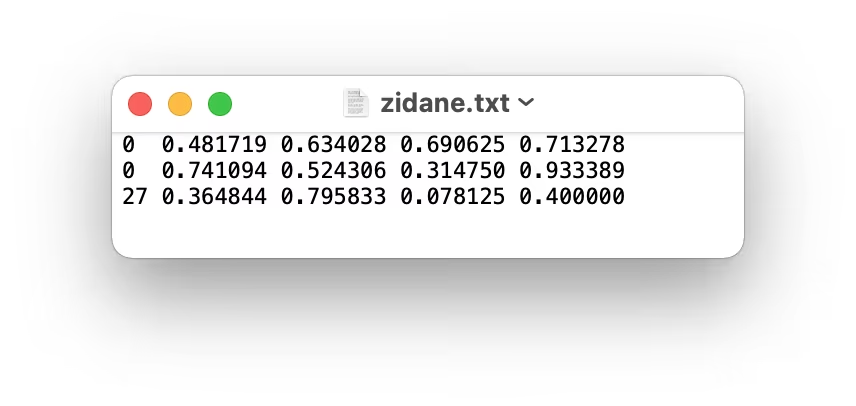
この形式のラベルは、画像ごとに*.txtファイルを1つずつ用意してYOLO形式にエクスポートしてください。画像にオブジェクトが含まれていない場合、*.txtファイルは不要です。*.txtファイルは、class x_center y_center width height形式でオブジェクトごとに1行となるように記述してください。バウンディングボックスの座標は正規化されたxywh形式(0~1)で指定してください。ボックスがピクセル単位の場合は、x_centerとwidthを画像の幅で、y_centerとheightを画像の高さで割ってください。座標は、EXIFの向きを適用したビューアーでの表示状態の画像を基準とします。これはUltralyticsがすべての画像を読み込む際の方法です。クラス番号は0始まり(0から開始)にしてください。
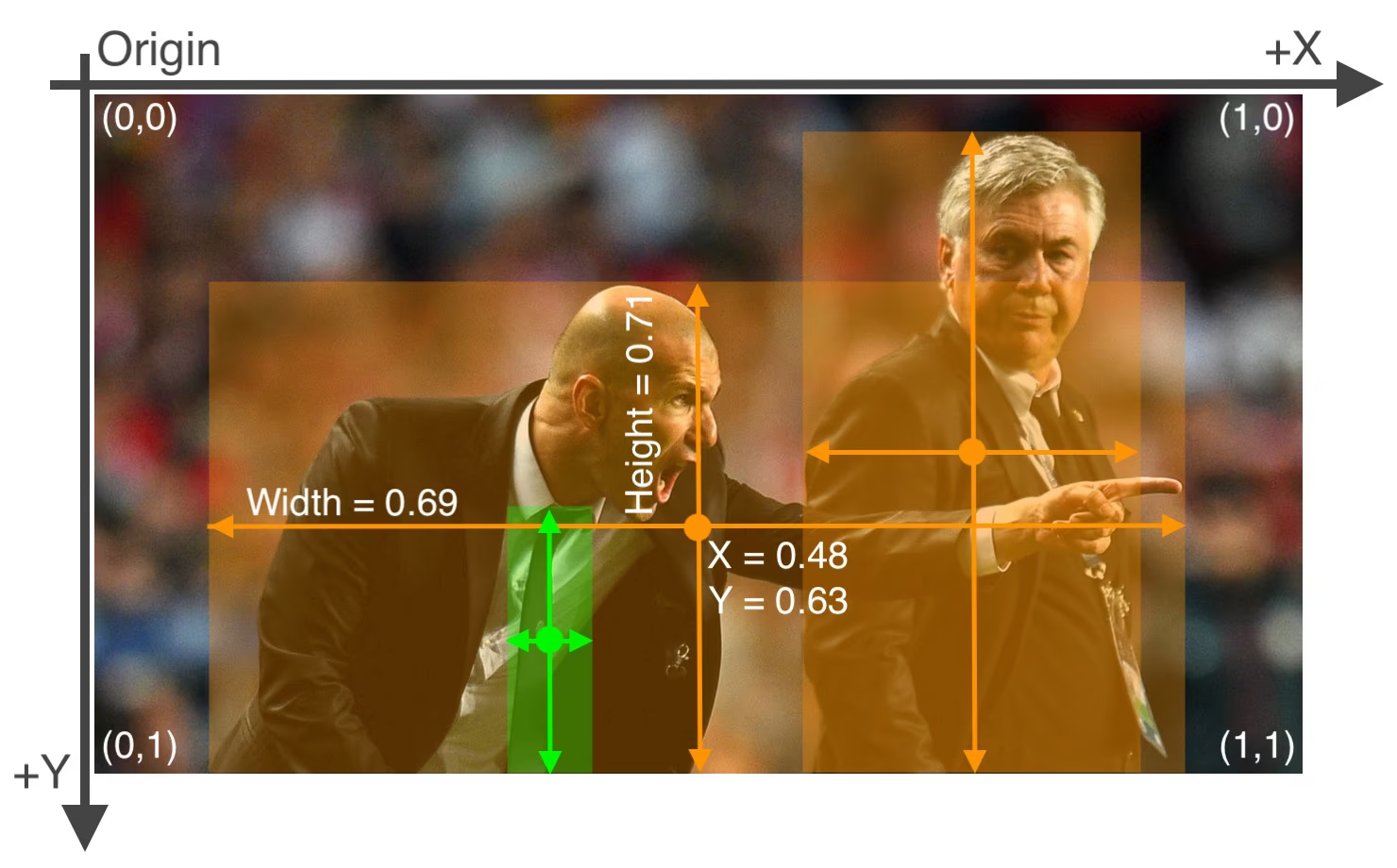
上記画像に対応するラベルファイルには、2人(クラス0)とネクタイ1つ(クラス27)が含まれています。
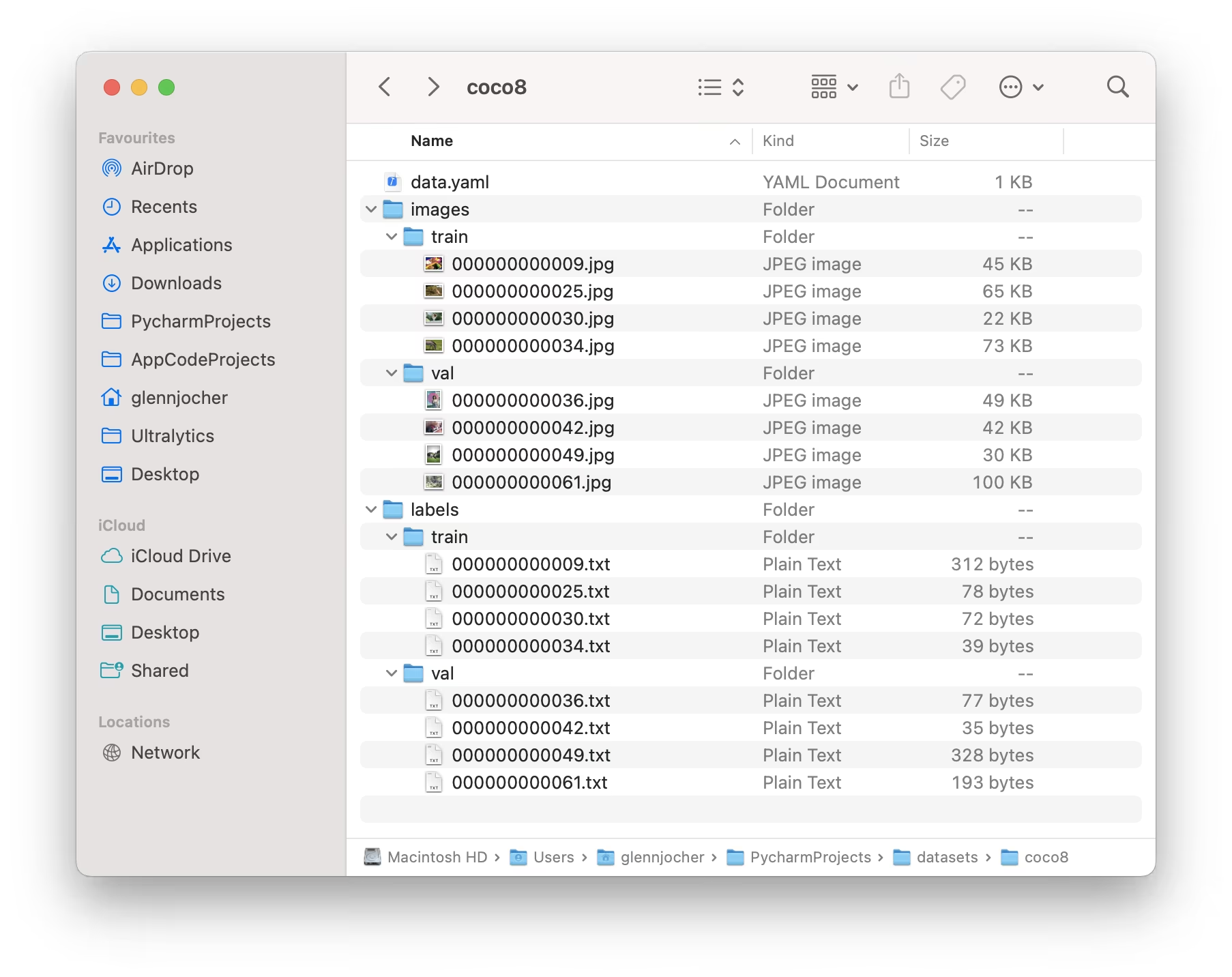
Ultralytics YOLO形式を使用する場合は、以下のCOCO8データセットの例に示すように、トレーニング用と検証用の画像およびラベルを整理してください。
使用例#
YOLO形式のデータセットを使用してモデルをトレーニングする方法は次のとおりです。
from ultralytics import YOLO

# モデルを読み込む
model = YOLO("yolo26n.pt")  # 事前トレーニング済みモデルを読み込みます(トレーニングにはこちらを推奨します)

# モデルをトレーニングする
results = model.train(data="coco8.yaml", epochs=100, imgsz=640)
Ultralytics NDJSON形式#
NDJSON(改行区切りJSON)形式は、Ultralytics YOLOモデルのデータセットを定義する別の方法です。この形式では、データセットのメタデータとアノテーションが1つのファイルに保存され、各行に個別のJSONオブジェクトが記述されます。
NDJSONデータセットファイルには、次の情報が含まれます。
- データセットレコード(1行目): タスクの種類、クラス名、一般情報など、データセットのメタデータが含まれます。
- 画像レコード(2行目以降): 各画像のサイズ、アノテーション、ファイルパスなどのデータが含まれます。
{
    "type": "dataset",
    "task": "detect",
    "name": "Example",
    "description": "COCO NDJSON example dataset",
    "url": "https://platform.ultralytics.com/user/datasets/example",
    "class_names": { "0": "person", "1": "bicycle", "2": "car" },
    "bytes": 426342,
    "version": 0,
    "created_at": "2024-01-01T00:00:00Z",
    "updated_at": "2025-01-01T00:00:00Z"
}カスタム画像メタデータ#
各画像レコードには、撮影条件、機器ID、レビュー状況など、アプリケーション固有のコンテキストを記述するmetadata JSONオブジェクトを含めることができます。ネストされた値にも対応しています。Ultralytics Platformにインポートすると、メタデータは画像とともに保存され、全画面の情報パネルから表示または編集できます。
{
    "type": "image",
    "file": "airbus-wing.jpg",
    "url": "https://example.com/airbus-wing.jpg",
    "split": "train",
    "metadata": {
        "aircraft": { "family": "A350", "section": "wing" },
        "inspectionStatus": "reviewed"
    }
}
Platformでは、最上位のメタデータキーは128文字まで、各画像のシリアライズ済みメタデータオブジェクトは500,000文字まで、1回のNDJSONインポートで扱うメタデータの合計有効文字数は500,000文字までに制限されています。
使用例#
NDJSONデータセットをYOLO26で使用するには、.ndjsonファイルへのパスを指定するだけです。
from ultralytics import YOLO

# モデルを読み込む
model = YOLO("yolo26n.pt")

# NDJSONデータセットを使用してトレーニング
results = model.train(data="path/to/dataset.ndjson", epochs=100, imgsz=640)NDJSON形式のメリット#
- 単一ファイル: データセットのすべての情報を1つのファイルに格納できます。
- ストリーミング: すべてをメモリに読み込まずに、大規模なデータセットを1行ずつ処理できます。
- クラウド連携: クラウドベースのトレーニングで、リモート画像URLをサポートします。
- 拡張性: カスタムメタデータフィールドを簡単に追加できます。
- バージョン管理: 単一ファイル形式のため、gitやバージョン管理システムとの相性が良好です。
サポート対象のデータセット#
以下は、サポート対象のデータセットとその概要です。これらの多くはUltralytics Platformでもホスティングされており、画像やアノテーションの閲覧、データセット統計の確認、クラウドトレーニング用のクローン作成ができます。
- African-wildlife:バッファロー、ゾウ、サイ、シマウマなど、アフリカの野生動物の画像を収録したデータセットです。
- Argoverse: 8種類の道路上の物体クラスを対象とする、54,446枚の都市部の自動運転画像からなるArgoverse-HD 2D検出データセットです。
- 脳腫瘍:脳MRI画像内の脳腫瘍を検出するためのデータセットです。腫瘍のバウンディングボックスでラベルが付けられています。単一クラスです。
- COCO:Common Objects in Context (COCO)は、80の物体カテゴリを含む大規模な物体検出、セグメンテーション、キャプション生成用データセットです。
- COCO8:COCO train2017の先頭8枚(トレーニング用4枚、検証用4枚)からなる小規模なサブセットで、迅速なテストに適しています。
- COCO8-Grayscale:RGBをグレースケールに変換して作成したCOCO8のグレースケール版で、シングルチャネルモデルの評価に役立ちます。
- COCO8-Multispectral:RGBの波長を補間して作成した、10チャネルのCOCO8マルチスペクトル版で、スペクトルを考慮したモデル評価に役立ちます。
- COCO12-Formats: 12種類の対応画像形式(AVIF、BMP、DNG、HEIC、JP2、JPEG、JPG、MPO、PNG、TIF、TIFF、WebP)を網羅した12枚の画像からなるテストデータセットです。画像読み込みパイプラインの検証に使用します。
- COCO16: COCO train2017の最初の16枚(トレーニング用8枚+検証用8枚)からなるサブセットで、迅速なテストに適しています。
- COCO32: COCO train2017の最初の32枚(トレーニング用16枚+検証用16枚)からなるサブセットで、迅速なテストに適しています。
- COCO64: COCO train2017の最初の64枚(トレーニング用32枚+検証用32枚)からなるサブセットで、迅速なテストに適しています。
- COCO128:COCO train2017の先頭128枚からなる小規模なサブセットで、テストに適しています。
- Construction-PPE: 建設現場の作業員を対象とし、ヘルメット、ベスト、手袋、ブーツ、ゴーグルなどの安全装備をラベル付けしたデータセットです。no_helmetやno_goggleなど、装備の欠落に関するアノテーションも含まれており、実環境でのコンプライアンス監視に利用できます。
- Global Wheat 2020:Global Wheat Challenge 2020向けの小麦穂の画像を含むデータセットです。
- HomeObjects-3K: ベッド、椅子、テレビなどの室内用品を含むデータセットです。スマートホームの自動化、ロボティクス、拡張現実、部屋のレイアウト分析などの用途に適しています。
- KITTI: ステレオ、LiDAR、GPS/IMUデータを含む実世界の走行シーンのデータセットです。ここでは、都市部、農村部、高速道路で車、自転車利用者、歩行者を識別する2D物体検出タスクに使用します。
- LVIS:1,203種類の物体カテゴリを含む、大規模な物体検出およびインスタンスセグメンテーション用データセットです。
- Medical-pills:医薬品の錠剤画像を収録したデータセットです。医薬品の品質保証、錠剤の仕分け、規制遵守などの用途向けにアノテーションされています。
- Objects365: 365の物体カテゴリと170万枚を超えるトレーニング画像を含む、高品質で大規模な物体検出用データセットです。
- OpenImagesV7:Googleが提供する包括的なデータセットで、トレーニング画像170万枚、検証画像4万2,000枚を収録しています。
- Roboflow 100:包括七个画像ドメインにわたる100個のデータセットを収録した、多様な物体検出ベンチマークです。包括的なモデル評価に利用できます。
- Signature:署名にアノテーションが付与されたさまざまな文書の画像を含むデータセットで、文書の検証や不正検出の研究を支援します。
- SKU-110K:小売環境における密集物体検出用データセットで、1万1,000枚を超える画像と170万個のバウンディングボックスを含みます。
- TT100K:検出と分類向けのTsinghua-Tencent 100K(TT100K)交通標識データセットです。221種類の標識カテゴリにわたる、街路ビュー画像16,817枚を収録しています。
- Ultralytics Benchmark:医療、航空、産業、小売などの分野にわたる、厳選された37の検出データセットを使用する自社ベンチマークスイートです。実環境でのモデルの汎化性能を測定するための固定プロトコルを備えています。
- VisDrone:ドローンで撮影された画像を基にした物体検出およびマルチオブジェクトトラッキングデータセットで、1万枚を超える画像と動画シーケンスを含みます。
- VOC:物体検出とセグメンテーション向けのPascal Visual Object Classes(VOC)データセットで、20種類の物体クラスと11K枚を超える画像を収録しています。
- xView:60種類の物体カテゴリと100万個を超えるアノテーション付き物体を含む、上空から撮影した画像向けの物体検出データセットです。
独自のデータセットを追加する#
独自のデータセットをお持ちで、Ultralytics YOLO形式を使用して検出モデルのトレーニングを行う場合は、「Ultralytics YOLO format」で前述した形式に準拠していることを確認してください。アノテーションを必要な形式に変換し、YAML設定ファイルでパス、クラス数、クラス名を指定してください。
ラベル形式の移植または変換#
COCOデータセット形式からYOLO形式への変換#
次のコードスニペットを使って、一般的なCOCOデータセット形式のラベルをYOLO形式に変換できます。
from ultralytics.data.converter import convert_coco

convert_coco(labels_dir="path/to/coco/annotations/")
この変換ツールを使用すると、COCOデータセットやCOCO形式の任意のデータセットをUltralytics YOLO形式に変換できます。この処理では、JSONベースのCOCOアノテーションを、よりシンプルなテキストベースのYOLO形式に変換し、Ultralytics YOLOモデルとの互換性を確保します。クラスIDのマッピング、ディレクトリ構成、セグメンテーションまたはポーズアノテーションを含むワークフロー全体については、COCOアノテーションをYOLOに変換をご覧ください。
使用するデータセットがモデルと互換性があり、必要な形式の規則に従っていることを必ず再確認してください。適切にフォーマットされたデータセットは、物体検出モデルのトレーニングを成功させるうえで不可欠です。
次のステップ#
データセットをフォーマットしたら、モデルのトレーニングを開始してください。どの事前学習済みモデルから始めればよいかわからない場合は、YOLO26モデルファミリーで選択肢を比較できます。
よくある質問#
Ultralytics YOLO形式は、トレーニングプロジェクトでデータセットを定義するための構造化された設定です。トレーニング、検証、テスト用の画像と対応するラベルへのパスを設定します。例:
# Ultralytics 🚀 AGPL-3.0 License - https://ultralytics.com/license

# COCO8 dataset (first 8 images from COCO train2017) by Ultralytics
# Documentation: https://docs.ultralytics.com/datasets/detect/coco8
# Example usage: yolo train data=coco8.yaml
# parent
# ├── ultralytics
# └── datasets
#     └── coco8 ← downloads here (1 MB)

# Train/val/test sets as 1) dir: path/to/imgs, 2) file: path/to/imgs.txt, or 3) list: [path/to/imgs1, path/to/imgs2, ..]
path: coco8 # dataset root dir
train: images/train # train images (relative to 'path') 4 images
val: images/val # val images (relative to 'path') 4 images
test: # test images (optional)

# Classes
names:
  0: person
  1: bicycle
  2: car
  3: motorcycle
  4: airplane
  5: bus
  6: train
  7: truck
  8: boat
  9: traffic light
  10: fire hydrant
  11: stop sign
  12: parking meter
  13: bench
  14: bird
  15: cat
  16: dog
  17: horse
  18: sheep
  19: cow
  20: elephant
  21: bear
  22: zebra
  23: giraffe
  24: backpack
  25: umbrella
  26: handbag
  27: tie
  28: suitcase
  29: frisbee
  30: skis
  31: snowboard
  32: sports ball
  33: kite
  34: baseball bat
  35: baseball glove
  36: skateboard
  37: surfboard
  38: tennis racket
  39: bottle
  40: wine glass
  41: cup
  42: fork
  43: knife
  44: spoon
  45: bowl
  46: banana
  47: apple
  48: sandwich
  49: orange
  50: broccoli
  51: carrot
  52: hot dog
  53: pizza
  54: donut
  55: cake
  56: chair
  57: couch
  58: potted plant
  59: bed
  60: dining table
  61: toilet
  62: tv
  63: laptop
  64: mouse
  65: remote
  66: keyboard
  67: cell phone
  68: microwave
  69: oven
  70: toaster
  71: sink
  72: refrigerator
  73: book
  74: clock
  75: vase
  76: scissors
  77: teddy bear
  78: hair drier
  79: toothbrush

# Download script/URL (optional)
download: https://github.com/ultralytics/assets/releases/download/v0.0.0/coco8.zip
ラベルは
*.txtファイルに保存され、画像ごとに1つのファイルが作成されます。形式は正規化座標を使用したclass x_center y_center width heightです。詳しいガイドについては、COCO8データセットの例をご覧ください。Ultralytics変換ツールを使って、COCOデータセットをYOLO形式に変換できます。簡単な方法は次のとおりです。
from ultralytics.data.converter import convert_coco convert_coco(labels_dir="path/to/coco/annotations/")このコードは、COCOアノテーションをYOLO形式に変換します。変換後のデータを使用してUltralytics YOLOモデルをトレーニングできます。
Ultralytics YOLOは、次のような幅広いデータセットをサポートしています。
各データセットのページでは、効率的なYOLO26トレーニングに合わせて、構成と使用方法について詳しく説明しています。サポート対象データセットセクションで全リストをご覧ください。
YOLO26モデルのトレーニングを始めるには、データセットが正しくフォーマットされ、YAMLファイルにパスが定義されていることを確認してください。次のスクリプトを使ってトレーニングを開始します。
例from ultralytics import YOLO model = YOLO("yolo26n.pt") # 事前トレーニング済みモデルを読み込む results = model.train(data="path/to/your_dataset.yaml", epochs=100, imgsz=640)Ultralyticsは、さまざまな用途でYOLOを使用するための多くの例と実践ガイドを提供しています。Ultralytics Blogでは、物体検出やセグメンテーションなどを扱う事例研究、詳細なチュートリアル、コミュニティの事例をご覧いただけます。具体的な例については、ドキュメントの予測モードのページを確認してください。


コメント54
質問したり、結果を共有したり、ほかの人をサポートしたりできます。
zcoolster11
Python Head Bop
 Paula DerrengerUltralytics
@zcoolster11, could you clarify what you mean by “Python Head Bop” and what you’d like to do with Ultralytics YOLO? Feel free to drop your dataset or Python questions here in the discussion so the Ultralytics team can help.
 Murat Raimbekov
hey @orz-serein, short answer: no, you don't need empty label files for background images - just leave the
.txtout.i verified this empirically on the current main branch. setup: 5 images, 2 with real labels, 1 with an empty
.txtfile, 2 without any.txtfile at all. building aYOLODatasetover them gives:Scanning /tmp/bgtest_full/labels... 3 images, 3 backgrounds, 0 corrupt: 100% 5/5all 5 images are kept. the 3 without labels (the empty-
.txtone and the two with no.txtat all) all end up with the same(0, 5)labels array - they are treated identically as background images.so both options work:
- no
.txtfile: counted as "missing" (nm=1), no labels -> background - empty
.txtfile: counted as "empty" (ne=1), no labels -> background
both end up in the same
backgrounds = nm + nebucket inultralytics/data/dataset.py.this is also stated in the detection dataset docs:
If there are no objects in an image, no
*.txtfile is required.how many background images: the yolov5 training tips recommend 0-10% of the dataset as background images to reduce false positives (coco has about 1% background).
hope this helps!
- no
 serein
Hello, I would like to ask a question. During the stage of preparing the training dataset, if some images do not have the target to be detected, do I need to add corresponding empty label files in the label folder?
Fatima-khanjar
Hello, I hope this message finds you well.
I have a question regarding fine-tuning a pre-trained YOLO model (e.g., trained on the COCO dataset) on my custom dataset. My dataset includes both new classes (not present in COCO) and the same existing classes (e.g., toothbrush, car), but with different layouts. Specifically, I would like to add my new classes starting from index 80, while still leveraging the pre-trained weights for the common classes, which are the same but with different layouts.
Is it possible to use the pre-trained weights for the common classes and only train the model on the new classes, while ensuring that the pre-trained knowledge for the common classes is preserved? If so, could you please guide me on how to proceed?
Thank you for your time and assistance. best regards,
bimal-gajera
Hello, I'm working on multiple dataset formats for object detection. For the YOLO dataset format, is there any way I can rename the labels directory and put it in yaml file? Something like this:
path: path_to_root_directory
train: train\images
val: val\images
test: test\images

labels_dir: yolo

nc: 1
names: ['object']
yolo directory has yolo annotations (*.txt files), and it's inside respective train, val and test directory.
 Glenn JocherUltralytics(編集済み)
@bimal-gajera currently, the
labels_dirkey is not supported in the YAML file. Ultralytics finds label files by replacing the last/images/directory in each image path with/labels/, so each split needs siblingimages/andlabels/directories (for exampletrain/imagesandtrain/labels). For more details, refer to the Object Detection Datasets Overview.1
nitya-pandey-astro
Hello Team, I am using YOLO for detecting trails of slow-moving astronomical objects in my images. While the model detects the trails, the bounding boxes predicted around the objects are not tight enough. The boxes tend to be too loose or not well-shaped to fit the elongated, irregular trails, resulting in inaccurate object localization. I suspect, YOLO's standard rectangular bounding box not being well-suited for the elongated, curving shapes of the trails. Could you provide guidance on how to improve bounding box accuracy for this specific use case?
- Glenn JocherUltralytics(編集済み)
@astronitya thank you for your question! For detecting elongated or irregular trails, consider using Oriented Bounding Boxes (OBB), which may better fit your objects' shapes compared to standard rectangular boxes. You can format your dataset in the YOLO OBB format and train a YOLO26 OBB model. Please refer to the Oriented Bounding Box (OBB) Datasets Overview for details on dataset formatting and training. Let me know if you need further clarification!
@glenn-jocher Thankyou very much for the prompt response. I am going to work on your suggestions.
Yuxuan1998
Hi team, I am a little bit confused with the dataset folder structure. For most dataset I used, it strunctured in the way that each of
train/andval/folders containsimages/andlabels/folders. However, the COCO8 dataset example shows the opposite way, each ofimages/andlabels/folder containstest/andval/folders. Does the folder structure matter here? Thanks in advance- Glenn JocherUltralytics(編集済み)
@Yuxuan1998 both layouts work, as long as each image has a sibling
labelsdirectory: Ultralytics finds the label for an image by replacing the last/images/in its path with/labels/(sotrain/images/img.jpgusestrain/labels/img.txt, andimages/train/img.jpguseslabels/train/img.txt). Set the paths in your dataset's YAML file to the image directories. For details, refer to the Object Detection Datasets Overview. Let us know if you need further clarification!1
milanaveed
Hello, can you please fix the broken images on this page? Can't see the label file example.
wgdcxy
Hello, my label and image files are stored according to the requirements, but they are still not recognized, and the following is an error message Thank you in advance
WARNING ⚠️ imgsz=[2448] must be multiple of max stride 32, updating to [2464] train: Scanning D:\Textile_testing\ultralytics-seg\cs\labels\ttb... 0 images, 30 backgrounds, 0 corrupt: 100%|██████████| 30/30 [00:00<00:00, 1138.41it/s] train: WARNING ⚠️ No labels found in D:\Textile_testing\ultralytics-seg\cs\labels\ttb.cache. See https://docs.ultralytics.com/datasets/detect for dataset formatting guidance. train: WARNING ⚠️ Cache directory D:\Textile_testing\ultralytics-seg\cs\labels is not writeable, cache not saved. WARNING ⚠️ No labels found in D:\Textile_testing\ultralytics-seg\cs\labels\ttb.cache, training may not work correctly. See https://docs.ultralytics.com/datasets/detect for dataset formatting guidance. val: Scanning D:\Textile_testing\ultralytics-seg\cs\labels\ttj... 0 images, 30 backgrounds, 0 corrupt: 100%|██████████| 30/30 [00:00<00:00, 1617.94it/s] val: WARNING ⚠️ No labels found in D:\Textile_testing\ultralytics-seg\cs\labels\ttj.cache. See https://docs.ultralytics.com/datasets/detect for dataset formatting guidance. val: WARNING ⚠️ Cache directory D:\Textile_testing\ultralytics-seg\cs\labels is not writeable, cache not saved. WARNING ⚠️ No labels found in D:\Textile_testing\ultralytics-seg\cs\labels\ttj.cache, training may not work correctly. See https://docs.ultralytics.com/datasets/detect for dataset formatting guidance. Plotting labels to runs\segment\train3\labels.jpg...
- Glenn JocherUltralytics
It seems like your dataset labels are not being recognized. Please ensure your label files are in the correct YOLO format and that the directory is writable. For detailed guidance, visit the dataset formatting section at https://docs.ultralytics.com/datasets/detect/.
Hi, but my file path is very accurate, and I checked it N times, so is there any otherreason? Thank you
- Glenn JocherUltralytics
@wgdcxy please ensure your label files are in the correct YOLO format, with one
.txtfile per image containing normalized coordinates. Also, verify that the directory permissions allow writing. For more details, refer to the dataset formatting guide linked earlier. Hello, I'm a student whose English is not particularly good, so some places may not be clear, and secondly, this is not an error but a warning.I don't know why it's the background that reads, not the images. The warnings are as follows: val: Scanning D:\Textile_testing\ultralytics-seg\cs\labels\ttj... 0 images, 30 backgrounds, 0 corrupt: 100%| 30/30 [00:00<00:00, 495.76it/s] val: WARNING ⚠️ No labels found in D:\Textile_testing\ultralytics-seg\cs\labels\ttj.cache. See https://docs.ultralytics.com/datasets/detect for dataset formatting guidance. val: WARNING ⚠️ Cache directory D:\Textile_testing\ultralytics-seg\cs\labels is not writeable, cache not saved. WARNING ⚠️ No labels found in D:\Textile_testing\ultralytics-seg\cs\labels\ttj.cache, training may not work correctly. See https://docs.ultralytics.com/datasets/detect for dataset formatting guidance. Plotting labels to runs\segment\train4\labels.jpg...
Then this warning tells me that the cache file is missing, and I don't know why I can't generate a cache file for the file I created, so I'm here to ask you guys. Below is my own yaml file: # Train/val/test sets as 1) dir: path/to/imgs, 2) file: path/to/imgs.txt, or 3) list: [path/to/imgs1, path/to/imgs2, ..] path: ../cs # dataset root dir train: images/ttb # train images (relative to 'path') 128 images val: images/ttj # val images (relative to 'path') 128 images test: # test images (optional) # Classes names : 0 : wf
Below is my label file: 0 0.6799428104575164 0.5005859375 0.6844771241830065 0.500537109375 0.6845996732026144 0.497265625 0.6802696078431373 0.497119140625 0 0.6803104575163399 0.4935546875 0.6848039215686275 0.493505859375 0.6847630718954248 0.497119140625 0.6802696078431373 0.49697265625 0 0.6802696078431373 0.49013671875 0.6849673202614379 0.490185546875 0.6849264705882353 0.49345703125 0.6803513071895425 0.493359375 0 0.6805555555555556 0.48662109375 0.6850898692810458 0.486767578125 0.6850490196078431 0.490234375 0.6803513071895425 0.490234375 0 0.6808415032679739 0.483447265625 0.6852941176470588 0.48349609375 0.6852124183006536 0.486767578125 0.6806781045751634 0.486669921875 0 0.6806372549019607 0.47998046875 0.6854166666666666 0.47998046875 0.6853349673202613 0.48349609375 0.6808415032679738 0.48359375
Finally, this yolo can be run, but I don't know why the result is 0. Here's how it works: Transferred 381/417 items from pretrained weights 195/200 8.73G 0 0 nan 0 0 2464: 100%|██████████| 8/8 [01:37<00:00, 12.13s/it] Class Images Instances Box(P R mAP50 mAP50-95) Mask(P R mAP50 mAP50-95): 100%|[00:31<00:00, 7.91s/it] all 30 0 0 0 0 0 0 0 0 0 Finally, thank you for explaining it to me
By the way, the size of my picture is 2448x2048, so the imgsz entered is 2448, and your code changed the size of my picture to 2464, is it related to this. imgsz=[2448] must be multiple of max stride 32, updating to [2464]
I apologize, I found a small mistake of mine. I wrote the file name as "labels" instead of "lables" which I intended to write.Please forgive my carelessness.After all, who doesn't make mistakes. I'll come back to you next time I have a problem. Thank you for your help.
Transferred 417/417 items from pretrained weights Freezing layer 'model.22.dfl.conv.weight' AMP: running Automatic Mixed Precision (AMP) checks with YOLOv8n... AMP: checks passed ✅ WARNING ⚠️ imgsz=[2448] must be multiple of max stride 32, updating to [2464] train: Scanning D:\Textile_testing\ultralytics-seg\cs\labels\ttb.cache... 30 images, 0 backgrounds, 0 corrupt: 100%|██████████| 30/30 [00:00<?, ?it/s] Hello, here I am again, with a new problem, how to solve this problem about image size?Ask for answers, thank you
- Glenn JocherUltralytics
@wgdcxy to address the image size issue, ensure your
imgszis a multiple of 32, as required by the model's architecture. This adjustment helps maintain compatibility with the model's stride. If you have further questions, feel free to ask! WARNING ⚠️ NMS time limit 0.900s exceeded. Hello, my teacher who has never met, what should I do with this warning?
- Glenn JocherUltralytics(編集済み)
@wgdcxy the "NMS time limit exceeded" warning is not controlled by an
nmsargument. It appears when too many candidate boxes need to be processed within the time limit, which is common early in training when validation uses a low confidence threshold. It usually stops as the model trains, and you can reduce it by raisingconfor loweringmax_detduring validation. If you have further questions, feel free to ask! Hello, I'm here again. The issue this time is still the same warning. I adjusted the max_time_img to 0.1 in ops. py, but I don't feel it's right. So I came to ask for your help because it still shows this warning. I hope you can tell me where to make the adjustment. Thank you again. WARNING ⚠️ NMS time limit 0.900s exceeded
How can these values be improved? We can only continue training or increase the training dataset. Epoch GPU_mem box_loss seg_loss cls_loss dfl_loss Instances Size 11/500 11G nan 6.21 nan nan 132 2464: 100%|██████████| 8/8 [01:56<00:00, 14.59s/it] Class Images Instances Box(P R mAP50 mAP50-95) Mask(P R mAP50 mAP50-95): 100%|██████████| 4/4 [00:54<00:00, 13.56s/it] all 30 664 0 0 0 0 0 0 0 0
- Glenn JocherUltralytics
To improve your model's performance, consider increasing the dataset size, enhancing data quality, or adjusting hyperparameters. If issues persist, reviewing the dataset for label accuracy and distribution might help.
WARNING ⚠️ imgsz=[2448] must be multiple of max stride 32, updating to [2464] train: Scanning D:\Textile_testing\ultralytics-seg\cs\labels\ttb... 0 images, 30 backgrounds, 0 corrupt: 100%|██████████| 30/30 [00:00<00:00, 1138.41it/s] train: WARNING ⚠️ No labels found in D:\Textile_testing\ultralytics-seg\cs\labels\ttb.cache. See https://docs.ultralytics.com/datasets/detect for dataset formatting guidance. train: WARNING ⚠️ Cache directory D:\Textile_testing\ultralytics-seg\cs\labels is not writeable, cache not saved. WARNING ⚠️ No labels found in D:\Textile_testing\ultralytics-seg\cs\labels\ttb.cache, training may not work correctly. See https://docs.ultralytics.com/datasets/detect for dataset formatting guidance. val: Scanning D:\Textile_testing\ultralytics-seg\cs\labels\ttj... 0 images, 30 backgrounds, 0 corrupt: 100%|██████████| 30/30 [00:00<00:00, 1617.94it/s] val: WARNING ⚠️ No labels found in D:\Textile_testing\ultralytics-seg\cs\labels\ttj.cache. See https://docs.ultralytics.com/datasets/detect for dataset formatting guidance. val: WARNING ⚠️ Cache directory D:\Textile_testing\ultralytics-seg\cs\labels is not writeable, cache not saved. WARNING ⚠️ No labels found in D:\Textile_testing\ultralytics-seg\cs\labels\ttj.cache, training may not work correctly. See https://docs.ultralytics.com/datasets/detect for dataset formatting guidance. Plotting labels to runs\segment\train3\labels.jpg...
这个问题该如何解决?
- Glenn JocherUltralytics
It looks like your dataset labels are missing or not formatted correctly. Please ensure your labels are in the YOLO format and check the directory permissions. For detailed guidance, visit the dataset formatting section at https://docs.ultralytics.com/datasets/detect/.