COCO-Segデータセット

COCO-Segデータセットは、COCO(Common Objects in Context)のインスタンスセグメンテーションマスクを、Ultralytics YOLOラベル形式で提供します。80のオブジェクトカテゴリにわたるポリゴンマスク付きのトレーニング画像118,287枚と検証画像5,000枚で構成されています。COCOの元画像とネイティブのセグメンテーションアノテーションを使用し、YOLOの学習用に変換されているため、インスタンスセグメンテーションタスクに取り組む研究者や開発者にとって標準的なリソースです。
COCO-Seg学習済みモデル#
| モデル | サイズ (ピクセル) | mAPbox50-95 (e2e) | mAPmask50-95 (e2e) | 速度 CPU ONNX (ms) | 速度 T4 TensorRT10 (ms) | パラメーター (M) | FLOPs (B) |
|---|---|---|---|---|---|---|---|
| YOLO26n-seg | 640 | 39.6 | 33.9 | 53.3 ± 0.5 | 2.1 ± 0.0 | 2.7 | 9.3 |
| YOLO26s-seg | 640 | 47.3 | 40.0 | 118.4 ± 0.9 | 3.3 ± 0.0 | 10.4 | 34.5 |
| YOLO26m-seg | 640 | 52.5 | 44.1 | 328.2 ± 2.4 | 6.7 ± 0.1 | 23.6 | 121.7 |
| YOLO26l-seg | 640 | 54.4 | 45.5 | 387.0 ± 3.7 | 8.0 ± 0.1 | 28.0 | 140.1 |
| YOLO26x-seg | 640 | 56.5 | 47.0 | 787.0 ± 6.8 | 16.4 ± 0.1 | 62.8 | 314.0 |
主な機能#
- COCO-Segは、COCOの約33万枚の画像を含むより広範なリリースのうち、ラベル付きのCOCO train2017/val2017画像123,287枚(学習用118,287枚 + 検証用5,000枚)のインスタンスセグメンテーションマスクを提供します。
- このデータセットには、元のCOCOデータセットと同じ80種類の物体カテゴリが含まれています。
- アノテーションは、YOLOのポリゴンラベル形式によるインスタンスセグメンテーションマスクを提供します。
- COCO-Segは、インスタンスセグメンテーションのパフォーマンスを評価するための標準化されたmAPおよびmARメトリクスを提供し、モデルのパフォーマンスを効果的に比較できます。
- ダウンロードサイズ:初回使用時は約20.3 GB(
train2017.zip+val2017.zip+ ラベル)。7 GBのtest2017.zipは自動取得されません。これらの画像には正解データが公開されておらず、test-dev2017への提出にのみ必要なためです。
データセットの構成#
COCO-Segデータセットは、次の3つのサブセットに分割されています。
- Train2017: インスタンスセグメンテーションモデルの学習に使用する118,287枚の画像です。
- Val2017: モデル開発中の検証に使用する5,000枚の画像です。
- Test-dev2017: ベンチマークに使用する、test2017の40,670枚の画像のうち20,288枚です。このサブセットの正解アノテーションは公開されていないため、スコアを取得するには予測結果をCOCO評価サーバーに提出する必要があります。
小規模な実験には、COCO128-Seg(128枚)およびCOCO8-Seg(8枚)のサブセットをご覧ください。
用途#
COCO-Segは、YOLOモデルなどの深層学習モデルをインスタンスセグメンテーション向けに学習・評価するために広く使用されています。アノテーション付き画像の多さ、オブジェクトカテゴリの多様性、標準化された評価指標により、コンピュータービジョンの研究者や実務者にとって標準的なリソースとなっています。COCO-Segのアノテーションはすべて、Ultralytics Platformで閲覧・管理することもできます。
データセットYAML#
データセット設定の定義にはYAMLファイルを使用します。このファイルには、データセットのパス、クラス、その他の関連情報が含まれます。COCO-Segデータセットの場合、coco.yamlファイルはhttps://github.com/ultralytics/ultralytics/blob/main/ultralytics/cfg/datasets/coco.yamlで管理されています。
# Ultralytics 🚀 AGPL-3.0 License - https://ultralytics.com/license

# COCO 2017 dataset https://cocodataset.org by Microsoft
# Documentation: https://docs.ultralytics.com/datasets/detect/coco
# Example usage: yolo train data=coco.yaml
# parent
# ├── ultralytics
# └── datasets
#     └── coco ← downloads here (20.3 GB)

# Train/val/test sets as 1) dir: path/to/imgs, 2) file: path/to/imgs.txt, or 3) list: [path/to/imgs1, path/to/imgs2, ..]
path: coco # dataset root dir
train: train2017.txt # train images (relative to 'path') 118287 images
val: val2017.txt # val images (relative to 'path') 5000 images
test: test-dev2017.txt # 20288 of 40670 images, submit via https://cocodataset.org/#detection-eval

# Classes
names:
  0: person
  1: bicycle
  2: car
  3: motorcycle
  4: airplane
  5: bus
  6: train
  7: truck
  8: boat
  9: traffic light
  10: fire hydrant
  11: stop sign
  12: parking meter
  13: bench
  14: bird
  15: cat
  16: dog
  17: horse
  18: sheep
  19: cow
  20: elephant
  21: bear
  22: zebra
  23: giraffe
  24: backpack
  25: umbrella
  26: handbag
  27: tie
  28: suitcase
  29: frisbee
  30: skis
  31: snowboard
  32: sports ball
  33: kite
  34: baseball bat
  35: baseball glove
  36: skateboard
  37: surfboard
  38: tennis racket
  39: bottle
  40: wine glass
  41: cup
  42: fork
  43: knife
  44: spoon
  45: bowl
  46: banana
  47: apple
  48: sandwich
  49: orange
  50: broccoli
  51: carrot
  52: hot dog
  53: pizza
  54: donut
  55: cake
  56: chair
  57: couch
  58: potted plant
  59: bed
  60: dining table
  61: toilet
  62: tv
  63: laptop
  64: mouse
  65: remote
  66: keyboard
  67: cell phone
  68: microwave
  69: oven
  70: toaster
  71: sink
  72: refrigerator
  73: book
  74: clock
  75: vase
  76: scissors
  77: teddy bear
  78: hair drier
  79: toothbrush

# Download script/URL (optional)
download: |
  from pathlib import Path

  from ultralytics.utils import ASSETS_URL
  from ultralytics.utils.downloads import download

  # Download labels
  segments = True  # segment or box labels
  dir = Path(yaml["path"])  # dataset root dir
  urls = [ASSETS_URL + ("/coco2017labels-segments.zip" if segments else "/coco2017labels.zip")]  # labels
  download(urls, dir=dir.parent)

  # Download data (test2017.zip excluded: ground truth is withheld, only used for the eval-server test-dev split)
  urls = [
      "http://images.cocodataset.org/zips/train2017.zip",  # 19G, 118k images
      "http://images.cocodataset.org/zips/val2017.zip",  # 1G, 5k images
  ]
download(urls, dir=dir / "images", threads=3)使用方法#
以下のコードスニペットを使用すると、COCO-Segデータセットで画像サイズ640、100エポックの条件でYOLO26n-segモデルをトレーニングできます。
from ultralytics import YOLO

# モデルを読み込む
model = YOLO("yolo26n-seg.pt")  # 事前トレーニング済みモデルを読み込みます(トレーニングにはこちらを推奨します)

# モデルをトレーニングする
results = model.train(data="coco.yaml", epochs=100, imgsz=640)サンプル画像とアノテーション#
COCO-Segには、COCOと同様に多様な画像、オブジェクトカテゴリ、複雑なシーンが含まれており、インスタンスセグメンテーションマスクはYOLOラベル形式で提供されています。以下に、データセット内の画像と、それぞれに対応するインスタンスセグメンテーションマスクの例を示します。
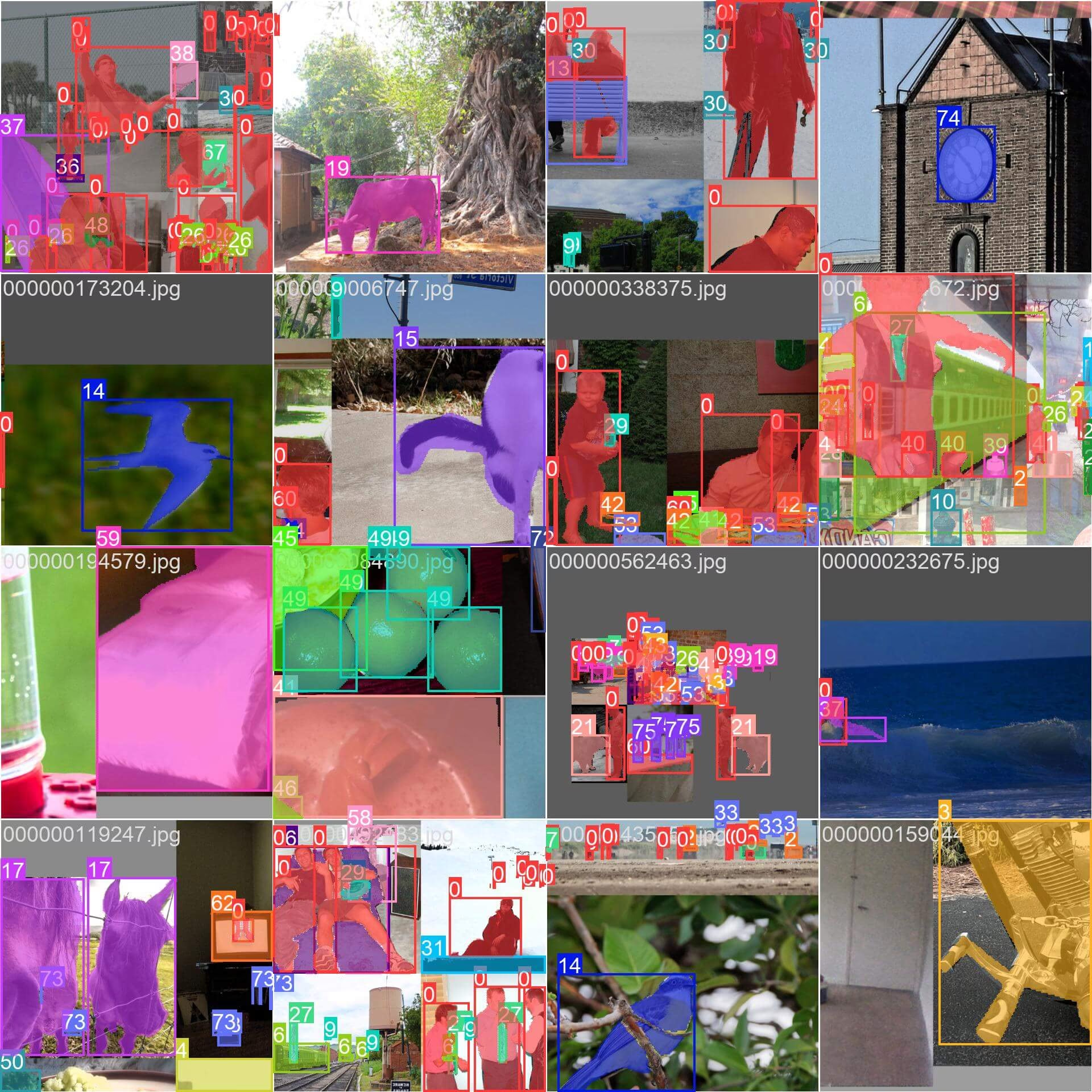
- モザイク画像: この画像は、データセットの画像をモザイク状に組み合わせた学習バッチを示しています。モザイク化は、学習時に複数の画像を1枚の画像に結合し、各学習バッチ内のオブジェクトやシーンの多様性を高める手法です。これにより、モデルがさまざまなオブジェクトのサイズ、アスペクト比、コンテキストに汎化する能力が向上します。
引用と謝辞#
研究や開発でCOCO-Segデータセットを使用する場合は、元のCOCO論文を引用し、COCO-Segへの拡張について明記してください。
@misc{lin2015microsoft,
      title={Microsoft COCO: Common Objects in Context},
      author={Tsung-Yi Lin and Michael Maire and Serge Belongie and Lubomir Bourdev and Ross Girshick and James Hays and Pietro Perona and Deva Ramanan and C. Lawrence Zitnick and Piotr Dollár},
      year={2015},
      eprint={1405.0312},
      archivePrefix={arXiv},
      primaryClass={cs.CV}
}コンピュータービジョンコミュニティにとって貴重なこのリソースを作成し、維持しているCOCO Consortiumに感謝します。
よくある質問#
COCO-Segは、COCOのネイティブなインスタンスセグメンテーションマスク(Common Objects in Context)を、同じ118,287枚のtrain2017画像と5,000枚のval2017画像についてUltralytics YOLO形式にパッケージ化したものです。元のCOCOアノテーションには、80のすべてのオブジェクトカテゴリについてこれらのポリゴンマスクがすでに含まれています。COCO-Segでは、オブジェクトのインスタンスセグメンテーションの学習に使用するYOLOラベル形式に変換します。
COCO-SegデータセットでYOLO26n-segモデルを画像サイズ640、100エポックで学習するには、次のコードスニペットを使用できます。利用可能な学習引数の詳細な一覧については、モデルの学習ページをご覧ください。
トレーニング例from ultralytics import YOLO # モデルを読み込む model = YOLO("yolo26n-seg.pt") # 事前トレーニング済みモデルを読み込みます(トレーニングにはこちらを推奨します) # モデルをトレーニングする results = model.train(data="coco.yaml", epochs=100, imgsz=640)COCO-Segデータセットには、次のような主な特徴があります。
- COCOのtrain2017/val2017に含まれるラベル付き画像123,287枚(train 118,287枚 + val 5,000枚)に、インスタンスセグメンテーションマスクを提供します。
- 元のCOCOと同じ80種類のオブジェクトカテゴリにアノテーションを付与しています。
- YOLOのポリゴンラベル形式でインスタンスセグメンテーションマスクを提供します。
- インスタンスセグメンテーションタスクでは、平均適合率(mAP)や平均再現率(mAR)などの標準化された評価指標を使用します。
COCO-Segデータセットは、性能指標がそれぞれ異なる複数の事前学習済みYOLO26セグメンテーションモデルに対応しています。利用可能なモデルと主な指標を以下にまとめます。
モデル サイズ
(ピクセル)mAPbox50-95
(e2e)mAPmask50-95
(e2e)速度
CPU ONNX
(ms)速度
T4 TensorRT10
(ms)パラメーター
(M)FLOPs
(B)YOLO26n-seg 640 39.6 33.9 53.3 ± 0.5 2.1 ± 0.0 2.7 9.3 YOLO26s-seg 640 47.3 40.0 118.4 ± 0.9 3.3 ± 0.0 10.4 34.5 YOLO26m-seg 640 52.5 44.1 328.2 ± 2.4 6.7 ± 0.1 23.6 121.7 YOLO26l-seg 640 54.4 45.5 387.0 ± 3.7 8.0 ± 0.1 28.0 140.1 YOLO26x-seg 640 56.5 47.0 787.0 ± 6.8 16.4 ± 0.1 62.8 314.0 これらのモデルには、軽量なYOLO26n-segから精度の高いYOLO26x-segまで幅広い種類があり、さまざまな用途の要件に合わせて速度と精度のトレードオフを選択できます。
COCO-Segデータセットは、特定の学習および評価のニーズに応じて3つのサブセットに分割されています。
- Train2017: 主にインスタンスセグメンテーションモデルの学習に使用する118,287枚の画像が含まれています。
- Val2017: 学習プロセス中の検証に使用される5,000枚の画像で構成されます。
- Test-dev2017: テストおよび学習済みモデルのベンチマーク用に確保されたtest2017画像40,670枚のうち、20,288枚が含まれます。このサブセットの正解アノテーションは公開されていません。評価用の性能結果はCOCO評価サーバーに提出します。
小規模な実験には、COCO128-Segデータセット(128枚)またはCOCOのtrain2017セットから選んだ8枚のみを含むコンパクトなデータセットであるCOCO8-Segデータセットもご検討ください。


コメント10
質問したり、結果を共有したり、ほかの人をサポートしたりできます。
liujieKermit
what the label format if I want to train my custom dataset, please give the solution step by step like label, train, val, export, predict
 Glenn JocherUltralytics(編集済み)
@liujieKermit for custom segmentation training with YOLO26, follow these steps:
-
Label Format: Use YOLO segmentation format - one text file per image with class index and normalized polygon coordinates (minimum 3 points per object). Example:
<class> <x1> <y1> <x2> <y2> ... <xn> <yn> -
Dataset YAML: Create a YAML file (example
data.yaml):
path: /path/to/dataset train: images/train val: images/val names: 0: class1 1: class2- Train:
from ultralytics import YOLO model = YOLO('yolo26n-seg.pt') model.train(data='data.yaml', epochs=100, imgsz=640)- Export/Predict:
model.export(format='onnx')  # export
model.predict('image.jpg')  # predict
For full details see our Dataset Format Guide and Auto-Annotation Tools. For commercial use, review our license terms.
-
YingdiZhang
Thanks for the great work. I am new to YOLO and AI. How to download the COCO dataset? is just running python coco.yaml?
- Glenn JocherUltralytics(編集済み)
@YingdiZhang to download the COCO dataset, you can run
yolo segment train data=coco.yamlin your terminal. This will automatically download the dataset for you. For more details, you can visit the Ultralytics documentation.
SacherTorte280
Dear developpers, I need to build a much simpler case where I'll only need <=5 labels, can I remove the others that i'll never use ?
 Paula DerrengerUltralytics(編集済み)
@SacherTorte280 yes, you can customize the dataset to include only the labels you need. To do this, modify the
coco.yamlfile to include only the desired classes in thenamessection and adjust the dataset paths accordingly. Also make sure the class indices in your label files are remapped to match the newnames(0 to N-1) and remove labels of the dropped classes. This will allow you to train your model with a simplified set of labels. For more details on configuring the dataset, please refer to the COCO-Seg documentation.
MoAbbasid
i get a list out of index error when running convert_coco function please help
- Paula DerrengerUltralytics
Hi there! It looks like you're encountering a
list index out of rangeerror with theconvert_cocofunction. This can often happen if the script is trying to access an element that doesn't exist in a list. To help you resolve this issue, please ensure that:- The data paths in your
coco.yamlconfig file are correctly set and point to valid files. - The COCO dataset is correctly downloaded and structured as expected by the script.
If the paths and dataset structure are correct, it might be helpful to check if the specific segment of data causing the error is formatted correctly or missing elements.
Here's a quick check you can perform:
try:
    # Assuming convert_coco is called here
    convert_coco()
except IndexError as e:
    print("An index error occurred: ", e)
    # You can add more debugging information here to understand which part of the data is causing the problem
This snippet will catch the
IndexErrorand print it, potentially providing more insight on what's going wrong. If you need further assistance, please don't hesitate to share a snippet of the data or more details on the error! - The data paths in your
mohamed-ladjal
Greetings, I possess medical imagery depicting bone lesions. These images comprise 3D volumes of dimensions (256, 256, 128), with each volume containing 128 slices. Corresponding masks of identical dimensions are available. My objective is to either fine-tune or train a model using these slices to accurately segment the lesions mohamed mohamed.laadjel2019@gmail.com
- Glenn JocherUltralytics(編集済み)
Hello Mohamed,
Great to hear about your project on segmenting bone lesions from medical imagery! For your 3D volumes, you can approach this by treating each slice as a separate 2D image for segmentation.
Given your setup, you might consider using our YOLO26-seg models, which are well-suited for segmentation tasks. Here’s a basic example of how you could set up your training with YOLO26:
from ultralytics import YOLO

# Load a pretrained segmentation model
model = YOLO('yolo26n-seg.pt')  # Choose the appropriate model size

# Prepare your dataset in a compatible format
# Ensure your dataset directory structure and annotations are correctly set up

# Train the model
results = model.train(data='your_dataset_config.yaml', epochs=100, imgsz=640)
Make sure your dataset is annotated similarly to how COCO-Seg annotations are structured, with masks corresponding to each slice. You might need to adjust the
your_dataset_config.yamlto correctly point to your training, validation, and test images along with their annotations.For more detailed guidance on preparing your dataset and annotations, you can refer to our documentation on COCO-Seg Dataset.
If you have any more questions or need further assistance, feel free to ask. Happy training! 🚀