クイックスタートガイド:NVIDIA JetsonでUltralytics YOLO26を使う
このガイドでは、NVIDIA JetsonデバイスへのUltralytics YOLO26のデプロイ手順を説明し、小型で電力効率に優れたこれらのデバイスでYOLO26が実現できる性能を示すベンチマークも掲載しています。
最大2070 FP4 TFLOPSのAI演算性能と128 GBのメモリを備え、電力を40 Wから130 Wの範囲で設定できる最新のNVIDIA Jetson AGX Thor Developer Kitに合わせて、このガイドを更新しました。NVIDIA Jetson AGX Orinと比べてAI演算性能は7.5倍以上、最も広く使われているAIモデルの実行時のエネルギー効率は3.5倍向上します。
視聴する: NVIDIA JetsonデバイスでUltralytics YOLO26を活用して、より高速な推論を実現しましょう 🚀
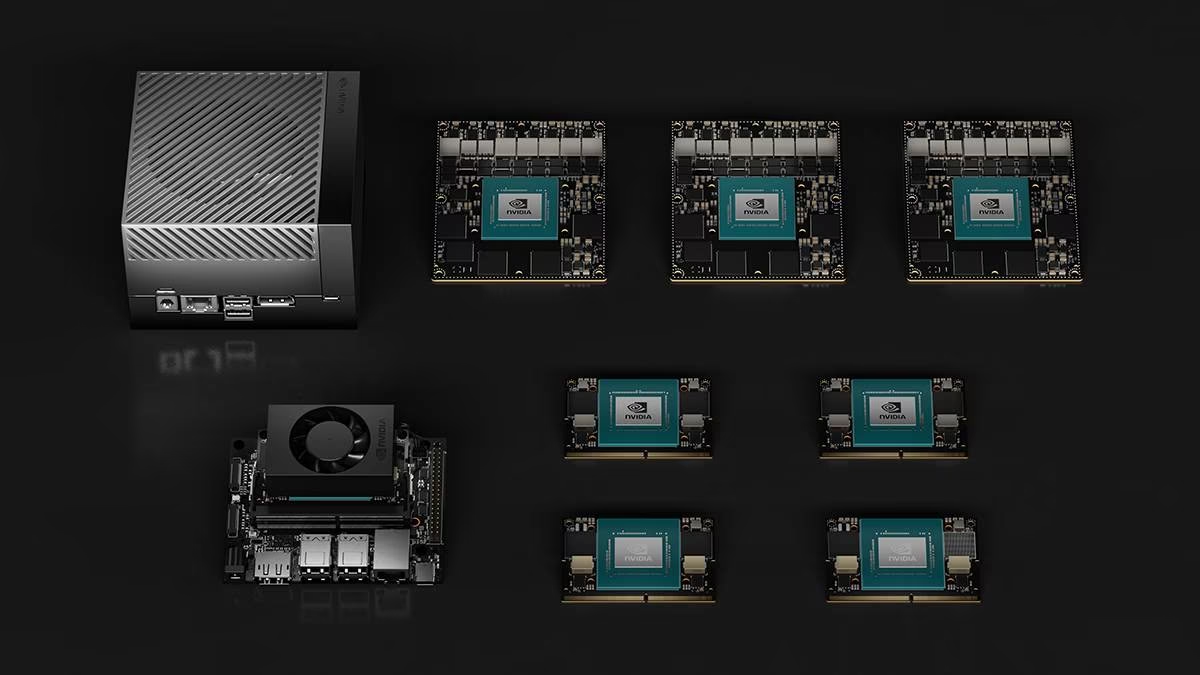
このガイドは、最新の安定版JetPack 7.2を実行するNVIDIA Jetson AGX Thor Developer Kit(Jetson T5000)およびNVIDIA Jetson AGX Orin Developer Kit(64GB)、JetPackリリースのJP6.1を実行するNVIDIA Jetson Orin Nano Super Developer Kit、JetPackリリースのJP6.0/JetPackリリースのJP5.1.3を実行する、NVIDIA Jetson Orin NX 16GBをベースとしたSeeed Studio reComputer J4012、およびJetPackリリースのJP4.6.1を実行する、NVIDIA Jetson Nano 4GBをベースとしたSeeed Studio reComputer J1020 v2でテスト済みです。最新および旧世代のデバイスを含む、すべてのNVIDIA Jetsonハードウェア製品で動作することが期待されます。
NVIDIA Jetsonとは何ですか?#
NVIDIA Jetsonは、アクセラレーションされたAI(人工知能)演算をエッジデバイスにもたらすために設計された組み込みコンピューティングボードのシリーズです。小型で高性能なこれらのデバイスはNVIDIAのGPUアーキテクチャを採用しており、クラウドコンピューティングのリソースに頼らず、デバイス上で複雑なAIアルゴリズムやディープラーニングモデルを直接実行できます。Jetsonボードは、ロボティクス、自動運転車、産業オートメーションなど、AI推論をローカルで低レイテンシかつ高効率に実行する必要がある用途でよく使用されます。また、ARM64アーキテクチャを採用し、従来のGPUコンピューティングデバイスよりも低い消費電力で動作します。
NVIDIA Jetsonシリーズの比較#
NVIDIA Jetson AGX Thorは、NVIDIA Blackwellアーキテクチャを採用したNVIDIA Jetsonファミリーの最新製品で、従来世代よりも大幅に高いAI性能を実現します。以下の表では、エコシステム内のJetsonデバイスをいくつか比較しています。
| Jetson AGX Thor(T5000) | Jetson AGX Orin 64GB | Jetson Orin NX 16GB | Jetson Orin Nano Super | Jetson AGX Xavier | Jetson Xavier NX | Jetson Nano | |
|---|---|---|---|---|---|---|---|
| AI性能 | 2070 TFLOPS | 275 TOPS | 100 TOPS | 67 TOPS | 32 TOPS | 21 TOPS | 472 GFLOPS |
| GPU | 2560コアのNVIDIA BlackwellアーキテクチャGPU、96基のTensor Core | 2048コアのNVIDIA AmpereアーキテクチャGPU、64基のTensor Core | 1024コアのNVIDIA AmpereアーキテクチャGPU、32基のTensor Core | 1024コアのNVIDIA AmpereアーキテクチャGPU、32基のTensor Core | 512コアのNVIDIA VoltaアーキテクチャGPU、64基のTensor Core | 384コアのNVIDIA Volta™アーキテクチャGPU、48基のTensor Core | 128コアのNVIDIA Maxwell™アーキテクチャGPU |
| GPU最大周波数 | 1.57 GHz | 1.3 GHz | 918 MHz | 1020 MHz | 1377 MHz | 1100 MHz | 921MHz |
| CPU | 14コアArm® Neoverse®-V3AE 64ビットCPU、1MB L2 + 16MB L3 | 12コアNVIDIA Arm® Cortex A78AE v8.2 64ビットCPU、3MB L2 + 6MB L3 | 8コアNVIDIA Arm® Cortex A78AE v8.2 64ビットCPU、2MB L2 + 4MB L3 | 6コア Arm® Cortex®-A78AE v8.2 64ビット CPU、L2 1.5MB + L3 4MB | 8コア NVIDIA Carmel Arm®v8.2 64ビット CPU、L2 8MB + L3 4MB | 6コア NVIDIA Carmel Arm®v8.2 64ビット CPU、L2 6MB + L3 4MB | クアッドコア Arm® Cortex®-A57 MPCore プロセッサ |
| CPU最大周波数 | 2.6 GHz | 2.2 GHz | 2.0 GHz | 1.7 GHz | 2.2 GHz | 1.9 GHz | 1.43GHz |
| メモリ | 128GB 256ビット LPDDR5X 273GB/s | 64GB 256ビット LPDDR5 204.8GB/s | 16GB 128ビット LPDDR5 102.4GB/s | 8GB 128ビット LPDDR5 102 GB/s | 32GB 256ビット LPDDR4x 136.5GB/s | 8GB 128ビット LPDDR4x 59.7GB/s | 4GB 64ビット LPDDR4 25.6GB/s |
NVIDIA JetPackとは何ですか?#
NVIDIA JetPack SDKはJetsonモジュールを動かし、エンドツーエンドのアクセラレーション対応AIアプリケーションを構築するための包括的な開発環境を提供します。JetPackには、ブートローダー、Linuxカーネル、Ubuntuデスクトップ環境を含むJetson Linuxと、GPUコンピューティング、マルチメディア、グラフィックス、コンピュータービジョンを高速化するライブラリ一式が含まれます。また、ホストコンピューターと開発キットの両方に対応するサンプル、ドキュメント、開発者ツールに加え、ストリーミング動画分析向けのDeepStream、ロボティクス向けのIsaac、対話型AI向けのRivaなどの上位SDKもサポートしています。
NVIDIA JetsonにJetPackを書き込む#
NVIDIA Jetsonデバイスを入手した後の最初の手順は、NVIDIA JetPackをデバイスに書き込むことです。NVIDIA Jetsonデバイスを書き込む方法はいくつかあります。
- 公式Jetson AGX Thor、AGX Orin、またはOrin Nano Developer KitでJetPack 7.2を使用する場合は、統合Jetson ISOをダウンロードしてUSBフラッシュドライブに書き込み、AGX Thor、AGX Orin、またはOrin Nanoのデバイス別クイックスタートに従ってください。JetPack 7.2以降、Orin Nanoではダウンロード可能なSDカードイメージを使用しなくなりました。ISOを使用したUSBインストールにより、Jetson LinuxがデバイスのmicroSDカードまたはNVMe SSDにインストールされます。
- Jetson Orin Nano Developer KitでJetPack 6を意図的に使用する場合は、NVIDIAのJetPack 6.xアップデートおよびSDカードの手順に従ってください。
- その他のNVIDIA Development Kitをお持ちの場合は、SDK Managerを使用してデバイスにJetPackを書き込むことができます。
- Seeed Studio reComputer J4012をお持ちの場合は、付属のSSDにJetPackを書き込むことができます。また、Seeed Studio reComputer J1020 v2をお持ちの場合は、eMMC/ SSDにJetPackを書き込むことができます。
- NVIDIA Jetsonモジュールを搭載したその他のサードパーティ製デバイスをお持ちの場合は、コマンドラインでの書き込みを推奨します。
上記の方法1、4、5では、システムを書き込んでデバイスを起動した後、デバイスのターミナルでsudo apt update && sudo apt install nvidia-jetpack -yを実行し、残りの必要なJetPackコンポーネントをすべてインストールします。
Jetsonデバイス別JetPackサポート#
以下の表は、各NVIDIA JetsonデバイスでサポートされるNVIDIA JetPackのバージョンを示しています。
| JetPack 4 | JetPack 5 | JetPack 6 | JetPack 7 | |
|---|---|---|---|---|
| Jetson Nano | ✅ | ❌ | ❌ | ❌ |
| Jetson TX2 | ✅ | ❌ | ❌ | ❌ |
| Jetson Xavier NX | ✅ | ✅ | ❌ | ❌ |
| Jetson AGX Xavier | ✅ | ✅ | ❌ | ❌ |
| Jetson AGX Orin | ❌ | ✅ | ✅ | ✅ |
| Jetson Orin NX | ❌ | ✅ | ✅ | ✅ |
| Jetson Orin Nano | ❌ | ✅ | ✅ | ✅ |
| Jetson AGX Thor | ❌ | ❌ | ❌ | ✅ |
Dockerでクイックスタート#
NVIDIA JetsonでUltralytics YOLO26をすぐに使い始めるには、Jetson向けのビルド済みDockerイメージを実行するのが最も簡単です。上記の表を参照し、使用するJetsonデバイスに応じたJetPackバージョンを選択してください。
t=ultralytics/ultralytics:latest-jetson-jetpack4
sudo docker pull $t && sudo docker run -it --ipc=host --runtime=nvidia $tlatest-nvidia-arm64イメージは、CUDA 13.4とTensorRT 11.4を含むNVIDIA PyTorch 26.10を使用します。NVIDIAは互換性表で、PyTorch向けにJetPack 7.1を掲載していますが、TensorRT 11はJetPackをサポートしていません。Thorも対象外です。このイメージは、サポート対象のホスト上でPyTorchのワークロードを実行する場合にのみ使用してください。JetsonでTensorRTにエクスポートする場合は、以下のネイティブインストールと、お使いのJetPackリリースでサポートされているTensorRT 10.xランタイムを使用してください。ThorまたはOrinでJetPack 7.2を使用する場合は、コンテナを個別に検証する必要があります。対象のGPUとTensorRTのバージョンに合わせてエンジンを再ビルドしてください。
JetPack 4、5、6のイメージについては、引き続きNVIDIA JetsonでTensorRTを使用するをご覧ください。上記のJetPack 7.1イメージはPyTorchワークロード専用です。
ネイティブインストールを開始する#
Dockerを使用せずにネイティブインストールする場合は、以下の手順を参照してください。
JetPack 7.2で実行する#
Ultralyticsパッケージをインストールする#
JetsonにUltralyticsパッケージをインストールします。モデルを初めてエクスポートする際にエクスポート用の依存関係が自動でインストールされるため、ここでは基本パッケージのみが必要です。このガイドでは、Jetsonデバイスで最高の性能を発揮するNVIDIA TensorRTへのエクスポートに焦点を当てます。
-
パッケージリストを更新し、pipをインストールして最新バージョンにアップグレードする
sudo apt update sudo apt install python3-pip -y pip install -U pip -
ultralyticspipパッケージをインストールするpip install ultralytics -
デバイスを再起動する
sudo reboot
PyTorchとTorchvisionをインストールする#
上記のultralyticsのインストールではTorchとTorchvisionがインストールされます。ただし、pipでインストールされるこれら2つのパッケージは、CUDA 13を実行するJetPack 7.2デバイスと互換性がないため、手動でインストールする必要があります。
JP7.2に応じてtorchとtorchvisionをインストールする
pip install torch torchvision --index-url https://download.pytorch.org/whl/cu130onnxruntime-gpuをインストールする#
お使いのJetPack、Python、CUDAのバージョンに合ったONNX Runtime GPUホイールを使用してください。現在のPyPIリリースにはARM64ホイールが含まれていますが、JetPackの各リリースに対応するデバイス固有のパッケージの代わりにはなりません。
Python3.12をサポートするonnxruntime-gpu 1.24.0をダウンロードしてインストールします。
pip install https://github.com/ultralytics/assets/releases/download/v0.0.0/onnxruntime_gpu-1.24.0-cp312-cp312-linux_aarch64.whlJetPack 6.1で実行する#
Ultralyticsパッケージをインストールする#
JetsonにUltralyticsパッケージをインストールします。モデルを初めてエクスポートする際にエクスポート用の依存関係が自動でインストールされるため、ここでは基本パッケージのみが必要です。このガイドでは、Jetsonデバイスで最高の性能を発揮するNVIDIA TensorRTへのエクスポートに焦点を当てます。
-
パッケージリストを更新し、pipをインストールして最新バージョンにアップグレードする
sudo apt update sudo apt install python3-pip -y pip install -U pip -
ultralyticspipパッケージをインストールするpip install ultralytics -
デバイスを再起動する
sudo reboot
PyTorchとTorchvisionをインストールする#
上記のultralyticsのインストールではTorchとTorchvisionがインストールされます。ただし、pipでインストールされるこれら2つのパッケージは、ARM64アーキテクチャを採用するJetsonプラットフォームと互換性がないため、ビルド済みのPyTorch pip wheelを手動でインストールし、Torchvisionをソースからコンパイルするかインストールする必要があります。
JP6.1に応じてtorch 2.10.0とtorchvision 0.25.0をインストールする
pip install https://github.com/ultralytics/assets/releases/download/v0.0.0/torch-2.10.0-cp310-cp310-linux_aarch64.whl
pip install https://github.com/ultralytics/assets/releases/download/v0.0.0/torchvision-0.25.0-cp310-cp310-linux_aarch64.whlJetson向けPyTorchページで、さまざまなJetPackバージョンに対応するPyTorchの各バージョンを確認できます。PyTorchとTorchvisionの互換性に関する詳しい一覧については、PyTorchとTorchvisionの互換性ページをご覧ください。
torch 2.10.0との依存関係の問題を修正するには、cuDSSをインストールしてください。
wget https://developer.download.nvidia.com/compute/cudss/0.7.1/local_installers/cudss-local-tegra-repo-ubuntu2204-0.7.1_0.7.1-1_arm64.deb
sudo dpkg -i cudss-local-tegra-repo-ubuntu2204-0.7.1_0.7.1-1_arm64.deb
sudo cp /var/cudss-local-tegra-repo-ubuntu2204-0.7.1/cudss-*-keyring.gpg /usr/share/keyrings/
sudo apt-get update
sudo apt-get -y install cudssonnxruntime-gpuをインストールする#
お使いのJetPack、Python、CUDAのバージョンに合ったONNX Runtime GPUホイールを使用してください。現在のPyPIリリースにはARM64ホイールが含まれていますが、JetPackの各リリースに対応するデバイス固有のパッケージの代わりにはなりません。
利用可能なonnxruntime-gpuパッケージは、JetPackバージョン、Pythonバージョン、その他の互換性情報別に整理されたJetson Zoo ONNX Runtime互換性マトリックスで確認できます。
Python 3.10をサポートするJetPack 6の場合、onnxruntime-gpu 1.23.0をインストールできます。
pip install https://github.com/ultralytics/assets/releases/download/v0.0.0/onnxruntime_gpu-1.23.0-cp310-cp310-linux_aarch64.whlまたは、onnxruntime-gpu 1.20.0の場合は次のようにします。
pip install https://github.com/ultralytics/assets/releases/download/v0.0.0/onnxruntime_gpu-1.20.0-cp310-cp310-linux_aarch64.whlJetPack 5.1.2で実行する#
Ultralyticsパッケージをインストールする#
JetsonにUltralyticsパッケージをインストールします。モデルを初めてエクスポートする際にエクスポート用の依存関係が自動でインストールされるため、ここでは基本パッケージのみが必要です。このガイドでは、Jetsonデバイスで最高の性能を発揮するNVIDIA TensorRTへのエクスポートに焦点を当てます。
-
パッケージリストを更新し、pipをインストールして最新バージョンにアップグレードする
sudo apt update sudo apt install python3-pip -y pip install -U pip -
ultralyticspipパッケージをインストールするpip install ultralytics -
デバイスを再起動する
sudo reboot
PyTorchとTorchvisionをインストールする#
上記のultralyticsのインストールではTorchとTorchvisionがインストールされます。ただし、pipでインストールされるこれら2つのパッケージは、ARM64アーキテクチャを採用するJetsonプラットフォームと互換性がないため、ビルド済みのPyTorch pip wheelを手動でインストールし、Torchvisionをソースからコンパイルするかインストールする必要があります。
-
現在インストールされているPyTorchとTorchvisionをアンインストールする
pip uninstall torch torchvision -
JP5.1.2に応じて
torch 2.1.0とtorchvision 0.16.2をインストールするpip install https://github.com/ultralytics/assets/releases/download/v0.0.0/torch-2.1.0a0+41361538.nv23.06-cp38-cp38-linux_aarch64.whl pip install https://github.com/ultralytics/assets/releases/download/v0.0.0/torchvision-0.16.2+c6f3977-cp38-cp38-linux_aarch64.whl
Jetson向けPyTorchページで、さまざまなJetPackバージョンに対応するPyTorchの各バージョンを確認できます。PyTorchとTorchvisionの互換性に関する詳しい一覧については、PyTorchとTorchvisionの互換性ページをご覧ください。
onnxruntime-gpuをインストールする#
お使いのJetPack、Python、CUDAのバージョンに合ったONNX Runtime GPUホイールを使用してください。現在のPyPIリリースにはARM64ホイールが含まれていますが、JetPackの各リリースに対応するデバイス固有のパッケージの代わりにはなりません。
JetPackのバージョン、Pythonのバージョン、その他の互換性情報で整理された、利用可能なすべてのonnxruntime-gpuパッケージは、Jetson Zoo ONNX Runtime互換性マトリックスで確認できます。Python3.8をサポートするonnxruntime-gpu 1.17.0をダウンロードしてインストールします。
wget https://nvidia.box.com/shared/static/zostg6agm00fb6t5uisw51qi6kpcuwzd.whl -O onnxruntime_gpu-1.17.0-cp38-cp38-linux_aarch64.whl
pip install onnxruntime_gpu-1.17.0-cp38-cp38-linux_aarch64.whlonnxruntime-gpuはNumPyを自動的に最新バージョンにアップグレードするため、発生する問題を解決するにはNumPy 1.23.5を再インストールします。
pip install numpy==1.23.5
NVIDIA JetsonでTensorRTを使用する#
Ultralyticsがサポートするすべてのモデルエクスポート形式の中で、TensorRTはNVIDIA Jetsonデバイス上で最も高い推論性能を発揮するため、JetsonへのデプロイにはTensorRTを最もおすすめします。エクスポートする前に、お使いのJetPackリリース用に提供されているTensorRT Pythonバインディングをインストールし、python3 -c "import tensorrt; print(tensorrt.__version__)"で動作を確認してください。JetPack 6/7では、サポートされているTensorRT 10.xランタイムを使用してください。TensorRT 11に置き換えないでください。セットアップ手順と高度な使い方については、TensorRT専用の統合ガイドをご覧ください。
ビルド環境をローカルで構成せずに、ブラウザーからエクスポートすることもできます。Ultralytics PlatformのモデルエクスポートタブでTensorRTと対象のJetsonを選択してください。Thorの選択肢は、実機のThorハードウェアで検証されています。Orinの6つの選択肢では、現在AGX-Orin上でビルドされた候補エンジンが生成されます。デプロイする前に、対象のOrin SKUで検証してください。
TensorRTは、ビルド時にエンジンのプロファイリングと最適化を行うGPU上でエンジンを調整します。対象デバイスのGPUアーキテクチャとTensorRT/CUDAランタイムを一致させ、ダウンロードしたすべてのエンジンをデプロイ先のデバイスで検証してください。同じアーキテクチャのOrin SKUであっても、必ず移植できるとは限りません。また、最良の結果を得るには、INT8キャリブレーションを対象デバイスで実行してください。
モデルをTensorRTに変換して推論を実行する#
PyTorch形式のYOLO26nモデルをTensorRTに変換し、エクスポートしたモデルで推論を実行します。
from ultralytics import YOLO

# YOLO26n PyTorchモデルを読み込む
model = YOLO("yolo26n.pt")

# モデルをTensorRTにエクスポートする
model.export(format="engine")  # 'yolo26n.engine'を作成します

# エクスポートしたTensorRTモデルを読み込む
trt_model = YOLO("yolo26n.engine")

# 推論を実行
results = trt_model("https://ultralytics.com/images/bus.jpg")
NVIDIA Deep Learning Accelerator(DLA)を使用する#
NVIDIA Deep Learning Accelerator(DLA)は、NVIDIA Jetsonデバイスに組み込まれた専用ハードウェアコンポーネントであり、電力効率と性能を高めるためにディープラーニング推論を最適化します。GPUから処理をオフロードして、より負荷の高い処理にGPUを使用できるようにすることで、DLAは高いスループットを維持しながらモデルの消費電力を抑えます。そのため、組み込みシステムやリアルタイムAIアプリケーションに最適です。
NVIDIAによると、DLAをサポートする最後のリリースはTensorRT 10.7です。TensorRT 11.xはDLAをサポートしていません。お使いのJetPackバージョンでサポートされている、DLA対応のTensorRTリリースを使用してください。TensorRT 11は、GPUのみへのエクスポートも含め、JetPackをサポートしていません。
以下のJetsonデバイスにはDLAハードウェアが搭載されています。
| Jetsonデバイス | DLAコア数 | DLA最大周波数 |
|---|---|---|
| Jetson AGX Orinシリーズ | 2 | 1.6 GHz |
| Jetson Orin NX 16GB | 2 | 614 MHz |
| Jetson Orin NX 8GB | 1 | 614 MHz |
| Jetson AGX Xavierシリーズ | 2 | 1.4 GHz |
| Jetson Xavier NXシリーズ | 2 | 1.1 GHz |
from ultralytics import YOLO

# YOLO26n PyTorchモデルを読み込む
model = YOLO("yolo26n.pt")

# DLAを有効にしてモデルをTensorRTにエクスポートする(FP16またはINT8でのみ動作)
model.export(format="engine", device="dla:0", quantize=16)  # dla:0またはdla:1はDLAコアに対応します

# エクスポートしたTensorRTモデルを読み込む
trt_model = YOLO("yolo26n.engine")

# 推論を実行
results = trt_model("https://ultralytics.com/images/bus.jpg")DLAにエクスポートすると、一部のレイヤーがDLAでの実行をサポートしておらず、GPUで実行される場合があります。このフォールバックによりレイテンシが増加し、推論性能全体に影響することがあります。そのため、DLAはTensorRTをGPUのみで実行する場合と比べて、推論レイテンシを削減することを主な目的としていません。DLAの主な目的は、スループットを向上させ、電力効率を高めることです。
NVIDIA JetsonでのYOLO26ベンチマーク#
Ultralyticsチームは、PyTorch、TorchScript、ONNX、OpenVINO、TensorRT、TF SavedModel、TF GraphDef、TF Lite、MNN、NCNN、ExecuTorchの11種類のモデル形式について、速度と精度を測定するYOLO26のベンチマークを実施しました。ベンチマークは、NVIDIA Jetson AGX Thor Developer Kit、NVIDIA Jetson AGX Orin Developer Kit(64GB)、NVIDIA Jetson Orin Nano Super Developer Kit、およびJetson Orin NX 16GBを搭載したSeeed Studio reComputer J4012で、FP32精度、デフォルトの入力画像サイズ640を使用して実施しました。
比較チャート#
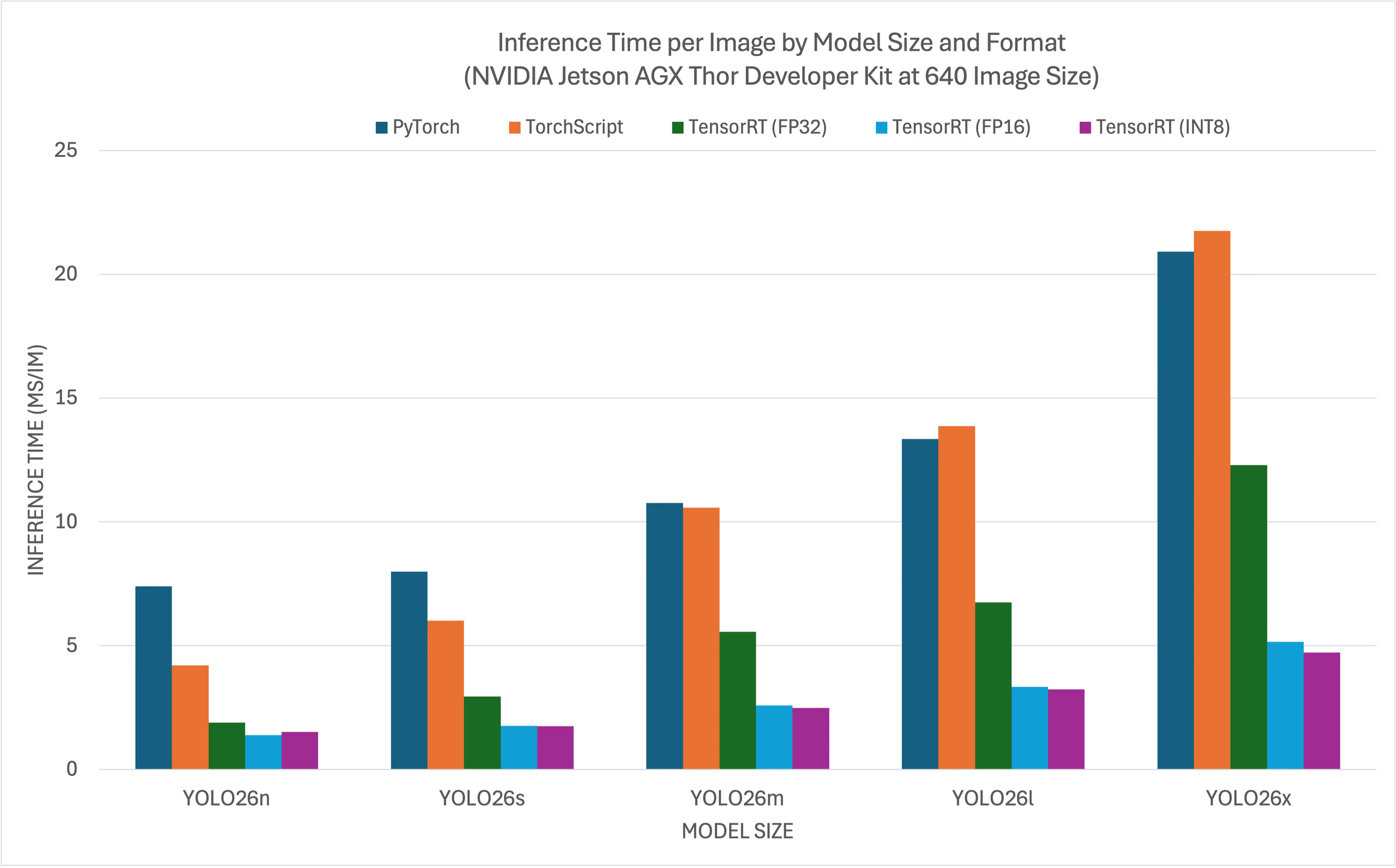
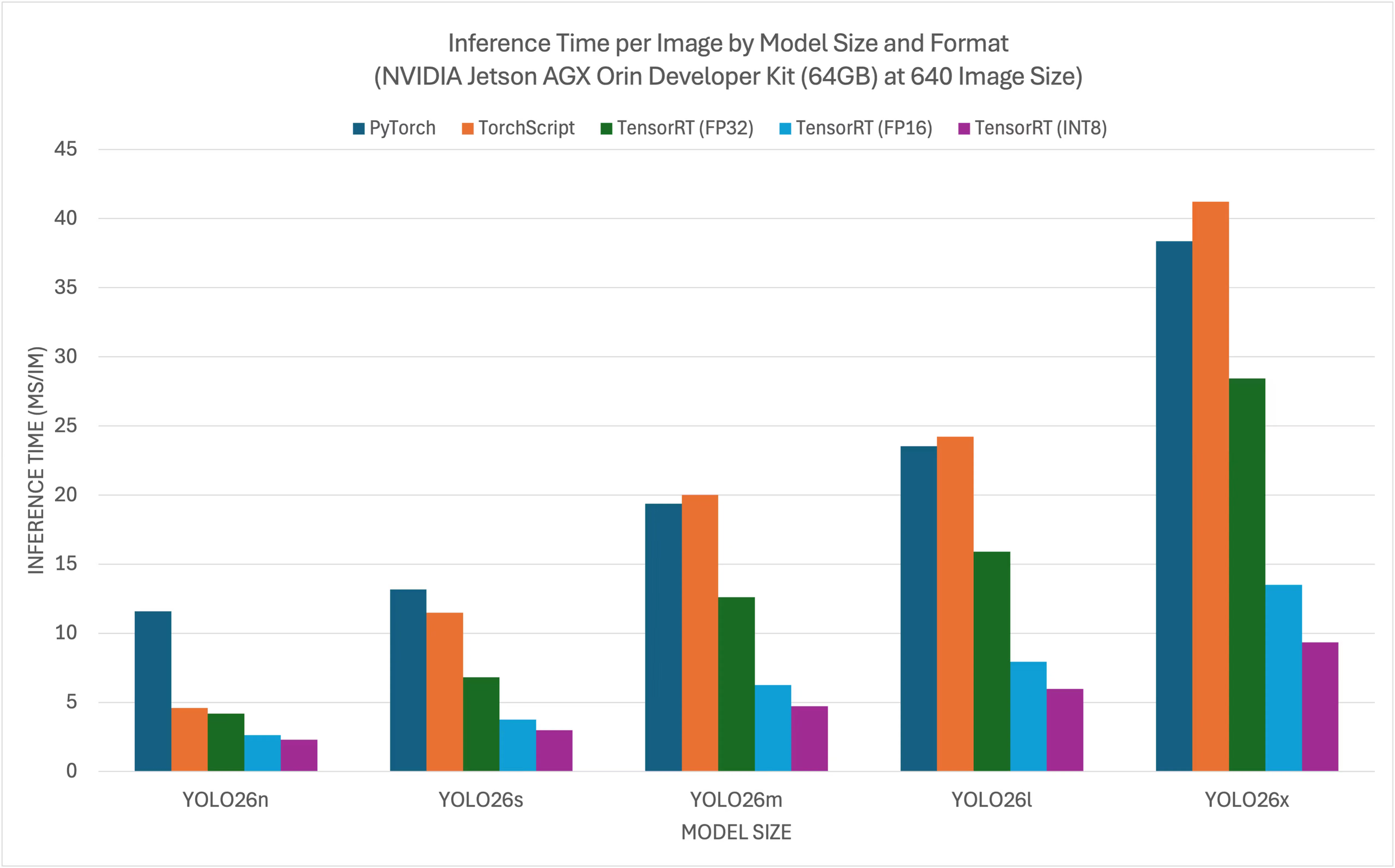
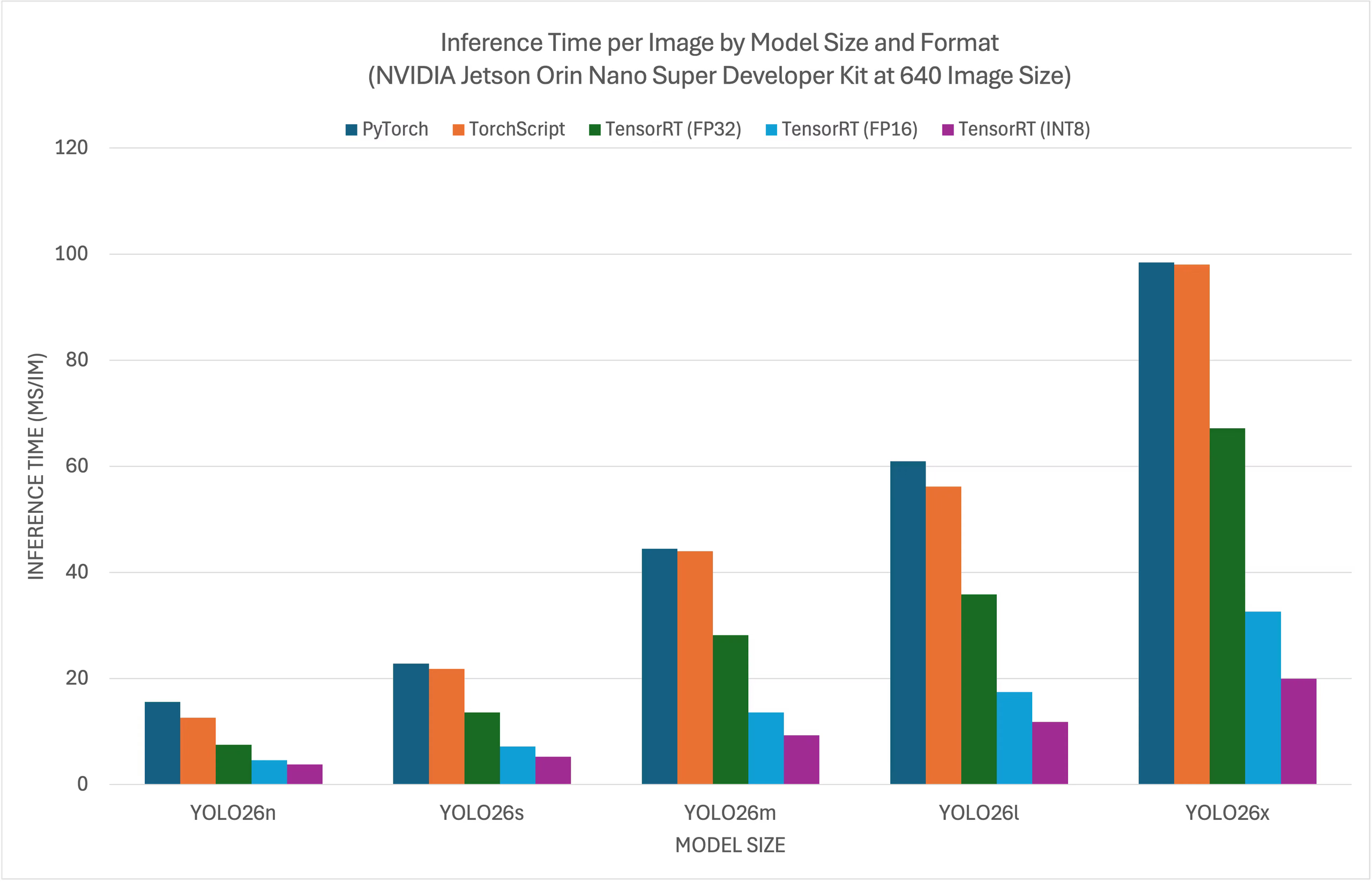
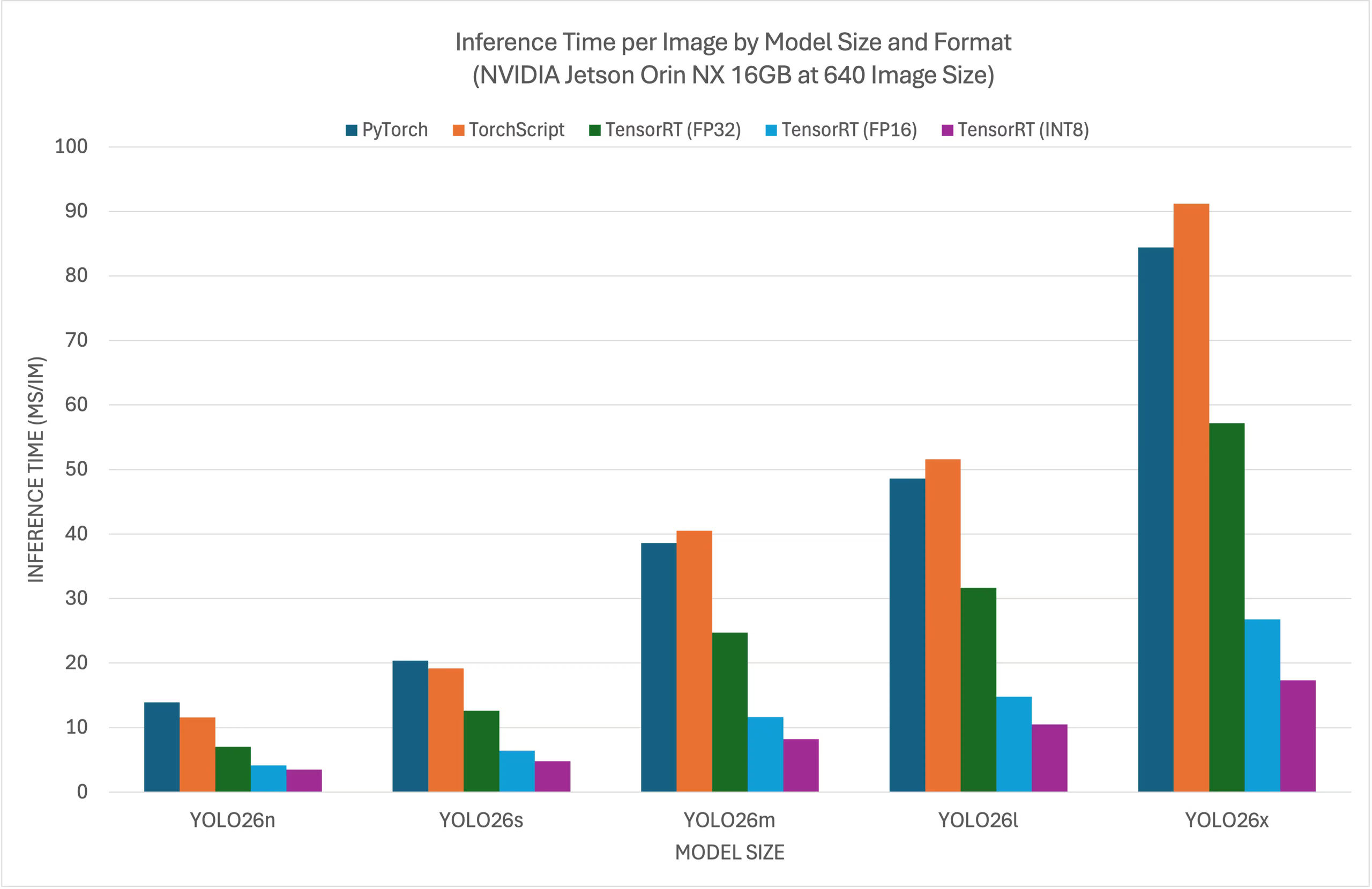
すべてのモデルエクスポートはNVIDIA Jetsonで動作しますが、以下の比較チャートにはPyTorch、TorchScript、TensorRTのみが含まれています。すべてのエクスポート形式のベンチマークは、このチャートの後のセクションで確認できます。
NVIDIA Jetson AGX Thor 開発者キット#
NVIDIA Jetson AGX Orin 開発者キット(64GB)#
NVIDIA Jetson Orin Nano Super 開発者キット#
NVIDIA Jetson Orin NX 16GB#
詳細な比較表#
次の表は、5種類のYOLO26モデル(YOLO26n、YOLO26s、YOLO26m、YOLO26l、YOLO26x)を11種類の形式(PyTorch、TorchScript、ONNX、OpenVINO、TensorRT、TF SavedModel、TF GraphDef、TF Lite、MNN、NCNN、ExecuTorch)でベンチマークした結果を示しています。各組み合わせのステータス、サイズ、mAP50-95(B)指標、推論時間を掲載しています。
NVIDIA Jetson AGX Thor 開発者キット#
| 形式 | ステータス | ディスク上のサイズ(MB) | mAP50-95(B) | 推論時間(ms/im) |
|---|---|---|---|---|
| PyTorch | ✅ | 5.3 | 0.4798 | 7.39 |
| TorchScript | ✅ | 9.8 | 0.4789 | 4.21 |
| ONNX | ✅ | 9.5 | 0.4767 | 6.58 |
| OpenVINO | ✅ | 10.1 | 0.4794 | 17.50 |
| TensorRT(FP32) | ✅ | 13.9 | 0.4791 | 1.90 |
| TensorRT(FP16) | ✅ | 7.6 | 0.4797 | 1.39 |
| TensorRT(INT8) | ✅ | 6.5 | 0.4273 | 1.52 |
| TF SavedModel | ✅ | 25.7 | 0.4764 | 47.24 |
| TF GraphDef | ✅ | 9.5 | 0.4764 | 45.98 |
| TF Lite | ✅ | 9.9 | 0.4764 | 182.04 |
| MNN | ✅ | 9.4 | 0.4784 | 21.83 |
Ultralytics 8.4.7でベンチマークを実施
推論時間には前処理と後処理は含まれません。
NVIDIA Jetson AGX Orin 開発者キット(64GB)#
| 形式 | ステータス | ディスク上のサイズ(MB) | mAP50-95(B) | 推論時間(ms/im) |
|---|---|---|---|---|
| PyTorch | ✅ | 5.3 | 0.4790 | 11.58 |
| TorchScript | ✅ | 9.8 | 0.4770 | 4.60 |
| ONNX | ✅ | 9.5 | 0.4770 | 9.87 |
| OpenVINO | ✅ | 9.6 | 0.4820 | 28.80 |
| TensorRT(FP32) | ✅ | 11.5 | 0.4770 | 4.18 |
| TensorRT(FP16) | ✅ | 7.9 | 0.4789 | 2.62 |
| TensorRT(INT8) | ✅ | 5.4 | 0.4640 | 2.30 |
| TF SavedModel | ✅ | 24.6 | 0.4760 | 71.10 |
| TF GraphDef | ✅ | 9.5 | 0.4760 | 70.02 |
| TF Lite | ✅ | 9.9 | 0.4760 | 227.94 |
| MNN | ✅ | 9.4 | 0.4760 | 32.46 |
| NCNN | ✅ | 9.3 | 0.4810 | 29.93 |
Ultralytics 8.4.32でベンチマークを実施
推論時間には前処理と後処理は含まれません。
NVIDIA Jetson Orin Nano Super 開発者キット#
| 形式 | ステータス | ディスク上のサイズ(MB) | mAP50-95(B) | 推論時間(ms/im) |
|---|---|---|---|---|
| PyTorch | ✅ | 5.3 | 0.4790 | 15.60 |
| TorchScript | ✅ | 9.8 | 0.4770 | 12.60 |
| ONNX | ✅ | 9.5 | 0.4760 | 15.76 |
| OpenVINO | ✅ | 9.6 | 0.4820 | 56.23 |
| TensorRT(FP32) | ✅ | 11.3 | 0.4770 | 7.53 |
| TensorRT(FP16) | ✅ | 8.1 | 0.4800 | 4.57 |
| TensorRT(INT8) | ✅ | 5.3 | 0.4490 | 3.80 |
| TF SavedModel | ✅ | 24.6 | 0.4760 | 118.33 |
| TF GraphDef | ✅ | 9.5 | 0.4760 | 116.30 |
| TF Lite | ✅ | 9.9 | 0.4760 | 286.00 |
| MNN | ✅ | 9.4 | 0.4760 | 68.77 |
| NCNN | ✅ | 9.3 | 0.4810 | 47.50 |
Ultralytics 8.4.33でベンチマークを実施
推論時間には前処理と後処理は含まれません。
NVIDIA Jetson Orin NX 16GB#
| 形式 | ステータス | ディスク上のサイズ(MB) | mAP50-95(B) | 推論時間(ms/im) |
|---|---|---|---|---|
| PyTorch | ✅ | 5.3 | 0.4799 | 13.90 |
| TorchScript | ✅ | 9.8 | 0.4787 | 11.60 |
| ONNX | ✅ | 9.5 | 0.4763 | 14.18 |
| OpenVINO | ✅ | 9.6 | 0.4819 | 40.19 |
| TensorRT(FP32) | ✅ | 11.4 | 0.4770 | 7.01 |
| TensorRT(FP16) | ✅ | 8.0 | 0.4789 | 4.13 |
| TensorRT(INT8) | ✅ | 5.5 | 0.4489 | 3.49 |
| TF SavedModel | ✅ | 24.6 | 0.4764 | 92.34 |
| TF GraphDef | ✅ | 9.5 | 0.4764 | 92.06 |
| TF Lite | ✅ | 9.9 | 0.4764 | 254.43 |
| MNN | ✅ | 9.4 | 0.4760 | 48.55 |
| NCNN | ✅ | 9.3 | 0.4805 | 34.31 |
Ultralytics 8.4.33でベンチマークを実施
推論時間には前処理と後処理は含まれません。
異なるバージョンのNVIDIA Jetsonハードウェアで実施されたSeeed Studioによるベンチマークの取り組みをさらに見る。
結果を再現する#
すべてのエクスポート形式で上記のUltralyticsベンチマークを再現するには、次のコードを実行してください。
from ultralytics import YOLO

# YOLO26n PyTorchモデルを読み込む
model = YOLO("yolo26n.pt")

# すべてのエクスポート形式でCOCO128データセットを使用してYOLO26nの速度と精度をベンチマークします
results = model.benchmark(data="coco128.yaml", imgsz=640)ベンチマーク結果は、システムのハードウェアとソフトウェアの構成や、ベンチマーク実行時のシステムの負荷によって異なる場合があります。最も信頼性の高い結果を得るには、data='coco.yaml'(検証画像5000枚)のような、画像数の多いデータセットを使用してください。
NVIDIA Jetsonを使用する際のベストプラクティス#
NVIDIA JetsonでYOLO26の性能を最大限に引き出すには、以下のベストプラクティスに従ってください。
-
MAX Power Modeを有効にする
JetsonでMAX Power Modeを有効にすると、すべてのCPUコアとGPUコアがオンになります。
sudo nvpmodel -m 0 -
Jetson Clocksを有効にする
Jetson Clocksを有効にすると、すべてのCPUコアとGPUコアが最大周波数で動作します。
sudo jetson_clocks -
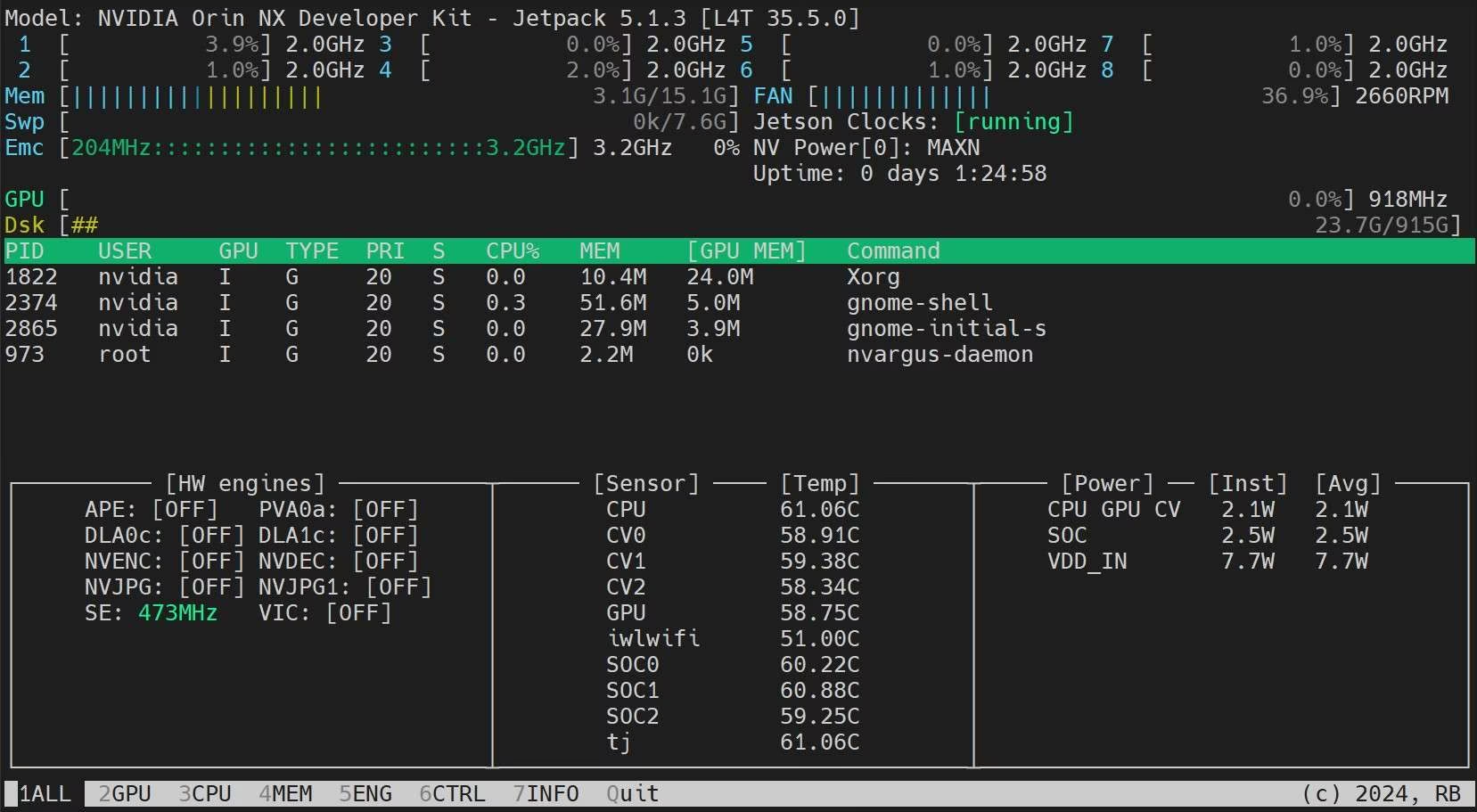
Jetson Statsアプリケーションをインストールする
jetson-statsアプリケーションを使うと、システムコンポーネントの温度やCPU、GPU、RAMの使用率を確認できるほか、電力モードの変更、最大クロックの設定、JetPack情報の確認ができます。
sudo apt update
sudo pip install jetson-stats
sudo reboot
jtop
NVIDIA Jetson向けメモリ最適化のヒント#
Jetsonデバイスでは、使用可能なメモリがボトルネックになることがよくあります。特に、Jetson Orin Nano(8 GB)やOrin NX 8 GBなど、メモリ容量の少ないモデルでは顕著です。以下のヒントは、実用的でリスクの低い変更であり、組み合わせることで数百メガバイトのメモリを解放し、より大きなYOLOモデルの実行や、追加の並列ワークロードのサポートが可能になります。詳しくは、Jetsonのメモリ効率を最大化する方法に関するNVIDIAのブログをご覧ください。
1. ヘッドレス(GUIなし)で起動する#
JetsonをSSH経由で接続している場合や、ディスプレイを接続せずに本番環境のアプライアンスとして実行している場合は、デスクトップ環境とディスプレイサーバーを無効にすることで、最大865 MBのRAMを回収できます。
sudo systemctl set-default multi-user.target
sudo reboot
後からデスクトップ環境を復元するには、次のコマンドを実行します。
sudo systemctl set-default graphical.target
sudo reboot
2. 使用していないシステムサービスを無効にする#
重要でないバックグラウンドサービス(Bluetooth、接続管理ツール、使用していないハードウェアデーモン)は、合計で約32 MBを消費します。実行中のサービスを一覧表示し、デプロイで必要のないものを無効にしてください。
# List running services
systemctl list-units --type=service --state=running

# Disable a service
sudo systemctl disable SERVICE_NAME
3. メモリ使用量をプロファイリングする#
最適化する前に、実際にどのプロセスがRAMを消費しているかを特定してください。procrankはプロセスをPSS(Proportional Set Size)順に並べ替えます。PSSは、他のプロセスと共有されるページを含む、プロセスにマッピングされた物理RAMページの合計であるRSS(Resident Set Size)よりも、プロセスごとの実際のメモリ使用量を正確に反映します。
git clone https://github.com/csimmonds/procrank_linux.git
cd procrank_linux && make
sudo ./procrank
プロセスごとのGPUおよびNvMap(CUDA/ビデオパイプライン)の割り当てを確認するには、次のコマンドを実行します。
sudo cat /sys/kernel/debug/nvmap/iovmm/clients4. 本番環境ではディスプレイなしで推論を実行する#
ライブプレビューが不要な推論パイプラインでは、ディスプレイ関連コンポーネント(Tiler、OSD、DisplaySink)を無効にすると、パイプラインだけで200 MB以上を節約できます。Ultralytics YOLOでは、ビューアーを非表示にし、代わりに結果をディスクに書き込みます。
from ultralytics import YOLO

model = YOLO("yolo26n.engine")

# show=Falseはディスプレイウィンドウを表示しないようにし、save=Trueは注釈付きの出力をディスクに書き込みます
results = model.predict(source="video.mp4", show=False, save=True)累積効果#
| 最適化 | おおよそのメモリ節約量 |
|---|---|
| デスクトップGUIを無効にする | ~865 MB |
| 使用していないOSサービスを無効にする | ~32 MB |
| ヘッドレス推論パイプライン(ディスプレイなし) | ~200+ MB |
| 合計(簡単にできる対策) | ~1 GB以上 |
これらの変更を組み合わせることは、メモリに制約のあるデバイスでTensorRT INT8モデルを使用する場合に特に効果的です。より大きなモデルをメモリに収められるかどうかを左右することがあります。
次のステップ#
詳しい情報やサポートについては、Ultralytics YOLO26ドキュメントをご覧ください。
よくある質問#
NVIDIA JetsonデバイスにUltralytics YOLO26をデプロイするには、まずNVIDIA JetPack SDKをJetsonデバイスに書き込みます。次に、すぐにセットアップできるビルド済みDockerイメージを使用するか、必要なパッケージを手動でインストールしてください。
YOLO26モデルはNVIDIA Jetson AGX Thor、AGX Orin、Orin Nano Super、Orin NXデバイスでベンチマークされており、TensorRT形式が最高の推論性能を発揮します。詳細比較表のセクションには、モデルとエクスポート形式ごとのmAP50-95および推論時間が掲載されています。
NVIDIA JetsonでYOLO26モデルをデプロイする場合は、TensorRTを推奨します。モデルをJetsonのGPU向けに最適化することで、すべてのエクスポート形式の中で最速の推論を実現します。
NVIDIA JetsonにPyTorchとTorchvisionをインストールするには、まずpip経由でインストールされた既存のバージョンをアンインストールします。次に、JetsonのARM64アーキテクチャに対応するPyTorchとTorchvisionのバージョンを手動でインストールします。この手順の詳しい説明は、PyTorchとTorchvisionをインストールするセクションをご覧ください。
YOLO26を使用してNVIDIA Jetsonのパフォーマンスを最大限に高めるには、次のベストプラクティスに従ってください。
- MAX Power Modeを有効にして、すべてのCPUコアとGPUコアを使用します。
- Jetson Clocksを有効にして、すべてのコアを最大周波数で動作させます。
- Jetson Statsアプリケーションをインストールして、システム指標を監視します。
コマンドや詳しい情報については、NVIDIA Jetsonを使用する際のベストプラクティスセクションをご覧ください。
メモリ容量の少ないJetsonデバイスでは、使用可能なRAMがボトルネックになることがよくあります。次の3つの簡単な対策を組み合わせると、1 GB以上を回収できます。
- ヘッドレス起動に切り替える(
sudo systemctl set-default multi-user.target)ことで、デスクトップGUIを無効にします(約865 MBを節約)。 - Bluetoothや接続管理ツールなどの使用していないサービスを無効にすることで、約32 MBを節約できます。
- YOLOの
predict呼び出しでshow=Falseを設定してディスプレイなしで推論を実行すると、ディスプレイパイプライン用のメモリ割り当てを回避できます(200 MB以上を節約)。
procrankを使用してプロセスごとのRAM使用量をプロファイリングし、sudo cat /sys/kernel/debug/nvmap/iovmm/clientsを使用してGPUの割り当てを確認してください。詳しくは、メモリ最適化のヒントセクションをご覧ください。- ヘッドレス起動に切り替える(
JetPack 6に同梱されているTensorRT 10.3.0には既知の問題があり、NMSなし(
nms=False)またはNMS組み込み(nms=True)の出力でINT8エンジンをビルドできません。Ultralyticsはこの組み合わせを検出すると、NMSなしのエクスポートではone-to-manyヘッドを選択し、nms=Trueのエクスポートをエラーで停止します。これらのINT8エクスポートを再び利用するには、TensorRTを新しいバージョン(例:10.7.0以降)にアップグレードしてください。
wget https://developer.download.nvidia.com/compute/cuda/repos/ubuntu2204/arm64/cuda-keyring_1.1-1_all.deb sudo dpkg -i cuda-keyring_1.1-1_all.deb sudo apt-get update sudo apt-get install -y tensorrtアップグレード後、エクスポートを再実行してください。詳細については、GitHubのissue #23841とissue #26655をご覧ください。


コメント194
質問したり、結果を共有したり、ほかの人をサポートしたりできます。
LG973641114
您好,如何用c++在jetson上部署YOLO26,有相关例子吗
1pknowler
Struggling with this on a new Jetson Orin Nano JP6.1. All good following the steps and installs to give torch.cuda.is_available as TRUE. The TensorRT export fails though with a number of dependency errors and I can’t re-install it with anything. Any pointers please?
1 Glenn JocherUltralytics
@pknowler it seems like the dependency errors during TensorRT export might stem from compatibility issues. Please ensure you’ve installed the required JetPack-compatible versions of PyTorch, Torchvision, and TensorRT as outlined in the Jetson Quick Start Guide. Additionally, verify that
onnxruntime-gpuandcuSPARSELtare correctly installed per the guide. If the issue persists, you can try reinstalling TensorRT using the NVIDIA SDK Manager for your JetPack version. Let me know if you need further clarification!Thank you. I will try again working through all of the steps and let you know how it goes!
I’ve tried again but this as far as I get… I have followed everything carefully.
WARNING ⚠️ TensorRT requires GPU export, automatically assigning device=0 Ultralytics 8.3.57 🚀 Python-3.10.16 torch-2.5.0a0+872d972e41.nv24.08 CUDA:0 (Orin, 7620MiB) YOLO11n summary (fused): 238 layers, 2,616,248 parameters, 0 gradients, 6.5 GFLOPs
PyTorch: starting from 'yolo11n.pt' with input shape (1, 3, 640, 640) BCHW and output shape(s) (1, 84, 8400) (5.4 MB)
ONNX: starting export with onnx 1.17.0 opset 19... ONNX: slimming with onnxslim 0.1.46... ONNX: export success ✅ 3.1s, saved as 'yolo11n.onnx' (10.2 MB) requirements: Ultralytics requirement ['tensorrt>7.0.0,!=10.1.0'] not found, attempting AutoUpdate... error: subprocess-exited-with-error
× python setup.py egg_info did not run successfully. │ exit code: 1 ╰─> [6 lines of output] Traceback (most recent call last): File "", line 2, in File "", line 34, in File "/tmp/pip-install-d0ljzl60/tensorrt-cu12_db0552ac431148489703f6f75df6764f/setup.py", line 71, in raise RuntimeError("TensorRT does not currently build wheels for Tegra systems") RuntimeError: TensorRT does not currently build wheels for Tegra systems [end of output]
note: This error originates from a subprocess, and is likely not a problem with pip. error: metadata-generation-failed
× Encountered error while generating package metadata. ╰─> See above for output.
note: This is an issue with the package mentioned above, not pip. hint: See above for details. Retry 1/2 failed: Command 'pip install --no-cache-dir "tensorrt>7.0.0,!=10.1.0" ' returned non-zero exit status 1. error: subprocess-exited-with-error
× python setup.py egg_info did not run successfully. │ exit code: 1 ╰─> [6 lines of output] Traceback (most recent call last): File "", line 2, in File "", line 34, in File "/tmp/pip-install-782zjqf9/tensorrt-cu12_44d261aea7c5489db3e9ce15cec8ee64/setup.py", line 71, in raise RuntimeError("TensorRT does not currently build wheels for Tegra systems") RuntimeError: TensorRT does not currently build wheels for Tegra systems [end of output]
note: This error originates from a subprocess, and is likely not a problem with pip. error: metadata-generation-failed
× Encountered error while generating package metadata. ╰─> See above for output.
note: This is an issue with the package mentioned above, not pip. hint: See above for details.
And I have TensorRT 10.7.0.23-1+cuda12.6
- Glenn JocherUltralytics
@pknowler it seems your TensorRT version is not compatible with the Jetson's ARM64 architecture. TensorRT does not provide pre-built Python wheels for Tegra systems. Please ensure you have TensorRT installed via the NVIDIA SDK Manager as part of the JetPack installation, and confirm compatibility with your JetPack version. The Jetson Quick Start Guide might also help clarify setup specifics. Let me know if further assistance is needed!
@glenn-jocher thank you. I have found the issue now. I am using miniconda and for some reason TensorRT Python bindings are not available in conda envs. So I can import Torch with no problem but the import TensorRT fails. I have re-installed without conda and all works as expected! 👍🏻
RasoulZardeyni
Which one reduce inference time using TensorRT or deepstream?
1 Paula DerrengerUltralytics(編集済み)
In terms of reducing inference time on your NVIDIA Jetson device, using TensorRT is generally recommended. TensorRT is specifically designed to provide high performance for NVIDIA hardware by optimizing deep learning models for inference. It accelerates models by fusing layers, pruning unused layers, and quantizing variables, among other optimizations. 🚀
DeepStream, on the other hand, is more focused on streaming analytics and can utilize TensorRT-optimized models. For most cases, directly using TensorRT for model optimization is your go-to for minimizing inference times.
Here's a quick example of exporting a YOLO model to TensorRT and running inference, tailored for your convenience:
from ultralytics import YOLO

# Load your YOLO model
model = YOLO('yolo26n.pt')

# Export to TensorRT format
model.export(format='engine')

# Load the TensorRT model
trt_model = YOLO('yolo26n.engine')

# Run inference using the TensorRT model
results = trt_model('your_image_or_video.jpg')
Feel free to explore more about deploying on NVIDIA Jetson with our Quick Start Guide for NVIDIA Jetson. Happy inferencing! 🌟
2Thanks!
1- Paula DerrengerUltralytics(編集済み)
Hey there! 😊 It looks like you're interested in speeding up your inference times. Between TensorRT and DeepStream on NVIDIA Jetson devices, TensorRT typically offers more direct optimization for reducing inference time for individual models by providing lower-level optimizations and quantization options.
DeepStream is a comprehensive framework for building end-to-end video analytics applications, which utilizes TensorRT under the hood for model inference. DeepStream excels in scenarios involving video streams, multi-stream input, and complex pipelines involving multiple AI models and analytics. If your primary goal is solely to minimize inference time for a specific model, direct optimization via TensorRT can provide more focused improvements.
A quick example of exporting a YOLO model to TensorRT:
from ultralytics import YOLO

# Load your YOLO model
model = YOLO('yolo26n.pt')

# Export to TensorRT format
model.export(format='engine')  # This creates 'yolo26n.engine'

# Done! Now you can use 'yolo26n.engine' for faster inference.
However, if your application benefits from a broader video analytics pipeline, incorporating DeepStream into your workflow can optimize and streamline these processes on top of efficiently handling inference with TensorRT optimized models. 🚀
Hope this gives you a clearer picture! If you have more questions, feel free to ask.
1
 Yufeng Wu(編集済み)
Hi, ultralytics team. I'm trying yolo26n-pose on Jetson orin agx 64gb and have this problem: I tried building engine with dynamic=true but failed, with the log saying ForeignNode[/model.23/Sigmoid.../model.23/Flatten] (Myelin) Skipping tactic ... Incompatible effective shapes in operation /model_23/Sub between: Unsqueeze_18_output_0 f32[1,2,33600] and Slice_output_0 f32[1,2,21504] Could not find any implementation for node {ForeignNode[/model.23/Sigmoid.../model.23/Flatten]} Is there a way to fix it?
- Glenn JocherUltralytics
This indicates a TensorRT dynamic-shape profile failure in the pose head. As a workaround, export a fixed-resolution engine, e.g.
yolo export model=yolo26n-pose.pt format=engine imgsz=640 batch=1 dynamic=False; build separate engines if multiple resolutions are required. If dynamic shapes are essential, please open a new issue with the full text log,yolo checksoutput, and JetPack/TensorRT/Ultralytics versions so we can reproduce it; see the TensorRT export guide.
 Haotian Gong(編集済み)
Hi, everyone,
I'd like to flag two issues with the Jetson installation guide that may need updating.
1. PyTorch 2.10.0 / Torchvision 0.25.0 doesn't work on JetPack 6.1
Following the "Start with naive installation" and "Run on JetPack 6.1" sections, I installed Pytorch 2.10.0 and Torchvision 0.25.0 as instructed.
Running my script then throws:
ImportError: libcublas.so.13: cannot open shared object file: No such file or directorySo I have to install Pytorch 2.8.0 with the guide:
https://forums.developer.nvidia.com/t/jetson-orin-nano-issues-running-yolo-ultralytics-due-to-pytorch-torchvision-compatibility-jetpack-6-x-cuda-12-6/365683/9And this version of Pytorch works. So maybe is the guide on Jetson obsolete or mistaken?
2. CSI camera requires the JetPack-bundled OpenCV, not the PyPI one
On Jetson, using a CSI camera (via
nvarguscamerasrc) requires the OpenCV that ships with JetPack, because the PyPIopencv-pythonwheel on aarch64 is built without GStreamer support.However,
pip install ultralyticspulls inopencv-pythonas a dependency, which shadows the JetPack-bundled version and silently breaks CSI camera pipelines.pip uninstall -y opencv-python opencv-python-headless sudo apt install -y python3-opencv # JetPack-bundled OpenCV with GStreamerThanks!
 Lakshantha DissanayakeUltralytics
Hi @ZephyrKeXiner Could you please double check whether you are using JetPack 6.1 system with CUDA 12.6? I have just verified on my JetPack 6.1 system with CUDA 12.6 with
torch-2.10.0andtorchvision-0.25.0as mentioned in the Ultralytics Jetson Guide and it works well.For JetPack 6.1, output of
cat /etc/nv_tegra_releaseshould look like below:(env) nvidia@ubuntu:~/yolo26/ultralytics$ cat /etc/nv_tegra_release # R36 (release), REVISION: 4.3, GCID: 38968081, BOARD: generic, EABI: aarch64, DATE: Wed Jan 8 01:49:37 UTC 2025 # KERNEL_VARIANT: oot TARGET_USERSPACE_LIB_DIR=nvidia TARGET_USERSPACE_LIB_DIR_PATH=usr/lib/aarch64-linux-gnu/nvidiaCould you also share yours please? Thanks!
cc: @raimbekovm
1- Haotian Gong
Hi @lakshanthad,
My output of
cat /etc/nv_tegra_releaseis below:$ cat /etc/nv_tegra_release # R36 (release), REVISION: 5.0, GCID: 43688277, BOARD: generic, EABI: aarch64, DATE: Fri Jan 16 03:50:45 UTC 2026 # KERNEL_VARIANT: oot TARGET_USERSPACE_LIB_DIR=nvidia TARGET_USERSPACE_LIB_DIR_PATH=usr/lib/aarch64-linux-gnu/nvidiaI notice that the revision is 5.0 not 4.3. Maybe does it cause the error?
smbunn(編集済み)
I would have thought the Jetson Orin Nano could do more than 5 streams, the deepstream examples with cars handles 16 streams of 1080p at what appears to be full framerate.
As a control systems engineer by training, edge devices seem a much better way to go so I prefer your jetson design. Even if one Jetson has an issue you are still processing 45 streams whereas a problem on your centralised server in option 2 takes everything down.
Are you going to set up an MQTT feed for alerts from each stream? Maybe consider secondary processing and a buffer, so the edge device detects what it thinks is an issue and a centralised server grabs 5 seconds of video of the incident and double checks.
Simon BUNN
General
From: Yash Patel @.> Sent: Friday, 22 May 2026 4:00 am To: ultralytics/ultralytics @.> Cc: Bunn, Simon @.>; Mention @.> Subject: Re: [ultralytics/ultralytics] guides/nvidia-jetson/ (Discussion #9942)
Hi, I am designing an AI-based CCTV surveillance system for a residential society with 50 RTSP camera streams. My current architecture uses multiple NVIDIA Jetson Orin Nano Super Developer Kit devices for distributed inference processing. I ZjQcmQRYFpfptBannerStart Attention The sender's identity could not be verified and someone may be impersonating the sender. L'identité de l'expéditeur n'a pas pu être vérifiée et quelqu'un pourrait se faire passer pour l'expéditeur.
ZjQcmQRYFpfptBannerEnd
Hi, I am designing an AI-based CCTV surveillance system for a residential society with 50 RTSP camera streams. My current architecture uses multiple NVIDIA Jetson Orin Nano Super Developer Kit devices for distributed inference processing. I estimate that one Jetson Orin Nano Super (8GB) can process around 5 RTSP streams at usable real-time FPS. This requires approximately 10 Jetson devices for the full deployment. Each device costs around ₹33,000 (~USD 395). The total estimated hardware cost is ₹330,000 (~USD 3,950). I want to compare this setup against a centralized Linux-based custom PC/server with NVIDIA GPU acceleration under the same budget. The comparison focuses on AI inference performance, scalability, reliability, and 24/7 operational efficiency. The workload mainly includes multi-stream YOLO/object detection inference on live RTSP feeds. I want to determine which architecture provides the best computation-to-cost ratio for this surveillance use case.
— Reply to this email directly, view it on GitHubhttps://urldefense.com/v3/__https://github.com/orgs/ultralytics/discussions/9942*discussioncomment-17006943__;Iw!!ElGdukoduuk!URiPjKkgDoMT_k2Y6pEd3XMEBGMDjhwgtQmwWXR9F4R4L7ymNloZD79NanOjYVg9YYmaARqyZGbgFv7U15KzgdcU$, or unsubscribehttps://urldefense.com/v3/__https://github.com/notifications/unsubscribe-auth/ABAAMILYUP7PPODNHDR3HC3434RYLAVCNFSM6AAAAABGAK2IGGVHI2DSMVQWIX3LMV43URDJONRXK43TNFXW4Q3PNVWWK3TUHMYTOMBQGY4TIMY__;!!ElGdukoduuk!URiPjKkgDoMT_k2Y6pEd3XMEBGMDjhwgtQmwWXR9F4R4L7ymNloZD79NanOjYVg9YYmaARqyZGbgFv7U1zjhi4YU$. Triage notifications on the go with GitHub Mobile for iOShttps://urldefense.com/v3/__https://apps.apple.com/app/apple-store/id1477376905?ct=notification-email&mt=8&pt=524675__;!!ElGdukoduuk!URiPjKkgDoMT_k2Y6pEd3XMEBGMDjhwgtQmwWXR9F4R4L7ymNloZD79NanOjYVg9YYmaARqyZGbgFv7U13gOq1qb$ or Androidhttps://urldefense.com/v3/__https://play.google.com/store/apps/details?id=com.github.android&referrer=utm_campaign*3Dnotification-email*26utm_medium*3Demail*26utm_source*3Dgithub__;JSUlJSU!!ElGdukoduuk!URiPjKkgDoMT_k2Y6pEd3XMEBGMDjhwgtQmwWXR9F4R4L7ymNloZD79NanOjYVg9YYmaARqyZGbgFv7U1zOl3XaF$. You are receiving this because you were mentioned.Message ID: @.***>
- Glenn JocherUltralytics
5streams on an Orin Nano Super is just a conservative YOLO/Python estimate; with a headless TensorRT or DeepStream pipeline, MAX power mode, andjetson_clocks, higher 1080p stream counts are definitely possible and depend heavily on the model size, input resolution, decode/encode, and any tracking or alert logic you add, so please drop your exactmodel,imgsz, FPS target, and RTSP resolution here and we can help size it more accurately using the Jetson deployment guide and DeepStream Jetson guide.
yashpatel2010
Hi, I am designing an AI-based CCTV surveillance system for a residential society with 50 RTSP camera streams. My current architecture uses multiple NVIDIA Jetson Orin Nano Super Developer Kit devices for distributed inference processing. I estimate that one Jetson Orin Nano Super (8GB) can process around 5 RTSP streams at usable real-time FPS. This requires approximately 10 Jetson devices for the full deployment. Each device costs around ₹33,000 (~USD 395). The total estimated hardware cost is ₹330,000 (~USD 3,950). I want to compare this setup against a centralized Linux-based custom PC/server with NVIDIA GPU acceleration under the same budget. The comparison focuses on AI inference performance, scalability, reliability, and 24/7 operational efficiency. The workload mainly includes multi-stream YOLO/object detection inference on live RTSP feeds. I want to determine which architecture provides the best computation-to-cost ratio for this surveillance use case.
RotatingGiraffe
Hi there, I am trying to run a fine-tuned YOLO26 based model for an OBB task on a Xavier NX running JetPack 5. I am using your container (ultralytics/ultralytics:latest-jetson-jetpack5) and trying to compile from PyTorch to TensorRT. I get the error: "mymodel.pt requires numpy>=1.26.1, however numpy==1.23.5 is installed."
Previously I have successfully the file on my host machine from PT to ONNX, copied ONNX to Jetson and then used tensorrtexec to compile to Engine. But the resulting models did not create any bounding boxes.
I wanted to ask if JetPack 5 even supports Yolo26 or if the model contains some incompatible layers? YOLO11 OBB works fine which I find extra-weird. Or is there likely an error somewhere else in my script?
- Glenn JocherUltralytics
Thanks for posting this here—JetPack 5 on Xavier NX is supported for YOLO26/TensorRT in our Jetson guide, so the
numpy>=1.26.1error points more to an environment/checkpoint mismatch than unsupported OBB layers; please paste the full text traceback andyolo checksoutput, and note that an engine built withtensorrtexeccan still produce empty OBB results if the Ultralytics export metadata/postprocessing is not preserved. Hi there, I tried to create a minimal reproducible example for you, based on what I am doing. I hope it helps with debugging.
The yolo checks you asked for is in the script output, along with the export script. I've also included the bit where I export via trtexex just for the sake of completion - it might very well be possible that I omit required metadata with this. My prefered goal would be that everything works via the Ultralytics Python API, but I had to search for workaround due to the NumPy error when compiling PT files.
I am now using the Ultralytics base image in the MRE which I hoped would be easier to debug for us. The NumPy error persists on the new image. Previously I was using something built upon l4t-ml.
Additionally, ONNX fails with an error ( `GLIBCXX_3.4.29' not found I think it was) but that is not a concern to me since I engine would be my prefered way to go. I have not installed any additional packages and kept it very vanilla (see dockerfile). The MRE also weirdly produced a new error during engine inference, but I'd say lets just focus on getting the Ultralytics native pipeline to work and then maybe all the other issues were just from my workarounds and disappear.
Execution Command
sudo docker compose up --buildDirectory Structure
obb-test-repro/
 ┣ 📂data/
 ┃ ┗ 📜mydataset.yaml
 ┣ 📂models/
 ┃ ┣ 📜my-yolo26m-model.onnx
 ┃ ┗ 📜my-yolo26m-model.pt
 ┣ 📂src/
 ┃ ┗ 📜main.py
 ┣ 📜docker-compose.yml
 ┣ 📜Dockerfile
 ┗ 📜requirements.txt
Dockerfile
FROM ultralytics/ultralytics:latest-jetson-jetpack5

WORKDIR /app

# Copy the test app
COPY src/ ./src/

# Run the test
CMD ["python3", "src/main.py"]
docker-compose.yml
version: '3.8'

services:
  obb-test-jp5:
    image: obb-test:latest
    container_name: obb_test_jp5
    build:
      context: .
      dockerfile: Dockerfile
    runtime: nvidia
    network_mode: host
    ipc: host
    restart: "no"
    volumes:
      - ./models:/app/models
      - ./data:/app/data
    environment:
      - NVIDIA_VISIBLE_DEVICES=all
      - NVIDIA_DRIVER_CAPABILITIES=all
main.py
"""
Minimal OBB model test script.

Behavior:
- Runs `yolo checks` to output environment details.
- Uses files in `/app/models` (container path mapped from `obb-test/models`).
- Expects two files (hard-coded):
  - `/app/models/my-yolo26m-model.pt` (optional) — used for Ultralytics native export
  - `/app/models/my-yolo26m-model.onnx` (optional) — used for trtexec compilation
- Runs both export methods (if files exist) and validates inference on each compiled engine using mydataset dataset.
"""

import logging
import sys
import subprocess
import os
from pathlib import Path
from ultralytics import YOLO

# Configure logging
logging.basicConfig(
    level=logging.INFO,
    format='%(asctime)s - %(levelname)s - %(message)s'
)
logger = logging.getLogger(__name__)


def run_yolo_checks():
    """Execute yolo checks via CLI to log environment details."""
    logger.info("=" * 60)
    logger.info("Environment Verification (yolo checks)")
    logger.info("=" * 60)
    try:
        res = subprocess.run(["yolo", "checks"], capture_output=True, text=True, check=True)
        logger.info("\n" + res.stdout.strip())
    except subprocess.CalledProcessError as e:
        logger.error(f"yolo checks failed:\n{e.stderr}")
    except FileNotFoundError:
        logger.error("yolo CLI command not found. Ensure ultralytics is installed in this environment.")


def test_export_to_engine():
    models_dir = Path("/app/models")
    pt_path = models_dir / "my-yolo26m-model.pt"
    onnx_path = models_dir / "my-yolo26m-model.onnx"
    dataset_yaml = "/app/data/mydataset.yaml"

    logger.info("=" * 60)
    logger.info("Minimal OBB Test - Export & Validation")
    logger.info("=" * 60)

    engines_tested = []

    # Part 1: Ultralytics native export (PT -> Engine)
    if pt_path.exists():
        try:
            logger.info(f"\nRunning Ultralytics native export for: {pt_path.name}")
            model = YOLO(str(pt_path))
            exported = model.export(format="engine", imgsz=1024, device=0, half=True)

            # Resolve the exported engine path
            native_engine = str(exported) if isinstance(exported, (str, Path)) else str(pt_path.with_suffix('.engine'))

            if os.path.exists(native_engine):
                logger.info(f"Ultralytics export successfully produced: {native_engine}")
                engines_tested.append(native_engine)
            else:
                logger.error(f"Ultralytics export completed, but engine file was not found at {native_engine}")
        except Exception as e:
            logger.error(f"Ultralytics native export failed: {e}", exc_info=True)
    else:
        logger.info(f"PT file not found ({pt_path}); skipping Ultralytics native export.")

    # Part 2: trtexec compilation (ONNX -> Engine)
    if onnx_path.exists():
        try:
            logger.info(f"\nRunning trtexec to compile ONNX: {onnx_path.name}")
            trt_engine = str(onnx_path.with_suffix('.trt.engine'))
            cmd = [
                "/usr/src/tensorrt/bin/trtexec",
                f"--onnx={onnx_path}",
                f"--saveEngine={trt_engine}",
                "--fp16",
                "--memPoolSize=workspace:768", # Prevents Out of Memory
            ]
            logger.info(f"Running command: {' '.join(cmd)}")
            res = subprocess.run(cmd, capture_output=True, text=True)

            if res.returncode != 0:
                logger.error("trtexec compilation failed.")
                logger.error(f"trtexec stderr:\n{res.stderr}")
            else:
                if os.path.exists(trt_engine):
                    logger.info(f"trtexec successfully saved engine to {trt_engine}")
                    engines_tested.append(trt_engine)
                else:
                    logger.error(f"trtexec returned success, but engine file was not found at {trt_engine}")
        except Exception as e:
            logger.error(f"trtexec execution failed: {e}", exc_info=True)
    else:
        logger.info(f"ONNX file not found ({onnx_path}); skipping trtexec compilation.")

    if not engines_tested:
        logger.error("\nNo engines are available to test. Exiting validation phase.")
        return False

    # Part 3: Inference Validation
    validation_success = True
    for eng in engines_tested:
        try:
            logger.info(f"\nValidating inference with engine: {eng}")

            model = YOLO(eng, task="obb")
            metrics = model.val(data=dataset_yaml, imgsz=1024, batch=1, verbose=False)

            logger.info(f"Validation metrics for {eng}: mAP50-95={metrics.box.map:.4f}, mAP50={metrics.box.map50:.4f}")
        except Exception as e:
            logger.error(f"Validation failed on {eng}: {e}", exc_info=True)
            validation_success = False

    logger.info("\nExecution complete.")
    return validation_success


if __name__ == "__main__":
    run_yolo_checks()

    try:
        success = test_export_to_engine()
        logger.info("\n" + "=" * 60)
        if success:
            logger.info("✓ Test passed")
        else:
            logger.info("✗ Test failed")
        logger.info("=" * 60)
        sys.exit(0 if success else 1)
    except Exception as e:
        logger.error(f"Unhandled script exception: {e}", exc_info=True)
        sys.exit(1)
Output
obb_test_jp5  | Creating new Ultralytics Settings v0.0.6 file ✅
obb_test_jp5  | View Ultralytics Settings with 'yolo settings' or at '/root/.config/Ultralytics/settings.json'
obb_test_jp5  | Update Settings with 'yolo settings key=value', i.e. 'yolo settings runs_dir=path/to/dir'. For help see https://docs.ultralytics.com/quickstart/#ultralytics-settings.
obb_test_jp5  | 2026-05-14 12:51:35,392 - INFO - ============================================================
obb_test_jp5  | 2026-05-14 12:51:35,392 - INFO - Environment Verification (yolo checks)
obb_test_jp5  | 2026-05-14 12:51:35,392 - INFO - ============================================================
obb_test_jp5  | 2026-05-14 12:51:50,554 - INFO -
obb_test_jp5  | Ultralytics 8.4.50 🚀 Python-3.8.10 torch-2.1.0a0+41361538.nv23.06 CUDA:0 (Xavier, 6833MiB)
obb_test_jp5  | Setup complete ✅ (2 CPUs, 6.7 GB RAM, 91.7/107.6 GB disk)
obb_test_jp5  |
obb_test_jp5  | OS                     Linux-5.10.216-tegra-aarch64-with-glibc2.29
obb_test_jp5  | Environment            Docker
obb_test_jp5  | Python                 3.8.10
obb_test_jp5  | Install                git
obb_test_jp5  | Path                   /ultralytics/ultralytics
obb_test_jp5  | RAM                    6.67 GB
obb_test_jp5  | Disk                   91.7/107.6 GB
obb_test_jp5  | CPU                    ARMv8 Processor rev 0 (v8l)
obb_test_jp5  | CPU count              2
obb_test_jp5  | GPU                    Xavier, 6833MiB
obb_test_jp5  | GPU count              1
obb_test_jp5  | CUDA                   11.4
obb_test_jp5  |
obb_test_jp5  | numpy                  ✅ 1.23.5>=1.23.0
obb_test_jp5  | matplotlib             ✅ 3.7.5>=3.3.0
obb_test_jp5  | opencv-python-headless ✅ 4.13.0.92>=4.6.0
obb_test_jp5  | pillow                 ✅ 10.4.0>=7.1.2
obb_test_jp5  | pyyaml                 ✅ 6.0.3>=5.3.1
obb_test_jp5  | requests               ✅ 2.32.4>=2.23.0
obb_test_jp5  | scipy                  ✅ 1.10.1>=1.4.1
obb_test_jp5  | torch                  ✅ 2.1.0a0+41361538.nv23.6>=1.8.0
obb_test_jp5  | torchvision            ✅ 0.16.2+c6f3977>=0.9.0
obb_test_jp5  | psutil                 ✅ 7.2.2>=5.8.0
obb_test_jp5  | polars                 ✅ 1.8.2>=0.20.0
obb_test_jp5  | ultralytics-thop       ✅ 2.0.19>=2.0.18
obb_test_jp5  | torch                  ✅ 2.1.0a0+41361538.nv23.6!=2.4.0,>=1.8.0; sys_platform == "win32"
obb_test_jp5  | 2026-05-14 12:51:50,562 - INFO - ============================================================
obb_test_jp5  | 2026-05-14 12:51:50,563 - INFO - Minimal OBB Test - Export & Validation
obb_test_jp5  | 2026-05-14 12:51:50,564 - INFO - ============================================================
obb_test_jp5  | 2026-05-14 12:51:50,565 - INFO -
obb_test_jp5  | Running Ultralytics native export for: my-yolo26m-model.pt
obb_test_jp5  | 2026-05-14 12:51:51,353 - ERROR - Ultralytics native export failed: ERROR ❌️ /app/models/my-yolo26m-model.pt requires numpy>=1.26.1, however numpy==1.23.5 is installed.
obb_test_jp5  | Traceback (most recent call last):
obb_test_jp5  |   File "/ultralytics/ultralytics/nn/tasks.py", line 1466, in torch_safe_load
obb_test_jp5  |     ckpt = _load()
obb_test_jp5  |   File "/ultralytics/ultralytics/nn/tasks.py", line 1463, in _load
obb_test_jp5  |     return torch_load(file, map_location="cpu")
obb_test_jp5  |   File "/ultralytics/ultralytics/utils/patches.py", line 181, in torch_load
obb_test_jp5  |     return torch.load(*args, **kwargs)
obb_test_jp5  |   File "/usr/local/lib/python3.8/dist-packages/torch/serialization.py", line 877, in load
obb_test_jp5  |     return _load(opened_zipfile, map_location, pickle_module, **pickle_load_args)
obb_test_jp5  |   File "/usr/local/lib/python3.8/dist-packages/torch/serialization.py", line 1253, in _load
obb_test_jp5  |     result = unpickler.load()
obb_test_jp5  |   File "/usr/local/lib/python3.8/dist-packages/torch/serialization.py", line 1246, in find_class
obb_test_jp5  |     return super().find_class(mod_name, name)
obb_test_jp5  | ModuleNotFoundError: No module named 'numpy._core'
obb_test_jp5  |
obb_test_jp5  | The above exception was the direct cause of the following exception:
obb_test_jp5  |
obb_test_jp5  | Traceback (most recent call last):
obb_test_jp5  |   File "src/minimal.py", line 58, in test_export_to_engine
obb_test_jp5  |     model = YOLO(str(pt_path))
obb_test_jp5  |   File "/ultralytics/ultralytics/models/yolo/model.py", line 76, in __init__
obb_test_jp5  |     super().__init__(model=model, task=task, verbose=verbose)
obb_test_jp5  |   File "/ultralytics/ultralytics/engine/model.py", line 144, in __init__
obb_test_jp5  |     self._load(model, task=task)
obb_test_jp5  |   File "/ultralytics/ultralytics/engine/model.py", line 283, in _load
obb_test_jp5  |     self.model, self.ckpt = load_checkpoint(weights)
obb_test_jp5  |   File "/ultralytics/ultralytics/nn/tasks.py", line 1537, in load_checkpoint
obb_test_jp5  |     ckpt, weight = torch_safe_load(weight)  # load ckpt
obb_test_jp5  |   File "/ultralytics/ultralytics/nn/tasks.py", line 1489, in torch_safe_load
obb_test_jp5  |     raise ModuleNotFoundError(
obb_test_jp5  | ModuleNotFoundError: ERROR ❌️ /app/models/my-yolo26m-model.pt requires numpy>=1.26.1, however numpy==1.23.5 is installed.
obb_test_jp5  | 2026-05-14 12:51:51,382 - INFO -
obb_test_jp5  | Running trtexec to compile ONNX: my-yolo26m-model.onnx
obb_test_jp5  | 2026-05-14 12:51:51,382 - INFO - Running command: /usr/src/tensorrt/bin/trtexec --onnx=/app/models/my-yolo26m-model.onnx --saveEngine=/app/models/my-yolo26m-model.trt.engine --fp16 --memPoolSize=workspace:768
obb_test_jp5  | 2026-05-14 13:21:39,214 - INFO - trtexec successfully saved engine to /app/models/my-yolo26m-model.trt.engine
obb_test_jp5  | 2026-05-14 13:21:39,217 - INFO -
obb_test_jp5  | Validating inference with engine: /app/models/my-yolo26m-model.trt.engine
obb_test_jp5  | Ultralytics 8.4.50 🚀 Python-3.8.10 torch-2.1.0a0+41361538.nv23.06 CUDA:0 (Xavier, 6833MiB)
obb_test_jp5  | Loading /app/models/my-yolo26m-model.trt.engine for TensorRT inference...
obb_test_jp5  | [05/14/2026-13:21:41] [TRT] [I] Loaded engine size: 43 MiB
obb_test_jp5  | [05/14/2026-13:21:45] [TRT] [I] [MemUsageChange] Init cuBLAS/cuBLASLt: CPU +260, GPU +306, now: CPU 648, GPU 5277 (MiB)
obb_test_jp5  | [05/14/2026-13:21:46] [TRT] [I] [MemUsageChange] Init cuDNN: CPU +82, GPU +156, now: CPU 730, GPU 5433 (MiB)
obb_test_jp5  | [05/14/2026-13:21:46] [TRT] [I] [MemUsageChange] TensorRT-managed allocation in engine deserialization: CPU +0, GPU +41, now: CPU 0, GPU 41 (MiB)
obb_test_jp5  | [05/14/2026-13:21:46] [TRT] [I] [MemUsageChange] Init cuBLAS/cuBLASLt: CPU +0, GPU +28, now: CPU 687, GPU 5422 (MiB)
obb_test_jp5  | [05/14/2026-13:21:46] [TRT] [I] [MemUsageChange] Init cuDNN: CPU +0, GPU +32, now: CPU 687, GPU 5454 (MiB)
obb_test_jp5  | [05/14/2026-13:21:46] [TRT] [I] [MemUsageChange] TensorRT-managed allocation in IExecutionContext creation: CPU +0, GPU +92, now: CPU 0, GPU 133 (MiB)
obb_test_jp5  | Setting batch=1 input of shape (1, 3, 1024, 1024)
obb_test_jp5  | 2026-05-14 13:21:54,562 - INFO - generated new fontManager
obb_test_jp5  | val: Fast image access ✅ (ping: 1.1±0.9 ms, read: 479.2±146.1 MB/s, size: 2563.4 KB)
val: Scanning /app/data/labels/rec26.cache... 2940 images, 26 backgrounds, 0 corrupt: 100% ━━━━━━━━━━━━ 2940/2940 14.4Mit/s 0.0s
obb_test_jp5  | 2026-05-14 13:22:01,033 - ERROR - Validation failed on /app/models/my-yolo26m-model.trt.engine: CUDA error: no kernel image is available for execution on the device
obb_test_jp5  | CUDA kernel errors might be asynchronously reported at some other API call, so the stacktrace below might be incorrect.
obb_test_jp5  | For debugging consider passing CUDA_LAUNCH_BLOCKING=1.
obb_test_jp5  | Compile with `TORCH_USE_CUDA_DSA` to enable device-side assertions.
obb_test_jp5  | Traceback (most recent call last):
obb_test_jp5  |   File "src/minimal.py", line 114, in test_export_to_engine
obb_test_jp5  |     metrics = model.val(data=dataset_yaml, imgsz=1024, batch=1, verbose=False)
obb_test_jp5  |   File "/ultralytics/ultralytics/engine/model.py", line 615, in val
obb_test_jp5  |     validator(model=self.model)
obb_test_jp5  |   File "/usr/local/lib/python3.8/dist-packages/torch/utils/_contextlib.py", line 115, in decorate_context
obb_test_jp5  |     return func(*args, **kwargs)
obb_test_jp5  |   File "/ultralytics/ultralytics/engine/validator.py", line 210, in __call__
obb_test_jp5  |     model.warmup(imgsz=(1 if pt else self.args.batch, self.data["channels"], imgsz, imgsz))  # warmup
obb_test_jp5  |   File "/ultralytics/ultralytics/nn/autobackend.py", line 313, in warmup
obb_test_jp5  |     non_max_suppression(warmup_boxes)  # warmup NMS
obb_test_jp5  |   File "/ultralytics/ultralytics/utils/nms.py", line 154, in non_max_suppression
obb_test_jp5  |     i = torchvision.ops.nms(boxes, scores, iou_thres)
obb_test_jp5  |   File "/usr/local/lib/python3.8/dist-packages/torchvision/ops/boxes.py", line 41, in nms
obb_test_jp5  |     return torch.ops.torchvision.nms(boxes, scores, iou_threshold)
obb_test_jp5  |   File "/usr/local/lib/python3.8/dist-packages/torch/_ops.py", line 646, in __call__
obb_test_jp5  |     return self._op(*args, **kwargs or {})
obb_test_jp5  | RuntimeError: CUDA error: no kernel image is available for execution on the device
obb_test_jp5  | CUDA kernel errors might be asynchronously reported at some other API call, so the stacktrace below might be incorrect.
obb_test_jp5  | For debugging consider passing CUDA_LAUNCH_BLOCKING=1.
obb_test_jp5  | Compile with `TORCH_USE_CUDA_DSA` to enable device-side assertions.
obb_test_jp5  |
obb_test_jp5  | 2026-05-14 13:22:01,521 - INFO -
obb_test_jp5  | Execution complete.
obb_test_jp5  | 2026-05-14 13:22:01,524 - INFO -
obb_test_jp5  | ============================================================
obb_test_jp5  | 2026-05-14 13:22:01,526 - INFO - ✗ Test failed
obb_test_jp5  | 2026-05-14 13:22:01,529 - INFO - ============================================================
obb_test_jp5 exited with code 1
Export Device
This is a bit of info on where my ONNX files come from and what my PC environment looks like where I compiled them.
Yolo Checks on the ONNX Export Device
Ultralytics 8.4.48 🚀 Python-3.13.9 torch-2.11.0+cu130 CPU (AMD Ryzen 5 5600G with Radeon Graphics)
Setup complete ✅ (12 CPUs, 15.0 GB RAM, 744.1/878.1 GB disk)

OS                     Linux-6.17.0-23-generic-x86_64-with-glibc2.39
Environment            Linux
Python                 3.13.9
Install                git
Path                   /home/myuser/projects/myproject/.venv/lib/python3.13/site-packages/ultralytics
RAM                    15.01 GB
Disk                   744.1/878.1 GB
CPU                    AMD Ryzen 5 5600G with Radeon Graphics
CPU count              12
GPU                    None
GPU count              None
CUDA                   None

numpy                  ✅ 2.4.4>=1.23.0
matplotlib             ✅ 3.10.9>=3.3.0
opencv-python          ✅ 4.13.0.92>=4.6.0
pillow                 ✅ 12.2.0>=7.1.2
pyyaml                 ✅ 6.0.3>=5.3.1
requests               ✅ 2.33.1>=2.23.0
scipy                  ✅ 1.17.1>=1.4.1
torch                  ✅ 2.11.0>=1.8.0
torch                  ✅ 2.11.0!=2.4.0,>=1.8.0; sys_platform == "win32"
torchvision            ✅ 0.26.0>=0.9.0
psutil                 ✅ 7.2.2>=5.8.0
polars                 ✅ 1.40.1>=0.20.0
ultralytics-thop       ✅ 2.0.19>=2.0.18
Export Code
from ultralytics import YOLO

# 1. Load the model weights
model_path = "my-yolo26m-model.pt"
model = YOLO(model_path)

# 2. Export the model
# Configured for OBB (Oriented Bounding Boxes) and legacy TensorRT compatibility
success = model.export(
    format="onnx",
    imgsz=1024,      # Target resolution
    opset=13,       # ONNX operator set version, also tried 12
    simplify=True,   # I hoped this would help
    task="obb",
    half=False,      # I tried this with True and False
    end2end=False    # For legacy TensorRT support...?
)

print(f"Export successful: {success}")
YOLO26m-obb summary (fused): 175 layers, 23,443,236 parameters, 0 gradients, 71.5 GFLOPs PyTorch: starting from 'my-yolo26m-model.pt' with input shape (1, 3, 1024, 1024) BCHW and output shape(s) (1, 6, 21504) (90.8 MB) ONNX: starting export with onnx 1.21.0 opset 13... ONNX: slimming with onnxslim 0.1.93... ONNX: export success ✅ 2.5s, saved as 'my-yolo26m-model.onnx' (81.3 MB) Export complete (4.3s)Old Container
Jut in case it is relevant, this is the yolo checks of my self-made container which is based on l4t-ml.
root@xaviernx-desktop:/app# yolo checks WARNING ⚠️ user config directory '/root/.config/Ultralytics' is not writable, using '/tmp/Ultralytics'. Set YOLO_CONFIG_DIR to override. Creating new Ultralytics Settings v0.0.6 file ✅ View Ultralytics Settings with 'yolo settings' or at '/tmp/Ultralytics/settings.json' Update Settings with 'yolo settings key=value', i.e. 'yolo settings runs_dir=path/to/dir'. For help see https://docs.ultralytics.com/quickstart/#ultralytics-settings. Ultralytics 8.4.49 🚀 Python-3.8.10 torch-2.0.0+nv23.05 CUDA:0 (Xavier, 6833MiB) Setup complete ✅ (2 CPUs, 6.7 GB RAM, 84.9/107.6 GB disk) OS Linux-5.10.216-tegra-aarch64-with-glibc2.29 Environment Docker Python 3.8.10 Install pip Path /usr/local/lib/python3.8/dist-packages/ultralytics RAM 6.67 GB Disk 84.9/107.6 GB CPU ARMv8 Processor rev 0 (v8l) CPU count 2 GPU Xavier, 6833MiB GPU count 1 CUDA 11.4 numpy ✅ 1.23.5>=1.23.0 matplotlib ✅ 3.7.5>=3.3.0 opencv-python ❌ (not installed)>=4.6.0 pillow ✅ 10.2.0>=7.1.2 pyyaml ✅ 5.3.1>=5.3.1 requests ✅ 2.32.4>=2.23.0 scipy ✅ 1.10.1>=1.4.1 torch ✅ 2.0.0+nv23.5>=1.8.0 torch ✅ 2.0.0+nv23.5!=2.4.0,>=1.8.0; sys_platform == "win32" torchvision ✅ 0.15.1a0+42759b1>=0.9.0 psutil ✅ 5.9.6>=5.8.0 polars ❌ (not installed)>=0.20.0 ultralytics-thop ❌ (not installed)>=2.0.18 Murat Raimbekov
Thanks for the detailed MRE. I reproduced the numpy failure end-to-end with
torch.save/torch.loadand have a verified fix. There are two independent issues here.1.
numpy._core/ "requires numpy>=1.26.1" — root cause and fixYour
.ptwas saved on your PC with numpy 2.x / Python 3.13, so the checkpoint pickle embeds the numpy-2numpy._coremodule path. JetPack 5 on Xavier NX runs Python 3.8, whose maximum numpy is 1.24.x, and Xavier cannot move to JetPack 6 (Orin-only). I verified that even numpy 1.26.x does not fully read such a checkpoint, so "upgrade numpy" is not a real option on JP5.The reliable fix is a small compatibility shim that aliases
numpy._coreto the legacynumpy.core, injected before the model is loaded. I confirmed this loads a numpy-2torch.savecheckpoint correctly under numpy 1.23.5 with the model and all fields intact. Put this at the very top of yourmain.py, beforefrom ultralytics import YOLO:import sys, numpy, numpy.core sys.modules["numpy._core"] = numpy.core for _s in ("multiarray", "numeric", "umath", "_multiarray_umath"): try: sys.modules[f"numpy._core.{_s}"] = __import__(f"numpy.core.{_s}", fromlist=[_s]) except Exception: passAlternatively, fix the checkpoint once on the PC (where numpy 2.x can read it) so the device never needs the shim — load it and re-save it after converting the auxiliary numpy fields, then copy the new
.ptto the Jetson.2. Empty boxes /
CUDA error: no kernel image is available for execution on the deviceThese are separate from numpy:
- The
trtexec-built engine produces no detections because a rawtrtexecengine carries none of the Ultralytics export metadata, so the OBB decoding/post-processing is never applied. Build the engine on the Jetson with Ultralytics directly from the.pt(after applying the shim above) so metadata is embedded:YOLO("model.pt").export(format="engine", imgsz=1024, half=True, device=0). no kernel image is availableis raised insidetorchvision.ops.nmson the GPU: the PyTorch/torchvision inultralytics/ultralytics:latest-jetson-jetpack5is built for Orin (SM 8.7), while Xavier NX is SM 7.2. That is exactly why YOLO11 OBB works in your older l4t-ml-based container (torch 2.0.0+nv23.5) but the official image fails. Recommended path: stay on the container that already works on your Xavier,pip install ultralytics opencv-python-headlessthere, and run the Ultralyticsexport(format="engine")+val()entirely on-device.
TL;DR: the numpy error is a pickle module-path mismatch from the numpy-2 export PC (fix with the shim above — verified), and the empty/CUDA errors are a raw-
trtexecmetadata loss plus a torch/torchvision build that doesn't target Xavier's SM 7.2.1- The
Hi there, thank you for the help! I just recently got around to trying out the shim and now everything works just fine, thank you for your help!
How to run deepstream for YOLO26 models in my jetson orin nano developer kit?
Is there any documentation for deepstream on jetson? I don't want any installation errors of version missmatch.
So give me any perfect guide link so that I will not miss anything while installation and run inference on live RTSP streams
githubwalt(編集済み)
Here you go: https://docs.ultralytics.com/guides/deepstream-nvidia-jetson/
Have a look in jtop (info) for your board compute capability (CUDA Arch BIN). If it's also 8.7, then see my posts here above to avoid problems with torch.
- Glenn JocherUltralytics
Adding one detail for
Jetson Orin Nano: keep the versions paired asJetPack 6.1+DeepStream 7.1from the Jetson quick-start and NVIDIA DeepStream getting started; for live RTSP, set theuriindeepstream_app_config.txtto your stream, and if you hit any mismatch please post the full text traceback plusyolo checksoutput here so the team can help. Thanks for your reply. Just onemore doubt to clear. docker pull nvcr.io/nvidia/deepstream:7.1-triton-multiarch
if I use above docker container for my jetpack6.1 so it there is no issue of version missmatch of deepstream right?
is it works very well with Yolo26 deepstream settings which is showing in this doc? https://docs.ultralytics.com/guides/deepstream-nvidia-jetson/
what is your recommendation to run Multiple RTSP streams with deepstream with docker containers or without docker containers manual installation?
- Glenn JocherUltralytics
Yes,
nvcr.io/nvidia/deepstream:7.1-triton-multiarchis the correct DeepStream 7.1 Jetson container forJetPack 6.1, but it still depends on the host having the JetPack BSP and NVIDIA container runtime installed, so it lowers mismatch risk rather than removing it completely; for YOLO26 + RTSP, the DeepStream multi-stream section is the right reference, and I’d suggest native setup first since that’s the install path used in the guide, then move to Docker once your pipeline is stable. (docs.ultralytics.com) Thanks. For native setup Is it good to install deepstream 7.1 while installing jetpack6.1 only?
- Glenn JocherUltralytics
Yes—on
Jetson Orin Nanonative setup,JetPack 6.1+DeepStream 7.1is the correct pairing; installJetPack 6.1first, boot and verify the system, then installDeepStream 7.1separately using the versions listed in the Jetson + YOLO26 guide and the DeepStream on Jetson guide to avoid mismatches.
Installing torch 2.11.0 from the official website pytorch.org on an AGX Orin 64Gb (dev kit) with JP6.2.2 or installing torch 2.10.0 and torchvision 0.25.0 following this page, give complaints about not being compatible with the Compute Capability (CC) of my machine which has 8.7, whatever that means. Only installing the previous versions torch 2.8.0 and torchvision 0.23.0 do work.
I understand that torch needs to be tailored specifically for the Jetson family and that is what this page is all about, so why do I have this issue if I follow the instructions given here? Is it because I am on Jetpack 6.2.2 and here it's 6.1?
I forgot the warning and error output when running a python test script:
UserWarning: Found GPU0 Orin which is of compute capability (CC) 8.7.The following list shows the CCs this version of PyTorch was built for and the hardware CCs it supports:- 8.0 which supports hardware CC >=8.0,<9.0 except {8.7}- 9.0 which supports hardware CC >=9.0,<10.0
torch.AcceleratorError CUDA error: no kernel image is available for execution on the device
- Glenn JocherUltralytics
Thanks, that traceback helps —
CC 8.7is the AGX Orin GPU architecture, andno kernel image is availablemeans the installed PyTorch wheel was built withoutsm_87support. So yes, this is most likely a JetPack/PyTorch wheel mismatch: the native steps in the JetPack 6.1 section don’t necessarily map cleanly toJP6.2.2, even though the page includesJP6.2benchmark coverage. For now I’d stick with the workingtorch 2.8.0+torchvision 0.23.0pair or use the JetPack 6 Docker setup; if you want us to check your exact environment, please postyolo checksand the full text traceback here in the discussion. Thanks, will stick to 2.8 🙂 👍 (I also posted on the guide page https://docs.ultralytics.com/guides/nvidia-jetson/#what-are-the-best-practices-for-maximizing-performance-on-nvidia-jetson-when-using-yolo26 , so you could ignore that if you like, can't delete my post there 😏 )
- Glenn JocherUltralytics
No worries — the duplicate is fine, and if you later confirm a stable
JP6.2.2+ PyTorch pairing on AGX Orin, please add it here so we can reflect it in the Jetson guide. Will do. Now trying to get the most out of the AGX. Experimenting with number of workers on a batch size of 16. So far 12 workers gave memory issues ... I chose 12 because of 12 cores, but that was a little too much. Now running with 8 workers ... so far so good. To be continued 🙂
Hi Glenn, I can confirm a stable JP6.2.2 + Pytorch (torch 2.8.0 and torchvision 0.23.0) on the AGX Orin.