Ultralytics YOLO27:

Ultralytics YOLO26 Modes#

Ultralytics YOLO ecosystem and integrations

简介#

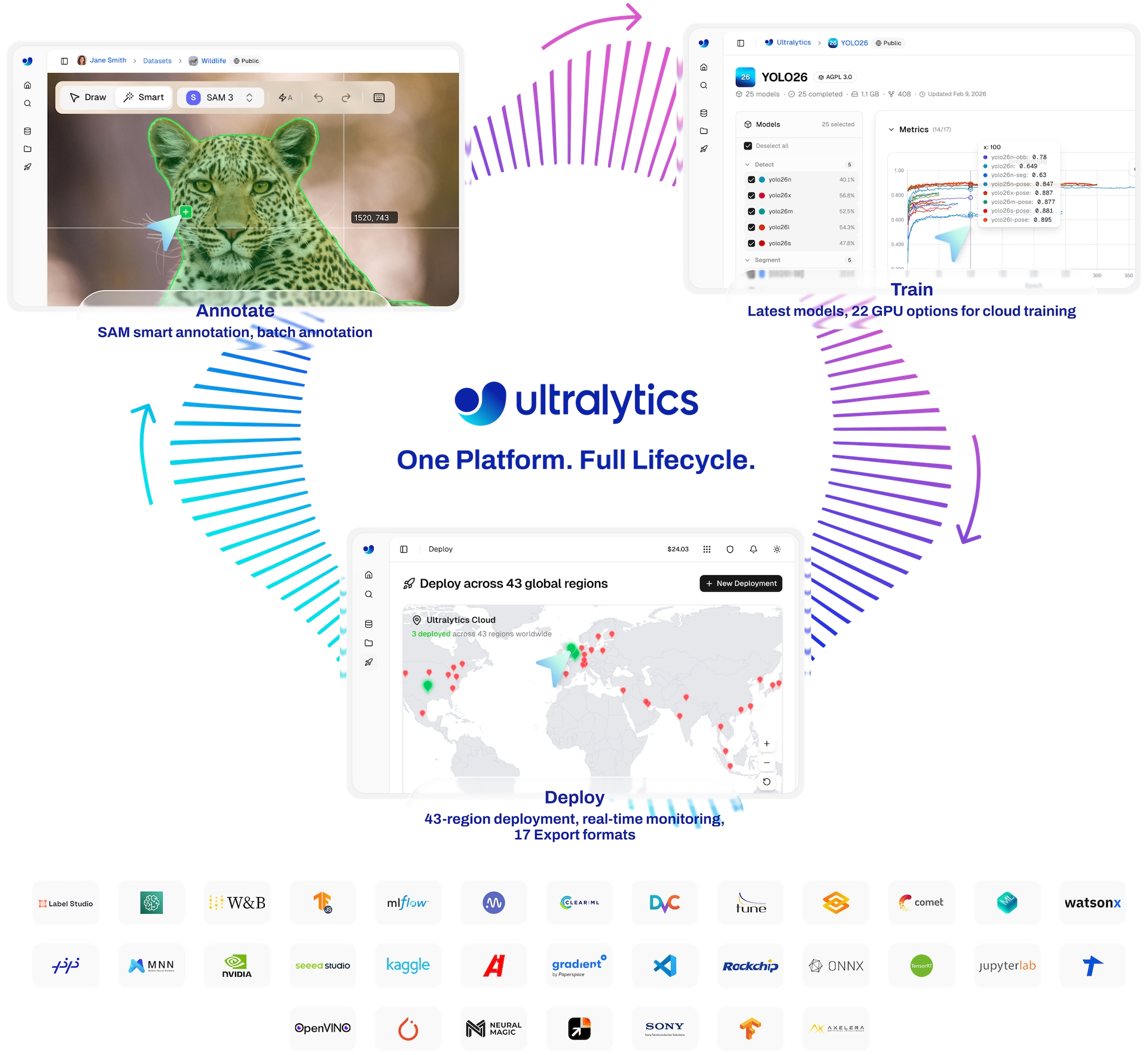
Ultralytics YOLO26 is not just another object detection model; it's a versatile framework designed to cover the entire lifecycle of machine learning models—from data ingestion and model training to validation, deployment, and real-world tracking. Each mode serves a specific purpose and is engineered to offer you the flexibility and efficiency required for different tasks and use cases.

关于计划中的 YOLO27 支持,请参阅 YOLO27 预览。YOLO27 即将推出,目前尚不可用;本指南使用的是已发布的 YOLO26 模型。


Watch: Ultralytics Modes Tutorial: Train, Validate, Predict, Export & Benchmark.

Modes at a Glance#

Understanding the different modes that Ultralytics YOLO26 supports is critical to getting the most out of your models:

  • Train mode: Fine-tune your model on custom or preloaded datasets.
  • Val mode: A post-training checkpoint to validate model performance.
  • Predict mode: Unleash the predictive power of your model on real-world data.
  • Export mode: Make your model deployment-ready in various formats.
  • Track mode: Extend your object detection model into real-time tracking applications.
  • Benchmark mode: Analyze the speed and accuracy of your model in diverse deployment environments.

This comprehensive guide aims to give you an overview and practical insights into each mode, helping you harness the full potential of YOLO26.

训练#

Train mode is used for training a YOLO26 model on a custom dataset. In this mode, the model is trained using the specified dataset and hyperparameters. The training process involves optimizing the model's parameters so that it can accurately predict the classes and locations of objects in an image. Training is essential for creating models that can recognize specific objects relevant to your application.

训练示例

Val#

Val mode is used for validating a YOLO26 model after it has been trained. In this mode, the model is evaluated on a validation set to measure its accuracy and generalization performance. Validation helps identify potential issues like overfitting and provides metrics such as mean Average Precision (mAP) to quantify model performance. This mode is crucial for tuning hyperparameters and improving overall model effectiveness.

验证示例

预测#

Predict mode is used for making predictions using a trained YOLO26 model on new images or videos. In this mode, the model is loaded from a checkpoint file, and the user can provide images or videos to perform inference. The model identifies and localizes objects in the input media, making it ready for real-world applications. Predict mode is the gateway to applying your trained model to solve practical problems.

预测示例

导出#

Export mode is used for converting a YOLO26 model to formats suitable for deployment across different platforms and devices. This mode transforms your PyTorch model into optimized formats like ONNX, TensorRT, or CoreML, enabling deployment in production environments. Exporting is essential for integrating your model with various software applications or hardware devices, often resulting in significant performance improvements.

导出示例

Track#

Track mode extends YOLO26's object detection capabilities to track objects across video frames or live streams. This mode is particularly valuable for applications requiring persistent object identification, such as surveillance systems or self-driving cars. It includes six trackers: TrackTrack (default), BoT-SORT, ByteTrack, OC-SORT, Deep OC-SORT, and FastTracker.

跟踪示例

Benchmark#

Benchmark mode profiles the speed and accuracy of various export formats for YOLO26. This mode provides comprehensive metrics on model size, accuracy (mAP50-95 for detection tasks or accuracy_top1 for classification), and inference time across different formats like ONNX, OpenVINO, and TensorRT. Benchmarking helps you select the optimal export format based on your specific requirements for speed and accuracy in your deployment environment.

基准测试示例

常见问题#

  • Training a custom object detection model with Ultralytics YOLO26 involves using the train mode. You need a dataset formatted in YOLO format, containing images and corresponding annotation files. Use the following command to start the training process:

    示例
    from ultralytics import YOLO
    
    # Load a pretrained YOLO model (you can choose n, s, m, l, or x versions)
    model = YOLO("yolo26n.pt")
    
    # Start training on your custom dataset
    model.train(data="path/to/dataset.yaml", epochs=100, imgsz=640)

    For more detailed instructions, you can refer to the Ultralytics Train Guide.

  • Ultralytics YOLO26 uses various metrics during the validation process to assess model performance. These include:

    • mAP (mean Average Precision): This evaluates the accuracy of object detection.
    • IOU (Intersection over Union): Measures the overlap between predicted and ground truth bounding boxes.
    • Precision and Recall: Precision measures the ratio of true positive detections to the total detected positives, while recall measures the ratio of true positive detections to the total actual positives.

    You can run the following command to start the validation:

    示例
    from ultralytics import YOLO
    
    # Load a pretrained or custom YOLO model
    model = YOLO("yolo26n.pt")
    
    # Run validation on your dataset
    model.val(data="path/to/validation.yaml")

    Refer to the Validation Guide for further details.

  • Ultralytics YOLO26 offers export functionality to convert your trained model into various deployment formats such as ONNX, TensorRT, CoreML, and more. Use the following example to export your model:

    示例
    from ultralytics import YOLO
    
    # Load your trained YOLO model
    model = YOLO("yolo26n.pt")
    
    # Export the model to ONNX format (you can specify other formats as needed)
    model.export(format="onnx")

    Detailed steps for each export format can be found in the Export Guide.

  • Benchmark mode in Ultralytics YOLO26 is used to analyze the speed and accuracy of various export formats such as ONNX, TensorRT, and OpenVINO. It provides metrics like model size, mAP50-95 for object detection, and inference time across different hardware setups, helping you choose the most suitable format for your deployment needs.

    示例
    from ultralytics.utils.benchmarks import benchmark
    
    # Run benchmark on GPU (device 0)
    # You can adjust parameters like model, dataset, image size, and precision as needed
    benchmark(model="yolo26n.pt", data="coco8.yaml", imgsz=640, device=0)

    For more details, refer to the Benchmark Guide.

  • Real-time object tracking can be achieved using the track mode in Ultralytics YOLO26. This mode extends object detection capabilities to track objects across video frames or live feeds. Use the following example to enable tracking:

    示例
    from ultralytics import YOLO
    
    # Load a pretrained YOLO model
    model = YOLO("yolo26n.pt")
    
    # Start tracking objects in a video
    # You can also use live video streams or webcam input
    model.track(source="path/to/video.mp4")

    For in-depth instructions, visit the Track Guide.

评论