TrackZone باستخدام Ultralytics YOLO26
ما TrackZone؟#

يتخصص TrackZone في مراقبة الكائنات داخل مناطق محددة من الإطار بدلًا من الإطار بأكمله. وهو مبني على Ultralytics YOLO26، ويدمج اكتشاف الكائنات والتتبع داخل المناطق تحديدًا، لمقاطع الفيديو وتدفقات الكاميرات المباشرة. وبما أن YOLO26 يجري الاكتشاف والتتبع بالتعلّم العميق في الوقت الفعلي، فإن TrackZone مناسب لتطبيقات مثل مراقبة الحشود والمراقبة الأمنية.
شاهد: كيفية تتبع الكائنات داخل منطقة باستخدام Ultralytics YOLO26 | TrackZone 🚀
مزايا تتبّع الأجسام ضمن المناطق (TrackZone)#
- التحليل الموجّه: يتيح تتبّع الأجسام ضمن مناطق محددة الحصول على رؤى أكثر تركيزًا، مما يسمح بمراقبة المناطق موضع الاهتمام وتحليلها بدقة، مثل نقاط الدخول أو المناطق المحظورة.
- تقليل عبء المعالجة اللاحقة: يتجاهل TrackZone الأجسام خارج المنطقة، فيستبعد الاكتشافات غير ذات الصلة ويقلل عدد الأجسام التي ينبغي عدّها أو تسجيلها أو إصدار تنبيهات بشأنها في المنطق الذي تبنيه فوقه. يظل الاكتشاف يعمل على إطار مقنّع بالحجم الكامل، لا على قصاصة ضيقة للمنطقة؛ لذا تتمثل الفائدة في مخرجات أنقى وأكثر تركيزًا، لا في تسريع استدلال النموذج.
- تعزيز الأمن: يحسّن التتبّع حسب المناطق المراقبة الأمنية من خلال مراقبة المناطق الحيوية، مما يساعد على الكشف المبكر عن الأنشطة غير المعتادة أو الاختراقات الأمنية.
- حلول قابلة للتوسع: تجعل إمكانية التركيز على مناطق محددة TrackZone قابلًا للتكيف مع سيناريوهات متنوعة، من مساحات البيع بالتجزئة إلى البيئات الصناعية.
تطبيقات واقعية#
| الزراعة | النقل والمواصلات |
|---|---|
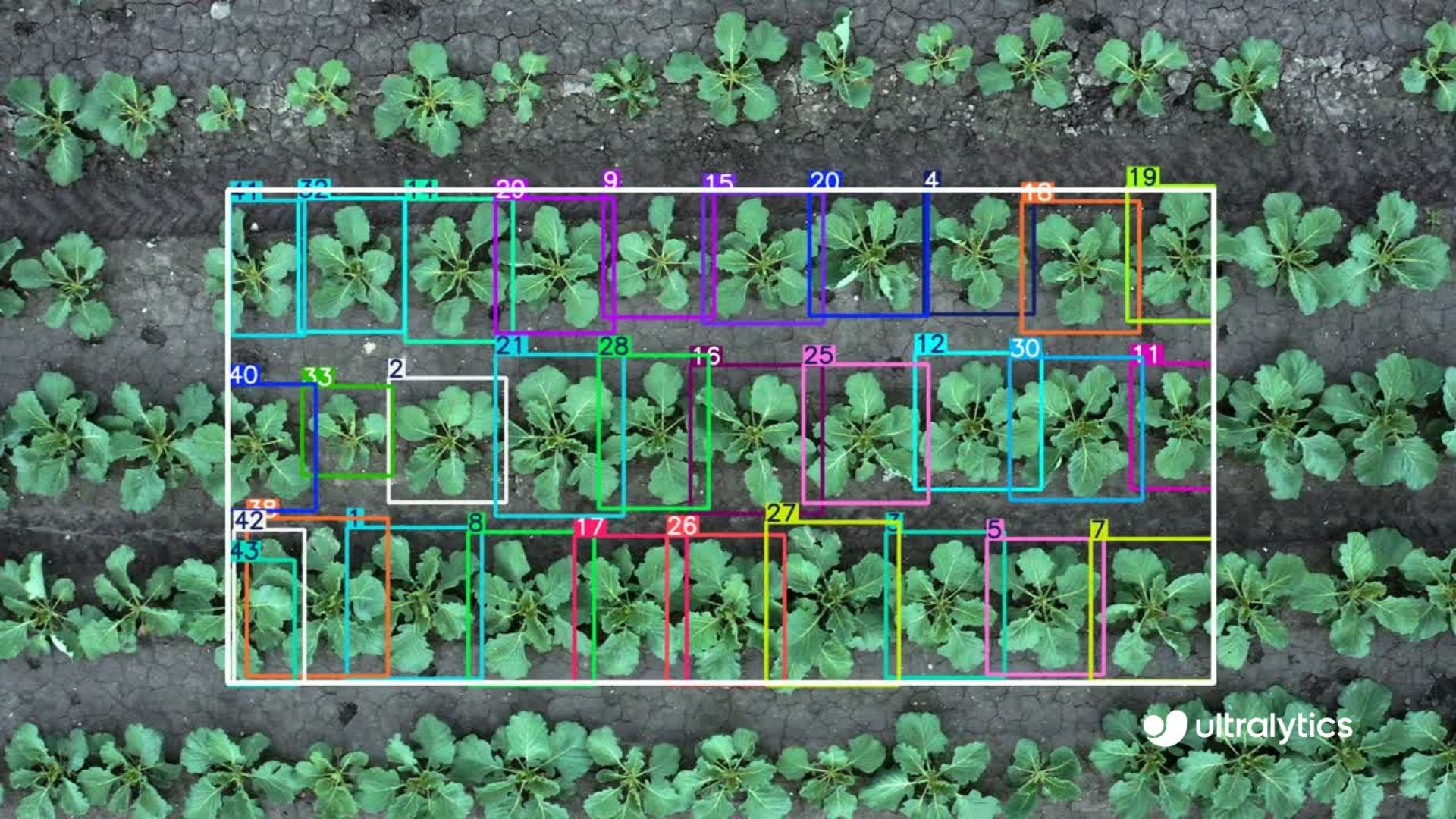 | 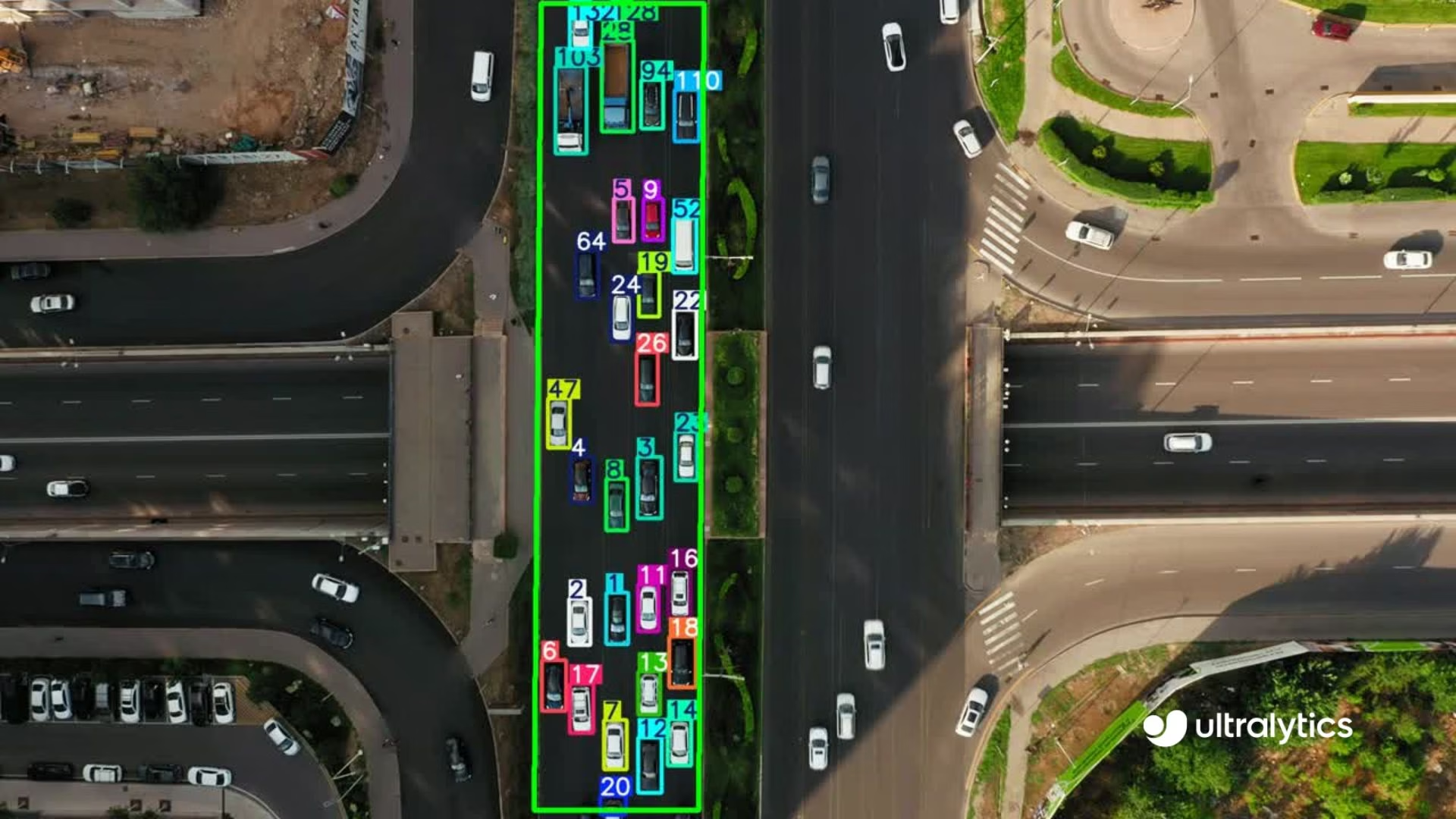 |
| تتبّع النباتات في حقل باستخدام Ultralytics YOLO26 | تتبّع المركبات على الطريق باستخدام Ultralytics YOLO26 |
# Run a trackzone example
yolo solutions trackzone show=True

# Pass a source video
yolo solutions trackzone source="path/to/video.mp4" show=True

# Pass region coordinates
yolo solutions trackzone show=True region="[(150, 150), (1130, 150), (1130, 570), (150, 570)]"
يعتمد TrackZone على القائمة region لتحديد الجزء من الإطار المطلوب مراقبته. حدّد المضلع بحيث يطابق المنطقة الفعلية التي تهمك (الأبواب والبوابات وما إلى ذلك)، وأبقِ show=True مفعّلًا أثناء الإعداد للتحقق من تطابق الطبقة المتراكبة مع بث الفيديو.
- كل إدخال في
regionهو إحداثي بكسل(x, y)في إطار الفيديو. أدرج النقاط بالترتيب الذي ينبغي أن تُوصَل به حول محيط المنطقة التي تريد مراقبتها. - ترتبط الإحداثيات بدقة الإطار، لذا لن تتطابق منطقة مُعدّة لبث بدقة 1280×720 مع بث بدقة 640×480. أبقِ
show=Trueمفعّلًا أثناء الإعداد لتتأكد من تطابق الطبقة المتراكبة مع بثك. - يختزل
TrackZoneالنقاط إلى غلافها المحدب، لذا يُبسّط الشكل المقعّر إلى أصغر مضلع محدب يحتوي على جميع نقاطه. للأشكال غير المحدبة أو المناطق المنفصلة المتعددة، استخدم حل RegionCounter بدلًا منه. - إذا حذفت
regionبالكامل، فسيُستخدم نطاق افتراضي بقيمة[(75, 75), (565, 75), (565, 285), (75, 285)].
وسيطات TrackZone#
إليك جدولًا بمعاملات TrackZone:
| المعامل | النوع | الافتراضي | الوصف |
|---|---|---|---|
model | str | None | مسار ملف نموذج Ultralytics YOLO. |
region | list أو dict | None | النقاط التي تحدد منطقة الاهتمام، سواء أكانت قائمة من الصفوف (x, y) أم قاموسًا يربط أسماء المناطق بقوائم النقاط لمناطق متعددة (في RegionCounter فقط). عندما يكون None، تستخدم الحلول التي تتطلب منطقة إعدادًا افتراضيًا محددًا مسبقًا. |
line_width | int | 2 | سماكة الخط للصناديق والنقاط المفتاحية والعدادات التي يرسمها الحل. |
verbose | bool | True | يفعّل سجل الحل لكل إطار، ويشمل شكل المدخل وعدد الفئات وسرعة المعالجة. يظل استدعاء التتبع نفسه صامتًا دائمًا. |
يتضمن حل TrackZone دعم معلمات track:
| المعامل | النوع | الافتراضي | الوصف |
|---|---|---|---|
tracker | str | 'tracktrack.yaml' | يحدد خوارزمية التتبع المطلوب استخدامها. الخيارات المضمنة: botsort.yaml، bytetrack.yaml، ocsort.yaml، deepocsort.yaml، fasttrack.yaml، tracktrack.yaml. |
conf | float | 0.25 | يضبط عتبة الثقة للكشوفات؛ إذ تسمح القيم الأقل بتتبع مزيد من الكائنات، لكنها قد تتضمن إيجابيات كاذبة. |
iou | float | 0.5 | يضبط عتبة التقاطع على الاتحاد (IoU) لتصفية الكشوفات المتداخلة. |
classes | list | None | يصفّي النتائج حسب فهرس الفئة. على سبيل المثال، لا يتتبع classes=[0, 2, 3] إلا الفئات المحددة. |
device | str | None | يحدد الجهاز المستخدم للاستدلال (مثل cpu أو cuda:0 أو 0). ويتيح للمستخدمين الاختيار بين CPU أو GPU محددة أو أجهزة حوسبة أخرى لتنفيذ النموذج. |
imgsz | int or tuple | 640 | حجم صورة الاستدلال المستهدف: عدد صحيح لصورة مربعة، أو زوج (height, width). تُعدّل الأبعاد وفقًا لخطوة النموذج. |
max_det | int | 300 | الحد الأقصى لعدد الكشوفات التي يُحتفظ بها لكل إطار قبل التتبع، ما يحد من عدد الكائنات التي يعالجها الحل في المشاهد الكثيفة. |
quantize | int or str | None | دقة الاستدلال: 16 (FP16) أو 32/unset (FP32) لنماذج PyTorch وTorchScript خارج CPU؛ أما التنسيقات الأخرى فتستخدم الدقة التي يحددها الملف الاصطناعي وبيئة التشغيل. يحل هذا الوسيط محل الوسيطة half المهملة. |
علاوة على ذلك، تتوفر خيارات التصور التالية:
| المعامل | النوع | الافتراضي | الوصف |
|---|---|---|---|
show | bool | False | إذا كان True، يعرض الصور أو مقاطع الفيديو المشروحة في نافذة. يفيد ذلك في الحصول على ملاحظات مرئية فورية أثناء التطوير أو الاختبار. |
show_conf | bool | True | يعرض درجة الثقة لكل اكتشاف بجوار التسمية، ما يوضح مدى يقين النموذج بشأن كل اكتشاف. |
show_labels | bool | True | يعرض تسميات كل اكتشاف في المخرجات المرئية، ما يتيح فهم الكائنات المكتشفة فورًا. |
عدّ الأجسام داخل المنطقة#
يعيد كل استدعاء لأداة التتبّع كائنًا من النوع SolutionResults، وتحتوي السمة total_tracks فيه على عدد الأجسام التي يجري تتبّعها حاليًا داخل المنطقة. اقرأ هذه السمة في كل إطار لمراقبة الإشغال المباشر، مثل تسجيل مدى ازدحام نقطة دخول أو منطقة محظورة:
import cv2

from ultralytics import solutions

cap = cv2.VideoCapture("path/to/video.mp4")
assert cap.isOpened(), "Error reading video file"

region_points = [(150, 150), (1130, 150), (1130, 570), (150, 570)]
trackzone = solutions.TrackZone(show=False, region=region_points, model="yolo26n.pt")

while cap.isOpened():
    success, im0 = cap.read()
    if not success:
        break
    results = trackzone(im0)
    print(f"Objects currently in zone: {results.total_tracks}")  # live zone occupancy

cap.release()
الأسئلة الشائعة#
شغّل الأمر أدناه لتتبع الكائنات داخل المنطقة فقط، ومرّر
regionلتحديد إحداثيات المنطقة. يناسب ذلك تطبيقات مثل المراقبة الأمنية وإدارة الحشود وأي سيناريو يتطلب التتبع حسب المناطق.yolo solutions trackzone source="path/to/video.mp4" show=Trueباستخدام بضعة أسطر من التعليمات البرمجية، يمكنك إعداد تتبّع الأجسام في مناطق محددة، مما يسهل دمجه في مشاريعك.
import cv2 from ultralytics import solutions cap = cv2.VideoCapture("path/to/video.mp4") assert cap.isOpened(), "Error reading video file" w, h, fps = (int(cap.get(x)) for x in (cv2.CAP_PROP_FRAME_WIDTH, cv2.CAP_PROP_FRAME_HEIGHT, cv2.CAP_PROP_FPS)) video_writer = cv2.VideoWriter("trackzone_output.avi", cv2.VideoWriter_fourcc(*"mp4v"), fps, (w, h)) trackzone = solutions.TrackZone( show=True, region=[(150, 150), (1130, 150), (1130, 570), (150, 570)], model="yolo26n.pt" ) while cap.isOpened(): success, im0 = cap.read() if not success: break results = trackzone(im0) video_writer.write(results.plot_im) cap.release() video_writer.release() cv2.destroyAllWindows()من السهل ضبط نقاط المنطقة لمعالجة الفيديو باستخدام Ultralytics TrackZone، كما يمكن تخصيصها. يمكنك تحديد المناطق وتعديلها مباشرةً عبر نص برمجي بلغة Python، مما يتيح تحكمًا دقيقًا في المناطق التي تريد مراقبتها.
from ultralytics import solutions # تحديد نقاط المنطقة region_points = [(150, 150), (1130, 150), (1130, 570), (150, 570)] # تهيئة trackzone trackzone = solutions.TrackZone( show=True, # # اعرض الناتج region=region_points, # # مرر نقاط المنطقة )تذكّر أن
TrackZoneيختزل النقاط إلى غلافها المحدب، لذا يُبسّط المحيط المقعّر إلى أصغر مضلع محدب يحتوي على جميع نقاطه.تتعامل الحلول الثلاثة مع المناطق، لكنها تجيب عن أسئلة مختلفة:
الحل استخدمه من أجل المخرجات المعتادة TrackZone تتبّع الأجسام ومراقبة الإشغال المباشر داخل منطقة محدبة واحدة معرّفات الأجسام المتتبّعة و total_tracksللمنطقةObjectCounter عدّ الأجسام التي تعبر خطًا أو تدخل منطقة وتخرج منها إجمالي أعداد الدخول والخروج RegionCounter عدّ الأجسام داخل منطقة اعتباطية واحدة أو أكثر (بما فيها المناطق غير المحدبة) أعداد الأجسام لكل منطقة اختر TrackZone عندما تريد تتبّعًا مستمرًا داخل منطقة واحدة، واختر RegionCounter عندما تحتاج إلى مناطق متعددة أو شكل غير محدب.


التعليقات40
اطرح سؤالًا، وشارك نتائجك، أو ساعد شخصًا آخر.
Paul231200
Hello, great development, but I had a question about the advantages of your solution in comparison with the regions of interest that can be done in Opencv, also the question is whether it is planned to add this development to such models as yolov8?
1 Glenn JocherUltralytics(تم التعديل)
@Paul231200 thank you for your question! TrackZone offers targeted and efficient region-based tracking, reducing computational overhead compared to general frame analysis in OpenCV. As for YOLOv8, TrackZone works with any Ultralytics model you pass via
model=, including YOLOv8, though we recommend YOLO26 for new projects. For more details, you can explore TrackZone here: https://docs.ultralytics.com/guides/trackzone/.
moshiour
Hi, Its a nice feature to yolo! How do make it counting on top of it? Thank you in advance!
1- Glenn JocherUltralytics(تم التعديل)
@moshiour thank you for your kind words!
TrackZonereturns a results object withtotal_tracks, the number of objects currently tracked inside the zone:results = trackzone(im0)thenresults.total_tracks. For counting objects entering or leaving a region, see the Object Counting guide. Let us know if you have more questions!1 RizwanMunawar
@Muhammad-237 Hi, We currently don't support the counting feature with TrackZone, but It's on our TODO's list, and we will release this feature soon! Thank you! In the meantime, you can explore our documentation available at: https://docs.ultralytics.com/guides/object-counting/#__tabbed_1_1
biancalepe
Thank you for this informative resource! I have a question - am I able to obtain the unique IDs of identified objects within 20 second windows? In this case, I'd like to know how many unique cars in total were in my zone for each 20 second time period of my video.
Below is my starting code:
def count_specific_classes(video_path, output_video_path, model_path, classes_to_count, region_points):
"""Count specific classes of objects in a video.""" cap = cv2.VideoCapture(video_path) assert cap.isOpened(), "Error reading video file" # Video writer w, h, fps = (int(cap.get(x)) for x in (cv2.CAP_PROP_FRAME_WIDTH, cv2.CAP_PROP_FRAME_HEIGHT, cv2.CAP_PROP_FPS)) video_writer = cv2.VideoWriter(output_video_path, cv2.VideoWriter_fourcc(*"mp4v"), fps, (w, h)) # Initiate TrackZone (object tracking in zones, not complete frame) trackzone = solutions.TrackZone(show=True, # Display the output region=region_points, # pass the region points model=model_path, # use any model that Ultralytics supports classes=classes_to_count) # which objects to track # Process video while cap.isOpened(): success, im0 = cap.read() if not success: print("Video frame is empty or processing is complete.") break results = trackzone(im0) #print (results) # access the output video_writer.write(results.plot_im) # write the video output cap.release() video_writer.release() cv2.destroyAllWindows() # destroy all open windows- Glenn JocherUltralytics(تم التعديل)
@biancalepe you can access unique track IDs from
trackzone.track_idsand implement time-based windowing for counting. Here's how to modify your code to count unique cars in 20-second intervals:def count_unique_cars_by_time_window(video_path, output_video_path, model_path, classes_to_count, region_points, window_seconds=20): cap = cv2.VideoCapture(video_path) assert cap.isOpened(), "Error reading video file" w, h, fps = (int(cap.get(x)) for x in (cv2.CAP_PROP_FRAME_WIDTH, cv2.CAP_PROP_FRAME_HEIGHT, cv2.CAP_PROP_FPS)) video_writer = cv2.VideoWriter(output_video_path, cv2.VideoWriter_fourcc(*"mp4v"), fps, (w, h)) trackzone = solutions.TrackZone( show=True, region=region_points, model=model_path, classes=classes_to_count ) frame_count = 0 window_frame_count = window_seconds * fps # frames per 20-second window current_window = 1 unique_ids_in_window = set() window_results = [] while cap.isOpened(): success, im0 = cap.read() if not success: break results = trackzone(im0) # Track IDs of the objects currently inside the zone unique_ids_in_window.update(trackzone.track_ids) frame_count += 1 # Check if window is complete if frame_count >= window_frame_count: unique_count = len(unique_ids_in_window) window_results.append(f"Window {current_window} ({window_seconds - 20}-{window_seconds}s): {unique_count} unique cars") print(f"Window {current_window}: {unique_count} unique cars detected") # Reset for next window unique_ids_in_window.clear() current_window += 1 frame_count = 0 window_seconds += 20 video_writer.write(results.plot_im) # Handle final incomplete window if unique_ids_in_window: unique_count = len(unique_ids_in_window) print(f"Final window: {unique_count} unique cars detected") cap.release() video_writer.release() cv2.destroyAllWindows() return window_resultsThis tracks unique car IDs within each 20-second window and provides counts for analysis.
Thank you!
Running the code, I see that cars exist in the twenty second windows but the code returns back zero cars for all windows. As I was trying to parse out the code, I printed results.boxes and I get this error --> AttributeError: 'SolutionResults' object has no attribute 'boxes'. I get a similar error when I try to print out results.boxes.id. Printing results seems to get me a "total_tracks" and a "speed" option, but nothing else. Is there something I should be doing?
@biancalepe If you want to retrieve the IDs of tracked objects in a specific Zone (these will be unique), you can use the code mentioned below. Please note SolutionResults class includes the data highlighted here. Track IDs can be extracted directly by Solution Object, i.e,
trackzone.track_ids. Thanksimport cv2 from ultralytics import solutions cap = cv2.VideoCapture("path/to/video.mp4") assert cap.isOpened(), "Error reading video file" # Define region points region_points = [(150, 150), (1130, 150), (1130, 570), (150, 570)] # Video writer w, h, fps = (int(cap.get(x)) for x in (cv2.CAP_PROP_FRAME_WIDTH, cv2.CAP_PROP_FRAME_HEIGHT, cv2.CAP_PROP_FPS)) video_writer = cv2.VideoWriter("trackzone_output.avi", cv2.VideoWriter_fourcc(*"mp4v"), fps, (w, h)) # Init trackzone (object tracking in zones, not complete frame) trackzone = solutions.TrackZone( show=True, # display the output region=region_points, # pass region points model="yolo11n.pt", # use any model that Ultralytics support, i.e. YOLOv9, YOLOv10 # line_width=2, # adjust the line width for bounding boxes and text display ) # Process video while cap.isOpened(): success, im0 = cap.read() if not success: print("Video frame is empty or processing is complete.") break results = trackzone(im0) print(trackzone.track_ids) # access the track_ids video_writer.write(results.plot_im) # write the video file cap.release() video_writer.release() cv2.destroyAllWindows() # destroy all opened windowsSorry @muhammadrizwanmunawar the reason I was doing the print statements is because I was trying to figure out why the first block of code written by @glenn-jocher wasn't working. I isolated the problem to the extract IDs from results part. Using your code and glenn's I updated that section to be the code below, which seems to have fixed the problem:
Extract track IDs from results
if trackzone.track_ids is not None: track_ids = trackzone.track_ids unique_ids_in_window.update(track_ids)1- Glenn JocherUltralytics
@biancalepe excellent troubleshooting! You've correctly identified that track IDs should be accessed via
trackzone.track_idsrather than from theresultsobject. This is the proper way to extract track IDs from TrackZone for time-windowed unique counting. Great job combining the solutions!
amoore1724
Can this be used to track two separate regions in the same frame?
yes! Currently, we support the tracking objects in a single zone.
 Caio Passos
Hi! I have a question. In the docs, it says TrackZone supports classes as parameters. I tried to limit TrackZone to only detect the class 0 (person).
heres the code, almost like the example in docs:
import cv2

from ultralytics import solutions, YOLO

cap = cv2.VideoCapture(
    "/path_to_video.mp4"
)
assert cap.isOpened(), "Error reading video file"

# Define region points
region_points = [(150, 150), (1130, 150), (1130, 570), (150, 570)]

# Video writer
w, h, fps = (
    int(cap.get(x))
    for x in (cv2.CAP_PROP_FRAME_WIDTH, cv2.CAP_PROP_FRAME_HEIGHT, cv2.CAP_PROP_FPS)
)
video_writer = cv2.VideoWriter(
    "trackzone_output.avi", cv2.VideoWriter_fourcc(*"mp4v"), fps, (w, h)
)
# Init trackzone (object tracking in zones, not complete frame)
trackzone = solutions.TrackZone(
    show=True,  # display the output
    region=region_points,  # pass region points
    model="yolo11n.pt",
    names=[0],
    # use any model that Ultralytics support, i.e. YOLOv9, YOLOv10
    line_width=1,  # adjust the line width for bounding boxes and text display
)
print(f" model class names: {trackzone.model.names}")
# Process video
while cap.isOpened():
    success, im0 = cap.read()
    if not success:
        print("Video frame is empty or processing is complete.")
        break

    results = trackzone(im0)

    # print(results)  # access the output

    video_writer.write(results.plot_im)  # write the video file

cap.release()
video_writer.release()
cv2.destroyAllWindows()  # destroy all opened windows
it runs without any issue, but still detecting other classes like backpacks, for example. Can you provide some extra details on how to limit detections for person class only?
@caio-passos Hi, thanks for sharing it. The actual argument to set classes is
classes, notnames,as mentioned in the documentation here: https://docs.ultralytics.com/guides/trackzone/#trackzone-arguments. Let me know if you have any questions. Thanks- Caio Passos
Thanks!! I've changed it in the code:
trackzone = solutions.TrackZone(
    show=True,  # display the output
    region=region_points,  # pass region points
    model="yolo11n.pt",
    classes=[0],
    # use any model that Ultralytics support, i.e. YOLOv9, YOLOv10
    line_width=1,  # adjust the line width for bounding boxes and text display
)
But it led to this error, something related to the size of the mask or tensor:
Traceback (most recent call last):
  File "/home/tarzan/Documents/programing/hive/aeroporto/track.py", line 38, in <module>
    results = trackzone(im0)
              ^^^^^^^^^^^^^^
  File "/home/tarzan/Documents/programing/hive/aeroporto/.venv/lib/python3.12/site-packages/ultralytics/solutions/solutions.py", line 195, in __call__
    result = self.process(*args, **kwargs)  # Call the subclass-specific process method
             ^^^^^^^^^^^^^^^^^^^^^^^^^^^^^
  File "/home/tarzan/Documents/programing/hive/aeroporto/.venv/lib/python3.12/site-packages/ultralytics/solutions/trackzone.py", line 73, in process
    self.extract_tracks(masked_frame)
  File "/home/tarzan/Documents/programing/hive/aeroporto/.venv/lib/python3.12/site-packages/ultralytics/solutions/solutions.py", line 120, in extract_tracks
    self.tracks = self.model.track(source=im0, persist=True, classes=self.classes, **self.track_add_args)
                  ^^^^^^^^^^^^^^^^^^^^^^^^^^^^^^^^^^^^^^^^^^^^^^^^^^^^^^^^^^^^^^^^^^^^^^^^^^^^^^^^^^^^^^^
  File "/home/tarzan/Documents/programing/hive/aeroporto/.venv/lib/python3.12/site-packages/ultralytics/engine/model.py", line 593, in track
    return self.predict(source=source, stream=stream, **kwargs)
           ^^^^^^^^^^^^^^^^^^^^^^^^^^^^^^^^^^^^^^^^^^^^^^^^^^^^
  File "/home/tarzan/Documents/programing/hive/aeroporto/.venv/lib/python3.12/site-packages/ultralytics/engine/model.py", line 549, in predict
    return self.predictor.predict_cli(source=source) if is_cli else self.predictor(source=source, stream=stream)
                                                                    ^^^^^^^^^^^^^^^^^^^^^^^^^^^^^^^^^^^^^^^^^^^^
  File "/home/tarzan/Documents/programing/hive/aeroporto/.venv/lib/python3.12/site-packages/ultralytics/engine/predictor.py", line 218, in __call__
    return list(self.stream_inference(source, model, *args, **kwargs))  # merge list of Result into one
           ^^^^^^^^^^^^^^^^^^^^^^^^^^^^^^^^^^^^^^^^^^^^^^^^^^^^^^^^^^^
  File "/home/tarzan/Documents/programing/hive/aeroporto/.venv/lib/python3.12/site-packages/torch/utils/_contextlib.py", line 36, in generator_context
    response = gen.send(None)
               ^^^^^^^^^^^^^^
  File "/home/tarzan/Documents/programing/hive/aeroporto/.venv/lib/python3.12/site-packages/ultralytics/engine/predictor.py", line 336, in stream_inference
    self.results = self.postprocess(preds, im, im0s)
                   ^^^^^^^^^^^^^^^^^^^^^^^^^^^^^^^^^
  File "/home/tarzan/Documents/programing/hive/aeroporto/.venv/lib/python3.12/site-packages/ultralytics/models/yolo/detect/predict.py", line 55, in postprocess
    preds = ops.non_max_suppression(
            ^^^^^^^^^^^^^^^^^^^^^^^^
  File "/home/tarzan/Documents/programing/hive/aeroporto/.venv/lib/python3.12/site-packages/ultralytics/utils/ops.py", line 304, in non_max_suppression
    x, xk = x[filt], xk[filt]
            ~^^^^^^
IndexError: The shape of the mask [64] at index 0 does not match the shape of the indexed tensor [62, 6] at index 0
I had experienced something similar with QueueManager before, but I couldn't figure it out where or what went wrong
@caio-passos, which ultralytics version are you using?
- Caio Passos
it's ultralytics version 8.3.114
@caio-passos, please upgrade the package with
pip install -U ultralytics. This error is already fixed in the latest version.1- Caio Passos
It solved the issue, thank you!! @RizwanMunawar
1
Parthpatil0024
Is there a way to use botsort without using the track method. how to do it if i am using a ncnn model format.
skyceeee
import cv2 import gc from ultralytics import solutions
Kamerayı başlat
cap = cv2.VideoCapture(0) assert cap.isOpened(), "Kamera açılırken hata oluştu!"
Kamera çözünürlüğünü belirle
cap.set(cv2.CAP_PROP_FRAME_WIDTH, 640) cap.set(cv2.CAP_PROP_FRAME_HEIGHT, 480)
Takip bölgesini tanımla (görüntü çözünürlüğüne uygun olmalı)
region_points = [(50, 50), (590, 50), (590, 430), (50, 430)]
TrackZone nesnesini başlat
trackzone = solutions.TrackZone( show=True, region=region_points, model="C:/yazilim/staj/trackzone/yolov8n480.pt", # Daha küçük model kullanıldı imgsz=480, # Model giriş boyutu sınırlandırıldı )
Canlı görüntü işleme döngüsü
while cap.isOpened(): success, frame = cap.read() if not success: print("Kamera görüntüsü alınamadı!") break
# Görüntüyü yeniden boyutlandır
frame = cv2.resize(frame, (640, 480))

# TrackZone ile işlem yap
try:
    processed_frame = trackzone.trackzone(frame)
except Exception as e:
    print(f"Takip sırasında bir hata oluştu: {e}")
    break

# Görüntüyü göster
cv2.imshow("TrackZone Canlı Takip", processed_frame)

# Bellek temizliği yap
gc.collect()

# 'q' tuşuna basarak çıkış yapabilirsiniz
if cv2.waitKey(10) & 0xFF == ord('q'):
    break
Kamera ve pencereyi serbest bırak
cap.release() cv2.destroyAllWindows()
This is my code. I use my own trained yolov8n model. When the camera is turned on, the area I drew also appears. No problems until then. But the moment a person enters the rectangle, the kernel dies. What could be the reason for this?My model does human detection. Error: The Kernel crashed while executing code in the current cell or a previous cell. Please review the code in the cell(s) to identify a possible cause of the failure. Click here for more info. View Jupyter log for further details.
- Glenn JocherUltralytics
The kernel crash could be due to insufficient memory or a compatibility issue with your custom YOLOv8 model. Ensure your system has enough resources available, and verify that the model file is correctly configured for the
TrackZonesolution. Additionally, try reducing the input resolution further (e.g.,imgsz=320) to minimize memory usage. For further debugging, check the full error log and confirm that your model works with standardpredictfunctionality outside ofTrackZone.
nichamond143
Hi, I'm using TrackZone with a custom model, but it's not detecting the target object. However, when I crop the zone of interest from the example video and put it through the model it works fine. I also trained the model on zoomed in images of the object because the full-frame image is too noisey and the object is very small. Any advice on how to approach this?
- Glenn JocherUltralytics
@nichamond143 it sounds like the model's training on zoomed-in images may limit its ability to generalize to full-frame inputs. You could try pre-processing the video frames to crop and resize the zone of interest before passing them to the model. Alternatively, consider retraining the model with multi-scale images, including both zoomed-in and contextual full-frame examples, to improve its detection robustness.
UltralyticsAssistantUltralytics
👋 Hello, thank you for your interest in Ultralytics 🚀! It sounds like you're exploring how TrackZone uses YOLO models for object tracking and analysis – fascinating topic!
If this is a ❓ Question about custom implementations, feel free to share more details about your use case so our team or the community can better assist. If it's a 🐛 Bug Report or you need specific technical help, please provide a clear description, along with any code snippets, error messages, or logs. Including a minimum reproducible example (MRE) would greatly help us debug and offer guidance swiftly.
For general inquiries or tips on achieving optimal results, consider reviewing our resources on model training and usage. Additionally, you can join the Ultralytics community on platforms like Discord, Reddit, or Discourse for deeper interactions and advice.
Lastly, please ensure you're running the latest version of the
ultralyticspackage and all required dependencies to avoid encountering previously resolved issues. You can upgrade using thepip install -U ultralyticscommand.Thank you for being part of the Ultralytics community! 😊 An Ultralytics engineer will be here to assist you further shortly.
By converting the yolo model to tensorrt and setting coordinates in Jetson Nano, I track objects in a certain area with Jetson Nano. Can I use trackzone instead of adjusting coordinates myself? Is Jetson Nano supported?
- Glenn JocherUltralytics
@skyceeee yes, you can use TrackZone with Jetson Nano for targeted object tracking within specific areas, eliminating the need to adjust coordinates manually. TrackZone is compatible with YOLO models, including TensorRT-exported ones. Ensure you optimize your model for Jetson Nano's limited resources for best performance. More details on TrackZone can be found here.
1
Thanks so much for this feature. Is it possible to use this feature with tensorrt format in Jetson nano?
- Glenn JocherUltralytics
@skyceeee thank you for your question! Yes, you can use the TensorRT-exported YOLO models on the Jetson Nano, including for the TrackZone feature. First, export your YOLO11 model to TensorRT format using the
yolo exportcommand. Then, ensure your TensorRT runtime is properly set up on the Nano, and integrate the exported model into your tracking workflow. For more details, refer to the Export Documentation. Let us know if you encounter any issues!1