Modelo YOLO-World#
YOLO-World es un enfoque en tiempo real basado en Ultralytics YOLOv8 para la detección de vocabulario abierto. Detecta objetos en una imagen a partir de texto descriptivo. Al reducir las necesidades computacionales y mantener una precisión competitiva, YOLO-World es adecuado para una amplia variedad de aplicaciones de visión.
Ver: Flujo de trabajo de entrenamiento de YOLO World con un conjunto de datos personalizado
Descripción general#
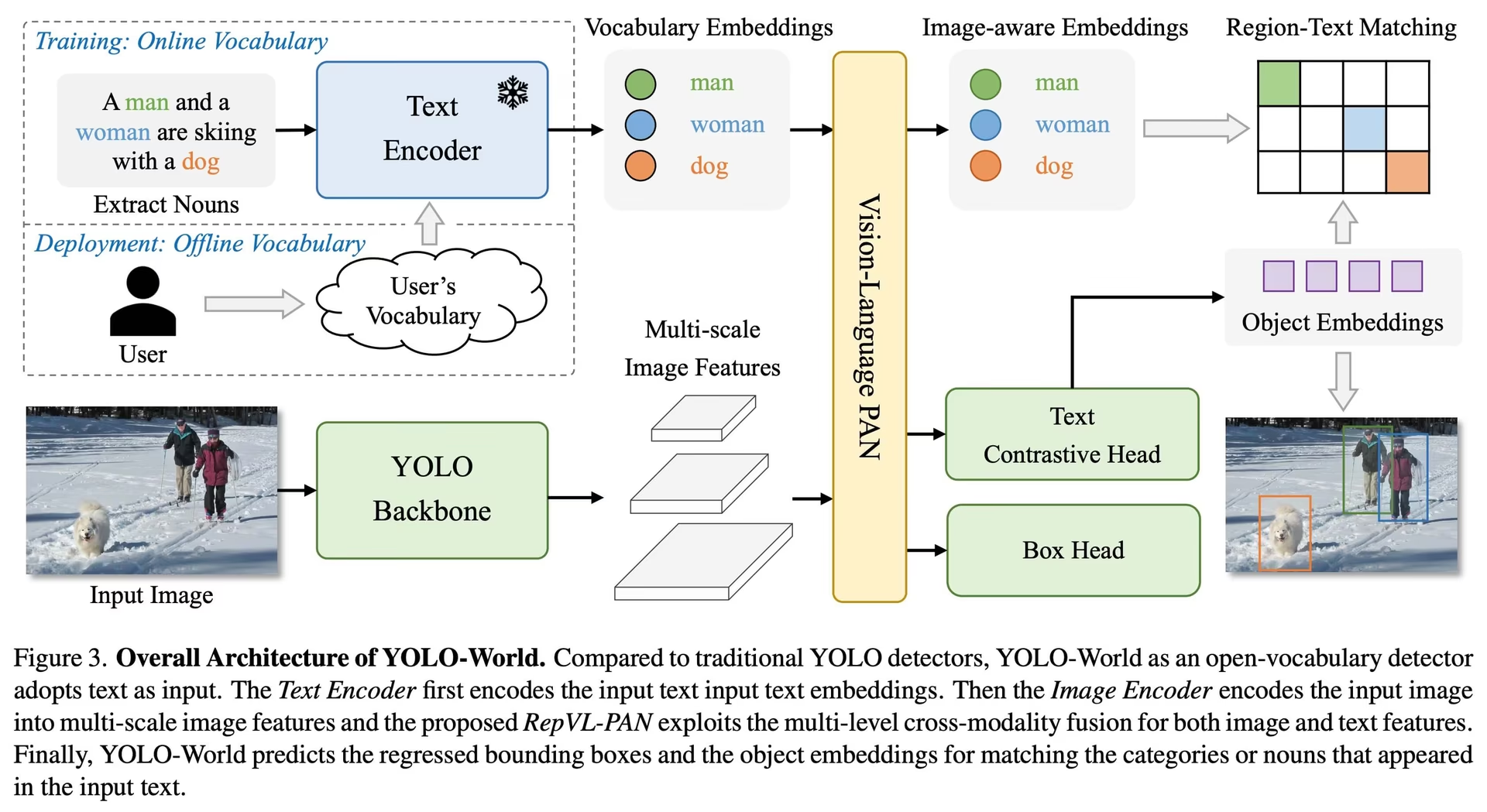
YOLO-World aborda los retos de los modelos tradicionales de detección de vocabulario abierto, que suelen depender de modelos Transformer pesados que requieren muchos recursos computacionales. Por su parte, los detectores de conjunto cerrado dependen de categorías de objetos predefinidas, lo que limita su uso en escenarios dinámicos. YOLO-World amplía el framework YOLOv8 con detección de vocabulario abierto, mediante el uso de modelado visión-lenguaje y el preentrenamiento con grandes conjuntos de datos para identificar eficazmente una amplia variedad de objetos en escenarios de cero disparos.
Para trabajos de vocabulario abierto que también necesiten máscaras de instancias, indicaciones visuales o un modo sin indicaciones, consulta YOLOE, que mantiene la misma API set_classes().
Características principales#
-
Solución en tiempo real: basado en CNNs rápidas, YOLO-World ofrece detección de vocabulario abierto con la rapidez suficiente para aplicaciones que necesitan resultados inmediatos.
-
Eficiencia y rendimiento: YOLO-World reduce las necesidades de cálculo y recursos sin perder precisión, ofrece una alternativa eficiente a los detectores de vocabulario abierto basados en Transformer más pesados y permite aplicaciones en tiempo real.
-
Inferencia con vocabulario sin conexión: YOLO-World introduce una estrategia de «solicitar y después detectar» que utiliza un vocabulario sin conexión para mejorar aún más la eficiencia. Este enfoque permite codificar y almacenar como incrustaciones de vocabulario sin conexión solicitudes personalizadas calculadas a priori, como descripciones o categorías, lo que agiliza el proceso de detección.
-
Impulsado por YOLOv8: basado en Ultralytics YOLOv8, YOLO-World adapta su arquitectura de detección en tiempo real para ofrecer detección de vocabulario abierto rápida y precisa.
-
Excelencia en las pruebas de referencia: YOLO-World supera a los detectores de vocabulario abierto existentes, incluidos MDETR y la serie GLIP, en velocidad y eficiencia en pruebas de referencia estándar, medidas en una única GPU NVIDIA V100.
-
Aplicaciones versátiles: la eficiencia de YOLO-World hace que la detección de vocabulario abierto sea práctica para muchas tareas de visión y se ejecuta mucho más rápido que los métodos anteriores de vocabulario abierto.
Modelos disponibles, tareas compatibles y modos de funcionamiento#
En esta sección se detallan los modelos disponibles, con sus pesos preentrenados específicos, las tareas que admiten y su compatibilidad con distintos modos de funcionamiento, como Entrenamiento, Validación, Inferencia y Exportación, indicados con ✅ para los modos compatibles y ❌ para los no compatibles.
Todos los pesos de YOLOv8-World se migran directamente desde el repositorio oficial YOLO-World; el mérito corresponde a sus autores.
| Tipo de modelo | Pesos preentrenados | Tareas compatibles | Entrenamiento | Validación | Inferencia | Exportar |
|---|---|---|---|---|---|---|
| YOLOv8s-world | yolov8s-world.pt | Detección de objetos | ✅ | ✅ | ✅ | ❌ |
| YOLOv8s-worldv2 | yolov8s-worldv2.pt | Detección de objetos | ✅ | ✅ | ✅ | ✅ |
| YOLOv8m-world | yolov8m-world.pt | Detección de objetos | ✅ | ✅ | ✅ | ❌ |
| YOLOv8m-worldv2 | yolov8m-worldv2.pt | Detección de objetos | ✅ | ✅ | ✅ | ✅ |
| YOLOv8l-world | yolov8l-world.pt | Detección de objetos | ✅ | ✅ | ✅ | ❌ |
| YOLOv8l-worldv2 | yolov8l-worldv2.pt | Detección de objetos | ✅ | ✅ | ✅ | ✅ |
| YOLOv8x-world | yolov8x-world.pt | Detección de objetos | ✅ | ✅ | ✅ | ❌ |
| YOLOv8x-worldv2 | yolov8x-worldv2.pt | Detección de objetos | ✅ | ✅ | ✅ | ✅ |
Transferencia zero-shot en el conjunto de datos COCO#
| Tipo de modelo | mAP50-95 | mAP50 | mAP75 |
|---|---|---|---|
| yolov8s-world | 37.4 | 52.0 | 40.6 |
| yolov8s-worldv2 | 37.7 | 52.2 | 41.0 |
| yolov8m-world | 42.0 | 57.0 | 45.6 |
| yolov8m-worldv2 | 43.0 | 58.4 | 46.8 |
| yolov8l-world | 45.7 | 61.3 | 49.8 |
| yolov8l-worldv2 | 45.8 | 61.3 | 49.8 |
| yolov8x-world | 47.0 | 63.0 | 51.2 |
| yolov8x-worldv2 | 47.1 | 62.8 | 51.4 |
Ejemplos de uso#
Ultralytics ofrece una API de Python y comandos de CLI para los modelos YOLO-World.
Ver: Ejemplos de uso del modelo YOLO-World con Ultralytics | Vocabulario abierto, sin solicitudes y más
Uso del entrenamiento#
Recomendamos encarecidamente usar yolov8-worldv2 para el entrenamiento personalizado, ya que admite el entrenamiento determinista y permite exportar fácilmente a formatos como ONNX y TensorRT.
Entrena un modelo de detección de objetos YOLO-World con el método train, que se muestra a continuación con el conjunto de datos de ejemplo COCO8:
Se pueden pasar modelos *.pt preentrenados de PyTorch, así como archivos de configuración *.yaml, a la clase YOLOWorld() para crear una instancia del modelo en Python:
from ultralytics import YOLOWorld

# Carga un modelo YOLOv8s-worldv2 preentrenado
model = YOLOWorld("yolov8s-worldv2.pt")

# Entrena el modelo durante 100 épocas con el conjunto de datos de ejemplo COCO8
results = model.train(data="coco8.yaml", epochs=100, imgsz=640)

# Ejecuta la inferencia con el modelo YOLO-World en la imagen 'bus.jpg'
results = model("path/to/bus.jpg")
Uso de la predicción#
Ejecuta la detección de objetos con el método predict, como se muestra a continuación:
from ultralytics import YOLOWorld

# Inicializa un modelo YOLO-World
model = YOLOWorld("yolov8s-world.pt")  # o selecciona yolov8m/l-world.pt para usar otros tamaños

# Ejecuta la inferencia con el modelo YOLOv8s-world en la imagen especificada
results = model.predict("path/to/image.jpg")

# Muestra los resultados
results[0].show()
Este fragmento carga un modelo preentrenado y ejecuta una predicción sobre una imagen.
Uso de la validación#
Valida el modelo con un conjunto de datos de la siguiente manera:
from ultralytics import YOLO

# Crea un modelo YOLO-World
model = YOLO("yolov8s-world.pt")  # o selecciona yolov8m/l-world.pt para usar otros tamaños

# Valida el modelo en el conjunto de datos de ejemplo COCO8
metrics = model.val(data="coco8.yaml")
Seguimiento de uso#
Ejecuta el seguimiento de objetos con un modelo YOLO-World en vídeos o imágenes de la siguiente manera:
from ultralytics import YOLO

# Crea un modelo YOLO-World
model = YOLO("yolov8s-world.pt")  # o selecciona yolov8m/l-world.pt para usar otros tamaños

# Realiza el seguimiento con un modelo YOLO-World en un vídeo
results = model.track(source="path/to/video.mp4")Los modelos YOLO-World que ofrece Ultralytics vienen preconfigurados con las categorías del conjunto de datos COCO como parte de su vocabulario sin conexión, por lo que están listos para usarse de inmediato. Esto permite que los modelos YOLOv8-World reconozcan y predigan directamente las 80 categorías estándar definidas en el conjunto de datos COCO sin necesidad de configuración ni personalización adicionales.
Configurar prompts#
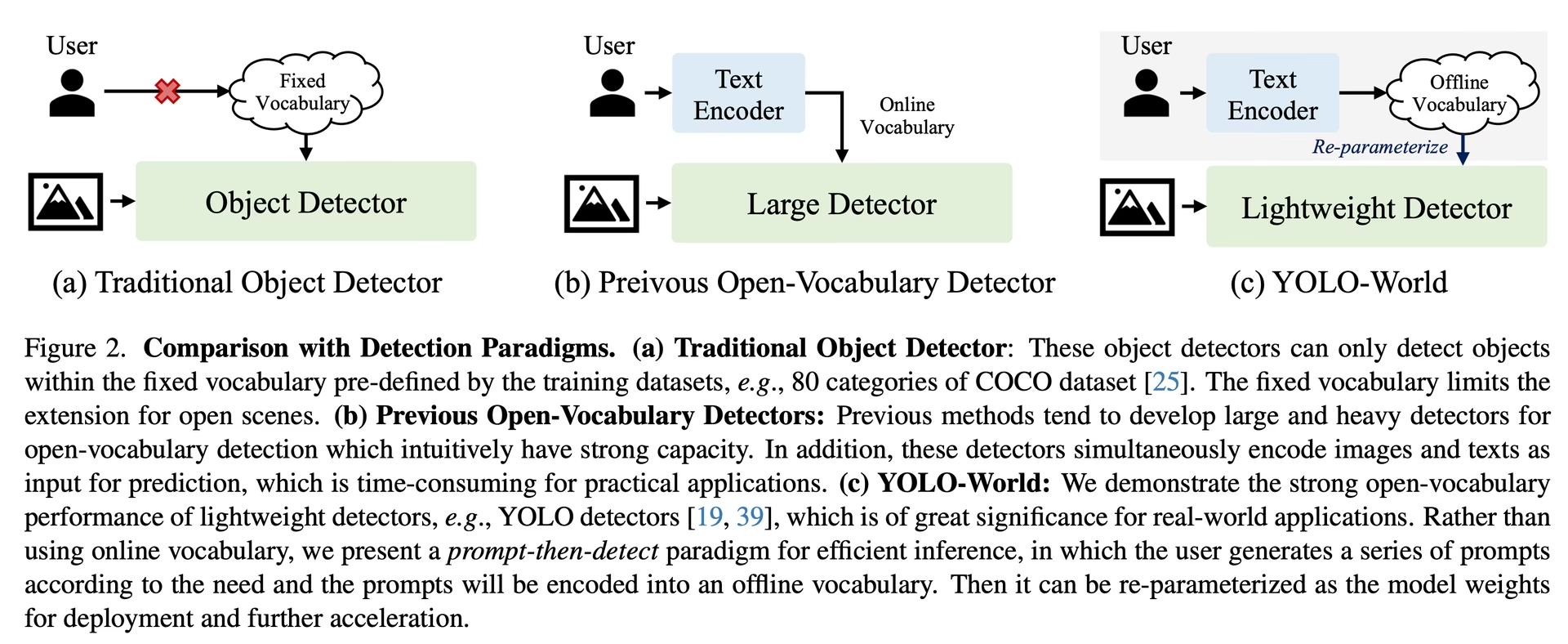
El framework YOLO-World permite especificar clases dinámicamente mediante solicitudes personalizadas, para que puedas adaptar el modelo a tus necesidades concretas sin volver a entrenarlo. Esta función resulta especialmente útil para adaptar el modelo a nuevos dominios o tareas específicas que no formaban parte originalmente de los datos de entrenamiento. Al configurar solicitudes personalizadas, puedes guiar el modelo hacia los objetos que te interesan y mejorar la relevancia y la precisión de los resultados de detección.
Por ejemplo, si tu aplicación solo necesita detectar objetos de tipo «persona» y «autobús», puedes especificar directamente estas clases:
from ultralytics import YOLO

# Inicializa un modelo YOLO-World
model = YOLO("yolov8s-world.pt")  # o elige yolov8m/l-world.pt

# Define clases personalizadas
model.set_classes(["person", "bus"])

# Ejecuta la predicción de las categorías especificadas en una imagen
results = model.predict("path/to/image.jpg")

# Muestra los resultados
results[0].show()Algunos usuarios han observado que añadir una cadena vacía "" como clase de fondo puede mejorar el rendimiento de detección en ciertas situaciones. Este comportamiento parece depender del escenario y no se conoce por completo el mecanismo exacto:
model.set_classes(["person", "bus", ""])La cadena vacía permanece en model.names como una clase propia, incluso en cualquier modelo que guardes, por lo que sus detecciones aparecen con una etiqueta vacía. Pasa classes=[0, 1] al realizar la predicción para conservar solo las clases reales.
También puedes guardar un modelo después de configurar clases personalizadas. Así crearás una versión del modelo YOLO-World especializada para tu caso de uso concreto. Este proceso incorpora las definiciones de tus clases personalizadas directamente en el archivo del modelo, que queda listo para usarse con las clases especificadas sin necesidad de realizar más ajustes. Sigue estos pasos para guardar y cargar tu modelo YOLO-World personalizado:
Primero, carga un modelo YOLO-World, configúrale clases personalizadas y guárdalo:
from ultralytics import YOLO

# Inicializa un modelo YOLO-World
model = YOLO("yolov8s-world.pt")  # o selecciona yolov8m/l-world.pt

# Define clases personalizadas
model.set_classes(["person", "bus"])

# Guarda el modelo con el vocabulario sin conexión definido
model.save("custom_yolov8s.pt")
Después de guardarlo, el modelo custom_yolov8s.pt se comporta como cualquier otro modelo YOLOv8 preentrenado, pero con una diferencia clave: ahora está optimizado para detectar únicamente las clases que has definido. Esta personalización puede mejorar notablemente el rendimiento de detección y la eficiencia en los escenarios de uso específicos de tu aplicación.
from ultralytics import YOLO

# Carga tu modelo personalizado
model = YOLO("custom_yolov8s.pt")

# Ejecuta la inferencia para detectar tus clases personalizadas
results = model.predict("path/to/image.jpg")

# Muestra los resultados
results[0].show()
Ventajas de guardar un modelo con vocabulario personalizado#
- Eficiencia: Agiliza el proceso de detección al centrarse en los objetos relevantes, reducir la carga computacional y acelerar la inferencia.
- Flexibilidad: Permite adaptar fácilmente el modelo a tareas de detección nuevas o especializadas sin necesidad de recopilar datos ni realizar un reentrenamiento exhaustivo.
- Sencillez: Simplifica la implementación al eliminar la necesidad de especificar repetidamente las clases personalizadas durante la ejecución, de modo que el modelo puede usarse directamente con el vocabulario incorporado.
- Rendimiento: Mejora la precisión de detección de las clases especificadas al centrar la atención y los recursos del modelo en reconocer los objetos definidos.
Este enfoque permite personalizar modelos de detección de objetos para tareas específicas sin volver a entrenarlos, lo que hace práctica la detección de vocabulario abierto en una gama más amplia de aplicaciones.
Reproduce desde cero los resultados oficiales (experimental)#
Preparar conjuntos de datos#
- Datos de entrenamiento
| Conjunto de datos | Tipo | Muestras | Cajas | Archivos de anotaciones |
|---|---|---|---|---|
| Objects365v1 | Detección | 609k | 9621k | objects365_train.json |
| GQA | Anotación de regiones | 621k | 3681k | final_mixed_train_no_coco.json |
| Flickr30k | Anotación de regiones | 149k | 641k | final_flickr_separateGT_train.json |
- Datos de validación
| Conjunto de datos | Tipo | Archivos de anotaciones |
|---|---|---|
| LVIS minival | Detección | minival.txt |
Iniciar el entrenamiento desde cero#
WorldTrainerFromScratch está altamente personalizado para permitir el entrenamiento simultáneo de modelos YOLO-World con conjuntos de datos de detección y de grounding.
from ultralytics import YOLOWorld
from ultralytics.models.yolo.world.train_world import WorldTrainerFromScratch

# Opción 1: Usa un diccionario de Python
data = {
    "train": {
        "yolo_data": ["Objects365.yaml"],
        "grounding_data": [
            {
                "img_path": "flickr30k/images",
                "json_file": "flickr30k/final_flickr_separateGT_train.json",
            },
            {
                "img_path": "GQA/images",
                "json_file": "GQA/final_mixed_train_no_coco.json",
            },
        ],
    },
    "val": {"yolo_data": ["lvis.yaml"]},
}

# Opción 2: Usa un archivo YAML (yolo_world_data.yaml)
# train:
#   yolo_data:
#     - Objects365.yaml
#   grounding_data:
#     - img_path: flickr/full_images/
# json_file: flickr/annotations/final_flickr_separateGT_train_segm.json
# - img_path: mixed_grounding/gqa/images
# json_file: mixed_grounding/annotations/final_mixed_train_no_coco_segm.json
# val:
#   yolo_data:
# - lvis.yaml

model = YOLOWorld("yolov8s-worldv2.yaml")
model.train(
    data=data,  # o data="yolo_world_data.yaml" si usas un archivo YAML
    batch=128,
    epochs=100,
    trainer=WorldTrainerFromScratch,
)
Citas y agradecimientos#
Agradecemos especialmente al Centro de Visión Artificial de Tencent AILab su trabajo pionero en la detección de objetos en tiempo real con vocabulario abierto mediante YOLO-World:
@article{cheng2024yolow,
title={YOLO-World: Real-Time Open-Vocabulary Object Detection},
author={Cheng, Tianheng and Song, Lin and Ge, Yixiao and Liu, Wenyu and Wang, Xinggang and Shan, Ying},
journal={arXiv preprint arXiv:2401.17270},
year={2024}
}
Puedes consultar el artículo original de YOLO-World en arXiv si quieres obtener más información. El código fuente del proyecto y otros recursos están disponibles en su repositorio de GitHub. Agradecemos su compromiso con el avance del campo y con compartir sus valiosas aportaciones con la comunidad.
Preguntas frecuentes#
El modelo YOLO-World es un método de detección de objetos en tiempo real basado en el framework Ultralytics YOLOv8. Realiza detección de vocabulario abierto identificando objetos en una imagen a partir de texto descriptivo. Mediante el modelado visión-lenguaje y el preentrenamiento con grandes conjuntos de datos, YOLO-World alcanza una gran eficiencia con menos exigencias computacionales, por lo que resulta muy adecuado para aplicaciones en tiempo real.
YOLO-World admite una estrategia de «solicitar y después detectar» que utiliza un vocabulario sin conexión para mejorar la eficiencia. Las solicitudes personalizadas, como descripciones o categorías de objetos concretas, se codifican previamente y se almacenan como incrustaciones de vocabulario sin conexión. Este enfoque agiliza el proceso de detección sin necesidad de volver a entrenar el modelo. Puedes configurar estas solicitudes dinámicamente dentro del modelo para adaptarlo a tareas de detección específicas, como se muestra a continuación:
from ultralytics import YOLOWorld # Inicializa un modelo YOLO-World model = YOLOWorld("yolov8s-world.pt") # Define clases personalizadas model.set_classes(["person", "bus"]) # Ejecuta una predicción en una imagen results = model.predict("path/to/image.jpg") # Muestra los resultados results[0].show()YOLO-World ofrece varias ventajas frente a los modelos tradicionales de detección con vocabulario abierto:
- Rendimiento en tiempo real: utiliza CNN rápidas para ofrecer una detección ágil y eficiente.
- Eficiencia y bajo consumo de recursos: YOLO-World mantiene un alto rendimiento y, a la vez, reduce notablemente las necesidades computacionales y de recursos.
- Prompts personalizables: El modelo permite configurar prompts dinámicamente, de modo que puedes especificar clases de detección personalizadas sin volver a entrenarlo.
- Excelencia en benchmarks: Supera a otros detectores de vocabulario abierto, como MDETR y GLIP, tanto en velocidad como en eficiencia en benchmarks estándar.
Entrena un modelo YOLO-World con tu conjunto de datos mediante la API de Python o la CLI. Aquí tienes cómo empezar a entrenarlo con Python:
from ultralytics import YOLOWorld

# Carga un modelo YOLOv8s-worldv2 preentrenado
model = YOLOWorld("yolov8s-worldv2.pt")

# Entrena el modelo con el conjunto de datos COCO8 durante 100 épocas
results = model.train(data="coco8.yaml", epochs=100, imgsz=640)
O con CLI:
yolo train model=yolov8s-worldv2.pt data=coco8.yaml epochs=100 imgsz=640Ultralytics ofrece varios modelos YOLO-World preentrenados que admiten distintas tareas y modos de funcionamiento:
Tipo de modelo Pesos preentrenados Tareas compatibles Entrenamiento Validación Inferencia Exportar YOLOv8s-world yolov8s-world.pt Detección de objetos ✅ ✅ ✅ ❌ YOLOv8s-worldv2 yolov8s-worldv2.pt Detección de objetos ✅ ✅ ✅ ✅ YOLOv8m-world yolov8m-world.pt Detección de objetos ✅ ✅ ✅ ❌ YOLOv8m-worldv2 yolov8m-worldv2.pt Detección de objetos ✅ ✅ ✅ ✅ YOLOv8l-world yolov8l-world.pt Detección de objetos ✅ ✅ ✅ ❌ YOLOv8l-worldv2 yolov8l-worldv2.pt Detección de objetos ✅ ✅ ✅ ✅ YOLOv8x-world yolov8x-world.pt Detección de objetos ✅ ✅ ✅ ❌ YOLOv8x-worldv2 yolov8x-worldv2.pt Detección de objetos ✅ ✅ ✅ ✅ Para reproducir desde cero los resultados oficiales, tienes que preparar los conjuntos de datos e iniciar el entrenamiento con el código proporcionado. El proceso de entrenamiento consiste en crear un diccionario de datos y ejecutar el método
traincon un entrenador personalizado:from ultralytics import YOLOWorld from ultralytics.models.yolo.world.train_world import WorldTrainerFromScratch data = { "train": { "yolo_data": ["Objects365.yaml"], "grounding_data": [ { "img_path": "flickr30k/images", "json_file": "flickr30k/final_flickr_separateGT_train.json", }, { "img_path": "GQA/images", "json_file": "GQA/final_mixed_train_no_coco.json", }, ], }, "val": {"yolo_data": ["lvis.yaml"]}, } model = YOLOWorld("yolov8s-worldv2.yaml") model.train(data=data, batch=128, epochs=100, trainer=WorldTrainerFromScratch)
Comentarios244
IamShubhamGupto Authors of yolo world released instructions to fine tune their models, would that be supported by ultralytics? if so id like to contribute - https://github.com/AILab-CVC/YOLO-World/blob/master/docs/finetuning.md
5Paula DerrengerUltralytics(editado) @IamShubhamGupto hey there! 👋
Absolutely, we're all for community contributions. Training is supported for YOLO-World models in Ultralytics (we recommend
yolov8*-worldv2.ptfor custom training), see the Train Usage section of the YOLO-World docs:from ultralytics import YOLOWorld model = YOLOWorld("yolov8s-worldv2.pt") model.train(data="coco8.yaml", epochs=100, imgsz=640)If you'd like to add parts of the authors' fine-tuning workflow that aren't covered yet, fork the repo, make your changes, and submit a pull request. Happy coding! 😊👨💻
2woerstcase If I get you right you thinking in a use like this? https://supervision.roboflow.com/develop/notebooks/zero-shot-object-detection-with-yolo-world/#filtering-detectuions-by-area
Paula DerrengerUltralytics(editado) Hey there! 👋
Yes, you're on the right track! The example you've linked from Roboflow demonstrates filtering detections by area, which is indeed supported by Ultralytics YOLO models. You can achieve similar functionality by manipulating the
resultsobject after prediction to filter out detections based on their bounding box area or any other criteria you prefer.Here's a quick example of how you might do that:
from ultralytics import YOLO

# Load a pretrained YOLO26 model
model = YOLO('yolo26n.pt')

# Perform object detection on an image
results = model('path/to/image.jpg')

# Filter detections by bounding box area (e.g., area > 1000 pixels)
filtered_results = [det for det in results[0].boxes.xyxy if (det[2] - det[0]) * (det[3] - det[1]) > 1000]

# Do something with filtered_results
Hope this helps! If you have more questions or need further assistance, feel free to ask. Happy coding! 😊🚀
2sbsbsbsbcccc @IamShubhamGupto嗨呀!👋
当然,我们全力支持社区贡献和对 YOLO-World 等微调模型的支持。如果你有兴趣做出贡献,那就太好了!🌟
请注意,虽然我们支持各种 YOLOv8 任务和模式,但
yolov8*-world.pt目前不支持 YOLO-World 模型 ( ) 的训练模式。不过,您仍然可以使用预先训练的权重进行推理和验证。如果您有与我们现有框架兼容的特定微调流程,我们很乐意看到您的成果!请随意分叉存储库,进行更改,然后提交拉取请求。如果您需要任何帮助或在此过程中有疑问,请随时提出。
祝你编码愉快!😊👨💻
你好,大佬,我想使用mixgrouding数据集和我自己定义的封闭数据集交叉训练,你有具体的mixgrouding数据集配置教程吗data = { "train": { "yolo_data": ["Objects365.yaml"], "grounding_data": [ { "img_path": "../datasets/GQA/images", "json_file": "../datasets/GQA/final_mixed_train_no_coco.json", }, ], }, }
model = YOLOWorld("yolov8s-worldv2.yaml")这几个yaml文件哪里可以找到?
meidachen Thanks for the great work! I'm wondering which training data has been used for yolov8x-worldv2 model? The model on the official site has "YOLO-Worldv2-X" trained on O365+GoldG+CC3M-Lite, are the training data the same as from here?
2Glenn JocherUltralytics @meidachen thank you for your kind words! 😊
The YOLOv8x-worldv2 model has indeed been trained on a combination of datasets, specifically Objects365, GoldG, and CC3M-Lite. This diverse training data helps the model excel in open-vocabulary detection tasks by leveraging a wide variety of object categories and contexts.
If you have any further questions or need additional details, feel free to ask. For more information on the YOLO-World model, you can also visit our YOLO-World documentation.
Happy experimenting! 🚀
Dragosjosan The model performance of the Yolo World Hugging Face model (https://huggingface.co/spaces/stevengrove/YOLO-World) is better for my purpose than the standard inference one "YOLOv8x-worldv2" for example.
Because my lack of domain knowledge regarding this topics I can't make the HF model work on my Mac (not an M processor) so I would like to be able to use the model weights with the abstraction from the ultralytics library.
Is there any way to use the author's provided weights together with the inference library? For example: model = YOLOWorld('yolow-v8_l_clipv2_frozen_t2iv2_bn_o365_goldg_pretrain.pth')
From the author's instruction on how to run the model on an image one needs the configuration file and the weights: https://github.com/AILab-CVC/YOLO-World
The conf file I want to use and the weights are available here: https://huggingface.co/spaces/stevengrove/YOLO-World/blob/main/configs/pretrain/yolo_world_l_t2i_bn_2e-4_100e_4x8gpus_obj365v1_goldg_train_lvis_minival.py https://huggingface.co/spaces/stevengrove/YOLO-World/blob/main/yolow-v8_l_clipv2_frozen_t2iv2_bn_o365_goldg_pretrain.pth
Thank you in advance :)
1Paula DerrengerUltralytics(editado) Hey there! 😊 Thanks for reaching out with your query.
Loading the original authors'
.pthweights and.pyconfig file into Ultralytics isn't supported:YOLOWorld()accepts Ultralytics.ptweights or.yamlmodel files only, and the architectures and weight names differ. Use the weights provided by Ultralytics instead, for exampleyolov8x-worldv2.pt:from ultralytics import YOLOWorld model = YOLOWorld("yolov8x-worldv2.pt") results = model.predict("path/to/image.jpg")Results can differ from the Hugging Face demo because of different weights, preprocessing and settings such as
confandimgsz. If you got any more questions, feel free to ask. 🚀Dragosjosan Hey @pderrenger,
Thanks your for answering my request! :)
The "8.1.42" ultralytics Version doesn't have an 'config' instance attribute, so I the provided code snippet raises an error.
YOLOWorld.__init__() got an unexpected keyword argument 'config'Do you suppose I'm doing something wrong?
Thanks again 👍
Paula DerrengerUltralytics @Dragosjosan hey there! 😊 It looks like there was a slight misunderstanding regarding model initialization with a 'config' attribute. The
YOLOWorldclass and the way to load pre-trained models or weights with a specific configuration don't directly support an 'config' attribute as part of the initialization process in the Ultralytics YOLOv8's current implementation.For using a model with specific weights, here's the correct approach:
from ultralytics import YOLO

# Load the model using pre-trained weights
model = YOLO('path/to/your/yolov8s-worldv2.pt')  # Example model

# Now, you can use this model for inference, training, etc.
# Example for inference
results = model.predict('path/to/image.jpg')
results[0].show()
If you're trying to integrate configurations that don't directly map to the pre-trained models provided by Ultralytics, it would usually involve modifying the model's architecture or training process, which is a bit more involved and typically done within the Python scripts or notebooks rather than through the CLI.
I hope this clears things up! If you have any more questions or need further help, feel free to ask. 👍
Dragosjosan @pderrenger thank you again for your answer.
Since we don't have the expected
model.ptexpected by the YOLO class, is there any way to convert the Hugging Facehf_model.pth?Paula DerrengerUltralytics(editado) Hey @Dragosjosan! 😊
Directly loading or converting external
.pthweights (such as the Hugging Face ones) into the Ultralytics framework isn't supported, since the model architectures and weight naming conventions differ. Please use the weights provided by Ultralytics, for exampleyolov8x-worldv2.pt.Hope this helps! 🚀
Dragosjosan Hey @pderrenger,
Thank you!
Paula DerrengerUltralytics Hey there! 🌟
Thank you for sharing your interest and enthusiasm! 🚀 To directly address your query, here's a concise example showing how to perform inferential tasks using the pre-trained YOLO-World models with our Python API:
from ultralytics import YOLO

# Load a pre-trained YOLO-World model (e.g., yolov8s-worldv2.pt for object detection)
model = YOLO('yolov8s-worldv2.pt')

# Run inference on an image
results = model.predict('path/to/image.jpg')

# Visualize and/or process the inference results
results[0].show()  # Displays the image with detections
This snippet loads a YOLO-World model, performs object detection on a specified image, and then visualizes the results. For different tasks or models, simply change the model filename (e.g.,
yolov8m-worldv2.pt).If you're keen on training or further customizing the model, remember that the v2 models (
yolov8*-worldv2.pt) support export for deployment. Just ensure you follow the documentation closely for the best outcomes!Feel free to reach out for more help or share your progress! Happy coding! 😊
tpsvoets Hey @Dragosjosan, did you have any success getting the .pth file to work? I am not sure why it is suggested to use a config, while that is currently not supported. And I also don't understand the latest reply by @pderrenger?
Dragosjosan Hi @tpsvoets ,
not with the ultralytics library, no.
Some of the answers might be auto-generated I guess. Long story short: they don't support it. If you want to convert it to .pt you need to figure it out on your own with pytorch and then also adapt this .pt to the ultralytics configuration.
Are you also interested in the topic?
junnnnchi Hey @Dragosjosan I am also interested in this topic, did you figure out how to convert .pth to .pt?
Dragosjosan Hey @junnnnchi,
no, sorry. How do you plan on tackling this problem? Maybe we can figure it out together.
tpsvoets @Dragosjosan ah too bad, it's a shame we cannot get any network file to work with the code. Right now it remains unknown for me how the two demos can differ quite so much. Do we know if the architecture is the same, so if the .pth to .pt conversion works that it will result in something that actually works?
junnnnchi @Dragosjosan I used the roboflow's implementation for YOLO-World. This version gives better results for my project. You might consider this.
Dragosjosan @junnnnchi for my application the model from Hugging Face works best... But good that you found something that works. May I ask what your App do? :)
mustfkeskin Has anyone solved this problem? 🤗
mustfkeskin How can I integrate the above mentioned files into the ultralytics library. I liked the model results better when working on Huggingface. I noticed that the model size used on Huggingface is a bit bigger size
The conf file I want to use and the weights are available here: https://huggingface.co/spaces/stevengrove/YOLO-World/blob/main/configs/pretrain/yolo_world_l_t2i_bn_2e-4_100e_4x8gpus_obj365v1_goldg_train_lvis_minival.py https://huggingface.co/spaces/stevengrove/YOLO-World/blob/main/yolow-v8_l_clipv2_frozen_t2iv2_bn_o365_goldg_pretrain.pth
Glenn JocherUltralytics @mustfkeskin unfortunately, integrating the specific .pth weights with the Ultralytics library isn't directly supported. You might need to convert the weights to a compatible format like .pt and adjust configurations manually. For further guidance, consider exploring PyTorch documentation or community forums.
-1
venuss920 Hi, guys, if we set and fine-tune our own dataset to fine-tune the model, then while fine-tuning the YOLO-World model, it will also learn text prompts while learning object detection as well?
Paula DerrengerUltralytics Fine-tuning on a standard detection dataset trains YOLO-World to associate visual features with your dataset’s class-name text embeddings; it does not learn arbitrary new prompts as separate annotations or generally train the text encoder. For richer phrase grounding, training requires paired grounding data rather than only YOLO detection labels; see the YOLO-World training reference.
feekyzz 为什么会出现单卡训练跑通train 但是多卡会出现类别和grounding之间不匹配的现象? Why does training run normally on a single GPU, but when using multiple GPUs, there is a mismatch between the nc and the grounding annotations?
Glenn JocherUltralytics 多卡下这类
nc与 grounding 标注不匹配通常更像是 DDP 进程读到了不一致的data配置、*.cache或混合安装环境,而不是单纯类别数设置问题;请先确认你是按 YOLO-World 训练示例 使用yolov8*-worldv2和WorldTrainerFromScratch,然后把完整 traceback、你的多卡启动命令,以及ultralytics.utils.checks.collect_system_info()的输出贴在这里,如果最近改过标签或数据集结构,也请先删除labels目录下的*.cache后再试。feekyzz 感谢您的答复,我按照你的建议,删除了*.cache,确认了完全按照示例使用。
这是我的train.py
from ultralytics import YOLOWorld
from ultralytics.models.yolo.world.train_world import WorldTrainerFromScratch

# Option 1: Use Python dictionary
data = dict(
    train=dict(
        yolo_data=["/home/qh1/Qwen/Yw/ultralytics-Yw/datasets/Objects365.yaml"],
        grounding_data=[
            dict(
                img_path="/home/qh1/Qwen/Yw/ultralytics-Yw/datasets/flickr30k/images",
                json_file="/home/qh1/Qwen/Yw/ultralytics-Yw/datasets/flickr30k/final_flickr_separateGT_train.json",
            ),
            dict(
                img_path="/home/qh1/Qwen/Yw/ultralytics-Yw/datasets/gqa/images",
                json_file="/home/qh1/Qwen/Yw/ultralytics-Yw/datasets/gqa/final_mixed_train_no_coco.json",
            ),
        ],
    ),
    val=dict(yolo_data=["/home/qh1/Qwen/Yw/ultralytics-Yw/datasets/lvis.yaml"]),
)
model = YOLOWorld("yolov8-worldv2.yaml")
model.train(
    data=data,
    batch=256,
    epochs=10,
    trainer=WorldTrainerFromScratch,
    workers=16,
    device=[0,2],
    name="Base-v8-worldv2",
)
这是我的训练脚本.sh
#!/bin/bash
# Stable RTDETR multi-GPU training script

# 设置使用的物理 GPU
export CUDA_VISIBLE_DEVICES=0,2

# NCCL / DDP 稳定性环境变量
export NCCL_DEBUG=INFO
export NCCL_IB_DISABLE=1
export NCCL_P2P_DISABLE=1
export TORCH_NCCL_BLOCKING_WAIT=1
export TORCH_NCCL_ASYNC_ERROR_HANDLING=1

# 设置随机 master port 避免冲突
PORT=$(shuf -i 25000-30000 -n 1)
echo "Using master port: $PORT"

# 创建日志文件
LOG_FILE="z-train2-02.log"
touch $LOG_FILE

# 后台运行训练
nohup python -u z-train2.py \
    --device 0 2 \
    --master_port $PORT \
    > $LOG_FILE 2>&1 &

echo "Training started, logging to $LOG_FILE"
echo "Use 'tail -f $LOG_FILE' to watch progress"
这是我的collect_system_info()输出
Ultralytics 8.3.229 🚀 Python-3.8.20 torch-2.1.0 CUDA:0 (NVIDIA H100 PCIe, 81089MiB)
Setup complete ✅ (128 CPUs, 503.5 GB RAM, 3277.3/24934.1 GB disk)

OS                     Linux-6.8.0-101-generic-x86_64-with-glibc2.17
Environment            Linux
Python                 3.8.20
Install                pip
Path                   /home/qh1/Qwen/Yw/ultralytics-Yw/ultralytics
RAM                    503.51 GB
Disk                   3277.3/24934.1 GB
CPU                    INTEL XEON GOLD 6530
CPU count              128
GPU                    NVIDIA H100 PCIe, 81089MiB
GPU count              8
CUDA                   12.1

numpy                  ✅ 1.24.3>=1.23.0
matplotlib             ✅ 3.7.5>=3.3.0
opencv-python          ✅ 4.13.0.92>=4.6.0
pillow                 ✅ 10.4.0>=7.1.2
pyyaml                 ✅ 6.0.2>=5.3.1
requests               ✅ 2.28.2>=2.23.0
scipy                  ✅ 1.10.1>=1.4.1
torch                  ✅ 2.1.0>=1.8.0
torch                  ✅ 2.1.0!=2.4.0,>=1.8.0; sys_platform == "win32"
torchvision            ✅ 0.16.0>=0.9.0
psutil                 ✅ 7.2.2>=5.8.0
polars                 ✅ 1.8.2>=0.20.0
ultralytics-thop       ✅ 2.0.18>=2.0.18
{'OS': 'Linux-6.8.0-101-generic-x86_64-with-glibc2.17', 'Environment': 'Linux', 'Python': '3.8.20', 'Install': 'pip', 'Path': '/home/qh1/Qwen/Yw/ultralytics-Yw/ultralytics', 'RAM': '503.51 GB', 'Disk': '3277.3/24934.1 GB', 'CPU': 'INTEL XEON GOLD 6530', 'CPU count': 128, 'GPU': 'NVIDIA H100 PCIe, 81089MiB', 'GPU count': 8, 'CUDA': '12.1', 'Package Info': {'numpy': '✅ 1.24.3>=1.23.0', 'matplotlib': '✅ 3.7.5>=3.3.0', 'opencv-python': '✅ 4.13.0.92>=4.6.0', 'pillow': '✅ 10.4.0>=7.1.2', 'pyyaml': '✅ 6.0.2>=5.3.1', 'requests': '✅ 2.28.2>=2.23.0', 'scipy': '✅ 1.10.1>=1.4.1', 'torch': '✅ 2.1.0!=2.4.0,>=1.8.0; sys_platform == "win32"', 'torchvision': '✅ 0.16.0>=0.9.0', 'psutil': '✅ 7.2.2>=5.8.0', 'polars': '✅ 1.8.2>=0.20.0', 'ultralytics-thop': '✅ 2.0.18>=2.0.18'}}
这是我的报错日志
Traceback (most recent call last):
  File "/home/qh1/Qwen/Yw/yw_env/lib/python3.8/site-packages/ultralytics/engine/validator.py", line 227, in __call__
    self.loss += model.loss(batch, preds)[1]
  File "/home/qh1/Qwen/Yw/yw_env/lib/python3.8/site-packages/ultralytics/nn/tasks.py", line 977, in loss
    return self.criterion(preds, batch)
  File "/home/qh1/Qwen/Yw/yw_env/lib/python3.8/site-packages/ultralytics/utils/loss.py", line 463, in __call__
    return self.loss(self.parse_output(preds), batch)
  File "/home/qh1/Qwen/Yw/yw_env/lib/python3.8/site-packages/ultralytics/utils/loss.py", line 468, in loss
    loss, loss_detach = self.get_assigned_targets_and_loss(preds, batch)[1:]
  File "/home/qh1/Qwen/Yw/yw_env/lib/python3.8/site-packages/ultralytics/utils/loss.py", line 414, in get_assigned_targets_and_loss
    _, target_bboxes, target_scores, fg_mask, target_gt_idx = self.assigner(
  File "/home/qh1/Qwen/Yw/yw_env/lib/python3.8/site-packages/torch/nn/modules/module.py", line 1518, in _wrapped_call_impl
    return self._call_impl(*args, **kwargs)
  File "/home/qh1/Qwen/Yw/yw_env/lib/python3.8/site-packages/torch/nn/modules/module.py", line 1527, in _call_impl
    return forward_call(*args, **kwargs)
  File "/home/qh1/Qwen/Yw/yw_env/lib/python3.8/site-packages/torch/utils/_contextlib.py", line 115, in decorate_context
    return func(*args, **kwargs)
  File "/home/qh1/Qwen/Yw/yw_env/lib/python3.8/site-packages/ultralytics/utils/tal.py", line 98, in forward
    return self._forward(pd_scores, pd_bboxes, anc_points, gt_labels, gt_bboxes, mask_gt)
  File "/home/qh1/Qwen/Yw/yw_env/lib/python3.8/site-packages/ultralytics/utils/tal.py", line 126, in _forward
    mask_pos, align_metric, overlaps = self.get_pos_mask(
  File "/home/qh1/Qwen/Yw/yw_env/lib/python3.8/site-packages/ultralytics/utils/tal.py", line 164, in get_pos_mask
    align_metric, overlaps = self.get_box_metrics(pd_scores, pd_bboxes, gt_labels, gt_bboxes, mask_in_gts * mask_gt)
  File "/home/qh1/Qwen/Yw/yw_env/lib/python3.8/site-packages/ultralytics/utils/tal.py", line 195, in get_box_metrics
    bbox_scores[mask_gt] = pd_scores[ind[0], :, ind[1]][mask_gt]  # b, max_num_obj, h*w
RuntimeError: CUDA error: device-side assert triggered
CUDA kernel errors might be asynchronously reported at some other API call, so the stacktrace below might be incorrect.
For debugging consider passing CUDA_LAUNCH_BLOCKING=1.
Compile with `TORCH_USE_CUDA_DSA` to enable device-side assertions.


During handling of the above exception, another exception occurred:

Traceback (most recent call last):
  File "/home/qh1/.config/Ultralytics/DDP/_temp_jzzt2g3g140562231208544.py", line 13, in <module>
    results = trainer.train()
  File "/home/qh1/Qwen/Yw/ultralytics-Yw/ultralytics/engine/trainer.py", line 246, in train
    self._do_train()
  File "/home/qh1/Qwen/Yw/ultralytics-Yw/ultralytics/engine/trainer.py", line 520, in _do_train
    self.metrics, self.fitness = self.validate()
  File "/home/qh1/Qwen/Yw/ultralytics-Yw/ultralytics/engine/trainer.py", line 752, in validate
    metrics = self.validator(self)
  File "/home/qh1/Qwen/Yw/yw_env/lib/python3.8/site-packages/torch/utils/_contextlib.py", line 115, in decorate_context
    return func(*args, **kwargs)
  File "/home/qh1/Qwen/Yw/yw_env/lib/python3.8/site-packages/ultralytics/engine/validator.py", line 227, in __call__
    self.loss += model.loss(batch, preds)[1]
  File "/home/qh1/Qwen/Yw/yw_env/lib/python3.8/site-packages/ultralytics/utils/ops.py", line 59, in __exit__
    self.dt = self.time() - self.start  # delta-time
  File "/home/qh1/Qwen/Yw/yw_env/lib/python3.8/site-packages/ultralytics/utils/ops.py", line 69, in time
    torch.cuda.synchronize(self.device)
  File "/home/qh1/Qwen/Yw/yw_env/lib/python3.8/site-packages/torch/cuda/__init__.py", line 783, in synchronize
    return torch._C._cuda_synchronize()
RuntimeError: CUDA error: device-side assert triggered
CUDA kernel errors might be asynchronously reported at some other API call, so the stacktrace below might be incorrect.
For debugging consider passing CUDA_LAUNCH_BLOCKING=1.
Compile with `TORCH_USE_CUDA_DSA` to enable device-side assertions.

[E ProcessGroupNCCL.cpp:915] [Rank 1] NCCL watchdog thread terminated with exception: CUDA error: device-side assert triggered
CUDA kernel errors might be asynchronously reported at some other API call, so the stacktrace below might be incorrect.
For debugging consider passing CUDA_LAUNCH_BLOCKING=1.
Compile with `TORCH_USE_CUDA_DSA` to enable device-side assertions.

Exception raised from c10_cuda_check_implementation at /opt/conda/conda-bld/pytorch_1695392036766/work/c10/cuda/CUDAException.cpp:44 (most recent call first):
frame #0: c10::Error::Error(c10::SourceLocation, std::string) + 0x57 (0x7a2ad6d91617 in /home/qh1/Qwen/Yw/yw_env/lib/python3.8/site-packages/torch/lib/libc10.so)
frame #1: c10::detail::torchCheckFail(char const*, char const*, unsigned int, std::string const&) + 0x64 (0x7a2ad6d4c98d in /home/qh1/Qwen/Yw/yw_env/lib/python3.8/site-packages/torch/lib/libc10.so)
frame #2: c10::cuda::c10_cuda_check_implementation(int, char const*, char const*, int, bool) + 0x118 (0x7a2ada9939f8 in /home/qh1/Qwen/Yw/yw_env/lib/python3.8/site-packages/torch/lib/libc10_cuda.so)
frame #3: c10d::ProcessGroupNCCL::WorkNCCL::finishedGPUExecutionInternal() const + 0x80 (0x7a2a41b46790 in /home/qh1/Qwen/Yw/yw_env/lib/python3.8/site-packages/torch/lib/libtorch_cuda.so)
frame #4: c10d::ProcessGroupNCCL::WorkNCCL::isCompleted() + 0x58 (0x7a2a41b4a5b8 in /home/qh1/Qwen/Yw/yw_env/lib/python3.8/site-packages/torch/lib/libtorch_cuda.so)
frame #5: c10d::ProcessGroupNCCL::workCleanupLoop() + 0x24b (0x7a2a41b60dfb in /home/qh1/Qwen/Yw/yw_env/lib/python3.8/site-packages/torch/lib/libtorch_cuda.so)
frame #6: c10d::ProcessGroupNCCL::ncclCommWatchdog() + 0x78 (0x7a2a41b61108 in /home/qh1/Qwen/Yw/yw_env/lib/python3.8/site-packages/torch/lib/libtorch_cuda.so)
frame #7: <unknown function> + 0xdf0e6 (0x7a2ad7c0a0e6 in /home/qh1/Qwen/Yw/yw_env/bin/../lib/libstdc++.so.6)
frame #8: <unknown function> + 0x94ac3 (0x7a2af4294ac3 in /lib/x86_64-linux-gnu/libc.so.6)
frame #9: <unknown function> + 0x1268d0 (0x7a2af43268d0 in /lib/x86_64-linux-gnu/libc.so.6)

terminate called after throwing an instance of 'std::runtime_error'
  what():  [Rank 1] NCCL watchdog thread terminated with exception: CUDA error: device-side assert triggered
CUDA kernel errors might be asynchronously reported at some other API call, so the stacktrace below might be incorrect.
For debugging consider passing CUDA_LAUNCH_BLOCKING=1.
Compile with `TORCH_USE_CUDA_DSA` to enable device-side assertions.

Exception raised from c10_cuda_check_implementation at /opt/conda/conda-bld/pytorch_1695392036766/work/c10/cuda/CUDAException.cpp:44 (most recent call first):
frame #0: c10::Error::Error(c10::SourceLocation, std::string) + 0x57 (0x7a2ad6d91617 in /home/qh1/Qwen/Yw/yw_env/lib/python3.8/site-packages/torch/lib/libc10.so)
frame #1: c10::detail::torchCheckFail(char const*, char const*, unsigned int, std::string const&) + 0x64 (0x7a2ad6d4c98d in /home/qh1/Qwen/Yw/yw_env/lib/python3.8/site-packages/torch/lib/libc10.so)
frame #2: c10::cuda::c10_cuda_check_implementation(int, char const*, char const*, int, bool) + 0x118 (0x7a2ada9939f8 in /home/qh1/Qwen/Yw/yw_env/lib/python3.8/site-packages/torch/lib/libc10_cuda.so)
frame #3: c10d::ProcessGroupNCCL::WorkNCCL::finishedGPUExecutionInternal() const + 0x80 (0x7a2a41b46790 in /home/qh1/Qwen/Yw/yw_env/lib/python3.8/site-packages/torch/lib/libtorch_cuda.so)
frame #4: c10d::ProcessGroupNCCL::WorkNCCL::isCompleted() + 0x58 (0x7a2a41b4a5b8 in /home/qh1/Qwen/Yw/yw_env/lib/python3.8/site-packages/torch/lib/libtorch_cuda.so)
frame #5: c10d::ProcessGroupNCCL::workCleanupLoop() + 0x24b (0x7a2a41b60dfb in /home/qh1/Qwen/Yw/yw_env/lib/python3.8/site-packages/torch/lib/libtorch_cuda.so)
frame #6: c10d::ProcessGroupNCCL::ncclCommWatchdog() + 0x78 (0x7a2a41b61108 in /home/qh1/Qwen/Yw/yw_env/lib/python3.8/site-packages/torch/lib/libtorch_cuda.so)
frame #7: <unknown function> + 0xdf0e6 (0x7a2ad7c0a0e6 in /home/qh1/Qwen/Yw/yw_env/bin/../lib/libstdc++.so.6)
frame #8: <unknown function> + 0x94ac3 (0x7a2af4294ac3 in /lib/x86_64-linux-gnu/libc.so.6)
frame #9: <unknown function> + 0x1268d0 (0x7a2af43268d0 in /lib/x86_64-linux-gnu/libc.so.6)

WARNING ⚠️ CUDA OutOfMemoryError in TaskAlignedAssigner, using CPU
[2026-04-21 22:14:56,796] torch.distributed.elastic.multiprocessing.api: [WARNING] Sending process 2677721 closing signal SIGTERM
[2026-04-21 22:15:02,669] torch.distributed.elastic.multiprocessing.api: [ERROR] failed (exitcode: -6) local_rank: 1 (pid: 2677722) of binary: /home/qh1/Qwen/Yw/yw_env/bin/python
Traceback (most recent call last):
  File "/home/qh1/Qwen/Yw/yw_env/lib/python3.8/runpy.py", line 194, in _run_module_as_main
    return _run_code(code, main_globals, None,
  File "/home/qh1/Qwen/Yw/yw_env/lib/python3.8/runpy.py", line 87, in _run_code
    exec(code, run_globals)
  File "/home/qh1/Qwen/Yw/yw_env/lib/python3.8/site-packages/torch/distributed/run.py", line 810, in <module>
    main()
  File "/home/qh1/Qwen/Yw/yw_env/lib/python3.8/site-packages/torch/distributed/elastic/multiprocessing/errors/__init__.py", line 346, in wrapper
    return f(*args, **kwargs)
  File "/home/qh1/Qwen/Yw/yw_env/lib/python3.8/site-packages/torch/distributed/run.py", line 806, in main
    run(args)
  File "/home/qh1/Qwen/Yw/yw_env/lib/python3.8/site-packages/torch/distributed/run.py", line 797, in run
    elastic_launch(
  File "/home/qh1/Qwen/Yw/yw_env/lib/python3.8/site-packages/torch/distributed/launcher/api.py", line 134, in __call__
    return launch_agent(self._config, self._entrypoint, list(args))
  File "/home/qh1/Qwen/Yw/yw_env/lib/python3.8/site-packages/torch/distributed/launcher/api.py", line 264, in launch_agent
    raise ChildFailedError(
torch.distributed.elastic.multiprocessing.errors.ChildFailedError:
============================================================
/home/qh1/.config/Ultralytics/DDP/_temp_jzzt2g3g140562231208544.py FAILED
------------------------------------------------------------
Failures:
  <NO_OTHER_FAILURES>
------------------------------------------------------------
Root Cause (first observed failure):
[0]:
  time      : 2026-04-21_22:14:56
  host      : fusion-G5500-V7
  rank      : 1 (local_rank: 1)
  exitcode  : -6 (pid: 2677722)
  error_file: <N/A>
  traceback : Signal 6 (SIGABRT) received by PID 2677722
============================================================
Traceback (most recent call last):
  File "z-train2.py", line 24, in <module>
    model.train(
  File "/home/qh1/Qwen/Yw/ultralytics-Yw/ultralytics/engine/model.py", line 778, in train
    self.trainer.train()
  File "/home/qh1/Qwen/Yw/ultralytics-Yw/ultralytics/engine/trainer.py", line 238, in train
    raise e
  File "/home/qh1/Qwen/Yw/ultralytics-Yw/ultralytics/engine/trainer.py", line 236, in train
    subprocess.run(cmd, check=True)
  File "/home/qh1/Qwen/Yw/yw_env/lib/python3.8/subprocess.py", line 516, in run
    raise CalledProcessError(retcode, process.args,
subprocess.CalledProcessError: Command '['/home/qh1/Qwen/Yw/yw_env/bin/python', '-m', 'torch.distributed.run', '--nproc_per_node', '2', '--master_port', '44421', '/home/qh1/.config/Ultralytics/DDP/_temp_jzzt2g3g140562231208544.py']' returned non-zero exit status 1.
Glenn JocherUltralytics 从这份 traceback 看,问题更像是 DDP 子进程混用了本地仓库和
site-packages的ultralytics(trainer.py走的是/ultralytics-Yw/,但validator.py、loss.py、tal.py来自site-packages),再叠加WorldTrainerFromScratch这类自定义组件不适合通过device=[0,2]触发自动 DDP;请按 multi-GPU custom code 说明 直接用torch.distributed.run启动训练脚本、去掉model.train()里的多卡device参数,并先统一成单一安装路径(建议只保留一个环境并用pip install -e .),另外日志里已经出现TaskAlignedAssignerOOM,先把batch=256降下来再复现,这个 OOM 也会连带触发后面的CUDA device-side assert。feekyzz 感谢您的回复,我按照您的设置已经完全解决了训练的问题。 现在有一个小小的问题,batch不能设置太大,不然仍会在val的过程中触发索引不匹配,这个应该就是你说的问题吧“先把 batch=256 降下来再复现,这个 OOM 也会连带触发后面的 CUDA device-side assert”。
Glenn JocherUltralytics 是的,这基本就是同一个问题:
val阶段的TaskAlignedAssigner对显存更敏感,大batch先触发 OOM 后,后面的“索引不匹配”或device-side assert通常只是连锁报错;建议把验证批次设得比训练更小,必要时参考 多卡自定义代码训练说明 先训练、再单独用更小batch做val。feekyzz 你好,为什么在训练了30轮左右,val仍停留在0.019左右
Glenn JocherUltralytics 如果你现在是用
WorldTrainerFromScratch从头训练,这种情况下 30 个 epoch 左右val还停在较低水平通常并不异常,尤其是用 LVISminival验证时;YOLO-World 从头训练参考 的官方配方本身就是epochs=100,而 训练常见问题 里也提到从头训练会比加载预训练权重收敛更慢。若到 100 个 epoch 后precision、recall和mAP50-95仍几乎不变,再把results.csv、训练曲线和一小份可复现数据贴出来,我们再继续看是否是数据质量或类映射问题。
wcymbnl 你好,我在训练自己的数据集的过程中,采用除了yoloworld以外的模型,精度都非常好。可是,一旦利用预训练权重是yolo-worldv2的模型后,一模一样的数据集,map一直为0。训练的代码也是你们提供的,请问如何解决。
mengdxiran 我也遇到了同样的问题,请问解决了吗?
Glenn JocherUltralytics @faesray Currently the YOLO-World integration only supports the built‑in CLIP text encoder (
ViT-B/32) viabuild_text_model, so swapping in a custom text encoder is not exposed as a config option—you’d need to modifyultralytics.nn.text_model.build_text_modeland retrain, which is a research-level change; for better accuracy with the existing pipeline, use the largeryolov8m/l/x-worldv2backbones rather than relying onsalone, see the model table in the YOLOWorld reference.@yizhihuo99 训练自己数据集时,普通“闭集”微调不需要在
.txt标签或yaml里写整句描述,只要在data.yaml里正确填写names,或在推理时用model.set_classes([...]),训练器会自动根据类别名生成文本特征;只有像文档示例那样用WorldTrainerFromScratch做“检测 + grounding”联合训练时,描述性语言才写在 grounding 的 JSON 里(例如 Flickr30k/GQA 的caption字段),并通过grounding_data传入,而不是放在 YOLO 的txt标签中,具体结构可以参考 WorldTrainerFromScratch 示例.@mgh-man 这里的
nc被硬编码为 80 是刻意设计,它表示“单张图像中最多使用的文本提示数”,而不是数据集的总类别数,所以即使 Objects365 有 365 类,只要一张图里实际出现的不同类别数 ≤ 80,就可以正常训练,不会因为类别 ID > 80 而“无法训练”;目前这个上限只能通过修改WorldTrainer.get_model中的nc=min(self.data["nc"], 80)以及相应模型代码来变更,暂时不支持通过yaml直接把它安全地提高到 365。@wcymbnl @mengdxiran 如果同一数据集在其它模型上 mAP 很高,而换成
yolov8*-worldv2后 mAP 始终为 0,请先确认您是用YOLOWorld类在训练,例如:from ultralytics import YOLOWorld model = YOLOWorld("yolov8s-worldv2.pt") model.train(data="your_dataset.yaml", epochs=100, imgsz=640)然后请检查
your_dataset.yaml中nc是否与names长度一致、标注类别索引是否从 0 连续编号,并在修正后删除标签目录下的*.cache文件再重新训练;如果问题仍在,烦请贴出完整的训练命令、model.train(...)调用和一次完整的日志,以及yolo checks的输出,方便我们进一步定位原因。
mgh-man Hello, I reproduced the official results from scratch according to the example and found that objects365 has 365 categories, but I cannot set nc to 365. Model. yaml is set to nc=80 during runtime (model. yaml nc=365 with nc=80), which results in images corresponding to categories with indexes exceeding 80 being unable to be trained. I noticed the following explanation in the code:
NOTE: This
nchere is the max number of different text samples in one image, rather than the actualnc.NOTE: Following the official config, nc hard-coded to 80 for now.
So how can I customize the number of nc?
Yangyang875 参考:YOLO-World 模型 - Ultralytics YOLO 文档
Mr.Y @.***
------------------ 原始邮件 ------------------ 发件人: "ultralytics/ultralytics" @.>; 发送时间: 2025年9月6日(星期六) 晚上11:04 @.>; @.@.>; 主题: Re: [ultralytics/ultralytics] zh/models/yolo-world/ (Discussion #8458)
我想问一下,在训练自己的数据集的时候,在哪里添加具有文本描述性的语言,在txt标签文件还是训练时使用的yaml文件
— Reply to this email directly, view it on GitHub, or unsubscribe. You are receiving this because you commented.Message ID: @.***>
yizhihuo99 我想问一下,在训练自己的数据集的时候,在哪里添加具有文本描述性的语言,在txt标签文件还是训练时使用的yaml文件
BorhanPetgar Hi, thanks for integrating YOLO-World. Is it possible to get the embedding for each bounding box?