Modal Quickstart Guide for Ultralytics#
This guide provides a comprehensive introduction to running Ultralytics YOLO26 on Modal, covering serverless GPU inference and model training.
What is Modal?#
Modal is a serverless cloud computing platform for AI and machine learning workloads. It handles provisioning, scaling, and execution automatically — you write Python code locally and Modal runs it in the cloud with GPU access. This makes it ideal for running deep learning models like YOLO26 without managing infrastructure.
What You Will Learn#
- Setting up Modal and authenticating
- Running YOLO26 inference on Modal
- Using GPUs for faster inference
- Training YOLO26 models on Modal
Prerequisites#
- A Modal account (sign up for free at modal.com)
- Python 3.9 or later installed on your local machine
Installation#
Install the Modal Python package:
pip install modalThen authenticate the CLI with your Modal account:
modal token newThe modal token new command will open a browser window to authenticate your Modal account. After authentication, you can run Modal commands from the terminal.
Running YOLO26 Inference#
Create a new Python file called modal_yolo.py to run inference with the following code:
"""
Modal + Ultralytics YOLO26 Quickstart
Run: modal run modal_yolo.py.
"""

import modal

app = modal.App("ultralytics-yolo")

image = modal.Image.debian_slim(python_version="3.11").apt_install("libgl1", "libglib2.0-0").pip_install("ultralytics")

@app.function(image=image)
def predict(image_url: str):
    """Run YOLO26 inference on an image URL."""
    from ultralytics import YOLO

    model = YOLO("yolo26n.pt")
    results = model(image_url)

    for r in results:
        print(f"Detected {len(r.boxes)} objects:")
        for box in r.boxes:
            print(f"  - {model.names[int(box.cls)]}: {float(box.conf):.2f}")

@app.local_entrypoint()
def main():
    """Test inference with sample image."""
    predict.remote("https://ultralytics.com/images/bus.jpg")
Run the inference:
modal run modal_yolo.pyExpected output:
✓ Initialized. View run at https://modal.com/apps/your-username/main/ap-xxxxxxxx
✓ Created objects.
├── 🔨 Created mount modal_yolo.py
└── 🔨 Created function predict.
Downloading https://github.com/ultralytics/assets/releases/download/v8.4.0/yolo26n.pt to 'yolo26n.pt'...
Downloading https://ultralytics.com/images/bus.jpg to 'bus.jpg'...
image 1/1 /root/bus.jpg: 640x480 4 persons, 1 bus, 377.8ms
Speed: 5.8ms preprocess, 377.8ms inference, 0.3ms postprocess per image at shape (1, 3, 640, 480)

Detected 5 objects:
  - bus: 0.92
  - person: 0.91
  - person: 0.91
  - person: 0.87
  - person: 0.53
✓ App completed.
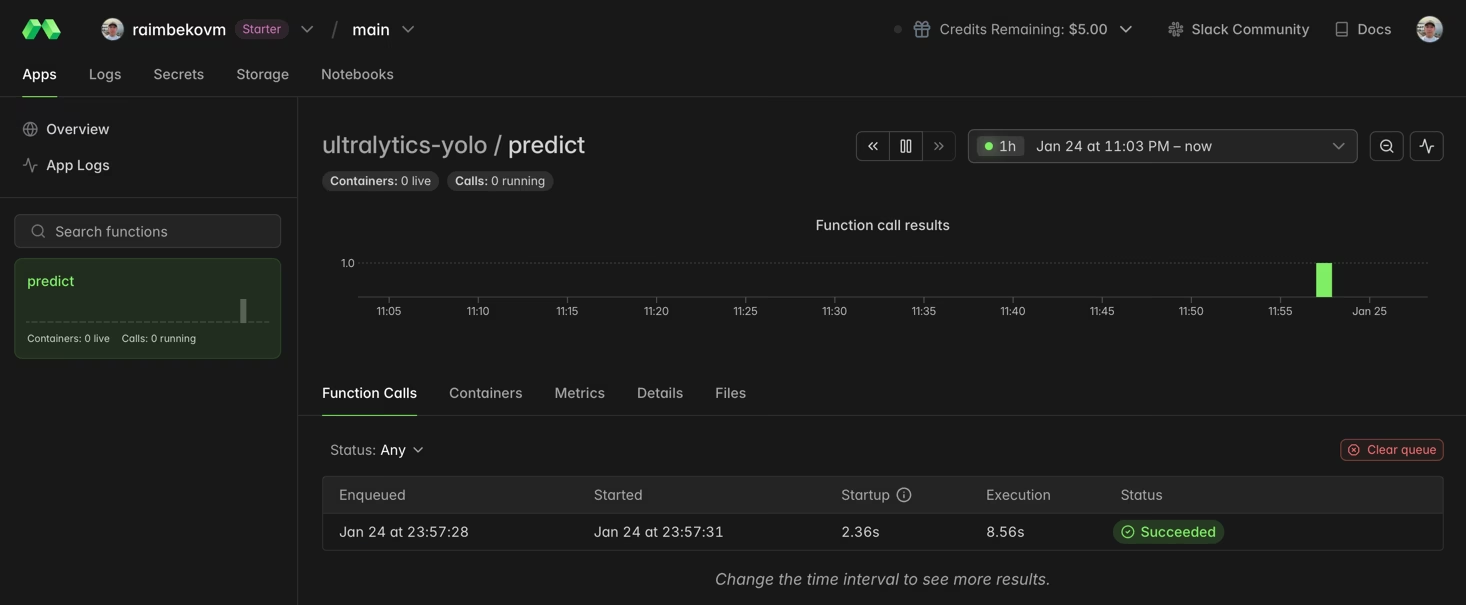
You can monitor your function execution in the Modal dashboard:
Using GPU for Faster Inference#
Add a GPU to your function by specifying the gpu parameter:
@app.function(image=image, gpu="T4")  # Options: "T4", "A10G", "A100", "H100"
def predict_gpu(image_url: str):
    """Run YOLO26 inference on GPU."""
    from ultralytics import YOLO

    model = YOLO("yolo26n.pt")
    results = model(image_url)
print(results[0].boxes)| GPU | Memory | Best For |
|---|---|---|
| T4 | 16 GB | Inference, small model training |
| A10G | 24 GB | Medium training jobs |
| A100 | 40 GB | Large-scale training |
| H100 | 80 GB | Maximum performance |
Training YOLO26 on Modal#
For training, use a GPU and Modal Volumes for persistent storage. Create a new Python file called train_yolo.py:
import modal

app = modal.App("ultralytics-training")

volume = modal.Volume.from_name("yolo-training-vol", create_if_missing=True)

image = modal.Image.debian_slim(python_version="3.11").apt_install("libgl1", "libglib2.0-0").pip_install("ultralytics")

@app.function(image=image, gpu="T4", timeout=3600, volumes={"/data": volume})
def train():
    """Train YOLO26 model on Modal."""
    from ultralytics import YOLO

    model = YOLO("yolo26n.pt")
    model.train(data="coco8.yaml", epochs=3, imgsz=640, project="/data/runs")

@app.local_entrypoint()
def main():
    train.remote()
Run training:
modal run train_yolo.pyModal Volumes persist data between function runs. Trained weights are saved to /data/runs/train/weights/.
Congratulations! You have successfully set up Ultralytics YOLO26 on Modal. For further learning:
- Explore the Ultralytics YOLO26 documentation for advanced features
- Learn about training custom models with your own datasets
- Try the Docker Quickstart for containerized deployment
- Visit the Modal documentation for advanced platform features
FAQ#
For inference, an NVIDIA T4 (16 GB) is typically sufficient and cost-effective. For training or larger models like YOLO26x, consider A10G or A100 GPUs.
Modal uses pay-per-second pricing. Approximate rates: CPU ~$0.05/hr, T4 ~$0.59/hr, A10G ~$1.10/hr, A100 ~$2.10/hr. Check Modal pricing for current rates.
Yes, you can run your own custom-trained YOLO model on Modal by loading the weights file from a Modal Volume:
model = YOLO("/data/my_custom_model.pt")For more information on training custom models, see the training guide.