Ultralytics YOLOによる回転バウンディングボックス検出
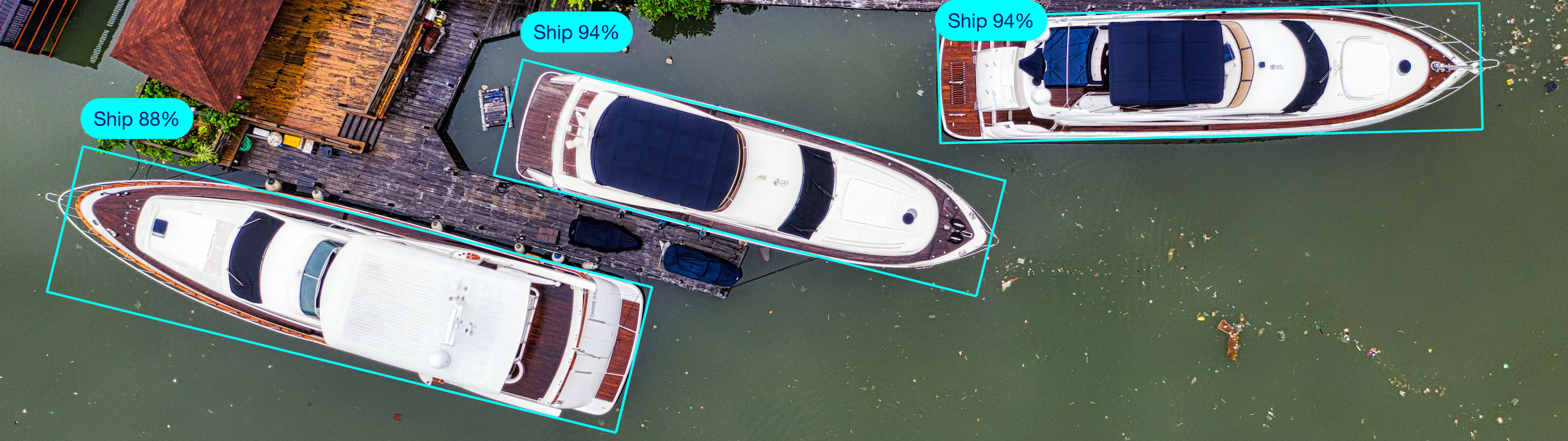
Oriented Object Detectionは、標準的な物体検出に追加の角度を導入し、画像内のオブジェクトの位置をより正確に特定します。
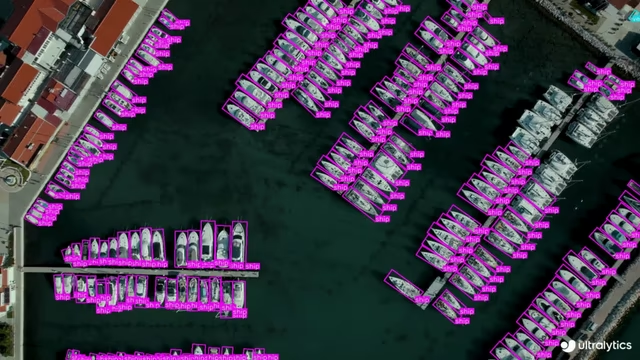
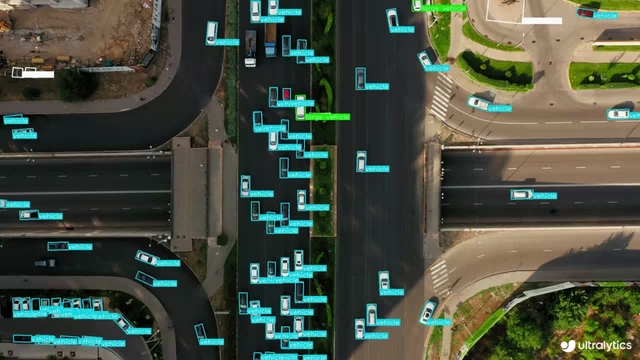
Oriented Object Detectionの出力は、画像内のオブジェクトを正確に囲む回転したバウンディングボックスの集合であり、各ボックスのクラスラベルと信頼度スコアも含まれます。物体がさまざまな角度で現れる場合、特にOriented Bounding Boxが役立ちます。たとえば航空画像では、従来の軸に沿ったバウンディングボックスに不要な背景が含まれることがあります。一般的な用途には、衛星やドローン画像からの船舶・車両検出、都市計画向けの建物・インフラ分析、作物のモニタリング、ソーラーパネルや風力タービンの点検があります。
視聴: Ultralytics YOLO26 の回転バウンディングボックス(OBB)で物体を検出・追跡する方法 | 船舶追跡 🚢
YOLO26 OBBモデルでは -obb サフィックスを使用します(例:yolo26n-obb.pt)。DOTAv1で事前学習されています。
| OBBを使用した船舶検出 | OBBを使用した車両検出 |
|---|---|
 |  |
モデル#
DOTAv1データセットで事前学習されたYOLO26 OBBモデルを以下に示します。
モデルは、初回使用時に最新のUltralytics リリースから自動的にダウンロードされます。
DOTAv1の画像とアノテーションは学術目的に限って使用でき、商用利用は禁止されています。Ultralyticsは、これらの制限は事前学習済みまたはファインチューニング済みのモデルの重みにではなく、ソースデータセットに適用されると解釈しています。使用目的に応じて、DOTAの利用規約をご確認ください。
| モデル | サイズ (ピクセル) | mAPtest50-95 (e2e) | mAPtest50 (e2e) | 速度 CPU ONNX (ms) | 速度 T4 TensorRT10 (ms) | パラメーター (M) | FLOPs (B) |
|---|---|---|---|---|---|---|---|
| YOLO26n-obb | 1024 | 52.4 | 78.9 | 97.7 ± 0.9 | 2.8 ± 0.0 | 2.4 | 14.8 |
| YOLO26s-obb | 1024 | 54.8 | 80.9 | 218.0 ± 1.4 | 4.9 ± 0.1 | 9.8 | 56.7 |
| YOLO26m-obb | 1024 | 55.3 | 81.0 | 579.2 ± 3.8 | 10.2 ± 0.3 | 21.2 | 184.9 |
| YOLO26l-obb | 1024 | 56.2 | 81.6 | 735.6 ± 3.1 | 13.0 ± 0.2 | 25.6 | 232.4 |
| YOLO26x-obb | 1024 | 56.7 | 81.7 | 1485.7 ± 11.5 | 30.5 ± 0.9 | 57.6 | 520.1 |
- mAPtestの値は、DOTAv1データセットで、単一モデル・マルチスケールを使用した場合のものです。
yolo obb val data=DOTAv1.yaml device=0 split=test nms=False save_json=Trueで再現し、統合した結果をDOTA評価に提出してください。 - 速度は、DOTAv1の検証画像をONNX(CPU)およびTensorRT10(NVIDIA T4 GPU)で処理した場合の平均値です。
yolo obb val data=DOTAv1.yaml batch=1 device=0|cpu nms=Falseで再現できます - ParamsとFLOPsの値は、Conv/BatchNormのfoldingと未使用の検出ブランチの削除を適用した後の、融合済みモデルの値です。事前学習済みチェックポイントにはトレーニング時のアーキテクチャ全体が保持されているため、より大きな値が表示される場合があります。
予備的なDOTAv1の結果については、未リリースのYOLO27プレビューをご覧ください。
学習#
DOTA8データセットで、画像サイズ640、100エポックの条件でYOLO26n-obbモデルをトレーニングします。
OBBとその180°回転は同一であるため、回転は180°を法として定義され、ボックスに方向性はありません。学習ラベルは長辺形式に正規化されます。ボックスの幅wは長辺であり、角度は正のx軸からw辺の向きまで時計回りに測定され、ラジアン単位で[-π/4, 3π/4)([-45°, 135°))に格納されます。予測は正規化されないため、予測ボックスでは短辺がwとして報告される場合があります。詳細については、結果の出力をご覧ください。[0°, 90°)形式は、正規化されたDOTAスタイルの規約であり、学習時にも推論時にも適用されません。
from ultralytics import YOLO

# モデルを読み込む
model = YOLO("yolo26n-obb.yaml")  # YAMLから新しいモデルを構築します
model = YOLO("yolo26n-obb.pt")  # 事前トレーニング済みモデルを読み込みます(トレーニングにはこちらを推奨します)
model = YOLO("yolo26n-obb.yaml").load("yolo26n-obb.pt")  # YAMLからモデルを構築し、重みを転送します

# モデルをトレーニングする
results = model.train(data="dota8.yaml", epochs=100, imgsz=640)
視聴: Ultralytics Platform を使って DOTA データセットで Ultralytics YOLO-OBB(回転バウンディングボックス)モデルをトレーニングする方法
trainモードの詳細については、学習ページをご覧ください。OBBモデルは、Ultralytics Platformのクラウドトレーニングでも学習できます。
データセットのフォーマット#
OBBデータセット形式の詳細については、データセットガイドをご覧ください。YOLO OBB形式では、座標を0から1の範囲に正規化した4つの頂点でバウンディングボックスを指定し、次の構造に従います。Ultralytics Platformのアノテーションは、専用の回転バウンディングボックス描画ツールを使ったOBBラベル付けに対応しています。
class_index x1 y1 x2 y2 x3 y3 x4 y4YOLOは内部的に、バウンディングボックスの中心点(xy)、幅、高さ、回転を表す xywhr 形式で損失と出力を処理します。
検証#
トレーニング済みYOLO26n-obbモデルの精度を、DOTA8データセット上で平均適合率(mAP)として測定して検証します。意図したデータセットのYAMLが使用されるよう、data を明示的に渡してください。
from ultralytics import YOLO

# モデルを読み込む
model = YOLO("yolo26n-obb.pt")  # 公式モデルを読み込みます
model = YOLO("path/to/best.pt")  # カスタムモデルを読み込む

# モデルを検証します
metrics = model.val(data="dota8.yaml")  # DOTA8データセットで検証します
metrics.box.map  # map50-95(B)
metrics.box.map50  # map50(B)
metrics.box.map75  # map75(B)
metrics.box.maps  # クラスごとの mAP50-95(B)。検証セットに存在しないクラスには全体の mAP(B) が設定されます
metrics.box.ap_class_index  # 実際に評価されたクラスのインデックス
metrics.box.image_metrics # 画像ごとのprecision、recall、F1、TP、FP、FNを含む指標辞書推論#
学習済みのYOLO26n-obbモデルを使用して、画像に対する予測を実行します。
from ultralytics import YOLO

# モデルを読み込む
model = YOLO("yolo26n-obb.pt")  # 公式モデルを読み込みます
model = YOLO("path/to/best.pt")  # カスタムモデルを読み込む

# モデルで予測します
results = model("https://ultralytics.com/images/boats.jpg")  # 画像に対して予測します

# 結果にアクセスします
for result in results:
    xywhr = result.obb.xywhr  # 中心x、中心y、幅、高さ、角度(ラジアン)
    xyxyxyxy = result.obb.xyxyxyxy  # 4点のポリゴン形式
    names = [result.names[cls.item()] for cls in result.obb.cls.int()]  # 各ボックスのクラス名
confs = result.obb.conf # 各ボックスの信頼度スコアPredictページでpredictモードの詳細をご確認ください。
save_crop=True を渡すと、ObjectCropper と同様に、各OBBをボックスサイズで回転位置合わせしたクロップとして保存します。
結果の出力#
回転バウンディングボックス検出では、画像ごとに1つのResultsオブジェクトが返されます。主な予測フィールドはresult.obbで、検出された各オブジェクトの回転ボックス、クラスID、信頼度スコアが含まれます。
| 属性 | 種類 | 形状 | 説明 |
|---|---|---|---|
result.obb | OBB | (N) | 方向付きボックスです。 |
result.obb.data | torch.float32 | (N,7/8) | 信頼度/クラスを含む、回転ボックスの生データです。 |
result.obb.xywhr | torch.float32 | (N,5) | xywhrの回転ボックスです。 |
result.obb.xyxyxyxy | torch.float32 | (N,4,2) | 4つのコーナー点です。 |
result.obb.conf | torch.float32 | (N,) | 信頼度スコアです。 |
ラベルは長辺基準の規約に正規化されますが、予測は正規化されないため、result.obb.xywhr は回転角を短辺基準で測定した場合、w が h より小さいと報告することがあります。どちらの形式も同じ矩形を表すため、result.obb.xyxyxyxy はどちらの場合も正しい値です。トラッキング時には、各トラックが前回の角度に最も近い半回転形式(θ または θ ± π)を維持するため、フレーム間でトラックの角度が π 反転せず、[-π/4, 3π/4) の範囲外になることがあります。後続のコードで長辺基準の形式が必要な場合は、頂点を元に戻してください。その際、ボックスのパラメーターを書き換えると頂点の順序が循環的にシフトする可能性がある点に注意してください:
from ultralytics.utils.ops import xyxyxyxy2xywhr

xywhr = xyxyxyxy2xywhr(result.obb.xyxyxyxy) # w >= h、回転角は[-pi/4, 3pi/4)ですすべてのタスクにおける、タスク固有のResultsフィールドについては、タスク別の予測結果セクションをご覧ください。
エクスポート#
YOLO26n-obbモデルをONNXやCoreMLなどの別の形式にエクスポートします。
from ultralytics import YOLO

# モデルを読み込む
model = YOLO("yolo26n-obb.pt")  # 公式モデルを読み込みます
model = YOLO("path/to/best.pt")  # カスタムモデルを読み込む

# モデルをエクスポートする
model.export(format="onnx")使用可能なYOLO26-obbのエクスポート形式を以下の表に示します。format 引数を使用して、任意の形式にエクスポートできます(例:format='onnx' または format='engine')。エクスポート済みモデルに対して直接予測または検証を実行できます(例:yolo predict model=yolo26n-obb.onnx)。エクスポートが完了すると、モデルの使用例が表示されます。
| 形式 | format引数 | モデル | メタデータ | 引数 |
|---|---|---|---|---|
| PyTorch | - | yolo26n-obb.pt | ✅ | - |
| TorchScript | torchscript | yolo26n-obb.torchscript | ✅ | imgsz, quantize, dynamic, nms, batch, device |
| ONNX | onnx | yolo26n-obb.onnx | ✅ | imgsz, quantize, dynamic, simplify, opset, nms, batch, data, fraction, device |
| OpenVINO | openvino | yolo26n-obb_openvino_model/ | ✅ | imgsz, quantize, dynamic, nms, batch, data, fraction, device |
| TensorRT | engine | yolo26n-obb.engine | ✅ | imgsz, quantize, dynamic, simplify, opset, workspace, nms, batch, data, fraction, device |
| CoreML | coreml | yolo26n-obb.mlpackage | ✅ | imgsz, dynamic, quantize, nms, batch, device |
| Apple Core AI | coreai | yolo26n-obb.aimodel | ✅ | imgsz, batch, quantize |
| TF SavedModel | saved_model | yolo26n-obb_saved_model/ | ✅ | imgsz, quantize, opset, nms, batch, data, fraction, device |
| TF GraphDef | pb | yolo26n-obb.pb | ❌ | imgsz, opset, batch, device |
| TF Edge TPU | edgetpu | yolo26n-obb_edgetpu.tflite | ✅ | imgsz, quantize, opset, data, fraction, device |
| LiteRT | litert | yolo26n-obb.tflite | ✅ | imgsz, quantize, batch, data, fraction, device |
| PaddlePaddle | paddle | yolo26n-obb_paddle_model/ | ✅ | imgsz, batch, device |
| MNN | mnn | yolo26n-obb.mnn | ✅ | imgsz, batch, dynamic, quantize, simplify, opset, nms, device |
| NCNN | ncnn | yolo26n-obb_ncnn_model/ | ✅ | imgsz, quantize, device |
| IMX500 | imx | yolo11n_imx_model/ | ✅ | imgsz, quantize, data, fraction, nms, device |
| RKNN | rknn | yolo26n-obb_rknn_model/ | ✅ | imgsz, batch, name, quantize, simplify, opset, data, fraction, device |
| ExecuTorch | executorch | yolo26n-obb_executorch_model/ | ✅ | imgsz, quantize, batch, data, fraction, device |
| Axelera | axelera | yolo26n-obb_axelera_model/ | ✅ | imgsz, batch, quantize, data, fraction, device |
| DEEPX | deepx | yolo26n-obb_deepx_model/ | ✅ | imgsz, quantize, simplify, opset, data, optimize, device |
| Qualcomm QNN | qnn | yolo26n-obb_qnn.onnx | ✅ | imgsz, batch, name, quantize, simplify, opset, data, fraction, device |
| Hailo | hailo | yolo26n-obb_hailo_model/ | ✅ | imgsz, name, quantize, data, fraction, simplify, conf, iou, device |
| Huawei Ascend | ascend | yolo26n-obb_ascend_model/ | ✅ | imgsz, batch, name, quantize, opset, simplify, nms, device |
| AMD Xilinx | xilinx | yolo26n-obb_xilinx_model/ | ✅ | imgsz, name, quantize, data, fraction, opset, simplify, device |
| NXP | nxp | yolo26n-obb_nxp.tflite | ✅ | imgsz, quantize, data, fraction, device |
| ST Edge AI | stedgeai | yolo26n-obb_stedgeai.onnx | ✅ | imgsz, quantize, data, fraction, opset, simplify, device |
nms=None は、外部NMS用にデフォルトでraw出力を返します(YOLO26はAxelera上でNMSフリーヘッドを維持します)。利用可能なNMSフリーヘッドを選択するには、nms=Falseを設定します。非対応の形式では、ネイティブの出力経路にフォールバックします。上記のnmsの項目は、nms=Trueを使用してNMSを埋め込める形式を示しています。
詳細なexport情報については、Exportページをご覧ください。
よくある質問#
Oriented Bounding Boxes(OBB)は、画像内の物体の位置特定精度を高めるための角度情報を追加で含みます。軸に沿った長方形である通常のバウンディングボックスとは異なり、OBBは物体の向きにより適合するよう回転できます。これは、航空画像や衛星画像など、物体の位置を正確に特定する必要がある用途で特に役立ちます(データセットガイド)。
カスタムデータセットを使用してYOLO26n-obbモデルをトレーニングするには、以下の例に従ってPythonまたはCLIを使用してください。
例from ultralytics import YOLO # 事前トレーニング済みモデルを読み込む model = YOLO("yolo26n-obb.pt") # モデルをトレーニングする results = model.train(data="path/to/custom_dataset.yaml", epochs=100, imgsz=640)トレーニング引数の詳細については、設定セクションをご確認ください。
以下に示すように、PythonまたはCLIコマンドを使用してYOLO26n-obbモデルを検証できます。
例from ultralytics import YOLO # モデルを読み込む model = YOLO("yolo26n-obb.pt") # モデルを検証します metrics = model.val(data="dota8.yaml")検証の詳細については、Valセクションをご覧ください。
PythonまたはCLIを使用すると、YOLO26-OBBモデルを簡単にONNX形式にエクスポートできます。
例from ultralytics import YOLO # モデルを読み込む model = YOLO("yolo26n-obb.pt") # モデルをエクスポートする model.export(format="onnx")その他のエクスポート形式と詳細については、Exportページをご覧ください。


コメント252
質問したり、結果を共有したり、ほかの人をサポートしたりできます。
zhouyizhuo
how to do Model Ensembling on yolov8-obb models?
2 Paula DerrengerUltralytics(編集済み)
Model ensembling with YOLOv8-obb models involves combining the predictions from multiple trained models to improve the accuracy of your oriented objects detection. Currently, direct support for model ensembling within Ultralytics YOLO isn't provided out-of-the-box. However, you can manually implement ensembling by running predictions with each model separately and then combining these predictions.
One common approach is to average the bounding box coordinates and confidence scores of the same object detected by multiple models. Ensure to consider the rotating angle parameter unique to OBB models in your ensembling logic. Here's a basic conceptual example to get you started:
from ultralytics import YOLO

models = [
    YOLO('path/to/first_obb_model.pt'),
    YOLO('path/to/second_obb_model.pt'),
    # Add more models as needed
]

# Assuming you have a method to read your images/videos
image = 'path/to/image.jpg'

# List to store results from all models
all_preds = []

for model in models:
    results = model(image)
    all_preds.append(results[0].obb)  # Extracting OBB predictions (xywhr, conf, cls)

# Assuming you have a method `combine_predictions(all_preds)`
# that combines predictions from all models
final_predictions = combine_predictions(all_preds)

# Process `final_predictions`...
This example loads each model, runs predictions on the same image, and stores the results. You'd then need to implement
combine_predictions(all_preds)to handle the logic for combining these predictions based on criteria like IoU, confidence scores, etc., taking into account the angle for rotated bounding boxes.Remember, ensembling may increase inference time due to processing with multiple models. Always weigh the benefits of improved accuracy against potential increases in computational cost. Happy coding! 😊
windzu
if you want draw predict results to img and save , you can ref below easy code :
# you predict code #

import cv2

image = cv2.imread(test_img_path)
for r in results:
    xyxyxyxy = r.obb.xyxyxyxy.cpu().numpy()

    for box in xyxyxyxy:
        points = box.reshape(4, 2).astype(int)
        cv2.polylines(image, [points], isClosed=True, color=(0, 255, 0), thickness=2)

cv2.imwrite("detected_image.jpg", image)
1 Glenn JocherUltralytics
@windzu thank you for sharing the code example. For more details on using YOLOv8 Oriented Bounding Boxes, please refer to our documentation on training, validation, and exporting models. If you have further questions, feel free to ask here.
krialm
Hi, when I am using yolov8_obb model in results I always have boxes: None keypoints: None masks: None
even when the model makes prediction. Did someone faced with this problem and if yes, what was the solution? Thank you.🙂
1RizwanMunawar
@krialm In the case of OBB, you can get bounding box data, using the mentioned code below.
model = YOLO("yolov8n-obb.pt")
results = model.predict(im0)
pred_boxes = results[0].obb
I hope this helps! Let me know if you have any additional questions.
Thanks and Regards Ultralytics Team!
1kedardg
Is there a way for me to train OBB models from scratch let's say the P2 or RTDETR models which are not available pre-trained?
- Paula DerrengerUltralytics
@kedardg absolutely, you can train OBB models like P2 or RTDETR from scratch even if they're not available pre-trained. You'd start by creating a new model from a YAML file, which defines the model architecture. Here's a quick example of how you might do it:
yolo obb train data=your_dataset.yaml model=your_model.yaml epochs=100 imgsz=640Just replace
your_dataset.yamlwith your dataset configuration file andyour_model.yamlwith your model configuration file. Make sure your dataset is properly formatted for OBB tasks. Happy training! 😊🚀 RumaisaIlyas
model = YOLO("yolov8n-obb.pt") results = model.predict(im0) pred_boxes = results[0].obb
i did this but i want to draw bounding boxes on the test image and return it. how to do that?
my function is:
def count_detection(image): if image is not None: # Load the YOLO model model = YOLO('bestobbv8s.pt')
# Check the shape of the input image print("Input image shape:", image.shape) # Use the model to predict the wheat spikes in image results = model(image, save=True) # Count count = sum(len(result) for result in results) print("count", count) # Draw bounding boxes for detected wheat heads for result in results: boxes = result.obb #here? return image- Paula DerrengerUltralytics
@RumaisaIlyas hey there! 😊 To draw bounding boxes on your test image and return it, you can use the
plot()method available in theResultsobject. Here's how you can modify your function:def count_detection(image): if image is not None: # Load the YOLO model model = YOLO('bestobbv8s.pt') # Check the shape of the input image print("Input image shape:", image.shape) # Use the model to predict results = model.predict(image) # Draw bounding boxes and return the annotated image annotated_image = results[0].plot() # Count detections count = len(results[0].obb) print("count", count) return annotated_imageIn this updated function, after making predictions with
model.predict(image), we useresults[0].plot()to draw bounding boxes on the image. This method returns the annotated image, which we then return from the function. This should give you the visual feedback you're looking for! 🚀Let me know if you need further assistance!
thankyou so much for your assistance. i am facing a problem that my runs folder is not created after i run the code provided. why is that? what should i do in code so that i get the runs folder with my predicted image
- Paula DerrengerUltralytics(編集済み)
Hey there! 😊 It sounds like you're doing everything right, but if the
runsfolder isn't being created, it might be due to a small oversight. Here's a quick checklist:- Ensure you're using the latest version of the Ultralytics YOLO library. Sometimes, updates fix these kinds of issues.
- Double-check your command and make sure it's complete. For predictions, it should look something like this:
from ultralytics import YOLO # Load your model model = YOLO('bestobbv8s.pt') # Run prediction # save=True writes the annotated image to the 'runs' folder results = model.predict('path/to/your/image.jpg', save=True)- If you're still not seeing the
runsfolder, try specifying the output directory explicitly in your code:
results = model.predict('path/to/your/image.jpg', save=True, project='runs/detect') # Adjust the path as needed- Lastly, ensure you have the necessary write permissions in your working directory. Sometimes, permission issues can prevent the creation of new folders.
If you've checked all these and the issue persists, it might be helpful to share more details about your environment (like your operating system) or any error messages you're seeing. That way, the community can offer more targeted advice. 🚀
Hope this helps, and happy detecting!
Ci-ne
I also face the same problem. I tried using the code provided but it still says NoneType
ncnn_model = YOLO("./my_ncnn_model", task='detect') results = ncnn_model.predict(image_path)
if results[0] is not None: # Ensure results is not None obb_boxes = results[0].obb # For OBB models print(f"OBB Box: {obb_boxes}") else: print("No detections.")
This is what I get
Speed: 4.1ms preprocess, 93.1ms inference, 1.2ms postprocess per image at shape (1, 3, 640, 640) OBB Box: None
Any help?
1chengz
The document notes that 'OBB angles are constrained to the range 0–90 degrees (exclusive of 90). Angles of 90 degrees or greater are not supported.' So what is the normal radian range for an OBB, [-π/4, 3π/4) or something else?
 Murat Raimbekov
the radian range is
[-π/4, 3π/4), i.e.[-45°, 135°), not[0°, 90°). that docs note was inaccurate and is fixed in #24534.ground-truth angles are normalized in
xyxyxyxy2xywhr(ultralytics/utils/ops.py) by two loops,while theta >= 3*pi/4: theta -= piandwhile theta < -pi/4: theta += pi, withwswapped to the longer side. sweeping a rectangle through physical 0->180°:0° -> 0.0000 45° -> 0.7854 (π/4) 90° -> 1.5708 (π/2) 120° -> 2.0944 135° -> -0.7854 (-π/4) 165° -> -0.2618so the span is exactly π wide, half-open at
3π/4.the heads match this:
OBB(yolov8/yolo11):angle = (sigmoid(raw) - 0.25) * π, hard-bounded to[-π/4, 3π/4].OBB26(yolo26): raw output, no sigmoid, trained on targets already in[-π/4, 3π/4).
[0, π/2)is the regularized DOTA-style form produced byregularize_rboxesinops.py. that function is defined but has no callers anywhere inultralytics/, so it is not applied at training or inference. predicted boxes reach you unregularized:result.obb.xywhrreturns the angle in[-π/4, 3π/4)(verified by feeding angles like-0.70and2.30through the predict path and reading them back unchanged).one consequence, which is what the original note was really about: an OBB and its 180° rotation encode to the same
xywhr, so rotation is defined only modulo 180° and the box has no direction. θ and θ+180° are indistinguishable, so you cannot recover a fixed corner ordering from the predicted angle.
 User
mAPtest values are for single-model multiscale on DOTAv1 dataset. Reproduce by yolo val obb data=DOTAv1.yaml device=0 split=test and submit merged results to DOTA evaluation. This mentions that the test results are submitted to the DOTAv1 server through a multiscale approach. I would like to ask, what does this "multiscale" mean? How is it specifically implemented? Is it trained at scales like 512512 and 10241024, and then tested on the test dataset? How are the final results obtained? I am not quite clear on what this multiscale refers to. Please help me with this.
- Glenn JocherUltralytics
Here, “multiscale” means evaluating the same trained model on multiple resized/split versions of each DOTA image tile, then merging those detections back into the original image for final submission; in Ultralytics this is tied to the DOTA split pipeline with scales like
rates=[0.5, 1.0, 1.5]in the DOTA dataset guide and the merged-result export inOBBValidator.eval_json(), so it is usually multi-scale test-time inference with one model rather than separately training 512 and 1024 models. - Murat Raimbekov
it is one model, trained once. there is no separate 512 and 1024 model, and no separate training runs per scale. the "multiscale" lives entirely in the dota tiling step, not inside
yolo val.where it comes from. dota images are huge (800x800 up to ~20000x20000), so they are cut into overlapping tiles before training/val using
split_trainval/split_testfromultralytics/data/split_dota.py. the multiscale variant passesrates=[0.5, 1.0, 1.5](this is exactly what the dota dataset guide shows). for each raterthe code usescrop_size / randgap / r, so with the defaultscrop_size=1024, gap=200you get tiles of:rate 0.5 -> 2048 px tiles (gap 400) rate 1.0 -> 1024 px tiles (gap 200) rate 1.5 -> 682 px tiles (gap 133)every original image is therefore cut into overlapping windows at all three crop sizes. each window is later resized to
imgszat inference, so the same content is effectively seen at three resolutions. concretely, a single 4000x4000 image produces ~98 tiles spread across those three sizes.training. the model is trained once on the multiscale-split trainval tiles (same
rates=[0.5, 1.0, 1.5]). it is not "trained at 512 then at 1024" as separate models.test / how the final number is obtained.
yolo val obb data=DOTAv1.yaml split=testruns that single model over every test tile. each tile filename encodes the source image id and crop offset (name__cropsize__xstart___ystart).OBBValidator.eval_json()parses that, shifts each tile's rotated boxes back into the original full-image coordinates, concatenates detections from all tiles and all scales, then runs a rotated probiou NMS (fast_nms, iou 0.3) to remove the overlap introduced by tiling. the merged per-image results are written as dotaTask1_*.txt, which is what you submit to the dota evaluation server.one practical caveat.
yolo val ... split=testdoes not create the multiscale tiles for you. you have to runsplit_test(rates=[0.5, 1.0, 1.5])first (andsplit_trainvalwith the same rates for training). running val on the raw full dota images is single-scale and will not reproduce themAPtestnumber in the table.so in short: multiscale = offline multi-scale tiling + per-tile single-scale inference + merge-back-and-NMS, all with one model. it is test-time multi-scale through the tiling, not test-time augmentation inside
val.
kssion
WARNING ⚠️ CoreML: 'nms=True' is only available for Detect models like 'yolo11n.pt'.
yolo export model=best.pt format=coreml nms=True conf=0.25 iou=0.45Ultralytics 8.3.232 🚀 Python-3.11.11 torch-2.9.1 CPU (Apple M1) YOLO11n-obb summary (fused): 109 layers, 2,653,918 parameters, 0 gradients, 6.6 GFLOPs
PyTorch: starting from 'best.pt' with input shape (1, 3, 640, 640) BCHW and output shape(s) (1, 6, 8400) (5.5 MB) Torch version 2.9.1 has not been tested with coremltools. You may run into unexpected errors. Torch 2.7.0 is the most recent version that has been tested.
CoreML: starting export with coremltools 9.0... WARNING ⚠️ CoreML: 'nms=True' is only available for Detect models like 'yolo11n.pt'. Converting PyTorch Frontend ==> MIL Ops: 100%|██████████████▉| 867/868 [00:00<00:00, 8975.73 ops/s] Running MIL frontend_pytorch pipeline: 100%|███████████████████| 5/5 [00:00<00:00, 166.58 passes/s] Running MIL default pipeline: 100%|███████████████████████████| 95/95 [00:00<00:00, 99.61 passes/s] Running MIL backend_mlprogram pipeline: 100%|████████████████| 12/12 [00:00<00:00, 176.60 passes/s] CoreML: export success ✅ 4.8s, saved as 'best.mlpackage' (5.3 MB)
Export complete (5.0s)
- Glenn JocherUltralytics
That warning is expected for OBB models: CoreML
nms=Trueis only supported for axis-aligned Detect heads, so export your*-obbmodel without NMS and do confidence/IoU (rotated NMS) post-processing on the app side (export success ✅ means you’re fine). See the Ultralytics YOLO OBB task docs for the OBB output formats.yolo export model=best.pt format=coreml
wang18382140151-hub
你好,请问你们未来的工作计划中是否有将rtdetr用于obb检测呢,最近我正在基于贵司源码做改进
AbhisekRao
I'm currently working with the YOLOv11 Oriented Bounding Box (OBB) model exported in TensorRT format, and deploying it on an NVIDIA Jetson device (AGX Orin). While the model works in standard inference pipelines (.pt) , I’m facing challenges integrating it into a DeepStream-based application to process live RTSP video streams.
There seems to be no existing reference implementation or sample Python code that demonstrates how to use the OBB variant of the model with DeepStream. Specifically, I'm looking for guidance on:
1- Integrating the YOLOv11 OBB TensorRT model with DeepStream (preferably using Python bindings). 2- Proper parsing and visualization of oriented bounding boxes from the model output. 3- Any custom parser or config file changes required in the DeepStream pipeline.
Any support, documentation, or examples from the team or community would be greatly appreciated.
cripsgreen
Hello, could you please share some insights on how to train the hyperparameters for YOLOv11-OBB, as well as the pre-trained weights? Thank you.
ziishuo
May I ask if the OBB model can be used to detect subjects in a normal perspective (such as a level shot)? I noticed that most of the examples are from a top-down angle. Thank you!