Model Benchmarking with Ultralytics YOLO#
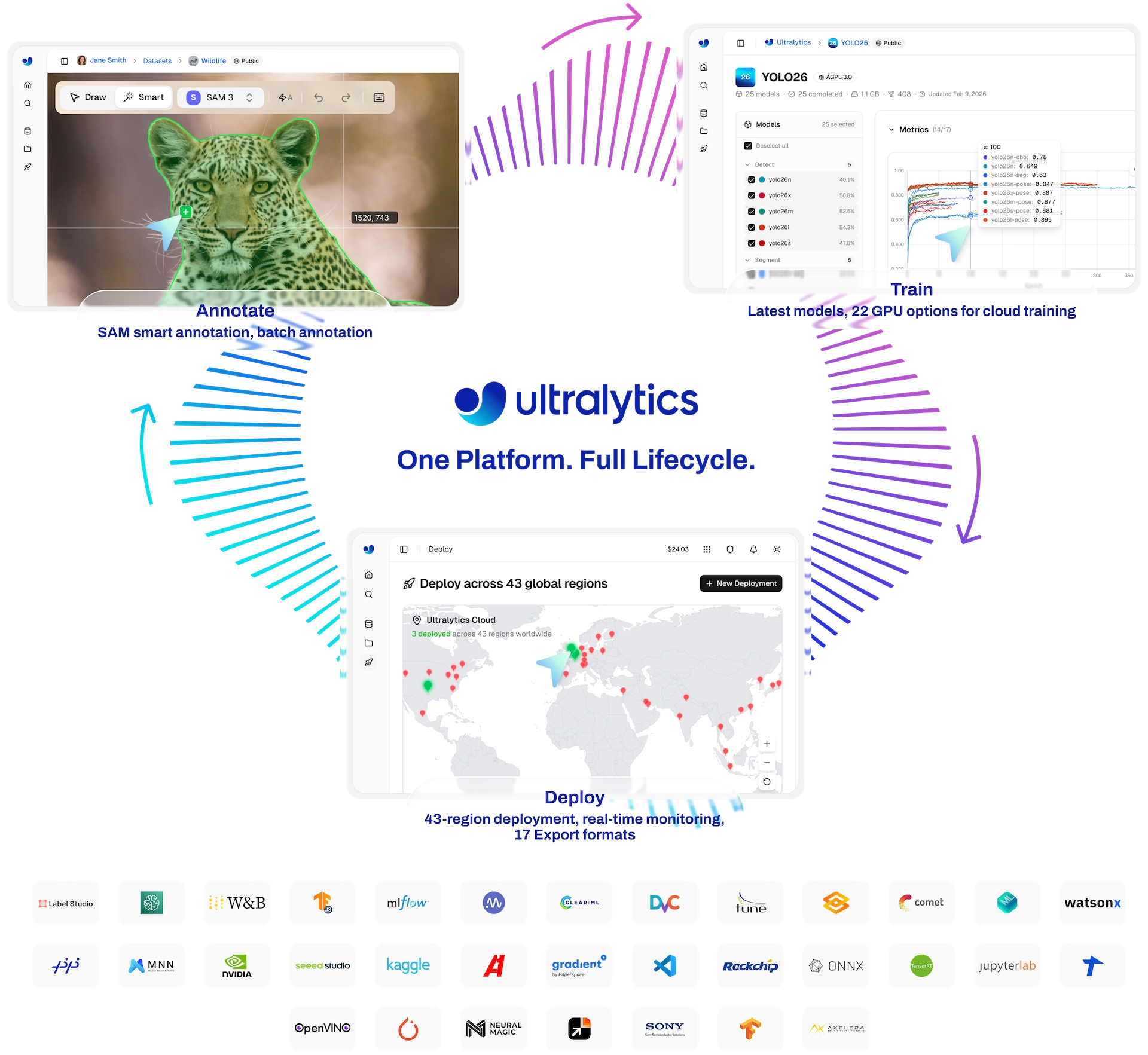
Benchmark Visualization#
Introduction#
Once your model is trained and validated, the next logical step is to evaluate its performance in various real-world scenarios. Benchmark mode in Ultralytics YOLO26 serves this purpose by providing a robust framework for assessing the speed and accuracy of your model across a range of export formats.
See the unreleased YOLO27 preview for preliminary speed benchmarks.
Watch: Benchmark Ultralytics YOLO26 Models | How to Compare Model Performance on Different Hardware?
Why Is Benchmarking Crucial?#
- Informed Decisions: Gain insights into the trade-offs between speed and accuracy.
- Resource Allocation: Understand how different export formats perform on different hardware.
- Optimization: Learn which export format offers the best performance for your specific use case.
- Cost Efficiency: Make more efficient use of hardware resources based on benchmark results.
Key Metrics in Benchmark Mode#
- mAP50-95: For object detection, instance segmentation, pose estimation, and OBB.
- mIoU: For semantic segmentation.
- delta1: For depth estimation.
- accuracy_top1: For image classification.
- Inference Time: Time taken for each image in milliseconds.
Supported Export Formats#
- ONNX: For optimal CPU performance
- TensorRT: For maximal GPU efficiency
- OpenVINO: For Intel hardware optimization
- CoreML, TensorFlow SavedModel, and More: For diverse deployment needs.
- Export to ONNX or OpenVINO for up to 3x CPU speedup.
- Export to TensorRT for up to 5x GPU speedup.
Usage Examples#
Install Ultralytics with export dependencies before benchmarking to avoid missing packages.
pip install ultralytics[export]Run YOLO26n benchmarks across all supported export formats (ONNX, TensorRT, etc.). See the Arguments section below for a full list of export options.
from ultralytics.utils.benchmarks import benchmark

# Benchmark on GPU
benchmark(model="yolo26n.pt", data="coco8.yaml", imgsz=640, device=0)

# Benchmark specific export format
benchmark(model="yolo26n.pt", data="coco8.yaml", imgsz=640, format="onnx")Arguments#
Arguments such as model, data, imgsz, quantize, device, verbose and format provide users with the flexibility to fine-tune the benchmarks to their specific needs and compare the performance of different export formats with ease.
| Key | Default Value | Description |
|---|---|---|
model | None | Specifies the path to the model file. Accepts both .pt and .yaml formats, e.g., "yolo26n.pt" for pretrained models or configuration files. |
data | None | Path to the dataset YAML for benchmarking, typically including paths and settings for validation data. Example: "coco8.yaml". Classification instead takes a dataset directory or a built-in dataset name (e.g., imagenet10). |
imgsz | 640 | The input image size for the model. Must be a single integer for square images (e.g., 640); benchmark() only supports square image sizes. |
quantize | None | Requested precision: 16 (FP16) or 8 (INT8; PTQ schemes need calibration data/fraction, weight-only ones do not); 32/unset is FP32 where the format supports it — a format that cannot export FP32 rejects an explicit 32 or falls back to the precision it requires. The native PyTorch row is not exported: only 16 affects it, selecting FP16 inference, while 8, 32 and unset run FP32. Each format then runs inference at its own runtime precision. Replaces the deprecated half/int8 flags. |
device | None | Defines the computation device for benchmarking, such as "cpu" or "cuda:0"; unset uses the first available GPU, else CPU. |
verbose | False | If True or a float, benchmark failures (other than assertions) raise instead of logging an error; a float such as 0.25 also asserts every successful format's metric exceeds that floor. |
eps | 0.001 | Small epsilon (milliseconds) added to the per-image inference time before converting it to FPS, preventing division by zero. Rarely changed. |
format | '' | Benchmarks only the specified export format (e.g., format=onnx). Leave it blank to test every supported format automatically. |
The standalone benchmark() function (from ultralytics.utils.benchmarks import benchmark) uses its own signature defaults instead of the table values above, notably model="yolo26n.pt", imgsz=160, and device="cpu"; pass imgsz and device explicitly to match the yolo benchmark CLI.
Export Formats#
Benchmarks will attempt to run automatically on all possible export formats listed below. Alternatively, you can run benchmarks for a specific format by using the format argument, which accepts any of the formats mentioned below.
| Format | format Argument | Model | Metadata | Arguments |
|---|---|---|---|---|
| PyTorch | - | yolo26n.pt | ✅ | - |
| TorchScript | torchscript | yolo26n.torchscript | ✅ | imgsz, quantize, dynamic, nms, batch, device |
| ONNX | onnx | yolo26n.onnx | ✅ | imgsz, quantize, dynamic, simplify, opset, nms, batch, data, fraction, device |
| OpenVINO | openvino | yolo26n_openvino_model/ | ✅ | imgsz, quantize, dynamic, nms, batch, data, fraction, device |
| TensorRT | engine | yolo26n.engine | ✅ | imgsz, quantize, dynamic, simplify, opset, workspace, nms, batch, data, fraction, device |
| CoreML | coreml | yolo26n.mlpackage | ✅ | imgsz, dynamic, quantize, nms, batch, device |
| Apple Core AI | coreai | yolo26n.aimodel | ✅ | imgsz, batch, quantize |
| TF SavedModel | saved_model | yolo26n_saved_model/ | ✅ | imgsz, quantize, opset, nms, batch, data, fraction, device |
| TF GraphDef | pb | yolo26n.pb | ❌ | imgsz, opset, batch, device |
| TF Edge TPU | edgetpu | yolo26n_edgetpu.tflite | ✅ | imgsz, quantize, opset, data, fraction, device |
| LiteRT | litert | yolo26n.tflite | ✅ | imgsz, quantize, batch, data, fraction, device |
| PaddlePaddle | paddle | yolo26n_paddle_model/ | ✅ | imgsz, batch, device |
| MNN | mnn | yolo26n.mnn | ✅ | imgsz, batch, dynamic, quantize, simplify, opset, nms, device |
| NCNN | ncnn | yolo26n_ncnn_model/ | ✅ | imgsz, quantize, batch, device |
| IMX500 | imx | yolo26n_imx_model/ | ✅ | imgsz, quantize, data, fraction, nms, device |
| RKNN | rknn | yolo26n_rknn_model/ | ✅ | imgsz, batch, name, quantize, simplify, opset, data, fraction, device |
| ExecuTorch | executorch | yolo26n_executorch_model/ | ✅ | imgsz, batch, device |
| Axelera | axelera | yolo26n_axelera_model/ | ✅ | imgsz, batch, quantize, data, fraction, device |
| DEEPX | deepx | yolo26n_deepx_model/ | ✅ | imgsz, quantize, simplify, opset, data, optimize, device |
| Qualcomm QNN | qnn | yolo26n_qnn.onnx | ✅ | imgsz, batch, name, quantize, simplify, opset, data, fraction, device |
| Hailo | hailo | yolo26n_hailo_model/ | ✅ | imgsz, name, quantize, data, fraction, simplify, conf, iou, device |
| Huawei Ascend | ascend | yolo26n_ascend_model/ | ✅ | imgsz, batch, name, quantize, opset, simplify, nms, device |
| AMD Xilinx | xilinx | yolo26n_xilinx_model/ | ✅ | imgsz, name, quantize, data, fraction, opset, simplify, device |
nms=None defaults to raw outputs for external NMS. Set nms=False to select an available NMS-free head; unsupported formats fall back to their native output path. The nms entries above identify formats that can embed NMS with nms=True.
See full export details in the Export page.
FAQ#
Ultralytics YOLO26 offers a Benchmark mode to assess your model's performance across different export formats. This mode provides insights into key metrics such as mean Average Precision (mAP50-95), accuracy, and inference time in milliseconds. To run benchmarks, you can use either Python or CLI commands. For example, to benchmark on a GPU:
Examplefrom ultralytics.utils.benchmarks import benchmark # Benchmark on GPU benchmark(model="yolo26n.pt", data="coco8.yaml", imgsz=640, device=0)For more details on benchmark arguments, visit the Arguments section.
Exporting YOLO26 models to different formats such as ONNX, TensorRT, and OpenVINO allows you to optimize performance based on your deployment environment. For instance:
- ONNX: Provides up to 3x CPU speedup.
- TensorRT: Offers up to 5x GPU speedup.
- OpenVINO: Specifically optimized for Intel hardware.
These formats improve inference speed on their target hardware, making your models more efficient for various real-world applications. Visit the Export page for complete details.
Benchmarking your YOLO26 models is essential for several reasons:
- Informed Decisions: Understand the trade-offs between speed and accuracy.
- Resource Allocation: Gauge the performance across different hardware options.
- Optimization: Determine which export format offers the best performance for specific use cases.
- Cost Efficiency: Optimize hardware usage based on benchmark results.
Key metrics such as mAP50-95, Top-1 accuracy, and inference time help in making these evaluations. Refer to the Key Metrics section for more information.
YOLO26 supports a variety of export formats, each tailored for specific hardware and use cases:
- ONNX: Best for CPU performance.
- TensorRT: Ideal for GPU efficiency.
- OpenVINO: Optimized for Intel hardware.
- CoreML & TensorFlow: Useful for iOS and general ML applications.
For a complete list of supported formats and their respective advantages, check out the Supported Export Formats section.
When running benchmarks, several arguments can be customized to suit specific needs:
- model: Path to the model file (e.g., "yolo26n.pt").
- data: Path to the dataset YAML (e.g.,
"coco8.yaml"); classification instead takes a dataset directory or a built-in dataset name (e.g.,imagenet10). - imgsz: The square input image size as a single integer, such as
640. Benchmark mode uses the same square image size across PyTorch and exported formats for fair comparison. - quantize: Requested precision:
16for FP16,8for INT8 (useful for edge devices);32/unset is FP32 where the format supports it — a format that cannot export FP32 rejects an explicit32or falls back to the precision it requires. The native PyTorch row is not exported: only16affects it, selecting FP16 inference, while8,32and unset run FP32. Each format then runs inference at its own runtime precision. - device: Specify the computation device (e.g., "cpu", "cuda:0").
- verbose: Raise on benchmark failures instead of logging them; pass a float to also require each format's metric to exceed that floor.
For a full list of arguments, refer to the Arguments section.