Оценка скорости с помощью Ultralytics YOLO26#
Что такое оценка скорости?#
Оценка скорости — это вычисление скорости перемещения объекта в заданном контексте, часто используемое в приложениях компьютерного зрения. С помощью Ultralytics YOLO26 можно вычислять скорость объектов, сочетая отслеживание объектов с данными о расстоянии и времени. Это полезно для таких задач, как мониторинг дорожного движения и видеонаблюдение.
Смотри: Оценка скорости с помощью Ultralytics YOLO26
Преимущества оценки скорости#
- Эффективное управление дорожным движением: Точная оценка скорости помогает регулировать транспортные потоки, повышать безопасность и уменьшать заторы на дорогах.
- Точная автономная навигация: В автономных системах, таких как беспилотные автомобили, надёжная оценка скорости обеспечивает безопасное и точное управление движением автомобиля.
- Повышение безопасности видеонаблюдения: Оценка скорости при анализе видеонаблюдения помогает выявлять необычное поведение и потенциальные угрозы, повышая эффективность мер безопасности.
Применение в реальных условиях#
| Транспорт | Транспорт |
|---|---|
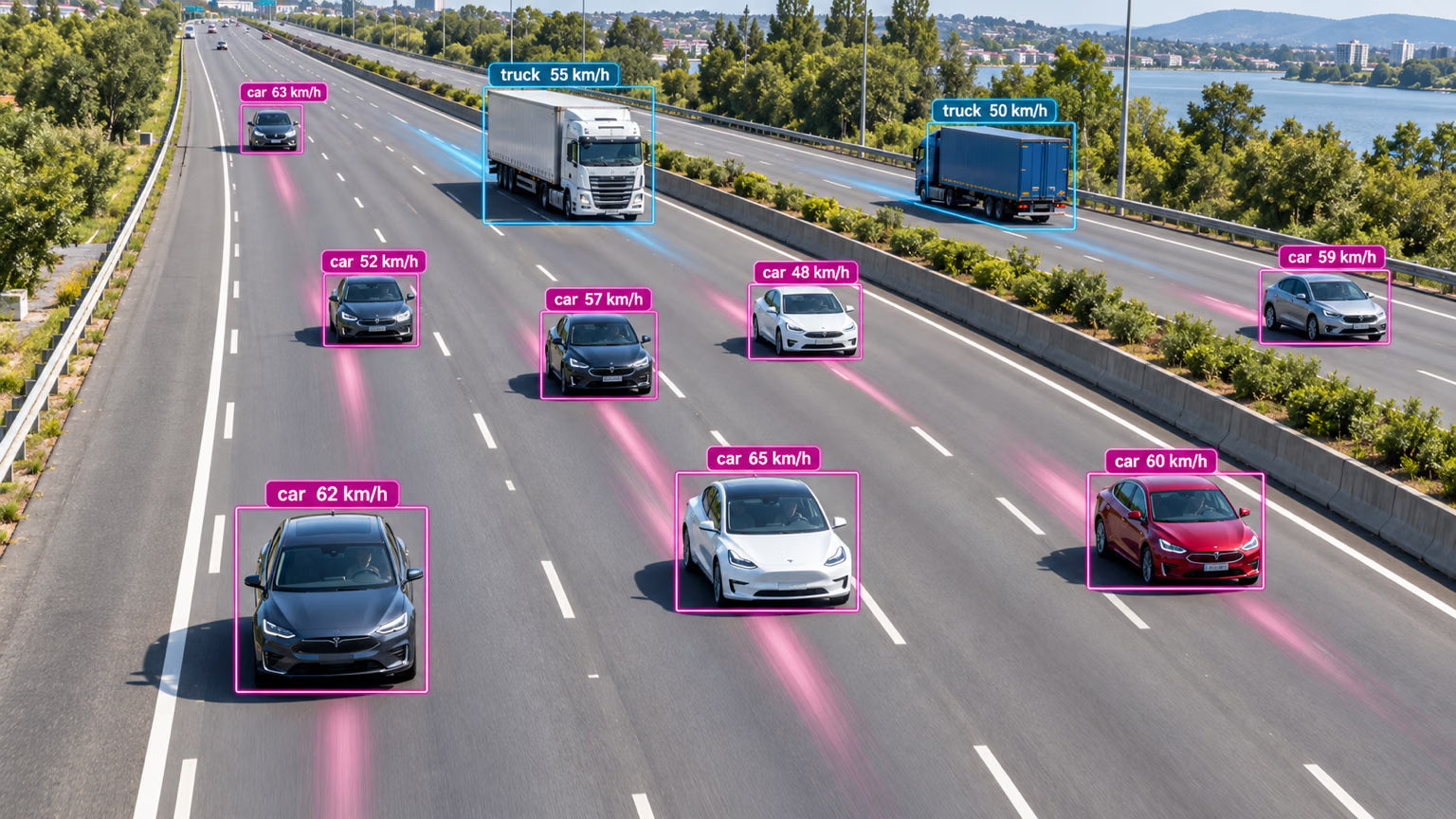 | 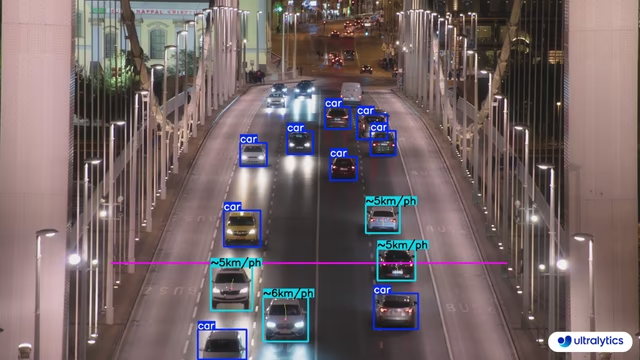 |
| Оценка скорости на дороге с помощью Ultralytics YOLO26 | Оценка скорости на мосту с помощью Ultralytics YOLO26 |
Скорость — это оценочное значение
Скорость является оценочной величиной, поэтому результат может быть неточным. Результаты также зависят от характеристик камеры и других связанных факторов.
Оценка скорости с YOLO26#
Решение SpeedEstimator отслеживает каждый объект на протяжении нескольких кадров и преобразует его смещение в пикселях в скорость, используя частоту кадров видео (fps) и масштаб реального мира (meter_per_pixel). Настрой meter_per_pixel с учётом параметров камеры и используй max_speed, чтобы отсекать выбросы, возникающие из-за зашумлённых траекторий.
# Run a speed example
yolo solutions speed show=True

# Pass a source video
yolo solutions speed source="path/to/video.mp4"

# Adjust meter per pixel value based on camera configuration
yolo solutions speed meter_per_pixel=0.05
Аргументы SpeedEstimator#
Вот таблица с аргументами SpeedEstimator:
| Аргумент | Тип | По умолчанию | Описание |
|---|---|---|---|
model | str | None | Путь к файлу модели Ultralytics YOLO. |
fps | float | 30.0 | Количество кадров в секунду, используемое для расчёта скорости. |
max_hist | int | 5 | Максимальное количество исторических точек на объект для расчёта скорости и направления. |
meter_per_pixel | float | 0.05 | Коэффициент масштабирования для преобразования расстояния в пикселях в единицы реального мира. |
max_speed | int | 120 | Максимальная скорость в км/ч; более высокие расчётные значения ограничиваются этим пределом. |
line_width | int | 2 | Толщина линий рамок, ключевых точек и счётчиков, которые рисует решение. |
verbose | bool | True | Включает журнал решения для каждого кадра с указанием формы входных данных, количества объектов по классам и скорости обработки. Сам вызов отслеживания всегда выполняется без вывода сообщений. |
Решение SpeedEstimator позволяет использовать параметры track:
| Аргумент | Тип | По умолчанию | Описание |
|---|---|---|---|
tracker | str | 'tracktrack.yaml' | Задаёт алгоритм отслеживания. Встроенные варианты: botsort.yaml, bytetrack.yaml, ocsort.yaml, deepocsort.yaml, fasttrack.yaml, tracktrack.yaml. |
conf | float | 0.25 | Задаёт порог уверенности для обнаружений: при более низких значениях можно отслеживать больше объектов, но возрастает вероятность ложноположительных срабатываний. |
iou | float | 0.7 | Задаёт порог пересечения над объединением (IoU) для фильтрации перекрывающихся обнаружений. |
classes | list | None | Фильтрует результаты по индексу класса. Например, classes=[0, 2, 3] отслеживает только указанные классы. |
device | str | None | Задаёт устройство для инференса (например, cpu, cuda:0 или 0). Позволяет выбрать CPU, определённый GPU или другое вычислительное устройство для выполнения модели. |
imgsz | int or tuple | 640 | Целевой размер изображения для инференса: целое число для квадратного изображения или пара (height, width). Размеры корректируются с учётом шага модели. |
max_det | int | 300 | Максимальное количество обнаружений, сохраняемых в каждом кадре перед отслеживанием; ограничивает число объектов, обрабатываемых решением в насыщенных сценах. |
quantize | int or str | None | Точность инференса: 16 (FP16) или 32/unset (FP32) для моделей PyTorch и TorchScript не на CPU; для других форматов точность определяется артефактом модели и средой выполнения. Заменяет устаревший аргумент half. |
Также поддерживаются следующие параметры визуализации:
| Аргумент | Тип | По умолчанию | Описание |
|---|---|---|---|
show | bool | False | Если True, показывает аннотированные изображения или видео в окне. Полезно для мгновенной визуальной проверки во время разработки или тестирования. |
show_labels | bool | True | Показывает метки каждой детекции на визуализации. Помогает сразу понять, какие объекты обнаружены. |
Часто задаваемые вопросы#
Оценка скорости объектов с помощью Ultralytics YOLO26 сочетает обнаружение объектов и отслеживание. Модель обнаруживает объекты в каждом кадре, отслеживает их между кадрами и преобразует пройденное расстояние в скорость, используя частоту кадров и масштаб
meter_per_pixel. Пример на Python выше запускает весь этот конвейер — передай видео и настройmeter_per_pixelс учётом параметров камеры. Подробнее читай в официальной статье в блоге.Использование Ultralytics YOLO26 для оценки скорости даёт значительные преимущества при управлении дорожным движением:
- Повышение безопасности: Точно оценивай скорость автомобилей, чтобы выявлять превышение скорости и повышать безопасность дорожного движения.
- Мониторинг в реальном времени: Используй возможности YOLO26 по обнаружению объектов в реальном времени для эффективного мониторинга транспортных потоков и заторов.
- Масштабируемость: Развёртывай модель на оборудовании разных типов — от периферийных устройств до серверов — и создавай гибкие масштабируемые решения для крупных проектов.
Больше вариантов применения смотри в разделе преимущества оценки скорости.
Да. YOLO26 построена на PyTorch, а Ultralytics поддерживает экспорт моделей YOLO26 в такие форматы, как ONNX, TensorRT, CoreML и TensorFlow SavedModel для совместимости с другими фреймворками машинного обучения.
Чтобы экспортировать модель YOLO26 в формат ONNX:
yolo export model=yolo26n.pt format=onnxПодробнее об экспорте моделей читай в нашем руководстве по экспорту.
Точность оценки скорости с помощью Ultralytics YOLO26 зависит от нескольких факторов, включая качество отслеживания объектов, разрешение и частоту кадров видео, а также условия окружающей среды. Оценщик скорости выдаёт надёжные результаты, но они могут быть не на 100% точными из-за различий в скорости обработки кадров и перекрытия объектов.
Примечание: Всегда учитывай погрешность и, по возможности, сверяй результаты с эталонными данными.
Комментарии109
Задай вопрос, поделись результатами или помоги кому-нибудь.
zwxdlut
For estimating the speed of passing through a region, I set the "region" parameter while initializing the speed estimator , as follow:
region_points = [(20, int(h / 2)), (w - 20, int(h / 2))]                      # line points
# Initialize speed estimation object
speedestimator = solutions.SpeedEstimator(
    show=True,  # display the output
    model="runs/detect/train/weights/best.pt",  # path to the model file
    fps=fps,  # adjust speed based on frame per second
    # max_speed=120,  # cap speed to a max value (km/h) to avoid outliers
    # max_hist=5,  # minimum frames object tracked before computing speed
    # meter_per_pixel=0.05,  # highly depends on the camera configuration
    classes=[3, 4, 5],  # estimate speed of specific classes.
    # line_width=2,  # adjust the line width for bounding boxes
    region=region_points,
)
```python

The model was customized trained with the VisDrone dataset.
The speed estimator estimates each object speed whether it is within the region or not. The parameter "region" doesn't take effect at all.

Has the function "estimating speed in regions" not been implemented yet?
t47352
I keep getting this error, whether I use reg_pts or line_pts to define the crossing line:
"ValueError: reg_pts is not a valid solution argument"
I was initially using Yolo11 with the code in the "Speed Estimation using Ultralytics YOLO" section on this webpage. Then I noticed that the Youtube video on the webpage was with Yolo8, so I changed the model to yolov8m.pt. Everything works with either model as long as I don't add "reg_points" or "line_pts".
So I tried to use "region=[(200,0), (200,720)]" instead but that didn't seem to do anything. My goal here is to only record speeds of people moving through a certain area/region of the video, not the speed of everyone in the frame. Could this be achieved?
(FYI, I do not know how to code at all... I've just been copy/pasting things together and then getting Gemini to help me fix stuff where it can.) Thank you!
 Glenn JocherUltralytics
@t47352
reg_pts/line_ptsaren’t valid for YOLO11’ssolutions.SpeedEstimator; use the documented args (model,fps,meter_per_pixel, etc.) and call it directly, then read per-ID speeds fromspeed.spdas shown in the guide and API reference.import cv2, numpy as np from ultralytics import solutions cap = cv2.VideoCapture("video.mp4") fps = cap.get(cv2.CAP_PROP_FPS) speed = solutions.SpeedEstimator(model="yolo11n.pt", fps=fps, meter_per_pixel=0.05, show=True) # Optional ROI filter (only keep speeds for boxes whose centroid is inside this polygon) roi = np.array([(200,0),(200,720),(400,720),(400,0)], dtype=np.int32) while cap.isOpened(): ok, im0 = cap.read() if not ok: break res = speed(im0) # processes and annotates frame speeds_in_roi = {} for box, tid in zip(speed.boxes, speed.track_ids): # xyxy and track ids from last frame x1,y1,x2,y2 = map(float, box) cx, cy = (x1+x2)/2, (y1+y2)/2 if cv2.pointPolygonTest(roi, (cx, cy), False) >= 0 and tid in speed.spd: speeds_in_roi[tid] = speed.spd[tid] # km/h for objects in your area- CLI (no ROI filtering):
yolo solutions speed source="video.mp4" model=yolo11n.pt meter_per_pixel=0.05 show=TrueFor supported arguments and examples see the Speed Estimation guide and the SpeedEstimator API reference: Speed Estimation using Ultralytics YOLO11 and SpeedEstimator class reference. If an error persists, please share the exact command and the output of
yolo checks.
greviewer-edt
Buen día, podrias compartir por favor los link de los videos que estan en este articulo porfa
NawzH
If I were to provide a live video feed from a moving vehicle, with the camera facing out the front window, could the speed estimator track the speeds of vehicles approaching and receding?
I understand this is possible with a stationary setup, but I am curious if the system can handle the added complexity of movement from the capturing vehicle itself?
- Glenn JocherUltralytics
@NawzH the current Ultralytics YOLO11 Speed Estimator assumes a stationary camera setup for accurate speed estimation. For a moving vehicle, additional considerations such as compensating for the camera's motion using GPS or IMU data would be required. This functionality is not natively supported in our implementation but could potentially be developed with custom modifications.
Hello Glenn, thank you for your response. I plan to use an OBD reader to capture the speed of the recording vehicle and am also now considering incorporating GPS data to aid in the estimation process.
Since I am exploring the route of custom modifications, could you kindly point me to any guidance or documentation that might assist with integrating GPS and OBD data into the YOLO speed estimator? Any advice or resources would be greatly appreciated!
- Glenn JocherUltralytics
Thank you for your interest! While we don't have direct documentation on integrating GPS and OBD data into the YOLO speed estimator, a possible approach would involve synchronizing GPS/OBD speed data with object tracking outputs to adjust for the capturing vehicle's motion. You may start by modifying the
SpeedEstimatorclass inultralytics/solutions/speed_estimation.pyto incorporate this additional data.
SourceOfNootmite
Hi how can I use this for other objects of interest like people, trains, animals, etc. Thanks.
- Glenn JocherUltralytics
@SourceOfNootmite to use speed estimation for other objects like people, trains, or animals, you can specify the desired object classes by setting the
classesargument in theSpeedEstimator. For example,classes=[0]for people orclasses=[1, 2]for specific vehicles. Refer to Speed Estimation Documentation for detailed examples. Let me know if you need further clarification!
1024-Zhang
Hello, I want to get the speed of each vehicle detected in the speed estimation method and write the vehicle ID and corresponding speed into a csv file. The speed written in the code below is not the speed of each vehicle detected, but the time taken to reason without a frame in the video. I'm using version 8.1.0 of YOLO.
speeds = [] tracks = model.track(im0, persist=True, show=False) for track in tracks: speed = speed_obj.estimate_speed(im0, track) if speed is not None: speeds.append(track.speed) im0 = speed_obj.estimate_speed(im0, tracks) video_writer.write(im0)
- Glenn JocherUltralytics(изменено)
@1024-Zhang to write the detected vehicle ID and speed into a CSV file, use the speeds returned by the current
SpeedEstimatorinresults.speed_dict({track_id: km/h}) after each frame:import csv import time with open("speeds.csv", "w", newline="") as f: writer = csv.writer(f) writer.writerow(["timestamp", "id", "speed_kmh"]) # inside your frame loop results = speed_obj(im0) for track_id, speed in results.speed_dict.items(): writer.writerow([time.time(), track_id, speed])See the Speed Estimation guide for the full setup. Let me know if you need further clarification!
samkitshah18
I believe for the code provided in the guide, we get object speed once it enters the region which is not updated further. For my use case, I have a video of a road with cars and for all the cars in the video I want to continuously track/detect speed throughout the video. Is this feasible using solutions.SpeedEstimator ? If yes, can you provide the code snippet/idea behind this ?
- Glenn JocherUltralytics(изменено)
@samkitshah18 the current
solutions.SpeedEstimatorcomputes each tracked object's speed once it has been tracked formax_histframes, then keeps that speed for the object's ID rather than updating it continuously. If you need continuously updated speeds, you can modify theSpeedEstimatorsource (ultralytics/solutions/speed_estimation.py) to not lock IDs, or compute speeds yourself from the track history. Keeppersist=Truetracking so IDs stay consistent. See the Speed Estimation guide for the current arguments. Let us know if you need further clarification! Thank you for your response ! I tried to implement it.
My code:
from ultralytics.solutions import speed_estimation import cv2 model = YOLO("yolo11n.pt") video_path = 'Path' cap = cv2.VideoCapture(video_path) assert cap.isOpened(), "Error opening video file" fps = int(cap.get(cv2.CAP_PROP_FPS)) w, h = (int(cap.get(cv2.CAP_PROP_FRAME_WIDTH)), int(cap.get(cv2.CAP_PROP_FRAME_HEIGHT))) video_writer = cv2.VideoWriter("speed_estimation8.mp4", cv2.VideoWriter_fourcc(*"mp4v"), fps, (w, h)) speed_obj = speed_estimation.SpeedEstimator( region=[(0, 0), (w, 0), (w, h), (0, h)], names=model.names, show=True, ) object_speeds = {} while cap.isOpened(): success, img = cap.read() if not success: break tracks = model.track(img, persist=True, show=True, tracker="bytetrack.yaml") if tracks is not None: updated_tracks = [] for track in tracks: obj_id = track.id if hasattr(track, 'id') else None if obj_id is not None: if obj_id not in object_speeds: object_speeds[obj_id] = [] if hasattr(track, 'speed'): object_speeds[obj_id].append(track.speed) updated_tracks.append(track) img = speed_obj.estimate_speed(img) video_writer.write(img) cap.release() video_writer.release() cv2.destroyAllWindows()``` Now it detects 0 speed for all the cars even though it tracks and detects cars. After Speed Detection: https://streamable.com/67n3f4 Can you please point me what am I missing here ?- Glenn JocherUltralytics(изменено)
The current
SpeedEstimatorno longer has areg_ptsargument or a speed region: it estimates the speed of every tracked object across the whole frame, so you don't need to define one. If speeds look wrong, checkfps,meter_per_pixelandmax_histagainst the Speed Estimation guide, and make sure tracking IDs are consistent. Let me know how it goes! Thank you ! In my use case, I've several videos from varied camera angles so defining the
reg_ptsis not feasible and I want to track the objects in the entire video and not just a region. Even when I try to narrow down the region, using thepersist=Truein the above code does not update the speed of vehicles in the above code. Can you please provide any suggestions on how to resolve this ?- Glenn JocherUltralytics(изменено)
@samkitshah18 the current
SpeedEstimatoralready tracks speeds across the entire frame without a region, andreg_ptsis no longer an argument, so there is nothing to disable. If the speed doesn't update, note that each object's speed is calculated after it has been tracked formax_histframes and then kept for that ID. Verify that frame-to-frame object IDs are consistent, and tunemeter_per_pixelandfpsfor your video. Let us know if you have further issues!
moshiour
Hi,
I would like to write speed using label box. However, the above script for speed estimation does not work. Even, I have already updated yolo11. Please check the above script in examples and here in discussion not same at all.
In the example above no tracking : speed_obj = solutions.SpeedEstimator( region=[(0, 360), (1280, 360)], model="yolo11n.pt", show=True, )
while cap.isOpened(): success, im0 = cap.read() if not success: break im0 = speed_obj.estimate_speed(im0) video_writer.write(im0)
And in the discussion:
Init speed-estimation obj
speed_obj = solutions.SpeedEstimator( reg_pts=line_pts, names=names, view_img=True, )
while cap.isOpened(): success, im0 = cap.read() if not success: print("Video frame is empty or video processing has been successfully completed.") break
tracks = model.track(im0, persist=True, show=False)

im0 = speed_obj.estimate_speed(im0, tracks)
video_writer.write(im0)
==============================================
Thank you in advance!
- Glenn JocherUltralytics
@moshiour thank you for your comment. It seems there might be a discrepancy between the examples. Please ensure you're using the correct tracking setup as shown in the discussion. For detailed guidance, refer to our speed estimation documentation at https://docs.ultralytics.com/guides/speed-estimation/. If you have further questions, feel free to ask here.
@glenn-jocher Thanks for clearification!
hardslugger
Hi! I am very glad that you introduced Yolov11 speed estimation module. I am very excited to start working with it. I have a question: Can I estimate speed of the vehicle without drawing the horizontal or vertical line? I am working on speed estimation of vehicles from the images captured by a camera mounted on an autonomous vehicle. Let me know how I can work this out?
- Glenn JocherUltralytics(изменено)
@hardslugger yes, the current
SpeedEstimatordoesn't require you to draw lines or regions:reg_ptsis no longer an argument. It estimates the speed of every tracked object in the frame, so just setfpsand ameter_per_pixelscale that fits your camera's perspective. For more details, visit our speed estimation guide.
eps1lonline(изменено)
Hi everyone, how can i add to array the speed of the car that passed the line? here is the code
import os import cv2 import time from ultralytics import YOLO, solutions # Запуск таймера start_time = time.time() # Путь, где будет сохранятся файл current_directory = os.getcwd() print("The resulting file is saved to the path:", current_directory) # Загрузка модели YOLOv8 model = YOLO("yolov8n.pt") names = model.model.names # Открытие видеофайла videoFile = "car7.mp4" cap = cv2.VideoCapture(videoFile) assert cap.isOpened(), "Error reading video file" w, h, fps = (int(cap.get(x)) for x in ( cv2.CAP_PROP_FRAME_WIDTH, cv2.CAP_PROP_FRAME_HEIGHT, cv2.CAP_PROP_FPS)) # Инициализация видеописателя video_writer = cv2.VideoWriter( "speed_estimation.avi", cv2.VideoWriter_fourcc(*"mp4v"), fps, (w, h)) # Определение линии line_pts = [(0, int(h/2)), (int(w), int(h/2))] # Инициализация объекта оценки скорости speed_obj = solutions.SpeedEstimator(reg_pts=line_pts, names=names, view_img=True,) speeds = [] while cap.isOpened(): success, im0 = cap.read() if not success: break tracks = model.track(im0, persist=True, show=False) im0 = speed_obj.estimate_speed(im0, tracks) video_writer.write(im0) print(speed_obj.spdl) # Освобождение ресурсов cap.release() video_writer.release() cv2.destroyAllWindows() # Время работы программы end_time = time.time() execution_time = end_time - start_time print("Program running time:", int(execution_time//60), " min ", int(execution_time%60), " sec")- Glenn JocherUltralytics(изменено)
@eps1lonline to add the speed of the car to an array, use the speeds returned by the current
SpeedEstimatorinresults.speed_dict({track_id: km/h}). Here's a minimal example:speeds = {} while cap.isOpened(): success, im0 = cap.read() if not success: break results = speed_obj(im0) speeds.update(results.speed_dict) # last known speed per track ID video_writer.write(results.plot_im) print(list(speeds.values()))This stores one speed per tracked car.
-1 @glenn-jocher, good day.
I wanted to know the speed of each car in km/h and put it in an array, but after looking at the code, I realized that this is not necessary, because all the speeds of cars can be obtained by accessing the Speed_obj object like this: Speed_obj.spd, we get a dictionary, where the index is the car number, and the value is the speed itself.
Now I have a couple of other questions:
-
For movement, we use the formula: U=S/t, where U is the speed of the car; S is the distance traveled by the car; t is time. My object: Speed_obj stores the coordinates along which each car moved, in order to get these coordinates, we must access the object like this: Speed_obj.trk_history. The distance itself is the Euclidean distance, i.e. we find the distance from the starting point to the next point, from this point to another point and so on until we reach the final one. So here's the question, I got that the distance = 600 pixels, how does your model convert pixels into meters, kilometers in order to calculate the speed?
-
What is Speed_obj.spdl, it stores an array of several dozens that are constantly changing (10, 10, 10, 10, 10, 10...)
Thank you for your attention!
-
- Glenn JocherUltralytics(изменено)
@eps1lonline 1. The solution uses a calibration factor,
meter_per_pixel, to convert pixels to real-world meters. You'll need to measure a known distance in the video to set this factor accurately.speed_obj.spdlbelonged to an older version and no longer exists. In the currentSpeedEstimator, the speeds are returned inresults.speed_dict({track_id: km/h}) each time you call it on a frame. See the speed estimation guide for details.