Обнаружение объектов с ориентированными рамками с помощью Ultralytics YOLO
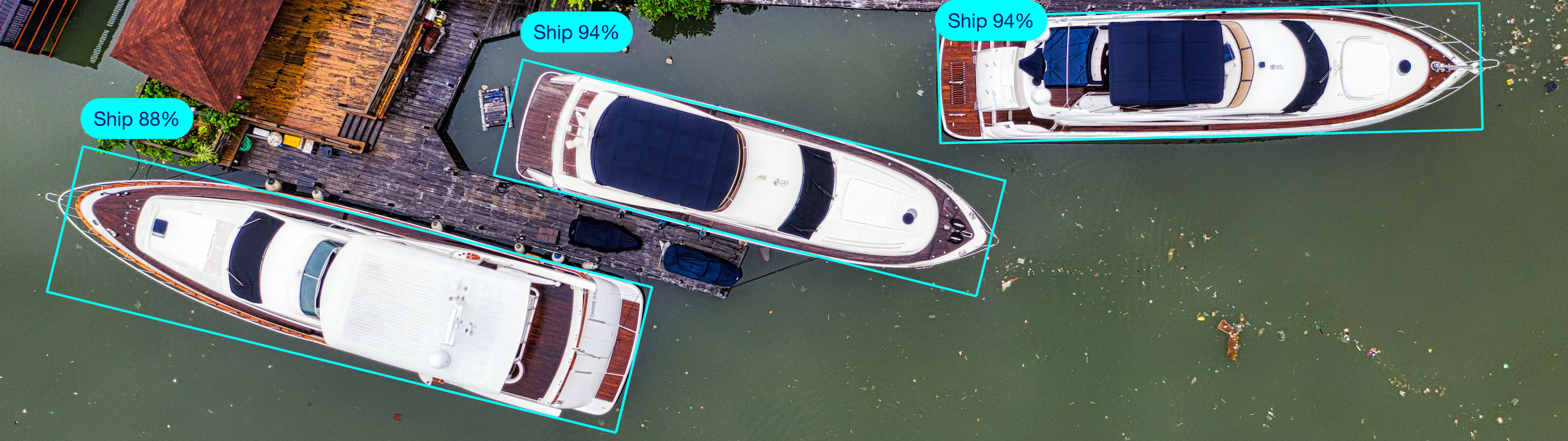
Детекция ориентированных объектов расширяет возможности стандартной детекции объектов, добавляя угол, который позволяет точнее находить объекты на изображении.
На выходе детектора ориентированных объектов получается набор повернутых ограничивающих рамок, точно охватывающих объекты на изображении, а также метки классов и оценки уверенности для каждой рамки. Ориентированные ограничивающие рамки особенно полезны, когда объекты расположены под разными углами, например на аэрофотоснимках, где традиционные рамки, выровненные по осям, могут захватывать лишний фон. Типичные области применения: обнаружение кораблей и автомобилей на спутниковых снимках и изображениях с дронов, анализ зданий и инфраструктуры для городского планирования, мониторинг посевов, а также проверка солнечных панелей и ветряных турбин.
Смотри: Как обнаруживать и отслеживать объекты с помощью ориентированных ограничивающих рамок Ultralytics YOLO26 (OBB) | Трекинг судов 🚢
В названиях моделей YOLO26 OBB используется суффикс -obb, например yolo26n-obb.pt; модели предварительно обучены на DOTAv1.
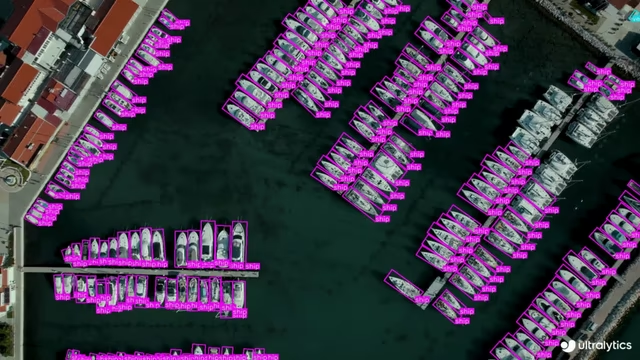
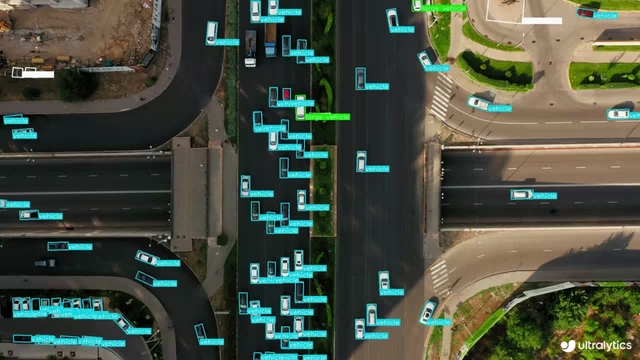
| Обнаружение кораблей с помощью OBB | Обнаружение транспортных средств с помощью OBB |
|---|---|
 |  |
Модели#
Ниже представлены модели YOLO26 OBB, предобученные на наборе данных DOTAv1.
Модели автоматически загружаются из последнего релиза Ultralytics при первом использовании.
Изображения и аннотации DOTAv1 предназначены только для академического использования; коммерческое использование запрещено. Ultralytics трактует эти ограничения как относящиеся к исходному датасету, а не к весам предобученной или дообученной модели. Ознакомься с условиями DOTA, чтобы определить, подходят ли они для твоих целей.
| Модель | размер (пиксели) | mAPtest50-95 (e2e) | mAPtest50 (e2e) | Скорость CPU ONNX (мс) | Скорость T4 TensorRT10 (мс) | параметры (M) | FLOPs (B) |
|---|---|---|---|---|---|---|---|
| YOLO26n-obb | 1024 | 52.4 | 78.9 | 97.7 ± 0.9 | 2.8 ± 0.0 | 2.4 | 14.8 |
| YOLO26s-obb | 1024 | 54.8 | 80.9 | 218.0 ± 1.4 | 4.9 ± 0.1 | 9.8 | 56.7 |
| YOLO26m-obb | 1024 | 55.3 | 81.0 | 579.2 ± 3.8 | 10.2 ± 0.3 | 21.2 | 184.9 |
| YOLO26l-obb | 1024 | 56.2 | 81.6 | 735.6 ± 3.1 | 13.0 ± 0.2 | 25.6 | 232.4 |
| YOLO26x-obb | 1024 | 56.7 | 81.7 | 1485.7 ± 11.5 | 30.5 ± 0.9 | 57.6 | 520.1 |
- Значения mAPtest получены для одной модели при нескольких масштабах на наборе данных DOTAv1.
Воспроизведи результаты с помощьюyolo obb val data=DOTAv1.yaml device=0 split=test nms=False save_json=Trueи отправь объединённые результаты на оценку DOTA. - Скорость усреднена по изображениям валидационной выборки DOTAv1: ONNX на CPU и TensorRT10 на GPU NVIDIA T4.
Воспроизведи результаты с помощьюyolo obb val data=DOTAv1.yaml batch=1 device=0|cpu nms=False - Значения Params и FLOPs указаны для объединённых моделей после свёртки Conv/BatchNorm и удаления неиспользуемой ветви обнаружения. Предварительно обученные контрольные точки сохраняют полную архитектуру обучения, поэтому их показатели могут быть выше.
Предварительные результаты на DOTAv1 см. в предварительной версии YOLO27, ещё не выпущенной.
Обучение#
Обучи модель YOLO26n-obb на датасете DOTA8 в течение 100 эпох с размером изображения 640.
OBB и его поворот на 180° идентичны, поэтому угол поворота задаётся по модулю 180°, а у рамки нет направления. Метки обучения приводятся к каноническому виду по длинной стороне: ширина рамки w соответствует её длинной стороне, угол измеряется по часовой стрелке от положительного направления оси x до ориентации ребра w, а значение хранится в радианах в [-π/4, 3π/4) ([-45°, 135°)). Предсказания не приводятся к каноническому виду, поэтому предсказанная рамка может обозначать короткое ребро как w; см. Вывод результатов. Форма [0°, 90°) — это стандартная регуляризованная конвенция в стиле DOTA, которая не применяется ни при обучении, ни при инференсе.
from ultralytics import YOLO

# Загрузить модель
model = YOLO("yolo26n-obb.yaml")  # создать новую модель из YAML
model = YOLO("yolo26n-obb.pt")  # загрузить предварительно обученную модель (рекомендуется для обучения)
model = YOLO("yolo26n-obb.yaml").load("yolo26n-obb.pt")  # создать модель из YAML и перенести веса

# Обучить модель
results = model.train(data="dota8.yaml", epochs=100, imgsz=640)
Смотри: Как обучать модели Ultralytics YOLO-OBB (ориентированные ограничивающие рамки) на датасете DOTA с помощью платформы Ultralytics
Полное описание режима train см. на странице Обучение. Модели OBB также можно обучать с помощью облачного обучения на платформе Ultralytics.
Формат датасета#
Подробное описание формата наборов данных OBB см. в руководстве по наборам данных. В формате YOLO OBB ограничивающие рамки задаются координатами четырёх углов, нормализованными в диапазоне от 0 до 1, в следующем формате. Инструмент аннотирования платформы Ultralytics поддерживает метки OBB и специальный инструмент для рисования ориентированных ограничивающих рамок:
class_index x1 y1 x2 y2 x3 y3 x4 y4Внутри YOLO обрабатывает функции потерь и выходные данные в формате xywhr, который задает центральную точку ограничивающей рамки (xy), ее ширину, высоту и угол поворота.
Валидация#
Проверь точность обученной модели YOLO26n-obb на наборе данных DOTA8, используя среднюю точность (mAP). Явно передай data, чтобы валидация использовала нужный YAML-файл набора данных.
from ultralytics import YOLO

# Загрузить модель
model = YOLO("yolo26n-obb.pt")  # загрузить официальную модель
model = YOLO("path/to/best.pt")  # загрузить пользовательскую модель

# Валидировать модель
metrics = model.val(data="dota8.yaml")  # проведи валидацию на наборе данных DOTA8
metrics.box.map  # map50-95(B)
metrics.box.map50  # map50(B)
metrics.box.map75  # map75(B)
metrics.box.maps  # mAP50-95(B) для каждого класса; для классов, отсутствующих в валидационной выборке, используется общее значение mAP(B)
metrics.box.ap_class_index  # Индексы классов, которые фактически оценивались
metrics.box.image_metrics # словарь метрик для каждого изображения: precision, recall, F1, TP, FP и FNПредсказание#
Используй обученную модель YOLO26n-obb, чтобы запускать предсказания для изображений.
from ultralytics import YOLO

# Загрузить модель
model = YOLO("yolo26n-obb.pt")  # загрузить официальную модель
model = YOLO("path/to/best.pt")  # загрузить пользовательскую модель

# Получи предсказания с помощью модели
results = model("https://ultralytics.com/images/boats.jpg")  # получи предсказание для изображения

# Обратись к результатам
for result in results:
    xywhr = result.obb.xywhr  # центр-x, центр-y, ширина, высота, угол (радианы)
    xyxyxyxy = result.obb.xyxyxyxy  # формат полигона с 4 точками
    names = [result.names[cls.item()] for cls in result.obb.cls.int()]  # название класса каждой рамки
    confs = result.obb.conf  # оценка уверенности каждой рамки
Полное описание режима predict см. на странице Предсказание.
Укажи save_crop=True, чтобы сохранять выровненную по углу поворота обрезанную область каждого OBB в размере его рамки, как это также делает ObjectCropper.
Результаты работы#
Обнаружение объектов с ориентированными ограничивающими рамками возвращает по одному объекту Results на изображение. Основное поле предсказания — result.obb, которое содержит повёрнутые рамки, идентификаторы классов и оценки достоверности для каждого обнаруженного объекта.
| Атрибут | Тип | Форма | Описание |
|---|---|---|---|
result.obb | OBB | (N) | Ориентированные боксы. |
result.obb.data | torch.float32 | (N,7/8) | Исходные повёрнутые боксы с оценкой уверенности/классом. |
result.obb.xywhr | torch.float32 | (N,5) | Повёрнутые боксы xywhr. |
result.obb.xyxyxyxy | torch.float32 | (N,4,2) | Четыре угловые точки. |
result.obb.conf | torch.float32 | (N,) | Оценки уверенности. |
Метки приводятся к канонической форме с длинной стороной, но предсказания — нет, поэтому result.obb.xywhr может указывать, что w меньше h, если угол измеряется от короткой стороны. Обе формы описывают один и тот же прямоугольник, поэтому result.obb.xyxyxyxy в любом случае корректен. При трекинге каждый трек сохраняет форму с полуоборотом (θ или θ ± π), ближайшую к предыдущему углу, поэтому углы треков не меняются на π между кадрами и могут выходить за пределы [-π/4, 3π/4). Если нижестоящему коду нужна форма с длинной стороной, преобразуй углы обратно, учитывая, что изменение параметров бокса может циклически сдвинуть порядок углов:
from ultralytics.utils.ops import xyxyxyxy2xywhr

xywhr = xyxyxyxy2xywhr(result.obb.xyxyxyxy)  # w >= h, rotation in [-pi/4, 3pi/4)
Описание полей Results, специфичных для каждой задачи, см. в разделе Результаты предсказаний по задачам.
Экспорт#
Экспортируй модель YOLO26n-obb в другой формат, например ONNX, CoreML и т. д.
from ultralytics import YOLO

# Загрузить модель
model = YOLO("yolo26n-obb.pt")  # загрузить официальную модель
model = YOLO("path/to/best.pt")  # загрузить пользовательскую модель

# Экспортировать модель
model.export(format="onnx")
Доступные форматы экспорта YOLO26-obb перечислены в таблице ниже. Экспортировать модель в любой формат можно с помощью аргумента format, например format='onnx' или format='engine'. Ты можешь запускать предсказание или валидацию непосредственно на экспортированных моделях, например yolo predict model=yolo26n-obb.onnx. После завершения экспорта для твоей модели будут показаны примеры использования.
| Формат | Аргумент format | Модель | Метаданные | Аргументы |
|---|---|---|---|---|
| PyTorch | - | yolo26n-obb.pt | ✅ | - |
| TorchScript | torchscript | yolo26n-obb.torchscript | ✅ | imgsz, quantize, dynamic, nms, batch, device |
| ONNX | onnx | yolo26n-obb.onnx | ✅ | imgsz, quantize, dynamic, simplify, opset, nms, batch, data, fraction, device |
| OpenVINO | openvino | yolo26n-obb_openvino_model/ | ✅ | imgsz, quantize, dynamic, nms, batch, data, fraction, device |
| TensorRT | engine | yolo26n-obb.engine | ✅ | imgsz, quantize, dynamic, simplify, opset, workspace, nms, batch, data, fraction, device |
| CoreML | coreml | yolo26n-obb.mlpackage | ✅ | imgsz, dynamic, quantize, nms, batch, device |
| Apple Core AI | coreai | yolo26n-obb.aimodel | ✅ | imgsz, batch, quantize |
| TF SavedModel | saved_model | yolo26n-obb_saved_model/ | ✅ | imgsz, quantize, opset, nms, batch, data, fraction, device |
| TF GraphDef | pb | yolo26n-obb.pb | ❌ | imgsz, opset, batch, device |
| TF Edge TPU | edgetpu | yolo26n-obb_edgetpu.tflite | ✅ | imgsz, quantize, opset, data, fraction, device |
| LiteRT | litert | yolo26n-obb.tflite | ✅ | imgsz, quantize, batch, data, fraction, device |
| PaddlePaddle | paddle | yolo26n-obb_paddle_model/ | ✅ | imgsz, batch, device |
| MNN | mnn | yolo26n-obb.mnn | ✅ | imgsz, batch, dynamic, quantize, simplify, opset, nms, device |
| NCNN | ncnn | yolo26n-obb_ncnn_model/ | ✅ | imgsz, quantize, device |
| IMX500 | imx | yolo11n_imx_model/ | ✅ | imgsz, quantize, data, fraction, nms, device |
| RKNN | rknn | yolo26n-obb_rknn_model/ | ✅ | imgsz, batch, name, quantize, simplify, opset, data, fraction, device |
| ExecuTorch | executorch | yolo26n-obb_executorch_model/ | ✅ | imgsz, quantize, batch, data, fraction, device |
| Axelera | axelera | yolo26n-obb_axelera_model/ | ✅ | imgsz, batch, quantize, data, fraction, device |
| DEEPX | deepx | yolo26n-obb_deepx_model/ | ✅ | imgsz, quantize, simplify, opset, data, optimize, device |
| Qualcomm QNN | qnn | yolo26n-obb_qnn.onnx | ✅ | imgsz, batch, name, quantize, simplify, opset, data, fraction, device |
| Hailo | hailo | yolo26n-obb_hailo_model/ | ✅ | imgsz, name, quantize, data, fraction, simplify, conf, iou, device |
| Huawei Ascend | ascend | yolo26n-obb_ascend_model/ | ✅ | imgsz, batch, name, quantize, opset, simplify, nms, device |
| AMD Xilinx | xilinx | yolo26n-obb_xilinx_model/ | ✅ | imgsz, name, quantize, data, fraction, opset, simplify, device |
| NXP | nxp | yolo26n-obb_nxp.tflite | ✅ | imgsz, quantize, data, fraction, device |
nms=None по умолчанию выдаёт необработанные выходные данные для внешней NMS (YOLO26 сохраняет голову без NMS на Axelera). Укажи nms=False, чтобы выбрать доступную голову без NMS; неподдерживаемые форматы используют собственный путь вывода. Записи nms выше указывают форматы, в которые можно встроить NMS с помощью nms=True.
Полное описание export смотри на странице экспорта.
Часто задаваемые вопросы#
Ориентированные ограничивающие рамки (OBB) включают дополнительный угол, чтобы повысить точность локализации объектов на изображениях. В отличие от обычных ограничивающих рамок, представляющих собой прямоугольники, выровненные по осям, OBB могут поворачиваться, чтобы точнее соответствовать ориентации объекта. Это особенно полезно в задачах, требующих точного размещения объектов, например при обработке аэрофотоснимков или спутниковых изображений (руководство по датасетам).
Чтобы обучить модель YOLO26n-obb на пользовательском датасете, воспользуйся примером ниже для Python или CLI:
Примерfrom ultralytics import YOLO # Загрузи предварительно обученную модель model = YOLO("yolo26n-obb.pt") # Обучить модель results = model.train(data="path/to/custom_dataset.yaml", epochs=100, imgsz=640)Дополнительные аргументы обучения смотри в разделе «Конфигурация».
Модели YOLO26-OBB предварительно обучены на таких датасетах, как DOTAv1, но можно использовать любой датасет в формате OBB. Подробную информацию о форматах датасетов OBB смотри в руководстве по датасетам.
Чтобы проверить модель YOLO26n-obb, воспользуйся командами Python или CLI, приведёнными ниже:
Примерfrom ultralytics import YOLO # Загрузить модель model = YOLO("yolo26n-obb.pt") # Валидировать модель metrics = model.val(data="dota8.yaml")Полную информацию о валидации смотри в разделе Val.
Экспортировать модель YOLO26-OBB в формат ONNX можно с помощью Python или CLI:
Примерfrom ultralytics import YOLO # Загрузить модель model = YOLO("yolo26n-obb.pt") # Экспортировать модель model.export(format="onnx")Дополнительные форматы экспорта и сведения о них смотри на странице Export.


Комментарии252
Задай вопрос, поделись результатами или помоги кому-нибудь.
zhouyizhuo
how to do Model Ensembling on yolov8-obb models?
2 Paula DerrengerUltralytics(изменено)
Model ensembling with YOLOv8-obb models involves combining the predictions from multiple trained models to improve the accuracy of your oriented objects detection. Currently, direct support for model ensembling within Ultralytics YOLO isn't provided out-of-the-box. However, you can manually implement ensembling by running predictions with each model separately and then combining these predictions.
One common approach is to average the bounding box coordinates and confidence scores of the same object detected by multiple models. Ensure to consider the rotating angle parameter unique to OBB models in your ensembling logic. Here's a basic conceptual example to get you started:
from ultralytics import YOLO

models = [
    YOLO('path/to/first_obb_model.pt'),
    YOLO('path/to/second_obb_model.pt'),
    # Add more models as needed
]

# Assuming you have a method to read your images/videos
image = 'path/to/image.jpg'

# List to store results from all models
all_preds = []

for model in models:
    results = model(image)
    all_preds.append(results[0].obb)  # Extracting OBB predictions (xywhr, conf, cls)

# Assuming you have a method `combine_predictions(all_preds)`
# that combines predictions from all models
final_predictions = combine_predictions(all_preds)

# Process `final_predictions`...
This example loads each model, runs predictions on the same image, and stores the results. You'd then need to implement
combine_predictions(all_preds)to handle the logic for combining these predictions based on criteria like IoU, confidence scores, etc., taking into account the angle for rotated bounding boxes.Remember, ensembling may increase inference time due to processing with multiple models. Always weigh the benefits of improved accuracy against potential increases in computational cost. Happy coding! 😊
windzu
if you want draw predict results to img and save , you can ref below easy code :
# you predict code #

import cv2

image = cv2.imread(test_img_path)
for r in results:
    xyxyxyxy = r.obb.xyxyxyxy.cpu().numpy()

    for box in xyxyxyxy:
        points = box.reshape(4, 2).astype(int)
        cv2.polylines(image, [points], isClosed=True, color=(0, 255, 0), thickness=2)

cv2.imwrite("detected_image.jpg", image)
1 Glenn JocherUltralytics
@windzu thank you for sharing the code example. For more details on using YOLOv8 Oriented Bounding Boxes, please refer to our documentation on training, validation, and exporting models. If you have further questions, feel free to ask here.
krialm
Hi, when I am using yolov8_obb model in results I always have boxes: None keypoints: None masks: None
even when the model makes prediction. Did someone faced with this problem and if yes, what was the solution? Thank you.🙂
1RizwanMunawar
@krialm In the case of OBB, you can get bounding box data, using the mentioned code below.
model = YOLO("yolov8n-obb.pt")
results = model.predict(im0)
pred_boxes = results[0].obb
I hope this helps! Let me know if you have any additional questions.
Thanks and Regards Ultralytics Team!
1kedardg
Is there a way for me to train OBB models from scratch let's say the P2 or RTDETR models which are not available pre-trained?
- Paula DerrengerUltralytics
@kedardg absolutely, you can train OBB models like P2 or RTDETR from scratch even if they're not available pre-trained. You'd start by creating a new model from a YAML file, which defines the model architecture. Here's a quick example of how you might do it:
yolo obb train data=your_dataset.yaml model=your_model.yaml epochs=100 imgsz=640Just replace
your_dataset.yamlwith your dataset configuration file andyour_model.yamlwith your model configuration file. Make sure your dataset is properly formatted for OBB tasks. Happy training! 😊🚀 RumaisaIlyas
model = YOLO("yolov8n-obb.pt") results = model.predict(im0) pred_boxes = results[0].obb
i did this but i want to draw bounding boxes on the test image and return it. how to do that?
my function is:
def count_detection(image): if image is not None: # Load the YOLO model model = YOLO('bestobbv8s.pt')
# Check the shape of the input image print("Input image shape:", image.shape) # Use the model to predict the wheat spikes in image results = model(image, save=True) # Count count = sum(len(result) for result in results) print("count", count) # Draw bounding boxes for detected wheat heads for result in results: boxes = result.obb #here? return image- Paula DerrengerUltralytics
@RumaisaIlyas hey there! 😊 To draw bounding boxes on your test image and return it, you can use the
plot()method available in theResultsobject. Here's how you can modify your function:def count_detection(image): if image is not None: # Load the YOLO model model = YOLO('bestobbv8s.pt') # Check the shape of the input image print("Input image shape:", image.shape) # Use the model to predict results = model.predict(image) # Draw bounding boxes and return the annotated image annotated_image = results[0].plot() # Count detections count = len(results[0].obb) print("count", count) return annotated_imageIn this updated function, after making predictions with
model.predict(image), we useresults[0].plot()to draw bounding boxes on the image. This method returns the annotated image, which we then return from the function. This should give you the visual feedback you're looking for! 🚀Let me know if you need further assistance!
thankyou so much for your assistance. i am facing a problem that my runs folder is not created after i run the code provided. why is that? what should i do in code so that i get the runs folder with my predicted image
- Paula DerrengerUltralytics(изменено)
Hey there! 😊 It sounds like you're doing everything right, but if the
runsfolder isn't being created, it might be due to a small oversight. Here's a quick checklist:- Ensure you're using the latest version of the Ultralytics YOLO library. Sometimes, updates fix these kinds of issues.
- Double-check your command and make sure it's complete. For predictions, it should look something like this:
from ultralytics import YOLO # Load your model model = YOLO('bestobbv8s.pt') # Run prediction # save=True writes the annotated image to the 'runs' folder results = model.predict('path/to/your/image.jpg', save=True)- If you're still not seeing the
runsfolder, try specifying the output directory explicitly in your code:
results = model.predict('path/to/your/image.jpg', save=True, project='runs/detect') # Adjust the path as needed- Lastly, ensure you have the necessary write permissions in your working directory. Sometimes, permission issues can prevent the creation of new folders.
If you've checked all these and the issue persists, it might be helpful to share more details about your environment (like your operating system) or any error messages you're seeing. That way, the community can offer more targeted advice. 🚀
Hope this helps, and happy detecting!
Ci-ne
I also face the same problem. I tried using the code provided but it still says NoneType
ncnn_model = YOLO("./my_ncnn_model", task='detect') results = ncnn_model.predict(image_path)
if results[0] is not None: # Ensure results is not None obb_boxes = results[0].obb # For OBB models print(f"OBB Box: {obb_boxes}") else: print("No detections.")
This is what I get
Speed: 4.1ms preprocess, 93.1ms inference, 1.2ms postprocess per image at shape (1, 3, 640, 640) OBB Box: None
Any help?
1chengz
The document notes that 'OBB angles are constrained to the range 0–90 degrees (exclusive of 90). Angles of 90 degrees or greater are not supported.' So what is the normal radian range for an OBB, [-π/4, 3π/4) or something else?
 Murat Raimbekov
the radian range is
[-π/4, 3π/4), i.e.[-45°, 135°), not[0°, 90°). that docs note was inaccurate and is fixed in #24534.ground-truth angles are normalized in
xyxyxyxy2xywhr(ultralytics/utils/ops.py) by two loops,while theta >= 3*pi/4: theta -= piandwhile theta < -pi/4: theta += pi, withwswapped to the longer side. sweeping a rectangle through physical 0->180°:0° -> 0.0000 45° -> 0.7854 (π/4) 90° -> 1.5708 (π/2) 120° -> 2.0944 135° -> -0.7854 (-π/4) 165° -> -0.2618so the span is exactly π wide, half-open at
3π/4.the heads match this:
OBB(yolov8/yolo11):angle = (sigmoid(raw) - 0.25) * π, hard-bounded to[-π/4, 3π/4].OBB26(yolo26): raw output, no sigmoid, trained on targets already in[-π/4, 3π/4).
[0, π/2)is the regularized DOTA-style form produced byregularize_rboxesinops.py. that function is defined but has no callers anywhere inultralytics/, so it is not applied at training or inference. predicted boxes reach you unregularized:result.obb.xywhrreturns the angle in[-π/4, 3π/4)(verified by feeding angles like-0.70and2.30through the predict path and reading them back unchanged).one consequence, which is what the original note was really about: an OBB and its 180° rotation encode to the same
xywhr, so rotation is defined only modulo 180° and the box has no direction. θ and θ+180° are indistinguishable, so you cannot recover a fixed corner ordering from the predicted angle.
 User
mAPtest values are for single-model multiscale on DOTAv1 dataset. Reproduce by yolo val obb data=DOTAv1.yaml device=0 split=test and submit merged results to DOTA evaluation. This mentions that the test results are submitted to the DOTAv1 server through a multiscale approach. I would like to ask, what does this "multiscale" mean? How is it specifically implemented? Is it trained at scales like 512512 and 10241024, and then tested on the test dataset? How are the final results obtained? I am not quite clear on what this multiscale refers to. Please help me with this.
- Glenn JocherUltralytics
Here, “multiscale” means evaluating the same trained model on multiple resized/split versions of each DOTA image tile, then merging those detections back into the original image for final submission; in Ultralytics this is tied to the DOTA split pipeline with scales like
rates=[0.5, 1.0, 1.5]in the DOTA dataset guide and the merged-result export inOBBValidator.eval_json(), so it is usually multi-scale test-time inference with one model rather than separately training 512 and 1024 models. - Murat Raimbekov
it is one model, trained once. there is no separate 512 and 1024 model, and no separate training runs per scale. the "multiscale" lives entirely in the dota tiling step, not inside
yolo val.where it comes from. dota images are huge (800x800 up to ~20000x20000), so they are cut into overlapping tiles before training/val using
split_trainval/split_testfromultralytics/data/split_dota.py. the multiscale variant passesrates=[0.5, 1.0, 1.5](this is exactly what the dota dataset guide shows). for each raterthe code usescrop_size / randgap / r, so with the defaultscrop_size=1024, gap=200you get tiles of:rate 0.5 -> 2048 px tiles (gap 400) rate 1.0 -> 1024 px tiles (gap 200) rate 1.5 -> 682 px tiles (gap 133)every original image is therefore cut into overlapping windows at all three crop sizes. each window is later resized to
imgszat inference, so the same content is effectively seen at three resolutions. concretely, a single 4000x4000 image produces ~98 tiles spread across those three sizes.training. the model is trained once on the multiscale-split trainval tiles (same
rates=[0.5, 1.0, 1.5]). it is not "trained at 512 then at 1024" as separate models.test / how the final number is obtained.
yolo val obb data=DOTAv1.yaml split=testruns that single model over every test tile. each tile filename encodes the source image id and crop offset (name__cropsize__xstart___ystart).OBBValidator.eval_json()parses that, shifts each tile's rotated boxes back into the original full-image coordinates, concatenates detections from all tiles and all scales, then runs a rotated probiou NMS (fast_nms, iou 0.3) to remove the overlap introduced by tiling. the merged per-image results are written as dotaTask1_*.txt, which is what you submit to the dota evaluation server.one practical caveat.
yolo val ... split=testdoes not create the multiscale tiles for you. you have to runsplit_test(rates=[0.5, 1.0, 1.5])first (andsplit_trainvalwith the same rates for training). running val on the raw full dota images is single-scale and will not reproduce themAPtestnumber in the table.so in short: multiscale = offline multi-scale tiling + per-tile single-scale inference + merge-back-and-NMS, all with one model. it is test-time multi-scale through the tiling, not test-time augmentation inside
val.
kssion
WARNING ⚠️ CoreML: 'nms=True' is only available for Detect models like 'yolo11n.pt'.
yolo export model=best.pt format=coreml nms=True conf=0.25 iou=0.45Ultralytics 8.3.232 🚀 Python-3.11.11 torch-2.9.1 CPU (Apple M1) YOLO11n-obb summary (fused): 109 layers, 2,653,918 parameters, 0 gradients, 6.6 GFLOPs
PyTorch: starting from 'best.pt' with input shape (1, 3, 640, 640) BCHW and output shape(s) (1, 6, 8400) (5.5 MB) Torch version 2.9.1 has not been tested with coremltools. You may run into unexpected errors. Torch 2.7.0 is the most recent version that has been tested.
CoreML: starting export with coremltools 9.0... WARNING ⚠️ CoreML: 'nms=True' is only available for Detect models like 'yolo11n.pt'. Converting PyTorch Frontend ==> MIL Ops: 100%|██████████████▉| 867/868 [00:00<00:00, 8975.73 ops/s] Running MIL frontend_pytorch pipeline: 100%|███████████████████| 5/5 [00:00<00:00, 166.58 passes/s] Running MIL default pipeline: 100%|███████████████████████████| 95/95 [00:00<00:00, 99.61 passes/s] Running MIL backend_mlprogram pipeline: 100%|████████████████| 12/12 [00:00<00:00, 176.60 passes/s] CoreML: export success ✅ 4.8s, saved as 'best.mlpackage' (5.3 MB)
Export complete (5.0s)
- Glenn JocherUltralytics
That warning is expected for OBB models: CoreML
nms=Trueis only supported for axis-aligned Detect heads, so export your*-obbmodel without NMS and do confidence/IoU (rotated NMS) post-processing on the app side (export success ✅ means you’re fine). See the Ultralytics YOLO OBB task docs for the OBB output formats.yolo export model=best.pt format=coreml
wang18382140151-hub
你好,请问你们未来的工作计划中是否有将rtdetr用于obb检测呢,最近我正在基于贵司源码做改进
AbhisekRao
I'm currently working with the YOLOv11 Oriented Bounding Box (OBB) model exported in TensorRT format, and deploying it on an NVIDIA Jetson device (AGX Orin). While the model works in standard inference pipelines (.pt) , I’m facing challenges integrating it into a DeepStream-based application to process live RTSP video streams.
There seems to be no existing reference implementation or sample Python code that demonstrates how to use the OBB variant of the model with DeepStream. Specifically, I'm looking for guidance on:
1- Integrating the YOLOv11 OBB TensorRT model with DeepStream (preferably using Python bindings). 2- Proper parsing and visualization of oriented bounding boxes from the model output. 3- Any custom parser or config file changes required in the DeepStream pipeline.
Any support, documentation, or examples from the team or community would be greatly appreciated.
cripsgreen
Hello, could you please share some insights on how to train the hyperparameters for YOLOv11-OBB, as well as the pre-trained weights? Thank you.
ziishuo
May I ask if the OBB model can be used to detect subjects in a normal perspective (such as a level shot)? I noticed that most of the examples are from a top-down angle. Thank you!