Hızlı Başlangıç Kılavuzu: NVIDIA Jetson ile Ultralytics YOLO26
Bu kılavuz, Ultralytics YOLO26'yı NVIDIA Jetson cihazlarına dağıtmayı adım adım açıklar ve YOLO26'nın bu kompakt, enerji verimli cihazlarda neler yapabildiğini gösteren performans kıyaslamalarını içerir.
Bu kılavuzu, 2070 FP4 TFLOPS'a kadar yapay zekâ işlem gücü ve 128 GB bellek sunan, gücü 40 W ile 130 W arasında ayarlanabilen en yeni NVIDIA Jetson AGX Thor Developer Kit ile güncelledik. En popüler yapay zekâ modellerini çalıştırırken NVIDIA Jetson AGX Orin'den 7,5 kat daha fazla yapay zekâ işlem gücü ve 3,5 kat daha iyi enerji verimliliği sunar.
İzle: NVIDIA Jetson cihazlarında Ultralytics YOLO26 ile daha hızlı çıkarım elde et 🚀
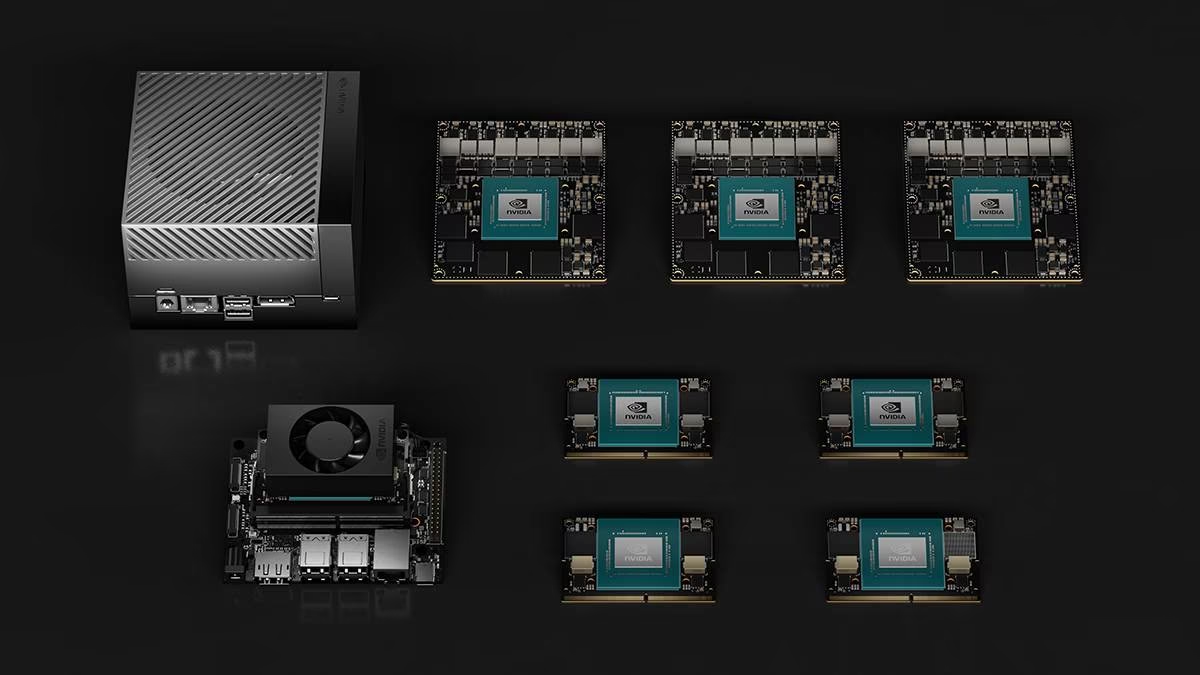
Bu kılavuz, en yeni kararlı JetPack 7.2 sürümünü çalıştıran NVIDIA Jetson AGX Thor Developer Kit (Jetson T5000) ve NVIDIA Jetson AGX Orin Developer Kit (64GB) ile; JP6.1 JetPack sürümünü çalıştıran NVIDIA Jetson Orin Nano Super Developer Kit ile; JetPack'in JP6.0/JP5.1.3 sürümlerini çalıştıran ve NVIDIA Jetson Orin NX 16GB tabanlı Seeed Studio reComputer J4012 ile ve JetPack'in JP4.6.1 sürümünü çalıştıran ve NVIDIA Jetson Nano 4GB tabanlı Seeed Studio reComputer J1020 v2 ile test edilmiştir. En yeni ve eski cihazlar dâhil olmak üzere tüm NVIDIA Jetson donanım ürün serisinde çalışması beklenmektedir.
NVIDIA Jetson nedir?#
NVIDIA Jetson, hızlandırılmış yapay zekâ (AI) hesaplamasını uç cihazlara taşımak için tasarlanmış bir gömülü bilgi işlem kartı serisidir. Kompakt ve güçlü bu cihazlar NVIDIA'nın GPU mimarisi üzerine kuruludur ve bulut bilişim kaynaklarına ihtiyaç duymadan karmaşık yapay zekâ algoritmalarını ve derin öğrenme modellerini doğrudan cihazda çalıştırabilir. Jetson kartları genellikle robotik, otonom araçlar, endüstriyel otomasyon ve yapay zekâ çıkarımının yerel olarak düşük gecikmeyle ve yüksek verimlilikle gerçekleştirilmesi gereken diğer uygulamalarda kullanılır. Ayrıca bu kartlar ARM64 mimarisini temel alır ve geleneksel GPU bilgi işlem cihazlarına kıyasla daha düşük güç tüketimiyle çalışır.
NVIDIA Jetson Serisi Karşılaştırması#
NVIDIA Jetson AGX Thor, önceki nesillere kıyasla çok daha yüksek yapay zekâ performansı sunan NVIDIA Blackwell mimarisini temel alan NVIDIA Jetson ailesinin en yeni üyesidir. Aşağıdaki tabloda ekosistemdeki birkaç Jetson cihazı karşılaştırılmaktadır.
| Jetson AGX Thor (T5000) | Jetson AGX Orin 64GB | Jetson Orin NX 16GB | Jetson Orin Nano Super | Jetson AGX Xavier | Jetson Xavier NX | Jetson Nano | |
|---|---|---|---|---|---|---|---|
| Yapay Zekâ Performansı | 2070 TFLOPS | 275 TOPS | 100 TOPS | 67 TOPS | 32 TOPS | 21 TOPS | 472 GFLOPS |
| GPU | 96 Tensor Core içeren 2560 çekirdekli NVIDIA Blackwell mimarisi GPU | 64 Tensor Core içeren 2048 çekirdekli NVIDIA Ampere mimarisi GPU | 32 Tensor Core içeren 1024 çekirdekli NVIDIA Ampere mimarisi GPU | 32 Tensor Core içeren 1024 çekirdekli NVIDIA Ampere mimarisi GPU | 64 Tensor Core içeren 512 çekirdekli NVIDIA Volta mimarisi GPU | 48 Tensor Core içeren 384 çekirdekli NVIDIA Volta™ mimarisi GPU | 128 çekirdekli NVIDIA Maxwell™ mimarisi GPU |
| GPU Maksimum Frekansı | 1.57 GHz | 1.3 GHz | 918 MHz | 1020 MHz | 1377 MHz | 1100 MHz | 921MHz |
| CPU | 14 çekirdekli Arm® Neoverse®-V3AE 64 bit CPU, 1 MB L2 + 16 MB L3 | 12 çekirdekli NVIDIA Arm® Cortex A78AE v8.2 64 bit CPU, 3 MB L2 + 6 MB L3 | 8 çekirdekli NVIDIA Arm® Cortex A78AE v8.2 64 bit CPU, 2 MB L2 + 4 MB L3 | 6 çekirdekli Arm® Cortex®-A78AE v8.2 64 bit CPU 1,5 MB L2 + 4 MB L3 | 8 çekirdekli NVIDIA Carmel Arm®v8.2 64 bit CPU 8 MB L2 + 4 MB L3 | 6 çekirdekli NVIDIA Carmel Arm®v8.2 64 bit CPU 6 MB L2 + 4 MB L3 | Dört çekirdekli Arm® Cortex®-A57 MPCore işlemci |
| CPU Maksimum Frekansı | 2.6 GHz | 2.2 GHz | 2.0 GHz | 1.7 GHz | 2.2 GHz | 1.9 GHz | 1.43GHz |
| Bellek | 128 GB 256 bit LPDDR5X 273 GB/sn | 64 GB 256 bit LPDDR5 204,8 GB/sn | 16 GB 128 bit LPDDR5 102,4 GB/sn | 8 GB 128 bit LPDDR5 102 GB/sn | 32 GB 256 bit LPDDR4x 136,5 GB/sn | 8 GB 128 bit LPDDR4x 59,7 GB/sn | 4 GB 64 bit LPDDR4 25,6 GB/sn |
NVIDIA JetPack nedir?#
NVIDIA JetPack SDK, Jetson modüllerine güç verir ve uçtan uca hızlandırılmış yapay zekâ uygulamaları geliştirmek için eksiksiz bir geliştirme ortamı sunar. JetPack; önyükleyici, Linux çekirdeği, Ubuntu masaüstü ortamı içeren Jetson Linux'u ve GPU hesaplamasını, çoklu ortamı, grafikleri ve bilgisayarlı görü hızlandırmak için gereken eksiksiz bir kütüphane kümesini içerir. Ayrıca ana bilgisayar ve geliştirme kiti için örnekler, belgeler ve geliştirici araçları sunar; akışlı video analitiği için DeepStream, robotik için Isaac ve konuşmaya dayalı yapay zekâ için Riva gibi üst düzey SDK'ları destekler.
NVIDIA Jetson'a JetPack'i yükle#
NVIDIA Jetson cihazını edindikten sonraki ilk adım, NVIDIA JetPack'i cihaza yüklemektir. NVIDIA Jetson cihazlarına yükleme yapmanın birkaç farklı yolu vardır.
- Resmî Jetson AGX Thor, AGX Orin veya Orin Nano Developer Kit üzerinde JetPack 7.2 kullanmak için birleşik Jetson ISO'sunu indir, bir USB belleğe yaz ve AGX Thor, AGX Orin veya Orin Nano için cihaza özel hızlı başlangıç yönergelerini izle. JetPack 7.2 ile birlikte Orin Nano artık indirilebilir bir SD kart imajı kullanmıyor; ISO'yu USB'den yüklemek, Jetson Linux'u cihazın microSD kartına veya NVMe SSD'sine kuruyor.
- Jetson Orin Nano Developer Kit üzerinde özellikle JetPack 6 kullanıyorsan NVIDIA'nın JetPack 6.x güncelleme ve SD kart yönergelerini izle.
- Başka bir NVIDIA Development Kit'e sahipsen SDK Manager kullanarak JetPack'i cihaza yükleyebilirsin.
- Seeed Studio reComputer J4012 cihazına sahipsen JetPack'i ürünle birlikte gelen SSD'ye yükleyebilirsin; Seeed Studio reComputer J1020 v2 cihazına sahipsen JetPack'i eMMC/SSD'ye yükleyebilirsin.
- NVIDIA Jetson modülüyle çalışan başka bir üçüncü taraf cihaza sahipsen komut satırından yükleme yöntemini izlemen önerilir.
Yukarıdaki 1., 4. ve 5. yöntemlerde sistemi flaşlayıp cihazı başlattıktan sonra, gereken JetPack bileşenlerinin geri kalanını yüklemek için cihaz terminalinde sudo apt update && sudo apt install nvidia-jetpack -y komutunu çalıştır.
Jetson Cihazına Göre JetPack Desteği#
Aşağıdaki tabloda farklı NVIDIA Jetson cihazlarının desteklediği NVIDIA JetPack sürümleri gösterilmektedir.
| JetPack 4 | JetPack 5 | JetPack 6 | JetPack 7 | |
|---|---|---|---|---|
| Jetson Nano | ✅ | ❌ | ❌ | ❌ |
| Jetson TX2 | ✅ | ❌ | ❌ | ❌ |
| Jetson Xavier NX | ✅ | ✅ | ❌ | ❌ |
| Jetson AGX Xavier | ✅ | ✅ | ❌ | ❌ |
| Jetson AGX Orin | ❌ | ✅ | ✅ | ✅ |
| Jetson Orin NX | ❌ | ✅ | ✅ | ✅ |
| Jetson Orin Nano | ❌ | ✅ | ✅ | ✅ |
| Jetson AGX Thor | ❌ | ❌ | ❌ | ✅ |
Docker ile Hızlı Başlangıç#
Ultralytics YOLO26'yı NVIDIA Jetson'da kullanmaya başlamanın en hızlı yolu, Jetson için önceden oluşturulmuş Docker görüntülerini çalıştırmaktır. Yukarıdaki tabloya bak ve sahip olduğun Jetson cihazına göre JetPack sürümünü seç.
t=ultralytics/ultralytics:latest-jetson-jetpack4
sudo docker pull $t && sudo docker run -it --ipc=host --runtime=nvidia $tlatest-nvidia-arm64 imajı, CUDA 13.4 ve TensorRT 11.4 dahil NVIDIA PyTorch 26.10 kullanır. NVIDIA, uyumluluk tablosunda PyTorch için JetPack 7.1'i listeliyor; ancak TensorRT 11, Thor dahil JetPack'i desteklemiyor. Bu imajı yalnızca desteklenen bir ana makinede PyTorch iş yükleri için kullan. Jetson TensorRT dışa aktarımları için aşağıdaki yerel kurulumu ve JetPack sürümünün desteklediği TensorRT 10.x çalışma zamanını kullan. Thor veya Orin üzerinde JetPack 7.2 için konteynerin ayrıca doğrulanması gerekir. Motorları hedef GPU ve TensorRT sürümü için yeniden oluştur.
JetPack 4, 5 ve 6 imajları için NVIDIA Jetson'da TensorRT kullanma bölümüne geç. Yukarıdaki JetPack 7.1 imajı yalnızca PyTorch iş yükleri içindir.
Yerel Kurulumla Başla#
Docker kullanmadan yerel kurulum yapmak için aşağıdaki adımlara bak.
JetPack 7.2'de Çalıştır#
Ultralytics Paketini Yükle#
Ultralytics paketini Jetson'a yükle. Dışa aktarma bağımlılıkları, bir modeli ilk kez dışa aktardığında otomatik olarak yüklenir; bu nedenle burada yalnızca temel paket gerekir. Bu kılavuz, Jetson cihazlarında en iyi performansı TensorRT sağladığı için NVIDIA TensorRT dışa aktarımlarına odaklanır.
-
Paket listesini güncelle, pip'i yükle ve en son sürüme yükselt
sudo apt update sudo apt install python3-pip -y pip install -U pip -
ultralyticspip paketini yüklepip install ultralytics -
Cihazı yeniden başlat
sudo reboot
PyTorch ve Torchvision'ı yükle#
Yukarıdaki ultralytics kurulumu Torch ve Torchvision'ı yükler. Ancak pip aracılığıyla yüklenen bu iki paket, CUDA 13 çalıştıran JetPack 7.2 cihazlarıyla uyumlu değildir; bu nedenle elle yüklenmeleri gerekir.
JP7.2'ye uygun torch ve torchvision öğelerini yükle
pip install torch torchvision --index-url https://download.pytorch.org/whl/cu130onnxruntime-gpu öğesini yükle#
JetPack, Python ve CUDA sürümlerinle eşleşen bir ONNX Runtime GPU wheel'i kullan. PyPI'daki güncel sürümlerde ARM64 wheel'leri bulunsa da bunlar her JetPack sürümüne özgü paketlerin yerini tutmaz.
Python3.12 desteğiyle onnxruntime-gpu 1.24.0 paketini indirip yükle.
pip install https://github.com/ultralytics/assets/releases/download/v0.0.0/onnxruntime_gpu-1.24.0-cp312-cp312-linux_aarch64.whlJetPack 6.1'de Çalıştır#
Ultralytics Paketini Yükle#
Ultralytics paketini Jetson'a yükle. Dışa aktarma bağımlılıkları, bir modeli ilk kez dışa aktardığında otomatik olarak yüklenir; bu nedenle burada yalnızca temel paket gerekir. Bu kılavuz, Jetson cihazlarında en iyi performansı TensorRT sağladığı için NVIDIA TensorRT dışa aktarımlarına odaklanır.
-
Paket listesini güncelle, pip'i yükle ve en son sürüme yükselt
sudo apt update sudo apt install python3-pip -y pip install -U pip -
ultralyticspip paketini yüklepip install ultralytics -
Cihazı yeniden başlat
sudo reboot
PyTorch ve Torchvision'ı yükle#
Yukarıdaki ultralytics kurulumu Torch ve Torchvision'ı yükler. Ancak pip aracılığıyla yüklenen bu iki paket, ARM64 mimarisini temel alan Jetson platformuyla uyumlu değildir; bu nedenle önceden oluşturulmuş bir PyTorch pip wheel'ini elle yüklemen ve Torchvision'ı kaynaktan derlemen ya da yüklemen gerekir.
JP6.1'e uygun torch 2.10.0 ve torchvision 0.25.0 öğelerini yükle
pip install https://github.com/ultralytics/assets/releases/download/v0.0.0/torch-2.10.0-cp310-cp310-linux_aarch64.whl
pip install https://github.com/ultralytics/assets/releases/download/v0.0.0/torchvision-0.25.0-cp310-cp310-linux_aarch64.whlFarklı JetPack sürümleri için PyTorch'un tüm sürümlerine Jetson için PyTorch sayfasından ulaşabilirsin. PyTorch ve Torchvision uyumluluğunun daha ayrıntılı listesi için PyTorch ve Torchvision uyumluluk sayfasını ziyaret et.
torch 2.10.0 ile ilgili bir bağımlılık sorununu düzeltmek için cuDSS öğesini yükle
wget https://developer.download.nvidia.com/compute/cudss/0.7.1/local_installers/cudss-local-tegra-repo-ubuntu2204-0.7.1_0.7.1-1_arm64.deb
sudo dpkg -i cudss-local-tegra-repo-ubuntu2204-0.7.1_0.7.1-1_arm64.deb
sudo cp /var/cudss-local-tegra-repo-ubuntu2204-0.7.1/cudss-*-keyring.gpg /usr/share/keyrings/
sudo apt-get update
sudo apt-get -y install cudss
onnxruntime-gpu öğesini yükle#
JetPack, Python ve CUDA sürümlerinle eşleşen bir ONNX Runtime GPU wheel'i kullan. PyPI'daki güncel sürümlerde ARM64 wheel'leri bulunsa da bunlar her JetPack sürümüne özgü paketlerin yerini tutmaz.
JetPack sürümü, Python sürümü ve diğer uyumluluk ayrıntılarına göre düzenlenmiş tüm onnxruntime-gpu paketlerini Jetson Zoo ONNX Runtime uyumluluk matrisinde bulabilirsin.
Python 3.10 desteğiyle JetPack 6 için onnxruntime-gpu 1.23.0 öğesini yükleyebilirsin:
pip install https://github.com/ultralytics/assets/releases/download/v0.0.0/onnxruntime_gpu-1.23.0-cp310-cp310-linux_aarch64.whlAlternatif olarak, onnxruntime-gpu 1.20.0 için:
pip install https://github.com/ultralytics/assets/releases/download/v0.0.0/onnxruntime_gpu-1.20.0-cp310-cp310-linux_aarch64.whlJetPack 5.1.2'de Çalıştır#
Ultralytics Paketini Yükle#
Ultralytics paketini Jetson'a yükle. Dışa aktarma bağımlılıkları, bir modeli ilk kez dışa aktardığında otomatik olarak yüklenir; bu nedenle burada yalnızca temel paket gerekir. Bu kılavuz, Jetson cihazlarında en iyi performansı TensorRT sağladığı için NVIDIA TensorRT dışa aktarımlarına odaklanır.
-
Paket listesini güncelle, pip'i yükle ve en son sürüme yükselt
sudo apt update sudo apt install python3-pip -y pip install -U pip -
ultralyticspip paketini yüklepip install ultralytics -
Cihazı yeniden başlat
sudo reboot
PyTorch ve Torchvision'ı yükle#
Yukarıdaki ultralytics kurulumu Torch ve Torchvision'ı yükler. Ancak pip aracılığıyla yüklenen bu iki paket, ARM64 mimarisini temel alan Jetson platformuyla uyumlu değildir; bu nedenle önceden oluşturulmuş bir PyTorch pip wheel'ini elle yüklemen ve Torchvision'ı kaynaktan derlemen ya da yüklemen gerekir.
-
Yüklü PyTorch ve Torchvision paketlerini kaldır
pip uninstall torch torchvision -
JP5.1.2'ye uygun
torch 2.1.0vetorchvision 0.16.2öğelerini yüklepip install https://github.com/ultralytics/assets/releases/download/v0.0.0/torch-2.1.0a0+41361538.nv23.06-cp38-cp38-linux_aarch64.whl pip install https://github.com/ultralytics/assets/releases/download/v0.0.0/torchvision-0.16.2+c6f3977-cp38-cp38-linux_aarch64.whl
Farklı JetPack sürümleri için PyTorch'un tüm sürümlerine Jetson için PyTorch sayfasından ulaşabilirsin. PyTorch ve Torchvision uyumluluğunun daha ayrıntılı listesi için PyTorch ve Torchvision uyumluluk sayfasını ziyaret et.
onnxruntime-gpu öğesini yükle#
JetPack, Python ve CUDA sürümlerinle eşleşen bir ONNX Runtime GPU wheel'i kullan. PyPI'daki güncel sürümlerde ARM64 wheel'leri bulunsa da bunlar her JetPack sürümüne özgü paketlerin yerini tutmaz.
JetPack sürümüne, Python sürümüne ve diğer uyumluluk ayrıntılarına göre düzenlenmiş tüm onnxruntime-gpu paketlerini Jetson Zoo ONNX Runtime uyumluluk matrisinde bulabilirsin. Python3.8 desteğiyle onnxruntime-gpu 1.17.0 paketini indirip yükle.
wget https://nvidia.box.com/shared/static/zostg6agm00fb6t5uisw51qi6kpcuwzd.whl -O onnxruntime_gpu-1.17.0-cp38-cp38-linux_aarch64.whl
pip install onnxruntime_gpu-1.17.0-cp38-cp38-linux_aarch64.whlonnxruntime-gpu, NumPy'yi otomatik olarak en son sürüme yükseltir; bunun yol açtığı sorunu gidermek için NumPy 1.23.5 sürümünü yeniden yükle:
pip install numpy==1.23.5
NVIDIA Jetson'da TensorRT Kullan#
Ultralytics tarafından desteklenen tüm model dışa aktarma biçimleri arasında TensorRT, NVIDIA Jetson cihazlarında en yüksek çıkarım performansını sunar; bu nedenle Jetson dağıtımları için en çok önerdiğimiz seçenektir. Dışa aktarmadan önce JetPack sürümün için sağlanan TensorRT Python bağlamalarını yükle ve python3 -c "import tensorrt; print(tensorrt.__version__)" ile doğrula. JetPack 6/7'de desteklenen TensorRT 10.x çalışma zamanını kullan; TensorRT 11 ile değiştirme. Kurulum talimatları ve gelişmiş kullanım için TensorRT entegrasyonu kılavuzumuza bak.
Derleme ortamını yerel olarak yapılandırmadan da tarayıcı üzerinden dışa aktarım yapabilirsin. Ultralytics Platform'daki model Dışa Aktar sekmesinde TensorRT'yi ve hedeflediğin Jetson cihazını seç. Thor seçenekleri fiziksel Thor donanımında doğrulanır. Altı Orin seçeneği şu anda AGX-Orin üzerinde oluşturulmuş aday motorlar üretir; dağıtımdan önce bu motorları hedeflediğin Orin SKU'sunda doğrula.
TensorRT, bir motoru derleme GPU'sunda profiller ve ayarlar. Hedefteki GPU mimarisini ve TensorRT/CUDA çalışma zamanını eşleştir; indirilen her motoru dağıtım cihazında doğrula. Aynı mimariye sahip Orin modellerinin taşınabilir olması garanti değildir ve en iyi sonuçlar için INT8 kalibrasyonu hedef cihazda yapılmalıdır.
Modeli TensorRT'ye Dönüştür ve Çıkarım Yap#
PyTorch biçimindeki YOLO26n modeli, dışa aktarılan modelle çıkarım çalıştırmak için TensorRT'ye dönüştürülür.
from ultralytics import YOLO

# YOLO26n PyTorch modelini yükle
model = YOLO("yolo26n.pt")

# Modeli TensorRT'ye aktar
model.export(format="engine")  # 'yolo26n.engine' oluşturur

# Dışa aktarılan TensorRT modelini yükle
trt_model = YOLO("yolo26n.engine")

# Çıkarımı çalıştır
results = trt_model("https://ultralytics.com/images/bus.jpg")
NVIDIA Derin Öğrenme Hızlandırıcısını (DLA) Kullan#
NVIDIA Derin Öğrenme Hızlandırıcısı (DLA), enerji verimliliği ve performans için derin öğrenme çıkarımını optimize eden, NVIDIA Jetson cihazlarına yerleşik özel bir donanım bileşenidir. Görevleri GPU'dan devralarak (GPU'yu daha yoğun işlemler için serbest bırakarak) DLA, yüksek iş hacmini korurken modellerin daha az güç tüketerek çalışmasını sağlar; bu özellik gömülü sistemler ve gerçek zamanlı AI uygulamaları için idealdir.
NVIDIA, DLA desteğine sahip son sürüm olarak TensorRT 10.7'yi listeliyor; TensorRT 11.x DLA'yı desteklemiyor. JetPack sürümünün desteklediği, DLA özellikli bir TensorRT sürümü kullan. TensorRT 11, yalnızca GPU kullanan dışa aktarımlar dahil JetPack'i desteklemiyor.
Aşağıdaki Jetson cihazlarında DLA donanımı bulunur:
| Jetson Cihazı | DLA Çekirdekleri | DLA Maksimum Frekansı |
|---|---|---|
| Jetson AGX Orin Serisi | 2 | 1.6 GHz |
| Jetson Orin NX 16GB | 2 | 614 MHz |
| Jetson Orin NX 8GB | 1 | 614 MHz |
| Jetson AGX Xavier Serisi | 2 | 1.4 GHz |
| Jetson Xavier NX Serisi | 2 | 1.1 GHz |
from ultralytics import YOLO

# YOLO26n PyTorch modelini yükle
model = YOLO("yolo26n.pt")

# DLA etkin olacak şekilde modeli TensorRT'ye aktar (yalnızca FP16 veya INT8 ile çalışır)
model.export(format="engine", device="dla:0", quantize=16)  # dla:0 veya dla:1, DLA çekirdeklerine karşılık gelir

# Dışa aktarılan TensorRT modelini yükle
trt_model = YOLO("yolo26n.engine")

# Çıkarımı çalıştır
results = trt_model("https://ultralytics.com/images/bus.jpg")DLA dışa aktarımları kullanılırken bazı katmanlar DLA'da çalışmayı desteklemeyebilir ve yürütme için GPU'ya geri döner. Bu geri dönüş ek gecikmeye neden olabilir ve genel çıkarım performansını etkileyebilir. Bu nedenle DLA, tamamen GPU'da çalışan TensorRT'ye kıyasla çıkarım gecikmesini azaltmak için tasarlanmamıştır. Temel amacı bunun yerine iş hacmini artırmak ve enerji verimliliğini iyileştirmektir.
NVIDIA Jetson YOLO26 Karşılaştırma Sonuçları#
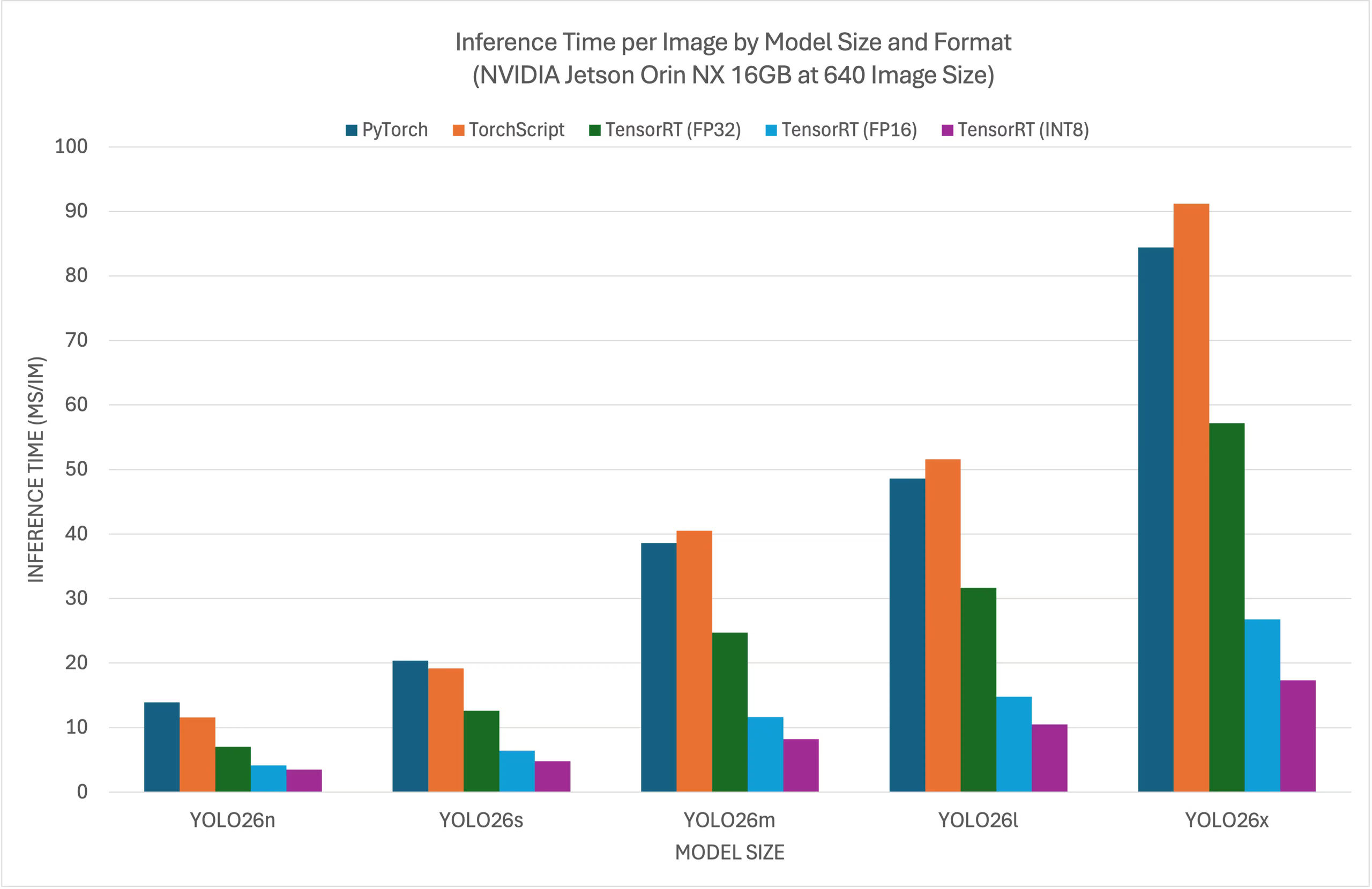
YOLO26 kıyaslamaları, hız ve doğruluğu ölçmek için Ultralytics ekibi tarafından 11 farklı model biçiminde gerçekleştirildi: PyTorch, TorchScript, ONNX, OpenVINO, TensorRT, TF SavedModel, TF GraphDef, TF Lite, MNN, NCNN, ExecuTorch. Kıyaslamalar; NVIDIA Jetson AGX Thor Developer Kit, NVIDIA Jetson AGX Orin Developer Kit (64GB), NVIDIA Jetson Orin Nano Super Developer Kit ve Jetson Orin NX 16GB ile güçlendirilmiş Seeed Studio reComputer J4012 cihazında, varsayılan 640 giriş görüntüsü boyutunda ve FP32 hassasiyetinde gerçekleştirildi.
Karşılaştırma Grafikleri#
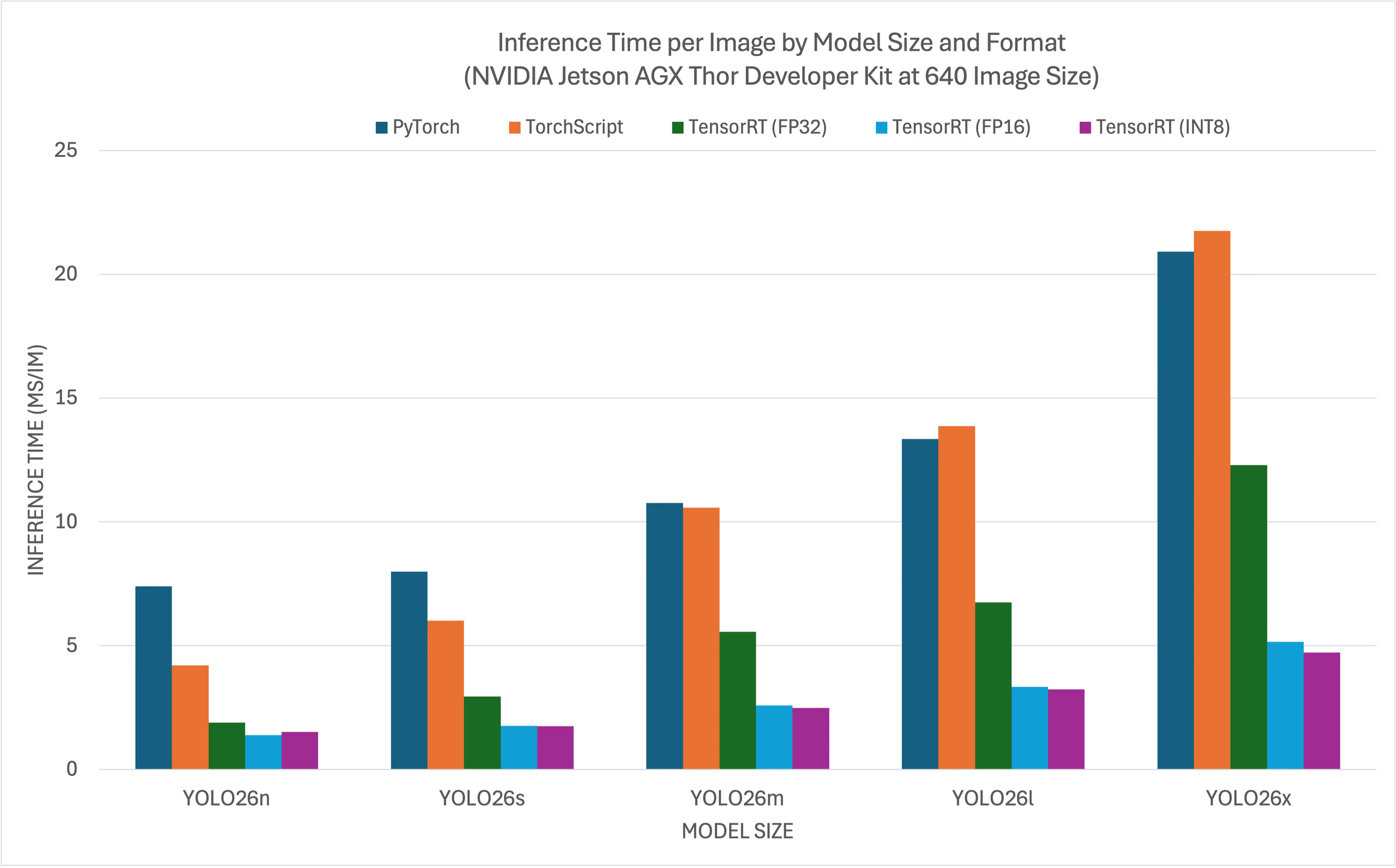
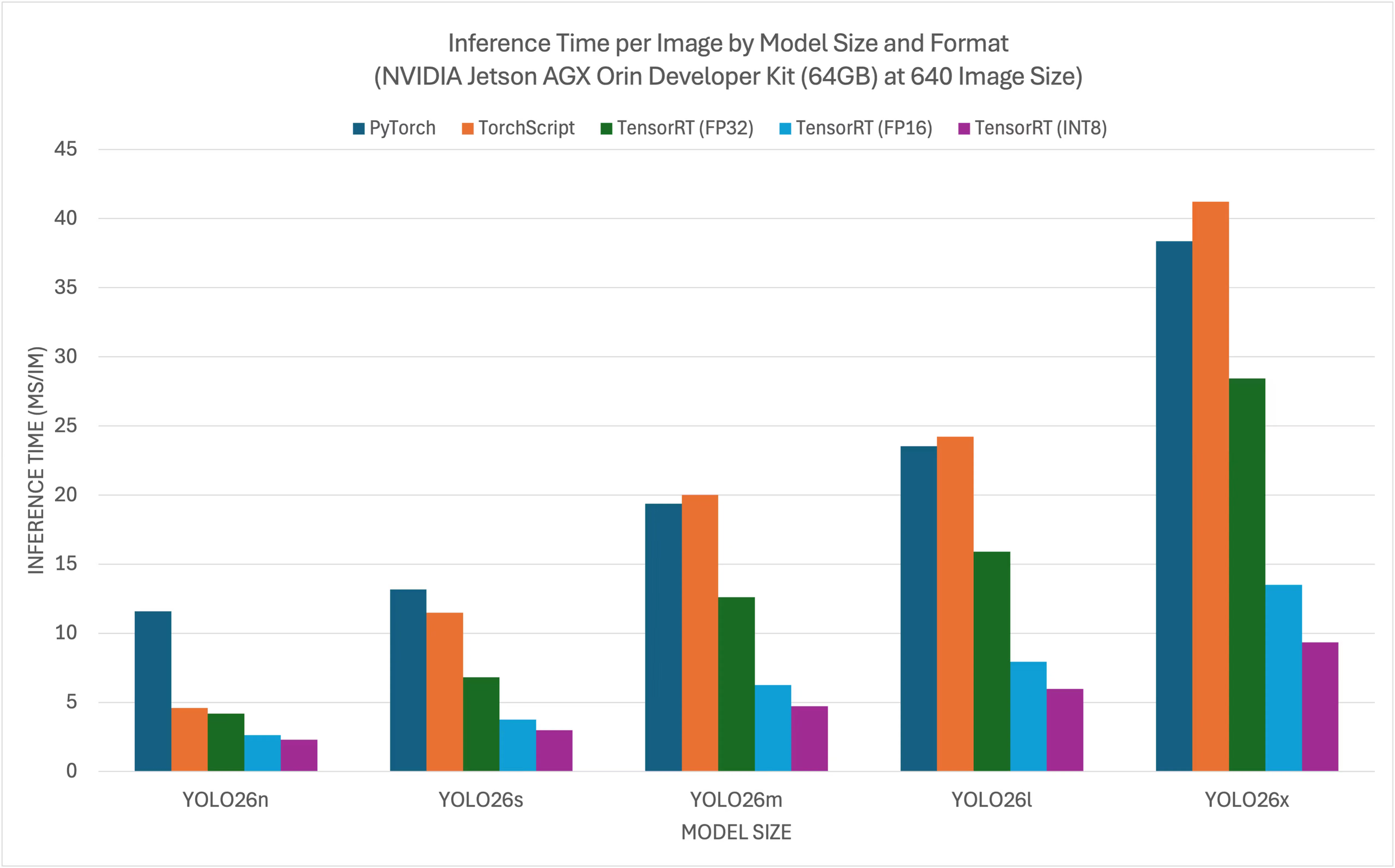
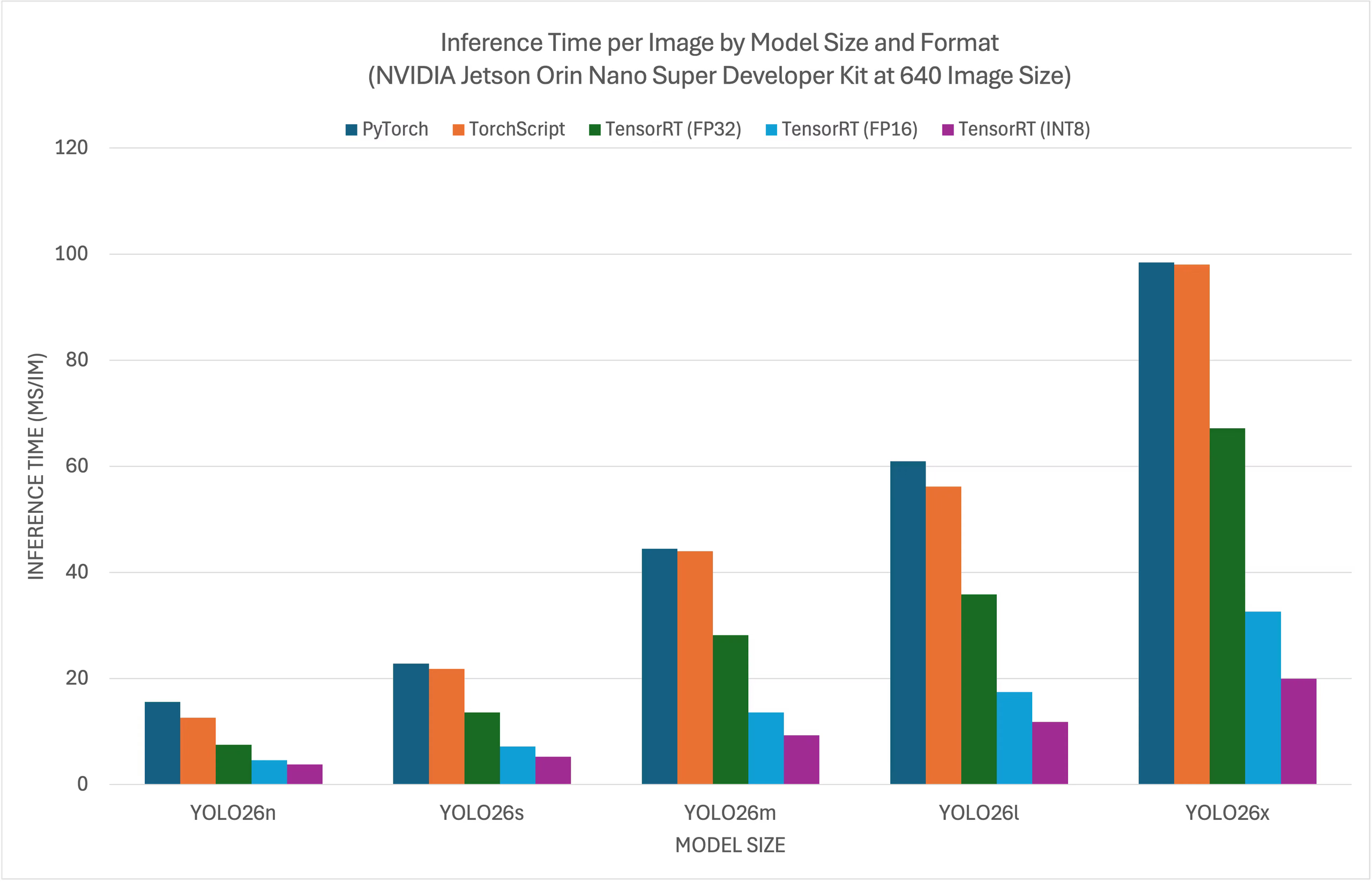
Tüm model dışa aktarımları NVIDIA Jetson üzerinde çalışsa da aşağıdaki karşılaştırma grafiğinde yalnızca PyTorch, TorchScript ve TensorRT yer alır. Tüm dışa aktarma biçimlerine ait kıyaslama sonuçlarını bu grafikten sonraki bölümde bulabilirsin.
NVIDIA Jetson AGX Thor Geliştirici Kiti#
NVIDIA Jetson AGX Orin Geliştirici Kiti (64GB)#
NVIDIA Jetson Orin Nano Super Geliştirici Kiti#
NVIDIA Jetson Orin NX 16GB#
Ayrıntılı Karşılaştırma Tabloları#
Aşağıdaki tabloda beş farklı YOLO26 modelinin (YOLO26n, YOLO26s, YOLO26m, YOLO26l, YOLO26x) 11 farklı biçimdeki (PyTorch, TorchScript, ONNX, OpenVINO, TensorRT, TF SavedModel, TF GraphDef, TF Lite, MNN, NCNN, ExecuTorch) kıyaslama sonuçları gösterilir. Her birleşim için durum, boyut, mAP50-95(B) metriği ve çıkarım süresi verilir.
NVIDIA Jetson AGX Thor Geliştirici Kiti#
| Biçim | Durum | Diskteki boyut (MB) | mAP50-95(B) | Çıkarım süresi (ms/im) |
|---|---|---|---|---|
| PyTorch | ✅ | 5.3 | 0.4798 | 7.39 |
| TorchScript | ✅ | 9.8 | 0.4789 | 4.21 |
| ONNX | ✅ | 9.5 | 0.4767 | 6.58 |
| OpenVINO | ✅ | 10.1 | 0.4794 | 17.50 |
| TensorRT (FP32) | ✅ | 13.9 | 0.4791 | 1.90 |
| TensorRT (FP16) | ✅ | 7.6 | 0.4797 | 1.39 |
| TensorRT (INT8) | ✅ | 6.5 | 0.4273 | 1.52 |
| TF SavedModel | ✅ | 25.7 | 0.4764 | 47.24 |
| TF GraphDef | ✅ | 9.5 | 0.4764 | 45.98 |
| TF Lite | ✅ | 9.9 | 0.4764 | 182.04 |
| MNN | ✅ | 9.4 | 0.4784 | 21.83 |
Ultralytics 8.4.7 ile kıyaslandı
Çıkarım süresine ön/son işleme dahil değildir.
NVIDIA Jetson AGX Orin Geliştirici Kiti (64GB)#
| Biçim | Durum | Diskteki boyut (MB) | mAP50-95(B) | Çıkarım süresi (ms/im) |
|---|---|---|---|---|
| PyTorch | ✅ | 5.3 | 0.4790 | 11.58 |
| TorchScript | ✅ | 9.8 | 0.4770 | 4.60 |
| ONNX | ✅ | 9.5 | 0.4770 | 9.87 |
| OpenVINO | ✅ | 9.6 | 0.4820 | 28.80 |
| TensorRT (FP32) | ✅ | 11.5 | 0.4770 | 4.18 |
| TensorRT (FP16) | ✅ | 7.9 | 0.4789 | 2.62 |
| TensorRT (INT8) | ✅ | 5.4 | 0.4640 | 2.30 |
| TF SavedModel | ✅ | 24.6 | 0.4760 | 71.10 |
| TF GraphDef | ✅ | 9.5 | 0.4760 | 70.02 |
| TF Lite | ✅ | 9.9 | 0.4760 | 227.94 |
| MNN | ✅ | 9.4 | 0.4760 | 32.46 |
| NCNN | ✅ | 9.3 | 0.4810 | 29.93 |
Ultralytics 8.4.32 ile kıyaslandı
Çıkarım süresine ön/son işleme dahil değildir.
NVIDIA Jetson Orin Nano Super Geliştirici Kiti#
| Biçim | Durum | Diskteki boyut (MB) | mAP50-95(B) | Çıkarım süresi (ms/im) |
|---|---|---|---|---|
| PyTorch | ✅ | 5.3 | 0.4790 | 15.60 |
| TorchScript | ✅ | 9.8 | 0.4770 | 12.60 |
| ONNX | ✅ | 9.5 | 0.4760 | 15.76 |
| OpenVINO | ✅ | 9.6 | 0.4820 | 56.23 |
| TensorRT (FP32) | ✅ | 11.3 | 0.4770 | 7.53 |
| TensorRT (FP16) | ✅ | 8.1 | 0.4800 | 4.57 |
| TensorRT (INT8) | ✅ | 5.3 | 0.4490 | 3.80 |
| TF SavedModel | ✅ | 24.6 | 0.4760 | 118.33 |
| TF GraphDef | ✅ | 9.5 | 0.4760 | 116.30 |
| TF Lite | ✅ | 9.9 | 0.4760 | 286.00 |
| MNN | ✅ | 9.4 | 0.4760 | 68.77 |
| NCNN | ✅ | 9.3 | 0.4810 | 47.50 |
Ultralytics 8.4.33 ile kıyaslandı
Çıkarım süresine ön/son işleme dahil değildir.
NVIDIA Jetson Orin NX 16GB#
| Biçim | Durum | Diskteki boyut (MB) | mAP50-95(B) | Çıkarım süresi (ms/im) |
|---|---|---|---|---|
| PyTorch | ✅ | 5.3 | 0.4799 | 13.90 |
| TorchScript | ✅ | 9.8 | 0.4787 | 11.60 |
| ONNX | ✅ | 9.5 | 0.4763 | 14.18 |
| OpenVINO | ✅ | 9.6 | 0.4819 | 40.19 |
| TensorRT (FP32) | ✅ | 11.4 | 0.4770 | 7.01 |
| TensorRT (FP16) | ✅ | 8.0 | 0.4789 | 4.13 |
| TensorRT (INT8) | ✅ | 5.5 | 0.4489 | 3.49 |
| TF SavedModel | ✅ | 24.6 | 0.4764 | 92.34 |
| TF GraphDef | ✅ | 9.5 | 0.4764 | 92.06 |
| TF Lite | ✅ | 9.9 | 0.4764 | 254.43 |
| MNN | ✅ | 9.4 | 0.4760 | 48.55 |
| NCNN | ✅ | 9.3 | 0.4805 | 34.31 |
Ultralytics 8.4.33 ile kıyaslandı
Çıkarım süresine ön/son işleme dahil değildir.
Farklı NVIDIA Jetson donanım sürümlerinde çalışan Seeed Studio'nun diğer kıyaslama çalışmalarını keşfet.
Sonuçlarımızı Yeniden Üretme#
Yukarıdaki Ultralytics kıyaslamalarını tüm dışa aktarma formatlarında yeniden üretmek için şu kodu çalıştır:
from ultralytics import YOLO

# YOLO26n PyTorch modelini yükle
model = YOLO("yolo26n.pt")

# COCO128 veri kümesinde YOLO26n hızını ve doğruluğunu tüm dışa aktarma formatları için kıyasla
results = model.benchmark(data="coco128.yaml", imgsz=640)
Kıyaslama sonuçlarının sistemin tam donanım ve yazılım yapılandırmasına ve kıyaslamalar çalıştırılırken sistemin mevcut iş yüküne göre değişebileceğini unutma. En güvenilir sonuçlar için çok sayıda görüntü içeren bir veri kümesi kullan; örneğin data='coco.yaml' (5000 doğrulama görüntüsü).
NVIDIA Jetson Kullanımı için En İyi Uygulamalar#
NVIDIA Jetson'da YOLO26'dan en yüksek performansı almak için bu en iyi uygulamaları izle.
-
MAX Güç Modunu Etkinleştir
Jetson'da MAX Power Mode'u etkinleştirmek, tüm CPU ve GPU çekirdeklerinin açık olmasını sağlar.
sudo nvpmodel -m 0 -
Jetson Clocks'u Etkinleştir
Jetson Clocks'u etkinleştirmek, tüm CPU ve GPU çekirdeklerinin en yüksek frekansta çalışmasını sağlar.
sudo jetson_clocks -
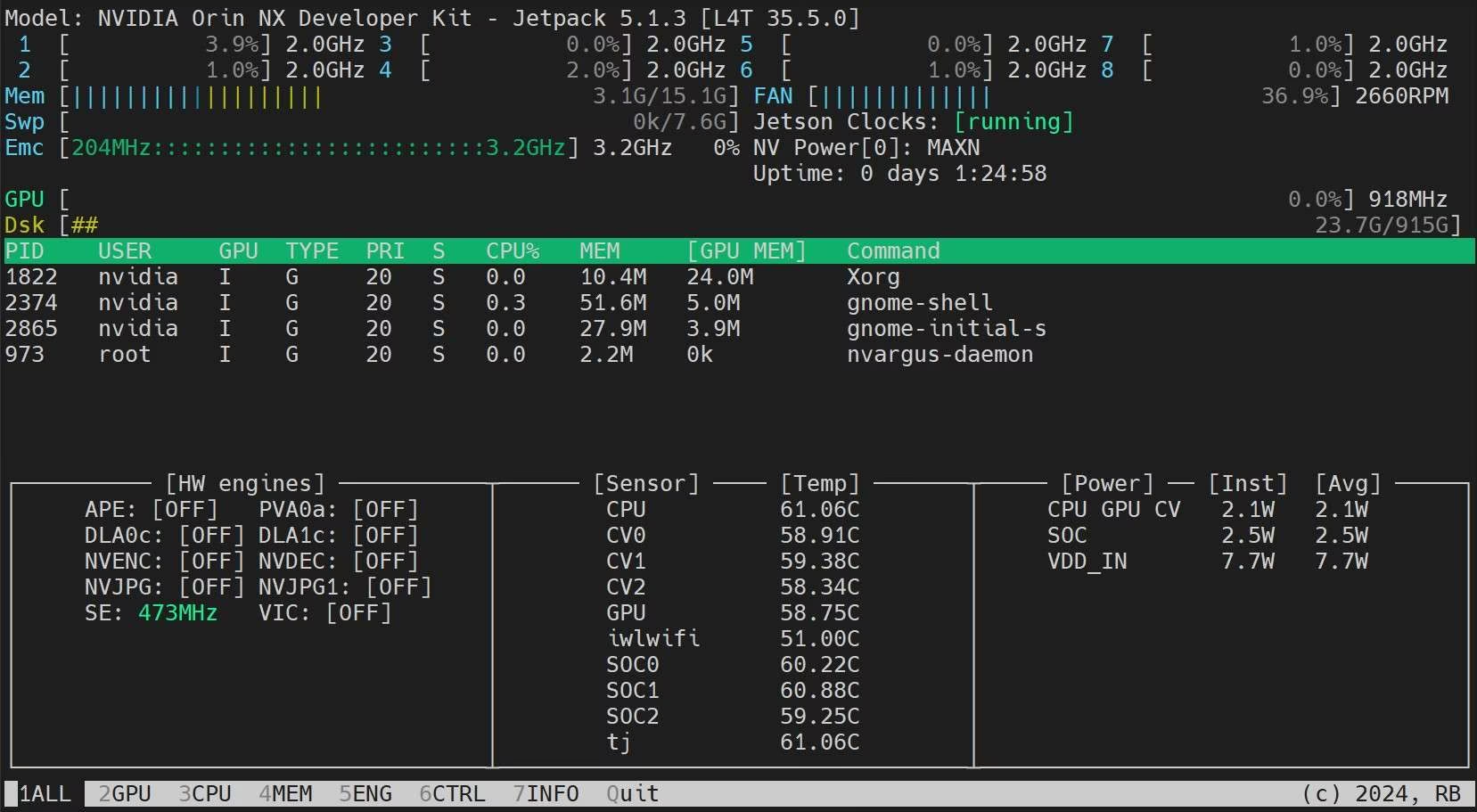
Jetson Stats Uygulamasını Yükle
Sistem bileşenlerinin sıcaklıklarını izlemek, CPU, GPU ve RAM kullanımını görüntülemek, güç modlarını değiştirmek, maksimum saat hızlarını ayarlamak ve JetPack bilgilerini kontrol etmek için jetson-stats uygulamasını kullan.
sudo apt update
sudo pip install jetson-stats
sudo reboot
jtop
NVIDIA Jetson için Bellek Optimizasyonu İpuçları#
Kullanılabilir bellek, özellikle Jetson Orin Nano (8 GB) veya Orin NX 8 GB gibi belleği az olan Jetson cihazlarında genellikle sınırlayıcı etkendir. Aşağıdaki ipuçları, bir arada uygulandığında yüzlerce megabayt bellek boşaltabilecek ve daha büyük YOLO modellerini çalıştırmanı ya da ek paralel iş yüklerini desteklemeni sağlayabilecek pratik, düşük riskli değişikliklerdir. Kapsamlı bilgi için Jetson'da bellek verimliliğini en üst düzeye çıkarmaya yönelik NVIDIA blog yazısına göz at.
1. Başsız (GUI'siz) Önyüklemeye Geç#
Jetson'ına SSH üzerinden bağlanıyorsan veya ekrana bağlı olmadan bir üretim cihazı olarak çalıştırıyorsan, masaüstü ortamını ve görüntü sunucusunu kaldırarak 865 MB'a kadar RAM kazanabilirsin:
sudo systemctl set-default multi-user.target
sudo reboot
Masaüstünü daha sonra geri yüklemek için:
sudo systemctl set-default graphical.target
sudo reboot
2. Kullanılmayan Sistem Hizmetlerini Devre Dışı Bırak#
Gerekli olmayan arka plan hizmetleri (Bluetooth, bağlantı yöneticileri, kullanılmayan donanım arka plan süreçleri) toplamda yaklaşık 32 MB bellek kullanır. Etkin hizmetleri listele ve dağıtımında gerekmeyenleri devre dışı bırak:
# List running services
systemctl list-units --type=service --state=running

# Disable a service
sudo systemctl disable SERVICE_NAME
3. Bellek Kullanımını Profille#
Optimizasyon yapmadan önce hangi süreçlerin gerçekten RAM kullandığını belirle. procrank, süreçleri PSS'ye (Orantılı Küme Boyutu) göre sıralar; PSS, bir sürecin diğer süreçlerle paylaşılan sayfalar dahil eşlenmiş toplam fiziksel RAM sayfalarını ifade eden RSS'den (Yerleşik Küme Boyutu) farklı olarak, süreç başına gerçek bellek ayak izini daha doğru yansıtır:
git clone https://github.com/csimmonds/procrank_linux.git
cd procrank_linux && make
sudo ./procrank
Süreç başına GPU ve NvMap (CUDA/video işlem hattı) bellek ayırmalarını görmek için:
sudo cat /sys/kernel/debug/nvmap/iovmm/clients4. Üretimde Görüntü Olmadan Çıkarım Çalıştır#
Canlı önizleme gerektirmeyen çıkarım işlem hatlarında, görüntüyle ilgili bileşenleri (Tiler, OSD, DisplaySink) devre dışı bırakmak yalnızca işlem hattından 200+ MB kazandırabilir. Ultralytics YOLO ile görüntüleyiciyi kapat ve sonuçları bunun yerine diske yaz:
from ultralytics import YOLO

model = YOLO("yolo26n.engine")

# show=False herhangi bir görüntü penceresinin açılmasını önler; save=True açıklama eklenmiş çıktıyı diske yazar
results = model.predict(source="video.mp4", show=False, save=True)
Toplam Etki#
| Optimizasyon | Yaklaşık Kazanılan Bellek |
|---|---|
| Masaüstü GUI'sini devre dışı bırak | ~865 MB |
| Kullanılmayan işletim sistemi hizmetlerini devre dışı bırak | ~32 MB |
| Başsız çıkarım işlem hattı (görüntü yok) | ~200+ MB |
| Toplam (kolay kazanımlar) | ~1 GB+ |
Bu değişiklikleri bir arada uygulamak, belleğin sınırlı olduğu cihazlarda TensorRT INT8 modellerini hedeflerken özellikle yararlıdır; daha büyük bir model varyantını belleğe sığdırıp sığdıramaman arasındaki farkı yaratabilir.
Sonraki Adımlar#
Daha fazla bilgi ve destek için Ultralytics YOLO26 Belgeleri sayfasına göz at.
Sık Sorulan Sorular#
Ultralytics YOLO26'yı NVIDIA Jetson cihazlarına dağıtmak için önce NVIDIA JetPack SDK ile Jetson cihazını flaşla. Ardından hızlı kurulum için önceden oluşturulmuş bir Docker görüntüsü kullan veya gerekli paketleri elle yükle.
YOLO26 modelleri NVIDIA Jetson AGX Thor, AGX Orin, Orin Nano Super ve Orin NX cihazlarında kıyaslanmıştır ve TensorRT biçimi en iyi çıkarım performansını sunar. Ayrıntılı Karşılaştırma Tabloları bölümünde her model ve dışa aktarma biçimi için mAP50-95 ile çıkarım süresi listelenir.
TensorRT, modeli Jetson'ın GPU'su için optimize ederek tüm dışa aktarma biçimleri arasında en hızlı çıkarımı sağladığından, NVIDIA Jetson üzerinde YOLO26 modellerini dağıtmak için önerilir.
NVIDIA Jetson'a PyTorch ve Torchvision yüklemek için önce pip aracılığıyla yüklenmiş olabilecek mevcut sürümleri kaldır. Ardından Jetson'ın ARM64 mimarisiyle uyumlu PyTorch ve Torchvision sürümlerini elle yükle. Bu süreçle ilgili ayrıntılı talimatları PyTorch ve Torchvision'ı Yükleme bölümünde bulabilirsin.
YOLO26 ile NVIDIA Jetson'da performansı en üst düzeye çıkarmak için şu en iyi uygulamaları izle:
- Tüm CPU ve GPU çekirdeklerinden yararlanmak için MAX Güç Modunu etkinleştir.
- Tüm çekirdekleri en yüksek frekanslarında çalıştırmak için Jetson Clocks'u etkinleştir.
- Sistem ölçümlerini izlemek için Jetson Stats uygulamasını yükle.
Komutlar ve ek ayrıntılar için NVIDIA Jetson Kullanımı için En İyi Uygulamalar bölümüne bak.
Kullanılabilir RAM, belleği az olan Jetson cihazlarında genellikle darboğazdır. Bir arada 1 GB'tan fazla bellek kazandırabilecek üç kolay yöntem:
- Başsız önyüklemeye geç (
sudo systemctl set-default multi-user.target) ve masaüstü GUI'sini kaldır (~865 MB kazanım). - Bluetooth veya bağlantı yöneticileri gibi kullanılmayan hizmetleri devre dışı bırak (~32 MB kazanım).
- YOLO
predictçağrındashow=Falseayarlayarak görüntü olmadan çıkarım çalıştır; bu, görüntü işleme hattı için bellek ayrılmasını önler (~200+ MB kazanım).
Süreç başına RAM kullanımını profillemek için
procrank, GPU bellek ayırmalarını incelemek içinsudo cat /sys/kernel/debug/nvmap/iovmm/clientskullan. Tüm ayrıntılar için Bellek Optimizasyonu İpuçları bölümüne göz at.- Başsız önyüklemeye geç (
JetPack 6 ile birlikte sunulan TensorRT 10.3.0'da, NMS içermeyen (
nms=False) veya gömülü NMS (nms=True) çıktılarıyla INT8 motorlarının oluşturulmasını engelleyen bilinen bir sorun vardır. Ultralytics bu birleşimi algıladığında, NMS içermeyen dışa aktarımlar için bire-çok başlığını seçer venms=Truedışa aktarımlarını bir hatayla durdurur.Bu INT8 dışa aktarımlarını yeniden etkinleştirmek için TensorRT'yi daha yeni bir sürüme yükselt (ör. 10.7.0+):
wget https://developer.download.nvidia.com/compute/cuda/repos/ubuntu2204/arm64/cuda-keyring_1.1-1_all.deb
sudo dpkg -i cuda-keyring_1.1-1_all.deb
sudo apt-get update
sudo apt-get install -y tensorrt
Yükseltme işleminden sonra dışa aktarma işlemini yeniden çalıştır. Daha fazla bilgi için GitHub sorunu #23841 ve sorun #26655 sayfalarına bak.


Yorumlar194
Bir soru sor, sonuçlarını paylaş veya başka birine yardım et.
LG973641114
您好,如何用c++在jetson上部署YOLO26,有相关例子吗
1pknowler
Struggling with this on a new Jetson Orin Nano JP6.1. All good following the steps and installs to give torch.cuda.is_available as TRUE. The TensorRT export fails though with a number of dependency errors and I can’t re-install it with anything. Any pointers please?
1 Glenn JocherUltralytics
@pknowler it seems like the dependency errors during TensorRT export might stem from compatibility issues. Please ensure you’ve installed the required JetPack-compatible versions of PyTorch, Torchvision, and TensorRT as outlined in the Jetson Quick Start Guide. Additionally, verify that
onnxruntime-gpuandcuSPARSELtare correctly installed per the guide. If the issue persists, you can try reinstalling TensorRT using the NVIDIA SDK Manager for your JetPack version. Let me know if you need further clarification!Thank you. I will try again working through all of the steps and let you know how it goes!
I’ve tried again but this as far as I get… I have followed everything carefully.
WARNING ⚠️ TensorRT requires GPU export, automatically assigning device=0 Ultralytics 8.3.57 🚀 Python-3.10.16 torch-2.5.0a0+872d972e41.nv24.08 CUDA:0 (Orin, 7620MiB) YOLO11n summary (fused): 238 layers, 2,616,248 parameters, 0 gradients, 6.5 GFLOPs
PyTorch: starting from 'yolo11n.pt' with input shape (1, 3, 640, 640) BCHW and output shape(s) (1, 84, 8400) (5.4 MB)
ONNX: starting export with onnx 1.17.0 opset 19... ONNX: slimming with onnxslim 0.1.46... ONNX: export success ✅ 3.1s, saved as 'yolo11n.onnx' (10.2 MB) requirements: Ultralytics requirement ['tensorrt>7.0.0,!=10.1.0'] not found, attempting AutoUpdate... error: subprocess-exited-with-error
× python setup.py egg_info did not run successfully. │ exit code: 1 ╰─> [6 lines of output] Traceback (most recent call last): File "", line 2, in File "", line 34, in File "/tmp/pip-install-d0ljzl60/tensorrt-cu12_db0552ac431148489703f6f75df6764f/setup.py", line 71, in raise RuntimeError("TensorRT does not currently build wheels for Tegra systems") RuntimeError: TensorRT does not currently build wheels for Tegra systems [end of output]
note: This error originates from a subprocess, and is likely not a problem with pip. error: metadata-generation-failed
× Encountered error while generating package metadata. ╰─> See above for output.
note: This is an issue with the package mentioned above, not pip. hint: See above for details. Retry 1/2 failed: Command 'pip install --no-cache-dir "tensorrt>7.0.0,!=10.1.0" ' returned non-zero exit status 1. error: subprocess-exited-with-error
× python setup.py egg_info did not run successfully. │ exit code: 1 ╰─> [6 lines of output] Traceback (most recent call last): File "", line 2, in File "", line 34, in File "/tmp/pip-install-782zjqf9/tensorrt-cu12_44d261aea7c5489db3e9ce15cec8ee64/setup.py", line 71, in raise RuntimeError("TensorRT does not currently build wheels for Tegra systems") RuntimeError: TensorRT does not currently build wheels for Tegra systems [end of output]
note: This error originates from a subprocess, and is likely not a problem with pip. error: metadata-generation-failed
× Encountered error while generating package metadata. ╰─> See above for output.
note: This is an issue with the package mentioned above, not pip. hint: See above for details.
And I have TensorRT 10.7.0.23-1+cuda12.6
- Glenn JocherUltralytics
@pknowler it seems your TensorRT version is not compatible with the Jetson's ARM64 architecture. TensorRT does not provide pre-built Python wheels for Tegra systems. Please ensure you have TensorRT installed via the NVIDIA SDK Manager as part of the JetPack installation, and confirm compatibility with your JetPack version. The Jetson Quick Start Guide might also help clarify setup specifics. Let me know if further assistance is needed!
@glenn-jocher thank you. I have found the issue now. I am using miniconda and for some reason TensorRT Python bindings are not available in conda envs. So I can import Torch with no problem but the import TensorRT fails. I have re-installed without conda and all works as expected! 👍🏻
RasoulZardeyni
Which one reduce inference time using TensorRT or deepstream?
1 Paula DerrengerUltralytics(düzenlendi)
In terms of reducing inference time on your NVIDIA Jetson device, using TensorRT is generally recommended. TensorRT is specifically designed to provide high performance for NVIDIA hardware by optimizing deep learning models for inference. It accelerates models by fusing layers, pruning unused layers, and quantizing variables, among other optimizations. 🚀
DeepStream, on the other hand, is more focused on streaming analytics and can utilize TensorRT-optimized models. For most cases, directly using TensorRT for model optimization is your go-to for minimizing inference times.
Here's a quick example of exporting a YOLO model to TensorRT and running inference, tailored for your convenience:
from ultralytics import YOLO

# Load your YOLO model
model = YOLO('yolo26n.pt')

# Export to TensorRT format
model.export(format='engine')

# Load the TensorRT model
trt_model = YOLO('yolo26n.engine')

# Run inference using the TensorRT model
results = trt_model('your_image_or_video.jpg')
Feel free to explore more about deploying on NVIDIA Jetson with our Quick Start Guide for NVIDIA Jetson. Happy inferencing! 🌟
2Thanks!
1- Paula DerrengerUltralytics(düzenlendi)
Hey there! 😊 It looks like you're interested in speeding up your inference times. Between TensorRT and DeepStream on NVIDIA Jetson devices, TensorRT typically offers more direct optimization for reducing inference time for individual models by providing lower-level optimizations and quantization options.
DeepStream is a comprehensive framework for building end-to-end video analytics applications, which utilizes TensorRT under the hood for model inference. DeepStream excels in scenarios involving video streams, multi-stream input, and complex pipelines involving multiple AI models and analytics. If your primary goal is solely to minimize inference time for a specific model, direct optimization via TensorRT can provide more focused improvements.
A quick example of exporting a YOLO model to TensorRT:
from ultralytics import YOLO

# Load your YOLO model
model = YOLO('yolo26n.pt')

# Export to TensorRT format
model.export(format='engine')  # This creates 'yolo26n.engine'

# Done! Now you can use 'yolo26n.engine' for faster inference.
However, if your application benefits from a broader video analytics pipeline, incorporating DeepStream into your workflow can optimize and streamline these processes on top of efficiently handling inference with TensorRT optimized models. 🚀
Hope this gives you a clearer picture! If you have more questions, feel free to ask.
1
 Yufeng Wu(düzenlendi)
Hi, ultralytics team. I'm trying yolo26n-pose on Jetson orin agx 64gb and have this problem: I tried building engine with dynamic=true but failed, with the log saying ForeignNode[/model.23/Sigmoid.../model.23/Flatten] (Myelin) Skipping tactic ... Incompatible effective shapes in operation /model_23/Sub between: Unsqueeze_18_output_0 f32[1,2,33600] and Slice_output_0 f32[1,2,21504] Could not find any implementation for node {ForeignNode[/model.23/Sigmoid.../model.23/Flatten]} Is there a way to fix it?
- Glenn JocherUltralytics
This indicates a TensorRT dynamic-shape profile failure in the pose head. As a workaround, export a fixed-resolution engine, e.g.
yolo export model=yolo26n-pose.pt format=engine imgsz=640 batch=1 dynamic=False; build separate engines if multiple resolutions are required. If dynamic shapes are essential, please open a new issue with the full text log,yolo checksoutput, and JetPack/TensorRT/Ultralytics versions so we can reproduce it; see the TensorRT export guide.
 Haotian Gong(düzenlendi)
Hi, everyone,
I'd like to flag two issues with the Jetson installation guide that may need updating.
1. PyTorch 2.10.0 / Torchvision 0.25.0 doesn't work on JetPack 6.1
Following the "Start with naive installation" and "Run on JetPack 6.1" sections, I installed Pytorch 2.10.0 and Torchvision 0.25.0 as instructed.
Running my script then throws:
ImportError: libcublas.so.13: cannot open shared object file: No such file or directorySo I have to install Pytorch 2.8.0 with the guide:
https://forums.developer.nvidia.com/t/jetson-orin-nano-issues-running-yolo-ultralytics-due-to-pytorch-torchvision-compatibility-jetpack-6-x-cuda-12-6/365683/9And this version of Pytorch works. So maybe is the guide on Jetson obsolete or mistaken?
2. CSI camera requires the JetPack-bundled OpenCV, not the PyPI one
On Jetson, using a CSI camera (via
nvarguscamerasrc) requires the OpenCV that ships with JetPack, because the PyPIopencv-pythonwheel on aarch64 is built without GStreamer support.However,
pip install ultralyticspulls inopencv-pythonas a dependency, which shadows the JetPack-bundled version and silently breaks CSI camera pipelines.pip uninstall -y opencv-python opencv-python-headless sudo apt install -y python3-opencv # JetPack-bundled OpenCV with GStreamerThanks!
 Lakshantha DissanayakeUltralytics
Hi @ZephyrKeXiner Could you please double check whether you are using JetPack 6.1 system with CUDA 12.6? I have just verified on my JetPack 6.1 system with CUDA 12.6 with
torch-2.10.0andtorchvision-0.25.0as mentioned in the Ultralytics Jetson Guide and it works well.For JetPack 6.1, output of
cat /etc/nv_tegra_releaseshould look like below:(env) nvidia@ubuntu:~/yolo26/ultralytics$ cat /etc/nv_tegra_release # R36 (release), REVISION: 4.3, GCID: 38968081, BOARD: generic, EABI: aarch64, DATE: Wed Jan 8 01:49:37 UTC 2025 # KERNEL_VARIANT: oot TARGET_USERSPACE_LIB_DIR=nvidia TARGET_USERSPACE_LIB_DIR_PATH=usr/lib/aarch64-linux-gnu/nvidiaCould you also share yours please? Thanks!
cc: @raimbekovm
1- Haotian Gong
Hi @lakshanthad,
My output of
cat /etc/nv_tegra_releaseis below:$ cat /etc/nv_tegra_release # R36 (release), REVISION: 5.0, GCID: 43688277, BOARD: generic, EABI: aarch64, DATE: Fri Jan 16 03:50:45 UTC 2026 # KERNEL_VARIANT: oot TARGET_USERSPACE_LIB_DIR=nvidia TARGET_USERSPACE_LIB_DIR_PATH=usr/lib/aarch64-linux-gnu/nvidiaI notice that the revision is 5.0 not 4.3. Maybe does it cause the error?
smbunn(düzenlendi)
I would have thought the Jetson Orin Nano could do more than 5 streams, the deepstream examples with cars handles 16 streams of 1080p at what appears to be full framerate.
As a control systems engineer by training, edge devices seem a much better way to go so I prefer your jetson design. Even if one Jetson has an issue you are still processing 45 streams whereas a problem on your centralised server in option 2 takes everything down.
Are you going to set up an MQTT feed for alerts from each stream? Maybe consider secondary processing and a buffer, so the edge device detects what it thinks is an issue and a centralised server grabs 5 seconds of video of the incident and double checks.
Simon BUNN
General
From: Yash Patel @.> Sent: Friday, 22 May 2026 4:00 am To: ultralytics/ultralytics @.> Cc: Bunn, Simon @.>; Mention @.> Subject: Re: [ultralytics/ultralytics] guides/nvidia-jetson/ (Discussion #9942)
Hi, I am designing an AI-based CCTV surveillance system for a residential society with 50 RTSP camera streams. My current architecture uses multiple NVIDIA Jetson Orin Nano Super Developer Kit devices for distributed inference processing. I ZjQcmQRYFpfptBannerStart Attention The sender's identity could not be verified and someone may be impersonating the sender. L'identité de l'expéditeur n'a pas pu être vérifiée et quelqu'un pourrait se faire passer pour l'expéditeur.
ZjQcmQRYFpfptBannerEnd
Hi, I am designing an AI-based CCTV surveillance system for a residential society with 50 RTSP camera streams. My current architecture uses multiple NVIDIA Jetson Orin Nano Super Developer Kit devices for distributed inference processing. I estimate that one Jetson Orin Nano Super (8GB) can process around 5 RTSP streams at usable real-time FPS. This requires approximately 10 Jetson devices for the full deployment. Each device costs around ₹33,000 (~USD 395). The total estimated hardware cost is ₹330,000 (~USD 3,950). I want to compare this setup against a centralized Linux-based custom PC/server with NVIDIA GPU acceleration under the same budget. The comparison focuses on AI inference performance, scalability, reliability, and 24/7 operational efficiency. The workload mainly includes multi-stream YOLO/object detection inference on live RTSP feeds. I want to determine which architecture provides the best computation-to-cost ratio for this surveillance use case.
— Reply to this email directly, view it on GitHubhttps://urldefense.com/v3/__https://github.com/orgs/ultralytics/discussions/9942*discussioncomment-17006943__;Iw!!ElGdukoduuk!URiPjKkgDoMT_k2Y6pEd3XMEBGMDjhwgtQmwWXR9F4R4L7ymNloZD79NanOjYVg9YYmaARqyZGbgFv7U15KzgdcU$, or unsubscribehttps://urldefense.com/v3/__https://github.com/notifications/unsubscribe-auth/ABAAMILYUP7PPODNHDR3HC3434RYLAVCNFSM6AAAAABGAK2IGGVHI2DSMVQWIX3LMV43URDJONRXK43TNFXW4Q3PNVWWK3TUHMYTOMBQGY4TIMY__;!!ElGdukoduuk!URiPjKkgDoMT_k2Y6pEd3XMEBGMDjhwgtQmwWXR9F4R4L7ymNloZD79NanOjYVg9YYmaARqyZGbgFv7U1zjhi4YU$. Triage notifications on the go with GitHub Mobile for iOShttps://urldefense.com/v3/__https://apps.apple.com/app/apple-store/id1477376905?ct=notification-email&mt=8&pt=524675__;!!ElGdukoduuk!URiPjKkgDoMT_k2Y6pEd3XMEBGMDjhwgtQmwWXR9F4R4L7ymNloZD79NanOjYVg9YYmaARqyZGbgFv7U13gOq1qb$ or Androidhttps://urldefense.com/v3/__https://play.google.com/store/apps/details?id=com.github.android&referrer=utm_campaign*3Dnotification-email*26utm_medium*3Demail*26utm_source*3Dgithub__;JSUlJSU!!ElGdukoduuk!URiPjKkgDoMT_k2Y6pEd3XMEBGMDjhwgtQmwWXR9F4R4L7ymNloZD79NanOjYVg9YYmaARqyZGbgFv7U1zOl3XaF$. You are receiving this because you were mentioned.Message ID: @.***>
- Glenn JocherUltralytics
5streams on an Orin Nano Super is just a conservative YOLO/Python estimate; with a headless TensorRT or DeepStream pipeline, MAX power mode, andjetson_clocks, higher 1080p stream counts are definitely possible and depend heavily on the model size, input resolution, decode/encode, and any tracking or alert logic you add, so please drop your exactmodel,imgsz, FPS target, and RTSP resolution here and we can help size it more accurately using the Jetson deployment guide and DeepStream Jetson guide.
yashpatel2010
Hi, I am designing an AI-based CCTV surveillance system for a residential society with 50 RTSP camera streams. My current architecture uses multiple NVIDIA Jetson Orin Nano Super Developer Kit devices for distributed inference processing. I estimate that one Jetson Orin Nano Super (8GB) can process around 5 RTSP streams at usable real-time FPS. This requires approximately 10 Jetson devices for the full deployment. Each device costs around ₹33,000 (~USD 395). The total estimated hardware cost is ₹330,000 (~USD 3,950). I want to compare this setup against a centralized Linux-based custom PC/server with NVIDIA GPU acceleration under the same budget. The comparison focuses on AI inference performance, scalability, reliability, and 24/7 operational efficiency. The workload mainly includes multi-stream YOLO/object detection inference on live RTSP feeds. I want to determine which architecture provides the best computation-to-cost ratio for this surveillance use case.
RotatingGiraffe
Hi there, I am trying to run a fine-tuned YOLO26 based model for an OBB task on a Xavier NX running JetPack 5. I am using your container (ultralytics/ultralytics:latest-jetson-jetpack5) and trying to compile from PyTorch to TensorRT. I get the error: "mymodel.pt requires numpy>=1.26.1, however numpy==1.23.5 is installed."
Previously I have successfully the file on my host machine from PT to ONNX, copied ONNX to Jetson and then used tensorrtexec to compile to Engine. But the resulting models did not create any bounding boxes.
I wanted to ask if JetPack 5 even supports Yolo26 or if the model contains some incompatible layers? YOLO11 OBB works fine which I find extra-weird. Or is there likely an error somewhere else in my script?
- Glenn JocherUltralytics
Thanks for posting this here—JetPack 5 on Xavier NX is supported for YOLO26/TensorRT in our Jetson guide, so the
numpy>=1.26.1error points more to an environment/checkpoint mismatch than unsupported OBB layers; please paste the full text traceback andyolo checksoutput, and note that an engine built withtensorrtexeccan still produce empty OBB results if the Ultralytics export metadata/postprocessing is not preserved. Hi there, I tried to create a minimal reproducible example for you, based on what I am doing. I hope it helps with debugging.
The yolo checks you asked for is in the script output, along with the export script. I've also included the bit where I export via trtexex just for the sake of completion - it might very well be possible that I omit required metadata with this. My prefered goal would be that everything works via the Ultralytics Python API, but I had to search for workaround due to the NumPy error when compiling PT files.
I am now using the Ultralytics base image in the MRE which I hoped would be easier to debug for us. The NumPy error persists on the new image. Previously I was using something built upon l4t-ml.
Additionally, ONNX fails with an error ( `GLIBCXX_3.4.29' not found I think it was) but that is not a concern to me since I engine would be my prefered way to go. I have not installed any additional packages and kept it very vanilla (see dockerfile). The MRE also weirdly produced a new error during engine inference, but I'd say lets just focus on getting the Ultralytics native pipeline to work and then maybe all the other issues were just from my workarounds and disappear.
Execution Command
sudo docker compose up --buildDirectory Structure
obb-test-repro/
 ┣ 📂data/
 ┃ ┗ 📜mydataset.yaml
 ┣ 📂models/
 ┃ ┣ 📜my-yolo26m-model.onnx
 ┃ ┗ 📜my-yolo26m-model.pt
 ┣ 📂src/
 ┃ ┗ 📜main.py
 ┣ 📜docker-compose.yml
 ┣ 📜Dockerfile
 ┗ 📜requirements.txt
Dockerfile
FROM ultralytics/ultralytics:latest-jetson-jetpack5

WORKDIR /app

# Copy the test app
COPY src/ ./src/

# Run the test
CMD ["python3", "src/main.py"]
docker-compose.yml
version: '3.8'

services:
  obb-test-jp5:
    image: obb-test:latest
    container_name: obb_test_jp5
    build:
      context: .
      dockerfile: Dockerfile
    runtime: nvidia
    network_mode: host
    ipc: host
    restart: "no"
    volumes:
      - ./models:/app/models
      - ./data:/app/data
    environment:
      - NVIDIA_VISIBLE_DEVICES=all
      - NVIDIA_DRIVER_CAPABILITIES=all
main.py
"""
Minimal OBB model test script.

Behavior:
- Runs `yolo checks` to output environment details.
- Uses files in `/app/models` (container path mapped from `obb-test/models`).
- Expects two files (hard-coded):
  - `/app/models/my-yolo26m-model.pt` (optional) — used for Ultralytics native export
  - `/app/models/my-yolo26m-model.onnx` (optional) — used for trtexec compilation
- Runs both export methods (if files exist) and validates inference on each compiled engine using mydataset dataset.
"""

import logging
import sys
import subprocess
import os
from pathlib import Path
from ultralytics import YOLO

# Configure logging
logging.basicConfig(
    level=logging.INFO,
    format='%(asctime)s - %(levelname)s - %(message)s'
)
logger = logging.getLogger(__name__)


def run_yolo_checks():
    """Execute yolo checks via CLI to log environment details."""
    logger.info("=" * 60)
    logger.info("Environment Verification (yolo checks)")
    logger.info("=" * 60)
    try:
        res = subprocess.run(["yolo", "checks"], capture_output=True, text=True, check=True)
        logger.info("\n" + res.stdout.strip())
    except subprocess.CalledProcessError as e:
        logger.error(f"yolo checks failed:\n{e.stderr}")
    except FileNotFoundError:
        logger.error("yolo CLI command not found. Ensure ultralytics is installed in this environment.")


def test_export_to_engine():
    models_dir = Path("/app/models")
    pt_path = models_dir / "my-yolo26m-model.pt"
    onnx_path = models_dir / "my-yolo26m-model.onnx"
    dataset_yaml = "/app/data/mydataset.yaml"

    logger.info("=" * 60)
    logger.info("Minimal OBB Test - Export & Validation")
    logger.info("=" * 60)

    engines_tested = []

    # Part 1: Ultralytics native export (PT -> Engine)
    if pt_path.exists():
        try:
            logger.info(f"\nRunning Ultralytics native export for: {pt_path.name}")
            model = YOLO(str(pt_path))
            exported = model.export(format="engine", imgsz=1024, device=0, half=True)

            # Resolve the exported engine path
            native_engine = str(exported) if isinstance(exported, (str, Path)) else str(pt_path.with_suffix('.engine'))

            if os.path.exists(native_engine):
                logger.info(f"Ultralytics export successfully produced: {native_engine}")
                engines_tested.append(native_engine)
            else:
                logger.error(f"Ultralytics export completed, but engine file was not found at {native_engine}")
        except Exception as e:
            logger.error(f"Ultralytics native export failed: {e}", exc_info=True)
    else:
        logger.info(f"PT file not found ({pt_path}); skipping Ultralytics native export.")

    # Part 2: trtexec compilation (ONNX -> Engine)
    if onnx_path.exists():
        try:
            logger.info(f"\nRunning trtexec to compile ONNX: {onnx_path.name}")
            trt_engine = str(onnx_path.with_suffix('.trt.engine'))
            cmd = [
                "/usr/src/tensorrt/bin/trtexec",
                f"--onnx={onnx_path}",
                f"--saveEngine={trt_engine}",
                "--fp16",
                "--memPoolSize=workspace:768", # Prevents Out of Memory
            ]
            logger.info(f"Running command: {' '.join(cmd)}")
            res = subprocess.run(cmd, capture_output=True, text=True)

            if res.returncode != 0:
                logger.error("trtexec compilation failed.")
                logger.error(f"trtexec stderr:\n{res.stderr}")
            else:
                if os.path.exists(trt_engine):
                    logger.info(f"trtexec successfully saved engine to {trt_engine}")
                    engines_tested.append(trt_engine)
                else:
                    logger.error(f"trtexec returned success, but engine file was not found at {trt_engine}")
        except Exception as e:
            logger.error(f"trtexec execution failed: {e}", exc_info=True)
    else:
        logger.info(f"ONNX file not found ({onnx_path}); skipping trtexec compilation.")

    if not engines_tested:
        logger.error("\nNo engines are available to test. Exiting validation phase.")
        return False

    # Part 3: Inference Validation
    validation_success = True
    for eng in engines_tested:
        try:
            logger.info(f"\nValidating inference with engine: {eng}")

            model = YOLO(eng, task="obb")
            metrics = model.val(data=dataset_yaml, imgsz=1024, batch=1, verbose=False)

            logger.info(f"Validation metrics for {eng}: mAP50-95={metrics.box.map:.4f}, mAP50={metrics.box.map50:.4f}")
        except Exception as e:
            logger.error(f"Validation failed on {eng}: {e}", exc_info=True)
            validation_success = False

    logger.info("\nExecution complete.")
    return validation_success


if __name__ == "__main__":
    run_yolo_checks()

    try:
        success = test_export_to_engine()
        logger.info("\n" + "=" * 60)
        if success:
            logger.info("✓ Test passed")
        else:
            logger.info("✗ Test failed")
        logger.info("=" * 60)
        sys.exit(0 if success else 1)
    except Exception as e:
        logger.error(f"Unhandled script exception: {e}", exc_info=True)
        sys.exit(1)
Output
obb_test_jp5  | Creating new Ultralytics Settings v0.0.6 file ✅
obb_test_jp5  | View Ultralytics Settings with 'yolo settings' or at '/root/.config/Ultralytics/settings.json'
obb_test_jp5  | Update Settings with 'yolo settings key=value', i.e. 'yolo settings runs_dir=path/to/dir'. For help see https://docs.ultralytics.com/quickstart/#ultralytics-settings.
obb_test_jp5  | 2026-05-14 12:51:35,392 - INFO - ============================================================
obb_test_jp5  | 2026-05-14 12:51:35,392 - INFO - Environment Verification (yolo checks)
obb_test_jp5  | 2026-05-14 12:51:35,392 - INFO - ============================================================
obb_test_jp5  | 2026-05-14 12:51:50,554 - INFO -
obb_test_jp5  | Ultralytics 8.4.50 🚀 Python-3.8.10 torch-2.1.0a0+41361538.nv23.06 CUDA:0 (Xavier, 6833MiB)
obb_test_jp5  | Setup complete ✅ (2 CPUs, 6.7 GB RAM, 91.7/107.6 GB disk)
obb_test_jp5  |
obb_test_jp5  | OS                     Linux-5.10.216-tegra-aarch64-with-glibc2.29
obb_test_jp5  | Environment            Docker
obb_test_jp5  | Python                 3.8.10
obb_test_jp5  | Install                git
obb_test_jp5  | Path                   /ultralytics/ultralytics
obb_test_jp5  | RAM                    6.67 GB
obb_test_jp5  | Disk                   91.7/107.6 GB
obb_test_jp5  | CPU                    ARMv8 Processor rev 0 (v8l)
obb_test_jp5  | CPU count              2
obb_test_jp5  | GPU                    Xavier, 6833MiB
obb_test_jp5  | GPU count              1
obb_test_jp5  | CUDA                   11.4
obb_test_jp5  |
obb_test_jp5  | numpy                  ✅ 1.23.5>=1.23.0
obb_test_jp5  | matplotlib             ✅ 3.7.5>=3.3.0
obb_test_jp5  | opencv-python-headless ✅ 4.13.0.92>=4.6.0
obb_test_jp5  | pillow                 ✅ 10.4.0>=7.1.2
obb_test_jp5  | pyyaml                 ✅ 6.0.3>=5.3.1
obb_test_jp5  | requests               ✅ 2.32.4>=2.23.0
obb_test_jp5  | scipy                  ✅ 1.10.1>=1.4.1
obb_test_jp5  | torch                  ✅ 2.1.0a0+41361538.nv23.6>=1.8.0
obb_test_jp5  | torchvision            ✅ 0.16.2+c6f3977>=0.9.0
obb_test_jp5  | psutil                 ✅ 7.2.2>=5.8.0
obb_test_jp5  | polars                 ✅ 1.8.2>=0.20.0
obb_test_jp5  | ultralytics-thop       ✅ 2.0.19>=2.0.18
obb_test_jp5  | torch                  ✅ 2.1.0a0+41361538.nv23.6!=2.4.0,>=1.8.0; sys_platform == "win32"
obb_test_jp5  | 2026-05-14 12:51:50,562 - INFO - ============================================================
obb_test_jp5  | 2026-05-14 12:51:50,563 - INFO - Minimal OBB Test - Export & Validation
obb_test_jp5  | 2026-05-14 12:51:50,564 - INFO - ============================================================
obb_test_jp5  | 2026-05-14 12:51:50,565 - INFO -
obb_test_jp5  | Running Ultralytics native export for: my-yolo26m-model.pt
obb_test_jp5  | 2026-05-14 12:51:51,353 - ERROR - Ultralytics native export failed: ERROR ❌️ /app/models/my-yolo26m-model.pt requires numpy>=1.26.1, however numpy==1.23.5 is installed.
obb_test_jp5  | Traceback (most recent call last):
obb_test_jp5  |   File "/ultralytics/ultralytics/nn/tasks.py", line 1466, in torch_safe_load
obb_test_jp5  |     ckpt = _load()
obb_test_jp5  |   File "/ultralytics/ultralytics/nn/tasks.py", line 1463, in _load
obb_test_jp5  |     return torch_load(file, map_location="cpu")
obb_test_jp5  |   File "/ultralytics/ultralytics/utils/patches.py", line 181, in torch_load
obb_test_jp5  |     return torch.load(*args, **kwargs)
obb_test_jp5  |   File "/usr/local/lib/python3.8/dist-packages/torch/serialization.py", line 877, in load
obb_test_jp5  |     return _load(opened_zipfile, map_location, pickle_module, **pickle_load_args)
obb_test_jp5  |   File "/usr/local/lib/python3.8/dist-packages/torch/serialization.py", line 1253, in _load
obb_test_jp5  |     result = unpickler.load()
obb_test_jp5  |   File "/usr/local/lib/python3.8/dist-packages/torch/serialization.py", line 1246, in find_class
obb_test_jp5  |     return super().find_class(mod_name, name)
obb_test_jp5  | ModuleNotFoundError: No module named 'numpy._core'
obb_test_jp5  |
obb_test_jp5  | The above exception was the direct cause of the following exception:
obb_test_jp5  |
obb_test_jp5  | Traceback (most recent call last):
obb_test_jp5  |   File "src/minimal.py", line 58, in test_export_to_engine
obb_test_jp5  |     model = YOLO(str(pt_path))
obb_test_jp5  |   File "/ultralytics/ultralytics/models/yolo/model.py", line 76, in __init__
obb_test_jp5  |     super().__init__(model=model, task=task, verbose=verbose)
obb_test_jp5  |   File "/ultralytics/ultralytics/engine/model.py", line 144, in __init__
obb_test_jp5  |     self._load(model, task=task)
obb_test_jp5  |   File "/ultralytics/ultralytics/engine/model.py", line 283, in _load
obb_test_jp5  |     self.model, self.ckpt = load_checkpoint(weights)
obb_test_jp5  |   File "/ultralytics/ultralytics/nn/tasks.py", line 1537, in load_checkpoint
obb_test_jp5  |     ckpt, weight = torch_safe_load(weight)  # load ckpt
obb_test_jp5  |   File "/ultralytics/ultralytics/nn/tasks.py", line 1489, in torch_safe_load
obb_test_jp5  |     raise ModuleNotFoundError(
obb_test_jp5  | ModuleNotFoundError: ERROR ❌️ /app/models/my-yolo26m-model.pt requires numpy>=1.26.1, however numpy==1.23.5 is installed.
obb_test_jp5  | 2026-05-14 12:51:51,382 - INFO -
obb_test_jp5  | Running trtexec to compile ONNX: my-yolo26m-model.onnx
obb_test_jp5  | 2026-05-14 12:51:51,382 - INFO - Running command: /usr/src/tensorrt/bin/trtexec --onnx=/app/models/my-yolo26m-model.onnx --saveEngine=/app/models/my-yolo26m-model.trt.engine --fp16 --memPoolSize=workspace:768
obb_test_jp5  | 2026-05-14 13:21:39,214 - INFO - trtexec successfully saved engine to /app/models/my-yolo26m-model.trt.engine
obb_test_jp5  | 2026-05-14 13:21:39,217 - INFO -
obb_test_jp5  | Validating inference with engine: /app/models/my-yolo26m-model.trt.engine
obb_test_jp5  | Ultralytics 8.4.50 🚀 Python-3.8.10 torch-2.1.0a0+41361538.nv23.06 CUDA:0 (Xavier, 6833MiB)
obb_test_jp5  | Loading /app/models/my-yolo26m-model.trt.engine for TensorRT inference...
obb_test_jp5  | [05/14/2026-13:21:41] [TRT] [I] Loaded engine size: 43 MiB
obb_test_jp5  | [05/14/2026-13:21:45] [TRT] [I] [MemUsageChange] Init cuBLAS/cuBLASLt: CPU +260, GPU +306, now: CPU 648, GPU 5277 (MiB)
obb_test_jp5  | [05/14/2026-13:21:46] [TRT] [I] [MemUsageChange] Init cuDNN: CPU +82, GPU +156, now: CPU 730, GPU 5433 (MiB)
obb_test_jp5  | [05/14/2026-13:21:46] [TRT] [I] [MemUsageChange] TensorRT-managed allocation in engine deserialization: CPU +0, GPU +41, now: CPU 0, GPU 41 (MiB)
obb_test_jp5  | [05/14/2026-13:21:46] [TRT] [I] [MemUsageChange] Init cuBLAS/cuBLASLt: CPU +0, GPU +28, now: CPU 687, GPU 5422 (MiB)
obb_test_jp5  | [05/14/2026-13:21:46] [TRT] [I] [MemUsageChange] Init cuDNN: CPU +0, GPU +32, now: CPU 687, GPU 5454 (MiB)
obb_test_jp5  | [05/14/2026-13:21:46] [TRT] [I] [MemUsageChange] TensorRT-managed allocation in IExecutionContext creation: CPU +0, GPU +92, now: CPU 0, GPU 133 (MiB)
obb_test_jp5  | Setting batch=1 input of shape (1, 3, 1024, 1024)
obb_test_jp5  | 2026-05-14 13:21:54,562 - INFO - generated new fontManager
obb_test_jp5  | val: Fast image access ✅ (ping: 1.1±0.9 ms, read: 479.2±146.1 MB/s, size: 2563.4 KB)
val: Scanning /app/data/labels/rec26.cache... 2940 images, 26 backgrounds, 0 corrupt: 100% ━━━━━━━━━━━━ 2940/2940 14.4Mit/s 0.0s
obb_test_jp5  | 2026-05-14 13:22:01,033 - ERROR - Validation failed on /app/models/my-yolo26m-model.trt.engine: CUDA error: no kernel image is available for execution on the device
obb_test_jp5  | CUDA kernel errors might be asynchronously reported at some other API call, so the stacktrace below might be incorrect.
obb_test_jp5  | For debugging consider passing CUDA_LAUNCH_BLOCKING=1.
obb_test_jp5  | Compile with `TORCH_USE_CUDA_DSA` to enable device-side assertions.
obb_test_jp5  | Traceback (most recent call last):
obb_test_jp5  |   File "src/minimal.py", line 114, in test_export_to_engine
obb_test_jp5  |     metrics = model.val(data=dataset_yaml, imgsz=1024, batch=1, verbose=False)
obb_test_jp5  |   File "/ultralytics/ultralytics/engine/model.py", line 615, in val
obb_test_jp5  |     validator(model=self.model)
obb_test_jp5  |   File "/usr/local/lib/python3.8/dist-packages/torch/utils/_contextlib.py", line 115, in decorate_context
obb_test_jp5  |     return func(*args, **kwargs)
obb_test_jp5  |   File "/ultralytics/ultralytics/engine/validator.py", line 210, in __call__
obb_test_jp5  |     model.warmup(imgsz=(1 if pt else self.args.batch, self.data["channels"], imgsz, imgsz))  # warmup
obb_test_jp5  |   File "/ultralytics/ultralytics/nn/autobackend.py", line 313, in warmup
obb_test_jp5  |     non_max_suppression(warmup_boxes)  # warmup NMS
obb_test_jp5  |   File "/ultralytics/ultralytics/utils/nms.py", line 154, in non_max_suppression
obb_test_jp5  |     i = torchvision.ops.nms(boxes, scores, iou_thres)
obb_test_jp5  |   File "/usr/local/lib/python3.8/dist-packages/torchvision/ops/boxes.py", line 41, in nms
obb_test_jp5  |     return torch.ops.torchvision.nms(boxes, scores, iou_threshold)
obb_test_jp5  |   File "/usr/local/lib/python3.8/dist-packages/torch/_ops.py", line 646, in __call__
obb_test_jp5  |     return self._op(*args, **kwargs or {})
obb_test_jp5  | RuntimeError: CUDA error: no kernel image is available for execution on the device
obb_test_jp5  | CUDA kernel errors might be asynchronously reported at some other API call, so the stacktrace below might be incorrect.
obb_test_jp5  | For debugging consider passing CUDA_LAUNCH_BLOCKING=1.
obb_test_jp5  | Compile with `TORCH_USE_CUDA_DSA` to enable device-side assertions.
obb_test_jp5  |
obb_test_jp5  | 2026-05-14 13:22:01,521 - INFO -
obb_test_jp5  | Execution complete.
obb_test_jp5  | 2026-05-14 13:22:01,524 - INFO -
obb_test_jp5  | ============================================================
obb_test_jp5  | 2026-05-14 13:22:01,526 - INFO - ✗ Test failed
obb_test_jp5  | 2026-05-14 13:22:01,529 - INFO - ============================================================
obb_test_jp5 exited with code 1
Export Device
This is a bit of info on where my ONNX files come from and what my PC environment looks like where I compiled them.
Yolo Checks on the ONNX Export Device
Ultralytics 8.4.48 🚀 Python-3.13.9 torch-2.11.0+cu130 CPU (AMD Ryzen 5 5600G with Radeon Graphics)
Setup complete ✅ (12 CPUs, 15.0 GB RAM, 744.1/878.1 GB disk)

OS                     Linux-6.17.0-23-generic-x86_64-with-glibc2.39
Environment            Linux
Python                 3.13.9
Install                git
Path                   /home/myuser/projects/myproject/.venv/lib/python3.13/site-packages/ultralytics
RAM                    15.01 GB
Disk                   744.1/878.1 GB
CPU                    AMD Ryzen 5 5600G with Radeon Graphics
CPU count              12
GPU                    None
GPU count              None
CUDA                   None

numpy                  ✅ 2.4.4>=1.23.0
matplotlib             ✅ 3.10.9>=3.3.0
opencv-python          ✅ 4.13.0.92>=4.6.0
pillow                 ✅ 12.2.0>=7.1.2
pyyaml                 ✅ 6.0.3>=5.3.1
requests               ✅ 2.33.1>=2.23.0
scipy                  ✅ 1.17.1>=1.4.1
torch                  ✅ 2.11.0>=1.8.0
torch                  ✅ 2.11.0!=2.4.0,>=1.8.0; sys_platform == "win32"
torchvision            ✅ 0.26.0>=0.9.0
psutil                 ✅ 7.2.2>=5.8.0
polars                 ✅ 1.40.1>=0.20.0
ultralytics-thop       ✅ 2.0.19>=2.0.18
Export Code
from ultralytics import YOLO

# 1. Load the model weights
model_path = "my-yolo26m-model.pt"
model = YOLO(model_path)

# 2. Export the model
# Configured for OBB (Oriented Bounding Boxes) and legacy TensorRT compatibility
success = model.export(
    format="onnx",
    imgsz=1024,      # Target resolution
    opset=13,       # ONNX operator set version, also tried 12
    simplify=True,   # I hoped this would help
    task="obb",
    half=False,      # I tried this with True and False
    end2end=False    # For legacy TensorRT support...?
)

print(f"Export successful: {success}")
YOLO26m-obb summary (fused): 175 layers, 23,443,236 parameters, 0 gradients, 71.5 GFLOPs PyTorch: starting from 'my-yolo26m-model.pt' with input shape (1, 3, 1024, 1024) BCHW and output shape(s) (1, 6, 21504) (90.8 MB) ONNX: starting export with onnx 1.21.0 opset 13... ONNX: slimming with onnxslim 0.1.93... ONNX: export success ✅ 2.5s, saved as 'my-yolo26m-model.onnx' (81.3 MB) Export complete (4.3s)Old Container
Jut in case it is relevant, this is the yolo checks of my self-made container which is based on l4t-ml.
root@xaviernx-desktop:/app# yolo checks WARNING ⚠️ user config directory '/root/.config/Ultralytics' is not writable, using '/tmp/Ultralytics'. Set YOLO_CONFIG_DIR to override. Creating new Ultralytics Settings v0.0.6 file ✅ View Ultralytics Settings with 'yolo settings' or at '/tmp/Ultralytics/settings.json' Update Settings with 'yolo settings key=value', i.e. 'yolo settings runs_dir=path/to/dir'. For help see https://docs.ultralytics.com/quickstart/#ultralytics-settings. Ultralytics 8.4.49 🚀 Python-3.8.10 torch-2.0.0+nv23.05 CUDA:0 (Xavier, 6833MiB) Setup complete ✅ (2 CPUs, 6.7 GB RAM, 84.9/107.6 GB disk) OS Linux-5.10.216-tegra-aarch64-with-glibc2.29 Environment Docker Python 3.8.10 Install pip Path /usr/local/lib/python3.8/dist-packages/ultralytics RAM 6.67 GB Disk 84.9/107.6 GB CPU ARMv8 Processor rev 0 (v8l) CPU count 2 GPU Xavier, 6833MiB GPU count 1 CUDA 11.4 numpy ✅ 1.23.5>=1.23.0 matplotlib ✅ 3.7.5>=3.3.0 opencv-python ❌ (not installed)>=4.6.0 pillow ✅ 10.2.0>=7.1.2 pyyaml ✅ 5.3.1>=5.3.1 requests ✅ 2.32.4>=2.23.0 scipy ✅ 1.10.1>=1.4.1 torch ✅ 2.0.0+nv23.5>=1.8.0 torch ✅ 2.0.0+nv23.5!=2.4.0,>=1.8.0; sys_platform == "win32" torchvision ✅ 0.15.1a0+42759b1>=0.9.0 psutil ✅ 5.9.6>=5.8.0 polars ❌ (not installed)>=0.20.0 ultralytics-thop ❌ (not installed)>=2.0.18 Murat Raimbekov
Thanks for the detailed MRE. I reproduced the numpy failure end-to-end with
torch.save/torch.loadand have a verified fix. There are two independent issues here.1.
numpy._core/ "requires numpy>=1.26.1" — root cause and fixYour
.ptwas saved on your PC with numpy 2.x / Python 3.13, so the checkpoint pickle embeds the numpy-2numpy._coremodule path. JetPack 5 on Xavier NX runs Python 3.8, whose maximum numpy is 1.24.x, and Xavier cannot move to JetPack 6 (Orin-only). I verified that even numpy 1.26.x does not fully read such a checkpoint, so "upgrade numpy" is not a real option on JP5.The reliable fix is a small compatibility shim that aliases
numpy._coreto the legacynumpy.core, injected before the model is loaded. I confirmed this loads a numpy-2torch.savecheckpoint correctly under numpy 1.23.5 with the model and all fields intact. Put this at the very top of yourmain.py, beforefrom ultralytics import YOLO:import sys, numpy, numpy.core sys.modules["numpy._core"] = numpy.core for _s in ("multiarray", "numeric", "umath", "_multiarray_umath"): try: sys.modules[f"numpy._core.{_s}"] = __import__(f"numpy.core.{_s}", fromlist=[_s]) except Exception: passAlternatively, fix the checkpoint once on the PC (where numpy 2.x can read it) so the device never needs the shim — load it and re-save it after converting the auxiliary numpy fields, then copy the new
.ptto the Jetson.2. Empty boxes /
CUDA error: no kernel image is available for execution on the deviceThese are separate from numpy:
- The
trtexec-built engine produces no detections because a rawtrtexecengine carries none of the Ultralytics export metadata, so the OBB decoding/post-processing is never applied. Build the engine on the Jetson with Ultralytics directly from the.pt(after applying the shim above) so metadata is embedded:YOLO("model.pt").export(format="engine", imgsz=1024, half=True, device=0). no kernel image is availableis raised insidetorchvision.ops.nmson the GPU: the PyTorch/torchvision inultralytics/ultralytics:latest-jetson-jetpack5is built for Orin (SM 8.7), while Xavier NX is SM 7.2. That is exactly why YOLO11 OBB works in your older l4t-ml-based container (torch 2.0.0+nv23.5) but the official image fails. Recommended path: stay on the container that already works on your Xavier,pip install ultralytics opencv-python-headlessthere, and run the Ultralyticsexport(format="engine")+val()entirely on-device.
TL;DR: the numpy error is a pickle module-path mismatch from the numpy-2 export PC (fix with the shim above — verified), and the empty/CUDA errors are a raw-
trtexecmetadata loss plus a torch/torchvision build that doesn't target Xavier's SM 7.2.1- The
Hi there, thank you for the help! I just recently got around to trying out the shim and now everything works just fine, thank you for your help!
How to run deepstream for YOLO26 models in my jetson orin nano developer kit?
Is there any documentation for deepstream on jetson? I don't want any installation errors of version missmatch.
So give me any perfect guide link so that I will not miss anything while installation and run inference on live RTSP streams
githubwalt(düzenlendi)
Here you go: https://docs.ultralytics.com/guides/deepstream-nvidia-jetson/
Have a look in jtop (info) for your board compute capability (CUDA Arch BIN). If it's also 8.7, then see my posts here above to avoid problems with torch.
- Glenn JocherUltralytics
Adding one detail for
Jetson Orin Nano: keep the versions paired asJetPack 6.1+DeepStream 7.1from the Jetson quick-start and NVIDIA DeepStream getting started; for live RTSP, set theuriindeepstream_app_config.txtto your stream, and if you hit any mismatch please post the full text traceback plusyolo checksoutput here so the team can help. Thanks for your reply. Just onemore doubt to clear. docker pull nvcr.io/nvidia/deepstream:7.1-triton-multiarch
if I use above docker container for my jetpack6.1 so it there is no issue of version missmatch of deepstream right?
is it works very well with Yolo26 deepstream settings which is showing in this doc? https://docs.ultralytics.com/guides/deepstream-nvidia-jetson/
what is your recommendation to run Multiple RTSP streams with deepstream with docker containers or without docker containers manual installation?
- Glenn JocherUltralytics
Yes,
nvcr.io/nvidia/deepstream:7.1-triton-multiarchis the correct DeepStream 7.1 Jetson container forJetPack 6.1, but it still depends on the host having the JetPack BSP and NVIDIA container runtime installed, so it lowers mismatch risk rather than removing it completely; for YOLO26 + RTSP, the DeepStream multi-stream section is the right reference, and I’d suggest native setup first since that’s the install path used in the guide, then move to Docker once your pipeline is stable. (docs.ultralytics.com) Thanks. For native setup Is it good to install deepstream 7.1 while installing jetpack6.1 only?
- Glenn JocherUltralytics
Yes—on
Jetson Orin Nanonative setup,JetPack 6.1+DeepStream 7.1is the correct pairing; installJetPack 6.1first, boot and verify the system, then installDeepStream 7.1separately using the versions listed in the Jetson + YOLO26 guide and the DeepStream on Jetson guide to avoid mismatches.
Installing torch 2.11.0 from the official website pytorch.org on an AGX Orin 64Gb (dev kit) with JP6.2.2 or installing torch 2.10.0 and torchvision 0.25.0 following this page, give complaints about not being compatible with the Compute Capability (CC) of my machine which has 8.7, whatever that means. Only installing the previous versions torch 2.8.0 and torchvision 0.23.0 do work.
I understand that torch needs to be tailored specifically for the Jetson family and that is what this page is all about, so why do I have this issue if I follow the instructions given here? Is it because I am on Jetpack 6.2.2 and here it's 6.1?
I forgot the warning and error output when running a python test script:
UserWarning: Found GPU0 Orin which is of compute capability (CC) 8.7.The following list shows the CCs this version of PyTorch was built for and the hardware CCs it supports:- 8.0 which supports hardware CC >=8.0,<9.0 except {8.7}- 9.0 which supports hardware CC >=9.0,<10.0
torch.AcceleratorError CUDA error: no kernel image is available for execution on the device
- Glenn JocherUltralytics
Thanks, that traceback helps —
CC 8.7is the AGX Orin GPU architecture, andno kernel image is availablemeans the installed PyTorch wheel was built withoutsm_87support. So yes, this is most likely a JetPack/PyTorch wheel mismatch: the native steps in the JetPack 6.1 section don’t necessarily map cleanly toJP6.2.2, even though the page includesJP6.2benchmark coverage. For now I’d stick with the workingtorch 2.8.0+torchvision 0.23.0pair or use the JetPack 6 Docker setup; if you want us to check your exact environment, please postyolo checksand the full text traceback here in the discussion. Thanks, will stick to 2.8 🙂 👍 (I also posted on the guide page https://docs.ultralytics.com/guides/nvidia-jetson/#what-are-the-best-practices-for-maximizing-performance-on-nvidia-jetson-when-using-yolo26 , so you could ignore that if you like, can't delete my post there 😏 )
- Glenn JocherUltralytics
No worries — the duplicate is fine, and if you later confirm a stable
JP6.2.2+ PyTorch pairing on AGX Orin, please add it here so we can reflect it in the Jetson guide. Will do. Now trying to get the most out of the AGX. Experimenting with number of workers on a batch size of 16. So far 12 workers gave memory issues ... I chose 12 because of 12 cores, but that was a little too much. Now running with 8 workers ... so far so good. To be continued 🙂
Hi Glenn, I can confirm a stable JP6.2.2 + Pytorch (torch 2.8.0 and torchvision 0.23.0) on the AGX Orin.