Tencent NCNN Dışa Aktarma
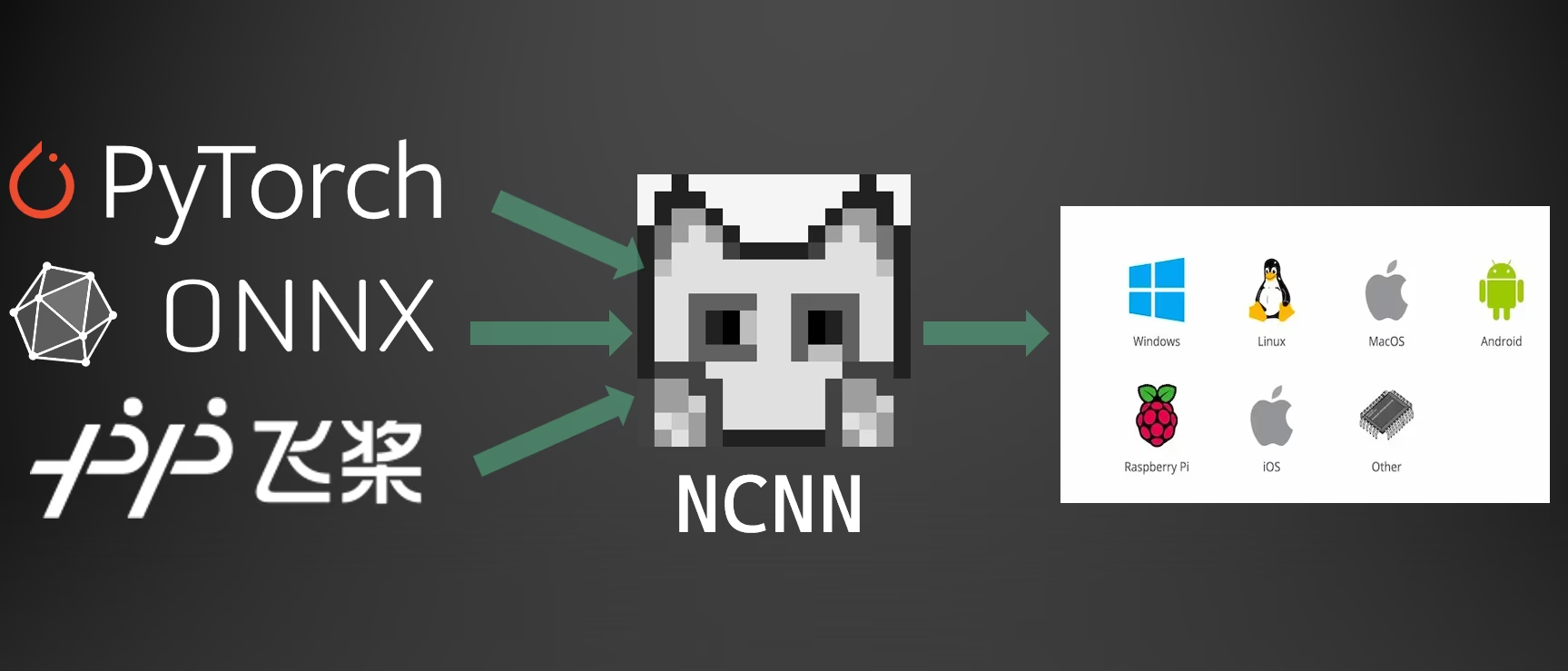
NCNN, Tencent'in telefonlar, gömülü kartlar ve masaüstü bilgisayarlar için açık kaynaklı sinir ağı çıkarım çerçevesidir. Bir Ultralytics YOLO26 modelini format="ncnn" ile dışa aktarmak, ağı .param ve .bin dosya çifti olarak içeren bir yolo26n_ncnn_model/ dizini oluşturur; ağırlıklar FP32 veya FP16 olur.
Genel Bakış#
| Özellik | Ayrıntılar |
|---|---|
format bağımsız değişkeni | ncnn |
| Çıktı | yolo26n_ncnn_model/; model.ncnn.param, model.ncnn.bin, model_ncnn.py ve metadata.yaml dosyalarını içeren bir dizin. |
| Çalıştığı ortamlar | ARM ve x86-64 CPU'lar ile Vulkan sürücülü GPU'lar: telefonlar, Raspberry Pi gibi tek kartlı bilgisayarlar ve masaüstü bilgisayarlar. |
| Çalışma zamanı | NCNN: ncnn Python paketi veya Android, iOS ve gömülü uygulamalardaki NCNN C++ kitaplığı. |
| Kesinlik | FP32 veya FP16 ağırlıklar; INT8 dışa aktarımı yoktur. YOLO26n, FP32'de 9.8 MB, FP16 ağırlıklarla 5.0 MB boyutundadır. |
| Dışa aktarma ana makinesi | pnnx paketinin derlemelerinin bulunduğu platformlar olan Linux x86-64 veya ARM64, macOS ya da Windows x64. Dışa aktarma GPU gerektirmez. |
Ultralytics Platform, eğitilmiş bir modeli senin için NCNN'ye aktarabilir; böylece yerel bir dışa aktarma ortamına ihtiyacın olmaz.
Hızlı Başlangıç#
Ultralytics paketini yükle:
pip install ultralyticsİlk dışa aktarma, eksikse ncnn ve pnnx paketlerini yükler; dışa aktarılan modelle yapılan ilk tahmin de eksikse ncnn paketini yükler. Yeni bir ortamda başka bir şeye gerek yoktur: Restart runtime or rerun command for updates to take effect kaydı verildikten sonra ilk dışa aktarma aynı çalıştırmada tamamlanır. Dışa aktarma için gereken sürümler:
| Paket | Gerekli sürüm |
|---|---|
pnnx | Tam olarak 20260526. Dışa aktarma bu sürümü yükler ve diğer sürümlerin yerini alır. |
ncnn | Herhangi bir sürüm |
torch | 2.0 veya üzeri: Dışa aktarma sürümü denetlemez; eski sürümlerde çıkarım çöktüğünden Ultralytics testleri NCNN'yi bu sürümlerde atlar. |
Diğer yükleme yöntemleri için yükleme kılavuzuna bak. Ardından modelini dışa aktar ve çıkarım yapmak ya da doğruluğunu değerlendirmek için dışa aktarılan dizini yükle.
from ultralytics import YOLO

# YOLO26 modelini yükle
model = YOLO("yolo26n.pt")

# # Modeli NCNN biçimine aktar
model.export(format="ncnn")  # creates 'yolo26n_ncnn_model/'

# Bunun yerine FP16 ağırlıklarla dışa aktar; bu dosya boyutunu yarıya indirir.
model.export(format="ncnn", quantize=16)  # creates 'yolo26n_ncnn_model/'
Her iki dışa aktarma da aynı yolo26n_ncnn_model/ dizinine yazar; dolayısıyla ikincisi ilkinin yerini alır.
from ultralytics import YOLO

# # Dışa aktarılan NCNN modelini yükle
model = YOLO("yolo26n_ncnn_model")

# Çıkarımı çalıştır
results = model("https://ultralytics.com/images/bus.jpg")from ultralytics import YOLO
# # Dışa aktarılan NCNN modelini yükle
model = YOLO("yolo26n_ncnn_model")
# COCO8 veri kümesinde doğruluğu doğrula
metrics = model.val(data="coco8.yaml")Desteklenen Görevler#
NCNN dışa aktarımı, YOLOv8, YOLO11 ve YOLO26 modelleriyle yedi Ultralytics görevinin tümünü destekler: nesne algılama, segmentasyon, semantik segmentasyon, derinlik tahmini, sınıflandırma, poz tahmini ve OBB. Semantik segmentasyon ve derinlik tahmini yalnızca bu başlıkları içeren tek aile olan YOLO26 ile kullanılabilir. YOLOv5u, YOLOv9, YOLOv10 ve YOLO12 nesne algılama modelleri de dışa aktarılır. RT-DETR, YOLO-World ve metin istemli YOLOE modelleri dönüştürülemez; Sınırlamalar ve Sorun Giderme bölümüne bak.
Dışa Aktarma Bağımsız Değişkenleri#
| Bağımsız değişken | Tür | Varsayılan | Açıklama |
|---|---|---|---|
format | str | 'ncnn' | Dışa aktarılan modelin hedef biçimi; çeşitli dağıtım ortamlarıyla uyumluluğu tanımlar. |
imgsz | int veya tuple | 640 | Dışa aktarılan modelde sabitlenen model girdisinin boyutu: kare görüntüler için bir tam sayı veya bir demet (height, width). Belirtilmezse dışa aktarımda kontrol noktasının eğitildiği boyut kullanılır. Resmî YOLO26 kontrol noktalarında nesne algılama, segmentasyon ve poz modelleri ile ADE20K üzerinde önceden eğitilmiş semantik modeller için 640, OBB modelleri ve Cityscapes üzerinde önceden eğitilmiş semantik modeller için 1024, derinlik modelleri için 768, sınıflandırma modelleri için 224 kullanılır. |
quantize | int veya str | None | Kaydedilen ağırlıkların hassasiyeti: 16 (FP16) dosya boyutunu yarıya indirir; 32/belirtilmemiş değeri FP32'dir. 8 hata verir ve quantize=8 ile eğitilmiş bir kontrol noktası NCNN'ye aktarılamaz; Sınırlamalar ve Sorun Giderme bölümüne bak. Bu seçenek, kullanımdan kaldırılmış half bayrağının yerini alır. |
nms | bool, isteğe bağlı | None | NCNN modelleri, harici NMS için her zaman ham tahminleri döndürür. NMS'siz başlık (False) ve gömülü NMS (True) kullanılamaz; Sınırlamalar ve Sorun Giderme bölümüne bak. |
device | str | None | Dönüştürme için modeli izleyen cihaz: cpu (varsayılan; GPU'lu bir makinede de kullanılır), CUDA GPU için 0 veya Apple silicon için mps. |
Biçime özgü dışa aktarma bağımsız değişkenleri arasından NCNN yalnızca bunları kabul eder. Tüm biçimlerde ortak olan bağımsız değişkenler için Dışa aktarma modu belgeleri bölümüne bak.
Kesinlik#
quantize, ağırlıkların model.ncnn.bin içinde nasıl saklanacağını belirler. Boyutlar, imgsz=640 ile dışa aktarılan YOLO26n nesne algılama modeli içindir:
quantize | Ağırlıklar | YOLO26n boyutu |
|---|---|---|
belirtilmemiş veya 32 | FP32 | 9.8 MB |
16 | FP16 | 5.0 MB |
- FP16 ağırlıklar:
quantize=16, ağırlıkları yarı hassasiyette saklar ve kalibrasyon verisi gerektirmez. Girdi ve çıktılarfloat32olarak kalır; bu nedenle FP32 model için yazılmış çıkarım kodu hiçbir değişiklik yapmadan çalışır. - Doğruluk: COCO val2017'de, x86-64 sunucu CPU'sunda YOLO26n'in FP32 ve FP16 NCNN modelleri, ONNX modeli ve PyTorch modeli (
rect=False) aynı 640x640 girdide 40.9 mAPval 50-95 değerine ulaştı. - FP16 hesaplama: NCNN, saklanan ağırlıkların hassasiyetinden bağımsız olarak yarı hassasiyette de hesaplama yapabilir. Apple M4'te her iki dışa aktarım için de varsayılan olarak bu şekilde hesaplama yaptı: tek bir test görüntüsünde, FP32 dışa aktarımının ham kutu koordinatları ONNX modelininkilerden 0.25'ten yüksek güven değerine sahip bağlantı noktalarında en fazla yaklaşık 2.1 piksel farklıydı; ncnn paketi içinde
net.opt.use_fp16_storage = Falseayarlandığında çıktının tamamı modelle 0.01 içinde eşleşti. x86-64 sunucu CPU'sunda, FP32 dışa aktarımının ham çıktıları aynı görüntüde nesne algılama, segmentasyon, derinlik, sınıflandırma, poz ve OBB modelleri için ONNX modelininkilerden 0.03'ten az farklıydı. FP16 ağırlıklarla bu bağlantı noktalarının kutu koordinatları sunucuda ONNX'ten yaklaşık 0.3 piksel, M4'te 1.6 piksel farklıydı. M4'te bu farklar doğruluğu 0.1'den az değiştirdi: COCO128'de Ultralytics doğrulayıcısı, aynı 640x640 girdide FP32 dışa aktarımı için 47.7 mAP 50-95, FP16 ağırlıklar için de 47.7, PyTorch modeli (rect=False) içinse 47.7 verdi.
Çıktı Biçimi#
Dışa aktarma tek bir dizin oluşturur:
| Dosya | İçindekiler |
|---|---|
model.ncnn.param | Metin dosyası olarak ağ grafiği |
model.ncnn.bin | Ağırlıklar |
model_ncnn.py | PNNX'in yazdığı ve modeli ncnn paketiyle rastgele bir girdi üzerinde çalıştıran Python betiği |
metadata.yaml | Ultralytics'in modeli yüklerken okuduğu sınıf adları, görev, görüntü boyutu, yığın boyutu, stride ve dışa aktarma bağımsız değişkenleri |
Dışa aktarım, dizinde silebileceğin bir __pycache__ klasörü de bırakır. Model, in0 adlı ve (3, height, width) şekline sahip tek bir girdi alır: kanalların ilk sırada olduğu, RGB biçiminde tek bir görüntü; float32, 0-1 aralığına ölçeklenmiştir. Toplu iş boyutu yoktur; çıktılarda da toplu iş boyutu bulunmaz. Aşağıdaki şekiller, semantik segmentasyon için Cityscapes kontrol noktası yolo26n-sem.pt dâhil olmak üzere, varsayılan dışa aktarma boyutlarında resmî YOLO26n kontrol noktalarına aittir:
| Görev | Varsayılan imgsz | Çıktılar |
|---|---|---|
| Detect | 640 | out0 (84, 8400) |
| Segment | 640 | out0 (116, 8400) ve out1 (32, 160, 160) |
| Anlamsal | 1024 | out0 (19, 1024, 1024), her sınıf ve piksel için bir skor |
| Derinlik | 768 | out0 (1, 768, 768), derinlik haritası |
| Sınıflandırma | 224 | out0 (1000,), sınıf olasılıkları |
| Poz | 640 | out0 (56, 8400) |
| OBB | 1024 | out0 (20, 21504) |
- Ham tahminler: nesne algılama, segmentasyon, poz ve OBB modelleri, toplu iş boyutu olmadan, varsayılan bir ONNX dışa aktarımıyla aynı ham tahminleri döndürür: her bağlantı noktası için girdi piksellerindeki kutu merkezi x, merkez y, genişlik ve yükseklik; ardından sınıf skorları ve göreve özgü değerler (32 maske katsayısı, 17 x 3 anahtar nokta değeri veya radyan cinsinden OBB açısı). NMS'yi kendin uygula.
- Segmentasyon:
out0tahminleri,out1ise maske prototiplerini içerir. - Anlamsal segmentasyon: çıktı, ONNX dışa aktarımındaki sınıf haritasını değil, her sınıf ve piksel için bir skor içerir. Bu nedenle kendi kodunda sınıf ekseni üzerinde argmax uygula.
- NMS: NMS'siz veya gömülü NMS çıktısı yoktur; Sınırlamalar ve Sorun Giderme bölümüne bak.
YOLO("yolo26n_ncnn_model"), düzeni metadata.yaml üzerinden okur, toplu iş boyutunu ekler ve NMS uygular; bu nedenle modeli kendi kodunda çalıştırırken yalnızca bu ayrıntıları bilmen gerekir. metadata.yaml anahtarları arasında names, task, imgsz, stride, batch, end2end, args ve poz modelleri için kpt_shape bulunur.
ncnn Paketiyle Çalıştırma#
Modeli Ultralytics paketi dışında çalıştırmak için iki dosyayı ncnn Python paketiyle yükle. Aynı .param ve .bin dosyaları Android, iOS ve gömülü Linux'taki NCNN C++ kitaplığında da yüklenir.
# Export first: yolo export model=yolo26n.pt format=ncnn
import ncnn
import numpy as np

net = ncnn.Net()
net.opt.num_threads = 4  # model yüklenmeden önce seçenekleri ayarla
assert net.load_param("yolo26n_ncnn_model/model.ncnn.param") == 0
assert net.load_model("yolo26n_ncnn_model/model.ncnn.bin") == 0

image = np.zeros((3, 640, 640), dtype=np.float32)  # letterbox uygulanmış görüntün: RGB, CHW, 0-1
with net.create_extractor() as ex:
    ex.input("in0", ncnn.Mat(image).clone())
    _, out0 = ex.extract("out0")
predictions = np.array(out0)  # şekil (84, 8400), NMS gerektiren ham tahminler
assert predictions.shape == (84, 8400), "export a detection model at imgsz=640"ncnn.Mat(image), NumPy dizisinin belleğini kopyalamadan okur; bu nedenle C-contiguous bir float32 dizisi geçir ve çıkarım tamamlanana kadar diziyi bellekte tut ya da yukarıdaki gibi .clone() ile kopyala. transpose ile oluşturulan bir dizi bitişik değildir; astype veya sonrasında yapılan bir bölme de bu düzeni korur. Bu nedenle ön işlemeyi np.ascontiguousarray(x, dtype=np.float32) ile tamamla. Bu modelle yapılan bir testte bitişik olmayan bir dizi hata vermeden çalıştı, ancak yanlış tahminler döndürdü; float64 dizisi ise Python'ın çökmesine neden oldu.
Dağıt#
Hedef cihaza paketi pip install ultralytics ile yükle ve yolo26n_ncnn_model/ dizinini cihaza kopyala. Ardından YOLO("yolo26n_ncnn_model"), Ultralytics'in ilk kullanımda yüklediği ncnn Python paketiyle modeli çalıştırır. device bağımsız değişkeni, NCNN'in nerede çalışacağını belirler:
device | Modelin çalıştığı yer |
|---|---|
belirtilmemiş veya cpu | CPU'da NCNN |
vulkan:0, vulkan:1, ... | Bu dizindeki Vulkan cihazında NCNN; Vulkan GPU Çıkarımı bölümüne bak |
CUDA GPU'lu bir makinede 0 | CPU'da NCNN: NCNN'in CUDA arka ucu yoktur |
Apple silicon'da mps | CPU'da NCNN; Ultralytics ise ön ve son işlemeyi Apple GPU'sunda yapar. M4'te bu, ilk görüntünün işlenmesine yaklaşık 0.6 saniye ekledi ve çıkarımı hızlandırmadı; bu nedenle device değerini belirtme |
- Sabit girdi şekli: model her zaman dışa aktarımdaki
imgszdeğerinde çalışır; bu değeri Ultralytics,metadata.yamlüzerinden okur.predictveyavaliçin geçirilenimgszdikkate alınmaz. Görüntü boyutunu değiştirmek için modeli yeniden dışa aktar. - Toplu işler: model tek bir görüntü alır ve Ultralytics, toplu işteki görüntüleri sırayla çalıştırır; bu nedenle istediğin sayıda görüntü kullanabilirsin.
val, geçirdiğin değerden bağımsız olarakbatch=1değerini ayarlar. - CPU iş parçacıkları: NCNN iş parçacığı sayısını kendi belirler ve Ultralytics bunu değiştirmez: Apple M4'te performans çekirdeği sayısı olan 4 iş parçacığı kullanılır. Çok sayıda çekirdeği olan makineler için Sınırlamalar ve Sorun Giderme bölümüne bak.
Vulkan GPU Çıkarımı#
NCNN, GPU'larda Vulkan üzerinden çalışır. Vulkan, CUDA olmadan AMD, Intel, ARM, Qualcomm ve Apple gibi GPU üreticilerinin donanımlarında kullanılabilir. İlk Vulkan cihazı için device="vulkan:0", ikinci cihaz için vulkan:1 değerini geçir:
from ultralytics import YOLO

# # Dışa aktarılan NCNN modelini yükle
model = YOLO("yolo26n_ncnn_model")

# İlk Vulkan cihazında çıkarım çalıştır
results = model("https://ultralytics.com/images/bus.jpg", device="vulkan:0")
GPU'nun bir Vulkan sürücüsüne ihtiyacı vardır; güncel GPU sürücülerinin çoğunda bu bulunur. Linux'ta vulkaninfo, yüklü sürücüleri listeler. Dizin, NCNN'in bulduğu Vulkan cihazlarını sayar; bu cihazların donanımsal GPU olması şart değildir. Sonuca güvenmeden önce cihazları yazdır:
import ncnn

for i in range(ncnn.get_gpu_count()):
    print(i, ncnn.get_gpu_info(i).device_name())
Vulkan her zaman CPU'dan hızlı değildir. Apple M4'te YOLO26n, Vulkan cihazında görüntü başına yaklaşık 31 ms, CPU'da ise yaklaşık 12 ms sürdü. Kendi cihazında her ikisini de ölç.
Dağıtım Kılavuzları#
- Raspberry Pi: Ultralytics'i Raspberry Pi kartlarında kur; kılavuz, NCNN'e dışa aktarımı doğrudan kart üzerinde yapar.
- NVIDIA Jetson: Jetson cihazlarının ARM CPU'sunda NCNN, GPU'larında ise TensorRT kullanılır.
- NCNN derleme talimatları: Android, iOS, Linux, macOS, Windows ve diğer hedefler için NCNN C++ kitaplığını derle.
- GitHub'da NCNN: kaynak kodu, Python paketi ve C++ örnekleri.
- Etkileşimli izleme arayüzü örneği: yalnızca CPU'lu cihazlarda NCNN modellerini çalıştıran bir Ultralytics örneği.
- Model dağıtım seçenekleri: NCNN'i diğer dışa aktarma biçimleriyle karşılaştır.
Sınırlamalar ve Sorun Giderme#
- INT8:
quantize=8,quantize=8 (INT8) is not supported; format='ncnn' supports quantize=16 (FP16), 32 or None (FP32).ile başarısız olur. Dosya boyutunu küçültmek için FP16 veya LiteRT ya da MNN gibi INT8 dışa aktarımını destekleyen bir biçim kullan. quantize=8ile eğitilmiş kontrol noktaları: niceleme farkındalıklı eğitim ile ince ayar yapılan bir kontrol noktasıformat='ncnn' cannot export a QAT model: its Q/DQ ranges are only read by the 'onnx' and 'engine' backendsile başarısız olur. Bunun yerine ince ayara başladığın kontrol noktasını dışa aktar veya ince ayar yapılmış kontrol noktasını ONNX ya da TensorRT biçimine aktar.- NMS'siz başlık: NCNN modelleri her zaman NMS gerektiren ham tahminler döndürür.
nms=Falseile YOLO26 veya YOLOv10 modelinin dışa aktarımıThis export format does not support end2end models, disabling the end2end branch.iletisini günlüğe yazar ve bire-çok başlığı kullanır; örneğin YOLO11 gibi diğer nesne algılama, segmentasyon, poz ve OBB modellerinde iseThis model has no one-to-one head; using one-to-many outputs.iletisini günlüğe yazar. - Gömülü NMS:
nms=True,format=ncnn does not support embedded NMS; exporting native outputs for external NMS.günlüğünü yazar ve ham çıktıyı kaydeder. - Sabit girdi şekli ve toplu iş boyutu:
dynamic=True,argument 'dynamic' is not supported for format='ncnn'ile başarısız olur; 1 dışında birbatchdeğeri deargument 'batch' is not supported for format='ncnn'ile başarısız olur. Görüntü boyutunu değiştirmek için modeli yeniden dışa aktar. - Dönüştürülemeyen modeller: RT-DETR (
rtdetr-l.pt), YOLO-Worldv2 (yolov8s-worldv2.pt) ve metin istemli YOLOE (yoloe-26s-seg.pt) modellerinin dışa aktarımıNCNN failed to load the exported model, it may contain layers NCNN does not support.ile başarısız olur. Sınıflarınıset_classes()ile sabitledikten sonra metin istemli bir YOLOE modelini dışa aktarabilirsin; istemsizyoloe-26s-seg-pf.ptmodeli ise olduğu gibi dışa aktarılır. - PNNX sürümü: dışa aktarım için
pnnx20260526 gerekir ve daha yeni bir sürüm bununla değiştirilir; çünkü PNNX 20260704 ile dönüştürülen modeller çıkarım sırasında çöker. - Otomatik yükleme kapalı:
YOLO_AUTOINSTALL=falsekullanıldığında paketlerin bulunmadığı bir ortamda dışa aktarımNo module named 'ncnn'ile başarısız olur. Paketleripip install --no-deps ncnnvepip install pnnx==20260526ile yükle. - Çok sayıda CPU çekirdeği olan makineler: NCNN iş parçacığı sayısını algıladığı CPU çekirdeklerine göre belirler; Ultralytics bu sayıyı değiştirmez. İki adet 96 çekirdekli AMD EPYC 9655 işlemcili (384 mantıksal CPU) bir paylaşımlı sunucuda 352 iş parçacığı seçti ve YOLO26n,
YOLO()üzerinden görüntü başına yaklaşık 210-630 ms sürdü. Model yüklenmeden önce iş parçacığı sayısı 8'e ayarlandığında süre yaklaşık 34 ms oldu.OMP_NUM_THREADSdeğişkeni ve CPU benzeşimi (taskset) iş parçacığı sayısını değiştirmedi:tasksetile 8 CPU ile sınırlandırıldığında model yine 352 iş parçacığıyla çalıştı ve görüntü başına yaklaşık 230 ms sürdü. Model yüklendikten sonranum_threadsdeğerini değiştirmek çıkarımı yavaşlattı. İş parçacığı sayısını seçmek için modeli ncnn paketi ile çalıştır ve yüklenmeden öncenet.opt.num_threadsdeğerini ayarla. - Eksik model dizini:
model.ncnn.bineksik veya yarım kalmışsa (örneğin cihaza kopyalama kesintiye uğradıysa) Python, izleme çıktısı olmadan bölümleme hatasıyla durur. Çıktının son satırlarında neden belirtilir:fopen yolo26n_ncnn_model/model.ncnn.bin failedveyaModelBin read weight_data failed.model.ncnn.paramiçermeyen bir dizinStopIterationile başarısız olur. Dizini yeniden kopyala. - Dizini olmayan
device="vulkan":IndexError: list index out of rangeile başarısız olur.device="vulkan:0"örneğindeki gibi dizini yaz. - Vulkan cihazı GPU değil: Bu sayfada kullanılan Linux sunucusunda, NCNN'in listelediği tek Vulkan cihazı CPU'da çalışan bir yazılım işleyicisi olan
llvmpipeidi.device="vulkan:0"daha sonra hata vermeden ve GPU olmadan çalışır. Tek cihazı olan bir makinedevulkan:9gibi mevcut olmayan bir dizin de hata vermeden çalışır. - Çıktı dizini: tek bir kontrol noktasının her dışa aktarımı,
quantizeveyaimgszdeğerinden bağımsız olarak aynıyolo26n_ncnn_model/dizinine yazar; dolayısıyla sonraki dışa aktarım öncekinin üzerine yazar. İkisini de saklamak için dizini yeniden adlandır; biçimi Ultralytics bu uzantıyla tanıdığı için adında_ncnn_modelbulunsun; örneğinyolo26n_fp16_ncnn_model/. Bu uzantıyı içermeyen bir dizin veya.paramdosyasının yoluis not a supported model formatile başarısız olur.
Diğer hatalar için Yaygın Sorunlar kılavuzuna bak.
Kıyaslamalar#
Ultralytics, iki ARM platformu için NCNN kıyaslama sonuçları yayımlar. Raspberry Pi 5 kıyaslamaları, YOLO26n ve YOLO26s için NCNN'i yedi başka biçimle karşılaştırır; NVIDIA Jetson kıyaslamalarında ise beş YOLO26 nesne algılama modelinin tümü için NCNN sonuçları bulunur. YOLO26 model sayfasında PyTorch kontrol noktalarının doğruluk değerleri listelenir.
Dışa aktarılan YOLO26 nesne algılama modellerinin boyutları, imgsz=640 değerinde, MB (10^6 bayt) cinsinden model.ncnn.param ile model.ncnn.bin toplamıdır. Dışa aktarma günlüğü tüm dizinin boyutunu MiB cinsinden yazar; YOLO26n için bu değerler 9.4 MB ve 4.8 MB'tır:
| Model | PyTorch | NCNN FP32 | NCNN FP16 |
|---|---|---|---|
| YOLO26n | 5.5 | 9.8 | 5.0 |
| YOLO26s | 20.4 | 38.1 | 19.2 |
| YOLO26m | 44.3 | 81.8 | 41.0 |
| YOLO26l | 53.2 | 99.4 | 49.8 |
| YOLO26x | 118.7 | 223.0 | 111.7 |
16 Kasım 2026'da ultralytics 8.4.215, NCNN 1.0.20261020 ve PNNX 20260526 ile dışa aktarıldı.
NCNN Hakkında#
NCNN, Tencent tarafından geliştirilmiştir ve QQ ile WeChat gibi Tencent uygulamalarında kullanılır. Üçüncü taraf çalışma zamanı bağımlılığı yoktur; CPU'larda ve Vulkan üzerinden GPU'larda çalışır ve PyTorch modellerini Ultralytics'in dışa aktarımında kullandığı PNNX aracıyla dönüştürür. Tam başvuru için NCNN belgeleri bölümüne bak.
Sık Sorulan Sorular#
Model boyutu önemliyse FP16 (
quantize=16) kullan: YOLO26n, FP16 ağırlıklarla 5.0 MB, FP32 ile 9.8 MB'tır ve kalibrasyon verisi gerektirmez. COCO val2017'de YOLO26n, FP16 ağırlıklarla FP32'dekiyle aynı 40.9 mAPval 50-95 değerine ulaştı. FP16 ağırlıklar dosyayı küçültür, modeli hızlandırmaz: NCNN, hesaplama hassasiyetini donanıma göre seçer; Hassasiyet bölümüne bak. Dağıtıma almadan önce dışa aktarılan modeli kendi verilerinde ve cihazında doğrula.pnnxvencnnpaketlerinin 64 bit ARM Linux için derlemeleri vardır; Raspberry Pi kılavuzu da aynıformat="ncnn"komutuyla dışa aktarımı kart üzerinde yapar. Dilersen PC'de dışa aktarım yapıpyolo26n_ncnn_model/dizinini karta kopyalayabilirsin. 32 bit ARM sistemindepnnxiçin derleme yoktur; bu nedenle başka bir makinede dışa aktarım yap.ncnniçin derlemeler vardır, ancak Ultralytics bu sistemde test edilmemiştir.NCNN derleme talimatlarında açıklandığı gibi platformun için NCNN kitaplığını derle veya indir, uygulamaya
model.ncnn.paramilemodel.ncnn.bindosyalarını ekle vein0girdisini Çıktı Biçimi bölümünde açıklandığı şekilde ver. Kodun görüntüye letterbox uygulamalı, ham tahminleri çözümlemeli ve NMS uygulamalıdır. Hazır bir uygulama bileşeni tercih edersen Ultralytics YOLO Flutter eklentisi, Android'de LiteRT dışa aktarımlarını, iOS'ta ise Core ML dışa aktarımlarını çalıştırır.Önce iş parçacığı sayısını kontrol et: NCNN bu sayıyı algıladığı CPU çekirdeklerine göre seçer; bu, yüzlerce çekirdeği olan bir sunucuda çıkarımı yavaşlattı; Sınırlamalar ve Sorun Giderme bölümüne bak. Bu sunucuda 8 iş parçacığıyla YOLO26n görüntü başına yaklaşık 34 ms, hem PyTorch hem de ONNX Runtime ise yaklaşık 13 ms sürdü. NCNN'in 4 iş parçacığı seçtiği Apple M4'te süre yaklaşık 12 ms oldu. x86-64 sunucular için Ultralytics'in kıyasladığı biçimler OpenVINO ve ONNX biçimleridir.


Yorumlar37
Bir soru sor, sonuçlarını paylaş veya başka birine yardım et.
gpsamt(düzenlendi)
I'm testing the use of ncnn on android. I converted a yolov11 model. I've tried every way to adjust the code, but I can't. The detections are not coming out correctly. The ncnn model on windows works as can be seen in the image. I'm sharing my native code in c++. If anyone can help me I'd really appreciate it.
Image detected with yolo predict model=C:\Users\guips\Downloads\best_ncnn_model source="C:\Users\guips\Downloads\brasil\test822.jpg" save_txt=true
#include <jni.h> #include <android/log.h> #include #include #include #include <opencv2/opencv.hpp> #include <ncnn/net.h> // #include <stb_image.h> // Uncomment if using stb_image
#define LOG_TAG "NCNN_DETECTOR" #define LOGD(...) __android_log_print(ANDROID_LOG_DEBUG, LOG_TAG, VA_ARGS) #define LOGI(...) __android_log_print(ANDROID_LOG_INFO, LOG_TAG, VA_ARGS) #define LOGE(...) __android_log_print(ANDROID_LOG_ERROR, LOG_TAG, VA_ARGS)
static ncnn::Net g_net; static std::vectorstd::string g_labels; static bool g_model_loaded = false;
struct Detection { float x, y, width, height; int label; float prob; };
static float sigmoid(float x) { return 1.0f / (1.0f + std::exp(-x)); }
static float calculate_iou(const Detection& a, const Detection& b) { float x1 = std::max(a.x, b.x); float y1 = std::max(a.y, b.y); float x2 = std::min(a.x + a.width, b.x + b.width); float y2 = std::min(a.y + a.height, b.y + b.height);
float inter_area = std::max(0.0f, x2 - x1) * std::max(0.0f, y2 - y1);
float union_area = a.width * a.height + b.width * b.height - inter_area;

return union_area > 0 ? inter_area / union_area : 0.0f;
}
extern "C" JNIEXPORT jboolean JNICALL Java_com_example_ncnnmy_1ok_MainActivity_loadModel( JNIEnv* env, jobject thiz, jstring param_path, jstring bin_path, jstring labels_path) {
const char* param_path_str = env->GetStringUTFChars(param_path, nullptr);
const char* bin_path_str = env->GetStringUTFChars(bin_path, nullptr);
const char* labels_path_str = env->GetStringUTFChars(labels_path, nullptr);

LOGI("Starting model loading...");
LOGD("Param path: %s", param_path_str);
LOGD("Bin path: %s", bin_path_str);
LOGD("Labels path: %s", labels_path_str);

g_net.clear();
g_labels.clear();
g_model_loaded = false;

g_net.opt.num_threads = 4;
g_net.opt.use_vulkan_compute = false;
g_net.opt.use_fp16_packed = false;
g_net.opt.use_fp16_storage = false;
g_net.opt.use_fp16_arithmetic = false;

int ret = g_net.load_param(param_path_str);
if (ret != 0) {
    LOGE("Failed to load .param file (%d)", ret);
    env->ReleaseStringUTFChars(param_path, param_path_str);
    env->ReleaseStringUTFChars(bin_path, bin_path_str);
    env->ReleaseStringUTFChars(labels_path, labels_path_str);
    return JNI_FALSE;
}

ret = g_net.load_model(bin_path_str);
if (ret != 0) {
    LOGE("Failed to load .bin file (%d)", ret);
    env->ReleaseStringUTFChars(param_path, param_path_str);
    env->ReleaseStringUTFChars(bin_path, bin_path_str);
    env->ReleaseStringUTFChars(labels_path, labels_path_str);
    return JNI_FALSE;
}

FILE* fp = fopen(labels_path_str, "r");
if (!fp) {
    LOGE("Failed to open labels file: %s", labels_path_str);
    env->ReleaseStringUTFChars(param_path, param_path_str);
    env->ReleaseStringUTFChars(bin_path, bin_path_str);
    env->ReleaseStringUTFChars(labels_path, labels_path_str);
    return JNI_FALSE;
}

char buffer[256];
while (fgets(buffer, sizeof(buffer), fp) != nullptr) {
    std::string label(buffer);
    label.erase(std::remove(label.begin(), label.end(), '\n'), label.end());
    label.erase(std::remove(label.begin(), label.end(), '\r'), label.end());
    if (!label.empty()) {
        g_labels.push_back(label);
    }
}
fclose(fp);

if (g_labels.empty()) {
    LOGE("No labels loaded from %s", labels_path_str);
    env->ReleaseStringUTFChars(param_path, param_path_str);
    env->ReleaseStringUTFChars(bin_path, bin_path_str);
    env->ReleaseStringUTFChars(labels_path, labels_path_str);
    return JNI_FALSE;
}

LOGI("Model loaded successfully");
LOGI("Total labels loaded: %zu", g_labels.size());
g_model_loaded = true;

env->ReleaseStringUTFChars(param_path, param_path_str);
env->ReleaseStringUTFChars(bin_path, bin_path_str);
env->ReleaseStringUTFChars(labels_path, labels_path_str);
return JNI_TRUE;
}
extern "C" JNIEXPORT jstring JNICALL Java_com_example_ncnnmy_1ok_MainActivity_detect( JNIEnv* env, jobject thiz, jstring image_path, jdouble conf_threshold, jdouble nms_threshold) {
LOGI("Running updated detect method (no debug image)");

if (!g_model_loaded) {
    LOGE("Model not loaded");
    return env->NewStringUTF("error:model_not_loaded");
}

const char* image_path_str = env->GetStringUTFChars(image_path, nullptr);
LOGI("Processing image: %s", image_path_str);

// Option 1: Use OpenCV (current)
cv::Mat image = cv::imread(image_path_str, cv::IMREAD_COLOR);
env->ReleaseStringUTFChars(image_path, image_path_str);

/*
// Option 2: Use stb_image (uncomment to test)
int width, height, channels;
unsigned char* image_data = stbi_load(image_path_str, &width, &height, &channels, 3);
env->ReleaseStringUTFChars(image_path, image_path_str);
if (!image_data) {
    LOGE("Failed to load image with stb_image");
    return env->NewStringUTF("error:image_load_failed");
}
cv::Mat image(height, width, CV_8UC3, image_data);
*/

if (image.empty()) {
    LOGE("Failed to load image");
    // stbi_image_free(image_data); // Uncomment if using stb_image
    return env->NewStringUTF("error:image_load_failed");
}

LOGD("Input image: %dx%d, channels=%d", image.cols, image.rows, image.channels());

const int target_size = 640;
int img_w = image.cols;
int img_h = image.rows;

float scale = std::min((float)target_size / img_w, (float)target_size / img_h);
int new_w = static_cast<int>(img_w * scale);
int new_h = static_cast<int>(img_h * scale);
int dx = (target_size - new_w) / 2;
int dy = (target_size - new_h) / 2;

cv::Mat resized;
cv::resize(image, resized, cv::Size(new_w, new_h));
cv::Mat input_mat(target_size, target_size, CV_8UC3, cv::Scalar(114, 114, 114));
resized.copyTo(input_mat(cv::Rect(dx, dy, new_w, new_h)));

cv::cvtColor(input_mat, input_mat, cv::COLOR_BGR2RGB);
input_mat.convertTo(input_mat, CV_32FC3, 1.0 / 255.0);

ncnn::Mat in = ncnn::Mat::from_pixels(input_mat.data, ncnn::Mat::PIXEL_RGB, target_size, target_size);

// stbi_image_free(image_data); // Uncomment if using stb_image

ncnn::Extractor ex = g_net.create_extractor();
ex.input("in0", in);
ncnn::Mat out;
ex.extract("out0", out);

if (out.empty()) {
    LOGE("Empty output from model");
    return env->NewStringUTF("error:empty_model_output");
}

LOGD("Output dimensions: w=%d, h=%d, c=%d", out.w, out.h, out.c);

int num_preds, num_classes;
bool is_decoupled = false;

if (out.c == 1) {
    LOGD("Possible decoupled heads detected, checking for additional outputs...");
    ncnn::Mat boxes, scores, classes;
    ex.extract("boxes", boxes);
    ex.extract("scores", scores);
    ex.extract("classes", classes);
    if (!boxes.empty() && !scores.empty() && !classes.empty()) {
        is_decoupled = true;
        LOGD("Decoupled heads detected: boxes=%dx%d, scores=%dx%d, classes=%dx%d",
             boxes.w, boxes.c, scores.w, scores.c, classes.w, classes.c);
        return env->NewStringUTF("error:decoupled_heads_not_implemented");
    }
}

if (!is_decoupled) {
    if (out.c >= 5) {
        num_preds = out.h * out.w;
        num_classes = out.c - 5;
        LOGD("Interpreting as [1, num_predictions, 5 + num_classes]: num_preds=%d, num_classes=%d",
             num_preds, num_classes);
    } else if (out.h >= 5) {
        num_preds = out.w;
        num_classes = out.h - 5;
        LOGD("Interpreting as [1, 5 + num_classes, num_predictions]: num_preds=%d, num_classes=%d",
             num_preds, num_classes);
    } else {
        LOGE("Invalid output dimensions: w=%d, h=%d, c=%d", out.w, out.h, out.c);
        return env->NewStringUTF("error:invalid_output_dimensions");
    }
}

if (num_classes != g_labels.size()) {
    LOGE("Mismatch between model outputs (%d) and labels (%zu)",
         num_classes, g_labels.size());
    return env->NewStringUTF("error:model_labels_mismatch");
}

std::vector<Detection> detections;
int stride = (out.c >= 5) ? out.c : out.h;
const float* data = (float*)out.data;

// Log raw outputs
if (num_preds > 0) {
    LOGD("Raw output sample: x=%.3f, y=%.3f, w=%.3f, h=%.3f, obj=%.3f",
         data[0], data[1], data[2], data[3], data[4]);
    // Log first class score
    if (num_classes > 0) {
        LOGD("Raw class score sample: class_0=%.3f", data[5]);
    }
}

for (int i = 0; i < num_preds; i++) {
    const float* pred = data + i * stride;

    float obj_score = sigmoid(pred[4]);
    if (obj_score < conf_threshold) continue;

    int class_id = 0;
    float max_score = sigmoid(pred[5]);
    for (int j = 1; j < num_classes; j++) {
        float score = sigmoid(pred[5 + j]);
        if (score > max_score) {
            max_score = score;
            class_id = j;
        }
    }

    float confidence = obj_score * max_score;
    if (confidence < conf_threshold) continue;

    // Normalize coordinates with sigmoid (assuming logits)
    float x_center = sigmoid(pred[0]) * target_size;
    float y_center = sigmoid(pred[1]) * target_size;
    float width = sigmoid(pred[2]) * target_size;
    float height = sigmoid(pred[3]) * target_size;

    // Adjust for letterbox
    float x = (x_center - width / 2 - dx) / scale;
    float y = (y_center - height / 2 - dy) / scale;
    width /= scale;
    height /= scale;

    LOGD("Prediction %d: x_center=%.2f, y_center=%.2f, width=%.2f, height=%.2f",
         i, x_center, y_center, width, height);
    LOGD("Transformed %d: x=%.2f, y=%.2f, width=%.2f, height=%.2f",
         i, x, y, width, height);

    // Validate coordinates
    if (x < 0 || y < 0 || width <= 0 || height <= 0 || x + width > img_w || y + height > img_h) {
        LOGD("Skipping invalid detection %d: x=%.2f, y=%.2f, w=%.2f, h=%.2f",
             i, x, y, width, height);
        continue;
    }

    // Minimum size filter
    if (width < 50 || height < 50) {
        LOGD("Skipping small detection %d: w=%.2f, h=%.2f", i, width, height);
        continue;
    }

    detections.push_back({x, y, width, height, class_id, confidence});
}

// NMS
std::sort(detections.begin(), detections.end(), [](const Detection& a, const Detection& b) {
    return a.prob > b.prob;
});

std::vector<bool> suppressed(detections.size(), false);
std::vector<Detection> final_detections;

for (size_t i = 0; i < detections.size(); i++) {
    if (suppressed[i]) continue;
    final_detections.push_back(detections[i]);

    for (size_t j = i + 1; j < detections.size(); j++) {
        if (suppressed[j]) continue;
        float iou = calculate_iou(detections[i], detections[j]);
        if (iou > nms_threshold) {
            suppressed[j] = true;
        }
    }
}

LOGD("Detections after NMS: %zu", final_detections.size());

// Format results
std::string result_str;
for (const auto& det : final_detections) {
    if (!result_str.empty()) result_str += ";";
    char buf[256];
    snprintf(buf, sizeof(buf), "%s:%.2f,%.0f,%.0f,%.0f,%.0f",
             g_labels[det.label].c_str(), det.prob,
             det.x, det.y, det.width, det.height);
    result_str += buf;
}

return env->NewStringUTF(result_str.empty() ? "none" : result_str.c_str());
}
Here is a log of the output of the flutter application.
[ ] D/NCNN_DETECTOR( 9180): Prediction 3730: x_center=640.00, y_center=640.00, width=640.00, height=640.00 [ ] D/NCNN_DETECTOR( 9180): Transformed 3730: x=320.00, y=240.00, width=640.00, height=640.00 [ ] D/NCNN_DETECTOR( 9180): Skipping invalid detection 3730: x=320.00, y=240.00, w=640.00, h=640.00 [ ] D/NCNN_DETECTOR( 9180): Prediction 3731: x_center=640.00, y_center=640.00, width=640.00, height=640.00 [ ] D/NCNN_DETECTOR( 9180): Transformed 3731: x=320.00, y=240.00, width=640.00, height=640.00 [ ] D/NCNN_DETECTOR( 9180): Skipping invalid detection 3731: x=320.00, y=240.00, w=640.00, h=640.00 [ ] D/NCNN_DETECTOR( 9180): Prediction 3732: x_center=640.00, y_center=640.00, width=640.00, height=640.00 [ ] D/NCNN_DETECTOR( 9180): Transformed 3732: x=320.00, y=240.00, width=640.00, height=640.00 [ ] D/NCNN_DETECTOR( 9180): Skipping invalid detection 3732: x=320.00, y=240.00, w=640.00, h=640.00 [ ] D/NCNN_DETECTOR( 9180): Detections after NMS: 0 [ ] I/flutter ( 9180): Detection result: none [ ] I/flutter ( 9180): STATUS: No objects detected [ ] E/libEGL ( 9180): called unimplemented OpenGL ES API
 Glenn JocherUltralytics(düzenlendi)
@gpsamt looking at your logs, the issue appears to be with output format parsing. YOLO11 NCNN outputs have no separate objectness score, and the class scores are already sigmoid-activated, so don't apply sigmoid again. Try parsing each prediction like this:
// Box is x_center, y_center, width, height (no sigmoid needed)
float x_center = pred[0];
float y_center = pred[1];
float width = pred[2];
float height = pred[3];
// pred[4 .. 4+nc) are the per-class scores; take the max class as the confidence

// Convert from center format to corner format
float x = (x_center - width / 2 - dx) / scale;
float y = (y_center - height / 2 - dy) / scale;
Also verify your model's actual output format by checking if coordinates are normalized (0-1) or absolute (0-640). The repeated 640.00 values suggest coordinate parsing issues. For official Android deployment examples, refer to the NCNN Android documentation.
aram199922
Hey everyone, I have trained yolo11n.pt pretrained model on my custom dataset. Run the detection on a video and got quite good results. Now trying to export ncnn with the given guide, files are being generated correctly, however the detection on the same video seems corrupted. I am trying to detect potholes on road, however ncnn model predict 300 potholes on each frame. Any suggestion?
One more note is that I have trained my model with 736p, 640p modes are converting fine. But does this mean I can't conver higher resolution trained model to ncnn?
- Glenn JocherUltralytics
@aram199922 The issue with your NCNN model detecting 300 potholes likely relates to confidence thresholds. When exporting to NCNN, default thresholds may not transfer properly. Try explicitly setting a higher confidence threshold during inference:
# Load the NCNN model
ncnn_model = YOLO("your_model_ncnn_model")

# Run inference with higher confidence threshold
results = ncnn_model("video.mp4", conf=0.5)  # Adjust this value as needed
Regarding your 736p model - yes, you can export higher resolution models to NCNN by specifying the custom size during export:
model = YOLO("your_trained_model.pt")
model.export(format="ncnn", imgsz=736)  # Use your training resolution
This ensures the exported model maintains the same input dimensions you used during training. Let me know if this helps resolve the issue!
Hello. Does anyone have any example of implementing the converted ncnn model in android?
PabloBR99
Do this work with YOLOv12?
- Glenn JocherUltralytics(düzenlendi)
@PabloBR99 YOLO12 isn't recommended for NCNN export due to training instability and performance limitations. For NCNN deployments, we strongly recommend using YOLO26 (or YOLO11), which offer optimized performance and stability across all platforms. You can find the NCNN export guide in our documentation.
I am exporting a YOLOv11s model to ncnn. My model has 4 classes, however, when I perform the export, it appears that it is identifying 3 classes: PyTorch: starting from '/content/drive/MyDrive/IAGeneration/yolo11/runs/detect/train3/weights/best.pt' with input shape (1, 3, 640, 640) BCHW and output shape(s) (1, 8, 8400) (18.3 MB). In Android Studio, this message appears:
2025-03-04 17:08:58.490 3853-3853 NcnnDetector com.example.agroinsect D Starting detection 2025-03-04 17:08:58.502 3853-3853 NcnnDetector com.example.test D Param file size: 22768 bytes 2025-03-04 17:08:58.504 3853-3853 NcnnDetector com.example.test D Load param result: 0 2025-03-04 17:08:58.504 3853-3853 NcnnDetector com.example.test D Bin file size: 10633344 bytes 2025-03-04 17:08:58.596 3853-3853 NcnnDetector com.example.test D Load model result: 10633344 2025-03-04 17:08:58.597 3853-3853 NcnnDetector com.example.test D Failed to load model file
[ +82 ms] D/CompatChangeReporter( 3853): Compat change id reported: 312399441; UID 10209; state: ENABLED [ +11 ms] D/nativeloader( 3853): Load /data/app/~~yVwXpMN1F9boaEz-oh0Bpw==/com.example.test-J2_0Fz9v3HSf0USV8uxz6Q==/lib/x86_64/libncnn_detector.so using ns clns-7 from class loader (caller=/data/app/~~yVwXpMN1F9boaEz-oh0Bpw==/com.example.test-J2_0Fz9v3HSf0USV8uxz6Q==/base.apk!classes4.dex): ok [ ] D/NcnnDetector( 3853): Library ncnn_detector loaded successfully [ ] D/NcnnDetector( 3853): Starting detection [ +10 ms] D/NcnnDetector( 3853): Param file size: 22768 bytes [ +2 ms] D/NcnnDetector( 3853): Load param result: 0 [ ] D/NcnnDetector( 3853): Bin file size: 10633344 bytes [ +97 ms] D/NcnnDetector( 3853): Load model result: 10633344 [ +1 ms] D/NcnnDetector( 3853): Failed to load model file [ ] I/flutter ( 3853): Native detect result: null [ ] I/flutter ( 3853): Detections received: [] [ ] I/flutter ( 3853): No detections found.
I have repeated the process several times, but I have not been able to resolve it. I found this answer: 'The current problem (Load model result: 37825744) suggests difficulties in exporting or compatibility.'"
- Glenn JocherUltralytics
@gpsamt thank you for reporting this issue. Let's address both aspects systematically:
-
Class Count Mismatch:
The output shape (1,8,8400) suggests your model is correctly configured for 4 classes (4 classes + 4 box coordinates = 8). This indicates the export itself is successful. The Android implementation might need adjustment to handle the 4-class output format. -
Model Loading Failure:
The "Failed to load model file" error typically indicates either:
- Missing/corrupted
.paramor.binfiles in deployment - Architecture mismatch between PyTorch and NCNN versions
- Incorrect Android NCNN implementation
We recommend:
- Verify successful local inference with your NCNN model using
yolo predict model='yolo11n_ncnn_model'before Android deployment - Ensure you're using the latest NCNN Android library from Tencent's NCNN GitHub repo
- Double-check that all NCNN model files are properly bundled in your Android assets
For specific Android implementation guidance, please consult NCNN's official Android deployment documentation.
-
I made several attempts and ended up not proceeding, however I really wanted to test my trained model running on android with ncnn. I made an export on windows of a yolo11 model trained in colab. To test the converted model yolo --> ncnn I did a test with an image with two objects. C:\Users\guips\Downloads>yolo predict model=C:\Users\guips\Downloads\best_ncnn_model source="C:\Users\guips\Downloads\brasil\test129.jpg" save_txt=true WARNING ⚠️ Unable to automatically guess model task, assuming 'task=detect'. Explicitly define task for your model, i.e. 'task=detect', 'segment', 'classify','pose' or 'obb'. Ultralytics 8.3.105 🚀 Python-3.11.9 torch-2.6.0+cpu CPU (12th Gen Intel Core(TM) i7-12700KF) Loading C:\Users\guips\Downloads\best_ncnn_model for NCNN inference...
image 1/1 C:\Users\guips\Downloads\brasil\test129.jpg: 640x640 2 Car, 103.0ms Speed: 20.4ms preprocess, 103.0ms inference, 24.2ms postprocess per image at shape (1, 3, 640, 640) Results saved to runs\detect\predict6 1 label saved to runs\detect\predict6\labels 💡 Learn more at https://docs.ultralytics.com/modes/predict
When I try to run the same image in the android application with flutter I can't. In TFLITE the output was (1,8,8400) Now it seems to be outputting (1,9,8400). I'm not able to work with the output data. I/flutter (14031): Labels loaded: 4E/libEGL (14031): called unimplemented OpenGL ES API I/flutter (14031): Storage permission denied D/InsetsController(14031): hide(ime(), fromIme=false) I/ImeTracker(14031): com.example.ncnnmy_ok:e29c5e1e: onCancelled at PHASE_CLIENT_ALREADY_HIDDEN E/libEGL (14031): called unimplemented OpenGL ES API D/InsetsController(14031): hide(ime(), fromIme=false) I/ImeTracker(14031): com.example.ncnnmy_ok:6f2d251e: onCancelled at PHASE_CLIENT_ALREADY_HIDDEN E/libEGL (14031): called unimplemented OpenGL ES API D/CompatChangeReporter(14031): Compat change id reported: 312399441; UID 10223; state: ENABLED I/flutter (14031): Image dimensions: 680.0x453.0 I/flutter (14031): Running inference on /data/user/0/com.example.ncnnmy_ok/cache/a6b569b8-5ff1-4466-ad32-49121fb24aa4/38.jpg D/MainActivity(14031): Received method call: detect I/NCNN (14031): Detecting on image: /data/user/0/com.example.ncnnmy_ok/cache/a6b569b8-5ff1-4466-ad32-49121fb24aa4/38.jpg I/NCNN (14031): Original image size: 680x453 I/NCNN (14031): Output dimensions: w=8400, h=9, c=1 I/NCNN (14031): Output saved to /data/user/0/com.example.ncnnmy_ok/cache/a6b569b8-5ff1-4466-ad32-49121fb24aa4/38.jpg_ncnn_output.txt W/NCNN (14031): Output has 4424 channels, expected 8. Using first 8 channels W/NCNN (14031): Invalid box at idx=9: w=0.000000, h=0.000000 W/NCNN (14031): Invalid box at idx=15: w=-0.010868, h=-0.063400 W/NCNN (14031): Invalid box at idx=16: w=-0.630245, h=-0.447460 W/NCNN (14031): Invalid box at idx=17: w=-0.685141, h=-0.837424 . . . W/NCNN (14031): Invalid box at idx=347: w=-0.077838, h=0.846499 F/libc (14031): Fatal signal 11 (SIGSEGV), code 2 (SEGV_ACCERR), fault addr 0x71c0c2499110 in tid 14031 (ample.ncnnmy_ok), pid 14031 (ample.ncnnmy_ok)
Build fingerprint: 'google/sdk_gphone64_x86_64/emu64xa:16/BP22.250221.010/13193326:user/release-keys' Revision: '0' ABI: 'x86_64' Timestamp: 2025-04-15 01:29:54.291432600+0000 Process uptime: 156s Cmdline: com.example.ncnnmy_ok pid: 14031, tid: 14031, name: ample.ncnnmy_ok >>> com.example.ncnnmy_ok <<< uid: 10223 signal 11 (SIGSEGV), code 2 (SEGV_ACCERR), fault addr 0x000071c0c2499110 rax 000071c0c2499100 rbx 000071c247d33be0 rcx 0000000000000004 rdx 0000000000000008 r8 00007ffc6ffc4080 r9 00007ffc6ffc40a0 r10 0000000000e8cada r11 0000000000000213 r12 00007ffc6ff903b0 r13 000071c247d33c88 r14 00007ffc6ff90718 r15 000071c247d33be0 rdi 00007ffc6ff8f840 rsi 0000000000000167 rbp 00007ffc6ff8f970 rsp 00007ffc6ff8f8b0 rip 000071c053d969ea 90 total frames backtrace: #00 pc 00000000000109ea /data/app/~~ygC8oOQ2RMgj_IeB2wDRKw==/com.example.ncnnmy_ok-1Q_3JHdbdZSe1RwVvc5qjQ==/lib/x86_64/libnative-lib.so (BuildId: 63a90d5f64ab095e3ac958c5db79324dfa15e937) #01 pc 000000000000fd3a /data/app/~~ygC8oOQ2RMgj_IeB2wDRKw==/com.example.ncnnmy_ok-1Q_3JHdbdZSe1RwVvc5qjQ==/lib/x86_64/libnative-lib.so (BuildId: 63a90d5f64ab095e3ac958c5db79324dfa15e937) #02 pc 000000000000e8aa /data/app/~~ygC8oOQ2RMgj_IeB2wDRKw==/com.example.ncnnmy_ok-1Q_3JHdbdZSe1RwVvc5qjQ==/lib/x86_64/libnative-lib.so (Java_com_example_ncnnmy_1ok_MainActivity_detect+2634) (BuildId: 63a90d5f64ab095e3ac958c5db79324dfa15e937) #03 pc 000000000022c80b /apex/com.android.art/lib64/libart.so (art_quick_generic_jni_trampoline+219) (BuildId: 53a0485d03b4e7011d7d555e293a17af) #04 pc 0000000000211dd4 /apex/com.android.art/lib64/libart.so (art_quick_invoke_stub+756) (BuildId: 53a0485d03b4e7011d7d555e293a17af) #05 pc 0000000000461715 /apex/com.android.art/lib64/libart.so (art::ArtMethod::Invoke(art::Thread*, unsigned int*, unsigned int, art::JValue*, char const*)+181) (BuildId: 53a0485d03b4e7011d7d555e293a17af) #06 pc 00000000005f74b2 /apex/com.android.art/lib64/libart.so (bool art::interpreter::DoCall(art::ArtMethod*, art::Thread*, art::ShadowFrame&, art::Instruction const*, unsigned short, bool, art::JValue*)+2402) (BuildId: 53a0485d03b4e7011d7d555e293a17af) #07 pc 0000000000233611 /apex/com.android.art/lib64/libart.so (void art::interpreter::ExecuteSwitchImplCpp(art::interpreter::SwitchImplContext*)+10625) (BuildId: 53a0485d03b4e7011d7d555e293a17af) #08 pc 000000000022eb25 /apex/com.android.art/lib64/libart.so (ExecuteSwitchImplAsm+5) (BuildId: 53a0485d03b4e7011d7d555e293a17af) #09 pc 00000000000006a4 anonymous:71c395b1d000 (com.example.ncnnmy_ok.MainActivity.configureFlutterEngine$lambda$0+0) #10 pc 00000000005ef3f2 /apex/com.android.art/lib64/libart.so (art::interpreter::Execute(art::Thread*, art::CodeItemDataAccessor const&, art::ShadowFrame&, art::JValue, bool, bool) (.__uniq.112435418011751916792819755956732575238)+466) (BuildId: 53a0485d03b4e7011d7d555e293a17af) #11 pc 00000000005f6706 /apex/com.android.art/lib64/libart.so (art::interpreter::ArtInterpreterToInterpreterBridge(art::Thread*, art::CodeItemDataAccessor const&, art::ShadowFrame*, art::JValue*)+102) (BuildId: 53a0485d03b4e7011d7d555e293a17af) #12 pc 00000000005f7498 /apex/com.android.art/lib64/libart.so (bool art::interpreter::DoCall(art::ArtMethod*, art::Thread*, art::ShadowFrame&, art::Instruction const*, unsigned short, bool, art::JValue*)+2376) (BuildId: 53a0485d03b4e7011d7d555e293a17af) #13 pc 0000000000234b05 /apex/com.android.art/lib64/libart.so (void art::interpreter::ExecuteSwitchImplCpp(art::interpreter::SwitchImplContext*)+15989) (BuildId: 53a0485d03b4e7011d7d555e293a17af) #14 pc 000000000022eb25 /apex/com.android.art/lib64/libart.so (ExecuteSwitchImplAsm+5) (BuildId: 53a0485d03b4e7011d7d555e293a17af) #15 pc 0000000000000604 anonymous:71c395b1d000 (com.example.ncnnmy_ok.MainActivity.$r8$lambda$8rE-0sywqH2S4u1lhbBM5kfBEYE+0) #16 pc 00000000005ef3f2 /apex/com.android.art/lib64/libart.so (art::interpreter::Execute(art::Thread*, art::CodeItemDataAccessor const&, art::ShadowFrame&, art::JValue, bool, bool) (.__uniq.112435418011751916792819755956732575238)+466) (BuildId: 53a0485d03b4e7011d7d555e293a17af) #17 pc 00000000005f6706 /apex/com.android.art/lib64/libart.so (art::interpreter::ArtInterpreterToInterpreterBridge(art::Thread*, art::CodeItemDataAccessor const&, art::ShadowFrame*, art::JValue*)+102) (BuildId: 53a0485d03b4e7011d7d555e293a17af) #18 pc 00000000005f7498 /apex/com.android.art/lib64/libart.so (bool art::interpreter::DoCall(art::ArtMethod*, art::Thread*, art::ShadowFrame&, art::Instruction const*, unsigned short, bool, art::JValue*)+2376) (BuildId: 53a0485d03b4e7011d7d555e293a17af) #19 pc 0000000000234b05 /apex/com.android.art/lib64/libart.so (void art::interpreter::ExecuteSwitchImplCpp(art::interpreter::SwitchImplContext*)+15989) (BuildId: 53a0485d03b4e7011d7d555e293a17af) #20 pc 000000000022eb25 /apex/com.android.art/lib64/libart.so (ExecuteSwitchImplAsm+5) (BuildId: 53a0485d03b4e7011d7d555e293a17af) #21 pc 00000000000005b8 anonymous:71c395b1d000 (com.example.ncnnmy_ok.MainActivity$$ExternalSyntheticLambda0.onMethodCall+0) #22 pc 00000000005ef3f2 /apex/com.android.art/lib64/libart.so (art::interpreter::Execute(art::Thread*, art::CodeItemDataAccessor const&, art::ShadowFrame&, art::JValue, bool, bool) (.__uniq.112435418011751916792819755956732575238)+466) (BuildId: 53a0485d03b4e7011d7d555e293a17af) #23 pc 00000000005f6706 /apex/com.android.art/lib64/libart.so (art::interpreter::ArtInterpreterToInterpreterBridge(art::Thread*, art::CodeItemDataAccessor const&, art::ShadowFrame*, art::JValue*)+102) (BuildId: 53a0485d03b4e7011d7d555e293a17af) #24 pc 00000000005f7498 /apex/com.android.art/lib64/libart.so (bool art::interpreter::DoCall(art::ArtMethod*, art::Thread*, art::ShadowFrame&, art::Instruction const*, unsigned short, bool, art::JValue*)+2376) (BuildId: 53a0485d03b4e7011d7d555e293a17af) #25 pc 00000000002346e5 /apex/com.android.art/lib64/libart.so (void art::interpreter::ExecuteSwitchImplCpp(art::interpreter::SwitchImplContext*)+14933) (BuildId: 53a0485d03b4e7011d7d555e293a17af) #26 pc 000000000022eb25 /apex/com.android.art/lib64/libart.so (ExecuteSwitchImplAsm+5) (BuildId: 53a0485d03b4e7011d7d555e293a17af) #27 pc 00000000001bfabc anonymous:71c054260000 (io.flutter.plugin.common.MethodChannel$IncomingMethodCallHandler.onMessage+0) #28 pc 00000000005ef3f2 /apex/com.android.art/lib64/libart.so (art::interpreter::Execute(art::Thread*, art::CodeItemDataAccessor const&, art::ShadowFrame&, art::JValue, bool, bool) (.__uniq.112435418011751916792819755956732575238)+466) (BuildId: 53a0485d03b4e7011d7d555e293a17af) #29 pc 00000000005f6706 /apex/com.android.art/lib64/libart.so (art::interpreter::ArtInterpreterToInterpreterBridge(art::Thread*, art::CodeItemDataAccessor const&, art::ShadowFrame*, art::JValue*)+102) (BuildId: 53a0485d03b4e7011d7d555e293a17af) #30 pc 00000000005f7498 /apex/com.android.art/lib64/libart.so (bool art::interpreter::DoCall(art::ArtMethod*, art::Thread*, art::ShadowFrame&, art::Instruction const*, unsigned short, bool, art::JValue*)+2376) (BuildId: 53a0485d03b4e7011d7d555e293a17af) #31 pc 00000000002346e5 /apex/com.android.art/lib64/libart.so (void art::interpreter::ExecuteSwitchImplCpp(art::interpreter::SwitchImplContext*)+14933) (BuildId: 53a0485d03b4e7011d7d555e293a17af) #32 pc 000000000022eb25 /apex/com.android.art/lib64/libart.so (ExecuteSwitchImplAsm+5) (BuildId: 53a0485d03b4e7011d7d555e293a17af) #33 pc 00000000001b1954 anonymous:71c054260000 (io.flutter.embedding.engine.dart.DartMessenger.invokeHandler+0) #34 pc 00000000005ef3f2 /apex/com.android.art/lib64/libart.so (art::interpreter::Execute(art::Thread*, art::CodeItemDataAccessor const&, art::ShadowFrame&, art::JValue, bool, bool) (.__uniq.112435418011751916792819755956732575238)+466) (BuildId: 53a0485d03b4e7011d7d555e293a17af) #35 pc 00000000005f6706 /apex/com.android.art/lib64/libart.so (art::interpreter::ArtInterpreterToInterpreterBridge(art::Thread*, art::CodeItemDataAccessor const&, art::ShadowFrame*, art::JValue*)+102) (BuildId: 53a0485d03b4e7011d7d555e293a17af) #36 pc 00000000005f7498 /apex/com.android.art/lib64/libart.so (bool art::interpreter::DoCall(art::ArtMethod*, art::Thread*, art::ShadowFrame&, art::Instruction const*, unsigned short, bool, art::JValue*)+2376) (BuildId: 53a0485d03b4e7011d7d555e293a17af) #37 pc 0000000000233611 /apex/com.android.art/lib64/libart.so (void art::interpreter::ExecuteSwitchImplCpp(art::interpreter::SwitchImplContext*)+10625) (BuildId: 53a0485d03b4e7011d7d555e293a17af) #38 pc 000000000022eb25 /apex/com.android.art/lib64/libart.so (ExecuteSwitchImplAsm+5) (BuildId: 53a0485d03b4e7011d7d555e293a17af) #39 pc 00000000001b19d8 anonymous:71c054260000 (io.flutter.embedding.engine.dart.DartMessenger.lambda$dispatchMessageToQueue$0$io-flutter-embedding-engine-dart-DartMessenger+0) #40 pc 00000000005ef3f2 /apex/com.android.art/lib64/libart.so (art::interpreter::Execute(art::Thread*, art::CodeItemDataAccessor const&, art::ShadowFrame&, art::JValue, bool, bool) (.__uniq.112435418011751916792819755956732575238)+466) (BuildId: 53a0485d03b4e7011d7d555e293a17af) #41 pc 00000000005f6706 /apex/com.android.art/lib64/libart.so (art::interpreter::ArtInterpreterToInterpreterBridge(art::Thread*, art::CodeItemDataAccessor const&, art::ShadowFrame*, art::JValue*)+102) (BuildId: 53a0485d03b4e7011d7d555e293a17af) #42 pc 00000000005f827f /apex/com.android.art/lib64/libart.so (bool art::interpreter::DoCall(art::ArtMethod*, art::Thread*, art::ShadowFrame&, art::Instruction const*, unsigned short, bool, art::JValue*)+2319) (BuildId: 53a0485d03b4e7011d7d555e293a17af) #43 pc 000000000023482d /apex/com.android.art/lib64/libart.so (void art::interpreter::ExecuteSwitchImplCpp(art::interpreter::SwitchImplContext*)+15261) (BuildId: 53a0485d03b4e7011d7d555e293a17af) #44 pc 000000000022eb25 /apex/com.android.art/lib64/libart.so (ExecuteSwitchImplAsm+5) (BuildId: 53a0485d03b4e7011d7d555e293a17af) #45 pc 00000000001b1168 anonymous:71c054260000 (io.flutter.embedding.engine.dart.DartMessenger$$ExternalSyntheticLambda0.run+0) #46 pc 00000000005ef3f2 /apex/com.android.art/lib64/libart.so (art::interpreter::Execute(art::Thread*, art::CodeItemDataAccessor const&, art::ShadowFrame&, art::JValue, bool, bool) (.__uniq.112435418011751916792819755956732575238)+466) (BuildId: 53a0485d03b4e7011d7d555e293a17af) #47 pc 00000000009978fb /apex/com.android.art/lib64/libart.so (artQuickToInterpreterBridge+907) (BuildId: 53a0485d03b4e7011d7d555e293a17af) #48 pc 000000000022c99c /apex/com.android.art/lib64/libart.so (art_quick_to_interpreter_bridge+140) (BuildId: 53a0485d03b4e7011d7d555e293a17af) #49 pc 0000000000160efc [anon_shmem:dalvik-jit-code-cache] (offset 0x2000000) (android.os.Handler.handleCallback+156) #50 pc 00000000000718af [anon_shmem:dalvik-jit-code-cache] (offset 0x2000000) (android.os.Handler.dispatchMessage+159) #51 pc 000000000006e9a4 [anon_shmem:dalvik-jit-code-cache] (offset 0x2000000) (android.os.Looper.loopOnce+1348) #52 pc 0000000000212136 /apex/com.android.art/lib64/libart.so (art_quick_invoke_static_stub+806) (BuildId: 53a0485d03b4e7011d7d555e293a17af) #53 pc 000000000046175c /apex/com.android.art/lib64/libart.so (art::ArtMethod::Invoke(art::Thread*, unsigned int*, unsigned int, art::JValue*, char const*)+252) (BuildId: 53a0485d03b4e7011d7d555e293a17af) #54 pc 00000000005f74b2 /apex/com.android.art/lib64/libart.so (bool art::interpreter::DoCall(art::ArtMethod*, art::Thread*, art::ShadowFrame&, art::Instruction const*, unsigned short, bool, art::JValue*)+2402) (BuildId: 53a0485d03b4e7011d7d555e293a17af) #55 pc 0000000000234b05 /apex/com.android.art/lib64/libart.so (void art::interpreter::ExecuteSwitchImplCpp(art::interpreter::SwitchImplContext*)+15989) (BuildId: 53a0485d03b4e7011d7d555e293a17af) #56 pc 000000000022eb25 /apex/com.android.art/lib64/libart.so (ExecuteSwitchImplAsm+5) (BuildId: 53a0485d03b4e7011d7d555e293a17af) #57 pc 000000000027c140 /system/framework/framework.jar (offset 0x1274000) (android.os.Looper.loop+0) #58 pc 00000000005ef3f2 /apex/com.android.art/lib64/libart.so (art::interpreter::Execute(art::Thread*, art::CodeItemDataAccessor const&, art::ShadowFrame&, art::JValue, bool, bool) (.__uniq.112435418011751916792819755956732575238)+466) (BuildId: 53a0485d03b4e7011d7d555e293a17af) #59 pc 00000000005f6706 /apex/com.android.art/lib64/libart.so (art::interpreter::ArtInterpreterToInterpreterBridge(art::Thread*, art::CodeItemDataAccessor const&, art::ShadowFrame*, art::JValue*)+102) (BuildId: 53a0485d03b4e7011d7d555e293a17af) #60 pc 00000000005f7498 /apex/com.android.art/lib64/libart.so (bool art::interpreter::DoCall(art::ArtMethod*, art::Thread*, art::ShadowFrame&, art::Instruction const*, unsigned short, bool, art::JValue*)+2376) (BuildId: 53a0485d03b4e7011d7d555e293a17af) #61 pc 0000000000234b05 /apex/com.android.art/lib64/libart.so (void art::interpreter::ExecuteSwitchImplCpp(art::interpreter::SwitchImplContext*)+15989) (BuildId: 53a0485d03b4e7011d7d555e293a17af) #62 pc 000000000022eb25 /apex/com.android.art/lib64/libart.so (ExecuteSwitchImplAsm+5) (BuildId: 53a0485d03b4e7011d7d555e293a17af) #63 pc 00000000001f1254 /system/framework/framework.jar (offset 0x7000) (android.app.ActivityThread.main+0) #64 pc 00000000005ef3f2 /apex/com.android.art/lib64/libart.so (art::interpreter::Execute(art::Thread*, art::CodeItemDataAccessor const&, art::ShadowFrame&, art::JValue, bool, bool) (.__uniq.112435418011751916792819755956732575238)+466) (BuildId: 53a0485d03b4e7011d7d555e293a17af) #65 pc 00000000009978fb /apex/com.android.art/lib64/libart.so (artQuickToInterpreterBridge+907) (BuildId: 53a0485d03b4e7011d7d555e293a17af) #66 pc 000000000022c99c /apex/com.android.art/lib64/libart.so (art_quick_to_interpreter_bridge+140) (BuildId: 53a0485d03b4e7011d7d555e293a17af) #67 pc 0000000000212136 /apex/com.android.art/lib64/libart.so (art_quick_invoke_static_stub+806) (BuildId: 53a0485d03b4e7011d7d555e293a17af) #68 pc 000000000046175c /apex/com.android.art/lib64/libart.so (art::ArtMethod::Invoke(art::Thread*, unsigned int*, unsigned int, art::JValue*, char const*)+252) (BuildId: 53a0485d03b4e7011d7d555e293a17af) #69 pc 000000000088b130 /apex/com.android.art/lib64/libart.so (_jobject* art::InvokeMethod<(art::PointerSize)8>(art::ScopedObjectAccessAlreadyRunnable const&, _jobject*, _jobject*, _jobject*, unsigned long)+2240) (BuildId: 53a0485d03b4e7011d7d555e293a17af) #70 pc 00000000007e0f1a /apex/com.android.art/lib64/libart.so (art::Method_invoke(_JNIEnv*, _jobject*, _jobject*, _jobjectArray*) (.__uniq.165753521025965369065708152063621506277)+42) (BuildId: 53a0485d03b4e7011d7d555e293a17af) #71 pc 000000000022c80b /apex/com.android.art/lib64/libart.so (art_quick_generic_jni_trampoline+219) (BuildId: 53a0485d03b4e7011d7d555e293a17af) #72 pc 0000000000211dd4 /apex/com.android.art/lib64/libart.so (art_quick_invoke_stub+756) (BuildId: 53a0485d03b4e7011d7d555e293a17af) #73 pc 0000000000461715 /apex/com.android.art/lib64/libart.so (art::ArtMethod::Invoke(art::Thread*, unsigned int*, unsigned int, art::JValue*, char const*)+181) (BuildId: 53a0485d03b4e7011d7d555e293a17af) #74 pc 00000000005f74b2 /apex/com.android.art/lib64/libart.so (bool art::interpreter::DoCall(art::ArtMethod*, art::Thread*, art::ShadowFrame&, art::Instruction const*, unsigned short, bool, art::JValue*)+2402) (BuildId: 53a0485d03b4e7011d7d555e293a17af) #75 pc 0000000000233611 /apex/com.android.art/lib64/libart.so (void art::interpreter::ExecuteSwitchImplCpp(art::interpreter::SwitchImplContext*)+10625) (BuildId: 53a0485d03b4e7011d7d555e293a17af) #76 pc 000000000022eb25 /apex/com.android.art/lib64/libart.so (ExecuteSwitchImplAsm+5) (BuildId: 53a0485d03b4e7011d7d555e293a17af) #77 pc 000000000027f6ec /system/framework/framework.jar (offset 0x2430000) (com.android.internal.os.RuntimeInit$MethodAndArgsCaller.run+0) #78 pc 00000000005ef3f2 /apex/com.android.art/lib64/libart.so (art::interpreter::Execute(art::Thread*, art::CodeItemDataAccessor const&, art::ShadowFrame&, art::JValue, bool, bool) (.__uniq.112435418011751916792819755956732575238)+466) (BuildId: 53a0485d03b4e7011d7d555e293a17af) #79 pc 00000000009978fb /apex/com.android.art/lib64/libart.so (artQuickToInterpreterBridge+907) (BuildId: 53a0485d03b4e7011d7d555e293a17af) #80 pc 000000000022c99c /apex/com.android.art/lib64/libart.so (art_quick_to_interpreter_bridge+140) (BuildId: 53a0485d03b4e7011d7d555e293a17af) #81 pc 00000000007fc865 /system/framework/x86_64/boot-framework.oat (com.android.internal.os.ZygoteInit.main+2693) (BuildId: 5539d75c58ae9a874c8bdd56a20d5ad37b7a2757) #82 pc 0000000000212136 /apex/com.android.art/lib64/libart.so (art_quick_invoke_static_stub+806) (BuildId: 53a0485d03b4e7011d7d555e293a17af) #83 pc 000000000046175c /apex/com.android.art/lib64/libart.so (art::ArtMethod::Invoke(art::Thread*, unsigned int*, unsigned int, art::JValue*, char const*)+252) (BuildId: 53a0485d03b4e7011d7d555e293a17af) #84 pc 000000000088bc46 /apex/com.android.art/lib64/libart.so (art::JValue art::InvokeWithVarArgs<_jmethodID*>(art::ScopedObjectAccessAlreadyRunnable const&, _jobject*, _jmethodID*, __va_list_tag*)+518) (BuildId: 53a0485d03b4e7011d7d555e293a17af) #85 pc 000000000072f31a /apex/com.android.art/lib64/libart.so (art::JNI::CallStaticVoidMethodV(_JNIEnv*, _jclass*, _jmethodID*, __va_list_tag*)+602) (BuildId: 53a0485d03b4e7011d7d555e293a17af) #86 pc 00000000000eefae /system/lib64/libandroid_runtime.so (_JNIEnv::CallStaticVoidMethod(_jclass*, _jmethodID*, ...)+126) (BuildId: 0e1c658a58fcbbaafa02d3d78a368ee8) #87 pc 000000000011b496 /system/lib64/libandroid_runtime.so (android::AndroidRuntime::start(char const*, android::Vectorandroid::String8 const&, bool)+966) (BuildId: 0e1c658a58fcbbaafa02d3d78a368ee8) #88 pc 0000000000004708 /system/bin/app_process64 (main+1640) (BuildId: e2134dffba60b5f40425e9c838419a02) #89 pc 0000000000054ea5 /apex/com.android.runtime/lib64/bionic/libc.so (__libc_init+117) (BuildId: 2fa253bed5a3b3aee8fce00edb55a139) Lost connection to device.
These are the first layers of the .param file and the last ones.
7767517 275 327 Input in0 0 1 in0 Convolution conv_0 1 1 in0 1 0=32 1=3 11=3 12=1 13=2 14=1 2=1 3=2 4=1 5=1 6=864 Swish silu_84 1 1 1 2 Convolution conv_1 1 1 2 3 0=64 1=3 11=3 12=1 13=2 14=1 2=1 3=2 4=1 5=1 6=18432 Swish silu_85 1 1 3 4 Convolution conv_2 1 1 4 5 0=64 1=1 11=1 12=1 13=1 14=0 2=1 3=1 4=0 5=1 6=4096
Last layer
Split splitncnn_27 1 2 313 314 315 BinaryOp add_16 2 1 310 312 316 0=0 Split splitncnn_28 1 2 316 317 318 BinaryOp add_17 2 1 314 317 319 0=0 BinaryOp div_18 1 1 319 320 0=3 1=1 2=2.000000e+00 BinaryOp sub_19 2 1 318 315 321 0=1 Concat cat_21 2 1 320 321 322 0=0 Reshape reshape_167 1 1 252 323 0=8400 1=1 BinaryOp mul_20 2 1 322 323 324 0=2 Sigmoid sigmoid_163 1 1 303 325 Concat cat_22 2 1 324 325 out0 0=0
I thank you in advance for your attention and help.
UltralyticsAssistantUltralytics
👋 Hello, thank you for your interest in Ultralytics 🚀! It's exciting to see discussions around optimizing YOLO models for mobile and embedded devices. The link you shared regarding NCNN integration is a great starting point for exploring this topic: https://docs.ultralytics.com/zh/integrations/ncnn/.
If you're encountering issues or have specific queries regarding the NCNN export or deployment, here are a few recommendations:
-
If this is a 🐛 Bug Report, please provide a minimum reproducible example so our team can better understand and debug any potential issues.
-
If this is an ❓ integration or optimization question, please provide as much context as possible, such as your model configuration, device specifications, and any logs or error messages.
For further learning and exploration, you may also find these resources helpful:
- Integration Examples: Comprehensive guides for integrating YOLO with various platforms and tools.
- NCNN Documentation: Specific details about NCNN and its benefits for resource-constrained environments.
Upgrade
Ensure you're using the latest Ultralytics package and dependencies by upgrading your environment with the following command:
pip install -U ultralyticsEnvironments
To experiment with YOLO in diverse, GPU-enabled environments, check out the following setups:
- Notebooks with free GPU:


- Cloud services like Google Cloud and AWS.
- Docker Image for efficient deployment and reproducibility
.
Status

This badge indicates the status of Ultralytics CI tests, which ensure the reliability of YOLO models across various environments. A green badge means all tests are successful ✅.
Lastly, this is an automated response to guide you as quickly as possible, but rest assured that an Ultralytics engineer will follow up soon to assist you further. Feel free to share additional information or questions in the meantime 😊.
 haitao5676
I have created a single target tracking model for deployment on Android devices. How can I export the ncnn file for deployment using my own model?
- haitao5676
I have resolved the issue of using the model trained by ncnn in Python and am now preparing to deploy Java references for Android. Excuse me!
- Glenn JocherUltralytics
@xiao5676wen thank you for your update. To deploy your YOLO11 NCNN model on Android, you'll need to build NCNN for Android using Tencent NCNN's build guide and integrate the exported model using the NCNN Android SDK. For detailed integration steps, refer to the official NCNN documentation for Android. Let me know if you encounter issues!
-
- haitao5676
How can I export ncnn using the PT file I trained myself?
- Glenn JocherUltralytics
@xiao5676wen to export your trained YOLO11
.ptmodel to NCNN format, load your model using theYOLOclass in Python and then call theexportmethod withformat="ncnn". Example:from ultralytics import YOLO model = YOLO("path_to_your_trained_model.pt") model.export(format="ncnn") # Creates the NCNN modelFor additional details, refer to the NCNN export documentation.
trungnb34
Hi everyone NCNN can be inferred from the int8 model I have a question. when converting Yolo model to int8 . Can ultralytics support it and Does the accuracy decrease much? Thanks
- Glenn JocherUltralytics(düzenlendi)
@trungnb34 Ultralytics can export YOLO models to NCNN in FP16 with
quantize=16, but INT8 quantization is not currently supported for NCNN exports (quantize=8is rejected for this format). For details, refer to the Export to NCNN guide. robert-hardman
Hello ultralytics==8.3.53 Like it doesn't support int8 yet
File "C:\Users***\AppData\Local\Programs\Python\Python312\Lib\site-packages\ultralytics\engine\exporter.py", line 253, in call validate_args(fmt, self.args, fmts_dict["Arguments"][flags.index(True) + 1]) File "C:\Users***AppData\Local\Programs\Python\Python312\Lib\site-packages\ultralytics\engine\exporter.py", line 144, in validate_args assert arg in valid_args, f"ERROR \u274c\ufe0f argument '{arg}' is not supported for format='{format}'" ^^^^^^^^^^^^^^^^^ AssertionError: ERROR \u274c\ufe0f argument 'int8' is not supported for format='ncnn'
- Glenn JocherUltralytics
@robert-hardman thank you for raising this issue. Currently, INT8 quantization is not supported for NCNN exports in Ultralytics. For updates on supported features, keep an eye on our Export documentation. Let us know if you have further questions!
1
amrboef66
Hellooo, im trying to run interference on a raspberry Pi 5, now indeed NCNN has the fastest time, but i need it to be even quicker, so i tried reducing the image format from 640 to 480, since my model does not require such a large image size, but when i do that it misidentifies and puts bounding boxes everywhere on screen. How do i reduce image size while still allowing the model to run accurately?
Also, do you have any thoughts on how i can make it quicker, perhaps a different method? I am already using Nano model and int8 quantisation.
Thank you so much!
- Glenn JocherUltralytics
@amrboef66 to improve accuracy with a smaller image size, consider fine-tuning your model on images of the desired size. Additionally, you might explore using a more efficient model architecture or further optimizing your inference pipeline.
abdullah000123
Can we directly export model in ncnn while training or we only can convert model which i obtained after training ie converting from pt to ncnn if we can convert directly while training whats is benefit in case of accuracy and also give me code if we can export directly while training model
 Paula DerrengerUltralytics
@abdullah000123 you can only export a YOLOv8 model to NCNN format after training is complete. Direct export during training is not supported. Exporting post-training ensures that the model is fully trained and optimized before conversion, which does not impact accuracy. For exporting, you can use the following command after training:
from ultralytics import YOLO
model = YOLO("yolov8n.pt")
model.export(format="ncnn")
For more details, please refer to the NCNN export guide.
woerstcase
Hey there!
I tried and on my Mac M2 Mac the inference time got from around 60ms to 30ms. And in a custom Model even faster.
But now i have the "problem" that the BBoxes are very flickering. Is there a good technique to make the bbox drawing even more smooth. I tried some approaches like drawing over 5 Frames for e.g. But if i have same classes on the image the bbox starts wandering trough the image.
best regards
- Glenn JocherUltralytics
Hey there! 👋
Great to hear about the speed improvements on your Mac M2! For smoothing out the flickering BBoxes, one approach is to apply a moving average or some form of temporal smoothing to the bounding box coordinates across frames. This helps in making the position more stable. A simple example could be:
# Assuming bbox is a list of bounding box coordinates for the current frame # prev_bboxes is a list of previous bounding boxes (could store N previous states) smoothed_bbox = current_bbox * alpha + prev_bbox * (1 - alpha)alphais a weighting factor that determines the balance between the current and previous frame's information (e.g.,alpha=0.6). This approach assumesprev_bboxis the bounding box coordinate from the previous frame. Adjustalphabased on your preference for smoothness vs. responsiveness.If you're handling multiple objects of the same class, consider incorporating an object tracker that assigns unique IDs to each object. This way, you can apply the smoothing individually to each tracked object, preventing the "wandering" effect across objects of the same class.
Hope this helps! Let us know if you have any more questions. 😊
Best regards
1 Worked for me! With my custom Model the inference time is around 15ms!
This is my smoothing function:
#Smoothing function def smooth_bbox(current_bbox, prev_bbox): if prev_bbox is None: return current_bbox smoothed_bbox = [(c * alpha + p * (1 - alpha)) for c, p in zip(current_bbox, prev_bbox)] return smoothed_bbox
....#later in the code i use it like this
    for box, confidence, cls in zip(boxes, confidences, classes):
        x1, y1, x2, y2 = map(int, box[:4])  # Extract bounding box coordinates
        class_name = names[int(cls)]

        # Generate a unique key for each bbox assuming no tracking ID available
        bbox_key = f"{x1}_{y1}_{x2}_{y2}"

        # Apply smoothing
        current_bbox = [x1, y1, x2, y2]
        if bbox_key in prev_bboxes:
            smoothed_coords = smooth_bbox(current_bbox, prev_bboxes[bbox_key])
        else:
            smoothed_coords = current_bbox

        # Update prev_bboxes
        prev_bboxes[bbox_key] = smoothed_coords

        # Calculate the center of the smoothed bbox
        center_x = int((smoothed_coords[0] + smoothed_coords[2]) / 2)
        center_y = int((smoothed_coords[1] + smoothed_coords[3]) / 2)
best regards
- Glenn JocherUltralytics
Hey there!
Great to see your impressive inference times, and thanks for sharing your smoothing function! 🚀 It looks like a solid approach. To address the flickering and "wandering" of bounding boxes for objects of the same class, you might consider integrating an object tracking algorithm like SORT or DeepSORT that assigns unique IDs to each object. This way, you can ensure that the smoothing you apply is object-specific.
Here's a small tweak to include object tracking by simply creating a unique key based on the object's class and center coordinates, assuming you'd implement tracking to assign IDs:
# Assuming bbox_key generation after object tracking assigns a unique track_id
bbox_key = f"{class_name}_{track_id}"

# Use this key for previous bbox retrieval and smoothing application
This tweak can help keep the smoothing consistent across consecutive frames for the same object, reducing "wandering."
Hope this helps make your bboxes smooth as silk! Let me know if you have other questions or if there's more we can help with.
Happy coding! 😊
Best regards