Her Şeyi Segmentleme Modeli (SAM)

Meta'nın Segment Anything Model'i (SAM), istemlerle yönlendirilebilen görüntü segmentasyonunu kullanıma sundu: bir nokta, kutu veya maske istemi verildiğinde hafif bir kod çözücüyle belirtilen nesnenin maskesini döndürür; bu kod çözücü etkileşimli kullanım için yeterince hızlıdır.
SAM'a Giriş: Her Şeyi Segmentleme Modeli#
Segment Anything Model veya SAM, çok çeşitli görüntü analizi görevlerinde istemlerle yönlendirilebilir segmentasyon için geliştirilmiş bir görüntü segmentasyonu modelidir. SAM, görüntü segmentasyonu için yeni bir model, görev ve veri kümesi sunan Meta'nın Segment Anything projesinin temelini oluşturur.
SAM'in tasarımı, önceden bilgi sahibi olmadan yeni görüntü dağılımlarına ve görevlere uyum sağlamasına olanak tanır; bu yetenek sıfır örnekli aktarım olarak bilinir. Özenle seçilmiş 11 milyon görüntüde 1 milyardan fazla maske içeren SA-1B veri kümesi üzerinde eğitilen SAM, çoğu zaman önceki tam denetimli sonuçlarla yarışan veya onları aşan güçlü bir sıfır örnekli performans sergiler.
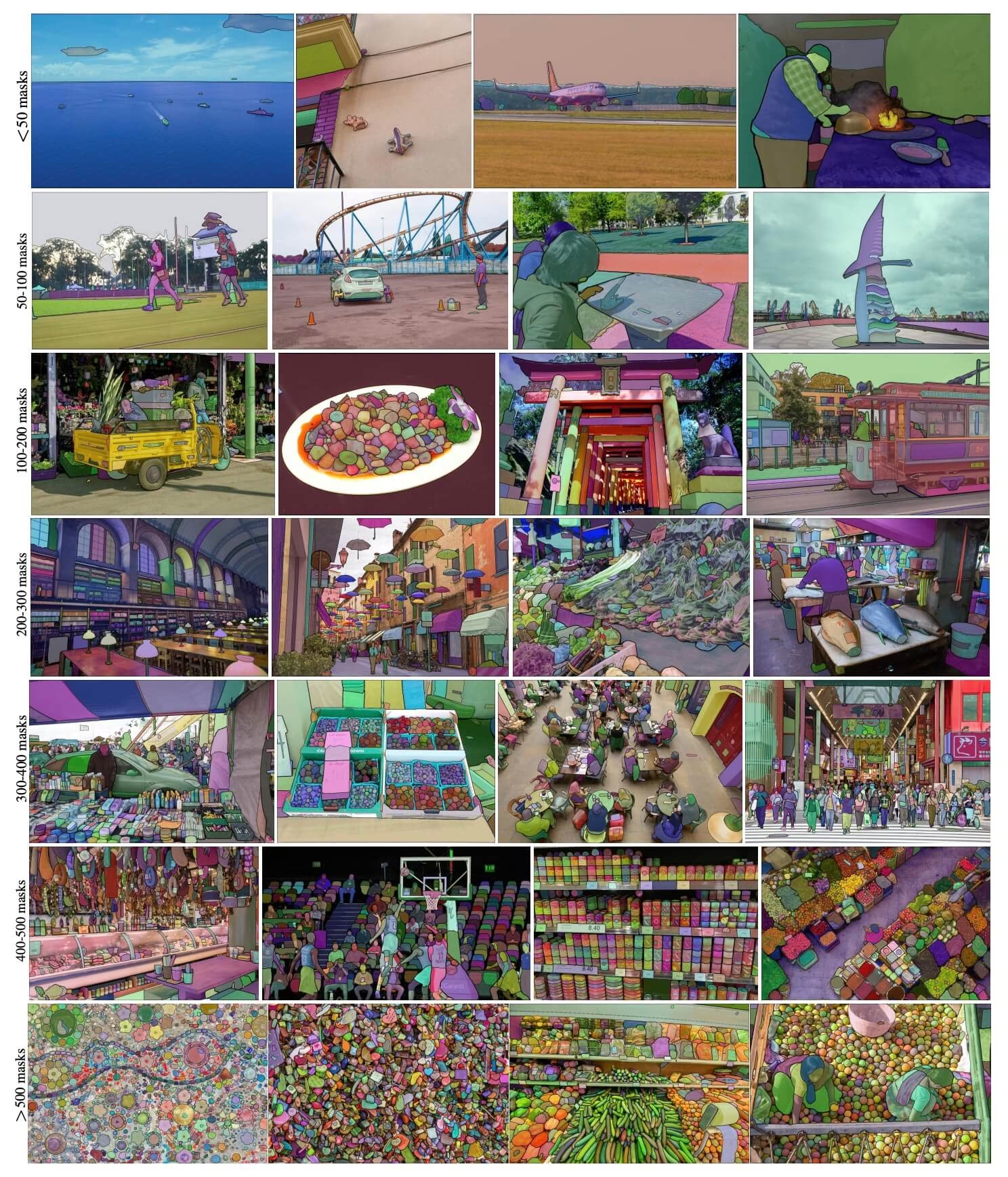 SA-1B örnek görüntüleri. SA-1B veri kümesinden, maskelerin üst üste bindirildiği görüntüler. SA-1B; çeşitli, yüksek çözünürlüklü, lisanslı ve gizliliği koruyan 11 milyon görüntü ile 1,1 milyar yüksek kaliteli segmentasyon maskesi içerir. Bu maskeler tamamen SAM tarafından otomatik olarak etiketlenmiştir ve insan değerlendirmeleri ile çok sayıda deneyde doğrulandığı üzere yüksek kalite ve çeşitliliğe sahiptir. Görselleştirme amacıyla görüntüler, görüntü başına maske sayısına göre gruplandırılmıştır (ortalama olarak görüntü başına yaklaşık 100 maske vardır).
Her Şeyi Segmentleme Modelinin (SAM) Temel Özellikleri#
- İstemlenebilir Segmentasyon Görevi: SAM, istemlenebilir bir segmentasyon görevi için tasarlandı ve nesneyi belirten uzamsal veya metinsel ipuçları gibi verilen herhangi bir istemden geçerli segmentasyon maskeleri oluşturabilir.
- Gelişmiş Mimari: Segment Anything Model; büyük bir görüntü kodlayıcı, bir istem kodlayıcı ve hafif bir maske kod çözücü kullanır. Bu mimari, segmentasyon görevlerinde esnek istemler verilmesini, maskelerin gerçek zamanlı hesaplanmasını ve belirsizliğin farkında olunmasını sağlar.
- SA-1B Veri Kümesi: Segment Anything projesiyle sunulan SA-1B veri kümesi, 11 milyon görüntü üzerinde 1 milyardan fazla maske içerir. Yayımlandığı sırada en büyük segmentasyon veri kümesi olan SA-1B, SAM'e çeşitli ve büyük ölçekli bir eğitim verisi kaynağı sağlar.
- Sıfır Örnekli Performans: SAM, çeşitli segmentasyon görevlerinde güçlü sıfır örnekli performans sergiler; bu da onu farklı uygulamalar için istem mühendisliğine çok az ihtiyaç duyan, kullanıma hazır bir araç hâline getirir.
Her Şeyi Segmentleme Modeli ve SA-1B veri kümesi hakkında ayrıntılı bilgi için Segment Anything GitHub sayfasını ziyaret et ve Segment Anything araştırma makalesine göz at.
SAM ailesi modelleri (SAM 2.1, SAM 3 ve SAM 3.1), Ultralytics Platform üzerindeki akıllı etiketleme özelliğine güç vererek veri kümelerini hızlıca etiketlemek için tıklamayla maske oluşturulmasını sağlar.
Kullanılabilir Modeller, Desteklenen Görevler ve Çalışma Modları#
Bu tabloda, kullanılabilir modeller; belirli önceden eğitilmiş ağırlıkları, destekledikleri görevler ve Eğitim, Doğrulama, Çıkarım ve Dışa Aktarma gibi farklı çalışma modlarıyla uyumluluklarıyla birlikte sunulmuştur. Desteklenen modlar ✅, desteklenmeyen modlar ise ❌ ile gösterilir.
| Model Türü | Önceden Eğitilmiş Ağırlıklar | Desteklenen Görevler | Eğitim | Doğrulama | Çıkarım | Dışa aktar |
|---|---|---|---|---|---|---|
| SAM temel | sam_b.pt | Örnek Segmentasyonu | ❌ | ❌ | ✅ | ❌ |
| SAM büyük | sam_l.pt | Örnek Segmentasyonu | ❌ | ❌ | ✅ | ❌ |
SAM Nasıl Kullanılır: Görüntü Segmentasyonunda Çok Yönlülük ve Güç#
Segment Anything Model, eğitim verilerinin ötesinde kenar algılama, nesne önerisi oluşturma, örnek segmentasyonu ve ilk aşama metinden maskeye tahmin gibi birçok alt görevde kullanılabilir. İstem mühendisliğiyle SAM, yeni görevlere ve veri dağılımlarına sıfır örnekli şekilde uyum sağlayabilir.
SAM tahmin örneği#
Verilen istemlerle görüntüyü segmentlere ayır.
from ultralytics import SAM

# Bir model yükle
model = SAM("sam_b.pt")

# Model bilgilerini görüntüle (isteğe bağlı)
model.info()

# bbox istemiyle çıkarım çalıştır
results = model("ultralytics/assets/zidane.jpg", bboxes=[439, 437, 524, 709])

# tek noktayla çıkarım çalıştır
results = model(points=[900, 370], labels=[1])

# birden çok noktayla çıkarım çalıştır
results = model(points=[[400, 370], [900, 370]], labels=[1, 1])

# her nesne için birden çok nokta istemiyle çıkarım çalıştır
results = model(points=[[[400, 370], [900, 370]]], labels=[[1, 1]])

# negatif nokta istemiyle çıkarım çalıştır
results = model(points=[[[400, 370], [900, 370]]], labels=[[1, 0]])Görüntünün tamamını segmentlere ayır.
from ultralytics import SAM

# Bir model yükle
model = SAM("sam_b.pt")

# Model bilgilerini görüntüle (isteğe bağlı)
model.info()

# Çıkarımı çalıştır
model("path/to/image.jpg")- Herhangi bir istem (bbox/nokta/maske) iletmezsen SAM görüntünün tamamını segmentlere ayırır.
Görüntüyü bir kez ayarla, ardından görüntü kodlayıcısını yeniden çalıştırmadan istem çıkarımını birden çok kez yürüt.
import cv2

from ultralytics.models.sam import Predictor as SAMPredictor

# SAMPredictor oluştur
overrides = {"conf": 0.25, "task": "segment", "mode": "predict", "imgsz": 1024, "model": "mobile_sam.pt"}
predictor = SAMPredictor(overrides=overrides)

# Görüntüyü ayarla
predictor.set_image("ultralytics/assets/zidane.jpg")  # Görüntü dosyasıyla ayarla
predictor.set_image(cv2.imread("ultralytics/assets/zidane.jpg"))  # np.ndarray ile ayarla
results = predictor(bboxes=[439, 437, 524, 709])

# Tek nokta istemiyle çıkarım yap
results = predictor(points=[900, 370], labels=[1])

# Birden fazla nokta istemiyle çıkarım yap
results = predictor(points=[[400, 370], [900, 370]], labels=[1, 1])

# negatif nokta istemiyle çıkarım çalıştır
results = predictor(points=[[[400, 370], [900, 370]]], labels=[[1, 0]])

# Görüntüyü sıfırla
predictor.reset_image()
Ek bağımsız değişkenlerle her şeyi segmentlere ayır.
from ultralytics.models.sam import Predictor as SAMPredictor

# SAMPredictor oluştur
overrides = {"conf": 0.25, "task": "segment", "mode": "predict", "imgsz": 1024, "model": "mobile_sam.pt"}
predictor = SAMPredictor(overrides=overrides)

# Ek bağımsız değişkenlerle segmentlere ayır
results = predictor(source="ultralytics/assets/zidane.jpg", crop_n_layers=1, points_stride=64, min_mask_region_area=100)Yukarıdaki örneklerde döndürülen results nesnelerinin tümü, tahmin edilen maskelere ve kaynak görüntüye erişim sağlayan Results nesneleridir.
- Daha fazla
Segment everythingbağımsız değişkeni içinPredictor/generatebaşvuru belgesine göz at.
SAM ve YOLO Karşılaştırması#
Burada Meta'nın SAM-b modelini, YOLO26 dahil Ultralytics segmentasyon modelleriyle karşılaştırıyoruz:
| Model | Boyut (MB) | Parametreler (M) | Hız (CPU) (ms/görüntü) |
|---|---|---|---|
| Meta SAM-b | 375 | 93.7 | 41703 |
| MobileSAM | 40.7 | 10.1 | 23802 |
| FastSAM-s ve YOLOv8 omurgası | 23.9 | 11.8 | 58.0 |
| Ultralytics YOLOv8n-seg | 7.1 (52.8 kat daha küçük) | 3.4 (27.6 kat daha az) | 24.8 (1682 kat daha hızlı) |
| Ultralytics YOLO11n-seg | 6.2 (60.5 kat daha küçük) | 2.9 (32.3 kat daha az) | 24.3 (1716 kat daha hızlı) |
| Ultralytics YOLO26n-seg | 6.7 (56.0 kat daha küçük) | 2.7 (34.7 kat daha az) | 25.2 (1655 kat daha hızlı) |
Bu karşılaştırma, SAM varyantları ile YOLO segmentasyon modelleri arasındaki model boyutu ve hız farklarının ne kadar büyük olduğunu gösteriyor. SAM, kendine özgü otomatik segmentasyon yetenekleri sunarken YOLO modelleri, özellikle YOLOv8n-seg, YOLO11n-seg ve YOLO26n-seg, önemli ölçüde daha küçük, daha hızlı ve hesaplama açısından daha verimlidir.
SAM hızları PyTorch, YOLO hızları ise ONNX Runtime kullanılarak ölçülmüştür. Testler, 16 GB RAM'e sahip 2025 Apple M4 Air üzerinde torch==2.10.0, ultralytics==8.4.31 ve onnxruntime==1.24.4 kullanılarak gerçekleştirilmiştir. Bu testi tekrarlamak için:
from ultralytics import ASSETS, SAM, YOLO, FastSAM

# SAM-b, MobileSAM profillerini çıkar
for file in ["sam_b.pt", "mobile_sam.pt"]:
    model = SAM(file)
    model.info()
    model(ASSETS)

# FastSAM-s profili oluştur
model = FastSAM("FastSAM-s.pt")
model.info()
model(ASSETS)

# YOLO modellerinin profilini çıkar (ONNX)
for file_name in ["yolov8n-seg.pt", "yolo11n-seg.pt", "yolo26n-seg.pt"]:
    model = YOLO(file_name)
    model.info()
    onnx_path = model.export(format="onnx", dynamic=True, nms=False)  # YOLO26 NMS içermeyen başlık; YOLOv8/YOLO11 için işlem yapmaz
    model = YOLO(onnx_path)
    model(ASSETS)
Otomatik Etiketleme: Segmentasyon Veri Kümelerine Hızlı Bir Yol#
Otomatik etiketleme, SAM'in önemli bir özelliğidir ve kullanıcıların önceden eğitilmiş bir algılama modeli kullanarak segmentasyon veri kümesi oluşturmasını sağlar. Bu özellik, zaman alan manuel etiketlemeyi ortadan kaldırarak çok sayıda görüntünün hızla etiketlenmesini mümkün kılar.
Algılama Modeliyle Segmentasyon Veri Kümeni Oluştur#
Ultralytics çerçevesiyle veri kümeni otomatik olarak etiketlemek için, YOLO26x gibi bir algılayıcıyı SAM ile eşleştiren auto_annotate işlevini kullan:
from ultralytics.data.annotator import auto_annotate

auto_annotate(data="path/to/images", det_model="yolo26x.pt", sam_model="sam_b.pt")| Bağımsız değişken | Tür | Varsayılan | Açıklama |
|---|---|---|---|
data | str | gerekli | Etiketleme veya bölümleme için hedef görüntüleri içeren dizinin yolu. |
det_model | str | 'yolo26x.pt' | İlk nesne algılama için YOLO algılama modelinin yolu. |
sam_model | str | 'sam_b.pt' | Bölümleme için SAM modelinin yolu (SAM, SAM 2, MobileSAM ve SAM 3 ağırlıklarını destekler). |
device | str | '' | Hesaplama aygıtı (ör. 'cuda:0', 'cpu' veya aygıtın otomatik algılanması için ''). |
conf | float | 0.25 | Zayıf algılamaları filtrelemek için YOLO algılama güven eşiği. |
iou | float | 0.5 | Çakışan kutuları filtrelemek için Maksimum Olmayan Bastırma IoU eşiği. |
imgsz | int | 640 | Görüntüleri yeniden boyutlandırmak için giriş boyutu (gerekirse 32'nin bir üst katına yuvarlanır). |
max_det | int | 300 | Bellek verimliliği için görüntü başına maksimum algılama sayısı. |
classes | list[int] | None | Algılanacak sınıf indekslerinin listesi (ör. kişi ve bisiklet için [0, 1]). |
output_dir | str | None | Etiketler için kayıt dizini (varsayılan: kardeş dizin <data>_auto_annotate_labels). |
auto_annotate işlevi, görüntülerinin yolunu alır. Ayrıca önceden eğitilmiş algılama ve SAM segmentasyon modellerini, modellerin çalıştırılacağı cihazı ve etiketlenmiş sonuçların kaydedileceği çıktı dizinini belirten isteğe bağlı bağımsız değişkenler de alır.
Önceden eğitilmiş modellerle otomatik etiketleme, segmentasyon veri kümeleri oluşturmak için gereken zaman ve çabayı büyük ölçüde azaltır; böylece büyük görüntü koleksiyonlarına sahip ekipler manuel etiketleme yerine model geliştirme ve değerlendirmeye odaklanabilir.
Atıflar ve Teşekkürler#
SAM'i araştırma veya geliştirme çalışmalarında yararlı buluyorsan makaleye atıfta bulunmanı öneririz:
@misc{kirillov2023segment,
      title={Segment Anything},
      author={Alexander Kirillov and Eric Mintun and Nikhila Ravi and Hanzi Mao and Chloe Rolland and Laura Gustafson and Tete Xiao and Spencer Whitehead and Alexander C. Berg and Wan-Yen Lo and Piotr Dollár and Ross Girshick},
      year={2023},
      eprint={2304.02643},
      archivePrefix={arXiv},
      primaryClass={cs.CV}
}
Bilgisayarlı görü topluluğu için bu değerli kaynağı oluşturup sürdürdükleri için Meta AI'a teşekkür ederiz.
Sık Sorulan Sorular#
Meta'nın Segment Anything Model'i (SAM), istemlerle yönlendirilebilir segmentasyon görevleri için tasarlanmış bir görüntü segmentasyonu modelidir. Nokta, kutu veya maske gibi istemlerden segmentasyon maskeleri oluşturmak için görüntü ve istem kodlayıcılarını hafif bir maske kod çözücüyle birleştirir. SA-1B veri kümesi üzerinde eğitilen SAM, önceden bilgi sahibi olmadan yeni görüntü dağılımlarına ve görevlere uyum sağlayarak sıfır örnekli kullanımda iyi performans gösterir.
Her Şeyi Segmentleme Modeli (SAM) ile sınırlayıcı kutular veya noktalar gibi çeşitli istemleri kullanarak çıkarım yapabilir ve görüntü segmentasyonu gerçekleştirebilirsin. Python kullanarak bir örnek:
from ultralytics import SAM

# Bir model yükle
model = SAM("sam_b.pt")

# Sınırlayıcı kutu istemiyle bölümle
model("ultralytics/assets/zidane.jpg", bboxes=[439, 437, 524, 709])

# Nokta istemiyle segmentlere ayır
model("ultralytics/assets/zidane.jpg", points=[900, 370], labels=[1])

# Birden fazla nokta istemiyle segmentlere ayır
model("ultralytics/assets/zidane.jpg", points=[[400, 370], [900, 370]], labels=[1, 1])

# Nesne başına birden fazla nokta istemiyle segmentlere ayır
model("ultralytics/assets/zidane.jpg", points=[[[400, 370], [900, 370]]], labels=[[1, 1]])

# Negatif nokta istemiyle segmentlere ayır.
model("ultralytics/assets/zidane.jpg", points=[[[400, 370], [900, 370]]], labels=[[1, 0]])
Alternatif olarak SAM ile komut satırı arayüzünde (CLI) çıkarım yapabilirsin:
yolo predict model=sam_b.pt source=path/to/image.jpgYOLO modelleriyle karşılaştırıldığında SAM-b, MobileSAM ve FastSAM-s gibi SAM çeşitleri genellikle daha büyük ve yavaştır; ancak benzersiz sıfır atışlı segmentasyon özellikleri sunar. Örneğin YOLO26n-seg, CPU üzerinde Meta'nın orijinal SAM-b modelinden 56 kat daha küçüktür ve 1650 kattan fazla daha hızlıdır. Bu nedenle YOLO modelleri hızlı, hafif ve hesaplama açısından verimli segmentasyon gerektiren uygulamalar için idealdir; SAM modelleri ise esnek, istemlenebilir ve sıfır atışlı segmentasyon görevlerinde öne çıkar.
Ultralytics SAM, önceden eğitilmiş bir algılama modeliyle segmentasyon veri kümeleri oluşturmanı sağlayan bir otomatik etiketleme özelliği sunar. Python ile bir örnek:
from ultralytics.data.annotator import auto_annotate

auto_annotate(data="path/to/images", det_model="yolo26x.pt", sam_model="sam_b.pt")
Bu işlev, görüntülerinin yolunu ve önceden eğitilmiş algılama ile SAM segmentasyon modelleri için isteğe bağlı bağımsız değişkenleri; ayrıca cihaz ve çıktı dizini ayarlarını alır. Eksiksiz bir kılavuz için Otomatik Etiketleme sayfasına göz at.
SAM, 11 milyon görüntüde 1 milyardan fazla maske içeren SA-1B veri kümesi üzerinde eğitilir. SA-1B, yayımlandığı sırada en büyük segmentasyon veri kümesiydi ve SAM'in segmentasyon görevlerindeki sıfır örnekli performansını destekleyen yüksek kaliteli ve çeşitli eğitim verileri sunuyordu.


Yorumlar27
Bir soru sor, sonuçlarını paylaş veya başka birine yardım et.
kh-diab
can we use SAM to process labeled images with bounding box to segment the object inside the box and generate new labels files like yolo or coco format if yes how please
1 Paula DerrengerUltralytics
Yes, you can use SAM to process labeled images with bounding boxes to segment the objects inside and generate new label files in formats like YOLO or COCO. You can achieve this by using the
auto_annotatefunction in the Ultralytics framework. This function allows you to auto-annotate your dataset using a pre-trained detection model and SAM for segmentation. For more details, you can refer to the Segment Anything Model documentation. If you need further assistance, feel free to ask!Hello @pderrenger
Thanks I tried to run the below but I face error all the time
import os import cv2 import numpy as np from ultralytics import SAM
Load the SAM model
model = SAM("sam_b.pt") # Update the model path if needed
Function to load YOLO annotations
def load_yolo_annotations(annotation_path, image_width, image_height): bboxes = [] try: with open(annotation_path, 'r') as file: lines = file.readlines() for line in lines: parts = line.strip().split() class_id = int(parts[0]) x_center = float(parts[1]) * image_width y_center = float(parts[2]) * image_height width = float(parts[3]) * image_width height = float(parts[4]) * image_height x = x_center - width / 2 y = y_center - height / 2 bboxes.append((x, y, x + width, y + height)) # Update to [x1, y1, x2, y2] except Exception as e: print(f"Error reading annotation file {annotation_path}: {e}") return bboxes
Paths
images_folder = r'E:\MSc\tesi\20210901_Herrenpuent_Taenikon_Matrice_300_15m_1.6m_s\500 D' annotations_folder = r'C:\Users\Khaled\OneDrive - OST\Study Material\Msc Thesis\dataset\Group D yolo format\obj_train_data' output_folder = r'C:\Users\Khaled\OneDrive - OST\Study Material\Msc Thesis\dataset\test output sam'
if not os.path.exists(output_folder): os.makedirs(output_folder)
Process each image and its corresponding annotation
total_images = len(os.listdir(images_folder)) processed_images = 0
for image_filename in os.listdir(images_folder): if image_filename.endswith(('.JPG', '.jpg', '.png')): image_path = os.path.join(images_folder, image_filename) annotation_path = os.path.join(annotations_folder, image_filename.replace('.JPG', '.txt').replace('.jpg', '.txt').replace('.png', '.txt'))
    print(f"Processing {image_filename}...")

    # Check if annotation file exists
    if not os.path.exists(annotation_path):
        print(f"Annotation file not found for {image_filename}")
        continue

    # Load the image
    image = cv2.imread(image_path)
    if image is None:
        print(f"Failed to load image {image_path}")
        continue

    image_rgb = cv2.cvtColor(image, cv2.COLOR_BGR2RGB)
    height, width, _ = image.shape

    # Load YOLO annotations
    bboxes = load_yolo_annotations(annotation_path, width, height)
    if not bboxes:
        print(f"No bounding boxes found in {annotation_path}")
        continue

    # Perform segmentation using SAM model
    results = model(image_rgb, bboxes=bboxes)

    for idx, result in enumerate(results):
        if hasattr(result, 'masks') and result.masks is not None:
            masks = result.masks.cpu().numpy()  # Convert to numpy array
            for m_idx, mask in enumerate(masks):
                chw_mask = mask.astype(np.uint8)  # Ensure mask is in uint8 format
                hwc_mask = np.transpose(chw_mask, (1, 2, 0))  # Convert CHW to HWC
                contours, _ = cv2.findContours(hwc_mask, cv2.RETR_EXTERNAL, cv2.CHAIN_APPROX_SIMPLE)

                segmented_image = cv2.bitwise_and(image, image, mask=hwc_mask)

                # Save the segmented image
                output_path = os.path.join(output_folder, image_filename.replace('.JPG', f'_segmented_{idx}_{m_idx}.jpg').replace('.jpg', f'_segmented_{idx}_{m_idx}.jpg').replace('.png', f'_segmented_{idx}_{m_idx}.png'))
                cv2.imwrite(output_path, segmented_image)
                print(f"Saved segmented image to {output_path}")

    processed_images += 1
    print(f"Processed {processed_images}/{total_images} images.")
print("Processing completed.")
error is
AttributeError: 'Masks' object has no attribute 'astype'. See valid attributes below.
A class for storing and manipulating detection masks.

    xy (list): A list of segments in pixel coordinates.
    xyn (list): A list of normalized segments.

Methods:
    cpu(): Returns the masks tensor on CPU memory.
    numpy(): Returns the masks tensor as a numpy array.
    cuda(): Returns the masks tensor on GPU memory.
    to(device, dtype): Returns the masks tensor with the specified device and dtype.
PS C:\Users\Khaled> & C:/MSc_Workspace/anaconda3/envs/GenEnv/python.exe "c:/Users/Khaled/OneDrive - OST/Study Material/Msc Thesis/coding/sam segment.py" Processing DJI_20210901122818_0695.JPG...
0: 1024x1024 67330.4ms Speed: 48.0ms preprocess, 67330.4ms inference, 8095.5ms postprocess per image at shape (1, 3, 1024, 1024) Traceback (most recent call last): File "c:\Users\Khaled\OneDrive - OST\Study Material\Msc Thesis\coding\sam segment.py", line 75, in chw_mask = mask.astype(np.uint8) # Ensure mask is in uint8 format File "C:\MSc_Workspace\anaconda3\envs\GenEnv\lib\site-packages\ultralytics\utils_init_.py", line 162, in getattr raise AttributeError(f"'{name}' object has no attribute '{attr}'. See valid attributes below.\n{self.doc}") AttributeError: 'Masks' object has no attribute 'astype'. See valid attributes below.
A class for storing and manipulating detection masks.

Attributes:
    xy (list): A list of segments in pixel coordinates.
    xyn (list): A list of normalized segments.

Methods:
    cpu(): Returns the masks tensor on CPU memory.
    numpy(): Returns the masks tensor as a numpy array.
    cuda(): Returns the masks tensor on GPU memory.
    to(device, dtype): Returns the masks tensor with the specified device and dtype.
do you have idea how to solve it thanks
evans rojas
Hola me gustaría usar SAM para clasificar vegetación a partir de una imagen. ¿Qué recomendaciones me sugieren?
- Paula DerrengerUltralytics
Hola, Evans. SAM puede ayudarte a delimitar la vegetación, pero el SAM original no identifica por sí solo especies ni tipos de cobertura. Te sugiero comenzar con puntos positivos sobre la vegetación y negativos sobre el fondo, revisar las máscaras y asignarles tus clases manualmente. Si buscas automatizar la clasificación en más imágenes, puedes usar esas anotaciones para entrenar un modelo de segmentación por instancias para plantas individuales o de segmentación semántica para coberturas del terreno. ¿Quieres separar vegetación del fondo o distinguir especies, y trabajas con fotografías terrestres, de dron o satelitales?
meenakshi71
I've been trying to export the SAM model (which i had trained on my custom dataset) into ONNX but the output is always wrong. It is just generating a grid instead of a proper segmentation mask every time even after providing multiple kinds of prompts.
 Glenn JocherUltralytics
@meenakshi71 it seems the issue may stem from the export process or configuration. Ensure you are using the correct export parameters and supported formats. SAM models are primarily designed for real-time inference and not all functionalities may transfer seamlessly to ONNX. Refer to the SAM export documentation for guidance. If the problem persists, consider testing the ONNX model with simpler prompts to isolate the issue.
MeenakshiKK236
Why are my segmentation results being automatically saved into this directory while using the SAM model to perform segmentation on my custom dataset? "Results saved to runs/segment/predict4"
- Glenn JocherUltralytics
@MeenakshiKK236 the results are saved to the
runs/segment/predict4directory by default. You can change the save directory by specifying theprojectandnamearguments in your command. For more details, please refer to the SAM documentation.
NasserAlqeifi
Correct me if I'm wrong, when I use the auto_annotate function I will only get labels for my dataset with the classes in Yolo pre-trained? What if I need classes that are not available within Yolo? For example, I want to get a label for the road, and this is not available in any version of Yolo, but it is available in SAM?
- Glenn JocherUltralytics
@NasserAlqeifi you are correct. The
auto_annotatefunction uses YOLO's pre-trained classes for labeling. If you need classes not available in YOLO, like "road," you can use SAM directly for segmentation. For more details, please refer to the Segment Anything Model documentation. - Glenn JocherUltralytics
@NasserAlqeifi but also remember SAM identifies segments but not classes, so it may find a sign or a road, but it won't be able to assign a class to them by itself.
Thank you for your quick response. Indeed, I tried to use SAM directly and found that it does not save the class names in the name, but the class number.
from ultralytics import SAM
Load a model
model = SAM("sam2_l.pt")
Predict results
results = model.predict(source=r"/testSAM/image.png", stream=True, bboxes=None, points=None, labels=None, show=False)
Iterate over results, print names, and save each result to a file
for i, result in enumerate(results): # Print the names detected in the result print(f"Result {i}: Detected Names - {result.names}")
# Save the result as an image file
result.save(f"output_{i}.jpg")
------------- output ---------
image 1/1 /testSAM/image.png: 1024x1024 1 0, 1 1, 1 2, 1 3, 1 4, 1 5, 1 6, 1 7, 1 8, 1 9, 1 10, 1 11, 1 12, 1 13, 1 14, 1 15, 1 16, 1 17, 1 18, 1 19, 1 20, 1 21, 1 22, 1 23, 1 24, 1 25, 1 26, 1 27, 1 28, 1 29, 1 30, 1 31, 1 32, 23758.2ms Result 0: Detected Names - {0: '0', 1: '1', 2: '2', 3: '3', 4: '4', 5: '5', 6: '6', 7: '7', 8: '8', 9: '9', 10: '10', 11: '11', 12: '12', 13: '13', 14: '14', 15: '15', 16: '16', 17: '17', 18: '18', 19: '19', 20: '20', 21: '21', 22: '22', 23: '23', 24: '24', 25: '25', 26: '26', 27: '27', 28: '28', 29: '29', 30: '30', 31: '31', 32: '32'} Speed: 20.3ms preprocess, 23758.2ms inference, 7.1ms postprocess per image at shape (1, 3, 1024, 1024)
- Glenn JocherUltralytics
Thank you for your feedback. Currently, SAM does not assign class names, only class numbers. If you need specific class names, you may need to implement a custom mapping or post-processing step to assign the desired class names based on your requirements.
dreambit
I have images where a single object (such as a car) is partially covered by small trees, resulting in the object being divided into multiple visible fragments. In coco it could look like { "id": 1, "image_id": 1, "category_id": 1, "bbox": [x, y, width, height], "segmentation": [ [polygon1_x1, polygon1_y1, polygon1_x2, polygon1_y2, ...], [polygon2_x1, polygon2_y1, polygon2_x2, polygon2_y2, ...] ], "area": 500, "iscrowd": 0 } Each polygon is an array of coordinates defining a closed shape
Is it possible with auto_annotate and yolo format?
- Glenn JocherUltralytics(düzenlendi)
@dreambit hi there!
Thank you for your detailed question. Yes, you can use the
auto_annotatefunction in the Ultralytics framework to handle images where objects are partially occluded and appear as multiple fragments. This function can generate segmentation masks for such complex scenarios.Here's how you can achieve this:
- Prepare Your Dataset: Ensure your images are organized in a directory.
- Use the
auto_annotateFunction: This function will use a pre-trained YOLO detection model and the SAM segmentation model to annotate your images.
Here's a code example to get you started:
from ultralytics.data.annotator import auto_annotate

# Path to your images
data_path = "path/to/your/images"

# Auto-annotate using YOLO26 and SAM models
auto_annotate(data=data_path, det_model="yolo26x.pt", sam_model="sam_b.pt")
Explanation:
data: Path to the folder containing your images.det_model: The pre-trained YOLO detection model, which defaults toyolo26x.pt.sam_model: The pre-trained SAM segmentation model, which defaults tosam_b.pt.
This setup will generate segmentation masks for your images, even if the objects are partially occluded.
For more detailed information on using SAM and its capabilities, you can refer to the Segment Anything Model (SAM) documentation.
If you encounter any issues or need further assistance, please provide a reproducible example so we can better understand and address your specific scenario. You can find more information on creating a minimum reproducible example here.
Feel free to update to the latest versions of the packages to ensure you have the latest features and fixes.
Best of luck with your project! 🚀
Glenn thanks, but as I see in docs https://docs.ultralytics.com/datasets/segment/#ultralytics-yolo-format ... In this format, is the index of the class for the object, and ... are the bounding coordinates of the object's segmentation mask. The coordinates are separated by spaces.
So it means that I could have only one segmentation mask?
0 0.681 0.485 0.670 0.487 0.676 0.487 1 0.504 0.000 0.501 0.004 0.498 0.004 0.493 0.010 0.492 0.0104
Glen, i ran the command you specified, and used an image from coco data set to test, as you can see segmentations are not correct, only half of the objects are segmented:
Here is original image from coco with car mask https://ibb.co/RjYyRdk
- Glenn JocherUltralytics(düzenlendi)
Hi @dreambit,
Thank you for sharing the images and details. I understand the challenge you're facing with partial segmentations. The
auto_annotatefunction should ideally handle such cases, but it seems like the segmentation results are not as expected.Steps to Troubleshoot and Improve Segmentation:
-
Verify Latest Versions: Ensure you are using the latest versions of the Ultralytics and SAM models. This can help avoid any bugs that might have been fixed in recent updates.
-
Reproducible Example: If the issue persists, providing a minimum reproducible example would be very helpful. This allows us to better understand and diagnose the problem. You can find guidance on creating a reproducible example here.
-
Adjusting Prompts: Sometimes, adjusting the prompts (bounding boxes or points) can improve segmentation results. Here’s an example of how you can use different prompts:
from ultralytics import SAM # Load a model model = SAM("sam_b.pt") # Run inference with bounding boxes prompt results = model("path/to/image.jpg", bboxes=[[x1, y1, x2, y2], [x3, y3, x4, y4]]) # Run inference with points prompt results = model("path/to/image.jpg", points=[[x1, y1], [x2, y2]], labels=[1, 1]) -
Segment Everything: If specific prompts are not yielding the desired results, you can try segmenting the entire image without prompts:
from ultralytics import SAM # Load a model model = SAM("sam_b.pt") # Segment the whole image results = model("path/to/image.jpg") -
Multiple Masks Handling: If your object is divided into multiple fragments, ensure that the segmentation model is capable of handling multiple masks per object. The YOLO format typically supports one segmentation mask per object, but you can adapt the output to handle multiple masks by combining them post-processing.
Example of Handling Multiple Masks:
If you need to combine multiple masks into a single annotation, you can do this post-processing:
# `results[0].masks.data` holds all masks of the image, shape (N, H, W)
combined_mask = results[0].masks.data.cpu().numpy().max(axis=0)

# Save or use the combined mask
Documentation and Resources:
For more detailed information on using SAM and its capabilities, please refer to the Segment Anything Model (SAM) documentation.
If you continue to face issues, please share a reproducible example, and we’ll be happy to assist further. Your feedback is valuable, and we aim to provide the best support possible.
-
kshweikeh
is there anyway where I can train YOLO SAM on a custom dataset?
- Paula DerrengerUltralytics(düzenlendi)
@kshweikeh hi there!
Currently, the Segment Anything Model (SAM) from Ultralytics is designed primarily for inference and does not support training on custom datasets. However, you can leverage SAM's powerful zero-shot capabilities for various segmentation tasks without the need for additional training.
If you're looking to create a segmentation dataset using SAM, you can use the auto-annotation feature. This allows you to generate segmentation masks using a pre-trained detection model. Here's a quick example:
from ultralytics.data.annotator import auto_annotate

auto_annotate(data="path/to/images", det_model="yolo26x.pt", sam_model="sam_b.pt")
This function will help you annotate your images quickly and efficiently, bypassing the need for manual labeling.
For more detailed information on using SAM, you can visit our Segment Anything Model (SAM) documentation.
If you have any further questions or need additional assistance, feel free to ask! 😊
Blessing988
@pderrenger It looks like auto_annotate for SAM only gives out the segmentation masks. What if you want to generate the bounding boxes in additionto the masks to verify if the results are right. Thanks.
Also, how will one visualise the segmentation masks after the auto_annotate which have been saved in a directory of txt files.
- Paula DerrengerUltralytics(düzenlendi)
Hi @Blessing988,
auto_annotatewrites one YOLO segmentation polygon per line (class_id x1 y1 x2 y2 ..., normalized) to its output folder (output_dir, by default<images folder>_auto_annotate_labels). Here is a script to draw those polygons on the images:from pathlib import Path import cv2 import numpy as np def visualize_annotations(image_dir, label_dir, output_dir): Path(output_dir).mkdir(parents=True, exist_ok=True) for image_path in Path(image_dir).glob("*.jpg"): image = cv2.imread(str(image_path)) h, w = image.shape[:2] label_path = Path(label_dir) / f"{image_path.stem}.txt" if not label_path.exists(): continue for line in label_path.read_text().splitlines(): values = line.split() polygon = (np.array(values[1:], dtype=float).reshape(-1, 2) * [w, h]).astype(np.int32) cv2.polylines(image, [polygon], isClosed=True, color=(0, 255, 0), thickness=2) cv2.imwrite(str(Path(output_dir) / image_path.name), image) visualize_annotations("path/to/images", "path/to/labels", "path/to/output")For more detailed information on using SAM and its features, you can refer to the Segment Anything Model (SAM) documentation.
Feel free to reach out if you have any further questions or need additional assistance! 😊
pabentse
Would be fantastic with support for the "H" size as well!
- Paula DerrengerUltralytics
@pabentse absolutely, the addition of an "H" size model would be a great enhancement to the range of model sizes we offer, catering to different computational needs and use cases. The YOLO community's feedback is invaluable, and suggestions like yours help guide future developments. Keep an eye on our updates! 👀🚀