YOLO-NAS
YOLO-NAS'in orijinal geliştiricisi Deci, NVIDIA tarafından satın alındı ve bu modeller artık Deci tarafından etkin olarak sürdürülmüyor. Ultralytics bu modellerin kullanımını desteklemeye devam ediyor ancak orijinal ekipten yeni güncellemeler beklenmiyor.
Genel Bakış#
Deci AI tarafından geliştirilen YOLO-NAS, sinir mimarisi araması ile üretilmiş ve önceki YOLO modellerinin sınırlamalarını gidermek üzere tasarlanmış bir nesne algılama modelidir. Niceleme desteğini ve doğruluk-gecikme ödünleşimini iyileştirir.
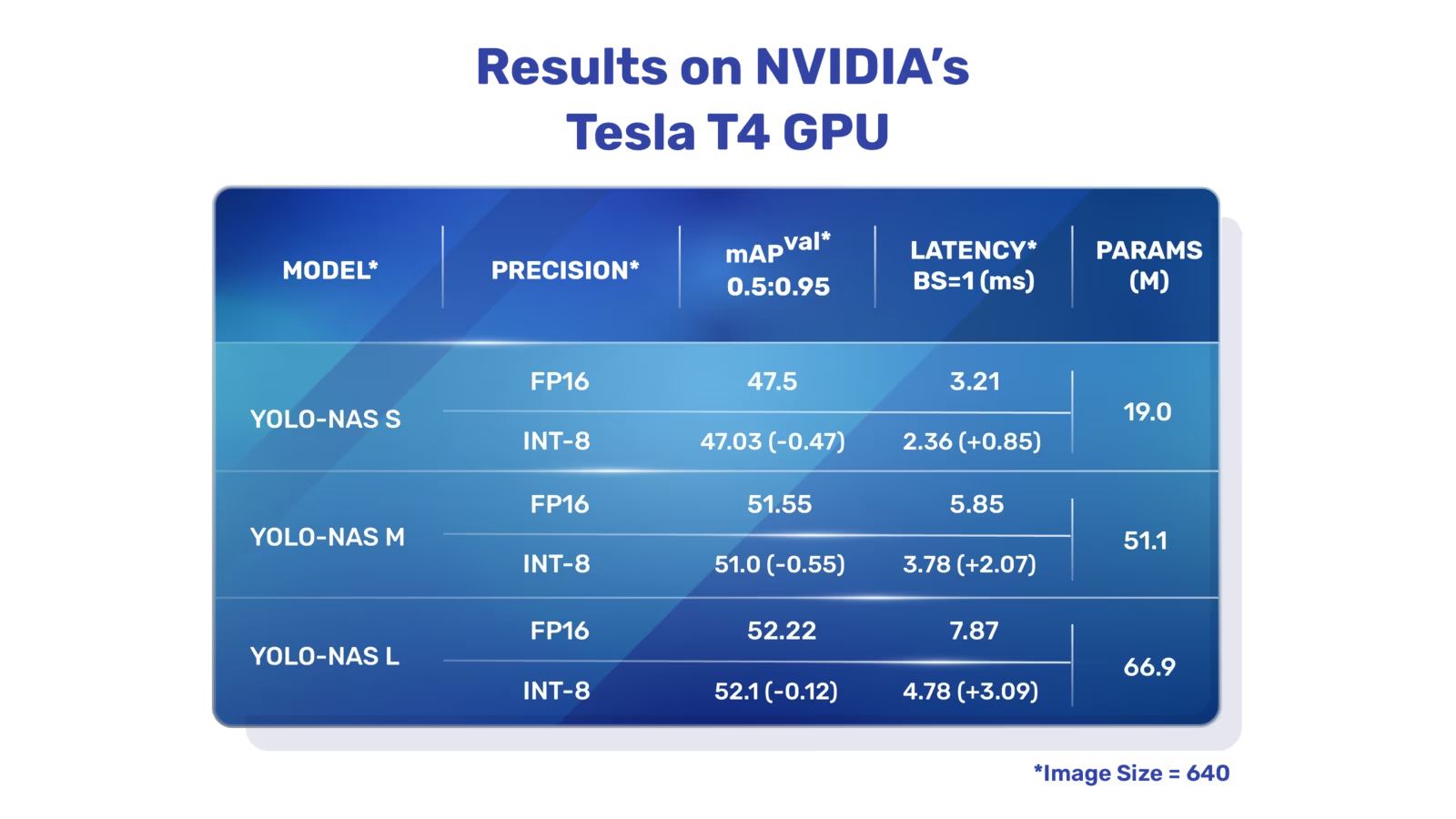 YOLO-NAS'e genel bakış. YOLO-NAS, niceleme sonrasında doğruluğu korumak için niceleme farkındalıklı bloklar ve seçici niceleme kullanır. INT8 nicelemeli sürüme dönüştürüldüğünde model çok az doğruluk kaybeder; bu, önceki YOLO modellerine kıyasla bir iyileşmedir.
Temel Özellikler#
- Nicelemeye Uygun Temel Blok: YOLO-NAS, önceki YOLO modellerinin önemli sınırlamalarından birini gidererek nicelemeye uygun yeni bir temel blok sunar.
- Gelişmiş Eğitim ve Niceleme: YOLO-NAS, performansı artırmak için gelişmiş eğitim yöntemleri ve eğitim sonrası niceleme kullanır.
- AutoNAC Optimizasyonu ve Ön Eğitim: YOLO-NAS, AutoNAC optimizasyonunu kullanır ve COCO, Objects365 ve Roboflow 100 gibi veri kümeleri üzerinde önceden eğitilmiştir. Bu ön eğitim, modeli üretimdeki alt görev nesne algılama görevleri için uygun hâle getirir.
Önceden Eğitilmiş Modeller#
Ultralytics, hız ve doğruluk arasında farklı dengeler sunan üç boyutta önceden eğitilmiş YOLO-NAS modelleri sağlar:
| Model | mAP50-95 | Gecikme (ms) |
|---|---|---|
| YOLO-NAS S | 47.5 | 3.21 |
| YOLO-NAS M | 51.55 | 5.85 |
| YOLO-NAS L | 52.22 | 7.87 |
| YOLO-NAS S INT-8 | 47.03 | 2.36 |
| YOLO-NAS M INT-8 | 51.0 | 3.78 |
| YOLO-NAS L INT-8 | 52.1 | 4.78 |
Her model varyantı, Ortalama Ortalama Hassasiyet (mAP) ile gecikme arasında denge sunacak şekilde tasarlanmıştır; böylece nesne algılama görevlerini hem performans hem de hız açısından optimize edebilirsin.
Kullanım Örnekleri#
ultralytics Python paketi, YOLO-NAS modellerini çalıştırmak için bir Python API'si ve CLI sunar.
YOLO-NAS modelleri super-gradients paketine ihtiyaç duyar; bu paket Python 3.10 ortamı gerektirir:
pip install ultralytics super-gradients "setuptools<81"Aşağıdaki örneklerde, çıkarım ve doğrulama için ultralytics paketiyle YOLO-NAS modellerinin nasıl kullanılacağı gösterilmektedir:
Çıkarım ve Doğrulama Örnekleri#
Bu örnekte YOLO-NAS-s modelini COCO8 veri kümesinde doğruluyoruz.
Bu örnek, YOLO-NAS için basit çıkarım ve doğrulama kodu sunar. YOLO-NAS dışa aktarmayı da destekler ancak ultralytics paketi modelin eğitimini desteklemez.
Python'da bir model örneği oluşturmak için PyTorch ile önceden eğitilmiş *.pt model dosyalarını NAS() sınıfına aktarabilirsin:
from ultralytics import NAS

# COCO üzerinde önceden eğitilmiş bir YOLO-NAS-s modelini yükle
model = NAS("yolo_nas_s.pt")

# Model bilgilerini görüntüle (isteğe bağlı)
model.info()

# Modeli COCO8 örnek veri kümesi üzerinde doğrula
results = model.val(data="coco8.yaml")

# 'bus.jpg' görüntüsünde YOLO-NAS-s modeliyle çıkarım yap
results = model("path/to/bus.jpg")
Desteklenen Görevler ve Modlar#
YOLO-NAS üç varyanttan oluşur: Küçük (s), Orta (m) ve Büyük (l). Her varyant, farklı hesaplama ve performans gereksinimlerini karşılayacak şekilde tasarlanmıştır:
- YOLO-NAS-s: Hesaplama kaynaklarının sınırlı olduğu ancak verimliliğin önemli olduğu ortamlar için optimize edilmiştir.
- YOLO-NAS-m: Daha yüksek doğruluk gerektiren genel amaçlı nesne algılama için uygun, dengeli bir yaklaşım sunar.
- YOLO-NAS-l: Hesaplama kaynaklarının daha az kısıtlayıcı olduğu ve en yüksek doğruluğun gerektiği senaryolar için tasarlanmıştır.
Aşağıda, önceden eğitilmiş ağırlıklarına bağlantılar, destekledikleri görevler ve farklı çalışma modlarıyla uyumlulukları dâhil olmak üzere her modelin ayrıntılı bir özeti yer alıyor.
| Model Türü | Önceden Eğitilmiş Ağırlıklar | Desteklenen Görevler | Eğitim | Doğrulama | Çıkarım | Dışa aktar |
|---|---|---|---|---|---|---|
| YOLO-NAS-s | yolo_nas_s.pt | Nesne Algılama | ❌ | ✅ | ✅ | ✅ |
| YOLO-NAS-m | yolo_nas_m.pt | Nesne Algılama | ❌ | ✅ | ✅ | ✅ |
| YOLO-NAS-l | yolo_nas_l.pt | Nesne Algılama | ❌ | ✅ | ✅ | ✅ |
Atıflar ve Teşekkürler#
YOLO-NAS'i araştırma veya geliştirme çalışmalarında kullanıyorsan lütfen SuperGradients'a atıfta bulun:
@misc{supergradients,
      doi = {10.5281/ZENODO.7789328},
      url = {https://zenodo.org/records/7789328},
      author = {Aharon,  Shay and {Louis-Dupont} and {Ofri Masad} and Yurkova,  Kate and {Lotem Fridman} and {Lkdci} and Khvedchenya,  Eugene and Rubin,  Ran and Bagrov,  Natan and Tymchenko,  Borys and Keren,  Tomer and Zhilko,  Alexander and {Eran-Deci}},
      title = {Super-Gradients},
      publisher = {GitHub},
      journal = {GitHub repository},
      year = {2021},
}
SuperGradients ekibine, bilgisayarlı görü topluluğu için bu değerli kaynağı oluşturma ve sürdürme çabalarından dolayı Deci AI adına teşekkür ederiz.
Sık Sorulan Sorular#
Deci AI tarafından geliştirilen YOLO-NAS, Sinir Mimarisi Araması (NAS) ile tasarlanmış bir nesne algılama modelidir. Nicemlemeye uygun temel bloklar ve gelişmiş eğitim yöntemleri gibi özellikler sunarak önceki YOLO modellerinin sınırlamalarını giderir ve özellikle hesaplama kaynaklarının sınırlı olduğu ortamlarda performansı artırır. YOLO-NAS ayrıca nicemlemeyi destekler; INT8 sürümüne dönüştürüldüğünde bile yüksek doğruluğu koruyarak üretim ortamlarına uygunluğunu artırır.
ultralyticspaketini kullanarak YOLO-NAS modellerini Python uygulamana entegre edebilirsin. Önceden eğitilmiş bir YOLO-NAS modelini yükleyip çıkarım yapmaya dair basit bir örnek:from ultralytics import NAS # COCO üzerinde önceden eğitilmiş bir YOLO-NAS-s modelini yükle model = NAS("yolo_nas_s.pt") # Modeli COCO8 örnek veri kümesi üzerinde doğrula results = model.val(data="coco8.yaml") # 'bus.jpg' görüntüsünde YOLO-NAS-s modeliyle çıkarım yap results = model("path/to/bus.jpg")Daha fazla bilgi için Çıkarım ve Doğrulama Örnekleri bölümüne bak.
YOLO-NAS, nicelemeli nesne algılama için güçlü bir seçenek olmasını sağlayan birkaç temel özellik sunar:
- Nicelemeye Uygun Temel Blok: Niceleme sonrasında doğruluğu koruyan, geliştirilmiş bir mimari.
- Gelişmiş Eğitim ve Niceleme: Gelişmiş eğitim yöntemleri ve eğitim sonrası niceleme tekniklerini kullanır.
- AutoNAC Optimizasyonu ve Ön Eğitim: AutoNAC optimizasyonunu kullanır ve COCO, Objects365 ve Roboflow 100 gibi veri kümeleri üzerinde önceden eğitilmiştir.
Bu özellikler, yüksek doğruluğuna, verimli performansına ve üretim ortamlarında dağıtıma uygunluğuna katkıda bulunur. Daha fazla bilgi için Temel Özellikler bölümüne bak.
YOLO-NAS modelleri, doğrulama, çıkarım ve dışa aktarma modlarında nesne algılamayı destekler. Eğitim desteklenmez. Desteklenen modeller arasında farklı hesaplama kapasiteleri ve performans gereksinimleri için tasarlanmış YOLO-NAS-s, YOLO-NAS-m ve YOLO-NAS-l yer alır.
Evet, Ultralytics doğrudan erişebileceğin, önceden eğitilmiş YOLO-NAS modelleri sunar. Bu modeller COCO gibi veri kümelerinde önceden eğitilmiştir. Modelleri Desteklenen Görevler ve Modlar bölümündeki bağlantıları kullanarak indirebilirsin. İşte bazı örnekler:


Yorumlar21
Bir soru sor, sonuçlarını paylaş veya başka birine yardım et.
riobastian09
Hi. i want to know is there any pre-configured of YOLO-NAS model? i want to use this to my experiment using the custom architecture YOLO-NAS model. Thank you!
 Glenn JocherUltralytics
@riobastian09 thank you for your question! Yes, pre-configured YOLO-NAS models, such as YOLO-NAS-s, YOLO-NAS-m, and YOLO-NAS-l, are available and optimized for inference, validation, and export. You can access these pre-trained models and easily integrate them into your experiments using the Ultralytics Python package. Unfortunately, custom architecture modifications or training directly with YOLO-NAS are not supported. For more, refer to the YOLO-NAS documentation: https://docs.ultralytics.com/models/yolo-nas/
 User
您好,我使用如下脚本将torch模型转成onnx模型时,出现如下错误: raise AttributeError(f"'{type(self).name}' object has no attribute '{name}'") AttributeError: 'YoloNAS_S' object has no attribute 'args'我该如何解决?
- User
from ultralytics import NAS model = NAS('yolo_nas_s') model.export( imgsz = [480,640], format = "onnx", simplify = True, opset = 17 )
- Glenn JocherUltralytics
@Stephen-Hao it seems like the error you're encountering is due to the 'args' attribute not being present in the 'YoloNAS_S' object. This might be related to the specific version of the model or the Ultralytics package you are using. Please ensure you have the latest version of the Ultralytics package installed. If the issue persists, consider checking the model's documentation or reaching out to the community for further assistance.
NoviceAlchemist
我训练使用的代码是:import torch import warnings from ultralytics import YOLO
忽略与“deterministic”和“non-deterministic”相关的所有警告
warnings.filterwarnings("ignore", category=UserWarning, message=".deterministic.")
if name == 'main': # 关闭PyTorch的确定性算法 torch.use_deterministic_algorithms(False)
# 初始化YOLO模型
# model_path = r'D:\ultralytics-main\ultralytics\cfg\models\v8\yolov8_attiton.yaml'
model_path = r'D:\ultralytics-main\model train\model\yolo_nas_s.pt'
model = YOLO(model_path)

# 设置正确的数据集路径
data_path = r"C:\Users\13579\Downloads\etiketlenmis_3.v6i.yolov8\data.yaml"

# 训练模型配置信息
model.train(data=data_path,
            imgsz=640,
            batch=32,
            epochs=200,
            name='NAS_S',
            )

# 设置验证集验证效果
# model.val()
但是会出现D:\Anaconda3\envs\yolov8\python.exe "D:\ultralytics-main\model train\My train\yolo nas.py" The console stream is logged into C:\Users\13579\sg_logs\console.log [2024-09-06 10:23:49] INFO - crash_tips_setup.py - Crash tips is enabled. You can set your environment variable to CRASH_HANDLER=FALSE to disable it [2024-09-06 10:23:49,572] torch.distributed.elastic.multiprocessing.redirects: [WARNING] NOTE: Redirects are currently not supported in Windows or MacOs. [WARNING]No module named 'pycocotools' [2024-09-06 10:23:51] WARNING - env_sanity_check.py - Failed to verify operating system: Deci officially supports only Linux kernels. Some features may not work as expected. WARNING ⚠️ The file 'D:\ultralytics-main\model train\model\yolo_nas_s.pt' appears to be improperly saved or formatted. For optimal results, use model.save('filename.pt') to correctly save YOLO models. Traceback (most recent call last): File "D:\ultralytics-main\model train\My train\yolo nas.py", line 15, in model = YOLO(model_path) File "D:\ultralytics-main\ultralytics\models\yolo\model.py", line 23, in init super().init(model=model, task=task, verbose=verbose) File "D:\ultralytics-main\ultralytics\engine\model.py", line 149, in init self._load(model, task=task) File "D:\ultralytics-main\ultralytics\engine\model.py", line 230, in _load self.model, self.ckpt = attempt_load_one_weight(weights) File "D:\ultralytics-main\ultralytics\nn\tasks.py", line 855, in attempt_load_one_weight ckpt, weight = torch_safe_load(weight) # load ckpt File "D:\ultralytics-main\ultralytics\nn\tasks.py", line 809, in torch_safe_load ckpt = {"model": ckpt.model} File "D:\Anaconda3\envs\yolov8\lib\site-packages\torch\nn\modules\module.py", line 1695, in getattr raise AttributeError(f"'{type(self).name}' object has no attribute '{name}'") AttributeError: 'YoloNAS_S' object has no attribute 'model'
进程已结束,退出代码为 1
这个怎么解决呀
- Glenn JocherUltralytics(düzenlendi)
@NoviceAlchemist YOLO-NAS models in Ultralytics are pretrained and support only validation, inference and export, not training (see the Training column in the YOLO-NAS docs), so
model.train()isn't available foryolo_nas_s.pt. To train on your own dataset, use a model with training support such as YOLO26 (e.g.yolo26s.pt). If you hit model-loading errors, verify thatpycocotoolsis installed and try the latest version of the Ultralytics package.
dota2015
from ultralytics import NAS import cv2
Load a COCO-pretrained YOLO-NAS-s model
model = NAS('yolo_nas_s.pt')
Display model information (optional)
model.info() results = model.predict('000000000009.jpg')
run reslult:
C:\Users\makef.conda\envs\yolov8\python.exe -X pycache_prefix=C:\Users\makef\AppData\Local\JetBrains\PyCharm2023.3\cpython-cache "C:/Program Files/JetBrains/PyCharm 2023.3.4/plugins/python/helpers/pydev/pydevd.py" --multiprocess --qt-support=auto --client 127.0.0.1 --port 62105 --file D:\02Code\code\yolov8\v8_2\yolo_nas.py Connected to pydev debugger (build 233.15026.15) The console stream is logged into C:\Users\makef\sg_logs\console.log [2024-04-28 16:29:38] INFO - crash_tips_setup.py - Crash tips is enabled. You can set your environment variable to CRASH_HANDLER=FALSE to disable it [2024-04-28 16:29:39] WARNING - redirects.py - NOTE: Redirects are currently not supported in Windows or MacOs. [WARNING]No module named 'pycocotools' [2024-04-28 16:29:45] WARNING - env_sanity_check.py - Failed to verify operating system: Deci officially supports only Linux kernels. Some features may not work as expected. Model summary: 685 layers, 19053888 parameters, 19053888 gradients
Traceback (most recent call last): File "C:\Users\makef.conda\envs\yolov8\lib\site-packages\torch\autograd\grad_mode.py", line 43, in generator_context response = gen.send(None) File "C:\Users\makef.conda\envs\yolov8\lib\site-packages\ultralytics\engine\predictor.py", line 228, in stream_inference self.model.warmup(imgsz=(1 if self.model.pt or self.model.triton else self.dataset.bs, 3, *self.imgsz)) File "C:\Users\makef.conda\envs\yolov8\lib\site-packages\ultralytics\nn\autobackend.py", line 624, in warmup self.forward(im) # warmup File "C:\Users\makef.conda\envs\yolov8\lib\site-packages\ultralytics\nn\autobackend.py", line 450, in forward y = self.model(im, augment=augment, visualize=visualize, embed=embed) File "C:\Users\makef.conda\envs\yolov8\lib\site-packages\torch\nn\modules\module.py", line 1194, in _call_impl return forward_call(*input, **kwargs) TypeError: forward() got an unexpected keyword argument 'augment' python-BaseException
Process finished with exit code 1
 Paula DerrengerUltralytics
Hey there! 👋 It looks like you're encountering a
TypeErrorrelated to theaugmentkeyword argument when running inference with the YOLO-NAS model. The error suggests that theforward()method in the model doesn't recognize theaugmentargument. This could be due to an oversight in the code or an issue with the model's compatibility with the Ultralytics framework.Let's try running the model without any additional arguments that aren't expected. Here's how you can do it:
from ultralytics import NAS

# Load a COCO-pretrained YOLO-NAS-s model
model = NAS('yolo_nas_s.pt')

# Run inference with the YOLO-NAS-s model on the 'bus.jpg' image
results = model('path/to/bus.jpg')
This simplifies the call to the model's inference method by removing the
augmentargument, which seems to be causing the issue.If you continue to face problems or if the issue is due to something else, it might be a good idea to check the Ultralytics documentation for YOLO-NAS compatibility or raise an issue on the GitHub repository for more specific help! Hope this sorts it out for you! 😊
Hey there! So, I've decked out my project with all the latest packages, but guess what? The issue is still lurking like it's on a vacation!
Here's the riveting tale of the pip upgrade:
Downloading ultralytics-8.2.4-py3-none-any.whl (752 kB) ━━━━━━━━━━━━━━━━━━━━━━━━━━━━━━━━━━━━━━━━ 752.1/752.1 kB 28.1 kB/s eta 0:00:00 Installing collected packages: ultralytics Attempting uninstall: ultralytics Found existing installation: ultralytics 8.2.1 Uninstalling ultralytics-8.2.1: Successfully uninstalled ultralytics-8.2.1 Successfully installed ultralytics-8.2.4
Behold, the saga of the runtime logs unfolds below:
C:\Users\makef.conda\envs\yolov8\python.exe D:\02Code\code\yolov8\v8_2\yolo_nas.py The console stream is logged into C:\Users\makef\sg_logs\console.log [2024-04-29 10:42:17] INFO - crash_tips_setup.py - Crash tips is enabled. You can set your environment variable to CRASH_HANDLER=FALSE to disable it [2024-04-29 10:42:18] WARNING - redirects.py - NOTE: Redirects are currently not supported in Windows or MacOs. [WARNING]No module named 'pycocotools' [2024-04-29 10:42:21] WARNING - env_sanity_check.py - Failed to verify operating system: Deci officially supports only Linux kernels. Some features may not work as expected. Model summary: 685 layers, 19053888 parameters, 19053888 gradients
Behold, the saga of the runtime logs unfolds below: Traceback (most recent call last): File "D:\02Code\code\yolov8\v8_2\yolo_nas.py", line 10, in results = model.predict('000000000009.jpg') File "C:\Users\makef.conda\envs\yolov8\lib\site-packages\ultralytics\engine\model.py", line 452, in predict return self.predictor.predict_cli(source=source) if is_cli else self.predictor(source=source, stream=stream) File "C:\Users\makef.conda\envs\yolov8\lib\site-packages\ultralytics\engine\predictor.py", line 168, in call return list(self.stream_inference(source, model, *args, **kwargs)) # merge list of Result into one File "C:\Users\makef.conda\envs\yolov8\lib\site-packages\torch\autograd\grad_mode.py", line 43, in generator_context response = gen.send(None) File "C:\Users\makef.conda\envs\yolov8\lib\site-packages\ultralytics\engine\predictor.py", line 228, in stream_inference self.model.warmup(imgsz=(1 if self.model.pt or self.model.triton else self.dataset.bs, 3, *self.imgsz)) File "C:\Users\makef.conda\envs\yolov8\lib\site-packages\ultralytics\nn\autobackend.py", line 627, in warmup self.forward(im) # warmup File "C:\Users\makef.conda\envs\yolov8\lib\site-packages\ultralytics\nn\autobackend.py", line 453, in forward y = self.model(im, augment=augment, visualize=visualize, embed=embed) File "C:\Users\makef.conda\envs\yolov8\lib\site-packages\torch\nn\modules\module.py", line 1194, in _call_impl return forward_call(*input, **kwargs) TypeError: forward() got an unexpected keyword argument 'augment'
Process finished with exit code 1
- Paula DerrengerUltralytics(düzenlendi)
Hey there! 😄 It looks like you're having a bit of a rough ride with the
augmentargument not being recognized during prediction. No worries, let's tidy this up!The error message you're seeing is due to the
augmentargument being passed where it was not expected. It's a simple fix; you just need to ensure you're using the prediction functionality without this argument, like so:from ultralytics import NAS # Load the COCO-pretrained YOLO-NAS-s model model = NAS('yolo_nas_s.pt') # Run inference on an image results = model('path/to/000000000009.jpg') # To visualize the results, you can do: results[0].show()This should run smoothly and get your project back on track! If issues persist or you have further questions, feel free to reach out. And remember, for the latest and greatest on usage, our docs page is always there to help you out. Happy coding! 🚀
I used your code, but the problem still persists, like a mischievous little gremlin playing hide and seek.
- Paula DerrengerUltralytics(düzenlendi)
Hey there! 🌟 It looks like that mischievous gremlin of an issue is quite stubborn. Not to worry, let's tackle it together.
Based on your feedback and the details from the YOLO-NAS docs, it seems like you're on the right track. However, if you're still encountering issues with predictions or validation, it's possible there might be a version mismatch or a missing dependency, especially
pycocotoolswhich is crucial for dataset operations and was flagged in your logs.Firstly, please ensure you've installed
pycocotoolsby running:pip install pycocotools-windowsIf you're not on Windows, just
pycocotoolsshould work.Moreover, the error regarding the
augmentargument not being expected might suggest an incompatibility issue or an outdated piece of code. Let's try simplifying the inference code snippet to not use this argument, as shown in the Ultralytics YOLO-NAS docs:from ultralytics import NAS # Load the COCO-pretrained YOLO-NAS-s model model = NAS('yolo_nas_s.pt') # Run inference with the YOLO-NAS-s model on a local image file results = model('path/to/bus.jpg') # Visualize the results results[0].show()This code directly uses the model without additional settings that may not be supported, like
augment.If the problem continues, it could be helpful to check for updates to the Ultralytics package or consider reaching out on the GitHub issues page for more targeted support. Sometimes, issues like these have been encountered and solved by others in the community!
Don't let those gremlins get you down; you're closer to a solution than you think! 🚀
C:\Users\makef.conda\envs\yolov8\python.exe D:\02Code\code\yolov8\v8_2\yolo_nas.py The console stream is logged into C:\Users\makef\sg_logs\console.log [2024-04-28 16:27:19] INFO - crash_tips_setup.py - Crash tips is enabled. You can set your environment variable to CRASH_HANDLER=FALSE to disable it [2024-04-28 16:27:20] WARNING - redirects.py - NOTE: Redirects are currently not supported in Windows or MacOs. [WARNING]No module named 'pycocotools' [2024-04-28 16:27:23] WARNING - env_sanity_check.py - Failed to verify operating system: Deci officially supports only Linux kernels. Some features may not work as expected. Model summary: 685 layers, 19053888 parameters, 19053888 gradients Traceback (most recent call last): File "D:\02Code\code\yolov8\v8_2\yolo_nas.py", line 10, in results = model.predict('000000000009.jpg') File "C:\Users\makef.conda\envs\yolov8\lib\site-packages\ultralytics\engine\model.py", line 452, in predict return self.predictor.predict_cli(source=source) if is_cli else self.predictor(source=source, stream=stream) File "C:\Users\makef.conda\envs\yolov8\lib\site-packages\ultralytics\engine\predictor.py", line 168, in call return list(self.stream_inference(source, model, *args, **kwargs)) # merge list of Result into one File "C:\Users\makef.conda\envs\yolov8\lib\site-packages\torch\autograd\grad_mode.py", line 43, in generator_context response = gen.send(None) File "C:\Users\makef.conda\envs\yolov8\lib\site-packages\ultralytics\engine\predictor.py", line 228, in stream_inference self.model.warmup(imgsz=(1 if self.model.pt or self.model.triton else self.dataset.bs, 3, *self.imgsz)) File "C:\Users\makef.conda\envs\yolov8\lib\site-packages\ultralytics\nn\autobackend.py", line 624, in warmup self.forward(im) # warmup File "C:\Users\makef.conda\envs\yolov8\lib\site-packages\ultralytics\nn\autobackend.py", line 450, in forward y = self.model(im, augment=augment, visualize=visualize, embed=embed) File "C:\Users\makef.conda\envs\yolov8\lib\site-packages\torch\nn\modules\module.py", line 1194, in _call_impl return forward_call(*input, **kwargs) TypeError: forward() got an unexpected keyword argument 'augment'
Process finished with exit code 1
from ultralytics import NAS import cv2
Load a COCO-pretrained YOLO-NAS-s model
model = NAS('yolo_nas_s.pt')
Display model information (optional)
model.info()
results = model.predict('000000000009.jpg')
- Paula DerrengerUltralytics
Hey there! 👋 It looks like you're trying to run predictions with the YOLO-NAS model and encountered an issue regarding the
augmentargument in theforward()method. This error typically occurs if there's a version mismatch or if the model and method usage doesn't align with the expected input parameters.Based on your usage:
from ultralytics import NAS
import cv2

# Load a COCO-pretrained YOLO-NAS-s model
model = NAS('yolo_nas_s.pt')

# Display model information (optional)
model.info()

results = model.predict('000000000009.jpg')
It seems correct on the surface, suggesting it might be related to the version of Ultralytics library you're using or specific to the model's implementation.
Here are a couple of steps you might want to try:
- Ensure you have the latest version of the Ultralytics package by running:
pip install --upgrade ultralytics - Check if the YOLO-NAS model you are using is compatible with the predict function in terms of its expected arguments. You can refer to the official Ultralytics documentation for the YOLO-NAS model and verify the correct method usage.
If you're still facing issues, feel free to share more details, such as the specific error messages and your environment setup. Hopefully, this helps you move forward! 🚀
- Ensure you have the latest version of the Ultralytics package by running:
Pragyy-G
How to train out this Yolo-nas model? like fine tune it on custom dataset?
- Glenn JocherUltralytics(düzenlendi)
@Pragyy-G hey there! 🙌 YOLO-NAS in Ultralytics is limited to pretrained weights for inference, validation and export; training and fine-tuning aren't supported (see the Training column in the YOLO-NAS docs), and there is no
Datasetclass to import.To train on a custom dataset, use a model with full training support such as YOLO26:
from ultralytics import YOLO

model = YOLO("yolo26n.pt")
model.train(data="path/to/data.yaml", epochs=100, imgsz=640)
Your dataset should follow the expected format, with a YAML file defining the train/val paths and classes.
Tottowich
@Pragyy-G Any results on this?
ashish-reddy26
Hi Glenn,
I tried training with the provided information, but I am getting the error that says 'Dataset' cannot be imported from ultralytics. Is Ultralytics not providing the resources to Dataset?
Can you clarify this and also please provide your inputs for training yolo-nas for object detection tasks (I am using yolov8 & yolov9, but I also want to try with yolo-nas as well).
Thank you, Ashish
- Glenn JocherUltralytics(düzenlendi)
Hi Ashish,
Datasetisn't a directly importable class from theultralyticspackage. For custom training datasets, you structure your data in the expected format and use a YAML file to define paths and classes.YOLO-NAS in Ultralytics supports inference, validation and export only, not training, so to train on a custom dataset use a model like YOLO26. To validate YOLO-NAS:
from ultralytics import NAS

# Load the model
model = NAS("yolo_nas_s.pt")

# Validate the model
results = model.val(data="path/to/your/data.yaml")
Please ensure your dataset follows the structure expected by the Ultralytics framework and that the YAML file correctly points to your train and validation images and labels.