Ultralytics YOLO ile Yönlendirilmiş Sınırlayıcı Kutu Tespiti
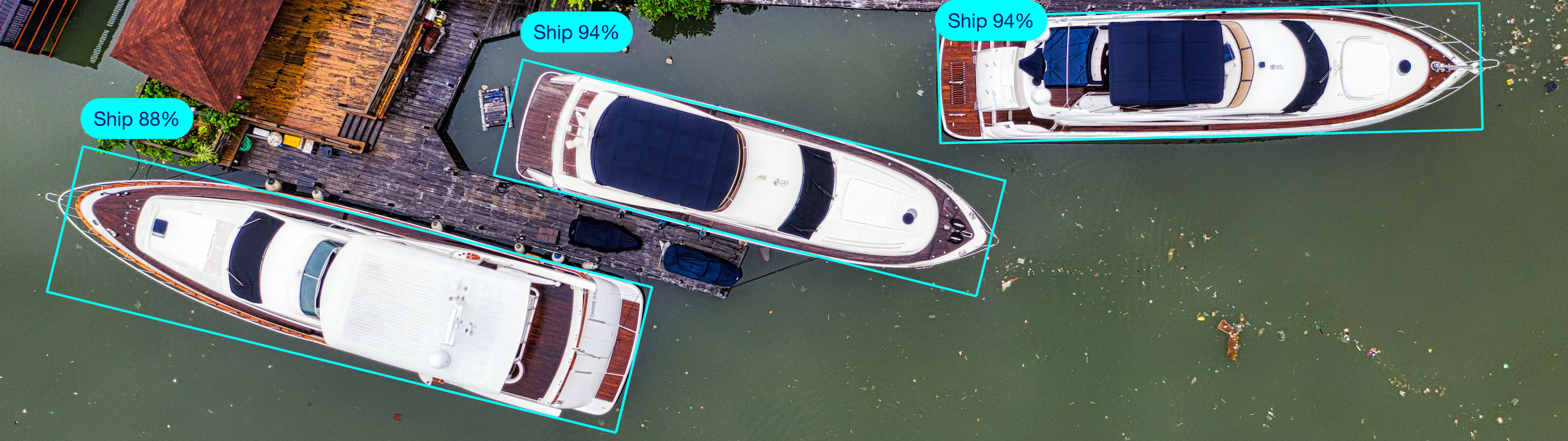
Yönlendirilmiş nesne algılama, görüntüdeki nesnelerin konumunu daha hassas belirlemek için ek bir açı ekleyerek standart nesne algılamanın ötesine geçer.
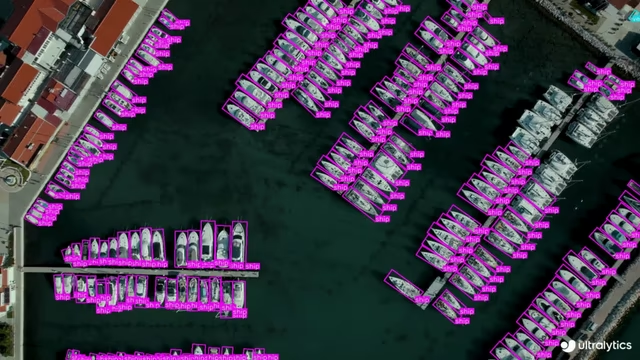
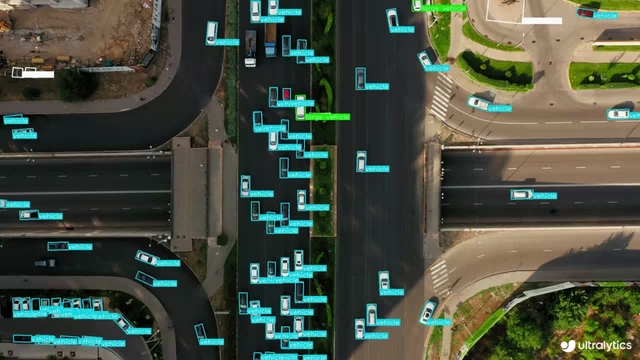
Yönlendirilmiş nesne algılayıcısının çıktısı, görüntüdeki nesneleri hassas biçimde çevreleyen döndürülmüş sınırlayıcı kutulardan ve her kutunun sınıf etiketleriyle güven puanlarından oluşur. Yönlendirilmiş sınırlayıcı kutular, özellikle geleneksel eksenlere hizalı sınırlayıcı kutuların gereksiz arka plan içerebildiği hava görüntüleri gibi, nesnelerin farklı açılarda göründüğü durumlarda kullanışlıdır. Yaygın kullanım alanları arasında uydu ve drone görüntülerinden gemi ve araç algılama, kentsel planlama için bina ve altyapı analizi, ürün izleme ve güneş panelleri ya da rüzgâr türbinlerinin incelenmesi yer alır.
İzle: Ultralytics YOLO26 Yönlendirilmiş Sınırlayıcı Kutularıyla (OBB) Nesneler Nasıl Algılanır ve İzlenir | Gemi Takibi 🚢
YOLO26 OBB modelleri -obb son ekini kullanır; örneğin yolo26n-obb.pt ve DOTAv1 üzerinde önceden eğitilmiştir.
| OBB ile gemi tespiti | OBB ile araç tespiti |
|---|---|
 |  |
Modeller#
DOTAv1 veri kümesi üzerinde önceden eğitilmiş YOLO26 OBB modelleri aşağıda gösterilmiştir.
Modeller ilk kullanımda en güncel Ultralytics sürümünden otomatik olarak indirilir.
DOTAv1 görüntüleri ve açıklamaları yalnızca akademik amaçlarla kullanılabilir; ticari kullanıma izin verilmez. Ultralytics, bu kısıtlamaların önceden eğitilmiş veya ince ayar yapılmış model ağırlıklarından ziyade kaynak veri kümesi için geçerli olduğunu yorumlar. Kullanım amacına uygunluğu değerlendirmek için DOTA koşullarını incele.
| Model | boyut (piksel) | mAPtest50-95 (e2e) | mAPtest50 (e2e) | Hız CPU ONNX (ms) | Hız T4 TensorRT10 (ms) | parametre (M) | FLOPs (B) |
|---|---|---|---|---|---|---|---|
| YOLO26n-obb | 1024 | 52.4 | 78.9 | 97.7 ± 0.9 | 2.8 ± 0.0 | 2.4 | 14.8 |
| YOLO26s-obb | 1024 | 54.8 | 80.9 | 218.0 ± 1.4 | 4.9 ± 0.1 | 9.8 | 56.7 |
| YOLO26m-obb | 1024 | 55.3 | 81.0 | 579.2 ± 3.8 | 10.2 ± 0.3 | 21.2 | 184.9 |
| YOLO26l-obb | 1024 | 56.2 | 81.6 | 735.6 ± 3.1 | 13.0 ± 0.2 | 25.6 | 232.4 |
| YOLO26x-obb | 1024 | 56.7 | 81.7 | 1485.7 ± 11.5 | 30.5 ± 0.9 | 57.6 | 520.1 |
- mAPtest değerleri, DOTAv1 veri kümesinde tek model ve çoklu ölçek için verilmiştir.
yolo obb val data=DOTAv1.yaml device=0 split=test nms=False save_json=Trueile sonuçları yeniden üret ve birleştirilmiş sonuçları DOTA değerlendirmesine gönder. - Hız değerleri, DOTAv1 doğrulama görüntülerinde ONNX CPU ve NVIDIA T4 GPU üzerinde TensorRT10 kullanılarak ortalaması alınmıştır.
yolo obb val data=DOTAv1.yaml batch=1 device=0|cpu nms=Falseile yeniden üret - Parametre ve FLOP değerleri; Conv/BatchNorm katmanları birleştirildikten ve kullanılmayan tespit dalı kaldırıldıktan sonraki füzyonlu modeller içindir. Önceden eğitilmiş kontrol noktaları, eğitim mimarisinin tamamını korur ve daha yüksek sayılar gösterebilir.
Ön sonuçlar için yayımlanmamış YOLO27 önizlemesine bak.
Eğit#
640 görüntü boyutunda 100 epoch boyunca DOTA8 veri kümesinde bir YOLO26n-obb modelini eğit.
Bir OBB ile onun 180° döndürülmüş hâli aynıdır; bu nedenle dönüş 180°'ye göre tanımlanır ve kutunun yönü yoktur. Eğitim etiketleri uzun kenar biçimine göre kanonikleştirilir: kutu genişliği olan w daha uzun kenardır, açı pozitif x ekseninden w kenarının yönüne saat yönünde ölçülür ve radyan cinsinden [-π/4, 3π/4) biçiminde ([-45°, 135°)) saklanır. Tahminler kanonikleştirilmediğinden tahmin edilen bir kutuda kısa kenar w olarak bildirilebilir; Sonuç Çıktısı sayfasına bak. [0°, 90°) biçimi, düzenlileştirilmiş DOTA tarzı kuraldır ve eğitim ya da çıkarım sırasında uygulanmaz.
from ultralytics import YOLO

# Bir model yükle
model = YOLO("yolo26n-obb.yaml")  # YAML'den yeni bir model oluştur
model = YOLO("yolo26n-obb.pt")  # Önceden eğitilmiş bir model yükle (eğitim için önerilir)
model = YOLO("yolo26n-obb.yaml").load("yolo26n-obb.pt")  # YAML'den oluştur ve ağırlıkları aktar

# Modeli eğit
results = model.train(data="dota8.yaml", epochs=100, imgsz=640)
İzle: Ultralytics Platformunu Kullanarak DOTA Veri Kümesinde Ultralytics YOLO-OBB (Yönlendirilmiş Sınırlayıcı Kutular) Modelleri Nasıl Eğitilir
train modunun tüm ayrıntılarını Eğitim sayfasında bulabilirsin. OBB modellerini Ultralytics Platform bulut eğitimi ile de eğitebilirsin.
Veri kümesi biçimi#
OBB veri kümesi biçiminin ayrıntılarını Veri Kümesi Kılavuzu sayfasında bulabilirsin. YOLO OBB biçiminde sınırlayıcı kutular, koordinatları 0 ile 1 arasında normalize edilmiş dört köşe noktasıyla aşağıdaki yapıda tanımlanır. Ultralytics Platform açıklama aracı, özel bir yönlendirilmiş sınırlayıcı kutu çizim aracıyla OBB etiketlerini destekler:
class_index x1 y1 x2 y2 x3 y3 x4 y4YOLO, kayıpları ve çıktıları dâhili olarak sınırlayıcı kutunun merkez noktasını (xy), genişliğini, yüksekliğini ve dönüşünü temsil eden xywhr biçiminde işler.
Doğrula#
Eğitilmiş YOLO26n-obb modelinin DOTA8 veri kümesindeki doğruluğunu, ortalama Hassasiyet (mAP) olarak ölçülen değerle doğrula. Doğrulamanın hedeflenen veri kümesi YAML dosyasını kullanması için data değerini açıkça ilet.
from ultralytics import YOLO

# Bir model yükle
model = YOLO("yolo26n-obb.pt")  # Resmî bir modeli yükle
model = YOLO("path/to/best.pt")  # özel bir model yükle

# Modeli doğrula
metrics = model.val(data="dota8.yaml")  # DOTA8 veri kümesinde doğrula
metrics.box.map  # map50-95(B)
metrics.box.map50  # map50(B)
metrics.box.map75  # map75(B)
metrics.box.maps  # Sınıf başına mAP50-95(B); val kümesinde bulunmayan sınıflara genel mAP(B) değeri atanır
metrics.box.ap_class_index  # Gerçekten değerlendirilen sınıf indeksleri
metrics.box.image_metrics # Hassasiyet, geri çağırma, F1, TP, FP ve FN değerlerini içeren görüntü başına metrik sözlüğüTahmin#
Görüntüler üzerinde tahmin yapmak için eğitilmiş bir YOLO26n-obb modeli kullan.
from ultralytics import YOLO

# Bir model yükle
model = YOLO("yolo26n-obb.pt")  # Resmî bir modeli yükle
model = YOLO("path/to/best.pt")  # özel bir model yükle

# Modelle tahmin yap
results = model("https://ultralytics.com/images/boats.jpg")  # bir görüntü üzerinde tahmin yap

# Sonuçlara eriş
for result in results:
    xywhr = result.obb.xywhr  # merkez-x, merkez-y, genişlik, yükseklik, açı (radyan)
    xyxyxyxy = result.obb.xyxyxyxy  # 4 noktalı çokgen biçimi
    names = [result.names[cls.item()] for cls in result.obb.cls.int()]  # her kutunun sınıf adı
    confs = result.obb.conf  # her kutunun güven puanı
predict kipinin tüm ayrıntıları için Tahmin sayfasına bak.
save_crop=True değerini ileterek her OBB'nin kutu boyutunda, döndürmeyle hizalanmış kırpımını kaydedebilirsin; ObjectCropper de bunu yapar.
Sonuç Çıktısı#
Yönlendirilmiş sınırlayıcı kutu tespiti, her görüntü için bir Results nesnesi döndürür. Temel tahmin alanı olan result.obb, tespit edilen her nesne için döndürülmüş kutuları, sınıf kimliklerini ve güven puanlarını içerir.
| Öznitelik | Tür | Şekil | Açıklama |
|---|---|---|---|
result.obb | OBB | (N) | Yönlendirilmiş kutular. |
result.obb.data | torch.float32 | (N,7/8) | Güven/sınıf bilgisi içeren ham döndürülmüş kutular. |
result.obb.xywhr | torch.float32 | (N,5) | xywhr döndürülmüş kutular. |
result.obb.xyxyxyxy | torch.float32 | (N,4,2) | Dört köşe noktası. |
result.obb.conf | torch.float32 | (N,) | Güven puanları. |
Etiketler uzun kenar kuralına göre kanonikleştirilir, ancak tahminler kanonikleştirilmez; bu nedenle result.obb.xywhr, dönüş kısa kenardan ölçülürken w değerinin h değerinden küçük olduğunu bildirebilir. Her iki biçim de aynı dikdörtgeni tanımlar, dolayısıyla result.obb.xyxyxyxy her iki durumda da doğrudur. İzleme sırasında her iz, yarım dönüş biçimlerinden (θ veya θ ± π) önceki açısına en yakın olanı korur; böylece iz açıları kareler arasında π kadar sıçramaz ve [-π/4, 3π/4) aralığının dışına çıkabilir. Aşağı akış kodu uzun kenar biçimine ihtiyaç duyduğunda köşeleri geri dönüştür; kutu parametrelerini yeniden yazmanın köşe sırasını döngüsel olarak kaydırabileceğini unutma:
from ultralytics.utils.ops import xyxyxyxy2xywhr

xywhr = xyxyxyxy2xywhr(result.obb.xyxyxyxy)  # w >= h, rotation in [-pi/4, 3pi/4)
Tüm görevlerde göreve özgü Results alanları için Göreve Göre Tahmin Sonuçları bölümüne bak.
Dışa aktar#
YOLO26n-obb modelini ONNX, CoreML vb. farklı bir biçime aktar.
from ultralytics import YOLO

# Bir model yükle
model = YOLO("yolo26n-obb.pt")  # Resmî bir modeli yükle
model = YOLO("path/to/best.pt")  # özel bir model yükle

# Modeli dışa aktar
model.export(format="onnx")
Kullanılabilir YOLO26-obb dışa aktarma biçimleri aşağıdaki tabloda listelenmiştir. format bağımsız değişkenini (ör. format='onnx' veya format='engine') kullanarak herhangi bir biçime aktarabilirsin. Dışa aktarılan modeller üzerinde doğrudan tahmin veya doğrulama yapabilirsin; örneğin yolo predict model=yolo26n-obb.onnx. Dışa aktarma tamamlandıktan sonra modelin için kullanım örnekleri gösterilir.
| Biçim | format bağımsız değişkeni | Model | Üst veriler | Bağımsız değişkenler |
|---|---|---|---|---|
| PyTorch | - | yolo26n-obb.pt | ✅ | - |
| TorchScript | torchscript | yolo26n-obb.torchscript | ✅ | imgsz, quantize, dynamic, nms, batch, device |
| ONNX | onnx | yolo26n-obb.onnx | ✅ | imgsz, quantize, dynamic, simplify, opset, nms, batch, data, fraction, device |
| OpenVINO | openvino | yolo26n-obb_openvino_model/ | ✅ | imgsz, quantize, dynamic, nms, batch, data, fraction, device |
| TensorRT | engine | yolo26n-obb.engine | ✅ | imgsz, quantize, dynamic, simplify, opset, workspace, nms, batch, data, fraction, device |
| CoreML | coreml | yolo26n-obb.mlpackage | ✅ | imgsz, dynamic, quantize, nms, batch, device |
| Apple Core AI | coreai | yolo26n-obb.aimodel | ✅ | imgsz, batch, quantize |
| TF SavedModel | saved_model | yolo26n-obb_saved_model/ | ✅ | imgsz, quantize, opset, nms, batch, data, fraction, device |
| TF GraphDef | pb | yolo26n-obb.pb | ❌ | imgsz, opset, batch, device |
| TF Edge TPU | edgetpu | yolo26n-obb_edgetpu.tflite | ✅ | imgsz, quantize, opset, data, fraction, device |
| LiteRT | litert | yolo26n-obb.tflite | ✅ | imgsz, quantize, batch, data, fraction, device |
| PaddlePaddle | paddle | yolo26n-obb_paddle_model/ | ✅ | imgsz, batch, device |
| MNN | mnn | yolo26n-obb.mnn | ✅ | imgsz, batch, dynamic, quantize, simplify, opset, nms, device |
| NCNN | ncnn | yolo26n-obb_ncnn_model/ | ✅ | imgsz, quantize, device |
| IMX500 | imx | yolo11n_imx_model/ | ✅ | imgsz, quantize, data, fraction, nms, device |
| RKNN | rknn | yolo26n-obb_rknn_model/ | ✅ | imgsz, batch, name, quantize, simplify, opset, data, fraction, device |
| ExecuTorch | executorch | yolo26n-obb_executorch_model/ | ✅ | imgsz, quantize, batch, data, fraction, device |
| Axelera | axelera | yolo26n-obb_axelera_model/ | ✅ | imgsz, batch, quantize, data, fraction, device |
| DEEPX | deepx | yolo26n-obb_deepx_model/ | ✅ | imgsz, quantize, simplify, opset, data, optimize, device |
| Qualcomm QNN | qnn | yolo26n-obb_qnn.onnx | ✅ | imgsz, batch, name, quantize, simplify, opset, data, fraction, device |
| Hailo | hailo | yolo26n-obb_hailo_model/ | ✅ | imgsz, name, quantize, data, fraction, simplify, conf, iou, device |
| Huawei Ascend | ascend | yolo26n-obb_ascend_model/ | ✅ | imgsz, batch, name, quantize, opset, simplify, nms, device |
| AMD Xilinx | xilinx | yolo26n-obb_xilinx_model/ | ✅ | imgsz, name, quantize, data, fraction, opset, simplify, device |
| NXP | nxp | yolo26n-obb_nxp.tflite | ✅ | imgsz, quantize, data, fraction, device |
nms=None, harici NMS için varsayılan olarak ham çıktılar üretir (YOLO26, Axelera üzerinde NMS içermeyen başlığını korur). Kullanılabilir NMS içermeyen bir başlık seçmek için nms=False değerini ayarla; desteklenmeyen biçimler yerel çıktı yoluna geri döner. Yukarıdaki nms girdileri, nms=True ile NMS gömebilen biçimleri belirtir.
Ayrıntılı export bilgileri için Dışa Aktarma sayfasına bak.
Sık Sorulan Sorular#
Yönlendirilmiş Sınırlayıcı Kutular (OBB), görüntülerde nesne konumunu belirleme doğruluğunu artırmak için ek bir açı içerir. Eksenlere hizalı dikdörtgenlerden oluşan normal sınırlayıcı kutuların aksine OBB'ler, nesnenin yönüne daha iyi uyum sağlamak için dönebilir. Bu özellik, hava veya uydu görüntüleri gibi nesnelerin hassas biçimde yerleştirilmesini gerektiren uygulamalarda özellikle kullanışlıdır (Veri Kümesi Kılavuzu).
YOLO26n-obb modelini özel bir veri kümesiyle eğitmek için Python veya CLI kullanarak aşağıdaki örneği uygula:
Örnekfrom ultralytics import YOLO # Önceden eğitilmiş bir modeli yükle model = YOLO("yolo26n-obb.pt") # Modeli eğit results = model.train(data="path/to/custom_dataset.yaml", epochs=100, imgsz=640)Daha fazla eğitim argümanı için Yapılandırma bölümüne bak.
YOLO26-OBB modelleri DOTAv1 gibi veri kümeleriyle önceden eğitilmiştir; ancak OBB biçiminde düzenlenmiş herhangi bir veri kümesini kullanabilirsin. OBB veri kümesi biçimleri hakkında ayrıntılı bilgi için Veri Kümesi Kılavuzu bölümüne bakabilirsin.
YOLO26n-obb modelini doğrulamak için aşağıda gösterildiği gibi Python veya CLI komutlarını kullanabilirsin:
Örnekfrom ultralytics import YOLO # Bir model yükle model = YOLO("yolo26n-obb.pt") # Modeli doğrula metrics = model.val(data="dota8.yaml")Doğrulama hakkında tüm ayrıntılar için Val bölümüne bak.
YOLO26-OBB modelini ONNX biçimine aktarmak Python veya CLI kullanarak oldukça kolaydır:
Örnekfrom ultralytics import YOLO # Bir model yükle model = YOLO("yolo26n-obb.pt") # Modeli dışa aktar model.export(format="onnx")Daha fazla dışa aktarma biçimi ve ayrıntı için Export sayfasına bak.


Yorumlar252
Bir soru sor, sonuçlarını paylaş veya başka birine yardım et.
zhouyizhuo
how to do Model Ensembling on yolov8-obb models?
2 Paula DerrengerUltralytics(düzenlendi)
Model ensembling with YOLOv8-obb models involves combining the predictions from multiple trained models to improve the accuracy of your oriented objects detection. Currently, direct support for model ensembling within Ultralytics YOLO isn't provided out-of-the-box. However, you can manually implement ensembling by running predictions with each model separately and then combining these predictions.
One common approach is to average the bounding box coordinates and confidence scores of the same object detected by multiple models. Ensure to consider the rotating angle parameter unique to OBB models in your ensembling logic. Here's a basic conceptual example to get you started:
from ultralytics import YOLO

models = [
    YOLO('path/to/first_obb_model.pt'),
    YOLO('path/to/second_obb_model.pt'),
    # Add more models as needed
]

# Assuming you have a method to read your images/videos
image = 'path/to/image.jpg'

# List to store results from all models
all_preds = []

for model in models:
    results = model(image)
    all_preds.append(results[0].obb)  # Extracting OBB predictions (xywhr, conf, cls)

# Assuming you have a method `combine_predictions(all_preds)`
# that combines predictions from all models
final_predictions = combine_predictions(all_preds)

# Process `final_predictions`...
This example loads each model, runs predictions on the same image, and stores the results. You'd then need to implement
combine_predictions(all_preds)to handle the logic for combining these predictions based on criteria like IoU, confidence scores, etc., taking into account the angle for rotated bounding boxes.Remember, ensembling may increase inference time due to processing with multiple models. Always weigh the benefits of improved accuracy against potential increases in computational cost. Happy coding! 😊
windzu
if you want draw predict results to img and save , you can ref below easy code :
# you predict code #

import cv2

image = cv2.imread(test_img_path)
for r in results:
    xyxyxyxy = r.obb.xyxyxyxy.cpu().numpy()

    for box in xyxyxyxy:
        points = box.reshape(4, 2).astype(int)
        cv2.polylines(image, [points], isClosed=True, color=(0, 255, 0), thickness=2)

cv2.imwrite("detected_image.jpg", image)
1 Glenn JocherUltralytics
@windzu thank you for sharing the code example. For more details on using YOLOv8 Oriented Bounding Boxes, please refer to our documentation on training, validation, and exporting models. If you have further questions, feel free to ask here.
krialm
Hi, when I am using yolov8_obb model in results I always have boxes: None keypoints: None masks: None
even when the model makes prediction. Did someone faced with this problem and if yes, what was the solution? Thank you.🙂
1RizwanMunawar
@krialm In the case of OBB, you can get bounding box data, using the mentioned code below.
model = YOLO("yolov8n-obb.pt")
results = model.predict(im0)
pred_boxes = results[0].obb
I hope this helps! Let me know if you have any additional questions.
Thanks and Regards Ultralytics Team!
1kedardg
Is there a way for me to train OBB models from scratch let's say the P2 or RTDETR models which are not available pre-trained?
- Paula DerrengerUltralytics
@kedardg absolutely, you can train OBB models like P2 or RTDETR from scratch even if they're not available pre-trained. You'd start by creating a new model from a YAML file, which defines the model architecture. Here's a quick example of how you might do it:
yolo obb train data=your_dataset.yaml model=your_model.yaml epochs=100 imgsz=640Just replace
your_dataset.yamlwith your dataset configuration file andyour_model.yamlwith your model configuration file. Make sure your dataset is properly formatted for OBB tasks. Happy training! 😊🚀 RumaisaIlyas
model = YOLO("yolov8n-obb.pt") results = model.predict(im0) pred_boxes = results[0].obb
i did this but i want to draw bounding boxes on the test image and return it. how to do that?
my function is:
def count_detection(image): if image is not None: # Load the YOLO model model = YOLO('bestobbv8s.pt')
# Check the shape of the input image print("Input image shape:", image.shape) # Use the model to predict the wheat spikes in image results = model(image, save=True) # Count count = sum(len(result) for result in results) print("count", count) # Draw bounding boxes for detected wheat heads for result in results: boxes = result.obb #here? return image- Paula DerrengerUltralytics
@RumaisaIlyas hey there! 😊 To draw bounding boxes on your test image and return it, you can use the
plot()method available in theResultsobject. Here's how you can modify your function:def count_detection(image): if image is not None: # Load the YOLO model model = YOLO('bestobbv8s.pt') # Check the shape of the input image print("Input image shape:", image.shape) # Use the model to predict results = model.predict(image) # Draw bounding boxes and return the annotated image annotated_image = results[0].plot() # Count detections count = len(results[0].obb) print("count", count) return annotated_imageIn this updated function, after making predictions with
model.predict(image), we useresults[0].plot()to draw bounding boxes on the image. This method returns the annotated image, which we then return from the function. This should give you the visual feedback you're looking for! 🚀Let me know if you need further assistance!
thankyou so much for your assistance. i am facing a problem that my runs folder is not created after i run the code provided. why is that? what should i do in code so that i get the runs folder with my predicted image
- Paula DerrengerUltralytics(düzenlendi)
Hey there! 😊 It sounds like you're doing everything right, but if the
runsfolder isn't being created, it might be due to a small oversight. Here's a quick checklist:- Ensure you're using the latest version of the Ultralytics YOLO library. Sometimes, updates fix these kinds of issues.
- Double-check your command and make sure it's complete. For predictions, it should look something like this:
from ultralytics import YOLO # Load your model model = YOLO('bestobbv8s.pt') # Run prediction # save=True writes the annotated image to the 'runs' folder results = model.predict('path/to/your/image.jpg', save=True)- If you're still not seeing the
runsfolder, try specifying the output directory explicitly in your code:
results = model.predict('path/to/your/image.jpg', save=True, project='runs/detect') # Adjust the path as needed- Lastly, ensure you have the necessary write permissions in your working directory. Sometimes, permission issues can prevent the creation of new folders.
If you've checked all these and the issue persists, it might be helpful to share more details about your environment (like your operating system) or any error messages you're seeing. That way, the community can offer more targeted advice. 🚀
Hope this helps, and happy detecting!
Ci-ne
I also face the same problem. I tried using the code provided but it still says NoneType
ncnn_model = YOLO("./my_ncnn_model", task='detect') results = ncnn_model.predict(image_path)
if results[0] is not None: # Ensure results is not None obb_boxes = results[0].obb # For OBB models print(f"OBB Box: {obb_boxes}") else: print("No detections.")
This is what I get
Speed: 4.1ms preprocess, 93.1ms inference, 1.2ms postprocess per image at shape (1, 3, 640, 640) OBB Box: None
Any help?
1chengz
The document notes that 'OBB angles are constrained to the range 0–90 degrees (exclusive of 90). Angles of 90 degrees or greater are not supported.' So what is the normal radian range for an OBB, [-π/4, 3π/4) or something else?
 Murat Raimbekov
the radian range is
[-π/4, 3π/4), i.e.[-45°, 135°), not[0°, 90°). that docs note was inaccurate and is fixed in #24534.ground-truth angles are normalized in
xyxyxyxy2xywhr(ultralytics/utils/ops.py) by two loops,while theta >= 3*pi/4: theta -= piandwhile theta < -pi/4: theta += pi, withwswapped to the longer side. sweeping a rectangle through physical 0->180°:0° -> 0.0000 45° -> 0.7854 (π/4) 90° -> 1.5708 (π/2) 120° -> 2.0944 135° -> -0.7854 (-π/4) 165° -> -0.2618so the span is exactly π wide, half-open at
3π/4.the heads match this:
OBB(yolov8/yolo11):angle = (sigmoid(raw) - 0.25) * π, hard-bounded to[-π/4, 3π/4].OBB26(yolo26): raw output, no sigmoid, trained on targets already in[-π/4, 3π/4).
[0, π/2)is the regularized DOTA-style form produced byregularize_rboxesinops.py. that function is defined but has no callers anywhere inultralytics/, so it is not applied at training or inference. predicted boxes reach you unregularized:result.obb.xywhrreturns the angle in[-π/4, 3π/4)(verified by feeding angles like-0.70and2.30through the predict path and reading them back unchanged).one consequence, which is what the original note was really about: an OBB and its 180° rotation encode to the same
xywhr, so rotation is defined only modulo 180° and the box has no direction. θ and θ+180° are indistinguishable, so you cannot recover a fixed corner ordering from the predicted angle.
 User
mAPtest values are for single-model multiscale on DOTAv1 dataset. Reproduce by yolo val obb data=DOTAv1.yaml device=0 split=test and submit merged results to DOTA evaluation. This mentions that the test results are submitted to the DOTAv1 server through a multiscale approach. I would like to ask, what does this "multiscale" mean? How is it specifically implemented? Is it trained at scales like 512512 and 10241024, and then tested on the test dataset? How are the final results obtained? I am not quite clear on what this multiscale refers to. Please help me with this.
- Glenn JocherUltralytics
Here, “multiscale” means evaluating the same trained model on multiple resized/split versions of each DOTA image tile, then merging those detections back into the original image for final submission; in Ultralytics this is tied to the DOTA split pipeline with scales like
rates=[0.5, 1.0, 1.5]in the DOTA dataset guide and the merged-result export inOBBValidator.eval_json(), so it is usually multi-scale test-time inference with one model rather than separately training 512 and 1024 models. - Murat Raimbekov
it is one model, trained once. there is no separate 512 and 1024 model, and no separate training runs per scale. the "multiscale" lives entirely in the dota tiling step, not inside
yolo val.where it comes from. dota images are huge (800x800 up to ~20000x20000), so they are cut into overlapping tiles before training/val using
split_trainval/split_testfromultralytics/data/split_dota.py. the multiscale variant passesrates=[0.5, 1.0, 1.5](this is exactly what the dota dataset guide shows). for each raterthe code usescrop_size / randgap / r, so with the defaultscrop_size=1024, gap=200you get tiles of:rate 0.5 -> 2048 px tiles (gap 400) rate 1.0 -> 1024 px tiles (gap 200) rate 1.5 -> 682 px tiles (gap 133)every original image is therefore cut into overlapping windows at all three crop sizes. each window is later resized to
imgszat inference, so the same content is effectively seen at three resolutions. concretely, a single 4000x4000 image produces ~98 tiles spread across those three sizes.training. the model is trained once on the multiscale-split trainval tiles (same
rates=[0.5, 1.0, 1.5]). it is not "trained at 512 then at 1024" as separate models.test / how the final number is obtained.
yolo val obb data=DOTAv1.yaml split=testruns that single model over every test tile. each tile filename encodes the source image id and crop offset (name__cropsize__xstart___ystart).OBBValidator.eval_json()parses that, shifts each tile's rotated boxes back into the original full-image coordinates, concatenates detections from all tiles and all scales, then runs a rotated probiou NMS (fast_nms, iou 0.3) to remove the overlap introduced by tiling. the merged per-image results are written as dotaTask1_*.txt, which is what you submit to the dota evaluation server.one practical caveat.
yolo val ... split=testdoes not create the multiscale tiles for you. you have to runsplit_test(rates=[0.5, 1.0, 1.5])first (andsplit_trainvalwith the same rates for training). running val on the raw full dota images is single-scale and will not reproduce themAPtestnumber in the table.so in short: multiscale = offline multi-scale tiling + per-tile single-scale inference + merge-back-and-NMS, all with one model. it is test-time multi-scale through the tiling, not test-time augmentation inside
val.
kssion
WARNING ⚠️ CoreML: 'nms=True' is only available for Detect models like 'yolo11n.pt'.
yolo export model=best.pt format=coreml nms=True conf=0.25 iou=0.45Ultralytics 8.3.232 🚀 Python-3.11.11 torch-2.9.1 CPU (Apple M1) YOLO11n-obb summary (fused): 109 layers, 2,653,918 parameters, 0 gradients, 6.6 GFLOPs
PyTorch: starting from 'best.pt' with input shape (1, 3, 640, 640) BCHW and output shape(s) (1, 6, 8400) (5.5 MB) Torch version 2.9.1 has not been tested with coremltools. You may run into unexpected errors. Torch 2.7.0 is the most recent version that has been tested.
CoreML: starting export with coremltools 9.0... WARNING ⚠️ CoreML: 'nms=True' is only available for Detect models like 'yolo11n.pt'. Converting PyTorch Frontend ==> MIL Ops: 100%|██████████████▉| 867/868 [00:00<00:00, 8975.73 ops/s] Running MIL frontend_pytorch pipeline: 100%|███████████████████| 5/5 [00:00<00:00, 166.58 passes/s] Running MIL default pipeline: 100%|███████████████████████████| 95/95 [00:00<00:00, 99.61 passes/s] Running MIL backend_mlprogram pipeline: 100%|████████████████| 12/12 [00:00<00:00, 176.60 passes/s] CoreML: export success ✅ 4.8s, saved as 'best.mlpackage' (5.3 MB)
Export complete (5.0s)
- Glenn JocherUltralytics
That warning is expected for OBB models: CoreML
nms=Trueis only supported for axis-aligned Detect heads, so export your*-obbmodel without NMS and do confidence/IoU (rotated NMS) post-processing on the app side (export success ✅ means you’re fine). See the Ultralytics YOLO OBB task docs for the OBB output formats.yolo export model=best.pt format=coreml
wang18382140151-hub
你好,请问你们未来的工作计划中是否有将rtdetr用于obb检测呢,最近我正在基于贵司源码做改进
AbhisekRao
I'm currently working with the YOLOv11 Oriented Bounding Box (OBB) model exported in TensorRT format, and deploying it on an NVIDIA Jetson device (AGX Orin). While the model works in standard inference pipelines (.pt) , I’m facing challenges integrating it into a DeepStream-based application to process live RTSP video streams.
There seems to be no existing reference implementation or sample Python code that demonstrates how to use the OBB variant of the model with DeepStream. Specifically, I'm looking for guidance on:
1- Integrating the YOLOv11 OBB TensorRT model with DeepStream (preferably using Python bindings). 2- Proper parsing and visualization of oriented bounding boxes from the model output. 3- Any custom parser or config file changes required in the DeepStream pipeline.
Any support, documentation, or examples from the team or community would be greatly appreciated.
cripsgreen
Hello, could you please share some insights on how to train the hyperparameters for YOLOv11-OBB, as well as the pre-trained weights? Thank you.
ziishuo
May I ask if the OBB model can be used to detect subjects in a normal perspective (such as a level shot)? I noticed that most of the examples are from a top-down angle. Thank you!