Xuất Rockchip RKNN
RKNN là định dạng model của NPU trên các bộ xử lý Rockchip như RK3588 và RK3566. Xuất model Ultralytics YOLO26 bằng format="rknn" sẽ tạo thư mục yolo26n_rknn_model/ chứa tệp .rknn được xây dựng cho một chip Rockchip; bạn chọn chip bằng đối số name. Tệp sử dụng độ chính xác FP16 hoặc INT8.
Tổng quan nhanh#
| Thuộc tính | Chi tiết |
|---|---|
Đối số format | rknn |
| Đầu ra | yolo26n_rknn_model/, một thư mục chứa yolo26n-rk3588.rknn và metadata.yaml; các bản xuất INT8 của model detect, segment, pose và OBB bổ sung tail.onnx |
| Chạy trên | NPU của một chip Rockchip cho mỗi lần xuất: RK3588, RK3576, RK3566, RK3568, RK3562, RK2118, RV1126B, RV1103, RV1106, RV1103B hoặc RV1106B; xem Chip mục tiêu |
| Runtime | RKNN Toolkit Lite2 (gói Python rknn-toolkit-lite2) trên thiết bị Rockchip |
| Precision | FP16 (mặc định) và INT8; chỉ hỗ trợ INT8 trên RV1103, RV1106, RV1103B và RV1106B. Không có bản xuất FP32. YOLO26n cho RK3588 có dung lượng 7.4 MB ở FP16 và 4.3 MB ở INT8 |
| Máy export | Linux x86-64 với Python 3.12 trở xuống. Xuất trên PC rồi sao chép thư mục đã xuất sang thiết bị Rockchip |
Ultralytics Platform có thể xuất model đã huấn luyện sang RKNN cho chip Rockchip bạn chọn, vì vậy bạn không cần môi trường xuất cục bộ.
Bắt đầu nhanh#
Cài gói Ultralytics trong một môi trường ảo riêng trên máy Linux x86-64, cùng với các phiên bản protobuf và numpy mà bộ công cụ RKNN yêu cầu:
pip install ultralytics "protobuf<7" "numpy<2.4"Lần xuất đầu tiên sẽ cài đặt onnx, onnxslim, onnxruntime và rknn-toolkit2 cùng các phần phụ thuộc nếu chúng chưa có. Với pip install ultralytics thông thường, lần xuất đầu tiên cũng thay thế numpy, protobuf và setuptools nếu phiên bản của chúng nằm ngoài các phạm vi bên dưới, vì vậy hãy dùng một môi trường riêng. Khi cần thay thế protobuf hoặc numpy, lần xuất đó sẽ thất bại, còn lần xuất tiếp theo trong một tiến trình mới sẽ thành công. Các yêu cầu phiên bản của quá trình xuất như sau:
| Package | Phiên bản yêu cầu |
|---|---|
| Python | 3.12 trở xuống, là phiên bản mới nhất mà rknn-toolkit2 2.3.2 có bản dựng |
rknn-toolkit2 | 2.3.2, bản phát hành duy nhất trên PyPI trong phạm vi yêu cầu (2.3.2 trở lên và dưới 2.5) |
onnx | 1.16.1 trở lên và dưới 1.19.0 |
numpy | dưới 2.4 |
protobuf | dưới 7 |
setuptools | dưới 82 |
Để xem các phương thức cài đặt khác, hãy tham khảo hướng dẫn cài đặt. Sau đó, xuất model trên PC, sao chép thư mục đã xuất sang thiết bị Rockchip và tải model lên thiết bị để chạy inference hoặc đánh giá độ chính xác.
from ultralytics import YOLO

# Nạp model YOLO26
model = YOLO("yolo26n.pt")

# # Xuất model sang định dạng RKNN cho RK3588 ở FP16
model.export(format="rknn", name="rk3588")  # creates 'yolo26n_rknn_model/'

# # Hoặc xuất model RKNN đã lượng tử hóa INT8 bằng dữ liệu hiệu chuẩn
model.export(format="rknn", name="rk3588", quantize=8, data="coco8.yaml")  # creates 'yolo26n_rknn_model/'
Cả hai lần xuất đều ghi vào cùng thư mục yolo26n_rknn_model/, vì vậy lần xuất thứ hai sẽ thay thế lần đầu. Predict và Validate chỉ chạy trên thiết bị Rockchip:
from ultralytics import YOLO

# # Tải model RKNN đã xuất lên thiết bị Rockchip
model = YOLO("yolo26n_rknn_model")

# Chạy suy luận
results = model("https://ultralytics.com/images/bus.jpg")from ultralytics import YOLO
# # Tải model RKNN đã xuất lên thiết bị Rockchip
model = YOLO("yolo26n_rknn_model")
# # Đánh giá độ chính xác trên bộ dữ liệu COCO8
metrics = model.val(data="coco8.yaml")Các tác vụ được hỗ trợ#
Quá trình xuất RKNN hỗ trợ cả bảy tác vụ Ultralytics với các model YOLOv8, YOLO11 và YOLO26: detection, segmentation, segmentation ngữ nghĩa, ước lượng độ sâu, phân loại, ước lượng pose và OBB. Segmentation ngữ nghĩa và ước lượng độ sâu chỉ có trên YOLO26, dòng model duy nhất có các head này.
Các tham số xuất model#
| Đối số | Kiểu | Mặc định | Mô tả |
|---|---|---|---|
format | str | 'rknn' | Định dạng đích của model đã xuất, xác định khả năng tương thích với nhiều môi trường triển khai. |
name | str | 'rk3588' | Chip Rockchip mà model được xây dựng cho, viết hoa hoặc viết thường. Xem Chip mục tiêu. |
imgsz | int hoặc tuple | 640 | Kích thước ảnh đầu vào của model: một số nguyên cho ảnh vuông hoặc một tuple (height, width). Nếu không truyền tham số này, quá trình xuất sẽ dùng kích thước mà checkpoint được huấn luyện. Các checkpoint YOLO26 chính thức sử dụng 640 cho model detect, segment, pose và model ngữ nghĩa được tiền huấn luyện trên ADE20K; 1024 cho model OBB và model ngữ nghĩa được tiền huấn luyện trên Cityscapes; 768 cho tác vụ depth; và 224 cho classify. |
quantize | int hoặc str | None | Độ chính xác: 16 hoặc không đặt sẽ tạo bản dựng FP16, còn 8 tạo bản dựng INT8 được hiệu chuẩn trên data. Với các chip chỉ hỗ trợ INT8, không đặt tham số sẽ tạo bản dựng INT8 và 16 sẽ gây lỗi. 32 sẽ gây lỗi, và không thể xuất checkpoint được huấn luyện bằng quantize=8 sang RKNN; xem Giới hạn và khắc phục sự cố. Thay thế các cờ half/int8 đã bị khai tử. |
data | str | None | File YAML của dataset dùng để hiệu chuẩn INT8; với phân loại, thay vào đó cần thư mục dataset hoặc tên dataset tích hợp sẵn. Hiệu chuẩn dùng split val trừ khi đặt split. Nếu không cung cấp quantize=8, Ultralytics dùng dataset mặc định nhỏ cho tác vụ của model, chẳng hạn coco8.yaml cho phát hiện. |
fraction | float, int hoặc list | 1.0 | Tập con hiệu chuẩn: tỷ lệ, số lượng ảnh (số nguyên lớn hơn 1) hoặc danh sách [train, val, test]; mục nhập của tập chia hiệu chuẩn sẽ được sử dụng. |
batch | int | 1 | Kích thước batch của model đã xuất, được cố định trong shape đầu vào. |
simplify | bool | True | Đơn giản hóa đồ thị ONNX trung gian bằng onnxslim. |
opset | int | None | Phiên bản opset ONNX của đồ thị ONNX trung gian. Nếu không đặt, sẽ dùng 19; các giá trị cao hơn sẽ được giảm xuống 19. |
nms | bool, không bắt buộc | None | Model RKNN luôn trả về dự đoán thô để áp dụng NMS bên ngoài. Head không cần NMS (False) và NMS tích hợp (True) không khả dụng; xem Giới hạn và khắc phục sự cố. |
device | str | None | Thiết bị dùng để trace đồ thị ONNX trung gian: cpu (mặc định) hoặc 0 cho GPU CUDA. |
Để biết các đối số dùng chung cho mọi định dạng, hãy xem tài liệu chế độ Export.
Chip mục tiêu#
Tệp .rknn được xây dựng cho một chip; name dùng để chọn chip đó. Kích thước bên dưới áp dụng cho model detection YOLO26n được xuất ở imgsz=640, khi quantize không được đặt:
name | Độ chính xác | Khi không đặt quantize, bản dựng sử dụng | Tệp YOLO26n | Kích thước |
|---|---|---|---|---|
rk3588 | FP16, INT8 | FP16 | yolo26n-rk3588.rknn | 7.4 MB |
rk3576 | FP16, INT8 | FP16 | yolo26n-rk3576.rknn | 10.5 MB |
rk3566 | FP16, INT8 | FP16 | yolo26n-rk3566.rknn | 6.8 MB |
rk3568 | FP16, INT8 | FP16 | yolo26n-rk3568.rknn | 6.8 MB |
rk3562 | FP16, INT8 | FP16 | yolo26n-rk3562.rknn | 6.8 MB |
rk2118 | FP16, INT8 | FP16 | yolo26n-rk2118.rknn | 6.8 MB |
rv1126b | FP16, INT8 | FP16 | yolo26n-rv1126b.rknn | 7.1 MB |
rv1103 | INT8 | INT8 | yolo26n-rv1103.rknn | 4.2 MB |
rv1106 | INT8 | INT8 | yolo26n-rv1106.rknn | 4.2 MB |
rv1103b | INT8 | INT8 | yolo26n-rv1103b.rknn | 4.2 MB |
rv1106b | INT8 | INT8 | yolo26n-rv1106b.rknn | 4.2 MB |
Bốn chip chỉ hỗ trợ INT8 được hiệu chuẩn trên coco8.yaml mặc định trong bảng này; các bản xuất tương ứng cũng ghi tail.onnx.
Lượng tử hóa#
quantize chọn độ chính xác của tệp .rknn. Kích thước bên dưới áp dụng cho bản xuất ở imgsz=640 và batch=1:
quantize | Precision | Dữ liệu hiệu chuẩn | Các tệp dành cho YOLO26n và rk3588 | Kích thước |
|---|---|---|---|---|
không đặt hoặc 16 | FP16 | Không | yolo26n-rk3588.rknn | 7.4 MB |
8 | INT8 | Có | yolo26n-rk3588.rknn và tail.onnx | 4.3 MB và 0.2 MB |
- FP16: mặc định cho bảy chip hỗ trợ định dạng này. Không cần dữ liệu hiệu chuẩn.
- INT8:
quantize=8chạy ảnh hiệu chuẩn qua model và lưu trọng số cùng activation dưới dạng số nguyên 8 bit. Quá trình xuất hiệu chuẩn trên tập chiavalcủadata, hoặc trên tập chia được đặt bằngsplit, và đưa ra cảnh báo nếu có dưới 300 ảnh. Dùngfractionđể giới hạn số lượng ảnh. - Độ chính xác hỗn hợp: trên bảy chip hỗ trợ FP16, khi xuất INT8, RKNN Toolkit cho phép giữ các layer ở FP16 nếu lượng tử hóa làm thay đổi đầu ra quá nhiều (
auto_hybrid). Bốn chip chỉ hỗ trợ INT8 bỏ qua bước này. - Head detection: với model detect, segment, pose và OBB, tệp
.rknnINT8 kết thúc ở các lớp tích chập đầu ra của head. Các phép toán giải mã những đầu ra này thành box được lưu trongtail.onnxvà chạy ở dạng dấu phẩy động trên CPU của thiết bị, vì INT8 theo từng tensor không thể biểu diễn các giá trị trong phạm vi pixel dùng để giải mã box. - Model depth: các bản xuất depth INT8 được hiệu chuẩn trên những ảnh của tập dữ liệu depth có bản đồ độ sâu tương ứng. Hãy chọn ảnh hiệu chuẩn bao quát phạm vi độ sâu gần và xa của cảnh triển khai. Với
depth8.yamlmặc định, có 4 ảnh validation, model YOLO26n-depth INT8 trong trình mô phỏng rknn-toolkit2 trả về độ sâu tối đa 3.9 cho ảnh đường phố, trong khi model FP16 trả về tối đa 13.9. - Trạng thái trên thiết bị: các bản xuất INT8 cho mọi tác vụ đã được chạy trong trình mô phỏng rknn-toolkit2 và so sánh với model ONNX trên một ảnh. Độ chính xác chưa được đo trên tập dữ liệu hoặc phần cứng Rockchip, vì vậy hãy validation model INT8 trên thiết bị và dữ liệu của riêng bạn trước khi triển khai.
from ultralytics import YOLO

model = YOLO("yolo26n.pt")

# Hiệu chuẩn trên 10% số ảnh validation COCO (500 ảnh); thay coco.yaml bằng dataset của riêng bạn
model.export(format="rknn", name="rk3588", quantize=8, data="coco.yaml", fraction=0.1)
Định dạng đầu ra#
Quá trình xuất ghi một thư mục:
| File | Nội dung |
|---|---|
yolo26n-rk3588.rknn | Model, với chip được đặt bằng name trong tên tệp |
tail.onnx | Chỉ dành cho model detect, segment, pose và OBB INT8: các phép toán giải mã đầu ra của head thành dự đoán thô để chạy trên CPU |
metadata.yaml | Tên lớp, tác vụ, kích thước ảnh, kích thước batch, stride và các tham số xuất mà Ultralytics đọc khi tải model |
Tệp yolo26n.onnx trung gian nằm cạnh thư mục. Model .rknn nhận một đầu vào có shape (batch, height, width, 3): RGB, thứ tự kênh cuối (NHWC), uint8 với giá trị từ 0 đến 255. Phép chia cho 255 đã nằm trong model, vì vậy không cần tự chuẩn hóa ảnh. Điều này khác với bản xuất ONNX, vốn nhận ảnh theo thứ tự kênh trước float32 được chuẩn hóa về 0-1.
Đầu ra tùy thuộc vào tác vụ và độ chính xác. Các shape bên dưới áp dụng cho checkpoint YOLO26n chính thức ở kích thước xuất mặc định, với checkpoint Cityscapes yolo26n-sem.pt dành cho segmentation ngữ nghĩa:
| Tác vụ | imgsz mặc định | Đầu ra FP16 và đầu ra tail.onnx cho INT8 | Đầu ra .rknn INT8 |
|---|---|---|---|
| Detect | 640 | (1, 84, 8400) | 6 tensor của head, được giải mã bằng tail.onnx |
| Segment | 640 | (1, 116, 8400) và (1, 32, 160, 160) | 9 tensor của head và (1, 32, 160, 160), được giải mã bằng tail.onnx |
| Ngữ nghĩa | 1024 | (1, 19, 1024, 1024), điểm số cho mỗi lớp và pixel | Giống FP16 |
| Độ sâu | 768 | (1, 1, 768, 768), bản đồ độ sâu | Giống FP16 |
| Phân loại | 224 | (1, 1000), xác suất lớp | Giống FP16 |
| Tư thế | 640 | (1, 56, 8400) | 9 tensor của head, được giải mã bằng tail.onnx |
| OBB | 1024 | (1, 20, 21504) | 9 tensor của head, được giải mã bằng tail.onnx |
- Dự đoán thô: model FP16 và
tail.onnxđối với model INT8 trả về cùng các dự đoán thô như bản xuất ONNX mặc định: với mỗi anchor, lần lượt là tâm box x, tâm y, chiều rộng và chiều cao tính bằng pixel đầu vào, tiếp theo là điểm số lớp rồi đến các giá trị của tác vụ (32 hệ số mask, 17 giá trị keypoint x 3 hoặc góc OBB tính bằng radian). Tự áp dụng NMS. Xem định dạng đầu ra ONNX để biết bố cục đầu ra của từng tác vụ. - Tensor head INT8: model detection INT8 trả về hai tensor cho mỗi một trong ba scale detection, một tensor chứa giá trị box và một tensor chứa điểm số lớp; model segmentation, pose và OBB trả về thêm một tensor mỗi scale chứa các giá trị bổ sung tương ứng. Đưa các tensor này vào
tail.onnxtheo thứ tự model trả về; model segmentation cũng chuyển nguyên trạng các prototype mask quatail.onnx. - Segmentation ngữ nghĩa: đầu ra chứa điểm số cho mỗi lớp và pixel, không phải bản đồ lớp như trong bản xuất ONNX; vì vậy, hãy lấy argmax trên trục lớp bằng code của bạn.
- NMS: không có đầu ra không cần NMS hoặc có NMS tích hợp; xem Giới hạn và khắc phục sự cố.
YOLO("yolo26n_rknn_model") đọc bố cục từ metadata.yaml, chạy tail.onnx và áp dụng NMS, vì vậy bạn chỉ cần các chi tiết này khi chạy model bằng code của riêng mình. Các key của metadata.yaml gồm names, task, imgsz, stride, batch, end2end, args và, với model pose, kpt_shape.
Chạy bằng RKNN Toolkit Lite2#
Để chạy model trên thiết bị mà không dùng gói Ultralytics, hãy tải model bằng gói rknn-toolkit-lite2 và, đối với model detect, segment, pose hoặc OBB INT8, chuyển đầu ra của model sang tail.onnx bằng ONNX Runtime:
# # Xuất trước: yolo export model=yolo26n.pt format=rknn name=rk3588 quantize=8 data=coco8.yaml
import numpy as np
import onnxruntime as ort
from rknnlite.api import RKNNLite

rknn = RKNNLite()
assert rknn.load_rknn("yolo26n_rknn_model/yolo26n-rk3588.rknn") == 0
assert rknn.init_runtime() == 0

image = np.zeros((1, 640, 640, 3), dtype=np.uint8)  # # ảnh đã letterbox: RGB, NHWC, 0-255
outputs = rknn.inference(inputs=[image])  # # sáu tensor head cho model detection INT8

tail = ort.InferenceSession("yolo26n_rknn_model/tail.onnx", providers=["CPUExecutionProvider"])
feed = {t.name: x.astype(np.float32) for t, x in zip(tail.get_inputs(), outputs)}
predictions = tail.run(None, feed)[0]  # # shape (1, 84, 8400), dự đoán thô cần NMS
assert predictions.shape == (1, 84, 8400), "export a detection model at imgsz=640 with quantize=8"
tail.onnx có batch size bằng 1 bất kể batch khi xuất, vì vậy hãy chạy một lần cho mỗi ảnh nếu model được xuất với batch lớn hơn. Model FP16 không có tail.onnx, còn outputs[0] đã chứa các dự đoán thô.
Triển khai#
Trên thiết bị Rockchip, cài gói bằng pip install ultralytics rồi sao chép thư mục yolo26n_rknn_model/ sang thiết bị; các phiên bản protobuf và numpy trong Quickstart chỉ cần cho quá trình xuất. Sau đó, YOLO("yolo26n_rknn_model") chạy model trên NPU bằng gói Python rknn-toolkit-lite2; Ultralytics sẽ cài gói này khi sử dụng lần đầu, cùng với onnxruntime nếu thư mục có chứa tail.onnx. Thiết bị cần Python 3.12 trở xuống, là phiên bản mới nhất mà rknn-toolkit-lite2 có bản dựng.
- Cần có thiết bị Rockchip: Ultralytics chỉ tải model RKNN trên các hệ thống Linux ARM 64-bit có chuỗi
compatibletrong device tree kết thúc bằng một trong các tên chip được hỗ trợ. Ở mọi môi trường khác, thao tác tải model sẽ thất bại; xem Giới hạn và khắc phục sự cố.rknn-toolkit-lite2cũng chỉ có bản dựng cho Linux ARM 64-bit, vì vậy trên mục tiêu không đáp ứng các điều kiện này, hãy chạy tệp.rknnbằng C API của Rockchip rồi chạytail.onnxhoặc tự triển khai cách giải mã tương tự trong code của bạn. - Chip tương thích: xuất model bằng
nametương ứng với chip trên board của bạn. - Shape đầu vào cố định: model luôn chạy ở
imgszvàbatchđược đặt khi xuất; Ultralytics đọc các giá trị này từmetadata.yaml.imgszđược truyền chopredicthoặcvalsẽ bị bỏ qua. Batch lớn hơn được chia thành các phần theo batch size lúc xuất, còn batch nhỏ hơn được thêm padding, vì vậy có thể xử lý số lượng ảnh bất kỳ. device: không có thiết bị để chọn. Model.rknnchạy qua runtime RKNN, còntail.onnxchạy bằng ONNX Runtime trên CPU.
Một phiên bản trước đó của quy trình này đã được thử nghiệm trên Radxa Rock 5B (RK3588) và Radxa Zero 3W (RK3566). Bản xuất INT8 hiện tại vẫn chưa được chạy trên phần cứng.
Hướng dẫn triển khai#
- Thiết lập board: trước tiên hãy cài hệ điều hành theo hướng dẫn bắt đầu sử dụng dành cho Radxa Rock 5B và Radxa Zero 3W.
- RKNN Toolkit2 trên GitHub: bộ công cụ chuyển đổi, runtime RKNN Toolkit Lite2 và thư viện runtime
librknnrt.socùng C API. - RKNN Model Zoo: các ví dụ triển khai bằng C và Python của Rockchip.
- Triển khai Ultralytics YOLO trên Rockchip: tổng quan quy trình trên blog Ultralytics.
- Các tùy chọn triển khai model: so sánh RKNN với các định dạng xuất khác.
Giới hạn và khắc phục sự cố#
-
Máy dùng để xuất: xuất trên máy Linux x86-64. Trên macOS, quá trình xuất không thể cài đặt
rknn-toolkit2và thất bại vớiNo module named 'rknn'; gói này không có bản dựng cho macOS hoặc Windows. Việc xuất trên Linux ARM64, bao gồm các board Rockchip, chưa được kiểm thử và không được hỗ trợ: Ultralytics chỉ kiểm thử bản xuất RKNN trên Linux x86-64. -
Phiên bản Python:
rknn-toolkit22.3.2 có bản dựng cho Python 3.12 trở xuống. Nếu dùng Python mới hơn, hãy tạo môi trường bằng Python 3.12. -
Lần xuất đầu tiên trong môi trường mới: trong môi trường chưa có các phiên bản
protobufvànumpytheo Quickstart, lần xuất đầu tiên sẽ thay thế các gói này trong quá trình chạy rồi thất bại. Khi thay thếprotobuf7, gói mà pip cài cùng vớionnx, lỗi sẽ làAttributeError: 'google._upb._message.FieldDescriptor' object has no attribute 'label'; khi chỉ thay thếnumpy, lỗi sẽ làTypeError: only 0-dimensional arrays can be converted to Python scalars. Chạy lại quá trình xuất trong một tiến trình mới; nếu dùng notebook, hãy khởi động lại kernel. Hoặc cài"protobuf<7" "numpy<2.4"trước lần xuất đầu tiên như trong Quickstart. -
Model RKNN không chạy trên PC: thao tác predict hoặc validate với
YOLO("yolo26n_rknn_model")sẽ thất bại vớiRKNN inference is only supported on Rockchip devices.trên PC và trên board có chuỗi/proc/device-tree/compatiblekhông kết thúc bằng một trong các tên chip được hỗ trợ. In chuỗi này bằngcat /proc/device-tree/compatible. -
FP32:
quantize=32thất bại vớiquantize=32 (FP32) is not supported; format='rknn' supports quantize=16 (FP16), 8 (INT8). -
Chip chỉ hỗ trợ INT8: với
rv1103,rv1106,rv1103bvàrv1106b, khi xuất mà không cóquantize, hệ thống ghi logRockchip target 'rv1106' requires INT8 quantization, enabling it.và tạo model INT8;quantize=16sẽ thất bại vớiRockchip target 'rv1106' only supports INT8, but got quantize=16. -
Thiếu hoặc sai
name: nếu không cóname, quá trình xuất ghi logRockchip RKNN export requires a missing 'name' arg for processor type. Using default name='rk3588'.. Giá trị không hợp lệ sẽ gây lỗiInvalid processor name 'rk9999' for Rockchip RKNN export., sau đó liệt kê các tên hợp lệ. -
Head không cần NMS: model RKNN luôn trả về dự đoán thô cần NMS. Với
nms=False, quá trình xuất model YOLO26 hoặc YOLOv10 ghi logThis export format does not support end2end models, disabling the end2end branch.và dùng head one-to-many; với các model detect, segment, pose và OBB khác, chẳng hạn YOLO11, quá trình này ghi logThis model has no one-to-one head; using one-to-many outputs.. Model classification, segmentation ngữ nghĩa và depth bỏ quanms=False. -
NMS tích hợp:
nms=Trueghi logformat=rknn does not support embedded NMS; exporting native outputs for external NMS.và ghi đầu ra thô. -
Checkpoint được huấn luyện bằng
quantize=8: checkpoint được fine-tune bằng huấn luyện nhận biết lượng tử hóa sẽ thất bại vớiformat='rknn' cannot export a QAT model: its Q/DQ ranges are only read by the 'onnx' and 'engine' backends. Thay vào đó, hãy xuất checkpoint ban đầu trước khi fine-tune bằngquantize=8. -
RT-DETR: với
rknn-toolkit22.3.2, quá trình xuất model RT-DETR thất bại bên trong bộ công cụ ở cả FP16 và INT8, tạiimgsz=640chortdetr-l.ptvớiValueError: operands could not be broadcast together with shapes (256,256) (8400,1). -
Shape đầu vào cố định:
dynamic=Truethất bại vớiargument 'dynamic' is not supported for format='rknn'. Hãy xuất lại để thay đổi kích thước ảnh hoặc batch size. -
Hiệu chuẩn khi thiếu
data: bản xuất model detectionquantize=8ghi logINT8 export requires a missing 'data' arg for calibration. Using default 'data=coco8.yaml'.và hiệu chuẩn trên tập dữ liệu nhỏ đó; các tác vụ khác nêu tên tập dữ liệu mặc định tương ứng. Truyềndatacùng ảnh đại diện cho dữ liệu triển khai của bạn. -
Kích thước tập hiệu chuẩn: quá trình xuất ghi log
>300 images recommended for INT8 calibration, found 4 images.khi tập chia hiệu chuẩn có dưới 300 ảnh.coco8.yamlchỉ có 4 ảnh validation, đủ để kiểm thử quá trình xuất nhưng không đủ để hiệu chuẩn model dùng trong triển khai. -
Thư mục đầu ra: mỗi lần xuất cùng một checkpoint đều ghi vào thư mục
yolo26n_rknn_model/, bất kểname,quantize,imgszhaybatchcủa lần xuất đó, đồng thời xóa nội dung cũ trước. Hãy đổi tên thư mục trước khi xuất cho chip hoặc độ chính xác thứ hai, và giữ_rknn_modeltrong tên, chẳng hạnyolo26n_rk3566_rknn_model/, vì Ultralytics nhận diện định dạng dựa vào chuỗi này. -
ONNX opset:
opsetlớn hơn 19 sẽ ghi logrknn-toolkit2 requires opset<=19, setting opset=19. -
Model INT8 từ các phiên bản trước: xuất lại các model phát hiện, phân đoạn, tư thế và OBB INT8 đã được xuất trước phiên bản
ultralytics8.4.191, bản phát hành bổ sungtail.onnx. Các model đó trả về tọa độ hộp và keypoint tương đối với kích thước đầu vào; các bản phát hành hiện tại không còn co giãn lại tọa độ, vì vậy model tải mà không báo lỗi nhưng trả về các hộp sai. -
Không khớp phiên bản runtime: nếu nhật ký trên thiết bị cho biết phiên bản runtime RKNN không khớp với phiên bản RKNN Toolkit và quá trình suy luận thất bại, hãy thay
/usr/lib/librknnrt.sobằng tệplibrknnrt.sochính thức.
Đối với các lỗi khác, hãy xem hướng dẫn về các sự cố thường gặp.
Benchmark#
Các kết quả benchmark YOLO26 bên dưới do nhóm Ultralytics thực hiện trên Radxa Rock 5B dùng Rockchip RK3588, với model ở định dạng rknn để đo tốc độ và độ chính xác.
| Model | Định dạng | Precision | Trạng thái | Kích thước (MB) | mAP50-95(B) | Thời gian suy luận (ms/ảnh) |
|---|---|---|---|---|---|---|
| YOLO26n | rknn | FP16 | ✅ | 7.2 | 0.477 | 58.5 |
| YOLO26n | rknn | INT8 | ✅ | 4.1 | 0.463 | 41.2 |
| YOLO26s | rknn | FP16 | ✅ | 21.0 | 0.569 | 93.8 |
| YOLO26s | rknn | INT8 | ✅ | 12.0 | 0.554 | 61.9 |
| YOLO26m | rknn | FP16 | ✅ | 43.0 | 0.608 | 226.3 |
| YOLO26m | rknn | INT8 | ✅ | 22.0 | 0.603 | 122.0 |
| YOLO26l | rknn | FP16 | ✅ | 53.0 | 0.628 | 264.7 |
| YOLO26l | rknn | INT8 | ✅ | 28.0 | 0.617 | 145.3 |
| YOLO26x | rknn | FP16 | ✅ | 113.0 | 0.664 | 655.4 |
| YOLO26x | rknn | INT8 | ✅ | 58.0 | 0.649 | 287.4 |
Benchmark bằng ultralytics 8.4.60
Việc xác thực cho các benchmark phía trên được thực hiện bằng tập dữ liệu COCO128. Thời gian suy luận không bao gồm tiền xử lý/hậu xử lý. Các hàng INT8 sẽ được cập nhật khi luồng xuất INT8 hiện tại (giải mã phía host và auto_hybrid) được xác thực trên phần cứng Rockchip.
Các kích thước trong bảng được ghi lại bằng phiên bản trước đó; kích thước ở những nơi khác trên trang này là kích thước tệp .rknn của một bản xuất hiện tại, tính bằng MB (10^6 byte). Trang model YOLO26 liệt kê độ chính xác của các checkpoint PyTorch trên toàn bộ tập xác thực COCO.
Giới thiệu về RKNN#
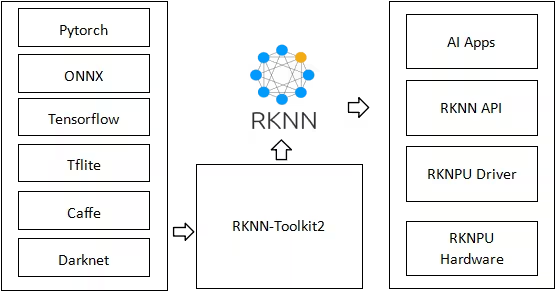
Rockchip thiết kế các hệ thống trên chip dựa trên ARM với NPU tích hợp, được sử dụng trong máy tính bo mạch đơn và các sản phẩm nhúng của những công ty như Radxa, ASUS, Pine64, Orange Pi, Odroid, Khadas và Banana Pi. RKNN, viết tắt của Mạng nơ-ron Rockchip, là định dạng model dành cho các NPU đó; RKNN Toolkit chuyển đổi model sang định dạng này trên PC và chạy model trên thiết bị.
Câu hỏi thường gặp#
Hãy dùng tên bộ xử lý trên bo mạch, không phải tên bo mạch: chẳng hạn
rk3588cho Radxa Rock 5B hoặcrk3566cho Radxa Zero 3W. Trên bo mạch,cat /proc/device-tree/compatiblein ra chuỗi mà Ultralytics dùng để nhận diện chip. Model được xuất cho một chip sẽ không chạy trên chip khác, vì vậy hãy xuất riêng cho từng chip. Xem Chip mục tiêu để biết các tên được chấp nhận.Hãy bắt đầu với FP16, định dạng mặc định. FP16 không cần dữ liệu hiệu chuẩn và trả về các dự đoán thô mà không cần model thứ hai chạy trên CPU. Chọn INT8 (
quantize=8) khi bạn cần model nhỏ hơn và nhanh hơn, hoặc khi chip chỉ hỗ trợ INT8: YOLO26n cho RK3588 có kích thước 4.3 MB ở INT8 so với 7.4 MB ở FP16; trong các kết quả benchmark, được đo bằng bản xuất trước đó, INT8 chạy YOLO26n mất 41.2 ms mỗi ảnh so với 58.5 ms ở FP16. INT8 cần dữ liệu hiệu chuẩn đại diện; với model phát hiện, phân đoạn, tư thế và OBB, INT8 chạy giải mã hộp trên CPU bằngtail.onnx. Hãy đo độ trễ và độ chính xác trên thiết bị của bạn trước khi lựa chọn.Không thể dùng
YOLO(), vì công cụ này chỉ tải model RKNN trên thiết bị Rockchip. Để kiểm tra chính model trên PC, hãy xác thực checkpoint PyTorch hoặc tệpyolo26n.onnxtrung gian mà quá trình xuất tạo ra bên cạnh thư mục, bằng ONNX Runtime: model RKNN được chuyển đổi từ đồ thị đó. Việc này không thay thế cho xác thực trên thiết bị, đặc biệt với INT8, vì lượng tử hóa làm thay đổi đầu ra.Có, bằng định dạng xuất tương ứng với từng bộ tăng tốc: model RKNN chỉ chạy trên NPU Rockchip. Xem TensorRT cho NVIDIA Jetson, Hailo, Axelera, DeepX và Coral Edge TPU; hoặc xem hướng dẫn các tùy chọn triển khai model để biết tổng quan.


Bình luận45
Đặt câu hỏi, chia sẻ kết quả hoặc giúp đỡ người khác.
as-jackson
We are pleased to confirm that the following ArmSoM boards based on Rockchip RK3576 have been successfully tested with Ultralytics projects (e.g., YOLO11n):
Validation Scope:
Model training/inference pipeline
1yizi72
I tried to convert the yolo11n.pt into a rknn model through codes below: from ultralytics import YOLO model = YOLO("yolo11n.pt") model.export(format="rknn", name="rk3588") and everything went correct. A rknn model named yolo11n-rk3588.rknn was build and used to infer a very traditional yolo demo image "bus"(a blue bus with several people in front of it), but no detection result was obtained.
I tried to convert the yolol11n.pt into onnx model through above codes firstly, and then used a convert.py offered by rknn_model_zoo/examples/yolo11/python,
import sys from rknn.api import RKNN
DATASET_PATH = '../../../datasets/COCO/coco_subset_20.txt' DEFAULT_RKNN_PATH = '/home/yizi/model/yolo11/yolodet.rknn' DEFAULT_QUANT = False
def parse_arg(): if len(sys.argv) < 3: print("Usage: python3 {} onnx_model_path [platform] [dtype(optional)] [output_rknn_path(optional)]".format(sys.argv[0])) print(" platform choose from [rk3562,rk3566,rk3568,rk3588,rk3576,rk1808,rv1109,rv1126]") print(" dtype choose from [i8, fp] for [rk3562,rk3566,rk3568,rk3588,rk3576]") print(" dtype choose from [u8, fp] for [rk1808,rv1109,rv1126]") exit(1)
model_path = sys.argv[1]
platform = sys.argv[2]

do_quant = DEFAULT_QUANT
if len(sys.argv) > 3:
    model_type = sys.argv[3]
    if model_type not in ['i8', 'u8', 'fp']:
        print("ERROR: Invalid model type: {}".format(model_type))
        exit(1)
    elif model_type in ['i8', 'u8']:
        do_quant = True
    else:
        do_quant = False

if len(sys.argv) > 4:
    output_path = sys.argv[4]
else:
    output_path = DEFAULT_RKNN_PATH

return model_path, platform, do_quant, output_path
if name == 'main': model_path, platform, do_quant, output_path = parse_arg()
# Create RKNN object
rknn = RKNN(verbose=False)

# Pre-process config
print('--> Config model')
rknn.config(mean_values=[[0, 0, 0]], std_values=[[255, 255, 255]], target_platform=platform)
print('done')

# Load model
print('--> Loading model')
ret = rknn.load_onnx(model=model_path)
if ret != 0:
    print('Load model failed!')
    exit(ret)
print('done')

# Build model
print('--> Building model')
ret = rknn.build(do_quantization=do_quant, dataset=DATASET_PATH)
if ret != 0:
    print('Build model failed!')
    exit(ret)
print('done')

# Export rknn model
print('--> Export rknn model')
ret = rknn.export_rknn(output_path)
if ret != 0:
    print('Export rknn model failed!')
    exit(ret)
print('done')

# Release
rknn.release()
Still everything went correct. A rknn model was created and applied to "bus.jpg", and there was no detection at all. I wonder what's wrong in the whole process?
1 Glenn JocherUltralytics
@yizi72 thanks for the detailed report. For RKNN inference issues with YOLO11, please ensure:
- You're using matching RKNN Toolkit and runtime versions (update both if needed)
- Input images are 640x640 with pixel values normalized 0-255
- You load models via
YOLO('./yolo11n_rknn_model')as shown in our RKNN deployment docs
If issues persist, please share your full environment details and validation results from both export methods.
1、I used rknn-toolkit2-2.3.0 which is the latest version ,bu I still did "pip install rknn-toolkit2 --upgrade" again. 2、The input image is 640*640, uchar, 0-255. 3. I used the following setting to transfer yolo11n.pt to onnx, from ultralytics import YOLO
加载一个模型,路径为 YOLO 模型的 .pt 文件
model = YOLO("yolo11n.pt")
导出模型,设置多种参数
model.export( format="onnx", imgsz=(640, 640),
keras=False,
optimize=True,
half=False,
int8=False,
dynamic=False,
simplify=True,
opset=12,
#workspace=4.0,
nms=False,
batch=1
) and applied the following codes to verify yolo11n.onnx model:from ultralytics import YOLO from PIL import Image
Load a model
model = YOLO("/home/yizi/models/yolo11/yolo11n.onnx") # load an official model
Predict with the model
results = model("bus.jpg") # predict on an image #results = rknn_model("bus.jpg")
Access the results
for result in results: xywh = result.boxes.xywh # center-x, center-y, width, height xywhn = result.boxes.xywhn # normalized xyxy = result.boxes.xyxy # top-left-x, top-left-y, bottom-right-x, bottom-right-y xyxyn = result.boxes.xyxyn # normalized names = [result.names[cls.item()] for cls in result.boxes.cls.int()] # class name of each box confs = result.boxes.conf # confidence score of each box
The results are good. All objects in bus.jpg were detected. Then I run the following code to transfer onnx to rknn:
from rknn.api import RKNN import cv2 import numpy as np
if name == 'main': rknn = RKNN(verbose=True,verbose_file="log.txt") rknn.config( mean_values=[[0, 0, 0]], std_values=[[255, 255, 255]], target_platform="rk3588", optimization_level=3 )
rknn.load_onnx(
    model="/home/yizi/models/yolo11/yolo11n.onnx",
    input_size_list=[[1,3,640,640]],
)
rknn.build(
    do_quantization=False
)

rknn.export_rknn(
    export_path="/home/yizi/models/yolo11/yolo11n.rknn"
)

rknn.release()
The transferring process went smooth, two problems appeared.
Firstly,when this rknn model was pushed into a rk3588 tablet, and run with a binary executable file generated by cross-compilation, no result was detected.
Secondly, I tried to run the following codes:
from ultralytics import YOLO from PIL import Image
rknn_model = YOLO("/home/yizi/models/yolo11/yolo11n.rknn", task=detect)
results = model("bus.jpg")
An error message, "model='/home/yizi/models/yolo11/yolo11n.rknn' is not a supported model format. Ultralytics supports: ('PyTorch', 'TorchScript', 'ONNX', 'OpenVINO', 'TensorRT', 'CoreML', 'TensorFlow SavedModel', 'TensorFlow GraphDef', 'TensorFlow Lite', 'TensorFlow Edge TPU', 'TensorFlow.js', 'PaddlePaddle', 'MNN', 'NCNN', 'IMX', 'RKNN') See https://docs.ultralytics.com/modes/predict for help. " appeared.
Last question, how many outputs does yolo11 yield? one or six?
- Glenn JocherUltralytics
@yizi72 thank you for the detailed report. For RKNN deployment issues:
- When using Ultralytics RKNN export, load models via the exported directory (not .rknn file), as shown in our RKNN deployment docs:
model = YOLO('./yolo11n_rknn_model') # directory path-
Ensure your RK3588 runtime uses matching librknnrt.so versions with your RKNN Toolkit 2.3.0 installation
-
YOLO11 detection models output 3 tensors by default (different from older YOLO versions). For conversion issues, we recommend using our native
model.export(format='rknn')rather than manual ONNX conversion.
Let me know if you still face issues after verifying these points.
Thanks for replies. I did verify all points you've mentioned above. When running model("bus.jpg"), error messages show:
File "/home/yizi/anaconda3/envs/rknn/lib/python3.9/site-packages/ultralytics/engine/model.py", line 182, in call return self.predict(source, stream, **kwargs) File "/home/yizi/anaconda3/envs/rknn/lib/python3.9/site-packages/ultralytics/engine/model.py", line 543, in predict self.predictor.setup_model(model=self.model, verbose=is_cli) File "/home/yizi/anaconda3/envs/rknn/lib/python3.9/site-packages/ultralytics/engine/predictor.py", line 378, in setup_model self.model = AutoBackend( File "/home/yizi/anaconda3/envs/rknn/lib/python3.9/site-packages/torch/utils/_contextlib.py", line 116, in decorate_context return func(*args, **kwargs) File "/home/yizi/anaconda3/envs/rknn/lib/python3.9/site-packages/ultralytics/nn/autobackend.py", line 495, in init raise OSError("RKNN inference is only supported on Rockchip devices.") OSError: RKNN inference is only supported on Rockchip devices.
It's very strange because I did connect a RK3588 tablet with my virtual machine.
I still have a quesiton on yolo11n output: yolo11n.pt has one output with shape (1, 84, 8400), and yolo11n-rk3588.rknn has one output with shape (1,84, 8400, 0). Are they correct? If so, can I use the similar codes to analyze rknn output, such as :
for result in results: xywh = result.boxes.xywh # center-x, center-y, width, height xywhn = result.boxes.xywhn # normalized xyxy = result.boxes.xyxy # top-left-x, top-left-y, bottom-right-x, bottom-right-y xyxyn = result.boxes.xyxyn # normalized names = [result.names[cls.item()] for cls in result.boxes.cls.int()] # class name of each box confs = result.boxes.conf
- Glenn JocherUltralytics
@yizi72 thanks for the details. For the RKNN inference error: ensure your Python script is running directly on the RK3588 hardware (not through a VM) as RKNN models require native Rockchip NPU access. Regarding outputs, YOLO11 detection models produce 3 output tensors by default (see our RKNN deployment docs), but your code should work if using the exported RKNN directory with the included postprocessing. Let me know if you still face issues after verifying native hardware execution.
 Yufeng Wu
Hello, Ultralytics team. I wonder if it's possible to port yolo26n-pose to rknn? I'm not sure if it's difficult to work out on my own? Is there any model architecture problems that prevent porting the pose models to rknn?
- Glenn JocherUltralytics
@kamosmkey exports fine. See https://platform.ultralytics.com/glenn-jocher/example-project/exp-24?tab=export
2
montemadjo
It appears it does not support rv1106 platform yet
When I try to export the model using this command
model.export(format="rknn", name="rv1106", imgsz=320)It gives the following error
E build: Current target_platform(rv1106) not support do_quantization = False!
E export_rknn: RKNN model does not exist, please load & build model first!
🤔
- Glenn JocherUltralytics(đã chỉnh sửa)
rv1106is an INT8-only target, so it needs a quantized RKNN build. Older Ultralytics releases always built withdo_quantization=False, which fails with the message you saw. Current releases support it: upgrade withpip install -U ultralyticsand export withquantize=8plus calibration data:model.export(format="rknn", name="rv1106", imgsz=320, quantize=8, data="coco8.yaml")See the Rockchip RKNN export guide. If it still fails, share your
!yolo checksoutput andrknn-toolkit2version here and we can sanity-check the environment.1 Here's the quick workaround for those who want to work with yolo26 on RV1106 chip (like Luckfox pico etc). I ran into a couple of issues there, including quantization erasing my confidence results.
Long story short - first you need to monkey-patch head.Detect.forward function in order to get two tensors - one for bboxes and one for scores. That way you escape all the heavy non-supported tensor functions. Then you export your yolo26 model to onnx format and finally to rknn like this
import torch
from ultralytics.nn.modules import head

# 1. First we monkey-patch the forward function
def patched_forward(self, x):
    if self.end2end:
        h = self.one2one
    else:
        h = self.one2many

    box_head = h["box_head"]
    cls_head = h["cls_head"]

    if box_head is None or cls_head is None:
        raise RuntimeError("Head moduls are None")

    bs = x[0].shape[0]
    boxes = torch.cat([box_head[i](x[i]).view(bs, 4 * self.reg_max, -1) for i in range(self.nl)], dim=-1)
    scores = torch.cat([cls_head[i](x[i]).view(bs, self.nc, -1) for i in range(self.nl)], dim=-1)

    preds = {"boxes": boxes, "scores": scores, "feats": x}
    y = self._inference(preds)

    # We are splitting into 2 tensors - both gets its own scale/zp at INT8 quantization
    bboxes = y[:, :4, :]   # [1, 4, 2100] — range 0-640
    scores = y[:, 4:, :]   # [1, 1, 2100] — range 0-1 (already sigmoid-ed)
    score_max_idx = scores[0, 0, :].argmax()
    return bboxes, scores

head.Detect.forward = patched_forward

# 2. Then we export to onnx model (we got best.pt model from ultralytics platform)
from ultralytics import YOLO
model = YOLO("best.pt")
model.export(format="onnx", dynamic=False, opset=12, imgsz=320)

# 3. Then we export to RKNN format
from rknn.api import RKNN

rknn = RKNN()

# 3.1. Konfiguracija specifična za RV1106
rknn.config(
    mean_values=[[0, 0, 0]],
    std_values=[[255, 255, 255]],
    target_platform='rv1106',
    quantized_algorithm='normal', # Ili 'mmse' za bolju preciznost
    quantized_dtype='asymmetric_quantized-8'
)

# 3.2. Load the ONNX model
print("Loading ONNX model...")
rknn.load_onnx(model='best.onnx')

# 3.3. Build modela sa INT8 kvantizacijom
# calib.txt should contain paths to calibration images
print("Building RKNN model with quantization...")
rknn.build(do_quantization=True, dataset='./calib.txt')

# 3.4. Exporting final .rknn file
print("Exporting RKNN model...")
rknn.export_rknn('./yolo26_rv1106_model_optimized.rknn')

rknn.release()
After this you need to postprocess those two outputs like this
yolo26_postprocess.h
/**
 * YOLO26 Post-processing header for Fish Counter
 *
 * Supports YOLO26 2-output format: boxes [1, 4, N] + scores [1, nc, N]
 *
 * Based on the working rknn_minimal_test example.
 */

#ifndef _YOLO26_POSTPROCESS_H_
#define _YOLO26_POSTPROCESS_H_

#include <stdint.h>
#include <vector>
#include "rknn_api.h"
#include "rknn_detector.h"

// YOLO26 model configuration defaults
#define YOLO26_CONF_THRESHOLD 0.25f
#define YOLO26_NMS_THRESHOLD 0.45f

// Detection result (same structure as postprocess.h for compatibility)
typedef struct
{
    float x1, y1, x2, y2; // Bounding box (in model coordinates)
    float confidence;
    int class_id;
} yolo26_detection_t;

// YOLO26 context for format detection and caching
typedef struct
{
    int num_predictions;
    int num_classes;
    bool boxes_transposed; // true = [1, 4, N], false = [1, N, 4]
} yolo26_context_t;

/**
 * Initialize YOLO26 post-processing
 * Detects the output format from model attributes
 *
 * @param app_ctx The RKNN app context with model info
 * @param yolo26_ctx Output: YOLO26 context for format info
 * @return 0 on success, -1 on error
 */
int yolo26_init_postprocess(rknn_app_context_t *app_ctx, yolo26_context_t *yolo26_ctx);

/**
 * Deinitialize YOLO26 post-processing
 */
void yolo26_deinit_postprocess();

/**
 * YOLO26 post_process: processes model outputs and returns detections
 * Uses 2-output format: boxes [1, 4, N] + scores [1, nc, N]
 *
 * @param app_ctx The RKNN app context
 * @param yolo26_ctx YOLO26 context from init
 * @param outputs Pointer to output tensor memory array
 * @param letter_box Letterbox transform info for coordinate mapping
 * @param conf_threshold Confidence threshold
 * @param nms_threshold NMS threshold
 * @param od_results Output: detection results (compatible with existing code)
 * @return 0 on success, -1 on error
 */
int yolo26_post_process(rknn_app_context_t *app_ctx, yolo26_context_t *yolo26_ctx,
                        void *outputs, letterbox_t *letter_box,
                        float conf_threshold, float nms_threshold,
                        object_detect_result_list *od_results);

#endif // _YOLO26_POSTPROCESS_H_
yolo26_postprocess.cc
/**
 * YOLO26 Post-processing for Fish Counter on RV1106
 *
 * Supports YOLO26 2-output format: boxes [1, 4, N] + scores [1, nc, N]
 *
 * Based on the working rknn_minimal_test example.
 */

#include "yolo26_postprocess.h"

#include <math.h>
#include <stdint.h>
#include <stdio.h>
#include <stdlib.h>
#include <string.h>
#include <algorithm>
#include <vector>

// Clamp value to range
inline static int clamp(float val, int min, int max)
{
    return val > min ? (val < max ? val : max) : min;
}

// Dequantize INT8 to float
static inline float dequantize(int8_t qnt, int32_t zp, float scale)
{
    return ((float)qnt - (float)zp) * scale;
}

// Sigmoid function
static inline float sigmoid(float x)
{
    return 1.0f / (1.0f + expf(-x));
}

// Calculate IoU between two boxes
static float calculate_iou(float x1_a, float y1_a, float x2_a, float y2_a,
                           float x1_b, float y1_b, float x2_b, float y2_b)
{
    float x1 = std::max(x1_a, x1_b);
    float y1 = std::max(y1_a, y1_b);
    float x2 = std::min(x2_a, x2_b);
    float y2 = std::min(y2_a, y2_b);

    float inter_w = std::max(0.0f, x2 - x1);
    float inter_h = std::max(0.0f, y2 - y1);
    float inter_area = inter_w * inter_h;

    float area_a = (x2_a - x1_a) * (y2_a - y1_a);
    float area_b = (x2_b - x1_b) * (y2_b - y1_b);
    float union_area = area_a + area_b - inter_area;

    return union_area > 0 ? inter_area / union_area : 0;
}

// Non-Maximum Suppression for YOLO26 detections
static std::vector<yolo26_detection_t> yolo26_nms(std::vector<yolo26_detection_t> &detections, float nms_threshold)
{
    // Sort by confidence (descending)
    std::sort(detections.begin(), detections.end(),
              [](const yolo26_detection_t &a, const yolo26_detection_t &b)
              { return a.confidence > b.confidence; });

    std::vector<yolo26_detection_t> result;
    std::vector<bool> suppressed(detections.size(), false);

    for (size_t i = 0; i < detections.size(); i++)
    {
        if (suppressed[i])
            continue;

        result.push_back(detections[i]);

        for (size_t j = i + 1; j < detections.size(); j++)
        {
            if (suppressed[j])
                continue;

            // Only suppress same class
            if (detections[i].class_id != detections[j].class_id)
                continue;

            float iou = calculate_iou(
                detections[i].x1, detections[i].y1, detections[i].x2, detections[i].y2,
                detections[j].x1, detections[j].y1, detections[j].x2, detections[j].y2);

            if (iou > nms_threshold)
            {
                suppressed[j] = true;
            }
        }
    }

    return result;
}

// Parse YOLO26 2-output format: boxes [1, 4, N] + scores [1, nc, N]
static std::vector<yolo26_detection_t> parse_yolo26_2output(
    rknn_tensor_mem **output_mems,
    rknn_tensor_attr *output_attrs,
    int model_width, int model_height,
    float conf_threshold, int num_classes,
    bool boxes_transposed)
{
    std::vector<yolo26_detection_t> detections;

    int8_t *boxes_data = (int8_t *)output_mems[0]->virt_addr;
    int32_t boxes_zp = output_attrs[0].zp;
    float boxes_scale = output_attrs[0].scale;

    int8_t *scores_data = (int8_t *)output_mems[1]->virt_addr;
    int32_t scores_zp = output_attrs[1].zp;
    float scores_scale = output_attrs[1].scale;

    // Determine number of anchors
    int num_anchors;
    if (boxes_transposed)
    {
        num_anchors = output_attrs[0].dims[2];
    }
    else
    {
        num_anchors = output_attrs[0].dims[1];
    }

    // Check if scores are already sigmoid or logits
    float scores_min = 9999, scores_max = -9999;
    for (int i = 0; i < (int)output_attrs[1].n_elems; i++)
    {
        float val = dequantize(scores_data[i], scores_zp, scores_scale);
        if (val < scores_min)
            scores_min = val;
        if (val > scores_max)
            scores_max = val;
    }
    bool scores_are_sigmoid = (scores_min >= -0.1f && scores_max <= 1.1f);

    for (int i = 0; i < num_anchors; i++)
    {
        // Get box coordinates
        float x1, y1, x2, y2;
        if (boxes_transposed)
        {
            // [1, 4, N] - channel first
            x1 = dequantize(boxes_data[0 * num_anchors + i], boxes_zp, boxes_scale);
            y1 = dequantize(boxes_data[1 * num_anchors + i], boxes_zp, boxes_scale);
            x2 = dequantize(boxes_data[2 * num_anchors + i], boxes_zp, boxes_scale);
            y2 = dequantize(boxes_data[3 * num_anchors + i], boxes_zp, boxes_scale);
        }
        else
        {
            // [1, N, 4] - anchor first
            x1 = dequantize(boxes_data[i * 4 + 0], boxes_zp, boxes_scale);
            y1 = dequantize(boxes_data[i * 4 + 1], boxes_zp, boxes_scale);
            x2 = dequantize(boxes_data[i * 4 + 2], boxes_zp, boxes_scale);
            y2 = dequantize(boxes_data[i * 4 + 3], boxes_zp, boxes_scale);
        }

        // Check if format is xywh instead of xyxy
        if (x2 < x1 || y2 < y1)
        {
            // Assume xywh format: convert to xyxy
            float cx = x1, cy = y1, w = x2, h = y2;
            x1 = cx - w / 2.0f;
            y1 = cy - h / 2.0f;
            x2 = cx + w / 2.0f;
            y2 = cy + h / 2.0f;
        }

        // Find max class score
        float max_score = -9999;
        int max_class = 0;
        for (int c = 0; c < num_classes; c++)
        {
            float score;
            if (boxes_transposed)
            {
                // [1, nc, N]
                score = dequantize(scores_data[c * num_anchors + i], scores_zp, scores_scale);
            }
            else
            {
                // [1, N, nc]
                score = dequantize(scores_data[i * num_classes + c], scores_zp, scores_scale);
            }

            if (!scores_are_sigmoid)
            {
                score = sigmoid(score);
            }

            if (score > max_score)
            {
                max_score = score;
                max_class = c;
            }
        }

        if (max_score < conf_threshold)
            continue;

        // Clamp to model bounds
        x1 = std::max(0.0f, std::min(x1, (float)model_width));
        y1 = std::max(0.0f, std::min(y1, (float)model_height));
        x2 = std::max(0.0f, std::min(x2, (float)model_width));
        y2 = std::max(0.0f, std::min(y2, (float)model_height));

        // Skip invalid boxes
        if (x2 <= x1 || y2 <= y1)
            continue;

        yolo26_detection_t det;
        det.x1 = x1;
        det.y1 = y1;
        det.x2 = x2;
        det.y2 = y2;
        det.confidence = max_score;
        det.class_id = max_class;

        detections.push_back(det);
    }

    return detections;
}

int yolo26_init_postprocess(rknn_app_context_t *app_ctx, yolo26_context_t *yolo26_ctx)
{
    if (!app_ctx || !yolo26_ctx)
    {
        printf("[YOLO26] ERROR: Invalid parameters\n");
        return -1;
    }

    memset(yolo26_ctx, 0, sizeof(yolo26_context_t));

    int n_output = app_ctx->io_num.n_output;

    printf("[YOLO26] Initializing 2-output format (%d outputs)...\n", n_output);

    // Print output tensor info
    for (int i = 0; i < n_output; i++)
    {
        printf("  Output %d: dims=[%d,%d,%d,%d], size=%d\n", i,
               app_ctx->output_attrs[i].dims[0],
               app_ctx->output_attrs[i].dims[1],
               app_ctx->output_attrs[i].dims[2],
               app_ctx->output_attrs[i].dims[3],
               app_ctx->output_attrs[i].size);
    }

    if (n_output != 2)
    {
        printf("[YOLO26] ERROR: Expected 2 outputs (boxes + scores), got %d\n", n_output);
        return -1;
    }

    // Parse 2-output format: boxes + scores
    int boxes_dim1 = app_ctx->output_attrs[0].dims[1];
    int boxes_dim2 = app_ctx->output_attrs[0].dims[2];
    int scores_dim1 = app_ctx->output_attrs[1].dims[1];
    int scores_dim2 = app_ctx->output_attrs[1].dims[2];

    if (boxes_dim1 == 4)
    {
        // [1, 4, N] boxes format
        yolo26_ctx->num_predictions = boxes_dim2;
        yolo26_ctx->boxes_transposed = true;
        yolo26_ctx->num_classes = scores_dim1;
        printf("[YOLO26] Format: boxes [1,4,%d], scores [1,%d,%d]\n",
               boxes_dim2, scores_dim1, scores_dim2);
    }
    else if (boxes_dim2 == 4)
    {
        // [1, N, 4] boxes format
        yolo26_ctx->num_predictions = boxes_dim1;
        yolo26_ctx->boxes_transposed = false;
        yolo26_ctx->num_classes = scores_dim2;
        printf("[YOLO26] Format: boxes [1,%d,4], scores [1,%d,%d]\n",
               boxes_dim1, scores_dim1, scores_dim2);
    }
    else
    {
        printf("[YOLO26] ERROR: Invalid boxes dimensions [1,%d,%d], expected [1,4,N] or [1,N,4]\n",
               boxes_dim1, boxes_dim2);
        return -1;
    }

    printf("[YOLO26] Predictions: %d, Classes: %d\n",
           yolo26_ctx->num_predictions, yolo26_ctx->num_classes);

    return 0;
}

void yolo26_deinit_postprocess()
{
    // Nothing to cleanup currently
}

int yolo26_post_process(rknn_app_context_t *app_ctx, yolo26_context_t *yolo26_ctx,
                        void *outputs, letterbox_t *letter_box,
                        float conf_threshold, float nms_threshold,
                        object_detect_result_list *od_results)
{
    if (!app_ctx || !yolo26_ctx || !outputs || !letter_box || !od_results)
    {
        return -1;
    }

    rknn_tensor_mem **output_mems = (rknn_tensor_mem **)outputs;

    int model_width = app_ctx->model_width;
    int model_height = app_ctx->model_height;

    // Parse 2-output format
    std::vector<yolo26_detection_t> raw_detections = parse_yolo26_2output(
        output_mems,
        app_ctx->output_attrs,
        model_width, model_height,
        conf_threshold,
        yolo26_ctx->num_classes > 0 ? yolo26_ctx->num_classes : 1,
        yolo26_ctx->boxes_transposed);

    // Apply NMS
    std::vector<yolo26_detection_t> final_detections = yolo26_nms(raw_detections, nms_threshold);

    // Convert to output format with letterbox coordinate mapping
    memset(od_results, 0, sizeof(object_detect_result_list));
    int count = 0;

    for (const auto &det : final_detections)
    {
        if (count >= OBJ_NUMB_MAX_SIZE)
            break;

        // Map coordinates back to original image space
        float x1 = det.x1 - letter_box->x_pad;
        float y1 = det.y1 - letter_box->y_pad;
        float x2 = det.x2 - letter_box->x_pad;
        float y2 = det.y2 - letter_box->y_pad;

        // Scale back to original coordinates
        od_results->results[count].box.left = (int)(clamp(x1, 0, model_width) / letter_box->scale);
        od_results->results[count].box.top = (int)(clamp(y1, 0, model_height) / letter_box->scale);
        od_results->results[count].box.right = (int)(clamp(x2, 0, model_width) / letter_box->scale);
        od_results->results[count].box.bottom = (int)(clamp(y2, 0, model_height) / letter_box->scale);
        od_results->results[count].prop = det.confidence;
        od_results->results[count].cls_id = det.class_id;

        count++;
    }

    od_results->count = count;

    return 0;
}
And you're good to go! 🚀
- Glenn JocherUltralytics(đã chỉnh sửa)
Thanks for sharing this—splitting the head into 2 outputs (boxes + scores) is a sensible RV1106 workaround to keep RKNN-friendly ops and avoid INT8 scale/zero-point coupling issues; just note that monkey-patching
head.Detect.forwardis inherently version-fragile. Current Ultralytics already provides an INT8 flow for RV1106 viaquantize=8withdata=calibration images (see the Rockchip RKNN export guide), so please try that first. If you still need your custom split, open a GitHub issue linking back to this thread and include!yolo checks, yourrknn-toolkit2version, and a minimal calibration set description so we can evaluate it.
dttvn0010
99ms per image is too bad. Using rknn native with 3 npu cores, I can achieve ~11ms per image
NikolayKash
Hi, what did you done to achieve this performance?
- Glenn JocherUltralytics
@Arshapjoy thanks for the detailed info; for YOLO11 detection heads the export output shape is
(1, nc + 4, 8400)(4 box coords plusncclass scores), so with 2 classes(1, 6, 8400)is expected and both classes are present, whereas a postprocessor assuming5 + nc(old YOLO layout with an extra objectness channel) will effectively drop one class. I’d suggest updating your RKNN-side decoder to treat channels[0:4]as[x, y, w, h]and[4:]as class logits for allncclasses; if you still see a true(1, 7, 8400)PyTorch output on the same checkpoint, please share yourultralyticsversion andyolo checksoutput so we can dig deeper. The overall YOLO11 head behaviour is also outlined in the YOLO11 model documentation.@BakhtiariB the high-level
YOLO("./yolo11n_rknn_model")interface is designed to keep preprocessing, NPU inference and postprocessing together, so if you need to run only the core RKNN inference on the NPU while fully controlling pre/post on the CPU you’ll need to load the exported.rknnwith Rockchip’sRKNNAPI directly and implement your own preprocessing and YOLO11 postprocessing around it.@dttvn0010 the ~99 ms figure is a conservative end-to-end pipeline measurement on our RK3588 test setup, so seeing ~11 ms from a highly tuned RKNN deployment using all three NPU cores is quite reasonable; if you are open to sharing your exact model variant, quantization mode, input size and NPU core configuration, we can use that to cross-check and better explain the gap between baseline and fully optimized numbers.
@NikolayKash in practice, large gains like that usually come from combining INT8-quantized RKNN models, all three NPU cores enabled, a suitable input resolution and very lean Python-side pre/postprocessing, so it would be great if @dttvn0010 can share their exact script and RK3588 configuration for others to replicate.
guojieli
he YOLO11 benchmark was run by the Ultralytics team on a Radxa Rock 5B based on the Rockchip RK3588, using the RKNN model format to evaluate speed and accuracy. Could you please clarify whether this was an INT8-quantized model?
- Glenn JocherUltralytics(đã chỉnh sửa)
Those RKNN benchmarks were not INT8-quantized; they used the floating-point RKNN build. INT8 RKNN export is now available with
quantize=8anddata=for calibration; see the Rockchip RKNN export guide.
BakhtiariB
I used ultralytics for rk3588 by below code, but i want do inference in NPU and do preprocess and postprocess in CPU, how can separate them. while, in below code, line: "results = rknn_model("https://ultralytics.com/images/bus.jpg")" just all of them!
from ultralytics import YOLO
Load the exported RKNN model
rknn_model = YOLO("./yolo11n_rknn_model")
Run inference
results = rknn_model("https://ultralytics.com/images/bus.jpg")
Arshapjoy
Exported RKNN/ONNX model only has 1 output class instead of 2
Overview
I’m using Ultralytics YOLOv11s with two custom classes and exporting it to ONNX and RKNN formats. After conversion, inference on the RKNN device only detects a single class, and the output tensor shape is
(1, 6, 8400)instead of the expected(1, 7, 8400). I’ve validated that the source.ptmodel correctly reports 2 classes, but both ONNX and RKNN exports drop one class.
Model Details
- Checkpoint path:
path/to/yolo11s_custom.pt - Number of classes: 2
- Input size: 640×640
from ultralytics import YOLO
Load the YOLO11 model
model = YOLO("custom_yolo11s.pt")
Export the model to RKNN format
rknn_path = model.export(format="rknn", name="rk3588") print(f"RKNN model saved to: {rknn_path}")
Actual Behavior
- Received ONNX , RKNN and metadata.yaml after conversion
- Exported ONNX model output shape:
(1, 6, 8400) - Exported RKNN model output shape:
(1, 6, 8400) - Only one class is detected during inference on the RK3588 board.
7. Logs & Metadata
- metadata.yaml generated alongside the RKNN model:
model: name: yolo11s_custom format: rknn input_shape: [1, 3, 640, 640] output_shape: [1, 6, 8400] classes: 2 - ONNX graph info: Attached minimal
onnx.shape_inferencelog shows only 6 channels in the final layer.
8. Additional Notes
- Manual ONNX export yields the same issue, so it’s unlikely to be an Ultralytics export bug alone.
- I’ve confirmed that the PyTorch forward pass on the
.ptcheckpoint produces a shape(1, 7, 8400).
9. Request Could you please:
- Confirm whether there’s an option/flag in the YOLO-Ultralytics or RKNN export pipeline I’m missing to preserve all classes.
- Suggest any workarounds or patches to ensure correct output-channel dimensionality.
- Identify if this might be a known issue in RKNN-Toolkit 1.5.0 or Ultralytics YOLO v11.
Thank you for your assistance!
- Checkpoint path:
WeiIIzz
Hello, when I exported the rknn model, I performed int8 quantization, but I had an error like this: E build: If set do_quantization = True, dataset file need be provided. But it`s value is None! E export_rknn: RKNN model does not exist, please load build model first! My export code is: from ultralytics import YOLO
model = YOLO("/home/ky/dfxw/runs/detect/train3/weights/best.pt") model.export(format="rknn", name="rk3576", int8=True, data="/home/ky/rknn_yolo_test/data.yaml") The path pointed to by data is the same as the training dataset. How to solve it
The content of data.yaml is as follows path: /home/ky/dfxw/split_jiaqian # dataset root dir train: images/train val: images/val
names: 0: 0 1: 1
- Glenn JocherUltralytics(đã chỉnh sửa)
@WeiIIzz INT8 export for RKNN is supported with
quantize=8(it replaces the deprecatedint8=True) together withdatapointing to a dataset YAML, which Ultralytics converts into the calibration image list that RKNN needs:from ultralytics import YOLO model = YOLO("/home/ky/dfxw/runs/detect/train3/weights/best.pt") model.export(format="rknn", name="rk3576", quantize=8, data="/home/ky/rknn_yolo_test/data.yaml")The error you saw comes from an older version that did not pass a calibration dataset to RKNN, so run
pip install -U ultralyticsand retry. Make sure the YAML points to existing images. Let us know if this resolves your issue! @glenn-jocher I followed your steps to modify the code as follows. But I still encountered the same problem.
from ultralytics import YOLO

model = YOLO("/home/ky/dfxw/runs/detect/train3/weights/best.pt")
model.export(format="rknn", name="rk3576", int8=True, data="/home/ky/rknn_yolo_test/images")
Is there only images in the data path?
- Glenn JocherUltralytics(đã chỉnh sửa)
@WeiIIzz older releases ignored
int8=Truefor RKNN and built the model without quantization. Current Ultralytics supports INT8 RKNN export, so afterpip install -U ultralyticsyou can export with:model.export(format="rknn", name="rk3576", quantize=8, data="data.yaml")Here
datais used for the calibration images. Withoutquantize, the export builds a floating-point (FP16) model.
VictorAboba
Good day,
Is RKNN available for obb tasks? I tried to use it directly, but got an error saying that some operations (cos) are not available in RKNN. As a fix, RKNN suggested adding disable_rules = ['reduce_reshape_op_around_concat'] to my configuration. I actually did this inside the YOLO library. Model was exported first to ONNX and then from ONNX to RKNN works and returns the responses in the format (1,6,21504), which seems what I expected. However, if I use this model through YOLO ("path_to_rknn_model", task = 'obb'), will I still get the results in the standard YOLO format? I just don't want to prescribe pre - and post-processing on my own :)
Thank you!
- Glenn JocherUltralytics(đã chỉnh sửa)
@VictorAboba thank you for your question! RKNN export now supports all seven Ultralytics tasks, including OBB, so you can export OBB models directly with
format="rknn"and load the exported_rknn_modeldirectory withYOLO(...)to get standard YOLO results without writing your own pre- and post-processing. See the Rockchip RKNN guide for details. Spidrre
Hey! Did you notice any significant decrease in quality of your model after conversion? I am also trying to find a way to convert from OBB onnx to RKNN without 'reduce_reshape_op_around_concat'.
Hey! Did you notice any significant decrease in quality of your model after conversion? I am also trying to find a way to convert from OBB onnx to RKNN without 'reduce_reshape_op_around_concat'.
Hello, after @glenn-jocher answer, I didn't attempt to convert the OBB model. We have a few other models, and all of them except YOLO were converted to the RKNN format. We will try using this stuff (YOLO without an NPU and others with it) ^_^ After conversion, the OCR model, for example, has almost the same quality, but it doesn't need 'reduce_reshape_op_around_concat' to be used.