Xuất Tencent NCNN
NCNN là framework inference mạng nơ-ron mã nguồn mở của Tencent dành cho điện thoại, bo mạch nhúng và máy tính để bàn. Xuất model Ultralytics YOLO26 bằng format="ncnn" sẽ tạo thư mục yolo26n_ncnn_model/ chứa mạng dưới dạng cặp file .param và .bin, với trọng số FP32 hoặc FP16.
Tổng quan nhanh#
| Thuộc tính | Chi tiết |
|---|---|
Đối số format | ncnn |
| Đầu ra | yolo26n_ncnn_model/, một thư mục chứa model.ncnn.param, model.ncnn.bin, model_ncnn.py và metadata.yaml |
| Chạy trên | CPU ARM và x86-64, cùng GPU có driver Vulkan: điện thoại, máy tính bo mạch đơn như Raspberry Pi và máy tính để bàn |
| Runtime | NCNN: package Python ncnn hoặc thư viện C++ NCNN trong ứng dụng Android, iOS và ứng dụng nhúng |
| Precision | Trọng số FP32 hoặc FP16; không có bản xuất INT8. YOLO26n có kích thước 9.8 MB ở FP32 và 5.0 MB với trọng số FP16 |
| Máy export | Linux x86-64 hoặc ARM64, macOS hoặc Windows x64; đây là các nền tảng có bản dựng pnnx. Quá trình xuất không cần GPU |
Ultralytics Platform có thể xuất model đã huấn luyện sang NCNN cho bạn, vì vậy bạn không cần môi trường xuất cục bộ.
Bắt đầu nhanh#
Cài đặt package Ultralytics:
pip install ultralyticsLần xuất đầu tiên sẽ cài các package ncnn và pnnx nếu chưa có; lần dự đoán đầu tiên bằng model đã xuất sẽ cài ncnn nếu package này chưa có. Môi trường mới không cần cài thêm gì: lần xuất đầu tiên hoàn tất trong cùng lần chạy, sau khi ghi Restart runtime or rerun command for updates to take effect. Quá trình xuất có các yêu cầu phiên bản sau:
| Package | Phiên bản yêu cầu |
|---|---|
pnnx | Chính xác là 20260526. Quá trình xuất cài phiên bản này và thay thế mọi phiên bản khác |
ncnn | Bất kỳ phiên bản nào |
torch | Phiên bản 2.0 trở lên: quá trình xuất không kiểm tra phiên bản; các bài kiểm thử Ultralytics bỏ qua NCNN trên phiên bản cũ hơn vì inference bị lỗi tại đó |
Để xem các phương thức cài đặt khác, hãy tham khảo hướng dẫn cài đặt. Sau đó xuất model và tải thư mục đã xuất để chạy inference hoặc xác thực độ chính xác.
from ultralytics import YOLO

# Nạp model YOLO26
model = YOLO("yolo26n.pt")

# Export model sang định dạng NCNN
model.export(format="ncnn")  # creates 'yolo26n_ncnn_model/'

# Hoặc xuất với trọng số FP16 để giảm một nửa kích thước file
model.export(format="ncnn", quantize=16)  # creates 'yolo26n_ncnn_model/'
Cả hai lần xuất đều ghi vào cùng thư mục yolo26n_ncnn_model/, vì vậy lần xuất thứ hai sẽ thay thế lần đầu.
from ultralytics import YOLO

# Tải model NCNN đã export
model = YOLO("yolo26n_ncnn_model")

# Chạy suy luận
results = model("https://ultralytics.com/images/bus.jpg")from ultralytics import YOLO
# Tải model NCNN đã export
model = YOLO("yolo26n_ncnn_model")
# # Đánh giá độ chính xác trên bộ dữ liệu COCO8
metrics = model.val(data="coco8.yaml")Các tác vụ được hỗ trợ#
Xuất NCNN hỗ trợ cả bảy tác vụ Ultralytics với các model YOLOv8, YOLO11 và YOLO26: phát hiện, phân đoạn, phân đoạn ngữ nghĩa, ước tính độ sâu, phân loại, ước tính tư thế và OBB. Phân đoạn ngữ nghĩa và ước tính độ sâu chỉ có trong YOLO26, dòng model duy nhất có các head này. Các model phát hiện YOLOv5u, YOLOv9, YOLOv10 và YOLO12 cũng xuất được. Model RT-DETR, YOLO-World và YOLOE dùng prompt văn bản không chuyển đổi được; xem Giới hạn và khắc phục sự cố.
Các tham số xuất model#
| Đối số | Kiểu | Mặc định | Mô tả |
|---|---|---|---|
format | str | 'ncnn' | Định dạng đích của model đã xuất, xác định khả năng tương thích với nhiều môi trường triển khai. |
imgsz | int hoặc tuple | 640 | Kích thước ảnh đầu vào của model, được cố định trong model đã xuất: một số nguyên đối với ảnh vuông hoặc một tuple (height, width). Nếu không truyền giá trị này, quá trình xuất sử dụng kích thước mà checkpoint đã được huấn luyện. Các checkpoint YOLO26 chính thức sử dụng 640 cho model detect, segment, pose và model ngữ nghĩa được pretrained trên ADE20K, 1024 cho model OBB và model ngữ nghĩa được pretrained trên Cityscapes, 768 cho depth và 224 cho classify. |
quantize | int hoặc str | None | Độ chính xác của trọng số được lưu: 16 (FP16) giảm một nửa kích thước tệp; 32/không đặt là FP32. 8 gây lỗi, và checkpoint được huấn luyện với quantize=8 không thể xuất sang NCNN; xem Giới hạn và khắc phục sự cố. Thay thế cờ half đã lỗi thời. |
nms | bool, không bắt buộc | None | Model NCNN luôn trả về các dự đoán thô để thực hiện NMS bên ngoài. Head không cần NMS (False) và NMS tích hợp (True) không khả dụng; xem Giới hạn và khắc phục sự cố. |
device | str | None | Thiết bị dùng để trace model khi chuyển đổi: cpu (mặc định, kể cả trên máy có GPU), 0 cho GPU CUDA hoặc mps cho Apple silicon. |
Trong số các đối số xuất riêng theo định dạng, NCNN chỉ chấp nhận những đối số này. Để xem các đối số dùng chung cho mọi định dạng, hãy tham khảo tài liệu chế độ Export.
Precision#
quantize chọn cách lưu trọng số trong model.ncnn.bin. Kích thước dưới đây là của model phát hiện YOLO26n được xuất tại imgsz=640:
quantize | Trọng số | Kích thước YOLO26n |
|---|---|---|
không đặt hoặc 32 | FP32 | 9.8 MB |
16 | FP16 | 5.0 MB |
- Trọng số FP16:
quantize=16lưu trọng số ở độ chính xác bán phần và không cần dữ liệu hiệu chuẩn. Đầu vào và đầu ra vẫn làfloat32, vì vậy mã inference viết cho model FP32 chạy mà không cần thay đổi. - Độ chính xác: trên COCO val2017, bằng CPU máy chủ x86-64, các model NCNN YOLO26n FP32 và FP16, model ONNX và model PyTorch (
rect=False) đều đạt 40.9 mAPval 50-95 với cùng đầu vào 640x640. - Tính toán FP16: NCNN cũng có thể tính toán ở độ chính xác bán phần, bất kể độ chính xác của trọng số được lưu. Trên Apple M4, theo mặc định, NCNN đã làm vậy với cả hai bản xuất: trên một ảnh thử nghiệm, tọa độ box thô của bản xuất FP32 lệch tối đa khoảng 2.1 pixel so với model ONNX đối với các anchor có confidence trên 0.25; toàn bộ đầu ra khớp với sai số dưới 0.01 khi đặt
net.opt.use_fp16_storage = Falsetrong gói ncnn. Trên CPU máy chủ x86-64, đầu ra thô của bản xuất FP32 lệch dưới 0.03 so với model ONNX trên cùng ảnh, đối với model detect, segment, depth, classify, pose và OBB. Với trọng số FP16, tọa độ box của các anchor đó lệch khoảng 0.3 pixel trên máy chủ và 1.6 pixel trên M4 so với ONNX. Trên M4, những sai khác này làm độ chính xác thay đổi dưới 0.1: trên COCO128, trình validator Ultralytics cho bản xuất FP32 47.7 mAP 50-95 và cho trọng số FP16 cũng là 47.7, so với 47.7 của model PyTorch (rect=False) với cùng đầu vào 640x640.
Định dạng đầu ra#
Quá trình xuất ghi một thư mục:
| File | Nội dung |
|---|---|
model.ncnn.param | Đồ thị mạng dưới dạng tệp văn bản |
model.ncnn.bin | Trọng số |
model_ncnn.py | Một script Python do PNNX tạo, chạy model trên đầu vào ngẫu nhiên bằng gói ncnn |
metadata.yaml | Tên lớp, tác vụ, kích thước ảnh, kích thước batch, stride và các tham số xuất mà Ultralytics đọc khi tải model |
Quá trình xuất cũng tạo một thư mục __pycache__ trong thư mục hiện tại; bạn có thể xóa thư mục này. Model nhận một đầu vào tên in0 có shape (3, height, width): một ảnh RGB, thứ tự kênh ở trước, float32, được scale về 0-1. Không có chiều batch, và đầu ra cũng vậy. Các shape bên dưới là của checkpoint YOLO26n chính thức tại kích thước xuất mặc định, trong đó checkpoint Cityscapes yolo26n-sem.pt được dùng cho phân đoạn ngữ nghĩa:
| Tác vụ | imgsz mặc định | Đầu ra |
|---|---|---|
| Detect | 640 | out0 (84, 8400) |
| Segment | 640 | out0 (116, 8400) và out1 (32, 160, 160) |
| Ngữ nghĩa | 1024 | out0 (19, 1024, 1024), điểm số cho từng lớp và pixel |
| Độ sâu | 768 | out0 (1, 768, 768), bản đồ độ sâu |
| Phân loại | 224 | out0 (1000,), xác suất lớp |
| Tư thế | 640 | out0 (56, 8400) |
| OBB | 1024 | out0 (20, 21504) |
- Dự đoán thô: model detect, segment, pose và OBB trả về các dự đoán thô giống như bản xuất ONNX mặc định, nhưng không có chiều batch: với mỗi anchor, lần lượt là tâm box x, tâm y, chiều rộng và chiều cao tính theo pixel đầu vào, sau đó là điểm số lớp, rồi đến các giá trị của tác vụ (32 hệ số mask, 17 x 3 giá trị keypoint hoặc góc OBB tính bằng radian). Tự áp dụng NMS.
- Phân đoạn:
out0chứa các dự đoán vàout1chứa các prototype mask. - Segmentation ngữ nghĩa: đầu ra chứa điểm số cho mỗi lớp và pixel, không phải bản đồ lớp như trong bản xuất ONNX; vì vậy, hãy lấy argmax trên trục lớp bằng code của bạn.
- NMS: không có đầu ra không cần NMS hoặc có NMS tích hợp; xem Giới hạn và khắc phục sự cố.
YOLO("yolo26n_ncnn_model") đọc bố cục từ metadata.yaml, thêm chiều batch và áp dụng NMS, vì vậy bạn chỉ cần biết các chi tiết này khi chạy model bằng mã của riêng mình. Các key của metadata.yaml gồm names, task, imgsz, stride, batch, end2end, args và, đối với model pose, kpt_shape.
Chạy bằng gói ncnn#
Để chạy model bên ngoài gói Ultralytics, hãy tải hai tệp bằng gói Python ncnn. Các tệp .param và .bin tương tự cũng được tải trong thư viện NCNN C++ trên Android, iOS và Linux nhúng.
# Export first: yolo export model=yolo26n.pt format=ncnn
import ncnn
import numpy as np

net = ncnn.Net()
net.opt.num_threads = 4  # đặt các tùy chọn trước khi tải model
assert net.load_param("yolo26n_ncnn_model/model.ncnn.param") == 0
assert net.load_model("yolo26n_ncnn_model/model.ncnn.bin") == 0

image = np.zeros((3, 640, 640), dtype=np.float32)  # ảnh đã letterbox: RGB, CHW, 0-1
with net.create_extractor() as ex:
    ex.input("in0", ncnn.Mat(image).clone())
    _, out0 = ex.extract("out0")
predictions = np.array(out0)  # shape (84, 8400), dự đoán thô cần NMS
assert predictions.shape == (84, 8400), "export a detection model at imgsz=640"
ncnn.Mat(image) đọc trực tiếp vùng nhớ của mảng NumPy mà không sao chép, vì vậy hãy truyền một mảng float32 liên tục theo C và giữ mảng đó tồn tại cho đến khi trích xuất xong, hoặc sao chép bằng .clone() như trên. Mảng tạo bằng transpose không liên tục, và astype hoặc phép chia thực hiện sau đó vẫn giữ nguyên bố cục này; do đó, hãy kết thúc bước tiền xử lý bằng np.ascontiguousarray(x, dtype=np.float32). Trong một thử nghiệm với model này, mảng không liên tục chạy mà không báo lỗi nhưng trả về dự đoán sai, còn mảng float64 khiến Python gặp sự cố.
Triển khai#
Trên thiết bị đích, cài gói bằng pip install ultralytics và sao chép thư mục yolo26n_ncnn_model/ sang thiết bị đó. Sau đó, YOLO("yolo26n_ncnn_model") chạy model bằng gói Python ncnn, gói mà Ultralytics cài đặt trong lần sử dụng đầu tiên. Đối số device chọn nơi NCNN chạy:
device | Nơi chạy model |
|---|---|
không đặt hoặc cpu | NCNN trên CPU |
vulkan:0, vulkan:1, ... | NCNN trên thiết bị Vulkan có chỉ số đó; xem Inference GPU bằng Vulkan |
0 trên máy có GPU CUDA | NCNN trên CPU: NCNN không có backend CUDA |
mps trên Apple silicon | NCNN chạy trên CPU, trong khi Ultralytics tiền xử lý và hậu xử lý trên GPU Apple. Trên M4, tùy chọn này làm ảnh đầu tiên mất thêm khoảng 0.6 giây và không tăng tốc inference, vì vậy hãy để device không được đặt |
- Shape đầu vào cố định: model luôn chạy ở
imgszkhi export; Ultralytics đọc giá trị này từmetadata.yaml. Giá trịimgsztruyền chopredicthoặcvalsẽ bị bỏ qua. Hãy export lại để thay đổi kích thước ảnh. - Batch: model nhận một ảnh, còn Ultralytics chạy lần lượt từng ảnh trong batch, vì vậy có thể xử lý số lượng ảnh bất kỳ.
valđặtbatch=1bất kể bạn truyền giá trị nào. - Luồng CPU: NCNN tự chọn số luồng: 4 trên Apple M4, bằng số lõi hiệu năng của máy. Trên Linux, Ultralytics giới hạn số luồng ở mức 8 và giới hạn theo các CPU mà tiến trình có thể sử dụng: CPU affinity (
taskset, Docker--cpuset-cpus) và hạn mức CPU của cgroup v2 (Docker--cpus). Xem Giới hạn và khắc phục sự cố để sử dụng số luồng khác.
Inference GPU bằng Vulkan#
NCNN chạy trên GPU thông qua Vulkan, tương thích với GPU của các nhà cung cấp như AMD, Intel, ARM, Qualcomm và Apple mà không cần CUDA. Truyền device="vulkan:0" để chọn thiết bị Vulkan đầu tiên hoặc vulkan:1 để chọn thiết bị thứ hai:
from ultralytics import YOLO

# Tải model NCNN đã export
model = YOLO("yolo26n_ncnn_model")

# Chạy inference trên thiết bị Vulkan đầu tiên
results = model("https://ultralytics.com/images/bus.jpg", device="vulkan:0")
GPU cần driver Vulkan; hầu hết driver GPU hiện nay đều có sẵn driver này. Trên Linux, vulkaninfo liệt kê các driver đã cài đặt. Chỉ số tương ứng với các thiết bị Vulkan mà NCNN tìm thấy, không nhất thiết phải là GPU phần cứng. Hãy liệt kê các thiết bị trước khi dựa vào kết quả:
import ncnn

for i in range(ncnn.get_gpu_count()):
    print(i, ncnn.get_gpu_info(i).device_name())
Vulkan không phải lúc nào cũng nhanh hơn CPU. Trên Apple M4, YOLO26n mất khoảng 31 ms cho mỗi ảnh trên thiết bị Vulkan và khoảng 12 ms trên CPU. Hãy đo hiệu năng trên thiết bị của bạn.
Hướng dẫn triển khai#
- Raspberry Pi: thiết lập Ultralytics trên các bo mạch Raspberry Pi; hướng dẫn này thực hiện export sang NCNN ngay trên bo mạch.
- NVIDIA Jetson: chạy NCNN trên CPU ARM của thiết bị Jetson, bên cạnh TensorRT chạy trên GPU.
- Hướng dẫn build NCNN: build thư viện NCNN C++ cho Android, iOS, Linux, macOS, Windows và các nền tảng khác.
- NCNN trên GitHub: mã nguồn, gói Python và các ví dụ C++.
- Ví dụ giao diện UI theo dõi tương tác: ví dụ Ultralytics chạy model NCNN trên thiết bị chỉ có CPU.
- Các tùy chọn triển khai model: so sánh NCNN với các định dạng export khác.
Giới hạn và khắc phục sự cố#
- INT8:
quantize=8không chạy được vớiquantize=8 (INT8) is not supported; format='ncnn' supports quantize=16 (FP16), 32 or None (FP32).. Hãy dùng FP16 để giảm kích thước tệp hoặc chọn định dạng hỗ trợ export INT8 như LiteRT hoặc MNN. - Checkpoint được huấn luyện với
quantize=8: checkpoint được fine-tune bằng huấn luyện nhận biết lượng tử hóa không chạy được vớiformat='ncnn' cannot export a QAT model: its Q/DQ ranges are only read by the 'onnx' and 'engine' backends. Thay vào đó, hãy export checkpoint ban đầu trước khi fine-tune, hoặc export checkpoint đã fine-tune sang ONNX hoặc TensorRT. - Head không cần NMS: model NCNN luôn trả về các dự đoán thô cần NMS. Với
nms=False, quá trình export model YOLO26 hoặc YOLOv10 ghi logThis export format does not support end2end models, disabling the end2end branch.và dùng head one-to-many; với các model detect, segment, pose và OBB khác, chẳng hạn YOLO11, quá trình này ghi logThis model has no one-to-one head; using one-to-many outputs. - NMS tích hợp:
nms=Trueghi logformat=ncnn does not support embedded NMS; exporting native outputs for external NMS.và ghi đầu ra thô. - Shape đầu vào và kích thước batch cố định:
dynamic=Truekhông chạy được vớiargument 'dynamic' is not supported for format='ncnn', và giá trịbatchkhác 1 không chạy được vớiargument 'batch' is not supported for format='ncnn'. Hãy export lại để thay đổi kích thước ảnh. - Model không chuyển đổi được: quá trình export model RT-DETR (
rtdetr-l.pt), YOLO-Worldv2 (yolov8s-worldv2.pt) và YOLOE dùng prompt văn bản (yoloe-26s-seg.pt) không chạy được vớiNCNN failed to load the exported model, it may contain layers NCNN does not support.. Model YOLOE dùng prompt văn bản có thể export sau khi cố định các lớp bằngset_classes(); modelyoloe-26s-seg-pf.ptkhông dùng prompt có thể export nguyên trạng. - Phiên bản PNNX: quá trình export yêu cầu
pnnx20260526 và thay thế phiên bản mới hơn, vì model chuyển đổi bằng PNNX 20260704 bị crash khi inference. - Tắt cài đặt tự động: với
YOLO_AUTOINSTALL=false, quá trình export không chạy được vớiNo module named 'ncnn'trong môi trường chưa cài các gói cần thiết. Cài đặt chúng bằngpip install --no-deps ncnnvàpip install pnnx==20260526. - Số luồng:
predictvàvalkhông có tham số để đặt số luồng NCNN, và biếnOMP_NUM_THREADSkhông làm thay đổi số luồng này. Trên Linux, Ultralytics sử dụng tối đa 8 luồng; các model lớn hơn có thể chạy nhanh hơn với nhiều luồng hơn trên máy có nhiều lõi: khi chạy bằng package ncnn trên 16 lõi của AMD EPYC 9655, YOLO26x mất khoảng 177 ms mỗi ảnh với 8 luồng và khoảng 154 ms với 16 luồng, còn YOLO26n mất khoảng 23 ms ở cả hai cấu hình. Để chọn số luồng, hãy chạy model bằng package ncnn và đặtnet.opt.num_threadstrước khi model được tải. Thay đổinum_threadssau khi model đã tải khiến quá trình suy luận chậm hơn. - Thư mục model không đầy đủ: khi thiếu hoặc bị cắt cụt
model.ncnn.bin, chẳng hạn sau khi quá trình sao chép sang thiết bị bị gián đoạn, Python dừng với lỗi segmentation fault mà không có traceback. Các dòng cuối của đầu ra nêu nguyên nhân làfopen yolo26n_ncnn_model/model.ncnn.bin failedhoặcModelBin read weight_data failed. Thư mục thiếumodel.ncnn.paramsẽ gặp lỗiStopIteration. Hãy sao chép lại thư mục. device="vulkan"không có chỉ số: gặp lỗiIndexError: list index out of range. Ghi chỉ số vào, như trongdevice="vulkan:0".- Thiết bị Vulkan không phải GPU: trên máy chủ Linux dùng cho trang này, thiết bị Vulkan duy nhất mà NCNN liệt kê là
llvmpipe, một trình kết xuất phần mềm chạy trên CPU. Khi đó,device="vulkan:0"chạy mà không báo lỗi và không dùng GPU. Chỉ số không tồn tại, chẳng hạnvulkan:9trên máy chỉ có một thiết bị, cũng chạy mà không báo lỗi. - Thư mục đầu ra: mỗi lần export cùng một checkpoint đều ghi vào cùng thư mục
yolo26n_ncnn_model/, bất kểquantizehayimgszcủa checkpoint đó, vì vậy bản export sau sẽ ghi đè bản trước. Hãy đổi tên thư mục để giữ lại cả hai, đồng thời giữ_ncnn_modeltrong tên, chẳng hạnyolo26n_fp16_ncnn_model/, vì Ultralytics nhận diện định dạng dựa vào chuỗi này. Thư mục không chứa chuỗi đó hoặc đường dẫn đến tệp.paramsẽ gặp lỗiis not a supported model format.
Đối với các lỗi khác, hãy xem hướng dẫn về các sự cố thường gặp.
Benchmark#
Ultralytics công bố benchmark NCNN cho hai nền tảng ARM. Benchmark Raspberry Pi 5 so sánh NCNN với bảy định dạng khác cho YOLO26n và YOLO26s; benchmark NVIDIA Jetson có kết quả NCNN cho cả năm model phát hiện YOLO26. Trang model YOLO26 liệt kê độ chính xác của các checkpoint PyTorch.
Kích thước các model phát hiện YOLO26 đã export, tính bằng tổng model.ncnn.param và model.ncnn.bin theo MB (10^6 byte) tại imgsz=640. Nhật ký export hiển thị kích thước toàn bộ thư mục theo MiB: 9.4 MB và 4.8 MB lần lượt cho YOLO26n:
| Model | PyTorch | NCNN FP32 | NCNN FP16 |
|---|---|---|---|
| YOLO26n | 5.5 | 9.8 | 5.0 |
| YOLO26s | 20.4 | 38.1 | 19.2 |
| YOLO26m | 44.3 | 81.8 | 41.0 |
| YOLO26l | 53.2 | 99.4 | 49.8 |
| YOLO26x | 118.7 | 223.0 | 111.7 |
Được export bằng ultralytics 8.4.215, NCNN 1.0.20261020 và PNNX 20260526 vào ngày 16 tháng 11 năm 2026.
Giới thiệu về NCNN#
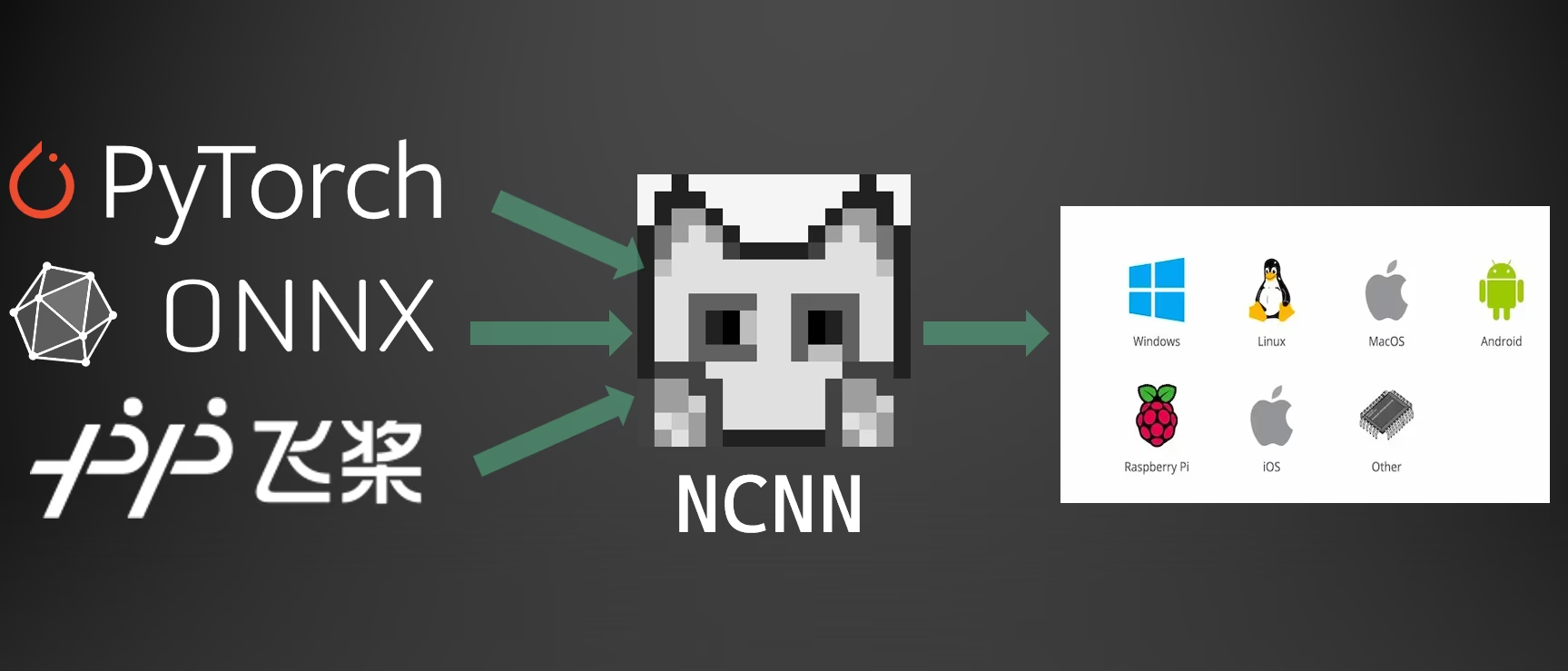
NCNN do Tencent phát triển và được sử dụng trong các ứng dụng của Tencent như QQ và WeChat. NCNN không phụ thuộc vào runtime bên thứ ba, chạy trên CPU và GPU thông qua Vulkan, đồng thời chuyển đổi model PyTorch bằng công cụ PNNX mà Ultralytics sử dụng trong quá trình export. Để xem tài liệu tham khảo đầy đủ, hãy xem tài liệu NCNN.
Câu hỏi thường gặp#
Dùng FP16 (
quantize=16) khi kích thước model quan trọng: YOLO26n có kích thước 5.0 MB với trọng số FP16 so với 9.8 MB ở FP32, đồng thời không cần dữ liệu hiệu chuẩn. Trên COCO val2017, YOLO26n đạt cùng 40.9 mAPval 50-95 với trọng số FP16 và FP32. Trọng số FP16 giúp tệp nhỏ hơn chứ không làm model chạy nhanh hơn: NCNN chọn độ chính xác tính toán dựa trên phần cứng; xem Độ chính xác. Hãy xác thực model đã export trên dữ liệu và thiết bị của chính bạn trước khi triển khai.Các gói
pnnxvàncnncó bản build cho Linux ARM 64-bit; hướng dẫn Raspberry Pi thực hiện export ngay trên bo mạch bằng cùng lệnhformat="ncnn". Bạn cũng có thể export trên PC rồi sao chép thư mụcyolo26n_ncnn_model/sang bo mạch. Trên hệ thống ARM 32-bit,pnnxkhông có bản build, vì vậy hãy export trên máy khác;ncnncó bản build cho hệ thống này, nhưng Ultralytics chưa được kiểm thử trên đó.Build hoặc tải thư viện NCNN cho nền tảng của bạn theo hướng dẫn trong hướng dẫn build NCNN, thêm
model.ncnn.paramvàmodel.ncnn.binvào ứng dụng, rồi cung cấp đầu vàoin0như mô tả trong Định dạng đầu ra. Mã của bạn cần letterbox ảnh, giải mã các dự đoán thô và áp dụng NMS. Nếu muốn dùng thành phần ứng dụng có sẵn, plugin Ultralytics YOLO Flutter chạy các bản export LiteRT trên Android và các bản export Core ML trên iOS.NCNN được xây dựng cho CPU ARM trên điện thoại và bo mạch nhúng. Trên máy chủ có hai bộ xử lý AMD EPYC 9655 96 lõi, YOLO26n mất khoảng 30 ms mỗi ảnh với NCNN ở 8 luồng, so với khoảng 13 ms với cả PyTorch và ONNX Runtime; trên Apple M4, nơi NCNN chọn 4 luồng, model mất khoảng 12 ms. Đối với máy chủ x86-64, OpenVINO và ONNX là các định dạng mà Ultralytics dùng để benchmark.


Bình luận37
Đặt câu hỏi, chia sẻ kết quả hoặc giúp đỡ người khác.
gpsamt(đã chỉnh sửa)
I'm testing the use of ncnn on android. I converted a yolov11 model. I've tried every way to adjust the code, but I can't. The detections are not coming out correctly. The ncnn model on windows works as can be seen in the image. I'm sharing my native code in c++. If anyone can help me I'd really appreciate it.
Image detected with yolo predict model=C:\Users\guips\Downloads\best_ncnn_model source="C:\Users\guips\Downloads\brasil\test822.jpg" save_txt=true
#include <jni.h> #include <android/log.h> #include #include #include #include <opencv2/opencv.hpp> #include <ncnn/net.h> // #include <stb_image.h> // Uncomment if using stb_image
#define LOG_TAG "NCNN_DETECTOR" #define LOGD(...) __android_log_print(ANDROID_LOG_DEBUG, LOG_TAG, VA_ARGS) #define LOGI(...) __android_log_print(ANDROID_LOG_INFO, LOG_TAG, VA_ARGS) #define LOGE(...) __android_log_print(ANDROID_LOG_ERROR, LOG_TAG, VA_ARGS)
static ncnn::Net g_net; static std::vectorstd::string g_labels; static bool g_model_loaded = false;
struct Detection { float x, y, width, height; int label; float prob; };
static float sigmoid(float x) { return 1.0f / (1.0f + std::exp(-x)); }
static float calculate_iou(const Detection& a, const Detection& b) { float x1 = std::max(a.x, b.x); float y1 = std::max(a.y, b.y); float x2 = std::min(a.x + a.width, b.x + b.width); float y2 = std::min(a.y + a.height, b.y + b.height);
float inter_area = std::max(0.0f, x2 - x1) * std::max(0.0f, y2 - y1);
float union_area = a.width * a.height + b.width * b.height - inter_area;

return union_area > 0 ? inter_area / union_area : 0.0f;
}
extern "C" JNIEXPORT jboolean JNICALL Java_com_example_ncnnmy_1ok_MainActivity_loadModel( JNIEnv* env, jobject thiz, jstring param_path, jstring bin_path, jstring labels_path) {
const char* param_path_str = env->GetStringUTFChars(param_path, nullptr);
const char* bin_path_str = env->GetStringUTFChars(bin_path, nullptr);
const char* labels_path_str = env->GetStringUTFChars(labels_path, nullptr);

LOGI("Starting model loading...");
LOGD("Param path: %s", param_path_str);
LOGD("Bin path: %s", bin_path_str);
LOGD("Labels path: %s", labels_path_str);

g_net.clear();
g_labels.clear();
g_model_loaded = false;

g_net.opt.num_threads = 4;
g_net.opt.use_vulkan_compute = false;
g_net.opt.use_fp16_packed = false;
g_net.opt.use_fp16_storage = false;
g_net.opt.use_fp16_arithmetic = false;

int ret = g_net.load_param(param_path_str);
if (ret != 0) {
    LOGE("Failed to load .param file (%d)", ret);
    env->ReleaseStringUTFChars(param_path, param_path_str);
    env->ReleaseStringUTFChars(bin_path, bin_path_str);
    env->ReleaseStringUTFChars(labels_path, labels_path_str);
    return JNI_FALSE;
}

ret = g_net.load_model(bin_path_str);
if (ret != 0) {
    LOGE("Failed to load .bin file (%d)", ret);
    env->ReleaseStringUTFChars(param_path, param_path_str);
    env->ReleaseStringUTFChars(bin_path, bin_path_str);
    env->ReleaseStringUTFChars(labels_path, labels_path_str);
    return JNI_FALSE;
}

FILE* fp = fopen(labels_path_str, "r");
if (!fp) {
    LOGE("Failed to open labels file: %s", labels_path_str);
    env->ReleaseStringUTFChars(param_path, param_path_str);
    env->ReleaseStringUTFChars(bin_path, bin_path_str);
    env->ReleaseStringUTFChars(labels_path, labels_path_str);
    return JNI_FALSE;
}

char buffer[256];
while (fgets(buffer, sizeof(buffer), fp) != nullptr) {
    std::string label(buffer);
    label.erase(std::remove(label.begin(), label.end(), '\n'), label.end());
    label.erase(std::remove(label.begin(), label.end(), '\r'), label.end());
    if (!label.empty()) {
        g_labels.push_back(label);
    }
}
fclose(fp);

if (g_labels.empty()) {
    LOGE("No labels loaded from %s", labels_path_str);
    env->ReleaseStringUTFChars(param_path, param_path_str);
    env->ReleaseStringUTFChars(bin_path, bin_path_str);
    env->ReleaseStringUTFChars(labels_path, labels_path_str);
    return JNI_FALSE;
}

LOGI("Model loaded successfully");
LOGI("Total labels loaded: %zu", g_labels.size());
g_model_loaded = true;

env->ReleaseStringUTFChars(param_path, param_path_str);
env->ReleaseStringUTFChars(bin_path, bin_path_str);
env->ReleaseStringUTFChars(labels_path, labels_path_str);
return JNI_TRUE;
}
extern "C" JNIEXPORT jstring JNICALL Java_com_example_ncnnmy_1ok_MainActivity_detect( JNIEnv* env, jobject thiz, jstring image_path, jdouble conf_threshold, jdouble nms_threshold) {
LOGI("Running updated detect method (no debug image)");

if (!g_model_loaded) {
    LOGE("Model not loaded");
    return env->NewStringUTF("error:model_not_loaded");
}

const char* image_path_str = env->GetStringUTFChars(image_path, nullptr);
LOGI("Processing image: %s", image_path_str);

// Option 1: Use OpenCV (current)
cv::Mat image = cv::imread(image_path_str, cv::IMREAD_COLOR);
env->ReleaseStringUTFChars(image_path, image_path_str);

/*
// Option 2: Use stb_image (uncomment to test)
int width, height, channels;
unsigned char* image_data = stbi_load(image_path_str, &width, &height, &channels, 3);
env->ReleaseStringUTFChars(image_path, image_path_str);
if (!image_data) {
    LOGE("Failed to load image with stb_image");
    return env->NewStringUTF("error:image_load_failed");
}
cv::Mat image(height, width, CV_8UC3, image_data);
*/

if (image.empty()) {
    LOGE("Failed to load image");
    // stbi_image_free(image_data); // Uncomment if using stb_image
    return env->NewStringUTF("error:image_load_failed");
}

LOGD("Input image: %dx%d, channels=%d", image.cols, image.rows, image.channels());

const int target_size = 640;
int img_w = image.cols;
int img_h = image.rows;

float scale = std::min((float)target_size / img_w, (float)target_size / img_h);
int new_w = static_cast<int>(img_w * scale);
int new_h = static_cast<int>(img_h * scale);
int dx = (target_size - new_w) / 2;
int dy = (target_size - new_h) / 2;

cv::Mat resized;
cv::resize(image, resized, cv::Size(new_w, new_h));
cv::Mat input_mat(target_size, target_size, CV_8UC3, cv::Scalar(114, 114, 114));
resized.copyTo(input_mat(cv::Rect(dx, dy, new_w, new_h)));

cv::cvtColor(input_mat, input_mat, cv::COLOR_BGR2RGB);
input_mat.convertTo(input_mat, CV_32FC3, 1.0 / 255.0);

ncnn::Mat in = ncnn::Mat::from_pixels(input_mat.data, ncnn::Mat::PIXEL_RGB, target_size, target_size);

// stbi_image_free(image_data); // Uncomment if using stb_image

ncnn::Extractor ex = g_net.create_extractor();
ex.input("in0", in);
ncnn::Mat out;
ex.extract("out0", out);

if (out.empty()) {
    LOGE("Empty output from model");
    return env->NewStringUTF("error:empty_model_output");
}

LOGD("Output dimensions: w=%d, h=%d, c=%d", out.w, out.h, out.c);

int num_preds, num_classes;
bool is_decoupled = false;

if (out.c == 1) {
    LOGD("Possible decoupled heads detected, checking for additional outputs...");
    ncnn::Mat boxes, scores, classes;
    ex.extract("boxes", boxes);
    ex.extract("scores", scores);
    ex.extract("classes", classes);
    if (!boxes.empty() && !scores.empty() && !classes.empty()) {
        is_decoupled = true;
        LOGD("Decoupled heads detected: boxes=%dx%d, scores=%dx%d, classes=%dx%d",
             boxes.w, boxes.c, scores.w, scores.c, classes.w, classes.c);
        return env->NewStringUTF("error:decoupled_heads_not_implemented");
    }
}

if (!is_decoupled) {
    if (out.c >= 5) {
        num_preds = out.h * out.w;
        num_classes = out.c - 5;
        LOGD("Interpreting as [1, num_predictions, 5 + num_classes]: num_preds=%d, num_classes=%d",
             num_preds, num_classes);
    } else if (out.h >= 5) {
        num_preds = out.w;
        num_classes = out.h - 5;
        LOGD("Interpreting as [1, 5 + num_classes, num_predictions]: num_preds=%d, num_classes=%d",
             num_preds, num_classes);
    } else {
        LOGE("Invalid output dimensions: w=%d, h=%d, c=%d", out.w, out.h, out.c);
        return env->NewStringUTF("error:invalid_output_dimensions");
    }
}

if (num_classes != g_labels.size()) {
    LOGE("Mismatch between model outputs (%d) and labels (%zu)",
         num_classes, g_labels.size());
    return env->NewStringUTF("error:model_labels_mismatch");
}

std::vector<Detection> detections;
int stride = (out.c >= 5) ? out.c : out.h;
const float* data = (float*)out.data;

// Log raw outputs
if (num_preds > 0) {
    LOGD("Raw output sample: x=%.3f, y=%.3f, w=%.3f, h=%.3f, obj=%.3f",
         data[0], data[1], data[2], data[3], data[4]);
    // Log first class score
    if (num_classes > 0) {
        LOGD("Raw class score sample: class_0=%.3f", data[5]);
    }
}

for (int i = 0; i < num_preds; i++) {
    const float* pred = data + i * stride;

    float obj_score = sigmoid(pred[4]);
    if (obj_score < conf_threshold) continue;

    int class_id = 0;
    float max_score = sigmoid(pred[5]);
    for (int j = 1; j < num_classes; j++) {
        float score = sigmoid(pred[5 + j]);
        if (score > max_score) {
            max_score = score;
            class_id = j;
        }
    }

    float confidence = obj_score * max_score;
    if (confidence < conf_threshold) continue;

    // Normalize coordinates with sigmoid (assuming logits)
    float x_center = sigmoid(pred[0]) * target_size;
    float y_center = sigmoid(pred[1]) * target_size;
    float width = sigmoid(pred[2]) * target_size;
    float height = sigmoid(pred[3]) * target_size;

    // Adjust for letterbox
    float x = (x_center - width / 2 - dx) / scale;
    float y = (y_center - height / 2 - dy) / scale;
    width /= scale;
    height /= scale;

    LOGD("Prediction %d: x_center=%.2f, y_center=%.2f, width=%.2f, height=%.2f",
         i, x_center, y_center, width, height);
    LOGD("Transformed %d: x=%.2f, y=%.2f, width=%.2f, height=%.2f",
         i, x, y, width, height);

    // Validate coordinates
    if (x < 0 || y < 0 || width <= 0 || height <= 0 || x + width > img_w || y + height > img_h) {
        LOGD("Skipping invalid detection %d: x=%.2f, y=%.2f, w=%.2f, h=%.2f",
             i, x, y, width, height);
        continue;
    }

    // Minimum size filter
    if (width < 50 || height < 50) {
        LOGD("Skipping small detection %d: w=%.2f, h=%.2f", i, width, height);
        continue;
    }

    detections.push_back({x, y, width, height, class_id, confidence});
}

// NMS
std::sort(detections.begin(), detections.end(), [](const Detection& a, const Detection& b) {
    return a.prob > b.prob;
});

std::vector<bool> suppressed(detections.size(), false);
std::vector<Detection> final_detections;

for (size_t i = 0; i < detections.size(); i++) {
    if (suppressed[i]) continue;
    final_detections.push_back(detections[i]);

    for (size_t j = i + 1; j < detections.size(); j++) {
        if (suppressed[j]) continue;
        float iou = calculate_iou(detections[i], detections[j]);
        if (iou > nms_threshold) {
            suppressed[j] = true;
        }
    }
}

LOGD("Detections after NMS: %zu", final_detections.size());

// Format results
std::string result_str;
for (const auto& det : final_detections) {
    if (!result_str.empty()) result_str += ";";
    char buf[256];
    snprintf(buf, sizeof(buf), "%s:%.2f,%.0f,%.0f,%.0f,%.0f",
             g_labels[det.label].c_str(), det.prob,
             det.x, det.y, det.width, det.height);
    result_str += buf;
}

return env->NewStringUTF(result_str.empty() ? "none" : result_str.c_str());
}
Here is a log of the output of the flutter application.
[ ] D/NCNN_DETECTOR( 9180): Prediction 3730: x_center=640.00, y_center=640.00, width=640.00, height=640.00 [ ] D/NCNN_DETECTOR( 9180): Transformed 3730: x=320.00, y=240.00, width=640.00, height=640.00 [ ] D/NCNN_DETECTOR( 9180): Skipping invalid detection 3730: x=320.00, y=240.00, w=640.00, h=640.00 [ ] D/NCNN_DETECTOR( 9180): Prediction 3731: x_center=640.00, y_center=640.00, width=640.00, height=640.00 [ ] D/NCNN_DETECTOR( 9180): Transformed 3731: x=320.00, y=240.00, width=640.00, height=640.00 [ ] D/NCNN_DETECTOR( 9180): Skipping invalid detection 3731: x=320.00, y=240.00, w=640.00, h=640.00 [ ] D/NCNN_DETECTOR( 9180): Prediction 3732: x_center=640.00, y_center=640.00, width=640.00, height=640.00 [ ] D/NCNN_DETECTOR( 9180): Transformed 3732: x=320.00, y=240.00, width=640.00, height=640.00 [ ] D/NCNN_DETECTOR( 9180): Skipping invalid detection 3732: x=320.00, y=240.00, w=640.00, h=640.00 [ ] D/NCNN_DETECTOR( 9180): Detections after NMS: 0 [ ] I/flutter ( 9180): Detection result: none [ ] I/flutter ( 9180): STATUS: No objects detected [ ] E/libEGL ( 9180): called unimplemented OpenGL ES API
 Glenn JocherUltralytics(đã chỉnh sửa)
@gpsamt looking at your logs, the issue appears to be with output format parsing. YOLO11 NCNN outputs have no separate objectness score, and the class scores are already sigmoid-activated, so don't apply sigmoid again. Try parsing each prediction like this:
// Box is x_center, y_center, width, height (no sigmoid needed)
float x_center = pred[0];
float y_center = pred[1];
float width = pred[2];
float height = pred[3];
// pred[4 .. 4+nc) are the per-class scores; take the max class as the confidence

// Convert from center format to corner format
float x = (x_center - width / 2 - dx) / scale;
float y = (y_center - height / 2 - dy) / scale;
Also verify your model's actual output format by checking if coordinates are normalized (0-1) or absolute (0-640). The repeated 640.00 values suggest coordinate parsing issues. For official Android deployment examples, refer to the NCNN Android documentation.
aram199922
Hey everyone, I have trained yolo11n.pt pretrained model on my custom dataset. Run the detection on a video and got quite good results. Now trying to export ncnn with the given guide, files are being generated correctly, however the detection on the same video seems corrupted. I am trying to detect potholes on road, however ncnn model predict 300 potholes on each frame. Any suggestion?
One more note is that I have trained my model with 736p, 640p modes are converting fine. But does this mean I can't conver higher resolution trained model to ncnn?
- Glenn JocherUltralytics
@aram199922 The issue with your NCNN model detecting 300 potholes likely relates to confidence thresholds. When exporting to NCNN, default thresholds may not transfer properly. Try explicitly setting a higher confidence threshold during inference:
# Load the NCNN model
ncnn_model = YOLO("your_model_ncnn_model")

# Run inference with higher confidence threshold
results = ncnn_model("video.mp4", conf=0.5)  # Adjust this value as needed
Regarding your 736p model - yes, you can export higher resolution models to NCNN by specifying the custom size during export:
model = YOLO("your_trained_model.pt")
model.export(format="ncnn", imgsz=736)  # Use your training resolution
This ensures the exported model maintains the same input dimensions you used during training. Let me know if this helps resolve the issue!
Hello. Does anyone have any example of implementing the converted ncnn model in android?
PabloBR99
Do this work with YOLOv12?
- Glenn JocherUltralytics(đã chỉnh sửa)
@PabloBR99 YOLO12 isn't recommended for NCNN export due to training instability and performance limitations. For NCNN deployments, we strongly recommend using YOLO26 (or YOLO11), which offer optimized performance and stability across all platforms. You can find the NCNN export guide in our documentation.
I am exporting a YOLOv11s model to ncnn. My model has 4 classes, however, when I perform the export, it appears that it is identifying 3 classes: PyTorch: starting from '/content/drive/MyDrive/IAGeneration/yolo11/runs/detect/train3/weights/best.pt' with input shape (1, 3, 640, 640) BCHW and output shape(s) (1, 8, 8400) (18.3 MB). In Android Studio, this message appears:
2025-03-04 17:08:58.490 3853-3853 NcnnDetector com.example.agroinsect D Starting detection 2025-03-04 17:08:58.502 3853-3853 NcnnDetector com.example.test D Param file size: 22768 bytes 2025-03-04 17:08:58.504 3853-3853 NcnnDetector com.example.test D Load param result: 0 2025-03-04 17:08:58.504 3853-3853 NcnnDetector com.example.test D Bin file size: 10633344 bytes 2025-03-04 17:08:58.596 3853-3853 NcnnDetector com.example.test D Load model result: 10633344 2025-03-04 17:08:58.597 3853-3853 NcnnDetector com.example.test D Failed to load model file
[ +82 ms] D/CompatChangeReporter( 3853): Compat change id reported: 312399441; UID 10209; state: ENABLED [ +11 ms] D/nativeloader( 3853): Load /data/app/~~yVwXpMN1F9boaEz-oh0Bpw==/com.example.test-J2_0Fz9v3HSf0USV8uxz6Q==/lib/x86_64/libncnn_detector.so using ns clns-7 from class loader (caller=/data/app/~~yVwXpMN1F9boaEz-oh0Bpw==/com.example.test-J2_0Fz9v3HSf0USV8uxz6Q==/base.apk!classes4.dex): ok [ ] D/NcnnDetector( 3853): Library ncnn_detector loaded successfully [ ] D/NcnnDetector( 3853): Starting detection [ +10 ms] D/NcnnDetector( 3853): Param file size: 22768 bytes [ +2 ms] D/NcnnDetector( 3853): Load param result: 0 [ ] D/NcnnDetector( 3853): Bin file size: 10633344 bytes [ +97 ms] D/NcnnDetector( 3853): Load model result: 10633344 [ +1 ms] D/NcnnDetector( 3853): Failed to load model file [ ] I/flutter ( 3853): Native detect result: null [ ] I/flutter ( 3853): Detections received: [] [ ] I/flutter ( 3853): No detections found.
I have repeated the process several times, but I have not been able to resolve it. I found this answer: 'The current problem (Load model result: 37825744) suggests difficulties in exporting or compatibility.'"
- Glenn JocherUltralytics
@gpsamt thank you for reporting this issue. Let's address both aspects systematically:
-
Class Count Mismatch:
The output shape (1,8,8400) suggests your model is correctly configured for 4 classes (4 classes + 4 box coordinates = 8). This indicates the export itself is successful. The Android implementation might need adjustment to handle the 4-class output format. -
Model Loading Failure:
The "Failed to load model file" error typically indicates either:
- Missing/corrupted
.paramor.binfiles in deployment - Architecture mismatch between PyTorch and NCNN versions
- Incorrect Android NCNN implementation
We recommend:
- Verify successful local inference with your NCNN model using
yolo predict model='yolo11n_ncnn_model'before Android deployment - Ensure you're using the latest NCNN Android library from Tencent's NCNN GitHub repo
- Double-check that all NCNN model files are properly bundled in your Android assets
For specific Android implementation guidance, please consult NCNN's official Android deployment documentation.
-
I made several attempts and ended up not proceeding, however I really wanted to test my trained model running on android with ncnn. I made an export on windows of a yolo11 model trained in colab. To test the converted model yolo --> ncnn I did a test with an image with two objects. C:\Users\guips\Downloads>yolo predict model=C:\Users\guips\Downloads\best_ncnn_model source="C:\Users\guips\Downloads\brasil\test129.jpg" save_txt=true WARNING ⚠️ Unable to automatically guess model task, assuming 'task=detect'. Explicitly define task for your model, i.e. 'task=detect', 'segment', 'classify','pose' or 'obb'. Ultralytics 8.3.105 🚀 Python-3.11.9 torch-2.6.0+cpu CPU (12th Gen Intel Core(TM) i7-12700KF) Loading C:\Users\guips\Downloads\best_ncnn_model for NCNN inference...
image 1/1 C:\Users\guips\Downloads\brasil\test129.jpg: 640x640 2 Car, 103.0ms Speed: 20.4ms preprocess, 103.0ms inference, 24.2ms postprocess per image at shape (1, 3, 640, 640) Results saved to runs\detect\predict6 1 label saved to runs\detect\predict6\labels 💡 Learn more at https://docs.ultralytics.com/modes/predict
When I try to run the same image in the android application with flutter I can't. In TFLITE the output was (1,8,8400) Now it seems to be outputting (1,9,8400). I'm not able to work with the output data. I/flutter (14031): Labels loaded: 4E/libEGL (14031): called unimplemented OpenGL ES API I/flutter (14031): Storage permission denied D/InsetsController(14031): hide(ime(), fromIme=false) I/ImeTracker(14031): com.example.ncnnmy_ok:e29c5e1e: onCancelled at PHASE_CLIENT_ALREADY_HIDDEN E/libEGL (14031): called unimplemented OpenGL ES API D/InsetsController(14031): hide(ime(), fromIme=false) I/ImeTracker(14031): com.example.ncnnmy_ok:6f2d251e: onCancelled at PHASE_CLIENT_ALREADY_HIDDEN E/libEGL (14031): called unimplemented OpenGL ES API D/CompatChangeReporter(14031): Compat change id reported: 312399441; UID 10223; state: ENABLED I/flutter (14031): Image dimensions: 680.0x453.0 I/flutter (14031): Running inference on /data/user/0/com.example.ncnnmy_ok/cache/a6b569b8-5ff1-4466-ad32-49121fb24aa4/38.jpg D/MainActivity(14031): Received method call: detect I/NCNN (14031): Detecting on image: /data/user/0/com.example.ncnnmy_ok/cache/a6b569b8-5ff1-4466-ad32-49121fb24aa4/38.jpg I/NCNN (14031): Original image size: 680x453 I/NCNN (14031): Output dimensions: w=8400, h=9, c=1 I/NCNN (14031): Output saved to /data/user/0/com.example.ncnnmy_ok/cache/a6b569b8-5ff1-4466-ad32-49121fb24aa4/38.jpg_ncnn_output.txt W/NCNN (14031): Output has 4424 channels, expected 8. Using first 8 channels W/NCNN (14031): Invalid box at idx=9: w=0.000000, h=0.000000 W/NCNN (14031): Invalid box at idx=15: w=-0.010868, h=-0.063400 W/NCNN (14031): Invalid box at idx=16: w=-0.630245, h=-0.447460 W/NCNN (14031): Invalid box at idx=17: w=-0.685141, h=-0.837424 . . . W/NCNN (14031): Invalid box at idx=347: w=-0.077838, h=0.846499 F/libc (14031): Fatal signal 11 (SIGSEGV), code 2 (SEGV_ACCERR), fault addr 0x71c0c2499110 in tid 14031 (ample.ncnnmy_ok), pid 14031 (ample.ncnnmy_ok)
Build fingerprint: 'google/sdk_gphone64_x86_64/emu64xa:16/BP22.250221.010/13193326:user/release-keys' Revision: '0' ABI: 'x86_64' Timestamp: 2025-04-15 01:29:54.291432600+0000 Process uptime: 156s Cmdline: com.example.ncnnmy_ok pid: 14031, tid: 14031, name: ample.ncnnmy_ok >>> com.example.ncnnmy_ok <<< uid: 10223 signal 11 (SIGSEGV), code 2 (SEGV_ACCERR), fault addr 0x000071c0c2499110 rax 000071c0c2499100 rbx 000071c247d33be0 rcx 0000000000000004 rdx 0000000000000008 r8 00007ffc6ffc4080 r9 00007ffc6ffc40a0 r10 0000000000e8cada r11 0000000000000213 r12 00007ffc6ff903b0 r13 000071c247d33c88 r14 00007ffc6ff90718 r15 000071c247d33be0 rdi 00007ffc6ff8f840 rsi 0000000000000167 rbp 00007ffc6ff8f970 rsp 00007ffc6ff8f8b0 rip 000071c053d969ea 90 total frames backtrace: #00 pc 00000000000109ea /data/app/~~ygC8oOQ2RMgj_IeB2wDRKw==/com.example.ncnnmy_ok-1Q_3JHdbdZSe1RwVvc5qjQ==/lib/x86_64/libnative-lib.so (BuildId: 63a90d5f64ab095e3ac958c5db79324dfa15e937) #01 pc 000000000000fd3a /data/app/~~ygC8oOQ2RMgj_IeB2wDRKw==/com.example.ncnnmy_ok-1Q_3JHdbdZSe1RwVvc5qjQ==/lib/x86_64/libnative-lib.so (BuildId: 63a90d5f64ab095e3ac958c5db79324dfa15e937) #02 pc 000000000000e8aa /data/app/~~ygC8oOQ2RMgj_IeB2wDRKw==/com.example.ncnnmy_ok-1Q_3JHdbdZSe1RwVvc5qjQ==/lib/x86_64/libnative-lib.so (Java_com_example_ncnnmy_1ok_MainActivity_detect+2634) (BuildId: 63a90d5f64ab095e3ac958c5db79324dfa15e937) #03 pc 000000000022c80b /apex/com.android.art/lib64/libart.so (art_quick_generic_jni_trampoline+219) (BuildId: 53a0485d03b4e7011d7d555e293a17af) #04 pc 0000000000211dd4 /apex/com.android.art/lib64/libart.so (art_quick_invoke_stub+756) (BuildId: 53a0485d03b4e7011d7d555e293a17af) #05 pc 0000000000461715 /apex/com.android.art/lib64/libart.so (art::ArtMethod::Invoke(art::Thread*, unsigned int*, unsigned int, art::JValue*, char const*)+181) (BuildId: 53a0485d03b4e7011d7d555e293a17af) #06 pc 00000000005f74b2 /apex/com.android.art/lib64/libart.so (bool art::interpreter::DoCall(art::ArtMethod*, art::Thread*, art::ShadowFrame&, art::Instruction const*, unsigned short, bool, art::JValue*)+2402) (BuildId: 53a0485d03b4e7011d7d555e293a17af) #07 pc 0000000000233611 /apex/com.android.art/lib64/libart.so (void art::interpreter::ExecuteSwitchImplCpp(art::interpreter::SwitchImplContext*)+10625) (BuildId: 53a0485d03b4e7011d7d555e293a17af) #08 pc 000000000022eb25 /apex/com.android.art/lib64/libart.so (ExecuteSwitchImplAsm+5) (BuildId: 53a0485d03b4e7011d7d555e293a17af) #09 pc 00000000000006a4 anonymous:71c395b1d000 (com.example.ncnnmy_ok.MainActivity.configureFlutterEngine$lambda$0+0) #10 pc 00000000005ef3f2 /apex/com.android.art/lib64/libart.so (art::interpreter::Execute(art::Thread*, art::CodeItemDataAccessor const&, art::ShadowFrame&, art::JValue, bool, bool) (.__uniq.112435418011751916792819755956732575238)+466) (BuildId: 53a0485d03b4e7011d7d555e293a17af) #11 pc 00000000005f6706 /apex/com.android.art/lib64/libart.so (art::interpreter::ArtInterpreterToInterpreterBridge(art::Thread*, art::CodeItemDataAccessor const&, art::ShadowFrame*, art::JValue*)+102) (BuildId: 53a0485d03b4e7011d7d555e293a17af) #12 pc 00000000005f7498 /apex/com.android.art/lib64/libart.so (bool art::interpreter::DoCall(art::ArtMethod*, art::Thread*, art::ShadowFrame&, art::Instruction const*, unsigned short, bool, art::JValue*)+2376) (BuildId: 53a0485d03b4e7011d7d555e293a17af) #13 pc 0000000000234b05 /apex/com.android.art/lib64/libart.so (void art::interpreter::ExecuteSwitchImplCpp(art::interpreter::SwitchImplContext*)+15989) (BuildId: 53a0485d03b4e7011d7d555e293a17af) #14 pc 000000000022eb25 /apex/com.android.art/lib64/libart.so (ExecuteSwitchImplAsm+5) (BuildId: 53a0485d03b4e7011d7d555e293a17af) #15 pc 0000000000000604 anonymous:71c395b1d000 (com.example.ncnnmy_ok.MainActivity.$r8$lambda$8rE-0sywqH2S4u1lhbBM5kfBEYE+0) #16 pc 00000000005ef3f2 /apex/com.android.art/lib64/libart.so (art::interpreter::Execute(art::Thread*, art::CodeItemDataAccessor const&, art::ShadowFrame&, art::JValue, bool, bool) (.__uniq.112435418011751916792819755956732575238)+466) (BuildId: 53a0485d03b4e7011d7d555e293a17af) #17 pc 00000000005f6706 /apex/com.android.art/lib64/libart.so (art::interpreter::ArtInterpreterToInterpreterBridge(art::Thread*, art::CodeItemDataAccessor const&, art::ShadowFrame*, art::JValue*)+102) (BuildId: 53a0485d03b4e7011d7d555e293a17af) #18 pc 00000000005f7498 /apex/com.android.art/lib64/libart.so (bool art::interpreter::DoCall(art::ArtMethod*, art::Thread*, art::ShadowFrame&, art::Instruction const*, unsigned short, bool, art::JValue*)+2376) (BuildId: 53a0485d03b4e7011d7d555e293a17af) #19 pc 0000000000234b05 /apex/com.android.art/lib64/libart.so (void art::interpreter::ExecuteSwitchImplCpp(art::interpreter::SwitchImplContext*)+15989) (BuildId: 53a0485d03b4e7011d7d555e293a17af) #20 pc 000000000022eb25 /apex/com.android.art/lib64/libart.so (ExecuteSwitchImplAsm+5) (BuildId: 53a0485d03b4e7011d7d555e293a17af) #21 pc 00000000000005b8 anonymous:71c395b1d000 (com.example.ncnnmy_ok.MainActivity$$ExternalSyntheticLambda0.onMethodCall+0) #22 pc 00000000005ef3f2 /apex/com.android.art/lib64/libart.so (art::interpreter::Execute(art::Thread*, art::CodeItemDataAccessor const&, art::ShadowFrame&, art::JValue, bool, bool) (.__uniq.112435418011751916792819755956732575238)+466) (BuildId: 53a0485d03b4e7011d7d555e293a17af) #23 pc 00000000005f6706 /apex/com.android.art/lib64/libart.so (art::interpreter::ArtInterpreterToInterpreterBridge(art::Thread*, art::CodeItemDataAccessor const&, art::ShadowFrame*, art::JValue*)+102) (BuildId: 53a0485d03b4e7011d7d555e293a17af) #24 pc 00000000005f7498 /apex/com.android.art/lib64/libart.so (bool art::interpreter::DoCall(art::ArtMethod*, art::Thread*, art::ShadowFrame&, art::Instruction const*, unsigned short, bool, art::JValue*)+2376) (BuildId: 53a0485d03b4e7011d7d555e293a17af) #25 pc 00000000002346e5 /apex/com.android.art/lib64/libart.so (void art::interpreter::ExecuteSwitchImplCpp(art::interpreter::SwitchImplContext*)+14933) (BuildId: 53a0485d03b4e7011d7d555e293a17af) #26 pc 000000000022eb25 /apex/com.android.art/lib64/libart.so (ExecuteSwitchImplAsm+5) (BuildId: 53a0485d03b4e7011d7d555e293a17af) #27 pc 00000000001bfabc anonymous:71c054260000 (io.flutter.plugin.common.MethodChannel$IncomingMethodCallHandler.onMessage+0) #28 pc 00000000005ef3f2 /apex/com.android.art/lib64/libart.so (art::interpreter::Execute(art::Thread*, art::CodeItemDataAccessor const&, art::ShadowFrame&, art::JValue, bool, bool) (.__uniq.112435418011751916792819755956732575238)+466) (BuildId: 53a0485d03b4e7011d7d555e293a17af) #29 pc 00000000005f6706 /apex/com.android.art/lib64/libart.so (art::interpreter::ArtInterpreterToInterpreterBridge(art::Thread*, art::CodeItemDataAccessor const&, art::ShadowFrame*, art::JValue*)+102) (BuildId: 53a0485d03b4e7011d7d555e293a17af) #30 pc 00000000005f7498 /apex/com.android.art/lib64/libart.so (bool art::interpreter::DoCall(art::ArtMethod*, art::Thread*, art::ShadowFrame&, art::Instruction const*, unsigned short, bool, art::JValue*)+2376) (BuildId: 53a0485d03b4e7011d7d555e293a17af) #31 pc 00000000002346e5 /apex/com.android.art/lib64/libart.so (void art::interpreter::ExecuteSwitchImplCpp(art::interpreter::SwitchImplContext*)+14933) (BuildId: 53a0485d03b4e7011d7d555e293a17af) #32 pc 000000000022eb25 /apex/com.android.art/lib64/libart.so (ExecuteSwitchImplAsm+5) (BuildId: 53a0485d03b4e7011d7d555e293a17af) #33 pc 00000000001b1954 anonymous:71c054260000 (io.flutter.embedding.engine.dart.DartMessenger.invokeHandler+0) #34 pc 00000000005ef3f2 /apex/com.android.art/lib64/libart.so (art::interpreter::Execute(art::Thread*, art::CodeItemDataAccessor const&, art::ShadowFrame&, art::JValue, bool, bool) (.__uniq.112435418011751916792819755956732575238)+466) (BuildId: 53a0485d03b4e7011d7d555e293a17af) #35 pc 00000000005f6706 /apex/com.android.art/lib64/libart.so (art::interpreter::ArtInterpreterToInterpreterBridge(art::Thread*, art::CodeItemDataAccessor const&, art::ShadowFrame*, art::JValue*)+102) (BuildId: 53a0485d03b4e7011d7d555e293a17af) #36 pc 00000000005f7498 /apex/com.android.art/lib64/libart.so (bool art::interpreter::DoCall(art::ArtMethod*, art::Thread*, art::ShadowFrame&, art::Instruction const*, unsigned short, bool, art::JValue*)+2376) (BuildId: 53a0485d03b4e7011d7d555e293a17af) #37 pc 0000000000233611 /apex/com.android.art/lib64/libart.so (void art::interpreter::ExecuteSwitchImplCpp(art::interpreter::SwitchImplContext*)+10625) (BuildId: 53a0485d03b4e7011d7d555e293a17af) #38 pc 000000000022eb25 /apex/com.android.art/lib64/libart.so (ExecuteSwitchImplAsm+5) (BuildId: 53a0485d03b4e7011d7d555e293a17af) #39 pc 00000000001b19d8 anonymous:71c054260000 (io.flutter.embedding.engine.dart.DartMessenger.lambda$dispatchMessageToQueue$0$io-flutter-embedding-engine-dart-DartMessenger+0) #40 pc 00000000005ef3f2 /apex/com.android.art/lib64/libart.so (art::interpreter::Execute(art::Thread*, art::CodeItemDataAccessor const&, art::ShadowFrame&, art::JValue, bool, bool) (.__uniq.112435418011751916792819755956732575238)+466) (BuildId: 53a0485d03b4e7011d7d555e293a17af) #41 pc 00000000005f6706 /apex/com.android.art/lib64/libart.so (art::interpreter::ArtInterpreterToInterpreterBridge(art::Thread*, art::CodeItemDataAccessor const&, art::ShadowFrame*, art::JValue*)+102) (BuildId: 53a0485d03b4e7011d7d555e293a17af) #42 pc 00000000005f827f /apex/com.android.art/lib64/libart.so (bool art::interpreter::DoCall(art::ArtMethod*, art::Thread*, art::ShadowFrame&, art::Instruction const*, unsigned short, bool, art::JValue*)+2319) (BuildId: 53a0485d03b4e7011d7d555e293a17af) #43 pc 000000000023482d /apex/com.android.art/lib64/libart.so (void art::interpreter::ExecuteSwitchImplCpp(art::interpreter::SwitchImplContext*)+15261) (BuildId: 53a0485d03b4e7011d7d555e293a17af) #44 pc 000000000022eb25 /apex/com.android.art/lib64/libart.so (ExecuteSwitchImplAsm+5) (BuildId: 53a0485d03b4e7011d7d555e293a17af) #45 pc 00000000001b1168 anonymous:71c054260000 (io.flutter.embedding.engine.dart.DartMessenger$$ExternalSyntheticLambda0.run+0) #46 pc 00000000005ef3f2 /apex/com.android.art/lib64/libart.so (art::interpreter::Execute(art::Thread*, art::CodeItemDataAccessor const&, art::ShadowFrame&, art::JValue, bool, bool) (.__uniq.112435418011751916792819755956732575238)+466) (BuildId: 53a0485d03b4e7011d7d555e293a17af) #47 pc 00000000009978fb /apex/com.android.art/lib64/libart.so (artQuickToInterpreterBridge+907) (BuildId: 53a0485d03b4e7011d7d555e293a17af) #48 pc 000000000022c99c /apex/com.android.art/lib64/libart.so (art_quick_to_interpreter_bridge+140) (BuildId: 53a0485d03b4e7011d7d555e293a17af) #49 pc 0000000000160efc [anon_shmem:dalvik-jit-code-cache] (offset 0x2000000) (android.os.Handler.handleCallback+156) #50 pc 00000000000718af [anon_shmem:dalvik-jit-code-cache] (offset 0x2000000) (android.os.Handler.dispatchMessage+159) #51 pc 000000000006e9a4 [anon_shmem:dalvik-jit-code-cache] (offset 0x2000000) (android.os.Looper.loopOnce+1348) #52 pc 0000000000212136 /apex/com.android.art/lib64/libart.so (art_quick_invoke_static_stub+806) (BuildId: 53a0485d03b4e7011d7d555e293a17af) #53 pc 000000000046175c /apex/com.android.art/lib64/libart.so (art::ArtMethod::Invoke(art::Thread*, unsigned int*, unsigned int, art::JValue*, char const*)+252) (BuildId: 53a0485d03b4e7011d7d555e293a17af) #54 pc 00000000005f74b2 /apex/com.android.art/lib64/libart.so (bool art::interpreter::DoCall(art::ArtMethod*, art::Thread*, art::ShadowFrame&, art::Instruction const*, unsigned short, bool, art::JValue*)+2402) (BuildId: 53a0485d03b4e7011d7d555e293a17af) #55 pc 0000000000234b05 /apex/com.android.art/lib64/libart.so (void art::interpreter::ExecuteSwitchImplCpp(art::interpreter::SwitchImplContext*)+15989) (BuildId: 53a0485d03b4e7011d7d555e293a17af) #56 pc 000000000022eb25 /apex/com.android.art/lib64/libart.so (ExecuteSwitchImplAsm+5) (BuildId: 53a0485d03b4e7011d7d555e293a17af) #57 pc 000000000027c140 /system/framework/framework.jar (offset 0x1274000) (android.os.Looper.loop+0) #58 pc 00000000005ef3f2 /apex/com.android.art/lib64/libart.so (art::interpreter::Execute(art::Thread*, art::CodeItemDataAccessor const&, art::ShadowFrame&, art::JValue, bool, bool) (.__uniq.112435418011751916792819755956732575238)+466) (BuildId: 53a0485d03b4e7011d7d555e293a17af) #59 pc 00000000005f6706 /apex/com.android.art/lib64/libart.so (art::interpreter::ArtInterpreterToInterpreterBridge(art::Thread*, art::CodeItemDataAccessor const&, art::ShadowFrame*, art::JValue*)+102) (BuildId: 53a0485d03b4e7011d7d555e293a17af) #60 pc 00000000005f7498 /apex/com.android.art/lib64/libart.so (bool art::interpreter::DoCall(art::ArtMethod*, art::Thread*, art::ShadowFrame&, art::Instruction const*, unsigned short, bool, art::JValue*)+2376) (BuildId: 53a0485d03b4e7011d7d555e293a17af) #61 pc 0000000000234b05 /apex/com.android.art/lib64/libart.so (void art::interpreter::ExecuteSwitchImplCpp(art::interpreter::SwitchImplContext*)+15989) (BuildId: 53a0485d03b4e7011d7d555e293a17af) #62 pc 000000000022eb25 /apex/com.android.art/lib64/libart.so (ExecuteSwitchImplAsm+5) (BuildId: 53a0485d03b4e7011d7d555e293a17af) #63 pc 00000000001f1254 /system/framework/framework.jar (offset 0x7000) (android.app.ActivityThread.main+0) #64 pc 00000000005ef3f2 /apex/com.android.art/lib64/libart.so (art::interpreter::Execute(art::Thread*, art::CodeItemDataAccessor const&, art::ShadowFrame&, art::JValue, bool, bool) (.__uniq.112435418011751916792819755956732575238)+466) (BuildId: 53a0485d03b4e7011d7d555e293a17af) #65 pc 00000000009978fb /apex/com.android.art/lib64/libart.so (artQuickToInterpreterBridge+907) (BuildId: 53a0485d03b4e7011d7d555e293a17af) #66 pc 000000000022c99c /apex/com.android.art/lib64/libart.so (art_quick_to_interpreter_bridge+140) (BuildId: 53a0485d03b4e7011d7d555e293a17af) #67 pc 0000000000212136 /apex/com.android.art/lib64/libart.so (art_quick_invoke_static_stub+806) (BuildId: 53a0485d03b4e7011d7d555e293a17af) #68 pc 000000000046175c /apex/com.android.art/lib64/libart.so (art::ArtMethod::Invoke(art::Thread*, unsigned int*, unsigned int, art::JValue*, char const*)+252) (BuildId: 53a0485d03b4e7011d7d555e293a17af) #69 pc 000000000088b130 /apex/com.android.art/lib64/libart.so (_jobject* art::InvokeMethod<(art::PointerSize)8>(art::ScopedObjectAccessAlreadyRunnable const&, _jobject*, _jobject*, _jobject*, unsigned long)+2240) (BuildId: 53a0485d03b4e7011d7d555e293a17af) #70 pc 00000000007e0f1a /apex/com.android.art/lib64/libart.so (art::Method_invoke(_JNIEnv*, _jobject*, _jobject*, _jobjectArray*) (.__uniq.165753521025965369065708152063621506277)+42) (BuildId: 53a0485d03b4e7011d7d555e293a17af) #71 pc 000000000022c80b /apex/com.android.art/lib64/libart.so (art_quick_generic_jni_trampoline+219) (BuildId: 53a0485d03b4e7011d7d555e293a17af) #72 pc 0000000000211dd4 /apex/com.android.art/lib64/libart.so (art_quick_invoke_stub+756) (BuildId: 53a0485d03b4e7011d7d555e293a17af) #73 pc 0000000000461715 /apex/com.android.art/lib64/libart.so (art::ArtMethod::Invoke(art::Thread*, unsigned int*, unsigned int, art::JValue*, char const*)+181) (BuildId: 53a0485d03b4e7011d7d555e293a17af) #74 pc 00000000005f74b2 /apex/com.android.art/lib64/libart.so (bool art::interpreter::DoCall(art::ArtMethod*, art::Thread*, art::ShadowFrame&, art::Instruction const*, unsigned short, bool, art::JValue*)+2402) (BuildId: 53a0485d03b4e7011d7d555e293a17af) #75 pc 0000000000233611 /apex/com.android.art/lib64/libart.so (void art::interpreter::ExecuteSwitchImplCpp(art::interpreter::SwitchImplContext*)+10625) (BuildId: 53a0485d03b4e7011d7d555e293a17af) #76 pc 000000000022eb25 /apex/com.android.art/lib64/libart.so (ExecuteSwitchImplAsm+5) (BuildId: 53a0485d03b4e7011d7d555e293a17af) #77 pc 000000000027f6ec /system/framework/framework.jar (offset 0x2430000) (com.android.internal.os.RuntimeInit$MethodAndArgsCaller.run+0) #78 pc 00000000005ef3f2 /apex/com.android.art/lib64/libart.so (art::interpreter::Execute(art::Thread*, art::CodeItemDataAccessor const&, art::ShadowFrame&, art::JValue, bool, bool) (.__uniq.112435418011751916792819755956732575238)+466) (BuildId: 53a0485d03b4e7011d7d555e293a17af) #79 pc 00000000009978fb /apex/com.android.art/lib64/libart.so (artQuickToInterpreterBridge+907) (BuildId: 53a0485d03b4e7011d7d555e293a17af) #80 pc 000000000022c99c /apex/com.android.art/lib64/libart.so (art_quick_to_interpreter_bridge+140) (BuildId: 53a0485d03b4e7011d7d555e293a17af) #81 pc 00000000007fc865 /system/framework/x86_64/boot-framework.oat (com.android.internal.os.ZygoteInit.main+2693) (BuildId: 5539d75c58ae9a874c8bdd56a20d5ad37b7a2757) #82 pc 0000000000212136 /apex/com.android.art/lib64/libart.so (art_quick_invoke_static_stub+806) (BuildId: 53a0485d03b4e7011d7d555e293a17af) #83 pc 000000000046175c /apex/com.android.art/lib64/libart.so (art::ArtMethod::Invoke(art::Thread*, unsigned int*, unsigned int, art::JValue*, char const*)+252) (BuildId: 53a0485d03b4e7011d7d555e293a17af) #84 pc 000000000088bc46 /apex/com.android.art/lib64/libart.so (art::JValue art::InvokeWithVarArgs<_jmethodID*>(art::ScopedObjectAccessAlreadyRunnable const&, _jobject*, _jmethodID*, __va_list_tag*)+518) (BuildId: 53a0485d03b4e7011d7d555e293a17af) #85 pc 000000000072f31a /apex/com.android.art/lib64/libart.so (art::JNI::CallStaticVoidMethodV(_JNIEnv*, _jclass*, _jmethodID*, __va_list_tag*)+602) (BuildId: 53a0485d03b4e7011d7d555e293a17af) #86 pc 00000000000eefae /system/lib64/libandroid_runtime.so (_JNIEnv::CallStaticVoidMethod(_jclass*, _jmethodID*, ...)+126) (BuildId: 0e1c658a58fcbbaafa02d3d78a368ee8) #87 pc 000000000011b496 /system/lib64/libandroid_runtime.so (android::AndroidRuntime::start(char const*, android::Vectorandroid::String8 const&, bool)+966) (BuildId: 0e1c658a58fcbbaafa02d3d78a368ee8) #88 pc 0000000000004708 /system/bin/app_process64 (main+1640) (BuildId: e2134dffba60b5f40425e9c838419a02) #89 pc 0000000000054ea5 /apex/com.android.runtime/lib64/bionic/libc.so (__libc_init+117) (BuildId: 2fa253bed5a3b3aee8fce00edb55a139) Lost connection to device.
These are the first layers of the .param file and the last ones.
7767517 275 327 Input in0 0 1 in0 Convolution conv_0 1 1 in0 1 0=32 1=3 11=3 12=1 13=2 14=1 2=1 3=2 4=1 5=1 6=864 Swish silu_84 1 1 1 2 Convolution conv_1 1 1 2 3 0=64 1=3 11=3 12=1 13=2 14=1 2=1 3=2 4=1 5=1 6=18432 Swish silu_85 1 1 3 4 Convolution conv_2 1 1 4 5 0=64 1=1 11=1 12=1 13=1 14=0 2=1 3=1 4=0 5=1 6=4096
Last layer
Split splitncnn_27 1 2 313 314 315 BinaryOp add_16 2 1 310 312 316 0=0 Split splitncnn_28 1 2 316 317 318 BinaryOp add_17 2 1 314 317 319 0=0 BinaryOp div_18 1 1 319 320 0=3 1=1 2=2.000000e+00 BinaryOp sub_19 2 1 318 315 321 0=1 Concat cat_21 2 1 320 321 322 0=0 Reshape reshape_167 1 1 252 323 0=8400 1=1 BinaryOp mul_20 2 1 322 323 324 0=2 Sigmoid sigmoid_163 1 1 303 325 Concat cat_22 2 1 324 325 out0 0=0
I thank you in advance for your attention and help.
UltralyticsAssistantUltralytics
👋 Hello, thank you for your interest in Ultralytics 🚀! It's exciting to see discussions around optimizing YOLO models for mobile and embedded devices. The link you shared regarding NCNN integration is a great starting point for exploring this topic: https://docs.ultralytics.com/zh/integrations/ncnn/.
If you're encountering issues or have specific queries regarding the NCNN export or deployment, here are a few recommendations:
-
If this is a 🐛 Bug Report, please provide a minimum reproducible example so our team can better understand and debug any potential issues.
-
If this is an ❓ integration or optimization question, please provide as much context as possible, such as your model configuration, device specifications, and any logs or error messages.
For further learning and exploration, you may also find these resources helpful:
- Integration Examples: Comprehensive guides for integrating YOLO with various platforms and tools.
- NCNN Documentation: Specific details about NCNN and its benefits for resource-constrained environments.
Upgrade
Ensure you're using the latest Ultralytics package and dependencies by upgrading your environment with the following command:
pip install -U ultralyticsEnvironments
To experiment with YOLO in diverse, GPU-enabled environments, check out the following setups:
- Notebooks with free GPU:


- Cloud services like Google Cloud and AWS.
- Docker Image for efficient deployment and reproducibility
.
Status

This badge indicates the status of Ultralytics CI tests, which ensure the reliability of YOLO models across various environments. A green badge means all tests are successful ✅.
Lastly, this is an automated response to guide you as quickly as possible, but rest assured that an Ultralytics engineer will follow up soon to assist you further. Feel free to share additional information or questions in the meantime 😊.
 haitao5676
I have created a single target tracking model for deployment on Android devices. How can I export the ncnn file for deployment using my own model?
- haitao5676
I have resolved the issue of using the model trained by ncnn in Python and am now preparing to deploy Java references for Android. Excuse me!
- Glenn JocherUltralytics
@xiao5676wen thank you for your update. To deploy your YOLO11 NCNN model on Android, you'll need to build NCNN for Android using Tencent NCNN's build guide and integrate the exported model using the NCNN Android SDK. For detailed integration steps, refer to the official NCNN documentation for Android. Let me know if you encounter issues!
-
- haitao5676
How can I export ncnn using the PT file I trained myself?
- Glenn JocherUltralytics
@xiao5676wen to export your trained YOLO11
.ptmodel to NCNN format, load your model using theYOLOclass in Python and then call theexportmethod withformat="ncnn". Example:from ultralytics import YOLO model = YOLO("path_to_your_trained_model.pt") model.export(format="ncnn") # Creates the NCNN modelFor additional details, refer to the NCNN export documentation.
trungnb34
Hi everyone NCNN can be inferred from the int8 model I have a question. when converting Yolo model to int8 . Can ultralytics support it and Does the accuracy decrease much? Thanks
- Glenn JocherUltralytics(đã chỉnh sửa)
@trungnb34 Ultralytics can export YOLO models to NCNN in FP16 with
quantize=16, but INT8 quantization is not currently supported for NCNN exports (quantize=8is rejected for this format). For details, refer to the Export to NCNN guide. robert-hardman
Hello ultralytics==8.3.53 Like it doesn't support int8 yet
File "C:\Users***\AppData\Local\Programs\Python\Python312\Lib\site-packages\ultralytics\engine\exporter.py", line 253, in call validate_args(fmt, self.args, fmts_dict["Arguments"][flags.index(True) + 1]) File "C:\Users***AppData\Local\Programs\Python\Python312\Lib\site-packages\ultralytics\engine\exporter.py", line 144, in validate_args assert arg in valid_args, f"ERROR \u274c\ufe0f argument '{arg}' is not supported for format='{format}'" ^^^^^^^^^^^^^^^^^ AssertionError: ERROR \u274c\ufe0f argument 'int8' is not supported for format='ncnn'
- Glenn JocherUltralytics
@robert-hardman thank you for raising this issue. Currently, INT8 quantization is not supported for NCNN exports in Ultralytics. For updates on supported features, keep an eye on our Export documentation. Let us know if you have further questions!
1
amrboef66
Hellooo, im trying to run interference on a raspberry Pi 5, now indeed NCNN has the fastest time, but i need it to be even quicker, so i tried reducing the image format from 640 to 480, since my model does not require such a large image size, but when i do that it misidentifies and puts bounding boxes everywhere on screen. How do i reduce image size while still allowing the model to run accurately?
Also, do you have any thoughts on how i can make it quicker, perhaps a different method? I am already using Nano model and int8 quantisation.
Thank you so much!
- Glenn JocherUltralytics
@amrboef66 to improve accuracy with a smaller image size, consider fine-tuning your model on images of the desired size. Additionally, you might explore using a more efficient model architecture or further optimizing your inference pipeline.
abdullah000123
Can we directly export model in ncnn while training or we only can convert model which i obtained after training ie converting from pt to ncnn if we can convert directly while training whats is benefit in case of accuracy and also give me code if we can export directly while training model
 Paula DerrengerUltralytics
@abdullah000123 you can only export a YOLOv8 model to NCNN format after training is complete. Direct export during training is not supported. Exporting post-training ensures that the model is fully trained and optimized before conversion, which does not impact accuracy. For exporting, you can use the following command after training:
from ultralytics import YOLO
model = YOLO("yolov8n.pt")
model.export(format="ncnn")
For more details, please refer to the NCNN export guide.
woerstcase
Hey there!
I tried and on my Mac M2 Mac the inference time got from around 60ms to 30ms. And in a custom Model even faster.
But now i have the "problem" that the BBoxes are very flickering. Is there a good technique to make the bbox drawing even more smooth. I tried some approaches like drawing over 5 Frames for e.g. But if i have same classes on the image the bbox starts wandering trough the image.
best regards
- Glenn JocherUltralytics
Hey there! 👋
Great to hear about the speed improvements on your Mac M2! For smoothing out the flickering BBoxes, one approach is to apply a moving average or some form of temporal smoothing to the bounding box coordinates across frames. This helps in making the position more stable. A simple example could be:
# Assuming bbox is a list of bounding box coordinates for the current frame # prev_bboxes is a list of previous bounding boxes (could store N previous states) smoothed_bbox = current_bbox * alpha + prev_bbox * (1 - alpha)alphais a weighting factor that determines the balance between the current and previous frame's information (e.g.,alpha=0.6). This approach assumesprev_bboxis the bounding box coordinate from the previous frame. Adjustalphabased on your preference for smoothness vs. responsiveness.If you're handling multiple objects of the same class, consider incorporating an object tracker that assigns unique IDs to each object. This way, you can apply the smoothing individually to each tracked object, preventing the "wandering" effect across objects of the same class.
Hope this helps! Let us know if you have any more questions. 😊
Best regards
1 Worked for me! With my custom Model the inference time is around 15ms!
This is my smoothing function:
#Smoothing function def smooth_bbox(current_bbox, prev_bbox): if prev_bbox is None: return current_bbox smoothed_bbox = [(c * alpha + p * (1 - alpha)) for c, p in zip(current_bbox, prev_bbox)] return smoothed_bbox
....#later in the code i use it like this
    for box, confidence, cls in zip(boxes, confidences, classes):
        x1, y1, x2, y2 = map(int, box[:4])  # Extract bounding box coordinates
        class_name = names[int(cls)]

        # Generate a unique key for each bbox assuming no tracking ID available
        bbox_key = f"{x1}_{y1}_{x2}_{y2}"

        # Apply smoothing
        current_bbox = [x1, y1, x2, y2]
        if bbox_key in prev_bboxes:
            smoothed_coords = smooth_bbox(current_bbox, prev_bboxes[bbox_key])
        else:
            smoothed_coords = current_bbox

        # Update prev_bboxes
        prev_bboxes[bbox_key] = smoothed_coords

        # Calculate the center of the smoothed bbox
        center_x = int((smoothed_coords[0] + smoothed_coords[2]) / 2)
        center_y = int((smoothed_coords[1] + smoothed_coords[3]) / 2)
best regards
- Glenn JocherUltralytics
Hey there!
Great to see your impressive inference times, and thanks for sharing your smoothing function! 🚀 It looks like a solid approach. To address the flickering and "wandering" of bounding boxes for objects of the same class, you might consider integrating an object tracking algorithm like SORT or DeepSORT that assigns unique IDs to each object. This way, you can ensure that the smoothing you apply is object-specific.
Here's a small tweak to include object tracking by simply creating a unique key based on the object's class and center coordinates, assuming you'd implement tracking to assign IDs:
# Assuming bbox_key generation after object tracking assigns a unique track_id
bbox_key = f"{class_name}_{track_id}"

# Use this key for previous bbox retrieval and smoothing application
This tweak can help keep the smoothing consistent across consecutive frames for the same object, reducing "wandering."
Hope this helps make your bboxes smooth as silk! Let me know if you have other questions or if there's more we can help with.
Happy coding! 😊
Best regards