نموذج تقسيم أي شيء (SAM)

قدّم نموذج تقسيم أي شيء (SAM) من Meta تجزئة الصور القابلة للتوجيه بالمطالبات: فعند تزويده بمطالبة على هيئة نقطة أو صندوق إحاطة أو قناع، يعيد قناعًا للكائن المشار إليه، باستخدام مفكك ترميز خفيف وسريع بما يكفي للاستخدام التفاعلي.
مقدمة إلى SAM: نموذج تقسيم أي شيء#
نموذج تقسيم أي شيء، أو SAM، هو نموذج لتقسيم الصور صُمم لدعم التقسيم الموجّه بالمطالبات في مجموعة واسعة من مهام تحليل الصور. ويشكّل SAM جوهر مشروع Meta لتقسيم أي شيء، الذي قدّم نموذجًا ومهمةً ومجموعة بيانات جديدة لتقسيم الصور.
يتيح تصميم SAM التكيّف مع توزيعات الصور والمهام الجديدة دون معرفة مسبقة، وهي قدرة تُعرف باسم النقل دون تدريب مسبق. وقد دُرّب النموذج على مجموعة بيانات SA-1B، التي تضم أكثر من مليار قناع موزعة على 11 مليون صورة منتقاة، ويُظهر أداءً قويًا دون تدريب مسبق، غالبًا ما ينافس النتائج السابقة المعتمدة على الإشراف الكامل أو يتفوق عليها.
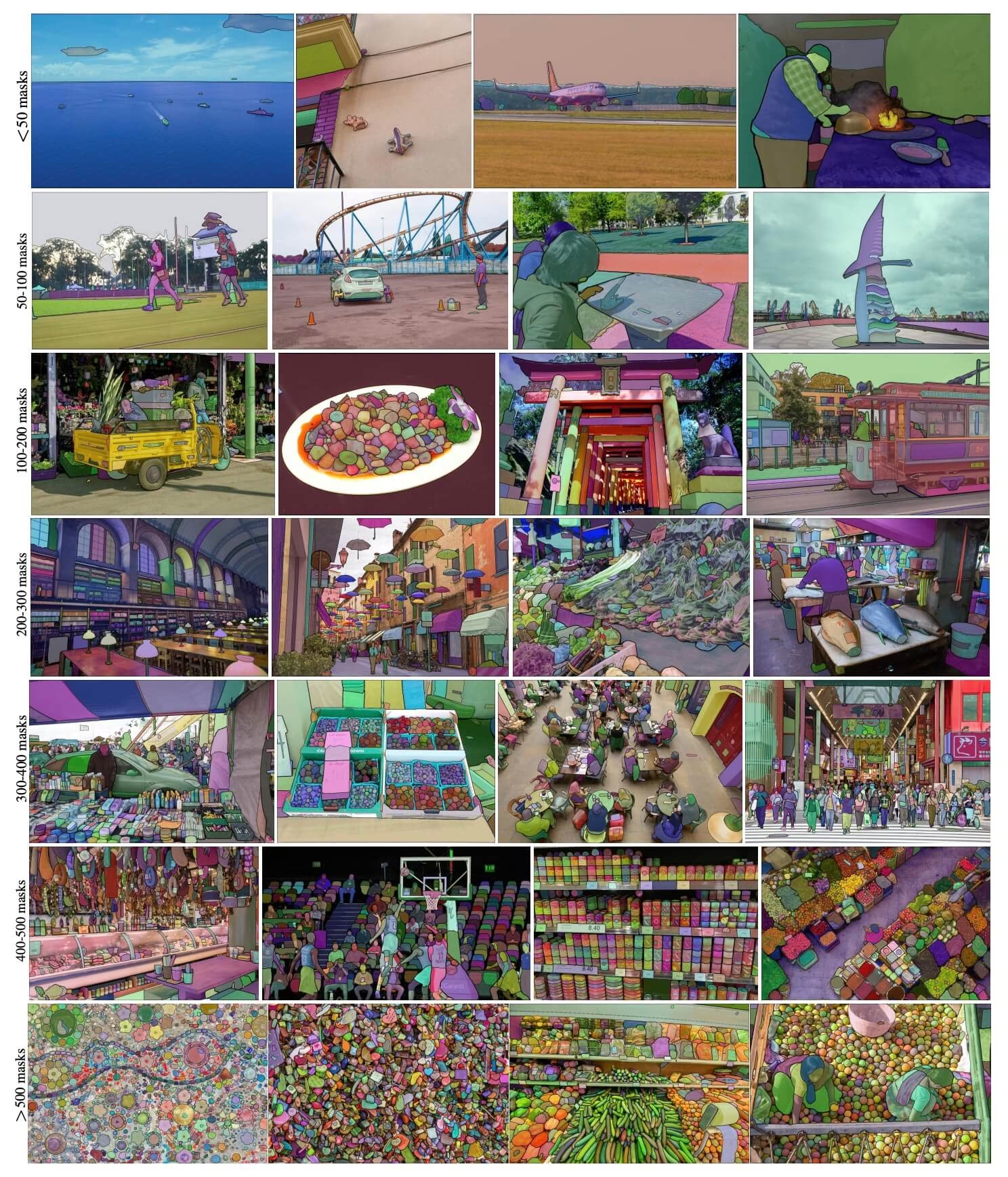 صور نموذجية من SA-1B. صور من مجموعة بيانات SA-1B مع أقنعة متراكبة. تضم SA-1B 11 مليون صورة متنوعة وعالية الدقة ومرخّصة وتحافظ على الخصوصية، و1.1 مليار قناع تقسيم عالي الجودة. أضاف SAM هذه الأقنعة تلقائيًا بالكامل، وهي عالية الجودة ومتنوعة، وفقًا لما أكدته تقييمات البشر وتجارب عديدة. جُمعت الصور وفقًا لعدد الأقنعة في كل صورة لأغراض العرض (يبلغ متوسطها نحو 100 قناع لكل صورة).
الميزات الرئيسية لنموذج تقسيم أي شيء (SAM)#
- مهمة التقسيم القابل للتوجيه: صُمم SAM مع وضع مهمة التقسيم القابل للتوجيه في الاعتبار، ما يتيح له إنشاء أقنعة تقسيم صالحة انطلاقًا من أي مطالبة، مثل الإشارات المكانية أو النصية التي تحدد كائنًا.
- بنية متقدمة: يستخدم نموذج تقسيم أي شيء مشفّر صور ضخمًا ومشفّرًا للمطالبات ومفكك ترميز أقنعة خفيفًا. تتيح هذه البنية تقديم مطالبات مرنة وحساب الأقنعة في الوقت الفعلي ومراعاة الالتباس في مهام التقسيم.
- مجموعة بيانات SA-1B: قدّم مشروع تقسيم أي شيء مجموعة بيانات SA-1B، التي تضم أكثر من مليار قناع موزعة على 11 مليون صورة. وباعتبارها أكبر مجموعة بيانات للتقسيم عند إصدارها، فهي توفر لـ SAM مصدرًا متنوعًا وضخمًا لبيانات التدريب.
- الأداء دون تدريب مسبق: يُظهر SAM أداءً قويًا دون تدريب مسبق عبر مهام تقسيم متنوعة، ما يجعله أداة جاهزة للاستخدام في تطبيقات مختلفة مع حاجة محدودة إلى هندسة المطالبات.
للاطلاع المتعمق على نموذج تقسيم أي شيء ومجموعة بيانات SA-1B، يُرجى زيارة مستودع Segment Anything على GitHub والاطلاع على الورقة البحثية Segment Anything.
تدعم نماذج عائلة SAM (SAM 2.1 وSAM 3 وSAM 3.1) ميزة التعليق التوضيحي الذكي على منصة Ultralytics، ما يتيح إنشاء الأقنعة بالنقر لتسريع إضافة التسميات إلى مجموعات البيانات.
النماذج المتاحة والمهام المدعومة وأوضاع التشغيل#
يعرض هذا الجدول النماذج المتاحة وأوزانها المدرّبة مسبقًا والمهام التي تدعمها ومدى توافقها مع أوضاع التشغيل المختلفة مثل التدريب والتحقق والاستدلال والتصدير. تشير ✅ إلى الأوضاع المدعومة و❌ إلى الأوضاع غير المدعومة.
| نوع النموذج | الأوزان المدرّبة مسبقاً | المهام المدعومة | التدريب | التحقق | الاستدلال | التصدير |
|---|---|---|---|---|---|---|
| SAM الأساسي | sam_b.pt | تجزئة الكائنات | ❌ | ❌ | ✅ | ❌ |
| SAM كبير | sam_l.pt | تجزئة الكائنات | ❌ | ❌ | ✅ | ❌ |
كيفية استخدام SAM: المرونة والقوة في تقسيم الصور#
يمكن استخدام نموذج تقسيم أي شيء في العديد من المهام اللاحقة التي تتجاوز نطاق بيانات التدريب الخاصة به، بما في ذلك اكتشاف الحواف، وتوليد مقترحات الكائنات، وتجزئة المثيلات، والتنبؤ الأولي بالقناع انطلاقًا من النص. وباستخدام هندسة المطالبات، يستطيع SAM التكيّف مع مهام جديدة وتوزيعات بيانات جديدة بأسلوب التعلّم صفريّ اللقطات.
مثال على التنبؤ باستخدام SAM#
قسّم الصورة باستخدام المطالبات المعطاة.
from ultralytics import SAM
# تحميل نموذج
model = SAM("sam_b.pt")
# عرض معلومات النموذج (اختياري)
model.info()
# تنفيذ الاستدلال باستخدام مطالبة المربعات المحيطة
results = model("ultralytics/assets/zidane.jpg", bboxes=[439, 437, 524, 709])
# تنفيذ الاستدلال باستخدام نقطة واحدة
results = model(points=[900, 370], labels=[1])
# تنفيذ الاستدلال باستخدام نقاط متعددة
results = model(points=[[400, 370], [900, 370]], labels=[1, 1])
# تنفيذ الاستدلال باستخدام مطالبة نقاط متعددة لكل كائن
results = model(points=[[[400, 370], [900, 370]]], labels=[[1, 1]])
# تنفيذ الاستدلال باستخدام مطالبة نقاط سلبية
results = model(points=[[[400, 370], [900, 370]]], labels=[[1, 0]])قسّم الصورة بالكامل.
from ultralytics import SAM
# تحميل نموذج
model = SAM("sam_b.pt")
# عرض معلومات النموذج (اختياري)
model.info()
# تنفيذ الاستدلال
model("path/to/image.jpg")- يقسّم SAM الصورة بأكملها عند عدم تمرير أي مطالبات (مربعات تحديد/نقاط/أقنعة).
حدّد الصورة مرة واحدة، ثم نفّذ الاستدلال بالمطالبات عدة مرات دون إعادة تشغيل مشفّر الصور.
import cv2
from ultralytics.models.sam import Predictor as SAMPredictor
# إنشاء SAMPredictor
overrides = {"conf": 0.25, "task": "segment", "mode": "predict", "imgsz": 1024, "model": "mobile_sam.pt"}
predictor = SAMPredictor(overrides=overrides)
# تعيين الصورة
predictor.set_image("ultralytics/assets/zidane.jpg") # التعيين باستخدام ملف صورة
predictor.set_image(cv2.imread("ultralytics/assets/zidane.jpg")) # التعيين باستخدام np.ndarray
results = predictor(bboxes=[439, 437, 524, 709])
# تشغيل الاستدلال باستخدام مطالبة نقطة واحدة
results = predictor(points=[900, 370], labels=[1])
# تشغيل الاستدلال باستخدام مطالبة نقاط متعددة
results = predictor(points=[[400, 370], [900, 370]], labels=[1, 1])
# تنفيذ الاستدلال باستخدام مطالبة نقاط سلبية
results = predictor(points=[[[400, 370], [900, 370]]], labels=[[1, 0]])
# إعادة تعيين الصورة
predictor.reset_image()قسّم كل شيء باستخدام وسيطات إضافية.
from ultralytics.models.sam import Predictor as SAMPredictor
# إنشاء SAMPredictor
overrides = {"conf": 0.25, "task": "segment", "mode": "predict", "imgsz": 1024, "model": "mobile_sam.pt"}
predictor = SAMPredictor(overrides=overrides)
# التقسيم باستخدام وسيطات إضافية
results = predictor(source="ultralytics/assets/zidane.jpg", crop_n_layers=1, points_stride=64, min_mask_region_area=100)جميع عناصر results المعادة في الأمثلة أعلاه هي كائنات Results تتيح الوصول إلى الأقنعة المتوقعة والصورة المصدر.
- للاطلاع على مزيد من وسيطات
Segment everything، راجع مرجعPredictor/generate.
مقارنة SAM بنماذج YOLO#
نقارن هنا نموذج SAM-b من Meta بنماذج التقسيم من Ultralytics، ومنها YOLO26:
| النموذج | الحجم (MB) | المعلمات (M) | السرعة (CPU) (مللي ثانية/صورة) |
|---|---|---|---|
| Meta SAM-b | 375 | 93.7 | 41703 |
| MobileSAM | 40.7 | 10.1 | 23802 |
| FastSAM-s مع البنية الأساسية لـ YOLOv8 | 23.9 | 11.8 | 58.0 |
| Ultralytics YOLOv8n-seg | 7.1 (أصغر بمقدار 52.8x) | 3.4 (أقل بمقدار 27.6x) | 24.8 (أسرع بمقدار 1682x) |
| Ultralytics YOLO11n-seg | 6.2 (أصغر بمقدار 60.5x) | 2.9 (أقل بمقدار 32.3x) | 24.3 (أسرع بمقدار 1716x) |
| Ultralytics YOLO26n-seg | 6.7 (أصغر بمقدار 56.0x) | 2.7 (أقل بمقدار 34.7x) | 25.2 (أسرع بمقدار 1655x) |
تُظهر هذه المقارنة الفروق الكبيرة في أحجام النماذج وسرعاتها بين إصدارات SAM ونماذج تقسيم YOLO. وعلى الرغم من أن SAM يوفر إمكانات فريدة للتقسيم التلقائي، فإن نماذج YOLO، ولا سيما YOLOv8n-seg وYOLO11n-seg وYOLO26n-seg، أصغر وأسرع وأكثر كفاءة حسابيًا بدرجة كبيرة.
قِيسَت سرعات SAM باستخدام PyTorch، وسرعات YOLO باستخدام ONNX Runtime. أُجريت الاختبارات على Apple M4 Air لعام 2025 بذاكرة RAM سعتها 16GB باستخدام torch==2.10.0 وultralytics==8.4.31 وonnxruntime==1.24.4. لإعادة إجراء هذا الاختبار:
from ultralytics import ASSETS, SAM, YOLO, FastSAM
# تحليل أداء SAM-b وMobileSAM
for file in ["sam_b.pt", "mobile_sam.pt"]:
model = SAM(file)
model.info()
model(ASSETS)
# أنشئ ملفًا تعريفيًا لـ FastSAM-s
model = FastSAM("FastSAM-s.pt")
model.info()
model(ASSETS)
# تحليل أداء نماذج YOLO (ONNX)
for file_name in ["yolov8n-seg.pt", "yolo11n-seg.pt", "yolo26n-seg.pt"]:
model = YOLO(file_name)
model.info()
onnx_path = model.export(format="onnx", dynamic=True, nms=False) # رأس NMS-free في YOLO26؛ لا إجراء لـ YOLOv8/YOLO11
model = YOLO(onnx_path)
model(ASSETS)التعليق التوضيحي التلقائي: مسار سريع لإنشاء مجموعات بيانات التقسيم#
يُعد التعليق التوضيحي التلقائي ميزة أساسية في SAM، إذ يتيح للمستخدمين إنشاء مجموعة بيانات للتقسيم باستخدام نموذج كشف مدرّب مسبقًا. وتمكّن هذه الميزة من إضافة التعليقات التوضيحية بسرعة إلى أعداد كبيرة من الصور، متجاوزةً عملية وضع التسميات يدويًا التي تستغرق وقتًا طويلًا.
أنشئ مجموعة بيانات التقسيم باستخدام نموذج كشف#
لإضافة التعليقات التوضيحية تلقائيًا إلى مجموعة بياناتك باستخدام إطار عمل Ultralytics، استخدم الدالة auto_annotate التي تجمع كاشفًا مثل YOLO26x مع SAM:
from ultralytics.data.annotator import auto_annotate

auto_annotate(data="path/to/images", det_model="yolo26x.pt", sam_model="sam_b.pt")| المعامل | النوع | الافتراضي | الوصف |
|---|---|---|---|
data | str | مطلوب | مسار الدليل الذي يحتوي على الصور المستهدفة المراد وسمها أو تجزئتها. |
det_model | str | 'yolo26x.pt' | مسار نموذج كشف YOLO لإجراء الكشف الأولي عن الكائنات. |
sam_model | str | 'sam_b.pt' | مسار نموذج SAM لإجراء التجزئة (يدعم أوزان SAM وSAM 2 وMobileSAM وSAM 3). |
device | str | '' | جهاز الحوسبة (مثل 'cuda:0' أو 'cpu' أو '' للكشف التلقائي عن الجهاز). |
conf | float | 0.25 | عتبة الثقة لكشف YOLO لتصفية الكشوفات ضعيفة الثقة. |
iou | float | 0.5 | عتبة IoU لكبت غير الأقصى لتصفية المربعات المتداخلة. |
imgsz | int | 640 | حجم الإدخال لتغيير أبعاد الصور (يُقرّب إلى أقرب مضاعف للعدد 32 عند الحاجة). |
max_det | int | 300 | الحد الأقصى لعدد الكشوفات لكل صورة لترشيد استخدام الذاكرة. |
classes | list[int] | None | قائمة بمؤشرات الفئات المراد كشفها (مثل [0, 1] للشخص والدراجة). |
output_dir | str | None | دليل حفظ الوسوم (الافتراضي: الدليل الشقيق <data>_auto_annotate_labels). |
تأخذ الدالة auto_annotate مسار الصور، مع وسيطات اختيارية لتحديد نموذجي الكشف والتقسيم SAM المدرّبين مسبقًا، والجهاز الذي ستُشغّل عليه النماذج، ومجلد الإخراج لحفظ النتائج التي أُضيفت إليها التعليقات التوضيحية.
يقلل التعليق التوضيحي التلقائي باستخدام النماذج المدرّبة مسبقًا كثيرًا الوقت والجهد اللازمين لإنشاء مجموعات بيانات التقسيم، ما يتيح للفرق التي لديها مجموعات صور كبيرة التركيز على تطوير النماذج وتقييمها بدلًا من التعليق التوضيحي اليدوي.
الاستشهادات والشكر والتقدير#
إذا وجدت SAM مفيدًا في أبحاثك أو أعمال التطوير، فيُرجى التفكير في الاستشهاد بالورقة البحثية:
@misc{kirillov2023segment,
      title={Segment Anything},
      author={Alexander Kirillov and Eric Mintun and Nikhila Ravi and Hanzi Mao and Chloe Rolland and Laura Gustafson and Tete Xiao and Spencer Whitehead and Alexander C. Berg and Wan-Yen Lo and Piotr Dollár and Ross Girshick},
      year={2023},
      eprint={2304.02643},
      archivePrefix={arXiv},
      primaryClass={cs.CV}
}
نود أن نعرب عن امتناننا لـ Meta AI لإنشاء هذا المورد القيّم والحفاظ عليه لصالح مجتمع الرؤية الحاسوبية.
الأسئلة الشائعة#
نموذج Meta لتقسيم أي شيء (SAM) هو نموذج لتقسيم الصور صُمم لمهام التقسيم الموجّه بالمطالبات. ويجمع بين مشفّري الصور والمطالبات ومفكك ترميز أقنعة خفيف لتوليد أقنعة التقسيم استنادًا إلى مطالبات مثل النقاط أو المربعات أو الأقنعة. وقد دُرّب SAM على مجموعة بيانات SA-1B، ويحقق أداءً جيدًا دون تدريب مسبق، إذ يتكيف مع توزيعات الصور والمهام الجديدة من دون معرفة مسبقة.
يمكنك استخدام نموذج تقسيم أي شيء (SAM) لتقسيم الصور عن طريق تشغيل الاستدلال باستخدام مطالبات متنوعة، مثل مربعات الإحاطة أو النقاط. إليك مثالًا باستخدام Python:
from ultralytics import SAM # تحميل نموذج model = SAM("sam_b.pt") # التجزئة باستخدام مطالبة مربع إحاطة model("ultralytics/assets/zidane.jpg", bboxes=[439, 437, 524, 709]) # التقسيم باستخدام مطالبة نقاط model("ultralytics/assets/zidane.jpg", points=[900, 370], labels=[1]) # التقسيم باستخدام مطالبة نقاط متعددة model("ultralytics/assets/zidane.jpg", points=[[400, 370], [900, 370]], labels=[1, 1]) # التقسيم باستخدام مطالبة نقاط متعددة لكل كائن model("ultralytics/assets/zidane.jpg", points=[[[400, 370], [900, 370]]], labels=[[1, 1]]) # التقسيم باستخدام مطالبة نقاط سلبية. model("ultralytics/assets/zidane.jpg", points=[[[400, 370], [900, 370]]], labels=[[1, 0]])بدلًا من ذلك، يمكنك تشغيل الاستدلال باستخدام SAM عبر واجهة سطر الأوامر (CLI):
yolo predict model=sam_b.pt source=path/to/image.jpgمقارنةً بنماذج YOLO، تكون متغيرات SAM مثل SAM-b وMobileSAM وFastSAM-s أكبر وأبطأ عادةً، لكنها توفر إمكانات فريدة للتقسيم دون تدريب مسبق. فعلى سبيل المثال، يُعد YOLO26n-seg أصغر بمقدار 56x وأسرع بأكثر من 1650x من نموذج SAM-b الأصلي من Meta على CPU. وهذا يجعل نماذج YOLO مثالية للتطبيقات التي تتطلب تقسيمًا سريعًا وخفيفًا وفعّالًا حسابيًا، بينما تتفوق نماذج SAM في مهام التقسيم المرن والقابل للتوجيه ودون تدريب مسبق.
يوفر SAM من Ultralytics ميزة للتعليق التوضيحي التلقائي تتيح إنشاء مجموعات بيانات للتقسيم باستخدام نموذج كشف مدرّب مسبقًا. إليك مثالًا بلغة Python:
from ultralytics.data.annotator import auto_annotate

auto_annotate(data="path/to/images", det_model="yolo26x.pt", sam_model="sam_b.pt")
تأخذ هذه الدالة مسار الصور والوسيطات الاختيارية لنموذجي الكشف والتقسيم SAM المدرّبين مسبقًا، إلى جانب تحديد الجهاز ومجلد الإخراج. للاطلاع على دليل كامل، راجع التعليق التوضيحي التلقائي.
دُرّب SAM على مجموعة بيانات SA-1B، التي تضم أكثر من مليار قناع عبر 11 مليون صورة. وكانت SA-1B أكبر مجموعة بيانات للتجزئة عند إصدارها، إذ وفرت بيانات تدريب عالية الجودة ومتنوعة تدعم أداء SAM دون أمثلة سابقة في مهام التجزئة.


التعليقات27
اطرح سؤالًا، وشارك نتائجك، أو ساعد شخصًا آخر.
kh-diab
can we use SAM to process labeled images with bounding box to segment the object inside the box and generate new labels files like yolo or coco format if yes how please
1 Paula DerrengerUltralytics
Yes, you can use SAM to process labeled images with bounding boxes to segment the objects inside and generate new label files in formats like YOLO or COCO. You can achieve this by using the
auto_annotatefunction in the Ultralytics framework. This function allows you to auto-annotate your dataset using a pre-trained detection model and SAM for segmentation. For more details, you can refer to the Segment Anything Model documentation. If you need further assistance, feel free to ask!Hello @pderrenger
Thanks I tried to run the below but I face error all the time
import os import cv2 import numpy as np from ultralytics import SAM
Load the SAM model
model = SAM("sam_b.pt") # Update the model path if needed
Function to load YOLO annotations
def load_yolo_annotations(annotation_path, image_width, image_height): bboxes = [] try: with open(annotation_path, 'r') as file: lines = file.readlines() for line in lines: parts = line.strip().split() class_id = int(parts[0]) x_center = float(parts[1]) * image_width y_center = float(parts[2]) * image_height width = float(parts[3]) * image_width height = float(parts[4]) * image_height x = x_center - width / 2 y = y_center - height / 2 bboxes.append((x, y, x + width, y + height)) # Update to [x1, y1, x2, y2] except Exception as e: print(f"Error reading annotation file {annotation_path}: {e}") return bboxes
Paths
images_folder = r'E:\MSc\tesi\20210901_Herrenpuent_Taenikon_Matrice_300_15m_1.6m_s\500 D' annotations_folder = r'C:\Users\Khaled\OneDrive - OST\Study Material\Msc Thesis\dataset\Group D yolo format\obj_train_data' output_folder = r'C:\Users\Khaled\OneDrive - OST\Study Material\Msc Thesis\dataset\test output sam'
if not os.path.exists(output_folder): os.makedirs(output_folder)
Process each image and its corresponding annotation
total_images = len(os.listdir(images_folder)) processed_images = 0
for image_filename in os.listdir(images_folder): if image_filename.endswith(('.JPG', '.jpg', '.png')): image_path = os.path.join(images_folder, image_filename) annotation_path = os.path.join(annotations_folder, image_filename.replace('.JPG', '.txt').replace('.jpg', '.txt').replace('.png', '.txt'))
    print(f"Processing {image_filename}...")

    # Check if annotation file exists
    if not os.path.exists(annotation_path):
        print(f"Annotation file not found for {image_filename}")
        continue

    # Load the image
    image = cv2.imread(image_path)
    if image is None:
        print(f"Failed to load image {image_path}")
        continue

    image_rgb = cv2.cvtColor(image, cv2.COLOR_BGR2RGB)
    height, width, _ = image.shape

    # Load YOLO annotations
    bboxes = load_yolo_annotations(annotation_path, width, height)
    if not bboxes:
        print(f"No bounding boxes found in {annotation_path}")
        continue

    # Perform segmentation using SAM model
    results = model(image_rgb, bboxes=bboxes)

    for idx, result in enumerate(results):
        if hasattr(result, 'masks') and result.masks is not None:
            masks = result.masks.cpu().numpy()  # Convert to numpy array
            for m_idx, mask in enumerate(masks):
                chw_mask = mask.astype(np.uint8)  # Ensure mask is in uint8 format
                hwc_mask = np.transpose(chw_mask, (1, 2, 0))  # Convert CHW to HWC
                contours, _ = cv2.findContours(hwc_mask, cv2.RETR_EXTERNAL, cv2.CHAIN_APPROX_SIMPLE)

                segmented_image = cv2.bitwise_and(image, image, mask=hwc_mask)

                # Save the segmented image
                output_path = os.path.join(output_folder, image_filename.replace('.JPG', f'_segmented_{idx}_{m_idx}.jpg').replace('.jpg', f'_segmented_{idx}_{m_idx}.jpg').replace('.png', f'_segmented_{idx}_{m_idx}.png'))
                cv2.imwrite(output_path, segmented_image)
                print(f"Saved segmented image to {output_path}")

    processed_images += 1
    print(f"Processed {processed_images}/{total_images} images.")
print("Processing completed.")
error is
AttributeError: 'Masks' object has no attribute 'astype'. See valid attributes below.
A class for storing and manipulating detection masks.

    xy (list): A list of segments in pixel coordinates.
    xyn (list): A list of normalized segments.

Methods:
    cpu(): Returns the masks tensor on CPU memory.
    numpy(): Returns the masks tensor as a numpy array.
    cuda(): Returns the masks tensor on GPU memory.
    to(device, dtype): Returns the masks tensor with the specified device and dtype.
PS C:\Users\Khaled> & C:/MSc_Workspace/anaconda3/envs/GenEnv/python.exe "c:/Users/Khaled/OneDrive - OST/Study Material/Msc Thesis/coding/sam segment.py" Processing DJI_20210901122818_0695.JPG...
0: 1024x1024 67330.4ms Speed: 48.0ms preprocess, 67330.4ms inference, 8095.5ms postprocess per image at shape (1, 3, 1024, 1024) Traceback (most recent call last): File "c:\Users\Khaled\OneDrive - OST\Study Material\Msc Thesis\coding\sam segment.py", line 75, in chw_mask = mask.astype(np.uint8) # Ensure mask is in uint8 format File "C:\MSc_Workspace\anaconda3\envs\GenEnv\lib\site-packages\ultralytics\utils_init_.py", line 162, in getattr raise AttributeError(f"'{name}' object has no attribute '{attr}'. See valid attributes below.\n{self.doc}") AttributeError: 'Masks' object has no attribute 'astype'. See valid attributes below.
A class for storing and manipulating detection masks.

Attributes:
    xy (list): A list of segments in pixel coordinates.
    xyn (list): A list of normalized segments.

Methods:
    cpu(): Returns the masks tensor on CPU memory.
    numpy(): Returns the masks tensor as a numpy array.
    cuda(): Returns the masks tensor on GPU memory.
    to(device, dtype): Returns the masks tensor with the specified device and dtype.
do you have idea how to solve it thanks
evans rojas
Hola me gustaría usar SAM para clasificar vegetación a partir de una imagen. ¿Qué recomendaciones me sugieren?
- Paula DerrengerUltralytics
Hola, Evans. SAM puede ayudarte a delimitar la vegetación, pero el SAM original no identifica por sí solo especies ni tipos de cobertura. Te sugiero comenzar con puntos positivos sobre la vegetación y negativos sobre el fondo, revisar las máscaras y asignarles tus clases manualmente. Si buscas automatizar la clasificación en más imágenes, puedes usar esas anotaciones para entrenar un modelo de segmentación por instancias para plantas individuales o de segmentación semántica para coberturas del terreno. ¿Quieres separar vegetación del fondo o distinguir especies, y trabajas con fotografías terrestres, de dron o satelitales?
meenakshi71
I've been trying to export the SAM model (which i had trained on my custom dataset) into ONNX but the output is always wrong. It is just generating a grid instead of a proper segmentation mask every time even after providing multiple kinds of prompts.
 Glenn JocherUltralytics
@meenakshi71 it seems the issue may stem from the export process or configuration. Ensure you are using the correct export parameters and supported formats. SAM models are primarily designed for real-time inference and not all functionalities may transfer seamlessly to ONNX. Refer to the SAM export documentation for guidance. If the problem persists, consider testing the ONNX model with simpler prompts to isolate the issue.
MeenakshiKK236
Why are my segmentation results being automatically saved into this directory while using the SAM model to perform segmentation on my custom dataset? "Results saved to runs/segment/predict4"
- Glenn JocherUltralytics
@MeenakshiKK236 the results are saved to the
runs/segment/predict4directory by default. You can change the save directory by specifying theprojectandnamearguments in your command. For more details, please refer to the SAM documentation.
NasserAlqeifi
Correct me if I'm wrong, when I use the auto_annotate function I will only get labels for my dataset with the classes in Yolo pre-trained? What if I need classes that are not available within Yolo? For example, I want to get a label for the road, and this is not available in any version of Yolo, but it is available in SAM?
- Glenn JocherUltralytics
@NasserAlqeifi you are correct. The
auto_annotatefunction uses YOLO's pre-trained classes for labeling. If you need classes not available in YOLO, like "road," you can use SAM directly for segmentation. For more details, please refer to the Segment Anything Model documentation. - Glenn JocherUltralytics
@NasserAlqeifi but also remember SAM identifies segments but not classes, so it may find a sign or a road, but it won't be able to assign a class to them by itself.
Thank you for your quick response. Indeed, I tried to use SAM directly and found that it does not save the class names in the name, but the class number.
from ultralytics import SAM
Load a model
model = SAM("sam2_l.pt")
Predict results
results = model.predict(source=r"/testSAM/image.png", stream=True, bboxes=None, points=None, labels=None, show=False)
Iterate over results, print names, and save each result to a file
for i, result in enumerate(results): # Print the names detected in the result print(f"Result {i}: Detected Names - {result.names}")
# Save the result as an image file
result.save(f"output_{i}.jpg")
------------- output ---------
image 1/1 /testSAM/image.png: 1024x1024 1 0, 1 1, 1 2, 1 3, 1 4, 1 5, 1 6, 1 7, 1 8, 1 9, 1 10, 1 11, 1 12, 1 13, 1 14, 1 15, 1 16, 1 17, 1 18, 1 19, 1 20, 1 21, 1 22, 1 23, 1 24, 1 25, 1 26, 1 27, 1 28, 1 29, 1 30, 1 31, 1 32, 23758.2ms Result 0: Detected Names - {0: '0', 1: '1', 2: '2', 3: '3', 4: '4', 5: '5', 6: '6', 7: '7', 8: '8', 9: '9', 10: '10', 11: '11', 12: '12', 13: '13', 14: '14', 15: '15', 16: '16', 17: '17', 18: '18', 19: '19', 20: '20', 21: '21', 22: '22', 23: '23', 24: '24', 25: '25', 26: '26', 27: '27', 28: '28', 29: '29', 30: '30', 31: '31', 32: '32'} Speed: 20.3ms preprocess, 23758.2ms inference, 7.1ms postprocess per image at shape (1, 3, 1024, 1024)
- Glenn JocherUltralytics
Thank you for your feedback. Currently, SAM does not assign class names, only class numbers. If you need specific class names, you may need to implement a custom mapping or post-processing step to assign the desired class names based on your requirements.
dreambit
I have images where a single object (such as a car) is partially covered by small trees, resulting in the object being divided into multiple visible fragments. In coco it could look like { "id": 1, "image_id": 1, "category_id": 1, "bbox": [x, y, width, height], "segmentation": [ [polygon1_x1, polygon1_y1, polygon1_x2, polygon1_y2, ...], [polygon2_x1, polygon2_y1, polygon2_x2, polygon2_y2, ...] ], "area": 500, "iscrowd": 0 } Each polygon is an array of coordinates defining a closed shape
Is it possible with auto_annotate and yolo format?
- Glenn JocherUltralytics(تم التعديل)
@dreambit hi there!
Thank you for your detailed question. Yes, you can use the
auto_annotatefunction in the Ultralytics framework to handle images where objects are partially occluded and appear as multiple fragments. This function can generate segmentation masks for such complex scenarios.Here's how you can achieve this:
- Prepare Your Dataset: Ensure your images are organized in a directory.
- Use the
auto_annotateFunction: This function will use a pre-trained YOLO detection model and the SAM segmentation model to annotate your images.
Here's a code example to get you started:
from ultralytics.data.annotator import auto_annotate

# Path to your images
data_path = "path/to/your/images"

# Auto-annotate using YOLO26 and SAM models
auto_annotate(data=data_path, det_model="yolo26x.pt", sam_model="sam_b.pt")
Explanation:
data: Path to the folder containing your images.det_model: The pre-trained YOLO detection model, which defaults toyolo26x.pt.sam_model: The pre-trained SAM segmentation model, which defaults tosam_b.pt.
This setup will generate segmentation masks for your images, even if the objects are partially occluded.
For more detailed information on using SAM and its capabilities, you can refer to the Segment Anything Model (SAM) documentation.
If you encounter any issues or need further assistance, please provide a reproducible example so we can better understand and address your specific scenario. You can find more information on creating a minimum reproducible example here.
Feel free to update to the latest versions of the packages to ensure you have the latest features and fixes.
Best of luck with your project! 🚀
Glenn thanks, but as I see in docs https://docs.ultralytics.com/datasets/segment/#ultralytics-yolo-format ... In this format, is the index of the class for the object, and ... are the bounding coordinates of the object's segmentation mask. The coordinates are separated by spaces.
So it means that I could have only one segmentation mask?
0 0.681 0.485 0.670 0.487 0.676 0.487 1 0.504 0.000 0.501 0.004 0.498 0.004 0.493 0.010 0.492 0.0104
Glen, i ran the command you specified, and used an image from coco data set to test, as you can see segmentations are not correct, only half of the objects are segmented:
Here is original image from coco with car mask https://ibb.co/RjYyRdk
- Glenn JocherUltralytics(تم التعديل)
Hi @dreambit,
Thank you for sharing the images and details. I understand the challenge you're facing with partial segmentations. The
auto_annotatefunction should ideally handle such cases, but it seems like the segmentation results are not as expected.Steps to Troubleshoot and Improve Segmentation:
-
Verify Latest Versions: Ensure you are using the latest versions of the Ultralytics and SAM models. This can help avoid any bugs that might have been fixed in recent updates.
-
Reproducible Example: If the issue persists, providing a minimum reproducible example would be very helpful. This allows us to better understand and diagnose the problem. You can find guidance on creating a reproducible example here.
-
Adjusting Prompts: Sometimes, adjusting the prompts (bounding boxes or points) can improve segmentation results. Here’s an example of how you can use different prompts:
from ultralytics import SAM # Load a model model = SAM("sam_b.pt") # Run inference with bounding boxes prompt results = model("path/to/image.jpg", bboxes=[[x1, y1, x2, y2], [x3, y3, x4, y4]]) # Run inference with points prompt results = model("path/to/image.jpg", points=[[x1, y1], [x2, y2]], labels=[1, 1]) -
Segment Everything: If specific prompts are not yielding the desired results, you can try segmenting the entire image without prompts:
from ultralytics import SAM # Load a model model = SAM("sam_b.pt") # Segment the whole image results = model("path/to/image.jpg") -
Multiple Masks Handling: If your object is divided into multiple fragments, ensure that the segmentation model is capable of handling multiple masks per object. The YOLO format typically supports one segmentation mask per object, but you can adapt the output to handle multiple masks by combining them post-processing.
Example of Handling Multiple Masks:
If you need to combine multiple masks into a single annotation, you can do this post-processing:
# `results[0].masks.data` holds all masks of the image, shape (N, H, W)
combined_mask = results[0].masks.data.cpu().numpy().max(axis=0)

# Save or use the combined mask
Documentation and Resources:
For more detailed information on using SAM and its capabilities, please refer to the Segment Anything Model (SAM) documentation.
If you continue to face issues, please share a reproducible example, and we’ll be happy to assist further. Your feedback is valuable, and we aim to provide the best support possible.
-
kshweikeh
is there anyway where I can train YOLO SAM on a custom dataset?
- Paula DerrengerUltralytics(تم التعديل)
@kshweikeh hi there!
Currently, the Segment Anything Model (SAM) from Ultralytics is designed primarily for inference and does not support training on custom datasets. However, you can leverage SAM's powerful zero-shot capabilities for various segmentation tasks without the need for additional training.
If you're looking to create a segmentation dataset using SAM, you can use the auto-annotation feature. This allows you to generate segmentation masks using a pre-trained detection model. Here's a quick example:
from ultralytics.data.annotator import auto_annotate

auto_annotate(data="path/to/images", det_model="yolo26x.pt", sam_model="sam_b.pt")
This function will help you annotate your images quickly and efficiently, bypassing the need for manual labeling.
For more detailed information on using SAM, you can visit our Segment Anything Model (SAM) documentation.
If you have any further questions or need additional assistance, feel free to ask! 😊
Blessing988
@pderrenger It looks like auto_annotate for SAM only gives out the segmentation masks. What if you want to generate the bounding boxes in additionto the masks to verify if the results are right. Thanks.
Also, how will one visualise the segmentation masks after the auto_annotate which have been saved in a directory of txt files.
- Paula DerrengerUltralytics(تم التعديل)
Hi @Blessing988,
auto_annotatewrites one YOLO segmentation polygon per line (class_id x1 y1 x2 y2 ..., normalized) to its output folder (output_dir, by default<images folder>_auto_annotate_labels). Here is a script to draw those polygons on the images:from pathlib import Path import cv2 import numpy as np def visualize_annotations(image_dir, label_dir, output_dir): Path(output_dir).mkdir(parents=True, exist_ok=True) for image_path in Path(image_dir).glob("*.jpg"): image = cv2.imread(str(image_path)) h, w = image.shape[:2] label_path = Path(label_dir) / f"{image_path.stem}.txt" if not label_path.exists(): continue for line in label_path.read_text().splitlines(): values = line.split() polygon = (np.array(values[1:], dtype=float).reshape(-1, 2) * [w, h]).astype(np.int32) cv2.polylines(image, [polygon], isClosed=True, color=(0, 255, 0), thickness=2) cv2.imwrite(str(Path(output_dir) / image_path.name), image) visualize_annotations("path/to/images", "path/to/labels", "path/to/output")For more detailed information on using SAM and its features, you can refer to the Segment Anything Model (SAM) documentation.
Feel free to reach out if you have any further questions or need additional assistance! 😊
pabentse
Would be fantastic with support for the "H" size as well!
- Paula DerrengerUltralytics
@pabentse absolutely, the addition of an "H" size model would be a great enhancement to the range of model sizes we offer, catering to different computational needs and use cases. The YOLO community's feedback is invaluable, and suggestions like yours help guide future developments. Keep an eye on our updates! 👀🚀