Ultralytics Platform



Ultralytics Platform is a comprehensive end-to-end computer vision platform that streamlines the entire ML workflow from data preparation to model deployment. Built for teams and individuals who need production-ready computer vision solutions without the infrastructure complexity.
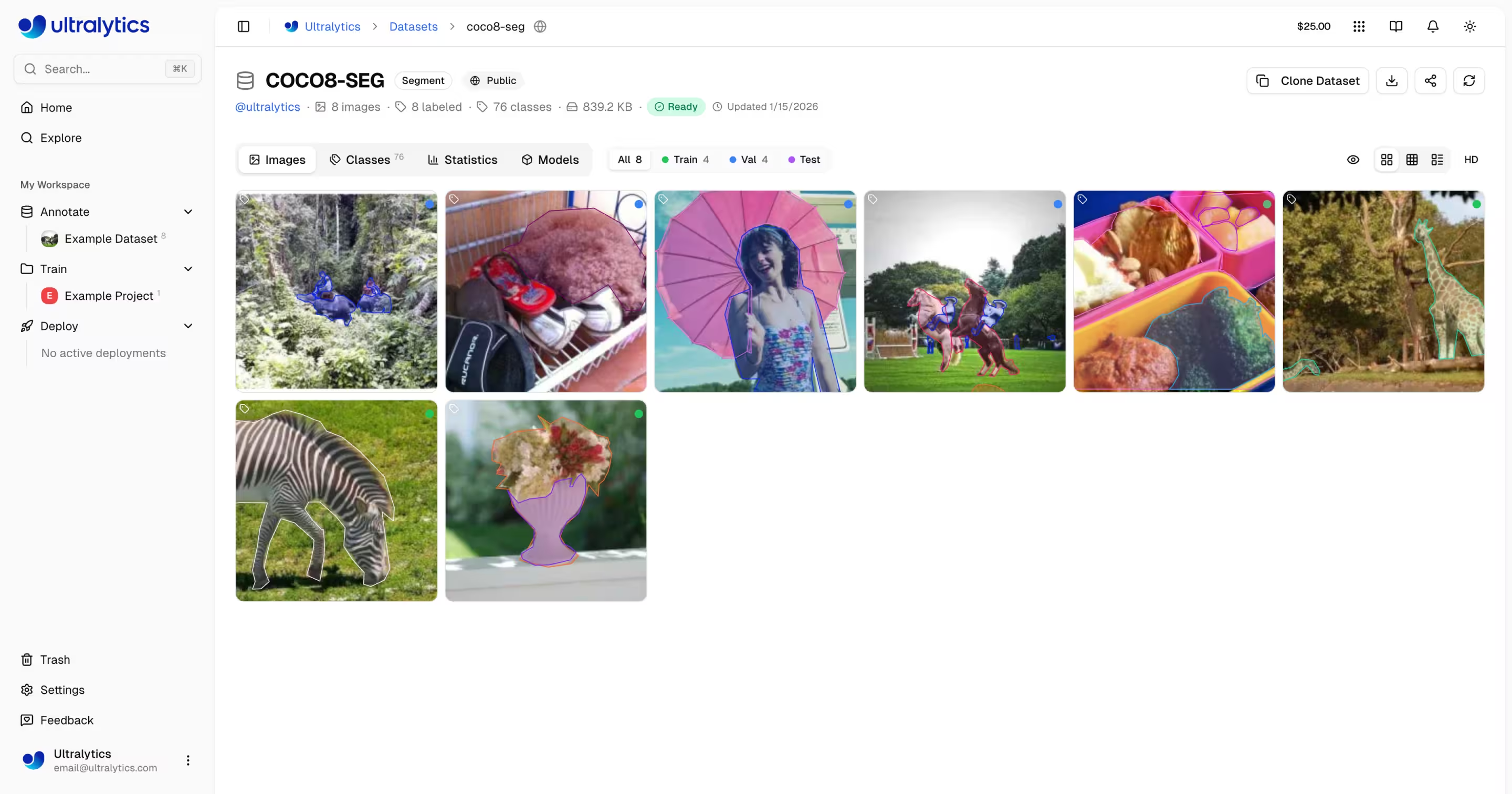
What is Ultralytics Platform?
Ultralytics Platform is designed to replace fragmented ML tooling with a unified solution. It combines the capabilities of:
- Roboflow - Data management and annotation
- Weights & Biases - Experiment tracking
- SageMaker - Cloud training
- HuggingFace - Model deployment
- Arize - Monitoring
All in one platform with native support for YOLO26 and YOLO11 models.
Workflow: Upload → Annotate → Train → Export → Deploy
The Platform provides an end-to-end workflow:
graph LR
    subgraph Data["📁 Data"]
        A[Upload] --> B[Annotate]
        B --> C[Analyze]
    end
    subgraph Train["🚀 Train"]
        D[Configure] --> E[Train on GPU]
        E --> F[View Metrics]
    end
    subgraph Deploy["🌐 Deploy"]
        G[Export] --> H[Deploy Endpoint]
        H --> I[Monitor]
    end
Data --> Train --> Deploy| Stage | Features |
|---|---|
| Upload | Images (50MB), videos (1GB), and dataset files (ZIP, TAR including .tar.gz/.tgz, NDJSON) with automatic processing |
| Annotate | Manual tools for all 5 task types, plus Smart Annotation with SAM and YOLO models for detect, segment, and OBB (see supported tasks) |
| Train | Cloud GPUs (20 free + 3 Pro-exclusive), real-time metrics, project organization |
| Export | 17 deployment formats (ONNX, TensorRT, CoreML, TFLite, etc.; see supported formats) |
| Deploy | 43 global regions with dedicated endpoints, scale-to-zero behavior, and monitoring |
What you can do:
- Upload images, videos, and dataset files to create training datasets
- Visualize annotations with interactive overlays for all 5 YOLO task types (see supported tasks)
- Train models on cloud GPUs (20 free, 23 with Pro) with real-time metrics
- Export to 17 deployment formats (ONNX, TensorRT, CoreML, TFLite, etc.)
- Deploy to 43 global regions with one-click dedicated endpoints
- Monitor training progress, deployment health, and usage metrics
- Collaborate by making projects and datasets public for the community
Multi-Region Infrastructure
Your data stays in your region. Ultralytics Platform operates infrastructure in three global regions:
| Region | Label | Location | Best For |
|---|---|---|---|
| US | Americas | Iowa, USA | Americas users, fastest for Americas |
| EU | Europe, Middle East & Africa | Belgium, Europe | European users, GDPR compliance |
| AP | Asia Pacific | Hong Kong, Asia-Pacific | Asia-Pacific users, lowest APAC latency |
You select your region during onboarding, and all your data, models, and deployments remain in that region.
Region is Permanent
Your data region cannot be changed after account creation. During onboarding, the platform measures latency to each region and recommends the closest one. Choose carefully.
Key Features
Data Preparation
- Dataset Management: Upload images, videos, or dataset files with automatic processing
- Annotation Editor: Manual annotation for all 5 YOLO task types (detect, segment, pose, OBB, classify; see supported tasks)
- Skeleton Templates: Built-in (Person, Hand, Face, Dog, Box) and custom skeleton templates for one-click pose annotation
- Smart Annotation: Use SAM 2.1 (Tiny, Small, Base, Large), SAM 3, pretrained Ultralytics YOLO models, or your own fine-tuned YOLO models from the annotation toolbar for detect, segment, and OBB tasks
- Dataset Versioning: Create numbered NDJSON snapshots with descriptions for reproducible training
- Statistics: Class distribution, location heatmaps, and dimension analysis
graph LR
    A[Upload Dataset/Images/Video] --> B[Auto-Process]
    B --> C[Browse & Filter]
    C --> D{Annotate}
    D --> E[Manual Tools]
    D --> F[SAM Smart]
    D --> G[YOLO Auto-Label]
    E --> H[Train-Ready Dataset]
    F --> H
    G --> H
Supported Task Types
The annotation editor supports all 5 YOLO task types: detect (bounding boxes), segment (polygons), pose (keypoints), OBB (oriented boxes), and classify (image-level labels). Each task type has dedicated drawing tools and keyboard shortcuts.
Model Training
- Cloud Training: Train on cloud GPUs (20 free, 23 with Pro) with real-time metrics
- Remote Training: Train anywhere and stream metrics to the platform (W&B-style)
- Project Organization: Group related models, compare experiments, track activity
- 17 Export Formats: ONNX, TensorRT, CoreML, TFLite, and more (see supported formats)
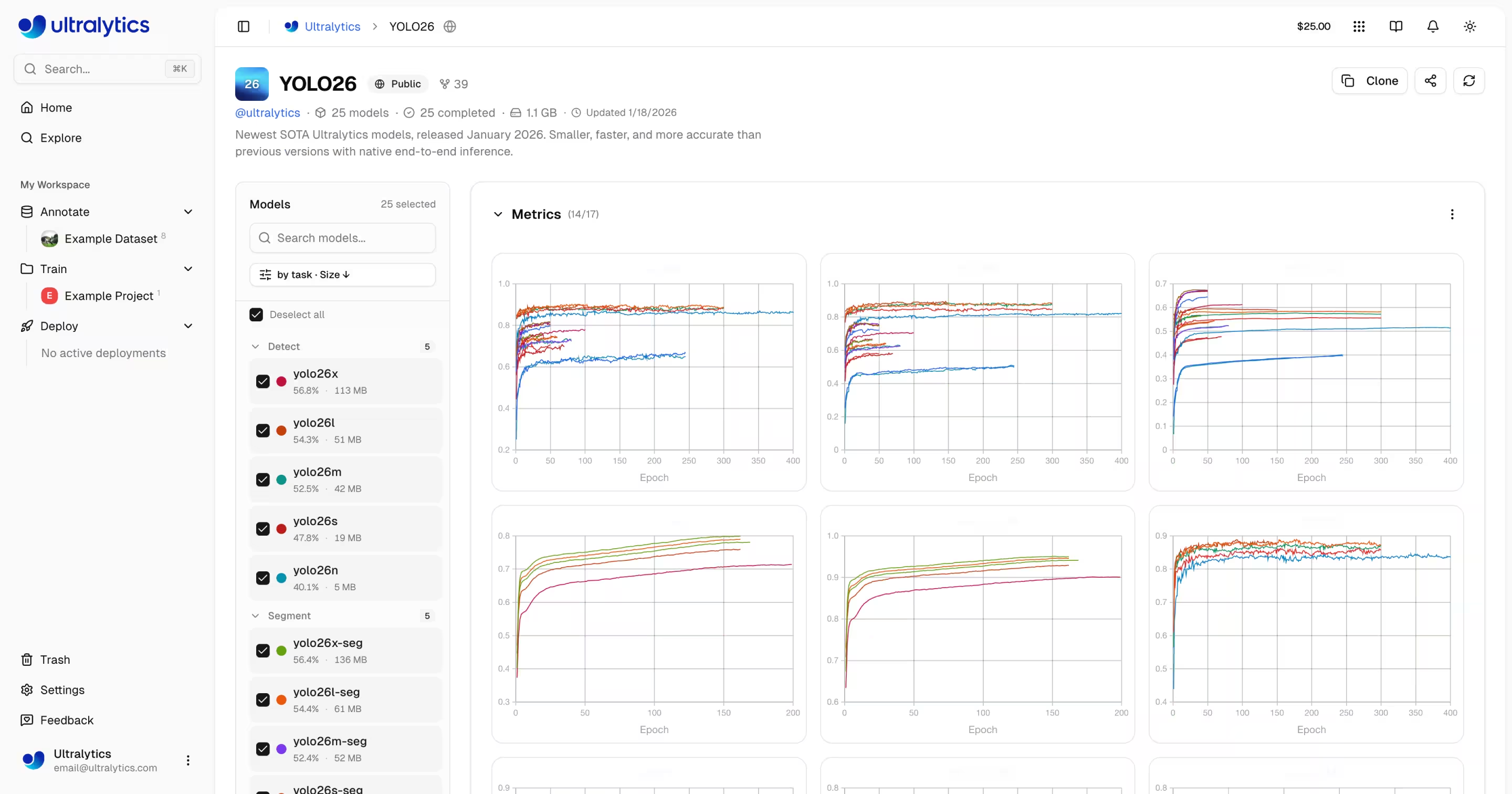
You can train models either through the web UI (cloud training) or from your own machine (remote training):
- Navigate to your project
- Click
Train Model - Select dataset, model, GPU, and epochs
- Monitor real-time loss curves and metrics
# Install ultralytics
pip install "ultralytics>=8.4.35"

# Set your API key
export ULTRALYTICS_API_KEY="YOUR_API_KEY"

# Train and stream metrics to the platform
yolo train model=yolo26n.pt data=coco.yaml epochs=100 project=username/my-project name=exp1
import os

from ultralytics import YOLO

os.environ["ULTRALYTICS_API_KEY"] = "YOUR_API_KEY"

model = YOLO("yolo26n.pt")
model.train(
    data="coco.yaml",
    epochs=100,
    project="username/my-project",
    name="exp1",
)
# Metrics stream to Platform automatically
Deployment
- Inference Testing: Test models directly in the browser with custom images
- Dedicated Endpoints: Deploy to 43 global regions with scale-to-zero behavior
- Monitoring: Real-time metrics, request logs, and performance dashboards
graph LR
    A[Trained Model] --> B{Action}
    B --> C[Browser Predict]
    B --> D[Export Format]
    B --> E[Deploy Endpoint]
    D --> F[ONNX / TensorRT / CoreML / TFLite / ...]
    E --> G[43 Global Regions]
    G --> H[API Endpoint URL]
    H --> I[Monitor & Scale]
Once deployed, call your endpoint from any language:
import requests

url = "https://your-endpoint-url/predict"
headers = {"Authorization": "Bearer YOUR_API_KEY"}

with open("image.jpg", "rb") as f:
    response = requests.post(url, headers=headers, files={"file": f})

print(response.json())
curl -X POST "https://your-endpoint-url/predict" \
  -H "Authorization: Bearer YOUR_API_KEY" \
  -F "file=@image.jpg"
const form = new FormData();
form.append("file", fileInput.files[0]);

const response = await fetch("https://your-endpoint-url/predict", {
    method: "POST",
    headers: { Authorization: "Bearer YOUR_API_KEY" },
    body: form,
});

const results = await response.json();
console.log(results);
Account Management
- Teams & Organizations: Collaborate with team members, manage roles and invites
- API Keys: Secure key management for remote training and API access
- Credits & Billing: Pay-as-you-go training with transparent pricing
- Activity Feed: Track all account events and actions
- Trash & Restore: 30-day soft delete with item recovery
- GDPR Compliance: Data export and account deletion
Plan Tiers
| Feature | Free | Pro ($29/mo) | Enterprise |
|---|---|---|---|
| Signup Credit | $5 / $25* | - | Custom |
| Monthly Credit | - | $30/seat/month | Custom |
| Models | 100 | 500 | Unlimited |
| Concurrent Trainings | 3 | 10 | Unlimited |
| Deployments | 3 | 10 | Unlimited |
| Storage | 100 GB | 500 GB | Unlimited |
| Cloud GPU Types | 20 | 23 (incl. H200/B200) | 23 |
| Teams | - | Up to 5 members | Up to 50 |
| Support | Community | Priority | Dedicated |
*$5 at signup, or $25 with a verified company/work email.
Quick Links
Get started with these resources:
- Quickstart: Create your first project and train a model in minutes
- Datasets: Upload and manage your training data
- Annotation: Label your data with manual and AI-assisted tools
- Projects: Organize your models and experiments
- Cloud Training: Train on cloud GPUs
- Inference: Test your models
- Endpoints: Deploy models to production
- Monitoring: Track deployment performance
- API Keys: Manage API access
- Billing: Credits and payment
- Activity: Track account events
- Trash: Recover deleted items
- REST API: API reference
FAQ
How do I get started with Ultralytics Platform?
To get started with Ultralytics Platform:
- Sign Up: Create an account at platform.ultralytics.com
- Select Region: Choose your data region (US, EU, or AP) during onboarding
- Upload Dataset: Navigate to the Datasets section to upload your data
- Train Model: Create a project and start training on cloud GPUs
- Deploy: Test your model and deploy to a dedicated endpoint
For a detailed guide, see the Quickstart page.
What are the benefits of Ultralytics Platform?
Ultralytics Platform offers:
- Unified Workflow: Data, training, and deployment in one place
- Multi-Region: Data residency in US, EU, or AP regions
- No-Code Training: Train advanced YOLO models without writing code
- Real-Time Metrics: Stream training progress and monitor deployments
- 43 Deploy Regions: Deploy models close to your users worldwide
- 5 Task Types: Support for detection, segmentation, pose, OBB, and classification (see task docs)
- AI-Assisted Annotation: Smart annotation with SAM and YOLO models to speed up data preparation
What GPU options are available for cloud training?
Ultralytics Platform supports multiple GPU types for cloud training:
| GPU | Generation | VRAM | Cost/Hour | Best For |
|---|---|---|---|---|
| RTX 2000 Ada | Ada | 16 GB | $0.24 | Small datasets, testing |
| RTX A4500 | Ampere | 20 GB | $0.25 | Small-medium datasets |
| RTX 4000 Ada | Ada | 20 GB | $0.26 | Medium datasets |
| RTX A5000 | Ampere | 24 GB | $0.27 | Medium datasets |
| L4 | Ada | 24 GB | $0.39 | Inference optimized |
| A40 | Ampere | 48 GB | $0.40 | Larger batch sizes |
| RTX 3090 | Ampere | 24 GB | $0.46 | General training |
| RTX A6000 | Ampere | 48 GB | $0.49 | Large models |
| RTX PRO 4500 | Blackwell | 32 GB | $0.54 | Great price/performance |
| RTX 4090 | Ada | 24 GB | $0.59 | Best price/performance |
| RTX 6000 Ada | Ada | 48 GB | $0.77 | Large batch training |
| L40S | Ada | 48 GB | $0.86 | Large batch training |
| RTX 5090 | Blackwell | 32 GB | $0.89 | Latest consumer generation |
| L40 | Ada | 48 GB | $0.99 | Large models |
| A100 PCIe | Ampere | 80 GB | $1.39 | Production training |
| A100 SXM | Ampere | 80 GB | $1.49 | Production training |
| RTX PRO 6000 | Blackwell | 96 GB | $1.69 | Recommended default |
| H100 PCIe | Hopper | 80 GB | $2.39 | High-performance training |
| H100 SXM | Hopper | 80 GB | $2.69 | Fastest training |
| H100 NVL | Hopper | 94 GB | $3.07 | Maximum performance |
| H200 NVL | Hopper | 143 GB | $3.39 | Maximum memory (Pro+) |
| H200 SXM | Hopper | 141 GB | $3.59 | Maximum performance (Pro+) |
| B200 | Blackwell | 180 GB | $4.99 | Largest models (Pro+) |
See Cloud Training for complete pricing and GPU options.
How does remote training work?
You can train models on your own hardware and stream real-time metrics to the platform, similar to Weights & Biases.
Package Version Requirement
Platform integration requires ultralytics>=8.4.35. Lower versions will NOT work with Platform.
pip install "ultralytics>=8.4.35"
# Set your API key
export ULTRALYTICS_API_KEY="YOUR_API_KEY"

# Train with project/name to stream metrics
yolo train model=yolo26n.pt data=coco.yaml epochs=100 project=username/my-project name=exp1
import os

from ultralytics import YOLO

os.environ["ULTRALYTICS_API_KEY"] = "YOUR_API_KEY"

model = YOLO("yolo26n.pt")
model.train(
    data="coco.yaml",
    epochs=100,
    project="username/my-project",
    name="exp1",
)
# Train using a Platform dataset directly
export ULTRALYTICS_API_KEY="YOUR_API_KEY"

yolo train model=yolo26n.pt data=ul://username/datasets/my-dataset epochs=100 project=username/my-project name=exp1
See Cloud Training for more details on remote training.
What annotation tools are available?
The Platform includes a full-featured annotation editor supporting:
- Manual Tools: Bounding boxes, polygons, keypoints with skeleton templates, oriented boxes, classification
- Skeleton Templates: Place all keypoints at once using built-in (Person, Hand, Face, Dog, Box) or custom templates
- Smart Annotation: Use SAM 2.1 or SAM 3 for click-based annotation, or run pretrained Ultralytics YOLO models and your own fine-tuned YOLO models from the toolbar for detect, segment, and OBB
- Keyboard Shortcuts: Efficient workflows with hotkeys
| Shortcut | Action |
|---|---|
V | Select mode |
S | SAM smart annotation mode |
A | Auto-annotate mode |
1 - 9 | Select class by number |
Delete | Delete selected annotation |
Ctrl+Z | Undo |
Ctrl+Y | Redo |
Escape | Cancel current action |
See Annotation for the complete guide.
What export formats are supported?
The Platform supports 17 deployment formats:
| Format | File Extension | Use Case |
|---|---|---|
| ONNX | .onnx | Cross-platform deployment |
| TorchScript | .torchscript | C++ deployment |
| OpenVINO | _openvino_model | Intel hardware |
| TensorRT | .engine | NVIDIA GPU inference |
| CoreML | .mlpackage | Apple devices |
| TFLite | .tflite | Mobile/edge devices |
| TF SavedModel | _saved_model | TensorFlow ecosystem |
| TF GraphDef | .pb | TensorFlow legacy |
| PaddlePaddle | _paddle_model | Baidu ecosystem |
| NCNN | _ncnn_model | Mobile (Android/ARM) |
| Edge TPU | _edgetpu.tflite | Google Coral devices |
| TF.js | _web_model | Browser deployment |
| MNN | .mnn | Alibaba mobile |
| RKNN | _rknn_model | Rockchip NPU |
| IMX500 | _imx_model | Sony IMX500 sensor |
| Axelera | _axelera_model | Axelera AI accelerators |
| ExecuTorch | _executorch_model | PyTorch mobile |
See Models Export, the Export mode guide, and the Integrations index for format-specific options.
Troubleshooting
Dataset Issues
| Problem | Solution |
|---|---|
| Dataset won't process | Check file format is supported (JPEG, PNG, WebP, etc.). Max file size: images 50MB, videos 1GB, datasets 10GB on Free / 20GB on Pro / 50GB on Enterprise |
| Missing annotations | Verify labels are in YOLO format with .txt files matching image filenames |
| "Train split required" | Add train/ folder to your dataset structure, or create splits in dataset settings |
| Class names undefined | Add a data.yaml file with names: list (see YOLO format), or define classes in dataset settings |
Training Issues
| Problem | Solution |
|---|---|
| Training won't start | Check credit balance in Settings > Billing. Positive balance required |
| Out of memory error | Reduce batch size, use smaller model (n/s), or select GPU with more VRAM |
| Poor metrics | Check dataset quality, increase epochs, try data augmentation, verify class balance |
| Training slow | Select faster GPU, reduce image size, check dataset isn't bottlenecked |
Deployment Issues
| Problem | Solution |
|---|---|
| Endpoint not responding | Check endpoint status (Ready vs Stopped). Cold start may take 5-15 seconds |
| 401 Unauthorized | Verify API key is correct and has required scopes |
| Slow inference | Check model size, consider TensorRT export, select closer region |
| Export failed | Some formats require specific model architectures. Try ONNX for broadest compatibility |
Common Questions
Can I change my username after signup?
No, usernames are permanent and cannot be changed. Choose carefully during signup.
Can I change my data region?
No, data region is selected during signup and cannot be changed. To switch regions, create a new account and re-upload your data.
How do I get more credits?
Go to Settings > Billing > Add Credits. Purchase credits from $5 to $1000. Purchased credits never expire.
What happens if training fails?
You're only charged for completed compute time. Checkpoints are saved, and you can resume training.
Can I download my trained model?
Yes, click the download icon on any model page to download the .pt file or exported formats.
How do I share my work publicly?
Edit your project or dataset settings and toggle visibility to "Public". Public content appears on the Explore page.
What are the file size limits?
Images: 50MB, Videos: 1GB, datasets: 10GB on Free, 20GB on Pro, 50GB on Enterprise. For larger files, split into multiple uploads.
How long are deleted items kept in Trash?
30 days. After that, items are permanently deleted and cannot be recovered.
Can I use Platform models commercially?
Free and Pro plans use the AGPL license. For commercial use without AGPL requirements, see Ultralytics Licensing.


