Esportazione di modelli TFLite per la distribuzione (deprecata)
A partire da Ultralytics 8.4.83, il formato di esportazione autonomo tflite è stato deprecato e sostituito dal formato unificato Google LiteRT. LiteRT (Lite Runtime) è la nuova generazione e il nuovo nome di TensorFlow Lite, ed esporta lo stesso modello .tflite, che ora supporta la distribuzione su dispositivi mobili, embedded, edge e browser in un unico formato.
format="tflite" continua a funzionare, ma genera un avviso di deprecazione ed esporta invece un modello LiteRT. D'ora in poi usa format="litert"; per le istruzioni e le opzioni di esportazione aggiornate, consulta la guida all'esportazione LiteRT.

La distribuzione di modelli di visione artificiale su dispositivi edge o embedded richiede un formato progettato per un'inferenza efficiente sul dispositivo.
Il precedente formato di esportazione TensorFlow Lite o TFLite ottimizzava i modelli Ultralytics YOLO26 per attività come il rilevamento degli oggetti e la classificazione delle immagini nelle applicazioni edge. Questa guida mantiene il contesto legacy della distribuzione TFLite; per le nuove esportazioni, usa LiteRT.
Perché si usava TFLite per l'esportazione?#
Introdotto da Google nel maggio 2017 nell'ambito del framework TensorFlow, TensorFlow Lite, o TFLite in breve, era un framework open source di deep learning progettato per l'inferenza sul dispositivo, nota anche come edge computing. Forniva agli sviluppatori strumenti per eseguire modelli addestrati su dispositivi mobili, embedded e IoT, oltre che sui computer tradizionali.
TensorFlow Lite supportava un'ampia gamma di piattaforme, tra cui Linux embedded, Android, iOS e microcontrollori (MCU). Le esportazioni TFLite permettevano alle applicazioni di eseguire modelli in locale e offline.
Funzionalità principali dei modelli TFLite#
I modelli TFLite offrono numerose funzionalità che consentono il machine learning sul dispositivo, aiutando gli sviluppatori a eseguire i propri modelli su dispositivi mobili, embedded ed edge:
-
Ottimizzazione sul dispositivo: TFLite è ottimizzato per il machine learning sul dispositivo; riduce la latenza elaborando i dati localmente, migliora la privacy evitando di trasmettere dati personali e riduce al minimo le dimensioni del modello per risparmiare spazio.
-
Supporto per più piattaforme: TFLite offre un'ampia compatibilità con le piattaforme, supportando Android, iOS, Linux embedded e microcontrollori.
-
Supporto per diversi linguaggi: TFLite è compatibile con vari linguaggi di programmazione, tra cui Java, Swift, Objective-C, C++ e Python.
-
Prestazioni elevate: usa l'accelerazione hardware e l'ottimizzazione dei modelli per un'inferenza rapida.
Prestazioni misurate (dati storici)#
Questi risultati sono stati registrati con il plugin Flutter di Ultralytics 0.6.8 e LiteRT 2.1.5 su Android 16/API 36 su uno Xiaomi 17 con 12 GB di memoria LPDDR5X. Il suo Snapdragon 8 Elite Gen 5 a 3 nm (SM8850) integra una CPU Qualcomm Oryon a 8 core (2 core Prime fino a 4,6 GHz e 6 core Performance fino a 3,62 GHz), una GPU Adreno e una NPU Hexagon. Queste tabelle confrontano gli asset TFLite INT8 legacy generati con onnx2tf con le esportazioni litert-torch candidate valutate durante la migrazione. Gli asset di rilascio sono stati successivamente sovrascritti con le esportazioni standardizzate, quindi questi numeri non descrivono i byte attuali dell'asset v0.7.0. Consulta le tabelle delle prestazioni LiteRT per le misurazioni aggiornate.
Entrambi i formati sono stati eseguiti nella stessa sessione di test GPU consecutiva alle dimensioni di input indicate. Ogni cella riporta il tempo totale (pre-elaborazione + inferenza + post-elaborazione), con la suddivisione per fase sotto il totale; i log nativi hanno confermato che entrambi i formati hanno delegato l'intero grafo a LiteRT OpenCL (LITERT_CL) sulla GPU Adreno.
| Modello | Attività | dimensione (pixel) | Legacy TFLite INT8 onnx2tf (ms) | Candidato LiteRT w8a32 (ms) |
|---|---|---|---|---|
| YOLO26n | Rilevamento | 640 | 14.0 1.8 / 8.1 / 4.2 | 13.5 1.9 / 8.1 / 3.5 |
| YOLO26n-seg | Segmentazione | 640 | 30.1 1.9 / 20.3 / 8.0 | 28.6 1.8 / 20.1 / 6.7 |
| YOLO26n-sem | Semantica | 640 | 26.4 1.9 / 16.4 / 8.1 | 32.9 1.8 / 23.0 / 8.2 |
| YOLO26n-cls | Classificazione | 224 | 3.5 0.9 / 2.2 / 0.4 | 3.2 1.0 / 2.2 / 0.1 |
| YOLO26n-pose | Posa | 640 | 17.4 2.4 / 9.9 / 5.1 | 14.0 1.9 / 9.3 / 2.8 |
| YOLO26n-obb | OBB | 640 | 13.9 3.0 / 8.3 / 2.7 | 13.0 2.9 / 7.9 / 2.3 |
La stessa sessione di migrazione ha confrontato anche i formati di quantizzazione per il rilevamento con YOLO26n. L'inferenza è la metrica confrontabile e dipendente dal formato:
| Formato Android | Inferenza GPU (ms) | Compilazione GPU |
|---|---|---|
| onnx2tf INT8 (TFLite legacy) | 8.6 | sì |
| LiteRT w8a32 (candidato) | 8.4 | sì |
LiteRT INT8 (quantize=8) | 11.0 | sì |
| LiteRT FP32 | 8.8 | sì |
LiteRT w8a16 (quantize="w8a16") | Fallback CPU | no |
In questa sessione, w8a16 è passato alla CPU, impiegando circa 660 ms in totale contro circa 17 ms per i formati GPU. Questi risultati hanno motivato la distribuzione di w8a32, ma la compatibilità con il delegate e le prestazioni dipendono dal dispositivo e dalla versione del runtime. Esegui benchmark sul dispositivo di destinazione e verifica nei log del runtime l'uso dell'acceleratore.
Opzioni di distribuzione con TFLite#
Prima dell'esempio di esportazione che usa la sostituzione LiteRT, ecco come vengono solitamente usati i modelli TFLite.
TFLite offre diverse opzioni per distribuire modelli di machine learning sui dispositivi, tra cui:
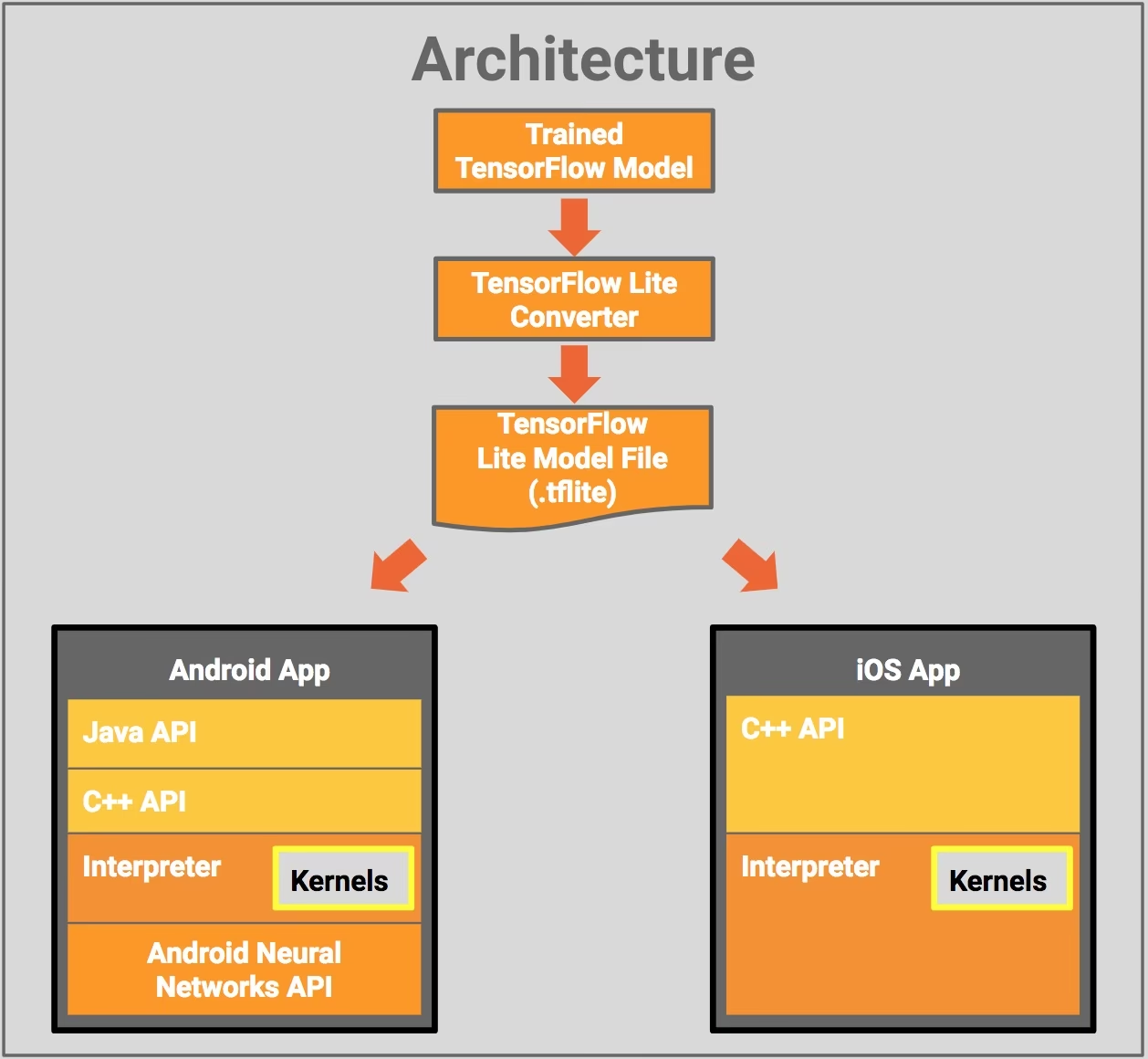
- Distribuzione su Android e iOS: le applicazioni Android e iOS con TFLite possono analizzare i flussi delle fotocamere e i sensori edge per rilevare e identificare oggetti. TFLite offre anche librerie native per iOS scritte in Swift e Objective-C. Il diagramma dell'architettura qui sotto mostra il processo di distribuzione di un modello addestrato sulle piattaforme Android e iOS con TensorFlow Lite.
-
Implementazione con Linux embedded: se l'esecuzione dell'inferenza su un Raspberry Pi non soddisfa i requisiti di velocità del tuo caso d'uso, puoi usare un modello TFLite esportato per accelerare l'inferenza. Inoltre, puoi migliorare ulteriormente le prestazioni usando un dispositivo Coral Edge TPU.
-
Distribuzione su microcontrollori: i modelli TFLite possono essere distribuiti anche su microcontrollori e altri dispositivi con pochi kilobyte di memoria. Il runtime principale occupa appena 16 KB su un Arm Cortex M3 e può eseguire molti modelli di base. Non richiede il supporto di un sistema operativo, librerie standard C o C++ né allocazione dinamica della memoria.
Sostituisci l'esportazione TFLite con LiteRT#
Per le nuove esportazioni, converti il tuo modello in LiteRT. Il modello risultante mantiene l'estensione di file .tflite.
Installazione#
Per installare i pacchetti necessari, esegui:
# Install the required package for YOLO26
pip install ultralytics
Per istruzioni dettagliate e best practice sulla procedura di installazione, consulta la nostra guida all'installazione di Ultralytics. Se durante l'installazione dei pacchetti necessari per YOLO26 riscontri difficoltà, consulta la nostra guida ai problemi comuni per trovare soluzioni e suggerimenti.
Utilizzo#
Tutti i modelli Ultralytics YOLO26 sono progettati per supportare l'esportazione senza configurazioni aggiuntive, semplificando l'integrazione nel workflow di distribuzione che preferisci. Puoi consultare l'elenco completo dei formati di esportazione supportati e delle opzioni di configurazione per scegliere la configurazione più adatta alla tua applicazione.
Il formato LiteRT sostitutivo supporta le modalità Export, Predict e Validate. Esporta il modello, quindi carica il modello .tflite esportato per eseguire inferenze o convalidarne l'accuratezza.
from ultralytics import YOLO

# Carica un modello YOLO26
model = YOLO("yolo26n.pt")

# Esporta il modello nel formato LiteRT
model.export(format="litert", imgsz=640) # usa imgsz=224 per la classificazionefrom ultralytics import YOLO
# Carica il modello TFLite esportato
model = YOLO("yolo26n.tflite")
# Esegui l'inferenza
results = model("https://ultralytics.com/images/bus.jpg")from ultralytics import YOLO
# Carica il modello TFLite esportato
model = YOLO("yolo26n.tflite")
# # Convalida l'accuratezza sul dataset COCO8
metrics = model.val(data="coco8.yaml")Argomenti di esportazione#
Consulta gli argomenti di esportazione LiteRT. Per maggiori dettagli sul processo di esportazione, visita la pagina della documentazione Ultralytics dedicata all'esportazione.
Distribuzione di modelli YOLO26 TFLite esportati#
Dopo aver esportato il tuo modello Ultralytics YOLO26 nel formato LiteRT, puoi distribuire il modello .tflite risultante. Il primo passaggio principale e consigliato per eseguire un modello TFLite consiste nell'usare il metodo YOLO("model.tflite"), come illustrato nello snippet di codice d'uso precedente. Per istruzioni dettagliate sulla distribuzione dei modelli TFLite in altri contesti, consulta le seguenti risorse:
-
Android: una guida rapida per integrare TensorFlow Lite nelle applicazioni Android, con passaggi semplici da seguire per configurare ed eseguire modelli di machine learning.
-
iOS: una guida per sviluppatori sull'integrazione e la distribuzione di modelli TensorFlow Lite nelle applicazioni iOS, con istruzioni dettagliate e risorse.
-
Esempi end-to-end: questa pagina offre una panoramica di vari esempi di TensorFlow Lite, presentando applicazioni pratiche e tutorial pensati per aiutare gli sviluppatori a implementare TensorFlow Lite nei progetti di machine learning per dispositivi mobili ed edge.
Riepilogo#
Questa guida mantiene il flusso di lavoro legacy per la distribuzione TFLite. Per le nuove esportazioni, usa LiteRT per creare modelli .tflite destinati agli ambienti di edge computing.
Per ulteriori dettagli sull'utilizzo, consulta la documentazione ufficiale di TFLite.
Domande frequenti#
Per una nuova esportazione, usa il formato LiteRT. Per prima cosa, installa il pacchetto richiesto con:
pip install ultralyticsPoi, usa il seguente frammento di codice per esportare il modello:
from ultralytics import YOLO

# Carica un modello YOLO26
model = YOLO("yolo26n.pt")

# Esporta il modello nel formato LiteRT
model.export(format="litert", imgsz=640)  # usa imgsz=224 per la classificazione
Se usi la CLI, puoi farlo con:
yolo export model=yolo26n.pt format=litert imgsz=640 # use imgsz=224 for classificationPer ulteriori dettagli, visita la guida all'esportazione di Ultralytics.
TensorFlow Lite (TFLite) è un framework open source di deep learning progettato per l'inferenza sul dispositivo, ideale per distribuire modelli YOLO26 su dispositivi mobili, embedded e IoT. Tra i principali vantaggi:
- Ottimizzazione sul dispositivo: riduci al minimo la latenza e migliora la privacy elaborando i dati in locale.
- Compatibilità con le piattaforme: supporta Android, iOS, Linux embedded e MCU.
- Prestazioni: usa l'accelerazione hardware per ottimizzare velocità ed efficienza del modello.
Per saperne di più, consulta la guida TFLite.
Sì, puoi eseguire modelli YOLO26 TFLite su Raspberry Pi per migliorare la velocità di inferenza. Per prima cosa, esporta il modello nel formato LiteRT come spiegato sopra. Poi esegui il modello
.tflitesul tuo Raspberry Pi conYOLO("yolo26n.tflite")o con l'interprete LiteRT.Un Coral Edge TPU può accelerare ulteriormente l'inferenza.
TFLite supporta la distribuzione su microcontrollori con risorse limitate: il runtime principale richiede solo 16 KB di memoria su un Arm Cortex M3 e può eseguire molti modelli di base. Tuttavia, i modelli YOLO26 sono generalmente troppo grandi per la memoria disponibile nei microcontrollori tipici; per YOLO26 sono quindi più adatti computer a scheda singola, dispositivi mobili o acceleratori dedicati.
Per iniziare, consulta la guida TFLite Micro per microcontrollori.
TensorFlow Lite offre un'ampia compatibilità con le piattaforme, consentendo di distribuire modelli YOLO26 su numerosi dispositivi, tra cui:
- Android e iOS: supporto nativo tramite le librerie TFLite per Android e iOS.
- Linux embedded: ideale per computer a scheda singola come Raspberry Pi.
- Microcontrollori: adatti agli MCU con risorse limitate.
Per ulteriori informazioni sulle opzioni di distribuzione, consulta la nostra guida dettagliata alla distribuzione.
Se riscontri errori durante l'esportazione di modelli YOLO26 in LiteRT, ecco alcune soluzioni comuni:
- Verifica la compatibilità dei pacchetti: assicurati di usare versioni compatibili di Ultralytics,
litert-torcheai-edge-litert. Consulta la nostra guida all'installazione. - Supporto del modello: verifica che il modello YOLO26 specifico supporti l'esportazione LiteRT consultando la pagina della documentazione sull'esportazione di Ultralytics.
- Problemi di quantizzazione: quando usi la quantizzazione INT8, assicurati di specificare correttamente il percorso del dataset nel parametro
data.
Per altri suggerimenti sulla risoluzione dei problemi, visita la nostra guida ai problemi comuni.
- Verifica la compatibilità dei pacchetti: assicurati di usare versioni compatibili di Ultralytics,


Commenti115
Fai una domanda, condividi i tuoi risultati o aiuta qualcun altro.
saleha-fatima(modificato)
hi there @glenn-jocher I am trying to convert the the yolov10 model to int8 with tflite format. but same error is occurring again and again. I've tried the solutions described in this thread but nothing seems to work. I am using this for conversion:
` from ultralytics import YOLO
model = YOLO("current_best4.pt")
model.export(format="tflite", int8=True, data='./datasets/data.yaml', imgsz=640) # creates 'yolov8n_float32.tflite'
tflite_model = YOLO("yolov8n_int8.tflite")
results = tflite_model("./frame_365.jpg")
results.show() `
and the error i am receiving is this:
ValueError: Exception encountered when calling layer "tf.math.add_5" (type TFOpLambda).
Dimensions must be equal, but are 32 and 16 for '{{node tf.math.add_5/Add}} = AddV2 [T=DT_FLOAT](Placeholder, Placeholder_1)' with input shapes: [1,80,160,32], [1,80,160,16].
Call arguments received by layer "tf.math.add_5" (type TFOpLambda): • x=tf.Tensor(shape=(1, 80, 160, 32), dtype=float32) • y=tf.Tensor(shape=(1, 80, 160, 16), dtype=float32) • name='/model.2/m.0/Add'
ERROR: input_onnx_file_path: weights/yolov10n.onnx ERROR: onnx_op_name: /model.2/m.0/Add ERROR: Read this and deal with it. https://github.com/PINTO0309/onnx2tf#parameter-replacement ERROR: Alternatively, if the input OP has a dynamic dimension, use the -b or -ois option to rewrite it to a static shape and try again. ERROR: If the input OP of ONNX before conversion is NHWC or an irregular channel arrangement other than NCHW, use the -kt or -kat option. ERROR: Also, for models that include NonMaxSuppression in the post-processing, try the -onwdt option. `
i
I have approx 5k images for calibration, so thats not the issue, all the packages are upto date as well. can you please suggest what solution should i opt for?
1 Glenn JocherUltralytics(modificato)
@saleha-fatima the error appears to be related to shape mismatches during ONNX to TFLite conversion. Please ensure that your model, dataset, and TensorFlow versions are fully compatible. Refer to the onnx2tf parameter replacement guide for addressing this issue. Additionally, try exporting with
int8=Falsefirst to confirm the issue is specific to quantization. If the problem persists, please share more details about your environment or test with the latest Ultralytics version.Note: Since Ultralytics 8.4.83,
format="tflite"is deprecated and exports through LiteRT (litert-torch) instead of onnx2tf and TensorFlow. Runpip install -U ultralyticsand export withformat="litert"(see the LiteRT guide).I've tried with
int8=False, but the problem persists. this is the info related to my model, packages and dataset so i am using yolov10 model fro conversion purposes coco dataset python version=3.9.12 packages:torch==2.0.1 torchvision==0.15.2 onnx==1.17.0 onnxruntime==1.15.1 pycocotools==2.0.7 PyYAML==6.0.1 scipy==1.13.0 onnxslim==0.1.31 onnxruntime-gpu==1.18.0 gradio==4.31.5 opencv-python==4.9.0.80 psutil==5.9.8 py-cpuinfo==9.0.0 huggingface-hub==0.23.2 safetensors==0.4.3 ultralytics==8.3.69 onnx2tf==1.20.0 onnxruntime==1.15.1 tensorflow==2.18.0
I have alse tried the suggestions mentioned in error msg but nothing seems to work!
- Glenn JocherUltralytics(modificato)
This was a compatibility issue between YOLOv10's architecture and the old ONNX->TFLite (onnx2tf) conversion path. Since Ultralytics 8.4.83,
format="tflite"is deprecated and exports through LiteRT (litert-torch) instead of onnx2tf and TensorFlow, so those version pins no longer apply. Runpip install -U ultralyticsand export withformat="litert"(see the LiteRT guide). nicola-321
hi there @glenn-jocher I am trying to convert the the yolov10 model to int8 with tflite format. but same error is occurring again and again. I've tried the solutions described in this thread but nothing seems to work. I am using this for conversion:
` from ultralytics import YOLO
model = YOLO("current_best4.pt")
model.export(format="tflite", int8=True, data='./datasets/data.yaml', imgsz=640) # creates 'yolov8n_float32.tflite'
tflite_model = YOLO("yolov8n_int8.tflite")
results = tflite_model("./frame_365.jpg")
results.show() `
and the error i am receiving is this:
ERROR: The trace log is below. Traceback (most recent call last): File "/mnt/drive/rev9ai/anaconda3/envs/int8_test/lib/python3.9/site-packages/onnx2tf/utils/common_functions.py", line 310, in print_wrapper_func result = func(*args, **kwargs) File "/mnt/drive/rev9ai/anaconda3/envs/int8_test/lib/python3.9/site-packages/onnx2tf/utils/common_functions.py", line 383, in inverted_operation_enable_disable_wrapper_func result = func(*args, **kwargs) File "/mnt/drive/rev9ai/anaconda3/envs/int8_test/lib/python3.9/site-packages/onnx2tf/utils/common_functions.py", line 53, in get_replacement_parameter_wrapper_func func(*args, **kwargs) File "/mnt/drive/rev9ai/anaconda3/envs/int8_test/lib/python3.9/site-packages/onnx2tf/ops/Add.py", line 248, in make_node merge_two_consecutive_identical_ops_into_one( File "/mnt/drive/rev9ai/anaconda3/envs/int8_test/lib/python3.9/site-packages/onnx2tf/utils/common_functions.py", line 5384, in merge_two_consecutive_identical_ops_into_one tf.math.add( File "/mnt/drive/rev9ai/anaconda3/envs/int8_test/lib/python3.9/site-packages/tensorflow/python/ops/weak_tensor_ops.py", line 142, in wrapper return op(*args, **kwargs) File "/mnt/drive/rev9ai/anaconda3/envs/int8_test/lib/python3.9/site-packages/tensorflow/python/util/traceback_utils.py", line 153, in error_handler raise e.with_traceback(filtered_tb) from None File "/mnt/drive/rev9ai/anaconda3/envs/int8_test/lib/python3.9/site-packages/tf_keras/src/layers/core/tf_op_layer.py", line 119, in handle return TFOpLambda(op)(*args, **kwargs) File "/mnt/drive/rev9ai/anaconda3/envs/int8_test/lib/python3.9/site-packages/tf_keras/src/utils/traceback_utils.py", line 70, in error_handler raise e.with_traceback(filtered_tb) from None ValueError: Exception encountered when calling layer "tf.math.add_5" (type TFOpLambda). Dimensions must be equal, but are 32 and 16 for '{{node tf.math.add_5/Add}} = AddV2 [T=DT_FLOAT](Placeholder, Placeholder_1)' with input shapes: [1,80,160,32], [1,80,160,16]. Call arguments received by layer "tf.math.add_5" (type TFOpLambda): • x=tf.Tensor(shape=(1, 80, 160, 32), dtype=float32) • y=tf.Tensor(shape=(1, 80, 160, 16), dtype=float32) • name='/model.2/m.0/Add' ERROR: input_onnx_file_path: weights/yolov10n.onnx ERROR: onnx_op_name: /model.2/m.0/Add ERROR: Read this and deal with it. https://github.com/PINTO0309/onnx2tf#parameter-replacement ERROR: Alternatively, if the input OP has a dynamic dimension, use the -b or -ois option to rewrite it to a static shape and try again. ERROR: If the input OP of ONNX before conversion is NHWC or an irregular channel arrangement other than NCHW, use the -kt or -kat option. ERROR: Also, for models that include NonMaxSuppression in the post-processing, try the -onwdt option.i
I have approx 5k images for calibration, so thats not the issue, all the packages are upto date as well. can you please suggest what solution should i opt for?
I've got the same error when covert yolov8 to tflite. Have you fix it?
- Glenn JocherUltralytics(modificato)
For YOLOv10 TFLite conversion issues in the old onnx2tf path: Since Ultralytics 8.4.83,
format="tflite"is deprecated and exports through LiteRT (litert-torch) instead of onnx2tf and TensorFlow, so those version pins no longer apply. Runpip install -U ultralyticsand export withformat="litert"(see the LiteRT guide). If errors persist, share the full export log. Thanks for your advice. I've tried to Update dependencies and Export with dynamic axes , but unfortunately, a new issue is as below:
AssertionError: ERROR ❌️ argument 'dynamic' is not supported for format='tflite'
If I only update dependencies and delete the dynamic axes , the issue is as before:
ValueError: Exception encountered when calling layer "tf.math.add_5" (type TFOpLambda).
Dimensions must be equal, but are 32 and 16 for '{{node tf.math.add_5/Add}} = AddV2 [T=DT_FLOAT](Placeholder, Placeholder_1)' with input shapes: [1,80,160,32], [1,80,160,16].
Call arguments received by layer "tf.math.add_5" (type TFOpLambda): • x=tf.Tensor(shape=(1, 80, 160, 32), dtype=float32) • y=tf.Tensor(shape=(1, 80, 160, 16), dtype=float32) • name='/model.2/m.0/Add'
I've got the same error when covert yolov8 to tflite. Have you fix it?
hi there, yes i fixed this issue. but it then resulted into new error saying "end2end model format conversion is not supported". btw i resolved that issue by using the following versions of dependencies: torch 2.6.0 tensorflow 2.15.1 onnx2tf 1.20.0
try this but if you are looking for direct export of the model to int8 with tflite. then according to my research
exportcommand does not work. atleast it didnt work for yolov10 model. for that i converted the .pt model to IR form (onnx) then further conversion. but if your concern is just to convert model to tflite with fp16/32 quantization. i would suggest to use command line prompt for conversion. for some reasons it works!yolo export model=runs/detect/train2/weights/best.pt format=tflite half=False simplify opset=13 workspace=16- Glenn JocherUltralytics(modificato)
@saleha-fatima thanks for sharing your solution! Since Ultralytics 8.4.83,
format="tflite"is deprecated and exports through LiteRT (litert-torch) instead of onnx2tf and TensorFlow. Runpip install -U ultralyticsand export withformat="litert"(see the LiteRT guide). Thedynamicargument is not supported for LiteRT export. I've got the same error when covert yolov8 to tflite. Have you fix it?
hi there, yes i fixed this issue. but it then resulted into new error saying "end2end model format conversion is not supported". btw i resolved that issue by using the following versions of dependencies: torch 2.6.0 tensorflow 2.15.1 onnx2tf 1.20.0
try this but if you are looking for direct export of the model to int8 with tflite. then according to my research
exportcommand does not work. atleast it didnt work for yolov10 model. for that i converted the .pt model to IR form (onnx) then further conversion. but if your concern is just to convert model to tflite with fp16/32 quantization. i would suggest to use command line prompt for conversion. for some reasons it works!yolo export model=runs/detect/train2/weights/best.pt format=tflite half=False simplify opset=13 workspace=16Thank you for your reply,. I've tried to update the dependencies or use the CLI but error persists. so I tried to convert the model step by step . It can be converted to onnx but when converting to tf. An new error occurs as below. It seems like the dependency conflict :
https://github.com/tensorflow/addons warnings.warn( Traceback (most recent call last): File "/workspace/user_code/model/convertModel/onnx-tensorflow/example/onnx_to_tf.py", line 3, in from onnx_tf.backend import prepare File "/workspace/user_code/model/convertModel/onnx-tensorflow/onnx_tf/init.py", line 1, in from . import backend File "/workspace/user_code/model/convertModel/onnx-tensorflow/onnx_tf/backend.py", line 28, in from onnx_tf.common.handler_helper import get_all_backend_handlers File "/workspace/user_code/model/convertModel/onnx-tensorflow/onnx_tf/common/handler_helper.py", line 3, in from onnx_tf.handlers.backend import * # noqa File "/workspace/user_code/model/convertModel/onnx-tensorflow/onnx_tf/handlers/backend/hardmax.py", line 3, in import tensorflow_addons as tfa File "/workspace/user_code/model/convertModel/myenv3.10/lib/python3.10/site-packages/tensorflow_addons/init.py", line 23, in from tensorflow_addons import activations File "/workspace/user_code/model/convertModel/myenv3.10/lib/python3.10/site-packages/tensorflow_addons/activations/init.py", line 17, in from tensorflow_addons.activations.gelu import gelu File "/workspace/user_code/model/convertModel/myenv3.10/lib/python3.10/site-packages/tensorflow_addons/activations/gelu.py", line 19, in from tensorflow_addons.utils.types import TensorLike File "/workspace/user_code/model/convertModel/myenv3.10/lib/python3.10/site-packages/tensorflow_addons/utils/types.py", line 29, in from keras.src.engine import keras_tensor ModuleNotFoundError: No module named 'keras.src.engine'
and if I use
!pip install 'keras<3.0.0' mediapipe-model-makerto fix the error from https://github.com/google-ai-edge/mediapipe/issues/5229 then it will leading to the issue as below:ImportError: This version of TensorFlow Probability requires TensorFlow version >= 2.18; Detected an installation of version 2.15.1. Please upgrade TensorFlow to proceed.
It seems like that keras<3.0.0 and TensorFlow version >= 2.18 is conflict
Hi, so i tested it on my end again and it worked. I would recommend you to create a new env and then just go for installing updated "ultralytics" package using
pip install ultralyticsnow without installing anything else just run this CLI export command:yolo export model=runs/detect/train2/weights/best.pt format=tflite half=False simplify opset=13 workspace=16It will install all the supported requirements itself. I have tested it, i am sure it will work for u as well. Do update me on this!
- Glenn JocherUltralytics(modificato)
Thanks for sharing your findings. For TFLite conversion issues, create a fresh environment and let Ultralytics install what it needs when you export. Since Ultralytics 8.4.83,
format="tflite"is deprecated and exports through LiteRT (litert-torch) instead of onnx2tf and TensorFlow, so those version pins no longer apply. Runpip install -U ultralyticsand export withformat="litert"(see the LiteRT guide). If issues persist, please share your environment details fromyolo checks. Hi, so i tested it on my end again and it worked. I would recommend you to create a new env and then just go for installing updated "ultralytics" package using
pip install ultralyticsnow without installing anything else just run this CLI export command:yolo export model=runs/detect/train2/weights/best.pt format=tflite half=False simplify opset=13 workspace=16It will install all the supported requirements itself. I have tested it, i am sure it will work for u as well. Do update me on this!
Hi, thanks for your sharing!Congratulate that you fix it ! but seems that it does's work in my env. I have create a new env . only "pip install ultralytics" , loading the yolov11. and my python packages is as below: `Package Version
absl-py 2.1.0 astunparse 1.6.3 cachetools 5.5.2 certifi 2025.1.31 cffi 1.17.1 charset-normalizer 3.4.1 coloredlogs 15.0.1 contourpy 1.1.1 cycler 0.12.1 filelock 3.16.1 flatbuffers 25.2.10 fonttools 4.56.0 fsspec 2025.2.0 gast 0.4.0 google-auth 2.38.0 google-auth-oauthlib 1.0.0 google-pasta 0.2.0 grpcio 1.70.0 h5py 3.11.0 humanfriendly 10.0 idna 3.10 importlib_metadata 8.5.0 importlib_resources 6.4.5 Jinja2 3.1.5 keras 2.13.1 kiwisolver 1.4.7 libclang 18.1.1 Markdown 3.7 MarkupSafe 2.1.5 matplotlib 3.7.5 mpmath 1.3.0 networkx 3.1 numpy 1.24.3 nvidia-cublas-cu12 12.1.3.1 nvidia-cuda-cupti-cu12 12.1.105 nvidia-cuda-nvrtc-cu12 12.1.105 nvidia-cuda-runtime-cu12 12.1.105 nvidia-cudnn-cu12 9.1.0.70 nvidia-cufft-cu12 11.0.2.54 nvidia-curand-cu12 10.3.2.106 nvidia-cusolver-cu12 11.4.5.107 nvidia-cusparse-cu12 12.1.0.106 nvidia-nccl-cu12 2.20.5 nvidia-nvjitlink-cu12 12.8.61 nvidia-nvtx-cu12 12.1.105 oauthlib 3.2.2 onnx 1.17.0 onnx_graphsurgeon 0.5.5 onnx2tf 1.20.0 onnxruntime 1.16.3 onnxslim 0.1.48 opencv-python 4.11.0.86 opt_einsum 3.4.0 packaging 24.2 pandas 2.0.3 pillow 10.4.0 pip 25.0.1 protobuf 5.29.3 psutil 7.0.0 py-cpuinfo 9.0.0 pyasn1 0.6.1 pyasn1_modules 0.4.1 pybind11 2.13.6 pycparser 2.22 pyparsing 3.1.4 python-dateutil 2.9.0.post0 pytz 2025.1 PyYAML 6.0.2 requests 2.32.3 requests-oauthlib 2.0.0 rsa 4.9 scipy 1.10.1 seaborn 0.13.2 setuptools 49.2.1 six 1.17.0 sng4onnx 1.0.4 sounddevice 0.5.1 sympy 1.13.3 tensorboard 2.13.0 tensorboard-data-server 0.7.2 tensorflow-cpu 2.13.1 tensorflow-estimator 2.13.0 tensorflow-io-gcs-filesystem 0.34.0 termcolor 2.4.0 tf-keras 2.15.0 tflite-support 0.4.0 torch 2.4.1 torchvision 0.19.1 tqdm 4.67.1 triton 3.0.0 typing_extensions 4.5.0 tzdata 2025.1 ultralytics 8.3.78 ultralytics-thop 2.0.14 urllib3 2.2.3 Werkzeug 3.0.6 wheel 0.45.1 wrapt 1.17.2 zipp 3.20.2`
The problem is still `ValueError: Exception encountered when calling layer "tf.math.add_5" (type TFOpLambda).
Dimensions must be equal, but are 32 and 16 for '{{node tf.math.add_5/Add}} = AddV2 [T=DT_FLOAT](Placeholder, Placeholder_1)' with input shapes: [1,16,160,32], [1,16,160,16].
Call arguments received by layer "tf.math.add_5" (type TFOpLambda): • x=tf.Tensor(shape=(1, 16, 160, 32), dtype=float32) • y=tf.Tensor(shape=(1, 16, 160, 16), dtype=float32) • name='/model.2/m.0/Add'
ERROR: input_onnx_file_path: yolo11n.onnx ERROR: onnx_op_name: /model.2/m.0/Add ERROR: Read this and deal with it. https://github.com/PINTO0309/onnx2tf#parameter-replacement ERROR: Alternatively, if the input OP has a dynamic dimension, use the -b or -ois option to rewrite it to a static shape and try again. ERROR: If the input OP of ONNX before conversion is NHWC or an irregular channel arrangement other than NCHW, use the -kt or -kat option. ERROR: Also, for models that include NonMaxSuppression in the post-processing, try the -onwdt option.`
- Glenn JocherUltralytics(modificato)
Thanks for sharing your environment details. Since Ultralytics 8.4.83,
format="tflite"is deprecated and exports through LiteRT (litert-torch) instead of onnx2tf and TensorFlow, so those version pins no longer apply. Runpip install -U ultralyticsand export withformat="litert"(see the LiteRT guide). Then export via CLI:yolo export model=yolo11n.pt format=litert imgsz=640.
Z-Mike0033
您好,我现在正在使用基于官网的yolo11m.pt预训练模型,在自己数据集上训练后的human_detector_model_float32.tflite,并在支持 TFLite GPU 代理的设备上进行推理。 1、从.pt到tflite的转换代码是官网提供的版本如下: model.export( format="tflite", imgsz=640, half=True, simplify=True ) 2、使用tflite在支持 TFLite GPU 代理的设备上进行推理,日志如下: I human_detector_mode_float32.tflite I Created GPU engine. INFO: Created TensorFlow Lite delegate for GPU. ERROR: Failed to build program executable - Build program failure error: Total size of kernel arguments exceeds limit! Total arguments size: 4120, limit: 2048 in kernel: 'main_function' error: backend compiler failed build.
error: Total size of kernel arguments exceeds limit! Total arguments size: 4120, limit: 2048 in kernel: 'main_function' error: backend compiler failed build.
ERROR: Falling back to OpenGL ERROR: TfLiteGpuDelegate Init: OpenGL-based API disabled ERROR: TfLiteGpuDelegate Prepare: delegate is not initialized ERROR: Node number 255 (TfLiteGpuDelegateV2) failed to prepare. ERROR: Restored original execution plan after delegate application failure. E tflite gpu not support!../models/extra/human_detector/human_detector_model_float32.tflite INFO: Created TensorFlow Lite XNNPACK delegate for CPU. I Load model finished I Image reader initialized. Total images: 15 I Starting image processing loop.. 3、由日志可知,模型成功加载,并创建了 GPU 代理;但在准备阶段,GPU 代理失败了,并回退到 CPU(XNNPACK)推理。主要原因是“Total size of kernel arguments exceeds limit!:**内核参数总大小超过了硬件限制。**日志显示参数大小为 4120,而限制为 2048”。 4、想问下这个是为什么?需要怎么解决这个GPU跑不了回退xnnpack的问题?
UltralyticsAssistantUltralytics
👋 Hello, thank you for your interest in Ultralytics 🚀! For users exploring model conversion and deployment, we recommend checking out the Docs where you’ll find a variety of helpful Python and CLI usage examples, as well as detailed integration guides.
If this is a 🐛 Bug Report regarding TFLite conversion, please provide a minimum reproducible example to help us investigate.
If you have a custom training ❓ Question or experience any issues during conversion, please include as much information as possible, such as code snippets, error messages, and details about your environment. Also, check our Tips for Best Training Results to ensure optimal performance.
Connect with the Ultralytics community in the way that suits you best: for real-time chat, join us on Discord 🎧, dive deeper on Discourse, or join discussions on our Subreddit.
Upgrade
Please upgrade to the latest
ultralyticspackage and all requirements in a Python>=3.8 environment with PyTorch>=1.8 to ensure your issue is not already resolved:pip install -U ultralyticsEnvironments
YOLO can be run in any of these up-to-date verified environments (with all dependencies such as CUDA/CUDNN, Python and PyTorch preinstalled):
- Notebooks with free GPU:


- Google Cloud Deep Learning VM. See GCP Quickstart Guide
- Amazon Deep Learning AMI. See AWS Quickstart Guide
- Docker Image. See Docker Quickstart Guide
Status

If this badge is green, all Ultralytics CI tests are currently passing. CI tests verify correct operation of all YOLO Modes and Tasks on macOS, Windows, and Ubuntu every 24 hours and on every commit.
🔔 This is an automated response. An Ultralytics engineer will also assist you here soon!
Alexts166
I'm working through the IDE, and I've updated the dependencies. I'm launching it from ultralytics import YOLO
Load the YOLO11 model
model = YOLO("yolo11m-obb.pt")
Export the model to TFLite format
model.export(format="tflite")
ERROR TensorFlow SavedModel: export failure 34.3s: No module named 'ai_edge_litert' Traceback (most recent call last): File "D:\nEWpapka\convert.py", line 7, in model.export(format="tflite") # creates 'yolo11n_float32.tflite' File "D:\nEWpapka.venv\lib\site-packages\ultralytics\engine\model.py", line 734, in export return Exporter(overrides=args, callbacks=self.callbacks)(model=self.model) File "D:\nEWpapka.venv\lib\site-packages\ultralytics\engine\exporter.py", line 494, in call f[5], keras_model = self.export_saved_model() File "D:\nEWpapka.venv\lib\site-packages\ultralytics\engine\exporter.py", line 198, in outer_func raise e File "D:\nEWpapka.venv\lib\site-packages\ultralytics\engine\exporter.py", line 193, in outer_func f, model = inner_func(*args, **kwargs) File "D:\nEWpapka.venv\lib\site-packages\ultralytics\engine\exporter.py", line 1003, in export_saved_model import onnx2tf # scoped for after ONNX export for reduced conflict during import File "D:\nEWpapka.venv\lib\site-packages\onnx2tf_init.py", line 1, in from onnx2tf.onnx2tf import convert, main File "D:\nEWpapka.venv\lib\site-packages\onnx2tf\onnx2tf.py", line 44, in from onnx2tf.utils.common_functions import ( File "D:\nEWpapka.venv\lib\site-packages\onnx2tf\utils\common_functions.py", line 20, in from ai_edge_litert.interpreter import Interpreter ModuleNotFoundError: No module named 'ai_edge_litert'
in bash pip install ai_edge_litert ERROR: Could not find a version that satisfies the requirement ai_edge_litert (from versions: none) ERROR: No matching distribution found for ai_edge_litert
- Glenn JocherUltralytics
You're correct that
ai_edge_literthas limited platform support and isn't available for Windows. For TFLite export on Windows, I recommend using one of these alternatives:- Google Colab (recommended): Export your model in a Colab notebook which runs on Linux
- Docker: Use the Ultralytics Docker image on Windows to export in a Linux container
- WSL2: Export using Windows Subsystem for Linux
The simplest approach is Colab - just upload your
.ptfile and run the export code there, then download the resulting.tflitefile back to your Windows machine. Thank you for your recommendations
- Notebooks with free GPU:
Hi! Please give me a hint. Exporting the model .pt in the model . tflite according to the code in the documentation. It remains to cope with the ai_edge_litert package. Do I understand correctly that there is no such package for WINDOWS? based on the information on https://pypi.org/project/ai-edge-litert/#files Or is there a way out?
longzaixiang222
您好老师,同一个模型,转换成tflite,同一张图片,每2秒识别一次,和单次识别为什么结果会不样?
每二秒识别,是通过录屏生成的图片,单次识别,是录屏后保存到本地的图片
- Glenn JocherUltralytics
@longzaixiang222 这种差异通常由以下原因造成:1) 录屏图像可能存在压缩损失或格式转换;2) 录屏帧和保存的图片可能在色彩空间、分辨率或编码上有细微差别;3) 图像预处理路径不同。建议检查两种图像的像素值、尺寸和格式是否完全一致,确保使用相同的预处理步骤。您可以尝试保存录屏帧并与本地图片进行像素级对比来定位差异源。
好的,谢谢了老师
diamondeyess
我的导出设置是:ormat = "tflite", device = "0", int8 = True, data =.....data.yaml, 为什么输出:fully_quantize: 0, inference_type: 6, input_inference_type: FLOAT32, output_inference_type: FLOAT32 ,没有完全量化吗?
- Glenn JocherUltralytics
@diamondeyess 这是正常的TFLite INT8量化行为!输入输出保持FLOAT32是为了保持精度和兼容性,而模型内部计算已经量化为INT8以提升性能和减小模型大小。这种"混合量化"可以在保持推理精度的同时获得INT8的性能优势。如需完全INT8量化(包括输入输出),需要特定的TFLite配置,但通常不推荐,因为可能影响精度。
好的,谢谢!后面输出还有一段:fully_quantize: 0, inference_type: 6, input_inference_type: INT8, output_inference_type: INT8 就是您说的完全量化吗?
- Glenn JocherUltralytics
@diamondeyess 是的,第二个输出(input_inference_type: INT8, output_inference_type: INT8)就是完全量化!这意味着模型的输入和输出也被量化为INT8。完全量化可以进一步减小模型大小和提升推理速度,但需要注意输入数据的预处理要匹配INT8格式。在使用时,您可能需要将输入数据从FLOAT32转换为INT8范围,并在推理后将输出从INT8转换回FLOAT32以便后处理。
SKUNAandGOJO
I'm trying to convert "tflite" to Google Colab, but it's showing like this
Ultralytics 8.3.133 🚀 Python-3.11.12 torch-2.6.0+cu124 CPU (Intel Xeon 2.00GHz) YOLO11n summary (fused): 100 layers, 2,584,687 parameters, 0 gradients, 6.3 GFLOPs
PyTorch: starting from 'fruit.pt' with input shape (1, 3, 640, 640) BCHW and output shape(s) (1, 17, 8400) (5.2 MB) requirements: Ultralytics requirements ['sng4onnx>=1.0.1', 'onnx_graphsurgeon>=0.3.26', 'ai-edge-litert>=1.2.0', 'onnx2tf>=1.26.3', 'protobuf>=5'] not found, attempting AutoUpdate... Looking in indexes: https://pypi.org/simple, https://pypi.ngc.nvidia.com Collecting sng4onnx>=1.0.1 Downloading sng4onnx-1.0.4-py3-none-any.whl.metadata (4.6 kB) Collecting onnx_graphsurgeon>=0.3.26 Downloading onnx_graphsurgeon-0.5.8-py2.py3-none-any.whl.metadata (8.2 kB) Collecting ai-edge-litert>=1.2.0 Downloading ai_edge_litert-1.2.0-cp311-cp311-manylinux_2_17_x86_64.whl.metadata (1.6 kB) Collecting onnx2tf>=1.26.3 Downloading onnx2tf-1.27.4-py3-none-any.whl.metadata (147 kB) ━━━━━━━━━━━━━━━━━━━━━━━━━━━━━━━━━━━━━━━ 147.7/147.7 kB 8.2 MB/s eta 0:00:00 Collecting protobuf>=5 Downloading protobuf-6.30.2-cp39-abi3-manylinux2014_x86_64.whl.metadata (593 bytes) Requirement already satisfied: numpy in /usr/local/lib/python3.11/dist-packages (from onnx_graphsurgeon>=0.3.26) (2.0.2) Requirement already satisfied: onnx>=1.14.0 in /usr/local/lib/python3.11/dist-packages (from onnx_graphsurgeon>=0.3.26) (1.17.0) Requirement already satisfied: flatbuffers in /usr/local/lib/python3.11/dist-packages (from ai-edge-litert>=1.2.0) (25.2.10) Downloading sng4onnx-1.0.4-py3-none-any.whl (5.9 kB) Downloading onnx_graphsurgeon-0.5.8-py2.py3-none-any.whl (57 kB) ━━━━━━━━━━━━━━━━━━━━━━━━━━━━━━━━━━━━━━━━ 57.9/57.9 kB 280.1 MB/s eta 0:00:00 Downloading ai_edge_litert-1.2.0-cp311-cp311-manylinux_2_17_x86_64.whl (3.5 MB) ━━━━━━━━━━━━━━━━━━━━━━━━━━━━━━━━━━━━━━━━ 3.5/3.5 MB 103.4 MB/s eta 0:00:00 Downloading onnx2tf-1.27.4-py3-none-any.whl (446 kB) ━━━━━━━━━━━━━━━━━━━━━━━━━━━━━━━━━━━━━━━ 446.1/446.1 kB 379.6 MB/s eta 0:00:00 Downloading protobuf-6.30.2-cp39-abi3-manylinux2014_x86_64.whl (316 kB) ━━━━━━━━━━━━━━━━━━━━━━━━━━━━━━━━━━━━━━━ 316.2/316.2 kB 356.0 MB/s eta 0:00:00 Installing collected packages: sng4onnx, protobuf, onnx2tf, ai-edge-litert, onnx_graphsurgeon Attempting uninstall: protobuf Found existing installation: protobuf 3.20.3 Uninstalling protobuf-3.20.3: Successfully uninstalled protobuf-3.20.3 Successfully installed ai-edge-litert-1.2.0 onnx2tf-1.27.4 onnx_graphsurgeon-0.5.8 protobuf-6.30.2 sng4onnx-1.0.4
requirements: AutoUpdate success ✅ 13.1s, installed 5 packages: ['sng4onnx>=1.0.1', 'onnx_graphsurgeon>=0.3.26', 'ai-edge-litert>=1.2.0', 'onnx2tf>=1.26.3', 'protobuf>=5'] WARNING ⚠️ requirements: Restart runtime or rerun command for updates to take effect
TensorFlow SavedModel: starting export with tensorflow 2.18.0... Downloading https://github.com/ultralytics/assets/releases/download/v8.3.0/calibration_image_sample_data_20x128x128x3_float32.npy.zip to 'calibration_image_sample_data_20x128x128x3_float32.npy.zip'... 100%|██████████| 1.11M/1.11M [00:00<00:00, 25.9MB/s] Unzipping calibration_image_sample_data_20x128x128x3_float32.npy.zip to /content/calibration_image_sample_data_20x128x128x3_float32.npy...: 100%|██████████| 1/1 [00:00<00:00, 32.58file/s] ONNX: starting export with onnx 1.18.0 opset 19...
ONNX: slimming with onnxslim 0.1.52... ONNX: export success ✅ 1.7s, saved as 'fruit.onnx' (10.2 MB) TensorFlow SavedModel: starting TFLite export with onnx2tf 1.27.4... ERROR:root:Internal Python error in the inspect module. Below is the traceback from this internal error.
ERROR: The trace log is below. Traceback (most recent call last): File "/usr/local/lib/python3.11/dist-packages/onnx2tf/utils/common_functions.py", line 313, in print_wrapper_func result = func(*args, **kwargs) ^^^^^^^^^^^^^^^^^^^^^ File "/usr/local/lib/python3.11/dist-packages/onnx2tf/utils/common_functions.py", line 386, in inverted_operation_enable_disable_wrapper_func result = func(*args, **kwargs) ^^^^^^^^^^^^^^^^^^^^^ File "/usr/local/lib/python3.11/dist-packages/onnx2tf/utils/common_functions.py", line 56, in get_replacement_parameter_wrapper_func func(*args, **kwargs) File "/usr/local/lib/python3.11/dist-packages/onnx2tf/ops/Add.py", line 281, in make_node merge_two_consecutive_identical_ops_into_one( File "/usr/local/lib/python3.11/dist-packages/onnx2tf/utils/common_functions.py", line 5475, in merge_two_consecutive_identical_ops_into_one tf.math.add( File "/usr/local/lib/python3.11/dist-packages/tensorflow/python/ops/weak_tensor_ops.py", line 142, in wrapper return op(*args, **kwargs) ^^^^^^^^^^^^^^^^^^^ File "/usr/local/lib/python3.11/dist-packages/tensorflow/python/util/traceback_utils.py", line 153, in error_handler raise e.with_traceback(filtered_tb) from None File "/usr/local/lib/python3.11/dist-packages/tf_keras/src/layers/core/tf_op_layer.py", line 119, in handle return TFOpLambda(op)(*args, **kwargs) ^^^^^^^^^^^^^^^^^^^^^^^^^^^^^^^ File "/usr/local/lib/python3.11/dist-packages/tf_keras/src/utils/traceback_utils.py", line 72, in error_handler del filtered_tb ValueError: Exception encountered when calling layer "tf.math.add_17" (type TFOpLambda).
Dimensions must be equal, but are 32 and 16 for '{{node tf.math.add_17/Add}} = AddV2 [T=DT_FLOAT](Placeholder, Placeholder_1)' with input shapes: [1,16,160,32], [1,16,160,16].
Call arguments received by layer "tf.math.add_17" (type TFOpLambda): • x=tf.Tensor(shape=(1, 16, 160, 32), dtype=float32) • y=tf.Tensor(shape=(1, 16, 160, 16), dtype=float32) • name='wa/model.2/m.0/Add'
ERROR: input_onnx_file_path: fruit.onnx ERROR: onnx_op_name: wa/model.2/m.0/Add ERROR: Read this and deal with it. https://github.com/PINTO0309/onnx2tf#parameter-replacement ERROR: Alternatively, if the input OP has a dynamic dimension, use the -b or -ois option to rewrite it to a static shape and try again. ERROR: If the input OP of ONNX before conversion is NHWC or an irregular channel arrangement other than NCHW, use the -kt or -kat option. ERROR: Also, for models that include NonMaxSuppression in the post-processing, try the -onwdt option. Traceback (most recent call last): File "/usr/local/lib/python3.11/dist-packages/onnx2tf/utils/common_functions.py", line 313, in print_wrapper_func result = func(*args, **kwargs) ^^^^^^^^^^^^^^^^^^^^^ File "/usr/local/lib/python3.11/dist-packages/onnx2tf/utils/common_functions.py", line 386, in inverted_operation_enable_disable_wrapper_func result = func(*args, **kwargs) ^^^^^^^^^^^^^^^^^^^^^ File "/usr/local/lib/python3.11/dist-packages/onnx2tf/utils/common_functions.py", line 56, in get_replacement_parameter_wrapper_func func(*args, **kwargs) File "/usr/local/lib/python3.11/dist-packages/onnx2tf/ops/Add.py", line 281, in make_node merge_two_consecutive_identical_ops_into_one( File "/usr/local/lib/python3.11/dist-packages/onnx2tf/utils/common_functions.py", line 5475, in merge_two_consecutive_identical_ops_into_one tf.math.add( File "/usr/local/lib/python3.11/dist-packages/tensorflow/python/ops/weak_tensor_ops.py", line 142, in wrapper return op(*args, **kwargs) ^^^^^^^^^^^^^^^^^^^ File "/usr/local/lib/python3.11/dist-packages/tensorflow/python/util/traceback_utils.py", line 153, in error_handler raise e.with_traceback(filtered_tb) from None File "/usr/local/lib/python3.11/dist-packages/tf_keras/src/layers/core/tf_op_layer.py", line 119, in handle return TFOpLambda(op)(*args, **kwargs) ^^^^^^^^^^^^^^^^^^^^^^^^^^^^^^^ File "/usr/local/lib/python3.11/dist-packages/tf_keras/src/utils/traceback_utils.py", line 72, in error_handler del filtered_tb ValueError: Exception encountered when calling layer "tf.math.add_17" (type TFOpLambda).
Dimensions must be equal, but are 32 and 16 for '{{node tf.math.add_17/Add}} = AddV2 [T=DT_FLOAT](Placeholder, Placeholder_1)' with input shapes: [1,16,160,32], [1,16,160,16].
Call arguments received by layer "tf.math.add_17" (type TFOpLambda): • x=tf.Tensor(shape=(1, 16, 160, 32), dtype=float32) • y=tf.Tensor(shape=(1, 16, 160, 16), dtype=float32) • name='wa/model.2/m.0/Add'
During handling of the above exception, another exception occurred:
Traceback (most recent call last): File "/usr/local/lib/python3.11/dist-packages/IPython/core/interactiveshell.py", line 3553, in run_code exec(code_obj, self.user_global_ns, self.user_ns) File "", line 7, in <cell line: 0> model.export(format="tflite") File "/usr/local/lib/python3.11/dist-packages/ultralytics/engine/model.py", line 730, in export return Exporter(overrides=args, _callbacks=self.callbacks)(model=self.model) ^^^^^^^^^^^^^^^^^^^^^^^^^^^^^^^^^^^^^^^^^^^^^^^^^^^^^^^^^^^^^^^^^^^^^ File "/usr/local/lib/python3.11/dist-packages/ultralytics/engine/exporter.py", line 468, in call f[5], keras_model = self.export_saved_model() ^^^^^^^^^^^^^^^^^^^^^^^^^ File "/usr/local/lib/python3.11/dist-packages/ultralytics/engine/exporter.py", line 192, in outer_func f, model = inner_func(*args, **kwargs) ^^^^^^^^^^^^^^^^^^^^^^^^^^^ File "/usr/local/lib/python3.11/dist-packages/ultralytics/engine/exporter.py", line 975, in export_saved_model keras_model = onnx2tf.convert( ^^^^^^^^^^^^^^^^ File "/usr/local/lib/python3.11/dist-packages/onnx2tf/onnx2tf.py", line 1149, in convert op.make_node( File "/usr/local/lib/python3.11/dist-packages/onnx2tf/utils/common_functions.py", line 379, in print_wrapper_func sys.exit(1) SystemExit: 1
During handling of the above exception, another exception occurred:
Traceback (most recent call last): File "/usr/local/lib/python3.11/dist-packages/IPython/core/ultratb.py", line 1101, in get_records return _fixed_getinnerframes(etb, number_of_lines_of_context, tb_offset) ^^^^^^^^^^^^^^^^^^^^^^^^^^^^^^^^^^^^^^^^^^^^^^^^^^^^^^^^^^^^^^^^^ File "/usr/local/lib/python3.11/dist-packages/IPython/core/ultratb.py", line 248, in wrapped return f(*args, **kwargs) ^^^^^^^^^^^^^^^^^^ File "/usr/local/lib/python3.11/dist-packages/IPython/core/ultratb.py", line 281, in _fixed_getinnerframes records = fix_frame_records_filenames(inspect.getinnerframes(etb, context)) ^^^^^^^^^^^^^^^^^^^^^^^^^^^^^^^^^^^^ File "/usr/lib/python3.11/inspect.py", line 1739, in getinnerframes traceback_info = getframeinfo(tb, context) ^^^^^^^^^^^^^^^^^^^^^^^^^ File "/usr/lib/python3.11/inspect.py", line 1671, in getframeinfo lineno = frame.f_lineno ^^^^^^^^^^^^^^ AttributeError: 'tuple' object has no attribute 'f_lineno'
ValueError Traceback (most recent call last) /usr/local/lib/python3.11/dist-packages/onnx2tf/utils/common_functions.py in print_wrapper_func(*args, **kwargs) 312 try: --> 313 result = func(*args, **kwargs) 314
22 frames ValueError: Exception encountered when calling layer "tf.math.add_17" (type TFOpLambda).
Dimensions must be equal, but are 32 and 16 for '{{node tf.math.add_17/Add}} = AddV2 [T=DT_FLOAT](Placeholder, Placeholder_1)' with input shapes: [1,16,160,32], [1,16,160,16].
Call arguments received by layer "tf.math.add_17" (type TFOpLambda): • x=tf.Tensor(shape=(1, 16, 160, 32), dtype=float32) • y=tf.Tensor(shape=(1, 16, 160, 16), dtype=float32) • name='wa/model.2/m.0/Add'
During handling of the above exception, another exception occurred:
SystemExit Traceback (most recent call last) [... skipping hidden 1 frame]
SystemExit: 1
During handling of the above exception, another exception occurred:
TypeError Traceback (most recent call last) [... skipping hidden 1 frame]
/usr/local/lib/python3.11/dist-packages/IPython/core/ultratb.py in find_recursion(etype, value, records) 380 # first frame (from in to out) that looks different. 381 if not is_recursion_error(etype, value, records): --> 382 return len(records), 0 383 384 # Select filename, lineno, func_name to track frames with
TypeError: object of type 'NoneType' has no len()
Sidyei
I directly exported my yolov8s trained model (best.pt) to tensorflow lite using this block of code:
from ultralytics import YOLO
model = YOLO("/content/runs/detect/yolov8s_sign_language/weights/best.pt") model.export( format="tflite", # Export to TFLite imgsz=[320, 320], # Match training input size dynamic=False, # Fixed batch size (required for TFLite) int8=False, # Disable quantization (preserves FP32 precision) simplify=True, # Optimize model (removes redundant ops) opset=12 # ONNX opset (if intermediate conversion is needed) )
The problem lies after conversion where there was a significant decrease of precision and it detects randomly compared to my best.pt file that performs well. Is this normal? how can I ensure that there are no lose ends during conversion?
McGillll
PyTorch: starting from 'my_model.pt' with input shape (1, 3, 640, 640) BCHW and output shape(s) (1, 6, 8400) (17.6 MB) TensorFlow SavedModel: export failure 0.0s: Unable to convert function return value to a Python type! The signature was () -> handle
TypeError Traceback (most recent call last) Cell In[11], line 2 1 model = YOLO("my_model.pt")
----> 2 model.export(format="tflite")- Glenn JocherUltralytics(modificato)
Hi @McGillll,
The error you're encountering during TFLite export is happening at the TensorFlow SavedModel stage, which is a prerequisite step for TFLite conversion. This function return value conversion error typically stems from version incompatibilities between PyTorch, TensorFlow, and the conversion tools.
Since Ultralytics 8.4.83,
format="tflite"is deprecated and exports through LiteRT (litert-torch) instead of onnx2tf and TensorFlow, so those version pins no longer apply. Runpip install -U ultralyticsand export withformat="litert"(see the LiteRT guide). Then try the CLI instead of the Python API:yolo export model=my_model.pt format=litert imgsz=640Let me know if these suggestions help or if you need further assistance!
from ultralytics import YOLO model = YOLO("best5.pt") model.export(format="tflite") 模型导出后识别效果不好 使用YOLO("best5_float32.tflite") 这种加载方式,效果就很好
但我使用: interpreter = tf.lite.Interpreter(model_path="best5_float32.tflite") interpreter.allocate_tensors() input_details = interpreter.get_input_details() output_details = interpreter.get_output_details() 识别效果不佳,部分类型识别不出来,原图尺寸640*640
请问下是您们内部对图片做了什么处理吗?
- Glenn JocherUltralytics(modificato)
@longzaixiang222 thank you for your question! The difference occurs because when using
YOLO("best5_float32.tflite"), we automatically handle preprocessing including image scaling, normalization (pixel values /255), and channel reordering (BGR→RGB). When using the TFLite Interpreter directly, you'll need to manually apply these preprocessing steps.For implementation details, please refer to our TFLite export documentation which explains the required input normalization and channel order. Ensure your input tensor matches the model's input shape (for current LiteRT exports (1,3,640,640) NCHW, for older onnx2tf exports (1,640,640,3) NHWC) with float32 dtype and normalized values; the
YOLOclass also letterboxes the image rather than stretching it. thanks
- Glenn JocherUltralytics(modificato)
Great observation! When using the TFLite Interpreter directly, you'll need to manually replicate the preprocessing steps our
YOLOclass handles automatically. Ensure you're resizing images to the export size, normalizing pixel values to 0-1 (divide by 255), and converting BGR→RGB before inference. The input tensor should match the model's input shape (for current LiteRT exports (1,3,640,640) NCHW, for older onnx2tf exports (1,640,640,3) NHWC) with float32 dtype. Resize by letterboxing (padding to keep aspect ratio) asYOLOdoes. For implementation details, refer to our TFLite preprocessing requirements.
