TrackZone с Ultralytics YOLO26
Что такое TrackZone?#

TrackZone предназначена для мониторинга объектов в заданных областях кадра, а не во всём кадре. Она создана на базе Ultralytics YOLO26 и объединяет обнаружение объектов и отслеживание именно внутри зон в видео и потоках с камер в реальном времени. Поскольку YOLO26 в реальном времени выполняет обнаружение и отслеживание на основе глубокого обучения, TrackZone подходит для таких задач, как мониторинг толпы и видеонаблюдение.
Смотри: Как отслеживать объекты в области с помощью Ultralytics YOLO26 | TrackZone 🚀
Преимущества отслеживания объектов в зонах (TrackZone)#
- Целевой анализ: Отслеживание объектов в отдельных зонах позволяет получать более целенаправленные данные и точно контролировать и анализировать интересующие области, например входы или зоны ограниченного доступа.
- Снижение нагрузки на последующую обработку: Игнорируя объекты за пределами зоны, TrackZone отбрасывает нерелевантные обнаружения, поэтому в последующей логике нужно подсчитывать, регистрировать или учитывать в оповещениях меньше объектов. При этом обнаружение выполняется на кадре исходного размера с маской, а не на узком фрагменте зоны, поэтому преимущество заключается в более чистом и целевом результате, а не в ускорении инференса модели.
- Повышение безопасности: Отслеживание в заданных зонах улучшает видеонаблюдение, помогая контролировать важные участки и своевременно выявлять подозрительную активность или нарушения безопасности.
- Масштабируемые решения: Возможность сосредоточиться на определённых зонах позволяет адаптировать TrackZone к разным сценариям — от торговых помещений до промышленных объектов.
Применение в реальных условиях#
| Сельское хозяйство | Транспорт |
|---|---|
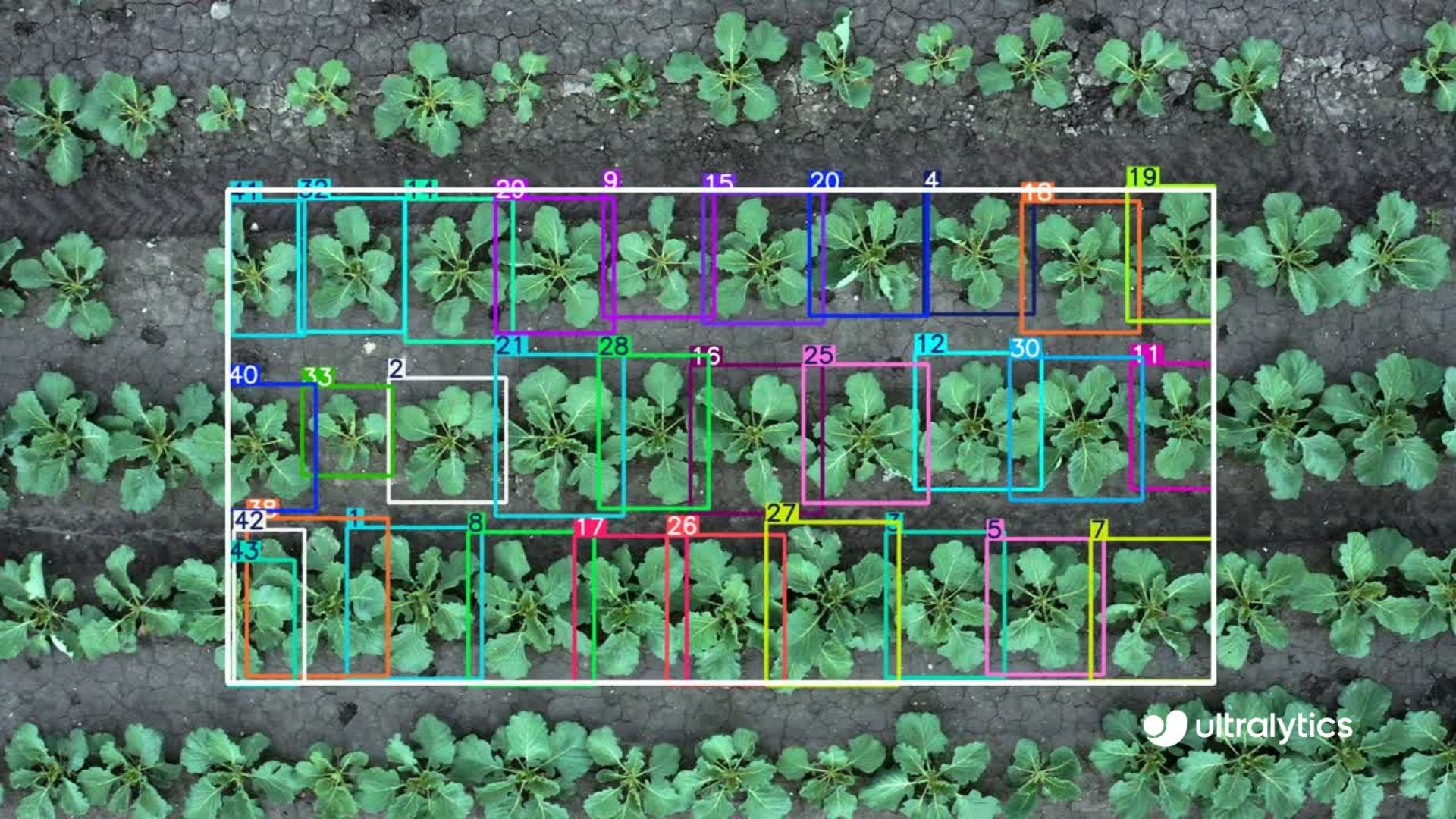 | 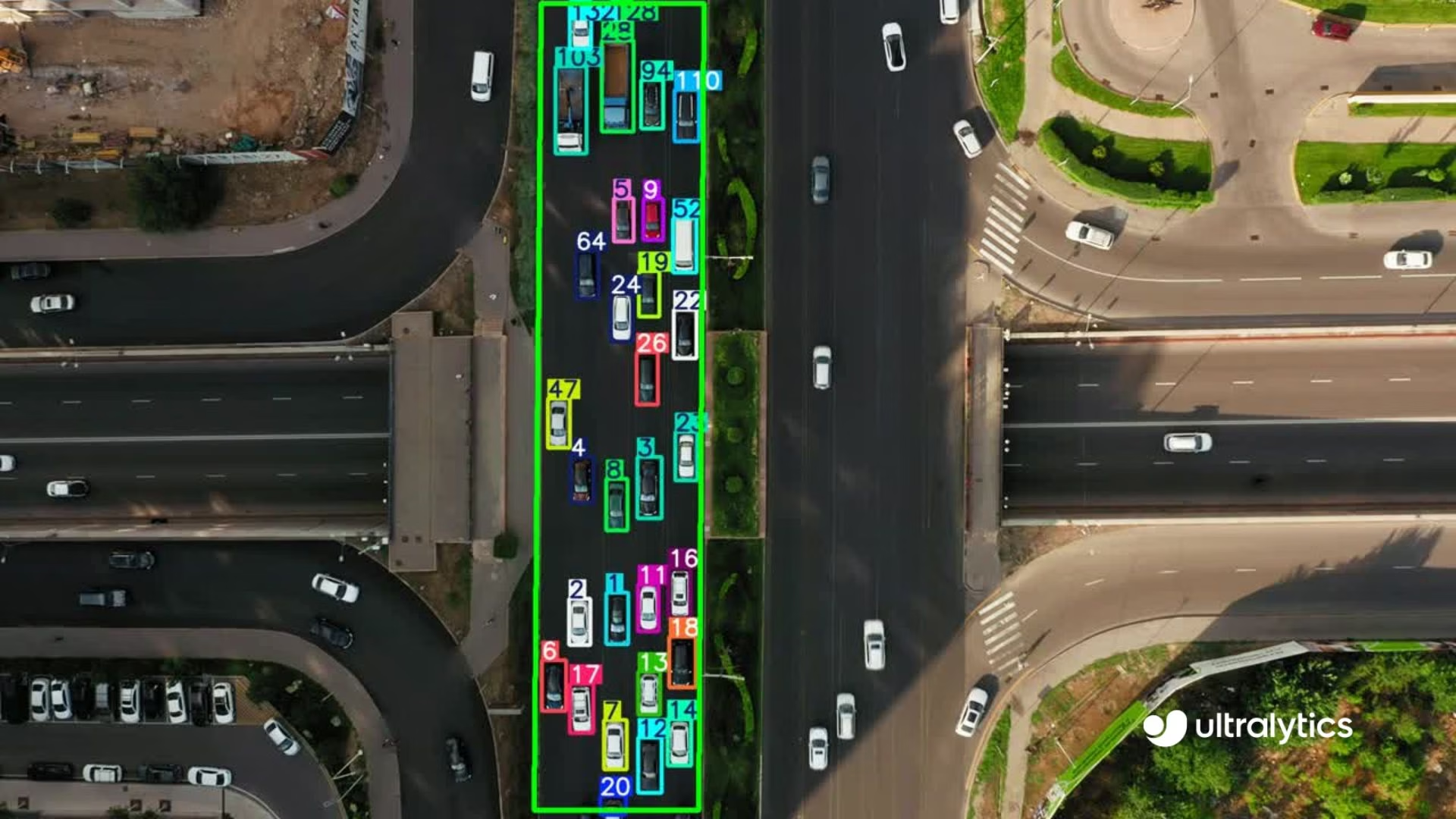 |
| Отслеживание растений в поле с помощью Ultralytics YOLO26 | Отслеживание автомобилей на дороге с помощью Ultralytics YOLO26 |
# Run a trackzone example
yolo solutions trackzone show=True

# Pass a source video
yolo solutions trackzone source="path/to/video.mp4" show=True

# Pass region coordinates
yolo solutions trackzone show=True region="[(150, 150), (1130, 150), (1130, 570), (150, 570)]"
TrackZone использует список region, чтобы определить, какую часть кадра нужно контролировать. Задай многоугольник, соответствующий нужной физической зоне (дверям, воротам и т. д.), и оставь включённым show=True во время настройки, чтобы проверить, совпадает ли наложенная область с видеопотоком.
- Каждая запись в
region— это координата пикселя(x, y)в кадре видео. Перечисли точки в том порядке, в котором их нужно соединить по периметру контролируемой области. - Координаты привязаны к разрешению кадра, поэтому область, заданная для потока 1280×720, не подойдёт для потока 640×480. Оставь включённым
show=Trueво время настройки, чтобы убедиться, что наложенная область совпадает с видеопотоком. TrackZoneсводит точки к их выпуклой оболочке, поэтому вогнутая фигура упрощается до наименьшего выпуклого многоугольника, содержащего все её точки. Для невыпуклых фигур или нескольких отдельных областей используй решение RegionCounter.- Если полностью не указать
region, будет использоваться зона по умолчанию[(75, 75), (565, 75), (565, 285), (75, 285)].
Аргументы TrackZone#
Вот таблица с аргументами TrackZone:
| Аргумент | Тип | По умолчанию | Описание |
|---|---|---|---|
model | str | None | Путь к файлу модели Ultralytics YOLO. |
region | list или dict | None | Точки, задающие интересующую область: список кортежей (x, y) или словарь, сопоставляющий названия областей со списками точек для нескольких областей (только RegionCounter). Если None, решения, которым требуется область, используют заданную по умолчанию область. |
line_width | int | 2 | Толщина линий рамок, ключевых точек и счётчиков, которые рисует решение. |
verbose | bool | True | Включает журнал решения для каждого кадра с указанием формы входных данных, количества объектов по классам и скорости обработки. Сам вызов отслеживания всегда выполняется без вывода сообщений. |
Решение TrackZone поддерживает параметры track:
| Аргумент | Тип | По умолчанию | Описание |
|---|---|---|---|
tracker | str | 'tracktrack.yaml' | Задаёт алгоритм отслеживания. Встроенные варианты: botsort.yaml, bytetrack.yaml, ocsort.yaml, deepocsort.yaml, fasttrack.yaml, tracktrack.yaml. |
conf | float | 0.25 | Задаёт порог уверенности для обнаружений: при более низких значениях можно отслеживать больше объектов, но возрастает вероятность ложноположительных срабатываний. |
iou | float | 0.5 | Задаёт порог пересечения над объединением (IoU) для фильтрации перекрывающихся обнаружений. |
classes | list | None | Фильтрует результаты по индексу класса. Например, classes=[0, 2, 3] отслеживает только указанные классы. |
device | str | None | Задаёт устройство для инференса (например, cpu, cuda:0 или 0). Позволяет выбрать CPU, определённый GPU или другое вычислительное устройство для выполнения модели. |
imgsz | int or tuple | 640 | Целевой размер изображения для инференса: целое число для квадратного изображения или пара (height, width). Размеры корректируются с учётом шага модели. |
max_det | int | 300 | Максимальное количество обнаружений, сохраняемых в каждом кадре перед отслеживанием; ограничивает число объектов, обрабатываемых решением в насыщенных сценах. |
quantize | int or str | None | Точность инференса: 16 (FP16) или 32/unset (FP32) для моделей PyTorch и TorchScript не на CPU; для других форматов точность определяется артефактом модели и средой выполнения. Заменяет устаревший аргумент half. |
Также доступны следующие параметры визуализации:
| Аргумент | Тип | По умолчанию | Описание |
|---|---|---|---|
show | bool | False | Если True, показывает аннотированные изображения или видео в окне. Полезно для мгновенной визуальной проверки во время разработки или тестирования. |
show_conf | bool | True | Показывает оценку уверенности каждой детекции рядом с меткой. Позволяет оценить уверенность модели в каждой детекции. |
show_labels | bool | True | Показывает метки каждой детекции на визуализации. Помогает сразу понять, какие объекты обнаружены. |
Подсчёт объектов внутри зоны#
Каждый вызов трекера возвращает объект SolutionResults, атрибут total_tracks которого содержит количество объектов, отслеживаемых в данный момент внутри зоны. Проверяй это значение на каждом кадре, чтобы отслеживать текущую заполненность, например, записывать, насколько загружен вход или зона ограниченного доступа:
import cv2

from ultralytics import solutions

cap = cv2.VideoCapture("path/to/video.mp4")
assert cap.isOpened(), "Error reading video file"

region_points = [(150, 150), (1130, 150), (1130, 570), (150, 570)]
trackzone = solutions.TrackZone(show=False, region=region_points, model="yolo26n.pt")

while cap.isOpened():
    success, im0 = cap.read()
    if not success:
        break
    results = trackzone(im0)
    print(f"Objects currently in zone: {results.total_tracks}")  # live zone occupancy

cap.release()
Часто задаваемые вопросы#
Запусти команду ниже, чтобы отслеживать объекты только внутри зоны, и передай
region, чтобы задать координаты зоны. Это подходит для видеонаблюдения, управления толпой и любых других сценариев, требующих зонального отслеживания.yolo solutions trackzone source="path/to/video.mp4" show=TrueВсего несколько строк кода — и ты настроишь отслеживание объектов в отдельных зонах, которое легко интегрировать в свои проекты.
import cv2 from ultralytics import solutions cap = cv2.VideoCapture("path/to/video.mp4") assert cap.isOpened(), "Error reading video file" w, h, fps = (int(cap.get(x)) for x in (cv2.CAP_PROP_FRAME_WIDTH, cv2.CAP_PROP_FRAME_HEIGHT, cv2.CAP_PROP_FPS)) video_writer = cv2.VideoWriter("trackzone_output.avi", cv2.VideoWriter_fourcc(*"mp4v"), fps, (w, h)) trackzone = solutions.TrackZone( show=True, region=[(150, 150), (1130, 150), (1130, 570), (150, 570)], model="yolo26n.pt" ) while cap.isOpened(): success, im0 = cap.read() if not success: break results = trackzone(im0) video_writer.write(results.plot_im) cap.release() video_writer.release() cv2.destroyAllWindows()Настроить точки зоны для обработки видео с помощью Ultralytics TrackZone просто, а параметры можно адаптировать под свои задачи. Зоны можно задать и изменить непосредственно в скрипте Python, точно указав области, которые нужно контролировать.
from ultralytics import solutions

# Задание точек области
region_points = [(150, 150), (1130, 150), (1130, 570), (150, 570)]

# Инициализация trackzone
trackzone = solutions.TrackZone(
    show=True,  # отобразить результат
    region=region_points,  # передать точки области
)
Помни, что
TrackZoneсводит точки к их выпуклой оболочке, поэтому вогнутая граница упрощается до наименьшего выпуклого многоугольника, содержащего все её точки.Все три решения работают с областями, но отвечают на разные вопросы:
Решение Для чего использовать Типичный результат TrackZone Отслеживать объекты и контролировать текущую заполненность одной выпуклой зоны Идентификаторы отслеживаемых объектов и total_tracksдля зоныObjectCounter Подсчитывать объекты, пересекающие линию или входящие в область и покидающие её Суммарное количество вошедших и вышедших объектов RegionCounter Подсчитывать объекты в одной или нескольких произвольных областях, в том числе невыпуклых Количество объектов в каждой области Выбирай TrackZone, если нужно непрерывно отслеживать объекты в одной области, а RegionCounter — если нужны несколько зон или невыпуклая область.


Комментарии40
Задай вопрос, поделись результатами или помоги кому-нибудь.
Paul231200
Hello, great development, but I had a question about the advantages of your solution in comparison with the regions of interest that can be done in Opencv, also the question is whether it is planned to add this development to such models as yolov8?
1 Glenn JocherUltralytics(изменено)
@Paul231200 thank you for your question! TrackZone offers targeted and efficient region-based tracking, reducing computational overhead compared to general frame analysis in OpenCV. As for YOLOv8, TrackZone works with any Ultralytics model you pass via
model=, including YOLOv8, though we recommend YOLO26 for new projects. For more details, you can explore TrackZone here: https://docs.ultralytics.com/guides/trackzone/.
moshiour
Hi, Its a nice feature to yolo! How do make it counting on top of it? Thank you in advance!
1- Glenn JocherUltralytics(изменено)
@moshiour thank you for your kind words!
TrackZonereturns a results object withtotal_tracks, the number of objects currently tracked inside the zone:results = trackzone(im0)thenresults.total_tracks. For counting objects entering or leaving a region, see the Object Counting guide. Let us know if you have more questions!1 RizwanMunawar
@Muhammad-237 Hi, We currently don't support the counting feature with TrackZone, but It's on our TODO's list, and we will release this feature soon! Thank you! In the meantime, you can explore our documentation available at: https://docs.ultralytics.com/guides/object-counting/#__tabbed_1_1
biancalepe
Thank you for this informative resource! I have a question - am I able to obtain the unique IDs of identified objects within 20 second windows? In this case, I'd like to know how many unique cars in total were in my zone for each 20 second time period of my video.
Below is my starting code:
def count_specific_classes(video_path, output_video_path, model_path, classes_to_count, region_points):
"""Count specific classes of objects in a video.""" cap = cv2.VideoCapture(video_path) assert cap.isOpened(), "Error reading video file" # Video writer w, h, fps = (int(cap.get(x)) for x in (cv2.CAP_PROP_FRAME_WIDTH, cv2.CAP_PROP_FRAME_HEIGHT, cv2.CAP_PROP_FPS)) video_writer = cv2.VideoWriter(output_video_path, cv2.VideoWriter_fourcc(*"mp4v"), fps, (w, h)) # Initiate TrackZone (object tracking in zones, not complete frame) trackzone = solutions.TrackZone(show=True, # Display the output region=region_points, # pass the region points model=model_path, # use any model that Ultralytics supports classes=classes_to_count) # which objects to track # Process video while cap.isOpened(): success, im0 = cap.read() if not success: print("Video frame is empty or processing is complete.") break results = trackzone(im0) #print (results) # access the output video_writer.write(results.plot_im) # write the video output cap.release() video_writer.release() cv2.destroyAllWindows() # destroy all open windows- Glenn JocherUltralytics(изменено)
@biancalepe you can access unique track IDs from
trackzone.track_idsand implement time-based windowing for counting. Here's how to modify your code to count unique cars in 20-second intervals:def count_unique_cars_by_time_window(video_path, output_video_path, model_path, classes_to_count, region_points, window_seconds=20): cap = cv2.VideoCapture(video_path) assert cap.isOpened(), "Error reading video file" w, h, fps = (int(cap.get(x)) for x in (cv2.CAP_PROP_FRAME_WIDTH, cv2.CAP_PROP_FRAME_HEIGHT, cv2.CAP_PROP_FPS)) video_writer = cv2.VideoWriter(output_video_path, cv2.VideoWriter_fourcc(*"mp4v"), fps, (w, h)) trackzone = solutions.TrackZone( show=True, region=region_points, model=model_path, classes=classes_to_count ) frame_count = 0 window_frame_count = window_seconds * fps # frames per 20-second window current_window = 1 unique_ids_in_window = set() window_results = [] while cap.isOpened(): success, im0 = cap.read() if not success: break results = trackzone(im0) # Track IDs of the objects currently inside the zone unique_ids_in_window.update(trackzone.track_ids) frame_count += 1 # Check if window is complete if frame_count >= window_frame_count: unique_count = len(unique_ids_in_window) window_results.append(f"Window {current_window} ({window_seconds - 20}-{window_seconds}s): {unique_count} unique cars") print(f"Window {current_window}: {unique_count} unique cars detected") # Reset for next window unique_ids_in_window.clear() current_window += 1 frame_count = 0 window_seconds += 20 video_writer.write(results.plot_im) # Handle final incomplete window if unique_ids_in_window: unique_count = len(unique_ids_in_window) print(f"Final window: {unique_count} unique cars detected") cap.release() video_writer.release() cv2.destroyAllWindows() return window_resultsThis tracks unique car IDs within each 20-second window and provides counts for analysis.
Thank you!
Running the code, I see that cars exist in the twenty second windows but the code returns back zero cars for all windows. As I was trying to parse out the code, I printed results.boxes and I get this error --> AttributeError: 'SolutionResults' object has no attribute 'boxes'. I get a similar error when I try to print out results.boxes.id. Printing results seems to get me a "total_tracks" and a "speed" option, but nothing else. Is there something I should be doing?
@biancalepe If you want to retrieve the IDs of tracked objects in a specific Zone (these will be unique), you can use the code mentioned below. Please note SolutionResults class includes the data highlighted here. Track IDs can be extracted directly by Solution Object, i.e,
trackzone.track_ids. Thanksimport cv2 from ultralytics import solutions cap = cv2.VideoCapture("path/to/video.mp4") assert cap.isOpened(), "Error reading video file" # Define region points region_points = [(150, 150), (1130, 150), (1130, 570), (150, 570)] # Video writer w, h, fps = (int(cap.get(x)) for x in (cv2.CAP_PROP_FRAME_WIDTH, cv2.CAP_PROP_FRAME_HEIGHT, cv2.CAP_PROP_FPS)) video_writer = cv2.VideoWriter("trackzone_output.avi", cv2.VideoWriter_fourcc(*"mp4v"), fps, (w, h)) # Init trackzone (object tracking in zones, not complete frame) trackzone = solutions.TrackZone( show=True, # display the output region=region_points, # pass region points model="yolo11n.pt", # use any model that Ultralytics support, i.e. YOLOv9, YOLOv10 # line_width=2, # adjust the line width for bounding boxes and text display ) # Process video while cap.isOpened(): success, im0 = cap.read() if not success: print("Video frame is empty or processing is complete.") break results = trackzone(im0) print(trackzone.track_ids) # access the track_ids video_writer.write(results.plot_im) # write the video file cap.release() video_writer.release() cv2.destroyAllWindows() # destroy all opened windowsSorry @muhammadrizwanmunawar the reason I was doing the print statements is because I was trying to figure out why the first block of code written by @glenn-jocher wasn't working. I isolated the problem to the extract IDs from results part. Using your code and glenn's I updated that section to be the code below, which seems to have fixed the problem:
Extract track IDs from results
if trackzone.track_ids is not None: track_ids = trackzone.track_ids unique_ids_in_window.update(track_ids)1- Glenn JocherUltralytics
@biancalepe excellent troubleshooting! You've correctly identified that track IDs should be accessed via
trackzone.track_idsrather than from theresultsobject. This is the proper way to extract track IDs from TrackZone for time-windowed unique counting. Great job combining the solutions!
amoore1724
Can this be used to track two separate regions in the same frame?
yes! Currently, we support the tracking objects in a single zone.
 Caio Passos
Hi! I have a question. In the docs, it says TrackZone supports classes as parameters. I tried to limit TrackZone to only detect the class 0 (person).
heres the code, almost like the example in docs:
import cv2

from ultralytics import solutions, YOLO

cap = cv2.VideoCapture(
    "/path_to_video.mp4"
)
assert cap.isOpened(), "Error reading video file"

# Define region points
region_points = [(150, 150), (1130, 150), (1130, 570), (150, 570)]

# Video writer
w, h, fps = (
    int(cap.get(x))
    for x in (cv2.CAP_PROP_FRAME_WIDTH, cv2.CAP_PROP_FRAME_HEIGHT, cv2.CAP_PROP_FPS)
)
video_writer = cv2.VideoWriter(
    "trackzone_output.avi", cv2.VideoWriter_fourcc(*"mp4v"), fps, (w, h)
)
# Init trackzone (object tracking in zones, not complete frame)
trackzone = solutions.TrackZone(
    show=True,  # display the output
    region=region_points,  # pass region points
    model="yolo11n.pt",
    names=[0],
    # use any model that Ultralytics support, i.e. YOLOv9, YOLOv10
    line_width=1,  # adjust the line width for bounding boxes and text display
)
print(f" model class names: {trackzone.model.names}")
# Process video
while cap.isOpened():
    success, im0 = cap.read()
    if not success:
        print("Video frame is empty or processing is complete.")
        break

    results = trackzone(im0)

    # print(results)  # access the output

    video_writer.write(results.plot_im)  # write the video file

cap.release()
video_writer.release()
cv2.destroyAllWindows()  # destroy all opened windows
it runs without any issue, but still detecting other classes like backpacks, for example. Can you provide some extra details on how to limit detections for person class only?
@caio-passos Hi, thanks for sharing it. The actual argument to set classes is
classes, notnames,as mentioned in the documentation here: https://docs.ultralytics.com/guides/trackzone/#trackzone-arguments. Let me know if you have any questions. Thanks- Caio Passos
Thanks!! I've changed it in the code:
trackzone = solutions.TrackZone(
    show=True,  # display the output
    region=region_points,  # pass region points
    model="yolo11n.pt",
    classes=[0],
    # use any model that Ultralytics support, i.e. YOLOv9, YOLOv10
    line_width=1,  # adjust the line width for bounding boxes and text display
)
But it led to this error, something related to the size of the mask or tensor:
Traceback (most recent call last):
  File "/home/tarzan/Documents/programing/hive/aeroporto/track.py", line 38, in <module>
    results = trackzone(im0)
              ^^^^^^^^^^^^^^
  File "/home/tarzan/Documents/programing/hive/aeroporto/.venv/lib/python3.12/site-packages/ultralytics/solutions/solutions.py", line 195, in __call__
    result = self.process(*args, **kwargs)  # Call the subclass-specific process method
             ^^^^^^^^^^^^^^^^^^^^^^^^^^^^^
  File "/home/tarzan/Documents/programing/hive/aeroporto/.venv/lib/python3.12/site-packages/ultralytics/solutions/trackzone.py", line 73, in process
    self.extract_tracks(masked_frame)
  File "/home/tarzan/Documents/programing/hive/aeroporto/.venv/lib/python3.12/site-packages/ultralytics/solutions/solutions.py", line 120, in extract_tracks
    self.tracks = self.model.track(source=im0, persist=True, classes=self.classes, **self.track_add_args)
                  ^^^^^^^^^^^^^^^^^^^^^^^^^^^^^^^^^^^^^^^^^^^^^^^^^^^^^^^^^^^^^^^^^^^^^^^^^^^^^^^^^^^^^^^
  File "/home/tarzan/Documents/programing/hive/aeroporto/.venv/lib/python3.12/site-packages/ultralytics/engine/model.py", line 593, in track
    return self.predict(source=source, stream=stream, **kwargs)
           ^^^^^^^^^^^^^^^^^^^^^^^^^^^^^^^^^^^^^^^^^^^^^^^^^^^^
  File "/home/tarzan/Documents/programing/hive/aeroporto/.venv/lib/python3.12/site-packages/ultralytics/engine/model.py", line 549, in predict
    return self.predictor.predict_cli(source=source) if is_cli else self.predictor(source=source, stream=stream)
                                                                    ^^^^^^^^^^^^^^^^^^^^^^^^^^^^^^^^^^^^^^^^^^^^
  File "/home/tarzan/Documents/programing/hive/aeroporto/.venv/lib/python3.12/site-packages/ultralytics/engine/predictor.py", line 218, in __call__
    return list(self.stream_inference(source, model, *args, **kwargs))  # merge list of Result into one
           ^^^^^^^^^^^^^^^^^^^^^^^^^^^^^^^^^^^^^^^^^^^^^^^^^^^^^^^^^^^
  File "/home/tarzan/Documents/programing/hive/aeroporto/.venv/lib/python3.12/site-packages/torch/utils/_contextlib.py", line 36, in generator_context
    response = gen.send(None)
               ^^^^^^^^^^^^^^
  File "/home/tarzan/Documents/programing/hive/aeroporto/.venv/lib/python3.12/site-packages/ultralytics/engine/predictor.py", line 336, in stream_inference
    self.results = self.postprocess(preds, im, im0s)
                   ^^^^^^^^^^^^^^^^^^^^^^^^^^^^^^^^^
  File "/home/tarzan/Documents/programing/hive/aeroporto/.venv/lib/python3.12/site-packages/ultralytics/models/yolo/detect/predict.py", line 55, in postprocess
    preds = ops.non_max_suppression(
            ^^^^^^^^^^^^^^^^^^^^^^^^
  File "/home/tarzan/Documents/programing/hive/aeroporto/.venv/lib/python3.12/site-packages/ultralytics/utils/ops.py", line 304, in non_max_suppression
    x, xk = x[filt], xk[filt]
            ~^^^^^^
IndexError: The shape of the mask [64] at index 0 does not match the shape of the indexed tensor [62, 6] at index 0
I had experienced something similar with QueueManager before, but I couldn't figure it out where or what went wrong
@caio-passos, which ultralytics version are you using?
- Caio Passos
it's ultralytics version 8.3.114
@caio-passos, please upgrade the package with
pip install -U ultralytics. This error is already fixed in the latest version.1- Caio Passos
It solved the issue, thank you!! @RizwanMunawar
1
Parthpatil0024
Is there a way to use botsort without using the track method. how to do it if i am using a ncnn model format.
skyceeee
import cv2 import gc from ultralytics import solutions
Kamerayı başlat
cap = cv2.VideoCapture(0) assert cap.isOpened(), "Kamera açılırken hata oluştu!"
Kamera çözünürlüğünü belirle
cap.set(cv2.CAP_PROP_FRAME_WIDTH, 640) cap.set(cv2.CAP_PROP_FRAME_HEIGHT, 480)
Takip bölgesini tanımla (görüntü çözünürlüğüne uygun olmalı)
region_points = [(50, 50), (590, 50), (590, 430), (50, 430)]
TrackZone nesnesini başlat
trackzone = solutions.TrackZone( show=True, region=region_points, model="C:/yazilim/staj/trackzone/yolov8n480.pt", # Daha küçük model kullanıldı imgsz=480, # Model giriş boyutu sınırlandırıldı )
Canlı görüntü işleme döngüsü
while cap.isOpened(): success, frame = cap.read() if not success: print("Kamera görüntüsü alınamadı!") break
# Görüntüyü yeniden boyutlandır
frame = cv2.resize(frame, (640, 480))

# TrackZone ile işlem yap
try:
    processed_frame = trackzone.trackzone(frame)
except Exception as e:
    print(f"Takip sırasında bir hata oluştu: {e}")
    break

# Görüntüyü göster
cv2.imshow("TrackZone Canlı Takip", processed_frame)

# Bellek temizliği yap
gc.collect()

# 'q' tuşuna basarak çıkış yapabilirsiniz
if cv2.waitKey(10) & 0xFF == ord('q'):
    break
Kamera ve pencereyi serbest bırak
cap.release() cv2.destroyAllWindows()
This is my code. I use my own trained yolov8n model. When the camera is turned on, the area I drew also appears. No problems until then. But the moment a person enters the rectangle, the kernel dies. What could be the reason for this?My model does human detection. Error: The Kernel crashed while executing code in the current cell or a previous cell. Please review the code in the cell(s) to identify a possible cause of the failure. Click here for more info. View Jupyter log for further details.
- Glenn JocherUltralytics
The kernel crash could be due to insufficient memory or a compatibility issue with your custom YOLOv8 model. Ensure your system has enough resources available, and verify that the model file is correctly configured for the
TrackZonesolution. Additionally, try reducing the input resolution further (e.g.,imgsz=320) to minimize memory usage. For further debugging, check the full error log and confirm that your model works with standardpredictfunctionality outside ofTrackZone.
nichamond143
Hi, I'm using TrackZone with a custom model, but it's not detecting the target object. However, when I crop the zone of interest from the example video and put it through the model it works fine. I also trained the model on zoomed in images of the object because the full-frame image is too noisey and the object is very small. Any advice on how to approach this?
- Glenn JocherUltralytics
@nichamond143 it sounds like the model's training on zoomed-in images may limit its ability to generalize to full-frame inputs. You could try pre-processing the video frames to crop and resize the zone of interest before passing them to the model. Alternatively, consider retraining the model with multi-scale images, including both zoomed-in and contextual full-frame examples, to improve its detection robustness.
UltralyticsAssistantUltralytics
👋 Hello, thank you for your interest in Ultralytics 🚀! It sounds like you're exploring how TrackZone uses YOLO models for object tracking and analysis – fascinating topic!
If this is a ❓ Question about custom implementations, feel free to share more details about your use case so our team or the community can better assist. If it's a 🐛 Bug Report or you need specific technical help, please provide a clear description, along with any code snippets, error messages, or logs. Including a minimum reproducible example (MRE) would greatly help us debug and offer guidance swiftly.
For general inquiries or tips on achieving optimal results, consider reviewing our resources on model training and usage. Additionally, you can join the Ultralytics community on platforms like Discord, Reddit, or Discourse for deeper interactions and advice.
Lastly, please ensure you're running the latest version of the
ultralyticspackage and all required dependencies to avoid encountering previously resolved issues. You can upgrade using thepip install -U ultralyticscommand.Thank you for being part of the Ultralytics community! 😊 An Ultralytics engineer will be here to assist you further shortly.
By converting the yolo model to tensorrt and setting coordinates in Jetson Nano, I track objects in a certain area with Jetson Nano. Can I use trackzone instead of adjusting coordinates myself? Is Jetson Nano supported?
- Glenn JocherUltralytics
@skyceeee yes, you can use TrackZone with Jetson Nano for targeted object tracking within specific areas, eliminating the need to adjust coordinates manually. TrackZone is compatible with YOLO models, including TensorRT-exported ones. Ensure you optimize your model for Jetson Nano's limited resources for best performance. More details on TrackZone can be found here.
1
Thanks so much for this feature. Is it possible to use this feature with tensorrt format in Jetson nano?
- Glenn JocherUltralytics
@skyceeee thank you for your question! Yes, you can use the TensorRT-exported YOLO models on the Jetson Nano, including for the TrackZone feature. First, export your YOLO11 model to TensorRT format using the
yolo exportcommand. Then, ensure your TensorRT runtime is properly set up on the Nano, and integrate the exported model into your tracking workflow. For more details, refer to the Export Documentation. Let us know if you encounter any issues!1