Bộ dữ liệu Dog-Pose
Giới thiệu#
Dataset Dog-Pose của Ultralytics là dataset ước lượng tư thế được tuyển chọn để ước lượng keypoint của chó, cung cấp 6,773 ảnh huấn luyện và 1,703 ảnh xác thực.
Xem: Cách huấn luyện model Ultralytics YOLO trên dataset ước tính tư thế chó Stanford | Hướng dẫn từng bước
Mỗi ảnh được chú giải gồm 24 keypoint, mỗi keypoint có 3 chiều (x, y, khả năng hiển thị), hỗ trợ nghiên cứu và ứng dụng ước lượng tư thế chó.
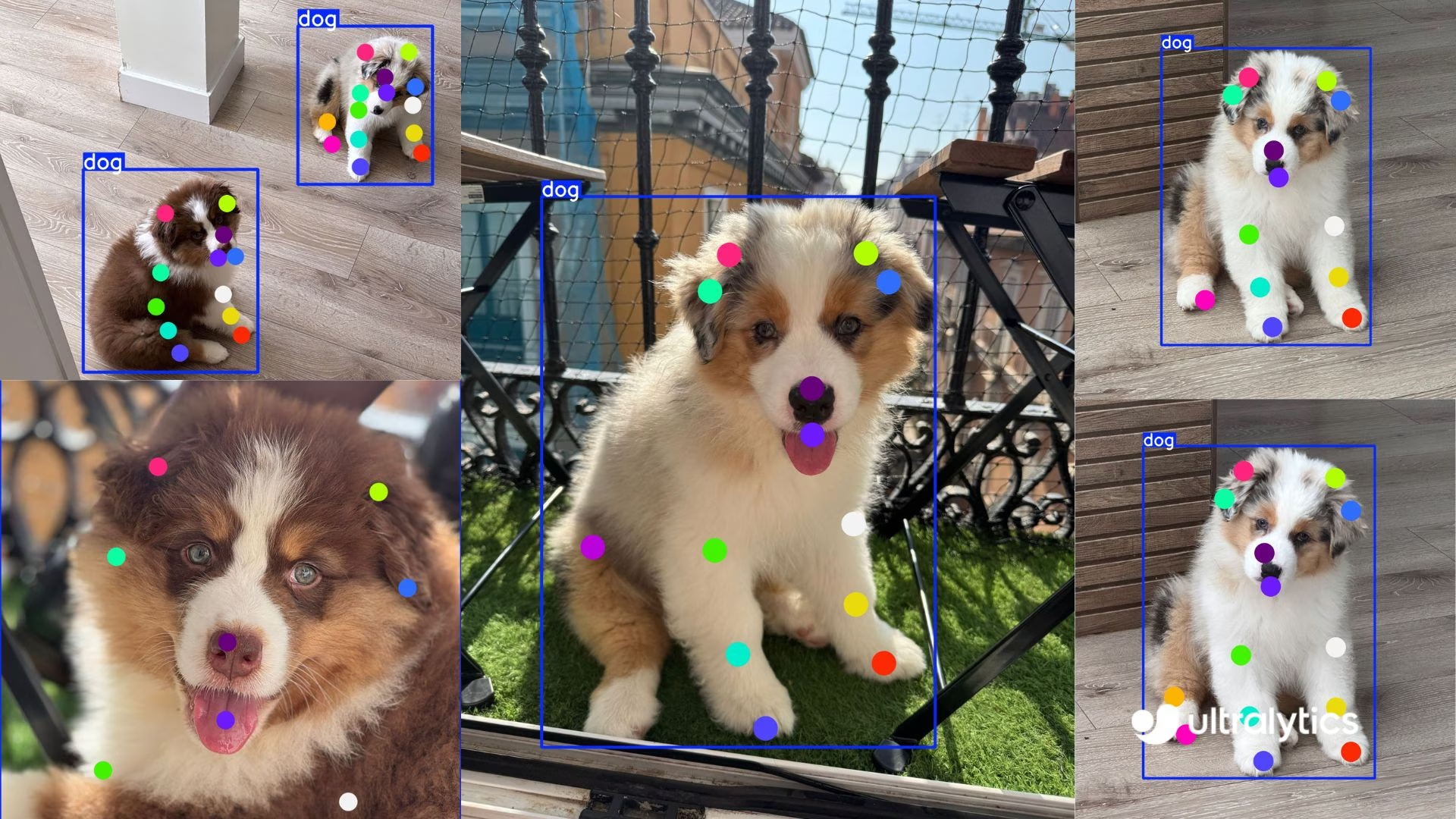
Nếu cần một giống chó cụ thể hoặc một loài động vật khác, Ultralytics Platform hỗ trợ tải lên, gán nhãn và huấn luyện model keypoint tùy chỉnh trên dữ liệu của riêng bạn mà không cần quản lý hạ tầng.
Cấu trúc dataset#
-
Tổng số hình ảnh: 8,476 (6,773 train / 1,703 val), cùng các tệp nhãn định dạng YOLO tương ứng.
-
Keypoint: 24 keypoint mỗi con chó, với các bộ ba
(x, y, visibility). -
Dung lượng tải xuống: ~337 MB.
-
Bố cục:
datasets/dog-pose/
├── images/{train,val}
└── labels/{train,val}
YAML của dataset#
Tệp YAML được dùng để xác định cấu hình bộ dữ liệu. Tệp này bao gồm đường dẫn, thông tin chi tiết về keypoint và các thông tin liên quan khác. Với bộ dữ liệu Dog-Pose, tệp dog-pose.yaml có tại https://github.com/ultralytics/ultralytics/blob/main/ultralytics/cfg/datasets/dog-pose.yaml.
# Ultralytics 🚀 AGPL-3.0 License - https://ultralytics.com/license

# Dogs dataset http://vision.stanford.edu/aditya86/ImageNetDogs/ by Stanford
# Documentation: https://docs.ultralytics.com/datasets/pose/dog-pose
# Example usage: yolo train data=dog-pose.yaml
# parent
# ├── ultralytics
# └── datasets
#     └── dog-pose ← downloads here (337 MB)

# Train/val/test sets as 1) dir: path/to/imgs, 2) file: path/to/imgs.txt, or 3) list: [path/to/imgs1, path/to/imgs2, ..]
path: dog-pose # dataset root dir
train: images/train # train images (relative to 'path') 6773 images
val: images/val # val images (relative to 'path') 1703 images

# Keypoints
kpt_shape: [24, 3] # number of keypoints, number of dims (2 for x,y or 3 for x,y,visible)

# Classes
names:
  0: dog

# Keypoint names per class
kpt_names:
  0:
    - front_left_paw
    - front_left_knee
    - front_left_elbow
    - rear_left_paw
    - rear_left_knee
    - rear_left_elbow
    - front_right_paw
    - front_right_knee
    - front_right_elbow
    - rear_right_paw
    - rear_right_knee
    - rear_right_elbow
    - tail_start
    - tail_end
    - left_ear_base
    - right_ear_base
    - nose
    - chin
    - left_ear_tip
    - right_ear_tip
    - left_eye
    - right_eye
    - withers
    - throat

# Download script/URL (optional)
download: https://github.com/ultralytics/assets/releases/download/v0.0.0/dog-pose.zip
Cách sử dụng#
Để huấn luyện model YOLO26n-pose trên bộ dữ liệu Dog-Pose trong 100 epoch với kích thước ảnh 640, bạn có thể dùng các đoạn mã sau.
from ultralytics import YOLO

# Tải model
model = YOLO("yolo26n-pose.pt")  # tải model đã huấn luyện trước (được khuyến nghị khi huấn luyện)

# Huấn luyện model
results = model.train(data="dog-pose.yaml", epochs=100, imgsz=640)
Hình ảnh mẫu và annotation#
Dưới đây là một số hình ảnh trong bộ dữ liệu Dog-Pose cùng với các chú thích tương ứng:
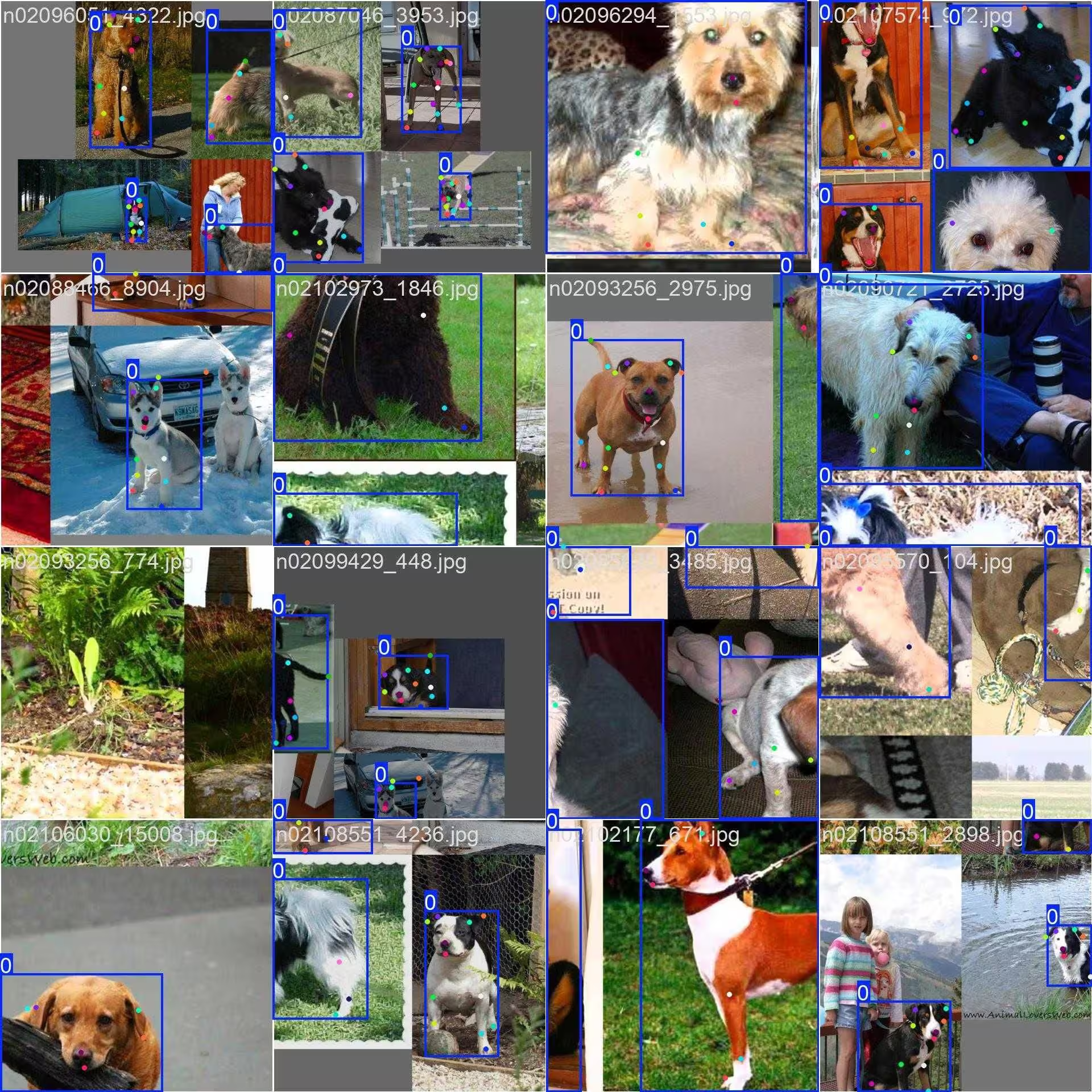
- Ảnh ghép Mosaic: Hình ảnh này minh họa một batch huấn luyện được tạo từ các ảnh mosaic của bộ dữ liệu. Mosaic là kỹ thuật được sử dụng trong quá trình huấn luyện, kết hợp nhiều hình ảnh thành một hình ảnh duy nhất để tăng sự đa dạng của đối tượng và bối cảnh trong mỗi batch huấn luyện. Kỹ thuật này giúp cải thiện khả năng tổng quát hóa của model đối với các kích thước đối tượng, tỷ lệ khung hình và ngữ cảnh khác nhau.
Ví dụ này cho thấy sự đa dạng và phức tạp của hình ảnh trong bộ dữ liệu Dog-Pose cũng như lợi ích của việc ghép ảnh mosaic trong quá trình huấn luyện.
Trích dẫn và lời cảm ơn#
Nếu sử dụng bộ dữ liệu Dog-Pose trong nghiên cứu hoặc phát triển, vui lòng trích dẫn bài báo sau:
@inproceedings{khosla2011fgvc,
  title={Novel dataset for Fine-Grained Image Categorization},
  author={Aditya Khosla and Nityananda Jayadevaprakash and Bangpeng Yao and Li Fei-Fei},
  booktitle={First Workshop on Fine-Grained Visual Categorization (FGVC), IEEE Conference on Computer Vision and Pattern Recognition (CVPR)},
  year={2011}
}
@inproceedings{deng2009imagenet,
  title={ImageNet: A Large-Scale Hierarchical Image Database},
  author={Jia Deng and Wei Dong and Richard Socher and Li-Jia Li and Kai Li and Li Fei-Fei},
  booktitle={IEEE Computer Vision and Pattern Recognition (CVPR)},
  year={2009}
}
Chúng tôi xin ghi nhận đóng góp của nhóm Stanford trong việc tạo và duy trì tài nguyên quý giá này cho cộng đồng thị giác máy tính. Để biết thêm thông tin về bộ dữ liệu Dog-Pose và những người tạo ra bộ dữ liệu, hãy truy cập trang web Stanford Dogs Dataset.
Câu hỏi thường gặp#
Dataset Dog-Pose có 6,773 ảnh huấn luyện và 1,703 ảnh xác thực được chú giải với 24 keypoint để ước lượng tư thế chó. Dataset được thiết kế để huấn luyện và xác thực model với Ultralytics YOLO26, hỗ trợ các ứng dụng như phân tích hành vi động vật, theo dõi thú cưng và nghiên cứu thú y. Chú giải chi tiết giúp dataset phù hợp để phát triển các model ước lượng tư thế chó chính xác.
Tải
yolo26n-pose.ptvà gọimodel.train(data="dog-pose.yaml", epochs=100, imgsz=640)— xem Ví dụ huấn luyện ở trên để biết đầy đủ các đoạn mã Python và CLI, và xem trang Huấn luyện của model để biết danh sách tham số đầy đủ.Với tổng cộng 8,476 hình ảnh (6,773 train / 1,703 val) bao quát nhiều giống chó và tư thế, cùng 24 keypoint trong 3 chiều (x, y, visibility) cho mỗi nhãn, bộ dữ liệu Dog-Pose cung cấp cho model độ bao phủ các tình huống thực tế cần thiết cho những ứng dụng như theo dõi thú cưng và phân tích hành vi.
Ghép ảnh mosaic kết hợp nhiều hình ảnh Dog-Pose thành một hình ảnh huấn luyện, tăng sự đa dạng về tư thế, kích thước và nền của chó mà model tiếp nhận trong mỗi bước, nhờ đó cải thiện khả năng khái quát hóa sang ngữ cảnh và tỷ lệ mới, đồng thời giảm overfitting. Xem phần Hình ảnh mẫu và chú thích để tham khảo hình ảnh ví dụ.
Có thể tìm tệp YAML của bộ dữ liệu Dog-Pose tại https://github.com/ultralytics/ultralytics/blob/main/ultralytics/cfg/datasets/dog-pose.yaml. Tệp này xác định cấu hình bộ dữ liệu, bao gồm đường dẫn, lớp, thông tin chi tiết về keypoint và các thông tin liên quan khác. YAML chỉ định 24 keypoint với 3 chiều cho mỗi keypoint, phù hợp cho các tác vụ ước tính tư thế chi tiết.
Để dùng file này với các script huấn luyện YOLO26, hãy tham chiếu file trong lệnh huấn luyện như minh họa ở mục Cách sử dụng. Dataset sẽ tự động tải xuống khi được sử dụng lần đầu, giúp việc thiết lập trở nên đơn giản.
Để tìm hiểu thêm về model keypoint, xem tài liệu tác vụ Ước tính tư thế.


Bình luận12
Đặt câu hỏi, chia sẻ kết quả hoặc giúp đỡ người khác.
legend-zhen
Hello, although YOLOv11-pose can perform both object detection and pose estimation tasks simultaneously, there seems to be little correlation between the performance of pose estimation and object detection. What could be the reason for this? As I understand, YOLOv11-pose was specifically designed for human pose estimation, so can it also be perfectly adapted for animal pose estimation, as it is for humans? Are any special settings required when performing animal pose estimation?
 Glenn JocherUltralytics(đã chỉnh sửa)
@legend-zhen YOLO26 and YOLO11 pose models are indeed versatile and can be adapted for animal pose estimation, such as with the Dog-Pose dataset. While the architecture is optimized for human pose estimation, adapting it to animals typically requires a dataset with accurate annotations (e.g., 24 keypoints for dogs in Dog-Pose). No special settings are mandatory beyond ensuring the dataset YAML file is properly configured. For details on Dog-Pose, check here.
Peakednesss
I can just find 20 points, 4 for ears, 1 for nose, 1 for mouth, 2 for tail, and 12 for legs, where are the other four points?
- Glenn JocherUltralytics(đã chỉnh sửa)
@Peakednesss the Dog-Pose dataset has 24 keypoints. Beyond the 20 you found (ears, nose, chin, tail and legs), the other four are the left eye, right eye, withers and throat. The full list is in
kpt_namesin the dataset YAML: https://github.com/ultralytics/ultralytics/blob/main/ultralytics/cfg/datasets/dog-pose.yaml. thank you very much
goodbetterbest1
do you know where are the other 4 points’ definitions? I can’t find any useful information in the yaml document. thx
chengziNaomi
When we annotate the key point data set in a picture, if the two boxes have overlapping parts, how to annotate the key points in the overlapping boxes?
- Glenn JocherUltralytics
@chengziNaomi when annotating overlapping bounding boxes in a keypoint dataset, ensure that each object's keypoints are labeled independently, even if they share overlapping regions. Annotate each keypoint based on its respective object, maintaining clear separation to avoid ambiguity during model training. For guidelines on keypoint annotation, refer to Dog-Pose Dataset Documentation.
If I have multiple objects in a picture, should I frame all the objects at once and then label the key points together, or should I frame an object, label the key points of that object, then frame an object, and then label the key points of that object?
- Glenn JocherUltralytics
@chengziNaomi when annotating a single image with multiple objects, you should annotate each object separately. Frame one object, label its keypoints completely, then move to the next object. This ensures clarity and avoids confusion during model training. Refer to Dog-Pose Dataset Documentation for more annotation insights.
Thank you very much! and how can I draw heatmap for key point detection?
- Glenn JocherUltralytics
You're welcome! To draw a heatmap for keypoint detection, you can preprocess the keypoints into Gaussian blobs on a blank image using libraries like OpenCV or NumPy, then overlay them on the original image. For detailed implementation, check external heatmap solutions or visualization tools as it currently falls outside YOLO's built-in features. Let me know if you have further questions!