اكتشاف مربعات الإحاطة الموجّهة باستخدام Ultralytics YOLO
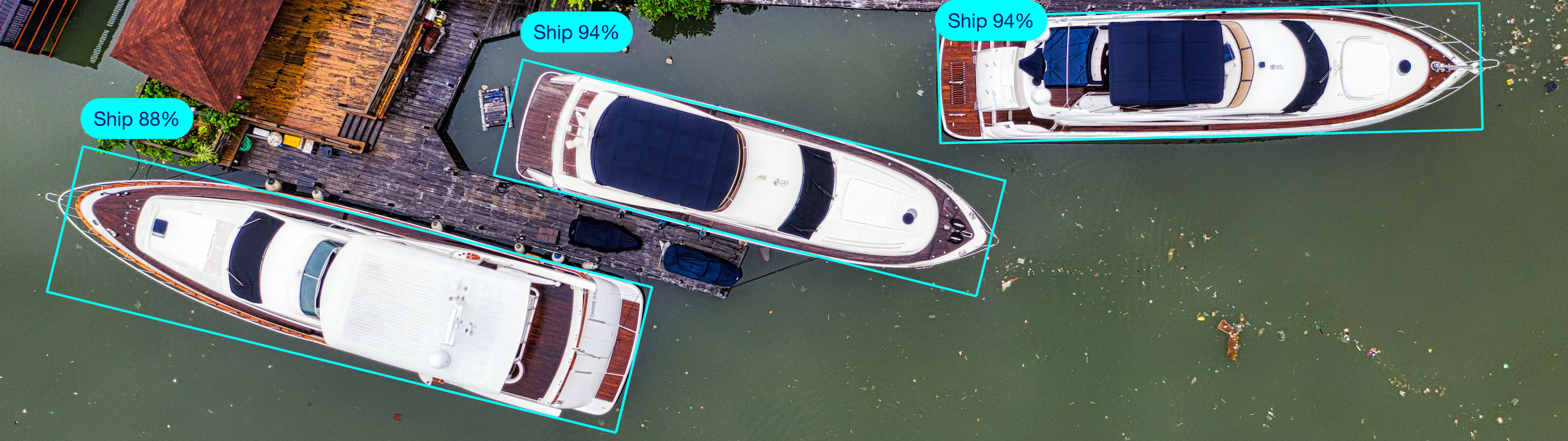
يتجاوز اكتشاف الكائنات الموجّهة اكتشاف الكائنات القياسي بإضافة زاوية أخرى لتحديد مواقع الكائنات في الصورة بدقة أكبر.
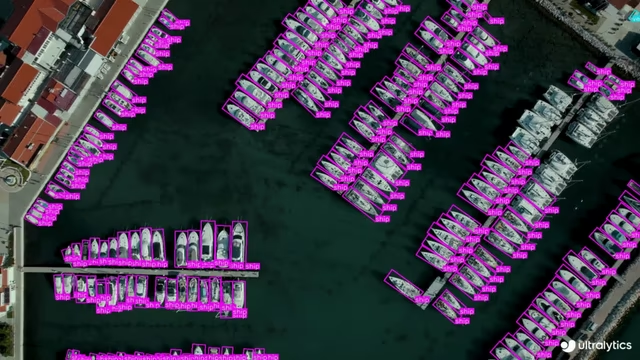
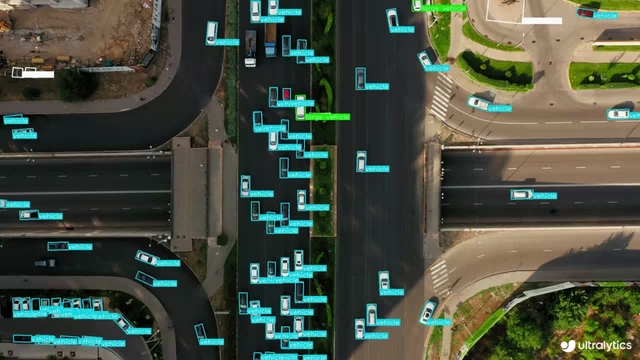
يتكون ناتج كاشف الكائنات الموجّهة من مجموعة من مربعات الإحاطة المدارة التي تحيط بدقة بالكائنات في الصورة، إلى جانب تسميات الفئات ودرجات الثقة لكل مربع. وتفيد مربعات الإحاطة الموجّهة خصوصًا عندما تظهر الكائنات بزوايا مختلفة، مثل الصور الجوية، حيث قد تتضمن مربعات الإحاطة التقليدية المحاذية للمحاور خلفية غير ضرورية. وتشمل الاستخدامات المعتادة اكتشاف السفن والمركبات من الأقمار الصناعية والطائرات المسيّرة، وتحليل المباني والبنية التحتية للتخطيط الحضري، ومراقبة المحاصيل، وفحص الألواح الشمسية أو توربينات الرياح.
شاهد: كيفية اكتشاف الكائنات وتتبعها باستخدام مربعات الإحاطة الموجّهة (OBB) في Ultralytics YOLO26 | تتبع السفن 🚢
تستخدم نماذج YOLO26 OBB اللاحقة -obb، مثل yolo26n-obb.pt، وهي مدرّبة مسبقًا على DOTAv1.
| اكتشاف السفن باستخدام OBB | اكتشاف المركبات باستخدام OBB |
|---|---|
 |  |
النماذج#
تظهر أدناه نماذج YOLO26 OBB المدرّبة مسبقًا على مجموعة بيانات DOTAv1.
تُنزّل النماذج تلقائيًا من أحدث إصدار من Ultralytics عند استخدامها لأول مرة.
يقتصر استخدام صور DOTAv1 وتعليقاتها التوضيحية على الأغراض الأكاديمية، ويُحظر استخدامها تجاريًا. تفسر Ultralytics هذه القيود على أنها تنطبق على مجموعة البيانات المصدر، لا على أوزان النماذج المدرّبة مسبقًا أو المضبوطة ضبطًا دقيقًا. راجع شروط DOTA للاستخدام الذي تنوي القيام به.
| النموذج | الحجم (بكسل) | mAPالاختبار50-95 (e2e) | mAPالاختبار50 (e2e) | السرعة CPU ONNX (مللي ثانية) | السرعة T4 TensorRT10 (ms) | المعاملات (M) | FLOPs (B) |
|---|---|---|---|---|---|---|---|
| YOLO26n-obb | 1024 | 52.4 | 78.9 | 97.7 ± 0.9 | 2.8 ± 0.0 | 2.4 | 14.8 |
| YOLO26s-obb | 1024 | 54.8 | 80.9 | 218.0 ± 1.4 | 4.9 ± 0.1 | 9.8 | 56.7 |
| YOLO26m-obb | 1024 | 55.3 | 81.0 | 579.2 ± 3.8 | 10.2 ± 0.3 | 21.2 | 184.9 |
| YOLO26l-obb | 1024 | 56.2 | 81.6 | 735.6 ± 3.1 | 13.0 ± 0.2 | 25.6 | 232.4 |
| YOLO26x-obb | 1024 | 56.7 | 81.7 | 1485.7 ± 11.5 | 30.5 ± 0.9 | 57.6 | 520.1 |
- قيم mAPtest محسوبة لنموذج واحد وبمقاييس متعددة على مجموعة بيانات DOTAv1.
أعِد إنتاج النتائج باستخدامyolo obb val data=DOTAv1.yaml device=0 split=test nms=False save_json=Trueوقدّم النتائج المدمجة إلى تقييم DOTA. - السرعة هي متوسط الأداء على صور التحقق DOTAv1 باستخدام ONNX على CPU وTensorRT10 على وحدة معالجة الرسوميات NVIDIA T4.
أعِد إنتاج النتائج باستخدامyolo obb val data=DOTAv1.yaml batch=1 device=0|cpu nms=False - قيم المعلمات وFLOPs خاصة بالنماذج المدمجة بعد طي Conv/BatchNorm وإزالة فرع الاكتشاف غير المستخدم. تحتفظ نقاط التحقق المدرّبة مسبقًا ببنية التدريب الكاملة، وقد تُظهر أعدادًا أعلى.
اطّلع على معاينة YOLO27 غير المُصدرة لمعرفة النتائج الأولية لـ DOTAv1.
التدريب#
درّب نموذج YOLO26n-obb على مجموعة بيانات DOTA8 لمدة 100 حقبة وبحجم صورة 640.
إن مربع OBB ودورانه بمقدار 180° متطابقان، لذا يُعرَّف الدوران بترديد 180° ولا يكون للمربع اتجاه. وتُوحَّد تسميات التدريب وفق صيغة الضلع الأطول: يكون عرض المربع w هو الضلع الأطول، وتُقاس الزاوية باتجاه عقارب الساعة من محور x الموجب إلى اتجاه الضلع w، وتُخزَّن بالراديان في [-π/4, 3π/4) ([-45°, 135°)). لا تُوحَّد التنبؤات بهذه الطريقة، لذا قد يُظهر المربع المتنبأ به الضلع الأقصر بوصفه w؛ راجع مخرجات النتائج. إن صيغة [0°, 90°) هي الاصطلاح المنتظم وفق نمط DOTA، ولا تُطبَّق أثناء التدريب أو الاستدلال.
from ultralytics import YOLO
# تحميل نموذج
model = YOLO("yolo26n-obb.yaml") # إنشاء نموذج جديد من YAML
model = YOLO("yolo26n-obb.pt") # تحميل نموذج مدرّب مسبقًا (موصى به للتدريب)
model = YOLO("yolo26n-obb.yaml").load("yolo26n-obb.pt") # الإنشاء من YAML ونقل الأوزان
# تدريب النموذج
results = model.train(data="dota8.yaml", epochs=100, imgsz=640)شاهد: كيفية تدريب نماذج Ultralytics YOLO-OBB (مربعات الإحاطة الموجّهة) على مجموعة بيانات DOTA باستخدام منصة Ultralytics
راجع التفاصيل الكاملة لوضع train في صفحة التدريب. ويمكن أيضًا تدريب نماذج OBB باستخدام التدريب السحابي على منصة Ultralytics.
تنسيق مجموعة البيانات#
للاطلاع على التفاصيل المتعلقة بتنسيق مجموعة بيانات OBB، راجع دليل مجموعة البيانات. يحدد تنسيق YOLO OBB مربعات الإحاطة بنقاط زواياها الأربع، مع تطبيع الإحداثيات بين 0 و1، وفق البنية التالية. وتدعم التعليقات التوضيحية على منصة Ultralytics تسميات OBB باستخدام أداة مخصصة لرسم مربعات الإحاطة الموجّهة:
class_index x1 y1 x2 y2 x3 y3 x4 y4يعالج YOLO داخليًا الخسائر والمخرجات بتنسيق xywhr، الذي يمثل نقطة مركز مربع الإحاطة (xy) وعرضه وارتفاعه ودورانه.
التحقق#
تحقّق من دقة نموذج YOLO26n-obb المدرّب على مجموعة بيانات DOTA8، والمقاسة وفق متوسط الدقة (mAP). مرّر data صراحةً لضمان استخدام ملف YAML لمجموعة البيانات المقصودة في التحقق.
from ultralytics import YOLO
# تحميل نموذج
model = YOLO("yolo26n-obb.pt") # حمّل نموذجًا رسميًا
model = YOLO("path/to/best.pt") # تحميل نموذج مخصص
# تحقّق من النموذج
metrics = model.val(data="dota8.yaml") # تحقّق من الصحة على مجموعة بيانات DOTA8
metrics.box.map # map50-95(B)
metrics.box.map50 # map50(B)
metrics.box.map75 # map75(B)
metrics.box.maps # قيمة mAP50-95(B) لكل فئة؛ تحتفظ الفئات غير الموجودة في مجموعة التحقق بقيمة mAP(B) الإجمالية
metrics.box.ap_class_index # فهارس الفئات التي جرى تقييمها فعليًا
metrics.box.image_metrics # قاموس المقاييس لكل صورة، ويشمل precision وrecall وF1 وTP وFP وFNالتنبؤ#
استخدم نموذج YOLO26n-obb مدرَّبًا لإجراء تنبؤات على الصور.
from ultralytics import YOLO
# تحميل نموذج
model = YOLO("yolo26n-obb.pt") # حمّل نموذجًا رسميًا
model = YOLO("path/to/best.pt") # تحميل نموذج مخصص
# أجرِ التنبؤ باستخدام النموذج
results = model("https://ultralytics.com/images/boats.jpg") # أجرِ التنبؤ على صورة
# الوصول إلى النتائج
for result in results:
xywhr = result.obb.xywhr # المركز-x، المركز-y، العرض، الارتفاع، الزاوية (بالراديان)
xyxyxyxy = result.obb.xyxyxyxy # تنسيق مضلع بأربع نقاط
names = [result.names[cls.item()] for cls in result.obb.cls.int()] # اسم فئة كل مربع
confs = result.obb.conf # درجة الثقة لكل مربعاطّلع على التفاصيل الكاملة لوضع predict في صفحة التنبؤ.
مرّر save_crop=True لحفظ قصاصة محاذاة للدوران لكل OBB بحجم صندوقه، كما يفعل ObjectCropper أيضًا.
مخرجات النتائج#
يعيد اكتشاف مربعات الإحاطة الموجّهة كائن Results واحدًا لكل صورة. حقل التنبؤ الأساسي هو result.obb، ويحتوي على المربعات المستديرة ومعرّفات الفئات ودرجات الثقة لكل كائن مكتشف.
| السمة | النوع | الشكل | الوصف |
|---|---|---|---|
result.obb | OBB | (N) | الصناديق الموجَّهة. |
result.obb.data | torch.float32 | (N,7/8) | الصناديق المُدارة الخام مع درجة الثقة/الفئة. |
result.obb.xywhr | torch.float32 | (N,5) | الصناديق المُدارة في xywhr. |
result.obb.xyxyxyxy | torch.float32 | (N,4,2) | أربع نقاط زوايا. |
result.obb.conf | torch.float32 | (N,) | درجات الثقة. |
تُوحَّد صيغة التسميات وفق اصطلاح الحافة الطويلة، بينما لا تُوحَّد صيغة التنبؤات؛ لذا قد يُظهر result.obb.xywhr أن w أصغر من h عند قياس الدوران انطلاقًا من الحافة القصيرة. تصف الصيغتان المستطيل نفسه، لذا يكون result.obb.xyxyxyxy صحيحًا في كلتا الحالتين. عند التتبّع، يحتفظ كل مسار بصيغة نصف دورة (θ أو θ ± π) الأقرب إلى زاويته السابقة، لذلك لا تنقلب زوايا المسارات بمقدار π بين الإطارات، وقد تخرج عن [-π/4, 3π/4). أعد تحويل الزوايا إلى الإحداثيات الركنية عندما يحتاج إليها الكود اللاحق بصيغة الحافة الطويلة، مع مراعاة أن إعادة كتابة معلمات الصندوق قد تؤدي دوريًا إلى تغيير ترتيب الزوايا الركنية:
from ultralytics.utils.ops import xyxyxyxy2xywhr
xywhr = xyxyxyxy2xywhr(result.obb.xyxyxyxy) # w >= h، والدوران في [-pi/4, 3pi/4)للاطلاع على حقول Results الخاصة بكل مهمة، راجع قسم نتائج التنبؤ حسب المهمة.
التصدير#
صدّر نموذج YOLO26n-obb إلى تنسيق آخر مثل ONNX أو CoreML وغيرها.
from ultralytics import YOLO
# تحميل نموذج
model = YOLO("yolo26n-obb.pt") # حمّل نموذجًا رسميًا
model = YOLO("path/to/best.pt") # تحميل نموذج مخصص
# صدّر النموذج
model.export(format="onnx")تظهر تنسيقات التصدير المتاحة لـ YOLO26-obb في الجدول أدناه. يمكنك التصدير بأي تنسيق باستخدام الوسيطة format، مثل format='onnx' أو format='engine'. ويمكنك إجراء التنبؤ أو التحقق مباشرةً باستخدام النماذج المصدّرة، مثل yolo predict model=yolo26n-obb.onnx. بعد اكتمال التصدير، تُعرض أمثلة الاستخدام الخاصة بنموذجك.
| التنسيق | وسيط format | النموذج | البيانات الوصفية | الوسيطات |
|---|---|---|---|---|
| PyTorch | - | yolo26n-obb.pt | ✅ | - |
| TorchScript | torchscript | yolo26n-obb.torchscript | ✅ | imgsz, quantize, dynamic, nms, batch, device |
| ONNX | onnx | yolo26n-obb.onnx | ✅ | imgsz, quantize, dynamic, simplify, opset, nms, batch, data, fraction, device |
| OpenVINO | openvino | yolo26n-obb_openvino_model/ | ✅ | imgsz, quantize, dynamic, nms, batch, data, fraction, device |
| TensorRT | engine | yolo26n-obb.engine | ✅ | imgsz, quantize, dynamic, simplify, opset, workspace, nms, batch, data, fraction, device |
| CoreML | coreml | yolo26n-obb.mlpackage | ✅ | imgsz, dynamic, quantize, nms, batch, device |
| Apple Core AI | coreai | yolo26n-obb.aimodel | ✅ | imgsz, batch, quantize |
| TF SavedModel | saved_model | yolo26n-obb_saved_model/ | ✅ | imgsz, quantize, opset, nms, batch, data, fraction, device |
| TF GraphDef | pb | yolo26n-obb.pb | ❌ | imgsz, opset, batch, device |
| TF Edge TPU | edgetpu | yolo26n-obb_edgetpu.tflite | ✅ | imgsz, quantize, opset, data, fraction, device |
| LiteRT | litert | yolo26n-obb.tflite | ✅ | imgsz, quantize, batch, data, fraction, device |
| PaddlePaddle | paddle | yolo26n-obb_paddle_model/ | ✅ | imgsz, batch, device |
| MNN | mnn | yolo26n-obb.mnn | ✅ | imgsz, batch, dynamic, quantize, simplify, opset, nms, device |
| NCNN | ncnn | yolo26n-obb_ncnn_model/ | ✅ | imgsz, quantize, device |
| IMX500 | imx | yolo11n_imx_model/ | ✅ | imgsz, quantize, data, fraction, nms, device |
| RKNN | rknn | yolo26n-obb_rknn_model/ | ✅ | imgsz, batch, name, quantize, simplify, opset, data, fraction, device |
| ExecuTorch | executorch | yolo26n-obb_executorch_model/ | ✅ | imgsz, quantize, batch, data, fraction, device |
| Axelera | axelera | yolo26n-obb_axelera_model/ | ✅ | imgsz, batch, quantize, data, fraction, device |
| DEEPX | deepx | yolo26n-obb_deepx_model/ | ✅ | imgsz, quantize, simplify, opset, data, optimize, device |
| Qualcomm QNN | qnn | yolo26n-obb_qnn.onnx | ✅ | imgsz, batch, name, quantize, simplify, opset, data, fraction, device |
| Hailo | hailo | yolo26n-obb_hailo_model/ | ✅ | imgsz, name, quantize, data, fraction, simplify, conf, iou, device |
| Huawei Ascend | ascend | yolo26n-obb_ascend_model/ | ✅ | imgsz, batch, name, quantize, opset, simplify, nms, device |
| AMD Xilinx | xilinx | yolo26n-obb_xilinx_model/ | ✅ | imgsz, name, quantize, data, fraction, opset, simplify, device |
| NXP | nxp | yolo26n-obb_nxp.tflite | ✅ | imgsz, quantize, data, fraction, device |
| ST Edge AI | stedgeai | yolo26n-obb_stedgeai.onnx | ✅ | imgsz, quantize, data, fraction, opset, simplify, device |
يُخرج nms=None افتراضيًا مخرجات خامًا لاستخدام NMS خارجي (ويحتفظ YOLO26 برأسه الخالي من NMS على Axelera). اضبط nms=False لتحديد رأس خالٍ من NMS متاح؛ أما التنسيقات غير المدعومة فتعود إلى مسار الإخراج الأصلي الخاص بها. تحدد إدخالات nms أعلاه التنسيقات التي يمكنها تضمين NMS باستخدام nms=True.
اطّلع على التفاصيل الكاملة لـexport في صفحة التصدير.
الأسئلة الشائعة#
تتضمن مربعات الإحاطة الموجّهة (OBB) زاوية إضافية لتحسين دقة تحديد مواضع الكائنات في الصور. وعلى عكس مربعات الإحاطة العادية، وهي مستطيلات محاذية للمحاور، يمكن تدوير مربعات الإحاطة الموجّهة لتلائم اتجاه الكائن بشكل أفضل. وهذا مفيد بوجه خاص للتطبيقات التي تتطلب تحديدًا دقيقًا لمواضع الكائنات، مثل الصور الجوية أو صور الأقمار الصناعية (دليل مجموعات البيانات).
لتدريب نموذج YOLO26n-obb باستخدام مجموعة بيانات مخصصة، اتبع المثال أدناه باستخدام Python أو CLI:
مثالfrom ultralytics import YOLO # تحميل نموذج مدرَّب مسبقًا model = YOLO("yolo26n-obb.pt") # تدريب النموذج results = model.train(data="path/to/custom_dataset.yaml", epochs=100, imgsz=640)لمزيد من وسيطات التدريب، راجع قسم الإعدادات.
تُدرَّب نماذج YOLO26-OBB مسبقًا على مجموعات بيانات مثل DOTAv1، لكن يمكنك استخدام أي مجموعة بيانات مُهيأة بتنسيق OBB. تتوفر معلومات تفصيلية عن تنسيقات مجموعات بيانات OBB في دليل مجموعات البيانات.
للتحقق من نموذج YOLO26n-obb، يمكنك استخدام أوامر Python أو CLI كما هو موضح أدناه:
مثالfrom ultralytics import YOLO # تحميل نموذج model = YOLO("yolo26n-obb.pt") # تحقّق من النموذج metrics = model.val(data="dota8.yaml")اطّلع على تفاصيل التحقق الكاملة في قسم Val.
يمكن بسهولة تصدير نموذج YOLO26-OBB إلى تنسيق ONNX باستخدام Python أو CLI:
مثالfrom ultralytics import YOLO # تحميل نموذج model = YOLO("yolo26n-obb.pt") # صدّر النموذج model.export(format="onnx")لمزيد من تنسيقات التصدير والتفاصيل، راجع صفحة Export.


التعليقات252
اطرح سؤالًا، وشارك نتائجك، أو ساعد شخصًا آخر.
zhouyizhuo
how to do Model Ensembling on yolov8-obb models?
2 Paula DerrengerUltralytics(تم التعديل)
Model ensembling with YOLOv8-obb models involves combining the predictions from multiple trained models to improve the accuracy of your oriented objects detection. Currently, direct support for model ensembling within Ultralytics YOLO isn't provided out-of-the-box. However, you can manually implement ensembling by running predictions with each model separately and then combining these predictions.
One common approach is to average the bounding box coordinates and confidence scores of the same object detected by multiple models. Ensure to consider the rotating angle parameter unique to OBB models in your ensembling logic. Here's a basic conceptual example to get you started:
from ultralytics import YOLO

models = [
    YOLO('path/to/first_obb_model.pt'),
    YOLO('path/to/second_obb_model.pt'),
    # Add more models as needed
]

# Assuming you have a method to read your images/videos
image = 'path/to/image.jpg'

# List to store results from all models
all_preds = []

for model in models:
    results = model(image)
    all_preds.append(results[0].obb)  # Extracting OBB predictions (xywhr, conf, cls)

# Assuming you have a method `combine_predictions(all_preds)`
# that combines predictions from all models
final_predictions = combine_predictions(all_preds)

# Process `final_predictions`...
This example loads each model, runs predictions on the same image, and stores the results. You'd then need to implement
combine_predictions(all_preds)to handle the logic for combining these predictions based on criteria like IoU, confidence scores, etc., taking into account the angle for rotated bounding boxes.Remember, ensembling may increase inference time due to processing with multiple models. Always weigh the benefits of improved accuracy against potential increases in computational cost. Happy coding! 😊
windzu
if you want draw predict results to img and save , you can ref below easy code :
# you predict code #

import cv2

image = cv2.imread(test_img_path)
for r in results:
    xyxyxyxy = r.obb.xyxyxyxy.cpu().numpy()

    for box in xyxyxyxy:
        points = box.reshape(4, 2).astype(int)
        cv2.polylines(image, [points], isClosed=True, color=(0, 255, 0), thickness=2)

cv2.imwrite("detected_image.jpg", image)
1 Glenn JocherUltralytics
@windzu thank you for sharing the code example. For more details on using YOLOv8 Oriented Bounding Boxes, please refer to our documentation on training, validation, and exporting models. If you have further questions, feel free to ask here.
krialm
Hi, when I am using yolov8_obb model in results I always have boxes: None keypoints: None masks: None
even when the model makes prediction. Did someone faced with this problem and if yes, what was the solution? Thank you.🙂
1RizwanMunawar
@krialm In the case of OBB, you can get bounding box data, using the mentioned code below.
model = YOLO("yolov8n-obb.pt")
results = model.predict(im0)
pred_boxes = results[0].obb
I hope this helps! Let me know if you have any additional questions.
Thanks and Regards Ultralytics Team!
1kedardg
Is there a way for me to train OBB models from scratch let's say the P2 or RTDETR models which are not available pre-trained?
- Paula DerrengerUltralytics
@kedardg absolutely, you can train OBB models like P2 or RTDETR from scratch even if they're not available pre-trained. You'd start by creating a new model from a YAML file, which defines the model architecture. Here's a quick example of how you might do it:
yolo obb train data=your_dataset.yaml model=your_model.yaml epochs=100 imgsz=640Just replace
your_dataset.yamlwith your dataset configuration file andyour_model.yamlwith your model configuration file. Make sure your dataset is properly formatted for OBB tasks. Happy training! 😊🚀 RumaisaIlyas
model = YOLO("yolov8n-obb.pt") results = model.predict(im0) pred_boxes = results[0].obb
i did this but i want to draw bounding boxes on the test image and return it. how to do that?
my function is:
def count_detection(image): if image is not None: # Load the YOLO model model = YOLO('bestobbv8s.pt')
# Check the shape of the input image print("Input image shape:", image.shape) # Use the model to predict the wheat spikes in image results = model(image, save=True) # Count count = sum(len(result) for result in results) print("count", count) # Draw bounding boxes for detected wheat heads for result in results: boxes = result.obb #here? return image- Paula DerrengerUltralytics
@RumaisaIlyas hey there! 😊 To draw bounding boxes on your test image and return it, you can use the
plot()method available in theResultsobject. Here's how you can modify your function:def count_detection(image): if image is not None: # Load the YOLO model model = YOLO('bestobbv8s.pt') # Check the shape of the input image print("Input image shape:", image.shape) # Use the model to predict results = model.predict(image) # Draw bounding boxes and return the annotated image annotated_image = results[0].plot() # Count detections count = len(results[0].obb) print("count", count) return annotated_imageIn this updated function, after making predictions with
model.predict(image), we useresults[0].plot()to draw bounding boxes on the image. This method returns the annotated image, which we then return from the function. This should give you the visual feedback you're looking for! 🚀Let me know if you need further assistance!
thankyou so much for your assistance. i am facing a problem that my runs folder is not created after i run the code provided. why is that? what should i do in code so that i get the runs folder with my predicted image
- Paula DerrengerUltralytics(تم التعديل)
Hey there! 😊 It sounds like you're doing everything right, but if the
runsfolder isn't being created, it might be due to a small oversight. Here's a quick checklist:- Ensure you're using the latest version of the Ultralytics YOLO library. Sometimes, updates fix these kinds of issues.
- Double-check your command and make sure it's complete. For predictions, it should look something like this:
from ultralytics import YOLO # Load your model model = YOLO('bestobbv8s.pt') # Run prediction # save=True writes the annotated image to the 'runs' folder results = model.predict('path/to/your/image.jpg', save=True)- If you're still not seeing the
runsfolder, try specifying the output directory explicitly in your code:
results = model.predict('path/to/your/image.jpg', save=True, project='runs/detect') # Adjust the path as needed- Lastly, ensure you have the necessary write permissions in your working directory. Sometimes, permission issues can prevent the creation of new folders.
If you've checked all these and the issue persists, it might be helpful to share more details about your environment (like your operating system) or any error messages you're seeing. That way, the community can offer more targeted advice. 🚀
Hope this helps, and happy detecting!
Ci-ne
I also face the same problem. I tried using the code provided but it still says NoneType
ncnn_model = YOLO("./my_ncnn_model", task='detect') results = ncnn_model.predict(image_path)
if results[0] is not None: # Ensure results is not None obb_boxes = results[0].obb # For OBB models print(f"OBB Box: {obb_boxes}") else: print("No detections.")
This is what I get
Speed: 4.1ms preprocess, 93.1ms inference, 1.2ms postprocess per image at shape (1, 3, 640, 640) OBB Box: None
Any help?
1chengz
The document notes that 'OBB angles are constrained to the range 0–90 degrees (exclusive of 90). Angles of 90 degrees or greater are not supported.' So what is the normal radian range for an OBB, [-π/4, 3π/4) or something else?
 Murat Raimbekov
the radian range is
[-π/4, 3π/4), i.e.[-45°, 135°), not[0°, 90°). that docs note was inaccurate and is fixed in #24534.ground-truth angles are normalized in
xyxyxyxy2xywhr(ultralytics/utils/ops.py) by two loops,while theta >= 3*pi/4: theta -= piandwhile theta < -pi/4: theta += pi, withwswapped to the longer side. sweeping a rectangle through physical 0->180°:0° -> 0.0000 45° -> 0.7854 (π/4) 90° -> 1.5708 (π/2) 120° -> 2.0944 135° -> -0.7854 (-π/4) 165° -> -0.2618so the span is exactly π wide, half-open at
3π/4.the heads match this:
OBB(yolov8/yolo11):angle = (sigmoid(raw) - 0.25) * π, hard-bounded to[-π/4, 3π/4].OBB26(yolo26): raw output, no sigmoid, trained on targets already in[-π/4, 3π/4).
[0, π/2)is the regularized DOTA-style form produced byregularize_rboxesinops.py. that function is defined but has no callers anywhere inultralytics/, so it is not applied at training or inference. predicted boxes reach you unregularized:result.obb.xywhrreturns the angle in[-π/4, 3π/4)(verified by feeding angles like-0.70and2.30through the predict path and reading them back unchanged).one consequence, which is what the original note was really about: an OBB and its 180° rotation encode to the same
xywhr, so rotation is defined only modulo 180° and the box has no direction. θ and θ+180° are indistinguishable, so you cannot recover a fixed corner ordering from the predicted angle.
 User
mAPtest values are for single-model multiscale on DOTAv1 dataset. Reproduce by yolo val obb data=DOTAv1.yaml device=0 split=test and submit merged results to DOTA evaluation. This mentions that the test results are submitted to the DOTAv1 server through a multiscale approach. I would like to ask, what does this "multiscale" mean? How is it specifically implemented? Is it trained at scales like 512512 and 10241024, and then tested on the test dataset? How are the final results obtained? I am not quite clear on what this multiscale refers to. Please help me with this.
- Glenn JocherUltralytics
Here, “multiscale” means evaluating the same trained model on multiple resized/split versions of each DOTA image tile, then merging those detections back into the original image for final submission; in Ultralytics this is tied to the DOTA split pipeline with scales like
rates=[0.5, 1.0, 1.5]in the DOTA dataset guide and the merged-result export inOBBValidator.eval_json(), so it is usually multi-scale test-time inference with one model rather than separately training 512 and 1024 models. - Murat Raimbekov
it is one model, trained once. there is no separate 512 and 1024 model, and no separate training runs per scale. the "multiscale" lives entirely in the dota tiling step, not inside
yolo val.where it comes from. dota images are huge (800x800 up to ~20000x20000), so they are cut into overlapping tiles before training/val using
split_trainval/split_testfromultralytics/data/split_dota.py. the multiscale variant passesrates=[0.5, 1.0, 1.5](this is exactly what the dota dataset guide shows). for each raterthe code usescrop_size / randgap / r, so with the defaultscrop_size=1024, gap=200you get tiles of:rate 0.5 -> 2048 px tiles (gap 400) rate 1.0 -> 1024 px tiles (gap 200) rate 1.5 -> 682 px tiles (gap 133)every original image is therefore cut into overlapping windows at all three crop sizes. each window is later resized to
imgszat inference, so the same content is effectively seen at three resolutions. concretely, a single 4000x4000 image produces ~98 tiles spread across those three sizes.training. the model is trained once on the multiscale-split trainval tiles (same
rates=[0.5, 1.0, 1.5]). it is not "trained at 512 then at 1024" as separate models.test / how the final number is obtained.
yolo val obb data=DOTAv1.yaml split=testruns that single model over every test tile. each tile filename encodes the source image id and crop offset (name__cropsize__xstart___ystart).OBBValidator.eval_json()parses that, shifts each tile's rotated boxes back into the original full-image coordinates, concatenates detections from all tiles and all scales, then runs a rotated probiou NMS (fast_nms, iou 0.3) to remove the overlap introduced by tiling. the merged per-image results are written as dotaTask1_*.txt, which is what you submit to the dota evaluation server.one practical caveat.
yolo val ... split=testdoes not create the multiscale tiles for you. you have to runsplit_test(rates=[0.5, 1.0, 1.5])first (andsplit_trainvalwith the same rates for training). running val on the raw full dota images is single-scale and will not reproduce themAPtestnumber in the table.so in short: multiscale = offline multi-scale tiling + per-tile single-scale inference + merge-back-and-NMS, all with one model. it is test-time multi-scale through the tiling, not test-time augmentation inside
val.
kssion
WARNING ⚠️ CoreML: 'nms=True' is only available for Detect models like 'yolo11n.pt'.
yolo export model=best.pt format=coreml nms=True conf=0.25 iou=0.45Ultralytics 8.3.232 🚀 Python-3.11.11 torch-2.9.1 CPU (Apple M1) YOLO11n-obb summary (fused): 109 layers, 2,653,918 parameters, 0 gradients, 6.6 GFLOPs
PyTorch: starting from 'best.pt' with input shape (1, 3, 640, 640) BCHW and output shape(s) (1, 6, 8400) (5.5 MB) Torch version 2.9.1 has not been tested with coremltools. You may run into unexpected errors. Torch 2.7.0 is the most recent version that has been tested.
CoreML: starting export with coremltools 9.0... WARNING ⚠️ CoreML: 'nms=True' is only available for Detect models like 'yolo11n.pt'. Converting PyTorch Frontend ==> MIL Ops: 100%|██████████████▉| 867/868 [00:00<00:00, 8975.73 ops/s] Running MIL frontend_pytorch pipeline: 100%|███████████████████| 5/5 [00:00<00:00, 166.58 passes/s] Running MIL default pipeline: 100%|███████████████████████████| 95/95 [00:00<00:00, 99.61 passes/s] Running MIL backend_mlprogram pipeline: 100%|████████████████| 12/12 [00:00<00:00, 176.60 passes/s] CoreML: export success ✅ 4.8s, saved as 'best.mlpackage' (5.3 MB)
Export complete (5.0s)
- Glenn JocherUltralytics
That warning is expected for OBB models: CoreML
nms=Trueis only supported for axis-aligned Detect heads, so export your*-obbmodel without NMS and do confidence/IoU (rotated NMS) post-processing on the app side (export success ✅ means you’re fine). See the Ultralytics YOLO OBB task docs for the OBB output formats.yolo export model=best.pt format=coreml
wang18382140151-hub
你好,请问你们未来的工作计划中是否有将rtdetr用于obb检测呢,最近我正在基于贵司源码做改进
AbhisekRao
I'm currently working with the YOLOv11 Oriented Bounding Box (OBB) model exported in TensorRT format, and deploying it on an NVIDIA Jetson device (AGX Orin). While the model works in standard inference pipelines (.pt) , I’m facing challenges integrating it into a DeepStream-based application to process live RTSP video streams.
There seems to be no existing reference implementation or sample Python code that demonstrates how to use the OBB variant of the model with DeepStream. Specifically, I'm looking for guidance on:
1- Integrating the YOLOv11 OBB TensorRT model with DeepStream (preferably using Python bindings). 2- Proper parsing and visualization of oriented bounding boxes from the model output. 3- Any custom parser or config file changes required in the DeepStream pipeline.
Any support, documentation, or examples from the team or community would be greatly appreciated.
cripsgreen
Hello, could you please share some insights on how to train the hyperparameters for YOLOv11-OBB, as well as the pre-trained weights? Thank you.
ziishuo
May I ask if the OBB model can be used to detect subjects in a normal perspective (such as a level shot)? I noticed that most of the examples are from a top-down angle. Thank you!