VisDrone-Datensatz
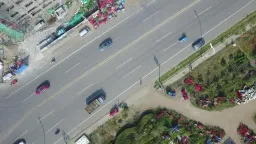
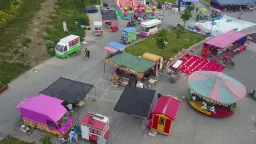
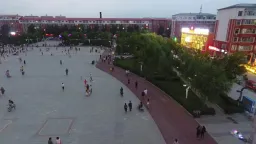
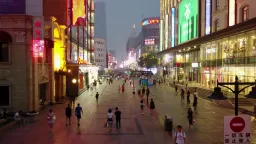
Der VisDrone-Datensatz ist ein umfangreicher Benchmark für Drohnenaufnahmen. Seine Teilmenge zur Objekterkennung (VisDrone2019-DET) umfasst 8.629 Luftbilder – 6.471 Trainings-, 548 Validierungs- und 1.610 Test-dev-Bilder – mit Annotationen für 10 Objektklassen zur Objekterkennung. Erstellt wurde der Datensatz vom AISKYEYE-Team am Institut für maschinelles Lernen und Data Mining der Tianjin-Universität in China.
Ansehen: So trainierst du Ultralytics YOLO mit dem VisDrone-Datensatz | Erkennung aus der Luft | Vollständiges Tutorial 🚀
Der vollständige VisDrone-Benchmark umfasst 288 Videoclips (261.908 Einzelbilder) und 10.209 Standbilder, die mit drohnenmontierten Kameras in 14 verschiedenen Städten Chinas aufgenommen wurden. Die Aufnahmen zeigen städtische und ländliche Umgebungen, wenig und stark frequentierte Szenen sowie unterschiedliche Wetter- und Lichtverhältnisse. Die Einzelbilder enthalten insgesamt über 2,6 Millionen manuell annotierte Begrenzungsrahmen mit zusätzlichen Attributen wie Sichtbarkeit der Szene, Objektklasse und Verdeckung. Die Ultralytics-Konfiguration VisDrone.yaml verwendet die Teilmenge der Standbilder VisDrone2019-DET aus diesem Benchmark.
Wichtige Funktionen#
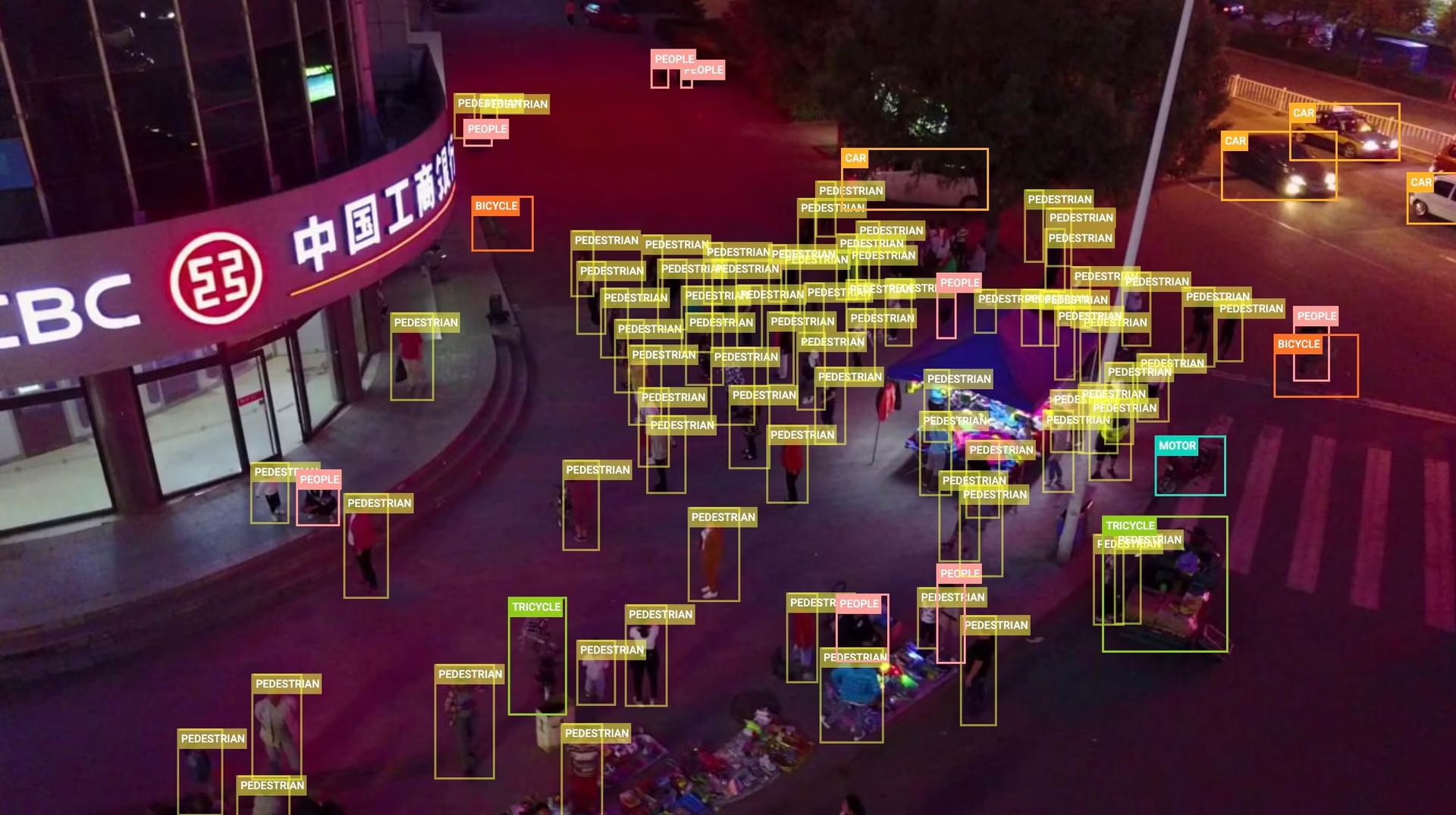
- Kleine, dicht gedrängte Objekte: Aus der Luft betrachtet sind die Ziele winzig und liegen dicht beieinander – allein die 548 Validierungsbilder enthalten 38.759 markierte Rahmen, also durchschnittlich etwa 70 Objekte pro Bild.
- Vielfältige Szenen: Aufnahmen aus 14 chinesischen Städten, die städtische und ländliche Gebiete, Tag und Nacht sowie unterschiedliche Wetterbedingungen abdecken.
- Umfangreiche Annotationen: Über 2,6 Millionen Rahmen im gesamten Benchmark, ergänzt um Angaben zu Verdeckung und Sichtbarkeit.
- Festgelegte Splits: Feste Trainings-, Validierungs- und Test-dev-Splits (6.471 / 548 / 1.610 Bilder) ermöglichen eine einheitliche Auswertung.
Datensatzstruktur#
Die Ultralytics-Konfiguration für VisDrone umfasst die Bildteilmenge VisDrone2019-DET, die in drei Teile unterteilt ist:
| Aufteilung | Bilder | Beschreibung |
|---|---|---|
| Trainieren | 6,471 | Beschriftete Luftbilder, die zum Trainieren des Detektors verwendet werden |
| Validierung | 548 | Bilder, die während der Entwicklung zur Auswertung verwendet werden |
| Test-dev | 1,610 | Zurückgehaltene Bilder zur abschließenden Auswertung des trainierten Modells |
Ein vierter Split, test-challenge (1.580 Bilder), bleibt für den VisDrone-Wettbewerb zurückgehalten und wird nicht heruntergeladen. Deshalb umfasst der vollständige DET-Satz insgesamt 10.209 Bilder.
Der Datensatz annotiert 10 Objektklassen: Fußgänger, Personen, Fahrräder, Autos, Lieferwagen, Lastwagen, Dreiräder, Dreiräder mit Verdeck, Busse und Motorräder. VisDrone unterscheidet zwischen pedestrian (einer stehenden oder gehenden Person) und people (einer Person in jeder anderen Körperhaltung).
Beim ersten Verwenden konvertiert das Downloadskript die ursprünglichen VisDrone-Annotationen ins YOLO-Format und überspringt als ignoriert markierte Bereiche (wodurch auch die nicht verwendete Kategorie „others“ ausgeschlossen wird).
Anwendungsfälle#
Die dicht besetzten Szenen und winzigen Ziele in VisDrone machen den Datensatz zu einem Standardbenchmark für die Erkennung kleiner Objekte aus der Luft. Typische Anwendungen von Computer Vision mit Drohnen sind:
- Verkehrsüberwachung und Fahrzeugzählung mit UAVs
- Menschenmengenanalyse und Überwachung für die öffentliche Sicherheit
- Inspektion von Infrastruktur und Baustellen
- Forschung im Bereich Computer Vision zur Erkennung kleiner Objekte in unübersichtlichen Szenen
Weitere Benchmarks für Luftbilder findest du im satellitenorientierten xView-Datensatz oder im Datensatz mit orientierten Rahmen DOTA-v2.
YAML-Datei des Datensatzes#
Die Datei VisDrone.yaml definiert die Datensatzkonfiguration – die Datensatzpfade, Klassennamen und das Skript für den automatischen Download und die Konvertierung. Sie wird im Ultralytics-Repository unter https://github.com/ultralytics/ultralytics/blob/main/ultralytics/cfg/datasets/VisDrone.yaml gepflegt.
# Ultralytics 🚀 AGPL-3.0 License - https://ultralytics.com/license

# VisDrone2019-DET dataset https://github.com/VisDrone/VisDrone-Dataset by Tianjin University
# Documentation: https://docs.ultralytics.com/datasets/detect/visdrone
# Example usage: yolo train data=VisDrone.yaml
# parent
# ├── ultralytics
# └── datasets
#     └── VisDrone ← downloads here (~2 GB)

# Train/val/test sets as 1) dir: path/to/imgs, 2) file: path/to/imgs.txt, or 3) list: [path/to/imgs1, path/to/imgs2, ..]
path: VisDrone # dataset root dir
train: images/train # train images (relative to 'path') 6471 images
val: images/val # val images (relative to 'path') 548 images
test: images/test # test-dev images (optional) 1610 images

# Classes
names:
  0: pedestrian
  1: people
  2: bicycle
  3: car
  4: van
  5: truck
  6: tricycle
  7: awning-tricycle
  8: bus
  9: motor

# Download script/URL (optional) ---------------------------------------------------------------------------------------
download: |
  import os
  from pathlib import Path
  import shutil

  from ultralytics.utils.downloads import download
  from ultralytics.utils import ASSETS_URL, TQDM

  def visdrone2yolo(dir, split, source_name=None):
      """Convert VisDrone annotations to YOLO format with images/{split} and labels/{split} structure."""
      from PIL import Image

      source_dir = dir / (source_name or f"VisDrone2019-DET-{split}")
      images_dir = dir / "images" / split
      labels_dir = dir / "labels" / split
      labels_dir.mkdir(parents=True, exist_ok=True)

      # Move images to new structure
      if (source_images_dir := source_dir / "images").exists():
          images_dir.mkdir(parents=True, exist_ok=True)
          for img in source_images_dir.glob("*.jpg"):
              img.rename(images_dir / img.name)

      for f in TQDM((source_dir / "annotations").glob("*.txt"), desc=f"Converting {split}"):
          img_size = Image.open(images_dir / f.with_suffix(".jpg").name).size
          dw, dh = 1.0 / img_size[0], 1.0 / img_size[1]
          lines = []

          with open(f, encoding="utf-8") as file:
              for row in [x.split(",") for x in file.read().strip().splitlines()]:
                  if row[4] != "0":  # Skip ignored regions
                      x, y, w, h = map(int, row[:4])
                      cls = int(row[5]) - 1
                      # Convert to YOLO format
                      x_center, y_center = (x + w / 2) * dw, (y + h / 2) * dh
                      w_norm, h_norm = w * dw, h * dh
                      lines.append(f"{cls} {x_center:.6f} {y_center:.6f} {w_norm:.6f} {h_norm:.6f}\n")

          (labels_dir / f.name).write_text("".join(lines), encoding="utf-8")

  # Download (ignores test-challenge split)
  dir = Path(yaml["path"])  # dataset root dir
  urls = [
      f"{ASSETS_URL}/VisDrone2019-DET-train.zip",
      f"{ASSETS_URL}/VisDrone2019-DET-val.zip",
      f"{ASSETS_URL}/VisDrone2019-DET-test-dev.zip",
      # f"{ASSETS_URL}/VisDrone2019-DET-test-challenge.zip",
  ]
  download(urls, dir=dir, threads=4)

  # Convert
  splits = {"VisDrone2019-DET-train": "train", "VisDrone2019-DET-val": "val", "VisDrone2019-DET-test-dev": "test"}
  for folder, split in splits.items():
      visdrone2yolo(dir, split, folder)  # convert VisDrone annotations to YOLO labels
shutil.rmtree(dir / folder) # cleanup original directoryVerwendung#
VisDrone wird beim ersten Training automatisch heruntergeladen – drei Archive mit insgesamt etwa 2 GB – und benötigt während des Entpackens und der Konvertierung ungefähr 4 GB freien Speicherplatz.
Um ein YOLO26n-Modell 100 Epochen lang mit Bildgröße 640 auf dem VisDrone-Datensatz zu trainieren, kannst du die folgenden Codeausschnitte verwenden.
from ultralytics import YOLO

# Ein Modell laden
model = YOLO("yolo26n.pt")  # ein vortrainiertes Modell laden (für das Training empfohlen)

# Modell trainieren – der Datensatz wird beim ersten Ausführen automatisch heruntergeladen
results = model.train(data="VisDrone.yaml", epochs=100, imgsz=640)
Um zusätzliche Luftbilder zu beschriften und VisDrone-Trainingsläufe im Browser zu verwalten, nutze die Ultralytics-Plattform.
Beispieldaten und Annotationen#
Das folgende Beispiel zeigt eine typische VisDrone-Szene: eine Luftaufnahme einer stark befahrenen Straße, auf der Fußgänger und Fahrzeuge als kleine, dicht gedrängte Ziele erscheinen und sich häufig teilweise gegenseitig verdecken.
Zitate und Danksagungen#
Wenn du den VisDrone-Datensatz in deiner Forschung oder Entwicklungsarbeit verwendest, zitiere bitte die folgende Arbeit:
@ARTICLE{9573394,
  author={Zhu, Pengfei and Wen, Longyin and Du, Dawei and Bian, Xiao and Fan, Heng and Hu, Qinghua and Ling, Haibin},
  journal={IEEE Transactions on Pattern Analysis and Machine Intelligence},
  title={Detection and Tracking Meet Drones Challenge},
  year={2022},
  volume={44},
  number={11},
  pages={7380-7399},
  doi={10.1109/TPAMI.2021.3119563}}
Wir möchten dem AISKYEYE-Team am Institut für maschinelles Lernen und Data Mining der Tianjin-Universität in China danken, das den VisDrone-Datensatz erstellt und gepflegt hat. Weitere Informationen findest du im GitHub-Repository des VisDrone-Datensatzes.
Häufig gestellte Fragen#
VisDrone wird zum Trainieren und Bewerten von Detektoren auf Drohnenaufnahmen verwendet, in denen Objekte klein und dicht gedrängt sind und aus der Vogelperspektive zu sehen sind. Die Kombination aus Luftperspektive, dicht bevölkerten Szenen und vielfältigen Bedingungen macht den Datensatz zu einem Standardtestfeld für die UAV-basierte Verkehrsüberwachung, die Analyse von Menschenmengen und die Forschung zur Erkennung kleiner Objekte.
Die Ultralytics-Konfiguration für VisDrone enthält 8.629 Bilder: 6.471 Trainingsbilder, 548 Validierungsbilder und 1.610 Testbilder (test-dev). Alle Splits haben dieselben 10 Klassen: Fußgänger, Personen, Fahrräder, Autos, Lieferwagen, Lastwagen, Dreiräder, Dreiräder mit Verdeck, Busse und Motorräder. Die vollständige Aufschlüsselung findest du unter Datensatzstruktur.
VisDrone wird beim ersten Training mit
data="VisDrone.yaml"automatisch heruntergeladen – manuelle Schritte sind nicht erforderlich. Das Skript lädt drei Archive (etwa 2 GB) aus den GitHub-Release-Dateien von Ultralytics herunter und konvertiert die Annotationen ins YOLO-Format. Der für den Wettbewerb zurückgehaltene test-challenge-Split ist nicht enthalten.Trainiere ein YOLO26n-Modell 100 Epochen lang mit VisDrone und einer Bildgröße von 640:
Trainingsbeispielfrom ultralytics import YOLO # Ein Modell laden model = YOLO("yolo26n.pt") # ein vortrainiertes Modell laden (für das Training empfohlen) # Das Modell trainieren results = model.train(data="VisDrone.yaml", epochs=100, imgsz=640)Ausführliche Konfigurationen findest du auf der Seite Training und in den Tipps zum Modelltraining.
Objekte in VisDrone sind im Verhältnis zum Bildausschnitt winzig – oft nur wenige Dutzend Pixel groß – und treten in dichten, stark verdeckten Gruppen auf. Das stellt Detektoren vor Herausforderungen, die auf Bodenaufnahmen abgestimmt sind. Training und Vorhersagen mit höherer Auflösung (zum Beispiel
imgsz=1280mit einer kleineren Batch-Größe) erfassen kleine Ziele besser, und die Kachelung mit hoher Auflösung unterteilt große Bilder, sodass kleine Objekte einen größeren Anteil jedes Inferenzfensters einnehmen.Der vollständige VisDrone-Benchmark umfasst fünf Aufgaben – Objekterkennung in Bildern, Objekterkennung in Videos, Verfolgung einzelner Objekte, Verfolgung mehrerer Objekte und Zählung von Menschenmengen – mit 288 Videoclips und 10.209 Standbildern. Die Ultralytics-Konfiguration
VisDrone.yamldeckt nur die Objekterkennung in Bildern (VisDrone2019-DET) ab und lädt die 6.471 Trainings-, 548 Validierungs- und 1.610 Test-dev-Bilder herunter.Zitiere die Arbeit „Detection and Tracking Meet Drones Challenge“ (IEEE TPAMI, Bd. 44, Nr. 11, 2022, DOI 10.1109/TPAMI.2021.3119563); den vollständigen BibTeX-Eintrag findest du oben im Abschnitt Zitate und Danksagungen.


Kommentare24
Stell eine Frage, teile deine Ergebnisse oder hilf jemand anderem.
arpithavkhanapur1226-collab
Thank you for the suggestions. I’ve tried the recommended changes and checked the dataset, including removing the degenerate bounding box, but I’m still facing the NaN issue around epoch 30. The best mAP I’m getting is only around 33.2%, which is far below the expected performance. I’ve tried several approaches already, but I’m not able to figure out what is causing the instability. Could you please help me identify what might be going wrong or suggest what I should specifically check next? ,I have attached my code and result below ,I would really appreciate your guidance.
visdrone2.ipynb
 Paula DerrengerUltralytics
Please rerun a clean baseline with the official
VisDrone.yaml, pretrained weights, and defaults; after correcting annotations, delete all*.cachefiles in the dataset’slabelsdirectories, and restart the notebook kernel if Ultralytics was upgraded. If NaNs persist, share the complete text training log/traceback, exactmodel.train(...)arguments, Ultralytics version, and output fromyolo checks; also try a smaller learning rate and higherimgszsuch as1280, since VisDrone contains many tiny objects.
I’m training YOLOv12 on the VisDrone dataset, but I faced NaN losses after around epoch 29. I found a degenerate bounding box with zero height and removed it, but the NaN issue still occurred. I then tried DDPNet on VisDrone, but the validation performance started plateauing around epoch 14. Training is also very slow on a T4 (~4 hours for 12 epochs). Could you suggest what I should check or change to improve the training performance?
- Paula DerrengerUltralytics
After correcting every invalid/non-finite label and ensuring normalized boxes have positive width/height, delete all
*.cachefiles inside thelabelsdirectories before retraining. Establish a baseline with a pretrained Ultralytics model atimgsz=640; then inspectresults.png, per-class AP, and the confusion matrix before changing augmentation or resolution. VisDrone contains many tiny, dense objects, so higher resolution may improve accuracy but will substantially slow a T4; use ann/smodel and the largest stable batch first. If NaNs persist, please share the exact training command, complete text logs around the first NaN, Ultralytics version, andyolo checksoutput; see the VisDrone training guide and fine-tuning troubleshooting.
mslabdelhak29
Hello can you offre a pretrained model i need it and i dont have source to entrain for 100 epochs
 Glenn JocherUltralytics(bearbeitet)
Hi, we don’t currently provide an official YOLO model pretrained specifically on VisDrone, so the usual workflow is to start from a generic checkpoint like
yolo26n.ptand fine‑tune it on VisDrone; you can safely reduceepochs(e.g. 10–20) or train on a subset of the data in Colab to keep compute low, and the YOLO train mode docs show how to adjust these arguments.
ysharvit
I am looking for drone photos in desert area ( in order to develop rescue detection system (I volunteer in SAR unit)) Can I filter only desert BG pictures in your dataset?
- Glenn JocherUltralytics(bearbeitet)
VisDrone doesn’t include scene/terrain metadata like “desert” (it’s largely urban/traffic), so there’s no built‑in way to filter for desert backgrounds; for SAR you’ll want to gather desert drone imagery and fine‑tune a COCO‑pretrained YOLO26 using the dataset setup in the Datasets Overview or manage it end‑to‑end with Ultralytics Platform datasets.
fardinabbasi
It would be very useful if someone could provide a list of pretrained YOLO models for the VisDrone dataset that are compatible with Ultralytics.
- Glenn JocherUltralytics(bearbeitet)
Ultralytics doesn’t currently maintain an official list of VisDrone‑trained checkpoints; the recommended path is to fine‑tune a COCO‑pretrained YOLO26 variant (e.g.,
yolo26s.pt)—see the available base weights on the YOLO26 models page.
lawyeh
Hello, the example and the yaml file pull from the object detection in images dataset (task 1). How can I train the model for object detection in video (task )?
- Glenn JocherUltralytics
For video object detection (Task 2) with VisDrone, you'll use the same YOLO training process but process video frames as individual images. Ensure your dataset paths in VisDrone.yaml point to the video task's frame sequences (organized as images), then train normally. Video inference can be done with
model.predict(source='video.mp4')after training. For video-specific annotations, verify they're converted to YOLO format per frame.1
SudhanshuBlaze
I trained yolov10x on VisDrone dataset with the below parameters, but I got the final
box_lossof1.97. I feel that model performed very poorly, do you know what might be the issue? Or what hyperparameters should I use?from ultralytics import YOLO # Load a model model = YOLO("yolov10x.pt") # load a pretrained model (recommended for training) # Train the model results = model.train(data="VisDrone.yaml", epochs=1000, imgsz=640, patience=250, project='visdrone', name='train', batch=-1)- Glenn JocherUltralytics
@SudhanshuBlaze it sounds like your model might be struggling with the complexity of the VisDrone dataset. First, ensure you're using the latest version of the Ultralytics package. You might also want to experiment with different learning rates, batch sizes, and augmentation techniques. Sometimes, reducing the learning rate or increasing the batch size can help stabilize training. Additionally, consider using early stopping to prevent overfitting. If the issue persists, reviewing the dataset for any inconsistencies or mislabeled data could also be beneficial. For more detailed guidance, you can refer to the VisDrone documentation.
mariem158
quelles sont les étapes pour télécharger roboflow100 sur google colab. je veux utiliser ce dataset pour faire la détection précise des véhicules filmés par des caméras ?
- Paula DerrengerUltralytics(bearbeitet)
@mariem158 bonjour!
Pour télécharger et utiliser le dataset Roboflow100 sur Google Colab pour la détection précise des véhicules, vous pouvez suivre les étapes ci-dessous. Cependant, il semble que vous ayez mentionné le dataset VisDrone dans votre commentaire, donc je vais également inclure des informations sur ce dataset.
Étapes pour télécharger Roboflow100 sur Google Colab
-
Installer les dépendances nécessaires:
!pip install roboflow -
Importer et configurer Roboflow:
from roboflow import Roboflow rf = Roboflow(api_key="YOUR_API_KEY") project = rf.workspace().project("roboflow100") dataset = project.version("1").download("yolov8") -
Configurer le dataset pour l'entraînement:
from ultralytics import YOLO

# Charger un modèle pré-entraîné
model = YOLO("yolo26n.pt")

# Entraîner le modèle
results = model.train(data=dataset.location + "/data.yaml", epochs=100, imgsz=640)
Utilisation du dataset VisDrone
Le dataset VisDrone est une excellente ressource pour la détection d'objets, le suivi d'objets et le comptage de foules dans des images et vidéos capturées par des drones. Voici comment vous pouvez l'utiliser avec YOLO26:
-
Télécharger et configurer le dataset VisDrone:
from ultralytics import YOLO # Charger un modèle pré-entraîné model = YOLO("yolo26n.pt") # Entraîner le modèle results = model.train(data="VisDrone.yaml", epochs=100, imgsz=640) -
YAML de configuration pour VisDrone:
# Ultralytics YOLO 🚀, AGPL-3.0 license
# VisDrone2019-DET dataset https://github.com/VisDrone/VisDrone-Dataset by Tianjin University
path: ../datasets/VisDrone
train: VisDrone2019-DET-train/images
val: VisDrone2019-DET-val/images
test: VisDrone2019-DET-test-dev/images
names:
  0: pedestrian
  1: people
  2: bicycle
  3: car
  4: van
  5: truck
  6: tricycle
  7: awning-tricycle
  8: bus
  9: motor
Pour plus de détails sur l'utilisation du dataset VisDrone, vous pouvez consulter la documentation complète ici : VisDrone Dataset Documentation.
N'hésitez pas à revenir vers nous si vous avez d'autres questions! 😊
Cordialement, L'équipe Ultralytics
-
comment intégrer visdataset sur google colab et l'intégrer dans mon code qui détecte seulement des véhicules par des drones situé verticalement au dessus de la route.
- Paula DerrengerUltralytics(bearbeitet)
Bonjour,
Merci pour votre question ! Pour intégrer le dataset VisDrone dans Google Colab et l'utiliser pour détecter uniquement des véhicules capturés par des drones, voici les étapes à suivre :
-
Configurer Google Colab:
- Assurez-vous d'avoir accès à un GPU pour accélérer l'entraînement. Allez dans
Runtime>Change runtime typeet sélectionnezGPU.
- Assurez-vous d'avoir accès à un GPU pour accélérer l'entraînement. Allez dans
-
Installer les dépendances:
- Installez les bibliothèques nécessaires, notamment
ultralyticspour YOLO26.
- Installez les bibliothèques nécessaires, notamment
-
Télécharger et préparer le dataset VisDrone:
- Utilisez le script de téléchargement et de conversion fourni dans le fichier
VisDrone.yaml.
- Utilisez le script de téléchargement et de conversion fourni dans le fichier
-
Entraîner le modèle:
- Chargez un modèle pré-entraîné YOLO26 et entraînez-le sur le dataset VisDrone en filtrant uniquement les classes de véhicules.
Voici un exemple de code pour chaque étape :
# Installer les dépendances
!pip install ultralytics

# Importer les bibliothèques nécessaires
from ultralytics import YOLO
import os
from pathlib import Path

# Télécharger et préparer le dataset VisDrone
def download_visdrone():
    from ultralytics.utils.downloads import download

    def visdrone2yolo(dir):
        from PIL import Image
        from tqdm import tqdm

        def convert_box(size, box):
            dw = 1. / size[0]
            dh = 1. / size[1]
            return (box[0] + box[2] / 2) * dw, (box[1] + box[3] / 2) * dh, box[2] * dw, box[3] * dh

        (dir / 'labels').mkdir(parents=True, exist_ok=True)
        pbar = tqdm((dir / 'annotations').glob('*.txt'), desc=f'Converting {dir}')
        for f in pbar:
            img_size = Image.open((dir / 'images' / f.name).with_suffix('.jpg')).size
            lines = []
            with open(f, 'r') as file:
                for row in [x.split(',') for x in file.read().strip().splitlines()]:
                    if row[4] == '0':
                        continue
                    cls = int(row[5]) - 1
                    box = convert_box(img_size, tuple(map(int, row[:4])))
                    lines.append(f"{cls} {' '.join(f'{x:.6f}' for x in box)}\n")
                with open(str(f).replace(f'{os.sep}annotations{os.sep}', f'{os.sep}labels{os.sep}'), 'w') as fl:
                    fl.writelines(lines)

    dir = Path('../datasets/VisDrone')
    urls = [
        'https://github.com/ultralytics/yolov5/releases/download/v1.0/VisDrone2019-DET-train.zip',
        'https://github.com/ultralytics/yolov5/releases/download/v1.0/VisDrone2019-DET-val.zip',
        'https://github.com/ultralytics/yolov5/releases/download/v1.0/VisDrone2019-DET-test-dev.zip',
        'https://github.com/ultralytics/yolov5/releases/download/v1.0/VisDrone2019-DET-test-challenge.zip'
    ]
    download(urls, dir=dir, curl=True, threads=4)
    for d in ['VisDrone2019-DET-train', 'VisDrone2019-DET-val', 'VisDrone2019-DET-test-dev']:
        visdrone2yolo(dir / d)

download_visdrone()

# Entraîner le modèle YOLO26 sur le dataset VisDrone
model = YOLO("yolo26n.pt")  # Charger un modèle pré-entraîné
results = model.train(data="VisDrone.yaml", epochs=100, imgsz=640)
Pour plus de détails sur la configuration du dataset et les options d'entraînement, vous pouvez consulter la documentation complète ici.
N'hésitez pas à revenir vers nous si vous avez d'autres questions. Bonne chance avec votre projet ! 🚀
Cordialement, L'équipe Ultralytics
-
comment je peux utiliser les modèles de visdrone et faire l'appel à ce dataset dans mon code pour faire la détection des véhicules par mon drone?
- Paula DerrengerUltralytics(bearbeitet)
Bonjour,
Merci pour votre question ! Pour utiliser le dataset VisDrone et détecter uniquement les véhicules capturés par des drones, voici comment procéder sur Google Colab :
-
Configurer Google Colab:
- Assurez-vous d'avoir accès à un GPU pour accélérer l'entraînement. Allez dans
Runtime>Change runtime typeet sélectionnezGPU.
- Assurez-vous d'avoir accès à un GPU pour accélérer l'entraînement. Allez dans
-
Installer les dépendances:
- Installez les bibliothèques nécessaires, notamment
ultralyticspour YOLO26.
- Installez les bibliothèques nécessaires, notamment
-
Télécharger et préparer le dataset VisDrone:
- Utilisez le script de téléchargement et de conversion fourni dans le fichier
VisDrone.yaml.
- Utilisez le script de téléchargement et de conversion fourni dans le fichier
-
Entraîner le modèle:
- Chargez un modèle pré-entraîné YOLO26 et entraînez-le sur le dataset VisDrone en filtrant uniquement les classes de véhicules.
Voici un exemple de code pour chaque étape :
# Installer les dépendances
!pip install ultralytics

# Importer les bibliothèques nécessaires
from ultralytics import YOLO
import os
from pathlib import Path

# Télécharger et préparer le dataset VisDrone
def download_visdrone():
    from ultralytics.utils.downloads import download

    def visdrone2yolo(dir):
        from PIL import Image
        from tqdm import tqdm

        def convert_box(size, box):
            dw = 1. / size[0]
            dh = 1. / size[1]
            return (box[0] + box[2] / 2) * dw, (box[1] + box[3] / 2) * dh, box[2] * dw, box[3] * dh

        (dir / 'labels').mkdir(parents=True, exist_ok=True)
        pbar = tqdm((dir / 'annotations').glob('*.txt'), desc=f'Converting {dir}')
        for f in pbar:
            img_size = Image.open((dir / 'images' / f.name).with_suffix('.jpg')).size
            lines = []
            with open(f, 'r') as file:
                for row in [x.split(',') for x in file.read().strip().splitlines()]:
                    if row[4] == '0':
                        continue
                    cls = int(row[5]) - 1
                    box = convert_box(img_size, tuple(map(int, row[:4])))
                    lines.append(f"{cls} {' '.join(f'{x:.6f}' for x in box)}\n")
                with open(str(f).replace(f'{os.sep}annotations{os.sep}', f'{os.sep}labels{os.sep}'), 'w') as fl:
                    fl.writelines(lines)

    dir = Path('../datasets/VisDrone')
    urls = [
        'https://github.com/ultralytics/yolov5/releases/download/v1.0/VisDrone2019-DET-train.zip',
        'https://github.com/ultralytics/yolov5/releases/download/v1.0/VisDrone2019-DET-val.zip',
        'https://github.com/ultralytics/yolov5/releases/download/v1.0/VisDrone2019-DET-test-dev.zip',
        'https://github.com/ultralytics/yolov5/releases/download/v1.0/VisDrone2019-DET-test-challenge.zip'
    ]
    download(urls, dir=dir, curl=True, threads=4)
    for d in ['VisDrone2019-DET-train', 'VisDrone2019-DET-val', 'VisDrone2019-DET-test-dev']:
        visdrone2yolo(dir / d)

download_visdrone()

# Entraîner le modèle YOLO26 sur le dataset VisDrone
model = YOLO("yolo26n.pt")  # Charger un modèle pré-entraîné
results = model.train(data="VisDrone.yaml", epochs=100, imgsz=640)
Pour plus de détails sur la configuration du dataset et les options d'entraînement, vous pouvez consulter la documentation complète ici.
N'hésitez pas à revenir vers nous si vous avez d'autres questions. Bonne chance avec votre projet ! 🚀
Cordialement, L'équipe Ultralytics
-
Elvis-Kiilu2
This is nice, but what's next after the detection? How do we send/retrieve the data to a given database? What further insights can we draw from the detected data? What other technologies can we intergrate to this to draw meaningful inferences??
- Paula DerrengerUltralytics(bearbeitet)
After detection, you have a few options to extend the functionality:
-
Data Storage: To send and store detections on a database:
import sqlite3 from datetime import datetime from ultralytics import YOLO # Connect to SQLite database connection = sqlite3.connect('my_detections.db') cursor = connection.cursor() # Create table cursor.execute('''CREATE TABLE IF NOT EXISTS detections (timestamp DATETIME, class TEXT, confidence REAL, x REAL, y REAL, width REAL, height REAL)''') # Example insertion from detection results = YOLO("yolo26n.pt")("image.jpg")[0] names = results.names timestamp = datetime.now().isoformat() for det in results.boxes: cursor.execute('''INSERT INTO detections (timestamp, class, confidence, x, y, width, height) VALUES (?, ?, ?, ?, ?, ?, ?)''', (timestamp, names[int(det.cls)], float(det.conf), *det.xywh[0].tolist())) connection.commit() connection.close() -
Further Analysis: Analyze the time series of detections to observe trends, detect anomalies, or aggregate counts over time.
-
Integration with Other Technologies: Integrate with IoT platforms for real-time alerts or incorporate AI-based services for enhanced image analysis and decision-making processes.
These steps help bridge the gap between raw detection outputs and actionable insights or responses in real-world applications.
-
Thanks @pderrenger for the reply. I wanted to implement this for my next project. Your insights are a good starting point. My aim is to extract/read data from the detected class/boxes. Then compare and match the read data with with those in a database that in a cloud data warehouse, Bigquery to be specific.
- Paula DerrengerUltralytics
Hey there! It's great to hear you're planning to use YOLOv8 for your project. To extract and compare data from detected objects with your BigQuery database, you can follow these steps:
-
Extract Data: After detection, extract the necessary details from each detection (like class, confidence, and bounding box coordinates).
-
Format Data: Convert this data into a suitable format (like JSON or CSV) that can be easily ingested into BigQuery.
-
Upload to BigQuery: Use the BigQuery API to upload your formatted data. Here’s a small Python snippet using
google-cloud-bigquery:from google.cloud import bigquery # Construct a BigQuery client object. client = bigquery.Client() # Define your table ID (dataset.table) table_id = "your-project.your_dataset.your_table" # Define the data to be inserted rows_to_insert = [ {u"class": detected_class, u"confidence": confidence, u"x_min": x_min, u"y_min": y_min, u"width": width, u"height": height} ] # Insert data into BigQuery errors = client.insert_rows_json(table_id, rows_to_insert) if errors == []: print("New rows have been added.") -
Query and Analyze: Once your data is in BigQuery, you can use SQL queries to compare, analyze, and draw insights based on your specific needs.
This workflow will help you leverage the power of cloud computing to analyze large datasets efficiently. If you need further assistance or have more specific requirements, feel free to ask! 🚀
-