Ultralytics YOLOのMLflow統合
はじめに#
実験管理は、機械学習のワークフローに欠かせない要素です。メトリクス、パラメーター、成果物を記録することで、結果の再現、問題のデバッグ、モデル性能の改善が可能になります。リアルタイムの物体検出機能で知られるUltralytics YOLOは、機械学習ライフサイクル全体を管理するオープンソースプラットフォームのMLflowと連携します。
このガイドでは、Ultralytics YOLOプロジェクトでMLflowのロギングを設定して使用する方法を説明します。
MLflowとは何ですか?#
MLflowは、Databricksが開発したオープンソースのプラットフォームで、機械学習ライフサイクル全体を管理します。実験の追跡、再現可能な実行環境としてのコードのパッケージ化、モデルの共有とデプロイを行うためのツールが含まれています。MLflowは、あらゆる機械学習ライブラリおよびプログラミング言語で動作するように設計されています。
機能#
- メトリクスの記録: 各エポックの終了時に、学習率、学習損失、検証メトリクスを記録します。
- パラメーターのログ記録: 学習で使用したすべてのパラメーターを記録します。
- 成果物のログ記録: 学習の終了時に、重みや設定ファイルなどのモデル成果物を記録します。
セットアップと前提条件#
MLflowがインストールされていることを確認してください。インストールされていない場合は、pipを使ってインストールします。
pip install mlflowUltralyticsの設定にあるmlflowキーによって、MLflowのログ記録はデフォルトで有効になっています。無効にした場合は、再度有効にしてください。
Python環境で、settingsオブジェクトのupdateメソッドを呼び出して設定を変更します。
from ultralytics import settings

# 設定を更新
settings.update({"mlflow": True})

# 設定をデフォルト値にリセット
settings.reset()使用方法#
コマンド#
-
プロジェクト名を設定する: 環境変数を使ってプロジェクト名を設定できます。
export MLFLOW_EXPERIMENT_NAME=YOUR_EXPERIMENT_NAMEYOLOモデルの学習時に
project=<project>引数を使用することもできます。例:yolo train project=my_project -
実行名を設定する: プロジェクト名の設定と同様に、環境変数を使って実行名を設定できます。
export MLFLOW_RUN=YOUR_RUN_NAMEYOLOモデルの学習時に
name=<name>引数を使用することもできます。例:yolo train project=my_project name=my_name -
ローカル MLflow サーバーを起動する:
MLFLOW_TRACKING_URIを指定しない場合、実行結果は学習を実行するディレクトリにある MLflow のデフォルトのローカルストアに記録されます(MLflow 3.7 以降では、ディレクトリにmlruns/の履歴がすでに存在する場合を除き、mlflow.dbに記録されます。それ以前のバージョンではmlruns/に記録されます)。実行結果を表示するには、同じディレクトリから次のコマンドを実行します。mlflow uiデフォルトでは、これにより
http://127.0.0.1:5000でローカルサーバーが起動します。学習の実行結果を別のトラッキングサーバーに送信するには、学習を開始する前にMLFLOW_TRACKING_URIをエクスポートします。export MLFLOW_TRACKING_URI=http://127.0.0.1:5000 -
トレーニング後もMLflowのRunをアクティブに保つ: デフォルトでは、トレーニングが終了すると、Ultralyticsは自ら開始したMLflowのRunを終了します。Runを閉じる前にトレーニングでエラーが発生した場合、ステータスは
FAILEDになります。トレーニング前に自分で開始したRunは再利用され、開いたままになります。Runを開いたままにするには(たとえば、同じノートブックから追加のメトリクスやアーティファクトを記録する場合)、トレーニング前にMLFLOW_KEEP_RUN_ACTIVEをTrueに設定します。export MLFLOW_KEEP_RUN_ACTIVE=True1、true、yes、on、y、tの値を指定すると、この動作が有効になります(大文字と小文字は区別されません)。それ以外の値(変数が未設定の場合を含む)では、実行はデフォルトどおり終了します。その後、mlflow.end_run()を使って手動で終了することを忘れないでください。
ロギング#
ログ記録は、on_pretrain_routine_end、on_train_epoch_end、on_fit_epoch_end、on_train_end のコールバック関数によって処理されます。これらの関数は、トレーニングプロセスの各段階で自動的に呼び出され、パラメーター、メトリクス、アーティファクトのログ記録を処理します。teardown コールバックは、トレーニングの失敗後に開いたままになった Run を終了します。
例#
-
カスタムメトリクスのログ記録:
on_fit_epoch_endの呼び出し前にtrainer.metricsの辞書を変更することで、ログに記録するカスタムメトリクスを追加できます。 -
実験の表示: ログを表示するには、MLflowサーバー(通常は
http://127.0.0.1:5000)に移動し、実験と実行を選択します。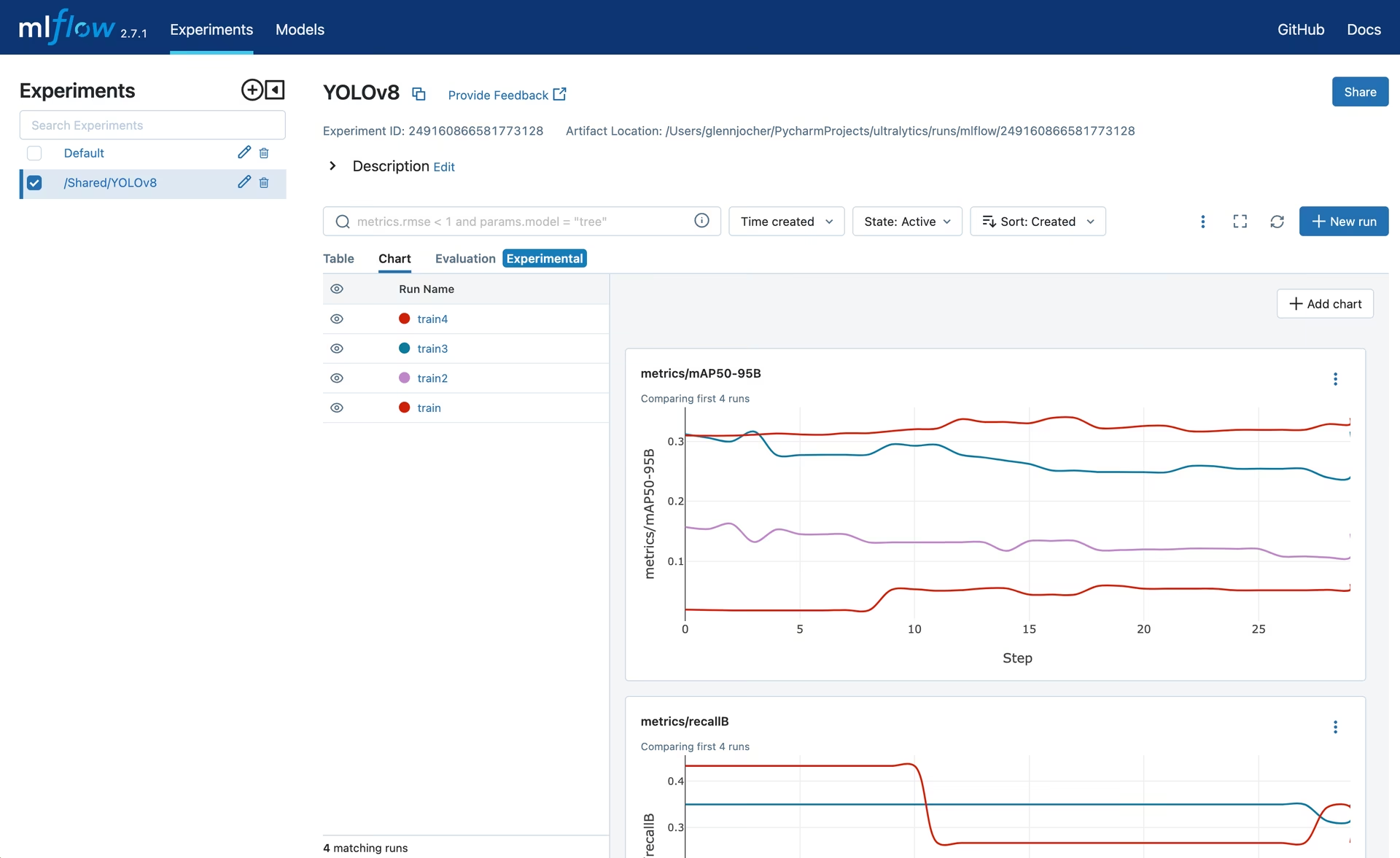
-
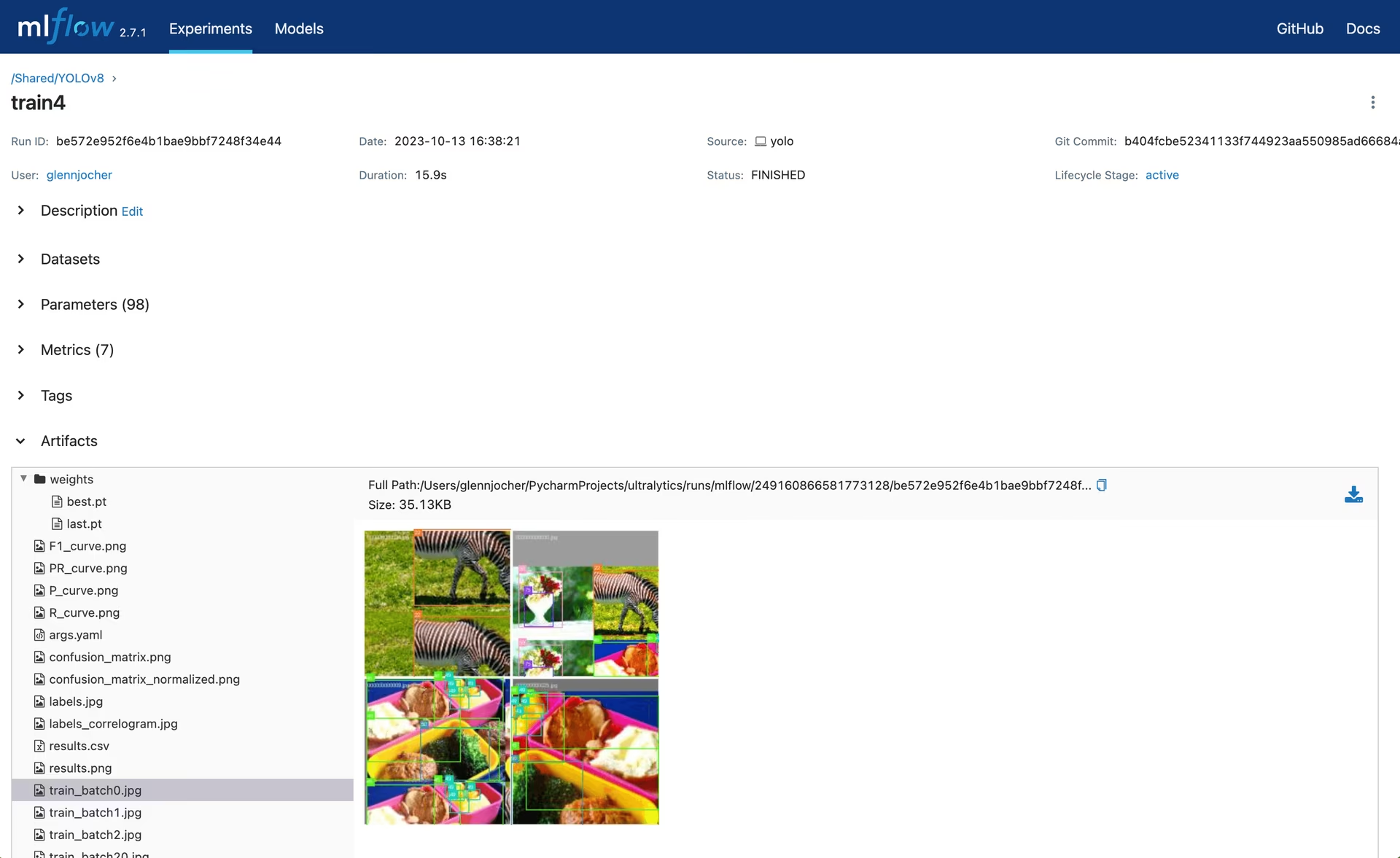
実行の表示: 実行とは、実験内の個々のモデルを指します。実行をクリックすると、アップロードされた成果物やモデルの重みなどの詳細を確認できます。
MLflowを無効にする#
MLflowのログ記録をオフにするには、次の手順に従います。
yolo settings mlflow=False結論#
MLflowとUltralytics YOLOのロギング連携により、機械学習の実験を簡単に追跡できます。モデルの開発からデプロイまで、性能メトリクスの監視と成果物の管理が可能です。
よくある質問#
Ultralytics YOLOでMLflowのログ記録を設定するには、まずMLflowがインストールされていることを確認します。pipを使ってインストールできます。
pip install mlflowUltralyticsの設定にある
mlflowキーによって、MLflowのログ記録はデフォルトで有効になっています。無効にした場合は、再度有効にしてください。UltralyticsのMLflow設定を更新するfrom ultralytics import settings # 設定を更新 settings.update({"mlflow": True}) # 設定をデフォルト値にリセット settings.reset()最後に、学習後、学習を実行したディレクトリからローカル MLflow サーバーを起動して、実行結果を表示します。
mlflow uiUltralytics YOLOとMLflowでは、学習プロセス全体を通じて、さまざまなメトリクス、パラメーター、成果物を記録できます。
- メトリクスのログ記録: 各エポックの終了時とトレーニング完了時にメトリクスを追跡します。
- パラメーターのログ記録: トレーニングプロセスで使用されたすべてのパラメーターを記録します。
- アーティファクトのログ記録: トレーニング後に、重みや設定ファイルなどのモデルアーティファクトを保存します。
はい、設定を更新することで、Ultralytics YOLOのMLflowログ記録を無効にできます。CLIを使用する手順は次のとおりです。
yolo settings mlflow=False設定のカスタマイズやリセットについては、設定ガイドをご覧ください。
ローカル MLflow サーバーで Ultralytics YOLO の実験を表示するには、学習を実行したディレクトリから次のコマンドを実行します。
mlflow uiこのコマンドを実行すると、デフォルトで
http://127.0.0.1:5000にローカルサーバーが起動します。サーバーを停止するには、そのターミナルでCtrl+Cを押します。コマンドの詳細については、コマンドのセクションをご覧ください。
トレーニングの前に、
MLFLOW_KEEP_RUN_ACTIVE環境変数をTrueに設定します。export MLFLOW_KEEP_RUN_ACTIVE=Trueデフォルト値は
Falseなので、トレーニングが完了するとUltralyticsは自ら開始したRunに対してmlflow.end_run()を呼び出します。MLFLOW_KEEP_RUN_ACTIVE=Trueを設定するとRunは開いたままになるため、同じPythonセッションから追加のメトリクス、パラメーター、アーティファクトを記録できます。完了後はmlflow.end_run()で自分でRunを閉じてください。1、true、yes、on、y、tの値を指定すると、この動作が有効になります(大文字と小文字は区別されません)。MLflowをUltralytics YOLOと統合すると、機械学習の実験管理にいくつかのメリットがあります。
- 実験管理の強化: 異なる実行とその結果を追跡して比較できます。
- モデルの再現性向上: すべてのパラメーターとアーティファクトをログに記録することで、実験の再現性を確保できます。
- パフォーマンスの監視: パフォーマンスメトリクスを時系列で可視化し、データに基づいてモデル改善の判断を行えます。
- ワークフローの効率化: ログ記録を自動化することで、手動での追跡ではなくモデル開発に集中できます。
- 共同開発: 実験結果をチームメンバーと共有し、連携や知識共有を促進できます。


コメント30
質問したり、結果を共有したり、ほかの人をサポートしたりできます。
UltralyticsAssistantUltralytics
👋 Bonjour, merci pour votre intérêt pour Ultralytics 🚀! Nous vous recommandons de consulter notre documentation complète sur les Intégrations MLflow pour découvrir comment configurer et utiliser MLflow avec Ultralytics YOLO afin d'améliorer le suivi des expériences et la reproductibilité des modèles.
Si ceci est un 🐛 Rapport de bug, veuillez fournir un exemple minimal reproductible pour nous aider à résoudre le problème.
Si vous avez une ❓ Question ou besoin d’aide avec la configuration MLflow, n'hésitez pas à partager plus de détails, tels que votre environnement d'exécution, les étapes effectuées et les éventuels messages d'erreur rencontrés.
Mise à jour
Assurez-vous que vous utilisez la version la plus récente d’
ultralyticsavec toutes les dépendances dans un environnement Python>=3.8 et PyTorch>=1.8. Vous pouvez mettre à jour avec la commande suivante :pip install -U ultralyticsEnvironnements
Vous pouvez exécuter YOLO dans les environnements suivants avec MLflow :
- Notebooks avec GPU gratuit :


- Cloud : Consultez nos guides rapides pour GCP et AWS.
- Docker Image : Consultez notre guide Docker
.
Communauté
Rejoignez la communauté Ultralytics où cela vous convient le mieux ! Pour des discussions en temps réel, rendez-vous sur notre Discord 🎧. Pour des discussions approfondies, visitez notre Discourse, ou échangez avec la communauté sur notre Subreddit.
Statut

Si ce badge est vert, tous les tests Ultralytics CI sont actuellement réussis, garantissant le bon fonctionnement de toutes les Modes et Tâches sur macOS, Windows et Ubuntu.
Ceci est une réponse automatisée 🤖. Un ingénieur Ultralytics examinera également votre discussion prochainement. 😊
 Glenn JocherUltralytics
Bonjour! Cette discussion est dédiée à l'intégration de MLflow avec Ultralytics YOLO. MLflow est un excellent outil pour suivre vos expériences, mesurer les performances et gérer les artefacts de vos modèles YOLO.
N'hésitez pas à poser vos questions sur cette intégration dans les commentaires ci-dessous. Notre équipe Ultralytics sera ravie de vous aider avec la configuration, le suivi des expériences ou tout problème que vous pourriez rencontrer.
Si vous utilisez déjà MLflow avec Ultralytics, nous serions également intéressés par vos retours d'expérience et vos cas d'utilisation.
- Notebooks avec GPU gratuit :
BlitzBricksterYY-db
For multiple GPU training a YOLO model, with autolog enabled and also I manually logged a few items by using mlflow.log_xxx() and I also logged the customized PyFunc model, it turns out to be multiple runs are generated per training.
I want to only have 1 run and it better have all the logged artifacts.
- Can you give a best practice advice?
- which GPU rank in a multiple GPU training is used for autologging purpose? I suppose is it the highest rank GPU?
Thanks Best, Yang
my code example:
from pyspark.ml.torch.distributor import TorchDistributor settings.update({"mlflow":True}) # if you do want to autolog. mlflow.autolog(disable = False) def train_fn(): from ultralytics import YOLO import torch import mlflow import torch.distributed as dist from ultralytics import settings from mlflow.types.schema import Schema, ColSpec from mlflow.models.signature import ModelSignature model = YOLO(f"{project_location}/raw_model/yolov8n.pt") model.train( batch=8, device=[0, 1], data="./coco8.yaml", # ref: https://github.com/ultralytics/ultralytics/blob/main/ultralytics/cfg/datasets/coco8.yaml epochs=5, project=f'{tmp_project_location}', exist_ok=True, fliplr=1, flipud=1, perspective=0.001, degrees=.45 ) # after training is done. if not dist.is_initialized(): # import torch.distributed as dist dist.init_process_group("nccl") rank = dist.get_rank() # we divert all other manual logging to the last GPU with max rank. if rank == torch.cuda.device_count() - 1: mlflow.log_params({"rank":rank}) yolo_wrapper = YOLOC(model.trainer.best) mlflow.pyfunc.log_model( artifact_path="model", artifacts={'model_path': str(model.trainer.save_dir), "best_point": str(model.trainer.best)}, python_model=yolo_wrapper, signature=signature ) mlflow.end_run() experiment_name = "/Users/yang.yang@databricks.com/ConvaTec Workshop Computer Vision/Experiments_YOLO_CoCo" mlflow.set_experiment(experiment_name) experiment_id = mlflow.get_experiment_by_name(experiment_name).experiment_id # os.environ['MLFLOW_EXPERIMENT_NAME'] = experiment_name os.environ['MLFLOW_EXPERIMENT_ID'] = experiment_id os.environ['MLFLOW_ENABLE_SYSTEM_METRICS_LOGGING'] = "true" with mlflow.start_run(experiment_id = experiment_id) as run: print("Active run_id: {}".format(run.info.run_id)) os.environ['MLFLOW_RUN_ID'] = run.info.run_id # try to register under the same run distributor = TorchDistributor(num_processes=2, local_mode=True, use_gpu=True ) distributor.run(train_fn)Also, is it possible to enable multi-GPU training to use the project folder on Databricks Unity Catalog Volume directory?
e.g.,
project=f'{tmp_project_location}',from above code in themodel.train()args.- Glenn JocherUltralytics
To achieve a single MLflow run during multi-GPU training, ensure manual logging is executed only once, typically on the main GPU (rank 0). For project directories, you can specify the Unity Catalog Volume directory by setting the
projectparameter to your desired path. This should work as expected on Databricks. If you encounter issues, verify the permissions and path configurations for the Unity Catalog Volume. I have tested, in multi-GPU settings,
- dbfs path wont work in
project= - Unity Catalog path wont work in
project= - VM path such as
project='/tmp/project/'works.
I have included in the
train_fn()the os.environ() for both databricks_host and databricks_pat (token). This doesn't help.In a single GPU setting, these all work.
I suspect the credential env vars are not passed correctly to worker GPUs or threads. Could you verify?
- dbfs path wont work in
2nd Issue: for autologging system metrics, there are confusions of logging each node, each GPU's system metrics into the MLflow run.
What is the best practice if I have two nodes and each node has two GPUs? for each node, it has GPU 0 and GPU 1 as local rank.
-
Plan A I tried: Logging all into the same MLflow run will yield 2 GPUs. Looks like overwritten issues happened between two nodes.
-
Logging into 4 different mlflow runs (each GPU created a run), then each run has its own GPU 0 and GPU 1, in total, I have 2*4 = 8 GPU system metrics, there must be duplications there.
What is the right way to do that?
-
- Glenn JocherUltralytics
@BlitzBricksterYY-db to avoid overwriting issues during multi-GPU and multi-node training with MLflow autologging, the best practice is usually to log system metrics from only the primary GPU (rank 0) on each node. This ensures unique entries and avoids duplication or conflicts. Configure logging in your script such that only rank 0 GPUs per node execute the logging logic. Let us know if further clarification is needed!
For system metrics like memory and network bandwidth usage, it is automatically done in the .train() function. I have the need to monitor each GPU on each node, i.e., [[0,1],[0,1]], what is the best way to achieve that? Automatically logging system metrics will overwritten each other cause only record GPU_0 and GPU_1, no matter it is node_0 or node_1.
I know for now single node with multiGPU is a clear solution as it is [0,1,2,3], logged perfectly by your auto logging within .train()
- Glenn JocherUltralytics
@BlitzBricksterYY-db to monitor system metrics for each GPU on each node in a multi-node, multi-GPU setup, the best approach is to disable automatic MLflow autologging for system metrics and implement custom logging. You can use GPU-specific identifiers (e.g., node rank and GPU local rank) to avoid overwriting and ensure distinct logs for each GPU. For assistance with custom implementations, refer to the MLflow documentation. Let us know if further clarification is needed!
1
vini-c-costa
Hey
I'm facing a strange situation between yolov8 and mlflow. I created a local container to run a postgres environment, and then I tried the following script:
import pandas as pd
from ultralytics import YOLO, settings
import os
import json
import mlflow


settings.reset()

settings.update({
    'mlflow': True,
    'clearml': False,
    'comet': False,
    'dvc': False,
    'hub': False,
    'neptune': False,
    'raytune': False,
    'tensorboard': False,
    'wandb': False
})

mlflow.set_experiment("Teste 01")
mlflow.set_tracking_uri("postgresql://user:senha@localhost:5432/postgres")

model_name = "yolov8n-cls.pt"
model = YOLO(model_name)
epochs = 3
image_size = 128

with mlflow.start_run(run_name=f'{model_name}-{epochs}-{image_size}'):
    model.train(name=f'{model_name}-{epochs}-{image_size}', data='dataset', epochs=epochs, imgsz=image_size, hsv_h=1, hsv_s=1, hsv_v=1)
The reason I maintained some mlflow configs out of with statement is because I would like to preserve all parameters, metrics and artifacts generated automatically by yolo-mlflow settings.
And the error I found was during the db creation: the experiment_id generated by yolo is bigger than serial4 type, which is the type used as postgres-mlflow default (a bigint type would solve I suppose). So, due to that, I'm facing the following error:
Traceback (most recent call last):
  File "/home/viniciusconti/miniconda3/envs/carbigdata_py310/lib/python3.10/site-packages/sqlalchemy/engine/base.py", line 1969, in _exec_single_context
    self.dialect.do_execute(
  File "/home/viniciusconti/miniconda3/envs/carbigdata_py310/lib/python3.10/site-packages/sqlalchemy/engine/default.py", line 922, in do_execute
    cursor.execute(statement, parameters)
psycopg2.errors.NumericValueOutOfRange: value "653626019723855191" is out of range for type integer
LINE 3: WHERE experiments.experiment_id = '653626019723855191' AND e...
                                          ^


The above exception was the direct cause of the following exception:

Traceback (most recent call last):
  File "/home/viniciusconti/miniconda3/envs/carbigdata_py310/lib/python3.10/site-packages/mlflow/store/db/utils.py", line 141, in make_managed_session
    yield session
  File "/home/viniciusconti/miniconda3/envs/carbigdata_py310/lib/python3.10/site-packages/mlflow/store/tracking/sqlalchemy_store.py", line 386, in get_experiment
    return self._get_experiment(
  File "/home/viniciusconti/miniconda3/envs/carbigdata_py310/lib/python3.10/site-packages/mlflow/store/tracking/sqlalchemy_store.py", line 360, in _get_experiment
    .one_or_none()
  File "/home/viniciusconti/miniconda3/envs/carbigdata_py310/lib/python3.10/site-packages/sqlalchemy/orm/query.py", line 2774, in one_or_none
    return self._iter().one_or_none()  # type: ignore
  File "/home/viniciusconti/miniconda3/envs/carbigdata_py310/lib/python3.10/site-packages/sqlalchemy/orm/query.py", line 2847, in _iter
    result: Union[ScalarResult[_T], Result[_T]] = self.session.execute(
  File "/home/viniciusconti/miniconda3/envs/carbigdata_py310/lib/python3.10/site-packages/sqlalchemy/orm/session.py", line 2308, in execute
    return self._execute_internal(
  File "/home/viniciusconti/miniconda3/envs/carbigdata_py310/lib/python3.10/site-packages/sqlalchemy/orm/session.py", line 2190, in _execute_internal
    result: Result[Any] = compile_state_cls.orm_execute_statement(
  File "/home/viniciusconti/miniconda3/envs/carbigdata_py310/lib/python3.10/site-packages/sqlalchemy/orm/context.py", line 293, in orm_execute_statement
    result = conn.execute(
  File "/home/viniciusconti/miniconda3/envs/carbigdata_py310/lib/python3.10/site-packages/sqlalchemy/engine/base.py", line 1416, in execute
    return meth(
  File "/home/viniciusconti/miniconda3/envs/carbigdata_py310/lib/python3.10/site-packages/sqlalchemy/sql/elements.py", line 517, in _execute_on_connection
    return connection._execute_clauseelement(
  File "/home/viniciusconti/miniconda3/envs/carbigdata_py310/lib/python3.10/site-packages/sqlalchemy/engine/base.py", line 1639, in _execute_clauseelement
    ret = self._execute_context(
  File "/home/viniciusconti/miniconda3/envs/carbigdata_py310/lib/python3.10/site-packages/sqlalchemy/engine/base.py", line 1848, in _execute_context
    return self._exec_single_context(
  File "/home/viniciusconti/miniconda3/envs/carbigdata_py310/lib/python3.10/site-packages/sqlalchemy/engine/base.py", line 1988, in _exec_single_context
    self._handle_dbapi_exception(
  File "/home/viniciusconti/miniconda3/envs/carbigdata_py310/lib/python3.10/site-packages/sqlalchemy/engine/base.py", line 2344, in _handle_dbapi_exception
    raise sqlalchemy_exception.with_traceback(exc_info[2]) from e
  File "/home/viniciusconti/miniconda3/envs/carbigdata_py310/lib/python3.10/site-packages/sqlalchemy/engine/base.py", line 1969, in _exec_single_context
    self.dialect.do_execute(
  File "/home/viniciusconti/miniconda3/envs/carbigdata_py310/lib/python3.10/site-packages/sqlalchemy/engine/default.py", line 922, in do_execute
    cursor.execute(statement, parameters)
sqlalchemy.exc.DataError: (psycopg2.errors.NumericValueOutOfRange) value "653626019723855191" is out of range for type integer
LINE 3: WHERE experiments.experiment_id = '653626019723855191' AND e...
                                          ^

[SQL: SELECT experiments.experiment_id AS experiments_experiment_id, experiments.name AS experiments_name, experiments.artifact_location AS experiments_artifact_location, experiments.lifecycle_stage AS experiments_lifecycle_stage, experiments.creation_time AS experiments_creation_time, experiments.last_update_time AS experiments_last_update_time
FROM experiments
WHERE experiments.experiment_id = %(experiment_id_1)s AND experiments.lifecycle_stage IN (%(lifecycle_stage_1_1)s, %(lifecycle_stage_1_2)s)]
[parameters: {'experiment_id_1': '653626019723855191', 'lifecycle_stage_1_1': 'active', 'lifecycle_stage_1_2': 'deleted'}]
(Background on this error at: https://sqlalche.me/e/20/9h9h)

During handling of the above exception, another exception occurred:

Traceback (most recent call last):
  File "/home/viniciusconti/carbigdata/repos/color-ml/yolo-test/yolo_impl.py", line 32, in <module>
    with mlflow.start_run(run_name=f'{model_name}-3-128'):
  File "/home/viniciusconti/miniconda3/envs/carbigdata_py310/lib/python3.10/site-packages/mlflow/tracking/fluent.py", line 377, in start_run
    active_run_obj = client.create_run(
  File "/home/viniciusconti/miniconda3/envs/carbigdata_py310/lib/python3.10/site-packages/mlflow/tracking/client.py", line 339, in create_run
    return self._tracking_client.create_run(experiment_id, start_time, tags, run_name)
  File "/home/viniciusconti/miniconda3/envs/carbigdata_py310/lib/python3.10/site-packages/mlflow/tracking/_tracking_service/client.py", line 132, in create_run
    return self.store.create_run(
  File "/home/viniciusconti/miniconda3/envs/carbigdata_py310/lib/python3.10/site-packages/mlflow/store/tracking/sqlalchemy_store.py", line 462, in create_run
    experiment = self.get_experiment(experiment_id)
  File "/home/viniciusconti/miniconda3/envs/carbigdata_py310/lib/python3.10/site-packages/mlflow/store/tracking/sqlalchemy_store.py", line 385, in get_experiment
    with self.ManagedSessionMaker() as session:
  File "/home/viniciusconti/miniconda3/envs/carbigdata_py310/lib/python3.10/contextlib.py", line 153, in __exit__
    self.gen.throw(typ, value, traceback)
  File "/home/viniciusconti/miniconda3/envs/carbigdata_py310/lib/python3.10/site-packages/mlflow/store/db/utils.py", line 155, in make_managed_session
    raise MlflowException(message=e, error_code=BAD_REQUEST)
mlflow.exceptions.MlflowException: (psycopg2.errors.NumericValueOutOfRange) value "653626019723855191" is out of range for type integer
LINE 3: WHERE experiments.experiment_id = '653626019723855191' AND e...
                                          ^

[SQL: SELECT experiments.experiment_id AS experiments_experiment_id, experiments.name AS experiments_name, experiments.artifact_location AS experiments_artifact_location, experiments.lifecycle_stage AS experiments_lifecycle_stage, experiments.creation_time AS experiments_creation_time, experiments.last_update_time AS experiments_last_update_time
FROM experiments
WHERE experiments.experiment_id = %(experiment_id_1)s AND experiments.lifecycle_stage IN (%(lifecycle_stage_1_1)s, %(lifecycle_stage_1_2)s)]
[parameters: {'experiment_id_1': '653626019723855191', 'lifecycle_stage_1_1': 'active', 'lifecycle_stage_1_2': 'deleted'}]
(Background on this error at: https://sqlalche.me/e/20/9h9h)
I was wondering if I could just define the experiment_id as a serial4, maintaining it in MLFlow patterns (numerical order e.g 1, 2, 3, 4...). I thought about fix it manually by changing the type directly on my database, but I believe that there's a smarter way to fix it.
Does anyone know how to solve it?
- Glenn JocherUltralytics
@vini-c-costa it seems the issue is related to the experiment_id exceeding the integer range in PostgreSQL. You might consider altering the database schema to use a
bigintfor the experiment_id. This should resolve the out-of-range error. For further details on MLflow integration, please visit the Ultralytics documentation.
MoAbbasid
@pderrenger Ive set the tracking uri correctly to point to the sqlite database but the db itself created after the Yolo training run is empty and has experiments or run, this is automatically generated by Ultralytics right? so this is an issue on Ultralytics side?
 Paula DerrengerUltralytics
Hi @MoAbbasid,
Thanks for reaching out! The creation and management of the SQLite database for MLflow is generally handled by MLflow itself rather than directly by Ultralytics. If the database is empty after a training run, it's possible that the MLflow tracking URI might not be set correctly, or the logging calls are not being executed as expected.
Here are a few things you can check:
- Ensure that MLflow is correctly installed and that the MLflow server is running during your training sessions.
- Verify that the
MLFLOW_TRACKING_URIis correctly pointing to your SQLite database. - Confirm that MLflow logging is enabled in your Ultralytics settings and that the logging functions (
on_pretrain_routine_end,on_fit_epoch_end, andon_train_end) are being triggered.
If these steps don't resolve the issue, it might be helpful to check the MLflow logs for any errors or warnings that could provide more insight.
Let us know how it goes or if you need further assistance!
how to set mlflow to true using CLI?
Im trying to log YOLO experiments using mlflow on a remote server, any idea how to do that?
do I have to use python and with mlflow.start run()? or can I do something similar from the command line?
- Paula DerrengerUltralytics
You can enable MLflow logging directly from the command line without needing to use
mlflow.start_run(). Simply update the settings using the CLI:yolo settings mlflow=TrueThen, you can set the project and run names when training your model:
yolo train project=my_project name=my_runThis will handle the logging of metrics, parameters, and artifacts automatically. For more detailed guidance, please refer to the documentation. Happy logging! 🚀
@pderranger, when I run this and check my mlflow server running locally I dont see the experiment results, only when I specify it in python mlflow.start run() do I see the run
and mlflow.autolog doesnt work, could you provide a working example of all segmentation results logged to mlflow?
- Paula DerrengerUltralytics(編集済み)
Thank you for your feedback! To ensure all segmentation results are logged to MLflow, you can follow these steps:
-
Enable MLflow Logging:
yolo settings mlflow=True -
Set Project and Run Names:
export MLFLOW_EXPERIMENT_NAME=my_experiment export MLFLOW_RUN=my_run -
Train Your Model:
yolo segment train project=my_project name=my_run
If
mlflow.autologisn't working as expected, you can manually log metrics and artifacts using themlflowlibrary within your training script. Here’s a basic example:import mlflow from ultralytics import YOLO # Start an MLflow run with mlflow.start_run(): # Load and train your model model = YOLO('yolov8n-seg.pt') results = model.train(data='coco128-seg.yaml', epochs=100, imgsz=640) # Log metrics and artifacts mlflow.log_metrics({'mAP50_95': results.box.map}) mlflow.log_artifacts(str(model.trainer.save_dir))This approach ensures all relevant data is logged to your MLflow server. For more detailed guidance, please refer to the MLflow Integration Documentation. If you have any further questions, feel free to ask! 😊
-
@pderranger, hi thanks I managed to get it to run for training with your code, but my val runs dont show up, any idea how I can log val mode in mlflow?
@pderranger, also it is reading from "runs/mlflow" directory fine but when I try to set up a sqlite db it fails to read the logged files
@pderranger, hi when setting mlflow=True, Yolov8 logs it under runs/mlflow, which includes the experiments, runs, and artifacts and there is an mlflow.db file, if I want these logs to be an sqlite format and have mlflow read them, what can I do? USING CLI
even tho --backend-store-uri runs the logged experiments correctly, the "runs/mlflow.db" database folder has empty experiments and runs, this means it an Ultralytics logging issue not an mlflow issue, please advise
@pderranger, how do I get yolov8 to automatically log to sqlite database?
- Paula DerrengerUltralytics(編集済み)
Hello @MoAbbasid,
For logging validation runs in MLflow, you can manually log the metrics after validation. Here's a basic example:
import mlflow
from ultralytics import YOLO

model = YOLO('yolov8n-seg.pt')
results = model.val(data='coco128-seg.yaml')

# Log the validation metrics you need, for example mAP50-95
mlflow.log_metrics({'mAP50_95': results.box.map})
Regarding your issue with setting up a SQLite database for MLflow, ensure that your MLflow server is correctly configured to use the SQLite backend. You might need to specify the SQLite URI when starting the MLflow server:
mlflow server --backend-store-uri sqlite:///mlflow.db --default-artifact-root ./artifactsMake sure the path to the SQLite database (
mlflow.db) is correct and accessible. If you continue to face issues, checking the MLflow server logs for any error messages could provide more insights.If you need further assistance, feel free to ask!
@pderranger, I initiated the server using your code: "mlflow server --backend-store-uri sqlite:///mlflow.db --default-artifact-root ./artifacts", and I have set mlflow=True in yolo settings but after I train the results are still logged to directory runs/mlflow and not the sqlite database, I also tried setting "export SET_TRACKING_URI=/runs/mlflow.db" but that threw an error. any advise about how to have the logs stored in an sql database in the CLI automatically?
- Paula DerrengerUltralytics
Hello @MoAbbasid,
It seems like there might be a misunderstanding in setting the MLflow tracking URI. The
SET_TRACKING_URIenvironment variable you tried setting is not recognized by MLflow. Instead, you should set theMLFLOW_TRACKING_URIenvironment variable to point to your SQLite database. Here’s how you can do it:-
Set the MLflow Tracking URI:
export MLFLOW_TRACKING_URI=sqlite:///mlflow.db -
Start the MLflow Server: Ensure you start the MLflow server with the correct backend store URI if you are using a server:
mlflow server --backend-store-uri sqlite:///mlflow.db --default-artifact-root ./artifacts -
Run Your Training: With the environment variable set, start your training as usual. MLflow should now log directly to the SQLite database specified.
If you continue to face issues, please ensure that the path to the SQLite database is correct and accessible, and that there are no permission issues. Also, verify that the MLflow version you are using supports the features and configurations you are trying to use.
Let me know if this helps or if you need further assistance!
-