Exporte modelos YOLO26 para o formato TFLite Edge TPU
A implantação de modelos de visão computacional em dispositivos com capacidade computacional limitada, como sistemas móveis ou embarcados, pode ser complicada. O uso de um formato de modelo otimizado para maior desempenho simplifica o processo. O formato de modelo TensorFlow Lite Edge TPU, ou TFLite Edge TPU, foi desenvolvido para consumir o mínimo de energia e, ao mesmo tempo, oferecer alto desempenho para redes neurais.
A exportação para o formato TFLite Edge TPU permite otimizar seus modelos Ultralytics YOLO26 para inferência rápida e de baixo consumo de energia. Neste guia, vamos mostrar como converter seus modelos para o formato TFLite Edge TPU, facilitando a obtenção de bom desempenho em vários dispositivos móveis e embarcados.
Por que exportar para TFLite Edge TPU?#
A exportação de modelos para TensorFlow Edge TPU torna as tarefas de aprendizado de máquina rápidas e eficientes. Essa tecnologia é adequada para aplicações com limitações de energia, recursos computacionais e conectividade. O Edge TPU é a versão para dispositivos de borda do acelerador de hardware unidade de processamento tensorial (TPU) do Google. Ele acelera modelos do TensorFlow Lite em dispositivos de borda. A imagem abaixo mostra um exemplo do processo envolvido.
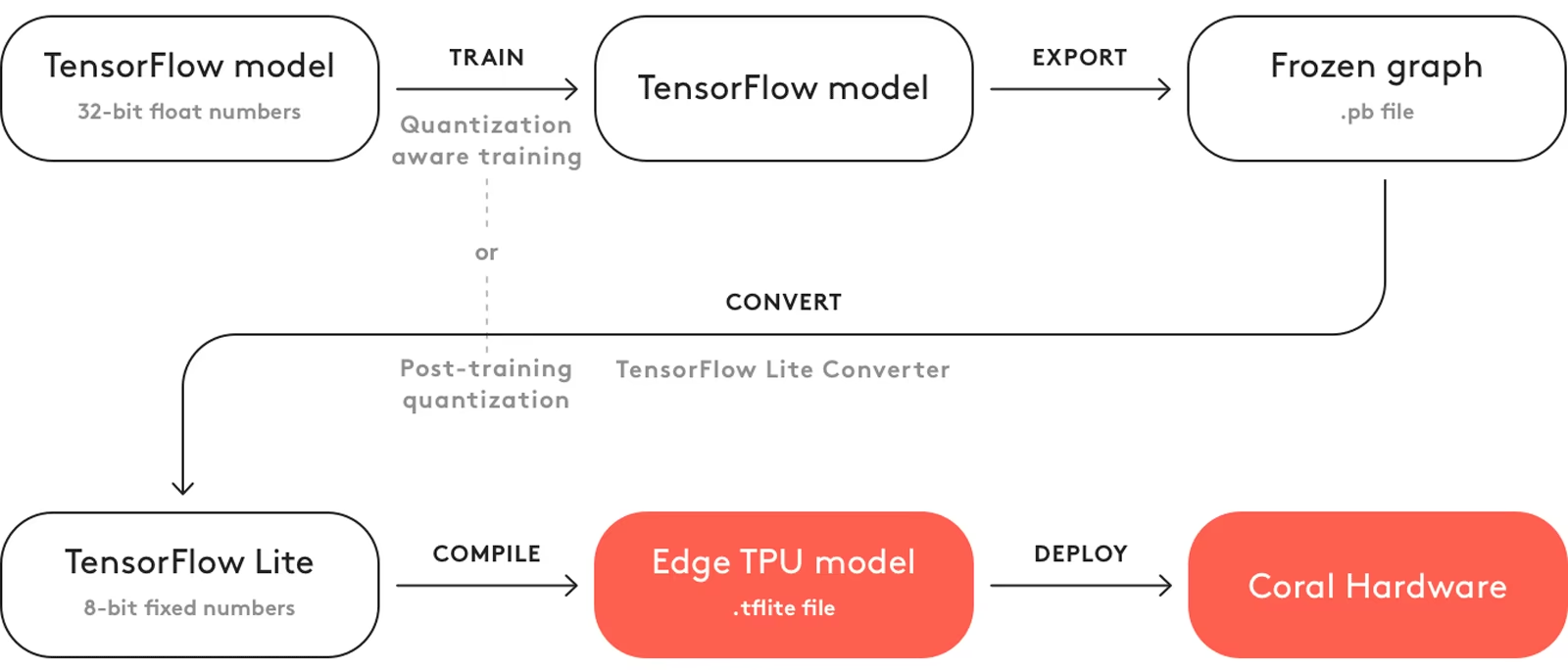
O Edge TPU funciona com modelos quantizados. A quantização torna os modelos menores e mais rápidos sem grande perda de precisão. É ideal para os recursos limitados da computação de borda, permitindo que as aplicações respondam rapidamente ao reduzir a latência e viabilizar o processamento local rápido de dados, sem depender da nuvem. O processamento local também mantém os dados dos usuários privados e seguros, pois eles não são enviados a um servidor remoto.
Principais funcionalidades do TFLite Edge TPU#
Confira os principais recursos que fazem do TFLite Edge TPU uma ótima opção de formato de modelo para desenvolvedores:
-
Desempenho otimizado em dispositivos de borda: O TFLite Edge TPU oferece inferência rápida de redes neurais por meio de quantização, otimização de modelos, aceleração de hardware e otimização do compilador. Sua arquitetura minimalista contribui para o tamanho reduzido e a eficiência de custos.
-
Alto rendimento computacional: o TFLite Edge TPU combina aceleração de hardware especializada e execução eficiente em tempo de execução para alcançar alto rendimento computacional. É ideal para implantar modelos de machine learning com requisitos rigorosos de desempenho em dispositivos de borda.
-
Cálculos matriciais eficientes: o TensorFlow Edge TPU é otimizado para operações matriciais, fundamentais para os cálculos de redes neurais. Essa eficiência é essencial em modelos de machine learning, sobretudo nos que exigem numerosas e complexas multiplicações e transformações matriciais.
Opções de implantação com TFLite Edge TPU#
Antes de exportar modelos YOLO26 para o formato TFLite Edge TPU, é útil entender onde esses modelos são normalmente usados.
O TFLite Edge TPU oferece várias opções para implantar modelos de machine learning, incluindo:
-
Implantação no dispositivo: os modelos TensorFlow Edge TPU podem ser implantados diretamente em dispositivos móveis e integrados. A implantação no dispositivo permite que os modelos sejam executados diretamente no hardware, eliminando a necessidade de conexão à nuvem, seja incorporando o modelo ao pacote do aplicativo, seja baixando-o sob demanda.
-
Implantação híbrida: uma abordagem híbrida combina a implantação no dispositivo e na nuvem, oferecendo uma solução versátil e escalável para implantar modelos de machine learning. Entre as vantagens estão o processamento no dispositivo para respostas rápidas e a computação em nuvem para cálculos mais complexos.
Tarefas suportadas#
A exportação para Edge TPU oferece suporte a seis das sete tarefas da Ultralytics. A segmentação semântica está disponível apenas com YOLO26, a única família que inclui essa cabeça. A estimativa de profundidade não é compatível porque o modelo INT8 gera um operador EXP v2 que o compilador Edge TPU não consegue analisar.
| Tarefa | YOLOv8 | YOLO11 | YOLO26 |
|---|---|---|---|
| Detetar | ✅ | ✅ | ✅ |
| Segmentar | ✅ | ✅ | ✅ |
| Semântica | ❌ | ❌ | ✅ |
| Profundidade | ❌ | ❌ | ❌ |
| Classificar | ✅ | ✅ | ✅ |
| Pose | ✅ | ✅ | ✅ |
| OBB | ✅ | ✅ | ✅ |
O compilador Edge TPU mapeia as operações compatíveis para o acelerador e deixa as demais na CPU; portanto, o suporte à tarefa não significa que todas as operações sejam executadas na TPU.
Exportar modelos YOLO26 para TFLite Edge TPU#
Você pode ampliar a compatibilidade dos modelos e a flexibilidade de implantação convertendo modelos YOLO26 para TensorFlow Edge TPU.
Instalação#
Para instalar o pacote necessário, executa:
# Install the required package for YOLO26
pip install ultralytics
Para obter instruções detalhadas e boas práticas relacionadas ao processo de instalação, consulte nosso guia de instalação da Ultralytics. Se tiver dificuldades ao instalar os pacotes necessários para YOLO26, consulte nosso guia de problemas comuns para ver soluções e dicas.
Uso#
Todos os modelos Ultralytics YOLO26 foram concebidos para suportar a exportação de origem, o que facilita a integração no fluxo de trabalho de implementação que preferires. Podes consultar a lista completa de formatos de exportação suportados e opções de configuração para escolheres a melhor configuração para a tua aplicação.
O formato TFLite Edge TPU é compatível com os modos Export, Predict e Validate. A inferência e a validação são executadas no hardware Coral Edge TPU. Exporte o modelo e, em seguida, carregue o modelo exportado para executar inferências ou validar a precisão.
from ultralytics import YOLO

# Carrega um modelo YOLO26
model = YOLO("yolo26n.pt")

# Exporte o modelo para o formato TFLite Edge TPU
model.export(format="edgetpu") # cria 'yolo26n_saved_model/yolo26n_full_integer_quant_edgetpu.tflite'from ultralytics import YOLO
# Carregue o modelo TFLite Edge TPU exportado
model = YOLO("yolo26n_saved_model/yolo26n_full_integer_quant_edgetpu.tflite")
# Executar inferência
results = model("https://ultralytics.com/images/bus.jpg")from ultralytics import YOLO
# Carregue o modelo TFLite Edge TPU exportado
model = YOLO("yolo26n_saved_model/yolo26n_full_integer_quant_edgetpu.tflite")
# Validar a precisão no conjunto de dados COCO8
metrics = model.val(data="coco8.yaml")Argumentos de exportação#
| Argumento | Tipo | Padrão | Descrição |
|---|---|---|---|
format | str | 'edgetpu' | Formato de destino do modelo exportado, que define a compatibilidade com vários ambientes de implantação. |
imgsz | int ou tuple | 640 | Tamanho de imagem desejado para a entrada do modelo. Pode ser um inteiro para imagens quadradas ou uma tupla (height, width) para dimensões específicas. |
quantize | int ou str | 8/auto | Precisão da quantização. 8 (INT8) é obrigatório e ativado automaticamente para Edge TPU, compactando o modelo e acelerando a inferência com perda mínima de precisão em dispositivos de borda. Substitui as flags descontinuadas half/int8. |
opset | int | None | Especifica a versão do opset do ONNX para o grafo ONNX intermediário. Se não for definido, usa o opset 18 (uma versão inferior no PyTorch < 2.4), limitado à versão instalada onnx. |
data | str | None | Caminho para o YAML do conjunto de dados, essencial para a quantização; para classificação, aceita um diretório de conjunto de dados ou o nome de um conjunto de dados integrado. Se for omitido com quantize=8, a Ultralytics seleciona o conjunto de dados de calibração predefinido para a tarefa do modelo. |
fraction | float, int ou list | 1.0 | Subconjunto de calibração como proporção, número de imagens ou proporções/contagens [train, val, test]. Listas de dois itens deixam test completo, enquanto 0 o ignora. |
device | str | None | Especifica o dispositivo para exportação: CPU (device=cpu). |
Use uma máquina Linux x86 ao exportar para Edge TPU.
Para mais detalhes sobre o processo de exportação, visita a página da documentação da Ultralytics sobre exportação.
Implantar modelos YOLO26 TFLite Edge TPU exportados#
Depois de exportar com sucesso seus modelos Ultralytics YOLO26 para o formato TFLite Edge TPU, você já pode implantá-los. A primeira etapa principal e recomendada para executar um modelo TFLite Edge TPU é usar o método YOLO("model_edgetpu.tflite"), conforme mostrado no trecho de código de uso anterior.
No entanto, para ver instruções detalhadas sobre como implantar seus modelos TFLite Edge TPU, consulte os seguintes recursos:
-
Coral Edge TPU em um Raspberry Pi com Ultralytics YOLO26: descubra como integrar Coral Edge TPUs com Raspberry Pi para aprimorar os recursos de machine learning.
-
Compilador Edge TPU: Saiba como o compilador Edge TPU mapeia modelos TensorFlow Lite para o acelerador e quais operações são compatíveis.
-
Executar inferência na Edge TPU com Python: saiba como usar a API Python do TensorFlow Lite em aplicações com Edge TPU, incluindo orientações de configuração e uso.
Resumo#
Neste guia, aprendemos a exportar modelos Ultralytics YOLO26 para o formato TFLite Edge TPU. Seguindo as etapas acima, você pode executar suas aplicações de visão computacional com mais velocidade e menos consumo de energia em dispositivos de borda.
Para mais detalhes sobre o uso, acesse o site oficial da Coral Edge TPU.
Perguntas frequentes#
Para exportar um modelo YOLO26 para o formato TFLite Edge TPU, siga estas etapas:
Usofrom ultralytics import YOLO # Carrega um modelo YOLO26 model = YOLO("yolo26n.pt") # Exporte o modelo para o formato TFLite Edge TPU model.export(format="edgetpu") # cria 'yolo26n_saved_model/yolo26n_full_integer_quant_edgetpu.tflite' # Carregue o modelo TFLite Edge TPU exportado edgetpu_model = YOLO("yolo26n_saved_model/yolo26n_full_integer_quant_edgetpu.tflite") # Executar inferência results = edgetpu_model("https://ultralytics.com/images/bus.jpg")Para ver todos os detalhes sobre a exportação de modelos para outros formatos, consulte nosso guia de exportação.
A exportação de modelos YOLO26 para TFLite Edge TPU oferece vários benefícios:
- Desempenho otimizado: alcance alto desempenho de redes neurais com consumo mínimo de energia.
- Latência reduzida: processamento local rápido de dados sem depender da nuvem.
- Mais privacidade: o processamento local mantém os dados dos usuários privados e seguros.
Isso torna o formato ideal para aplicações de computação de borda, em que os dispositivos têm recursos de energia e computacionais limitados.
Sim, os modelos TensorFlow Lite Edge TPU podem ser implantados diretamente em dispositivos móveis e integrados. Essa abordagem permite que os modelos sejam executados diretamente no hardware, oferecendo inferência mais rápida e eficiente. Para ver exemplos de integração, consulte nosso guia de implantação da Coral Edge TPU no Raspberry Pi.
Os casos de uso comuns dos modelos TFLite Edge TPU incluem:
- Câmeras inteligentes: aprimoramento da análise de imagens e vídeos em tempo real.
- Dispositivos IoT: viabilização da automação residencial inteligente e industrial.
- Saúde: aceleração de exames de imagem e diagnósticos médicos.
- Varejo: aprimoramento da gestão de estoque e da análise do comportamento dos clientes.
Essas aplicações se beneficiam do alto desempenho e do baixo consumo de energia dos modelos TFLite Edge TPU. Saiba mais sobre cenários de uso.
Se você encontrar problemas ao exportar ou implantar modelos TFLite Edge TPU, consulte nosso guia de problemas comuns para obter dicas de solução. O guia aborda problemas comuns e suas soluções para ajudar você a garantir o funcionamento adequado. Para receber mais suporte, acesse nossa Central de Ajuda.


Comentários30
Faz uma pergunta, partilha os teus resultados ou ajuda alguém.
faizaanscnz
I am running a float32 TFLite model on Pixel 8a using the GPU. How can I run an Edge TPU model on the hardware to get faster FPS? I’m currently getting 8 FPS, but I need 20+. (Kivy app)
walissong
I would like to know if this tutorial works with yolov8n. I've been trying for many days and I'm not able to convert it to edgetpu.tflite.
dbro
Hello. This seems to be broken for yolo11, although it works for yolov8. After running these two commands in Google colab, the output file is less than 1kb and it generates an error.
! pip install ultralytics ! yolo mode=export model=yolo11n.pt format=edgetpu imgsz=320
The final step to run the EdgeTPU compiler seems to be where the problem is:
... TensorFlow SavedModel: export success ✅ 112.9s, saved as 'yolo11n_saved_model' (33.8 MB)
Edge TPU: starting export with Edge TPU compiler 16.0.384591198... Edge TPU: running 'edgetpu_compiler --out_dir "yolo11n_saved_model" --show_operations --search_delegate --delegate_search_step 30 --timeout_sec 180 "yolo11n_saved_model/yolo11n_full_integer_quant.tflite"' Edge TPU Compiler version 16.0.384591198 Searching for valid delegate with step 30 Try to compile segment with 677 ops ERROR: Didn't find op for builtin opcode 'CONV_2D' version '6'. An older version of this builtin might be supported. Are you using an old TFLite binary with a newer model?
ERROR: Registration failed.
Invalid model: yolo11n_saved_model/yolo11n_full_integer_quant.tflite Model could not be parsed Edge TPU: export success ✅ 0.0s, saved as 'yolo11n_saved_model/yolo11n_full_integer_quant_edgetpu.tflite' (0.0 MB) ...
tomcomtang
I am still studying edge computing(https://edgeone.ai/learning/edge-computing), while you have already delved into a deeper level.
 Glenn JocherUltralytics
@tomcomtang yes, TFLite Edge TPU is designed for optimized performance in edge computing, offering high-speed neural networking with minimal power, reduced latency, and enhanced privacy. For details see the TFLite Edge TPU docs: https://docs.ultralytics.com/integrations/edge-tpu/
manu13008
Hi, Once I exported my best.pt model into edgetpu tflite, I tried to run an inference on an image as the code above but I got the following error :
OSError: libedgetpu.so.1: cannot open shared object file: No such file or directory
Do you have any insights of how resolving this ?
Thanks :)
- Glenn JocherUltralytics
@manu13008 it seems like the error is due to the missing Edge TPU runtime library. Please ensure you have installed the Edge TPU runtime on your device. You can find installation instructions in the Edge TPU documentation. If you need further assistance, feel free to check the resources there.
Abdullah-Ory
Hi friends, i am using google colap to compile yolo11n.pt into edgetpu format, since i have orange pi 5 pro which is arm, so when i am trying to do it in my laptop i got this Ultralytics 8.3.9 🚀 Python-3.10.12 torch-2.4.1+cu121 CPU (Intel Xeon 2.20GHz) YOLO11n summary (fused): 238 layers, 2,616,248 parameters, 0 gradients, 6.5 GFLOPs
PyTorch: starting from '/content/yolo11n.pt' with input shape (1, 3, 640, 640) BCHW and output shape(s) (1, 84, 8400) (5.4 MB)
TensorFlow SavedModel: starting export with tensorflow 2.17.0...
ONNX: starting export with onnx 1.17.0 opset 19... ONNX: slimming with onnxslim 0.1.34... ONNX: export success ✅ 3.0s, saved as '/content/yolo11n.onnx' (10.3 MB) TensorFlow SavedModel: starting TFLite export with onnx2tf 1.22.3...
Automatic generation of each OP name started ======================================== Automatic generation of each OP name complete!
Model loaded ========================================================================
Model conversion started ============================================================ saved_model output started ========================================================== saved_model output complete! Float32 tflite output complete! Float16 tflite output complete! Dynamic Range Quantization tflite output complete! Input signature information for quantization signature_name: serving_default input_name.0: images shape: (1, 640, 640, 3) dtype: <dtype: 'float32'> INT8 Quantization tflite output complete! Full INT8 Quantization tflite output complete! Traceback (most recent call last): File "/usr/local/lib/python3.10/dist-packages/onnx2tf/onnx2tf.py", line 1566, in convert tflite_model = converter.convert() File "/usr/local/lib/python3.10/dist-packages/tensorflow/lite/python/lite.py", line 1231, in wrapper return self._convert_and_export_metrics(convert_func, *args, **kwargs) File "/usr/local/lib/python3.10/dist-packages/tensorflow/lite/python/lite.py", line 1183, in _convert_and_export_metrics result = convert_func(self, *args, **kwargs) File "/usr/local/lib/python3.10/dist-packages/tensorflow/lite/python/lite.py", line 1562, in convert return self._convert_from_saved_model(graph_def) File "/usr/local/lib/python3.10/dist-packages/tensorflow/lite/python/lite.py", line 1424, in _convert_from_saved_model return self._optimize_tflite_model( File "/usr/local/lib/python3.10/dist-packages/tensorflow/lite/python/convert_phase.py", line 215, in wrapper raise error from None # Re-throws the exception. File "/usr/local/lib/python3.10/dist-packages/tensorflow/lite/python/convert_phase.py", line 205, in wrapper return func(*args, **kwargs) File "/usr/local/lib/python3.10/dist-packages/tensorflow/lite/python/lite.py", line 1127, in _optimize_tflite_model model = self._quantize( File "/usr/local/lib/python3.10/dist-packages/tensorflow/lite/python/lite.py", line 767, in _quantize return calibrate_quantize.calibrate_and_quantize( File "/usr/local/lib/python3.10/dist-packages/tensorflow/lite/python/convert_phase.py", line 215, in wrapper raise error from None # Re-throws the exception. File "/usr/local/lib/python3.10/dist-packages/tensorflow/lite/python/convert_phase.py", line 205, in wrapper return func(*args, **kwargs) File "/usr/local/lib/python3.10/dist-packages/tensorflow/lite/python/optimize/calibrator.py", line 194, in calibrate_and_quantize return self._calibrator.QuantizeModel( RuntimeError: Quantized dimension for tensor property and quantization parameters do not match. Got 3 and 0 respectively.
WARNING: INT8 Quantization with int16 activations tflite output failed. Traceback (most recent call last): File "/usr/local/lib/python3.10/dist-packages/onnx2tf/onnx2tf.py", line 1597, in convert tflite_model = converter.convert() File "/usr/local/lib/python3.10/dist-packages/tensorflow/lite/python/lite.py", line 1231, in wrapper return self._convert_and_export_metrics(convert_func, *args, **kwargs) File "/usr/local/lib/python3.10/dist-packages/tensorflow/lite/python/lite.py", line 1183, in _convert_and_export_metrics result = convert_func(self, *args, **kwargs) File "/usr/local/lib/python3.10/dist-packages/tensorflow/lite/python/lite.py", line 1562, in convert return self._convert_from_saved_model(graph_def) File "/usr/local/lib/python3.10/dist-packages/tensorflow/lite/python/lite.py", line 1424, in _convert_from_saved_model return self._optimize_tflite_model( File "/usr/local/lib/python3.10/dist-packages/tensorflow/lite/python/convert_phase.py", line 215, in wrapper raise error from None # Re-throws the exception. File "/usr/local/lib/python3.10/dist-packages/tensorflow/lite/python/convert_phase.py", line 205, in wrapper return func(*args, **kwargs) File "/usr/local/lib/python3.10/dist-packages/tensorflow/lite/python/lite.py", line 1127, in _optimize_tflite_model model = self._quantize( File "/usr/local/lib/python3.10/dist-packages/tensorflow/lite/python/lite.py", line 767, in _quantize return calibrate_quantize.calibrate_and_quantize( File "/usr/local/lib/python3.10/dist-packages/tensorflow/lite/python/convert_phase.py", line 215, in wrapper raise error from None # Re-throws the exception. File "/usr/local/lib/python3.10/dist-packages/tensorflow/lite/python/convert_phase.py", line 205, in wrapper return func(*args, **kwargs) File "/usr/local/lib/python3.10/dist-packages/tensorflow/lite/python/optimize/calibrator.py", line 194, in calibrate_and_quantize return self._calibrator.QuantizeModel( RuntimeError: Quantized dimension for tensor property and quantization parameters do not match. Got 3 and 0 respectively.
WARNING: Full INT8 Quantization with int16 activations tflite output failed. TensorFlow SavedModel: export success ✅ 248.1s, saved as '/content/yolo11n_saved_model' (36.1 MB) Edge TPU: WARNING ⚠️ Edge TPU known bug https://github.com/ultralytics/ultralytics/issues/1185
Edge TPU: starting export with Edge TPU compiler 16.0.384591198... Edge TPU: running 'edgetpu_compiler -s -d -k 10 --out_dir "/content/yolo11n_saved_model" "/content/yolo11n_saved_model/yolo11n_full_integer_quant.tflite"' Edge TPU: export success ✅ 3.9s, saved as '/content/yolo11n_saved_model/yolo11n_full_integer_quant_edgetpu.tflite' (3.5 MB)
Export complete (252.6s) Results saved to /content Predict: yolo predict task=detect model=/content/yolo11n_saved_model/yolo11n_full_integer_quant_edgetpu.tflite imgsz=640 int8 Validate: yolo val task=detect model=/content/yolo11n_saved_model/yolo11n_full_integer_quant_edgetpu.tflite imgsz=640 data=/usr/src/ultralytics/ultralytics/cfg/datasets/coco.yaml int8 Visualize: https://netron.app /content/yolo11n_saved_model/yolo11n_full_integer_quant_edgetpu.tflite
- Glenn JocherUltralytics
@Abdullah-Ory it seems you're encountering an issue with INT8 quantization during the TFLite Edge TPU export. Please ensure your model is compatible with Edge TPU requirements, and consider checking the Ultralytics documentation for detailed guidance on exporting models to TFLite Edge TPU format. If the issue persists, reviewing the quantization parameters might help.
MECHAAMER
Hi,
I trained a YOLOv8l model with VisDrone dataset, and attempted to convert the best weights.pt to Edge TPU TFlite format using:
model = YOLO("best.pt") model.export(format="edgetpu")
my board is Coral dev board.
The conversion completed successfully, but the results indicate that 164 of operations will run on the CPU instead of the Edge TPU. only 223 operation will run using Edge TPU This CPU usage will likely cause performance delays.
I'm wondering if there are any strategies or techniques to improve Edge TPU utilization and minimize CPU usage during inference for this model. Any suggestions or insights would be greatly appreciated.
Thanks,
- Glenn JocherUltralytics
@MECHAAMER to improve Edge TPU utilization, ensure your model is fully quantized and compatible with Edge TPU operations. Consider simplifying the model architecture or using supported operations. For detailed guidance, please refer to the Ultralytics Edge TPU documentation.
Hi, thank you for your support, I follow the attached link, and apply it using: model.export(format="edgetpu") , and I get this output:
Number of operations that will run on Edge TPU: 133 Number of operations that will run on CPU: 364
more details in the attached photo.
I think with this big percent of ops that runs on the CPU, the model will be very slow and I will suffer from large latency.
Do you have any suggestions?
- Glenn JocherUltralytics
To improve Edge TPU utilization, ensure your model is fully quantized and uses supported operations. Simplifying the model architecture might help. For more details, please refer to the Ultralytics Edge TPU documentation.
Hi there,
I'm following the Ultralytics Edge TPU documentation to train a YOLO model for object detection. However, I'm encountering suboptimal results.
I suspect that the issue might lie in the model's compatibility with the TPU. It's possible that certain operations within the model are not optimized for the TPU, leading to delays.
To address this, I'm considering using a YOLO model that is specifically designed to run efficiently on the Edge TPU. Do you have any recommendations for such models?
- Glenn JocherUltralytics
For optimal Edge TPU performance, consider using a smaller YOLO model like YOLOv8n, which is more compatible with Edge TPU operations. Simplifying the model architecture can also help.
I'm encountering a "Segmentation fault" error while trying to run a segmented YOLOv5s model on my Coral Dev Board with an external Coral ML Accelerator (USB). I followed the recommended steps to export, compile, and segment the model using edgetpu_compiler.
I follow these steps:
I trained Yolov5su model, then I exported the model as tflite - 8int by using:
model.export()

then I use the edgetpu_compiler to compile the tflite model and segmented it into 2 models:
edgetpu_compiler model.tflite --num_segments=2

then I get 12 files, 8 models and 4 logs, the models are:
1- best_float32_segment_0_of_2.tflite
2- best_float32_segment_1_of_2.tflite
3- best_float32_segment_0_of_2_edgetpu.tflite
4- best_float32_segment_1_of_2_edgetpu.tflite
5- best_full_integer_quant_segment_0_of_2.tflite
6- best_full_integer_quant_segment_1_of_2.tflite
7- best_full_integer_quant_segment_0_of_2_edgetpu.tflite
8- best_full_integer_quant_segment_1_of_2_edgetpu.tflite
I transfer the "best_full_integer_quant_segment_0_of_2_edgetpu.tflite" and "best_full_integer_quant_segment_1_of_2_edgetpu.tflite" to the coral board and I tried to run the models to detect object in a video, the code:
import argparse
import re
import threading
import time

import numpy as np
import cv2

from pycoral.adapters import classify
from pycoral.adapters import common
import pycoral.pipeline.pipelined_model_runner as pipeline
from pycoral.utils.dataset import read_label_file
from pycoral.utils.edgetpu import list_edge_tpus
from pycoral.utils.edgetpu import make_interpreter


def _get_devices(num_devices):
  edge_tpus = list_edge_tpus()

  if len(edge_tpus) < num_devices:
    raise RuntimeError(
        'Not enough Edge TPUs detected, expected %d, detected %d.' %
        (num_devices, len(edge_tpus)))

  num_pci_devices = sum(1 for device in edge_tpus if device['type'] == 'pci')

  return ['pci:%d' % i for i in range(min(num_devices, num_pci_devices))] + [
      'usb:%d' % i for i in range(max(0, num_devices - num_pci_devices))
  ]


def _make_runner(model_paths, devices):
  """Constructs PipelinedModelRunner given model paths and devices."""
  print('Using devices: ', devices)
  print('Using models: ', model_paths)

  print("  hey runner   1")
  if len(model_paths) != len(devices):
    raise ValueError('# of devices and #of model_paths should match')

  print("  hey runner   2", model_paths[0], devices[1])

  interpreters = []
  interpreter = make_interpreter(model_paths[0], devices[0])
  print("  hey runner   3")
  interpreter.allocate_tensors()
  print("  hey runner   4")
  interpreters.append(interpreter)
  print("  hey runner   5", model_paths[1], devices[0])

  interpreter2 = make_interpreter(model_paths[1], devices[1])
  print("  hey runner   6")
  interpreter.allocate_tensors()
  interpreter2.allocate_tensors()
  print("  hey runner   7")
  interpreters.append(interpreter2)
  print("  hey runner   8")

  return pipeline.PipelinedModelRunner(interpreters)


def main():
  parser = argparse.ArgumentParser(
      formatter_class=argparse.ArgumentDefaultsHelpFormatter)
  parser.add_argument(
      '-m',
      '--models',
      required=True,
      help=('File path template of .tflite model segments, e.g.,'
            'inception_v3_299_quant_segment_%d_of_2_edgetpu.tflite'))
  parser.add_argument(
      '-i', '--input', required=True, help='Image to be classified.')
  parser.add_argument('-l', '--labels', help='File path of labels file.')
  parser.add_argument(
      '-k',
      '--top_k',
      type=int,
      default=1,
      help='Max number of classification results')
  parser.add_argument(
      '-t',
      '--threshold',
      type=float,
      default=0.0,
      help='Classification score threshold')
  parser.add_argument(
      '-c',
      '--count',
      type=int,
      default=1,
      help='Number of times to run inference')
  args = parser.parse_args()
  labels = {0:"pedestrian", 1:"people", 2:"bicycle", 3:"car", 4:"van", 5:"truck", 6:"tricycle", 7:"awning-tricycle", 8:"bus", 9:"motor"}
  print("hey lets begin   1")
  result = re.search(r'^.*_segment_%d_of_(?P<num_segments>[0-9]+)_.*.tflite',
                     args.models)
  print("hey lets begin   2")

  if not result:
    print("hey lets begin    3")

    raise ValueError(
        '--models should follow *_segment%d_of_[num_segments]_*.tflite pattern')
  print("hey lets begin    4")

  num_segments = int(result.group('num_segments'))
  model_paths = [args.models % i for i in range(num_segments)]
  print("hey lets begin    5")

  devices = _get_devices(num_segments)

  print("hey lets begin    6")

  runner = _make_runner(model_paths, devices)

  print("hey lets begin      7")


  # Get the input name and size
  size = common.input_size(runner.interpreters()[0])

  print("hey lets begin     8")

  name = common.input_details(runner.interpreters()[0], 'name')

  print("hey lets begin    9")

  cap = cv2.VideoCapture(args.input)

  print("hey lets begin    10")

  if not cap.isOpened():
      print("Error opening video capture device")
      return

  print("hey lets begin    11")

  while True:
      ret, frame = cap.read()
      if not ret:
          break

      # Preprocess the frame
      height, width, _ = frame.shape
      new_height = int(640 * height / width)
      image = cv2.resize(frame, (640, new_height))

      # Run inference
      runner.push({name: image})

      output_details = runner.interpreters()[-1].get_output_details()[0]
      scale, zero_point = output_details['quantization']

      result = runner.pop()

      if result:
          # Process the results
          values, = result.values()
          scores = scale * (values[0].astype(np.int64) - zero_point)
          classes, scores = classify.get_classes_from_scores(result[0], args.top_k, args.threshold)

          for klass in classes:
              print('%s: %.5f' % (labels.get(klass.id, klass.id), klass.score))

          print('-------RESULTS--------')
      else:
          print("No results")

if __name__ == '__main__':
  main()
then I try execute the python file:python3 test2tpu.py -m best_full_integer_quant_segment_%d_of_2_edgetpu.tflite -i "/coral/720p/Busy Road.mp4"
the output that I get:
hey lets begin 1 hey lets begin 2 hey lets begin 4 hey lets begin 5 hey lets begin 6 Using devices: ['pci:0', 'usb:0'] Using models: ['best_full_integer_quant_segment_0_of_2_edgetpu.tflite', 'best_full_integer_quant_segment_1_of_2_edgetpu.tflite'] hey runner 1 hey runner 2 best_full_integer_quant_segment_0_of_2_edgetpu.tflite usb:0 hey runner 3 hey runner 4 hey runner 5 best_full_integer_quant_segment_1_of_2_edgetpu.tflite pci:0 Segmentation fault
Note: pycoral version: 2.0.0
- Glenn JocherUltralytics
It seems like the segmentation fault might be due to compatibility issues with the model operations on the Edge TPU. Consider simplifying the model architecture or ensuring all operations are supported by the Edge TPU. You can also check the Common Issues guide for additional troubleshooting tips.
Can you help me to know more about: simplifying the model architecture or ensuring all operations are supported by the Edge TPU.
I don't have access now to the records because I am outside office, as I remember In yolov5su, there are more than 200 process depends in TPU and only 25 process use CPU, Also the model working well on 1 TPU (with no segmentation).
- Glenn JocherUltralytics
@MECHAAMER to improve Edge TPU compatibility, consider using a smaller model like YOLOv8n, which is more likely to use supported operations, or simplify the architecture by reducing layers and operations that are not TPU-optimized.
Taufiq-Ahmed
Hi, I have train my custom dataset for detect fire and smoke with yolov8 nano. it's best model size is around 6MB and after exporting it using "yolo export model=yolov8n.pt format=edgetpu". it's size reduced to 3MB. But have to integrate this model in XIAO RP2040 MCU. So I need more light weight model for my edge device. In this case what I should? Please give me a solution.
- Glenn JocherUltralytics
@Taufiq-Ahmed hi! It's great to hear that you've successfully trained your custom dataset with YOLOv8 nano. For further reducing the model size for your XIAO RP2040 MCU, you might want to explore additional quantization techniques. The TFLite Edge TPU format already applies full integer quantization, but you can experiment with pruning or other model compression techniques to further reduce the size. If you haven't already, ensure you're using the latest version of the Ultralytics package for the best optimization features. For more detailed guidance, you can check out our Edge TPU integration guide. Good luck with your deployment!
samphonic
So I have a tflite model and object detection is working, but I can't seem to figure out how to tell if (and how effectively) the model is actually using the Edge TPU hardware. Is there some way to confirm that the hardware is actually being used? Can I manually enable/disable it to compare inference time?
- Glenn JocherUltralytics
@Sammy1Am to confirm if your model is utilizing the Edge TPU hardware, you can check the inference time and compare it with and without the Edge TPU. Typically, when the Edge TPU is in use, you should see a significant reduction in inference time. You can manually enable or disable the Edge TPU by using the
edgetpuinterpreter for the Edge TPU and the standard TFLite interpreter otherwise. For more details on setting this up, you might find the Edge TPU documentation helpful. If you need further assistance, feel free to explore our Ultralytics documentation.
FearL0rd
How do I use YOLO with a Dual TPU card?
I have APEX_0 and APEX_1 devices.
Streamline segmentation during export https://coral.ai/docs/edgetpu/pipeline/
- Glenn JocherUltralytics
@FearL0rd thank you for your suggestion! Streamlining segmentation during export is indeed a valuable enhancement. For detailed guidance on exporting YOLOv8 models to TFLite Edge TPU format, you can refer to our documentation. This will help you optimize your models for high-speed, low-power inferencing on devices with limited computational power.
For more information on using YOLO with a Dual TPU card, you can leverage the APEX_0 and APEX_1 devices to distribute the workload effectively. This setup can significantly boost performance and efficiency in your machine learning tasks.
Feel free to explore the provided resources and let us know if you have any further questions! 🚀
@glenn-jocher where is the doc talking about segmentation using APEX_0 and APEX_1
- Glenn JocherUltralytics
Hi @FearL0rd,
For documentation on segmentation using APEX_0 and APEX_1, you can refer to the guide on exporting YOLOv8 models to TFLite Edge TPU format. This guide covers optimizing your models for high-speed, low-power inferencing on devices like the Coral Edge TPU.
To utilize both APEX_0 and APEX_1 devices, you can distribute the workload effectively across the dual TPU setup, enhancing performance and efficiency. For more detailed instructions, please visit the relevant sections in our documentation.
Feel free to reach out if you have any more questions! 😊