Detecção de caixas delimitadoras orientadas com Ultralytics YOLO
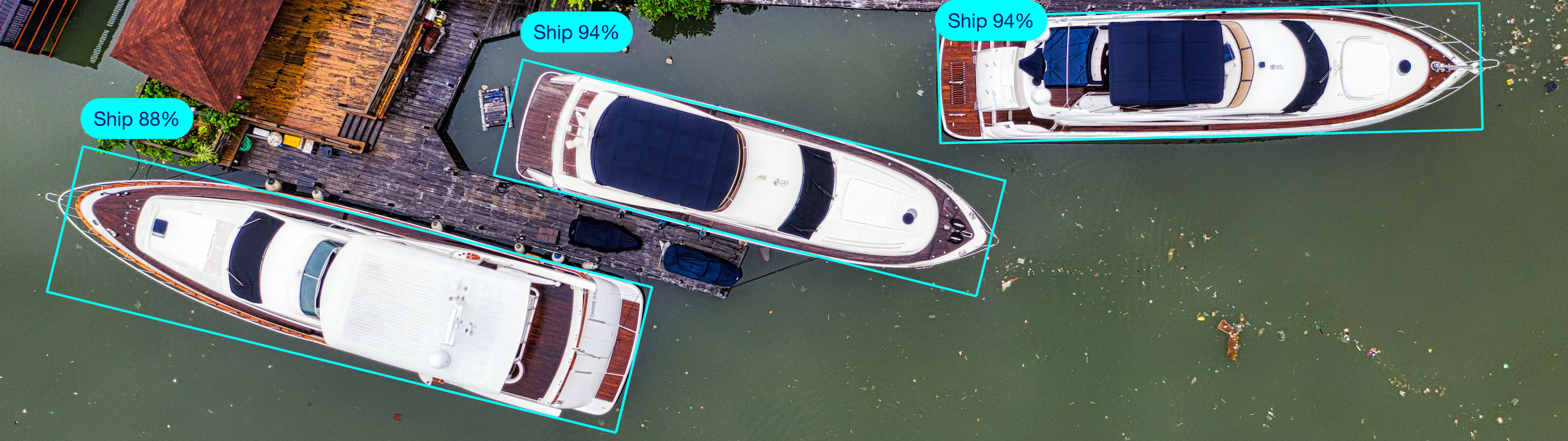
A detecção de objetos orientados vai além da detecção de objetos padrão ao adicionar um ângulo extra para localizar objetos com mais precisão em uma imagem.
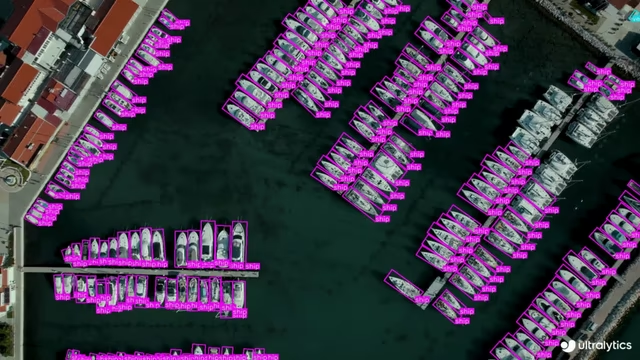
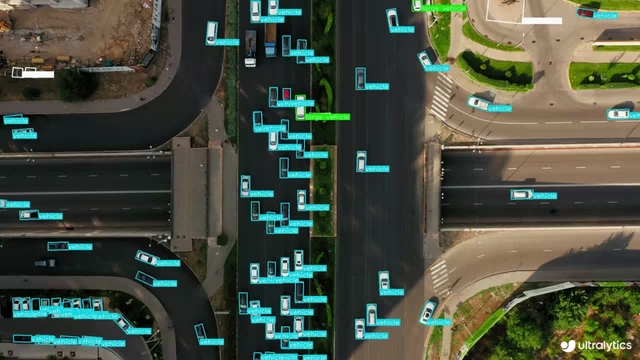
A saída de um detector de objetos orientados é um conjunto de caixas delimitadoras giradas que envolvem os objetos na imagem com precisão, acompanhado de rótulos de classe e pontuações de confiança para cada caixa. As caixas delimitadoras orientadas são especialmente úteis quando os objetos aparecem em vários ângulos, como em imagens aéreas, nas quais as caixas delimitadoras tradicionais alinhadas aos eixos podem incluir elementos desnecessários do fundo. Os usos típicos incluem a detecção de navios e veículos por satélites e drones, a análise de edifícios e infraestrutura para planejamento urbano, o monitoramento de plantações e a inspeção de painéis solares ou turbinas eólicas.
Assista: Como detectar e rastrear objetos com caixas delimitadoras orientadas (OBB) do Ultralytics YOLO26 | Rastreamento de navios 🚢
Os modelos OBB do YOLO26 usam o sufixo -obb, por exemplo, yolo26n-obb.pt, e são pré-treinados no DOTAv1.
| Detecção de navios usando OBB | Detecção de veículos usando OBB |
|---|---|
 |  |
Modelos#
Abaixo estão os modelos YOLO26 OBB pré-treinados no conjunto de dados DOTAv1.
Os modelos são transferidos automaticamente da versão mais recente do Ultralytics na primeira utilização.
As imagens e anotações do DOTAv1 estão limitadas ao uso acadêmico e não permitem uso comercial. A Ultralytics interpreta essas restrições como aplicáveis ao conjunto de dados de origem, e não aos pesos de modelos pré-treinados ou ajustados. Consulte os termos do DOTA para o uso pretendido.
| Modelo | tamanho (pixels) | mAPteste50-95 (e2e) | mAPteste50 (e2e) | Velocidade CPU ONNX (ms) | Velocidade T4 TensorRT10 (ms) | parâmetros (M) | FLOPs (B) |
|---|---|---|---|---|---|---|---|
| YOLO26n-obb | 1024 | 52.4 | 78.9 | 97.7 ± 0.9 | 2.8 ± 0.0 | 2.4 | 14.8 |
| YOLO26s-obb | 1024 | 54.8 | 80.9 | 218.0 ± 1.4 | 4.9 ± 0.1 | 9.8 | 56.7 |
| YOLO26m-obb | 1024 | 55.3 | 81.0 | 579.2 ± 3.8 | 10.2 ± 0.3 | 21.2 | 184.9 |
| YOLO26l-obb | 1024 | 56.2 | 81.6 | 735.6 ± 3.1 | 13.0 ± 0.2 | 25.6 | 232.4 |
| YOLO26x-obb | 1024 | 56.7 | 81.7 | 1485.7 ± 11.5 | 30.5 ± 0.9 | 57.6 | 520.1 |
- Os valores de mAPtest são para um único modelo em várias escalas no conjunto de dados DOTAv1.
Reproduza comyolo obb val data=DOTAv1.yaml device=0 split=test nms=False save_json=Truee envie os resultados combinados para a avaliação DOTA. - Velocidade calculada como a média em imagens de validação do DOTAv1 com ONNX na CPU e TensorRT10 em uma GPU NVIDIA T4.
Reproduza comyolo obb val data=DOTAv1.yaml batch=1 device=0|cpu nms=False - Os valores de Params e FLOPs referem-se a modelos fundidos após a fusão de Conv/BatchNorm e a remoção do ramo de deteção não utilizado. Os pontos de controlo pré-treinados mantêm a arquitetura de treino completa e podem apresentar contagens superiores.
Consulte a prévia não lançada do YOLO27 para ver resultados preliminares do DOTAv1.
Treinar#
Treina um modelo YOLO26n-obb no conjunto de dados DOTA8 durante 100 épocas, com tamanho de imagem 640.
Uma OBB e sua rotação de 180° são idênticas; por isso, a rotação é definida módulo 180° e a caixa não tem direção. Os rótulos de treinamento são normalizados para o formato de lado maior: a largura da caixa w corresponde ao lado mais longo, o ângulo é medido no sentido horário a partir do eixo x positivo até a orientação da aresta w e é armazenado em radianos em [-π/4, 3π/4) ([-45°, 135°)). As previsões não são normalizadas; portanto, uma caixa prevista pode informar a aresta curta como w; consulte Saída dos resultados. O formato [0°, 90°) é a convenção regularizada no estilo DOTA e não é aplicado durante o treinamento nem a inferência.
from ultralytics import YOLO

# Carregar um modelo
model = YOLO("yolo26n-obb.yaml")  # crie um novo modelo a partir de YAML
model = YOLO("yolo26n-obb.pt")  # carregue um modelo pré-treinado (recomendado para treinamento)
model = YOLO("yolo26n-obb.yaml").load("yolo26n-obb.pt")  # crie a partir de YAML e transfira os pesos

# Treinar o modelo
results = model.train(data="dota8.yaml", epochs=100, imgsz=640)
Assista: Como treinar modelos Ultralytics YOLO-OBB (caixas delimitadoras orientadas) no conjunto de dados DOTA usando a plataforma Ultralytics
Consulte a página Treinar para ver todos os detalhes do modo train. Os modelos OBB também podem ser treinados com o treinamento na nuvem da Ultralytics Platform.
Formato do conjunto de dados#
Você encontra detalhes sobre o formato do conjunto de dados OBB no Guia do conjunto de dados. O formato YOLO OBB representa as caixas delimitadoras pelos quatro pontos dos cantos, com coordenadas normalizadas entre 0 e 1, seguindo esta estrutura. A anotação da Ultralytics Platform oferece suporte a rótulos OBB com uma ferramenta dedicada para desenhar caixas delimitadoras orientadas:
class_index x1 y1 x2 y2 x3 y3 x4 y4Internamente, YOLO processa as perdas e as saídas no formato xywhr, que representa o ponto central da caixa delimitadora (xy), a largura, a altura e a rotação.
Validar#
Valide a precisão do modelo YOLO26n-obb treinado, medida como precisão média (mAP), no conjunto de dados DOTA8. Passe data explicitamente para que a validação use o YAML do conjunto de dados pretendido.
from ultralytics import YOLO

# Carregar um modelo
model = YOLO("yolo26n-obb.pt")  # carrega um modelo oficial
model = YOLO("path/to/best.pt")  # carregar um modelo personalizado

# Valida o modelo
metrics = model.val(data="dota8.yaml")  # valida no conjunto de dados DOTA8
metrics.box.map  # map50-95(B)
metrics.box.map50  # map50(B)
metrics.box.map75  # map75(B)
metrics.box.maps  # mAP50-95(B) por classe; as classes ausentes do conjunto de validação recebem o mAP(B) geral
metrics.box.ap_class_index  # índices das classes que foram efetivamente avaliadas
metrics.box.image_metrics # dicionário de métricas por imagem com precisão, revocação, F1, TP, FP e FNPrever#
Use um modelo YOLO26n-obb treinado para fazer previsões em imagens.
from ultralytics import YOLO

# Carregar um modelo
model = YOLO("yolo26n-obb.pt")  # carrega um modelo oficial
model = YOLO("path/to/best.pt")  # carregar um modelo personalizado

# Faz previsões com o modelo
results = model("https://ultralytics.com/images/boats.jpg")  # faz uma previsão numa imagem

# Acede aos resultados
for result in results:
    xywhr = result.obb.xywhr  # centro-x, centro-y, largura, altura, ângulo (radianos)
    xyxyxyxy = result.obb.xyxyxyxy  # formato de polígono com 4 pontos
    names = [result.names[cls.item()] for cls in result.obb.cls.int()]  # nome da classe de cada caixa
    confs = result.obb.conf  # pontuação de confiança de cada caixa
Consulta os detalhes completos do modo predict na página Previsão.
Passe save_crop=True para salvar um recorte alinhado à rotação de cada OBB no tamanho da caixa, como ObjectCropper também faz.
Saída dos resultados#
A detecção de caixas delimitadoras orientadas retorna um objeto Results por imagem. O principal campo de previsão é result.obb, que contém caixas rotacionadas, IDs de classe e pontuações de confiança para cada objeto detectado.
| Atributo | Tipo | Formato | Descrição |
|---|---|---|---|
result.obb | OBB | (N) | Caixas orientadas. |
result.obb.data | torch.float32 | (N,7/8) | Caixas rotacionadas brutas com confiança/classe. |
result.obb.xywhr | torch.float32 | (N,5) | Caixas rotacionadas xywhr. |
result.obb.xyxyxyxy | torch.float32 | (N,4,2) | Pontos dos quatro cantos. |
result.obb.conf | torch.float32 | (N,) | Pontuações de confiança. |
Os rótulos são normalizados para a convenção do lado mais longo, mas as previsões não; por isso, result.obb.xywhr pode indicar que w é menor que h, com a rotação medida a partir do lado mais curto. As duas formas descrevem o mesmo retângulo, então result.obb.xyxyxyxy está correto em ambos os casos. Durante o rastreamento, cada trajetória mantém a forma de meia-volta (θ ou θ ± π) mais próxima do ângulo anterior, para que os ângulos das trajetórias não oscilem em π entre quadros e possam sair de [-π/4, 3π/4). Converte os cantos de volta quando o código a jusante precisar da forma do lado mais longo, tendo em conta que reescrever os parâmetros da caixa pode deslocar ciclicamente a ordem dos cantos:
from ultralytics.utils.ops import xyxyxyxy2xywhr

xywhr = xyxyxyxy2xywhr(result.obb.xyxyxyxy)  # w >= h, rotação em [-pi/4, 3pi/4)
Para ver os campos Results específicos de cada tarefa, consulta a secção Resultados da previsão por tarefa.
Exportar#
Exporte um modelo YOLO26n-obb para outro formato, como ONNX, CoreML etc.
from ultralytics import YOLO

# Carregar um modelo
model = YOLO("yolo26n-obb.pt")  # carrega um modelo oficial
model = YOLO("path/to/best.pt")  # carregar um modelo personalizado

# Exporta o modelo
model.export(format="onnx")
Os formatos de exportação disponíveis para YOLO26-obb estão na tabela abaixo. Você pode exportar para qualquer formato usando o argumento format, por exemplo, format='onnx' ou format='engine'. Você pode executar previsões ou validações diretamente nos modelos exportados, por exemplo, yolo predict model=yolo26n-obb.onnx. Após a conclusão da exportação, são exibidos exemplos de uso do modelo.
| Formato | Argumento format | Modelo | Metadados | Argumentos |
|---|---|---|---|---|
| PyTorch | - | yolo26n-obb.pt | ✅ | - |
| TorchScript | torchscript | yolo26n-obb.torchscript | ✅ | imgsz, quantize, dynamic, nms, batch, device |
| ONNX | onnx | yolo26n-obb.onnx | ✅ | imgsz, quantize, dynamic, simplify, opset, nms, batch, data, fraction, device |
| OpenVINO | openvino | yolo26n-obb_openvino_model/ | ✅ | imgsz, quantize, dynamic, nms, batch, data, fraction, device |
| TensorRT | engine | yolo26n-obb.engine | ✅ | imgsz, quantize, dynamic, simplify, opset, workspace, nms, batch, data, fraction, device |
| CoreML | coreml | yolo26n-obb.mlpackage | ✅ | imgsz, dynamic, quantize, nms, batch, device |
| Apple Core AI | coreai | yolo26n-obb.aimodel | ✅ | imgsz, batch, quantize |
| TF SavedModel | saved_model | yolo26n-obb_saved_model/ | ✅ | imgsz, quantize, opset, nms, batch, data, fraction, device |
| TF GraphDef | pb | yolo26n-obb.pb | ❌ | imgsz, opset, batch, device |
| TF Edge TPU | edgetpu | yolo26n-obb_edgetpu.tflite | ✅ | imgsz, quantize, opset, data, fraction, device |
| LiteRT | litert | yolo26n-obb.tflite | ✅ | imgsz, quantize, batch, data, fraction, device |
| PaddlePaddle | paddle | yolo26n-obb_paddle_model/ | ✅ | imgsz, batch, device |
| MNN | mnn | yolo26n-obb.mnn | ✅ | imgsz, batch, dynamic, quantize, simplify, opset, nms, device |
| NCNN | ncnn | yolo26n-obb_ncnn_model/ | ✅ | imgsz, quantize, device |
| IMX500 | imx | yolo11n_imx_model/ | ✅ | imgsz, quantize, data, fraction, nms, device |
| RKNN | rknn | yolo26n-obb_rknn_model/ | ✅ | imgsz, batch, name, quantize, simplify, opset, data, fraction, device |
| ExecuTorch | executorch | yolo26n-obb_executorch_model/ | ✅ | imgsz, quantize, batch, data, fraction, device |
| Axelera | axelera | yolo26n-obb_axelera_model/ | ✅ | imgsz, batch, quantize, data, fraction, device |
| DEEPX | deepx | yolo26n-obb_deepx_model/ | ✅ | imgsz, quantize, simplify, opset, data, optimize, device |
| Qualcomm QNN | qnn | yolo26n-obb_qnn.onnx | ✅ | imgsz, batch, name, quantize, simplify, opset, data, fraction, device |
| Hailo | hailo | yolo26n-obb_hailo_model/ | ✅ | imgsz, name, quantize, data, fraction, simplify, conf, iou, device |
| Huawei Ascend | ascend | yolo26n-obb_ascend_model/ | ✅ | imgsz, batch, name, quantize, opset, simplify, nms, device |
| AMD Xilinx | xilinx | yolo26n-obb_xilinx_model/ | ✅ | imgsz, name, quantize, data, fraction, opset, simplify, device |
| NXP | nxp | yolo26n-obb_nxp.tflite | ✅ | imgsz, quantize, data, fraction, device |
| ST Edge AI | stedgeai | yolo26n-obb_stedgeai.onnx | ✅ | imgsz, quantize, data, fraction, opset, simplify, device |
nms=None usa por padrão saídas brutas para NMS externo (YOLO26 mantém sua cabeça sem NMS na Axelera). Define nms=False para selecionar uma cabeça sem NMS disponível; os formatos não compatíveis recorrem ao caminho de saída nativo. As entradas nms acima identificam os formatos que podem incorporar NMS com nms=True.
Consulte os detalhes completos de export na página Exportação.
Perguntas frequentes#
As caixas delimitadoras orientadas (OBB) incluem um ângulo adicional para aumentar a precisão da localização de objetos em imagens. Ao contrário das caixas delimitadoras comuns, que são retângulos alinhados aos eixos, as OBB podem girar para se ajustar melhor à orientação do objeto. Isso é especialmente útil em aplicações que exigem o posicionamento preciso de objetos, como imagens aéreas ou de satélite (Guia de conjuntos de dados).
Para treinar um modelo YOLO26n-obb com um conjunto de dados personalizado, siga o exemplo abaixo usando Python ou a CLI:
Exemplofrom ultralytics import YOLO # Carregar um modelo pré-treinado model = YOLO("yolo26n-obb.pt") # Treinar o modelo results = model.train(data="path/to/custom_dataset.yaml", epochs=100, imgsz=640)Para ver mais argumentos de treinamento, consulte a seção Configuração.
Os modelos YOLO26-OBB são pré-treinados em conjuntos de dados como DOTAv1, mas você pode usar qualquer conjunto de dados formatado para OBB. Você encontra informações detalhadas sobre os formatos de conjuntos de dados OBB no Guia de conjuntos de dados.
Para validar um modelo YOLO26n-obb, você pode usar comandos Python ou da CLI, como mostrado abaixo:
Exemplofrom ultralytics import YOLO # Carregar um modelo model = YOLO("yolo26n-obb.pt") # Valida o modelo metrics = model.val(data="dota8.yaml")Consulte todos os detalhes da validação na seção Val.
É simples exportar um modelo YOLO26-OBB para o formato ONNX usando Python ou a CLI:
Exemplofrom ultralytics import YOLO # Carregar um modelo model = YOLO("yolo26n-obb.pt") # Exporta o modelo model.export(format="onnx")Para ver mais formatos de exportação e detalhes, consulte a página Export.


Comentários252
Faz uma pergunta, partilha os teus resultados ou ajuda alguém.
zhouyizhuo
how to do Model Ensembling on yolov8-obb models?
2 Paula DerrengerUltralytics(editado)
Model ensembling with YOLOv8-obb models involves combining the predictions from multiple trained models to improve the accuracy of your oriented objects detection. Currently, direct support for model ensembling within Ultralytics YOLO isn't provided out-of-the-box. However, you can manually implement ensembling by running predictions with each model separately and then combining these predictions.
One common approach is to average the bounding box coordinates and confidence scores of the same object detected by multiple models. Ensure to consider the rotating angle parameter unique to OBB models in your ensembling logic. Here's a basic conceptual example to get you started:
from ultralytics import YOLO

models = [
    YOLO('path/to/first_obb_model.pt'),
    YOLO('path/to/second_obb_model.pt'),
    # Add more models as needed
]

# Assuming you have a method to read your images/videos
image = 'path/to/image.jpg'

# List to store results from all models
all_preds = []

for model in models:
    results = model(image)
    all_preds.append(results[0].obb)  # Extracting OBB predictions (xywhr, conf, cls)

# Assuming you have a method `combine_predictions(all_preds)`
# that combines predictions from all models
final_predictions = combine_predictions(all_preds)

# Process `final_predictions`...
This example loads each model, runs predictions on the same image, and stores the results. You'd then need to implement
combine_predictions(all_preds)to handle the logic for combining these predictions based on criteria like IoU, confidence scores, etc., taking into account the angle for rotated bounding boxes.Remember, ensembling may increase inference time due to processing with multiple models. Always weigh the benefits of improved accuracy against potential increases in computational cost. Happy coding! 😊
windzu
if you want draw predict results to img and save , you can ref below easy code :
# you predict code #

import cv2

image = cv2.imread(test_img_path)
for r in results:
    xyxyxyxy = r.obb.xyxyxyxy.cpu().numpy()

    for box in xyxyxyxy:
        points = box.reshape(4, 2).astype(int)
        cv2.polylines(image, [points], isClosed=True, color=(0, 255, 0), thickness=2)

cv2.imwrite("detected_image.jpg", image)
1 Glenn JocherUltralytics
@windzu thank you for sharing the code example. For more details on using YOLOv8 Oriented Bounding Boxes, please refer to our documentation on training, validation, and exporting models. If you have further questions, feel free to ask here.
krialm
Hi, when I am using yolov8_obb model in results I always have boxes: None keypoints: None masks: None
even when the model makes prediction. Did someone faced with this problem and if yes, what was the solution? Thank you.🙂
1RizwanMunawar
@krialm In the case of OBB, you can get bounding box data, using the mentioned code below.
model = YOLO("yolov8n-obb.pt")
results = model.predict(im0)
pred_boxes = results[0].obb
I hope this helps! Let me know if you have any additional questions.
Thanks and Regards Ultralytics Team!
1kedardg
Is there a way for me to train OBB models from scratch let's say the P2 or RTDETR models which are not available pre-trained?
- Paula DerrengerUltralytics
@kedardg absolutely, you can train OBB models like P2 or RTDETR from scratch even if they're not available pre-trained. You'd start by creating a new model from a YAML file, which defines the model architecture. Here's a quick example of how you might do it:
yolo obb train data=your_dataset.yaml model=your_model.yaml epochs=100 imgsz=640Just replace
your_dataset.yamlwith your dataset configuration file andyour_model.yamlwith your model configuration file. Make sure your dataset is properly formatted for OBB tasks. Happy training! 😊🚀 RumaisaIlyas
model = YOLO("yolov8n-obb.pt") results = model.predict(im0) pred_boxes = results[0].obb
i did this but i want to draw bounding boxes on the test image and return it. how to do that?
my function is:
def count_detection(image): if image is not None: # Load the YOLO model model = YOLO('bestobbv8s.pt')
# Check the shape of the input image print("Input image shape:", image.shape) # Use the model to predict the wheat spikes in image results = model(image, save=True) # Count count = sum(len(result) for result in results) print("count", count) # Draw bounding boxes for detected wheat heads for result in results: boxes = result.obb #here? return image- Paula DerrengerUltralytics
@RumaisaIlyas hey there! 😊 To draw bounding boxes on your test image and return it, you can use the
plot()method available in theResultsobject. Here's how you can modify your function:def count_detection(image): if image is not None: # Load the YOLO model model = YOLO('bestobbv8s.pt') # Check the shape of the input image print("Input image shape:", image.shape) # Use the model to predict results = model.predict(image) # Draw bounding boxes and return the annotated image annotated_image = results[0].plot() # Count detections count = len(results[0].obb) print("count", count) return annotated_imageIn this updated function, after making predictions with
model.predict(image), we useresults[0].plot()to draw bounding boxes on the image. This method returns the annotated image, which we then return from the function. This should give you the visual feedback you're looking for! 🚀Let me know if you need further assistance!
thankyou so much for your assistance. i am facing a problem that my runs folder is not created after i run the code provided. why is that? what should i do in code so that i get the runs folder with my predicted image
- Paula DerrengerUltralytics(editado)
Hey there! 😊 It sounds like you're doing everything right, but if the
runsfolder isn't being created, it might be due to a small oversight. Here's a quick checklist:- Ensure you're using the latest version of the Ultralytics YOLO library. Sometimes, updates fix these kinds of issues.
- Double-check your command and make sure it's complete. For predictions, it should look something like this:
from ultralytics import YOLO # Load your model model = YOLO('bestobbv8s.pt') # Run prediction # save=True writes the annotated image to the 'runs' folder results = model.predict('path/to/your/image.jpg', save=True)- If you're still not seeing the
runsfolder, try specifying the output directory explicitly in your code:
results = model.predict('path/to/your/image.jpg', save=True, project='runs/detect') # Adjust the path as needed- Lastly, ensure you have the necessary write permissions in your working directory. Sometimes, permission issues can prevent the creation of new folders.
If you've checked all these and the issue persists, it might be helpful to share more details about your environment (like your operating system) or any error messages you're seeing. That way, the community can offer more targeted advice. 🚀
Hope this helps, and happy detecting!
Ci-ne
I also face the same problem. I tried using the code provided but it still says NoneType
ncnn_model = YOLO("./my_ncnn_model", task='detect') results = ncnn_model.predict(image_path)
if results[0] is not None: # Ensure results is not None obb_boxes = results[0].obb # For OBB models print(f"OBB Box: {obb_boxes}") else: print("No detections.")
This is what I get
Speed: 4.1ms preprocess, 93.1ms inference, 1.2ms postprocess per image at shape (1, 3, 640, 640) OBB Box: None
Any help?
1chengz
The document notes that 'OBB angles are constrained to the range 0–90 degrees (exclusive of 90). Angles of 90 degrees or greater are not supported.' So what is the normal radian range for an OBB, [-π/4, 3π/4) or something else?
 Murat Raimbekov
the radian range is
[-π/4, 3π/4), i.e.[-45°, 135°), not[0°, 90°). that docs note was inaccurate and is fixed in #24534.ground-truth angles are normalized in
xyxyxyxy2xywhr(ultralytics/utils/ops.py) by two loops,while theta >= 3*pi/4: theta -= piandwhile theta < -pi/4: theta += pi, withwswapped to the longer side. sweeping a rectangle through physical 0->180°:0° -> 0.0000 45° -> 0.7854 (π/4) 90° -> 1.5708 (π/2) 120° -> 2.0944 135° -> -0.7854 (-π/4) 165° -> -0.2618so the span is exactly π wide, half-open at
3π/4.the heads match this:
OBB(yolov8/yolo11):angle = (sigmoid(raw) - 0.25) * π, hard-bounded to[-π/4, 3π/4].OBB26(yolo26): raw output, no sigmoid, trained on targets already in[-π/4, 3π/4).
[0, π/2)is the regularized DOTA-style form produced byregularize_rboxesinops.py. that function is defined but has no callers anywhere inultralytics/, so it is not applied at training or inference. predicted boxes reach you unregularized:result.obb.xywhrreturns the angle in[-π/4, 3π/4)(verified by feeding angles like-0.70and2.30through the predict path and reading them back unchanged).one consequence, which is what the original note was really about: an OBB and its 180° rotation encode to the same
xywhr, so rotation is defined only modulo 180° and the box has no direction. θ and θ+180° are indistinguishable, so you cannot recover a fixed corner ordering from the predicted angle.
 User
mAPtest values are for single-model multiscale on DOTAv1 dataset. Reproduce by yolo val obb data=DOTAv1.yaml device=0 split=test and submit merged results to DOTA evaluation. This mentions that the test results are submitted to the DOTAv1 server through a multiscale approach. I would like to ask, what does this "multiscale" mean? How is it specifically implemented? Is it trained at scales like 512512 and 10241024, and then tested on the test dataset? How are the final results obtained? I am not quite clear on what this multiscale refers to. Please help me with this.
- Glenn JocherUltralytics
Here, “multiscale” means evaluating the same trained model on multiple resized/split versions of each DOTA image tile, then merging those detections back into the original image for final submission; in Ultralytics this is tied to the DOTA split pipeline with scales like
rates=[0.5, 1.0, 1.5]in the DOTA dataset guide and the merged-result export inOBBValidator.eval_json(), so it is usually multi-scale test-time inference with one model rather than separately training 512 and 1024 models. - Murat Raimbekov
it is one model, trained once. there is no separate 512 and 1024 model, and no separate training runs per scale. the "multiscale" lives entirely in the dota tiling step, not inside
yolo val.where it comes from. dota images are huge (800x800 up to ~20000x20000), so they are cut into overlapping tiles before training/val using
split_trainval/split_testfromultralytics/data/split_dota.py. the multiscale variant passesrates=[0.5, 1.0, 1.5](this is exactly what the dota dataset guide shows). for each raterthe code usescrop_size / randgap / r, so with the defaultscrop_size=1024, gap=200you get tiles of:rate 0.5 -> 2048 px tiles (gap 400) rate 1.0 -> 1024 px tiles (gap 200) rate 1.5 -> 682 px tiles (gap 133)every original image is therefore cut into overlapping windows at all three crop sizes. each window is later resized to
imgszat inference, so the same content is effectively seen at three resolutions. concretely, a single 4000x4000 image produces ~98 tiles spread across those three sizes.training. the model is trained once on the multiscale-split trainval tiles (same
rates=[0.5, 1.0, 1.5]). it is not "trained at 512 then at 1024" as separate models.test / how the final number is obtained.
yolo val obb data=DOTAv1.yaml split=testruns that single model over every test tile. each tile filename encodes the source image id and crop offset (name__cropsize__xstart___ystart).OBBValidator.eval_json()parses that, shifts each tile's rotated boxes back into the original full-image coordinates, concatenates detections from all tiles and all scales, then runs a rotated probiou NMS (fast_nms, iou 0.3) to remove the overlap introduced by tiling. the merged per-image results are written as dotaTask1_*.txt, which is what you submit to the dota evaluation server.one practical caveat.
yolo val ... split=testdoes not create the multiscale tiles for you. you have to runsplit_test(rates=[0.5, 1.0, 1.5])first (andsplit_trainvalwith the same rates for training). running val on the raw full dota images is single-scale and will not reproduce themAPtestnumber in the table.so in short: multiscale = offline multi-scale tiling + per-tile single-scale inference + merge-back-and-NMS, all with one model. it is test-time multi-scale through the tiling, not test-time augmentation inside
val.
kssion
WARNING ⚠️ CoreML: 'nms=True' is only available for Detect models like 'yolo11n.pt'.
yolo export model=best.pt format=coreml nms=True conf=0.25 iou=0.45Ultralytics 8.3.232 🚀 Python-3.11.11 torch-2.9.1 CPU (Apple M1) YOLO11n-obb summary (fused): 109 layers, 2,653,918 parameters, 0 gradients, 6.6 GFLOPs
PyTorch: starting from 'best.pt' with input shape (1, 3, 640, 640) BCHW and output shape(s) (1, 6, 8400) (5.5 MB) Torch version 2.9.1 has not been tested with coremltools. You may run into unexpected errors. Torch 2.7.0 is the most recent version that has been tested.
CoreML: starting export with coremltools 9.0... WARNING ⚠️ CoreML: 'nms=True' is only available for Detect models like 'yolo11n.pt'. Converting PyTorch Frontend ==> MIL Ops: 100%|██████████████▉| 867/868 [00:00<00:00, 8975.73 ops/s] Running MIL frontend_pytorch pipeline: 100%|███████████████████| 5/5 [00:00<00:00, 166.58 passes/s] Running MIL default pipeline: 100%|███████████████████████████| 95/95 [00:00<00:00, 99.61 passes/s] Running MIL backend_mlprogram pipeline: 100%|████████████████| 12/12 [00:00<00:00, 176.60 passes/s] CoreML: export success ✅ 4.8s, saved as 'best.mlpackage' (5.3 MB)
Export complete (5.0s)
- Glenn JocherUltralytics
That warning is expected for OBB models: CoreML
nms=Trueis only supported for axis-aligned Detect heads, so export your*-obbmodel without NMS and do confidence/IoU (rotated NMS) post-processing on the app side (export success ✅ means you’re fine). See the Ultralytics YOLO OBB task docs for the OBB output formats.yolo export model=best.pt format=coreml
wang18382140151-hub
你好,请问你们未来的工作计划中是否有将rtdetr用于obb检测呢,最近我正在基于贵司源码做改进
AbhisekRao
I'm currently working with the YOLOv11 Oriented Bounding Box (OBB) model exported in TensorRT format, and deploying it on an NVIDIA Jetson device (AGX Orin). While the model works in standard inference pipelines (.pt) , I’m facing challenges integrating it into a DeepStream-based application to process live RTSP video streams.
There seems to be no existing reference implementation or sample Python code that demonstrates how to use the OBB variant of the model with DeepStream. Specifically, I'm looking for guidance on:
1- Integrating the YOLOv11 OBB TensorRT model with DeepStream (preferably using Python bindings). 2- Proper parsing and visualization of oriented bounding boxes from the model output. 3- Any custom parser or config file changes required in the DeepStream pipeline.
Any support, documentation, or examples from the team or community would be greatly appreciated.
cripsgreen
Hello, could you please share some insights on how to train the hyperparameters for YOLOv11-OBB, as well as the pre-trained weights? Thank you.
ziishuo
May I ask if the OBB model can be used to detect subjects in a normal perspective (such as a level shot)? I noticed that most of the examples are from a top-down angle. Thank you!